
Last Updated August 4, 2026
Policy resistance occurs when a system pushes back against an intervention. A policy, program, reform, technology, incentive, rule, or leadership decision is introduced with a clear intended effect, but the system responds in ways that weaken, absorb, delay, distort, or reverse the intervention. The failure is not always caused by poor intentions or weak effort. Often, the intervention enters a system of feedback loops, incentives, delays, mental models, power relationships, informal norms, and adaptive actors that behave differently from what the policy designer expected.
Systems thinking treats policy resistance as a structural signal. If an intervention fails repeatedly, the question is not only whether the policy was implemented forcefully enough. The deeper question is whether the policy was designed for the system that actually exists. Systems push back when interventions ignore feedback, misread incentives, shift burden, trigger defensive behavior, overlook delay, underestimate adaptation, violate trust, or try to change outcomes without changing the structure that produces them. Structural redesign differs from pressure because it changes the relationships, rules, feedback, capacity, information flows, and goals that make the old pattern persist.
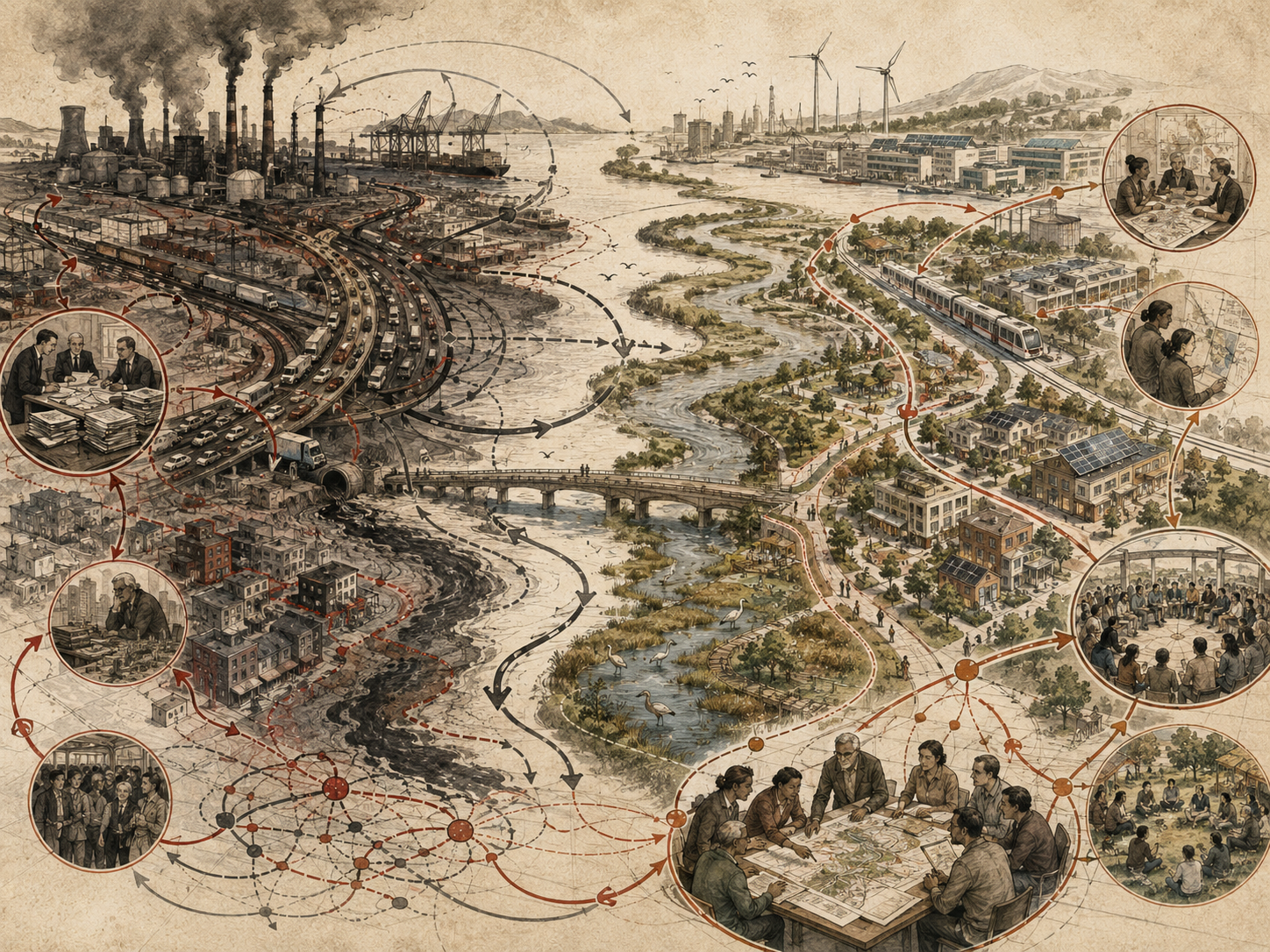
This article examines policy resistance as a central problem in systems thinking. It explains why systems push back against interventions, how compensating feedback and adaptive behavior undermine well-intended reforms, why pressure differs from redesign, and how structural change requires attention to reference modes, implementation capacity, administrative burden, incentives, information, authority, trust, power, path dependence, uncertainty, and system goals. It also examines the ethical stakes of policy resistance: whose behavior is treated as resistance, whose knowledge is ignored, who carries implementation work, who bears displaced harm, and how responsible redesign can build learning, participation, contestability, and repair into the intervention itself.
Policy resistance is best understood as an endogenous response rather than an external surprise. The intervention changes incentives, expectations, workload, prices, information, authority, or risk; actors and institutions then adapt to those changed conditions. The policy becomes part of the causal structure it is trying to change. This is why a technically plausible intervention can produce weak, delayed, unequal, or opposite results even when it is implemented with considerable effort.
Contemporary systems-oriented policy guidance reinforces this conclusion. Effective intervention requires more than a correct diagnosis at one moment. It requires institutions capable of anticipating plausible futures, testing mechanisms, observing system response, learning from implementation, protecting participation and remedy, and revising policy before compensating feedback becomes entrenched. Structural redesign therefore joins systems mapping with implementation capacity, administrative-burden analysis, anticipatory governance, evaluation, and accountable adaptation.
Why Policy Resistance Matters
Policy resistance matters because many serious problems persist despite repeated intervention. A city expands roads, yet congestion returns. A school raises accountability pressure, yet learning gaps persist. A public agency tightens rules, yet burden, appeals, and distrust grow. A workplace increases productivity targets, yet burnout, turnover, and rework rise. A platform changes content rules, yet harmful behavior adapts. A climate policy creates incentives, yet emissions shift across sectors or borders. The system absorbs the intervention and continues producing the old pattern.
This pattern can be frustrating because it makes reform feel irrationally difficult. But from a systems perspective, resistance is often information. It reveals the feedback loops, incentives, constraints, mental models, and power structures that keep the system stable. A policy may fail because it acts on the wrong variable, at the wrong level, with the wrong timing, against the wrong feedback loop, or without the trust and capacity required for implementation.
Policy resistance also matters because failed interventions can cause harm. When a system resists, institutions often respond by applying more pressure. More targets. More enforcement. More communication. More urgency. More technology. More surveillance. More compliance demands. But if the intervention is structurally misaligned, more pressure can intensify the very problem it was meant to solve. Backlog becomes burnout. Accountability becomes fear. Safety becomes control. Efficiency becomes burden shifting. Reform becomes legitimacy loss.
| Intervention goal | Common resistance pattern | Structural question |
|---|---|---|
| Reduce congestion | Road expansion induces more driving and land-use dependence. | Is the mobility system designed around access or vehicle throughput? |
| Improve service speed | Processing pressure increases errors, appeals, and rework. | Are rules, staffing, technology, and burden producing the delay? |
| Raise performance | Metrics are gamed or work narrows toward measured targets. | Do incentives reward real outcomes or proxy compliance? |
| Increase public trust | Messaging fails because institutional behavior remains unchanged. | What repair, accountability, and reliability are needed? |
| Reduce risk | Strict controls create avoidance, concealment, or burden shifting. | Does the system make safe behavior easier or merely punish deviation? |
| Scale technology | Automation shifts error correction and contestation burden to users. | Are governance, appeal, oversight, and accountability designed into the system? |
The point of studying policy resistance is not to become pessimistic about intervention. It is to become more serious about design. Systems can change. But they rarely change just because someone pushes harder on a symptom. They change when the structure that generates the pattern is redesigned.
What Policy Resistance Means
Policy resistance is the tendency of a system to respond to intervention in ways that offset, dilute, delay, or reverse the intended effect. The term “policy” should be understood broadly. It includes laws, regulations, incentives, organizational rules, performance targets, technology deployments, management decisions, public programs, platform policies, design changes, and informal institutional interventions.
Resistance does not always mean open opposition. A system can resist silently through feedback. A new rule may change behavior in unexpected ways. A target may produce gaming. A subsidy may increase demand and raise prices. A road may create more traffic. A verification rule may reduce access and increase appeals. A performance metric may encourage narrow compliance instead of meaningful improvement. A technology may increase throughput while reducing accountability. The policy appears to move the system, but the system adapts.
\text{Intervention} \rightarrow \text{Intended Effect}
\]
\[
\text{Intervention} \rightarrow \text{System Response} \rightarrow \text{Offsetting Effect}
\]
Interpretation: Policy resistance occurs when a system response creates an offsetting effect that weakens or reverses the intended intervention.
Policy resistance usually involves one or more of the following structures:
- compensating feedback loops that counteract the intervention;
- adaptive actors who change behavior in response to new rules;
- delays that hide consequences until after the policy is judged;
- incentives that reward gaming or superficial compliance;
- capacity constraints that prevent implementation;
- trust deficits that reduce cooperation;
- boundary errors that shift costs outside the official frame;
- power structures that preserve the old operating goal;
- mental models that define the problem too narrowly;
- goals that conflict with the stated purpose of reform.
Policy resistance is often strongest when an intervention targets behavior while leaving structure untouched. People respond to the system they face. If the system’s incentives, constraints, information, authority, and risks remain the same, people often adapt in ways that preserve the old pattern. This is not necessarily irrational. It may be the predictable behavior of actors trying to survive inside unchanged structure.
The practical lesson is that intervention design must include the system’s likely response. A policy is not simply an input. It becomes part of a feedback system.
Policy Resistance as an Endogenous System Response
Policy resistance is often narrated as if a sound intervention encountered an external obstacle: insufficient compliance, weak communication, poor execution, political opposition, or bad luck. Systems thinking asks a more difficult question. Did the intervention itself activate the response that weakened it? If a rule changes incentives, a target changes attention, a subsidy changes prices, an automation changes discretion, or an enforcement campaign changes avoidance behavior, the resulting pushback is not external to the policy. It is part of the policy’s total effect.
This endogenous view changes diagnosis. A policy is not evaluated only by its direct mechanism. It is evaluated as an event inside a living system of feedback, adaptation, accumulation, delay, power, and learning. The intervention may alter the very variables used to judge it. A performance target can change reporting. A benefit rule can change take-up. A road project can change land use. A risk model can change which cases enter the data used to retrain it. A climate incentive can change technology, trade, consumption, and political coalitions. The policy enters the system and the system reorganizes around it.
| Observed result | Narrow interpretation | Endogenous systems interpretation |
|---|---|---|
| Participation remains low. | People do not understand or value the program. | Eligibility burden, distrust, access constraints, stigma, or unstable service may be suppressing participation. |
| A performance metric improves while outcomes stagnate. | The reform is partly successful. | Actors may be reallocating effort toward the measured proxy while unmeasured quality deteriorates. |
| Demand rises after capacity expansion. | The system needs still more capacity. | Lower friction may induce demand, change location choices, or expose previously unmet need. |
| Enforcement produces concealment or avoidance. | More enforcement is required. | The intervention may be strengthening an avoidance loop or shifting activity beyond the measured boundary. |
| Automation reduces processing time but increases appeals. | The model needs incremental tuning. | Speed gains may be transferring error detection, explanation, and correction work to users and frontline staff. |
Not every setback is policy resistance. Some interventions are simply underfunded, poorly administered, legally blocked, or based on false factual assumptions. The analytical task is to distinguish these explanations. Policy resistance is especially likely when the intervention produces a patterned response that offsets its intended effect, recurs across implementation cycles, or moves the problem to another population, place, time, metric, or institution.
The practical consequence is that policy design must include a theory of system response. It is not enough to specify what the intervention does to the system. The analysis must also specify what the system is likely to do in response to the intervention.
Reference Modes, Dynamic Hypotheses, and Competing Explanations
A strong policy-resistance diagnosis begins with a reference mode: a description of how the problem has behaved over time and how it might behave under plausible futures. A reference mode is more useful than a single before-and-after statistic because resistance often appears through delay, rebound, oscillation, erosion, overshoot, burden shifting, or temporary improvement followed by relapse.
The reference mode should identify the outcome pattern, the time horizon, the relevant groups, and the comparison trajectory. Is backlog rising steadily, cycling with staffing pressure, or falling briefly after emergency overtime before returning? Are emissions falling locally while imported emissions rise? Is a service becoming faster for routine cases while complex cases wait longer? Are aggregate outcomes improving while disparities widen? These distinctions point toward different structures.
A dynamic hypothesis explains how feedback loops, stocks, flows, delays, rules, incentives, and actor decisions could generate the observed pattern. It is a provisional explanation, not a claim of certainty. Several hypotheses should be considered where evidence is incomplete. A recurring service backlog, for example, might be produced by inadequate staffing, growing demand, excessive verification, poor case routing, rework after errors, employee turnover, or a combination of these mechanisms.
Competing hypotheses protect the analysis from becoming a decorative causal map. Each hypothesis should imply observable evidence. A capacity hypothesis predicts workload, vacancy, and queue patterns. A burden hypothesis predicts abandonment, incomplete applications, help-seeking, and unequal take-up. A gaming hypothesis predicts divergence between measured performance and independent quality indicators. A trust hypothesis predicts avoidance, complaint, noncooperation, and reliance on informal channels. The purpose of modeling is to make these implications testable.
Counterfactual thinking also matters. The relevant question is not only whether the outcome improved after the intervention, but what would probably have happened without it and what other changes occurred at the same time. In complex systems, one method rarely resolves attribution. Time-series evidence, process tracing, qualitative accounts, comparative cases, administrative data, simulation, and experimental or quasi-experimental evidence can be combined to strengthen or reject a dynamic hypothesis.
A reference mode and a dynamic hypothesis turn policy resistance from a vague story about unintended consequences into a disciplined inquiry about behavior over time, causal structure, and evidence.
Pressure versus Structural Redesign
Pressure and structural redesign are different forms of intervention. Pressure tries to make the system perform differently by increasing force on a target variable: more effort, more enforcement, more urgency, more funding, more messaging, more targets, more monitoring, more discipline, more output. Structural redesign changes the relationships that produce behavior: feedback loops, incentives, rules, information flows, authority, capacity, goals, boundaries, and mental models.
Pressure can work when the system has unused capacity and the desired behavior is already structurally supported. If a team has clear priorities, adequate staff, and good tools, a temporary push may help meet a deadline. If an agency has simple rules and enough capacity, added funding may improve performance. If people lack information but trust the source, communication may help. But pressure fails when the system lacks the capacity, trust, incentives, or structure required to respond as intended.
Structural redesign asks why the current behavior is reasonable inside the current system. If workers are burning out, redesign asks about workload, staffing, priorities, delay, rework, incentives, recovery, and authority. If applicants struggle with public services, redesign asks about administrative burden, rule complexity, language access, digital exclusion, appeals, and trust. If climate policy fails, redesign asks about energy systems, infrastructure lock-in, incentives, political economy, cumulative emissions, and transition capacity.
| Pressure-based intervention | Structural redesign intervention |
|---|---|
| Push harder on performance targets. | Change the feedback, capacity, incentives, and learning conditions that produce performance. |
| Increase communication to overcome distrust. | Repair institutional behavior, reduce burden, and create accountable feedback from affected people. |
| Add enforcement to increase compliance. | Redesign rules so legitimate compliance is easier, fairer, and more meaningful. |
| Add technology to process more volume. | Simplify the process, govern automation, protect appeal rights, and reduce unnecessary demand. |
| Increase urgency during recurring crisis. | Reduce crisis generation by investing in prevention, buffers, and system capacity. |
| Reward the visible metric. | Measure the system outcome, side effects, distribution, and long-term capacity. |
Pressure often feels more practical because it is immediate. Redesign can feel slower because it requires diagnosis, participation, investment, and institutional change. But repeated pressure without redesign creates exhaustion, gaming, distrust, and policy resistance. It treats resistance as a lack of will rather than as information about structure.
Structural redesign begins when the system stops asking, “How do we make people comply with the intervention?” and starts asking, “What system makes the desired behavior difficult, risky, irrational, invisible, or unrewarded?”
Compensating Feedback and System Pushback
Compensating feedback is one of the main causes of policy resistance. An intervention changes one part of the system, and another part responds in a way that offsets the change. The policy pushes; the system pushes back. This pushback may come from behavior, incentives, prices, workload, trust, capacity, demand, ecology, institutions, or political response.
Road expansion is a classic example. Adding lanes may temporarily reduce congestion. But shorter travel times can encourage more driving, longer commutes, more car-dependent development, and reduced pressure for transit or land-use change. Demand grows until congestion returns. The system has compensated. The intervention changed capacity, but it did not change the mobility structure that generates traffic.
Performance metrics also create compensating feedback. If an organization rewards speed, workers may process faster but make more errors. Errors create rework. Rework creates backlog. Backlog creates more pressure for speed. The policy improves the metric temporarily while worsening the structure that produces the problem. The system compensates through quality loss and rework.
Y_{t+1} = Y_t + I_t – C_t
\]
Interpretation: The desired outcome \(Y\) changes through intervention effect \(I_t\), but compensating feedback \(C_t\) offsets some or all of the gain.
Compensating feedback may appear as:
- induced demand after capacity expansion;
- gaming after metrics are introduced;
- avoidance after enforcement increases;
- appeals and rework after rules tighten;
- price increases after subsidies expand demand;
- burnout after productivity pressure rises;
- distrust after messaging substitutes for repair;
- emissions leakage when climate policy shifts production elsewhere;
- risk compensation when safety improvements encourage riskier behavior.
Compensating feedback is not proof that intervention is futile. It is evidence that policy design must include the system’s likely response. The question is not only “What effect will this policy have?” but “What behavior will this policy induce, what feedback will it activate, and what structure will remain unchanged?”
Structural redesign weakens policy resistance by changing the compensating loop itself. It does not merely push harder against feedback. It redesigns the feedback so the system no longer has the same reason or ability to recreate the old pattern.
Adaptive Actors and Behavioral Response
Systems resist policy because people and institutions adapt. A policy changes the environment, and actors respond based on incentives, constraints, beliefs, risks, goals, and available options. If policy assumes passive behavior, it will often fail. People are not mechanical parts. Organizations are not inert containers. Markets, agencies, platforms, schools, households, and communities interpret and respond to intervention.
Adaptive behavior can be constructive. People may learn, cooperate, innovate, and improve when conditions support them. But adaptation can also undermine policy if rules create perverse incentives, mistrust, burden, or fear. A school under narrow accountability pressure may teach to the test. A firm facing regulation may shift costs elsewhere. A public agency under speed targets may prioritize easy cases. A platform facing content rules may see harmful actors change language, tactics, or networks. A household facing benefit cliffs may adjust work hours to avoid losing support.
Policy resistance often emerges because the intervention changes one actor’s incentives while ignoring the whole behavior field. If actors are rewarded for meeting a metric, they may optimize the metric. If they are punished for reporting problems, they may hide problems. If they lack capacity to comply, they may avoid the system. If they distrust the institution, they may resist even beneficial guidance.
B_{i,t+1} = f(R_t, I_t, C_{i,t}, M_{i,t})
\]
Interpretation: Actor \(i\)’s behavior \(B\) changes in response to rules \(R_t\), incentives \(I_t\), constraints \(C_{i,t}\), and mental models \(M_{i,t}\).
Designing for adaptive actors means asking:
- How will people interpret this intervention?
- What behavior will the intervention make easier?
- What behavior will it make harder?
- What incentives will it create?
- What burdens will it add?
- What avoidance or gaming might appear?
- Who has capacity to comply?
- Who will be harmed by compliance costs?
- How will powerful actors adapt differently from less powerful actors?
Adaptive behavior should not be treated only as a problem. It is also a resource. Structural redesign can invite constructive adaptation by aligning incentives with real outcomes, reducing unnecessary burden, increasing trust, providing feedback, and giving people authority to solve problems rather than merely comply with rules.
A system resists badly designed policy because actors adapt to survive. A better-designed system helps actors adapt toward the public purpose.
Delays, Timing, and Misread Effects
Delays are central to policy resistance. A policy may appear ineffective before its benefits have time to emerge. Or it may appear successful before its harms become visible. Timing errors cause systems to abandon useful interventions too early, repeat harmful interventions too long, or misinterpret short-term indicators as long-term outcomes.
For example, prevention policies often have delayed benefits. Early childhood health, climate mitigation, infrastructure maintenance, workforce development, trust repair, and education investments may take years to show full effects. If evaluation windows are too short, the system may judge them ineffective and return to symptomatic fixes. In contrast, quick fixes may show immediate benefit while producing delayed harm. Overtime reduces backlog now but increases burnout later. Deferred maintenance saves money now but raises failure risk later. Communication campaigns reduce criticism now but deepen distrust if behavior does not change.
Y_t = f(I_{t-d})
\]
Interpretation: Current outcomes \(Y_t\) may depend on interventions made earlier \(I_{t-d}\). Delay \(d\) makes it easy to misread policy effects.
Delays create several policy-resistance risks:
- useful structural reforms are abandoned before benefits accumulate;
- harmful quick fixes are judged successful before side effects appear;
- overcorrection occurs because feedback arrives late;
- oscillation emerges when policies are reversed too frequently;
- political cycles reward short-term relief over long-term repair;
- institutions fail to connect present outcomes to past interventions;
- affected communities experience harm before official indicators confirm it.
Structural redesign requires matching evaluation to system time. Preventive policies need leading indicators and patience. Quick fixes need monitoring for delayed consequences. Complex reforms need feedback loops that can adapt without abandoning the deeper purpose. Systems with long delays need governance that protects long-term investments from short-term pressure.
The timing question is therefore not only “Did the policy work?” but “When would we expect the policy to work, what early signs should we monitor, and what delayed consequences might appear?”
Incentives, Metrics, and Gaming
Policy resistance often appears through metrics and incentives. A system defines a target, rewards achievement, and expects behavior to improve. But when the metric is only a proxy for the real goal, actors may optimize the metric rather than the outcome. The system then gets the appearance of improvement without the substance of improvement.
Metrics are necessary. Systems need feedback. But metrics become dangerous when they are too narrow, too punitive, too disconnected from lived outcomes, or too strongly tied to rewards and punishments. People respond to what is measured, especially when their resources, status, funding, security, or reputation depend on it.
Examples are widespread. Schools under test-score pressure may narrow curriculum. Hospitals may avoid high-risk patients if metrics punish poor outcomes without adjusting for complexity. Public agencies may process easy cases first to improve speed metrics. Police departments may respond to crime metrics in ways that increase enforcement without improving safety. Platforms may optimize engagement while degrading information quality. Workplaces may reward productivity while hiding burnout and rework.
\text{Measured Performance} \neq \text{System Outcome}
\]
Interpretation: A metric may approximate the desired outcome, but it can diverge from the real system purpose when incentives encourage optimization of the measure itself.
Gaming is not always cynical. Sometimes people game metrics because the metric is unreasonable, incomplete, or misaligned with their real work. A frontline worker may prioritize measured tasks because unmeasured care is invisible. A teacher may teach to the test because the system punishes broader learning. A manager may avoid difficult cases because the metric punishes complexity. In these cases, gaming is a system response to poor measurement design.
Better measurement systems should include:
- multiple indicators rather than one narrow target;
- leading and lagging indicators;
- quality, burden, equity, and capacity measures;
- feedback from affected people;
- context-adjusted interpretation;
- monitoring for gaming and unintended consequences;
- learning-oriented review rather than only punitive accountability;
- alignment between metrics and the actual system goal.
Metrics should help the system learn. When they become tools of pressure without learning, they often generate resistance.
Implementation Capacity, Administrative Burden, and Frontline Feedback
Many interventions fail not because the stated policy goal is wrong, but because the implementation system cannot carry the policy as designed. Capacity includes staffing, skills, time, information, technology, authority, coordination, procurement, legal clarity, supervision, recovery, and the ability to learn. When those conditions are weak, additional policy pressure can increase delay, error, turnover, informal workarounds, and distrust.
Implementation capacity is not located only inside the responsible agency. A policy may depend on local governments, schools, clinics, contractors, employers, community organizations, digital vendors, courts, or households. Each intermediary translates the policy through its own incentives and constraints. A formal rule can therefore become several different practical policies depending on where and by whom it is implemented.
Administrative burden provides an especially important lens. People may face learning costs when they must discover and understand a program; compliance costs when they must complete forms, provide evidence, travel, wait, or repeatedly verify eligibility; psychological costs through stigma, fear, uncertainty, or loss of autonomy; and contestation costs when an error must be explained, appealed, or corrected. Frontline workers and service providers can also carry burden through duplicative reporting, fragmented systems, unclear rules, and unfunded administrative work. Provider burden often becomes user burden through slower, less responsive, or lower-quality service.
| Capacity or burden failure | Likely system response | Structural redesign direction |
|---|---|---|
| Insufficient staffing and high case complexity | Queues, triage toward easy cases, error, overtime, burnout, and turnover | Workload-based staffing, complexity-sensitive routing, recovery time, and demand reduction |
| Fragmented data and incompatible systems | Repeated verification, manual reconciliation, inconsistent decisions, and correction work | Interoperability with data minimization, clear ownership, auditability, and assisted alternatives |
| Complex eligibility or compliance rules | Abandonment, exclusion, informal workarounds, appeals, and unequal take-up | Rule simplification, presumptive eligibility, plain language, and burden measurement |
| Digital-only access | Exclusion, proxy use, repeated failure, and transfer of work to family or community intermediaries | Accessible multichannel service, human assistance, and monitoring of completion and correction burden |
| Punitive performance management | Gaming, silence, risk avoidance, under-reporting, and loss of learning | Balanced metrics, safe reporting, quality review, and learning-oriented accountability |
Digitalization does not automatically reduce burden. It can remove travel and waiting while introducing authentication failures, inaccessible interfaces, opaque decisions, data errors, or new forms of surveillance. Automation may also embed discretionary judgments inside technical architecture while making them harder to see or contest. The relevant measure is not whether a process became digital, but whether total burden, error, inequality, and correction work declined.
Frontline workers and affected people are therefore essential sensors. Their workarounds, complaints, delays, and repeated requests for clarification reveal where formal policy diverges from implementation reality. A learning system treats that evidence as operational intelligence rather than as noise or resistance to change.
Trust, Legitimacy, and Institutional Behavior
Trust and legitimacy are often hidden variables in policy resistance. A policy that looks technically sound may fail if the institution implementing it is not trusted. People do not respond only to policy content. They respond to institutional history, credibility, perceived fairness, prior harm, procedural burden, and whether they believe the system will treat them with dignity.
When trust is low, more communication may not solve the problem. Messaging can even worsen resistance if people experience it as persuasion without repair. A public agency that has delayed, denied, confused, or burdened people cannot rebuild trust through slogans. A workplace that has normalized burnout cannot rebuild trust through wellness messaging alone. A platform that has rewarded harmful engagement cannot rebuild trust through policy announcements alone. Trust is rebuilt through behavior.
\text{Policy Cooperation} = f(\text{Trust}, \text{Legitimacy}, \text{Capacity}, \text{Burden}, \text{Perceived Fairness})
\]
Interpretation: Cooperation depends not only on policy design, but on trust, legitimacy, capacity to comply, burden, and perceived fairness.
Legitimacy is especially important in public systems. A rule may be legal but still experienced as illegitimate if it is arbitrary, inaccessible, discriminatory, burdensome, opaque, or disconnected from lived reality. People may resist not because they misunderstand the policy, but because the policy imposes costs without voice, repair, or fairness.
Trust-related policy resistance often appears through:
- low participation;
- avoidance of services;
- appeals and complaints;
- noncooperation;
- rumor and informal workarounds;
- frontline conflict;
- public backlash;
- employee silence or disengagement;
- formal compliance without real commitment.
Structural redesign for trust requires behavior change, not only communication. It may require burden reduction, transparent rules, appeal rights, reliable service, community participation, repair for past harm, frontline authority, and accountability for institutional failure. Trust is a stock. It is built by repeated experience and depleted by repeated harm.
Policies resist implementation when institutions spend trust they have not earned.
Power, Boundaries, and Whose Resistance Counts
Policy resistance is not politically neutral. The phrase can be used to describe systems that push back against interventions, but it can also be used to blame people who are being harmed by a policy. Systems thinking must ask whose behavior is called resistance and whose power is treated as normal structure.
When marginalized communities resist a policy that increases burden, surveillance, displacement, or exposure, that resistance may be legitimate feedback. When workers resist productivity pressure because it produces burnout, that resistance may reveal capacity limits. When applicants struggle with administrative rules, the problem may be burden design rather than noncompliance. When residents distrust institutions, the problem may be accumulated institutional behavior rather than communication failure.
Powerful actors also resist policy, but their resistance may be less visible as resistance. Firms lobby against regulation. Institutions delay accountability. Agencies preserve procedures that protect their authority. Platforms adjust behavior to protect revenue. Wealthy communities resist shared responsibility. Professional groups defend status. These forms of resistance may be framed as practical concern, efficiency, expertise, legal caution, or market realism.
| Form of resistance | Possible interpretation | Systems question |
|---|---|---|
| Community opposition | Feedback about harm, exclusion, distrust, or burden. | Was the policy designed with affected people or imposed on them? |
| Worker disengagement | Capacity limit, burnout, lack of authority, or distrust. | Does the system support the behavior it demands? |
| Applicant noncompletion | Administrative burden or inaccessible design. | Is the process measuring need or the ability to navigate bureaucracy? |
| Corporate lobbying | Protection of profit, market position, or externalized costs. | Who benefits if the current structure remains unchanged? |
| Institutional delay | Risk avoidance, self-protection, or capacity constraint. | Does delay protect learning or protect the old system? |
Boundary choices also shape policy resistance. If the policy boundary excludes the people who carry the burden, resistance may appear irrational. If it excludes ecological effects, economic consequences may look positive. If it excludes frontline labor, administrative reform may look efficient. If it excludes future costs, short-term savings may look successful.
Responsible systems thinking does not treat all resistance as obstruction. It asks what the resistance knows. Some resistance is self-protection by powerful actors. Some resistance is feedback from people who understand the system’s hidden costs. Structural redesign must be able to tell the difference.
Policy Feedback, Path Dependence, and Institutional Lock-In
Policies do not only respond to existing systems. They reshape future politics and institutional capacity. A policy can create beneficiaries, administrative routines, professional identities, data systems, contracts, infrastructures, legal precedents, expectations, and revenue streams that later defend or constrain the policy. These policy-feedback effects help explain why temporary interventions can become durable and why unsuccessful arrangements may persist long after their original rationale has weakened.
Path dependence occurs when early choices alter the cost and feasibility of later choices. A transport system organized around roads changes settlement, investment, household behavior, and political expectations. A benefits system built around repeated verification creates vendors, staffing models, fraud metrics, and legal categories that make simplification institutionally difficult. A digital platform that optimizes engagement accumulates data, advertisers, creator practices, and internal performance systems that resist a shift toward information quality.
Lock-in may be material, organizational, cognitive, or political. Material lock-in is embedded in infrastructure and capital assets. Organizational lock-in appears through routines, budgets, and specialized roles. Cognitive lock-in appears when a metric or model becomes the accepted definition of the problem. Political lock-in emerges when powerful actors benefit from the arrangement or when the costs of transition are concentrated and visible while the benefits are diffuse and delayed.
Structural redesign must therefore include transition design. It may require compensation for affected groups, retraining, bridge funding, staged retirement of old systems, modular replacement, legal reform, contract renegotiation, data migration, and protection against service interruption. An intervention that identifies the desirable end state but ignores the transition path can trigger resistance even when the long-term direction is sound.
Review clauses, sunset provisions, pilot stages, reversible commitments, open standards, and explicit decommissioning plans can reduce lock-in. But flexibility should not become endless postponement. The purpose is to preserve learning and correction while maintaining direction. A durable reform creates institutions capable of adapting without continually reproducing the structure it was meant to replace.
Rebound, Leakage, Displacement, and Burden Shifting
Policy resistance frequently appears outside the official boundary of evaluation. A policy improves the measured outcome in one place while increasing cost, risk, demand, or harm elsewhere. Rebound occurs when an efficiency gain lowers cost or friction and encourages more use. Leakage occurs when activity moves to another jurisdiction, sector, organization, or supply chain. Displacement occurs when a problem is relocated rather than reduced. Burden shifting occurs when institutions improve their own performance by transferring work, uncertainty, or risk to workers, users, households, communities, ecosystems, or future budgets.
| Pattern | Illustration | Boundary needed for evaluation |
|---|---|---|
| Rebound | Energy efficiency lowers operating costs and total use rises. | Total consumption, not efficiency per unit alone |
| Spatial leakage | Production or emissions move to a less regulated jurisdiction. | Supply-chain and consumption-based effects |
| Sectoral displacement | Risk is reduced in one service but grows in an adjacent system. | Connected services and substitution behavior |
| Temporal displacement | Maintenance is deferred, improving the current budget while increasing future failure risk. | Lifecycle cost and long-term reliability |
| Administrative burden shifting | An automated service reduces agency handling time but increases user correction and appeal work. | Total work across agency, user, advocate, and reviewer |
| Distributional displacement | An average improves because difficult cases are excluded or underserved. | Group-level access, quality, and unmet need |
These patterns are not secondary side effects. They determine whether the policy produced real improvement. A hospital can shorten reported wait times by redirecting patients. A platform can reduce visible harmful content while harmful communities migrate or adapt their language. A city can reduce central congestion while increasing travel distances and housing pressure. A firm can improve direct emissions while purchasing more carbon-intensive inputs.
Boundary critique should be built into policy design. Analysts should ask where the problem could move, who could absorb new work, what behavior could substitute for the targeted behavior, and which costs are excluded from the official metric. Distributional and lifecycle analysis are especially important because resistance often exploits the parts of the system that remain invisible.
A structurally successful intervention reduces the problem across the relevant system rather than merely improving the institution’s local score.
Principles of Structural Redesign
Structural redesign changes the system conditions that produce resistance. It does not merely intensify pressure on the old structure. It asks what feedback, incentives, capacity, information, authority, rules, boundaries, and goals must change so that the desired outcome becomes easier, more legitimate, more sustainable, and less harmful.
Structural redesign begins with humility. If the system resists, the intervention may have misunderstood the system. This does not mean giving up. It means learning. A better intervention may need to change the rule, expand the boundary, reduce burden, increase capacity, protect trust, alter incentives, redesign metrics, change timing, or shift the system goal.
Several principles guide structural redesign:
- change the feedback loop, not only the output;
- align incentives with real outcomes, not proxy metrics;
- increase capacity before demanding performance;
- reduce administrative and cognitive burden where possible;
- include affected people in problem definition and redesign;
- build trust through behavior, not only messaging;
- measure side effects, distribution, and delayed consequences;
- protect long-term repair from short-term pressure;
- design for adaptive actors, not passive compliance;
- change the system goal when the old goal produces harm.
| Resistance source | Pressure response | Structural redesign response |
|---|---|---|
| Capacity constraint | Demand more output. | Build staffing, tools, training, recovery, and process capacity. |
| Metric gaming | Add penalties. | Redesign metrics to include quality, context, burden, and outcomes. |
| Low trust | Increase communication. | Repair harm, reduce burden, improve reliability, and share authority. |
| Adaptive avoidance | Increase enforcement. | Make legitimate participation easier and more beneficial. |
| Delayed harm | Judge policy by short-term results. | Use leading indicators and monitor long-term consequences. |
| Boundary error | Optimize inside the narrow frame. | Include shifted costs, affected people, ecology, and future impacts. |
Structural redesign does not mean everything must change at once. It means the intervention is aimed at the structure that generates the pattern. Sometimes a small change in information flow, authority, timing, or rule design can create large effects. Sometimes deep redesign is required because the system’s goal itself is wrong.
The test of redesign is whether the old pattern becomes less likely to reproduce itself.
Intervention Portfolios, Sequencing, and Adaptive Pathways
Complex policy resistance is rarely overcome by a single lever. A stronger strategy uses an intervention portfolio: a coordinated set of actions addressing demand, capacity, incentives, rules, information, protection, participation, and transition. The purpose is not to produce an indiscriminate list of programs. It is to combine interventions that weaken the main resistance loops while reinforcing one another.
Sequencing matters because the same action can have different effects depending on when it occurs. Tightening standards before building implementation capacity may produce noncompliance and distrust. Introducing a new digital system before simplifying rules may automate complexity. Removing an old subsidy before viable alternatives exist may intensify hardship and political resistance. Conversely, early burden reduction, bridge support, and visible reliability can create the trust and capacity needed for deeper structural change.
A practical sequence often includes five overlapping moves:
- Stop immediate harm. Use emergency protection, enforcement, or temporary support where delay would cause serious injury, exclusion, or ecological damage.
- Stabilize capacity. Address staffing, finance, data, skills, legal authority, maintenance, and recovery so the system can carry reform.
- Reduce avoidable burden. Simplify rules, remove duplicated work, protect access, and make correction possible.
- Change the behavior-generating structure. Redesign incentives, information flows, authority, infrastructure, and system goals.
- Institutionalize learning. Establish monitoring, participation, evaluation, revision triggers, and accountable ownership.
Adaptive pathways make the sequence conditional. Instead of pretending that one forecast is certain, the policy specifies a direction, near-term actions, monitoring indicators, and trigger points for escalation, revision, or exit. A climate adaptation plan might invest immediately in no-regret measures while defining thresholds for larger infrastructure decisions. A service reform might pilot simplified rules, monitor error and burden, and scale only when quality safeguards are met.
Portfolio design should distinguish reversible from irreversible decisions. Reversible experiments can be used to learn quickly. Irreversible infrastructure, legal, or data-system choices require stronger evidence, broader participation, and stress testing. The portfolio should also identify dependencies: which actions must precede others, which institutions own them, and what resources or political agreements are required.
The goal is coherent movement rather than perfect prediction. A good pathway preserves the ability to learn while steadily reducing the structures that reproduce the problem.
Participation, Voice, Contestability, and Learning Governance
Structural redesign cannot be treated as a purely technical exercise. People who live with a system, implement its rules, repair its failures, or bear its externalities often possess knowledge that is absent from administrative data and formal models. Participation helps reveal hidden work, informal rules, mistrust, exclusion, and plausible actor responses before they become policy resistance.
Participation is most useful when it influences problem definition, boundary choice, model assumptions, intervention design, and evaluation. Consultation after the main decisions have been made may collect reactions without changing the structure. Participatory mapping, facilitated system dynamics, worker inquiry, community research, service co-design, deliberative forums, and structured dissent can bring multiple causal perspectives into the analysis.
Voice also requires contestability. People affected by a policy need understandable decisions, accessible complaint and appeal channels, protection from retaliation, and the ability to correct data or challenge automated judgments. Contestability is not only an individual right. It is a feedback mechanism that helps institutions detect recurring error, unequal burden, and model failure.
Learning governance assigns responsibility for receiving and acting on that feedback. A policy should specify:
- who owns the overall system outcome rather than only the program output;
- who monitors leading, lagging, distributional, and burden indicators;
- how frontline and community evidence enters review;
- which assumptions and model limitations are documented;
- what thresholds trigger investigation, pause, repair, or redesign;
- who has authority to change rules, contracts, budgets, or technology;
- how affected people are informed about changes and remedies;
- how independent oversight and public accountability are maintained.
Participation does not eliminate conflict. Different groups may have incompatible interests, unequal power, or competing visions of the system goal. Responsible governance makes those differences visible rather than hiding them behind a single technical optimum. It protects minority evidence, documents dissent, and distinguishes legitimate public purpose from the preferences of the most powerful participants.
A learning system is not one that changes direction whenever criticism appears. It is one that has a disciplined process for testing evidence, repairing harm, revising mechanisms, and preserving long-term purpose under changing conditions.
Ethics: Intervention, Burden, and Responsibility
Policy resistance has ethical stakes because failed interventions often increase burden on people who were already exposed to system failure. When institutions respond to resistance with pressure, the costs can fall on frontline workers, applicants, patients, students, residents, low-income households, marginalized communities, ecosystems, or future generations. A policy that fails structurally can still punish people behaviorally.
For example, if a public benefits system becomes difficult to access, nonparticipation may be blamed on applicants. If a workplace burns people out, disengagement may be blamed on employee attitude. If a community distrusts a public agency, distrust may be blamed on misinformation. If a school struggles under concentrated poverty and underinvestment, performance pressure may be imposed on teachers and students. In each case, the system treats symptoms of structural failure as individual resistance.
Ethical policy design asks whether the intervention increases or reduces unjust burden. It asks whether people have the capacity to comply, whether the policy is legitimate, whether affected people participated in design, whether side effects are monitored, and whether the institution is willing to change its own behavior. Policy is not responsible merely because its goal is good. It must also be responsible in how it changes the system.
Ethical policy-resistance analysis asks:
- Who defines the problem?
- Who defines success?
- Who is expected to change behavior?
- Who must absorb implementation burden?
- Who benefits if the current structure remains unchanged?
- Who is blamed when the policy fails?
- What feedback from affected people is ignored?
- Does the policy repair harm or redistribute it?
- What safeguards protect people from unintended consequences?
- How will the institution change if resistance reveals design failure?
Responsible systems intervention requires accountability. If a policy creates harm, the answer should not be to insist that people comply harder. The answer should be to learn, redesign, repair, and change the structure that produced harm. Systems thinking should make institutions more accountable, not less.
The ethical measure of policy is not only whether it expresses good intent. It is whether it changes the system without shifting hidden costs onto those least able to carry them.
Artificial Intelligence, Automation, and Machine-Speed Policy Resistance
Artificial intelligence and automated decision systems can amplify policy resistance because they operate at scale, reshape behavior, and create feedback loops between decisions and future data. An automated system may increase speed or consistency while hardening narrow categories, hiding discretion inside technical architecture, and making error more difficult to contest. When the model’s outputs influence who receives attention, enforcement, opportunity, or support, they also influence the data later used to judge or retrain the system.
Several resistance patterns are especially important:
| Automated-system pattern | Policy-resistance mechanism | Required safeguard |
|---|---|---|
| Proxy optimization | The system improves a measurable target while degrading the underlying public outcome. | Outcome-based evaluation, independent quality measures, and monitoring for gaming |
| Selective labels and feedback data | Past decisions determine which outcomes become observable, reinforcing existing practice. | Data provenance, missing-outcome analysis, counterfactual testing, and external validation |
| Behavioral adaptation | Users, firms, or regulated actors learn how to avoid, manipulate, or overfit to the system. | Adversarial testing, anomaly review, rotating evidence, and mechanism-level monitoring |
| Automation bias | Staff defer to model outputs even when local evidence conflicts. | Meaningful human review, authority to override, training, and review of override patterns |
| Burden transfer | Institutional processing becomes faster while explanation, correction, or proof shifts to users. | Accessible notice, assisted correction, appeals, burden metrics, and service-level accountability |
| Model drift and context change | Performance erodes as behavior, population, policy, or environment changes. | Continuous monitoring, change detection, revalidation, rollback, and retirement criteria |
AI governance should therefore be treated as a continuous feedback process rather than a one-time approval. Governance must map the use context and affected groups, measure performance and harm, manage identified risks, and maintain organizational accountability across the lifecycle. Technical accuracy is necessary but insufficient. The evaluation must include access, distribution, burden, contestability, institutional dependency, security, privacy, environmental cost, and the possibility that the system changes the behavior it is measuring.
Structural redesign may also require refusing automation. If the underlying rule is incoherent, unjust, or excessively burdensome, automating it can scale policy failure. The first question should be whether the process should exist in its current form, not only whether it can be processed faster.
Responsible deployment includes clear purpose, documented boundaries, human accountability, audit logs, independent testing, appeal and repair, safe fallback procedures, procurement controls, monitoring for downstream effects, and credible retirement or rollback. Machine-speed intervention requires machine-speed observation, but it also requires human judgment, rights, and institutional capacity to act on what monitoring reveals.
Examples Across Systems
Policy resistance appears across social, ecological, institutional, technological, and economic systems. The examples below show how structural redesign changes the diagnosis.
Public health
A public-health campaign may aim to change behavior through information. If people lack access, trust, transportation, paid leave, language support, or affordable care, information alone will not produce the intended effect. The system may label low participation as resistance, but the deeper issue may be access and legitimacy. Structural redesign would include community partnership, service access, trust repair, practical support, and feedback from affected people.
Infrastructure
A transportation policy may expand road capacity to reduce congestion. Travel times may improve briefly, but induced demand and land-use change can recreate congestion. More pressure on road supply does not redesign the mobility system. Structural redesign might focus on land use, transit, pricing, walkability, housing location, remote work patterns, and access rather than vehicle throughput alone.
Organizations
An organization may respond to missed deadlines by increasing performance pressure. Workers respond by working longer hours, narrowing attention, hiding problems, or leaving. The apparent resistance may be a capacity signal. Structural redesign would examine workload, staffing, priorities, decision authority, rework, recovery time, incentives, and institutional learning.
Education
A school accountability policy may raise test pressure to improve learning. Schools may narrow curriculum, teach to the test, exclude difficult-to-serve students, or reduce broader developmental goals. The policy improves measured performance while weakening learning. Structural redesign would address teaching conditions, curriculum quality, student support, poverty, belonging, assessment design, and resource equity.
Artificial intelligence systems
An institution may deploy AI to improve efficiency. But users adapt, staff become dependent, errors become harder to contest, and accountability becomes diffuse. If the underlying process is burdensome or unjust, automation can scale the problem. Structural redesign would simplify rules, protect appeal rights, audit outcomes, clarify accountability, include affected users, and govern deployment as sociotechnical infrastructure.
Climate and ecology
A climate policy may reduce emissions in one sector while emissions rise elsewhere through leakage, rebound effects, or increased consumption. Efficiency gains may lower cost and increase total use. Structural redesign would address total throughput, infrastructure lock-in, energy systems, land use, justice, public investment, and long-term transition capacity rather than isolated incentives alone.
Economics
A housing subsidy may help households afford rent, but if housing supply, speculation, zoning, land markets, and tenant protections remain unchanged, landlords may capture some of the benefit through price increases. Structural redesign would include supply, affordability rules, public housing, tenant protection, land policy, and anti-displacement strategies.
Public administration
A public agency may tighten verification to reduce errors. The policy may reduce some improper payments but increase burden, delay, appeals, nonparticipation, and distrust. The system then experiences more workload and public frustration. Structural redesign would balance accountability with accessible design, simplified rules, clear appeals, language access, staff capacity, and burden measurement.
Across these examples, resistance is not simply failure to comply. It is the system revealing the structures that policy failed to change.
Worked Diagnostic: A Public-Benefits Backlog
Consider a public agency facing a growing benefits backlog. Leadership introduces stricter productivity targets and an automated triage tool intended to classify straightforward cases for rapid processing. Initial reports show more cases completed per worker. Several months later, appeals rise, complex cases wait longer, staff turnover increases, and community organizations report that applicants are abandoning claims or submitting the same evidence repeatedly.
A narrow explanation says that workers need more training, applicants need clearer instructions, and the model requires tuning. A systems diagnosis begins with the behavior-over-time pattern and traces the loops that could generate it.
| Diagnostic element | Observed or hypothesized pattern | Evidence to collect |
|---|---|---|
| Reference mode | Temporary throughput gain followed by rising appeals, rework, complex-case delay, and turnover | Queue length, case age, completion, reversal, appeal, staffing, absence, and turnover over time |
| Speed–error loop | Higher pressure narrows review, increasing error and later rework | Quality audits, correction time, repeat contacts, and error by workload level |
| Easy-case selection loop | Workers and the tool prioritize cases that improve visible throughput | Case complexity, wait time, completion, and denial by triage category |
| Verification-burden loop | Repeated proof requests increase abandonment and unequal access | Document requests, incomplete cases, assisted-service use, language, disability, and income |
| Turnover-capacity loop | Pressure and rework increase burnout, reducing experienced capacity and worsening backlog | Caseload, overtime, vacancy duration, tenure, training time, and exit interviews |
| Automation-contestation loop | Opaque classifications transfer explanation and correction work to applicants and advocates | Override, appeal, reversal, explanation requests, and time to correction |
A pressure-only response would raise targets, increase automated triage, or tighten applicant deadlines. Those actions may briefly improve the throughput metric while strengthening the same loops. A redesign portfolio would begin by stopping harmful denials and protecting appeal rights. It would simplify eligibility and evidence requirements, eliminate duplicate verification, separate complex-case capacity from routine processing, improve staffing and recovery, provide assisted access, and require the triage system to produce reviewable reasons.
Measurement would change as well. The agency would track total time to a correct decision rather than first-touch speed alone. It would measure repeat contacts, reversal, abandonment, burden, complex-case age, worker recovery, and group-level access. Frontline workers, applicants, advocates, and reviewers would participate in testing the causal map and reviewing evidence.
The redesign would be staged. Rule simplification and staffing stabilization would precede broader automation. A limited pilot would compare different routing and assistance models. Predefined thresholds for error, disparity, appeal, or burden would trigger pause and review. The agency would retain a functioning human fallback and publish a repair process for people harmed by incorrect decisions.
The worked example illustrates the core discipline of policy-resistance analysis: follow the intervention through the system, include the response it creates, and redesign the structure rather than demanding more performance from a structure that is producing failure.
Mathematics, Computation, and Modeling
Policy resistance can be modeled through feedback loops, delayed responses, adaptive behavior, stock-flow structures, incentive models, system dynamics simulations, scenario analysis, and sensitivity testing. The goal is not to predict every response perfectly. The goal is to make likely system responses visible before intervention is scaled.
A reference-mode gap can be represented as:
G_t = Y_t^{*} – Y_t
\]
Interpretation: The gap \(G_t\) compares the desired or counterfactual trajectory \(Y_t^{*}\) with the observed system outcome \(Y_t\). The shape of the gap over time helps distinguish temporary underperformance from rebound, delay, or structural failure.
The net policy effect should include offsetting and displaced effects:
N_t = D_t – C_t – L_t – B_t
\]
Interpretation: Net effect \(N_t\) equals the direct intended effect \(D_t\) minus compensating feedback \(C_t\), leakage or displacement \(L_t\), and burden or harm \(B_t\).
A robust portfolio can be evaluated across a set of plausible scenarios \(\mathcal{S}\):
V(p) = \min_{s \in \mathcal{S}} \left[\Delta Y(p,s) – \lambda B(p,s) – \mu H(p,s) +
ho K(p,s)
ight]
\]
Interpretation: Portfolio \(p\) is judged by its weakest performance across plausible scenarios, including outcome improvement, burden, harm, and capacity building. This favors robust intervention over optimization for one forecast.
A basic intervention model can be represented as:
Y_{t+1} = Y_t + I_t
\]
Interpretation: A simple model assumes the outcome \(Y\) improves directly through intervention \(I_t\). This view often misses system response.
A policy-resistance model includes compensating feedback:
Y_{t+1} = Y_t + I_t – C_t
\]
Interpretation: The intervention improves the outcome, but compensating feedback \(C_t\) offsets part or all of the intended effect.
Compensating feedback may depend on the intervention itself:
C_t = \alpha I_{t-d}
\]
Interpretation: The offsetting response can be a delayed function of the intervention, with \(\alpha\) representing the strength of system pushback and \(d\) representing delay.
Actor adaptation can be represented as:
B_{i,t+1} = f(R_t, M_t, K_{i,t}, T_{i,t})
\]
Interpretation: Actor behavior changes in response to rules \(R_t\), metrics \(M_t\), capacity \(K_{i,t}\), and trust \(T_{i,t}\).
A structural redesign model changes the governing system function:
F_{\text{pressure}}(x_t, u_t) \neq F_{\text{redesign}}(x_t, u_t)
\]
Interpretation: Pressure-based intervention acts within the old structure. Structural redesign changes the governing relationships that produce system behavior.
A burden-adjusted policy evaluation can be represented as:
J = \Delta Y – \lambda B – \mu H + \rho C
\]
Interpretation: Policy value \(J\) should include outcome improvement \(\Delta Y\), burden \(B\), harm \(H\), and capacity-building \(C\), rather than measuring the intended outcome alone.
| Modeling task | Policy-resistance question | Example output |
|---|---|---|
| Baseline simulation | What happens if the current structure continues? | Behavior-over-time trajectory. |
| Intervention simulation | What direct effect should the policy have? | Expected outcome improvement. |
| Compensating feedback test | What system response might offset the effect? | Offsetting-loop strength and delay. |
| Adaptive actor modeling | How might actors respond to incentives, rules, or metrics? | Gaming, avoidance, cooperation, or burden-shifting scenarios. |
| Delay analysis | Are effects being judged too early or too late? | Short-term and long-term policy trajectories. |
| Distributional analysis | Who receives benefit, burden, or harm? | Group-level outcome and burden comparison. |
| Structural redesign comparison | Does changing the structure reduce resistance? | Pressure-only versus redesign scenarios. |
Modeling policy resistance should include the system’s likely response, not only the policy’s intended effect. A model that assumes passive response may overestimate benefits and underestimate harm. A better model asks what feedback the policy activates, who adapts, what burden shifts, and whether structural redesign changes the behavior-generating conditions.
Evaluation, Uncertainty, and Causal Learning in Complex Systems
Evaluation should be designed with the intervention, not added after implementation. In a complex system, the intervention may adapt, the context may change, multiple programs may interact, outcomes may be delayed, and actors may alter behavior because they know how success is measured. These conditions do not make evaluation impossible. They require a broader evaluation design.
The first task is to specify the theory of change and the dynamic hypothesis. What mechanism should produce improvement? What compensating loops could weaken it? What groups or places could experience different effects? What leading indicators should change before the final outcome? What harms, burdens, or capacity losses would indicate that the intervention is producing resistance?
Experimental and quasi-experimental methods can be valuable where treatment is sufficiently defined, comparison is credible, and spillovers are manageable. They should be combined with process evidence when the intervention or system adapts. Theory-based evaluation, realist evaluation, contribution analysis, comparative case analysis, interrupted time series, qualitative process tracing, participatory evaluation, and simulation can help explain why an outcome occurred and whether the mechanism will travel to another setting.
Policy-resistance evaluation should cover at least five domains:
- Outcome: Did the underlying public, social, ecological, or organizational condition improve?
- System response: What adaptation, gaming, rebound, leakage, or displacement occurred?
- Distribution: Who benefited, who was excluded, and who carried new burden or risk?
- Capacity: Did the intervention strengthen or deplete the institutions and people required for sustained performance?
- Durability: Did improvement persist after emergency effort, temporary funding, or political attention declined?
Uncertainty should be separated into types. Parametric uncertainty concerns uncertain values such as delay or feedback strength. Structural uncertainty concerns whether the causal model omits or misrepresents an important loop. Behavioral uncertainty concerns how actors will adapt. Contextual uncertainty concerns future economic, political, technological, or ecological conditions. Normative uncertainty concerns disagreement about goals, acceptable burden, and distribution.
Sensitivity analysis tests which assumptions matter. Scenario analysis tests performance under different futures. Robustness analysis asks which portfolio performs acceptably across many plausible conditions rather than which one is optimal under a single forecast. Monitoring and participation test the model against real implementation. The evaluation plan should identify revision triggers and distinguish ordinary variation from evidence that the policy mechanism is failing.
The purpose of evaluation is not to certify a policy permanently. It is to improve causal understanding, accountability, and the capacity to change course before resistance becomes entrenched.
Python Workflow: Intervention Response, Compensating Feedback, Trust, Burden, and Redesign Diagnostics
The Python workflow below turns policy-resistance analysis into a small reproducible systems model. It compares four scenarios: pressure-only intervention, metric-driven reform, partial structural redesign, and participatory structural redesign. It also includes one-at-a-time sensitivity analysis for the participatory redesign scenario. The script uses only the Python standard library, writes CSV outputs relative to the article folder, and is designed as a clear starting point for companion repository work.
# policy_resistance_structural_redesign_workflow.py
# Dependency-light workflow for policy-resistance diagnostics:
# intervention effects, compensating feedback, adaptive actor response,
# metric gaming, trust, burden, delay, and structural redesign comparison.
# Writes outputs relative to the article root.

from __future__ import annotations

from dataclasses import dataclass, replace
from pathlib import Path
import csv
from statistics import mean

ARTICLE_ROOT = Path(__file__).resolve().parents[1]
TABLES = ARTICLE_ROOT / "outputs" / "tables"


@dataclass
class PolicyScenario:
    name: str
    intervention_pressure: float
    structural_redesign_strength: float
    compensating_feedback_strength: float
    adaptive_gaming_risk: float
    implementation_delay: float
    capacity_investment: float
    trust_repair: float
    burden_reduction: float
    affected_voice: float
    metric_quality: float
    accountability: float
    power_resistance: float


def clamp(value: float, low: float = 0.0, high: float = 140.0) -> float:
    return max(low, min(high, value))


def run_scenario(scenario: PolicyScenario, periods: int = 64) -> list[dict[str, object]]:
    problem_pressure = 62.0
    outcome_quality = 40.0 + scenario.structural_redesign_strength * 12.0
    implementation_capacity = 42.0 + scenario.capacity_investment * 22.0
    trust_stock = 38.0 + scenario.trust_repair * 22.0
    burden_stock = 46.0 - scenario.burden_reduction * 10.0
    metric_integrity = 42.0 + scenario.metric_quality * 22.0
    learning_capacity = 34.0 + scenario.affected_voice * 18.0
    vulnerable_group_burden = 34.0 + scenario.power_resistance * 12.0
    intervention_history: list[float] = [0.0]
    rows: list[dict[str, object]] = []

    delay_steps = max(0, int(round(scenario.implementation_delay * 10.0)))

    for period in range(periods + 1):
        delayed_index = max(0, len(intervention_history) - 1 - delay_steps)
        delayed_intervention = intervention_history[delayed_index]

        direct_intervention_effect = clamp(
            scenario.intervention_pressure * 18.0
            + scenario.structural_redesign_strength * 10.0
            + scenario.capacity_investment * 6.0
            - scenario.implementation_delay * 4.0,
            0.0,
            120.0,
        )

        compensating_feedback = clamp(
            delayed_intervention * scenario.compensating_feedback_strength * 0.75
            + scenario.power_resistance * 10.0
            + max(0.0, 55.0 - trust_stock) * 0.10
            + burden_stock * 0.06
            - scenario.structural_redesign_strength * 5.0
            - scenario.accountability * 3.0,
            0.0,
            120.0,
        )

        adaptive_gaming = clamp(
            scenario.adaptive_gaming_risk * 14.0
            + scenario.intervention_pressure * 8.0
            + max(0.0, 60.0 - metric_integrity) * 0.12
            - scenario.metric_quality * 5.0
            - scenario.affected_voice * 3.0,
            0.0,
            100.0,
        )

        burden_flow = clamp(
            scenario.intervention_pressure * 8.0
            + compensating_feedback * 0.10
            + adaptive_gaming * 0.08
            + scenario.power_resistance * 5.0
            - scenario.burden_reduction * 10.0
            - scenario.affected_voice * 4.0,
            0.0,
            100.0,
        )

        redesign_flow = clamp(
            scenario.structural_redesign_strength * 20.0
            + scenario.capacity_investment * 12.0
            + scenario.trust_repair * 10.0
            + scenario.burden_reduction * 10.0
            + scenario.affected_voice * 9.0
            + scenario.accountability * 8.0
            - scenario.power_resistance * 5.0,
            0.0,
            120.0,
        )

        implementation_friction = clamp(
            max(0.0, 55.0 - implementation_capacity) * 0.20
            + max(0.0, 55.0 - trust_stock) * 0.14
            + scenario.implementation_delay * 10.0
            + burden_stock * 0.05
            + scenario.power_resistance * 8.0
            - scenario.affected_voice * 4.0,
            0.0,
            100.0,
        )

        problem_pressure = clamp(
            problem_pressure
            + compensating_feedback * 0.12
            + adaptive_gaming * 0.07
            + burden_flow * 0.07
            + implementation_friction * 0.06
            - direct_intervention_effect * 0.10
            - redesign_flow * 0.11,
            0.0,
            140.0,
        )

        outcome_quality = clamp(
            outcome_quality
            + direct_intervention_effect * 0.06
            + redesign_flow * 0.10
            + learning_capacity * 0.025
            - adaptive_gaming * 0.07
            - compensating_feedback * 0.05
            - burden_stock * 0.025,
            0.0,
            120.0,
        )

        implementation_capacity = clamp(
            implementation_capacity
            + scenario.capacity_investment * 1.5
            + redesign_flow * 0.06
            + scenario.accountability * 0.8
            - implementation_friction * 0.08
            - burden_stock * 0.025,
            0.0,
            120.0,
        )

        burden_stock = clamp(
            burden_stock
            + burden_flow * 0.12
            + implementation_friction * 0.04
            - scenario.burden_reduction * 1.8
            - redesign_flow * 0.035,
            0.0,
            120.0,
        )

        vulnerable_group_burden = clamp(
            vulnerable_group_burden
            + burden_stock * 0.045
            + adaptive_gaming * 0.04
            + scenario.power_resistance * 1.0
            - scenario.affected_voice * 1.4
            - scenario.burden_reduction * 1.0
            - scenario.accountability * 0.8,
            0.0,
            100.0,
        )

        metric_integrity = clamp(
            metric_integrity
            + scenario.metric_quality * 1.4
            + scenario.accountability * 0.9
            + scenario.affected_voice * 0.8
            - adaptive_gaming * 0.09
            - scenario.intervention_pressure * 0.5,
            0.0,
            100.0,
        )

        learning_capacity = clamp(
            learning_capacity
            + scenario.affected_voice * 1.4
            + scenario.accountability * 1.1
            + scenario.metric_quality * 0.9
            + redesign_flow * 0.04
            - implementation_friction * 0.04
            - scenario.power_resistance * 0.6,
            0.0,
            100.0,
        )

        trust_stock = clamp(
            trust_stock
            + scenario.trust_repair * 1.5
            + scenario.accountability * 1.2
            + scenario.affected_voice * 1.0
            + max(0.0, outcome_quality - 45.0) * 0.025
            - burden_stock * 0.035
            - vulnerable_group_burden * 0.035
            - adaptive_gaming * 0.025,
            0.0,
            100.0,
        )

        resistance_index = clamp(
            compensating_feedback * 0.20
            + adaptive_gaming * 0.18
            + burden_stock * 0.16
            + vulnerable_group_burden * 0.18
            + implementation_friction * 0.14
            + scenario.power_resistance * 10.0
            - learning_capacity * 0.08
            - trust_stock * 0.06,
            0.0,
            100.0,
        )

        redesign_alignment_score = clamp(
            outcome_quality * 0.18
            + implementation_capacity * 0.16
            + trust_stock * 0.16
            + metric_integrity * 0.14
            + learning_capacity * 0.14
            + scenario.accountability * 10.0
            + scenario.affected_voice * 10.0
            - resistance_index * 0.18
            - burden_stock * 0.15
            - vulnerable_group_burden * 0.16,
            0.0,
            100.0,
        )

        rows.append({
            "period": period,
            "scenario": scenario.name,
            "problem_pressure": round(problem_pressure, 3),
            "outcome_quality": round(outcome_quality, 3),
            "implementation_capacity": round(implementation_capacity, 3),
            "trust_stock": round(trust_stock, 3),
            "burden_stock": round(burden_stock, 3),
            "metric_integrity": round(metric_integrity, 3),
            "learning_capacity": round(learning_capacity, 3),
            "vulnerable_group_burden": round(vulnerable_group_burden, 3),
            "direct_intervention_effect": round(direct_intervention_effect, 3),
            "compensating_feedback": round(compensating_feedback, 3),
            "adaptive_gaming": round(adaptive_gaming, 3),
            "implementation_friction": round(implementation_friction, 3),
            "resistance_index": round(resistance_index, 3),
            "redesign_alignment_score": round(redesign_alignment_score, 3),
        })

        intervention_history.append(direct_intervention_effect)

    return rows


def summarize(rows: list[dict[str, object]]) -> list[dict[str, object]]:
    output: list[dict[str, object]] = []
    for scenario_name in sorted({row["scenario"] for row in rows}):
        subset = [row for row in rows if row["scenario"] == scenario_name]
        final = subset[-1]
        avg_resistance = mean(float(row["resistance_index"]) for row in subset)
        avg_redesign = mean(float(row["redesign_alignment_score"]) for row in subset)
        avg_burden = mean(float(row["burden_stock"]) for row in subset)
        avg_feedback = mean(float(row["compensating_feedback"]) for row in subset)
        avg_vulnerable = mean(float(row["vulnerable_group_burden"]) for row in subset)

        if float(final["redesign_alignment_score"]) >= 65 and float(final["resistance_index"]) <= 35:
            diagnostic = "structural redesign is reducing resistance and burden"
        elif avg_feedback >= 55 and avg_resistance >= 55:
            diagnostic = "compensating feedback is offsetting the intervention"
        elif avg_burden >= 55 or avg_vulnerable >= 55:
            diagnostic = "policy pressure is shifting burden and creating legitimacy risk"
        elif avg_resistance >= 55:
            diagnostic = "system pushback remains strong under current design"
        elif avg_redesign >= 55:
            diagnostic = "partial redesign with remaining resistance risk"
        else:
            diagnostic = "weak evidence of durable structural change"

        output.append({
            "scenario": scenario_name,
            "final_redesign_alignment_score": final["redesign_alignment_score"],
            "final_resistance_index": final["resistance_index"],
            "final_problem_pressure": final["problem_pressure"],
            "final_outcome_quality": final["outcome_quality"],
            "final_trust_stock": final["trust_stock"],
            "final_burden_stock": final["burden_stock"],
            "final_vulnerable_group_burden": final["vulnerable_group_burden"],
            "average_resistance_index": round(avg_resistance, 3),
            "average_redesign_alignment_score": round(avg_redesign, 3),
            "average_burden_stock": round(avg_burden, 3),
            "average_compensating_feedback": round(avg_feedback, 3),
            "average_vulnerable_group_burden": round(avg_vulnerable, 3),
            "diagnostic": diagnostic,
        })

    return output


def one_at_a_time(base: PolicyScenario, delta: float = 0.10) -> list[dict[str, object]]:
    base_score = float(run_scenario(base)[-1]["redesign_alignment_score"])
    parameters = [
        "intervention_pressure",
        "structural_redesign_strength",
        "compensating_feedback_strength",
        "adaptive_gaming_risk",
        "implementation_delay",
        "capacity_investment",
        "trust_repair",
        "burden_reduction",
        "affected_voice",
        "metric_quality",
        "accountability",
        "power_resistance",
    ]

    rows: list[dict[str, object]] = []
    for parameter in parameters:
        for direction in (-1, 1):
            current = getattr(base, parameter)
            revised_value = max(0.0, min(1.0, current + direction * delta))
            revised = replace(base, name=f"{base.name} {parameter} {direction * delta:+.2f}", **{parameter: revised_value})
            revised_score = float(run_scenario(revised)[-1]["redesign_alignment_score"])
            rows.append({
                "parameter": parameter,
                "delta": direction * delta,
                "base_value": current,
                "revised_value": revised_value,
                "base_final_redesign_alignment_score": round(base_score, 3),
                "revised_final_redesign_alignment_score": round(revised_score, 3),
                "score_change": round(revised_score - base_score, 3),
                "absolute_score_change": round(abs(revised_score - base_score), 3),
            })

    return sorted(rows, key=lambda row: float(row["absolute_score_change"]), reverse=True)


def write_csv(path: Path, rows: list[dict[str, object]]) -> None:
    path.parent.mkdir(parents=True, exist_ok=True)
    if not rows:
        raise ValueError(f"No rows to write: {path}")
    with path.open("w", newline="", encoding="utf-8") as handle:
        writer = csv.DictWriter(handle, fieldnames=list(rows[0].keys()))
        writer.writeheader()
        writer.writerows(rows)


def main() -> None:
    scenarios = [
        PolicyScenario("Pressure-only intervention", 0.82, 0.18, 0.74, 0.72, 0.62, 0.24, 0.22, 0.20, 0.18, 0.24, 0.20, 0.64),
        PolicyScenario("Metric-driven reform", 0.72, 0.32, 0.58, 0.82, 0.50, 0.36, 0.34, 0.30, 0.28, 0.36, 0.34, 0.52),
        PolicyScenario("Partial structural redesign", 0.52, 0.64, 0.40, 0.38, 0.34, 0.66, 0.62, 0.60, 0.58, 0.62, 0.60, 0.34),
        PolicyScenario("Participatory structural redesign", 0.38, 0.84, 0.24, 0.22, 0.22, 0.82, 0.82, 0.82, 0.86, 0.82, 0.84, 0.22),
    ]

    rows: list[dict[str, object]] = []
    for scenario in scenarios:
        rows.extend(run_scenario(scenario))

    write_csv(TABLES / "policy_resistance_timeseries.csv", rows)
    write_csv(TABLES / "policy_resistance_summary.csv", summarize(rows))
    write_csv(TABLES / "policy_resistance_sensitivity_analysis.csv", one_at_a_time(scenarios[-1]))

    print("Policy resistance workflow complete.")
    print(TABLES / "policy_resistance_timeseries.csv")


if __name__ == "__main__":
    main()
The workflow is intentionally simple enough to inspect. It shows how intervention pressure, compensating feedback, adaptive gaming, implementation delay, capacity, trust, burden, affected voice, metric quality, accountability, and power resistance interact over time. It also shows why pressure-only policy can increase resistance when system structure remains unchanged. The model is synthetic and illustrative; it supports disciplined inquiry rather than replacing domain expertise, stakeholder evidence, or ethical judgment.
Python Workflow: Uncertainty Ensemble and Robustness Testing
The base workflow compares named policy scenarios and performs one-at-a-time sensitivity analysis. The companion workflow below adds a reproducible Monte Carlo ensemble. It perturbs intervention pressure, redesign strength, compensating feedback, adaptive gaming, delay, capacity investment, trust repair, burden reduction, affected voice, metric quality, accountability, and power resistance around each scenario. It then reports the distribution of final alignment, resistance, burden, and vulnerable-group burden across 500 trials per scenario.
The purpose is not to convert structural uncertainty into false precision. The ensemble addresses uncertainty in parameter values within the specified model. It does not prove that the model structure is correct. Analysts should therefore combine the results with competing causal hypotheses, qualitative evidence, participatory review, and tests of omitted loops.
# policy_resistance_uncertainty_ensemble.py
# Monte Carlo uncertainty and robustness analysis for the companion
# policy-resistance system dynamics workflow. Uses only the Python standard library.

from __future__ import annotations

from dataclasses import replace
from pathlib import Path
import csv
import random
from statistics import median

from policy_resistance_structural_redesign_workflow import PolicyScenario, run_scenario

ARTICLE_ROOT = Path(__file__).resolve().parents[1]
TABLES = ARTICLE_ROOT / "outputs" / "tables"

BASE_SCENARIOS = [
    PolicyScenario("Pressure-only intervention", 0.82, 0.18, 0.74, 0.72, 0.62, 0.24, 0.22, 0.20, 0.18, 0.24, 0.20, 0.64),
    PolicyScenario("Metric-driven reform", 0.72, 0.32, 0.58, 0.82, 0.50, 0.36, 0.34, 0.30, 0.28, 0.36, 0.34, 0.52),
    PolicyScenario("Partial structural redesign", 0.52, 0.64, 0.40, 0.38, 0.34, 0.66, 0.62, 0.60, 0.58, 0.62, 0.60, 0.34),
    PolicyScenario("Participatory structural redesign", 0.38, 0.84, 0.24, 0.22, 0.22, 0.82, 0.82, 0.82, 0.86, 0.82, 0.84, 0.22),
]

PARAMETERS = [
    "intervention_pressure",
    "structural_redesign_strength",
    "compensating_feedback_strength",
    "adaptive_gaming_risk",
    "implementation_delay",
    "capacity_investment",
    "trust_repair",
    "burden_reduction",
    "affected_voice",
    "metric_quality",
    "accountability",
    "power_resistance",
]


def bounded_triangular(
    rng: random.Random,
    center: float,
    spread: float = 0.12,
) -> float:
    low = max(0.0, center - spread)
    high = min(1.0, center + spread)
    return rng.triangular(low, high, center)


def perturb(
    scenario: PolicyScenario,
    rng: random.Random,
) -> PolicyScenario:
    values = {
        parameter: bounded_triangular(rng, float(getattr(scenario, parameter)))
        for parameter in PARAMETERS
    }
    return replace(scenario, **values)


def percentile(values: list[float], probability: float) -> float:
    if not values:
        raise ValueError("Cannot calculate a percentile from an empty list.")
    ordered = sorted(values)
    position = (len(ordered) - 1) * probability
    lower = int(position)
    upper = min(lower + 1, len(ordered) - 1)
    fraction = position - lower
    return ordered[lower] + (ordered[upper] - ordered[lower]) * fraction


def write_csv(path: Path, rows: list[dict[str, object]]) -> None:
    path.parent.mkdir(parents=True, exist_ok=True)
    if not rows:
        raise ValueError(f"No rows to write: {path}")
    with path.open("w", newline="", encoding="utf-8") as handle:
        writer = csv.DictWriter(handle, fieldnames=list(rows[0].keys()))
        writer.writeheader()
        writer.writerows(rows)


def run_ensemble(
    trials_per_scenario: int = 500,
    seed: int = 20260804,
) -> tuple[list[dict[str, object]], list[dict[str, object]]]:
    rng = random.Random(seed)
    trial_rows: list[dict[str, object]] = []

    for base in BASE_SCENARIOS:
        for trial in range(1, trials_per_scenario + 1):
            sampled = perturb(base, rng)
            final = run_scenario(sampled)[-1]

            acceptable = (
                float(final["redesign_alignment_score"]) >= 60.0
                and float(final["resistance_index"]) <= 40.0
                and float(final["burden_stock"]) <= 45.0
                and float(final["vulnerable_group_burden"]) <= 45.0
            )

            trial_rows.append({
                "scenario": base.name,
                "trial": trial,
                "final_redesign_alignment_score": final["redesign_alignment_score"],
                "final_resistance_index": final["resistance_index"],
                "final_problem_pressure": final["problem_pressure"],
                "final_outcome_quality": final["outcome_quality"],
                "final_implementation_capacity": final["implementation_capacity"],
                "final_trust_stock": final["trust_stock"],
                "final_burden_stock": final["burden_stock"],
                "final_vulnerable_group_burden": final["vulnerable_group_burden"],
                "acceptable_outcome": int(acceptable),
            })

    summary_rows: list[dict[str, object]] = []
    for scenario_name in [scenario.name for scenario in BASE_SCENARIOS]:
        subset = [row for row in trial_rows if row["scenario"] == scenario_name]
        alignment = [float(row["final_redesign_alignment_score"]) for row in subset]
        resistance = [float(row["final_resistance_index"]) for row in subset]
        burden = [float(row["final_burden_stock"]) for row in subset]
        vulnerable = [float(row["final_vulnerable_group_burden"]) for row in subset]
        acceptable_probability = sum(int(row["acceptable_outcome"]) for row in subset) / len(subset)

        summary_rows.append({
            "scenario": scenario_name,
            "trials": len(subset),
            "alignment_p10": round(percentile(alignment, 0.10), 3),
            "alignment_median": round(median(alignment), 3),
            "alignment_p90": round(percentile(alignment, 0.90), 3),
            "resistance_p10": round(percentile(resistance, 0.10), 3),
            "resistance_median": round(median(resistance), 3),
            "resistance_p90": round(percentile(resistance, 0.90), 3),
            "burden_median": round(median(burden), 3),
            "vulnerable_group_burden_median": round(median(vulnerable), 3),
            "probability_acceptable_outcome": round(acceptable_probability, 4),
        })

    return trial_rows, summary_rows


def main() -> None:
    trials, summary = run_ensemble()
    write_csv(TABLES / "policy_resistance_uncertainty_ensemble.csv", trials)
    write_csv(TABLES / "policy_resistance_uncertainty_summary.csv", summary)

    print("Policy resistance uncertainty ensemble complete.")
    print(TABLES / "policy_resistance_uncertainty_summary.csv")


if __name__ == "__main__":
    main()
A scenario is classified as acceptable only when redesign alignment is sufficiently high while overall resistance, total burden, and vulnerable-group burden remain below explicit thresholds. This non-compensatory rule prevents a strong average score from concealing severe distributional harm. The output includes trial-level results and a compact scenario summary with tenth, median, and ninetieth percentiles and the probability of meeting the stated safeguards.
R Workflow: Policy-Resistance Summary and Redesign-Scenario Visualization
The R workflow reads the Python-generated time-series and sensitivity outputs, creates scenario summaries, and exports base R plots for problem pressure, compensating feedback, burden, trust, resistance, and redesign alignment. It uses only base R so it remains portable across simple local environments.
# policy_resistance_structural_redesign_diagnostics.R
# Base R workflow for policy-resistance summary and redesign-scenario visualization.

args <- commandArgs(trailingOnly = FALSE)
file_arg <- grep("^--file=", args, value = TRUE)

if (length(file_arg) > 0) {
  script_path <- normalizePath(sub("^--file=", "", file_arg[1]), mustWork = TRUE)
  article_root <- normalizePath(file.path(dirname(script_path), ".."), mustWork = TRUE)
} else {
  article_root <- getwd()
}

setwd(article_root)

tables_dir <- file.path(article_root, "outputs", "tables")
figures_dir <- file.path(article_root, "outputs", "figures")

if (!dir.exists(tables_dir)) {
  dir.create(tables_dir, recursive = TRUE)
}

if (!dir.exists(figures_dir)) {
  dir.create(figures_dir, recursive = TRUE)
}

timeseries_path <- file.path(tables_dir, "policy_resistance_timeseries.csv")
sensitivity_path <- file.path(tables_dir, "policy_resistance_sensitivity_analysis.csv")

if (!file.exists(timeseries_path)) {
  stop(paste("Missing", timeseries_path, "Run the Python workflow first."))
}

data <- read.csv(timeseries_path, stringsAsFactors = FALSE)

last_by_scenario <- do.call(
  rbind,
  lapply(split(data, data$scenario), function(df) df[nrow(df), ])
)

avg_resistance <- aggregate(resistance_index ~ scenario, data = data, FUN = mean)
avg_redesign <- aggregate(redesign_alignment_score ~ scenario, data = data, FUN = mean)
avg_burden <- aggregate(burden_stock ~ scenario, data = data, FUN = mean)
avg_feedback <- aggregate(compensating_feedback ~ scenario, data = data, FUN = mean)
avg_vulnerable <- aggregate(vulnerable_group_burden ~ scenario, data = data, FUN = mean)

names(avg_resistance)[2] <- "average_resistance_index"
names(avg_redesign)[2] <- "average_redesign_alignment_score"
names(avg_burden)[2] <- "average_burden_stock"
names(avg_feedback)[2] <- "average_compensating_feedback"
names(avg_vulnerable)[2] <- "average_vulnerable_group_burden"

final_fields <- last_by_scenario[, c(
  "scenario",
  "redesign_alignment_score",
  "resistance_index",
  "problem_pressure",
  "outcome_quality",
  "trust_stock",
  "burden_stock",
  "vulnerable_group_burden"
)]

names(final_fields) <- c(
  "scenario",
  "final_redesign_alignment_score",
  "final_resistance_index",
  "final_problem_pressure",
  "final_outcome_quality",
  "final_trust_stock",
  "final_burden_stock",
  "final_vulnerable_group_burden"
)

summary_table <- Reduce(
  function(x, y) merge(x, y, by = "scenario"),
  list(avg_resistance, avg_redesign, avg_burden, avg_feedback, avg_vulnerable, final_fields)
)

summary_table$diagnostic <- ifelse(
  summary_table$final_redesign_alignment_score >= 65 &
    summary_table$final_resistance_index <= 35,
  "structural redesign is reducing resistance and burden",
  ifelse(
    summary_table$average_compensating_feedback >= 55 &
      summary_table$average_resistance_index >= 55,
    "compensating feedback is offsetting the intervention",
    ifelse(
      summary_table$average_burden_stock >= 55 |
        summary_table$average_vulnerable_group_burden >= 55,
      "policy pressure is shifting burden and creating legitimacy risk",
      ifelse(
        summary_table$average_resistance_index >= 55,
        "system pushback remains strong under current design",
        ifelse(
          summary_table$average_redesign_alignment_score >= 55,
          "partial redesign with remaining resistance risk",
          "weak evidence of durable structural change"
        )
      )
    )
  )
)

summary_table <- summary_table[order(summary_table$final_redesign_alignment_score, decreasing = TRUE), ]

write.csv(
  summary_table,
  file.path(tables_dir, "policy_resistance_r_summary.csv"),
  row.names = FALSE
)

if (file.exists(sensitivity_path)) {
  sensitivity <- read.csv(sensitivity_path, stringsAsFactors = FALSE)
  sensitivity_ranked <- sensitivity[order(sensitivity$absolute_score_change, decreasing = TRUE), ]
  write.csv(
    sensitivity_ranked,
    file.path(tables_dir, "policy_resistance_sensitivity_ranked_r.csv"),
    row.names = FALSE
  )
}

plot_metric <- function(metric, label, file_name) {
  png(file.path(figures_dir, file_name), width = 1200, height = 700)
  scenarios <- unique(data$scenario)
  plot(
    NA,
    xlim = range(data$period),
    ylim = range(data[[metric]], na.rm = TRUE),
    xlab = "Period",
    ylab = label,
    main = paste(label, "by Policy Scenario")
  )
  for (scenario_name in scenarios) {
    subset_data <- data[data$scenario == scenario_name, ]
    lines(subset_data$period, subset_data[[metric]], lwd = 2)
  }
  legend("topleft", legend = scenarios, lwd = 2, cex = 0.8, bty = "n")
  grid()
  dev.off()
}

plot_metric("problem_pressure", "Problem pressure", "problem_pressure_trajectories.png")
plot_metric("compensating_feedback", "Compensating feedback", "compensating_feedback_trajectories.png")
plot_metric("burden_stock", "Burden stock", "burden_stock_trajectories.png")
plot_metric("trust_stock", "Trust stock", "trust_stock_trajectories.png")
plot_metric("resistance_index", "Resistance index", "resistance_index_trajectories.png")
plot_metric("redesign_alignment_score", "Redesign alignment score", "redesign_alignment_trajectories.png")

png(file.path(figures_dir, "final_redesign_alignment_scores.png"), width = 1200, height = 700)
barplot(
  summary_table$final_redesign_alignment_score,
  names.arg = summary_table$scenario,
  las = 2,
  ylab = "Final redesign alignment score",
  main = "Final Redesign Alignment Score by Scenario"
)
grid()
dev.off()

print(summary_table)

uncertainty_path <- file.path(tables_dir, "policy_resistance_uncertainty_ensemble.csv")

if (file.exists(uncertainty_path)) {
  uncertainty <- read.csv(uncertainty_path, stringsAsFactors = FALSE)

  uncertainty_summary <- do.call(
    rbind,
    lapply(split(uncertainty, uncertainty$scenario), function(group) {
      data.frame(
        scenario = group$scenario[1],
        trials = nrow(group),
        alignment_p10 = unname(quantile(group$final_redesign_alignment_score, 0.10, na.rm = TRUE)),
        alignment_median = median(group$final_redesign_alignment_score, na.rm = TRUE),
        alignment_p90 = unname(quantile(group$final_redesign_alignment_score, 0.90, na.rm = TRUE)),
        resistance_median = median(group$final_resistance_index, na.rm = TRUE),
        burden_median = median(group$final_burden_stock, na.rm = TRUE),
        vulnerable_group_burden_median = median(
          group$final_vulnerable_group_burden,
          na.rm = TRUE
        ),
        probability_acceptable_outcome = mean(
          group$acceptable_outcome,
          na.rm = TRUE
        ),
        row.names = NULL
      )
    })
  )

  write.csv(
    uncertainty_summary,
    file.path(tables_dir, "policy_resistance_uncertainty_summary_r.csv"),
    row.names = FALSE
  )

  png(
    file.path(figures_dir, "uncertainty_alignment_boxplot.png"),
    width = 1200,
    height = 760
  )
  boxplot(
    final_redesign_alignment_score ~ scenario,
    data = uncertainty,
    las = 2,
    ylab = "Final redesign alignment score",
    main = "Uncertainty Distribution of Redesign Alignment"
  )
  grid()
  dev.off()
}
This workflow supports the article’s central methodological claim: interventions should be tested against system response, burden, trust, and adaptive behavior before they are treated as effective. The R outputs help readers compare pressure-based intervention with structural redesign.
GitHub Repository
The companion repository for this article supports reference-mode development, feedback mapping, policy-resistance simulation, adaptive actor analysis, burden and distributional diagnostics, intervention-portfolio comparison, and uncertainty testing using synthetic datasets and reproducible workflows.
Complete Code Repository
Companion repository for the article, including policy-resistance simulations, compensating-feedback models, adaptive actor scenarios, implementation-capacity and administrative-burden diagnostics, trust and power indicators, structural-redesign comparisons, uncertainty ensembles, validation materials, and multi-language scaffolds for systems analysis.
articles/policy-resistance-and-structural-redesign/
├── python/
│   ├── policy_resistance_structural_redesign_workflow.py
│   ├── policy_resistance_uncertainty_ensemble.py
│   ├── policy_resistance_baseline.py
│   ├── compensating_feedback_model.py
│   ├── adaptive_actor_response.py
│   ├── delay_policy_timing.py
│   ├── metric_gaming_diagnostics.py
│   ├── implementation_capacity_diagnostics.py
│   ├── administrative_burden_analysis.py
│   ├── trust_legitimacy_model.py
│   ├── burden_adjusted_policy_evaluation.py
│   ├── intervention_portfolio_stress_test.py
│   ├── structural_redesign_scenarios.py
│   ├── validation_checks.py
│   └── run_all_policy_resistance_workflows.py
├── r/
│   ├── policy_resistance_structural_redesign_diagnostics.R
│   ├── policy_resistance_uncertainty_summary.R
│   ├── policy_resistance_plots.R
│   ├── compensating_feedback_visualization.R
│   ├── intervention_vs_redesign_tables.R
│   ├── delay_sensitivity_summary.R
│   ├── burden_distribution_analysis.R
│   └── run_all_policy_resistance_workflows.R
├── julia/
│   ├── nonlinear_policy_resistance.jl
│   ├── adaptive_response_simulation.jl
│   └── structural_redesign_dynamics.jl
├── sql/
│   ├── schema_policy_interventions.sql
│   ├── schema_system_responses.sql
│   ├── schema_feedback_loops.sql
│   ├── schema_actor_behaviors.sql
│   ├── schema_metric_gaming.sql
│   ├── schema_capacity_and_burden.sql
│   ├── schema_distributional_effects.sql
│   ├── schema_redesign_scenarios.sql
│   ├── schema_model_runs.sql
│   └── schema_outputs.sql
├── rust/
│   └── policy_resistance_diagnostics_cli.rs
├── go/
│   └── redesign_scenario_runner.go
├── cpp/
│   ├── efficient_feedback_offset_scan.cpp
│   └── intervention_response_solver.cpp
├── fortran/
│   └── recurrence_policy_resistance_model.f90
├── c/
│   └── low_level_policy_feedback_engine.c
├── docs/
│   ├── modeling_principles.md
│   ├── article_notes.md
│   ├── reference_modes_and_dynamic_hypotheses.md
│   ├── policy_resistance_framework.md
│   ├── structural_redesign_framework.md
│   ├── implementation_capacity_and_burden.md
│   ├── participation_and_contestability.md
│   ├── diagnostic_questions.md
│   ├── ethics_and_distribution_notes.md
│   ├── assumptions_and_limitations.md
│   └── responsible_use.md
├── data/
│   ├── synthetic_policy_interventions.csv
│   ├── synthetic_system_responses.csv
│   ├── synthetic_feedback_loops.csv
│   ├── synthetic_actor_behaviors.csv
│   ├── synthetic_metric_gaming.csv
│   ├── synthetic_capacity_and_burden.csv
│   ├── synthetic_distributional_effects.csv
│   ├── synthetic_redesign_scenarios.csv
│   ├── synthetic_model_runs.csv
│   └── synthetic_outputs.csv
├── tests/
│   ├── test_base_workflow.py
│   ├── test_uncertainty_ensemble.py
│   ├── test_output_contracts.py
│   └── test_reproducibility.py
├── outputs/
│   ├── README.md
│   ├── figures/
│   └── tables/
└── notebooks/
    ├── python_policy_resistance_walkthrough.ipynb
    └── r_structural_redesign_visualization_placeholder.ipynb
This structure separates intended interventions from system responses and makes assumptions, uncertainty, burden, and distribution visible. The two executable Python workflows generate time-series, scenario, sensitivity, and uncertainty outputs. The base R workflow summarizes and visualizes those outputs. Additional language folders remain scaffolds for extending nonlinear dynamics, data contracts, performance-sensitive diagnostics, and command-line tooling without implying that every language is required for ordinary use.
A Practical Method for Diagnosing Policy Resistance
A disciplined diagnosis follows the intervention through the system rather than judging it only by intent, implementation activity, or a short-term target. The method below combines behavior-over-time analysis, feedback mapping, implementation inquiry, distributional review, and adaptive evaluation.
1. Define the observed pattern and reference mode
Describe how the problem has changed over time, which groups experience it, and what trajectory would count as meaningful improvement. Look for delay, rebound, oscillation, erosion, displacement, or temporary gains followed by relapse.
2. State the intended outcome and policy mechanism
Clarify what the intervention is supposed to change and how. Identify whether it relies on funding, regulation, pricing, information, technology, enforcement, service provision, participation, infrastructure, or behavior change.
3. Set the system boundary and map affected actors
Include implementing institutions, intermediaries, frontline workers, affected communities, regulated actors, supply chains, households, ecosystems, and future costs. Record who has authority, information, resources, and exposure to harm.
4. Map the behavior-generating structure
Identify stocks, flows, feedback loops, delays, rules, incentives, information flows, capacity limits, mental models, and system goals. Distinguish the structure that produces the problem from the symptoms that make it visible.
5. Develop competing dynamic hypotheses
Write more than one plausible explanation for the observed pattern. Specify what evidence each hypothesis predicts and what evidence would weaken it.
6. Analyze adaptation, power, and implementation reality
Examine how actors are likely to respond, including gaming, avoidance, substitution, burden shifting, lobbying, informal workarounds, and constructive innovation. Include differences in capacity and power.
7. Evaluate capacity, burden, and trust
Assess staffing, skills, data, authority, coordination, finance, technology, recovery, administrative burden, service accessibility, legitimacy, and the ability to correct errors or appeal decisions.
8. Test compensating feedback, rebound, and displacement
Ask what loops might offset the intended effect and where the problem could move across groups, sectors, jurisdictions, institutions, metrics, or time. Expand the boundary where necessary.
9. Compare pressure with structural redesign
Contrast an intervention that pushes harder on the current structure with one that changes rules, incentives, capacity, information, authority, boundaries, infrastructure, or goals.
10. Build and sequence an intervention portfolio
Combine immediate protection, capacity building, burden reduction, structural change, and learning. Identify dependencies, responsible institutions, resources, reversible experiments, and transition support.
11. Define outcomes, safeguards, and revision triggers
Track the underlying outcome, system response, distribution, burden, capacity, and durability. Set thresholds for investigation, pause, repair, escalation, rollback, or redesign.
12. Create a continuing learning cycle
Combine quantitative monitoring, qualitative evidence, frontline feedback, participation, evaluation, and periodic review. Revise policy when evidence shows that formal compliance or short-term improvement is not producing substantive system change.
This method treats policy resistance as diagnostic information. Pushback is neither automatically obstruction nor proof that change is impossible. It is evidence about the system that intervention design must explain.
Common Pitfalls
Policy-resistance analysis can be misused when it becomes too abstract or when it blames affected people for structural failure. Several pitfalls are common.
- Assuming resistance means lack of effort: When a policy fails, institutions often conclude that people did not try hard enough. Systems thinking asks whether the intervention ignored feedback, capacity, incentives, trust, or structure.
- Pushing harder on the same lever: If the intervention activates compensating feedback, more pressure may intensify resistance. Structural redesign may be needed instead.
- Ignoring adaptive behavior: Policies enter systems where actors respond. If the design assumes passive compliance, it will often misread real behavior.
- Judging too early or too late: Delayed benefits may be abandoned prematurely, while delayed harms may be discovered only after the quick fix has been repeated.
- Confusing metrics with outcomes: A policy can improve a metric while harming the real system goal. Measurement design must include quality, burden, equity, and capacity.
- Calling legitimate feedback “resistance”: People may resist because the policy creates harm, burden, exclusion, or distrust. That feedback should be studied, not dismissed.
- Ignoring power: Powerful actors may resist change while less powerful actors are blamed for noncompliance. Policy resistance must be analyzed politically as well as technically.
- Redesigning without affected people: Policies that ignore lived experience are more likely to misread burden, incentives, trust, and implementation reality.
The central pitfall is treating systems as passive objects. Systems respond. Policy design must therefore include response, learning, and redesign from the beginning.
Why Structural Redesign Matters
Policy resistance matters because it reveals the difference between intervention and system change. An intervention can be visible, forceful, expensive, and well-intended while leaving the behavior-generating structure intact. When that happens, the system adapts around the intervention. It compensates, delays, shifts burden, games metrics, protects old goals, or reproduces the pattern through another pathway.
Structural redesign asks a deeper question: what would make the desired behavior natural, supported, legitimate, and sustainable inside the system? That question leads to feedback, incentives, rules, information, capacity, trust, authority, boundaries, and goals. It shifts attention from pressure to architecture.
This does not mean pressure is never useful. Some systems need urgent action. Some rules need enforcement. Some harms must be stopped immediately. But pressure without redesign often becomes another fix that fails. It may create compliance without learning, activity without repair, and temporary improvement without structural change.
The lesson of policy resistance is that systems are not changed by force alone. They are changed when the structure that made the old behavior rational is redesigned. A serious intervention does not only ask people to behave differently. It builds a system in which different behavior can endure.
Related Articles
- Success to the Successful and Systemic Advantage
- Dynamic Complexity and Policy Resistance
- Delayed Feedback and Policy Timing
- Sensitivity Analysis for System Interventions
- Leverage Points and Places to Intervene in a System
- Paradigms, Goals, and Deep System Change
- Systems Thinking in Organizations and Learning
- System Archetypes and Recurring Patterns
Further Reading
- Sterman, J.D. (2000) Business Dynamics: Systems Thinking and Modeling for a Complex World. Boston: Irwin/McGraw-Hill.
- Sterman, J.D. (2006) “Learning from Evidence in a Complex World.” American Journal of Public Health, 96(3), pp. 505–514.
- Meadows, D.H. (2008) Thinking in Systems: A Primer. White River Junction, VT: Chelsea Green Publishing.
- OECD (2020) Systemic Thinking for Policy Making: The Potential of Systems Analysis for Addressing Global Policy Challenges in the 21st Century. Paris: OECD Publishing.
- Tõnurist, P. and Orlik, J. (2025) Towards Anticipatory Governance Guidelines for Public Sector Organisations. OECD Working Papers on Public Governance, No. 82.
- HM Treasury (2026) Magenta Book: Central Government Guidance on Evaluation. London: UK Government.
- World Health Organization Regional Office for Europe (2022) Systems Thinking for Noncommunicable Disease Prevention Policy: Guidance to Bring Systems Approaches into Practice.
- Herd, P. and Moynihan, D.P. (2018) Administrative Burden: Policymaking by Other Means. New York: Russell Sage Foundation.
- Ostrom, E. (2005) Understanding Institutional Diversity. Princeton, NJ: Princeton University Press.
- National Institute of Standards and Technology (2024) Artificial Intelligence Risk Management Framework: Generative Artificial Intelligence Profile. NIST AI 600-1.
References
- Baekgaard, M. et al. (2024) “Administrative Burden in Citizen–State Interactions: A Systematic Literature Review.” Journal of Public Administration Research and Theory, 34(2), pp. 180–195. Available at: Oxford Academic.
- Bell, E., Christensen, J. and Hansen, K.J. (2024) “Types of Administrative Burden Reduction Strategies: Who, What, and How.” Journal of Public Administration Research and Theory, 34(3), pp. 349–358. Available at: Oxford Academic.
- Forrester, J.W. (1961) Industrial Dynamics. Cambridge, MA: MIT Press.
- Forrester, J.W. (1969) Urban Dynamics. Cambridge, MA: MIT Press.
- Herd, P. and Moynihan, D.P. (2018) Administrative Burden: Policymaking by Other Means. New York: Russell Sage Foundation.
- Hirschman, A.O. (1970) Exit, Voice, and Loyalty: Responses to Decline in Firms, Organizations, and States. Cambridge, MA: Harvard University Press.
- HM Treasury (2026) Magenta Book: Central Government Guidance on Evaluation. London: UK Government. Available at: GOV.UK.
- Meadows, D.H. (1999) “Leverage Points: Places to Intervene in a System.” The Sustainability Institute. Available at: Donella Meadows Project.
- Meadows, D.H. (2008) Thinking in Systems: A Primer. White River Junction, VT: Chelsea Green Publishing.
- National Institute of Standards and Technology (2023) Artificial Intelligence Risk Management Framework (AI RMF 1.0). Gaithersburg, MD: NIST. Available at: NIST.
- National Institute of Standards and Technology (2024) Artificial Intelligence Risk Management Framework: Generative Artificial Intelligence Profile. NIST AI 600-1. Available at: NIST.
- OECD (2017) Systems Approaches to Public Sector Challenges: Working with Change. Paris: OECD Publishing. Available at: OECD.
- OECD (2020) Systemic Thinking for Policy Making: The Potential of Systems Analysis for Addressing Global Policy Challenges in the 21st Century. Paris: OECD Publishing. Available at: OECD.
- OECD (2025) Government at a Glance 2025: Seamless and Accessible Public Administrative Services. Paris: OECD Publishing. Available at: OECD.
- Ostrom, E. (2005) Understanding Institutional Diversity. Princeton, NJ: Princeton University Press.
- Pressman, J.L. and Wildavsky, A. (1973) Implementation: How Great Expectations in Washington Are Dashed in Oakland. Berkeley: University of California Press.
- Senge, P.M. (1990) The Fifth Discipline: The Art and Practice of the Learning Organization. New York: Doubleday/Currency.
- Sterman, J.D. (2000) Business Dynamics: Systems Thinking and Modeling for a Complex World. Boston: Irwin/McGraw-Hill.
- Sterman, J.D. (2006) “Learning from Evidence in a Complex World.” American Journal of Public Health, 96(3), pp. 505–514. Available at: PubMed Central.
- Tõnurist, P. and Orlik, J. (2025) “Towards Anticipatory Governance Guidelines for Public Sector Organisations.” OECD Working Papers on Public Governance, No. 82. Available at: OECD.
- World Health Organization Regional Office for Europe (2022) Systems Thinking for Noncommunicable Disease Prevention Policy: Guidance to Bring Systems Approaches into Practice. Available at: WHO.