
Last Updated June 1, 2026
Causality is one of the hardest problems in systems thinking because complex systems rarely behave through simple one-way chains. A causes B is sometimes true, but many important systems involve multiple causes, delayed consequences, feedback loops, threshold effects, reinforcing dynamics, structural conditions, actor adaptation, and unintended effects. To think systemically about causality is to ask not only what caused an event, but how relationships, rules, incentives, flows, boundaries, histories, and feedback structures made that event more likely.
Systems thinking does not reject cause and effect. It deepens causal inquiry. It asks how causes interact, how effects return to influence their own causes, how visible events emerge from deeper structures, and how interventions can change the system in ways that create new causal pathways. In complex systems, causality is often circular, distributed, delayed, conditional, and contested. Understanding that complexity is essential for responsible explanation, governance, policy, organizational design, sustainability, infrastructure, technology, public health, and institutional change.
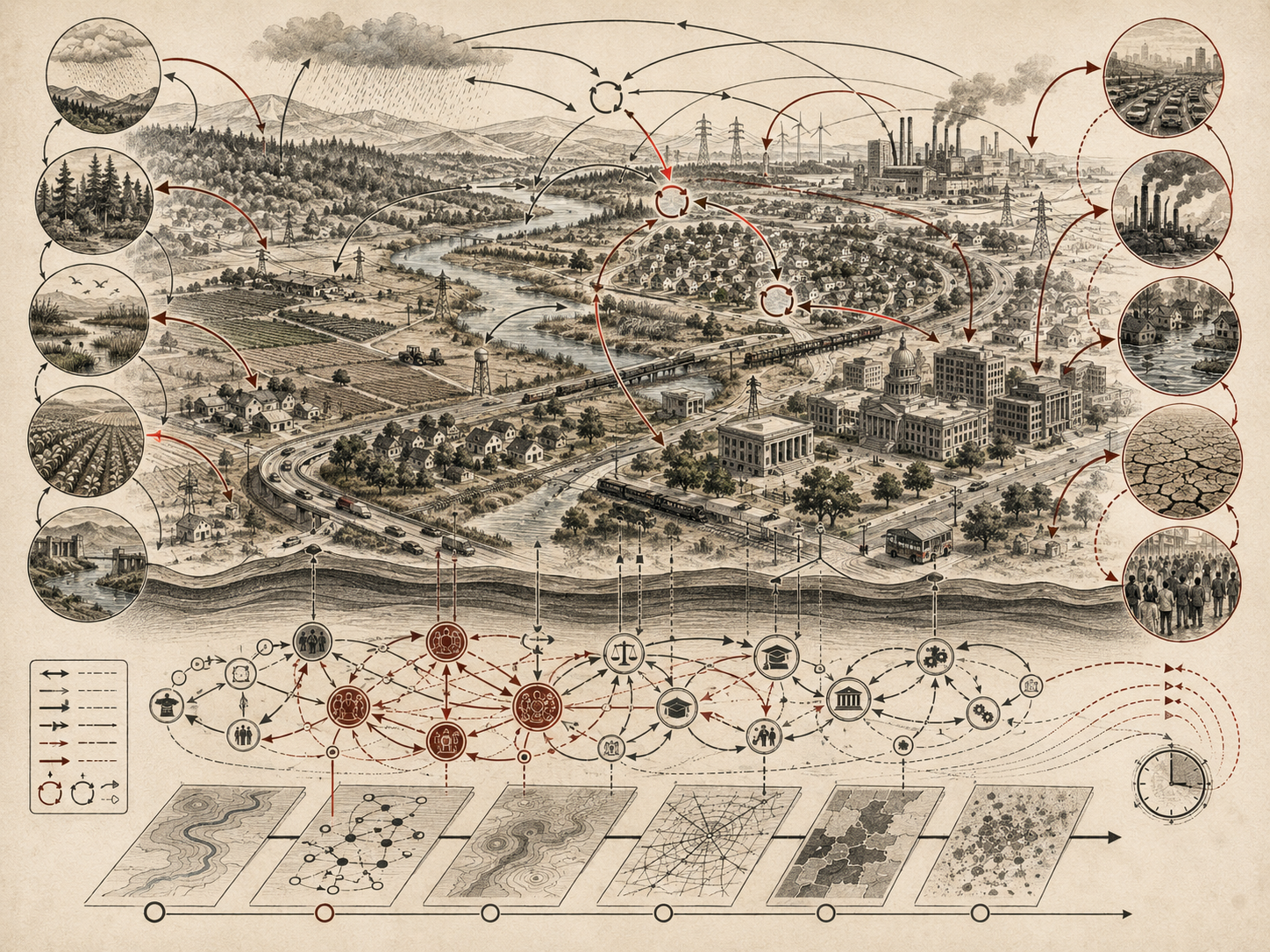
This article examines causality as a foundation of systems thinking. It explains why linear cause-and-effect explanations are often useful but incomplete, how feedback loops create circular causality, why structural conditions matter, and how delays, accumulations, thresholds, path dependence, and adaptation shape system behavior. It also shows why causal analysis is ethically important: the way a problem is explained determines who is blamed, what is measured, what is changed, and what forms of responsibility become visible.
The Causal Question in Systems Thinking
The causal question asks why something happened, why it keeps happening, and what would have to change for it to happen differently. In systems thinking, causality is not only about identifying a trigger. It is about understanding the structure that makes certain outcomes likely. A trigger can explain timing. A structure explains vulnerability, recurrence, amplification, resistance, and consequence.
A systems thinker rarely stops with the nearest cause. If a bridge fails, the immediate cause may be a material failure, design flaw, overload, inspection failure, or weather event. But the systems question goes further. Why was the bridge vulnerable? How was maintenance funded? What inspection regime existed? What political incentives shaped repair? What climate stresses were anticipated? What information was ignored? What institutional structure allowed risk to accumulate?
Similarly, if an organization misses a deadline, the immediate cause may be a delayed task or unavailable team member. A systems causal analysis asks whether the deadline failure belongs to a larger pattern of unclear ownership, dependency bottlenecks, unrealistic planning, leadership churn, poor documentation, inadequate staffing, or incentives that reward commitment without capacity.
Systems causality therefore asks:
- What immediate event or condition triggered the outcome?
- What recurring pattern does the outcome belong to?
- What structure made the outcome likely?
- What feedback loops reinforced the pattern?
- What delays separated action from consequence?
- What accumulated over time before the event became visible?
- What boundaries shape the explanation?
- Who benefits from the causal explanation being framed one way rather than another?
This matters because causal explanation guides action. If a problem is explained as individual failure, the solution may be training, punishment, replacement, or persuasion. If it is explained as structural failure, the solution may involve redesigning incentives, rules, information flows, resources, authority, boundaries, or feedback mechanisms. Causality is never only analytical. It is practical and ethical.
Linear Causality and Its Limits
Linear causality describes a one-directional relationship: A causes B. This form of explanation is useful in many cases. A broken valve causes a leak. A missing payment causes an account hold. A software bug causes an application crash. A contaminated water source causes illness. Linear causality is powerful when causes are close in time, direct in mechanism, and relatively isolated from broader feedback.
Systems thinking does not reject linear causality. It asks when linear causality is enough and when it is not. Many systems problems include linear causal links, but the larger behavior of the system cannot be explained by one link alone. A linear explanation may identify the final step in a causal chain while missing the conditions that made the chain possible.
A \rightarrow B
\]
Interpretation: A linear causal relationship states that one condition \(A\) contributes directly to another condition \(B\). This can be accurate for local mechanisms but incomplete for complex system behavior.
Linear explanation becomes weak when:
- many causes interact at once;
- causes and effects are separated by long delays;
- effects return to influence causes;
- outcomes emerge from relationships rather than single parts;
- actors adapt to interventions;
- the same cause produces different effects under different conditions;
- small changes produce large effects after thresholds are crossed;
- responsibility is distributed across institutions, rules, incentives, and histories.
A linear frame can also produce narrow accountability. If the last visible actor before failure is treated as the cause, deeper design and governance failures may disappear. A nurse, driver, teacher, caseworker, resident, engineer, student, or user may become the focal point of blame even when the outcome was shaped by workload, information failure, resource scarcity, organizational design, policy constraints, or historical neglect.
Linear causality is not wrong. It is incomplete when used to explain dynamic systems as if they were isolated events.
Circular Causality and Feedback
Circular causality occurs when an effect returns to influence the cause that helped produce it. This is the logic of feedback. In a feedback loop, causality does not move in a straight line and stop. It circulates through relationships, altering the conditions from which future behavior emerges.
Reinforcing feedback amplifies change. Trust can increase cooperation, cooperation can improve performance, and improved performance can build more trust. Distrust can reduce cooperation, weakened cooperation can damage performance, and damaged performance can deepen distrust. Backlog can create delay, delay can increase demand pressure, and demand pressure can increase backlog. Advantage can compound. So can disadvantage.
Balancing feedback resists change. A thermostat responds to temperature deviation. A regulator responds to risk. A budget constraint limits spending. A community norm discourages certain behavior. A system may correct itself toward a goal, threshold, or equilibrium. But balancing feedback can also preserve harmful arrangements by resisting reform, protecting authority, or normalizing existing patterns.
A \rightarrow B \rightarrow C \rightarrow A
\]
Interpretation: In circular causality, consequences return to influence earlier conditions. The effect becomes part of the cause of future system behavior.
Circular causality is central to systems thinking because it explains why patterns can persist without a single continuing external cause. Once a reinforcing loop begins, the system may generate momentum from its own behavior. Once a balancing loop is established, the system may resist change even when many actors want improvement.
Feedback also explains unintended consequences. An intervention enters a system that reacts. A policy may reduce one problem while increasing another. A new metric may improve measured performance while distorting real behavior. A platform design may increase engagement while weakening trust. A road expansion may reduce congestion briefly but encourage more driving and restore congestion. A disciplinary policy may suppress visible disorder while increasing exclusion and long-term disengagement.
Systems causality therefore asks not only “What effect will this action have?” but “How will the system respond to the action, and how will that response affect future causes?”
Multiple Causes, Conditions, and Interactions
Complex outcomes usually have multiple causes. But systems thinking goes beyond listing causes. It asks how causes interact. Some causes are direct triggers. Some are enabling conditions. Some are constraints. Some are amplifiers. Some are buffers. Some causes matter only when other causes are present. Some have delayed effects. Some operate through feedback loops. Some are visible only at a different scale.
For example, flooding may be caused by heavy rainfall, but rainfall alone may not explain the damage. The outcome may also depend on drainage capacity, land use, pavement coverage, watershed health, housing location, maintenance backlog, climate change, zoning, insurance markets, emergency response, and neighborhood inequality. Rainfall may trigger the event. The system determines vulnerability.
Systems thinking distinguishes several causal roles:
| Causal role | Question | Example |
|---|---|---|
| Triggering cause | What immediate condition activated the event? | A storm, outage, illness, software failure, price shock, or conflict. |
| Enabling condition | What made the event possible? | Weak maintenance, poor access, insufficient staffing, fragile infrastructure. |
| Amplifying factor | What made the effect larger? | Feedback loops, concentration of risk, lack of redundancy, social vulnerability. |
| Buffering factor | What reduced harm or slowed escalation? | Reserves, trust, redundancy, mutual aid, adaptive capacity, safety systems. |
| Structural cause | What arrangement made the pattern likely? | Rules, incentives, authority, resource distribution, boundaries, mental models. |
| Historical cause | What past decisions shaped present vulnerability? | Segregation, land-use patterns, infrastructure neglect, institutional memory loss. |
This distinction matters because causal language often compresses very different ideas into one word. Saying “X caused Y” can hide whether X was a trigger, condition, amplifier, or structural generator. Responsible systems analysis makes the causal role explicit.
Multiple causality also changes intervention. Removing a trigger may prevent one event but not the larger pattern. Strengthening a buffer may reduce harm but not eliminate the source of risk. Changing an enabling condition may reduce vulnerability. Changing a structural cause may alter the pattern itself. Systems thinking asks which causal role the intervention targets.
Proximate Causes and Structural Causes
A proximate cause is close to the event. A structural cause is embedded in the system that made the event likely. Both matter, but they answer different questions. Proximate causes explain immediate occurrence. Structural causes explain recurrence, vulnerability, unequal exposure, and patterned behavior.
If a patient is readmitted to the hospital, the proximate cause might be a complication, medication issue, or missed follow-up appointment. A structural analysis may examine discharge planning, insurance coverage, housing stability, primary care access, transportation, language access, caregiver support, nutrition, and chronic stress. The proximate cause identifies the visible pathway. The structural causes explain why that pathway was likely for certain patients.
If a worker makes an error, the proximate cause may be a missed step. Structural causes may include fatigue, understaffing, confusing interface design, production pressure, inadequate training, poor documentation, fear of reporting, or a culture that rewards speed over safety. Blaming the worker may be easier than changing the system, but recurrence suggests structure.
O = f(P, S)
\]
Interpretation: An outcome \(O\) can be understood as a function of proximate causes \(P\) and structural conditions \(S\). Systems thinking asks how immediate events and deeper structures interact.
Structural causes are not always more important than proximate causes, but they are often more neglected. This neglect has consequences. A system that repeatedly identifies proximate causes but never changes structural conditions may become highly skilled at incident response while remaining structurally incapable of prevention.
Structural causality also changes moral analysis. If a harm is repeatedly produced by system design, then the harm cannot be treated indefinitely as an accident. Recurrence is evidence. When institutions know that their rules, incentives, resource decisions, or measurement systems produce repeated harm, responsibility expands beyond the immediate actor.
Systems thinking therefore asks whether proximate-cause analysis is being used as a substitute for structural accountability.
Delay, Accumulation, and Hidden Causality
Many causal relationships in systems are delayed. The effect of a cause may appear days, years, or generations later. Delay makes causality difficult to see because people often look for causes close to effects. Systems thinking expands the time horizon so that accumulation and delayed consequence can be recognized.
Carbon emissions accumulate before their full climate effects are felt. Deferred maintenance accumulates before infrastructure failure occurs. Public distrust accumulates through repeated experiences before a legitimacy crisis becomes visible. Organizational burnout accumulates before turnover rises. Soil degradation accumulates before agricultural productivity declines. Debt accumulates before financial crisis. Skill loss accumulates before institutional capacity weakens.
Delay creates several problems for decision-making:
- harmful actions may continue because consequences are not immediate;
- beneficial interventions may be abandoned before results appear;
- leaders may overcorrect because they respond to outdated information;
- short-term success may hide long-term depletion;
- future people or ecosystems may bear costs created by present decisions.
S_{t+1} = S_t + I_t – O_t
\]
Interpretation: A stock \(S\) changes through inflows \(I\) and outflows \(O\). Accumulated stocks often explain delayed system behavior better than isolated events do.
Hidden causality often appears when a slowly changing stock crosses a threshold. A system may seem stable because the accumulated condition is not yet visible. Then a visible event occurs, and observers mistake the trigger for the whole cause. A storm may trigger flooding, but land-use decisions and maintenance neglect may have accumulated vulnerability for decades. A scandal may trigger institutional distrust, but public suspicion may have accumulated through years of ignored complaints.
Systems thinking treats time as part of causality. The question is not only what caused the event, but what had been accumulating before the event became possible.
Thresholds, Tipping Points, and Nonlinearity
In many systems, cause and effect are not proportional. A small change can produce a large effect if the system is near a threshold. A large intervention can produce little visible change if the system is buffered, resistant, or far from a threshold. This is nonlinearity.
A threshold is a point at which system behavior changes significantly. A lake may absorb pollution for a time before shifting into a degraded state. A team may absorb workload until burnout accelerates. A community may tolerate institutional failure until trust collapses. A supply chain may operate efficiently until one disruption cascades through tightly coupled dependencies. A climate system may respond gradually until feedback loops accelerate change.
Nonlinearity complicates causality because visible change may not correspond neatly to the size of the immediate cause. The final push may be small, but the accumulated conditions may be large. Systems thinking therefore avoids assuming that the most recent cause is the most important cause.
y =
\begin{cases}
f_1(x), & x < T \\ f_2(x), & x \geq T \end{cases} \]
Interpretation: A system may behave one way below a threshold \(T\) and another way once that threshold is crossed. The causal effect of \(x\) depends on the system’s current state.
Thresholds also matter ethically because delay can make responsibility harder to see. A system may be pushed toward danger slowly by many decisions, each of which appears manageable alone. When the threshold is crossed, harm may seem sudden. But the causal responsibility lies not only in the last action before the shift. It also lies in the decisions that moved the system toward the threshold.
Nonlinearity teaches humility. It means complex systems can surprise us. It also teaches urgency. Waiting until damage is obvious may mean waiting until the system has already crossed into a harder-to-repair state.
Path Dependence and Historical Causality
Path dependence means that present possibilities are shaped by past decisions, investments, institutions, infrastructures, norms, and histories. A system does not begin fresh at each moment. It carries the consequences of earlier paths. Those paths can create lock-in, inertia, unequal capacity, inherited vulnerability, and resistance to change.
Infrastructure is path dependent. Roads, pipes, railways, electrical grids, zoning, housing patterns, and land-use decisions shape future development. Once built, they become expensive to reverse. Technology systems are path dependent. Standards, platforms, data formats, user habits, procurement choices, and organizational routines make some futures easier and others harder. Institutions are path dependent. Rules, precedents, professional cultures, funding formulas, and administrative categories shape later decisions.
Path dependence also matters for injustice. Historical decisions can structure present outcomes long after the original decision-makers are gone. Segregation, land dispossession, discriminatory lending, environmental siting, unequal school funding, labor exclusion, and infrastructure neglect can continue to shape housing, health, wealth, education, exposure, trust, and political voice. A present event may have historical causes embedded in the system’s structure.
Systems thinking asks:
- What past decisions created today’s options?
- What infrastructure or institution locks the system into its current path?
- What costs make change difficult?
- Who benefited from the historical path?
- Who still bears its consequences?
- What would path repair require?
Historical causality is often uncomfortable because it expands accountability beyond the immediate present. But ignoring history produces shallow analysis. A system’s current behavior is often the visible expression of accumulated choices.
Counterfactual Thinking and Intervention
Causal analysis often depends on counterfactual thinking: asking what would have happened if some condition had been different. In simple causal analysis, the question may be: would the outcome have occurred without this event? In systems thinking, the counterfactual question becomes broader: how would the system’s behavior change if a relationship, rule, flow, boundary, feedback loop, or structural condition were changed?
Counterfactual thinking is essential for intervention. A systems thinker asks not only what caused the problem, but what kind of change would alter the pattern. If a backlog is caused by demand growth, insufficient staffing, fragmented data, and approval delays, then one can ask how the system behaves under different staffing, data integration, process redesign, or demand-reduction scenarios.
Counterfactuals can operate at different levels:
- Event counterfactual: What if the immediate trigger had not occurred?
- Process counterfactual: What if the workflow had been designed differently?
- Structural counterfactual: What if incentives, rules, resources, or authority were different?
- Boundary counterfactual: What if the problem were framed at another scale?
- Historical counterfactual: What if past investments or exclusions had not occurred?
- Feedback counterfactual: What if the system received faster, more accurate, or more democratic feedback?
\Delta O = O_{\text{intervention}} – O_{\text{baseline}}
\]
Interpretation: A basic intervention analysis compares an outcome under an intervention to a baseline. In systems thinking, the deeper question is whether the intervention changes the structure that generates the outcome.
Counterfactuals should be used carefully. They can clarify causal assumptions, but they can also oversimplify if the system adapts. A policy may appear effective in a model but fail because actors change behavior. A technology may appear beneficial under one frame but create harms when deployed in institutions with unequal power. A reform may improve one metric while worsening another. Systems counterfactuals must therefore include adaptation, feedback, delay, and unintended effects.
The strongest causal analysis is not the one that names the most causes. It is the one that identifies which changes could meaningfully alter system behavior.
Correlation, Causal Claims, and Evidence
Systems thinking must be careful about evidence. A systems approach recognizes complexity, but complexity does not justify loose causal claims. Correlation is not causation. A pattern may suggest a causal relationship, but it does not prove one by itself. Systems thinking requires disciplined causal reasoning because poor causal claims can lead to ineffective or harmful interventions.
Several kinds of evidence can support causal analysis:
- Temporal evidence: the cause precedes the effect.
- Mechanistic evidence: there is a plausible pathway connecting cause and effect.
- Pattern evidence: similar relationships appear across cases or time.
- Counterfactual evidence: outcomes differ when the condition changes.
- Process evidence: qualitative or institutional evidence shows how the effect is produced.
- Model evidence: simulations or statistical models test assumptions under defined conditions.
- Stakeholder evidence: affected people reveal mechanisms that formal data may miss.
Systems thinking is strongest when it combines forms of evidence. Quantitative data can show trends, associations, and behavior over time. Qualitative evidence can reveal mechanisms, meaning, institutional practice, and lived experience. Historical evidence can show path dependence. Technical evidence can identify component mechanisms. Ecological evidence can reveal material limits. Governance evidence can show authority and accountability.
A causal claim in systems thinking should therefore answer several questions:
- What is the proposed cause?
- What is the proposed effect?
- What mechanism connects them?
- What evidence supports the mechanism?
- What alternative explanations exist?
- What feedback loops may complicate the relationship?
- What boundary defines the causal claim?
- What would change if the cause were removed or altered?
Good systems thinking is not vague about causality. It is more precise because it refuses to confuse simple causality with sufficient explanation.
Ethics, Blame, and Responsibility
Causal explanation has ethical consequences. The way a system explains harm determines who is blamed, who is protected, what is changed, and what remains invisible. A causal frame can individualize structural harm, or it can reveal the systems that produce repeated vulnerability.
If poverty is explained only as personal failure, then responsibility is assigned to individuals. If poverty is explained through wages, housing, education, health, discrimination, care burdens, labor markets, public policy, and wealth accumulation, responsibility expands to institutions and structures. If burnout is explained only as poor resilience, workers become the problem. If burnout is explained through workload, staffing, incentives, digital pace, leadership, culture, and recovery time, organizational design becomes part of the cause.
Systems thinking does not eliminate individual responsibility. It places individual action inside a causal field. People make choices, but choices are shaped by opportunity, constraint, information, incentives, fear, fatigue, norms, resources, authority, and history. When many people in similar positions produce similar outcomes, causal analysis must examine the position, not only the person.
Ethical causal analysis asks:
- Who is being blamed by this explanation?
- Who is being protected from responsibility?
- What structural causes are visible?
- What structural causes are hidden?
- Who benefits from a narrow causal frame?
- Who bears harm when the causal frame is wrong?
- What would repair require if the cause is structural?
This is especially important where power is unequal. Institutions often control the causal story. They define metrics, write reports, classify incidents, manage communication, and decide what counts as evidence. A systems approach makes causal framing contestable. It asks whether the official cause is an explanation or a defense.
Responsible systems thinking therefore treats causality as both analytical and moral. It seeks truthful explanation because bad causal explanations produce bad interventions and unjust accountability.
Examples Across Systems
Systems causality appears across many domains. The examples below show why causal explanation must move beyond simple triggers while still preserving concrete mechanisms.
Public health
A rise in emergency-room visits may be caused immediately by illness, injury, or acute need. A systems analysis asks whether emergency demand reflects limited primary care, housing instability, chronic disease, insurance gaps, environmental exposure, transportation barriers, public-health underinvestment, or distrust. The emergency visit is visible. The causal structure may be distributed across many systems.
Infrastructure
A water-main break may be caused by pipe failure. But pipe failure may reflect age, material quality, deferred maintenance, soil movement, freeze-thaw cycles, funding constraints, inspection intervals, political incentives, and climate stress. A repair fixes the event. Structural causal analysis asks why breakage is recurring and where risk is accumulating.
Organizations
A project delay may be caused by missed handoffs or late decisions. But recurring delays may reflect unclear authority, conflicting priorities, overloaded teams, weak documentation, poor planning assumptions, dependency bottlenecks, or fear of escalating bad news. The causal unit is not just the task. It is the organizational system.
Education
A student’s absence may have an immediate cause, but absenteeism patterns may reflect housing instability, transportation, illness, caregiving, school climate, exclusionary discipline, disability support, work obligations, or family economic pressure. Systems causality asks why absence is concentrated and recurring.
Artificial intelligence systems
An algorithmic harm may be attributed to a model error, but the causal structure may include training data, labeling practices, evaluation metrics, institutional incentives, deployment context, user interface design, lack of appeal, weak governance, and unequal exposure. The model is only one part of the causal system.
Climate systems
A flood, drought, fire, or heat wave may have immediate meteorological causes. Systems causality also includes emissions, land use, ecological degradation, infrastructure design, development patterns, insurance incentives, public investment, emergency capacity, and social vulnerability. The hazard is natural in one sense, but vulnerability is socially and structurally produced.
Economic systems
Inflation, debt distress, unemployment, or supply shortage may have immediate triggers, but systems analysis examines production capacity, market concentration, energy prices, monetary policy, trade networks, labor conditions, public investment, consumer behavior, and expectations. Economic causality is often recursive because expectations and behavior feed back into the conditions being explained.
Across these domains, the systems question is not merely “What caused the event?” It is “What causal structure produces the pattern, and what intervention would change that structure responsibly?”
Mathematics, Computation, and Modeling
Causality in systems thinking can be studied through diagrams, qualitative inquiry, institutional analysis, stakeholder research, process tracing, scenario planning, statistical modeling, network analysis, and simulation. Mathematical and computational models can support causal thinking by making assumptions explicit, identifying feedback, testing counterfactuals, and comparing scenarios. They should not be treated as substitutes for judgment, evidence, or ethical interpretation.
A simple causal relationship can be represented as:
Y = f(X)
\]
Interpretation: Outcome \(Y\) is represented as a function of cause \(X\). In simple cases this may be useful, but complex systems usually require additional variables, feedback, delay, and context.
A multivariable systems causal model can be represented as:
Y_t = f(X_{1t}, X_{2t}, X_{3t}, R_t, D_t, B_t)
\]
Interpretation: Outcome \(Y_t\) at time \(t\) may depend on multiple variables \(X\), relationships \(R_t\), delays \(D_t\), and boundary conditions \(B_t\).
Feedback can be represented dynamically:
x_{t+1} = f(x_t, u_t, \theta)
\]
Interpretation: The future state \(x_{t+1}\) depends on the current state \(x_t\), intervention \(u_t\), and system parameters \(\theta\). This helps represent systems where present conditions shape future causal behavior.
A causal network can be represented as:
G_c = (V, E_c)
\]
Interpretation: A causal graph \(G_c\) contains variables or actors \(V\) and causal edges \(E_c\). The edges should represent specified causal mechanisms, not vague association.
Modeling can support several causal tasks:
| Modeling task | Causal question | Example use |
|---|---|---|
| Causal-loop diagramming | How do causes and effects circulate through feedback? | Mapping trust, backlog, burnout, demand, or policy resistance. |
| Stock-flow modeling | What accumulates before an effect becomes visible? | Studying maintenance backlog, public trust, carbon, debt, or capacity. |
| Scenario comparison | How might outcomes change under different assumptions? | Testing policy, infrastructure, climate, staffing, or governance interventions. |
| Network analysis | How do causal pathways connect variables or actors? | Identifying dependency, contagion, bottlenecks, and cascade risk. |
| Counterfactual simulation | What might have happened under another structure? | Comparing baseline and intervention cases over time. |
| Sensitivity analysis | Which assumptions most influence the outcome? | Testing parameter uncertainty, boundary choices, and delayed effects. |
Models can clarify causality, but they can also mislead if they are treated as neutral. A causal model reflects boundary choices, variable definitions, data limitations, assumptions, and values. It may omit power, history, lived experience, ecological complexity, and institutional constraints. The strongest systems modeling practice documents assumptions and treats model output as an aid to inquiry, not as automatic authority.
Python Workflow: Systems Causality and Counterfactual Diagnostics
The Python workflow below turns systems causality into a small reproducible model. It compares four scenarios: nearest-cause response, pattern-and-evidence analysis, structural causal analysis, and feedback-aware intervention. The script uses only the Python standard library, writes CSV outputs relative to the article folder, and is designed as a clear starting point for companion repository work.
# systems_causality_workflow.py
# Dependency-light workflow for systems causality, feedback, delay,
# structural conditions, and counterfactual diagnostics.
# Writes outputs relative to the article root.

from __future__ import annotations

from dataclasses import dataclass
from pathlib import Path
import csv
from statistics import mean

ARTICLE_ROOT = Path(__file__).resolve().parents[1]
TABLES = ARTICLE_ROOT / "outputs" / "tables"


@dataclass
class CausalScenario:
    name: str
    proximate_response: float
    structural_analysis: float
    feedback_visibility: float
    delay_awareness: float
    counterfactual_quality: float
    evidence_quality: float
    accountability: float
    recurrence_pressure: float


def clamp(value: float, low: float = 0.0, high: float = 100.0) -> float:
    return max(low, min(high, value))


def run_scenario(scenario: CausalScenario, periods: int = 36) -> list[dict[str, object]]:
    recurrence_stock = scenario.recurrence_pressure * 58.0
    causal_clarity = scenario.evidence_quality * 34.0
    structural_capacity = scenario.structural_analysis * 42.0
    accountability_stock = scenario.accountability * 38.0
    rows: list[dict[str, object]] = []

    for period in range(periods + 1):
        proximate_control = clamp(
            scenario.proximate_response * 24.0
            + scenario.evidence_quality * 10.0
            - max(0.0, recurrence_stock - 55.0) * 0.06
        )

        feedback_correction = clamp(
            scenario.feedback_visibility * 22.0
            + scenario.delay_awareness * 14.0
            + accountability_stock * 0.10
            + scenario.counterfactual_quality * 13.0
        )

        structural_capacity = clamp(
            structural_capacity
            + scenario.structural_analysis * 1.8
            + feedback_correction * 0.08
            + scenario.counterfactual_quality * 1.3
            - max(0.0, 45.0 - causal_clarity) * 0.04
        )

        hidden_causal_risk = clamp(
            scenario.recurrence_pressure * 22.0
            + max(0.0, 60.0 - structural_capacity) * 0.22
            + max(0.0, 55.0 - feedback_correction) * 0.18
            + scenario.delay_awareness * -4.0
            - scenario.accountability * 3.0
        )

        recurrence_stock = clamp(
            recurrence_stock
            + hidden_causal_risk * 0.20
            - proximate_control * 0.08
            - structural_capacity * 0.12
            - accountability_stock * 0.05
        )

        causal_clarity = clamp(
            causal_clarity
            + scenario.evidence_quality * 1.7
            + scenario.counterfactual_quality * 1.5
            + feedback_correction * 0.06
            - hidden_causal_risk * 0.04
        )

        accountability_stock = clamp(
            accountability_stock
            + scenario.accountability * 1.9
            + causal_clarity * 0.05
            + structural_capacity * 0.04
            - recurrence_stock * 0.04
        )

        intervention_leverage = clamp(
            structural_capacity * 0.28
            + feedback_correction * 0.22
            + scenario.counterfactual_quality * 18.0
            + accountability_stock * 0.14
            - recurrence_stock * 0.10
        )

        systems_causal_score = clamp(
            causal_clarity * 0.24
            + structural_capacity * 0.24
            + feedback_correction * 0.18
            + intervention_leverage * 0.22
            + accountability_stock * 0.12
            - recurrence_stock * 0.14
            - hidden_causal_risk * 0.10
        )

        rows.append({
            "period": period,
            "scenario": scenario.name,
            "proximate_control": round(proximate_control, 3),
            "feedback_correction": round(feedback_correction, 3),
            "structural_capacity": round(structural_capacity, 3),
            "hidden_causal_risk": round(hidden_causal_risk, 3),
            "recurrence_stock": round(recurrence_stock, 3),
            "causal_clarity": round(causal_clarity, 3),
            "accountability_stock": round(accountability_stock, 3),
            "intervention_leverage": round(intervention_leverage, 3),
            "systems_causal_score": round(systems_causal_score, 3),
        })

    return rows


def write_csv(path: Path, rows: list[dict[str, object]]) -> None:
    path.parent.mkdir(parents=True, exist_ok=True)
    if not rows:
        raise ValueError(f"No rows to write: {path}")
    with path.open("w", newline="", encoding="utf-8") as handle:
        writer = csv.DictWriter(handle, fieldnames=list(rows[0].keys()))
        writer.writeheader()
        writer.writerows(rows)


def summarize(rows: list[dict[str, object]]) -> list[dict[str, object]]:
    output: list[dict[str, object]] = []
    for scenario_name in sorted({row["scenario"] for row in rows}):
        subset = [row for row in rows if row["scenario"] == scenario_name]
        final = subset[-1]
        avg_recurrence = mean(float(row["recurrence_stock"]) for row in subset)
        avg_hidden_risk = mean(float(row["hidden_causal_risk"]) for row in subset)
        avg_score = mean(float(row["systems_causal_score"]) for row in subset)

        if float(final["systems_causal_score"]) >= 65 and float(final["recurrence_stock"]) <= 35:
            diagnostic = "systems causal analysis supports durable intervention"
        elif avg_recurrence >= 55:
            diagnostic = "recurrence remains structurally generated"
        elif avg_hidden_risk >= 50:
            diagnostic = "hidden causal risk remains high"
        elif avg_score >= 55:
            diagnostic = "partial causal learning with remaining recurrence risk"
        else:
            diagnostic = "proximate causality dominates the analysis"

        output.append({
            "scenario": scenario_name,
            "final_systems_causal_score": final["systems_causal_score"],
            "final_recurrence_stock": final["recurrence_stock"],
            "final_hidden_causal_risk": final["hidden_causal_risk"],
            "final_causal_clarity": final["causal_clarity"],
            "final_intervention_leverage": final["intervention_leverage"],
            "average_recurrence_stock": round(avg_recurrence, 3),
            "average_hidden_causal_risk": round(avg_hidden_risk, 3),
            "average_systems_causal_score": round(avg_score, 3),
            "diagnostic": diagnostic,
        })

    return output


def main() -> None:
    scenarios = [
        CausalScenario("Nearest-cause response", 0.82, 0.18, 0.22, 0.20, 0.24, 0.42, 0.24, 0.74),
        CausalScenario("Pattern and evidence analysis", 0.66, 0.46, 0.50, 0.42, 0.52, 0.68, 0.42, 0.62),
        CausalScenario("Structural causal analysis", 0.54, 0.74, 0.70, 0.66, 0.68, 0.76, 0.64, 0.42),
        CausalScenario("Feedback-aware intervention", 0.48, 0.82, 0.84, 0.80, 0.78, 0.82, 0.78, 0.30),
    ]

    rows: list[dict[str, object]] = []
    for scenario in scenarios:
        rows.extend(run_scenario(scenario))

    write_csv(TABLES / "systems_causality_timeseries.csv", rows)
    write_csv(TABLES / "systems_causality_summary.csv", summarize(rows))

    print("Systems causality workflow complete.")
    print(TABLES / "systems_causality_timeseries.csv")


if __name__ == "__main__":
    main()
The workflow is intentionally simple enough to inspect. It shows how nearest-cause response may improve proximate control while leaving recurrence intact, and how structural causal analysis becomes stronger when feedback visibility, delay awareness, counterfactual quality, evidence quality, and accountability improve. The model is synthetic and illustrative; it supports disciplined inquiry rather than replacing causal evidence, domain expertise, stakeholder knowledge, or ethical judgment.
R Workflow: Causal Pattern Summary and Visualization
The R workflow reads the Python-generated time-series output, creates scenario summaries, and exports base R plots for recurrence, hidden causal risk, causal clarity, intervention leverage, and systems causal score. It uses only base R so it remains portable across simple local environments.
# systems_causality_diagnostics.R
# Base R workflow for causal pattern summary and visualization.

args <- commandArgs(trailingOnly = FALSE)
file_arg <- grep("^--file=", args, value = TRUE)

if (length(file_arg) > 0) {
  script_path <- normalizePath(sub("^--file=", "", file_arg[1]), mustWork = TRUE)
  article_root <- normalizePath(file.path(dirname(script_path), ".."), mustWork = TRUE)
} else {
  article_root <- getwd()
}

setwd(article_root)

tables_dir <- file.path(article_root, "outputs", "tables")
figures_dir <- file.path(article_root, "outputs", "figures")

if (!dir.exists(tables_dir)) {
  dir.create(tables_dir, recursive = TRUE)
}

if (!dir.exists(figures_dir)) {
  dir.create(figures_dir, recursive = TRUE)
}

timeseries_path <- file.path(tables_dir, "systems_causality_timeseries.csv")

if (!file.exists(timeseries_path)) {
  stop(paste("Missing", timeseries_path, "Run the Python workflow first."))
}

data <- read.csv(timeseries_path, stringsAsFactors = FALSE)

last_by_scenario <- do.call(
  rbind,
  lapply(split(data, data$scenario), function(df) df[nrow(df), ])
)

avg_recurrence <- aggregate(recurrence_stock ~ scenario, data = data, FUN = mean)
avg_hidden_risk <- aggregate(hidden_causal_risk ~ scenario, data = data, FUN = mean)
avg_score <- aggregate(systems_causal_score ~ scenario, data = data, FUN = mean)

names(avg_recurrence)[2] <- "average_recurrence_stock"
names(avg_hidden_risk)[2] <- "average_hidden_causal_risk"
names(avg_score)[2] <- "average_systems_causal_score"

final_fields <- last_by_scenario[, c(
  "scenario",
  "systems_causal_score",
  "recurrence_stock",
  "hidden_causal_risk",
  "causal_clarity",
  "intervention_leverage"
)]

names(final_fields) <- c(
  "scenario",
  "final_systems_causal_score",
  "final_recurrence_stock",
  "final_hidden_causal_risk",
  "final_causal_clarity",
  "final_intervention_leverage"
)

summary_table <- Reduce(
  function(x, y) merge(x, y, by = "scenario"),
  list(avg_recurrence, avg_hidden_risk, avg_score, final_fields)
)

summary_table$diagnostic <- ifelse(
  summary_table$final_systems_causal_score >= 65 &
    summary_table$final_recurrence_stock <= 35,
  "systems causal analysis supports durable intervention",
  ifelse(
    summary_table$average_recurrence_stock >= 55,
    "recurrence remains structurally generated",
    ifelse(
      summary_table$average_hidden_causal_risk >= 50,
      "hidden causal risk remains high",
      ifelse(
        summary_table$average_systems_causal_score >= 55,
        "partial causal learning with remaining recurrence risk",
        "proximate causality dominates the analysis"
      )
    )
  )
)

write.csv(
  summary_table,
  file.path(tables_dir, "systems_causality_r_summary.csv"),
  row.names = FALSE
)

plot_metric <- function(metric, label, file_name) {
  png(file.path(figures_dir, file_name), width = 1200, height = 700)
  scenarios <- unique(data$scenario)
  plot(
    NA,
    xlim = range(data$period),
    ylim = range(data[[metric]], na.rm = TRUE),
    xlab = "Period",
    ylab = label,
    main = paste(label, "by Scenario")
  )
  for (scenario_name in scenarios) {
    subset_data <- data[data$scenario == scenario_name, ]
    lines(subset_data$period, subset_data[[metric]], lwd = 2)
  }
  legend("topleft", legend = scenarios, lwd = 2, cex = 0.8, bty = "n")
  grid()
  dev.off()
}

plot_metric("recurrence_stock", "Recurrence stock", "recurrence_stock_trajectories.png")
plot_metric("hidden_causal_risk", "Hidden causal risk", "hidden_causal_risk_trajectories.png")
plot_metric("causal_clarity", "Causal clarity", "causal_clarity_trajectories.png")
plot_metric("intervention_leverage", "Intervention leverage", "intervention_leverage_trajectories.png")
plot_metric("systems_causal_score", "Systems causal score", "systems_causal_score_trajectories.png")

print(summary_table)
This workflow supports the article’s central methodological claim: causal claims should be tested through patterns, mechanisms, feedback, delay, counterfactuals, and evidence. The R outputs help readers see whether an intervention changes the causal structure or only suppresses the nearest visible cause.
GitHub Repository
The companion repository for this article should help readers represent and test systems causality through causal-loop examples, structural cause mapping, delay simulation, counterfactual comparison, causal-network analysis, threshold behavior, and responsible documentation. The repository should support conceptual learning while also showing how causal assumptions can be made explicit in reproducible workflows.
Complete Code Repository
Companion repository for the article, including causal-loop examples, structural cause maps, delay and accumulation simulations, counterfactual scenario workflows, causal-network analysis, threshold models, synthetic datasets, documentation notes, and multi-language scaffolds for systems causality.
articles/causality-in-systems-thinking/
├── python/
│   ├── systems_causality_workflow.py
│   ├── causal_loop_examples.py
│   ├── structural_cause_mapping.py
│   ├── delay_accumulation_simulation.py
│   ├── counterfactual_scenario_analysis.py
│   ├── causal_network_analysis.py
│   ├── threshold_causality_model.py
│   ├── validation_checks.py
│   └── run_all_causality_workflows.py
├── r/
│   ├── systems_causality_diagnostics.R
│   ├── causal_pattern_summary.R
│   ├── counterfactual_comparison.R
│   ├── delay_visualization.R
│   ├── threshold_behavior_plots.R
│   ├── causal_network_tables.R
│   └── run_all_causality_workflows.R
├── julia/
│   ├── dynamic_causality_examples.jl
│   └── nonlinear_causal_feedback.jl
├── sql/
│   ├── schema_causal_variables.sql
│   ├── schema_causal_relationships.sql
│   ├── schema_counterfactuals.sql
│   ├── schema_scenarios.sql
│   ├── schema_indicators.sql
│   └── schema_model_runs.sql
├── rust/
│   └── causality_diagnostics_cli.rs
├── go/
│   └── causal_pathway_utility.go
├── cpp/
│   ├── efficient_causal_network.cpp
│   └── feedback_causality_simulation.cpp
├── fortran/
│   └── recurrence_causality_model.f90
├── c/
│   └── low_level_causal_simulation.c
├── docs/
│   ├── modeling_principles.md
│   ├── article_notes.md
│   ├── assumptions_and_limitations.md
│   └── responsible_use.md
├── data/
│   ├── synthetic_causal_variables.csv
│   ├── synthetic_causal_edges.csv
│   ├── synthetic_counterfactuals.csv
│   ├── synthetic_scenarios.csv
│   └── synthetic_indicators.csv
├── outputs/
│   ├── figures/
│   └── tables/
└── notebooks/
    ├── python_systems_causality_walkthrough.ipynb
    └── r_causal_comparison_placeholder.ipynb
This repository structure supports the article’s central argument: causality in systems is often distributed, delayed, structural, circular, and conditional. The data/ folder separates causal variables, causal edges, counterfactual assumptions, scenarios, and indicators. The python/ and r/ folders support causal-loop examples, counterfactual comparison, delay analysis, threshold behavior, and causal-network summaries. The julia/ folder supports dynamic and nonlinear feedback examples. The sql/ folder defines schemas for causal variables, relationships, counterfactuals, scenarios, indicators, and model runs. The lower-level language folders provide scaffolds for efficient diagnostics, pathway tracing, recurrence, and causal simulation.
A Practical Method for Systems Causal Analysis
Systems causal analysis can be practiced through a disciplined sequence of inquiry. The purpose is not to find one final cause, but to understand how causes interact and where intervention could change the system responsibly.
1. Define the outcome
Begin by naming the outcome clearly. Is the outcome an event, pattern, trend, threshold crossing, failure, harm, improvement, or distribution? Causal analysis becomes weak when the outcome is vague.
2. Separate event from pattern
Ask whether the outcome is isolated or recurring. If it is recurring, the causal question must move beyond the immediate trigger and examine structure.
3. Identify proximate causes
List the immediate factors that contributed to the event. These may include component failure, human action, environmental shock, software error, missing information, or process breakdown.
4. Identify structural conditions
Ask what arrangements made the proximate causes more likely. Examine rules, incentives, authority, resources, boundaries, data flows, maintenance, staffing, governance, and mental models.
5. Map feedback loops
Ask whether effects return to influence causes. Look for reinforcing loops that amplify behavior and balancing loops that stabilize or resist change.
6. Examine stocks, flows, and delays
Identify what has accumulated over time. Ask whether the visible outcome was produced by delayed consequences, hidden depletion, or accumulated vulnerability.
7. Check thresholds and nonlinear behavior
Ask whether the system changed suddenly after gradual pressure. Identify possible tipping points, capacity limits, saturation effects, and cascading risks.
8. Consider historical path dependence
Ask how past decisions created present causal conditions. Look for lock-in, inherited infrastructure, institutional memory, historical exclusion, and long-term investment patterns.
9. Compare alternative causal frames
Ask how the explanation changes if the boundary changes. Compare individual, organizational, institutional, ecological, economic, historical, and governance frames.
10. Test intervention logic
Ask what would change if the proposed intervention were implemented. Does it change a trigger, condition, feedback loop, stock, boundary, incentive, or mental model? Does it alter the pattern or merely suppress one event?
This method makes causal explanation more rigorous by connecting immediate events to deeper system behavior. It also makes responsibility harder to evade, because it asks whether known structures continue to produce known harms.
Common Pitfalls
Causal reasoning in systems thinking is powerful, but several pitfalls are common.
- Stopping at the nearest cause: The most visible cause is not always the most important cause. A trigger may explain timing while structure explains recurrence and vulnerability.
- Confusing correlation with causation: A relationship between variables does not prove causality. Systems analysis should identify mechanisms, timing, alternative explanations, and evidence.
- Listing causes without explaining interaction: Complex systems often have many causes. A list is not enough. The analysis must explain how causes interact, reinforce, buffer, delay, or condition one another.
- Ignoring feedback: Many interventions fail because they assume the system is passive. Systems respond. Actors adapt. Consequences feed back into future behavior.
- Ignoring delay: If causes and effects are separated in time, decision-makers may abandon good interventions too early or continue harmful practices too long.
- Using complexity to avoid responsibility: Saying “it is complex” should not dissolve accountability. Systems thinking should clarify distributed responsibility, not erase it.
- Blaming individuals for repeated structural outcomes: When similar outcomes recur across many actors, the causal explanation must examine the system that positions those actors.
- Treating models as proof: Models are tools for inquiry. They depend on assumptions, boundaries, data, and values. They should be interpreted alongside qualitative, historical, technical, and stakeholder evidence.
The deeper pitfall is treating causal explanation as a hunt for a single final cause. Good systems causality is specific, relational, evidence-seeking, historically aware, ethically alert, and intervention-oriented.
Why Causality Matters
Causality matters because every intervention rests on an explanation. If the explanation is wrong, the intervention may fail, shift burdens, deepen harm, or create unintended consequences. If the explanation is too narrow, the system may respond by reproducing the same pattern through another pathway. If the explanation blames the wrong actors, accountability becomes unjust.
Systems thinking improves causal reasoning by widening the field of explanation without abandoning discipline. It asks how immediate causes, structural conditions, feedback loops, delays, accumulations, thresholds, histories, and boundaries interact. It distinguishes triggers from generators, symptoms from structures, correlation from mechanism, and event response from system change.
This kind of causal thinking is especially important for complex problems where harm is repeated, responsibility is distributed, and consequences are delayed. Climate change, infrastructure failure, public-health vulnerability, organizational burnout, institutional distrust, algorithmic harm, economic inequality, and ecological degradation cannot be understood through simple cause-and-effect stories alone.
To ask “what caused this?” is necessary. To ask “what system made this likely?” is the beginning of systems thinking.
Related Articles
- What Is Systems Thinking?
- Patterns, Events, and Structural Explanation
- Wholes, Parts, and Interdependence
- System Boundaries and Problem Framing
- Systems Thinking and Levels of Analysis
- Feedback Loops and System Behavior
- Behavior Over Time and Structural Explanation
- Dynamic Complexity and Policy Resistance
Further Reading
- Meadows, Donella H. Thinking in Systems: A Primer. Chelsea Green Publishing.
- Sterman, John D. Business Dynamics: Systems Thinking and Modeling for a Complex World. Irwin/McGraw-Hill.
- Forrester, Jay W. Industrial Dynamics. MIT Press.
- Holland, John H. Hidden Order: How Adaptation Builds Complexity. Addison-Wesley.
- Checkland, Peter. Systems Thinking, Systems Practice. John Wiley & Sons.
- Pearl, Judea. Causality: Models, Reasoning, and Inference. Cambridge University Press.
- Cartwright, Nancy. Nature’s Capacities and Their Measurement. Oxford University Press.
References
- Cartwright, N. (1989) Nature’s Capacities and Their Measurement. Oxford: Oxford University Press.
- Checkland, P. (1981) Systems Thinking, Systems Practice. Chichester: John Wiley & Sons.
- Forrester, J.W. (1961) Industrial Dynamics. Cambridge, MA: MIT Press.
- Holland, J.H. (1995) Hidden Order: How Adaptation Builds Complexity. Reading, MA: Addison-Wesley.
- Meadows, D.H. (2008) Thinking in Systems: A Primer. White River Junction, VT: Chelsea Green Publishing. Available at: https://www.chelseagreen.com/product/thinking-in-systems/
- Pearl, J. (2009) Causality: Models, Reasoning, and Inference. 2nd edn. Cambridge: Cambridge University Press.
- Sterman, J.D. (2000) Business Dynamics: Systems Thinking and Modeling for a Complex World. Boston: Irwin/McGraw-Hill.