
Last Updated June 1, 2026
Delays are one of the main reasons systems behave in ways that surprise people. A delay separates cause from effect, action from consequence, signal from response, and intervention from visible result. In simple situations, delay is merely inconvenience. In complex systems, delay can create overshoot, oscillation, instability, false confidence, premature abandonment of good interventions, continued commitment to harmful ones, and deep misperception about what is actually causing system behavior.
Systems thinking pays close attention to delay because many important consequences do not appear immediately. Carbon emissions accumulate long before their full climate effects are felt. Deferred maintenance can remain invisible until infrastructure fails. Public distrust can build for years before a legitimacy crisis becomes visible. Organizational burnout can accumulate before turnover spikes. Ecological degradation can proceed quietly until resilience is lost. When consequences are delayed, people often misread the system. They may mistake symptoms for causes, triggers for structures, and short-term improvement for long-term health.
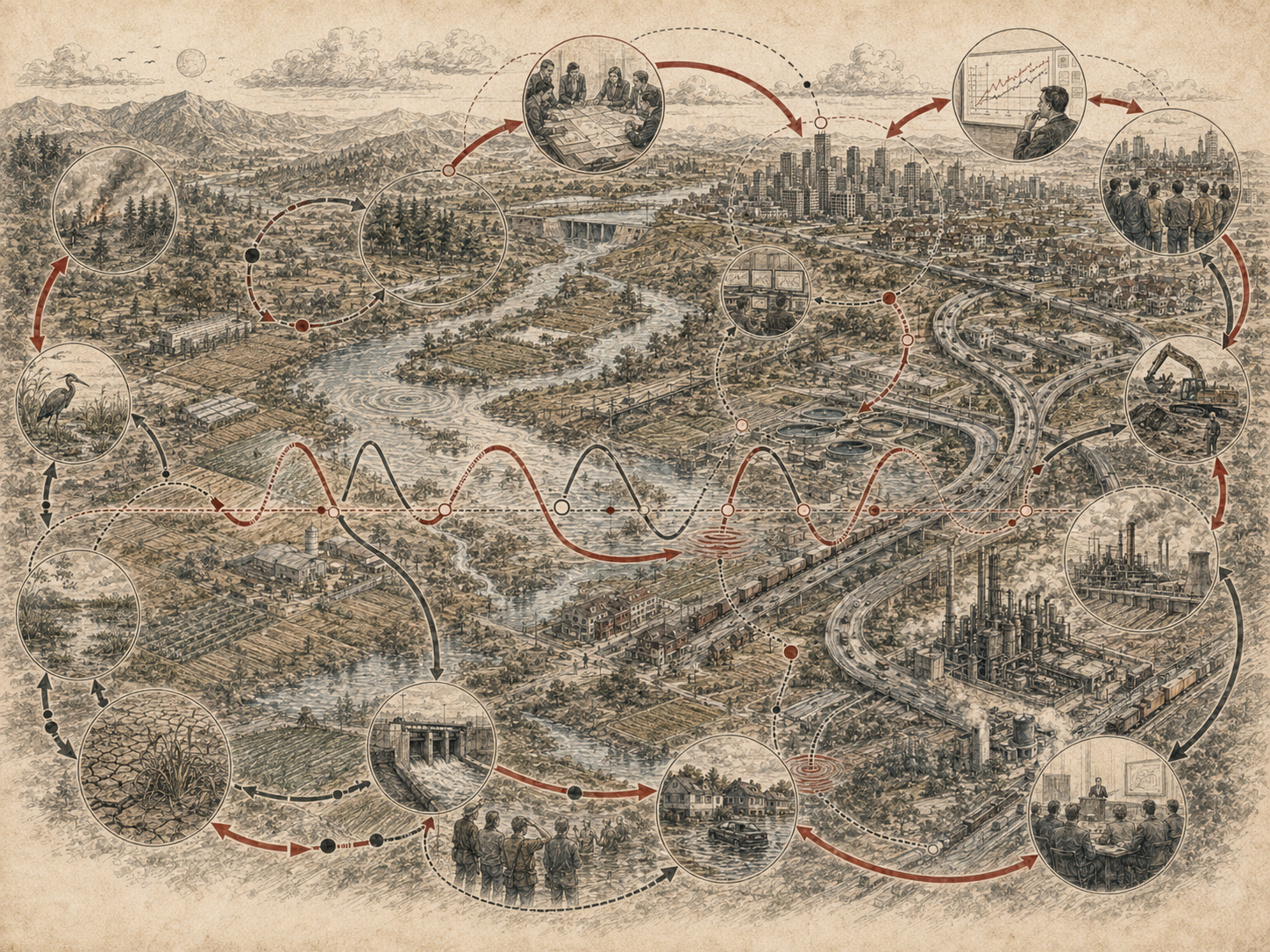
This article examines delays, oscillation, and misperception as central problems in systems thinking. It explains how delays shape feedback loops, why delayed correction can cause systems to overshoot or oscillate, how decision-makers misread delayed effects, and why short-term evidence often produces bad long-term judgment. The article also shows why delay is ethically important: delayed harms are often shifted to people, communities, workers, ecosystems, and future generations with less power to prevent them.
Why Delays Matter in Systems Thinking
A delay is a time gap between one part of a system and another. It may occur between action and effect, observation and reporting, decision and implementation, investment and benefit, harm and recognition, warning and response, or reform and visible change. In systems thinking, delay is not a minor detail. It is often a central cause of system misbehavior.
Delays matter because feedback is useful only when it arrives in time to inform correction. If feedback arrives late, decision-makers may act on outdated information. If consequences appear slowly, harmful practices may continue. If benefits appear slowly, valuable reforms may be abandoned. If damage accumulates invisibly, a system may look healthy until it has already crossed a threshold.
Many systems are difficult to govern because their most important feedback is delayed. Climate systems, infrastructure systems, public-health systems, educational systems, labor systems, financial systems, ecological systems, and institutional systems all contain delay. People often prefer immediate evidence, but the system may be governed by long causal chains.
| Delay problem | Systems effect | Example |
|---|---|---|
| Action-effect delay | Consequences appear long after the original action. | Carbon emissions, infrastructure neglect, soil degradation. |
| Information delay | Decision-makers receive late or incomplete signals. | Delayed reporting, outdated dashboards, slow public-health surveillance. |
| Implementation delay | Policy or organizational decisions take time to affect practice. | Hiring, reform rollout, infrastructure repair, curriculum change. |
| Perception delay | People recognize a problem only after it has accumulated. | Burnout, public distrust, debt, maintenance backlog. |
| Recovery delay | Repair takes longer than damage. | Ecosystem restoration, institutional trust, workforce rebuilding. |
Delays create a gap between the system’s real condition and the system’s perceived condition. This gap is dangerous. A leader may believe a reform has failed because results are not visible yet. A government may believe a risk is manageable because damage has not appeared yet. An organization may believe workload is sustainable because people have not yet resigned. A community may appear stable while ecological, financial, or social reserves are being depleted.
Systems thinking therefore treats delay as part of causality. The question is not only what caused the outcome. It is how long the causal pathway took, when the signal appeared, who received it, and whether the response came early enough to matter.
Types of Delay
Delays take many forms. A serious systems analysis should distinguish among them because different delays require different interventions. Some delays are physical. Some are institutional. Some are cognitive. Some are political. Some are ecological. Some are built into measurement systems. Others are created by power, bureaucracy, denial, or exclusion.
Material delays occur because physical processes take time. Water moves through watersheds. Heat accumulates in climate systems. Buildings age. Soil regenerates slowly. Infrastructure repair requires labor, materials, and coordination. These delays cannot be eliminated entirely, but they can be anticipated.
Information delays occur when signals about the system arrive late. Data may be collected slowly, reported quarterly, buried in fragmented systems, filtered through hierarchy, or ignored because it is inconvenient. Information delay can cause organizations and governments to respond to yesterday’s system rather than today’s.
Decision delays occur when institutions take time to interpret information, assign responsibility, secure approval, allocate resources, and authorize action. Decision delay is often shaped by governance design, bureaucracy, politics, risk avoidance, legal review, funding cycles, and professional jurisdiction.
Implementation delays occur after a decision has been made. Hiring takes time. Construction takes time. Training takes time. Policy implementation takes time. Technology integration takes time. Cultural change takes time. A decision is not the same as a changed system.
Perception delays occur when people do not recognize the meaning of a pattern until late. Workers may normalize overload. Residents may gradually adapt to declining service. Leaders may underestimate distrust. Institutions may dismiss early warnings as isolated complaints.
Recovery delays occur because repair often takes longer than damage. Trust is easier to lose than rebuild. Experienced workers are easier to lose than replace. Ecosystems can degrade faster than they regenerate. Infrastructure can fail suddenly after decades of neglect.
| Delay type | Core question | Potential response |
|---|---|---|
| Material delay | How long does the physical process take? | Design for lead time, buffers, redundancy, and early action. |
| Information delay | How long does it take to know what is happening? | Improve monitoring, reporting, data integration, and frontline feedback. |
| Decision delay | How long does it take to authorize response? | Clarify authority, shorten escalation paths, and predefine triggers. |
| Implementation delay | How long does action take to change system behavior? | Plan staged rollout, capacity building, and adaptive evaluation. |
| Perception delay | How long does it take for people to recognize the pattern? | Use behavior-over-time analysis, stakeholder evidence, and early indicators. |
| Recovery delay | How long does repair take? | Protect reserves, prevent irreversible damage, and invest before collapse. |
Not every delay is harmful. Some delays protect systems from overreaction. Judicial review, public consultation, ecological recovery periods, safety testing, and deliberative governance can be necessary. The issue is not whether all delay should be eliminated. The issue is whether the delay is understood, justified, visible, and governed responsibly.
Systems thinking asks which delays are necessary, which are harmful, which are hidden, and which are being used to avoid responsibility.
Delayed Feedback and System Behavior
Feedback allows a system to adjust. Delayed feedback makes adjustment difficult. If the system receives information too late, it may correct too slowly, overcorrect, or respond to conditions that no longer exist. Delayed feedback is one of the major causes of oscillation, overshoot, instability, and policy resistance.
Consider a hiring system. Workload rises. Workers become overloaded. Managers eventually notice stress or declining quality. A request for hiring is submitted. Approval takes time. Recruiting takes time. Onboarding takes time. New staff take time to become effective. By the time capacity arrives, experienced workers may already have burned out or left. The delay between workload increase and effective capacity can produce repeated cycles of overload and recovery.
Delayed feedback also affects public policy. If a government responds to economic indicators that lag behind current conditions, it may stimulate or tighten too late. If a city responds to flood risk only after repeated disasters, land use and infrastructure vulnerability may already be locked in. If an agency responds to public distrust only after a crisis, years of unaddressed experience may have accumulated.
x_{t+1} = x_t + k(G – x_{t-d})
\]
Interpretation: A delayed feedback system adjusts the current state \(x_t\) based on a past observation \(x_{t-d}\). When the delay \(d\) is large, correction may be late, excessive, or unstable.
The danger of delayed feedback is that actors may believe they are responding rationally. They are using the information available to them. But if the information reflects a past system state, the response may be poorly timed. This is why better dashboards alone do not solve delay. The issue is not only data visibility. It is whether the information is timely, meaningful, connected to authority, and interpreted with an understanding of system dynamics.
Delayed feedback can create several recurring problems:
- continued harmful action because damage is not yet visible;
- premature abandonment of effective interventions because benefits are delayed;
- overcorrection because the system responds after conditions have already changed;
- false confidence because accumulated risk has not yet surfaced;
- underinvestment in prevention because avoided harm is hard to see;
- misplaced blame because the visible trigger appears long after the structural cause.
Systems thinking therefore asks not only whether feedback exists, but whether feedback arrives in time to support learning and correction.
Oscillation and Overcorrection
Oscillation occurs when a system moves back and forth around a goal, target, or equilibrium. Oscillation often appears in balancing feedback loops with delay. The system tries to correct a gap, but because information or response is delayed, the correction arrives too late or too strongly. The result is repeated overshooting in one direction and then the other.
Inventory systems are a classic example. If demand rises, a company may order more inventory. But if orders are based on delayed demand signals, the company may order too much. Inventory rises above the desired level, so the company cuts orders. But if the reduction is delayed, inventory may fall too far. The system cycles between shortage and surplus.
Organizations can oscillate in staffing. A team becomes overloaded. Hiring is approved after delay. New staff arrive after demand has shifted or after experienced people have left. The organization may overhire, freeze hiring, then face overload again. The cycle repeats because correction is always lagging the real system state.
Public policy can oscillate too. A government may respond to crisis with strict controls, then relax them when visible pressure decreases, then tighten again when consequences reappear. Without understanding delay, policy becomes reactive and unstable.
e_t = G – x_t
\]
Interpretation: The error \(e_t\) is the gap between a goal \(G\) and the current state \(x_t\). In delayed systems, correction may respond to an old error rather than the current one.
Oscillation is not always a sign of irrationality. It can be the rational outcome of delayed feedback. Actors may be trying to correct the system, but the system’s timing undermines them. This is why blaming individual decision-makers can miss the deeper structure. The problem may be the delay between detection, decision, implementation, and effect.
Oscillation can be reduced by:
- shortening information delays;
- improving early-warning indicators;
- reducing implementation lead times;
- using smaller and more frequent adjustments;
- building buffers and reserves;
- tracking stocks, not just flows;
- avoiding overreaction to short-term variation;
- aligning decision cycles with system response times.
Systems thinking helps distinguish oscillation caused by changing external conditions from oscillation caused by the system’s own delayed correction. In the second case, the system is generating its own instability.
Overshoot and Collapse
Overshoot occurs when a system moves beyond a sustainable limit because feedback about the limit arrives too late. Collapse can follow when the system damages the conditions that support it. Overshoot is one of the most serious delay-driven patterns in systems thinking.
Overshoot often involves reinforcing growth combined with delayed balancing feedback. Growth continues because constraints are not yet visible. By the time the constraint appears, the system has already exceeded sustainable capacity. The correction may then be severe, costly, or irreversible.
Ecological systems make this pattern visible. A population may grow while resources appear abundant. If resource depletion is delayed or hidden, growth can continue beyond carrying capacity. Once the resource base is damaged, the population may decline sharply. The same logic can appear in fisheries, forests, soil systems, groundwater use, carbon emissions, and biodiversity loss.
Organizations also overshoot. A company may keep accepting work because demand is strong. Revenue rises, reputation improves, and growth reinforces itself. But coordination capacity, staffing, culture, quality control, and leadership attention may lag behind. By the time quality problems, burnout, and customer dissatisfaction become visible, the organization may have overextended itself.
x_{t+1} = x_t + r x_t\left(1 – \frac{x_{t-d}}{K}\right)
\]
Interpretation: This simplified delayed-limit model shows growth responding to a past perception of capacity. If the system perceives the limit \(K\) too late, overshoot can occur.
Overshoot is dangerous because short-term success can be part of the problem. Growth may look healthy while it is consuming reserves. Production may look efficient while maintenance is deferred. Public budgets may look balanced while infrastructure deteriorates. A workforce may look productive while exhaustion accumulates. A platform may look successful while trust and social cohesion erode.
Overshoot analysis asks:
- What limit is being approached?
- Is the limit visible or hidden?
- How long does it take for feedback about the limit to appear?
- What reinforcing loop is driving growth?
- What balancing loop should constrain growth?
- Is correction delayed until damage occurs?
- Can the system recover if the limit is crossed?
The ethical issue is clear: overshoot often allows present actors to benefit while future actors inherit damage. Delayed limits create delayed responsibility. Systems thinking makes that delay visible before collapse becomes the teacher.
Misperception of Feedback
Misperception of feedback occurs when people misunderstand the relationship between their actions and system outcomes. Delays make misperception more likely because causes and effects are separated in time. When feedback is delayed, people may attribute outcomes to the wrong causes, underestimate the consequences of their actions, or fail to see that their own interventions are producing the pattern they want to eliminate.
People often expect systems to respond quickly and proportionally. If an intervention is effective, they expect improvement soon. If a practice is harmful, they expect harm to appear clearly. But many systems do not behave that way. Effects may be delayed, dispersed, indirect, nonlinear, or masked by other variables. This creates room for false learning.
False learning happens when a system teaches the wrong lesson. A city may widen roads and see congestion decline briefly, concluding that road expansion works. Years later, induced demand restores congestion, but the delayed consequence is attributed to population growth rather than the intervention. An organization may use overtime to meet deadlines, concluding that pressure works. Months later, burnout and turnover rise, but the cause is attributed to weak commitment rather than overuse of human capacity.
Misperception of feedback is common when:
- effects are delayed beyond the decision cycle;
- multiple causes operate at once;
- short-term and long-term effects move in opposite directions;
- success is measured too narrowly;
- costs are externalized outside the system boundary;
- stakeholders harmed by delayed consequences lack voice;
- leaders rotate before long-term consequences appear;
- institutions reward short-term visible results.
\text{Perceived Effect}_t \neq \text{Actual Effect}_{t+d}
\]
Interpretation: The effect perceived at time \(t\) may differ from the actual consequence that appears after delay \(d\). Misperception arises when judgment is based on the early signal alone.
Misperception can become institutionalized. Metrics may capture short-term outputs while ignoring long-term outcomes. Budget cycles may reward immediate savings while hiding future costs. Political cycles may reward visible projects over preventive maintenance. Business models may reward engagement while ignoring social harm. The system then repeatedly teaches decision-makers to favor actions whose harms appear too late to affect the original decision.
Systems thinking counters misperception by extending time horizons, tracking accumulations, mapping feedback loops, including affected stakeholders, and asking how the system might behave after delays unfold.
Policy Timing and Premature Judgment
Policy timing is a systems problem because interventions take time to produce effects. A policy may be judged too early, too late, or with the wrong indicators. If judged too early, a beneficial policy may appear ineffective. If judged too late, a harmful policy may be allowed to do damage. If judged with narrow indicators, a policy may appear successful while shifting costs elsewhere.
Premature judgment is especially common when implementation delay is long. A workforce development program may take years to affect employment outcomes. Early evaluation may show little change, even though capacity is developing. A public-health intervention may prevent future harm that is difficult to observe because the avoided crisis never occurs. A climate adaptation strategy may look expensive until delayed risk is considered. A trust-building reform may require repeated reliable performance before public confidence changes.
Delayed benefits create political vulnerability. Preventive work is often undervalued because success appears as non-event: a bridge that does not collapse, an outbreak that does not spread, a worker who does not burn out, an ecosystem that does not cross a threshold. Systems with short evaluation cycles may underinvest in prevention because prevention does not produce dramatic visible proof.
Delayed harms create the opposite problem. A policy may appear successful because negative consequences have not yet appeared. Cost cutting may improve a budget while increasing future failure risk. Performance pressure may increase output while eroding trust, quality, and workforce capacity. Development may increase tax revenue while worsening flood exposure or displacement. Technology deployment may improve efficiency while weakening accountability, privacy, or public trust.
| Timing error | What happens | Systems risk |
|---|---|---|
| Judging too early | Benefits have not appeared yet. | Effective interventions may be abandoned prematurely. |
| Judging too late | Damage has already accumulated. | Correction becomes expensive, difficult, or impossible. |
| Judging too narrowly | Only immediate or internal metrics are counted. | Externalized costs and long-term harms remain hidden. |
| Judging at the wrong level | System-level effects are evaluated using local or short-term indicators. | The intervention may look successful at one level while failing at another. |
Better policy timing requires matching evaluation to system dynamics. Some outcomes should be monitored immediately. Others require intermediate indicators, leading indicators, delayed outcome measures, and long-term review. Systems thinking asks what should change first, what should change later, and what would count as meaningful evidence at each stage.
Good governance does not merely ask whether a policy worked. It asks whether the evaluation occurred at the right time horizon for the system being changed.
Hidden Accumulation and Late Visibility
Many delays matter because something is accumulating invisibly. A stock builds up or depletes over time, but the change may not be noticed until it produces a visible event. Hidden accumulation is one of the main reasons systems appear stable before sudden crisis.
A maintenance backlog may accumulate for years before bridges, pipes, roads, or buildings fail. Public distrust may accumulate through repeated small failures before a public legitimacy crisis. Worker fatigue may accumulate before resignations increase. Debt may accumulate before financial distress. Carbon may accumulate before climate effects intensify. Soil degradation may accumulate before productivity declines. Institutional knowledge may quietly erode through turnover before the organization realizes it has lost capacity.
Stocks are often harder to see than flows. A flow is an activity rate: spending, hiring, emissions, complaints, production, service requests, repairs. A stock is the accumulated condition: debt, workforce capacity, carbon concentration, backlog, trust, fatigue, biodiversity, institutional memory. Systems are often misread because decision-makers track flows while ignoring stocks.
S_{t+1} = S_t + I_t – O_t
\]
Interpretation: A stock \(S\) changes through inflows \(I\) and outflows \(O\). Hidden accumulation occurs when the stock changes faster than the system recognizes or responds.
Late visibility creates causal confusion. When a crisis finally appears, observers may attribute it to the most recent trigger. A storm caused the flood. A resignation caused the staffing crisis. A scandal caused distrust. A broken component caused the outage. The trigger matters, but the accumulated condition often explains vulnerability.
Systems thinking asks:
- What stock has been accumulating or depleting?
- What flows are changing that stock?
- Is the stock directly measured?
- Who notices changes in the stock first?
- What early-warning indicators exist?
- When does the stock become visible to decision-makers?
- What happens if response waits until visibility is undeniable?
Hidden accumulation is a warning against governing only by visible events. A system may look calm not because it is healthy, but because its most important changes have not yet surfaced.
Ethics, Power, and Delayed Consequences
Delays are ethically important because delayed consequences are often distributed unequally. Those who benefit from a decision may not be the people who later bear its costs. Those with authority may leave before consequences appear. Those harmed may lack voice when early warnings arise. Future generations, ecosystems, low-income communities, frontline workers, and politically marginalized groups often absorb delayed costs created elsewhere.
Deferred maintenance is an ethical problem because present budgets may look responsible while future users inherit risk. Carbon emissions are an ethical problem because present energy systems create future climate harm. Workforce depletion is an ethical problem because organizations may consume human capacity while calling it productivity. Public distrust is an ethical problem because institutions may ignore early feedback until the people harmed by the system no longer believe correction is possible.
Delay can become a strategy of avoidance. Institutions may postpone action until evidence is undeniable, but undeniable evidence often arrives after harm has accumulated. They may demand more data from affected communities while continuing the system that produces harm. They may frame delay as caution while the cost of waiting falls on others. They may treat slow violence as uncertainty.
Ethical delay analysis asks:
- Who benefits before the delayed consequences appear?
- Who pays when they do appear?
- Who has authority to act early?
- Who lacks power to force early response?
- What harms are being deferred?
- What forms of evidence are dismissed as premature?
- What would prevention require?
- What obligations exist to future people and ecological systems?
Power determines whose feedback is treated as urgent. A financial signal may trigger immediate response. A community complaint may be delayed, studied, deferred, or dismissed. A workforce warning may be ignored until turnover appears in metrics. An ecological signal may be discounted until restoration becomes far more difficult.
Systems thinking should therefore make delayed consequences visible before they become irreversible. Delay is not merely a technical lag. It is often where responsibility is hidden.
Examples Across Systems
Delays, oscillation, and misperception appear across many systems. The examples below show how timing changes interpretation and intervention.
Public health
Public-health systems contain delays between exposure, illness, diagnosis, reporting, public response, and outcome. If surveillance is slow, decision-makers may respond after spread has already accelerated. If trust has eroded over years, emergency communication may fail even when information is accurate. Delayed feedback can turn manageable risks into crises.
Infrastructure
Infrastructure systems are shaped by long delays between maintenance neglect and failure. A road, pipe, bridge, or grid component may appear functional while risk accumulates. Budget savings from deferral are immediate; failure costs are delayed. This creates a dangerous incentive to underinvest in prevention.
Organizations
Organizations often misread workload delays. Teams can absorb pressure temporarily. Output may remain high while fatigue accumulates. Leaders may assume the system is working because deadlines are met. Months later, errors, conflict, disengagement, and resignations appear. The delayed consequence is then misattributed to attitude, culture, or individual weakness rather than accumulated overload.
Education
Educational interventions often have delayed effects. Early childhood support, literacy development, mentoring, belonging, and family stability may shape outcomes years later. Conversely, exclusionary discipline, chronic stress, unstable housing, and repeated failure may accumulate before appearing in graduation, employment, or health outcomes. Short evaluation windows can misread both harm and benefit.
Artificial intelligence systems
AI systems can contain delayed feedback between deployment and harm. A model may appear accurate in testing but produce downstream consequences through user behavior, institutional reliance, automation bias, data drift, or appeal failure. Harm may appear only after repeated decisions accumulate across people, institutions, and time.
Climate and ecology
Climate and ecological systems are defined by delay. Emissions accumulate before effects are fully realized. Biodiversity loss may remain hidden until ecosystem function weakens. Wetlands, forests, soils, and watersheds can absorb stress for a time, creating false confidence, then shift rapidly after thresholds are crossed.
Economic systems
Economic systems often oscillate because decisions respond to delayed information. Hiring, investment, inventories, interest rates, housing supply, and consumer demand can all move with lag. Overbuilding, underbuilding, boom-bust cycles, and delayed policy correction reflect feedback systems that act on past signals.
Across these domains, delay is not a peripheral issue. It is often the structure that explains why reasonable actors produce unreasonable system behavior.
Mathematics, Computation, and Modeling
Delays, oscillation, and misperception can be studied through behavior-over-time graphs, stock-flow models, delayed feedback equations, scenario analysis, time-series analysis, sensitivity testing, and simulation. Modeling is useful because delayed systems are often counterintuitive. A system may become unstable not because actors are irrational, but because the feedback they receive is late.
A simple delayed feedback model can be represented as:
x_{t+1} = x_t + k(G – x_{t-d})
\]
Interpretation: The system adjusts the current state \(x_t\) toward a goal \(G\) using delayed information \(x_{t-d}\). Larger delays can increase oscillation and instability.
A stock-flow model of hidden accumulation can be represented as:
\frac{dS}{dt} = I(t) – O(t)
\]
Interpretation: The stock \(S\) changes through inflows \(I(t)\) and outflows \(O(t)\). If the stock is not measured directly, accumulation may remain hidden until a threshold is crossed.
A simple oscillatory system can be represented conceptually as:
x_{t+2} – 2x_{t+1} + x_t \neq 0
\]
Interpretation: Changes in the direction or rate of movement across time can indicate oscillation. Analysts should examine whether delayed correction is producing repeated swings.
A misperception gap can be represented as:
M_t = X_t – P_t
\]
Interpretation: The misperception gap \(M_t\) is the difference between the actual system condition \(X_t\) and the perceived condition \(P_t\). Large gaps can produce poor decisions.
Delay modeling can support several analytical tasks:
| Modeling task | Delay question | Example use |
|---|---|---|
| Delay simulation | How does response time affect stability? | Testing hiring, inventory, maintenance, water management, or policy response. |
| Oscillation analysis | Does delayed correction cause repeated swings? | Studying boom-bust cycles, staffing cycles, demand-response cycles, or overcorrection. |
| Stock-flow modeling | What is accumulating before visible crisis? | Modeling backlog, fatigue, trust, carbon, debt, knowledge loss, or ecological stress. |
| Scenario comparison | How do early, late, and delayed interventions differ? | Comparing prevention, crisis response, and post-failure recovery. |
| Sensitivity analysis | Which delays matter most? | Testing reporting lag, approval time, implementation time, and recovery time. |
| Perception-gap analysis | How far is perceived system state from actual state? | Comparing dashboard indicators, frontline evidence, stakeholder reports, and delayed outcomes. |
Computational models should be used carefully. Delay models can clarify timing and structure, but they can also hide uncertainty, power, lived experience, and ecological complexity. A model may show that earlier action would reduce harm, but ethical and institutional analysis is still needed to ask why early warnings were ignored and who had the authority to respond.
Python Workflow: Delay, Oscillation, Hidden Accumulation, and Timing Diagnostics
The Python workflow below turns delay analysis into a small reproducible model. It compares four scenarios: late recognition, delayed correction, early warning, and accountable prevention. The script uses only the Python standard library, writes CSV outputs relative to the article folder, and is designed as a clear starting point for companion repository work.
# delay_oscillation_misperception_workflow.py
# Dependency-light workflow for delayed feedback, oscillation, overshoot,
# hidden accumulation, perception gaps, and policy timing.
# Writes outputs relative to the article root.

from __future__ import annotations

from dataclasses import dataclass
from pathlib import Path
import csv
from statistics import mean

ARTICLE_ROOT = Path(__file__).resolve().parents[1]
TABLES = ARTICLE_ROOT / "outputs" / "tables"


@dataclass
class DelayScenario:
    name: str
    information_delay: float
    decision_delay: float
    implementation_delay: float
    feedback_accuracy: float
    early_warning_capacity: float
    buffer_capacity: float
    accountability: float
    accumulation_pressure: float


def clamp(value: float, low: float = 0.0, high: float = 120.0) -> float:
    return max(low, min(high, value))


def run_scenario(scenario: DelayScenario, periods: int = 48) -> list[dict[str, object]]:
    actual_stock = scenario.accumulation_pressure * 48.0
    perceived_stock = actual_stock * (0.60 + scenario.feedback_accuracy * 0.20)
    buffer_stock = 28.0 + scenario.buffer_capacity * 38.0
    response_capacity = 34.0 + scenario.early_warning_capacity * 26.0
    policy_memory = scenario.accountability * 36.0
    history: list[float] = [actual_stock]
    rows: list[dict[str, object]] = []

    total_delay = scenario.information_delay + scenario.decision_delay + scenario.implementation_delay
    delay_steps = max(0, int(round(total_delay * 4.0)))

    for period in range(periods + 1):
        delay_index = max(0, len(history) - 1 - delay_steps)
        delayed_observation = history[delay_index]

        perceived_stock = clamp(
            perceived_stock
            + scenario.feedback_accuracy * 0.18 * (delayed_observation - perceived_stock)
            + scenario.early_warning_capacity * 0.06 * (actual_stock - perceived_stock),
            0.0,
            120.0
        )

        misperception_gap = actual_stock - perceived_stock

        warning_signal = clamp(
            scenario.early_warning_capacity * 28.0
            + scenario.feedback_accuracy * 18.0
            + max(0.0, perceived_stock - 45.0) * 0.22
            + policy_memory * 0.07
            - total_delay * 4.0,
            0.0,
            100.0
        )

        correction_response = clamp(
            response_capacity * 0.22
            + warning_signal * 0.20
            + scenario.accountability * 14.0
            + scenario.buffer_capacity * 10.0
            - max(0.0, misperception_gap) * 0.08
            - total_delay * 5.0,
            0.0,
            100.0
        )

        accumulation_flow = clamp(
            scenario.accumulation_pressure * 18.0
            + max(0.0, 55.0 - correction_response) * 0.22
            + max(0.0, 40.0 - buffer_stock) * 0.12
            - scenario.accountability * 3.0,
            0.0,
            100.0
        )

        overshoot_risk = clamp(
            max(0.0, actual_stock - buffer_stock) * 0.42
            + total_delay * 9.0
            + max(0.0, misperception_gap) * 0.18
            - scenario.early_warning_capacity * 5.0
            - scenario.accountability * 3.5,
            0.0,
            100.0
        )

        oscillation_pressure = clamp(
            total_delay * 10.0
            + abs(misperception_gap) * 0.14
            + correction_response * 0.08
            - scenario.feedback_accuracy * 4.0
            - scenario.buffer_capacity * 3.0,
            0.0,
            100.0
        )

        actual_stock = clamp(
            actual_stock
            + accumulation_flow * 0.18
            - correction_response * 0.14
            - buffer_stock * 0.035,
            0.0,
            120.0
        )

        buffer_stock = clamp(
            buffer_stock
            + scenario.buffer_capacity * 2.2
            + scenario.accountability * 1.6
            - overshoot_risk * 0.06
            - actual_stock * 0.025,
            0.0,
            100.0
        )

        response_capacity = clamp(
            response_capacity
            + scenario.early_warning_capacity * 2.0
            + scenario.feedback_accuracy * 1.6
            + scenario.accountability * 1.4
            - total_delay * 0.9
            - overshoot_risk * 0.04,
            0.0,
            100.0
        )

        policy_memory = clamp(
            policy_memory
            + scenario.accountability * 1.9
            + warning_signal * 0.05
            - overshoot_risk * 0.04,
            0.0,
            100.0
        )

        delay_health_score = clamp(
            response_capacity * 0.22
            + buffer_stock * 0.22
            + warning_signal * 0.18
            + policy_memory * 0.16
            + scenario.accountability * 12.0
            - overshoot_risk * 0.18
            - oscillation_pressure * 0.12
            - abs(misperception_gap) * 0.10,
            0.0,
            100.0
        )

        rows.append({
            "period": period,
            "scenario": scenario.name,
            "actual_stock": round(actual_stock, 3),
            "perceived_stock": round(perceived_stock, 3),
            "misperception_gap": round(misperception_gap, 3),
            "delayed_observation": round(delayed_observation, 3),
            "warning_signal": round(warning_signal, 3),
            "correction_response": round(correction_response, 3),
            "accumulation_flow": round(accumulation_flow, 3),
            "buffer_stock": round(buffer_stock, 3),
            "overshoot_risk": round(overshoot_risk, 3),
            "oscillation_pressure": round(oscillation_pressure, 3),
            "response_capacity": round(response_capacity, 3),
            "delay_health_score": round(delay_health_score, 3),
        })

        history.append(actual_stock)

    return rows


def write_csv(path: Path, rows: list[dict[str, object]]) -> None:
    path.parent.mkdir(parents=True, exist_ok=True)
    if not rows:
        raise ValueError(f"No rows to write: {path}")
    with path.open("w", newline="", encoding="utf-8") as handle:
        writer = csv.DictWriter(handle, fieldnames=list(rows[0].keys()))
        writer.writeheader()
        writer.writerows(rows)


def summarize(rows: list[dict[str, object]]) -> list[dict[str, object]]:
    output: list[dict[str, object]] = []
    for scenario_name in sorted({row["scenario"] for row in rows}):
        subset = [row for row in rows if row["scenario"] == scenario_name]
        final = subset[-1]
        avg_overshoot = mean(float(row["overshoot_risk"]) for row in subset)
        avg_oscillation = mean(float(row["oscillation_pressure"]) for row in subset)
        avg_gap = mean(abs(float(row["misperception_gap"])) for row in subset)
        avg_health = mean(float(row["delay_health_score"]) for row in subset)

        if float(final["delay_health_score"]) >= 65 and float(final["overshoot_risk"]) <= 35:
            diagnostic = "timely feedback with accountable delay governance"
        elif avg_overshoot >= 55:
            diagnostic = "overshoot risk is high because correction arrives late"
        elif avg_oscillation >= 55:
            diagnostic = "delayed correction is producing oscillation pressure"
        elif avg_gap >= 35:
            diagnostic = "misperception gap remains large"
        elif avg_health >= 55:
            diagnostic = "partial delay governance with remaining timing risk"
        else:
            diagnostic = "weak delay awareness; hidden accumulation likely"

        output.append({
            "scenario": scenario_name,
            "final_delay_health_score": final["delay_health_score"],
            "final_actual_stock": final["actual_stock"],
            "final_misperception_gap": final["misperception_gap"],
            "final_overshoot_risk": final["overshoot_risk"],
            "final_oscillation_pressure": final["oscillation_pressure"],
            "average_overshoot_risk": round(avg_overshoot, 3),
            "average_oscillation_pressure": round(avg_oscillation, 3),
            "average_abs_misperception_gap": round(avg_gap, 3),
            "average_delay_health_score": round(avg_health, 3),
            "diagnostic": diagnostic,
        })

    return output


def main() -> None:
    scenarios = [
        DelayScenario("Late recognition", 0.78, 0.70, 0.62, 0.34, 0.24, 0.28, 0.24, 0.76),
        DelayScenario("Delayed correction", 0.62, 0.64, 0.70, 0.52, 0.46, 0.42, 0.42, 0.60),
        DelayScenario("Early warning system", 0.34, 0.42, 0.50, 0.70, 0.76, 0.62, 0.62, 0.42),
        DelayScenario("Accountable prevention", 0.22, 0.28, 0.34, 0.82, 0.84, 0.80, 0.82, 0.30),
    ]

    rows: list[dict[str, object]] = []
    for scenario in scenarios:
        rows.extend(run_scenario(scenario))

    write_csv(TABLES / "delay_oscillation_misperception_timeseries.csv", rows)
    write_csv(TABLES / "delay_oscillation_misperception_summary.csv", summarize(rows))

    print("Delay, oscillation, and misperception workflow complete.")
    print(TABLES / "delay_oscillation_misperception_timeseries.csv")


if __name__ == "__main__":
    main()
The workflow is intentionally simple enough to inspect. It shows how information, decision, and implementation delays can widen the gap between actual and perceived system conditions, increase overshoot risk, and create oscillation pressure. It also shows how early-warning capacity, buffers, feedback accuracy, and accountability can improve delay governance. The model is synthetic and illustrative; it supports disciplined inquiry rather than replacing domain expertise, stakeholder evidence, or ethical judgment.
R Workflow: Delay Dynamics Summary and Visualization
The R workflow reads the Python-generated time-series output, creates scenario summaries, and exports base R plots for actual stock, perceived stock, misperception gap, overshoot risk, oscillation pressure, and delay health. It uses only base R so it remains portable across simple local environments.
# delay_oscillation_misperception_diagnostics.R
# Base R workflow for delay dynamics summary and visualization.

args <- commandArgs(trailingOnly = FALSE)
file_arg <- grep("^--file=", args, value = TRUE)

if (length(file_arg) > 0) {
  script_path <- normalizePath(sub("^--file=", "", file_arg[1]), mustWork = TRUE)
  article_root <- normalizePath(file.path(dirname(script_path), ".."), mustWork = TRUE)
} else {
  article_root <- getwd()
}

setwd(article_root)

tables_dir <- file.path(article_root, "outputs", "tables")
figures_dir <- file.path(article_root, "outputs", "figures")

if (!dir.exists(tables_dir)) {
  dir.create(tables_dir, recursive = TRUE)
}

if (!dir.exists(figures_dir)) {
  dir.create(figures_dir, recursive = TRUE)
}

timeseries_path <- file.path(tables_dir, "delay_oscillation_misperception_timeseries.csv")

if (!file.exists(timeseries_path)) {
  stop(paste("Missing", timeseries_path, "Run the Python workflow first."))
}

data <- read.csv(timeseries_path, stringsAsFactors = FALSE)

last_by_scenario <- do.call(
  rbind,
  lapply(split(data, data$scenario), function(df) df[nrow(df), ])
)

avg_overshoot <- aggregate(overshoot_risk ~ scenario, data = data, FUN = mean)
avg_oscillation <- aggregate(oscillation_pressure ~ scenario, data = data, FUN = mean)
avg_gap <- aggregate(abs(misperception_gap) ~ scenario, data = data, FUN = mean)
avg_health <- aggregate(delay_health_score ~ scenario, data = data, FUN = mean)

names(avg_overshoot)[2] <- "average_overshoot_risk"
names(avg_oscillation)[2] <- "average_oscillation_pressure"
names(avg_gap)[2] <- "average_abs_misperception_gap"
names(avg_health)[2] <- "average_delay_health_score"

final_fields <- last_by_scenario[, c(
  "scenario",
  "delay_health_score",
  "actual_stock",
  "misperception_gap",
  "overshoot_risk",
  "oscillation_pressure"
)]

names(final_fields) <- c(
  "scenario",
  "final_delay_health_score",
  "final_actual_stock",
  "final_misperception_gap",
  "final_overshoot_risk",
  "final_oscillation_pressure"
)

summary_table <- Reduce(
  function(x, y) merge(x, y, by = "scenario"),
  list(avg_overshoot, avg_oscillation, avg_gap, avg_health, final_fields)
)

summary_table$diagnostic <- ifelse(
  summary_table$final_delay_health_score >= 65 &
    summary_table$final_overshoot_risk <= 35,
  "timely feedback with accountable delay governance",
  ifelse(
    summary_table$average_overshoot_risk >= 55,
    "overshoot risk is high because correction arrives late",
    ifelse(
      summary_table$average_oscillation_pressure >= 55,
      "delayed correction is producing oscillation pressure",
      ifelse(
        summary_table$average_abs_misperception_gap >= 35,
        "misperception gap remains large",
        ifelse(
          summary_table$average_delay_health_score >= 55,
          "partial delay governance with remaining timing risk",
          "weak delay awareness; hidden accumulation likely"
        )
      )
    )
  )
)

write.csv(
  summary_table,
  file.path(tables_dir, "delay_oscillation_misperception_r_summary.csv"),
  row.names = FALSE
)

plot_metric <- function(metric, label, file_name) {
  png(file.path(figures_dir, file_name), width = 1200, height = 700)
  scenarios <- unique(data$scenario)
  plot(
    NA,
    xlim = range(data$period),
    ylim = range(data[[metric]], na.rm = TRUE),
    xlab = "Period",
    ylab = label,
    main = paste(label, "by Scenario")
  )
  for (scenario_name in scenarios) {
    subset_data <- data[data$scenario == scenario_name, ]
    lines(subset_data$period, subset_data[[metric]], lwd = 2)
  }
  legend("topleft", legend = scenarios, lwd = 2, cex = 0.8, bty = "n")
  grid()
  dev.off()
}

plot_metric("actual_stock", "Actual stock", "actual_stock_trajectories.png")
plot_metric("perceived_stock", "Perceived stock", "perceived_stock_trajectories.png")
plot_metric("misperception_gap", "Misperception gap", "misperception_gap_trajectories.png")
plot_metric("overshoot_risk", "Overshoot risk", "overshoot_risk_trajectories.png")
plot_metric("oscillation_pressure", "Oscillation pressure", "oscillation_pressure_trajectories.png")
plot_metric("delay_health_score", "Delay health score", "delay_health_score_trajectories.png")

print(summary_table)
This workflow supports the article’s central methodological claim: delay should be analyzed as structure, not background. The R outputs help readers see how timing, perception, accumulation, and correction interact over time.
GitHub Repository
The companion repository for this article should help readers explore delay-driven system behavior through delayed feedback simulations, oscillation examples, stock-flow accumulation, perception-gap analysis, policy-timing scenarios, and multi-language systems-analysis scaffolds.
Complete Code Repository
Companion repository for the article, including delayed feedback simulations, oscillation models, misperception-gap analysis, policy-timing scenarios, hidden-accumulation examples, synthetic datasets, documentation notes, and multi-language scaffolds for systems analysis.
articles/delays-oscillation-and-misperception/
├── python/
│   ├── delay_oscillation_misperception_workflow.py
│   ├── delayed_feedback_simulation.py
│   ├── oscillation_model.py
│   ├── overshoot_and_collapse.py
│   ├── misperception_gap_analysis.py
│   ├── policy_timing_scenarios.py
│   ├── hidden_accumulation_model.py
│   ├── validation_checks.py
│   └── run_all_delay_workflows.py
├── r/
│   ├── delay_oscillation_misperception_diagnostics.R
│   ├── delay_response_plots.R
│   ├── oscillation_visualization.R
│   ├── overshoot_scenario_comparison.R
│   ├── perception_gap_tables.R
│   ├── policy_timing_plots.R
│   └── run_all_delay_workflows.R
├── julia/
│   ├── delayed_feedback_dynamics.jl
│   └── nonlinear_oscillation_examples.jl
├── sql/
│   ├── schema_delay_variables.sql
│   ├── schema_feedback_delays.sql
│   ├── schema_policy_timing.sql
│   ├── schema_scenarios.sql
│   ├── schema_indicators.sql
│   └── schema_model_runs.sql
├── rust/
│   └── delay_diagnostics_cli.rs
├── go/
│   └── timing_pathway_utility.go
├── cpp/
│   ├── efficient_delay_model.cpp
│   └── oscillation_simulation.cpp
├── fortran/
│   └── recurrence_delay_dynamics.f90
├── c/
│   └── low_level_delay_simulation.c
├── docs/
│   ├── modeling_principles.md
│   ├── article_notes.md
│   ├── assumptions_and_limitations.md
│   └── responsible_use.md
├── data/
│   ├── synthetic_delay_variables.csv
│   ├── synthetic_feedback_delays.csv
│   ├── synthetic_policy_timing.csv
│   ├── synthetic_scenarios.csv
│   └── synthetic_indicators.csv
├── outputs/
│   ├── figures/
│   └── tables/
└── notebooks/
    ├── python_delay_dynamics_walkthrough.ipynb
    └── r_oscillation_visualization_placeholder.ipynb
This repository structure supports the article’s central argument: delayed feedback changes how systems behave and how people perceive them. The data/ folder separates delay variables, feedback delays, policy-timing scenarios, general scenarios, and indicators. The python/ and r/ folders support delay simulations, oscillation analysis, overshoot modeling, misperception-gap diagnostics, and policy-timing comparisons. The julia/ folder supports dynamic and nonlinear delay examples. The sql/ folder defines schemas for delay variables, feedback delays, policy timing, indicators, scenarios, and model runs. The lower-level language folders provide scaffolds for efficient diagnostics, recurrence modeling, timing pathways, and simulation.
A Practical Method for Delay Analysis
Delay analysis can become practical through a disciplined sequence of questions. The goal is to understand how timing shapes system behavior, interpretation, and intervention.
1. Identify the focal behavior
Begin with the system behavior that needs explanation: backlog, trust, fatigue, emissions, cost, demand, delay, failure, quality, resilience, capacity, or risk. Ask how it changes over time.
2. Map the feedback loop
Identify the causal loop that connects action, consequence, signal, decision, and response. A delay matters most when it sits inside a feedback loop.
3. Locate the delays
Mark where time gaps occur. Separate action-effect delay, information delay, decision delay, implementation delay, perception delay, and recovery delay.
4. Identify what accumulates
Ask what stock is changing while the system waits. Backlog, fatigue, distrust, carbon, debt, maintenance risk, and ecological stress often accumulate invisibly.
5. Compare perceived and actual system state
Ask whether decision-makers are seeing the real current condition or a delayed, partial, filtered, or misleading signal.
6. Look for oscillation
Ask whether the system repeatedly overshoots and corrects. If so, delayed balancing feedback may be producing instability.
7. Look for overshoot
Ask whether reinforcing growth has continued beyond a sustainable limit because the balancing signal arrived late.
8. Match evaluation timing to system timing
Ask when meaningful evidence should appear. Distinguish early indicators, intermediate outcomes, long-term outcomes, and avoided harms.
9. Identify who bears delayed costs
Ask whether delayed consequences fall on people, communities, workers, ecosystems, or future generations who did not benefit from the original decision.
10. Redesign feedback
Improve early warning, reduce reporting delay, shorten decision cycles, build buffers, create staged interventions, protect reserves, and include affected stakeholders whose signals are often ignored.
This method helps prevent systems from learning too late. Delay analysis is ultimately about improving timing, perception, and responsibility.
Common Pitfalls
Delay analysis is powerful, but several pitfalls are common.
- Assuming no visible harm means no harm exists: Many systems accumulate damage before visible crisis. Absence of visible harm may reflect delayed feedback, not safety.
- Judging interventions too early: Some benefits require time. Premature evaluation can cause effective reforms to be abandoned before their effects appear.
- Responding to outdated information: Dashboards, reports, and indicators may represent past conditions. Acting on delayed data can cause overcorrection or mistimed response.
- Ignoring stocks: Flows may look manageable while stocks are worsening. Tracking activity rates without tracking accumulation can hide system deterioration.
- Confusing triggers with accumulated causes: The event that reveals a problem may not be the main cause. Delayed accumulation often explains why the trigger produced severe consequences.
- Overcorrecting after delayed recognition: When systems respond late, they may respond too strongly. Overcorrection can create oscillation and instability.
- Using short-term metrics for long-term systems: Some systems require years or decades to evaluate. Short-term metrics can reward harmful practices and punish preventive ones.
- Ignoring unequal exposure to delayed harm: Delayed consequences are often shifted onto people with less power. Systems thinking should identify who pays when feedback arrives late.
The central pitfall is treating time as background. In systems thinking, time is part of structure.
Why Delay Thinking Matters
Delay thinking matters because complex systems often punish impatience, denial, and short time horizons. A system can appear stable while reserves are being depleted. A policy can appear successful before its costs appear. A reform can appear ineffective before its benefits emerge. A crisis can appear sudden even though its causes accumulated for years.
Delays make systems harder to interpret because feedback arrives late, distorted, filtered, or unequally heard. They make systems harder to govern because correction must often begin before proof is obvious. They make systems ethically demanding because delayed harms are frequently shifted to people, ecosystems, and future generations who did not choose the original path.
Systems thinking teaches that timing is not secondary. The question is not only what causes what. It is when causes operate, when effects appear, when signals are recognized, when decisions are made, when interventions take effect, and when repair becomes possible or impossible.
To understand delays is to understand why systems can keep moving in the wrong direction even while people believe they are responding. It is also to understand why prevention, early warning, long time horizons, and humility are essential to responsible systems governance.
Related Articles
- Feedback Loops and System Behavior
- Reinforcing and Balancing Dynamics
- Behavior Over Time and Structural Explanation
- Feedback Loop Polarity and Causal Signs
- Dynamic Complexity and Policy Resistance
- Stocks, Flows, and Accumulation
- Stock and Flow Diagrams
- Nonlinear Change and Threshold Effects
Further Reading
- Meadows, Donella H. Thinking in Systems: A Primer. Chelsea Green Publishing.
- Sterman, John D. Business Dynamics: Systems Thinking and Modeling for a Complex World. Irwin/McGraw-Hill.
- Forrester, Jay W. Industrial Dynamics. MIT Press.
- Senge, Peter M. The Fifth Discipline: The Art and Practice of the Learning Organization. Doubleday/Currency.
- Richardson, George P. Feedback Thought in Social Science and Systems Theory. University of Pennsylvania Press.
- Ashby, W. Ross. An Introduction to Cybernetics. Chapman & Hall.
- Wiener, Norbert. Cybernetics: Or Control and Communication in the Animal and the Machine. MIT Press.
References
- Ashby, W.R. (1956) An Introduction to Cybernetics. London: Chapman & Hall. Available at: https://archive.org/details/introductiontocy00ashb
- Forrester, J.W. (1961) Industrial Dynamics. Cambridge, MA: MIT Press.
- Meadows, D.H. (2008) Thinking in Systems: A Primer. White River Junction, VT: Chelsea Green Publishing. Available at: https://www.chelseagreen.com/product/thinking-in-systems/
- MIT OpenCourseWare (2013) Introduction to System Dynamics. Massachusetts Institute of Technology. Available at: https://ocw.mit.edu/courses/15-871-introduction-to-system-dynamics-fall-2013/
- Richardson, G.P. (1991) Feedback Thought in Social Science and Systems Theory. Philadelphia: University of Pennsylvania Press.
- Senge, P.M. (1990) The Fifth Discipline: The Art and Practice of the Learning Organization. New York: Doubleday/Currency.
- Sterman, J.D. (1989) “Misperceptions of Feedback in Dynamic Decision Making.” Organizational Behavior and Human Decision Processes, 43(3), pp. 301–335.
- Sterman, J.D. (2000) Business Dynamics: Systems Thinking and Modeling for a Complex World. Boston: Irwin/McGraw-Hill.
- Wiener, N. (1948) Cybernetics: Or Control and Communication in the Animal and the Machine. Cambridge, MA: MIT Press.