
Last Updated June 1, 2026
Feedback loops are among the most important ideas in systems thinking because they explain how systems generate behavior over time. A feedback loop exists when the consequences of an action, decision, condition, or change return to influence the original source of that change. The effect becomes part of the cause of future behavior. This is why systems often grow, collapse, stabilize, oscillate, resist reform, overshoot limits, or produce unintended consequences.
Feedback changes how causality is understood. In a simple linear explanation, one thing causes another and the story ends. In a feedback explanation, the story returns to itself. Trust affects cooperation, cooperation affects performance, performance affects trust. Demand affects workload, workload affects delay, delay affects demand. Investment affects capacity, capacity affects service quality, service quality affects legitimacy, legitimacy affects future investment. The system does not merely react. It learns, amplifies, resists, adapts, and reorganizes through feedback.
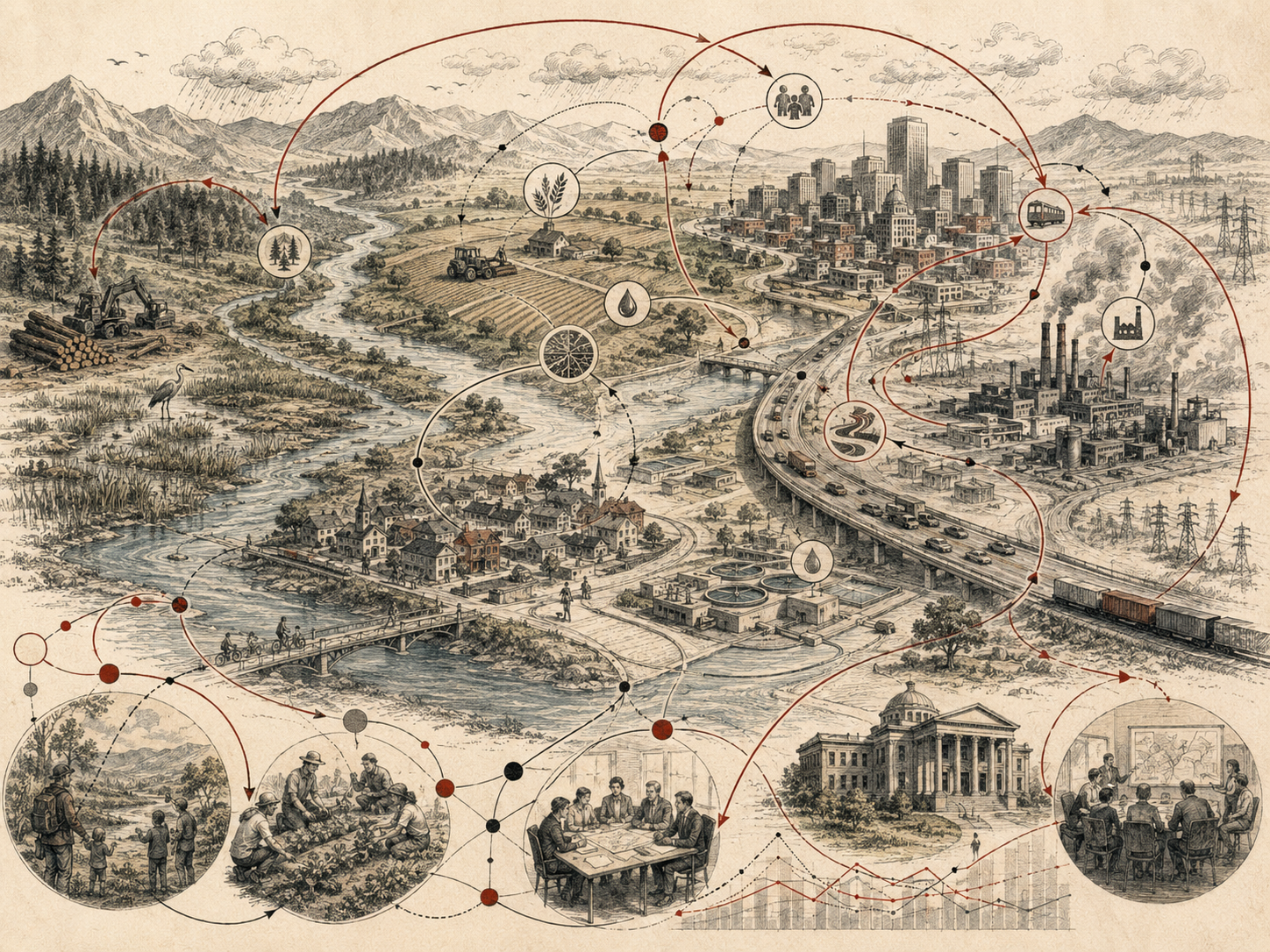
This article explains feedback loops as a foundation of systems thinking. It distinguishes reinforcing loops from balancing loops, shows how loop polarity shapes behavior, explains the role of delay, and examines common feedback-driven patterns such as compounding advantage, erosion of trust, goal-seeking behavior, overshoot, oscillation, escalation, policy resistance, and shifting the burden. It also explores why feedback is ethically important: systems often reward some actions, punish others, externalize costs, hide harms, and make certain outcomes repeat even when individual actors change.
What Feedback Means in Systems Thinking
Feedback means that the output of a system becomes input into future system behavior. A consequence returns to influence the conditions that helped produce it. This return path is what distinguishes feedback from a simple causal chain. In systems thinking, feedback is not only a technical term from engineering or control theory. It is a general pattern of circular causality found in organizations, ecosystems, economies, technologies, institutions, public policy, health systems, and social life.
Feedback explains why systems can behave as if they have memory. A past action changes the present state of the system, and that present state influences future action. A city that defers maintenance accumulates backlog. Backlog increases failure risk. Failure increases emergency spending. Emergency spending can reduce funds for preventive maintenance. The original decision returns through the system as future constraint. The system remembers through accumulation and feedback.
Feedback also explains why systems may surprise decision-makers. An intervention may not simply produce its intended result. It may trigger adaptive responses, countermeasures, compensating behavior, hidden costs, delayed effects, or new incentives. A policy designed to improve performance may change how performance is measured. A metric designed to increase accountability may encourage gaming. A road expansion designed to reduce congestion may encourage more driving. A platform feature designed to increase engagement may amplify outrage, dependency, or misinformation.
Systems thinking asks feedback questions:
- What consequence returns to influence the original condition?
- Does the loop amplify change or resist it?
- Where are the delays in the loop?
- What accumulates as the loop operates?
- What behavior does the loop generate over time?
- What intervention might change the loop rather than only the event?
- Who benefits from the loop’s current behavior?
- Who absorbs harm when the loop operates?
Feedback is the grammar of system behavior. It shows how causes and effects become circular, how patterns become self-reinforcing, and how systems can stabilize around outcomes that no one person fully intended.
The Structure of a Feedback Loop
A feedback loop contains variables connected by causal relationships that eventually return to the starting variable. A simple causal chain might move from \(A\) to \(B\) to \(C\). A feedback loop moves from \(A\) to \(B\) to \(C\) and then back to \(A\). The loop closes. Once the loop closes, the system’s behavior can become self-reinforcing or self-correcting.
A \rightarrow B \rightarrow C \rightarrow A
\]
Interpretation: A feedback loop occurs when a chain of influence returns to affect an earlier variable. The consequence becomes part of the cause of future behavior.
Each connection in a loop has a direction and a polarity. A positive causal link means that change in one variable tends to move another variable in the same direction, all else equal. If workload increases, stress may increase. If public trust increases, cooperation may increase. A negative causal link means that change in one variable tends to move another variable in the opposite direction. If staffing increases, delay may decrease. If regulation improves, risk exposure may decrease.
The whole loop also has a pattern. If the loop amplifies change, it is a reinforcing loop. If the loop counteracts change, it is a balancing loop. Reinforcing loops are often marked with \(R\). Balancing loops are often marked with \(B\). These labels do not mean good or bad. A reinforcing loop can produce growth, learning, trust, and recovery. It can also produce collapse, contagion, inequality, and escalation. A balancing loop can produce stability, safety, and regulation. It can also produce stagnation, resistance, suppression, or unjust equilibrium.
| Loop element | Meaning | Example |
|---|---|---|
| Variable | A condition that can increase or decrease. | Trust, backlog, demand, capacity, risk, cost, stress, legitimacy. |
| Causal link | A relationship in which one variable influences another. | Higher demand increases workload. |
| Positive polarity | Variables move in the same direction. | More trust tends to increase cooperation. |
| Negative polarity | Variables move in opposite directions. | More staffing tends to reduce delay. |
| Delay | Time gap between cause and effect. | Maintenance neglect may take years to appear as failure. |
| Loop behavior | The dynamic pattern generated by the loop. | Growth, decline, stabilization, oscillation, overshoot, collapse. |
Feedback-loop analysis is not simply diagramming. A loop diagram should explain behavior. It should help answer why a pattern persists, intensifies, stabilizes, oscillates, or resists intervention. If a loop does not help explain behavior over time, it may be a drawing rather than a systems analysis.
Reinforcing Feedback Loops
A reinforcing feedback loop amplifies change. The more a condition increases, the more the loop pushes it to increase further. The more a condition decreases, the more the loop may push it to decrease further. Reinforcing loops produce compounding behavior. They can generate growth, acceleration, escalation, collapse, contagion, lock-in, and cumulative advantage or disadvantage.
A simple example is compound interest. More savings produce more interest. More interest increases savings. Increased savings produce still more interest. The loop reinforces itself. A similar structure can appear in knowledge accumulation, reputation, skill development, network effects, social trust, institutional legitimacy, and ecological regeneration.
But reinforcing loops can also produce decline. Public distrust can reduce cooperation. Lower cooperation can weaken institutional performance. Weaker performance can deepen distrust. A maintenance backlog can increase failures. Failures can consume emergency resources. Emergency spending can reduce preventive maintenance. Reduced preventive maintenance can increase backlog. The loop intensifies deterioration.
x_{t+1} = x_t + r x_t
\]
Interpretation: A simple reinforcing process grows by adding a proportion \(r\) of the current state \(x_t\). The larger the stock becomes, the larger the next increase can be.
Common reinforcing loops include:
- Compounding advantage: advantage produces resources that create more advantage.
- Compounding disadvantage: disadvantage reduces capacity, which deepens disadvantage.
- Trust and cooperation: trust increases cooperation, improving outcomes and strengthening trust.
- Distrust and withdrawal: distrust reduces cooperation, worsening outcomes and deepening distrust.
- Network effects: more users increase value, attracting more users.
- Escalation: one actor’s response triggers stronger response from another.
- Learning loops: practice improves skill, skill improves results, results increase motivation to practice.
- Collapse loops: loss of capacity increases stress, and stress further weakens capacity.
Reinforcing loops are powerful because they can generate momentum. Once they begin, they may not require the original trigger to continue. A rumor can spread after the first source disappears. A culture of fear can persist after the original leader leaves. A damaged ecosystem can continue degrading after the initial disturbance because internal regenerative processes have been weakened. A pattern of inequality can reproduce itself through accumulated differences in wealth, access, education, health, housing, and political voice.
Systems thinking asks whether reinforcing loops are strengthening the system or driving it toward fragility, injustice, or collapse. The same loop structure can produce flourishing or harm depending on what is being reinforced.
Balancing Feedback Loops
A balancing feedback loop counteracts change. It pushes the system toward a goal, target, limit, norm, threshold, or equilibrium. Balancing loops are stabilizing loops. They reduce gaps between current conditions and desired or tolerated conditions.
A thermostat is the classic example. When temperature falls below the target, the heating system turns on. As temperature rises toward the target, the heating system turns off. The loop acts to reduce the difference between actual temperature and desired temperature.
Balancing feedback appears in many systems. A budget constraint limits spending. A safety mechanism reduces risk. A regulatory process responds to harm. A body regulates temperature and blood glucose. A community norm discourages unacceptable behavior. An organization adds staffing when workload becomes unsustainable. A reservoir releases or retains water to maintain levels.
x_{t+1} = x_t + k(G – x_t)
\]
Interpretation: A simple balancing process adjusts the current state \(x_t\) toward a goal \(G\). The parameter \(k\) controls the speed of adjustment.
Balancing loops are often useful because they support stability. But stability is not always justice. A system can stabilize around unequal access, persistent underinvestment, bureaucratic delay, environmental harm, or low public trust. A balancing loop may correct deviation from a harmful norm. A political system may absorb protest without changing policy. An organization may respond to complaints with symbolic action that protects the status quo. A platform may moderate only enough content to preserve legitimacy while maintaining incentives that produce harm.
Balancing loops can also misbehave when delays are long. If a system responds slowly to change, it may overcorrect. A hiring process may add staff only after burnout has already caused turnover. A water-management system may release too much or too little water because information is delayed. A central bank may respond to economic data that reflects past conditions. A public agency may expand capacity after the crisis has already shifted.
Balancing feedback therefore raises several questions:
- What goal or reference condition is the system trying to maintain?
- Who defined the goal?
- Is the goal legitimate, equitable, and sustainable?
- How quickly does the system detect deviation?
- How quickly does it respond?
- Does the response correct the problem or suppress the symptom?
- Does stabilization protect the system or the people affected by it?
A balancing loop is not automatically good. It is a mechanism of correction. Systems thinking asks what it corrects toward.
Loop Polarity, Direction, and Behavior
Feedback-loop diagrams often use positive and negative signs to show causal polarity. A positive sign means that a change in one variable tends to produce a change in the same direction in another variable. A negative sign means the change tends to move the second variable in the opposite direction. These signs do not mean good or bad. They describe direction of influence.
For example, if service demand rises, workload tends to rise. That is a positive causal link. If staffing rises, response delay tends to fall. That is a negative causal link. If response delay rises, public trust may fall. That is also a negative causal link. The signs help determine whether the full loop is reinforcing or balancing.
| Causal link | Polarity | Meaning |
|---|---|---|
| Demand → Workload | Positive | Higher demand tends to increase workload. |
| Staffing → Delay | Negative | Higher staffing tends to reduce delay. |
| Delay → Trust | Negative | Higher delay tends to reduce trust. |
| Trust → Cooperation | Positive | Higher trust tends to increase cooperation. |
| Maintenance → Failure Risk | Negative | More maintenance tends to reduce failure risk. |
Loop polarity is determined by the number of negative links in the loop. A loop with zero or an even number of negative links is reinforcing. A loop with an odd number of negative links is balancing. This rule is useful, but it should not replace substantive understanding. The analyst must still explain why the relationships exist, whether evidence supports them, where delays occur, and what behavior the loop produces.
\text{Loop Type} =
\begin{cases}
R, & \text{if the number of negative links is even} \\
B, & \text{if the number of negative links is odd}
\end{cases}
\]
Interpretation: A loop with an even number of negative causal links is reinforcing; a loop with an odd number of negative causal links is balancing.
Polarity can be misread when variables are poorly named. A variable should be phrased so it can increase or decrease. “Better policy” is vague. “Policy enforcement capacity” is clearer. “Problems” is vague. “Number of unresolved service requests” is clearer. “Community wellbeing” may be useful if defined, but its components should be specified. Clear variables make feedback analysis more disciplined.
Feedback diagrams should also distinguish between causal direction and moral judgment. A positive loop is not morally positive. A negative link is not morally negative. The language of polarity is mathematical and causal, not ethical. Ethical analysis comes later, when the analyst asks what the loop does, who benefits, who suffers, and whether the system behavior is legitimate.
Delays, Overshoot, and Oscillation
Delays are time gaps between cause and effect. They are among the most important reasons feedback systems behave unpredictably. When feedback is delayed, actors may respond too late, too strongly, too weakly, or in the wrong direction. Delays can produce overshoot, oscillation, instability, and policy failure.
Overshoot occurs when a system continues past a desirable or sustainable level because corrective feedback arrives too late. A population may grow beyond ecological carrying capacity before resource limits reduce growth. An organization may continue adding commitments beyond capacity before burnout and turnover reveal the overload. A city may approve development before infrastructure capacity catches up. A government may defer maintenance until failure risk becomes expensive and dangerous.
Oscillation occurs when delayed correction causes the system to swing around a target. If response is slow, a system may overcorrect after the original condition has already changed. Inventory systems, hiring cycles, housing markets, water management, economic policy, and organizational capacity planning can all oscillate when decisions are based on delayed information.
x_{t+1} = x_t + k(G – x_{t-d})
\]
Interpretation: A delayed balancing process adjusts the current state \(x_t\) based on a past state \(x_{t-d}\). The delay \(d\) can cause overcorrection, oscillation, or instability.
Delays matter because they separate action from consequence. This separation weakens learning. If harmful consequences appear far in the future, decision-makers may underestimate risk. If benefits appear slowly, decision-makers may abandon effective interventions too early. If data arrives after conditions have changed, corrective action may intensify the problem.
Delay also affects accountability. Present actors may benefit from decisions whose costs are paid by future people, future workers, future residents, future ecosystems, or future administrations. A system can appear successful in the short term because it transfers risk across time. Deferred maintenance, carbon emissions, ecological degradation, public debt, institutional distrust, and workforce depletion all involve delayed feedback.
Systems thinking asks:
- How long does it take for consequences to appear?
- How long does it take for the system to detect them?
- How long does it take for decision-makers to respond?
- Does the response rely on current data or delayed data?
- Does the delay cause underreaction or overreaction?
- Who benefits during the delay?
- Who pays when delayed consequences finally appear?
Feedback without delay can stabilize. Feedback with delay can destabilize. Understanding the difference is essential for responsible systems design.
Feedback and Behavior Over Time
Feedback loops are valuable because they explain behavior over time. A single event may reveal a problem, but feedback analysis asks what pattern the event belongs to. Is the system growing, declining, stabilizing, oscillating, overshooting, collapsing, recovering, or resisting change?
Different feedback structures generate different behavior patterns. Reinforcing feedback often produces exponential growth or decline. Balancing feedback often produces goal-seeking behavior. Balancing feedback with delay can produce oscillation. Reinforcing growth combined with limits can produce overshoot and collapse. Multiple loops operating together can produce complex behavior: early growth followed by constraint, temporary improvement followed by relapse, crisis response followed by neglect, or reform followed by resistance.
| Behavior over time | Likely feedback structure | Example |
|---|---|---|
| Exponential growth | Dominant reinforcing loop | Network adoption, viral spread, compound interest, skill accumulation. |
| Exponential decline | Reinforcing deterioration loop | Trust erosion, capacity loss, ecological degradation, institutional collapse. |
| Goal seeking | Balancing loop | Thermostat control, budget adjustment, safety regulation, inventory management. |
| Oscillation | Balancing loop with delay | Hiring cycles, inventory swings, housing cycles, policy overcorrection. |
| Overshoot and collapse | Reinforcing growth plus delayed balancing limits | Resource depletion, overexpansion, ecological collapse, organizational overload. |
| Policy resistance | Compensating feedback loops | Reforms that produce weaker results because the system adapts around them. |
Behavior-over-time thinking helps distinguish symptoms from structures. A one-time drop may be an event. A repeated decline suggests a pattern. An oscillating pattern suggests delayed correction. A recurring failure after reform suggests policy resistance. A sudden collapse after long stability suggests accumulated stock, hidden depletion, or threshold crossing.
Systems thinking therefore uses behavior-over-time graphs as diagnostic tools. They do not need to be mathematically complex. The key is to ask how the variable changes across time and what feedback structure could plausibly generate that pattern.
Feedback analysis becomes strongest when it connects three layers:
- Observed behavior: what pattern appears over time?
- Feedback structure: what loops could generate the pattern?
- Intervention logic: what loop, delay, stock, goal, or relationship must change?
A system’s behavior is often the visible trace of its feedback structure.
Policy Resistance and Unintended Consequences
Policy resistance occurs when an intervention produces weaker results than expected because the system responds in ways that offset, absorb, redirect, or undermine the intervention. The system is not passive. It adapts. Actors change behavior. Incentives shift. Burdens move. Feedback loops compensate.
For example, a city may widen roads to reduce congestion. In the short term, travel may improve. Over time, easier driving can encourage longer commutes, more car dependence, dispersed land use, and higher vehicle miles traveled. Congestion returns. The original intervention changed the system’s behavior in ways that restored the problem.
An organization may introduce performance metrics to improve accountability. Employees and managers may adapt by focusing on what is measured rather than what matters. The metric improves, but the underlying purpose weakens. A school may increase punitive discipline to improve order. Exclusion may reduce visible disruption temporarily but increase disengagement, absenteeism, and long-term harm. A public agency may add documentation requirements to prevent fraud. The requirements may reduce access for eligible people, increase administrative burden, and erode trust.
Policy resistance is not always malicious. It can result from rational adaptation by actors operating inside incentives. It can also result from delayed feedback, poor boundary-setting, lack of capacity, hidden constraints, competing goals, or failure to include affected stakeholders.
\text{Observed Effect} = \text{Intended Effect} – \text{Compensating Feedback}
\]
Interpretation: An intervention’s actual impact may be reduced when the system generates feedback that offsets or redirects the intended effect.
Unintended consequences often arise when interventions target symptoms rather than feedback structures. A symptom-focused intervention may reduce visible pressure temporarily while leaving the underlying loop intact. The problem then returns, sometimes stronger than before.
Systems thinking asks policy-resistance questions:
- What feedback loops will the intervention activate?
- Who will adapt to the intervention, and how?
- What incentives will change?
- What burdens may shift elsewhere?
- What hidden constraints may limit the intervention?
- What time delays may cause premature judgment?
- What metric might improve while the real problem persists?
Good systems intervention anticipates feedback. It does not assume that changing one part of the system will leave the rest unchanged.
Common Feedback Archetypes
Systems thinkers often use recurring feedback patterns called archetypes. An archetype is not a rigid formula. It is a recognizable structure that appears across many systems. Archetypes help analysts identify familiar failure modes, recurring traps, and leverage points.
| Archetype | Core feedback structure | Typical leverage point |
|---|---|---|
| Limits to growth | Reinforcing growth meets balancing constraint. | Identify and relieve the real constraint without ignoring limits. |
| Shifting the burden | Short-term fix weakens fundamental solution. | Invest in underlying capacity, not only symptom relief. |
| Fixes that fail | Immediate improvement creates delayed harm. | Extend time horizon and track delayed consequences. |
| Escalation | Mutual reinforcing response between actors. | Break the comparison logic or create new rules for interaction. |
| Success to the successful | Advantage attracts resources that deepen advantage. | Redesign resource allocation and counter cumulative inequality. |
| Tragedy of the commons | Individual gain depletes shared resource. | Govern access, feedback, accountability, and shared stewardship. |
Archetypes are useful when they sharpen analysis. They are dangerous when applied mechanically. A real system may contain several archetypes at once, and the same visible pattern may have different underlying structures. The purpose is not to label the system quickly. The purpose is to ask better questions about feedback.
Ethics, Power, and Feedback
Feedback loops are not morally neutral. They reward some behavior, punish other behavior, amplify some voices, suppress others, distribute resources, hide costs, produce burdens, and shape what systems learn. A feedback loop can build trust, resilience, and shared capacity. It can also reproduce inequality, extraction, exclusion, surveillance, depletion, and institutional neglect.
Power matters because not everyone participates equally in feedback. Some actors produce signals that institutions hear quickly. Others experience harm without being heard. Wealthy communities may generate political feedback that produces rapid response. Marginalized communities may experience repeated harm without corrective feedback reaching decision-makers. Workers may report overload but be ignored until turnover rises. Ecosystems may signal stress only after thresholds are crossed.
A system’s feedback design reveals its values. What does it measure? What does it ignore? Whose complaints count? Which harms trigger response? Which costs remain external? Which goals are protected? Which actors can appeal, contest, or correct the system? Which outcomes are treated as noise?
Feedback loops can also intensify injustice. Cumulative advantage loops can concentrate wealth, opportunity, reputation, and political power. Disadvantage loops can deepen exclusion through housing, health, education, debt, policing, environmental exposure, and institutional distrust. Platform feedback loops can amplify content that generates engagement while degrading attention, trust, or public discourse. Organizational feedback loops can reward overwork until human capacity is depleted.
Ethical feedback analysis asks:
- Who receives benefits from the loop?
- Who absorbs the loop’s costs?
- Whose feedback is ignored or delayed?
- What harm must occur before the system responds?
- What does the loop reward?
- What does the loop punish?
- Does the loop build capacity or consume it?
- Does the loop make repair easier or harder over time?
Systems thinking should make feedback visible because hidden feedback can become hidden governance. When feedback determines what a system learns, amplifies, and corrects, feedback design becomes an ethical responsibility.
Examples Across Systems
Feedback loops appear across ecological, institutional, technological, social, organizational, and economic systems. The examples below show how feedback structures generate behavior over time.
Public health
Public trust affects cooperation with health guidance. Cooperation affects outcomes. Outcomes affect trust. If institutions communicate transparently and deliver reliable services, trust may reinforce cooperation. If institutions are inconsistent, inaccessible, or unjust, distrust can reduce cooperation, worsen outcomes, and deepen distrust. Public health is therefore not only a medical system. It is also a feedback system of trust, performance, access, and legitimacy.
Infrastructure
Deferred maintenance can create a reinforcing deterioration loop. Lower preventive maintenance increases failure risk. More failures require emergency spending. Emergency spending reduces funds for preventive maintenance. The loop worsens backlog. A balancing loop would require stable maintenance funding, inspection, early repair, and long-term accountability.
Organizations
Overwork can become self-reinforcing. Workload increases stress. Stress increases errors and rework. Rework increases workload. Higher workload produces more stress. If managers respond with pressure rather than capacity, the loop accelerates. A healthier balancing loop would monitor workload, adjust priorities, add capacity, and protect recovery time.
Education
Student disengagement can create feedback. Disengagement reduces participation. Lower participation reduces learning and belonging. Reduced belonging increases disengagement. Punitive discipline may intensify the loop by removing students from the learning environment. A different loop could reinforce belonging, support, participation, and learning.
Artificial intelligence systems
AI systems can create feedback through data. A recommendation system promotes certain content. Promoted content receives more engagement. Engagement data trains or tunes future recommendation. The system may reinforce popularity, polarization, bias, or narrow preferences. If feedback is not governed, the system may amplify patterns that are profitable but socially harmful.
Climate and ecology
Climate systems contain powerful feedback loops. Melting ice reduces reflectivity, causing more heat absorption and more melting. Forest loss can reduce moisture cycling and increase fire risk. Soil degradation can reduce water retention and plant growth, deepening degradation. Ecological feedback loops can support resilience or accelerate collapse.
Economic systems
Expectations can feed back into economic behavior. If firms expect demand to fall, they may reduce investment and hiring. Reduced hiring lowers income and demand, confirming pessimistic expectations. Conversely, confidence can increase investment, employment, demand, and confidence. Economic systems often contain feedback between belief, behavior, and material conditions.
Across these domains, feedback loops help explain why system behavior continues after the original trigger fades. They also show why changing isolated parts may not change the pattern unless the feedback structure changes.
Mathematics, Computation, and Modeling
Feedback loops can be studied qualitatively through causal-loop diagrams, stakeholder inquiry, historical analysis, and behavior-over-time graphs. They can also be modeled quantitatively through recurrence equations, differential equations, stock-flow models, simulations, control systems, network analysis, and scenario comparison. The purpose of modeling is not to reduce systems thinking to mathematics. The purpose is to make assumptions explicit and test how feedback structures may generate behavior.
A simple reinforcing loop can be represented as:
x_{t+1} = (1+r)x_t
\]
Interpretation: The state \(x\) grows by a proportional rate \(r\). This captures a simple compounding process.
A simple balancing loop can be represented as:
x_{t+1} = x_t + k(G – x_t)
\]
Interpretation: The system adjusts toward a goal \(G\). The parameter \(k\) controls the strength or speed of correction.
A delayed balancing loop can be represented as:
x_{t+1} = x_t + k(G – x_{t-d})
\]
Interpretation: The system responds to a delayed observation \(x_{t-d}\). Delay can generate oscillation, overcorrection, and instability.
A stock-flow feedback system can be represented as:
\frac{dS}{dt} = I(S,t) – O(S,t)
\]
Interpretation: The stock \(S\) changes through inflows \(I\) and outflows \(O\), both of which may depend on the current state of the system and time.
Feedback modeling can support several analytical tasks:
| Modeling task | Feedback question | Example use |
|---|---|---|
| Causal-loop diagramming | What loops connect variables? | Mapping trust, demand, backlog, stress, capacity, risk, or legitimacy. |
| Behavior-over-time plotting | What pattern does the system produce? | Identifying growth, decline, oscillation, overshoot, or recovery. |
| Stock-flow modeling | What accumulates, and how do feedback loops change flows? | Modeling maintenance backlog, public trust, carbon, debt, fatigue, or capacity. |
| Delay simulation | How does delayed feedback affect correction? | Testing overcorrection, oscillation, inventory swings, or delayed policy response. |
| Scenario comparison | How do different interventions change loop behavior? | Comparing symptom relief, capacity investment, rule change, or goal redesign. |
| Sensitivity analysis | Which parameters make the loop unstable or resilient? | Testing growth rates, correction strength, delay length, and threshold values. |
Models are especially useful when feedback behavior is counterintuitive. A delayed balancing loop can oscillate even when everyone is trying to correct the problem. A reinforcing loop can generate rapid change after long slow buildup. A short-term fix can reduce a symptom while worsening the system later. Modeling can make these patterns visible before they cause harm.
But models must be interpreted carefully. A model reflects boundary choices, variable definitions, assumptions, data limits, and values. It may omit power, lived experience, ecological complexity, institutional constraints, and political resistance. Good feedback modeling documents assumptions and treats results as structured inquiry, not automatic truth.
Python Workflow: Reinforcing, Balancing, Delay, and Policy-Resistance Diagnostics
The Python workflow below turns feedback-loop analysis into a small reproducible model. It compares four scenarios: a symptom-fix loop, a delayed balancing loop, a capacity-investment loop, and a learning feedback system. The script uses only the Python standard library, writes CSV outputs relative to the article folder, and is designed as a clear starting point for companion repository work.
# feedback_loop_system_behavior_workflow.py
# Dependency-light workflow for reinforcing loops, balancing loops,
# delayed correction, overshoot, policy resistance, and feedback diagnostics.
# Writes outputs relative to the article root.

from __future__ import annotations

from dataclasses import dataclass
from pathlib import Path
import csv
from statistics import mean

ARTICLE_ROOT = Path(__file__).resolve().parents[1]
TABLES = ARTICLE_ROOT / "outputs" / "tables"


@dataclass
class FeedbackScenario:
    name: str
    reinforcing_strength: float
    balancing_strength: float
    delay_length: float
    response_accuracy: float
    capacity_investment: float
    symptom_fix_dependence: float
    accountability: float
    stress_exposure: float


def clamp(value: float, low: float = 0.0, high: float = 100.0) -> float:
    return max(low, min(high, value))


def run_scenario(scenario: FeedbackScenario, periods: int = 48) -> list[dict[str, object]]:
    problem_stock = scenario.stress_exposure * 52.0
    capacity_stock = 34.0 + scenario.capacity_investment * 18.0
    trust_stock = 42.0 + scenario.accountability * 10.0
    policy_resistance_stock = scenario.symptom_fix_dependence * 38.0
    delayed_signal = problem_stock
    history: list[float] = [problem_stock]
    rows: list[dict[str, object]] = []

    for period in range(periods + 1):
        delay_index = max(0, len(history) - 1 - int(round(scenario.delay_length * 8)))
        delayed_signal = history[delay_index]

        reinforcing_pressure = clamp(
            scenario.reinforcing_strength * 22.0
            + problem_stock * 0.18
            + policy_resistance_stock * 0.12
            + scenario.stress_exposure * 10.0
        )

        balancing_response = clamp(
            scenario.balancing_strength * 22.0
            + scenario.response_accuracy * 18.0
            + capacity_stock * 0.16
            + trust_stock * 0.10
            - delayed_signal * 0.06
        )

        symptom_relief = clamp(
            scenario.symptom_fix_dependence * 18.0
            + scenario.response_accuracy * 7.0
            - policy_resistance_stock * 0.06
        )

        policy_resistance = clamp(
            scenario.symptom_fix_dependence * 20.0
            + max(0.0, problem_stock - capacity_stock) * 0.16
            + scenario.delay_length * 9.0
            - scenario.accountability * 5.0
            - scenario.capacity_investment * 4.0
        )

        policy_resistance_stock = clamp(
            policy_resistance_stock
            + policy_resistance * 0.18
            - scenario.accountability * 1.4
            - scenario.response_accuracy * 0.9
        )

        capacity_flow = clamp(
            scenario.capacity_investment * 4.2
            + scenario.accountability * 2.4
            + scenario.response_accuracy * 1.6
            - policy_resistance_stock * 0.04
        )

        capacity_stock = clamp(
            capacity_stock
            + capacity_flow * 0.30
            - problem_stock * 0.035
            - scenario.delay_length * 0.7
        )

        problem_stock = clamp(
            problem_stock
            + reinforcing_pressure * 0.18
            + policy_resistance_stock * 0.05
            - balancing_response * 0.16
            - symptom_relief * 0.06
            - capacity_stock * 0.045
        )

        trust_stock = clamp(
            trust_stock
            + scenario.accountability * 1.7
            + balancing_response * 0.05
            + capacity_stock * 0.035
            - problem_stock * 0.05
            - policy_resistance_stock * 0.04
        )

        feedback_health_score = clamp(
            balancing_response * 0.24
            + capacity_stock * 0.24
            + trust_stock * 0.18
            + scenario.accountability * 16.0
            - reinforcing_pressure * 0.14
            - problem_stock * 0.16
            - policy_resistance_stock * 0.12
            - scenario.delay_length * 6.0
        )

        rows.append({
            "period": period,
            "scenario": scenario.name,
            "problem_stock": round(problem_stock, 3),
            "capacity_stock": round(capacity_stock, 3),
            "trust_stock": round(trust_stock, 3),
            "delayed_signal": round(delayed_signal, 3),
            "reinforcing_pressure": round(reinforcing_pressure, 3),
            "balancing_response": round(balancing_response, 3),
            "symptom_relief": round(symptom_relief, 3),
            "policy_resistance": round(policy_resistance, 3),
            "policy_resistance_stock": round(policy_resistance_stock, 3),
            "feedback_health_score": round(feedback_health_score, 3),
        })

        history.append(problem_stock)

    return rows


def write_csv(path: Path, rows: list[dict[str, object]]) -> None:
    path.parent.mkdir(parents=True, exist_ok=True)
    if not rows:
        raise ValueError(f"No rows to write: {path}")
    with path.open("w", newline="", encoding="utf-8") as handle:
        writer = csv.DictWriter(handle, fieldnames=list(rows[0].keys()))
        writer.writeheader()
        writer.writerows(rows)


def summarize(rows: list[dict[str, object]]) -> list[dict[str, object]]:
    output: list[dict[str, object]] = []
    for scenario_name in sorted({row["scenario"] for row in rows}):
        subset = [row for row in rows if row["scenario"] == scenario_name]
        final = subset[-1]
        avg_problem = mean(float(row["problem_stock"]) for row in subset)
        avg_resistance = mean(float(row["policy_resistance_stock"]) for row in subset)
        avg_score = mean(float(row["feedback_health_score"]) for row in subset)

        if float(final["feedback_health_score"]) >= 65 and float(final["problem_stock"]) <= 35:
            diagnostic = "feedback structure supports learning and correction"
        elif avg_resistance >= 55:
            diagnostic = "policy resistance dominates the feedback structure"
        elif avg_problem >= 55:
            diagnostic = "reinforcing pressure keeps problem stock high"
        elif avg_score >= 55:
            diagnostic = "partial feedback improvement with remaining delay risk"
        else:
            diagnostic = "weak feedback health; symptom relief dominates"

        output.append({
            "scenario": scenario_name,
            "final_feedback_health_score": final["feedback_health_score"],
            "final_problem_stock": final["problem_stock"],
            "final_capacity_stock": final["capacity_stock"],
            "final_trust_stock": final["trust_stock"],
            "final_policy_resistance_stock": final["policy_resistance_stock"],
            "average_problem_stock": round(avg_problem, 3),
            "average_policy_resistance_stock": round(avg_resistance, 3),
            "average_feedback_health_score": round(avg_score, 3),
            "diagnostic": diagnostic,
        })

    return output


def main() -> None:
    scenarios = [
        FeedbackScenario("Symptom-fix loop", 0.72, 0.34, 0.74, 0.34, 0.26, 0.82, 0.24, 0.72),
        FeedbackScenario("Delayed balancing loop", 0.60, 0.62, 0.72, 0.58, 0.46, 0.42, 0.44, 0.56),
        FeedbackScenario("Capacity investment loop", 0.48, 0.68, 0.42, 0.70, 0.76, 0.28, 0.62, 0.42),
        FeedbackScenario("Learning feedback system", 0.40, 0.82, 0.24, 0.82, 0.84, 0.18, 0.82, 0.30),
    ]

    rows: list[dict[str, object]] = []
    for scenario in scenarios:
        rows.extend(run_scenario(scenario))

    write_csv(TABLES / "feedback_loop_system_behavior_timeseries.csv", rows)
    write_csv(TABLES / "feedback_loop_system_behavior_summary.csv", summarize(rows))

    print("Feedback loop system behavior workflow complete.")
    print(TABLES / "feedback_loop_system_behavior_timeseries.csv")


if __name__ == "__main__":
    main()
The workflow is intentionally simple enough to inspect. It shows how symptom relief can reduce visible pressure while leaving policy resistance intact, how delayed balancing can produce weak correction, and how capacity investment and learning feedback improve whole-system behavior. The model is synthetic and illustrative; it supports disciplined inquiry rather than replacing domain expertise, stakeholder evidence, or ethical judgment.
R Workflow: Feedback Behavior Summary and Visualization
The R workflow reads the Python-generated time-series output, creates scenario summaries, and exports base R plots for problem stock, capacity stock, policy resistance, balancing response, and feedback health. It uses only base R so it remains portable across simple local environments.
# feedback_loop_system_behavior_diagnostics.R
# Base R workflow for feedback behavior summary and visualization.

args <- commandArgs(trailingOnly = FALSE)
file_arg <- grep("^--file=", args, value = TRUE)

if (length(file_arg) > 0) {
  script_path <- normalizePath(sub("^--file=", "", file_arg[1]), mustWork = TRUE)
  article_root <- normalizePath(file.path(dirname(script_path), ".."), mustWork = TRUE)
} else {
  article_root <- getwd()
}

setwd(article_root)

tables_dir <- file.path(article_root, "outputs", "tables")
figures_dir <- file.path(article_root, "outputs", "figures")

if (!dir.exists(tables_dir)) {
  dir.create(tables_dir, recursive = TRUE)
}

if (!dir.exists(figures_dir)) {
  dir.create(figures_dir, recursive = TRUE)
}

timeseries_path <- file.path(tables_dir, "feedback_loop_system_behavior_timeseries.csv")

if (!file.exists(timeseries_path)) {
  stop(paste("Missing", timeseries_path, "Run the Python workflow first."))
}

data <- read.csv(timeseries_path, stringsAsFactors = FALSE)

last_by_scenario <- do.call(
  rbind,
  lapply(split(data, data$scenario), function(df) df[nrow(df), ])
)

avg_problem <- aggregate(problem_stock ~ scenario, data = data, FUN = mean)
avg_resistance <- aggregate(policy_resistance_stock ~ scenario, data = data, FUN = mean)
avg_score <- aggregate(feedback_health_score ~ scenario, data = data, FUN = mean)

names(avg_problem)[2] <- "average_problem_stock"
names(avg_resistance)[2] <- "average_policy_resistance_stock"
names(avg_score)[2] <- "average_feedback_health_score"

final_fields <- last_by_scenario[, c(
  "scenario",
  "feedback_health_score",
  "problem_stock",
  "capacity_stock",
  "trust_stock",
  "policy_resistance_stock"
)]

names(final_fields) <- c(
  "scenario",
  "final_feedback_health_score",
  "final_problem_stock",
  "final_capacity_stock",
  "final_trust_stock",
  "final_policy_resistance_stock"
)

summary_table <- Reduce(
  function(x, y) merge(x, y, by = "scenario"),
  list(avg_problem, avg_resistance, avg_score, final_fields)
)

summary_table$diagnostic <- ifelse(
  summary_table$final_feedback_health_score >= 65 &
    summary_table$final_problem_stock <= 35,
  "feedback structure supports learning and correction",
  ifelse(
    summary_table$average_policy_resistance_stock >= 55,
    "policy resistance dominates the feedback structure",
    ifelse(
      summary_table$average_problem_stock >= 55,
      "reinforcing pressure keeps problem stock high",
      ifelse(
        summary_table$average_feedback_health_score >= 55,
        "partial feedback improvement with remaining delay risk",
        "weak feedback health; symptom relief dominates"
      )
    )
  )
)

write.csv(
  summary_table,
  file.path(tables_dir, "feedback_loop_system_behavior_r_summary.csv"),
  row.names = FALSE
)

plot_metric <- function(metric, label, file_name) {
  png(file.path(figures_dir, file_name), width = 1200, height = 700)
  scenarios <- unique(data$scenario)
  plot(
    NA,
    xlim = range(data$period),
    ylim = range(data[[metric]], na.rm = TRUE),
    xlab = "Period",
    ylab = label,
    main = paste(label, "by Scenario")
  )
  for (scenario_name in scenarios) {
    subset_data <- data[data$scenario == scenario_name, ]
    lines(subset_data$period, subset_data[[metric]], lwd = 2)
  }
  legend("topleft", legend = scenarios, lwd = 2, cex = 0.8, bty = "n")
  grid()
  dev.off()
}

plot_metric("problem_stock", "Problem stock", "problem_stock_trajectories.png")
plot_metric("capacity_stock", "Capacity stock", "capacity_stock_trajectories.png")
plot_metric("policy_resistance_stock", "Policy resistance stock", "policy_resistance_trajectories.png")
plot_metric("balancing_response", "Balancing response", "balancing_response_trajectories.png")
plot_metric("feedback_health_score", "Feedback health score", "feedback_health_score_trajectories.png")

print(summary_table)
This workflow supports the article’s central methodological claim: feedback loops should be evaluated through behavior over time. The R outputs help readers see whether an intervention changes the loop structure or only suppresses visible symptoms.
GitHub Repository
The companion repository for this article should help readers represent reinforcing loops, balancing loops, delayed correction, overshoot, oscillation, policy resistance, behavior-over-time patterns, and feedback archetypes using synthetic datasets and reproducible examples.
Complete Code Repository
Companion repository for the article, including reinforcing and balancing feedback models, delay and overshoot simulations, behavior-over-time plots, policy-resistance examples, causal-loop diagnostics, synthetic datasets, documentation notes, and multi-language scaffolds for systems analysis.
articles/feedback-loops-and-system-behavior/
├── python/
│   ├── feedback_loop_system_behavior_workflow.py
│   ├── feedback_loop_simulation.py
│   ├── reinforcing_balancing_models.py
│   ├── delay_and_overshoot.py
│   ├── behavior_over_time_analysis.py
│   ├── policy_resistance_model.py
│   ├── causal_loop_diagnostics.py
│   ├── validation_checks.py
│   └── run_all_feedback_workflows.py
├── r/
│   ├── feedback_loop_system_behavior_diagnostics.R
│   ├── feedback_loop_visualization.R
│   ├── behavior_over_time_plots.R
│   ├── delay_response_plots.R
│   ├── scenario_comparison.R
│   ├── feedback_summary_tables.R
│   └── run_all_feedback_workflows.R
├── julia/
│   ├── nonlinear_feedback_dynamics.jl
│   └── oscillation_and_overshoot_examples.jl
├── sql/
│   ├── schema_feedback_loops.sql
│   ├── schema_loop_variables.sql
│   ├── schema_causal_edges.sql
│   ├── schema_scenarios.sql
│   ├── schema_indicators.sql
│   └── schema_model_runs.sql
├── rust/
│   └── feedback_diagnostics_cli.rs
├── go/
│   └── causal_loop_pathways.go
├── cpp/
│   ├── efficient_feedback_network.cpp
│   └── feedback_simulation.cpp
├── fortran/
│   └── recurrence_feedback_model.f90
├── c/
│   └── low_level_feedback_simulation.c
├── docs/
│   ├── modeling_principles.md
│   ├── article_notes.md
│   ├── assumptions_and_limitations.md
│   └── responsible_use.md
├── data/
│   ├── synthetic_loop_variables.csv
│   ├── synthetic_causal_edges.csv
│   ├── synthetic_feedback_loops.csv
│   ├── synthetic_scenarios.csv
│   └── synthetic_indicators.csv
├── outputs/
│   ├── figures/
│   └── tables/
└── notebooks/
    ├── python_feedback_loops_walkthrough.ipynb
    └── r_feedback_visualization_placeholder.ipynb
This repository structure supports the article’s central argument: system behavior is often generated by feedback structure. The data/ folder separates loop variables, causal edges, feedback loops, scenarios, and indicators. The python/ and r/ folders support simulation, visualization, behavior-over-time analysis, delay modeling, policy-resistance examples, and causal-loop diagnostics. The julia/ folder supports nonlinear feedback and oscillation examples. The sql/ folder defines schemas for loop variables, causal relationships, feedback loops, indicators, scenarios, and model runs. The lower-level language folders provide scaffolds for efficient diagnostics, recurrence, pathway tracing, and simulation.
A Practical Method for Feedback Analysis
Feedback analysis can become practical through a disciplined sequence of inquiry. The goal is to move from visible events to behavior over time and then to the loop structures that generate that behavior.
1. Identify the recurring behavior
Begin with a variable that changes over time: trust, demand, cost, delay, workload, risk, backlog, emissions, capacity, quality, stress, compliance, or legitimacy. Ask whether the behavior is growing, declining, oscillating, stabilizing, overshooting, or recurring.
2. Draw a behavior-over-time pattern
Create a simple graph or description of the pattern. Does the problem spike, compound, recover, relapse, or cycle? Feedback loops explain patterns, so the pattern should be clear before the loop is drawn.
3. Identify variables that influence the behavior
List the conditions that increase or decrease the focal variable. Variables should be phrased so they can rise or fall. “Public trust,” “response delay,” “maintenance backlog,” and “institutional capacity” are more useful than vague categories such as “problems” or “performance.”
4. Map causal links and polarity
Connect variables with causal arrows. Mark whether the relationship is positive or negative. A positive link means variables move in the same direction. A negative link means they move in opposite directions.
5. Close the loop
Ask whether consequences return to influence earlier conditions. A feedback loop is not complete until the causal path returns to a prior variable.
6. Classify the loop
Determine whether the loop is reinforcing or balancing. Reinforcing loops amplify change. Balancing loops counteract change. Then ask whether the loop is producing healthy, harmful, stabilizing, fragile, just, or unjust behavior.
7. Identify delays
Mark where time delays exist. Delays are often responsible for overshoot, oscillation, poor learning, and policy failure.
8. Locate stocks and accumulations
Ask what builds up or depletes as the loop operates. Trust, backlog, debt, fatigue, carbon, knowledge, capacity, and legitimacy often behave as stocks.
9. Test intervention points
Ask how different interventions would affect the loop. Would they weaken a harmful reinforcing loop, strengthen a beneficial loop, improve feedback accuracy, reduce delay, change a goal, increase capacity, or redesign incentives?
10. Monitor for adaptation
After intervention, observe how the system responds. Feedback systems adapt. A good intervention includes learning loops that detect unintended effects and allow correction.
This method helps transform feedback from an abstract concept into a practical tool for diagnosis, design, governance, and learning.
Common Pitfalls
Feedback-loop analysis is powerful, but several pitfalls are common.
- Drawing arrows without causal meaning: A diagram with many arrows is not necessarily a systems analysis. Each arrow should represent a causal relationship that can be explained.
- Confusing positive feedback with good feedback: Positive feedback means reinforcing feedback. It can produce growth or collapse, trust or distrust, learning or contagion, resilience or runaway harm.
- Confusing negative feedback with bad feedback: Negative feedback means balancing feedback. It can stabilize a system, but it can also preserve an unjust or ineffective status quo.
- Ignoring delay: Many feedback failures are delay failures. Without delay analysis, the model may miss overshoot, oscillation, and premature intervention.
- Focusing only on symptoms: A visible symptom may be part of a deeper loop. Symptom relief can help, but it may not change the loop that produces the symptom.
- Ignoring power: Feedback is not evenly distributed. Some people and institutions are heard quickly. Others are ignored until harm accumulates. Feedback analysis should ask whose signals count.
- Assuming the loop is the whole system: A feedback loop is a simplified representation. Real systems often contain multiple interacting loops, boundaries, institutions, histories, and external conditions.
- Using archetypes mechanically: Archetypes are prompts for inquiry, not labels to impose. The structure must be supported by evidence and domain knowledge.
The strongest feedback analysis is specific, evidence-aware, ethically alert, and behavior-focused. It explains how structure generates behavior over time.
Why Feedback Loops Matter
Feedback loops matter because they explain why systems behave the way they do over time. They show why some problems intensify, why some reforms fail, why systems resist change, why short-term fixes create long-term harm, why delayed consequences surprise decision-makers, and why visible events often belong to deeper patterns.
Feedback thinking changes the causal question. Instead of asking only what caused an event, it asks what loop produced the pattern. Instead of asking only what intervention will fix the symptom, it asks what structure must change for the behavior to change. Instead of assuming the system will passively accept reform, it asks how the system will respond, adapt, compensate, or resist.
This way of thinking is essential for sustainability, governance, public health, infrastructure, organizations, technology, economics, education, and ecological resilience. Climate feedbacks, trust feedbacks, maintenance feedbacks, platform feedbacks, workload feedbacks, inequality feedbacks, and policy feedbacks all shape real-world outcomes. Many of the most important systems problems persist because harmful loops remain intact.
To understand feedback is to understand that systems do not merely produce outcomes. They produce the conditions for future outcomes. Every loop teaches the system what to repeat, what to amplify, what to suppress, and what to ignore.
Related Articles
- What Is Systems Thinking?
- Patterns, Events, and Structural Explanation
- Wholes, Parts, and Interdependence
- System Boundaries and Problem Framing
- Causality in Systems Thinking
- Systems Thinking and Levels of Analysis
- Reinforcing and Balancing Dynamics
- Delays, Oscillation, and Misperception
- Behavior Over Time and Structural Explanation
- Feedback Loop Polarity and Causal Signs
Further Reading
- Meadows, Donella H. Thinking in Systems: A Primer. Chelsea Green Publishing.
- Sterman, John D. Business Dynamics: Systems Thinking and Modeling for a Complex World. Irwin/McGraw-Hill.
- Forrester, Jay W. Industrial Dynamics. MIT Press.
- Senge, Peter M. The Fifth Discipline: The Art and Practice of the Learning Organization. Doubleday/Currency.
- Richardson, George P. Feedback Thought in Social Science and Systems Theory. University of Pennsylvania Press.
- Wiener, Norbert. Cybernetics: Or Control and Communication in the Animal and the Machine. MIT Press.
- Ashby, W. Ross. An Introduction to Cybernetics. Chapman & Hall.
References
- Ashby, W.R. (1956) An Introduction to Cybernetics. London: Chapman & Hall. Available at: https://archive.org/details/introductiontocy00ashb
- Forrester, J.W. (1961) Industrial Dynamics. Cambridge, MA: MIT Press.
- Meadows, D.H. (2008) Thinking in Systems: A Primer. White River Junction, VT: Chelsea Green Publishing. Available at: https://www.chelseagreen.com/product/thinking-in-systems/
- MIT OpenCourseWare (2013) Introduction to System Dynamics. Massachusetts Institute of Technology. Available at: https://ocw.mit.edu/courses/15-871-introduction-to-system-dynamics-fall-2013/
- Richardson, G.P. (1991) Feedback Thought in Social Science and Systems Theory. Philadelphia: University of Pennsylvania Press.
- Senge, P.M. (1990) The Fifth Discipline: The Art and Practice of the Learning Organization. New York: Doubleday/Currency.
- Sterman, J.D. (2000) Business Dynamics: Systems Thinking and Modeling for a Complex World. Boston: Irwin/McGraw-Hill.
- Wiener, N. (1948) Cybernetics: Or Control and Communication in the Animal and the Machine. Cambridge, MA: MIT Press.