
Last Updated May 7, 2026
The planetary squeeze describes the tightening pressure on the Earth system caused by four interacting forces: population growth, rising affluence, climate change, and ecosystem degradation. These forces do not operate separately. They reinforce one another through food systems, energy systems, land use, infrastructure, material extraction, water demand, global supply chains, and unequal patterns of consumption. Together, they narrow the safe operating space for human development and make sustainable development more difficult, more urgent, and more dependent on systemic transformation.
The planetary squeeze is best understood as a systems-pressure framework. Population growth increases the number of people who need food, water, shelter, energy, health care, mobility, education, and infrastructure. Rising affluence changes the scale and composition of demand, often increasing material throughput, energy use, meat consumption, mobility, housing size, manufactured goods, and waste. Climate change destabilizes the environmental conditions that support agriculture, water security, public health, infrastructure, ecosystems, and economic stability. Ecosystem degradation weakens the biosphere’s capacity to buffer shocks, regulate climate, cycle nutrients, sustain biodiversity, store carbon, filter water, and support livelihoods.
Main Library
Publications
Article Map
Planetary Boundaries
Related Topic
Sustainable Development
Related Topic
Earth Science
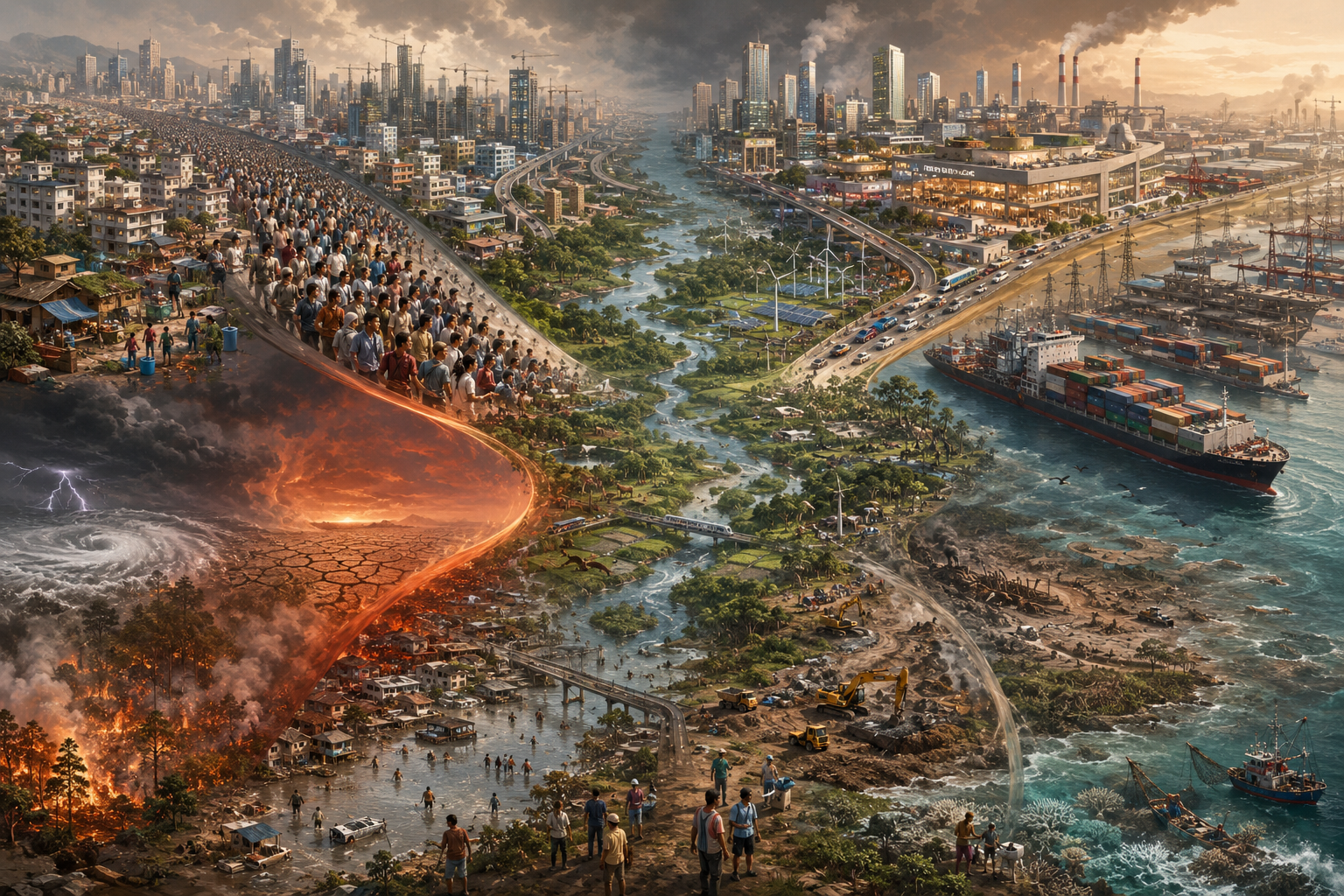
The result is a planetary compression: human needs and aspirations are expanding while the ecological systems that support them are being degraded. This does not mean that development should stop, nor does it imply that population alone is the cause of environmental crisis. The planetary squeeze is not a blame framework. It is a diagnostic framework. It asks how demographic scale, consumption patterns, climate instability, and ecological decline interact within a finite Earth system whose boundaries are increasingly stressed.
This article deepens the planetary squeeze concept and folds it into the planetary-boundaries framework. It explains the four forces, how they interact, why they matter for safe operating space, how they connect to the Great Acceleration and Anthropocene risk, why justice must be central to any interpretation, and how the squeeze can be modeled using mathematical, Python, R, and Go workflows.
What Is the Planetary Squeeze?
The planetary squeeze is the condition in which expanding human demand and weakening Earth-system resilience press against one another. It describes the structural tension between human development and planetary limits. On one side are legitimate human needs: food, clean water, shelter, electricity, sanitation, transport, education, health care, safety, and opportunity. On the other side are the biophysical systems that make those needs possible: climate stability, fertile soils, functioning ecosystems, freshwater flows, ocean chemistry, nutrient cycles, biodiversity, and atmospheric balance.
The squeeze emerges when four forces intensify together. Population growth increases the scale of human need. Rising affluence increases per-capita demand for energy, materials, land, water, infrastructure, goods, and services. Climate change destabilizes the environmental conditions under which societies operate. Ecosystem degradation weakens the living systems that regulate and buffer the planet. Each force matters on its own, but their interaction is what makes the sustainability crisis systemic.
This concept helps avoid two common simplifications. The first is the idea that population alone explains environmental pressure. It does not. Consumption, technology, inequality, institutions, and production systems matter enormously. The second is the idea that climate change alone explains planetary risk. Climate is central, but it interacts with land systems, freshwater, biodiversity, nutrient flows, ocean chemistry, chemical pollution, and social systems. The planetary squeeze therefore encourages a more integrated analysis.
Placed inside the planetary-boundaries framework, the planetary squeeze explains why safe operating space is shrinking. The pressures of development are increasing while the Earth system’s capacity to absorb pressure is declining. That is the core strategic problem of sustainability in the twenty-first century.
The concept is especially useful because it links human aspiration to biophysical constraint without turning sustainability into anti-development rhetoric. The squeeze does not say that people should have less dignity, less health, less education, less mobility, or less security. It says that the systems used to deliver human wellbeing must be redesigned so that wellbeing expands while planetary pressure falls.
Why the Squeeze Matters
The planetary squeeze matters because it shifts sustainability from a single-issue problem to a coupled-systems problem. Climate mitigation cannot succeed if land systems, food systems, material extraction, and ecosystem degradation continue moving in the wrong direction. Biodiversity protection cannot succeed if climate change, pollution, water stress, and destructive consumption continue accelerating. Poverty reduction cannot succeed if ecological destabilization undermines food, water, health, housing, and infrastructure security.
The squeeze also matters because it exposes a tension at the heart of development. Billions of people still need improved living standards. Many communities need more energy access, more infrastructure, better housing, stronger health systems, cleaner water, safer sanitation, and more economic opportunity. At the same time, the dominant development pathway has historically increased fossil energy use, land conversion, material throughput, chemical pollution, waste, and emissions. The challenge is not development versus environment. The challenge is development without planetary destabilization.
This is why the planetary squeeze belongs with the Great Acceleration. The post-1950 world expanded human capacity, wealth, mobility, communication, food production, and infrastructure at extraordinary speed. But it also expanded carbon emissions, nitrogen and phosphorus disruption, land conversion, water withdrawals, biodiversity loss, and synthetic chemical burdens. The squeeze is the contemporary experience of those accumulated pressures.
The framework also matters because it clarifies why incremental improvements are not enough. Efficiency gains can help, but if population, affluence, material demand, and ecological pressure continue to rise faster than efficiency improves, total pressure may still increase. Sustainable development requires not only efficiency, but structural redesign: clean energy, circular material systems, regenerative food systems, ecological restoration, responsible consumption, governance reform, and justice-centered development.
In that sense, the planetary squeeze is a warning against narrow optimism. Better technology, better markets, or better indicators can help, but none of them is sufficient if the underlying development model keeps converting human aspiration into rising boundary pressure. The squeeze asks whether societies can build institutions capable of redirecting the whole system.
Population Growth and Global Development
The first force in the planetary squeeze is population growth. During the mid-twentieth century, global population was roughly three billion people. Today it exceeds eight billion, and United Nations projections suggest that it may peak around 10.3 billion in the mid-2080s before gradually declining. This demographic scale matters because every person has legitimate needs for food, water, housing, health, education, energy, mobility, and security.
Population growth alone, however, does not fully explain planetary pressure. Environmental impact depends on how many people there are, how much they consume, what technologies and infrastructures they use, how production systems are organized, and how power and resources are distributed. A small high-consuming population can create far greater planetary pressure than a much larger low-consuming population. Any serious analysis must therefore avoid simplistic population blame.
The development dimension is essential. Many regions with growing populations have contributed relatively little to historical emissions and resource overuse. They also often face high exposure to climate risk, food insecurity, water stress, disease burdens, and weak infrastructure. A just planetary-boundary framework must therefore distinguish between survival needs and luxury consumption, between development rights and wasteful throughput, and between historical responsibility and current vulnerability.
Population growth still matters because meeting human needs at large scale requires material systems. More people need more food, more housing, more sanitation, more energy, more clinics, more schools, more transport, and more climate-resilient infrastructure. The sustainability question is therefore not whether people should have those things. They should. The question is how to provide them in ways that remain compatible with planetary boundaries.
This links directly to Population Growth and the Global Economy and Sustainable Development Goals Within Planetary Boundaries. Population must be interpreted through dignity, development, equity, and resource systems rather than through crude scarcity narratives.
The deepest point is that population is not only a number. It is a social and ethical reality. A boundary-aware approach must ask how many people can live dignified lives within a safe operating space, and what forms of consumption, infrastructure, energy, food, and governance make that possible.
Affluence and Rising Resource Consumption
The second force in the planetary squeeze is rising affluence. Economic growth has lifted large populations out of extreme poverty, expanded access to education and health care, increased life expectancy, and improved material living standards in many regions. These gains are morally significant and should not be dismissed. But rising affluence also changes the scale of resource demand when it follows material-intensive development pathways.
As incomes rise, demand often increases for electricity, transport, meat and dairy, larger homes, appliances, manufactured goods, digital infrastructure, construction materials, tourism, private vehicles, air conditioning, and consumer products. These patterns increase demand for fossil fuels, metals, minerals, cement, timber, land, water, fertilizers, plastics, and waste management. Without structural change, rising affluence can therefore intensify pressure across multiple planetary boundaries.
The International Resource Panel’s Global Resources Outlook 2024 emphasizes that resource use is central to the triple planetary crisis of climate change, biodiversity loss, and pollution. Resource extraction and processing are not background economic activities. They shape emissions, land degradation, water stress, biodiversity loss, air pollution, and toxic burdens. The planetary squeeze is therefore partly a material-throughput problem.
Affluence must be handled carefully. The goal is not to condemn human flourishing or deny people better lives. The goal is to distinguish wellbeing from wasteful material intensity. A society can improve health, education, safety, comfort, mobility, and dignity without reproducing the most resource-intensive consumption patterns of high-income economies. This requires decoupling human wellbeing from environmental degradation, not simply making old consumption models slightly more efficient.
This is why the planetary squeeze connects to Economic Growth and Human Progress, Beyond GDP: Development, Wellbeing, and Social Progress, and Planetary Boundaries and Doughnut Economics. The real question is not whether societies should prosper. It is what kind of prosperity can endure within planetary limits.
A planetary-boundary approach therefore requires a sharper vocabulary than “growth versus degrowth” alone. It must distinguish public goods from private excess, capability from throughput, sufficiency from deprivation, and prosperity from ecological overshoot. Some material systems must expand to meet unmet needs. Others must shrink because they represent destructive excess.
Climate Change as a Systemic Risk
The third force in the planetary squeeze is climate change. Human emissions of greenhouse gases have increased atmospheric concentrations of carbon dioxide, methane, and nitrous oxide, changing the planet’s energy balance and raising global temperatures. Climate change is not merely a warming trend. It is a systemic risk multiplier that affects water availability, agriculture, heat exposure, disease ecology, infrastructure, coastal risk, ecosystems, food prices, migration, insurance, public finance, and geopolitical stability.
Climate change intensifies the planetary squeeze because it undermines the environmental regularity on which development depends. Crops become more vulnerable to heat and drought. Water systems become less reliable. Coastal infrastructure faces sea-level rise and storm surge. Forests face greater fire, pest, and heat stress. Public health systems face heat waves, air pollution, vector-borne disease, and disaster response burdens. Economic systems face supply-chain disruption, asset losses, and adaptation costs.
Climate change also interacts with the other three forces. Larger populations and rising affluence can increase energy demand if development remains fossil-dependent. Climate impacts can degrade ecosystems, reduce agricultural yields, increase water stress, and intensify inequality. Ecosystem degradation can weaken carbon sinks, making mitigation harder. The squeeze is therefore not simply additive. It is interactive.
In planetary-boundary terms, climate change is one of the core boundaries because severe climate disruption can help push the Earth system into a less stable state. Yet climate cannot be solved in isolation. A climate strategy that ignores land, water, food systems, biodiversity, materials, and justice will be incomplete. See Climate Change as a Planetary Boundary for the dedicated boundary treatment.
The strategic implication is clear: climate mitigation is necessary but not sufficient. A climate transition that relies on destructive mining, land grabs, ecosystem degradation, or unequal burden-shifting may reduce emissions while reproducing other planetary pressures. A serious response must be climate-effective, ecosystem-aware, materially realistic, and justice-centered.
Ecosystem Degradation and Planetary Stability
The fourth force in the planetary squeeze is ecosystem degradation. Ecosystems are not simply scenic landscapes or sources of raw materials. They are life-support systems. Forests store carbon, recycle moisture, stabilize soils, support biodiversity, influence regional rainfall, and regulate temperature. Wetlands filter water, buffer floods, store carbon, and provide habitat. Oceans absorb heat and carbon dioxide while supporting marine food webs. Soils regulate nutrients, carbon, water, and food production. Biodiversity sustains pollination, pest control, decomposition, genetic diversity, ecological recovery, and resilience.
Ecosystem degradation weakens the Earth system’s ability to absorb pressure. Deforestation reduces carbon storage and moisture recycling. Wetland loss increases flood risk and water pollution. Soil degradation reduces agricultural resilience. Biodiversity loss simplifies ecosystems and weakens functional redundancy. Coral reef decline threatens coastal protection, fisheries, and marine biodiversity. Freshwater ecosystem degradation affects food, water, disease, and livelihoods.
The IPBES global assessment identifies land- and sea-use change, direct exploitation of organisms, climate change, pollution, and invasive alien species as major direct drivers of nature decline. These drivers are closely linked to the planetary squeeze. Population and affluence affect demand for land, food, materials, and energy. Climate change adds stress. Ecosystem degradation reduces resilience. Each force feeds back into the others.
In planetary-boundary terms, ecosystem degradation appears most directly through biosphere integrity, land-system change, freshwater change, biogeochemical flows, ocean acidification, and novel entities. It is therefore not one issue among many. It is a cross-boundary condition that determines how much resilience remains in the Earth system. See Biosphere Integrity and the Stability of Life Systems, Land-System Change and Ecological Transformation, and Freshwater Change and Earth System Risk.
The biosphere is not a passive recipient of human pressure. It is part of the planet’s regulatory capacity. When ecosystems are degraded, Earth-system resilience declines. The squeeze tightens not only because human pressure rises, but because the planet’s buffering capacity weakens.
Interaction Effects: Why the Four Forces Multiply Risk
The planetary squeeze is most important when the four forces interact. Population growth increases the scale of development needs. Rising affluence increases per-capita demand. Climate change makes food, water, infrastructure, and health systems more vulnerable. Ecosystem degradation reduces the capacity of natural systems to buffer those stresses. The result is not four separate risks, but a coupled pressure system.
Consider food systems. Population growth increases demand for food. Rising affluence can increase demand for resource-intensive diets. Climate change increases heat, drought, flood, and pest risk. Ecosystem degradation weakens soils, pollinators, freshwater systems, biodiversity, and landscape resilience. The food-system squeeze therefore combines demographic demand, consumption patterns, climate exposure, and ecological decline.
Consider cities. Population growth and urbanization increase housing, transport, energy, water, and infrastructure demand. Rising affluence can increase floor space, vehicle use, electricity consumption, construction materials, and waste. Climate change increases heat, flood, storm, and water risks. Ecosystem degradation removes wetlands, forests, urban canopy, floodplains, and natural cooling systems. Urban sustainability must therefore address all four pressures together.
Consider water. Population and affluence increase water demand for households, agriculture, industry, and energy. Climate change alters rainfall, snowpack, drought, evapotranspiration, and flood extremes. Ecosystem degradation reduces watershed resilience, groundwater recharge, water quality, and wetland buffering. The freshwater boundary cannot be understood without the planetary squeeze.
This interaction logic explains why the planetary squeeze is useful. It makes clear that sustainability failure often emerges from compounding pressures rather than single causes. It also suggests that solutions should target leverage points across the system: clean energy, regenerative agriculture, circular materials, ecosystem restoration, water governance, urban redesign, social protection, and demand-side transformation.
The interaction logic also cautions against isolated success claims. A policy may reduce one pressure while worsening another. A bioenergy strategy may reduce fossil emissions but increase land pressure. A food strategy may increase calories but degrade soils and water. An urban growth model may raise income while increasing heat exposure and material demand. Planetary-boundary governance must therefore ask how interventions perform across the whole coupled system.
The Planetary Squeeze and Planetary Boundaries
The planetary boundaries framework gives the squeeze its Earth-system architecture. Population growth and rising affluence increase pressure on energy, materials, food, land, water, chemicals, and infrastructure. Climate change and ecosystem degradation show how those pressures translate into Earth-system instability. Planetary boundaries identify the processes whose destabilization threatens safe operating space.
Climate change is intensified by fossil energy use, land conversion, industrial agriculture, and material throughput. Biosphere integrity is weakened by habitat loss, exploitation, pollution, climate change, invasive species, and ecosystem simplification. Land-system change reflects agriculture, forestry, infrastructure, urbanization, and extraction. Freshwater change reflects irrigation, groundwater withdrawal, dams, land use, and climate change. Biogeochemical flows reflect nitrogen and phosphorus overload. Ocean acidification reflects carbon dioxide absorption. Novel entities reflect synthetic chemical and material production. Atmospheric aerosol loading reflects combustion, industry, and land burning.
The current boundary picture makes the squeeze especially urgent. The 2023 global assessment concluded that six of nine planetary boundaries had been transgressed. The 2025 Planetary Health Check reports that seven of nine are now breached, with ocean acidification newly crossing the boundary. This does not mean collapse is inevitable, but it does mean the world is operating deeper within a high-risk zone.
The squeeze also helps explain why boundaries interact. Climate change can worsen ecosystem degradation. Ecosystem degradation can weaken climate regulation. Nutrient flows can degrade freshwater and coastal systems. Land conversion can intensify climate, hydrological, and biodiversity pressures. Novel entities can undermine ecosystem and human health in ways that are poorly monitored. Planetary boundaries are not independent containers. They are interacting risk domains within one Earth system.
The planetary squeeze therefore helps translate boundary science into development strategy. It shows why safe operating space cannot be protected only by monitoring thresholds. It must also be protected by changing the demographic, consumption, energy, food, material, and governance systems that generate boundary pressure.
Tipping Points and Abrupt Environmental Change
A further concern associated with the planetary squeeze is the possibility of tipping points. Many natural systems can absorb pressure for long periods before shifting abruptly once thresholds are crossed. Lakes can shift from clear to eutrophic states. Coral reefs can collapse after repeated heat stress and bleaching. Forests can become more fire-prone or shift toward savanna-like states. Ice sheets can enter long-term retreat. Permafrost can release stored carbon as it thaws.
Tipping points matter because they challenge linear assumptions. A gradual increase in pressure does not always produce a gradual response. Systems can appear resilient until they suddenly reorganize. In a planetary squeeze context, this is dangerous because multiple pressures can push systems toward thresholds at the same time. Climate change, land conversion, water stress, biodiversity loss, nutrient loading, and pollution can interact.
Tipping dynamics also create governance problems. Political systems often respond to visible damage rather than early-warning signals. Markets often discount long-term risk. Infrastructure planning often assumes historical conditions. But if Earth-system thresholds are involved, waiting for certainty can be irresponsible. By the time a threshold is obvious, the opportunity to prevent crossing it may already be gone.
This is why precaution is central to planetary-boundary thinking. A boundary is not necessarily the cliff edge. It is a warning line designed to preserve distance from dangerous thresholds when uncertainty is unavoidable. See Tipping Points, Feedback Loops, and Cascading Ecological Change and Safe Operating Space and the Logic of Thresholds.
The planetary squeeze makes tipping risk more serious because it reduces redundancy. A stressed food system, weakened biosphere, hotter climate, degraded watershed, and unequal society have less room to absorb shocks. Tipping points become not only ecological risks, but social and institutional risks as well.
Justice, Responsibility, and Unequal Exposure
The planetary squeeze is not experienced equally and was not produced equally. High-consuming societies, wealthy households, fossil-fuel-intensive economies, industrial agriculture, extractive industries, and historically powerful states have contributed disproportionately to emissions, material throughput, land conversion, and pollution. Meanwhile, many low-income communities, Indigenous peoples, small island states, dryland farmers, informal settlements, coastal populations, and future generations face high exposure despite contributing far less to the pressures.
This justice dimension is essential. A simplistic planetary squeeze narrative can become dangerous if it treats population growth in poorer regions as the central problem while ignoring high-consumption lifestyles, luxury emissions, corporate extraction, historical responsibility, unequal trade, and institutional power. A rigorous planetary-boundary perspective must distinguish between basic human needs and excessive material demand.
The question is not whether people should have better lives. They should. The question is whether development can be organized around human wellbeing rather than wasteful throughput. That means reducing extreme inequality, expanding access to basic services, protecting rights, supporting adaptation, financing loss and damage, protecting Indigenous stewardship, and transforming high-impact consumption and production systems.
Justice is also practical. Sustainability transitions that ignore equity often fail politically. Climate policy that raises costs for vulnerable households without support can trigger backlash. Conservation that excludes local communities can undermine legitimacy. Resource policies that shift burdens onto poorer countries can reproduce injustice. The planetary squeeze must therefore be addressed through justice-centered transformation, not technocratic austerity.
This justice framing also clarifies the difference between scarcity politics and planetary responsibility. Scarcity politics blames vulnerable people for needing more. Planetary responsibility asks high-pressure systems to change while expanding dignified access for those still denied basic capabilities.
Implications for Sustainable Development
The planetary squeeze highlights the central challenge of sustainable development: expanding human prosperity while maintaining the stability of the Earth system. The traditional development model assumed that economies could grow first and repair environmental damage later. Planetary-boundary science challenges that assumption. Some Earth-system processes involve thresholds, irreversibility, lag effects, and cascading risk. Damage cannot always be repaired after the fact.
Sustainable development in squeeze conditions requires a different strategy. Food systems must produce nutrition while restoring soils, protecting biodiversity, reducing nutrient overload, and adapting to climate change. Energy systems must decarbonize while expanding reliable access. Cities must become more compact, resilient, affordable, and ecologically integrated. Water systems must protect watersheds and groundwater. Material systems must become circular, durable, repairable, and less extractive. Finance must account for physical risk, transition risk, ecological dependency, and long-term resilience.
This also changes how progress is measured. GDP growth alone cannot tell whether development is increasing wellbeing while reducing planetary pressure. A society can grow economically while depleting soils, destabilizing climate, degrading water, destroying biodiversity, and increasing vulnerability. Better indicators must measure health, education, dignity, resilience, inequality, ecological integrity, emissions, material throughput, and boundary pressure.
The planetary squeeze therefore points toward a development model organized around sufficiency, resilience, justice, restoration, and responsible prosperity. It does not require abandoning human aspiration. It requires designing economies that meet human needs without eroding the planetary systems that make those needs possible.
For sustainable development, the squeeze is a test of seriousness. A development agenda that ignores planetary limits is fragile. A planetary agenda that ignores human needs is unjust. The difficult work is to hold both together: ecological ceilings and social foundations, planetary stability and human dignity, constraint and capability.
Governance Under Planetary Squeeze Conditions
Governance under planetary squeeze conditions must be anticipatory, integrated, adaptive, and accountable. The four forces do not fit neatly into separate ministries, markets, sectors, or academic disciplines. Population, affluence, climate, and ecosystems intersect across food, energy, housing, water, health, transport, land, industry, finance, and trade. Governance must therefore move beyond siloed decision-making.
Anticipatory governance means acting before thresholds are crossed. Integrated governance means recognizing that climate policy, biodiversity policy, food policy, water policy, urban policy, and industrial policy are connected. Adaptive governance means monitoring outcomes, learning from feedback, and revising strategies as conditions change. Accountable governance means making data, assumptions, trade-offs, and responsibilities visible.
The planetary squeeze also requires polycentric cooperation. Local communities, cities, national governments, Indigenous institutions, international organizations, scientific bodies, civil society, firms, investors, and courts all shape outcomes. No single actor can resolve the squeeze alone. But coordination without accountability is insufficient. Powerful actors must not be allowed to use complexity as a shield against responsibility.
The governance challenge is therefore not only technical. It is political and ethical. It requires decisions about whose needs are prioritized, whose consumption is reduced, whose ecosystems are protected, whose lands are restored, whose losses are compensated, and whose futures are made possible.
Planetary squeeze governance also requires public capacity. States need the ability to regulate, tax, invest, coordinate, protect, restore, and learn. Communities need voice and rights. Scientific institutions need independence and transparency. Markets need rules and boundaries. Without governance capacity, the squeeze becomes a force that pushes societies toward instability rather than transformation.
Common Misunderstandings
A common misunderstanding is that the planetary squeeze is mainly about population growth. It is not. Population matters, but environmental pressure also depends on affluence, consumption patterns, energy systems, technology, inequality, production models, institutions, and historical responsibility. Population without consumption analysis is incomplete.
Another misunderstanding is that affluence is inherently bad. The issue is not human wellbeing, education, health, comfort, dignity, or opportunity. The issue is material-intensive affluence organized around fossil energy, extractive supply chains, wasteful consumption, land conversion, and pollution. The goal is better lives with lower planetary pressure.
A third misunderstanding is that climate change is separate from ecosystem degradation. Climate change damages ecosystems, and ecosystem degradation weakens climate regulation. Forests, wetlands, soils, oceans, and biodiversity all shape climate resilience. The two forces are deeply connected.
A fourth misunderstanding is that the squeeze means scarcity politics or anti-development. A justice-centered planetary-boundary approach rejects that interpretation. The goal is to expand human dignity while reducing the forms of consumption, extraction, pollution, and inequality that destabilize the Earth system.
A final misunderstanding is that the planetary squeeze can be solved by efficiency alone. Efficiency matters, but efficiency gains can be overwhelmed by rising total demand if systems remain growth-dependent, fossil-intensive, and materially extractive. The squeeze requires structural transformation, not only marginal improvement.
Why This Matters for Planetary Boundaries
The planetary squeeze matters because it explains why boundary transgression is not only a scientific status report. It is the result of interacting human and ecological pressures: more people needing dignified lives, higher-consumption development pathways, a destabilizing climate, and ecosystems losing their capacity to buffer disturbance. These pressures narrow safe operating space and increase systemic risk.
It also matters because it clarifies why planetary-boundary governance must be integrated. Climate change cannot be treated apart from land, food, water, biodiversity, materials, and justice. Population cannot be discussed apart from inequality and development rights. Affluence cannot be discussed apart from material throughput and consumption patterns. Ecosystem degradation cannot be treated as an environmental side issue when it weakens the living systems that support development itself.
The issue is also one of justice. The planetary squeeze has been produced disproportionately by high-throughput systems and high-consuming groups, while its burdens fall heavily on communities with less responsibility and less capacity to adapt. A serious response must reduce destructive excess while expanding secure foundations for those still denied basic capabilities.
To understand the planetary squeeze is to understand the central design problem of sustainable development in the Anthropocene: human dignity must expand while planetary pressure declines. That is not a call for despair. It is a call for transformation.
Development becomes credible under planetary squeeze conditions when food, water, energy, housing, mobility, public health, infrastructure, and economic opportunity are reorganized around safe operating space, ecological repair, resilience, and justice.
Mathematical Lens
The planetary squeeze can be modeled as a coupled pressure system. A familiar starting point is the IPAT identity, which represents environmental impact as a function of population, affluence, and technology:
I = P \times A \times T
\]
Interpretation: Environmental impact rises with population, affluence or consumption per person, and impact per unit of consumption, though the relationship is only a starting point for analysis.
Here, \(I\) is environmental impact, \(P\) is population, \(A\) is affluence or consumption per person, and \(T\) is impact per unit of consumption. The planetary squeeze expands this logic by incorporating climate stress and ecosystem degradation as interacting conditions rather than external outcomes alone.
Let \(P_t\) represent normalized population pressure, \(A_t\) represent normalized affluence or consumption pressure, \(C_t\) represent climate stress, and \(E_t\) represent ecosystem degradation at time \(t\). A simple squeeze index can be written as:
S_t = \alpha P_t + \beta A_t + \gamma C_t + \delta E_t
\]
Interpretation: A simple squeeze index combines population pressure, affluence pressure, climate stress, and ecosystem degradation into a single conceptual pressure score.
This additive index is useful for interpretation, but the squeeze is not merely additive. Interaction effects matter. A coupled interaction term can be written as:
M_t = w_{PA}P_tA_t + w_{PC}P_tC_t + w_{PE}P_tE_t + w_{AC}A_tC_t + w_{AE}A_tE_t + w_{CE}C_tE_t
\]
Interpretation: Interaction terms represent the way population, affluence, climate stress, and ecosystem degradation can amplify one another.
The total squeeze pressure can then be represented as:
Q_t = S_t(1 + M_t)(1 – G_t)
\]
Interpretation: Planetary squeeze pressure rises when core pressures and interaction effects are high, and falls when governance, adaptive, and justice capacity are strong.
Planetary-boundary pressure can be included by comparing observed Earth-system process \(X_i(t)\) to boundary value \(B_i\):
R_i(t) = \frac{X_i(t)}{B_i}
\]
Interpretation: A value greater than 1 indicates that an Earth-system process exceeds its boundary value.
A boundary-adjusted squeeze score can then be written as:
Z_t = Q_t\left(1 + \frac{1}{n}\sum_{i=1}^{n} R_i(t)\right)
\]
Interpretation: Boundary-adjusted squeeze pressure increases when multiple Earth-system processes approach or exceed their boundaries.
| Term | Meaning | Interpretive role |
|---|---|---|
| \(P_t\) | Population pressure | Represents demographic scale and the material requirements of meeting human needs. |
| \(A_t\) | Affluence or consumption pressure | Represents per-capita demand for energy, materials, land, water, goods, services, and infrastructure. |
| \(C_t\) | Climate stress | Represents warming, extremes, climate instability, and climate-related development risk. |
| \(E_t\) | Ecosystem degradation | Represents loss of biodiversity, ecosystem function, carbon storage, water regulation, and ecological resilience. |
| \(S_t\) | Core squeeze pressure | Represents the combined structural pressure of the four main forces. |
| \(M_t\) | Interaction amplification | Represents how the four forces multiply risk when they interact. |
| \(G_t\) | Governance capacity | Represents institutional ability to mitigate, adapt, restore, regulate, protect, and govern justly. |
| \(R_i(t)\) | Boundary pressure ratio | Represents the status of an Earth-system process relative to its boundary value. |
| \(Z_t\) | Boundary-adjusted squeeze score | Represents total squeeze pressure adjusted for planetary-boundary status. |
This simplified formulation does not claim to predict the Earth system precisely. It provides a transparent way to structure thinking about pressure, interaction, boundary status, and governance capacity.
Advanced Python Workflow: Planetary Squeeze Diagnostics
The following Python workflow models the planetary squeeze as a coupled socio-ecological risk diagnostic. It separates population pressure, affluence pressure, climate stress, ecosystem degradation, boundary pressure, interaction amplification, governance capacity, adaptive capacity, justice capacity, and transformation urgency. The values are illustrative, but the structure can be adapted for sustainability dashboards, planetary-boundary reporting, development analysis, risk assessment, and policy scenario testing.
"""
Planetary squeeze diagnostics for planetary-boundary analysis.

This workflow models the planetary squeeze using:
- population pressure
- affluence or consumption pressure
- climate stress
- ecosystem degradation
- planetary-boundary pressure
- interaction amplification
- governance capacity
- adaptive capacity
- justice capacity
- transformation urgency

The values are illustrative. Replace them with documented demographic data,
consumption indicators, climate metrics, ecosystem indicators, boundary data,
governance assessments, and transparent assumptions before applied use.
"""

from __future__ import annotations

from dataclasses import dataclass
from pathlib import Path
from typing import Literal

import numpy as np
import pandas as pd


RiskClass = Literal[
    "managed_transition",
    "rising_squeeze_pressure",
    "high_planetary_squeeze",
    "system_transformation_urgent",
]


@dataclass(frozen=True)
class SqueezeScenario:
    """Planetary squeeze scenario profile."""

    scenario: str
    population_pressure: float
    affluence_pressure: float
    climate_stress: float
    ecosystem_degradation: float
    boundary_pressure: float
    governance_capacity: float
    adaptive_capacity: float
    justice_capacity: float
    mitigation_capacity: float
    restoration_capacity: float
    material_efficiency: float


def build_squeeze_scenarios() -> pd.DataFrame:
    """Create illustrative planetary squeeze scenarios."""
    scenarios = [
        SqueezeScenario(
            scenario="current_fragmented_response",
            population_pressure=0.78,
            affluence_pressure=0.84,
            climate_stress=0.86,
            ecosystem_degradation=0.88,
            boundary_pressure=7 / 9,
            governance_capacity=0.42,
            adaptive_capacity=0.46,
            justice_capacity=0.34,
            mitigation_capacity=0.42,
            restoration_capacity=0.36,
            material_efficiency=0.38,
        ),
        SqueezeScenario(
            scenario="growth_with_relative_efficiency",
            population_pressure=0.80,
            affluence_pressure=0.88,
            climate_stress=0.72,
            ecosystem_degradation=0.78,
            boundary_pressure=6 / 9,
            governance_capacity=0.50,
            adaptive_capacity=0.52,
            justice_capacity=0.42,
            mitigation_capacity=0.58,
            restoration_capacity=0.44,
            material_efficiency=0.56,
        ),
        SqueezeScenario(
            scenario="climate_policy_without_ecosystem_repair",
            population_pressure=0.78,
            affluence_pressure=0.76,
            climate_stress=0.58,
            ecosystem_degradation=0.84,
            boundary_pressure=6 / 9,
            governance_capacity=0.56,
            adaptive_capacity=0.58,
            justice_capacity=0.46,
            mitigation_capacity=0.66,
            restoration_capacity=0.40,
            material_efficiency=0.54,
        ),
        SqueezeScenario(
            scenario="planetary_boundary_aligned_development",
            population_pressure=0.70,
            affluence_pressure=0.58,
            climate_stress=0.46,
            ecosystem_degradation=0.48,
            boundary_pressure=4 / 9,
            governance_capacity=0.72,
            adaptive_capacity=0.70,
            justice_capacity=0.66,
            mitigation_capacity=0.76,
            restoration_capacity=0.72,
            material_efficiency=0.74,
        ),
        SqueezeScenario(
            scenario="just_transition_and_restoration",
            population_pressure=0.66,
            affluence_pressure=0.52,
            climate_stress=0.38,
            ecosystem_degradation=0.36,
            boundary_pressure=3 / 9,
            governance_capacity=0.82,
            adaptive_capacity=0.78,
            justice_capacity=0.80,
            mitigation_capacity=0.84,
            restoration_capacity=0.82,
            material_efficiency=0.80,
        ),
    ]

    return pd.DataFrame([scenario.__dict__ for scenario in scenarios])


def classify_squeeze_risk(score: float, urgency: float) -> RiskClass:
    """Classify planetary squeeze risk condition."""
    if score >= 1.25 and urgency >= 0.70:
        return "system_transformation_urgent"
    if score >= 0.95:
        return "high_planetary_squeeze"
    if score >= 0.65:
        return "rising_squeeze_pressure"
    return "managed_transition"


def score_planetary_squeeze(data: pd.DataFrame) -> pd.DataFrame:
    """Calculate planetary squeeze diagnostics."""
    scored = data.copy()

    scored["core_squeeze_pressure"] = (
        0.24 * scored["population_pressure"]
        + 0.26 * scored["affluence_pressure"]
        + 0.26 * scored["climate_stress"]
        + 0.24 * scored["ecosystem_degradation"]
    )

    scored["interaction_amplification"] = (
        0.22 * scored["population_pressure"] * scored["affluence_pressure"]
        + 0.18 * scored["population_pressure"] * scored["climate_stress"]
        + 0.18 * scored["population_pressure"] * scored["ecosystem_degradation"]
        + 0.18 * scored["affluence_pressure"] * scored["climate_stress"]
        + 0.18 * scored["affluence_pressure"] * scored["ecosystem_degradation"]
        + 0.20 * scored["climate_stress"] * scored["ecosystem_degradation"]
    )

    scored["response_capacity"] = (
        0.18 * scored["governance_capacity"]
        + 0.16 * scored["adaptive_capacity"]
        + 0.18 * scored["justice_capacity"]
        + 0.18 * scored["mitigation_capacity"]
        + 0.16 * scored["restoration_capacity"]
        + 0.14 * scored["material_efficiency"]
    )

    scored["planetary_squeeze_risk"] = (
        scored["core_squeeze_pressure"]
        * (1 + scored["interaction_amplification"])
        * (1 + 0.45 * scored["boundary_pressure"])
        * (1 - 0.55 * scored["response_capacity"])
    )

    scored["transformation_urgency"] = (
        scored["planetary_squeeze_risk"]
        * (1 - scored["response_capacity"])
        * (1 + scored["boundary_pressure"])
    )

    scored["risk_class"] = [
        classify_squeeze_risk(score, urgency)
        for score, urgency in zip(
            scored["planetary_squeeze_risk"],
            scored["transformation_urgency"],
        )
    ]

    scored["priority"] = np.select(
        [
            scored["risk_class"] == "system_transformation_urgent",
            scored["climate_stress"] >= 0.75,
            scored["ecosystem_degradation"] >= 0.75,
            scored["affluence_pressure"] >= 0.80,
            scored["justice_capacity"] < 0.45,
        ],
        [
            "system_transformation",
            "accelerated_climate_mitigation",
            "ecosystem_restoration",
            "resource_demand_reduction",
            "justice_centered_development",
        ],
        default="integrated_boundary_governance",
    )

    return scored.sort_values(
        "planetary_squeeze_risk",
        ascending=False,
    ).reset_index(drop=True)


def main() -> None:
    """Run planetary squeeze diagnostics."""
    output_dir = Path(
        "articles/the-planetary-squeeze-four-forces-driving-the-sustainability-crisis/outputs"
    )
    output_dir.mkdir(parents=True, exist_ok=True)

    scenarios = build_squeeze_scenarios()
    scored = score_planetary_squeeze(scenarios)

    scored.to_csv(output_dir / "planetary_squeeze_diagnostics.csv", index=False)

    print("\nPlanetary squeeze diagnostics:")
    print(scored.to_string(index=False))


if __name__ == "__main__":
    main()
This workflow is intentionally transparent. It does not claim to produce definitive planetary squeeze scores. It provides a reproducible structure for connecting population pressure, affluence pressure, climate stress, ecosystem degradation, planetary-boundary status, governance capacity, justice capacity, and transformation urgency. In applied use, the illustrative values should be replaced with documented datasets and explicit assumptions.
Advanced R Workflow: Planetary Squeeze Dashboarding
The following R workflow prepares dashboard-ready outputs for comparing planetary squeeze conditions across development scenarios. It is designed for sustainability analysts, planetary-boundary researchers, development planners, climate adaptation teams, environmental governance practitioners, and risk analysts who need to compare population pressure, affluence pressure, climate stress, ecosystem degradation, boundary pressure, response capacity, interaction amplification, and transformation urgency.
# Planetary squeeze dashboard
#
# This workflow scores scenario-level sustainability pressure across:
# - population pressure
# - affluence or consumption pressure
# - climate stress
# - ecosystem degradation
# - planetary-boundary pressure
# - interaction amplification
# - governance capacity
# - adaptive capacity
# - justice capacity
# - mitigation capacity
# - restoration capacity
# - material efficiency
#
# Values are illustrative and should be replaced with documented demographic data,
# consumption indicators, climate metrics, ecosystem indicators, boundary data,
# governance assessments, and transparent assumptions before applied use.

library(readr)
library(dplyr)
library(tidyr)

squeeze_scenarios <- tibble::tibble(
  scenario = c(
    "current_fragmented_response",
    "growth_with_relative_efficiency",
    "climate_policy_without_ecosystem_repair",
    "planetary_boundary_aligned_development",
    "just_transition_and_restoration"
  ),
  population_pressure = c(0.78, 0.80, 0.78, 0.70, 0.66),
  affluence_pressure = c(0.84, 0.88, 0.76, 0.58, 0.52),
  climate_stress = c(0.86, 0.72, 0.58, 0.46, 0.38),
  ecosystem_degradation = c(0.88, 0.78, 0.84, 0.48, 0.36),
  boundary_pressure = c(7 / 9, 6 / 9, 6 / 9, 4 / 9, 3 / 9),
  governance_capacity = c(0.42, 0.50, 0.56, 0.72, 0.82),
  adaptive_capacity = c(0.46, 0.52, 0.58, 0.70, 0.78),
  justice_capacity = c(0.34, 0.42, 0.46, 0.66, 0.80),
  mitigation_capacity = c(0.42, 0.58, 0.66, 0.76, 0.84),
  restoration_capacity = c(0.36, 0.44, 0.40, 0.72, 0.82),
  material_efficiency = c(0.38, 0.56, 0.54, 0.74, 0.80)
)

scored <- squeeze_scenarios %>%
  mutate(
    core_squeeze_pressure =
      0.24 * population_pressure +
      0.26 * affluence_pressure +
      0.26 * climate_stress +
      0.24 * ecosystem_degradation,

    interaction_amplification =
      0.22 * population_pressure * affluence_pressure +
      0.18 * population_pressure * climate_stress +
      0.18 * population_pressure * ecosystem_degradation +
      0.18 * affluence_pressure * climate_stress +
      0.18 * affluence_pressure * ecosystem_degradation +
      0.20 * climate_stress * ecosystem_degradation,

    response_capacity =
      0.18 * governance_capacity +
      0.16 * adaptive_capacity +
      0.18 * justice_capacity +
      0.18 * mitigation_capacity +
      0.16 * restoration_capacity +
      0.14 * material_efficiency,

    planetary_squeeze_risk =
      core_squeeze_pressure *
      (1 + interaction_amplification) *
      (1 + 0.45 * boundary_pressure) *
      (1 - 0.55 * response_capacity),

    transformation_urgency =
      planetary_squeeze_risk *
      (1 - response_capacity) *
      (1 + boundary_pressure),

    risk_class = case_when(
      planetary_squeeze_risk >= 1.25 & transformation_urgency >= 0.70 ~ "system_transformation_urgent",
      planetary_squeeze_risk >= 0.95 ~ "high_planetary_squeeze",
      planetary_squeeze_risk >= 0.65 ~ "rising_squeeze_pressure",
      TRUE ~ "managed_transition"
    ),

    priority = case_when(
      risk_class == "system_transformation_urgent" ~ "system_transformation",
      climate_stress >= 0.75 ~ "accelerated_climate_mitigation",
      ecosystem_degradation >= 0.75 ~ "ecosystem_restoration",
      affluence_pressure >= 0.80 ~ "resource_demand_reduction",
      justice_capacity < 0.45 ~ "justice_centered_development",
      TRUE ~ "integrated_boundary_governance"
    )
  ) %>%
  arrange(desc(planetary_squeeze_risk))

dashboard_long <- scored %>%
  select(
    scenario,
    population_pressure,
    affluence_pressure,
    climate_stress,
    ecosystem_degradation,
    boundary_pressure,
    core_squeeze_pressure,
    interaction_amplification,
    response_capacity,
    planetary_squeeze_risk,
    transformation_urgency
  ) %>%
  pivot_longer(
    cols = -scenario,
    names_to = "metric",
    values_to = "value"
  )

summary_by_class <- scored %>%
  group_by(risk_class) %>%
  summarise(
    scenarios = n(),
    mean_core_squeeze_pressure = mean(core_squeeze_pressure),
    mean_interaction_amplification = mean(interaction_amplification),
    mean_response_capacity = mean(response_capacity),
    mean_planetary_squeeze_risk = mean(planetary_squeeze_risk),
    mean_transformation_urgency = mean(transformation_urgency),
    .groups = "drop"
  )

dir.create(
  "articles/the-planetary-squeeze-four-forces-driving-the-sustainability-crisis/outputs",
  recursive = TRUE,
  showWarnings = FALSE
)

write_csv(
  scored,
  "articles/the-planetary-squeeze-four-forces-driving-the-sustainability-crisis/outputs/r_planetary_squeeze_scores.csv"
)

write_csv(
  dashboard_long,
  "articles/the-planetary-squeeze-four-forces-driving-the-sustainability-crisis/outputs/r_planetary_squeeze_dashboard_long.csv"
)

write_csv(
  summary_by_class,
  "articles/the-planetary-squeeze-four-forces-driving-the-sustainability-crisis/outputs/r_planetary_squeeze_summary.csv"
)

print(scored)
print(summary_by_class)
R is useful here because planetary squeeze analysis often needs to become dashboard-ready: ranked scenario tables, long-format metric tables, grouped summaries, and reproducible reporting. This workflow keeps the analytical structure visible while allowing the results to support visual dashboards, policy review, and comparative development planning.
Advanced Go Workflow: Lightweight Planetary Squeeze Scoring Service
This Go workflow translates the article’s planetary squeeze logic into a compact scoring service. Python and R are strong for analysis and reporting, but Go is useful when planetary squeeze diagnostics need to run as a lightweight command-line tool or service behind a dashboard, API, or governance workflow. The service validates inputs, computes core pressure, interaction amplification, response capacity, risk score, transformation urgency, and a readable risk class.
package main

import (
	"encoding/csv"
	"fmt"
	"os"
	"strconv"
)

type SqueezeRecord struct {
	Scenario             string
	PopulationPressure   float64
	AffluencePressure    float64
	ClimateStress        float64
	EcosystemDegradation float64
	BoundaryPressure     float64
	GovernanceCapacity   float64
	AdaptiveCapacity     float64
	JusticeCapacity      float64
	MitigationCapacity   float64
	RestorationCapacity  float64
	MaterialEfficiency   float64
}

func parseFloat(value string) (float64, error) {
	parsed, err := strconv.ParseFloat(value, 64)
	if err != nil {
		return 0, err
	}

	if parsed < 0 {
		return 0, fmt.Errorf("value cannot be negative: %f", parsed)
	}

	return parsed, nil
}

func parseRecord(row []string) (SqueezeRecord, error) {
	if len(row) != 12 {
		return SqueezeRecord{}, fmt.Errorf("invalid record length: expected 12 columns")
	}

	values := make([]float64, 11)

	for i, col := range row[1:] {
		value, err := parseFloat(col)
		if err != nil {
			return SqueezeRecord{}, err
		}

		values[i] = value
	}

	return SqueezeRecord{
		Scenario:             row[0],
		PopulationPressure:   values[0],
		AffluencePressure:    values[1],
		ClimateStress:        values[2],
		EcosystemDegradation: values[3],
		BoundaryPressure:     values[4],
		GovernanceCapacity:   values[5],
		AdaptiveCapacity:     values[6],
		JusticeCapacity:      values[7],
		MitigationCapacity:   values[8],
		RestorationCapacity:  values[9],
		MaterialEfficiency:   values[10],
	}, nil
}

func coreSqueezePressure(record SqueezeRecord) float64 {
	return 0.24*record.PopulationPressure +
		0.26*record.AffluencePressure +
		0.26*record.ClimateStress +
		0.24*record.EcosystemDegradation
}

func interactionAmplification(record SqueezeRecord) float64 {
	return 0.22*record.PopulationPressure*record.AffluencePressure +
		0.18*record.PopulationPressure*record.ClimateStress +
		0.18*record.PopulationPressure*record.EcosystemDegradation +
		0.18*record.AffluencePressure*record.ClimateStress +
		0.18*record.AffluencePressure*record.EcosystemDegradation +
		0.20*record.ClimateStress*record.EcosystemDegradation
}

func responseCapacity(record SqueezeRecord) float64 {
	return 0.18*record.GovernanceCapacity +
		0.16*record.AdaptiveCapacity +
		0.18*record.JusticeCapacity +
		0.18*record.MitigationCapacity +
		0.16*record.RestorationCapacity +
		0.14*record.MaterialEfficiency
}

func planetarySqueezeRisk(record SqueezeRecord) float64 {
	return coreSqueezePressure(record) *
		(1 + interactionAmplification(record)) *
		(1 + 0.45*record.BoundaryPressure) *
		(1 - 0.55*responseCapacity(record))
}

func transformationUrgency(record SqueezeRecord) float64 {
	return planetarySqueezeRisk(record) *
		(1 - responseCapacity(record)) *
		(1 + record.BoundaryPressure)
}

func riskClass(record SqueezeRecord) string {
	score := planetarySqueezeRisk(record)
	urgency := transformationUrgency(record)

	if score >= 1.25 && urgency >= 0.70 {
		return "system_transformation_urgent"
	}

	if score >= 0.95 {
		return "high_planetary_squeeze"
	}

	if score >= 0.65 {
		return "rising_squeeze_pressure"
	}

	return "managed_transition"
}

func main() {
	file, err := os.Open("planetary_squeeze_scenarios_service.csv")
	if err != nil {
		fmt.Println("Error opening CSV:", err)
		return
	}
	defer file.Close()

	reader := csv.NewReader(file)

	rows, err := reader.ReadAll()
	if err != nil {
		fmt.Println("Error reading CSV:", err)
		return
	}

	for i, row := range rows {
		if i == 0 {
			continue
		}

		record, err := parseRecord(row)
		if err != nil {
			fmt.Println("Parse error:", err)
			continue
		}

		fmt.Printf(
			"scenario=%s core_pressure=%.3f amplification=%.3f response_capacity=%.3f squeeze_risk=%.3f transformation_urgency=%.3f risk_class=%s\n",
			record.Scenario,
			coreSqueezePressure(record),
			interactionAmplification(record),
			responseCapacity(record),
			planetarySqueezeRisk(record),
			transformationUrgency(record),
			riskClass(record),
		)
	}
}
The point is not to build a complete planetary-boundary governance platform inside the article. The point is to show how the logic of population pressure, affluence pressure, climate stress, ecosystem degradation, boundary status, response capacity, and transformation urgency can be operationalized in a compact and auditable service layer. That makes the article’s conceptual framework easier to translate into dashboards, APIs, institutional risk registers, and reproducible governance tools.
Engineering Extensions in the GitHub Repository
The accompanying GitHub repository extends the article workflow beyond Python, R, and Go into a broader engineering scaffold. The article body keeps Python and R visible because they are the most accessible tools for analytics, dashboard preparation, scenario testing, and reproducible reporting. Go provides a compact service layer. The repository, however, is structured for readers who want to translate planetary squeeze analysis into more technical systems: auditable databases, scenario-scoring engines, APIs, embedded monitoring, edge anomaly detection, and accelerator-aware environmental data workflows.
The SQL scaffold is intended for demographic pressure, affluence and consumption indicators, climate stress, ecosystem degradation, planetary-boundary status, governance capacity, adaptive capacity, justice capacity, mitigation capacity, restoration capacity, material efficiency, scenario outputs, source provenance, and audit trails. Rust can support reliable squeeze scoring where type safety and reproducibility matter. Go can support lightweight diagnostic APIs. C and C++ can support embedded threshold alerts and high-performance scenario simulation. TinyML can support low-power anomaly detection at the edge, while PYNQ-oriented scaffolding can support accelerated preprocessing of environmental telemetry or dashboard inputs.
This engineering layer matters because the planetary squeeze is not only a concept. It is also a measurement, interaction, and decision-support problem. A serious technical architecture should make scenario assumptions visible, uncertainty explicit, data provenance auditable, and response logic reproducible.
GitHub Repository
Complete Code Repository
The full code distribution for this article, including planetary squeeze diagnostics, four-force interaction modeling, boundary-adjusted scenario scoring, SQL materials, optional service tooling, and edge-side engineering scaffolds, is available on GitHub.
Related Articles
- The Holocene: The Stable Climate State That Enabled Human Civilization
- The Great Acceleration: How Human Activity Reshaped the Earth System
- Navigating the Anthropocene: Sustainable Development in a 3–6–9 World
- What Are Planetary Boundaries? Earth System Limits Explained
- Safe Operating Space and the Logic of Thresholds
- Population Growth and the Global Economy
- Economic Growth and Human Progress
- Beyond GDP: Development, Wellbeing, and Social Progress
- Climate Change as a Planetary Boundary
- Biosphere Integrity and the Stability of Life Systems
- Land-System Change and Ecological Transformation
- Freshwater Change and Earth System Risk
- Biogeochemical Flows: Nitrogen, Phosphorus, and Planetary Destabilization
- Tipping Points, Feedback Loops, and Cascading Ecological Change
- Planetary Boundaries, Justice, and Global Inequality
- Planetary Boundaries and Doughnut Economics
Further Reading
- Ehrlich, P.R. and Holdren, J.P. (1971) ‘Impact of population growth’, Science, 171(3977), pp. 1212–1217. Available at: https://www.science.org/doi/10.1126/science.171.3977.1212
- Intergovernmental Panel on Climate Change (2023) Climate Change 2023: Synthesis Report. Geneva: IPCC. Available at: https://www.ipcc.ch/report/ar6/syr/
- International Resource Panel (2024) Global Resources Outlook 2024: Bend the Trend – Pathways to a Liveable Planet as Resource Use Spikes. Nairobi: United Nations Environment Programme. Available at: https://www.unep.org/resources/Global-Resource-Outlook-2024
- IPBES (2019) Global Assessment Report on Biodiversity and Ecosystem Services. Bonn: Intergovernmental Science-Policy Platform on Biodiversity and Ecosystem Services. Available at: https://www.ipbes.net/global-assessment
- Planetary Health Check (2025) Planetary Health Check 2025. Potsdam: Potsdam Institute for Climate Impact Research. Available at: https://www.planetaryhealthcheck.org/
- Richardson, K. et al. (2023) ‘Earth beyond six of nine planetary boundaries’, Science Advances, 9(37), eadh2458. Available at: https://www.science.org/doi/10.1126/sciadv.adh2458
- Rockström, J. et al. (2009) ‘A safe operating space for humanity’, Nature, 461, pp. 472–475. Available at: https://www.nature.com/articles/461472a
- Steffen, W. et al. (2015) ‘The trajectory of the Anthropocene: The Great Acceleration’, The Anthropocene Review, 2(1), pp. 81–98. Available at: https://journals.sagepub.com/doi/10.1177/2053019614564785
- United Nations Department of Economic and Social Affairs, Population Division (2024) World Population Prospects 2024: Summary of Results. New York: United Nations. Available at: https://population.un.org/wpp/
References
- Ehrlich, P.R. and Holdren, J.P. (1971) ‘Impact of population growth’, Science, 171(3977), pp. 1212–1217. Available at: https://www.science.org/doi/10.1126/science.171.3977.1212
- Intergovernmental Panel on Climate Change (2023) Climate Change 2023: Synthesis Report. Geneva: IPCC. Available at: https://www.ipcc.ch/report/ar6/syr/
- International Resource Panel (2024) Global Resources Outlook 2024: Bend the Trend – Pathways to a Liveable Planet as Resource Use Spikes. Nairobi: United Nations Environment Programme. Available at: https://www.unep.org/resources/Global-Resource-Outlook-2024
- IPBES (2019) Global Assessment Report on Biodiversity and Ecosystem Services. Bonn: Intergovernmental Science-Policy Platform on Biodiversity and Ecosystem Services. Available at: https://www.ipbes.net/global-assessment
- Planetary Health Check (2025) Planetary Health Check 2025. Potsdam: Potsdam Institute for Climate Impact Research. Available at: https://www.planetaryhealthcheck.org/
- Richardson, K., Steffen, W., Lucht, W., Bendtsen, J., Cornell, S.E., Donges, J.F., Drüke, M., Fetzer, I., Bala, G., von Bloh, W., Feulner, G., Fiedler, S., Gerten, D., Gleeson, T., Hofmann, M., Huiskamp, W., Jakobsson, C., Jürgensen, J.H., Kummu, M., Mohan, C., Nogués-Bravo, D., Petri, S., Porkka, M., Rahmstorf, S., Schaphoff, S., Schulte-Uebbing, L., Staal, A., Sun, Z., Sakschewski, B. and Wang-Erlandsson, L. (2023) ‘Earth beyond six of nine planetary boundaries’, Science Advances, 9(37), eadh2458. Available at: https://www.science.org/doi/10.1126/sciadv.adh2458
- Rockström, J., Steffen, W., Noone, K., Persson, Å., Chapin, F.S. III, Lambin, E.F., Lenton, T.M., Scheffer, M., Folke, C., Schellnhuber, H.J., Nykvist, B., de Wit, C.A., Hughes, T., van der Leeuw, S., Rodhe, H., Sörlin, S., Snyder, P.K., Costanza, R., Svedin, U., Falkenmark, M., Karlberg, L., Corell, R.W., Fabry, V.J., Hansen, J., Walker, B., Liverman, D., Richardson, K., Crutzen, P. and Foley, J.A. (2009) ‘A safe operating space for humanity’, Nature, 461, pp. 472–475. Available at: https://www.nature.com/articles/461472a
- Steffen, W., Broadgate, W., Deutsch, L., Gaffney, O. and Ludwig, C. (2015) ‘The trajectory of the Anthropocene: The Great Acceleration’, The Anthropocene Review, 2(1), pp. 81–98. Available at: https://journals.sagepub.com/doi/10.1177/2053019614564785
- United Nations Department of Economic and Social Affairs, Population Division (2024) World Population Prospects 2024: Summary of Results. New York: United Nations. Available at: https://population.un.org/wpp/