
Last Updated May 7, 2026
The Great Acceleration describes the rapid post-1950 surge in human activity that transformed both society and the Earth system. Population, economic output, energy use, water use, fertilizer consumption, transportation, telecommunications, urbanization, trade, and material extraction all expanded dramatically during the second half of the twentieth century. At the same time, Earth-system indicators such as carbon dioxide concentration, methane concentration, surface temperature, ocean acidification, tropical forest loss, nitrogen flows, biodiversity decline, and coastal ecosystem degradation also accelerated.
The result was not merely faster economic growth. It was a planetary-scale reorganization of the relationship between human societies and the Earth system. The Great Acceleration marks the period when industrial modernity became unmistakably planetary in consequence: the human economy, once embedded within regional landscapes and ecosystems, became a force capable of altering climate, oceans, land, freshwater, nutrient cycles, biodiversity, and synthetic chemical burdens at global scale.
Main Library
Publications
Article Map
Planetary Boundaries
Related Topic
Sustainable Development
Related Topic
Earth Science
Related Topic
Environmental Science
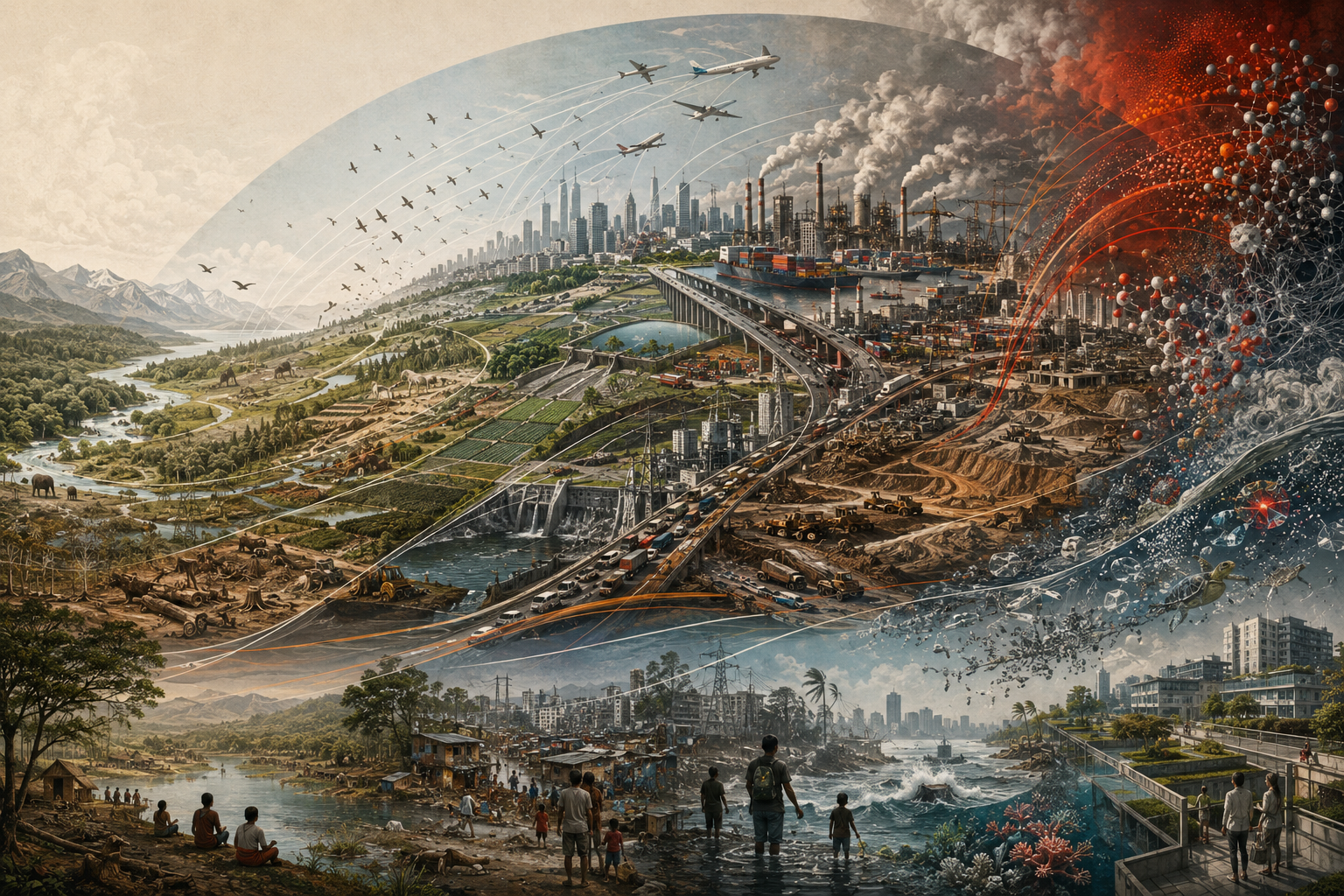
The Great Acceleration is one of the central concepts for understanding the Anthropocene and the planetary boundaries framework. The Holocene provided the stable climate state within which agriculture, settlement, cities, infrastructure, and modern civilization emerged. The Great Acceleration marks the period when industrial society began pushing multiple Earth-system processes far outside the ranges that characterized that stable operating context. It is the historical bridge between Holocene stability and planetary-boundary transgression.
The concept also clarifies why sustainability cannot be reduced to isolated environmental problems. Climate change, land-system change, freshwater disruption, biogeochemical flows, ocean acidification, novel entities, and biosphere degradation did not accelerate separately by coincidence. They accelerated because human systems of energy, industry, agriculture, extraction, transport, consumption, finance, and trade expanded together. The Great Acceleration therefore reveals planetary risk as a systems problem: socio-economic growth patterns became tightly coupled to Earth-system destabilization.
What Is the Great Acceleration?
The Great Acceleration is the name given to the dramatic rise in human activity and Earth-system pressure that occurred especially after the mid-twentieth century. It refers to a cluster of socio-economic trends and environmental trends that began rising sharply after about 1950. These include population, gross domestic product, primary energy use, water use, fertilizer consumption, paper production, transportation, telecommunications, international tourism, urbanization, and large-scale material flows.
They also include atmospheric carbon dioxide, methane, nitrous oxide, global temperature, ocean acidification, marine fish capture, tropical forest loss, domesticated land, terrestrial biosphere degradation, and coastal nitrogen loading. The importance of the concept lies in the fact that these indicators did not rise separately. They moved together because industrial society became more energy-intensive, material-intensive, interconnected, and globally organized.
The Great Acceleration is therefore not only a description of faster growth. It is a description of coupled transformation. Human systems became powerful enough to alter planetary systems. The economy was no longer merely embedded within local landscapes. It became a planetary force acting through fossil energy, industrial agriculture, global supply chains, infrastructure, finance, telecommunications, extraction, and mass consumption.
The Great Acceleration does not mean that human environmental impact began only in 1950. Humans had already transformed landscapes for millennia through hunting, farming, settlement, fire, irrigation, mining, trade, and urbanization. But the scale, speed, global reach, and systemic coupling of change after 1950 were historically distinctive. The postwar period intensified human pressure across nearly every major Earth-system domain.
This makes the Great Acceleration central to the planetary boundaries framework. If the Holocene describes the stable operating context of civilization, the Great Acceleration describes the historical surge that pushed human activity toward and beyond multiple planetary boundaries.
Why 1950 Matters
The year 1950 is not a magical boundary, but it is a powerful marker. After the Second World War, industrial production, fossil fuel consumption, global trade, infrastructure construction, agricultural intensification, chemical manufacturing, consumer markets, and technological systems expanded rapidly. The global economy became increasingly energy-intensive, material-intensive, and interconnected. This period also saw the expansion of development planning, mass production, petrochemical agriculture, highway systems, aviation, container shipping, plastics, telecommunications, and large-scale resource extraction.
From an Earth-system perspective, the post-1950 period stands out because many socio-economic indicators and Earth-system indicators rise together. Economic growth and material throughput were accompanied by emissions, land conversion, nutrient loading, water use, chemical pollution, and biodiversity loss. This coupling is the central lesson of the Great Acceleration: the dominant development model scaled up human welfare, consumption, infrastructure, and production while also scaling up planetary pressure.
The Great Acceleration also helps explain why the Anthropocene is often associated with the mid-twentieth century in Earth-system science. Even though the Anthropocene is not currently formalized as an official geological epoch, the post-1950 surge remains a compelling marker of humanity’s growing planetary influence. It is the period when human activity became unmistakably global in its Earth-system consequences.
In this sense, 1950 matters because it marks a shift from regional industrialization to planetary industrial metabolism. The pace of change became fast enough to reshape the atmosphere, oceans, land surface, biosphere, freshwater systems, and biogeochemical cycles within a single human lifetime. That compression of planetary change into one or two generations is part of what makes the Great Acceleration so historically unusual and so politically urgent.
Socio-Economic Indicators of Acceleration
The socio-economic indicators of the Great Acceleration track the expansion of the human enterprise. They include population growth, gross domestic product, primary energy use, water use, fertilizer consumption, paper production, transportation, telecommunications, international tourism, urban population, and resource consumption. These indicators show the rapid growth of production, consumption, mobility, communication, infrastructure, and extraction after the mid-twentieth century.
These indicators matter because they describe the human drivers behind Earth-system change. Fossil energy powers industry, transport, heating, cooling, shipping, agriculture, mining, digital infrastructure, and military systems. Fertilizer use alters nitrogen and phosphorus cycles. Water use changes river basins, groundwater systems, wetlands, and food production. Transport networks enable global supply chains. Urbanization concentrates people, infrastructure, heat, water demand, waste, and vulnerability. Telecommunications and finance accelerate coordination, trade, consumption, and market expansion.
The socio-economic indicators also show how development has been materially organized. Modern prosperity has often depended on rising throughput: more energy, more materials, more land conversion, more fertilizer, more transport, more extraction, and more waste. That does not mean development must always require proportional environmental harm. But historically, the dominant development model has been deeply coupled to Earth-system pressure.
This is why the Great Acceleration is not just a story of growth. It is a story of coupling. The challenge of sustainable development is to decouple human wellbeing from planetary destabilization without denying development needs, freezing inequality, or shifting burdens onto vulnerable communities. The central question is not whether human societies should improve living standards, but whether improvement can be organized through systems that reduce boundary pressure rather than intensify it.
Earth-System Indicators of Acceleration
The Earth-system indicators of the Great Acceleration show the planetary consequences of socio-economic expansion. Atmospheric carbon dioxide, methane, and nitrous oxide concentrations rose sharply. Global surface temperature increased. Ocean acidification intensified as the oceans absorbed carbon dioxide. Tropical forest loss and land-system transformation accelerated. Nitrogen loading increased. Biodiversity declined. Coastal ecosystems and marine systems faced growing stress.
These indicators are not merely environmental side effects. They represent changes in the functioning of the Earth system. Greenhouse gases alter radiative balance. Land conversion changes carbon storage, evapotranspiration, albedo, biodiversity, and hydrology. Nutrient loading disrupts freshwater and coastal ecosystems. Ocean acidification changes carbonate chemistry. Biodiversity loss weakens the living systems that regulate climate, water, soils, food webs, and recovery from disturbance.
The Great Acceleration therefore reveals why planetary boundaries are necessary. If human activity pushes climate, biosphere integrity, land systems, freshwater, biogeochemical flows, ocean chemistry, and novel entities beyond safer ranges, then development itself becomes vulnerable. The problem is not simply environmental damage in an external realm called “nature.” The problem is that human systems are destabilizing the Earth-system processes on which they depend.
The Earth-system indicators also show why delayed action is dangerous. Many planetary processes involve inertia, lag effects, feedbacks, and thresholds. Carbon dioxide remains in the climate system for long periods. Species loss can be irreversible. Soil degradation and groundwater depletion can take decades or centuries to recover. Chemical pollutants can persist and accumulate. Once acceleration becomes embedded in infrastructure and institutions, slowing or reversing it becomes harder.
For that reason, Earth-system indicators are not only scientific measurements. They are warnings about the durability of the conditions that made human development possible. They show that accelerating material prosperity, when organized through fossil energy, extraction, land conversion, and chemical overload, can undermine the very planetary systems on which prosperity depends.
From Holocene Stability to Anthropocene Pressure
The Great Acceleration makes sense only when placed against the Holocene baseline. The Holocene provided relatively stable climatic and ecological conditions for agriculture, settlement, cities, states, infrastructure, and modern economies. The Great Acceleration marks the period when human systems began pushing the Earth system out of that stable operating range at unprecedented speed.
This is why the Great Acceleration belongs near the beginning of the Planetary Boundaries series. It explains the transition from a stable Earth-system context to a condition of intensifying human pressure. The Holocene tells us what made civilization possible. The Great Acceleration tells us how modern civilization began destabilizing its own operating conditions.
The Anthropocene concept emerges from this tension. It names the condition in which human activity has become a dominant force shaping the Earth system. The Great Acceleration provides much of the empirical basis for that claim because it shows how rapidly socio-economic and environmental indicators shifted after the mid-twentieth century.
For that reason, this article should be read alongside The Holocene: The Stable Climate State That Enabled Human Civilization and Navigating the Anthropocene: Sustainable Development in a 3–6–9 World. Together, they form the historical sequence behind planetary-boundary thinking: stable operating context, acceleration of human pressure, and Anthropocene risk.
The historical sequence matters because it changes the moral and strategic meaning of development. Development can no longer be understood only as the expansion of production, income, infrastructure, and technological capability. It must also be judged by whether those systems preserve the Earth-system stability that allowed development to emerge in the first place.
The Great Acceleration and Planetary Boundaries
The Great Acceleration is the historical process that helps explain why planetary boundaries are now being breached. Climate change is driven by the acceleration of fossil fuel use, industrial production, transportation, land conversion, and energy demand. Biosphere integrity is weakened by habitat loss, exploitation, pollution, invasive species, climate change, and ecological simplification. Land-system change reflects agricultural expansion, deforestation, infrastructure, urbanization, and commodity extraction. Freshwater change is tied to irrigation, dams, groundwater extraction, industrial use, urban demand, and land-use change.
Biogeochemical flows accelerated through industrial fertilizer production, intensive agriculture, livestock systems, wastewater, and combustion. Ocean acidification accelerated as carbon dioxide emissions increased. Novel entities expanded through petrochemicals, plastics, synthetic chemicals, pesticides, industrial compounds, pharmaceuticals, and engineered materials. Atmospheric aerosols increased through combustion, industry, biomass burning, and transport. Stratospheric ozone depletion, though now a relative governance success, was also linked to industrial chemical production.
The planetary boundaries framework gives structure to the Great Acceleration. It identifies which Earth-system processes are being destabilized and why their destabilization matters. The Great Acceleration provides the historical driver; planetary boundaries provide the risk architecture.
The reported 2025 planetary-boundary status makes the Great Acceleration more than historical context. It is the trajectory that must now be redirected. The boundary framework shows why accelerating human activity cannot be treated as neutral progress when it pushes multiple life-support systems beyond safer operating ranges. The Great Acceleration therefore becomes a diagnosis of historical cause and a warning about future constraint.
That diagnosis does not imply anti-development fatalism. It implies transformation. Planetary-boundary thinking asks how societies can meet human needs, expand dignity, and reduce deprivation while cutting the destructive coupling between development and boundary transgression.
Industrial Metabolism, Energy, and Material Throughput
The Great Acceleration was powered by industrial metabolism: the large-scale conversion of energy and materials into goods, infrastructure, services, waste, emissions, and geopolitical power. Fossil fuels were central because they provided dense, transportable energy for manufacturing, electricity, transportation, construction, agriculture, mining, and military systems. Petroleum, coal, and gas enabled the expansion of industrial society at a scale unmatched by earlier energy regimes.
Energy use is not only a technical variable. It shapes settlement patterns, supply chains, food systems, mobility, production, consumption, and political power. Cheap fossil energy made long-distance trade, mass aviation, container shipping, car-dependent urbanization, mechanized agriculture, synthetic fertilizer, plastics, and globalized consumption possible. It also created deep infrastructural lock-in.
Material throughput expanded with energy use. Steel, cement, aluminum, plastics, sand, timber, rare earths, fertilizers, and petrochemicals became the physical substrate of modern development. The built environment grew rapidly. Highways, ports, airports, dams, pipelines, factories, data centers, power plants, suburbs, and megacities all embodied acceleration in material form.
This industrial metabolism now poses a governance challenge. Decarbonization is necessary but not sufficient if development continues to require ever-rising material extraction, land conversion, chemical production, and waste. A planetary-boundary strategy must address energy systems and material systems together.
The central issue is not simply replacing one energy source with another while leaving the same material-growth model intact. A boundary-aware transition must ask how energy, infrastructure, consumption, production, and repair can be reorganized so that human capability improves while total pressure on Earth-system processes declines.
Food Systems, Land Conversion, and Biogeochemical Flows
Food systems are central to the Great Acceleration. The postwar expansion of industrial agriculture increased yields and helped feed billions of people, but it also transformed land, water, soils, biodiversity, and nutrient cycles. Fertilizer production, irrigation, mechanization, pesticides, monocultures, livestock expansion, commodity crops, and global food trade all intensified the human imprint on the Earth system.
The Haber-Bosch process and industrial fertilizer use profoundly altered the nitrogen cycle. Phosphorus mining and fertilizer application changed phosphorus flows. Excess nitrogen and phosphorus contribute to eutrophication, harmful algal blooms, oxygen depletion, water pollution, soil imbalance, and coastal dead zones. These changes connect directly to the planetary boundary on biogeochemical flows.
Land conversion also affects multiple boundaries at once. Forest clearing reduces carbon storage, alters evapotranspiration, fragments habitat, disrupts biodiversity, changes rainfall patterns, and exposes soils. Wetland loss reduces flood buffering, water filtration, carbon storage, and habitat. Agricultural expansion can support food production while weakening ecosystem resilience when managed without ecological limits.
The food-system lesson is therefore not simply that agriculture is harmful. Agriculture is essential to human life. The challenge is to redesign food systems so they support nutrition, livelihoods, soil health, biodiversity, water stability, climate mitigation, and justice while reducing pressure on planetary boundaries.
That means treating food systems as social-ecological systems rather than as output machines. Production, distribution, diet, labor, land tenure, trade, waste, biodiversity, water, and public health all shape whether food-system transformation becomes a source of resilience or another driver of acceleration.
Cities, Infrastructure, and Exposure
The Great Acceleration also transformed cities and infrastructure. Urban populations expanded, infrastructure networks multiplied, and built environments became larger, more energy-intensive, and more interconnected. Cities became centers of innovation, culture, public health, education, and economic opportunity. They also concentrated heat risk, flood exposure, air pollution, water demand, waste flows, transport emissions, and social inequality.
Infrastructure both enables development and locks in future risk. Roads, buildings, pipelines, ports, power plants, water systems, and industrial zones often last for decades. Decisions made during periods of acceleration continue shaping emissions, resource use, vulnerability, and adaptation options long after they are built. This is why infrastructure planning is one of the most important leverage points for redirecting the Great Acceleration.
Urbanization also reveals the social dimension of planetary risk. Wealthy urban districts may be protected by flood defenses, air conditioning, insurance, green space, and resilient infrastructure, while informal settlements or marginalized neighborhoods face heat, pollution, displacement, flood exposure, and weak public services. Acceleration does not distribute benefits and burdens evenly.
A boundary-aware urban strategy must therefore combine mitigation, adaptation, public health, ecological restoration, affordable housing, transit, green infrastructure, water resilience, and environmental justice. Cities are not separate from planetary boundaries. They are major sites where boundary pressure is produced, experienced, and potentially reduced.
The urban question is therefore not whether cities are good or bad for sustainability in the abstract. It is what kind of urbanization is being built: car-dependent or transit-rich, heat-trapping or climate-adapted, extractive or circular, exclusionary or inclusive, brittle or resilient, boundary-transgressing or boundary-aware.
The Great Acceleration as Great Inequality
The Great Acceleration should not be described as if all humanity contributed equally. The post-1950 surge in consumption, emissions, material use, chemical production, energy demand, and ecological pressure has been highly unequal. Wealthy countries and high-consuming groups have driven a disproportionate share of historical emissions, resource use, and planetary pressure. Many low-income communities and countries contributed far less while facing severe exposure to climate risk, pollution, food insecurity, land degradation, and ecological disruption.
This inequality matters for both science communication and governance. It is misleading to say simply that “humanity” caused the Great Acceleration without distinguishing among systems of wealth, power, consumption, colonial history, industrial capacity, and institutional control. Humanity is a planetary force in aggregate, but responsibility and vulnerability are unevenly distributed.
The justice dimension is essential for sustainable development. The goal cannot be to deny basic needs to those who have historically consumed least. Billions of people still require safe housing, clean water, electricity, transportation, education, health care, food security, sanitation, and climate resilience. The challenge is to meet those needs while reducing luxury emissions, wasteful consumption, fossil dependence, extractive supply chains, and ecologically destructive development pathways.
For this reason, the Great Acceleration should be interpreted alongside Planetary Boundaries, Justice, and Global Inequality and Planetary Boundaries and Doughnut Economics. Planetary limits and social foundations must be addressed together.
The historical question is therefore not only how fast the world accelerated, but who accelerated, who benefited, who paid, who remained excluded, and who now faces the highest risk from boundary transgression. Without that justice lens, the Great Acceleration becomes falsely universal and politically incomplete.
Governance, Lock-In, and Institutional Delay
The Great Acceleration created enormous benefits: longer life expectancy, expanded education, technological progress, public health gains, mobility, communication, food production, and economic growth. But it also created lock-in. Fossil fuel systems, car-dependent infrastructure, industrial agriculture, petrochemical production, extractive supply chains, financial incentives, and consumer expectations became embedded in institutions and everyday life.
Lock-in makes transformation difficult. A coal plant, highway system, suburban pattern, irrigation regime, fertilizer dependency, or petrochemical supply chain is not simply a technical object. It is connected to jobs, firms, political interests, regulations, subsidies, public habits, debt, infrastructure, and regional economies. This means that planetary-boundary governance cannot rely only on better information. It must address the institutions that reproduce acceleration.
Institutional delay is especially dangerous because Earth-system processes can involve thresholds and feedbacks. Waiting until impacts become obvious may mean waiting until change is more expensive, less reversible, and more unjust. The longer acceleration continues, the more difficult it becomes to preserve safe operating space.
Governance in the Great Acceleration era must therefore become anticipatory, precautionary, adaptive, and justice-centered. It must reduce boundary pressure while managing transition risks for workers, communities, regions, and countries. The aim is not simply to slow growth. It is to redirect development toward forms of prosperity that remain compatible with Earth-system stability.
The governance problem is therefore structural. Information matters, but information alone does not transform energy systems, land systems, food systems, finance, infrastructure, and consumption. Transformation requires institutions capable of changing incentives, protecting vulnerable people, redesigning public investment, regulating harmful production, supporting innovation, and holding power accountable.
Deceleration, Redirection, and Transformation
The answer to the Great Acceleration is not simply deceleration in the abstract. Some things need to slow: fossil fuel combustion, deforestation, groundwater depletion, nitrogen and phosphorus overload, synthetic chemical accumulation, biodiversity destruction, wasteful luxury consumption, and material throughput that exceeds ecological repair. But other things need to accelerate: clean energy access, ecological restoration, circular material systems, safe chemistry, public health, climate adaptation, resilient infrastructure, equitable finance, democratic accountability, and social protection.
This is why the article’s central strategic concept is redirection. The problem is not human development as such. The problem is a historically specific development pathway that tied welfare gains, economic power, and infrastructure expansion to fossil energy, extraction, pollution, land conversion, and unequal consumption. The task is to redirect human capability away from boundary transgression and toward ecological repair, justice, and resilience.
Redirection is difficult because many accelerated systems are self-reinforcing. Fossil infrastructure supports fossil demand. Chemical production supports agricultural and consumer systems dependent on chemical inputs. Car-dependent urban form supports oil demand and road expansion. Financial systems reward short-term returns even when long-term ecological risk rises. Consumer culture converts identity into material throughput. These systems cannot be changed by individual behavior alone.
Transformation therefore requires coordinated changes in infrastructure, law, finance, technology, public administration, culture, and political economy. It also requires a clear ethical distinction between reducing harmful excess and expanding dignified access for those still denied basic capabilities. Boundary-aware development must reduce overconsumption and destructive throughput while expanding the social foundation for all.
The Great Acceleration explains how the present crisis emerged. The next task is to build a Great Redirection: a deliberate transformation of human systems back toward a safe and just operating space.
Common Misunderstandings
A common misunderstanding is that the Great Acceleration means all environmental change began after 1950. It does not. Humans altered environments long before industrialization. The Great Acceleration identifies the distinctive speed, scale, and global coupling of socio-economic and Earth-system change after the mid-twentieth century.
Another misunderstanding is that the Great Acceleration is only a story of damage. It is also a story of development, health gains, technology, food production, communication, and infrastructure. The problem is that these gains were historically tied to fossil energy, extraction, pollution, land conversion, and unequal resource use. The task is to preserve human wellbeing while breaking that destructive coupling.
A third misunderstanding is that “humanity” caused the Great Acceleration equally. Responsibility is deeply unequal. High-consuming groups, wealthy countries, industrial systems, fossil fuel economies, and extractive supply chains have contributed disproportionately to planetary pressure, while many vulnerable communities face the greatest harms.
A fourth misunderstanding is that deceleration means anti-development. The goal is not to deny dignity, infrastructure, health, education, energy, or opportunity. The goal is to redirect development so that human wellbeing improves without continued boundary transgression.
A final misunderstanding is that technology alone can solve the problem. Technology is essential, but it is not sufficient. Without governance, justice, restraint, institutional reform, public investment, and ecological repair, technology can become another way to accelerate pressure rather than a way to reduce it.
Why This Matters for Planetary Boundaries
The Great Acceleration matters because it explains how planetary-boundary transgression became historically possible. It shows that boundary pressure did not emerge from isolated environmental mistakes. It emerged from a whole development model: fossil energy, industrial metabolism, agricultural intensification, chemical production, urban expansion, global trade, material extraction, and mass consumption moving together at accelerating speed.
It also matters because it reveals the Earth-system cost of treating growth as separate from biophysical limits. The post-1950 development model generated real improvements in health, education, infrastructure, production, mobility, and communication, but it did so through systems that placed rising pressure on climate, biodiversity, land, freshwater, oceans, nutrient cycles, and chemical environments. Planetary boundaries name the risk architecture of that historical bargain.
The issue is also one of justice. The Great Acceleration has never been evenly produced or evenly experienced. Those who benefited most from high-throughput industrial development are not always those most exposed to climate risk, ecological disruption, pollution, and development fragility. A serious response must therefore combine boundary reduction with social foundations, historical responsibility, and protection for vulnerable communities.
To understand the Great Acceleration is to understand why the task ahead is not merely environmental management. It is civilizational redirection. The challenge is to preserve the real gains of modern development while transforming the energy, material, food, urban, financial, and institutional systems that tied those gains to planetary destabilization.
Development becomes credible when acceleration is redirected toward decarbonization, restoration, circularity, safe chemistry, resilient infrastructure, and justice-centered public capacity rather than toward further boundary transgression.
Mathematical Lens
The Great Acceleration can be represented mathematically as a change in the rate of socio-economic and Earth-system indicators over time. Let \(S_i(t)\) represent socio-economic indicator \(i\), such as energy use, fertilizer consumption, transport, water use, or GDP. The acceleration of that indicator can be approximated by the second derivative:
a_i(t) = \frac{d^2 S_i(t)}{dt^2}
\]
Interpretation: A positive and rising \(a_i(t)\) indicates that the growth of a socio-economic indicator is itself speeding up.
Earth-system pressure can be represented similarly. Let \(E_j(t)\) represent Earth-system indicator \(j\), such as atmospheric carbon dioxide, ocean acidification, nitrogen loading, forest loss, or temperature anomaly:
b_j(t) = \frac{d^2 E_j(t)}{dt^2}
\]
Interpretation: A positive and rising \(b_j(t)\) indicates that Earth-system pressure is also accelerating rather than merely increasing linearly.
The Great Acceleration becomes a systems problem when socio-economic acceleration and Earth-system acceleration are coupled. A simplified coupling coefficient can be written as:
C_{ij} = \mathrm{corr}\left(\Delta S_i(t), \Delta E_j(t)\right)
\]
Interpretation: Strong coupling suggests that socio-economic expansion and Earth-system pressure are moving together rather than being decoupled.
Planetary-boundary pressure can be represented by comparing an Earth-system indicator \(X_j(t)\) with its boundary value \(B_j\):
P_j(t) = \frac{X_j(t)}{B_j}
\]
Interpretation: If \(P_j(t) > 1\), the boundary is transgressed. If \(P_j(t) < 1\), the indicator remains below the boundary value.
A Great Acceleration risk index can then combine socio-economic acceleration, Earth-system pressure, and governance capacity:
R_t = \left(\sum_i \alpha_i a_i(t)\right)\left(1 + \sum_j \beta_j P_j(t)\right)(1 – G_t)
\]
Interpretation: Risk rises when socio-economic acceleration increases, boundary pressure intensifies, and governance, adaptive, and justice capacity remain weak.
| Term | Meaning | Interpretive role |
|---|---|---|
| \(S_i(t)\) | Socio-economic indicator | Represents human-system variables such as energy use, water use, fertilizer consumption, transport, or GDP. |
| \(E_j(t)\) | Earth-system indicator | Represents environmental variables such as carbon dioxide, nitrogen loading, forest loss, temperature anomaly, or ocean acidification. |
| \(a_i(t)\) | Socio-economic acceleration | Represents the rate at which socio-economic growth itself is speeding up. |
| \(b_j(t)\) | Earth-system acceleration | Represents the rate at which environmental pressure itself is speeding up. |
| \(C_{ij}\) | Coupling coefficient | Represents how closely changes in socio-economic indicators move with changes in Earth-system indicators. |
| \(P_j(t)\) | Boundary pressure ratio | Represents the status of an Earth-system indicator relative to its boundary value. |
| \(G_t\) | Governance capacity | Represents the ability of institutions to reduce pressure, manage transition, and protect justice under planetary risk. |
| \(R_t\) | Acceleration risk index | Represents coupled risk from human acceleration, boundary pressure, and insufficient governance response. |
The equations are conceptual rather than predictive. Their value is to make visible the structure of the problem: the Great Acceleration is not merely rapid growth, but coupled socio-economic and Earth-system acceleration under conditions of uneven governance capacity and unequal responsibility.
Advanced Python Workflow: Great Acceleration Diagnostics
The following Python workflow models the Great Acceleration as a coupled socio-economic and Earth-system diagnostic. It separates socio-economic growth, Earth-system pressure, acceleration rates, coupling strength, boundary pressure, governance capacity, justice capacity, and transformation urgency. The values are illustrative, but the structure can be adapted for Great Acceleration dashboards, planetary-boundary reporting, sustainability analytics, scenario analysis, and institutional risk assessment.
"""
Great Acceleration diagnostics for planetary-boundary analysis.

This workflow models the Great Acceleration using:
- socio-economic indicators
- Earth-system indicators
- growth rates
- acceleration rates
- socio-ecological coupling
- boundary pressure
- governance capacity
- justice capacity
- transformation urgency

The values are illustrative. Replace them with documented Great Acceleration
datasets, planetary-boundary estimates, emissions data, material-flow data,
land-system data, governance indicators, and transparent assumptions before
applied use.
"""

from __future__ import annotations

from dataclasses import dataclass
from pathlib import Path
from typing import Literal

import numpy as np
import pandas as pd


RiskClass = Literal[
    "managed_transition",
    "rising_acceleration_risk",
    "high_boundary_pressure",
    "system_transformation_urgent",
]


@dataclass(frozen=True)
class AccelerationProfile:
    """Great Acceleration profile for one coupled indicator pair."""

    indicator_pair: str
    socioeconomic_growth: float
    earth_system_pressure: float
    acceleration_rate: float
    coupling_strength: float
    boundary_pressure_ratio: float
    governance_capacity: float
    justice_capacity: float
    mitigation_capacity: float
    restoration_capacity: float
    lock_in_pressure: float


def build_acceleration_profiles() -> pd.DataFrame:
    """Create illustrative Great Acceleration indicator profiles."""
    profiles = [
        AccelerationProfile(
            indicator_pair="energy_use_and_climate_change",
            socioeconomic_growth=0.92,
            earth_system_pressure=0.88,
            acceleration_rate=0.86,
            coupling_strength=0.90,
            boundary_pressure_ratio=1.28,
            governance_capacity=0.52,
            justice_capacity=0.40,
            mitigation_capacity=0.48,
            restoration_capacity=0.38,
            lock_in_pressure=0.82,
        ),
        AccelerationProfile(
            indicator_pair="fertilizer_use_and_biogeochemical_flows",
            socioeconomic_growth=0.84,
            earth_system_pressure=0.90,
            acceleration_rate=0.82,
            coupling_strength=0.88,
            boundary_pressure_ratio=1.62,
            governance_capacity=0.42,
            justice_capacity=0.38,
            mitigation_capacity=0.44,
            restoration_capacity=0.46,
            lock_in_pressure=0.76,
        ),
        AccelerationProfile(
            indicator_pair="land_conversion_and_biosphere_integrity",
            socioeconomic_growth=0.78,
            earth_system_pressure=0.92,
            acceleration_rate=0.74,
            coupling_strength=0.86,
            boundary_pressure_ratio=1.75,
            governance_capacity=0.44,
            justice_capacity=0.36,
            mitigation_capacity=0.42,
            restoration_capacity=0.52,
            lock_in_pressure=0.80,
        ),
        AccelerationProfile(
            indicator_pair="water_use_and_freshwater_change",
            socioeconomic_growth=0.76,
            earth_system_pressure=0.80,
            acceleration_rate=0.70,
            coupling_strength=0.78,
            boundary_pressure_ratio=1.36,
            governance_capacity=0.46,
            justice_capacity=0.42,
            mitigation_capacity=0.44,
            restoration_capacity=0.48,
            lock_in_pressure=0.66,
        ),
        AccelerationProfile(
            indicator_pair="petrochemicals_and_novel_entities",
            socioeconomic_growth=0.88,
            earth_system_pressure=0.94,
            acceleration_rate=0.88,
            coupling_strength=0.82,
            boundary_pressure_ratio=1.80,
            governance_capacity=0.34,
            justice_capacity=0.34,
            mitigation_capacity=0.36,
            restoration_capacity=0.28,
            lock_in_pressure=0.86,
        ),
        AccelerationProfile(
            indicator_pair="transport_growth_and_aerosol_loading",
            socioeconomic_growth=0.72,
            earth_system_pressure=0.58,
            acceleration_rate=0.62,
            coupling_strength=0.60,
            boundary_pressure_ratio=0.74,
            governance_capacity=0.40,
            justice_capacity=0.36,
            mitigation_capacity=0.50,
            restoration_capacity=0.42,
            lock_in_pressure=0.62,
        ),
    ]

    return pd.DataFrame([profile.__dict__ for profile in profiles])


def classify_acceleration_risk(score: float, boundary_pressure: float) -> RiskClass:
    """Classify Great Acceleration risk condition."""
    if score >= 1.40 and boundary_pressure >= 1.50:
        return "system_transformation_urgent"
    if boundary_pressure >= 1.00:
        return "high_boundary_pressure"
    if score >= 0.70:
        return "rising_acceleration_risk"
    return "managed_transition"


def score_great_acceleration(data: pd.DataFrame) -> pd.DataFrame:
    """Calculate Great Acceleration diagnostics."""
    scored = data.copy()

    scored["human_activity_pressure"] = (
        0.40 * scored["socioeconomic_growth"]
        + 0.35 * scored["acceleration_rate"]
        + 0.25 * scored["lock_in_pressure"]
    )

    scored["earth_system_stress"] = (
        0.55 * scored["earth_system_pressure"]
        + 0.45 * scored["boundary_pressure_ratio"]
    )

    scored["response_capacity"] = (
        0.30 * scored["governance_capacity"]
        + 0.25 * scored["justice_capacity"]
        + 0.25 * scored["mitigation_capacity"]
        + 0.20 * scored["restoration_capacity"]
    )

    scored["coupled_acceleration_risk"] = (
        scored["human_activity_pressure"]
        * scored["earth_system_stress"]
        * (1 + scored["coupling_strength"])
        * (1 - 0.50 * scored["response_capacity"])
    )

    scored["transformation_urgency"] = (
        scored["coupled_acceleration_risk"]
        * (1 + scored["lock_in_pressure"])
        * (1 - scored["justice_capacity"])
    )

    scored["risk_class"] = [
        classify_acceleration_risk(score, pressure)
        for score, pressure in zip(
            scored["coupled_acceleration_risk"],
            scored["boundary_pressure_ratio"],
        )
    ]

    scored["priority"] = np.select(
        [
            scored["indicator_pair"].str.contains("climate", regex=False),
            scored["indicator_pair"].str.contains("biogeochemical", regex=False),
            scored["indicator_pair"].str.contains("biosphere", regex=False),
            scored["indicator_pair"].str.contains("freshwater", regex=False),
            scored["indicator_pair"].str.contains("novel_entities", regex=False),
        ],
        [
            "decarbonize_energy_systems",
            "reduce_nutrient_overload",
            "restore_biosphere_integrity",
            "build_freshwater_resilience",
            "control_synthetic_overload",
        ],
        default="integrated_transition_strategy",
    )

    return scored.sort_values(
        "coupled_acceleration_risk",
        ascending=False,
    ).reset_index(drop=True)


def main() -> None:
    """Run Great Acceleration diagnostics."""
    output_dir = Path(
        "articles/the-great-acceleration-how-human-activity-reshaped-the-earth-system/outputs"
    )
    output_dir.mkdir(parents=True, exist_ok=True)

    profiles = build_acceleration_profiles()
    scored = score_great_acceleration(profiles)

    scored.to_csv(output_dir / "great_acceleration_diagnostics.csv", index=False)

    print("\nGreat Acceleration diagnostics:")
    print(scored.to_string(index=False))


if __name__ == "__main__":
    main()
This workflow is intentionally transparent. It does not claim to measure the Great Acceleration directly from authoritative datasets. Instead, it provides a reproducible scoring architecture for connecting socio-economic growth, Earth-system pressure, boundary transgression, lock-in, governance capacity, and justice capacity. In applied use, the illustrative values should be replaced with documented datasets and explicit assumptions.
Advanced R Workflow: Great Acceleration Dashboarding
The following R workflow prepares dashboard-ready outputs for analyzing the Great Acceleration as a coupled socio-economic and Earth-system process. It is designed for sustainability analysts, planetary-boundary researchers, environmental governance teams, development planners, risk analysts, and data scientists who need to compare acceleration, coupling, boundary pressure, lock-in, governance capacity, justice capacity, and transformation urgency.
# Great Acceleration dashboard
#
# This workflow scores coupled socio-economic and Earth-system acceleration across:
# - socioeconomic growth
# - Earth-system pressure
# - acceleration rate
# - coupling strength
# - boundary pressure
# - governance capacity
# - justice capacity
# - mitigation capacity
# - restoration capacity
# - lock-in pressure
#
# Values are illustrative and should be replaced with documented Great Acceleration
# datasets, planetary-boundary estimates, emissions data, material-flow data,
# land-system data, governance indicators, and transparent assumptions before use.

library(readr)
library(dplyr)
library(tidyr)

acceleration_profiles <- tibble::tibble(
  indicator_pair = c(
    "energy_use_and_climate_change",
    "fertilizer_use_and_biogeochemical_flows",
    "land_conversion_and_biosphere_integrity",
    "water_use_and_freshwater_change",
    "petrochemicals_and_novel_entities",
    "transport_growth_and_aerosol_loading"
  ),
  socioeconomic_growth = c(0.92, 0.84, 0.78, 0.76, 0.88, 0.72),
  earth_system_pressure = c(0.88, 0.90, 0.92, 0.80, 0.94, 0.58),
  acceleration_rate = c(0.86, 0.82, 0.74, 0.70, 0.88, 0.62),
  coupling_strength = c(0.90, 0.88, 0.86, 0.78, 0.82, 0.60),
  boundary_pressure_ratio = c(1.28, 1.62, 1.75, 1.36, 1.80, 0.74),
  governance_capacity = c(0.52, 0.42, 0.44, 0.46, 0.34, 0.40),
  justice_capacity = c(0.40, 0.38, 0.36, 0.42, 0.34, 0.36),
  mitigation_capacity = c(0.48, 0.44, 0.42, 0.44, 0.36, 0.50),
  restoration_capacity = c(0.38, 0.46, 0.52, 0.48, 0.28, 0.42),
  lock_in_pressure = c(0.82, 0.76, 0.80, 0.66, 0.86, 0.62)
)

scored <- acceleration_profiles %>%
  mutate(
    human_activity_pressure =
      0.40 * socioeconomic_growth +
      0.35 * acceleration_rate +
      0.25 * lock_in_pressure,

    earth_system_stress =
      0.55 * earth_system_pressure +
      0.45 * boundary_pressure_ratio,

    response_capacity =
      0.30 * governance_capacity +
      0.25 * justice_capacity +
      0.25 * mitigation_capacity +
      0.20 * restoration_capacity,

    coupled_acceleration_risk =
      human_activity_pressure *
      earth_system_stress *
      (1 + coupling_strength) *
      (1 - 0.50 * response_capacity),

    transformation_urgency =
      coupled_acceleration_risk *
      (1 + lock_in_pressure) *
      (1 - justice_capacity),

    risk_class = case_when(
      coupled_acceleration_risk >= 1.40 & boundary_pressure_ratio >= 1.50 ~ "system_transformation_urgent",
      boundary_pressure_ratio >= 1.00 ~ "high_boundary_pressure",
      coupled_acceleration_risk >= 0.70 ~ "rising_acceleration_risk",
      TRUE ~ "managed_transition"
    ),

    priority = case_when(
      grepl("climate", indicator_pair) ~ "decarbonize_energy_systems",
      grepl("biogeochemical", indicator_pair) ~ "reduce_nutrient_overload",
      grepl("biosphere", indicator_pair) ~ "restore_biosphere_integrity",
      grepl("freshwater", indicator_pair) ~ "build_freshwater_resilience",
      grepl("novel_entities", indicator_pair) ~ "control_synthetic_overload",
      TRUE ~ "integrated_transition_strategy"
    )
  ) %>%
  arrange(desc(coupled_acceleration_risk))

dashboard_long <- scored %>%
  select(
    indicator_pair,
    human_activity_pressure,
    earth_system_stress,
    response_capacity,
    coupled_acceleration_risk,
    transformation_urgency,
    boundary_pressure_ratio
  ) %>%
  pivot_longer(
    cols = -indicator_pair,
    names_to = "metric",
    values_to = "value"
  )

summary_by_class <- scored %>%
  group_by(risk_class) %>%
  summarise(
    indicator_pairs = n(),
    mean_human_activity_pressure = mean(human_activity_pressure),
    mean_earth_system_stress = mean(earth_system_stress),
    mean_response_capacity = mean(response_capacity),
    mean_coupled_acceleration_risk = mean(coupled_acceleration_risk),
    mean_transformation_urgency = mean(transformation_urgency),
    .groups = "drop"
  )

dir.create(
  "articles/the-great-acceleration-how-human-activity-reshaped-the-earth-system/outputs",
  recursive = TRUE,
  showWarnings = FALSE
)

write_csv(
  scored,
  "articles/the-great-acceleration-how-human-activity-reshaped-the-earth-system/outputs/r_great_acceleration_scores.csv"
)

write_csv(
  dashboard_long,
  "articles/the-great-acceleration-how-human-activity-reshaped-the-earth-system/outputs/r_great_acceleration_dashboard_long.csv"
)

write_csv(
  summary_by_class,
  "articles/the-great-acceleration-how-human-activity-reshaped-the-earth-system/outputs/r_great_acceleration_summary.csv"
)

print(scored)
print(summary_by_class)
R is especially useful here because Great Acceleration analysis often requires dashboard-ready summaries, long-format outputs, grouped risk classes, and reproducible tabular reporting. This workflow produces both wide and long outputs so that the same underlying assessment can support summary tables, charts, dashboards, and comparative policy review.
Advanced Go Workflow: Lightweight Acceleration Risk Scoring Service
This Go workflow translates the article’s diagnostic logic into a compact scoring service. Python and R are strong for analysis and reporting, but Go is useful when Great Acceleration diagnostics need to run as a lightweight command-line tool or service behind a dashboard, API, or internal governance workflow. The service validates normalized inputs, computes human-activity pressure, Earth-system stress, response capacity, coupled acceleration risk, and transformation urgency, then returns a readable risk class.
package main

import (
	"encoding/csv"
	"fmt"
	"os"
	"strconv"
)

type AccelerationRecord struct {
	IndicatorPair         string
	SocioeconomicGrowth   float64
	EarthSystemPressure   float64
	AccelerationRate      float64
	CouplingStrength      float64
	BoundaryPressureRatio float64
	GovernanceCapacity    float64
	JusticeCapacity       float64
	MitigationCapacity    float64
	RestorationCapacity   float64
	LockInPressure        float64
}

func parseFloat(value string) (float64, error) {
	parsed, err := strconv.ParseFloat(value, 64)
	if err != nil {
		return 0, err
	}

	if parsed < 0 {
		return 0, fmt.Errorf("value cannot be negative: %f", parsed)
	}

	return parsed, nil
}

func parseRecord(row []string) (AccelerationRecord, error) {
	if len(row) != 11 {
		return AccelerationRecord{}, fmt.Errorf("invalid record length: expected 11 columns")
	}

	values := make([]float64, 10)

	for i, col := range row[1:] {
		value, err := parseFloat(col)
		if err != nil {
			return AccelerationRecord{}, err
		}

		values[i] = value
	}

	return AccelerationRecord{
		IndicatorPair:         row[0],
		SocioeconomicGrowth:   values[0],
		EarthSystemPressure:   values[1],
		AccelerationRate:      values[2],
		CouplingStrength:      values[3],
		BoundaryPressureRatio: values[4],
		GovernanceCapacity:    values[5],
		JusticeCapacity:       values[6],
		MitigationCapacity:    values[7],
		RestorationCapacity:   values[8],
		LockInPressure:        values[9],
	}, nil
}

func humanActivityPressure(record AccelerationRecord) float64 {
	return 0.40*record.SocioeconomicGrowth +
		0.35*record.AccelerationRate +
		0.25*record.LockInPressure
}

func earthSystemStress(record AccelerationRecord) float64 {
	return 0.55*record.EarthSystemPressure +
		0.45*record.BoundaryPressureRatio
}

func responseCapacity(record AccelerationRecord) float64 {
	return 0.30*record.GovernanceCapacity +
		0.25*record.JusticeCapacity +
		0.25*record.MitigationCapacity +
		0.20*record.RestorationCapacity
}

func coupledAccelerationRisk(record AccelerationRecord) float64 {
	return humanActivityPressure(record) *
		earthSystemStress(record) *
		(1 + record.CouplingStrength) *
		(1 - 0.50*responseCapacity(record))
}

func transformationUrgency(record AccelerationRecord) float64 {
	return coupledAccelerationRisk(record) *
		(1 + record.LockInPressure) *
		(1 - record.JusticeCapacity)
}

func riskClass(record AccelerationRecord) string {
	risk := coupledAccelerationRisk(record)

	if risk >= 1.40 && record.BoundaryPressureRatio >= 1.50 {
		return "system_transformation_urgent"
	}

	if record.BoundaryPressureRatio >= 1.00 {
		return "high_boundary_pressure"
	}

	if risk >= 0.70 {
		return "rising_acceleration_risk"
	}

	return "managed_transition"
}

func main() {
	file, err := os.Open("great_acceleration_profiles_service.csv")
	if err != nil {
		fmt.Println("Error opening CSV:", err)
		return
	}
	defer file.Close()

	reader := csv.NewReader(file)

	rows, err := reader.ReadAll()
	if err != nil {
		fmt.Println("Error reading CSV:", err)
		return
	}

	for i, row := range rows {
		if i == 0 {
			continue
		}

		record, err := parseRecord(row)
		if err != nil {
			fmt.Println("Parse error:", err)
			continue
		}

		fmt.Printf(
			"indicator_pair=%s human_pressure=%.3f earth_stress=%.3f response_capacity=%.3f coupled_risk=%.3f transformation_urgency=%.3f risk_class=%s\n",
			record.IndicatorPair,
			humanActivityPressure(record),
			earthSystemStress(record),
			responseCapacity(record),
			coupledAccelerationRisk(record),
			transformationUrgency(record),
			riskClass(record),
		)
	}
}
The point is not to build a complete planetary-boundary monitoring system inside the article. The point is to show how the logic of acceleration, coupling, boundary pressure, lock-in, governance capacity, and justice capacity can be operationalized in a compact and auditable service layer. That makes the article’s systems argument easier to translate into dashboards, APIs, institutional risk registers, and reproducible environmental governance tools.
Engineering Extensions in the GitHub Repository
The accompanying GitHub repository extends the article workflow beyond Python, R, and Go into a broader engineering scaffold. The article body keeps Python and R visible because they are the most accessible tools for analytics, dashboard preparation, scenario testing, and reproducible reporting. Go provides a compact service layer. The repository, however, can support readers who want to translate Great Acceleration analysis into more technical systems: auditable databases, acceleration scoring engines, APIs, embedded monitoring, scenario simulation, edge anomaly detection, and accelerator-aware environmental data workflows.
The SQL scaffold is intended for socio-economic indicators, Earth-system indicators, annual observations, acceleration rates, coupling coefficients, boundary pressure, governance capacity, justice capacity, mitigation capacity, restoration capacity, lock-in pressure, source provenance, and audit trails. Rust can support reliable acceleration scoring where type safety and reproducibility matter. C and C++ can support embedded threshold alerts and high-performance scenario simulation. TinyML can support low-power anomaly detection at the edge, while PYNQ-oriented scaffolding can support accelerated preprocessing of environmental telemetry or dashboard inputs.
This engineering layer matters because the Great Acceleration is not only a historical concept. It is also a measurement, coupling, and decision-support problem. A serious technical architecture should make acceleration visible, uncertainty explicit, data provenance auditable, and response logic reproducible.
GitHub Repository
Complete Code Repository
The full code distribution for this article, including Great Acceleration diagnostics, socio-economic and Earth-system coupling analysis, boundary-pressure scoring, SQL materials, optional service tooling, and edge-side engineering scaffolds, is available on GitHub.
Related Articles
- The Holocene: The Stable Climate State That Enabled Human Civilization
- Navigating the Anthropocene: Sustainable Development in a 3–6–9 World
- What Are Planetary Boundaries? Earth System Limits Explained
- The Origins of the Planetary Boundaries Framework
- Safe Operating Space and the Logic of Thresholds
- Resilience Thinking in the Anthropocene
- Planetary Boundaries and Earth System Resilience
- Climate Change as a Planetary Boundary
- Biosphere Integrity and the Stability of Life Systems
- Land-System Change and Ecological Transformation
- Freshwater Change and Earth System Risk
- Biogeochemical Flows: Nitrogen, Phosphorus, and Planetary Destabilization
- Novel Entities and the Problem of Synthetic Overload
- Sustainable Development Goals Within Planetary Boundaries
- Planetary Boundaries, Justice, and Global Inequality
- Planetary Boundaries and Doughnut Economics
Further Reading
- Crutzen, P.J. (2002) ‘Geology of mankind’, Nature, 415, p. 23. Available at: https://www.nature.com/articles/415023a
- Rockström, J. et al. (2009) ‘A safe operating space for humanity’, Nature, 461, pp. 472–475. Available at: https://www.nature.com/articles/461472a
- Steffen, W., Crutzen, P.J. and McNeill, J.R. (2007) ‘The Anthropocene: Are humans now overwhelming the great forces of nature?’, Ambio, 36(8), pp. 614–621. Available at: https://www.jstor.org/stable/25547826
- Steffen, W., Broadgate, W., Deutsch, L., Gaffney, O. and Ludwig, C. (2015) ‘The trajectory of the Anthropocene: The Great Acceleration’, The Anthropocene Review, 2(1), pp. 81–98. Available at: https://journals.sagepub.com/doi/10.1177/2053019614564785
- Steffen, W. et al. (2015) ‘Planetary boundaries: Guiding human development on a changing planet’, Science, 347(6223), 1259855. Available at: https://www.science.org/doi/10.1126/science.1259855
- Stockholm Resilience Centre (2016) ‘The trajectory of the Anthropocene: The Great Acceleration’. Available at: https://www.stockholmresilience.org/publications/publications/2016-04-18-the-trajectory-of-the-anthropocene-the-great-acceleration.html
- Richardson, K. et al. (2023) ‘Earth beyond six of nine planetary boundaries’, Science Advances, 9(37), eadh2458. Available at: https://www.science.org/doi/10.1126/sciadv.adh2458
- Planetary Health Check (2025) Planetary Health Check 2025. Potsdam: Potsdam Institute for Climate Impact Research. Available at: https://www.planetaryhealthcheck.org/
References
- Crutzen, P.J. (2002) ‘Geology of mankind’, Nature, 415, p. 23. Available at: https://www.nature.com/articles/415023a
- Planetary Health Check (2025) Planetary Health Check 2025. Potsdam: Potsdam Institute for Climate Impact Research. Available at: https://www.planetaryhealthcheck.org/
- Richardson, K., Steffen, W., Lucht, W., Bendtsen, J., Cornell, S.E., Donges, J.F., Drüke, M., Fetzer, I., Bala, G., von Bloh, W., Feulner, G., Fiedler, S., Gerten, D., Gleeson, T., Hofmann, M., Huiskamp, W., Jakobsson, C., Jürgensen, J.H., Kummu, M., Mohan, C., Nogués-Bravo, D., Petri, S., Porkka, M., Rahmstorf, S., Schaphoff, S., Schulte-Uebbing, L., Staal, A., Sun, Z., Sakschewski, B. and Wang-Erlandsson, L. (2023) ‘Earth beyond six of nine planetary boundaries’, Science Advances, 9(37), eadh2458. Available at: https://www.science.org/doi/10.1126/sciadv.adh2458
- Rockström, J., Steffen, W., Noone, K., Persson, Å., Chapin, F.S. III, Lambin, E.F., Lenton, T.M., Scheffer, M., Folke, C., Schellnhuber, H.J., Nykvist, B., de Wit, C.A., Hughes, T., van der Leeuw, S., Rodhe, H., Sörlin, S., Snyder, P.K., Costanza, R., Svedin, U., Falkenmark, M., Karlberg, L., Corell, R.W., Fabry, V.J., Hansen, J., Walker, B., Liverman, D., Richardson, K., Crutzen, P. and Foley, J.A. (2009) ‘A safe operating space for humanity’, Nature, 461, pp. 472–475. Available at: https://www.nature.com/articles/461472a
- Steffen, W., Broadgate, W., Deutsch, L., Gaffney, O. and Ludwig, C. (2015) ‘The trajectory of the Anthropocene: The Great Acceleration’, The Anthropocene Review, 2(1), pp. 81–98. Available at: https://journals.sagepub.com/doi/10.1177/2053019614564785
- Steffen, W., Crutzen, P.J. and McNeill, J.R. (2007) ‘The Anthropocene: Are humans now overwhelming the great forces of nature?’, Ambio, 36(8), pp. 614–621. Available at: https://www.jstor.org/stable/25547826
- Steffen, W., Richardson, K., Rockström, J., Cornell, S.E., Fetzer, I., Bennett, E.M., Biggs, R., Carpenter, S.R., de Vries, W., de Wit, C.A., Folke, C., Gerten, D., Heinke, J., Mace, G.M., Persson, L.M., Ramanathan, V., Reyers, B. and Sörlin, S. (2015) ‘Planetary boundaries: Guiding human development on a changing planet’, Science, 347(6223), 1259855. Available at: https://www.science.org/doi/10.1126/science.1259855
- Stockholm Resilience Centre (2016) ‘The trajectory of the Anthropocene: The Great Acceleration’. Available at: https://www.stockholmresilience.org/publications/publications/2016-04-18-the-trajectory-of-the-anthropocene-the-great-acceleration.html