
Last Updated May 20, 2026
Economic systems are the organized ways societies sustain material life. They determine how goods and services are produced, how labor is organized, how resources are allocated, how money and credit circulate, how public goods are funded, how risks are distributed, and how prosperity is measured. Economics is therefore not only the study of markets or prices. It is the study of the institutions, incentives, infrastructures, ecological dependencies, financial systems, and power relations through which societies reproduce themselves across time.
Economic life is never separate from society or nature. Households, firms, markets, states, banks, workers, care systems, public institutions, land, energy, water, ecosystems, and technologies all interact through the economy. A serious economic framework must therefore ask not only how output is produced, but how human needs are met, how value is measured, how public capacity is built, how inequality is generated or reduced, and whether economic activity remains compatible with ecological stability and long-run social legitimacy.
This article map brings together the major domains through which economics interprets production, distribution, exchange, finance, labor, development, institutions, public goods, inequality, ecological constraint, resilience, and future economic transformation. It treats economics as a field of systems analysis: practical, mathematical, institutional, historical, ecological, and ethical at once.
Main Library
Publications
Article Map
Economic Systems
Related Topic
Sustainable Development
Related Topic
Risk & Resilience
Related Topic
Institutions & Governance
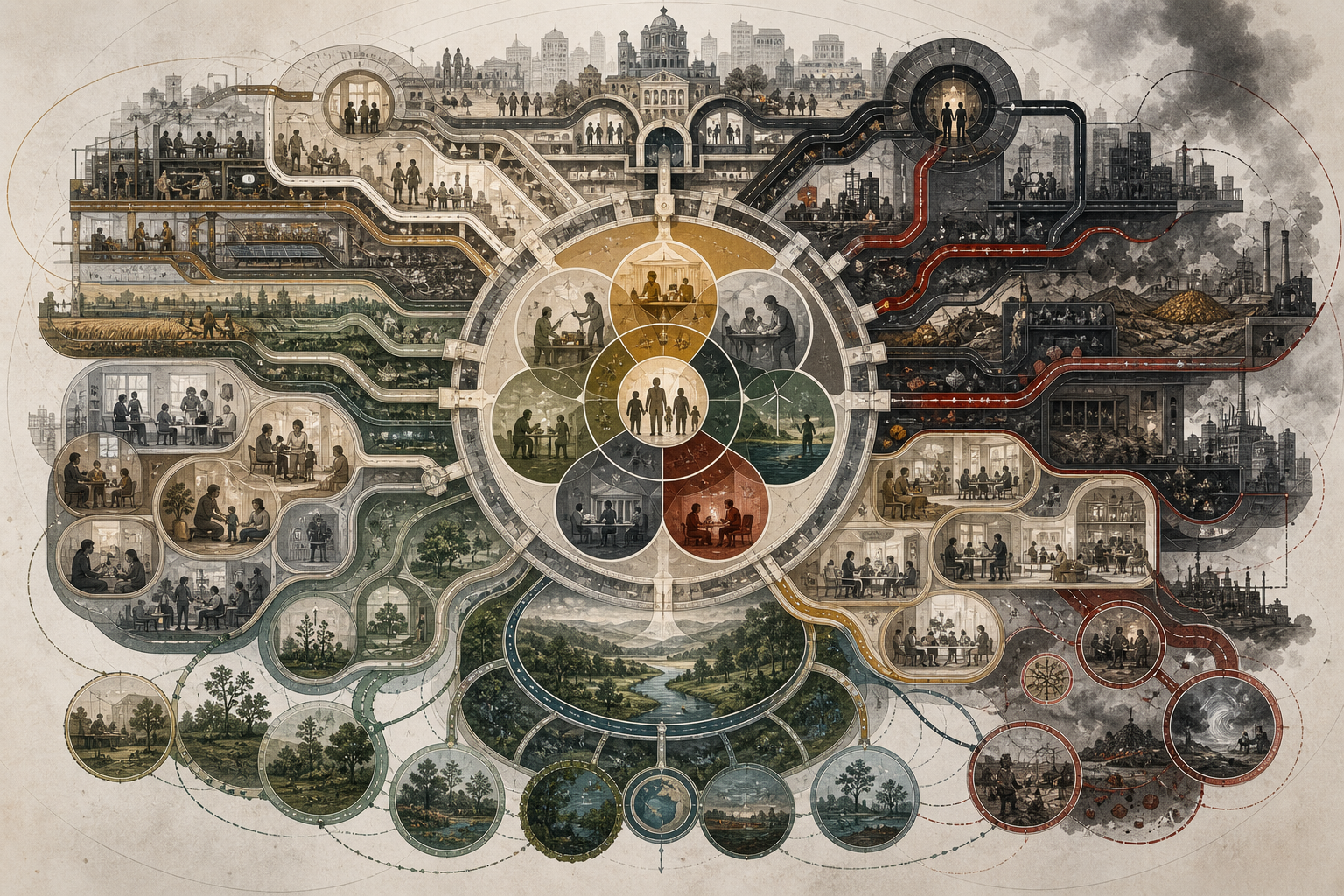
Economic systems increasingly require mathematical reasoning, statistical evidence, computational workflows, institutional analysis, and ecological accounting. Prices, wages, output, inflation, trade balances, debt, emissions, public investment, inequality, and resilience can all be modeled, measured, compared, and stress-tested. At the same time, economics cannot be reduced to equations. Economic systems are historical and political arrangements shaped by law, power, ownership, bargaining, public institutions, social norms, ecological limits, and technological change.
For that reason, this series integrates economic theory with mathematics, Python, R, SQL, Stata, Julia, public data, reproducible workflows, and research-grade code where appropriate. Mathematics clarifies production, demand, trade-offs, distribution, welfare, externalities, and system constraints. Python supports data pipelines, simulation, visualization, scenario analysis, and reproducible economic modeling. R supports statistics, econometrics, indicator construction, dashboards, and public-data analysis. SQL supports structured indicator databases, article metadata, policy data, fiscal records, and auditable evidence systems. Stata remains important for applied economics, replication, and econometric workflows. Julia supports numerical modeling, optimization, dynamic systems, and high-performance simulation.
The aim is not to make economics artificially technical. The aim is to show that serious economic reasoning must connect concepts, evidence, institutions, computation, and ethics. Economics is most useful when it helps explain how societies can organize material life in ways that are productive, fair, resilient, ecologically grounded, and capable of sustaining human dignity across generations.
Economic Systems Research Repository
The Economic Systems knowledge series is supported by a research repository with article-level folders, reproducible examples, synthetic datasets, documentation, indicator workflows, scenario models, and full-stack analytical scaffolding across Python, R, Stata, SQL, Julia, and notebooks where appropriate.
Economic Systems as a Foundational Framework
Economic systems occupy a central place in any serious account of social life because they shape how societies secure food, shelter, work, care, infrastructure, health, education, energy, mobility, public goods, and long-term security. An economy is not only a collection of transactions. It is a structure of institutions and relationships that determines who can command resources, who must sell labor, who owns productive assets, who bears risk, who receives public support, and what forms of value are counted.
This foundational role does not mean that economics replaces sociology, political science, law, ecology, history, ethics, or engineering. Rather, economics provides a way to connect those fields around the organization of material life. Economic systems are built from legal institutions, political authority, technological infrastructures, cultural norms, environmental foundations, financial systems, and social expectations. They cannot be understood through market exchange alone.
A mature framework for economic systems must therefore examine production and distribution together; markets and public institutions together; finance and real activity together; growth and ecological constraint together; individual choice and institutional structure together; and efficiency, justice, resilience, and legitimacy together. The economy is not a machine outside society. It is one of the main ways society becomes material.
Economics as a Science of Coordination, Production, and Distribution
Economics may be understood as the study of how societies coordinate human activity under conditions of scarcity, uncertainty, interdependence, and institutional constraint. That coordination may occur through markets, prices, firms, states, families, communities, commons, cooperatives, public utilities, planning systems, financial institutions, or hybrid arrangements. No economy is coordinated by one mechanism alone.
At the microeconomic level, economics studies households, firms, prices, costs, incentives, contracts, information, market structure, externalities, public goods, and collective action. At the macroeconomic level, it studies output, income, employment, inflation, money, credit, investment, public spending, trade, debt, financial conditions, business cycles, and long-run growth. Political economy adds the questions of power, property, class, bargaining, institutions, law, and distributional conflict. Ecological economics adds the physical reality that production depends on energy, materials, land, water, ecosystems, and waste sinks.
Taken together, these fields show that economic systems are never only technical. They involve moral and institutional choices about who gets what, who decides, what is protected, what is sacrificed, and how societies define prosperity. Economics is therefore most useful when it is not reduced to a narrow account of price signals, but treated as a broad inquiry into coordination, production, distribution, value, public purpose, and long-run viability.
Economics as a Quantitative and Computational Field
Modern economics is deeply quantitative. Economists estimate relationships, build models, test hypotheses, simulate policy scenarios, analyze household surveys, study national accounts, model financial risk, forecast inflation, measure inequality, estimate poverty, evaluate programs, construct indicators, and compare development pathways. Economic reasoning now depends heavily on data systems, reproducible workflows, computational environments, and transparent assumptions.
This does not make economics a purely technical field. Models are always simplifications. Indicators reflect choices. Data can exclude what is politically inconvenient or difficult to measure. Assumptions about behavior, institutions, information, value, nature, and time shape the conclusions models produce. Good economic analysis therefore requires both formal discipline and interpretive judgment.
In this series, computation appears where it improves clarity. Some articles are primarily conceptual or historical. Others naturally require code, data, formulas, simulations, or statistical workflows. The goal is to make economic reasoning more transparent and reproducible without pretending that equations alone can decide questions of justice, public purpose, ecological obligation, or democratic legitimacy.
What Economic Systems Study
Economic systems study the social organization of material life. They examine production, exchange, distribution, consumption, labor, capital, money, credit, taxation, public goods, ecological inputs, technological change, property, risk, and institutional authority. They ask how societies meet needs, allocate resources, fund public infrastructure, manage scarcity, govern markets, distribute wealth, stabilize demand, respond to crisis, and adapt to long-term transformation.
They also study the hidden foundations of formal economic activity. Unpaid care work, household labor, ecosystems, public infrastructure, legal systems, social trust, energy systems, and historical power relations all support the visible economy. When these foundations are ignored, economic analysis becomes distorted. A market price may look efficient while concealing pollution, exhaustion, unpaid labor, monopoly power, public subsidy, or ecological depletion.
The study of economic systems therefore connects economics to a wider set of questions: What does prosperity mean? What should be counted? What forms of work matter? What should markets decide? What should be protected collectively? What does society owe to future generations? What does economic freedom mean when people enter markets with unequal power, unequal wealth, unequal security, and unequal exposure to risk?
Mathematics, Computation, and Systems Modeling in Economics
Mathematics gives economics a formal language for production, demand, prices, welfare, externalities, growth, inflation, debt, risk, and constraint. It helps clarify relationships that ordinary prose can obscure. A national-income identity shows how consumption, investment, government spending, and net exports combine. A supply-and-demand condition shows how markets clear under simplified assumptions. A social-cost equation shows how externalities make private prices incomplete. A welfare function shows why output alone cannot stand in for human flourishing.
Computation extends this formal language. Python can build data pipelines, simulate policy scenarios, visualize economic systems, and automate reproducible workflows. R can support statistical analysis, econometrics, indicator dashboards, and public-data reporting. SQL can organize structured economic evidence. Stata remains important for empirical economics and replication. Julia can support dynamic systems, optimization, and large-scale numerical modeling.
Systems modeling is especially useful because economic systems are full of feedback loops. Investment affects income; income affects consumption; consumption affects production; credit affects demand; interest rates affect debt burdens; expectations affect investment; public spending affects employment; ecological stress affects prices, migration, public budgets, and financial risk. The economy is not a set of isolated variables. It is a dynamic system of relationships that can stabilize, amplify, delay, or transmit change across institutions and time.
Core Mathematical Lens
National Income Identity
Y = C + I + G + NX
\]
Interpretation: Total output \(Y\) equals consumption \(C\), investment \(I\), government spending \(G\), and net exports \(NX\). This identity is central to macroeconomics because it connects households, firms, governments, and the external sector.
Market Coordination
Q_d(P) = Q_s(P)
\]
Interpretation: A market clears when quantity demanded equals quantity supplied at price \(P\). The condition is useful, but incomplete when market power, inequality, public goods, rationing, externalities, or missing markets shape outcomes.
Production and Institutional Support
Y = f(K,\ L,\ A,\ E,\ I_s)
\]
Interpretation: Output depends on capital \(K\), labor \(L\), technology or productivity \(A\), energy and ecological inputs \(E\), and institutional support \(I_s\). This broader form recognizes that production is not merely technical; it depends on public systems, law, infrastructure, trust, and ecological foundations.
External Costs
MSC = MPC + MEC
\]
Interpretation: Marginal social cost \(MSC\) equals marginal private cost \(MPC\) plus marginal external cost \(MEC\). Pollution, carbon emissions, congestion, health harms, and ecological depletion show why private prices may fail to represent full social costs.
Inflation Pressure
\pi = f(gap,\ expectations,\ supply\ shocks,\ institutions)
\]
Interpretation: Inflation \(\pi\) may reflect demand pressure, expectations, supply constraints, energy shocks, wage-setting systems, market power, and institutional credibility. Inflation is rarely explained well by one cause alone.
Social Welfare Beyond Output
W = f(Y,\ D,\ PG,\ H,\ T,\ EQ)
\]
Interpretation: Social welfare \(W\) depends on output \(Y\), distribution \(D\), public goods \(PG\), health and human capability \(H\), time and care \(T\), and ecological quality \(EQ\). This helps explain why GDP alone cannot define prosperity.
Throughput Pressure
TP = N \times A \times MI
\]
Interpretation: Throughput pressure \(TP\) depends on population \(N\), affluence or consumption per person \(A\), and material intensity \(MI\). Ecological economics begins from the fact that economic systems have physical scale.
Economic Resilience
R = f(B,\ RD,\ PC,\ T,\ AD)
\]
Interpretation: Resilience \(R\) depends on buffers \(B\), redundancy \(RD\), public capacity \(PC\), trust \(T\), and adaptation \(AD\). A system optimized only for short-run efficiency may become fragile when shocks arrive.
Python Workflow for Economic Systems
The Python workflow below gives a compact overview of economic systems reasoning. It combines national income accounting, output gaps, external costs, throughput pressure, and a broader welfare score.
# Economic Systems Overview
# Compact Python workflow for output, externalities, throughput, and welfare

import pandas as pd

# National income identity
C = 520   # consumption
I = 160   # investment
G = 240   # government spending
NX = -30  # net exports

Y = C + I + G + NX

# Output gap
potential_output = 950
output_gap = (Y - potential_output) / potential_output

# External cost framework
marginal_private_cost = 50
marginal_external_cost = 18
marginal_social_cost = marginal_private_cost + marginal_external_cost

# Throughput pressure
population = 100
affluence = 1.35
material_intensity = 0.62
throughput_pressure = population * affluence * material_intensity

# Broader welfare score
distribution = 0.62
public_goods = 0.70
health_capability = 0.74
time_and_care = 0.58
ecological_quality = 0.52

welfare_score = (
    0.20 * (Y / potential_output)
    + 0.18 * distribution
    + 0.18 * public_goods
    + 0.18 * health_capability
    + 0.12 * time_and_care
    + 0.14 * ecological_quality
)

dashboard = pd.DataFrame({
    "Indicator": [
        "Output",
        "Potential Output",
        "Output Gap",
        "Marginal Private Cost",
        "Marginal External Cost",
        "Marginal Social Cost",
        "Throughput Pressure",
        "Welfare Score"
    ],
    "Value": [
        Y,
        potential_output,
        output_gap,
        marginal_private_cost,
        marginal_external_cost,
        marginal_social_cost,
        throughput_pressure,
        welfare_score
    ]
})

print(dashboard.round(3))
This workflow is intentionally simple. It shows how an economic overview can combine aggregate demand, productive capacity, externalities, ecological pressure, and welfare rather than treating them as separate subjects. More advanced article-level workflows can extend this foundation with inequality data, public finance, monetary policy, business-cycle modeling, climate economics, or resilience indicators.
R Workflow for Economic Systems
The R workflow performs the same calculations and can be adapted for article-level indicators, teaching examples, and reproducible economic summaries.
# Economic Systems Overview
# Compact R workflow for output, externalities, throughput, and welfare

# National income identity
C <- 520
I <- 160
G <- 240
NX <- -30

Y <- C + I + G + NX

# Output gap
potential_output <- 950
output_gap <- (Y - potential_output) / potential_output

# External cost framework
marginal_private_cost <- 50
marginal_external_cost <- 18
marginal_social_cost <- marginal_private_cost + marginal_external_cost

# Throughput pressure
population <- 100
affluence <- 1.35
material_intensity <- 0.62
throughput_pressure <- population * affluence * material_intensity

# Broader welfare score
distribution <- 0.62
public_goods <- 0.70
health_capability <- 0.74
time_and_care <- 0.58
ecological_quality <- 0.52

welfare_score <- (
  0.20 * (Y / potential_output) +
  0.18 * distribution +
  0.18 * public_goods +
  0.18 * health_capability +
  0.12 * time_and_care +
  0.14 * ecological_quality
)

dashboard <- data.frame(
  Indicator = c(
    "Output",
    "Potential Output",
    "Output Gap",
    "Marginal Private Cost",
    "Marginal External Cost",
    "Marginal Social Cost",
    "Throughput Pressure",
    "Welfare Score"
  ),
  Value = c(
    Y,
    potential_output,
    output_gap,
    marginal_private_cost,
    marginal_external_cost,
    marginal_social_cost,
    throughput_pressure,
    welfare_score
  )
)

print(round(dashboard, 3))
R is especially useful for indicators, statistical summaries, econometric models, dashboards, and visualizations. Used alongside Python, SQL, Stata, and Julia, it helps make economic systems analysis more reproducible and transparent.
Major Domains of Economic Systems
Economic systems include several overlapping domains. Foundations of economic life address scarcity, allocation, production, distribution, exchange, households, firms, markets, states, prices, and social value. Microeconomics examines choice, incentives, market coordination, competition, public goods, externalities, information, uncertainty, behavior, and common resources. Labor and production analysis examines wages, productivity, bargaining, capital, investment, firm organization, care work, and social reproduction.
Macroeconomics examines output, income, employment, inflation, credit, money, fiscal policy, monetary policy, business cycles, stabilization, crisis, and long-run growth. Development economics studies poverty, capability, structural transformation, industrial policy, trade, dependency, public investment, and global financial hierarchy. Political economy studies institutions, property, capitalism, socialism, planning, mixed economies, power, class, distributional conflict, and state capacity. Ecological economics studies natural capital, resource use, circularity, decarbonization, planetary boundaries, post-growth, and the material basis of prosperity.
A complete economic framework must move across these domains without flattening their differences. Markets matter, but they are not the whole economy. States matter, but public capacity is uneven. Finance matters, but it can stabilize or destabilize. Growth matters, but it cannot stand in for well-being. Ecological limits matter, because economies depend on the living and material systems that make production possible.
Why Economic Systems Matter
Economic systems matter because they shape the lived conditions of everyday life. They influence whether people can find decent work, afford housing, access healthcare, build savings, receive care, start a business, survive a shock, retire securely, or participate meaningfully in society. They also shape the long-run future: what infrastructure is built, what industries develop, how energy systems change, how public goods are funded, how climate risks are managed, and whether ecological foundations are maintained or depleted.
They matter because economic arrangements distribute power. Ownership, wealth, debt, labor contracts, land, intellectual property, public budgets, and financial systems all shape who can decide and who must adjust. An economic system is therefore never neutral. It creates winners and losers, visible and invisible work, counted and uncounted value, protected and exposed populations.
They matter because the economy is one of the main ways societies translate values into institutions. A society that values dignity must ask whether people can live without constant insecurity. A society that values freedom must ask whether people have real capabilities, not merely formal choices. A society that values sustainability must ask whether prosperity depends on ecological damage. A society that values democracy must ask whether economic power undermines political equality.
Economic Systems and Human Self-Understanding
Economic systems shape how human beings understand progress, work, value, freedom, responsibility, and the good life. If prosperity is defined only as rising output, then care, leisure, ecological repair, public trust, and nonmarket forms of value can appear secondary. If value is defined only by market price, then unpaid labor, ecosystems, public goods, and future generations become difficult to see. If freedom is defined only as consumer choice, then questions of power, security, capability, and institutional access may disappear.
A richer understanding of economic systems changes the question. It asks what kind of society an economy is creating. Are people more secure? Are public goods stronger? Are ecological foundations more stable? Is power more accountable? Are workers treated with dignity? Are households less fragile? Are future generations protected? Are the benefits of development broadly shared?
Economics is therefore not only a technical discipline. It is part of a society’s self-description. It teaches people what to count, what to ignore, what to reward, what to protect, and what to imagine as possible. That is why a serious article map for economic systems must include mathematical models and public finance, but also care, institutions, ecological limits, development justice, resilience, and the future of prosperity itself.
Economic Systems Article Map
The map below organizes the Economic Systems knowledge series into conceptual domains. Published articles are linked directly. Planned articles are included as future directions and marked as (planned) without placeholder links.
Foundations of Economic Life
- What Is an Economic System? — A foundational article defining economic systems as institutional arrangements for organizing production, distribution, exchange, labor, finance, public goods, and material life.
- Scarcity, Allocation, and the Organization of Material Life — An article on scarcity, opportunity cost, allocation, coordination, social provisioning, and the institutional organization of economic life.
- Production, Distribution, and Exchange in Human Societies — A study of how societies produce goods and services, distribute surplus, organize exchange, and reproduce material life.
- Households, Firms, Markets, and States — An article on the major actors of economic systems and how households, firms, markets, states, communities, and institutions interact.
- Economic Value, Price, and Social Worth (planned) — A conceptual article on market price, use value, exchange value, public value, ecological value, and social worth.
- Property, Contracts, and the Legal Architecture of Economic Life (planned) — A study of property, contract, exchange, debt, inheritance, corporate organization, and the legal foundations of markets.
- Economic Systems in Historical Perspective (planned) — An article comparing household economies, agrarian systems, tributary systems, mercantilism, industrial capitalism, socialism, mixed economies, and contemporary global capitalism.
Microeconomics, Markets, and Everyday Coordination
- Supply, Demand, Prices, and Economic Coordination — An article on prices, supply, demand, equilibrium, shortages, surpluses, rationing, and the role of markets in coordinating decentralized activity.
- Consumer Choice, Household Welfare, and Everyday Economic Life — A study of household decision-making, budgets, preferences, time use, vulnerability, care responsibilities, and welfare.
- Firms, Costs, Competition, and Market Structure — An article on production costs, firm behavior, perfect competition, monopoly, oligopoly, market power, and industrial organization.
- Externalities, Public Goods, and Collective Provision — A foundational article on market failures, pollution, public goods, free-riding, collective goods, and institutional provision.
- Commons, Shared Resources, and Institutional Governance — An article on common-pool resources, collective action, governance rules, local institutions, and alternatives to the market-versus-state binary.
- Behavioral Economics and Bounded Rationality — A study of bounded rationality, heuristics, bias, framing, time inconsistency, and behavioral approaches to economic decision-making.
- Information, Uncertainty, and Imperfect Markets — An article on asymmetric information, adverse selection, moral hazard, uncertainty, trust, signaling, and institutional design.
- Transaction Costs, Institutions, and Economic Coordination (planned) — An article on why contracts, enforcement, norms, firms, and institutions matter when exchange is costly or uncertain.
- Regulation, Competition Policy, and Market Power (planned) — A study of monopoly, antitrust, platform power, concentration, regulatory capacity, and the public governance of markets.
- Market Design, Auctions, and Matching Systems (planned) — An article on auction design, matching markets, allocation mechanisms, school choice, organ exchange, electricity markets, and platform rules.
Labor, Production, Capital, and Social Reproduction
- Labor, Wages, Productivity, and the Social Organization of Work — An article on labor markets, wages, bargaining power, productivity, employment relations, and the organization of work.
- Capital, Investment, and the Dynamics of Accumulation — An article on capital formation, accumulation, investment, profits, depreciation, ownership, and productive capacity.
- Unpaid Care Work and the Hidden Foundations of the Economy (planned) — A feminist economics article on household labor, caregiving, social reproduction, gendered work, time use, and the limits of GDP-centered measurement.
- Precarious Work, Informality, and Economic Security (planned) — A study of informal labor, gig work, contract work, wage insecurity, workplace risk, and social protection gaps.
- Labor Unions, Collective Bargaining, and Worker Power (planned) — An article on bargaining institutions, labor law, union power, wage setting, workplace democracy, and the politics of labor protection.
- Automation, Skills, and the Future of Work (planned) — A future-facing article on technological change, AI, productivity, displacement, skill formation, labor-market transition, and public policy.
- Care, Time, and the Economics of Human Reproduction (planned) — A deeper article on care systems, demographic change, household labor, public provision, and the social foundations of economic life.
- Productivity, Technology, and the Organization of Work (planned) — A study of productivity growth, technology adoption, labor process, management systems, training, and institutional support.
Money, Banking, Finance, and Macroeconomic Stability
- Money, Banking, Credit, and Financial Intermediation — A foundational article on money creation, banking systems, credit, deposits, lending, and financial intermediation.
- Finance, Leverage, and Systemic Risk — An article on leverage, liquidity, asset prices, debt cycles, shadow banking, contagion, and financial fragility.
- Macroeconomic Stability, Business Cycles, and Crisis — A macroeconomic article on demand, investment, expectations, recession, crisis, stabilization, and recovery.
- Economic Resilience: Why Recessions Occur and How Economies Recover — An article on recessions, demand shocks, fragility, recovery, policy response, and economic resilience.
- Business Cycles: Economic Expansions, Recessions, and Macroeconomic Stability — A study of expansions, contractions, turning points, cyclical instability, and macroeconomic stabilization.
- Stabilization Policy: Fiscal and Monetary Tools for Managing Economic Fluctuations — An article on fiscal and monetary tools for stabilizing demand, employment, output, and financial conditions.
- Limits of Stabilization Policy: Fiscal Policy, Monetary Policy, and Macroeconomic Constraints — An article on inflation, debt, crowding out, supply limits, expectations, institutional constraints, and policy trade-offs.
- The IS–LM Model: Fiscal Policy, Monetary Policy, and Macroeconomic Equilibrium — A formal article on goods-market and money-market equilibrium, fiscal policy, monetary policy, and interest-rate effects.
- Inflation, Energy Shocks, and Supply Constraints — A study of inflation dynamics, supply shocks, energy prices, bottlenecks, wage-price dynamics, and monetary policy trade-offs.
- Fiscal Policy, Taxation, and Public Investment — An article on taxes, spending, deficits, debt, public investment, and the fiscal foundations of collective capacity.
- Monetary Policy, Central Banking, and Financial Conditions — An article on central banking, interest rates, reserves, liquidity, transmission channels, and financial conditions.
- Open-Economy Macroeconomics, Exchange Rates, and Balance of Payments (planned) — A study of exchange rates, capital flows, trade balances, external debt, currency crises, and macroeconomic vulnerability.
- Financial Crises, Bank Runs, and Lender-of-Last-Resort Institutions (planned) — An article on panic, liquidity, solvency, deposit insurance, central banks, and crisis containment.
- Debt Deflation, Balance Sheets, and Macroeconomic Instability (planned) — A study of balance-sheet recessions, debt overhang, deleveraging, asset prices, and financial amplification.
Growth, Development, and Structural Transformation
- Growth, Development, and Structural Transformation — An article on growth, productivity, sectoral change, industrialization, development, and long-run transformation.
- Industrial Policy and the Developmental State — A study of public coordination, industrial upgrading, strategic sectors, state capacity, and development strategy.
- Trade, Globalization, and Uneven Development — An article on global trade, specialization, value chains, dependency, labor, and uneven development.
- Debt, Dependency, and Global Financial Order — An article on sovereign debt, dependency, financial hierarchy, austerity, crisis, and global development constraints.
- Agrarian Change, Land, and Rural Development (planned) — An article on land tenure, agriculture, rural livelihoods, agrarian transition, food systems, and the political economy of land.
- Infrastructure, Urbanization, and Productive Capacity (planned) — A study of infrastructure investment, urban systems, transport, energy, housing, logistics, and the physical foundations of productivity.
- Technology Transfer, Learning, and Economic Catch-Up (planned) — An article on industrial learning, technology diffusion, state capacity, productivity growth, and late development.
- Dependency, Structuralism, and Global Economic Hierarchy (planned) — A critical article on center-periphery relations, terms of trade, underdevelopment, debt, commodity dependence, and global asymmetry.
- Development Finance, Public Banks, and Long-Term Investment (planned) — A study of development banks, patient capital, infrastructure finance, credit allocation, and strategic public investment.
- Industrialization, Premature Deindustrialization, and Development Strategy (planned) — An article on manufacturing, services, productivity, late development, trade competition, and structural constraints.
Inequality, Welfare, Capability, and Social Protection
- Inequality, Redistribution, and Social Mobility — An article on income distribution, wealth, class mobility, taxation, transfers, and the institutional production of unequal life chances.
- Poverty, Capability, and Economic Inclusion — A study of poverty, capability, economic inclusion, public services, and lived freedom.
- The Welfare State and Social Protection — An article on welfare institutions, social insurance, public provision, risk pooling, and economic security.
- Capability, Freedom, and Human Development (planned) — An article on capability, substantive freedom, development as opportunity, and the relationship between economic systems and human flourishing.
- Public Goods, Social Infrastructure, and Collective Well-Being (planned) — A study of education, health, care, public transportation, housing, digital access, and the economic foundations of collective life.
- Universal Basic Services, Income Security, and Social Provisioning (planned) — An article on income support, social services, public provision, redistribution, and the design of economic security.
- Wealth Concentration, Inheritance, and the Political Economy of Opportunity (planned) — A study of capital ownership, inheritance, class reproduction, wealth taxation, and unequal life chances.
- Housing, Rent, and the Political Economy of Everyday Security (planned) — An article on housing markets, rent extraction, land value, affordability, public housing, and household vulnerability.
- Health, Education, and the Economics of Human Capability (planned) — A study of human capital, capability, public health, education systems, social mobility, and long-term development.
Institutions, Property, Capitalism, Socialism, and Mixed Economies
- Institutions, Property Rights, and Economic Order — An article on property rights, legal systems, norms, enforcement, and institutional design as foundations of economic life.
- Capitalism and Its Varieties — A study of capitalist systems, ownership, markets, firms, wage labor, accumulation, and institutional diversity.
- Socialism, Planning, and the Mixed Economy — An article on planning, public ownership, social provision, mixed economies, and the institutional variety of non-market coordination.
- Political Economy, Power, and Distributional Conflict — An article on power, class, ownership, bargaining, law, and politics in distributional outcomes.
- Public Finance, State Capacity, and Collective Goods (planned) — A study of taxation, fiscal institutions, public investment, administrative capacity, and the financing of collective life.
- Cooperatives, Commons, and Democratic Economic Governance (planned) — An article on cooperative ownership, commons governance, workplace democracy, local economic institutions, and plural ownership forms.
- Markets, Planning, and Coordination Beyond Ideology (planned) — An article on how markets, planning, public provision, and institutional coordination can be analyzed pragmatically rather than ideologically.
- Corporate Power, Governance, and the Political Economy of the Firm (planned) — A study of corporations, shareholders, managers, workers, accountability, and the governance of productive power.
- Platform Capitalism, Data Assets, and Digital Market Power (planned) — An article on platforms, network effects, data extraction, algorithmic pricing, labor control, monopoly, and digital governance.
Ecological Economics, Circularity, and Planetary Limits
- Ecological Economics and the Embedded Economy — An article treating the economy as embedded within living ecological systems, social institutions, care structures, and biophysical limits.
- Natural Capital, Resource Use, and Environmental Constraint — A study of natural capital, resource depletion, ecological constraint, and the limits of conventional economic accounting.
- Circular Economy and Regenerative Production — An article on repair, reuse, remanufacturing, circular design, waste reduction, and regenerative production systems.
- Climate Economics, Transition Policy, and Decarbonization — An article on emissions, transition policy, carbon pricing, public investment, decarbonization, and economic restructuring.
- Beyond GDP: Measuring Well-Being, Inclusion, and Sustainability — A study of alternative measures of progress, well-being, distribution, sustainability, and the limits of national accounting.
- Economic Systems Within Planetary Boundaries — An article on how economies can operate within ecological ceilings while supporting human dignity and development.
- Post-Growth, Degrowth, and the Critique of Endless Expansion — A study of growth dependence, sufficiency, care, throughput reduction, public goods, and the politics of enough.
- Energy, Materials, and the Metabolism of the Economy (planned) — An article on energy flows, material throughput, thermodynamic limits, resource extraction, waste, and the physical basis of economic systems.
- Ecological Distribution Conflicts and the Politics of Resource Use (planned) — A critical article on mining, land use, water, pollution, energy transition minerals, and conflicts over ecological burden and benefit.
- Regenerative Economics and the Repair of Living Systems (planned) — A study of restoration, circularity, social-ecological repair, regenerative production, and economies designed around replenishment rather than depletion.
- Climate Finance, Loss and Damage, and Global Economic Responsibility (planned) — An article on climate finance, adaptation, liability, debt, development space, and the distribution of transition burdens.
Measurement, Indicators, and Evaluation Beyond GDP
- Beyond GDP: Measuring Well-Being, Inclusion, and Sustainability — A foundational article on moving beyond output-centered measurement toward well-being, inclusion, and ecological accounting.
- National Accounts, GDP, and the Politics of Measurement (planned) — An article on national income accounting, GDP, productivity, measurement conventions, and what economic statistics include or exclude.
- Well-Being Economics and Social Progress Indicators (planned) — A study of well-being frameworks, life satisfaction, health, education, security, trust, and social progress measures.
- Natural Capital Accounting and Its Limits (planned) — An article on ecosystem accounting, environmental valuation, natural capital, and the ethical and methodological limits of monetizing nature.
- Distributional National Accounts and the Measurement of Inequality (planned) — A study of income and wealth distribution, percentile analysis, inequality measurement, and the limits of averages.
- Resilience Indicators and the Measurement of Economic Fragility (planned) — An article on how economies can be assessed for adaptive capacity, redundancy, exposure, financial stress, and public capacity.
- Care, Time Use, and the Measurement of Social Reproduction (planned) — A measurement-focused article on unpaid labor, time-use surveys, household production, care systems, and economic invisibility.
- Dashboards, Composite Indicators, and the Governance of Economic Evidence (planned) — An article on indicator design, dashboards, weighting, uncertainty, public communication, and data governance.
Economic Resilience, Risk, and Future Systems
- Economic Resilience, Fragility, and Adaptive Capacity — An article on shocks, buffers, redundancy, public capacity, household stability, financial fragility, supply chains, and adaptation.
- The Future of Economic Systems in an Age of Limits — A synthesis article on ecological limits, public goods, finance, technology, legitimacy, resilience, and future economic design.
- Supply Chains, Strategic Reserves, and Economic Resilience (planned) — An article on supply-chain fragility, inventories, chokepoints, local capacity, resilience, and the trade-offs between efficiency and security.
- Climate Risk, Insurance, and the Economics of Uninsurable Futures (planned) — A study of insurance withdrawal, climate risk pricing, housing markets, public backstops, and the economic consequences of rising physical risk.
- AI, Automation, and the Next Transformation of Economic Systems (planned) — A future-facing article on artificial intelligence, productivity, labor displacement, platform power, data assets, and the governance of automated economic systems.
- Polycrisis, Economic Fragmentation, and the Future of Globalization (planned) — A synthesis article on overlapping shocks, geopolitical fragmentation, supply-chain restructuring, debt, climate stress, and global economic order.
- Resilience, Adaptation, and the Economics of Rebuilding After Shock (planned) — An article on recovery, reconstruction, public investment, institutional learning, and long-run adaptive capacity.
- Scenario Planning, Stress Testing, and Economic Futures (planned) — A methodological article on scenarios, stress tests, uncertainty, resilience planning, and long-run economic transition.
Measurement, Indicators, and Economic Practice
Economic measurement shapes public reality. GDP, inflation, unemployment, poverty, productivity, inequality, debt, trade balances, interest rates, emissions, material use, and well-being indicators all influence policy decisions. What is measured tends to become visible; what is not measured often becomes easier to ignore.
That is why economic measurement is not merely technical. GDP can rise while household insecurity increases. Productivity can improve while workers lose bargaining power. Inflation can fall while housing remains unaffordable. A fiscal balance can improve while public infrastructure decays. A firm can report profits while externalizing ecological costs. A national average can improve while entire regions decline.
A serious economic systems framework therefore requires plural measurement. National accounts remain important, but they must be interpreted alongside distributional accounts, public-goods indicators, ecological accounts, care and time-use data, resilience metrics, financial-stability indicators, and measures of lived well-being. Measurement should clarify social reality, not narrow it.
Economic Systems, Technology, and the Modern World
Technology reshapes economic systems by changing what can be produced, how labor is organized, how firms compete, how information circulates, how public services are delivered, and how power is concentrated. Industrial machinery, electricity, telecommunications, computing, artificial intelligence, automation, biotechnology, logistics networks, and digital platforms have all altered the structure of production and distribution.
But technology does not determine economic outcomes by itself. Institutions decide whether productivity gains become higher wages, higher profits, shorter working hours, cheaper goods, stronger public services, or deeper inequality. Public policy decides whether new technologies support broad capability or private concentration. Labor institutions decide whether workers are protected during transition. Energy systems decide whether digital growth increases or reduces ecological pressure.
The modern economy therefore requires technology governance. Innovation must be connected to public purpose, ecological limits, labor dignity, privacy, democratic accountability, and long-term resilience. Technology can widen human capability, but only if its direction, ownership, and distribution are governed well.
Economic Systems in a Wider Intellectual Context
Economics belongs to a wider intellectual history of debates over progress, property, labor, freedom, justice, nature, and power. Classical political economy asked how surplus was produced and distributed. Marxian political economy asked how capital, labor, exploitation, and crisis were structured. Neoclassical economics formalized choice, price, and equilibrium. Keynesian economics showed why aggregate demand, expectations, uncertainty, and public policy matter. Institutional economics emphasized law, norms, organizations, and governance. Development economics studied structural transformation and global inequality. Ecological economics placed the economy inside the biosphere. Feminist economics brought care and social reproduction into view.
The value of an economic systems approach is that it can hold these traditions in relation. It does not require one school to explain everything. Markets, states, firms, households, commons, finance, public goods, ecological systems, and global institutions all matter. Their relative importance depends on the question being asked.
Economics is strongest when it helps societies see trade-offs clearly without hiding values behind technique. It should explain how economies work, but also clarify what they are for. In that sense, economic systems analysis is not only about production and allocation. It is about the conditions under which human societies can organize material life with dignity, justice, resilience, and responsibility.
Related Reading
- Sustainable Systems
- Sustainable Development
- Risk & Resilience
- Institutions & Governance
- Stewardship & Ethics
- Planetary Boundaries
- Systems Thinking
- Data Systems & Analytics
- Artificial Intelligence Systems
- Geopolitics & Global Order
Further Reading
- International Monetary Fund (IMF) (n.d.) Climate Change. Available at: https://www.imf.org/en/topics/climate-change
- Organisation for Economic Co-operation and Development (OECD) (2018) Beyond GDP: Measuring What Counts for Economic and Social Performance. Available at: https://www.oecd.org/en/publications/beyond-gdp_9789264307292-en.html
- Organisation for Economic Co-operation and Development (OECD) (2020) Systemic Thinking for Policy Making. Available at: https://www.oecd.org/en/publications/systemic-thinking-for-policy-making_879c4f7a-en.html
- Organisation for Economic Co-operation and Development (OECD) (n.d.) Well-being and Beyond GDP. Available at: https://www.oecd.org/en/topics/well-being-and-beyond-gdp.html
- United Nations Development Programme (UNDP) (n.d.) Human Development Reports. Available at: https://hdr.undp.org/
- United Nations Environment Programme (UNEP) (2024) Global Resources Outlook 2024. Available at: https://www.unep.org/resources/global-resource-outlook-2024
- World Bank (2021) Green, Resilient, and Inclusive Development. Available at: https://documents.worldbank.org/en/publication/documents-reports/documentdetail/285171633074966748/green-resilient-and-inclusive-development
- Ostrom, E. (1990) Governing the Commons. Cambridge: Cambridge University Press. Available at: https://doi.org/10.1017/CBO9780511807763
- Sen, A. (1999) Development as Freedom. Oxford: Oxford University Press. Available at: https://global.oup.com/academic/product/development-as-freedom-9780192893307
- Raworth, K. (2017) Doughnut Economics: Seven Ways to Think Like a 21st-Century Economist. Available at: https://www.penguin.co.uk/books/436418/doughnut-economics-by-raworth-kate/9781847941398
References
- International Monetary Fund (IMF) (n.d.) Climate Change. Available at: https://www.imf.org/en/topics/climate-change
- International Monetary Fund (IMF) (n.d.) Climate Policy Diagnostic. Available at: https://www.imf.org/en/topics/climate-change/climate-policy-diagnostic
- Organisation for Economic Co-operation and Development (OECD) (2018) Beyond GDP: Measuring What Counts for Economic and Social Performance. Paris: OECD. Available at: https://www.oecd.org/en/publications/beyond-gdp_9789264307292-en.html
- Organisation for Economic Co-operation and Development (OECD) (2020) Systemic Thinking for Policy Making. Paris: OECD. Available at: https://www.oecd.org/en/publications/systemic-thinking-for-policy-making_879c4f7a-en.html
- Organisation for Economic Co-operation and Development (OECD) (n.d.) Well-being and Beyond GDP. Available at: https://www.oecd.org/en/topics/well-being-and-beyond-gdp.html
- Organisation for Economic Co-operation and Development (OECD) (n.d.) Measuring Well-being and Progress. Available at: https://www.oecd.org/en/topics/measuring-well-being-and-progress.html
- United Nations Development Programme (UNDP) (n.d.) Human Development Reports. Available at: https://hdr.undp.org/
- United Nations Environment Programme (UNEP) (2024) Global Resources Outlook 2024. Available at: https://www.unep.org/resources/global-resource-outlook-2024
- World Bank (2021) Green, Resilient, and Inclusive Development. Washington, DC: World Bank. Available at: https://documents.worldbank.org/en/publication/documents-reports/documentdetail/285171633074966748/green-resilient-and-inclusive-development
- World Bank (2021) Green, Resilient, and Inclusive Development [PDF]. Available at: https://documents1.worldbank.org/curated/en/285171633074966748/pdf/Green-Resilient-and-Inclusive-Development.pdf
- Ostrom, E. (1990) Governing the Commons. Cambridge: Cambridge University Press. Available at: https://doi.org/10.1017/CBO9780511807763
- Sen, A. (1999) Development as Freedom. Oxford: Oxford University Press. Available at: https://global.oup.com/academic/product/development-as-freedom-9780192893307
- Raworth, K. (2017) Doughnut Economics: Seven Ways to Think Like a 21st-Century Economist. London: Random House Business. Available at: https://www.penguin.co.uk/books/436418/doughnut-economics-by-raworth-kate/9781847941398