
Last Updated June 11, 2026
Postcolonial storytelling is not only about what stories say after empire. It is also about how stories are shaped: who speaks, whose language carries authority, what counts as evidence, how memory is arranged, how time is broken or braided, how place is represented, how silence enters the page, and how narrative form itself can resist colonial ways of knowing.
Postcolonial Storytelling and the Politics of Narrative Form examines how colonial history, anti-colonial resistance, migration, language, hybridity, archive, testimony, oral tradition, translation, fragmentation, and counter-memory shape narrative structure. It argues that form is political. A postcolonial story may reject linear progress, challenge imperial archives, center multilingual voice, expose imposed categories, reclaim local memory, or turn narrative fragmentation into a method of resistance.
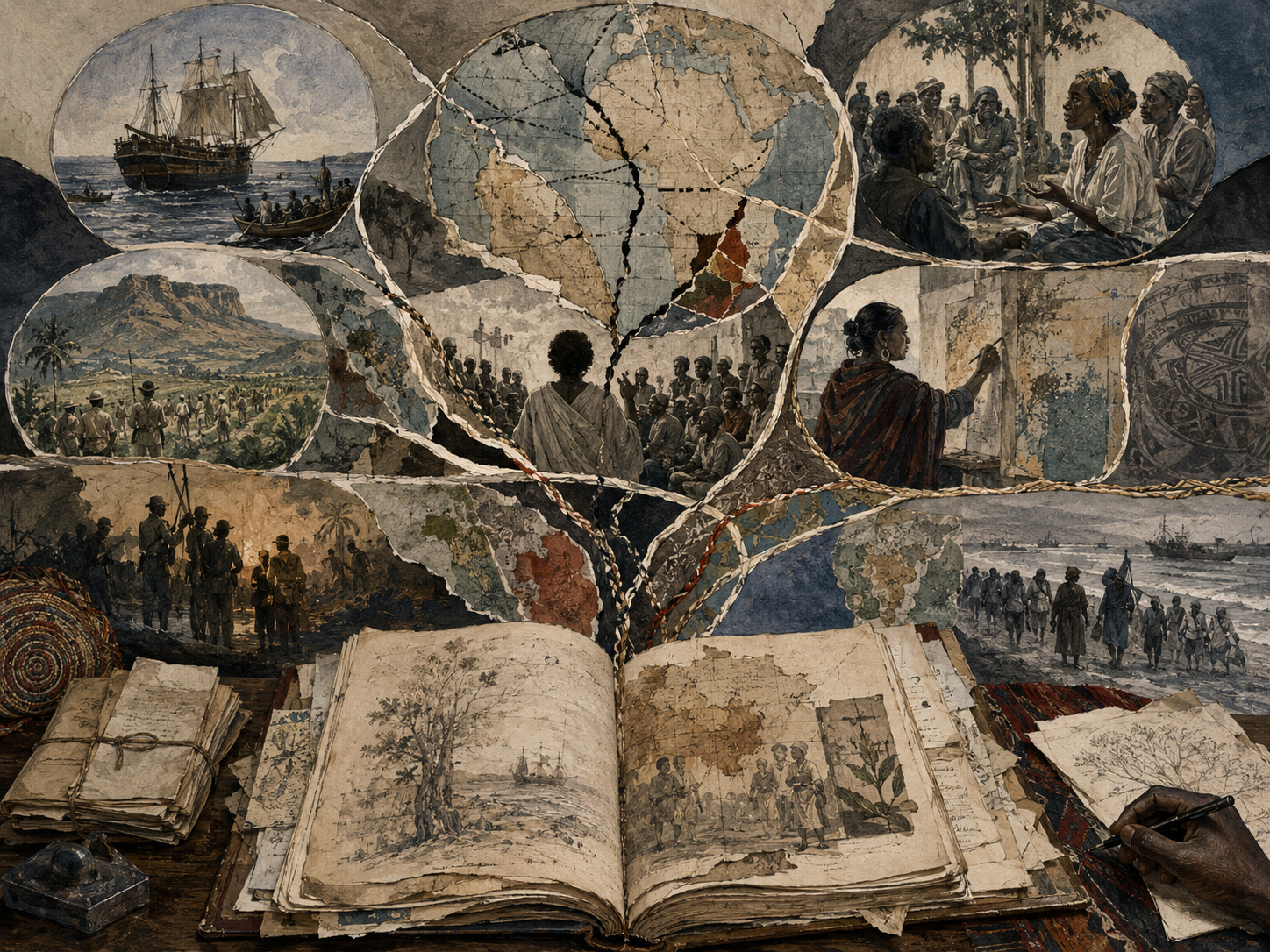
This article treats postcolonial narrative form as a struggle over memory, authority, and representation. Colonial power often organized stories through conquest, discovery, classification, hierarchy, exotic description, linear progress, and administrative record. Postcolonial storytelling responds by changing not only the content of the story, but the shape of telling itself.
Why Postcolonial Form Matters
Postcolonial form matters because empire was never only military, economic, or administrative. It was also narrative. Colonial power told stories about discovery, civilization, savagery, development, progress, race, language, gender, land, religion, history, and identity. These stories were embedded in maps, schoolbooks, legal documents, travel writing, missionary records, ethnographic descriptions, museums, novels, archives, census categories, and official histories.
Postcolonial storytelling challenges these forms of knowledge. It may answer imperial narrative by rewriting the archive, centering the colonized voice, refusing translation into dominant categories, foregrounding multilingual speech, exposing the violence of classification, or creating broken forms that reflect broken histories.
The politics of narrative form asks not only “What happened?” but “Who gets to organize what happened into a story?”
| Formal question | Postcolonial significance | Risk without critique |
|---|---|---|
| Who narrates? | Voice determines authority and perspective. | Colonial observers remain the default storytellers. |
| What language carries the story? | Language shapes memory, audience, power, and cultural continuity. | Colonial language becomes invisible as a norm. |
| What counts as evidence? | Archives, oral memory, testimony, land, and ritual may all carry knowledge. | Imperial records define truth alone. |
| How is time organized? | Colonial histories often impose progress narratives. | Displacement, recurrence, and rupture are flattened. |
| How is place represented? | Land may be homeland, relation, sacred space, extraction zone, or contested territory. | Place becomes scenery or resource. |
| What form resists domination? | Fragment, braid, counter-archive, polyphony, and oral structure may contest power. | Resistance is reduced to content only. |
Postcolonial form matters because storytelling is one of the places where historical power is repeated, contested, and remade.
Story After Empire
Postcolonial storytelling emerges from histories of colonization, slavery, settlement, extraction, missionization, forced education, linguistic suppression, racial hierarchy, migration, partition, exile, resistance, and independence. The term “postcolonial” does not mean that colonial power is simply over. It often names the continuing effects of colonial domination, including neocolonial economics, cultural hierarchy, border violence, language politics, racialization, and institutional memory.
A postcolonial story may be set during colonial rule, after independence, in diaspora, across borders, or inside an imperial center. It may speak from the colony, the former colony, the settler colony, the metropolis, the border, the archive, the plantation, the school, the prison, the refugee route, or the inherited family wound.
This is why narrative form matters. A linear progress story may not be adequate for histories shaped by rupture and ongoing domination. A single-protagonist arc may not fit collective dispossession. A neat ending may betray unresolved historical harm.
| Postcolonial story condition | Possible narrative form | What the form reveals |
|---|---|---|
| Colonial archive | Counter-archive, document collage, testimony. | Official records are partial and political. |
| Language domination | Multilingual narration, code-switching, untranslated terms. | Language is a site of power. |
| Migration and diaspora | Braided timeline, split setting, memory fragments. | Identity is stretched across places. |
| Partition or displacement | Broken chronology, family silence, map-based form. | Historical rupture enters narrative structure. |
| Independence and aftermath | Satire, institutional tragedy, cyclical corruption narrative. | Freedom may coexist with new domination. |
| Anti-colonial resistance | Collective voice, oral testimony, revolutionary chronicle. | Agency may be communal rather than heroic. |
Postcolonial storytelling asks how stories continue after empire, but also how empire continues inside stories.
Language, Translation, and Power
Language is central to postcolonial narrative form. Colonial education often elevated imperial languages while devaluing local languages. Literature written in English, French, Spanish, Portuguese, Dutch, or other colonial languages may reach global audiences, but it may also carry histories of coercion, exclusion, and cultural displacement.
Ngũgĩ wa Thiong’o’s work is especially important here because it frames language as a carrier of culture, memory, identity, and political struggle. A postcolonial writer may choose to write in an Indigenous or local language, write in a colonial language against itself, mix languages, refuse italics for non-English words, use untranslated terms, or build narrative rhythm from oral speech.
Translation is also political. Who translates? For whom? What is explained? What remains opaque? What must the reader learn to meet the text on its own terms?
| Language strategy | Narrative effect | Political meaning |
|---|---|---|
| Writing in a local language | Centers local audience, sound, idiom, and memory. | Refuses colonial language hierarchy. |
| Writing in a colonial language against itself | Alters syntax, rhythm, metaphor, and worldview. | Turns imposed language into a contested medium. |
| Code-switching | Moves between linguistic registers and communities. | Shows identity as relational and situated. |
| Untranslated terms | Creates necessary opacity or cultural specificity. | Refuses total accessibility to dominant readers. |
| Oral cadence | Preserves speech, performance, proverb, chant, or memory. | Challenges print-centered literary authority. |
| Translator visibility | Makes mediation explicit. | Prevents translation from pretending to be neutral. |
Postcolonial language politics remind readers that narrative voice is never just style. It is a struggle over who may speak, in what language, and under whose terms.
Voice and the Question of Who Speaks
The question of who speaks is central to postcolonial storytelling. Colonial narrative often spoke about colonized people while denying them narrative authority. It described, classified, explained, measured, and translated them for imperial audiences. Postcolonial form often contests this by changing the location of voice.
A postcolonial text may use first-person testimony, multiple narrators, unreliable colonial documents, oral narrators, communal voice, fragmented voice, letters, court records, songs, marginal notes, or silence. It may make the reader confront the difference between being represented and speaking.
Gayatri Chakravorty Spivak’s question about whether the subaltern can speak is useful because it does not merely ask whether marginalized people have voices. It asks how systems of power organize who can be heard, translated, recognized, and authorized.
| Voice problem | Postcolonial form | Analytical question |
|---|---|---|
| Colonial observer voice | Ironized report, unreliable record, counter-narration. | Whose authority is being exposed? |
| Silenced subject | Testimony, gap, fragment, or withheld speech. | What makes speech difficult or dangerous? |
| Collective experience | Chorus, oral history, communal narration. | Why is one protagonist insufficient? |
| Translated voice | Translator notes, multilingual form, code-switching. | What changes across mediation? |
| Hybrid identity | Shifting narration, doubled perspective, ambivalent address. | How does voice move between worlds? |
| Refusal to explain | Opacity, silence, untranslated terms, withheld context. | What does the text protect from extraction? |
Voice is political because representation is never neutral when some people have historically been spoken for, spoken over, or made unreadable.
Counter-Archive and Contested Memory
Colonial power produced archives: maps, ledgers, censuses, legal records, military documents, missionary accounts, school files, ethnographies, photographs, museum catalogs, land deeds, plantation records, and bureaucratic classifications. These archives preserve evidence, but they also preserve power. They may record colonized people as labor, property, subjects, tribes, cases, converts, criminals, specimens, or administrative problems.
Postcolonial storytelling often builds a counter-archive. It may rewrite official records from below, restore family memory, question legal documents, expose what the archive excludes, or stage conflict between oral memory and written record. The counter-archive does not simply add missing facts. It questions the system that decided what counted as fact.
Archive form is especially important for stories about slavery, indenture, genocide, partition, land theft, migration, imprisonment, forced schooling, and suppressed language.
| Archive feature | Colonial function | Postcolonial narrative response |
|---|---|---|
| Map | Claims territory, borders, routes, and resources. | Reclaims place through memory, relation, and local geography. |
| Census | Classifies populations into administrative categories. | Shows identity exceeding imposed categories. |
| Ledger | Records labor, property, debt, extraction, or trade. | Restores human lives behind numbers. |
| Missionary record | Frames conversion, education, and “civilization.” | Exposes cultural suppression and spiritual complexity. |
| Legal document | Defines ownership, status, criminality, or legitimacy. | Questions law as an instrument of domination. |
| Photograph | Fixes bodies as objects of study or spectacle. | Reclaims image, gaze, and context. |
The counter-archive is a narrative form that asks who made the record, who was excluded from it, and what forms of memory survive outside it.
Fragmentation, Displacement, and Nonlinear Time
Postcolonial stories often use fragmented or nonlinear time because colonial history itself is experienced through rupture: invasion, enslavement, forced migration, partition, exile, dispossession, language loss, family separation, and historical erasure. A smooth chronological arc may be inadequate for these experiences.
Fragmentation can represent broken memory, interrupted genealogy, archival absence, trauma, migration, multilingual consciousness, or the impossibility of returning to an intact origin. Nonlinear form can also resist imperial histories of progress, where colonization is falsely framed as development or modernization.
Postcolonial time may be braided: ancestral memory, colonial history, national independence, diaspora life, and contemporary crisis may appear together. The past is not past; it returns through language, land, law, family, and memory.
| Temporal form | Postcolonial function | What it resists |
|---|---|---|
| Fragmented chronology | Represents broken memory and historical rupture. | False continuity. |
| Braided timeline | Connects past and present across generations. | The idea that colonial harm is over. |
| Cyclical return | Shows recurring violence, memory, or ritual. | Linear progress narratives. |
| Delayed revelation | Exposes suppressed history gradually. | Official certainty. |
| Haunted time | Shows the dead, lost, or silenced as still present. | Historical closure. |
| Interrupted genealogy | Marks broken family or cultural transmission. | Simple origin stories. |
Postcolonial time is often nonlinear because colonial violence does not stay neatly in the past.
Hybridity, Mimicry, and Ambivalent Form
Postcolonial form is often hybrid. It may combine oral and written modes, local and imperial languages, myth and realism, archive and memory, satire and tragedy, epic and bureaucratic record, testimony and fiction, or Indigenous knowledge and modern legal form. Hybridity is not simply mixture. It can be a site of conflict, creativity, ambivalence, and resistance.
Homi Bhabha’s concepts of hybridity, mimicry, interstice, and liminality are useful here because colonial culture is not a simple opposition between colonizer and colonized. Colonial authority often produces unstable forms: imitation that becomes mockery, assimilation that reveals difference, translation that changes meaning, and identity that emerges between imposed categories.
Mimicry can be politically sharp. A postcolonial text may imitate colonial genres, schoolbook language, travel writing, legal form, or official report in order to expose their absurdity and violence.
| Formal strategy | How it works | Political effect |
|---|---|---|
| Genre hybridity | Combines novel, myth, testimony, history, and archive. | Refuses single literary classification. |
| Mimicry | Imitates colonial form with difference. | Exposes colonial authority as unstable. |
| Satirical report | Uses bureaucratic or official style ironically. | Turns administrative language against itself. |
| Ambivalent voice | Speaks from multiple cultural positions. | Rejects pure identity categories. |
| Liminal setting | Places story at borders, thresholds, ports, schools, or diasporic spaces. | Shows identity formed in between. |
| Mixed temporal form | Connects memory, myth, colonial history, and present life. | Challenges linear imperial history. |
Hybrid form is political because colonial power tried to classify the world, while postcolonial storytelling often shows what escapes classification.
Oral Tradition and Written Form
Postcolonial storytelling often brings oral tradition into written form: proverb, song, chant, ritual speech, performance, call-and-response, praise poetry, folktale, genealogy, communal memory, and storytelling circles. This is not decorative local color. It can be a structural challenge to colonial print authority.
Oral traditions often carry knowledge through performance, repetition, variation, relation, and embodied memory. A written postcolonial text may preserve oral cadence, interrupt linear narration with proverb, use communal address, or make storytelling itself a scene of cultural transmission.
The political question is whether oral form is respected as knowledge or reduced to folklore. Postcolonial narrative form often insists that oral memory is not inferior to written archive. It may be the only place where suppressed histories survive.
| Oral feature | Narrative function | Political significance |
|---|---|---|
| Proverb | Condenses communal wisdom. | Centers local interpretive authority. |
| Song or chant | Carries memory through rhythm and performance. | Preserves history outside official record. |
| Call-and-response | Creates communal participation. | Challenges solitary authorship. |
| Genealogy | Connects person, family, land, and history. | Restores interrupted lineage. |
| Storytelling frame | Shows transmission as part of the story. | Makes memory relational. |
| Variation | Allows repeated story to change across tellings. | Resists fixed colonial classification. |
Postcolonial oral form reminds readers that writing is not the only home of narrative authority.
Diaspora, Migration, and Braided Identity
Diasporic storytelling often uses braided form because identity is stretched across multiple places, languages, generations, and historical wounds. The story may move between homeland and host country, past and present, family memory and public history, local belonging and racialization abroad.
Migration changes narrative structure. A migrant or diasporic story may be organized around border crossing, paperwork, remittance, memory, accent, translation, food, names, family separation, return visits, inherited silence, or children who know one world through another. Home may become multiple, lost, imaginary, contested, or impossible.
Braided identity is not confusion. It is a narrative condition. A diasporic form may need split chronology, alternating settings, inherited stories, letters, phone calls, documents, songs, recipes, maps, and untranslated phrases.
| Diasporic condition | Possible form | What it reveals |
|---|---|---|
| Split belonging | Alternating settings and voices. | Identity forms across place. |
| Family separation | Letters, calls, fragments, memory scenes. | Distance structures relation. |
| Inherited history | Intergenerational braid. | The past arrives through family memory. |
| Translation between worlds | Code-switching, gloss, silence, misunderstanding. | Language mediates belonging. |
| Return visit | Circular or spiral structure. | Home changes through absence. |
| Racialization abroad | Double consciousness, social scenes, institutional encounters. | The host country becomes part of colonial aftermath. |
Diasporic narrative form often refuses a single origin, single home, or single timeline.
Place, Land, and Spatial Form
Colonial storytelling often turned land into territory, resource, frontier, plantation, colony, property, or backdrop. Postcolonial storytelling often reclaims place as memory, relation, homeland, sacred geography, ecological system, ancestral presence, contested border, or stolen ground.
Spatial form matters because maps are political. A story may be organized around routes, borders, villages, plantations, ports, camps, schools, mines, rivers, islands, neighborhoods, checkpoints, or burial grounds. Place can carry history that official narrative suppresses.
Postcolonial spatial form may also challenge colonial cartography. It may use Indigenous place names, local geography, walking routes, memory maps, circular space, ritual sites, or counter-maps that reveal what imperial maps erased.
| Spatial form | Narrative function | Political question |
|---|---|---|
| Border narrative | Shows identity shaped by crossing and restriction. | Who controls movement? |
| Island form | Concentrates histories of trade, empire, isolation, and mixture. | What histories meet in one place? |
| Plantation geography | Reveals labor, extraction, race, and property. | Whose bodies made wealth? |
| Counter-map | Reorganizes place through local memory. | What did colonial maps erase? |
| Route narrative | Tracks migration, exile, trade, or forced movement. | What histories move with the traveler? |
| Homeland memory | Places identity in relation to land and ancestors. | What does belonging mean after dispossession? |
Postcolonial spatial form shows that place is not setting alone. It is a record of power.
Gender, Care, and Postcolonial Story
Postcolonial storytelling must also ask how gender shapes colonial and postcolonial experience. Empire often organized gender through domesticity, sexuality, respectability, racial hierarchy, labor, reproduction, education, missionization, and legal control. Anti-colonial nationalism sometimes challenged empire while still reproducing patriarchal expectations.
Gendered postcolonial form may center domestic space, care labor, mother-daughter memory, sexual violence, migration work, household economies, education, widowhood, marriage law, reproductive control, or the burden of cultural preservation. These are not private side issues. They are central to how colonial and postcolonial power operates.
Care narratives are especially important. Women and marginalized caregivers often preserve language, memory, kinship, foodways, ritual, and survival under conditions of violence or displacement. A heroic quest model may miss this form of political labor.
| Gendered narrative field | Possible form | Political meaning |
|---|---|---|
| Domestic memory | Kitchen, household, family, care, object archive. | Private space carries public history. |
| Mother-daughter transmission | Intergenerational braid. | Memory survives through relation. |
| Gendered labor | Maintenance narrative, work scenes, remittance records. | Economic and cultural survival depend on hidden labor. |
| Sexual violence | Testimony, silence, fragment, refusal of spectacle. | The form must protect witness. |
| National allegory | Woman as land, mother, nation, or tradition. | Gender symbols may reproduce control. |
| Queer postcolonial form | Opacity, chosen kinship, refusal, hybrid belonging. | Challenges both colonial and nationalist norms. |
Gender critique prevents postcolonial form from treating nation, land, culture, and memory as abstractions carried by ungendered subjects.
Digital and AI-Mediated Postcolonial Story
Digital platforms and AI systems create new conditions for postcolonial storytelling. They can help preserve endangered languages, circulate diasporic stories, build counter-archives, map displacement, and support collaborative memory work. They can also reproduce colonial patterns through data extraction, English-language dominance, representational stereotypes, platform dependency, algorithmic visibility, and automated exoticization.
AI narrative tools may default to Western plot structures, standard English prose, monolingual assumptions, simplified cultural markers, heroic arcs, or “authentic” local color. Image generators may reproduce orientalist visual patterns. Search systems may rank imperial archives over local memory. Translation systems may flatten culturally specific terms.
A postcolonial digital workflow must therefore ask who controls the data, whose language is supported, whose archive is indexed, whose story is monetized, and whether automation is repeating colonial representation at scale.
| Digital issue | Risk | Responsible alternative |
|---|---|---|
| Language model defaults | English or dominant-language structures become invisible norms. | Support multilingual, local, and untranslated forms. |
| AI story templates | Postcolonial stories are forced into Western plot arcs. | Audit narrative form before generation. |
| Digital archive | Colonial records become easier to find than local memory. | Build counter-archives with community control. |
| Image generation | Orientalist or exoticizing imagery is automated. | Review visual framing, setting, costume, and gaze. |
| Data extraction | Cultural knowledge becomes training material without consent. | Use consent, attribution, rights, and community governance. |
| Platform visibility | Algorithmic attention rewards familiar forms. | Preserve slower, local, oral, and non-template structures. |
Postcolonial digital storytelling must make sure that new tools do not simply automate old hierarchies.
Ethics of Postcolonial Narrative Form
The ethics of postcolonial narrative form begins with accountability. A story about colonial history, diaspora, Indigenous memory, slavery, migration, partition, war, or cultural survival cannot be judged only by elegance or market appeal. It must also be judged by what it does to memory, language, place, and voice.
Some stories require opacity because full explanation to dominant audiences would repeat extraction. Some require fragmentation because the archive is broken. Some require multilingualism because translation alone cannot carry the world of the story. Some require collective voice because individual heroism would misrepresent political struggle. Some require open endings because colonial harm remains unresolved.
Ethical form asks: what does the story need to protect from simplification?
| Ethical pressure | Formal response | Why it matters |
|---|---|---|
| Extraction | Opacity, withheld explanation, consent-based archive. | Not all knowledge is for every audience. |
| Erasure | Counter-archive, testimony, oral memory. | Suppressed histories need form. |
| Language loss | Multilingual structure, local idiom, untranslated terms. | Language carries cultural survival. |
| Historical rupture | Fragment, braid, nonlinear time. | Smooth chronology can be false. |
| Colonial gaze | Shifted voice, reversed perspective, satirical mimicry. | Representation must not reproduce domination. |
| Unresolved harm | Open ending, witness form, institutional critique. | Closure may erase accountability. |
Ethical postcolonial form does not merely tell a story about power. It changes the conditions under which power is allowed to tell the story.
Examples of Postcolonial Form Analysis
The examples below show how postcolonial storytelling changes narrative structure.
Counter-archive novel
Weak: The analysis treats documents as background exposition.
Stronger: The analysis asks how maps, ledgers, legal records, letters, and gaps reveal colonial power.
Why it works: It treats archive as narrative form.
Diasporic family story
Weak: The story is forced into a single assimilation arc.
Stronger: The analysis tracks braided identity, inherited memory, translation, return visits, and split belonging.
Why it works: It respects multiple homes and timelines.
Multilingual narrative
Weak: Non-English words are treated as flavor or obstacle.
Stronger: The analysis asks what the text translates, refuses to translate, and protects through opacity.
Why it works: It treats language as power.
Satirical colonial report
Weak: The official tone is taken at face value.
Stronger: The analysis reads mimicry, irony, bureaucratic absurdity, and unstable authority.
Why it works: It shows colonial form turning against itself.
Oral-memory structure
Weak: Oral elements are treated as folklore decoration.
Stronger: The analysis tracks proverb, repetition, performance, call-and-response, and communal transmission.
Why it works: It recognizes oral tradition as structure and knowledge.
AI-generated cultural story
Weak: The tool generates exotic setting, heroic arc, and simplified cultural markers.
Stronger: The workflow audits language, archive, gaze, template forcing, consent, and community context.
Why it works: It prevents automation from repeating colonial representation.
Postcolonial form analysis asks how the story organizes authority, not only what themes it contains.
Mathematics, Computation, and Modeling
Postcolonial narrative form should not be reduced to metrics. Still, structured modeling can help audit whether a reading, article, repository, or AI workflow is forcing colonial assumptions back into the analysis.
A colonial-form risk score can estimate whether narrative analysis is relying too heavily on imperial forms of knowledge:
C_r = A_dw_a + L_hw_l + G_cw_g + T_fw_t + E_aw_e + (1 – O_p)w_o
\]
Interpretation: Colonial-form risk \(C_r\) rises with archive dominance \(A_d\), language hierarchy \(L_h\), gaze centrality \(G_c\), template forcing \(T_f\), extraction anxiety \(E_a\), and weak opacity protection \(O_p\).
A postcolonial-form strength score can estimate whether the analysis recognizes resistant structures:
P_s = \frac{V_c + L_p + M_f + A_c + T_m + S_p + R_l}{7}
\]
Interpretation: Postcolonial-form strength \(P_s\) averages voice complexity \(V_c\), language politics \(L_p\), memory fragmentation \(M_f\), archive critique \(A_c\), temporal multiplicity \(T_m\), spatial politics \(S_p\), and relational land/context \(R_l\).
A translation-governance score can estimate whether a workflow handles multilingual material responsibly:
T_g = \frac{C_s + L_a + O_n + U_t + R_v + H_r}{6}
\]
Interpretation: Translation governance \(T_g\) averages cultural specificity \(C_s\), local authority \(L_a\), opacity notes \(O_n\), untranslated-term handling \(U_t\), reviewer visibility \(R_v\), and harm review \(H_r\).
A digital-coloniality score can estimate whether AI or platform tools are repeating colonial patterns:
D_c = E_dw_e + S_bw_s + X_rw_x + A_fw_a + V_ow_v + (1 – C_g)w_c
\]
Interpretation: Digital coloniality \(D_c\) rises with English dominance \(E_d\), stereotype bias \(S_b\), extraction risk \(X_r\), archive flattening \(A_f\), visual orientalism \(V_o\), and weak community governance \(C_g\).
| Modeling task | Interpretive question | Example output |
|---|---|---|
| Colonial-form risk audit | Is the analysis relying on archive dominance, gaze centrality, or template forcing? | Colonial-form risk score. |
| Postcolonial-form strength audit | Does the analysis recognize voice, language, memory, archive, time, place, and relation? | Postcolonial-form strength score. |
| Translation governance audit | Are multilingual and untranslated elements handled responsibly? | Translation-governance score. |
| Counter-archive audit | Does the workflow preserve gaps, oral memory, and contested evidence? | Archive critique notes. |
| AI coloniality audit | Does automation reproduce stereotypes, English dominance, or exoticized imagery? | Digital-coloniality risk score. |
| Publication governance audit | Is the article responsible enough for reuse? | Canvas card and governance queue. |
Computation can support postcolonial reading only when it makes power visible rather than turning power into another invisible default.
Python Workflow: Postcolonial Narrative Form Audit
The Python workflow below follows the advanced Catalyst Canvas standard: typed records, config-driven scoring, validation, governance notes, Canvas-card exports, CSV outputs, JSON outputs, markdown governance queues, and review priorities. The companion repository version includes the shared `python/catalyst_canvas/` layer plus article-specific data for colonial-form risk, postcolonial-form strength, translation governance, digital coloniality, counter-archive analysis, and AI-mediated representation review.
# run_postcolonial_narrative_form_audit.py
from __future__ import annotations

from dataclasses import dataclass
from pathlib import Path
import csv
import json
from hashlib import sha256
from statistics import mean
from typing import Any


ARTICLE_ROOT = Path(__file__).resolve().parents[1]
OUTPUTS = ARTICLE_ROOT / "outputs"


@dataclass(frozen=True)
class PostcolonialNarrativeFormRecord:
    item: str
    claim_context: str
    archive_dominance: float
    language_hierarchy: float
    gaze_centrality: float
    template_forcing: float
    extraction_anxiety: float
    opacity_protection: float
    voice_complexity: float
    language_politics: float
    memory_fragmentation: float
    archive_critique: float
    temporal_multiplicity: float
    spatial_politics: float
    relational_land_context: float
    cultural_specificity: float
    local_authority: float
    opacity_notes: float
    untranslated_terms: float
    reviewer_visibility: float
    harm_review: float
    english_dominance: float
    stereotype_bias: float
    extraction_risk: float
    archive_flattening: float
    visual_orientalism: float
    community_governance: float
    public_consequence: float
    owner: str = "editorial"
    status: str = "active"
    notes: str = ""


@dataclass(frozen=True)
class PostcolonialNarrativeFormConfig:
    article_title: str = "Postcolonial Storytelling and the Politics of Narrative Form"
    article_slug: str = "postcolonial-storytelling-and-the-politics-of-narrative-form"
    medium_threshold: float = 0.45
    high_threshold: float = 0.62
    allowed_statuses: tuple[str, ...] = ("active", "archive", "review", "revise")


def validate_score(value: float, field_name: str) -> None:
    if value < 0 or value > 1:
        raise ValueError(f"{field_name} must be between 0 and 1.")


def validate_record(record: PostcolonialNarrativeFormRecord, config: PostcolonialNarrativeFormConfig) -> None:
    if not record.item.strip():
        raise ValueError("item is required.")
    if not record.claim_context.strip():
        raise ValueError("claim_context is required.")
    if record.status not in config.allowed_statuses:
        raise ValueError(f"Invalid status: {record.status}")

    for field_name, value in record.__dict__.items():
        if isinstance(value, float):
            validate_score(value, field_name)


def colonial_form_risk(record: PostcolonialNarrativeFormRecord) -> float:
    return min(
        1.0,
        record.archive_dominance * 0.18
        + record.language_hierarchy * 0.18
        + record.gaze_centrality * 0.18
        + record.template_forcing * 0.18
        + record.extraction_anxiety * 0.16
        + (1 - record.opacity_protection) * 0.12,
    )


def postcolonial_form_strength(record: PostcolonialNarrativeFormRecord) -> float:
    return mean([
        record.voice_complexity,
        record.language_politics,
        record.memory_fragmentation,
        record.archive_critique,
        record.temporal_multiplicity,
        record.spatial_politics,
        record.relational_land_context,
    ])


def translation_governance(record: PostcolonialNarrativeFormRecord) -> float:
    return mean([
        record.cultural_specificity,
        record.local_authority,
        record.opacity_notes,
        record.untranslated_terms,
        record.reviewer_visibility,
        record.harm_review,
    ])


def digital_coloniality(record: PostcolonialNarrativeFormRecord) -> float:
    return min(
        1.0,
        record.english_dominance * 0.18
        + record.stereotype_bias * 0.18
        + record.extraction_risk * 0.18
        + record.archive_flattening * 0.16
        + record.visual_orientalism * 0.16
        + (1 - record.community_governance) * 0.14,
    )


def governance_priority_score(record: PostcolonialNarrativeFormRecord, config: PostcolonialNarrativeFormConfig) -> float:
    score = (
        colonial_form_risk(record) * 0.30
        + digital_coloniality(record) * 0.24
        + (1 - translation_governance(record)) * 0.18
        + record.public_consequence * 0.18
        + (1 - postcolonial_form_strength(record)) * 0.10
    )

    if record.status == "revise":
        score = max(score, config.high_threshold)
    elif record.status == "review":
        score = max(score, config.medium_threshold)

    return min(1.0, max(0.0, score))


def review_priority(record: PostcolonialNarrativeFormRecord, config: PostcolonialNarrativeFormConfig) -> str:
    score = governance_priority_score(record, config)
    if score >= config.high_threshold:
        return "high"
    if score >= config.medium_threshold:
        return "medium"
    return "standard"


def card_id(record: PostcolonialNarrativeFormRecord, config: PostcolonialNarrativeFormConfig) -> str:
    raw = f"{config.article_slug}|{record.item}|{record.claim_context}"
    return sha256(raw.encode("utf-8")).hexdigest()[:16]


def governance_note(record: PostcolonialNarrativeFormRecord, config: PostcolonialNarrativeFormConfig) -> str:
    priority = review_priority(record, config)
    notes = []

    if priority == "high":
        notes.append("High-priority postcolonial narrative-form governance review required.")
    elif priority == "medium":
        notes.append("Medium-priority review recommended before reuse.")
    else:
        notes.append("Standard editorial review sufficient.")

    if colonial_form_risk(record) >= 0.55:
        notes.append("Colonial-form risk is elevated; review archive dominance, language hierarchy, gaze centrality, template forcing, extraction anxiety, and opacity protection.")
    if digital_coloniality(record) >= 0.55:
        notes.append("Digital coloniality risk is elevated; review English dominance, stereotype bias, extraction risk, archive flattening, visual orientalism, and community governance.")
    if translation_governance(record) < 0.65:
        notes.append("Translation governance is limited; strengthen cultural specificity, local authority, opacity notes, untranslated term handling, reviewer visibility, and harm review.")
    if postcolonial_form_strength(record) >= 0.70:
        notes.append("Postcolonial-form strength is high; preserve voice complexity, language politics, memory fragmentation, archive critique, temporal multiplicity, spatial politics, and land/context relation.")
    if record.notes:
        notes.append(record.notes)

    return " ".join(notes)


def canvas_card(record: PostcolonialNarrativeFormRecord, config: PostcolonialNarrativeFormConfig) -> dict[str, Any]:
    return {
        "schema_version": "1.0.0",
        "card_id": card_id(record, config),
        "card_type": "postcolonial_narrative_form",
        "article_title": config.article_title,
        "article_slug": config.article_slug,
        "item": record.item,
        "claim_context": record.claim_context,
        "scores": {
            "colonial_form_risk": round(colonial_form_risk(record), 4),
            "postcolonial_form_strength": round(postcolonial_form_strength(record), 4),
            "translation_governance": round(translation_governance(record), 4),
            "digital_coloniality": round(digital_coloniality(record), 4),
            "governance_priority_score": round(governance_priority_score(record, config), 4),
        },
        "review": {
            "priority": review_priority(record, config),
            "owner": record.owner,
            "status": record.status,
            "governance_note": governance_note(record, config),
        },
    }


def write_csv(path: Path, rows: list[dict[str, Any]]) -> None:
    path.parent.mkdir(parents=True, exist_ok=True)
    fieldnames = list(rows[0].keys())
    with path.open("w", encoding="utf-8", newline="") as handle:
        writer = csv.DictWriter(handle, fieldnames=fieldnames)
        writer.writeheader()
        writer.writerows(rows)


def write_json(path: Path, payload: Any) -> None:
    path.parent.mkdir(parents=True, exist_ok=True)
    path.write_text(json.dumps(payload, indent=2), encoding="utf-8")


def write_markdown_queue(path: Path, rows: list[dict[str, Any]]) -> None:
    path.parent.mkdir(parents=True, exist_ok=True)
    lines = [
        "# Postcolonial Narrative Form Governance Queue",
        "",
        "| Item | Context | Colonial risk | Form strength | Translation governance | Digital coloniality | Priority | Owner |",
        "|---|---|---:|---:|---:|---:|---|---|",
    ]

    for row in rows:
        lines.append(
            f"| {row['item']} | {row['claim_context']} | "
            f"{row['colonial_form_risk']} | {row['postcolonial_form_strength']} | "
            f"{row['translation_governance']} | {row['digital_coloniality']} | "
            f"{row['review_priority']} | {row['owner']} |"
        )

    path.write_text("\n".join(lines) + "\n", encoding="utf-8")


def main() -> None:
    config = PostcolonialNarrativeFormConfig()

    records = [
        PostcolonialNarrativeFormRecord(
            "Counter-archive novel",
            "archive critique and contested memory audit",
            0.74, 0.52, 0.66, 0.58, 0.62, 0.80,
            0.86, 0.72, 0.84, 0.94, 0.82, 0.78, 0.74,
            0.84, 0.82, 0.80, 0.70, 0.78, 0.86,
            0.58, 0.64, 0.68, 0.72, 0.60, 0.74,
            0.90,
            "governance", "review",
            "Preserve contested archive logic and avoid treating colonial records as neutral evidence."
        ),
        PostcolonialNarrativeFormRecord(
            "Multilingual diaspora story",
            "language politics translation opacity and braided identity audit",
            0.48, 0.82, 0.52, 0.50, 0.56, 0.88,
            0.90, 0.94, 0.76, 0.68, 0.86, 0.72, 0.78,
            0.92, 0.88, 0.86, 0.90, 0.86, 0.88,
            0.74, 0.54, 0.58, 0.50, 0.46, 0.82,
            0.86,
            "ethics review", "review",
            "Preserve multilingual opacity and avoid smoothing diasporic form into assimilation arc."
        ),
        PostcolonialNarrativeFormRecord(
            "AI cultural story generator",
            "digital coloniality stereotype and template forcing audit",
            0.62, 0.88, 0.84, 0.86, 0.82, 0.52,
            0.58, 0.64, 0.52, 0.50, 0.56, 0.54, 0.48,
            0.56, 0.48, 0.50, 0.44, 0.58, 0.72,
            0.92, 0.90, 0.86, 0.78, 0.84, 0.42,
            0.94,
            "governance", "revise",
            "Escalate AI representation review for English dominance, stereotype bias, extraction risk, and visual orientalism."
        ),
    ]

    rows = []
    cards = []

    for record in records:
        validate_record(record, config)
        cards.append(canvas_card(record, config))
        rows.append({
            "item": record.item,
            "claim_context": record.claim_context,
            "colonial_form_risk": round(colonial_form_risk(record), 4),
            "postcolonial_form_strength": round(postcolonial_form_strength(record), 4),
            "translation_governance": round(translation_governance(record), 4),
            "digital_coloniality": round(digital_coloniality(record), 4),
            "governance_priority_score": round(governance_priority_score(record, config), 4),
            "review_priority": review_priority(record, config),
            "owner": record.owner,
            "status": record.status,
            "governance_note": governance_note(record, config),
        })

    priority_order = {"high": 3, "medium": 2, "standard": 1}
    rows = sorted(
        rows,
        key=lambda row: (
            priority_order.get(str(row["review_priority"]), 0),
            float(row["governance_priority_score"]),
        ),
        reverse=True,
    )

    queue = [row for row in rows if row["review_priority"] != "standard"]
    queue_cards = [card for card in cards if card["review"]["priority"] != "standard"]

    write_csv(OUTPUTS / "tables" / "postcolonial_narrative_form_audit.csv", rows)
    write_csv(OUTPUTS / "tables" / "postcolonial_narrative_form_governance_queue.csv", queue)
    write_json(OUTPUTS / "json" / "postcolonial_narrative_form_canvas_cards.json", cards)
    write_json(OUTPUTS / "json" / "postcolonial_narrative_form_governance_queue.json", queue_cards)
    write_markdown_queue(OUTPUTS / "markdown" / "postcolonial_narrative_form_governance_queue.md", queue)

    print("Postcolonial narrative form audit complete.")


if __name__ == "__main__":
    main()
This workflow supports postcolonial analysis by treating form as a governance question: whose archive, language, memory, gaze, and structure are being centered?
R Workflow: Colonial Form Risk Diagnostics
The R workflow below provides a portable base R diagnostic for colonial-form risk, postcolonial-form strength, translation governance, and digital coloniality.
# postcolonial_narrative_form_diagnostics.R
# Base R workflow for Postcolonial Storytelling and the Politics of Narrative Form.

args <- commandArgs(trailingOnly = FALSE)
file_arg <- grep("^--file=", args, value = TRUE)

if (length(file_arg) > 0) {
  script_path <- normalizePath(sub("^--file=", "", file_arg[1]), mustWork = TRUE)
  article_root <- normalizePath(file.path(dirname(script_path), ".."), mustWork = TRUE)
} else {
  article_root <- getwd()
}

setwd(article_root)

tables_dir <- file.path(article_root, "outputs", "tables")
figures_dir <- file.path(article_root, "outputs", "figures")
dir.create(tables_dir, recursive = TRUE, showWarnings = FALSE)
dir.create(figures_dir, recursive = TRUE, showWarnings = FALSE)

records <- data.frame(
  item = c(
    "Counter-archive novel",
    "Multilingual diaspora story",
    "AI cultural story generator"
  ),
  claim_context = c(
    "archive critique and contested memory audit",
    "language politics translation opacity and braided identity audit",
    "digital coloniality stereotype and template forcing audit"
  ),
  archive_dominance = c(0.74, 0.48, 0.62),
  language_hierarchy = c(0.52, 0.82, 0.88),
  gaze_centrality = c(0.66, 0.52, 0.84),
  template_forcing = c(0.58, 0.50, 0.86),
  extraction_anxiety = c(0.62, 0.56, 0.82),
  opacity_protection = c(0.80, 0.88, 0.52),
  voice_complexity = c(0.86, 0.90, 0.58),
  language_politics = c(0.72, 0.94, 0.64),
  memory_fragmentation = c(0.84, 0.76, 0.52),
  archive_critique = c(0.94, 0.68, 0.50),
  temporal_multiplicity = c(0.82, 0.86, 0.56),
  spatial_politics = c(0.78, 0.72, 0.54),
  relational_land_context = c(0.74, 0.78, 0.48),
  cultural_specificity = c(0.84, 0.92, 0.56),
  local_authority = c(0.82, 0.88, 0.48),
  opacity_notes = c(0.80, 0.86, 0.50),
  untranslated_terms = c(0.70, 0.90, 0.44),
  reviewer_visibility = c(0.78, 0.86, 0.58),
  harm_review = c(0.86, 0.88, 0.72),
  english_dominance = c(0.58, 0.74, 0.92),
  stereotype_bias = c(0.64, 0.54, 0.90),
  extraction_risk = c(0.68, 0.58, 0.86),
  archive_flattening = c(0.72, 0.50, 0.78),
  visual_orientalism = c(0.60, 0.46, 0.84),
  community_governance = c(0.74, 0.82, 0.42),
  public_consequence = c(0.90, 0.86, 0.94),
  owner = c("governance", "ethics review", "governance"),
  status = c("review", "review", "revise"),
  stringsAsFactors = FALSE
)

records$colonial_form_risk <- pmin(
  1,
  records$archive_dominance * 0.18 +
    records$language_hierarchy * 0.18 +
    records$gaze_centrality * 0.18 +
    records$template_forcing * 0.18 +
    records$extraction_anxiety * 0.16 +
    (1 - records$opacity_protection) * 0.12
)

records$postcolonial_form_strength <- rowMeans(records[, c(
  "voice_complexity",
  "language_politics",
  "memory_fragmentation",
  "archive_critique",
  "temporal_multiplicity",
  "spatial_politics",
  "relational_land_context"
)])

records$translation_governance <- rowMeans(records[, c(
  "cultural_specificity",
  "local_authority",
  "opacity_notes",
  "untranslated_terms",
  "reviewer_visibility",
  "harm_review"
)])

records$digital_coloniality <- pmin(
  1,
  records$english_dominance * 0.18 +
    records$stereotype_bias * 0.18 +
    records$extraction_risk * 0.18 +
    records$archive_flattening * 0.16 +
    records$visual_orientalism * 0.16 +
    (1 - records$community_governance) * 0.14
)

records$governance_priority_score <- pmin(
  1,
  records$colonial_form_risk * 0.30 +
    records$digital_coloniality * 0.24 +
    (1 - records$translation_governance) * 0.18 +
    records$public_consequence * 0.18 +
    (1 - records$postcolonial_form_strength) * 0.10
)

records$review_priority <- ifelse(
  records$status == "revise" | records$governance_priority_score >= 0.62,
  "high",
  ifelse(
    records$status == "review" | records$governance_priority_score >= 0.45,
    "medium",
    "standard"
  )
)

records <- records[order(records$governance_priority_score, decreasing = TRUE), ]

write.csv(records, file.path(tables_dir, "postcolonial_narrative_form_diagnostics.csv"), row.names = FALSE)
write.csv(records[records$review_priority != "standard", ], file.path(tables_dir, "postcolonial_narrative_form_governance_queue.csv"), row.names = FALSE)

png(file.path(figures_dir, "colonial_form_risk_scores.png"), width = 1200, height = 700)
barplot(
  records$colonial_form_risk,
  names.arg = records$item,
  las = 2,
  ylab = "Colonial-form risk",
  main = "Colonial-Form Risk"
)
grid()
dev.off()

png(file.path(figures_dir, "postcolonial_form_strength_scores.png"), width = 1200, height = 700)
barplot(
  records$postcolonial_form_strength,
  names.arg = records$item,
  las = 2,
  ylab = "Postcolonial-form strength",
  main = "Postcolonial Narrative Form Strength"
)
grid()
dev.off()

print(records[, c(
  "item",
  "claim_context",
  "colonial_form_risk",
  "postcolonial_form_strength",
  "translation_governance",
  "digital_coloniality",
  "review_priority"
)])
This workflow helps identify when postcolonial storytelling is being flattened by archive dominance, language hierarchy, template forcing, or digital coloniality.
GitHub Repository
The companion repository for this article supports postcolonial narrative-form analysis as a Catalyst Canvas-ready module. It includes advanced additive `python/catalyst_canvas/` governance infrastructure, article-specific postcolonial-form data, config-driven scoring, validation, governance notes, Canvas card generation, CSV/JSON/markdown exporters, CLI workflows, smoke tests, unit tests, R diagnostics, SQL structures, documentation, and reusable postcolonial narrative-form review templates.
Complete Code Repository
Companion repository for the article, including advanced Catalyst Canvas-ready code for postcolonial storytelling, colonial-form risk, language politics, counter-archive analysis, translation governance, digital coloniality, JSON exports, Canvas cards, governance queues, and reproducible research workflows.
articles/postcolonial-storytelling-and-the-politics-of-narrative-form/
├── canvas/
│   ├── canvas_manifest.json
│   ├── input_schema.json
│   ├── output_schema.json
│   ├── catalyst_canvas_config.json
│   ├── catalyst_canvas_manifest.json
│   ├── catalyst_canvas_cards.json
│   └── catalyst_canvas_governance_queue.json
├── html/
├── css/
├── php/
├── java/
├── python/
│   ├── catalyst_canvas/
│   │   ├── __init__.py
│   │   ├── __main__.py
│   │   ├── cli.py
│   │   ├── models.py
│   │   ├── scoring.py
│   │   ├── validation.py
│   │   ├── governance.py
│   │   └── exporters.py
│   ├── postcolonial_narrative_form_canvas/
│   │   ├── __init__.py
│   │   ├── models.py
│   │   ├── scoring.py
│   │   ├── validation.py
│   │   ├── governance.py
│   │   └── exporters.py
│   ├── tests/
│   │   ├── test_catalyst_canvas.py
│   │   └── test_postcolonial_narrative_form_canvas.py
│   ├── run_catalyst_canvas_audit.py
│   └── run_postcolonial_narrative_form_audit.py
├── r/
│   ├── postcolonial_narrative_form_diagnostics.R
│   └── run_all_postcolonial_narrative_form_workflows.R
├── sql/
│   ├── canvas_schema.sql
│   └── canvas_queries.sql
├── docs/
│   ├── article_notes.md
│   ├── modeling_principles.md
│   ├── story_after_empire.md
│   ├── language_translation_and_power.md
│   ├── voice_and_who_speaks.md
│   ├── counter_archive_and_contested_memory.md
│   ├── fragmentation_displacement_nonlinear_time.md
│   ├── hybridity_mimicry_and_ambivalent_form.md
│   ├── oral_tradition_and_written_form.md
│   ├── diaspora_migration_and_braided_identity.md
│   ├── place_land_and_spatial_form.md
│   ├── gender_care_and_postcolonial_story.md
│   ├── digital_and_ai_mediated_postcolonial_story.md
│   ├── ethical_risk.md
│   ├── responsible_use.md
│   ├── governance_notes.md
│   └── catalyst_canvas_upgrade_notes.md
├── data/
│   ├── postcolonial_narrative_form_claims.csv
│   ├── colonial_form_risk_notes.csv
│   ├── language_translation_notes.csv
│   ├── counter_archive_notes.csv
│   ├── digital_coloniality_notes.csv
│   └── catalyst_canvas_assessment.csv
├── outputs/
│   ├── figures/
│   ├── json/
│   ├── markdown/
│   └── tables/
├── notebooks/
├── shared/
│   ├── schemas/
│   ├── narrative-templates/
│   ├── story-archetypes/
│   ├── character-models/
│   ├── plot-structures/
│   ├── rhetorical-frameworks/
│   ├── cultural-memory/
│   ├── postcolonial-form/
│   └── governance/
├── tests/
└── README.md
Related Articles
- Tragedy, Cyclical Story, and Non-Heroic Narrative
- Alternative Story Structures Beyond the Monomyth
- Gender, Critique, and the Limits of Universal Story Models
- Indigenous Storytelling, Place, and Relational Memory
- Storytelling as Intangible Cultural Heritage
- Storytelling and the Ethics of Representation
A Practical Method for Reading Postcolonial Narrative Form
1. Identify the historical pressure
Ask what colonial, anti-colonial, diasporic, settler-colonial, or neocolonial history shapes the story.
2. Locate narrative authority
Ask who speaks, who is spoken about, who is translated, who is silenced, and who is allowed to interpret.
3. Audit language politics
Identify colonial language, local language, code-switching, untranslated terms, oral cadence, and translation choices.
4. Read the archive
Ask what documents appear, who produced them, what they omit, and how the story builds counter-memory.
5. Map time
Look for rupture, nonlinear memory, haunting, recurrence, interrupted genealogy, and braided past-present structure.
6. Map place
Ask whether land is treated as territory, homeland, relation, extraction zone, border, route, or sacred geography.
7. Identify hybrid form
Track mixtures of oral tradition, realism, myth, satire, archive, testimony, history, and modern genre.
8. Review gender and care
Ask how colonial power shapes domestic life, labor, sexuality, family, memory, and cultural transmission.
9. Audit digital mediation
Check whether AI, archives, platforms, translation tools, or search systems reproduce colonial hierarchy.
10. State the ethical limit
Explain what the analysis should not simplify, translate, extract, resolve, or universalize.
The method treats postcolonial form as a way of reading power in the shape of the story itself.
Common Pitfalls
Several pitfalls appear when postcolonial storytelling is analyzed only by theme.
- Reducing postcolonial story to setting: A story is not postcolonial merely because it takes place in a formerly colonized region.
- Ignoring form: Language, archive, time, voice, place, and genre may carry the politics of the story.
- Treating colonial archives as neutral: Official records often preserve colonial categories and silences.
- Demanding full explanation: Opacity can be an ethical refusal of extraction.
- Flattening multilingualism: Translation choices are narrative and political choices.
- Turning hybridity into celebration only: Hybrid form may also express pressure, loss, ambivalence, or coercion.
- Forcing heroic resistance arcs: Anti-colonial and postcolonial agency may be collective, domestic, oral, archival, or survival-based.
- Separating gender from empire: Colonial and national projects often organize power through gendered bodies and labor.
- Automating cultural representation: AI tools can reproduce exoticism, English dominance, and template forcing.
- Confusing decolonial critique with symbolic inclusion: Adding diverse characters is not the same as changing the narrative structure of power.
The central pitfall is treating postcolonial storytelling as content while leaving colonial forms of reading intact.
Why the Politics of Form Matters
Postcolonial storytelling changes how narrative itself works. It challenges who speaks, what language counts, what archive is trusted, what time means, what place remembers, and what forms of knowledge survive outside imperial systems.
The politics of form matters because colonial power organized the world narratively. It named lands, classified peoples, ranked languages, collected artifacts, wrote schoolbooks, drew borders, produced records, and taught stories of progress that justified domination. Postcolonial storytelling contests those inherited structures by making new forms: counter-archives, multilingual narration, oral-written hybrids, fragmented memory, diasporic braids, satirical mimicry, collective voice, and unresolved witness.
These forms are not technical experiments detached from politics. They are methods of reclaiming memory, refusing extraction, protecting opacity, and exposing the limits of imperial knowledge.
A postcolonial story does not merely add a new speaker to an old structure. At its strongest, it changes the structure of speaking itself.
Further Reading
- Ashcroft, B., Griffiths, G. and Tiffin, H. (2002) The Empire Writes Back: Theory and Practice in Post-Colonial Literatures. 2nd edn. London: Routledge.
- Bhabha, H.K. (1994) The Location of Culture. London: Routledge.
- Fanon, F. (1963) The Wretched of the Earth. Translated by C. Farrington. New York: Grove Press.
- Glissant, É. (1997) Poetics of Relation. Translated by B. Wing. Ann Arbor: University of Michigan Press.
- Ngũgĩ wa Thiong’o (1986) Decolonising the Mind: The Politics of Language in African Literature. London: James Currey.
- Said, E.W. (1978) Orientalism. New York: Pantheon.
- Smith, L.T. (2021) Decolonizing Methodologies: Research and Indigenous Peoples. 3rd edn. London: Bloomsbury Academic.
- Spivak, G.C. (1988) ‘Can the Subaltern Speak?’, in Nelson, C. and Grossberg, L. (eds.) Marxism and the Interpretation of Culture. Urbana: University of Illinois Press.
References
- Ashcroft, B., Griffiths, G. and Tiffin, H. (2002) The Empire Writes Back: Theory and Practice in Post-Colonial Literatures. 2nd edn. London: Routledge. Available at: https://www.routledge.com/The-Empire-Writes-Back-Theory-and-Practice-in-Post-Colonial-Literatures/Ashcroft-Griffiths-Tiffin/p/book/9780415280204
- Bhabha, H.K. (1994) The Location of Culture. London: Routledge. Available at: https://www.routledge.com/The-Location-of-Culture/Bhabha/p/book/9780415336390
- Birhane, A. and Guest, O. (2020) ‘Towards decolonising computational sciences’. Available at: https://arxiv.org/abs/2009.14258
- Britannica (2026) ‘Postcolonialism’. Available at: https://www.britannica.com/topic/postcolonialism
- British Academy (2020) ‘What is postcolonial literature?’ Available at: https://www.thebritishacademy.ac.uk/blog/what-is-postcolonial-literature/
- Fanon, F. (1963) The Wretched of the Earth. Translated by C. Farrington. New York: Grove Press.
- Glissant, É. (1997) Poetics of Relation. Translated by B. Wing. Ann Arbor: University of Michigan Press.
- Held, W., Harris, C., Best, M. and Yang, D. (2023) ‘A Material Lens on Coloniality in NLP’. Available at: https://arxiv.org/abs/2311.08391
- Ngũgĩ wa Thiong’o (1986) Decolonising the Mind: The Politics of Language in African Literature. London: James Currey. Available at: https://www.cambridge.org/core/journals/african-studies-review/article/ngugi-wa-thiongo-decolonising-the-mind-the-politics-of-language-in-african-literature-london-james-currey-nairobi-heinemann-kenya-portsmouth-n-h-heinemann-harare-zimbabwe-publishing-house-1986-114-pp-1000-paper/8A1DFF78B71F3BC5285D4BE867A0E349
- Said, E.W. (1978) Orientalism. New York: Pantheon.
- Smith, L.T. (2021) Decolonizing Methodologies: Research and Indigenous Peoples. 3rd edn. London: Bloomsbury Academic. Available at: https://www.bloomsbury.com/us/decolonizing-methodologies-9781786998125/
- Spivak, G.C. (1988) ‘Can the Subaltern Speak?’, in Nelson, C. and Grossberg, L. (eds.) Marxism and the Interpretation of Culture. Urbana: University of Illinois Press.
- Zhao, Z. and Liu, Y. (2025) ‘Visual Orientalism in the AI Era: From West-East Binaries to English-Language Centrism’. Available at: https://arxiv.org/abs/2511.22931