
Last Updated June 11, 2026
Narratology is the study of how stories are built. It asks not only what happens in a narrative, but how events are ordered, who tells them, who perceives them, what information is withheld, how time is arranged, how characters function, and how meaning emerges from structure. In this sense, narratology is the grammar of story.
Narratology and the Grammar of Story examines the core structural concepts that make narrative analysis possible: fabula and discourse, plot and story, narrator and narratee, voice and focalization, sequence and duration, analepsis and prolepsis, character function, narrative levels, reliability, closure, and the ethics of interpretation. It treats narratology not as a dry technical vocabulary, but as a powerful way to understand how stories organize experience, control access to knowledge, and shape meaning over time.
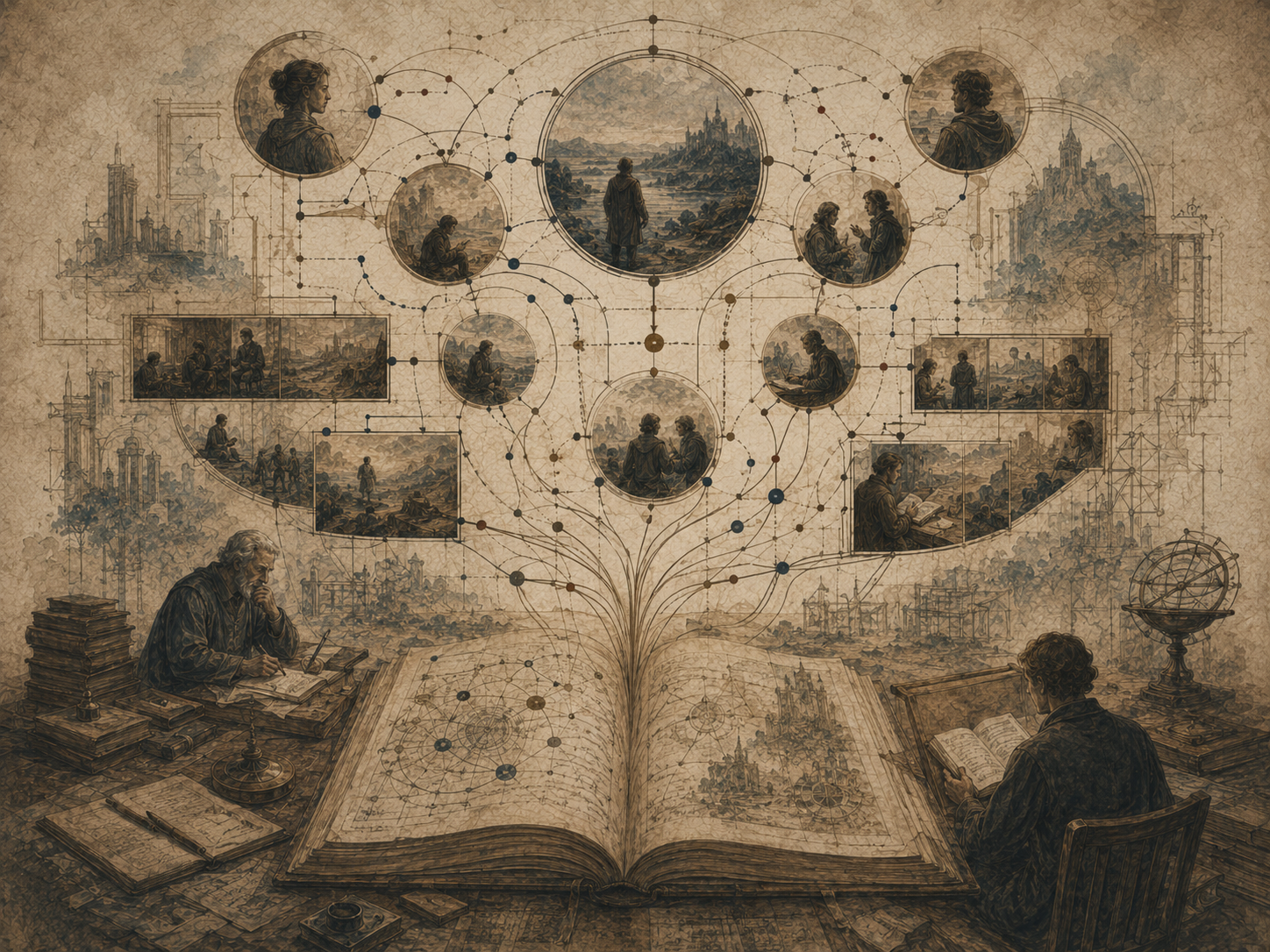
This article introduces narratology as a practical and theoretical framework for analyzing how stories work. It examines the difference between events and their telling, between narrator and character, between chronology and discourse order, between point of view and focalization, and between structural description and ethical interpretation. It also includes computational workflows for auditing narrative structure, focalization, temporal order, information access, reliability, and governance risk using the advanced Catalyst Canvas standard.
Why Narratology Matters
Narratology matters because stories are not only made of events. They are made of arrangements. The same sequence of events can become tragedy, comedy, confession, mystery, testimony, myth, propaganda, memoir, documentary, game, case study, or institutional narrative depending on how it is told.
A narratological approach asks structural questions: Who speaks? Who sees? What is told first? What is delayed? What is repeated? What is omitted? How much does the narrator know? How much does the audience know? What is treated as cause? What is treated as accident? Where does the story begin? Where does it end? What remains unresolved?
These questions matter in literature and film, but they also matter in public communication, legal argument, journalism, history, organizational storytelling, policy explanation, memoir, testimony, brand narrative, and AI-generated content. A story’s grammar shapes what audiences notice, trust, remember, and believe.
| Narratological question | What it reveals | Why it matters |
|---|---|---|
| Who tells? | Narrative voice and authority. | Voice shapes trust, distance, and accountability. |
| Who sees? | Focalization and information access. | Perspective controls what the audience can know. |
| What happens? | Fabula, event structure, and causal sequence. | Events supply the underlying story material. |
| How is it told? | Discourse order, pacing, style, and arrangement. | Telling transforms events into meaning. |
| What is omitted? | Silence, exclusion, uncertainty, and withheld evidence. | Omission can create suspense or hide responsibility. |
| What changes? | Transformation, recognition, closure, or unresolved tension. | Change gives narrative movement and consequence. |
Narratology matters because it lets us see story as structure, not just content.
What Is Narratology?
Narratology is the study of narrative structure. It asks what narratives have in common, how they differ, and how narrative meaning emerges from relations among events, discourse, voice, perspective, time, character, sequence, and audience interpretation.
The term is closely associated with structuralist approaches to narrative, but narratology has expanded far beyond early structuralism. Classical narratology analyzed recurring structures across literary narratives: plot, narrator, time, focalization, levels, and character functions. Later approaches have widened the field to include cognitive narratology, feminist narratology, rhetorical narratology, unnatural narratology, transmedia narratology, computational narratology, and ethical approaches to narrative form.
At its most useful, narratology provides a disciplined vocabulary for seeing how stories work. It does not replace interpretation. It makes interpretation more precise. Instead of saying “the story feels distant,” narratology asks whether distance comes from external focalization, summary, unreliable narration, temporal compression, impersonal voice, or withheld interiority.
| Area | Core concern | Example question |
|---|---|---|
| Classical narratology | Structure, sequence, narrator, time, focalization. | How is the story organized? |
| Rhetorical narratology | Author, audience, purpose, ethics, effects. | How does the narrative guide judgment? |
| Cognitive narratology | Mental models, comprehension, emotion, inference. | How does the audience build a story world? |
| Feminist narratology | Gender, voice, authority, power, silence. | Whose narrative authority is recognized? |
| Transmedia narratology | Story across media, platforms, games, serial forms. | How does narrative change across medium? |
| Computational narratology | Modeling story structure, events, characters, and discourse. | What can structured data reveal about narrative patterns? |
Narratology gives story analysis a grammar: not a rulebook, but a set of concepts for describing how narratives function.
Story, Discourse, and Fabula
One of the central distinctions in narratology is between the underlying sequence of events and the way those events are presented. Different theorists use different terms, but the basic distinction is often described as story and discourse, or fabula and syuzhet.
The fabula is the underlying event logic: what happened in the story world, in causal and chronological order. The discourse is the actual telling: the order, pacing, framing, voice, style, emphasis, omission, repetition, and perspective through which the audience encounters those events.
This distinction is powerful because the same fabula can be told in many ways. A crime can be presented chronologically as tragedy, backward as mystery, through testimony as legal drama, through memory as trauma narrative, through conflicting accounts as unreliable narration, or through fragments as modernist fiction.
| Concept | Meaning | Example question |
|---|---|---|
| Fabula | The underlying events in their story-world order. | What happened first, second, and third? |
| Discourse | The actual arrangement and presentation of those events. | How does the audience receive the events? |
| Story | The represented events, characters, and situations. | What is the narrative about at the event level? |
| Telling | The act or form through which the story is communicated. | Who tells, in what order, and with what limits? |
| Order | The relation between event chronology and discourse sequence. | Does the telling begin at the beginning? |
| Arrangement | The shaping of material into narrative effect. | What does the arrangement make the audience infer? |
The grammar of story begins with the difference between what happens and how it is told.
Plot and Narrative Logic
Plot is not merely a list of events. Plot is event relation. It turns happenings into sequence, causality, tension, expectation, reversal, recognition, and consequence. A narratological analysis asks how events are selected, connected, delayed, framed, and resolved.
Some narratives emphasize causal plot: this happened because that happened. Others emphasize thematic arrangement, memory association, symbolic repetition, episodic movement, or spatial exploration. A story may appear loose on the surface while still having deep structural logic through motif, rhythm, focalization, or moral contrast.
Narrative logic also depends on what a story treats as meaningful. A tiny gesture may matter more than a war. A delayed letter may reshape an entire plot. A missing witness may determine legal meaning. A repeated image may hold together otherwise fragmented events. Plot is therefore not just sequence. It is the system of narrative relevance.
| Plot feature | Function | Analytic question |
|---|---|---|
| Selection | Chooses which events matter. | What events are included or excluded? |
| Sequence | Arranges events in an order. | What does the order make possible? |
| Causality | Connects events through consequence. | What causes what? |
| Delay | Withholds information, action, or resolution. | What does delay make the audience expect? |
| Reversal | Changes the meaning of earlier events. | When does the story turn? |
| Closure | Limits, resolves, suspends, or refuses completion. | What kind of ending does the plot create? |
Plot is the grammar of event relation.
Narrator and Narratee
The narrator is the voice or agent that tells the story. The narrator is not always the author. A first-person narrator may be a character. A third-person narrator may be external, intrusive, limited, unreliable, anonymous, or strongly styled. Some narratives have multiple narrators. Some have embedded narrators. Some blur the boundary between narrator, character, editor, witness, compiler, or document.
The narratee is the implied recipient of the narration inside the narrative situation. Sometimes the narratee is unnamed. Sometimes the story is addressed to a judge, child, lover, reader, community, official, future generation, or self. Identifying the narratee clarifies why the story is told in a particular way.
Narrator and narratee matter because storytelling is relational. A confession told to a priest differs from a confession told to a jury. A memoir addressed to descendants differs from one addressed to critics. A public report differs from a whispered testimony. The grammar of narration includes who speaks and to whom.
| Term | Meaning | Example question |
|---|---|---|
| Author | The real person or collective that produced the work. | Who made the narrative? |
| Implied author | The organizing presence inferred from the work’s design. | What values seem built into the narrative? |
| Narrator | The voice or agent that tells the story. | Who speaks? |
| Narratee | The implied or explicit recipient of the narration. | To whom is the story told? |
| Character narrator | A narrator who participates in the story world. | How does involvement limit knowledge? |
| External narrator | A narrator outside the story events. | What authority does distance create? |
Narration is never neutral; it is a structured relation between teller, story, and audience.
Voice and Focalization
Voice and focalization are often confused. Voice asks who speaks. Focalization asks who sees, perceives, knows, or filters the events. A narrator may speak from outside the story while focalizing through one character. A character may narrate events but not fully understand what they perceive. A narrative may shift focalization across characters, scenes, chapters, or media forms.
Focalization is one of narratology’s most useful concepts because it describes information control. A story may restrict the audience to one character’s knowledge, provide omniscient access, show only external behavior, or move between multiple perspectives. Each choice shapes sympathy, suspense, irony, distance, and judgment.
Voice and focalization also carry ethical weight. Who gets interiority? Whose perception is trusted? Who is only described from the outside? Who is denied a voice? Who is seen but not heard? Who speaks for whom? In public storytelling, these questions shape representation and accountability.
| Concept | Question | Effect |
|---|---|---|
| Voice | Who speaks? | Controls tone, authority, distance, and style. |
| Focalization | Who sees or perceives? | Controls information, sympathy, suspense, and judgment. |
| Zero focalization | Does the narrator know more than characters? | Creates broad access or omniscient range. |
| Internal focalization | Is perception filtered through a character? | Creates intimacy, limitation, and subjectivity. |
| External focalization | Are only observable actions shown? | Creates distance, ambiguity, and behavioral emphasis. |
| Multiple focalization | Do perspectives shift across tellings? | Creates conflict, complexity, and interpretive tension. |
Voice tells us who speaks; focalization tells us whose access to the world organizes the telling.
Time: Order, Duration, and Frequency
Narrative time is not the same as chronological time. Stories reorder, compress, expand, repeat, anticipate, and interrupt time. A story may begin at the end, move backward, pause for reflection, skip decades, repeat one event from multiple perspectives, or stretch a single moment across many pages.
Narratology often analyzes time through order, duration, and frequency. Order concerns the relation between event chronology and discourse sequence. Duration concerns the relation between story time and telling time. Frequency concerns how often events happen in the story world compared with how often they are narrated.
These concepts are especially useful for analyzing memory narratives, trauma narratives, mysteries, epics, legal testimony, documentaries, serialized television, games, and institutional histories. Time arrangement controls suspense, causality, responsibility, emotional weight, and interpretive delay.
| Temporal concept | Meaning | Example |
|---|---|---|
| Order | Relation between event chronology and telling sequence. | A story begins with a death, then explains the past. |
| Analepsis | Flashback or backward movement. | A narrator returns to childhood memory. |
| Prolepsis | Flashforward or anticipatory movement. | The narrator hints at a future disaster. |
| Duration | Relation between story time and discourse time. | Ten years pass in one sentence; one hour fills a chapter. |
| Pause | Telling continues while story time stops. | Description, commentary, analysis, or reflection. |
| Frequency | Relation between occurrence and narration. | One repeated ritual is narrated once as habitual action. |
Narrative time is a grammar of memory, emphasis, suspense, and meaning.
Narrative Levels
Narratives often contain stories within stories. A character tells a memory. A document is quoted. A witness gives testimony. A manuscript is found. A film includes a recording. A game contains lore inside an archive. These embedded structures create narrative levels.
Narrative levels matter because they affect authority, distance, and interpretation. A story told by a character inside another story may be unreliable, partial, strategic, sacred, legal, therapeutic, or manipulative. A frame narrative may guide the audience’s judgment of the embedded story. A nested account may create ambiguity: are we meant to trust the inner narrator, the outer narrator, both, or neither?
Levels also shape institutional and historical narratives. Reports include case studies. Courts include testimony. Archives include letters. Public memorials include recorded witness. A narratological analysis asks how the frame controls the embedded voice.
| Level | Function | Question |
|---|---|---|
| Primary narrative | Main frame or storytelling level. | What story world organizes the whole? |
| Embedded narrative | A story told inside another story. | Who tells it, and why? |
| Documentary insert | Letter, report, archive, transcript, image, or record. | What authority does the document claim? |
| Witness account | Testimony placed inside a larger narrative frame. | Does the frame protect or control the witness? |
| Metanarrative | Story reflecting on its own storytelling. | How does the narrative expose its construction? |
| Transmedia layer | Story distributed across multiple platforms or forms. | Which medium controls which part of the story? |
Narrative levels show that stories can contain, frame, authorize, and contest other stories.
Character Function and Agency
Characters are not only psychological individuals. They also perform narrative functions. A character may initiate action, block action, reveal information, embody a value, carry memory, represent an institution, provide contrast, mislead the audience, transmit a message, or expose a contradiction.
Classical structural approaches often described characters by function: hero, helper, donor, villain, dispatcher, princess, false hero, and so on. Modern narratology does not need to reduce characters to roles, but functional analysis remains useful. It helps identify what a character does in the grammar of the story.
Agency is especially important. Who can act? Who can decide? Who only suffers? Who is described but not allowed to speak? Who becomes the object of another person’s development? Who bears consequences without shaping events? Character function becomes ethically significant when some people are granted interiority and agency while others become scenery, symbol, threat, or lesson.
| Character function | How it works | Ethical question |
|---|---|---|
| Agent | Initiates action and changes the story world. | Who is allowed to act? |
| Witness | Sees, remembers, testifies, or preserves truth. | Is witness protected or exploited? |
| Helper | Supports another character’s movement. | Does the helper have their own agency? |
| Obstacle | Blocks action or creates conflict. | Is the obstacle dehumanized? |
| Double | Mirrors or contrasts another figure. | What difference is being dramatized? |
| Scapegoat | Carries blame or symbolic burden. | Does the story displace responsibility? |
Character analysis becomes stronger when it combines function, psychology, agency, and ethics.
Reliability and Information Control
Reliability concerns whether the narration can be trusted. An unreliable narrator may misunderstand events, distort facts, conceal motives, rationalize harm, exaggerate, misremember, or manipulate the audience. But unreliability is not always deception. It can arise from trauma, immaturity, limited perspective, ideology, social pressure, genre convention, or memory itself.
Information control is broader than reliability. A narrative may be reliable but limited. It may be honest but incomplete. It may withhold information for suspense. It may reveal too much too early. It may create dramatic irony by giving the audience more knowledge than a character. It may hide institutional responsibility behind passive voice or documentary framing.
In public storytelling, information control has ethical consequences. A legal narrative, policy report, brand story, news feature, memoir, or documentary can shape judgment by controlling chronology, voice, evidence, omission, and perspective. Narratology helps identify how trust is built or compromised.
| Information pattern | How it works | Review question |
|---|---|---|
| Restricted knowledge | Audience knows only what one figure knows. | What does restriction hide or intensify? |
| Dramatic irony | Audience knows more than a character. | How does superior knowledge shape judgment? |
| Unreliable narration | Narrator’s account is partial, distorted, or suspect. | What cues reveal unreliability? |
| Strategic omission | Important information is withheld. | Is omission suspense, trauma, censorship, or manipulation? |
| Documentary authority | Records, data, or official forms appear to guarantee truth. | What does documentary form obscure? |
| Passive framing | Actions are described without clear agents. | Who disappears from responsibility? |
Reliability is not just a literary trick; it is a question of narrative trust and accountability.
Genre, Medium, and Narrative Form
Narrative grammar changes across genre and medium. A novel can enter interior consciousness through prose. A film can use framing, editing, sound, and performance. A comic can arrange time spatially across panels. A game can distribute narrative through choice, environment, rules, failure states, and player action. A podcast can use voice, pacing, silence, archive, and montage. A public report can use headings, evidence, case examples, and institutional voice.
Narratology must therefore be medium-aware. The same structural question changes form across media. Who sees? In prose, focalization may be linguistic. In film, it may be visual and auditory. In games, it may involve interface, camera, player knowledge, and playable perspective. In data storytelling, focalization may emerge through chart selection and framing.
Genre also shapes expectations. A mystery withholds information. A tragedy organizes irreversible consequence. A romance structures recognition and union. A memoir negotiates memory and truth. A policy narrative structures problem, cause, intervention, and outcome. Narratology helps identify those expectations without assuming they are universal.
| Medium | Narrative grammar | Analytic question |
|---|---|---|
| Novel | Voice, focalization, interiority, prose time. | How does language shape access to consciousness? |
| Film | Camera, editing, sound, performance, montage. | How does audiovisual form control perception? |
| Comics | Panel sequence, page layout, gutters, visual time. | How does space organize narrative time? |
| Game | Player agency, rules, environment, branching, failure. | How do action and system shape story experience? |
| Podcast | Voice, pacing, archive, music, silence, testimony. | How does sound create trust and intimacy? |
| Report | Evidence, headings, cases, charts, institutional voice. | How does form organize public reasoning? |
Narrative grammar is structural, but it is always shaped by medium.
Narratology and Meaning
Narratology is sometimes mistaken for mechanical analysis. But structure is not separate from meaning. Order, voice, focalization, repetition, delay, character function, and closure all shape interpretation. A story’s grammar tells the audience what to notice, when to judge, whom to trust, and what kind of meaning is possible.
For example, a story told chronologically may emphasize development. A story told backward may emphasize discovery or regret. A story told through multiple witnesses may emphasize contested truth. A story told through limited focalization may generate intimacy or error. A story that refuses closure may preserve trauma, ambiguity, or ethical discomfort.
Meaning is therefore not simply located in theme. It is produced through narrative form. Narratology helps identify how form carries meaning before the story says anything explicitly. It lets us analyze how a narrative thinks.
| Formal choice | Possible meaning effect | Example question |
|---|---|---|
| Delayed beginning | Mystery, trauma, memory, or interpretive suspense. | Why does the story avoid chronological origin? |
| Restricted focalization | Intimacy, bias, uncertainty, or vulnerability. | What does the character not know? |
| Multiple narrators | Plural truth, contradiction, social complexity. | How do accounts compete? |
| Repetition | Memory, ritual, obsession, trauma, pattern, emphasis. | What changes when the event returns? |
| Open ending | Ambiguity, refusal, continuity, unresolved responsibility. | Why is closure withheld? |
| Frame narrative | Authority, distance, mediation, archival control. | How does the frame shape the inner story? |
Narratology shows that form is meaning in motion.
Narratology and Ethics
Narrative structure has ethical consequences. Who receives voice? Who receives interiority? Who becomes an object? Who is described only from outside? Who controls the frame? Who is believed? Who is silenced? Who is made responsible? Who disappears behind abstraction?
Ethical narratology asks how form shapes moral attention. A narrative can make a victim visible or invisible. It can humanize a perpetrator while flattening the harmed. It can turn suffering into spectacle. It can distribute blame or hide causality. It can give one group complexity while making another group a type.
This matters far beyond literature. Public narratives about war, migration, poverty, technology, climate change, health, policing, education, or institutional reform use narrative grammar. They choose narrators, focal points, event sequences, victims, agents, causes, and endings. Those choices affect public reasoning.
| Ethical issue | Narrative form | Review question |
|---|---|---|
| Voice allocation | Some figures speak; others are spoken about. | Who gets to narrate? |
| Interior access | Some figures receive thoughts and feelings; others remain external. | Whose humanity is made complex? |
| Agency framing | Actions may be active, passive, hidden, or displaced. | Who is responsible? |
| Victim framing | Suffering may be witnessed, consumed, or minimized. | Does the story protect dignity? |
| Closure pressure | Stories may force repair before repair exists. | Does closure erase harm? |
| Frame control | Institutions may control how testimony is presented. | Does the frame preserve or contain witness? |
Narratology becomes ethically serious when it asks how story structure distributes visibility, agency, and responsibility.
Examples of Narratological Analysis
The examples below show how narratology clarifies story structure without reducing interpretation to technical labels.
Flashback in memoir
Weak: The analysis says the story “goes into the past.”
Stronger: The analysis identifies analepsis, asks what triggers memory, and examines whether the flashback clarifies trauma, identity, or withheld causality.
Why it works: It connects temporal form with meaning.
Unreliable narrator
Weak: The narrator is simply called dishonest.
Stronger: The analysis distinguishes lying, misremembering, self-deception, ideological distortion, and limited knowledge.
Why it works: It treats unreliability as structural and ethical.
Multiple perspectives
Weak: The story is described as having many points of view.
Stronger: The analysis maps shifts in focalization, voice, knowledge, contradiction, and reader judgment.
Why it works: It shows how plural narration creates contested meaning.
Legal testimony
Weak: The witness tells what happened.
Stronger: The analysis asks how the courtroom frame, questioning structure, chronology, and institutional authority shape the witness account.
Why it works: It treats testimony as framed narration.
Institutional origin story
Weak: The organization tells its founding story.
Stronger: The analysis examines narrator authority, omitted actors, origin sequence, crisis framing, and closure claims.
Why it works: It turns institutional memory into an auditable narrative structure.
Film focalization
Weak: The camera shows one character’s experience.
Stronger: The analysis distinguishes camera alignment, sound design, restricted knowledge, subjective imagery, and audience inference.
Why it works: It adapts narratology to audiovisual form.
Narratology works best when technical categories lead to better interpretive judgment.
Mathematics, Computation, and Modeling
Narratology can be modeled as a structured audit of narrative grammar. Computation cannot replace literary judgment, cultural interpretation, or ethical reading. It can, however, help identify patterns in time, focalization, voice, event order, character agency, information access, and governance risk.
A narrative-grammar strength score can estimate how clearly a story’s formal structure has been documented:
G_s = \frac{S_d + V_c + F_c + T_m + C_a + I_c}{6}
\]
Interpretation: Narrative grammar strength \(G_s\) averages story-discourse clarity \(S_d\), voice clarity \(V_c\), focalization clarity \(F_c\), temporal mapping \(T_m\), character-agency mapping \(C_a\), and information-control analysis \(I_c\).
A focalization complexity score can estimate how much perspective management the narrative requires:
F_x = \frac{P_s + K_r + I_a + S_h + M_f}{5}
\]
Interpretation: Focalization complexity \(F_x\) averages perspective shifts \(P_s\), knowledge restriction \(K_r\), interior access \(I_a\), source hierarchy \(S_h\), and multiple focalizers \(M_f\).
A temporal complexity score can estimate how strongly the discourse rearranges chronology:
T_x = \frac{A_n + P_r + E_l + D_v + R_f}{5}
\]
Interpretation: Temporal complexity \(T_x\) averages analepsis \(A_n\), prolepsis \(P_r\), ellipsis \(E_l\), duration variation \(D_v\), and repetition frequency \(R_f\).
A narrative-governance risk score can estimate whether formal choices require deeper review:
N_r = O_mw_o + P_bw_p + V_iw_v + C_pw_c + U_rw_u + (1 – M_l)w_m
\]
Interpretation: Narrative governance risk \(N_r\) rises with omission \(O_m\), power blindness \(P_b\), voice imbalance \(V_i\), closure pressure \(C_p\), unreliable framing risk \(U_r\), and weak method-limit marking \(M_l\).
| Modeling task | Interpretive question | Example output |
|---|---|---|
| Story/discourse audit | How does event order differ from telling order? | Chronology map and discourse-order table. |
| Focalization audit | Who sees, knows, perceives, and filters? | Focalization matrix. |
| Voice audit | Who speaks, and from what level? | Narrator/narratee profile. |
| Temporal audit | Where do flashback, anticipation, ellipsis, and repetition appear? | Temporal complexity score. |
| Agency audit | Who acts, who reacts, who is described, and who is silenced? | Character-agency table. |
| Governance audit | Does the narrative structure create ethical risk? | Canvas card and governance queue. |
Computational narratology is most useful when it makes narrative assumptions visible rather than pretending to automate interpretation.
Python Workflow: Narratology Canvas Audit
The Python workflow below follows the advanced Catalyst Canvas standard: typed records, config-driven scoring, validation, governance notes, Canvas-card exports, CSV outputs, JSON outputs, markdown governance queues, and strict review priorities. The companion repository version includes the shared `python/catalyst_canvas/` layer plus article-specific data for narratology and narrative-grammar analysis.
# run_narratology_canvas_audit.py
from __future__ import annotations

from dataclasses import dataclass
from pathlib import Path
import csv
import json
from hashlib import sha256
from statistics import mean
from typing import Any


ARTICLE_ROOT = Path(__file__).resolve().parents[1]
OUTPUTS = ARTICLE_ROOT / "outputs"


@dataclass(frozen=True)
class NarratologyRecord:
    item: str
    claim_context: str
    story_discourse_clarity: float
    voice_clarity: float
    focalization_clarity: float
    temporal_mapping: float
    character_agency_mapping: float
    information_control_analysis: float
    perspective_shifts: float
    knowledge_restriction: float
    interior_access: float
    source_hierarchy: float
    multiple_focalizers: float
    analepsis: float
    prolepsis: float
    ellipsis: float
    duration_variation: float
    repetition_frequency: float
    omission_risk: float
    power_blindness: float
    voice_imbalance: float
    closure_pressure: float
    unreliable_framing_risk: float
    method_limits: float
    source_context: float
    counterexamples: float
    uncertainty_notes: float
    owner: str = "editorial"
    status: str = "active"
    notes: str = ""


@dataclass(frozen=True)
class NarratologyConfig:
    article_title: str = "Narratology and the Grammar of Story"
    article_slug: str = "narratology-and-the-grammar-of-story"
    medium_threshold: float = 0.45
    high_threshold: float = 0.62
    allowed_statuses: tuple[str, ...] = ("active", "archive", "review", "revise")


def validate_score(value: float, field_name: str) -> None:
    if value < 0 or value > 1:
        raise ValueError(f"{field_name} must be between 0 and 1.")


def validate_record(record: NarratologyRecord, config: NarratologyConfig) -> None:
    if not record.item.strip():
        raise ValueError("item is required.")
    if not record.claim_context.strip():
        raise ValueError("claim_context is required.")
    if record.status not in config.allowed_statuses:
        raise ValueError(f"Invalid status: {record.status}")

    for field_name, value in record.__dict__.items():
        if isinstance(value, float):
            validate_score(value, field_name)


def narrative_grammar_strength(record: NarratologyRecord) -> float:
    return mean([
        record.story_discourse_clarity,
        record.voice_clarity,
        record.focalization_clarity,
        record.temporal_mapping,
        record.character_agency_mapping,
        record.information_control_analysis,
    ])


def focalization_complexity(record: NarratologyRecord) -> float:
    return mean([
        record.perspective_shifts,
        record.knowledge_restriction,
        record.interior_access,
        record.source_hierarchy,
        record.multiple_focalizers,
    ])


def temporal_complexity(record: NarratologyRecord) -> float:
    return mean([
        record.analepsis,
        record.prolepsis,
        record.ellipsis,
        record.duration_variation,
        record.repetition_frequency,
    ])


def interpretation_readiness(record: NarratologyRecord) -> float:
    return mean([
        record.source_context,
        record.counterexamples,
        record.method_limits,
        record.uncertainty_notes,
        record.story_discourse_clarity,
        record.focalization_clarity,
    ])


def governance_risk(record: NarratologyRecord) -> float:
    return min(
        1.0,
        record.omission_risk * 0.18
        + record.power_blindness * 0.20
        + record.voice_imbalance * 0.20
        + record.closure_pressure * 0.16
        + record.unreliable_framing_risk * 0.16
        + (1 - record.method_limits) * 0.10,
    )


def governance_priority_score(record: NarratologyRecord, config: NarratologyConfig) -> float:
    score = (
        governance_risk(record) * 0.40
        + (1 - interpretation_readiness(record)) * 0.28
        + record.voice_imbalance * 0.16
        + record.omission_risk * 0.16
    )

    if record.status == "revise":
        score = max(score, config.high_threshold)
    elif record.status == "review":
        score = max(score, config.medium_threshold)

    return min(1.0, max(0.0, score))


def review_priority(record: NarratologyRecord, config: NarratologyConfig) -> str:
    score = governance_priority_score(record, config)
    if score >= config.high_threshold:
        return "high"
    if score >= config.medium_threshold:
        return "medium"
    return "standard"


def card_id(record: NarratologyRecord, config: NarratologyConfig) -> str:
    raw = f"{config.article_slug}|{record.item}|{record.claim_context}"
    return sha256(raw.encode("utf-8")).hexdigest()[:16]


def governance_note(record: NarratologyRecord, config: NarratologyConfig) -> str:
    priority = review_priority(record, config)
    risk = governance_risk(record)
    readiness = interpretation_readiness(record)

    notes = []

    if priority == "high":
        notes.append("High-priority narratology governance review required.")
    elif priority == "medium":
        notes.append("Medium-priority review recommended before reuse.")
    else:
        notes.append("Standard editorial review sufficient.")

    if risk >= 0.55:
        notes.append("Governance risk is elevated; review omission, power blindness, voice imbalance, closure pressure, and unreliable framing.")
    if readiness < 0.60:
        notes.append("Interpretation readiness is limited; strengthen source context, counterexamples, method limits, and uncertainty notes.")
    if record.notes:
        notes.append(record.notes)

    return " ".join(notes)


def canvas_card(record: NarratologyRecord, config: NarratologyConfig) -> dict[str, Any]:
    return {
        "schema_version": "1.0.0",
        "card_id": card_id(record, config),
        "card_type": "narratology_grammar_of_story",
        "article_title": config.article_title,
        "article_slug": config.article_slug,
        "item": record.item,
        "claim_context": record.claim_context,
        "scores": {
            "narrative_grammar_strength": round(narrative_grammar_strength(record), 4),
            "focalization_complexity": round(focalization_complexity(record), 4),
            "temporal_complexity": round(temporal_complexity(record), 4),
            "governance_risk": round(governance_risk(record), 4),
            "interpretation_readiness": round(interpretation_readiness(record), 4),
            "governance_priority_score": round(governance_priority_score(record, config), 4),
        },
        "review": {
            "priority": review_priority(record, config),
            "owner": record.owner,
            "status": record.status,
            "governance_note": governance_note(record, config),
        },
    }


def write_csv(path: Path, rows: list[dict[str, Any]]) -> None:
    path.parent.mkdir(parents=True, exist_ok=True)
    fieldnames = list(rows[0].keys())
    with path.open("w", encoding="utf-8", newline="") as handle:
        writer = csv.DictWriter(handle, fieldnames=fieldnames)
        writer.writeheader()
        writer.writerows(rows)


def write_json(path: Path, payload: Any) -> None:
    path.parent.mkdir(parents=True, exist_ok=True)
    path.write_text(json.dumps(payload, indent=2), encoding="utf-8")


def write_markdown_queue(path: Path, rows: list[dict[str, Any]]) -> None:
    path.parent.mkdir(parents=True, exist_ok=True)
    lines = [
        "# Narratology Governance Queue",
        "",
        "| Item | Context | Grammar | Focalization | Time | Risk | Readiness | Priority | Owner |",
        "|---|---|---:|---:|---:|---:|---:|---|---|",
    ]

    for row in rows:
        lines.append(
            f"| {row['item']} | {row['claim_context']} | "
            f"{row['narrative_grammar_strength']} | {row['focalization_complexity']} | "
            f"{row['temporal_complexity']} | {row['governance_risk']} | "
            f"{row['interpretation_readiness']} | {row['review_priority']} | {row['owner']} |"
        )

    path.write_text("\n".join(lines) + "\n", encoding="utf-8")


def main() -> None:
    config = NarratologyConfig()

    records = [
        NarratologyRecord(
            "Story and discourse distinction",
            "fabula and discourse grammar audit",
            0.92, 0.78, 0.74, 0.84, 0.76, 0.82,
            0.42, 0.58, 0.50, 0.48, 0.38,
            0.72, 0.44, 0.62, 0.70, 0.56,
            0.30, 0.28, 0.34, 0.32, 0.36, 0.78,
            0.84, 0.76, 0.80,
            "editorial", "active",
            "Core narratology concept suitable for Canvas reuse."
        ),
        NarratologyRecord(
            "Focalization and voice",
            "perspective information access and voice allocation audit",
            0.80, 0.90, 0.94, 0.74, 0.78, 0.86,
            0.86, 0.84, 0.88, 0.76, 0.80,
            0.48, 0.40, 0.42, 0.52, 0.46,
            0.46, 0.58, 0.66, 0.44, 0.52, 0.82,
            0.84, 0.80, 0.82,
            "ethics review", "review",
            "Review voice imbalance and restricted interiority."
        ),
        NarratologyRecord(
            "Institutional narrative frame",
            "public report testimony and authority framing audit",
            0.78, 0.82, 0.80, 0.76, 0.70, 0.88,
            0.58, 0.72, 0.54, 0.82, 0.50,
            0.40, 0.34, 0.66, 0.60, 0.48,
            0.64, 0.76, 0.72, 0.68, 0.70, 0.62,
            0.70, 0.64, 0.66,
            "governance", "revise",
            "Escalate when institutional frames control witness or obscure responsibility."
        ),
    ]

    rows = []
    cards = []

    for record in records:
        validate_record(record, config)
        cards.append(canvas_card(record, config))
        rows.append({
            "item": record.item,
            "claim_context": record.claim_context,
            "narrative_grammar_strength": round(narrative_grammar_strength(record), 4),
            "focalization_complexity": round(focalization_complexity(record), 4),
            "temporal_complexity": round(temporal_complexity(record), 4),
            "governance_risk": round(governance_risk(record), 4),
            "interpretation_readiness": round(interpretation_readiness(record), 4),
            "governance_priority_score": round(governance_priority_score(record, config), 4),
            "review_priority": review_priority(record, config),
            "owner": record.owner,
            "status": record.status,
            "governance_note": governance_note(record, config),
        })

    priority_order = {"high": 3, "medium": 2, "standard": 1}
    rows = sorted(
        rows,
        key=lambda row: (
            priority_order.get(str(row["review_priority"]), 0),
            float(row["governance_priority_score"]),
        ),
        reverse=True,
    )

    queue = [row for row in rows if row["review_priority"] != "standard"]
    queue_cards = [card for card in cards if card["review"]["priority"] != "standard"]

    write_csv(OUTPUTS / "tables" / "narratology_audit.csv", rows)
    write_csv(OUTPUTS / "tables" / "narratology_governance_queue.csv", queue)
    write_json(OUTPUTS / "json" / "narratology_canvas_cards.json", cards)
    write_json(OUTPUTS / "json" / "narratology_governance_queue.json", queue_cards)
    write_markdown_queue(OUTPUTS / "markdown" / "narratology_governance_queue.md", queue)

    print("Narratology Canvas audit complete.")


if __name__ == "__main__":
    main()
This workflow treats narratology as structured interpretive accountability, not mechanical story scoring.
R Workflow: Narrative Grammar Diagnostics
The R workflow below provides a portable base R diagnostic for narratological analysis. It calculates narrative grammar strength, focalization complexity, temporal complexity, governance risk, interpretation readiness, governance priority, and review status.
# narratology_diagnostics.R
# Base R workflow for Narratology and the Grammar of Story.

args <- commandArgs(trailingOnly = FALSE)
file_arg <- grep("^--file=", args, value = TRUE)

if (length(file_arg) > 0) {
  script_path <- normalizePath(sub("^--file=", "", file_arg[1]), mustWork = TRUE)
  article_root <- normalizePath(file.path(dirname(script_path), ".."), mustWork = TRUE)
} else {
  article_root <- getwd()
}

setwd(article_root)

tables_dir <- file.path(article_root, "outputs", "tables")
figures_dir <- file.path(article_root, "outputs", "figures")
dir.create(tables_dir, recursive = TRUE, showWarnings = FALSE)
dir.create(figures_dir, recursive = TRUE, showWarnings = FALSE)

records <- data.frame(
  item = c(
    "Story and discourse distinction",
    "Focalization and voice",
    "Institutional narrative frame"
  ),
  claim_context = c(
    "fabula and discourse grammar audit",
    "perspective information access and voice allocation audit",
    "public report testimony and authority framing audit"
  ),
  story_discourse_clarity = c(0.92, 0.80, 0.78),
  voice_clarity = c(0.78, 0.90, 0.82),
  focalization_clarity = c(0.74, 0.94, 0.80),
  temporal_mapping = c(0.84, 0.74, 0.76),
  character_agency_mapping = c(0.76, 0.78, 0.70),
  information_control_analysis = c(0.82, 0.86, 0.88),
  perspective_shifts = c(0.42, 0.86, 0.58),
  knowledge_restriction = c(0.58, 0.84, 0.72),
  interior_access = c(0.50, 0.88, 0.54),
  source_hierarchy = c(0.48, 0.76, 0.82),
  multiple_focalizers = c(0.38, 0.80, 0.50),
  analepsis = c(0.72, 0.48, 0.40),
  prolepsis = c(0.44, 0.40, 0.34),
  ellipsis = c(0.62, 0.42, 0.66),
  duration_variation = c(0.70, 0.52, 0.60),
  repetition_frequency = c(0.56, 0.46, 0.48),
  omission_risk = c(0.30, 0.46, 0.64),
  power_blindness = c(0.28, 0.58, 0.76),
  voice_imbalance = c(0.34, 0.66, 0.72),
  closure_pressure = c(0.32, 0.44, 0.68),
  unreliable_framing_risk = c(0.36, 0.52, 0.70),
  method_limits = c(0.78, 0.82, 0.62),
  source_context = c(0.84, 0.84, 0.70),
  counterexamples = c(0.76, 0.80, 0.64),
  uncertainty_notes = c(0.80, 0.82, 0.66),
  owner = c("editorial", "ethics review", "governance"),
  status = c("active", "review", "revise"),
  stringsAsFactors = FALSE
)

records$narrative_grammar_strength <- rowMeans(records[, c(
  "story_discourse_clarity",
  "voice_clarity",
  "focalization_clarity",
  "temporal_mapping",
  "character_agency_mapping",
  "information_control_analysis"
)])

records$focalization_complexity <- rowMeans(records[, c(
  "perspective_shifts",
  "knowledge_restriction",
  "interior_access",
  "source_hierarchy",
  "multiple_focalizers"
)])

records$temporal_complexity <- rowMeans(records[, c(
  "analepsis",
  "prolepsis",
  "ellipsis",
  "duration_variation",
  "repetition_frequency"
)])

records$interpretation_readiness <- rowMeans(records[, c(
  "source_context",
  "counterexamples",
  "method_limits",
  "uncertainty_notes",
  "story_discourse_clarity",
  "focalization_clarity"
)])

records$governance_risk <- pmin(
  1,
  records$omission_risk * 0.18 +
    records$power_blindness * 0.20 +
    records$voice_imbalance * 0.20 +
    records$closure_pressure * 0.16 +
    records$unreliable_framing_risk * 0.16 +
    (1 - records$method_limits) * 0.10
)

records$governance_priority_score <- pmin(
  1,
  records$governance_risk * 0.40 +
    (1 - records$interpretation_readiness) * 0.28 +
    records$voice_imbalance * 0.16 +
    records$omission_risk * 0.16
)

records$review_priority <- ifelse(
  records$status == "revise" | records$governance_priority_score >= 0.62,
  "high",
  ifelse(
    records$status == "review" | records$governance_priority_score >= 0.45,
    "medium",
    "standard"
  )
)

records <- records[order(records$governance_priority_score, decreasing = TRUE), ]

write.csv(records, file.path(tables_dir, "narratology_diagnostics.csv"), row.names = FALSE)
write.csv(records[records$review_priority != "standard", ], file.path(tables_dir, "narratology_governance_queue.csv"), row.names = FALSE)

png(file.path(figures_dir, "narrative_grammar_strength_scores.png"), width = 1200, height = 700)
barplot(
  records$narrative_grammar_strength,
  names.arg = records$item,
  las = 2,
  ylab = "Narrative grammar strength",
  main = "Narrative Grammar Strength"
)
grid()
dev.off()

png(file.path(figures_dir, "governance_risk_scores.png"), width = 1200, height = 700)
barplot(
  records$governance_risk,
  names.arg = records$item,
  las = 2,
  ylab = "Governance risk",
  main = "Narratology Governance Risk"
)
grid()
dev.off()

print(records[, c(
  "item",
  "claim_context",
  "narrative_grammar_strength",
  "focalization_complexity",
  "temporal_complexity",
  "governance_risk",
  "interpretation_readiness",
  "review_priority"
)])
This workflow supports structured narrative analysis while preserving the interpretive limits of computation.
GitHub Repository
The companion repository for this article supports narratology and narrative-grammar analysis as a Catalyst Canvas-ready module. It includes advanced additive `python/catalyst_canvas/` governance infrastructure, article-specific narratology data, config-driven scoring, validation, governance notes, Canvas card generation, CSV/JSON/markdown exporters, CLI workflows, smoke tests, unit tests, R diagnostics, SQL structures, documentation, and reusable narrative-grammar templates.
Complete Code Repository
Companion repository for the article, including advanced Catalyst Canvas-ready code for story/discourse analysis, focalization review, temporal mapping, voice and narrator auditing, governance queues, JSON exports, Canvas cards, and reproducible research workflows.
articles/narratology-and-the-grammar-of-story/
├── canvas/
│   ├── canvas_manifest.json
│   ├── input_schema.json
│   ├── output_schema.json
│   ├── catalyst_canvas_config.json
│   ├── catalyst_canvas_manifest.json
│   ├── catalyst_canvas_cards.json
│   └── catalyst_canvas_governance_queue.json
├── html/
├── css/
├── php/
├── java/
├── python/
│   ├── catalyst_canvas/
│   │   ├── __init__.py
│   │   ├── __main__.py
│   │   ├── cli.py
│   │   ├── models.py
│   │   ├── scoring.py
│   │   ├── validation.py
│   │   ├── governance.py
│   │   └── exporters.py
│   ├── narratology_canvas/
│   │   ├── __init__.py
│   │   ├── models.py
│   │   ├── scoring.py
│   │   ├── validation.py
│   │   ├── governance.py
│   │   └── exporters.py
│   ├── tests/
│   │   ├── test_catalyst_canvas.py
│   │   └── test_narratology_canvas.py
│   ├── run_catalyst_canvas_audit.py
│   └── run_narratology_canvas_audit.py
├── r/
│   ├── narratology_diagnostics.R
│   └── run_all_narratology_workflows.R
├── sql/
│   ├── canvas_schema.sql
│   └── canvas_queries.sql
├── docs/
│   ├── article_notes.md
│   ├── modeling_principles.md
│   ├── story_discourse_fabula.md
│   ├── narrator_and_narratee.md
│   ├── voice_and_focalization.md
│   ├── narrative_time.md
│   ├── narrative_levels.md
│   ├── reliability_and_information_control.md
│   ├── ethical_risk.md
│   ├── responsible_use.md
│   ├── governance_notes.md
│   └── catalyst_canvas_upgrade_notes.md
├── data/
│   ├── narratology_claims.csv
│   ├── focalization_notes.csv
│   ├── temporal_structure_notes.csv
│   ├── voice_narrator_notes.csv
│   ├── governance_notes.csv
│   └── catalyst_canvas_assessment.csv
├── outputs/
│   ├── figures/
│   ├── json/
│   ├── markdown/
│   └── tables/
├── notebooks/
├── shared/
│   ├── schemas/
│   ├── narrative-templates/
│   ├── story-archetypes/
│   ├── character-models/
│   ├── plot-structures/
│   ├── rhetorical-frameworks/
│   ├── cultural-memory/
│   ├── narratology/
│   └── governance/
├── tests/
└── README.md
Related Articles
- Creation, Flood, Exile, and Return as Narrative Patterns
- Paul Ricoeur and Narrative Time
- Plot, Action, and Narrative Coherence
- Voice, Perspective, and Point of View
- Beginnings, Endings, and Narrative Closure
- Narrative Identity and the Story of the Self
A Practical Method for Narratological Analysis
1. Separate events from telling
Map the fabula or underlying event sequence. Then map the discourse order. Identify rearrangements, gaps, repetitions, and delays.
2. Identify the narrator
Ask who speaks, from what position, with what knowledge, and with what authority.
3. Identify the narratee
Ask to whom the story is addressed, explicitly or implicitly. This clarifies tone, selection, and persuasion.
4. Map focalization
Ask who sees, perceives, knows, remembers, imagines, or filters the narrative world.
5. Map narrative time
Identify flashbacks, anticipations, ellipses, pauses, summaries, repetitions, and temporal compression.
6. Examine character agency
Ask who acts, who reacts, who speaks, who witnesses, who is silenced, and who carries consequence.
7. Examine reliability
Distinguish deception, limited knowledge, misremembering, ideology, trauma, and strategic framing.
8. Identify narrative levels
Look for frames, embedded stories, documents, testimony, archival material, and metanarrative moments.
9. Analyze ethical effects
Ask how structure distributes voice, interiority, agency, visibility, responsibility, and closure.
10. State interpretive limits
Describe what the narratological reading clarifies and what it cannot determine on its own.
The method turns narratology into a practical grammar for responsible story analysis.
Common Pitfalls
Several pitfalls appear when narratology is handled carelessly.
- Terminology without interpretation: Technical labels are used without explaining their meaning.
- Mechanistic reading: Story is reduced to structure without attention to culture, ethics, or experience.
- Confusing author and narrator: The real author is mistaken for the narrative voice.
- Confusing voice and focalization: Who speaks is treated as the same question as who sees.
- Ignoring medium: Concepts developed for prose are applied to film, games, or audio without adaptation.
- Flattening character: Functional analysis erases psychology, agency, and social context.
- Overtrusting structure: A neat diagram is mistaken for full interpretation.
- Ignoring power: Voice, focalization, and closure are analyzed without asking who benefits.
- Forcing closure: Open, traumatic, or unresolved narratives are treated as incomplete.
- Data overconfidence: Computational outputs are treated as interpretive truth rather than analytical support.
The central pitfall is treating narratology as a labeling system rather than a disciplined way of asking better questions.
Why the Grammar of Story Still Matters
Narratology still matters because stories continue to shape how people understand memory, evidence, identity, responsibility, and meaning. A story’s power is not located only in its subject. It is located in arrangement: who speaks, who sees, what is shown, what is withheld, how time moves, how characters act, and how endings distribute responsibility.
The grammar of story helps us read more carefully. It helps us distinguish event from telling, narrator from author, voice from focalization, chronology from discourse, witness from frame, and closure from repair. These distinctions matter in literature, but they also matter in law, journalism, public policy, institutional communication, media, memoir, testimony, and AI-assisted storytelling.
Narratology does not remove mystery from story. It sharpens attention. It shows that stories are made, mediated, structured, and governed. When used responsibly, narratology helps writers, readers, researchers, editors, educators, and institutions ask a better question: not only “What is this story about?” but “How does this story make meaning, and what does that structure ask us to believe?”
Further Reading
- Abbott, H.P. (2008) The Cambridge Introduction to Narrative. 2nd edn. Cambridge: Cambridge University Press.
- Bal, M. (2017) Narratology: Introduction to the Theory of Narrative. 4th edn. Toronto: University of Toronto Press.
- Barthes, R. (1977) ‘Introduction to the Structural Analysis of Narratives’, in Image Music Text. London: Fontana Press.
- Britannica (2026) Narratology. Available at: https://www.britannica.com/art/narratology
- Genette, G. (1980) Narrative Discourse: An Essay in Method. Ithaca: Cornell University Press.
- Herman, D. (2009) Basic Elements of Narrative. Malden: Wiley-Blackwell.
- Jahn, M. (2021) Narratology: A Guide to the Theory of Narrative. Available at: https://www.uni-koeln.de/~ame02/pppn.htm
- Prince, G. (2003) A Dictionary of Narratology. Rev. edn. Lincoln: University of Nebraska Press.
- Rimmon-Kenan, S. (2002) Narrative Fiction: Contemporary Poetics. 2nd edn. London: Routledge.
- Ryan, M.-L. (ed.) (2004) Narrative Across Media: The Languages of Storytelling. Lincoln: University of Nebraska Press.
References
- Abbott, H.P. (2008) The Cambridge Introduction to Narrative. 2nd edn. Cambridge: Cambridge University Press.
- Bal, M. (2017) Narratology: Introduction to the Theory of Narrative. 4th edn. Toronto: University of Toronto Press.
- Barthes, R. (1977) ‘Introduction to the Structural Analysis of Narratives’, in Image Music Text. London: Fontana Press.
- Britannica (2026) Narratology. Available at: https://www.britannica.com/art/narratology
- Genette, G. (1980) Narrative Discourse: An Essay in Method. Ithaca: Cornell University Press.
- Herman, D. (2009) Basic Elements of Narrative. Malden: Wiley-Blackwell.
- Jahn, M. (2021) Narratology: A Guide to the Theory of Narrative. Available at: https://www.uni-koeln.de/~ame02/pppn.htm
- Prince, G. (2003) A Dictionary of Narratology. Rev. edn. Lincoln: University of Nebraska Press.
- Rimmon-Kenan, S. (2002) Narrative Fiction: Contemporary Poetics. 2nd edn. London: Routledge.
- Ryan, M.-L. (ed.) (2004) Narrative Across Media: The Languages of Storytelling. Lincoln: University of Nebraska Press.