
Last Updated June 11, 2026
Indigenous storytelling is not simply a form of cultural expression that can be separated from land, language, kinship, protocol, memory, responsibility, and sovereignty. Stories may belong to particular Peoples, Nations, families, places, seasons, ceremonies, languages, or relationships. They may carry law, ethics, genealogy, ecological knowledge, humor, warning, grief, teaching, place memory, and obligations that cannot be reduced to plot.
Indigenous Storytelling, Place, and Relational Memory examines how story works as a living relation among people, land, ancestors, more-than-human beings, language, community, and time. It treats Indigenous storytelling not as a generic narrative style, but as a field of situated practices shaped by sovereignty, place-based knowledge, oral tradition, protocol, relational accountability, and memory held across generations.
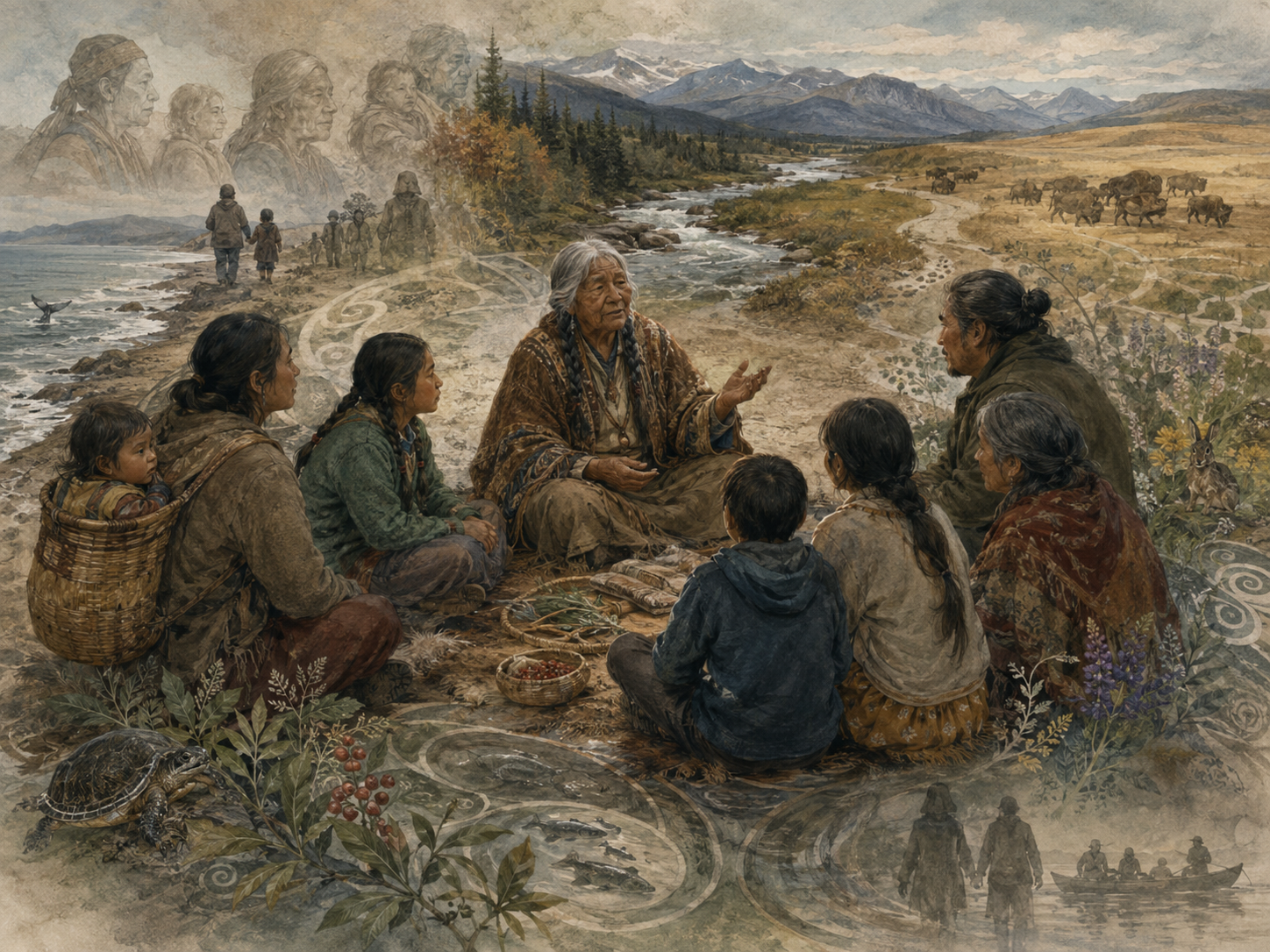
This article argues that Indigenous storytelling must be approached through relation rather than extraction. A story is not only a narrative object. It may be a responsibility, a teaching, a place-based memory, a protocol, a relationship, a way of knowing, and a mode of continuing collective life. The ethical question is not simply “What does this story mean?” but “Who has the right to tell, hear, interpret, share, translate, archive, teach, or adapt this story, and under what conditions?”
Why Indigenous Storytelling Requires Care
Indigenous storytelling requires care because the term “Indigenous” does not name one culture, one tradition, one worldview, one literary form, or one set of stories. It refers to many distinct Peoples, Nations, communities, languages, territories, histories, and knowledge systems. A story from one community cannot be treated as interchangeable with a story from another.
Care is also necessary because many Indigenous stories have been collected, translated, published, displayed, interpreted, commercialized, and adapted through colonial systems that did not respect Indigenous authority. Stories have often been taken from their communities and turned into folklore, mythology, children’s literature, museum content, academic data, tourism material, or generic spiritual wisdom.
Responsible reading begins by refusing extraction. A story is not automatically public because it has been printed. A story is not automatically available for adaptation because it has been summarized. A story is not automatically universal because it contains recognizable motifs. Context, permission, protocol, and relationship matter.
| Common assumption | Relational correction | Why it matters |
|---|---|---|
| Indigenous stories are universal myths. | Stories are situated in specific Peoples, lands, languages, and relations. | Prevents pan-Indigenous flattening. |
| Published stories are free to reuse. | Publication does not erase protocol or community authority. | Protects story sovereignty. |
| Story is symbolic content. | Story may carry law, ethics, memory, genealogy, and land relation. | Prevents reduction to motif. |
| Meaning belongs to the reader. | Meaning may depend on who tells, hears, teaches, and receives the story. | Honors relational accountability. |
| Translation makes the story accessible. | Translation may also erase sound, place, law, humor, and protocol. | Keeps language politics visible. |
| Digital access equals consent. | Online availability does not equal permission for reuse, training, or adaptation. | Protects Indigenous data and cultural governance. |
Indigenous storytelling requires care because a story can be harmed by being removed from the relationships that give it life.
Story as Relation, Not Object
A relational approach treats story as something that happens among teller, listener, place, language, memory, ancestry, community, and responsibility. The story is not only a text to decode. It is part of a living network.
Jo-ann Archibald Q’um Q’um Xiiem’s Indigenous Storywork is especially important because it articulates story principles such as respect, responsibility, reverence, reciprocity, holism, interrelatedness, and synergy. These principles shift attention away from extraction and toward readiness, relationship, and ethical engagement.
A relational approach changes the reader’s role. The reader is not a detached analyst standing outside the story. The reader becomes responsible for how they receive, interpret, cite, teach, adapt, or withhold the story.
| Storywork principle | Narrative implication | Reader responsibility |
|---|---|---|
| Respect | The story is approached with humility. | Do not treat the story as raw material. |
| Responsibility | Interpretation has consequences. | Ask what the analysis does to the story. |
| Reverence | Some stories carry sacred, ceremonial, or ancestral weight. | Avoid casual reuse or aesthetic consumption. |
| Reciprocity | Story exchange creates obligation. | Consider what is returned to the community. |
| Holism | Story involves mind, body, heart, spirit, land, and relation. | Do not reduce story to theme or plot. |
| Interrelatedness | Meaning emerges through relation. | Track kinship, land, language, and community. |
| Synergy | Story can generate shared transformation. | Honor the story’s living context. |
Story as relation means interpretation is never neutral. It is a form of participation.
Place, Land, and Memory
Indigenous storytelling is often place-based, but “place” here should not be reduced to setting. Place may be ancestor, relation, law, route, home, ceremony, burial ground, food source, watershed, story site, treaty territory, contested land, ecological teacher, or living presence.
Keith Basso’s work on Western Apache place-making is useful because it shows how wisdom, memory, morality, and history can be tied to named places. Place can remind, warn, teach, and call people back into relationship. In this sense, landscape is not background. It is part of narrative memory.
Place-based storytelling challenges colonial mapping. Colonial maps often turn land into property, resource, border, commodity, jurisdiction, or blank space to be claimed. Indigenous stories may instead hold place through relation, obligation, season, route, ceremony, and memory.
| Place as… | Story function | Analytical question |
|---|---|---|
| Memory | Place holds events, ancestors, teachings, and warnings. | What does this place remember? |
| Relation | Place is connected to people, nonhuman beings, and obligations. | Who is related through this place? |
| Law | Place teaches conduct, boundaries, responsibility, and consequence. | What ethical order does place carry? |
| Route | Movement through land becomes memory and instruction. | What does the path teach? |
| Ancestor | Place connects living people to those who came before. | How does ancestry remain present? |
| Contested ground | Place bears colonial dispossession, treaty conflict, or resource extraction. | What power struggles are embedded in place? |
Place-based story asks readers to understand land not as scenery, but as a participant in memory.
Relational Memory and Kinship
Relational memory is memory held across relationships. It may be carried by Elders, families, clans, Nations, songs, ceremonies, place names, foodways, kinship systems, ecological practices, stories, objects, routes, and repeated teachings. It does not belong only to an individual mind.
In many Indigenous contexts, memory is not separated from obligation. To remember may mean to continue a relationship, care for a place, honor an ancestor, uphold a teaching, protect a language, or practice a law. Memory is not simply recollection. It is responsibility.
Kinship also exceeds a narrow human family model. Kin may include land, waters, plants, animals, ancestors, future generations, ceremonial relations, and other beings. Story can teach how to live within these relations.
| Relational memory form | How it carries story | What it protects |
|---|---|---|
| Elder teaching | Memory is transmitted through relationship and readiness. | Authority, context, and responsibility. |
| Kinship story | Family and community relations structure meaning. | Belonging and obligation. |
| Place name | A name carries history, event, warning, or relation. | Land-based knowledge. |
| Song or chant | Memory is held through sound, rhythm, and repetition. | Language and ceremony. |
| Seasonal practice | Memory returns with harvest, migration, ceremony, or weather. | Ecological timing. |
| Future-oriented teaching | Memory is held for descendants. | Continuity across generations. |
Relational memory makes story a bridge among ancestors, living communities, land, and those not yet born.
Oral Tradition, Performance, and Protocol
Oral tradition is not simply speech before writing. It is a complex system of performance, memory, authority, timing, repetition, variation, and relationship. A story may change depending on the teller, audience, place, purpose, season, ceremony, or teaching context.
Protocol matters. Some stories may be public. Some may be family-held. Some may be restricted. Some may be told only in particular seasons or ceremonies. Some may require permission, preparation, or a specific relationship to the story. Some may not be appropriate to record, publish, summarize, teach, or adapt.
Performance also matters. Gesture, pause, humor, repetition, song, audience response, tone, setting, and embodied presence may carry meaning that cannot be fully captured in transcript.
| Oral-story feature | Function | Ethical caution |
|---|---|---|
| Teller authority | Connects story to lineage, community, and responsibility. | Do not detach story from who has authority to tell it. |
| Audience readiness | Meaning depends on preparation and relationship. | Do not assume every audience is entitled to every story. |
| Seasonal timing | Story belongs to a time of year or ceremony. | Do not treat timing as optional decoration. |
| Repetition | Teaches through return, emphasis, rhythm, and memory. | Do not edit repetition as inefficiency. |
| Variation | Allows living transmission across contexts. | Do not demand a single fixed version. |
| Embodied performance | Meaning is carried by voice, body, place, and gathering. | Do not treat transcript as the whole story. |
Oral tradition reminds readers that story is an event, not only a text.
Language, Translation, and Untranslatability
Language carries worldviews, relationships, sounds, humor, law, place names, ecological knowledge, kinship terms, ceremonial meanings, and forms of address. Translation can help a story travel, but it can also flatten meaning.
Some terms may be untranslatable because they carry relations that English does not organize in the same way. Some names may carry place, ancestry, action, or memory. Some jokes, teachings, songs, or ceremonial references may depend on sound, grammar, or context. Translation may require notes, community review, or deliberate opacity.
A responsible reading does not treat every untranslated word as a problem. Sometimes the reader’s task is not to demand full access, but to recognize the limits of their access.
| Language issue | Story effect | Reader responsibility |
|---|---|---|
| Place names | Carry history, memory, law, and relation. | Do not reduce names to labels on a map. |
| Kinship terms | Reveal relational worlds. | Do not force terms into narrow family categories. |
| Untranslated words | Protect specificity and opacity. | Accept that not all meaning is immediately available. |
| Song and chant | Carry rhythm, ceremony, and sound-based memory. | Do not treat lyrics as simple text. |
| Humor | Creates relation, correction, survival, and critique. | Do not flatten humor into anecdote. |
| Translation notes | Make mediation visible. | Ask who translated and under what authority. |
Translation is not only a technical act. It is an ethical and political relation.
Story, Law, and Ethical Instruction
Indigenous stories may carry law and ethical instruction. They may teach how to behave toward land, water, animals, plants, elders, children, guests, kin, strangers, ancestors, and future generations. They may warn against greed, disrespect, carelessness, isolation, arrogance, waste, or broken reciprocity.
This means story cannot always be analyzed as entertainment, metaphor, or mythic content. A story may teach governance, land responsibility, treaty memory, kinship obligation, or ecological conduct. Its force may be normative as well as narrative.
Ethical instruction may not appear as a direct moral. It may emerge through humor, consequence, transformation, place memory, repeated telling, or the listener’s gradual readiness.
| Story function | What it may teach | Misreading risk |
|---|---|---|
| Law | Obligations, boundaries, responsibilities, and consequences. | Reducing law to legend. |
| Ethics | How to live well in relation. | Extracting a simplistic moral. |
| Governance | How authority, accountability, and community responsibility work. | Ignoring political meaning. |
| Ecological conduct | How to harvest, travel, listen, reciprocate, and protect. | Turning knowledge into scenery. |
| Kinship instruction | How to honor relations across generations and beings. | Reducing kinship to family drama. |
| Warning | What happens when obligations are broken. | Treating warning as fantasy only. |
When story carries law, irresponsible interpretation can become a form of ethical damage.
Season, Ceremony, and Timing
Some stories are tied to season, ceremony, weather, migration, harvest, winter, hunting, planting, gathering, mourning, initiation, or community events. Timing may be part of the story’s authority. A story told at the wrong time, by the wrong person, or outside the right setting may lose meaning or violate protocol.
Seasonal storytelling also connects memory to ecological rhythm. A story may return when certain plants appear, when animals migrate, when snow arrives, when ceremonies occur, or when a community gathers. Time is not abstract. It is lived through land and relation.
This challenges literary habits that treat stories as endlessly available. A book can be opened at any time, but a story’s deeper protocol may not be governed by the book.
| Timing relation | Narrative function | Ethical question |
|---|---|---|
| Winter story | Belongs to a season of gathering, teaching, or reflection. | Is the timing protocol being honored? |
| Ceremonial story | Belongs to ritual action and preparation. | Who has authority to tell or hear it? |
| Harvest story | Connects teaching to food, land, and reciprocity. | What practice does the story guide? |
| Migration story | Follows animal, water, weather, or travel cycles. | How does movement structure memory? |
| Mourning story | Helps hold grief, memory, and continuity. | What care does the story require? |
| Teaching story | Meets the listener at a moment of readiness. | Is the listener prepared to receive it? |
Season and ceremony remind readers that story can belong to a time as well as a place.
Place-Based Ecological Knowledge
Indigenous stories may hold ecological knowledge about animals, plants, water, fire, weather, food systems, medicines, seasonal timing, trails, coastlines, watersheds, and interdependence. This knowledge should not be treated as quaint environmental metaphor. It may carry empirical, ethical, spiritual, and legal dimensions together.
Place-based ecological knowledge is relational. It often teaches how to live with a place rather than how to control it. It may encode caution, gratitude, restraint, reciprocity, observation, and long-term memory.
A story may preserve knowledge about when to harvest, what signs to notice, how to move through land, how to respect animal nations, how to share food, how to avoid overuse, or how to respond to environmental change.
| Ecological story element | Possible knowledge carried | Risk if extracted |
|---|---|---|
| Animal relation | Behavior, ethics, warning, kinship, seasonal sign. | Reduced to character symbolism. |
| Plant teaching | Food, medicine, timing, reciprocity, care. | Converted into resource data without context. |
| Water story | Route, boundary, origin, danger, relation, obligation. | Treated as scenery or metaphor only. |
| Fire story | Renewal, danger, governance, ecological practice. | Separated from land management context. |
| Seasonal sign | Timing for harvest, movement, ceremony, or caution. | Flattened into atmosphere. |
| Food practice | Reciprocity, sharing, law, kinship, survival. | Commercialized as cultural flavor. |
Ecological storywork asks readers to see knowledge, ethics, and relation as braided rather than separate.
Colonial Disruption and Story Survival
Colonial power has often attacked Indigenous storytelling by attacking the conditions that allow stories to live: land, language, ceremony, family, education, governance, mobility, food systems, and intergenerational transmission. Forced schooling, missionization, relocation, language suppression, criminalization of ceremony, archive extraction, and land dispossession have all affected story continuity.
Yet Indigenous storytelling has also been a form of survival, resurgence, repair, and sovereignty. Stories have been carried through families, Elders, songs, ceremonies, humor, resistance, literature, education, community archives, language revitalization, land defense, and public testimony.
A responsible analysis must hold both disruption and continuity. It should not frame Indigenous story only through loss, nor should it romanticize survival without naming colonial harm.
| Colonial disruption | Story impact | Story survival response |
|---|---|---|
| Land dispossession | Separates people from story places. | Place memory, land defense, return, mapping, testimony. |
| Language suppression | Interrupts story sound, grammar, humor, and law. | Language revitalization and bilingual storytelling. |
| Forced schooling | Breaks intergenerational transmission. | Elder teaching, family memory, survivor testimony. |
| Ceremony restriction | Limits ritual contexts for story. | Ceremonial resurgence and community protocol. |
| Archive extraction | Removes stories into institutions without community control. | Repatriation, access protocols, Indigenous archives. |
| Commercial appropriation | Turns story into marketable content. | Story sovereignty and use governance. |
Story survival is not only preservation of the past. It is an ongoing practice of cultural, political, and relational life.
Archives, Repatriation, and Data Sovereignty
Many Indigenous stories, songs, recordings, photographs, notes, fieldwork documents, and ceremonial materials sit in museums, universities, libraries, government archives, missionary collections, and private holdings. Their presence in archives does not mean they were collected ethically or can be reused freely.
Repatriation and Indigenous data sovereignty change the question from access to authority. Who controls the record? Who decides whether it can be digitized, described, indexed, translated, taught, quoted, trained into AI systems, or made public? Who benefits? Who is harmed? Who governs future use?
Digital archives require especially careful protocols. A restricted story can be made globally searchable if institutions treat digitization as automatic access. Responsible archive work may require community review, tiered access, cultural labels, takedown processes, consent protocols, and refusal to publish certain materials.
| Archive issue | Governance question | Responsible practice |
|---|---|---|
| Recorded story | Was consent given for recording, storage, and reuse? | Review permissions and community protocol. |
| Digitized material | Does online access violate cultural restriction? | Use tiered access and community control. |
| Metadata | Do labels reproduce colonial categories? | Use Indigenous names, terms, and description practices. |
| Research data | Who owns, governs, and benefits from the data? | Follow Indigenous data sovereignty principles. |
| AI training | Was cultural material included without consent? | Exclude restricted materials and require governance review. |
| Repatriation | Can materials be returned or governed by source communities? | Prioritize community authority over institutional possession. |
Archive ethics ask whether a story is being preserved in relationship or captured as content.
Digital and AI-Mediated Indigenous Story
Digital tools can support Indigenous storytelling when they are governed by Indigenous communities and designed around sovereignty, consent, language revitalization, cultural protocol, and community benefit. They can help create community archives, language learning tools, place-based maps, oral history projects, educational resources, and intergenerational memory platforms.
But digital and AI systems can also repeat colonial extraction. They may scrape cultural materials, generate generic “Indigenous-style” stories, imitate ceremonial language, flatten distinct Nations into stereotypes, expose restricted knowledge, mislabel archives, overrepresent colonial records, or treat sacred materials as training data.
AI story generation is especially risky because it can create plausible but false cultural stories. A model may invent teachings, protocols, place names, ceremonies, or Elder voices. It may also reproduce pan-Indigenous imagery and language. Responsible workflows should never generate or adapt Indigenous cultural stories without community authority.
| Digital use | Possible benefit | Governance risk |
|---|---|---|
| Community archive | Supports memory, access, and transmission. | Access may exceed protocol if not governed locally. |
| Language tool | Supports revitalization and learning. | May detach words from speakers, place, and use context. |
| Story map | Connects place, memory, and teaching. | May expose sensitive sites. |
| AI text generation | Can help with administrative drafting or educational scaffolds. | May invent or appropriate cultural stories. |
| Image generation | Can support visual communication when carefully governed. | May reproduce stereotypes or sacred imagery. |
| Search and discovery | Can help locate records. | May privilege colonial archives over community authority. |
Digital storytelling should not turn Indigenous knowledge into open content. It should strengthen Indigenous governance over story, memory, language, and place.
Ethics of Representation and Use
The ethics of Indigenous storytelling begins with specificity. Name the People, Nation, language, place, and source when appropriate and permitted. Avoid generic claims about “Indigenous mythology,” “Native wisdom,” or “ancient earth stories.” Such phrases often erase sovereignty and difference.
Ethics also requires recognizing limits. Some stories should not be summarized. Some should not be quoted. Some should not be adapted. Some should not be used in branding, AI prompts, educational content, public talks, or creative writing exercises. Some require consultation, permission, or community review.
Responsible representation asks what the story authorizes. It also asks what the researcher, writer, educator, designer, or reader is not authorized to do.
| Ethical principle | Practical question | Risk if ignored |
|---|---|---|
| Specificity | Which People, language, place, and authority are involved? | Pan-Indigenous flattening. |
| Permission | Who has authorized telling, quoting, teaching, or adapting? | Appropriation. |
| Protocol | Are there restrictions on season, audience, format, or context? | Cultural harm. |
| Reciprocity | What is returned to the community? | Extraction. |
| Opacity | What should not be explained or made public? | Exposure of protected knowledge. |
| Sovereignty | Who governs the story’s future use? | Institutional or commercial capture. |
Ethical use is not only about avoiding mistakes. It is about honoring the relationships that make storytelling possible.
Examples of Relational Story Analysis
The examples below show how relational reading changes interpretation.
Place-name story
Weak: The place name is treated as a colorful setting detail.
Stronger: The analysis asks how the name holds memory, warning, law, route, ancestry, and relation.
Why it works: It treats place as a participant in story.
Elder teaching story
Weak: The story is summarized for a general audience as a moral lesson.
Stronger: The analysis asks who told it, to whom, in what context, and what responsibilities the listener receives.
Why it works: It protects teller authority and listener responsibility.
Seasonal story
Weak: Seasonal timing is ignored as background tradition.
Stronger: The analysis asks whether the story belongs to a time, ceremony, harvest, weather pattern, or teaching cycle.
Why it works: It recognizes timing as part of form.
Archive recording
Weak: The recording is treated as public data because it is held by an institution.
Stronger: The analysis asks about consent, community control, access protocols, and whether digitization is appropriate.
Why it works: It shifts from access to sovereignty.
Ecological story
Weak: Animal or plant figures are treated as symbols only.
Stronger: The analysis asks what ecological relationship, ethical instruction, seasonal knowledge, or reciprocal obligation the story carries.
Why it works: It recognizes knowledge as relational.
AI-generated “Indigenous-style” story
Weak: The output is judged by whether it sounds authentic.
Stronger: The workflow rejects generic cultural imitation and asks about authority, consent, specificity, source, and governance.
Why it works: It prevents automation from reproducing appropriation.
Relational story analysis begins by asking what relationships make the story possible and what obligations follow from receiving it.
Mathematics, Computation, and Modeling
Indigenous storytelling should not be reduced to metrics. Still, structured modeling can help audit whether a workflow is respecting relational accountability, place specificity, protocol, sovereignty, and limits of use.
A relational accountability score can estimate whether a story analysis recognizes relationship and responsibility:
R_a = \frac{P_s + C_a + T_r + L_c + O_b + G_v}{6}
\]
Interpretation: Relational accountability \(R_a\) averages place specificity \(P_s\), community authority \(C_a\), teller relationship \(T_r\), listener context \(L_c\), obligation visibility \(O_b\), and governance visibility \(G_v\).
A protocol-risk score can estimate whether a story may be mishandled:
P_r = A_pw_a + S_rw_s + C_rw_c + T_fw_t + D_ew_d + (1 – G_v)w_g
\]
Interpretation: Protocol risk \(P_r\) rises with access pressure \(A_p\), seasonal restriction \(S_r\), ceremonial restriction \(C_r\), template forcing \(T_f\), digital exposure \(D_e\), and weak governance visibility \(G_v\).
A place-memory strength score can estimate whether analysis treats land as relation rather than setting:
M_p = \frac{L_n + E_k + A_m + R_t + S_c + F_g}{6}
\]
Interpretation: Place-memory strength \(M_p\) averages land naming \(L_n\), ecological knowledge \(E_k\), ancestral memory \(A_m\), route teaching \(R_t\), seasonal context \(S_c\), and future-generation responsibility \(F_g\).
A digital-sovereignty risk score can estimate whether digital tools are repeating extraction:
D_s = X_rw_x + O_aw_o + A_tw_a + S_bw_s + M_fw_m + (1 – C_g)w_c
\]
Interpretation: Digital-sovereignty risk \(D_s\) rises with extraction risk \(X_r\), open-access assumption \(O_a\), AI training risk \(A_t\), stereotype bias \(S_b\), metadata flattening \(M_f\), and weak community governance \(C_g\).
| Modeling task | Governance question | Example output |
|---|---|---|
| Relational accountability audit | Does the analysis name place, authority, relation, obligation, and governance? | Relational accountability score. |
| Protocol-risk audit | Could the story be restricted by season, ceremony, audience, or authority? | Protocol-risk score and review flag. |
| Place-memory audit | Does the analysis treat land as relation rather than setting? | Place-memory strength score. |
| Translation audit | Are language, untranslatability, and opacity handled responsibly? | Translation governance note. |
| Digital-sovereignty audit | Could digitization, search, metadata, or AI training violate story governance? | Digital-sovereignty risk score. |
| Publication governance audit | Is the article or resource responsible enough for reuse? | Canvas card and governance queue. |
Computation can support Indigenous story governance only when it helps identify limits, protocols, and responsibilities rather than making stories easier to extract.
Python Workflow: Indigenous Story Governance Audit
The Python workflow below follows the advanced Catalyst Canvas standard: typed records, config-driven scoring, validation, governance notes, Canvas-card exports, CSV outputs, JSON outputs, markdown governance queues, and review priorities. The companion repository version includes the shared `python/catalyst_canvas/` layer plus article-specific data for relational accountability, protocol risk, place-memory strength, translation governance, digital-sovereignty risk, and AI-mediated representation review.
# run_indigenous_story_governance_audit.py
from __future__ import annotations

from dataclasses import dataclass
from pathlib import Path
import csv
import json
from hashlib import sha256
from statistics import mean
from typing import Any


ARTICLE_ROOT = Path(__file__).resolve().parents[1]
OUTPUTS = ARTICLE_ROOT / "outputs"


@dataclass(frozen=True)
class IndigenousStoryGovernanceRecord:
    item: str
    claim_context: str
    place_specificity: float
    community_authority: float
    teller_relationship: float
    listener_context: float
    obligation_visibility: float
    governance_visibility: float
    access_pressure: float
    seasonal_restriction: float
    ceremonial_restriction: float
    template_forcing: float
    digital_exposure: float
    land_naming: float
    ecological_knowledge: float
    ancestral_memory: float
    route_teaching: float
    seasonal_context: float
    future_generation_responsibility: float
    cultural_specificity: float
    language_context: float
    opacity_notes: float
    untranslated_terms: float
    reviewer_visibility: float
    harm_review: float
    extraction_risk: float
    open_access_assumption: float
    ai_training_risk: float
    stereotype_bias: float
    metadata_flattening: float
    community_governance: float
    public_consequence: float
    owner: str = "editorial"
    status: str = "active"
    notes: str = ""


@dataclass(frozen=True)
class IndigenousStoryGovernanceConfig:
    article_title: str = "Indigenous Storytelling, Place, and Relational Memory"
    article_slug: str = "indigenous-storytelling-place-and-relational-memory"
    medium_threshold: float = 0.45
    high_threshold: float = 0.62
    allowed_statuses: tuple[str, ...] = ("active", "archive", "review", "revise")


def validate_score(value: float, field_name: str) -> None:
    if value < 0 or value > 1:
        raise ValueError(f"{field_name} must be between 0 and 1.")


def validate_record(record: IndigenousStoryGovernanceRecord, config: IndigenousStoryGovernanceConfig) -> None:
    if not record.item.strip():
        raise ValueError("item is required.")
    if not record.claim_context.strip():
        raise ValueError("claim_context is required.")
    if record.status not in config.allowed_statuses:
        raise ValueError(f"Invalid status: {record.status}")

    for field_name, value in record.__dict__.items():
        if isinstance(value, float):
            validate_score(value, field_name)


def relational_accountability(record: IndigenousStoryGovernanceRecord) -> float:
    return mean([
        record.place_specificity,
        record.community_authority,
        record.teller_relationship,
        record.listener_context,
        record.obligation_visibility,
        record.governance_visibility,
    ])


def protocol_risk(record: IndigenousStoryGovernanceRecord) -> float:
    return min(
        1.0,
        record.access_pressure * 0.18
        + record.seasonal_restriction * 0.16
        + record.ceremonial_restriction * 0.18
        + record.template_forcing * 0.16
        + record.digital_exposure * 0.16
        + (1 - record.governance_visibility) * 0.16,
    )


def place_memory_strength(record: IndigenousStoryGovernanceRecord) -> float:
    return mean([
        record.land_naming,
        record.ecological_knowledge,
        record.ancestral_memory,
        record.route_teaching,
        record.seasonal_context,
        record.future_generation_responsibility,
    ])


def translation_governance(record: IndigenousStoryGovernanceRecord) -> float:
    return mean([
        record.cultural_specificity,
        record.language_context,
        record.opacity_notes,
        record.untranslated_terms,
        record.reviewer_visibility,
        record.harm_review,
    ])


def digital_sovereignty_risk(record: IndigenousStoryGovernanceRecord) -> float:
    return min(
        1.0,
        record.extraction_risk * 0.18
        + record.open_access_assumption * 0.18
        + record.ai_training_risk * 0.20
        + record.stereotype_bias * 0.16
        + record.metadata_flattening * 0.14
        + (1 - record.community_governance) * 0.14,
    )


def governance_priority_score(record: IndigenousStoryGovernanceRecord, config: IndigenousStoryGovernanceConfig) -> float:
    score = (
        protocol_risk(record) * 0.28
        + digital_sovereignty_risk(record) * 0.28
        + (1 - relational_accountability(record)) * 0.16
        + (1 - translation_governance(record)) * 0.12
        + record.public_consequence * 0.16
    )

    if record.status == "revise":
        score = max(score, config.high_threshold)
    elif record.status == "review":
        score = max(score, config.medium_threshold)

    return min(1.0, max(0.0, score))


def review_priority(record: IndigenousStoryGovernanceRecord, config: IndigenousStoryGovernanceConfig) -> str:
    score = governance_priority_score(record, config)
    if score >= config.high_threshold:
        return "high"
    if score >= config.medium_threshold:
        return "medium"
    return "standard"


def card_id(record: IndigenousStoryGovernanceRecord, config: IndigenousStoryGovernanceConfig) -> str:
    raw = f"{config.article_slug}|{record.item}|{record.claim_context}"
    return sha256(raw.encode("utf-8")).hexdigest()[:16]


def governance_note(record: IndigenousStoryGovernanceRecord, config: IndigenousStoryGovernanceConfig) -> str:
    priority = review_priority(record, config)
    notes = []

    if priority == "high":
        notes.append("High-priority Indigenous story governance review required.")
    elif priority == "medium":
        notes.append("Medium-priority review recommended before reuse.")
    else:
        notes.append("Standard editorial review sufficient.")

    if protocol_risk(record) >= 0.55:
        notes.append("Protocol risk is elevated; review access pressure, seasonal restriction, ceremonial restriction, template forcing, digital exposure, and governance visibility.")
    if digital_sovereignty_risk(record) >= 0.55:
        notes.append("Digital-sovereignty risk is elevated; review extraction risk, open-access assumptions, AI training risk, stereotype bias, metadata flattening, and community governance.")
    if relational_accountability(record) < 0.70:
        notes.append("Relational accountability is limited; strengthen place specificity, community authority, teller relationship, listener context, obligation visibility, and governance visibility.")
    if place_memory_strength(record) >= 0.70:
        notes.append("Place-memory strength is high; preserve land naming, ecological knowledge, ancestral memory, route teaching, seasonal context, and future-generation responsibility.")
    if record.notes:
        notes.append(record.notes)

    return " ".join(notes)


def canvas_card(record: IndigenousStoryGovernanceRecord, config: IndigenousStoryGovernanceConfig) -> dict[str, Any]:
    return {
        "schema_version": "1.0.0",
        "card_id": card_id(record, config),
        "card_type": "indigenous_story_governance",
        "article_title": config.article_title,
        "article_slug": config.article_slug,
        "item": record.item,
        "claim_context": record.claim_context,
        "scores": {
            "relational_accountability": round(relational_accountability(record), 4),
            "protocol_risk": round(protocol_risk(record), 4),
            "place_memory_strength": round(place_memory_strength(record), 4),
            "translation_governance": round(translation_governance(record), 4),
            "digital_sovereignty_risk": round(digital_sovereignty_risk(record), 4),
            "governance_priority_score": round(governance_priority_score(record, config), 4),
        },
        "review": {
            "priority": review_priority(record, config),
            "owner": record.owner,
            "status": record.status,
            "governance_note": governance_note(record, config),
        },
    }


def write_csv(path: Path, rows: list[dict[str, Any]]) -> None:
    path.parent.mkdir(parents=True, exist_ok=True)
    fieldnames = list(rows[0].keys())
    with path.open("w", encoding="utf-8", newline="") as handle:
        writer = csv.DictWriter(handle, fieldnames=fieldnames)
        writer.writeheader()
        writer.writerows(rows)


def write_json(path: Path, payload: Any) -> None:
    path.parent.mkdir(parents=True, exist_ok=True)
    path.write_text(json.dumps(payload, indent=2), encoding="utf-8")


def write_markdown_queue(path: Path, rows: list[dict[str, Any]]) -> None:
    path.parent.mkdir(parents=True, exist_ok=True)
    lines = [
        "# Indigenous Story Governance Queue",
        "",
        "| Item | Context | Relational accountability | Protocol risk | Place memory | Digital sovereignty risk | Priority | Owner |",
        "|---|---|---:|---:|---:|---:|---|---|",
    ]

    for row in rows:
        lines.append(
            f"| {row['item']} | {row['claim_context']} | "
            f"{row['relational_accountability']} | {row['protocol_risk']} | "
            f"{row['place_memory_strength']} | {row['digital_sovereignty_risk']} | "
            f"{row['review_priority']} | {row['owner']} |"
        )

    path.write_text("\n".join(lines) + "\n", encoding="utf-8")


def main() -> None:
    config = IndigenousStoryGovernanceConfig()

    records = [
        IndigenousStoryGovernanceRecord(
            "Place-name story",
            "place memory and relational accountability audit",
            0.94, 0.86, 0.82, 0.78, 0.88, 0.84,
            0.48, 0.36, 0.34, 0.46, 0.58,
            0.96, 0.84, 0.90, 0.86, 0.82, 0.88,
            0.88, 0.86, 0.82, 0.78, 0.84, 0.88,
            0.54, 0.52, 0.58, 0.46, 0.56, 0.82,
            0.88,
            "governance", "review",
            "Preserve place as participant in memory, not as scenery."
        ),
        IndigenousStoryGovernanceRecord(
            "Archive recording",
            "access protocol and data sovereignty audit",
            0.72, 0.62, 0.58, 0.54, 0.70, 0.50,
            0.86, 0.64, 0.78, 0.62, 0.92,
            0.68, 0.58, 0.66, 0.54, 0.50, 0.64,
            0.70, 0.68, 0.74, 0.62, 0.66, 0.82,
            0.88, 0.94, 0.92, 0.70, 0.84, 0.46,
            0.94,
            "ethics review", "revise",
            "Escalate review; institutional possession does not equal permission for access, digitization, reuse, or AI training."
        ),
        IndigenousStoryGovernanceRecord(
            "AI generated Indigenous-style story",
            "template forcing stereotype and false authority audit",
            0.34, 0.20, 0.18, 0.22, 0.24, 0.18,
            0.92, 0.48, 0.72, 0.96, 0.94,
            0.28, 0.30, 0.24, 0.26, 0.22, 0.30,
            0.34, 0.28, 0.22, 0.20, 0.24, 0.54,
            0.96, 0.92, 0.98, 0.94, 0.86, 0.18,
            0.96,
            "governance", "revise",
            "Reject generic Indigenous-style generation without specific community authority, consent, and governance."
        ),
    ]

    rows = []
    cards = []

    for record in records:
        validate_record(record, config)
        cards.append(canvas_card(record, config))
        rows.append({
            "item": record.item,
            "claim_context": record.claim_context,
            "relational_accountability": round(relational_accountability(record), 4),
            "protocol_risk": round(protocol_risk(record), 4),
            "place_memory_strength": round(place_memory_strength(record), 4),
            "translation_governance": round(translation_governance(record), 4),
            "digital_sovereignty_risk": round(digital_sovereignty_risk(record), 4),
            "governance_priority_score": round(governance_priority_score(record, config), 4),
            "review_priority": review_priority(record, config),
            "owner": record.owner,
            "status": record.status,
            "governance_note": governance_note(record, config),
        })

    priority_order = {"high": 3, "medium": 2, "standard": 1}
    rows = sorted(
        rows,
        key=lambda row: (
            priority_order.get(str(row["review_priority"]), 0),
            float(row["governance_priority_score"]),
        ),
        reverse=True,
    )

    queue = [row for row in rows if row["review_priority"] != "standard"]
    queue_cards = [card for card in cards if card["review"]["priority"] != "standard"]

    write_csv(OUTPUTS / "tables" / "indigenous_story_governance_audit.csv", rows)
    write_csv(OUTPUTS / "tables" / "indigenous_story_governance_queue.csv", queue)
    write_json(OUTPUTS / "json" / "indigenous_story_governance_canvas_cards.json", cards)
    write_json(OUTPUTS / "json" / "indigenous_story_governance_queue.json", queue_cards)
    write_markdown_queue(OUTPUTS / "markdown" / "indigenous_story_governance_queue.md", queue)

    print("Indigenous story governance audit complete.")


if __name__ == "__main__":
    main()
This workflow supports Indigenous story governance by making limits, authority, protocol, place, language, and digital sovereignty visible before reuse.
R Workflow: Relational Story Risk Diagnostics
The R workflow below provides a portable base R diagnostic for relational accountability, protocol risk, place-memory strength, translation governance, and digital-sovereignty risk.
# indigenous_story_governance_diagnostics.R
# Base R workflow for Indigenous Storytelling, Place, and Relational Memory.

args <- commandArgs(trailingOnly = FALSE)
file_arg <- grep("^--file=", args, value = TRUE)

if (length(file_arg) > 0) {
  script_path <- normalizePath(sub("^--file=", "", file_arg[1]), mustWork = TRUE)
  article_root <- normalizePath(file.path(dirname(script_path), ".."), mustWork = TRUE)
} else {
  article_root <- getwd()
}

setwd(article_root)

tables_dir <- file.path(article_root, "outputs", "tables")
figures_dir <- file.path(article_root, "outputs", "figures")
dir.create(tables_dir, recursive = TRUE, showWarnings = FALSE)
dir.create(figures_dir, recursive = TRUE, showWarnings = FALSE)

records <- data.frame(
  item = c(
    "Place-name story",
    "Archive recording",
    "AI generated Indigenous-style story"
  ),
  claim_context = c(
    "place memory and relational accountability audit",
    "access protocol and data sovereignty audit",
    "template forcing stereotype and false authority audit"
  ),
  place_specificity = c(0.94, 0.72, 0.34),
  community_authority = c(0.86, 0.62, 0.20),
  teller_relationship = c(0.82, 0.58, 0.18),
  listener_context = c(0.78, 0.54, 0.22),
  obligation_visibility = c(0.88, 0.70, 0.24),
  governance_visibility = c(0.84, 0.50, 0.18),
  access_pressure = c(0.48, 0.86, 0.92),
  seasonal_restriction = c(0.36, 0.64, 0.48),
  ceremonial_restriction = c(0.34, 0.78, 0.72),
  template_forcing = c(0.46, 0.62, 0.96),
  digital_exposure = c(0.58, 0.92, 0.94),
  land_naming = c(0.96, 0.68, 0.28),
  ecological_knowledge = c(0.84, 0.58, 0.30),
  ancestral_memory = c(0.90, 0.66, 0.24),
  route_teaching = c(0.86, 0.54, 0.26),
  seasonal_context = c(0.82, 0.50, 0.22),
  future_generation_responsibility = c(0.88, 0.64, 0.30),
  cultural_specificity = c(0.88, 0.70, 0.34),
  language_context = c(0.86, 0.68, 0.28),
  opacity_notes = c(0.82, 0.74, 0.22),
  untranslated_terms = c(0.78, 0.62, 0.20),
  reviewer_visibility = c(0.84, 0.66, 0.24),
  harm_review = c(0.88, 0.82, 0.54),
  extraction_risk = c(0.54, 0.88, 0.96),
  open_access_assumption = c(0.52, 0.94, 0.92),
  ai_training_risk = c(0.58, 0.92, 0.98),
  stereotype_bias = c(0.46, 0.70, 0.94),
  metadata_flattening = c(0.56, 0.84, 0.86),
  community_governance = c(0.82, 0.46, 0.18),
  public_consequence = c(0.88, 0.94, 0.96),
  owner = c("governance", "ethics review", "governance"),
  status = c("review", "revise", "revise"),
  stringsAsFactors = FALSE
)

records$relational_accountability <- rowMeans(records[, c(
  "place_specificity",
  "community_authority",
  "teller_relationship",
  "listener_context",
  "obligation_visibility",
  "governance_visibility"
)])

records$protocol_risk <- pmin(
  1,
  records$access_pressure * 0.18 +
    records$seasonal_restriction * 0.16 +
    records$ceremonial_restriction * 0.18 +
    records$template_forcing * 0.16 +
    records$digital_exposure * 0.16 +
    (1 - records$governance_visibility) * 0.16
)

records$place_memory_strength <- rowMeans(records[, c(
  "land_naming",
  "ecological_knowledge",
  "ancestral_memory",
  "route_teaching",
  "seasonal_context",
  "future_generation_responsibility"
)])

records$translation_governance <- rowMeans(records[, c(
  "cultural_specificity",
  "language_context",
  "opacity_notes",
  "untranslated_terms",
  "reviewer_visibility",
  "harm_review"
)])

records$digital_sovereignty_risk <- pmin(
  1,
  records$extraction_risk * 0.18 +
    records$open_access_assumption * 0.18 +
    records$ai_training_risk * 0.20 +
    records$stereotype_bias * 0.16 +
    records$metadata_flattening * 0.14 +
    (1 - records$community_governance) * 0.14
)

records$governance_priority_score <- pmin(
  1,
  records$protocol_risk * 0.28 +
    records$digital_sovereignty_risk * 0.28 +
    (1 - records$relational_accountability) * 0.16 +
    (1 - records$translation_governance) * 0.12 +
    records$public_consequence * 0.16
)

records$review_priority <- ifelse(
  records$status == "revise" | records$governance_priority_score >= 0.62,
  "high",
  ifelse(
    records$status == "review" | records$governance_priority_score >= 0.45,
    "medium",
    "standard"
  )
)

records <- records[order(records$governance_priority_score, decreasing = TRUE), ]

write.csv(records, file.path(tables_dir, "indigenous_story_governance_diagnostics.csv"), row.names = FALSE)
write.csv(records[records$review_priority != "standard", ], file.path(tables_dir, "indigenous_story_governance_queue.csv"), row.names = FALSE)

png(file.path(figures_dir, "relational_accountability_scores.png"), width = 1200, height = 700)
barplot(
  records$relational_accountability,
  names.arg = records$item,
  las = 2,
  ylab = "Relational accountability",
  main = "Indigenous Story Relational Accountability"
)
grid()
dev.off()

png(file.path(figures_dir, "digital_sovereignty_risk_scores.png"), width = 1200, height = 700)
barplot(
  records$digital_sovereignty_risk,
  names.arg = records$item,
  las = 2,
  ylab = "Digital sovereignty risk",
  main = "Digital Sovereignty Risk"
)
grid()
dev.off()

print(records[, c(
  "item",
  "claim_context",
  "relational_accountability",
  "protocol_risk",
  "place_memory_strength",
  "digital_sovereignty_risk",
  "review_priority"
)])
This workflow helps identify where a reading, archive, digital resource, or AI workflow risks extraction, protocol violation, or pan-Indigenous flattening.
GitHub Repository
The companion repository for this article supports Indigenous story governance analysis as a Catalyst Canvas-ready module. It includes advanced additive `python/catalyst_canvas/` governance infrastructure, article-specific Indigenous story governance data, config-driven scoring, validation, governance notes, Canvas card generation, CSV/JSON/markdown exporters, CLI workflows, smoke tests, unit tests, R diagnostics, SQL structures, documentation, and reusable relational story review templates.
Complete Code Repository
Companion repository for the article, including advanced Catalyst Canvas-ready code for Indigenous storytelling, place-based memory, relational accountability, story protocol, translation governance, digital sovereignty, JSON exports, Canvas cards, governance queues, and reproducible research workflows.
articles/indigenous-storytelling-place-and-relational-memory/
├── canvas/
│   ├── canvas_manifest.json
│   ├── input_schema.json
│   ├── output_schema.json
│   ├── catalyst_canvas_config.json
│   ├── catalyst_canvas_manifest.json
│   ├── catalyst_canvas_cards.json
│   └── catalyst_canvas_governance_queue.json
├── html/
├── css/
├── php/
├── java/
├── python/
│   ├── catalyst_canvas/
│   │   ├── __init__.py
│   │   ├── __main__.py
│   │   ├── cli.py
│   │   ├── models.py
│   │   ├── scoring.py
│   │   ├── validation.py
│   │   ├── governance.py
│   │   └── exporters.py
│   ├── indigenous_story_governance_canvas/
│   │   ├── __init__.py
│   │   ├── models.py
│   │   ├── scoring.py
│   │   ├── validation.py
│   │   ├── governance.py
│   │   └── exporters.py
│   ├── tests/
│   │   ├── test_catalyst_canvas.py
│   │   └── test_indigenous_story_governance_canvas.py
│   ├── run_catalyst_canvas_audit.py
│   └── run_indigenous_story_governance_audit.py
├── r/
│   ├── indigenous_story_governance_diagnostics.R
│   └── run_all_indigenous_story_governance_workflows.R
├── sql/
│   ├── canvas_schema.sql
│   └── canvas_queries.sql
├── docs/
│   ├── article_notes.md
│   ├── modeling_principles.md
│   ├── story_as_relation_not_object.md
│   ├── place_land_and_memory.md
│   ├── relational_memory_and_kinship.md
│   ├── oral_tradition_performance_and_protocol.md
│   ├── language_translation_and_untranslatability.md
│   ├── story_law_and_ethical_instruction.md
│   ├── season_ceremony_and_timing.md
│   ├── place_based_ecological_knowledge.md
│   ├── colonial_disruption_and_story_survival.md
│   ├── archives_repatriation_and_data_sovereignty.md
│   ├── digital_and_ai_mediated_indigenous_story.md
│   ├── ethical_risk.md
│   ├── responsible_use.md
│   ├── governance_notes.md
│   └── catalyst_canvas_upgrade_notes.md
├── data/
│   ├── indigenous_story_governance_claims.csv
│   ├── protocol_risk_notes.csv
│   ├── place_memory_notes.csv
│   ├── translation_governance_notes.csv
│   ├── digital_sovereignty_notes.csv
│   └── catalyst_canvas_assessment.csv
├── outputs/
│   ├── figures/
│   ├── json/
│   ├── markdown/
│   └── tables/
├── notebooks/
├── shared/
│   ├── schemas/
│   ├── narrative-templates/
│   ├── story-archetypes/
│   ├── character-models/
│   ├── plot-structures/
│   ├── rhetorical-frameworks/
│   ├── cultural-memory/
│   ├── indigenous-story-governance/
│   └── governance/
├── tests/
└── README.md
Related Articles
- Postcolonial Storytelling and the Politics of Narrative Form
- Storytelling as Intangible Cultural Heritage
- Oral Tradition, Performance, and Collective Memory
- Performance, Memory, and Variation in Oral Storytelling
- Tragedy, Cyclical Story, and Non-Heroic Narrative
- Storytelling and the Ethics of Representation
A Practical Method for Reading Indigenous Story Responsibly
1. Name specificity carefully
Identify the People, Nation, language, place, source, teller, and context only when appropriate and permitted.
2. Ask whether you are authorized to analyze or reuse the story
Do not assume that publication, digitization, or classroom availability equals permission.
3. Identify the story relationship
Ask who tells, who listens, who teaches, who receives, and what obligations follow.
4. Locate place
Ask how land, water, route, place name, season, ecology, or territory participates in the story.
5. Check protocol
Ask whether the story has seasonal, ceremonial, audience, family, community, or access restrictions.
6. Treat language as knowledge
Track names, untranslated terms, kinship words, oral cadence, humor, song, and untranslatability.
7. Read for law and ethics
Ask what the story teaches about obligation, conduct, reciprocity, governance, and consequence.
8. Review archive conditions
Ask how the story was recorded, translated, stored, labeled, digitized, and governed.
9. Audit digital and AI risks
Check whether the story, language, image, metadata, or archive could be exposed, scraped, imitated, or misused.
10. State the limit
Clearly identify what should not be summarized, adapted, generalized, automated, or made public.
The method treats interpretation as a responsibility within relation, not as free access to cultural content.
Common Pitfalls
Several pitfalls appear when Indigenous storytelling is approached through ordinary literary or content frameworks alone.
- Pan-Indigenous generalization: Distinct Peoples, Nations, languages, and protocols are flattened into one category.
- Myth extraction: Stories are treated as symbolic material detached from land, law, and relation.
- Ignoring authority: The analysis fails to ask who has the right to tell, teach, translate, or adapt.
- Assuming public access: Publication, digitization, or archive presence is mistaken for permission.
- Reducing place to setting: Land is treated as scenery instead of memory, relation, law, or participant.
- Flattening oral tradition: Transcripts are treated as complete versions of performance events.
- Over-translating: Untranslatable or protected meanings are forced into dominant-language accessibility.
- Ignoring protocol: Seasonal, ceremonial, family, or community restrictions are treated as optional.
- Romanticizing ecological knowledge: Story knowledge is aestheticized rather than respected as situated practice.
- Using AI for cultural imitation: Generic “Indigenous-style” stories, voices, or images are produced without authority or consent.
The central pitfall is treating story as content rather than relationship.
Why Relational Memory Matters
Indigenous storytelling shows that memory is not only something people possess. Memory lives in relationships: between people and land, Elders and youth, language and place, ancestors and descendants, humans and more-than-human beings, ceremony and season, law and story, archive and community governance.
This changes how storytelling should be studied. A story cannot be responsibly understood only by identifying plot, theme, archetype, or motif. The reader must ask what relationships the story carries and what obligations come with receiving it.
Relational memory also challenges modern content systems. Search engines, databases, classrooms, archives, and AI tools often make stories appear detachable, searchable, remixable, and reusable. Indigenous story governance reminds us that access is not the same as consent, and preservation is not the same as sovereignty.
At its strongest, Indigenous storytelling does not merely preserve the past. It sustains relations among land, memory, language, law, community, and future generations. It teaches that story is not only something told. It is something lived, carried, protected, and answered to.
Further Reading
- Archibald, J. Q’um Q’um Xiiem (2008) Indigenous Storywork: Educating the Heart, Mind, Body, and Spirit. Vancouver: UBC Press.
- Basso, K.H. (1996) Wisdom Sits in Places: Landscape and Language among the Western Apache. Albuquerque: University of New Mexico Press.
- Kimmerer, R.W. (2013) Braiding Sweetgrass: Indigenous Wisdom, Scientific Knowledge and the Teachings of Plants. Minneapolis: Milkweed Editions.
- Kovach, M. (2021) Indigenous Methodologies: Characteristics, Conversations, and Contexts. 2nd edn. Toronto: University of Toronto Press.
- Simpson, L.B. (2011) Dancing on Our Turtle’s Back: Stories of Nishnaabeg Re-Creation, Resurgence and a New Emergence. Winnipeg: Arbeiter Ring Publishing.
- Smith, L.T. (2021) Decolonizing Methodologies: Research and Indigenous Peoples. 3rd edn. London: Bloomsbury Academic.
- Wilson, S. (2008) Research Is Ceremony: Indigenous Research Methods. Halifax: Fernwood Publishing.
- Whyte, K. (2017) ‘Indigenous Climate Change Studies: Indigenizing Futures, Decolonizing the Anthropocene’, English Language Notes, 55(1), pp. 153–162.
References
- Archibald, J. Q’um Q’um Xiiem (2008) Indigenous Storywork: Educating the Heart, Mind, Body, and Spirit. Vancouver: UBC Press.
- Archibald, J. Q’um Q’um Xiiem (2024) ‘Become story-ready with the basket of gifts Q’um Q’um Xiiem offers through Indigenous Storywork’, UBC NITEP. Available at: https://nitep.educ.ubc.ca/march-11-2024-become-story-ready-with-the-basket-of-gifts-qum-qum-xiiem-aka-dr-jo-ann-archibald-offers-through-indigenous-storywork/
- Basso, K.H. (1996) Wisdom Sits in Places: Landscape and Language among the Western Apache. Albuquerque: University of New Mexico Press. Available at: https://www.unmpress.com/9780826317247/wisdom-sits-in-places/
- Carroll, S.R., Garba, I., Figueroa-Rodríguez, O.L., Holbrook, J., Lovett, R., Materechera, S., Parsons, M., Raseroka, K., Rodriguez-Lonebear, D., Rowe, R., Sara, R., Walker, J.D., Anderson, J. and Hudson, M. (2020) ‘The CARE Principles for Indigenous Data Governance’, Data Science Journal, 19(1), p. 43. Available at: https://datascience.codata.org/articles/10.5334/dsj-2020-043
- Indigenous Storywork (n.d.) ‘Indigenous Storywork’. Available at: https://indigenousstorywork.com/
- Kimmerer, R.W. (2013) Braiding Sweetgrass: Indigenous Wisdom, Scientific Knowledge and the Teachings of Plants. Minneapolis: Milkweed Editions.
- Kovach, M. (2021) Indigenous Methodologies: Characteristics, Conversations, and Contexts. 2nd edn. Toronto: University of Toronto Press.
- Roberts, J.S. and Montoya, L.N. (2022) ‘Decolonisation, Global Data Law, and Indigenous Data Sovereignty’. Available at: https://arxiv.org/abs/2208.04700
- Simpson, L.B. (2011) Dancing on Our Turtle’s Back: Stories of Nishnaabeg Re-Creation, Resurgence and a New Emergence. Winnipeg: Arbeiter Ring Publishing.
- Smith, L.T. (2021) Decolonizing Methodologies: Research and Indigenous Peoples. 3rd edn. London: Bloomsbury Academic. Available at: https://www.bloomsbury.com/us/decolonizing-methodologies-9781786998125/
- Wilson, S. (2008) Research Is Ceremony: Indigenous Research Methods. Halifax: Fernwood Publishing. Available at: https://fernwoodpublishing.ca/book/research-is-ceremony-shawn-wilson