
Last Updated June 11, 2026
Not every serious story is heroic. Some stories move through downfall, recurrence, mourning, ritual, endurance, inherited harm, social repetition, ecological return, or the refusal of triumph. These stories do not fail because they lack heroic victory. They ask a different question: what does narrative do when victory is impossible, morally ambiguous, temporary, or beside the point?
Tragedy, Cyclical Story, and Non-Heroic Narrative examines three major alternatives to heroic quest structure: tragedy, cyclical story, and non-heroic narrative. It explores how stories can move through downfall, recognition, repetition, ritual return, seasonal pattern, social recurrence, care, witness, endurance, and unresolved consequence. The article treats these forms not as exceptions to “real” story, but as essential narrative structures for understanding limits, suffering, memory, power, responsibility, and survival.
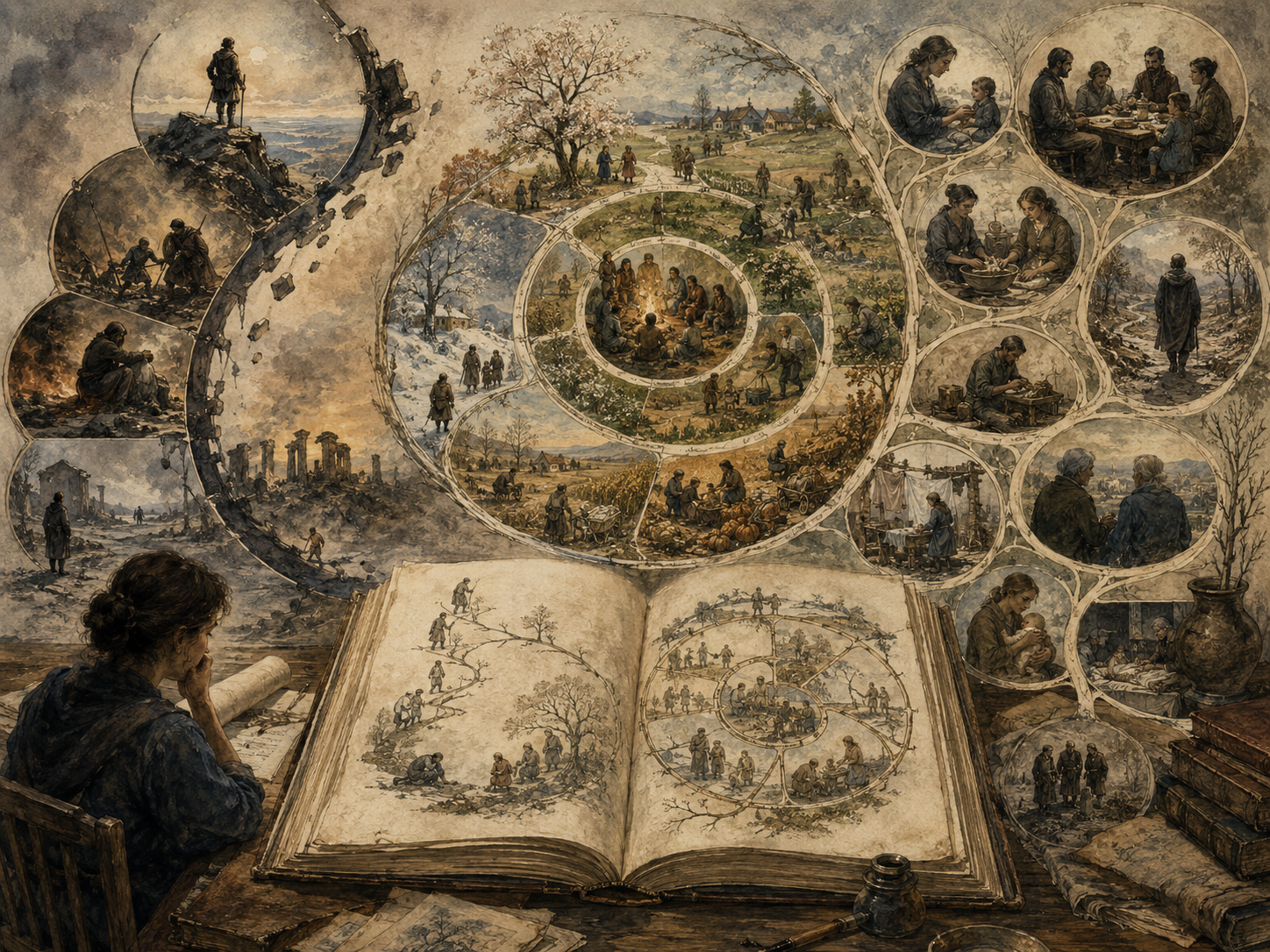
This article argues that non-heroic structures are not weaker than heroic structures. Tragedy clarifies limits, consequence, recognition, and irreversible loss. Cyclical story clarifies recurrence, ritual, season, inheritance, and return with variation. Non-heroic narrative clarifies care, endurance, witness, refusal, maintenance, and survival. These forms are indispensable for stories where the deepest truth is not conquest, but what remains when conquest is impossible.
Why Non-Heroic Forms Matter
Non-heroic forms matter because many human experiences do not become meaningful through victory. Illness, grief, aging, exile, poverty, inherited violence, institutional harm, ecological collapse, caregiving, moral injury, displacement, and historical trauma are not always resolved by courage, cleverness, or transformation. They may require endurance, witness, ritual, repair, memory, refusal, or tragic recognition.
Heroic structures often imagine a protagonist who can act decisively, leave home, enter danger, confront opposition, win knowledge, and return with a boon. Non-heroic structures often begin elsewhere. The protagonist may not be free to depart. The crisis may not be winnable. The harm may be systemic. The ending may remain open. The most important action may be staying alive, caring for another person, remembering the dead, refusing a role, or telling the truth after loss.
This does not mean non-heroic forms lack structure. They often have powerful structures: downward tragic arcs, recurrent cycles, ritual repetitions, witness sequences, care patterns, institutional procedures, ecological feedback loops, and intergenerational returns.
| Heroic assumption | Non-heroic alternative | Why it matters |
|---|---|---|
| Agency means conquest. | Agency may mean care, refusal, witness, endurance, or repair. | Action becomes broader than victory. |
| Conflict produces transformation. | Conflict may reveal limits, loss, complicity, or recurrence. | Not every crisis is redemptive. |
| Return completes the journey. | Return may be impossible, cyclical, haunted, or ethically incomplete. | Closure may be false. |
| The protagonist is central. | The story may center family, community, institution, system, or world. | Agency may be distributed. |
| Growth is the goal. | Recognition, mourning, accountability, or survival may be the goal. | Meaning need not equal self-improvement. |
| Structure rises toward victory. | Structure may descend, repeat, circle, or remain unresolved. | Form can honor loss and limitation. |
Non-heroic narrative matters because some truths cannot be told as triumph.
What Tragedy Does
Tragedy gives narrative form to irreversible consequence. It does not merely show sadness. It shows a structure in which action, error, fate, law, character, power, ignorance, timing, and recognition converge toward loss. Tragedy often asks what it means to understand too late.
In classical terms, tragedy is associated with serious action, pity, fear, reversal, recognition, and catharsis. But tragedy is not only a classical dramatic genre. It is also a narrative logic. A novel, film, memoir, historical account, court case, political story, ecological story, or institutional record can be tragic when it reveals a meaningful collision between agency and limit.
Tragedy is powerful because it refuses easy moral simplification. The tragic figure may be guilty and admirable, responsible and constrained, perceptive and blind, powerful and vulnerable. Tragedy shows that suffering is not always distributed according to justice.
| Tragic element | Narrative function | Analytical question |
|---|---|---|
| Serious action | Gives consequence weight. | What action cannot be undone? |
| Reversal | Turns success into danger or certainty into loss. | Where does the story change direction? |
| Recognition | Reveals truth, guilt, identity, or consequence. | What is understood too late? |
| Limit | Shows the boundary of will, knowledge, power, or justice. | What cannot be mastered? |
| Pity and fear | Engage the audience ethically and emotionally. | What makes the suffering intelligible and disturbing? |
| Irreversibility | Prevents easy restoration. | What loss changes the moral world? |
Tragedy is not the opposite of meaning. It is a form that asks what meaning survives irreversible loss.
Tragedy and Recognition
Recognition is one of tragedy’s deepest movements. A character may recognize the truth of a situation, the identity of another person, the consequences of an action, the nature of a law, the limits of power, or the extent of personal blindness. Recognition often arrives too late to prevent disaster.
This lateness matters. Tragedy is not simply ignorance followed by knowledge. It is knowledge arriving after the world has already changed. The audience sees the cost of delayed understanding.
Recognition can also belong to the audience, not only to the character. A tragic story may teach the audience to recognize a social pattern, institutional failure, family inheritance, political lie, ecological warning, or moral contradiction. The protagonist may die without full understanding, while the audience receives the burden of knowledge.
| Recognition type | What is revealed | Tragic effect |
|---|---|---|
| Self-recognition | The character sees their own error, guilt, or blindness. | Responsibility becomes visible. |
| Relational recognition | A hidden identity, bond, betrayal, or obligation is revealed. | Private life becomes morally charged. |
| Institutional recognition | A system’s failure or violence becomes legible. | Harm exceeds individual choice. |
| Historical recognition | The past returns as consequence. | Inheritance becomes unavoidable. |
| Ecological recognition | Delayed feedback reveals accumulated damage. | Time itself becomes tragic. |
| Audience recognition | The reader or viewer understands what characters cannot. | Witness becomes responsibility. |
Recognition makes tragedy more than suffering. It turns suffering into knowledge, however costly or late.
Hamartia, Fate, and Structure
Hamartia is often simplified as a “tragic flaw,” but tragic error is usually more complex. It may involve mistaken judgment, limited knowledge, moral blindness, excessive confidence, inherited obligation, structural pressure, institutional role, or a decision that becomes destructive under conditions the character does not fully understand.
Fate also requires careful handling. In tragedy, fate does not always mean supernatural predestination. It can mean social fate, family fate, political fate, ecological fate, institutional fate, or historical force. A character may act freely and still be constrained by structures already in motion.
The tragic question is not “Was the character free or doomed?” The stronger question is: how do agency and structure interact to produce irreversible consequence?
| Tragic force | How it operates | Risk if oversimplified |
|---|---|---|
| Hamartia | Error, misrecognition, excess, blindness, or compromised judgment. | Reduced to a personality flaw. |
| Fate | Limits already embedded in the world of the story. | Reduced to supernatural inevitability. |
| Law | Competing obligations or rigid systems of authority. | Reduced to simple rule-breaking. |
| Family inheritance | Patterns passed through kinship, memory, debt, shame, or violence. | Reduced to private psychology. |
| Political structure | Power shapes what choices are available. | Reduced to individual morality. |
| Timing | Truth arrives too late, or action occurs before knowledge. | Reduced to coincidence. |
Tragedy is strongest when it refuses to separate character from world, agency from constraint, and error from structure.
Catharsis and Tragic Knowledge
Catharsis is one of the most debated concepts in tragedy. It is often associated with the emotional processing of pity and fear, but its meaning has been interpreted in multiple ways: purgation, purification, clarification, education, emotional regulation, or aesthetic transformation.
Whatever interpretation one adopts, catharsis points to an important fact: tragedy does something to the audience. It does not simply display suffering. It organizes suffering so that the audience feels, recognizes, reflects, and carries knowledge differently.
Tragic knowledge is not optimistic knowledge. It may not offer a solution. It may reveal that a solution came too late, that a system demanded sacrifice, that pride met limit, that justice failed, or that no action could undo what happened. The ethical power of tragedy is that it can deepen perception without pretending to repair loss.
| Audience movement | What tragedy may produce | Ethical caution |
|---|---|---|
| Pity | Recognition of undeserved or disproportionate suffering. | Do not turn suffering into spectacle. |
| Fear | Recognition of vulnerability, contingency, or shared risk. | Do not manipulate fear for cheap effect. |
| Clarification | Understanding of action, error, structure, or consequence. | Do not reduce tragedy to a lesson. |
| Release | Emotional movement through grief, tension, and recognition. | Do not treat catharsis as erasing harm. |
| Witness | Responsibility to remember what happened. | Do not let audience feeling replace accountability. |
| Humility | Recognition of human limit. | Do not romanticize powerlessness. |
Tragedy teaches by making the audience feel the cost of knowledge.
Cyclical Story and Return
Cyclical stories organize meaning through return. A place, season, ritual, wound, family pattern, political crisis, ecological rhythm, or moral question comes back. The return may repeat the past, repair it, expose it, transform it, or show that it has not been escaped.
Unlike the monomythic return, cyclical return is not necessarily triumphant. It may be ritual, haunted, seasonal, ironic, tragic, or regenerative. A cycle can preserve life, but it can also trap people in repeated harm. The question is not merely that something returns. The question is whether return changes the meaning of what returned.
Cyclical story is especially important for narratives about family inheritance, community memory, ritual practice, ecological time, political recurrence, addiction, grief, generational trauma, and institutional failure.
| Cyclical pattern | Meaning | Analytical question |
|---|---|---|
| Seasonal cycle | Life moves through recurring natural rhythms. | What changes across seasons? |
| Ritual cycle | Community repeats symbolic action to renew meaning. | What does ritual preserve or transform? |
| Generational cycle | Patterns repeat across family or lineage. | What is inherited, interrupted, or repaired? |
| Political cycle | Power repeats crisis, reform, backlash, or collapse. | Who benefits from recurrence? |
| Trauma cycle | Unprocessed harm returns in memory or behavior. | What has not been witnessed or repaired? |
| Ecological cycle | Systems move through feedback, renewal, depletion, or collapse. | How does time exceed human intention? |
Cyclical story treats return as a structure of meaning, not merely as an ending.
Ritual, Season, and Repetition
Ritual and seasonal structures reveal a kind of narrative intelligence that is different from heroic progress. Ritual repeats, but repetition does not mean nothing changes. Repetition can renew community, mark transition, preserve memory, contain grief, structure obligation, or open a temporary space outside ordinary hierarchy.
Seasonal structures connect human life to larger rhythms: planting, harvest, winter, return, migration, drought, flood, decay, renewal, and ecological change. The story may not move by a single protagonist’s will. It may move by seasonal pressure, communal response, or environmental feedback.
Repetition also has a darker side. Repeated harm, repeated silence, repeated institutional failure, or repeated family violence can become narrative structure. The cycle may need to be honored, interrupted, mourned, or exposed.
| Repetition type | Function | Possible danger |
|---|---|---|
| Ritual repetition | Renews shared meaning. | Can conceal exclusion or coercion. |
| Seasonal repetition | Connects story to ecological time. | Can romanticize natural cycles while ignoring harm. |
| Family repetition | Shows inheritance and pattern. | Can make harm seem inevitable. |
| Institutional repetition | Exposes procedural failure. | Can normalize bureaucracy as fate. |
| Traumatic repetition | Shows unresolved return. | Can turn pain into spectacle. |
| Spiral repetition | Returns with difference or deeper understanding. | Can imply progress where none exists. |
Repetition is not the absence of structure. It is one of narrative’s most powerful structures.
Non-Heroic Narrative
Non-heroic narrative does not mean a story without courage. It means a story where courage is not organized as conquest, mastery, public triumph, or heroic exceptionalism. The central figure may be ordinary, constrained, morally ambiguous, damaged, tired, dependent, unseen, or one voice among many.
Non-heroic narrative often appears in realism, memoir, testimony, care narratives, bureaucratic fiction, domestic fiction, survival stories, postwar narratives, disability narratives, ecological narratives, and stories of social marginalization. The protagonist may not overcome the world. They may endure it, understand it, resist it, care within it, or expose it.
These stories challenge the assumption that a protagonist must become larger than life. Sometimes the ethical force of a story comes from remaining human-sized.
| Non-heroic feature | What it does | Why it matters |
|---|---|---|
| Ordinary protagonist | Centers common life rather than exceptional destiny. | Meaning becomes accessible without grandeur. |
| Limited agency | Shows constraint, dependency, or structural pressure. | Power relations remain visible. |
| Moral ambiguity | Resists simplified good-versus-evil structure. | Responsibility becomes more complex. |
| Quiet action | Values care, patience, witness, and endurance. | Action is not reduced to force. |
| Open ending | Refuses false completion. | Unresolved life remains truthful. |
| Distributed meaning | Spreads significance across relations or systems. | The self is not the only center. |
Non-heroic narrative gives dignity to forms of life that heroic structure often treats as background.
Care, Endurance, and Maintenance
Care narratives reveal the labor that keeps life possible. They may center nursing, parenting, feeding, cleaning, teaching, translating, sheltering, remembering, organizing, tending land, sustaining community, or accompanying the dying. These are not secondary actions. They are the infrastructure of survival.
Endurance narratives are not passive. To endure illness, poverty, war, grief, displacement, discrimination, caregiving burden, or bureaucratic violence can require discipline, creativity, social intelligence, moral courage, and collective support. Endurance is often invisible because it does not look like conquest.
Maintenance narratives challenge the heroic bias toward crisis and climax. They show that much of human life is not about winning a decisive battle, but about sustaining fragile systems under pressure.
| Maintenance action | Narrative value | Risk if ignored |
|---|---|---|
| Caregiving | Shows relational obligation and embodied vulnerability. | Care becomes invisible background. |
| Feeding and sheltering | Shows survival as daily labor. | Basic life support is treated as non-narrative. |
| Teaching and transmitting | Preserves knowledge across generations. | Continuity is mistaken for stasis. |
| Repairing | Responds to breakdown without spectacle. | Repair is overshadowed by crisis. |
| Remembering | Maintains connection to the dead or absent. | Memory is reduced to exposition. |
| Enduring | Shows persistence under constraint. | Survival is mistaken for lack of action. |
Care and maintenance are narrative actions because worlds collapse without them.
Witness, Refusal, and Survival
Witness narratives center the act of telling, remembering, recording, or preserving truth. The witness may not defeat the harm. They may not reverse the loss. Their action is to make erasure more difficult. Testimony, archive, memoir, oral history, court record, diary, documentary, and elegy often work through this structure.
Refusal is another non-heroic form of agency. A character may refuse a role, marriage, institution, ideology, inheritance, identity script, confession, demand for forgiveness, or false reconciliation. Refusal may appear inactive when judged by quest structure, but it can be morally decisive.
Survival narratives focus on continuing under pressure. Survival may not offer cathartic triumph. It may be partial, compromised, communal, hidden, or exhausting. But survival is not a lesser form of story. It is often the condition that makes future story possible.
| Non-heroic action | What it protects | What it resists |
|---|---|---|
| Witness | Memory, truth, evidence, and accountability. | Erasure and denial. |
| Refusal | Integrity, boundary, dignity, or moral clarity. | Forced participation. |
| Survival | Life under pressure. | Systems that make life precarious. |
| Silence | Privacy, safety, grief, or the unspeakable. | Demands for confession or spectacle. |
| Staying | Relation, place, care, or obligation. | The assumption that freedom always means departure. |
| Remembering | Connection to what power wants forgotten. | Historical amnesia. |
Witness, refusal, and survival reveal agency where heroic models often see only delay, passivity, or aftermath.
Collective and Institutional Tragedy
Tragedy is not always individual. A community, institution, profession, nation, school, hospital, court, company, movement, or ecosystem can be tragic. Institutional tragedy occurs when a system produces harm through rules, incentives, habits, silences, hierarchies, delays, or repeated failures.
Collective tragedy resists the single-hero model. The tragic subject may be a city after disaster, a community after violence, a workforce after exploitation, a family across generations, or a public after institutional betrayal. The story’s movement may involve warning signs ignored, responsibilities displaced, procedures followed without wisdom, and recognition arriving after harm.
These stories require structural reading. Asking “Who is the tragic hero?” may be the wrong question. The better question may be: what system made tragedy likely?
| Institutional tragic pattern | How it appears | Analytical question |
|---|---|---|
| Warning ignored | Signals appear before disaster, but authority dismisses them. | Who had power to respond? |
| Responsibility dispersed | Everyone contributes, but no one feels accountable. | How does the system hide agency? |
| Procedure without judgment | Rules are followed while harm increases. | When does procedure become tragic blindness? |
| Delayed recognition | The system understands only after loss. | Why did knowledge arrive too late? |
| Sacrifice logic | Some people bear costs for institutional continuity. | Whose suffering is normalized? |
| Repetition after reform | The institution claims change but repeats the pattern. | What cycle remains intact? |
Institutional tragedy shows that downfall can be designed by systems, not only by flawed individuals.
Ecological and Systemic Cycles
Ecological narratives often resist heroic structure because ecological time exceeds individual intention. Forests, rivers, climate systems, species, farms, cities, and infrastructures move through cycles, feedback loops, thresholds, delays, accumulations, collapses, and recoveries. The protagonist may be a system.
Ecological tragedy can occur when human action ignores delayed consequence. A community may enjoy short-term success while long-term damage accumulates. Recognition arrives after thresholds are crossed. The tragic structure is temporal: action and consequence are separated by delay.
Systemic cycles also appear in economics, public health, infrastructure, organizational life, and political systems. A non-heroic narrative may track patterns rather than one decisive confrontation.
| Systemic pattern | Narrative movement | Tragic or cyclical question |
|---|---|---|
| Feedback loop | Action produces effects that return into the system. | What reinforces the pattern? |
| Delay | Consequences arrive after decisions are made. | What was invisible at the time of action? |
| Threshold | Gradual change becomes sudden rupture. | When did recovery become impossible? |
| Depletion | Resources decline while normal life continues. | What keeps the crisis hidden? |
| Recovery cycle | Renewal follows disturbance. | What kind of repair is possible? |
| Collapse cycle | Repeated failure becomes systemic pattern. | What must change beyond the individual? |
Ecological and systemic stories require narrative forms that can hold time, feedback, recurrence, and consequence beyond the hero.
Digital and AI-Mediated Narrative
Digital and AI-mediated storytelling can reinforce heroic defaults. Tools often generate protagonists, goals, conflicts, climaxes, and resolutions because those structures are easy to template. But tragedy, cyclical story, and non-heroic narrative require different design habits.
AI may over-smooth tragic ambiguity, turn care narratives into low-stakes subplots, convert cycles into repetitive errors, or force unresolved witness into neat moral lessons. It may mistake non-heroic agency for passivity because action is not dramatic in conventional ways.
Responsible AI-assisted narrative design should be able to model tragic recognition, cyclical recurrence, distributed agency, care labor, witness, refusal, and open endings. It should flag when a heroic arc is being imposed onto material that requires another form.
| AI tendency | Risk | Responsible alternative |
|---|---|---|
| Generate hero-goal-conflict-resolution arc. | Forces conventional structure. | Offer tragic, cyclical, care, witness, and open structures. |
| Smooth ambiguity. | Weakens tragedy and moral complexity. | Preserve contradiction and unresolved consequence. |
| Treat repetition as redundancy. | Misreads cyclical form. | Track repetition with variation. |
| Undervalue care labor. | Makes maintenance invisible. | Score care as narrative action. |
| Demand closure. | Creates false repair. | Allow unresolved endings where ethically necessary. |
| Individualize systemic harm. | Turns institutional tragedy into personal flaw. | Map distributed agency and structural constraint. |
AI should not make every serious story heroic. It should help identify when heroism is the wrong narrative model.
Ethics of Non-Heroic Form
Non-heroic form has ethical stakes. Some stories should not be turned into empowerment arcs. Some tragedies should not be redeemed too quickly. Some cycles should not be romanticized. Some witness narratives should not be forced into catharsis. Some care stories should not be treated as background to more dramatic action.
Ethical form asks what the story owes to the people, histories, losses, and responsibilities it represents. A tragedy may owe the audience discomfort rather than consolation. A cyclical story may owe the past recurrence rather than closure. A care narrative may owe maintenance visibility rather than heroic climax. A witness narrative may owe testimony rather than transformation.
The central ethical question is: what kind of structure would distort this story, and what kind of structure would let it remain truthful?
| Ethical issue | Structural response | Why it matters |
|---|---|---|
| Irreversible loss | Tragic form. | Refuses false restoration. |
| Repeated harm | Cyclical form. | Shows recurrence and inherited pattern. |
| Unseen labor | Care narrative. | Makes maintenance visible. |
| Historical erasure | Witness or archive form. | Protects memory and evidence. |
| Systemic failure | Collective or institutional form. | Avoids blaming one person for structural harm. |
| Unresolved injustice | Open ending. | Prevents catharsis from replacing accountability. |
Non-heroic form is ethical when it refuses to make suffering useful merely because audiences want resolution.
Examples of Tragic, Cyclical, and Non-Heroic Analysis
The examples below show how non-heroic structures change interpretation.
Tragic leadership story
Weak: The story is read as a failed hero’s journey.
Stronger: The analysis asks how pride, limited knowledge, institutional pressure, and delayed recognition produce irreversible loss.
Why it works: It treats downfall as structure, not failed triumph.
Family cycle narrative
Weak: Repetition is treated as lack of plot.
Stronger: The analysis tracks inherited harm, repeated choices, silence, attempted repair, and return with variation.
Why it works: It recognizes recurrence as narrative motion.
Caregiving memoir
Weak: The story is considered low-action because the protagonist stays.
Stronger: The analysis identifies care labor, endurance, dependency, grief, and moral responsibility as structure.
Why it works: It makes maintenance visible.
Institutional failure
Weak: The analysis searches for a single villain or tragic hero.
Stronger: The analysis maps dispersed responsibility, ignored warnings, procedure without judgment, and delayed recognition.
Why it works: It sees tragedy at the system level.
Ecological story
Weak: The narrative is forced into protagonist-conflict-resolution form.
Stronger: The analysis tracks feedback loops, thresholds, depletion, seasonal return, and delayed consequence.
Why it works: It respects ecological time.
Witness narrative
Weak: The story is expected to provide healing or catharsis.
Stronger: The analysis respects testimony, unresolved grief, evidence, memory, and refusal of false closure.
Why it works: It protects witness from being turned into entertainment.
These examples show that non-heroic form is not the absence of structure. It is another way of organizing consequence, recurrence, and responsibility.
Mathematics, Computation, and Modeling
Tragedy, cyclical story, and non-heroic narrative should not be reduced to formulas. Still, structured modeling can help audit whether a reading is forcing heroic expectations onto non-heroic material.
A tragic-structure score can estimate whether a story is organized around irreversible consequence:
T_s = \frac{C_a + L_m + R_v + K_l + I_r + W_t}{6}
\]
Interpretation: Tragic structure \(T_s\) averages consequential action \(C_a\), limit pressure \(L_m\), reversal \(R_v\), recognition knowledge \(K_l\), irreversibility \(I_r\), and witness burden \(W_t\).
A cyclical-structure score can estimate whether recurrence is central:
C_s = \frac{R_p + S_n + G_t + I_h + E_f + V_r}{6}
\]
Interpretation: Cyclical structure \(C_s\) averages repeated pattern \(R_p\), seasonal or ritual signal \(S_n\), generational transmission \(G_t\), institutional habit \(I_h\), ecological feedback \(E_f\), and variation across return \(V_r\).
A non-heroic agency score can estimate whether action is present outside heroic form:
N_a = \frac{C_r + E_d + W_s + R_f + M_t + S_v}{6}
\]
Interpretation: Non-heroic agency \(N_a\) averages care \(C_r\), endurance \(E_d\), witness \(W_s\), refusal \(R_f\), maintenance \(M_t\), and survival \(S_v\).
A heroic-overfit risk score can estimate whether the analysis is imposing the wrong model:
H_r = H_fw_h + V_pw_v + C_pw_c + R_pw_r + G_pw_g + (1 – E_v)w_e
\]
Interpretation: Heroic-overfit risk \(H_r\) rises with hero forcing \(H_f\), victory pressure \(V_p\), closure pressure \(C_p\), return pressure \(R_p\), growth pressure \(G_p\), and weak evidence visibility \(E_v\).
| Modeling task | Interpretive question | Example output |
|---|---|---|
| Tragic-structure audit | Does the story move through irreversible consequence and recognition? | Tragic-structure score. |
| Cyclical-structure audit | Does recurrence organize the story? | Cyclical-structure score. |
| Non-heroic agency audit | Where does action occur outside conquest? | Care, endurance, witness, refusal, maintenance, and survival profile. |
| Heroic-overfit audit | Is the analysis forcing victory, closure, or return? | Heroic-overfit risk score. |
| Systemic tragedy audit | Is responsibility individual or distributed? | Institutional pattern note. |
| Publication governance audit | Is the interpretation responsible enough for reuse? | Canvas card and governance queue. |
Computation can support non-heroic reading when it helps make non-obvious agency visible.
Python Workflow: Non-Heroic Narrative Canvas Audit
The Python workflow below follows the advanced Catalyst Canvas standard: typed records, config-driven scoring, validation, governance notes, Canvas-card exports, CSV outputs, JSON outputs, markdown governance queues, and review priorities. The companion repository version includes the shared `python/catalyst_canvas/` layer plus article-specific data for tragedy, cyclical story, non-heroic agency, heroic-overfit risk, and ethical review.
# run_non_heroic_narrative_canvas_audit.py
from __future__ import annotations

from dataclasses import dataclass
from pathlib import Path
import csv
import json
from hashlib import sha256
from statistics import mean
from typing import Any


ARTICLE_ROOT = Path(__file__).resolve().parents[1]
OUTPUTS = ARTICLE_ROOT / "outputs"


@dataclass(frozen=True)
class NonHeroicNarrativeRecord:
    item: str
    claim_context: str
    consequential_action: float
    limit_pressure: float
    reversal: float
    recognition_knowledge: float
    irreversibility: float
    witness_burden: float
    repeated_pattern: float
    seasonal_ritual_signal: float
    generational_transmission: float
    institutional_habit: float
    ecological_feedback: float
    variation_across_return: float
    care: float
    endurance: float
    witness: float
    refusal: float
    maintenance: float
    survival: float
    hero_forcing: float
    victory_pressure: float
    closure_pressure: float
    return_pressure: float
    growth_pressure: float
    evidence_visibility: float
    public_consequence: float
    source_context: float
    method_limits: float
    uncertainty_notes: float
    review_owner_clarity: float
    owner: str = "editorial"
    status: str = "active"
    notes: str = ""


@dataclass(frozen=True)
class NonHeroicNarrativeConfig:
    article_title: str = "Tragedy, Cyclical Story, and Non-Heroic Narrative"
    article_slug: str = "tragedy-cyclical-story-and-non-heroic-narrative"
    medium_threshold: float = 0.45
    high_threshold: float = 0.62
    allowed_statuses: tuple[str, ...] = ("active", "archive", "review", "revise")


def validate_score(value: float, field_name: str) -> None:
    if value < 0 or value > 1:
        raise ValueError(f"{field_name} must be between 0 and 1.")


def validate_record(record: NonHeroicNarrativeRecord, config: NonHeroicNarrativeConfig) -> None:
    if not record.item.strip():
        raise ValueError("item is required.")
    if not record.claim_context.strip():
        raise ValueError("claim_context is required.")
    if record.status not in config.allowed_statuses:
        raise ValueError(f"Invalid status: {record.status}")

    for field_name, value in record.__dict__.items():
        if isinstance(value, float):
            validate_score(value, field_name)


def tragic_structure(record: NonHeroicNarrativeRecord) -> float:
    return mean([
        record.consequential_action,
        record.limit_pressure,
        record.reversal,
        record.recognition_knowledge,
        record.irreversibility,
        record.witness_burden,
    ])


def cyclical_structure(record: NonHeroicNarrativeRecord) -> float:
    return mean([
        record.repeated_pattern,
        record.seasonal_ritual_signal,
        record.generational_transmission,
        record.institutional_habit,
        record.ecological_feedback,
        record.variation_across_return,
    ])


def non_heroic_agency(record: NonHeroicNarrativeRecord) -> float:
    return mean([
        record.care,
        record.endurance,
        record.witness,
        record.refusal,
        record.maintenance,
        record.survival,
    ])


def heroic_overfit_risk(record: NonHeroicNarrativeRecord) -> float:
    return min(
        1.0,
        record.hero_forcing * 0.18
        + record.victory_pressure * 0.18
        + record.closure_pressure * 0.18
        + record.return_pressure * 0.16
        + record.growth_pressure * 0.16
        + (1 - record.evidence_visibility) * 0.14,
    )


def review_readiness(record: NonHeroicNarrativeRecord) -> float:
    return mean([
        record.source_context,
        record.method_limits,
        record.uncertainty_notes,
        record.review_owner_clarity,
        record.evidence_visibility,
    ])


def governance_priority_score(record: NonHeroicNarrativeRecord, config: NonHeroicNarrativeConfig) -> float:
    score = (
        heroic_overfit_risk(record) * 0.34
        + (1 - review_readiness(record)) * 0.24
        + max(tragic_structure(record), cyclical_structure(record), non_heroic_agency(record)) * 0.18
        + record.public_consequence * 0.24
    )

    if record.status == "revise":
        score = max(score, config.high_threshold)
    elif record.status == "review":
        score = max(score, config.medium_threshold)

    return min(1.0, max(0.0, score))


def review_priority(record: NonHeroicNarrativeRecord, config: NonHeroicNarrativeConfig) -> str:
    score = governance_priority_score(record, config)
    if score >= config.high_threshold:
        return "high"
    if score >= config.medium_threshold:
        return "medium"
    return "standard"


def card_id(record: NonHeroicNarrativeRecord, config: NonHeroicNarrativeConfig) -> str:
    raw = f"{config.article_slug}|{record.item}|{record.claim_context}"
    return sha256(raw.encode("utf-8")).hexdigest()[:16]


def governance_note(record: NonHeroicNarrativeRecord, config: NonHeroicNarrativeConfig) -> str:
    priority = review_priority(record, config)

    notes = []
    if priority == "high":
        notes.append("High-priority non-heroic narrative governance review required.")
    elif priority == "medium":
        notes.append("Medium-priority review recommended before reuse.")
    else:
        notes.append("Standard editorial review sufficient.")

    if heroic_overfit_risk(record) >= 0.55:
        notes.append("Heroic-overfit risk is elevated; review hero forcing, victory pressure, closure pressure, return pressure, growth pressure, and evidence visibility.")
    if non_heroic_agency(record) >= 0.65:
        notes.append("Non-heroic agency is strong; preserve care, endurance, witness, refusal, maintenance, and survival as narrative action.")
    if cyclical_structure(record) >= 0.65:
        notes.append("Cyclical structure is strong; preserve recurrence, ritual, generational, institutional, ecological, and variation patterns.")
    if tragic_structure(record) >= 0.65:
        notes.append("Tragic structure is strong; preserve consequence, limit, reversal, recognition, irreversibility, and witness burden.")
    if record.notes:
        notes.append(record.notes)

    return " ".join(notes)


def canvas_card(record: NonHeroicNarrativeRecord, config: NonHeroicNarrativeConfig) -> dict[str, Any]:
    return {
        "schema_version": "1.0.0",
        "card_id": card_id(record, config),
        "card_type": "tragedy_cyclical_non_heroic_narrative",
        "article_title": config.article_title,
        "article_slug": config.article_slug,
        "item": record.item,
        "claim_context": record.claim_context,
        "scores": {
            "tragic_structure": round(tragic_structure(record), 4),
            "cyclical_structure": round(cyclical_structure(record), 4),
            "non_heroic_agency": round(non_heroic_agency(record), 4),
            "heroic_overfit_risk": round(heroic_overfit_risk(record), 4),
            "review_readiness": round(review_readiness(record), 4),
            "governance_priority_score": round(governance_priority_score(record, config), 4),
        },
        "review": {
            "priority": review_priority(record, config),
            "owner": record.owner,
            "status": record.status,
            "governance_note": governance_note(record, config),
        },
    }


def write_csv(path: Path, rows: list[dict[str, Any]]) -> None:
    path.parent.mkdir(parents=True, exist_ok=True)
    fieldnames = list(rows[0].keys())
    with path.open("w", encoding="utf-8", newline="") as handle:
        writer = csv.DictWriter(handle, fieldnames=fieldnames)
        writer.writeheader()
        writer.writerows(rows)


def write_json(path: Path, payload: Any) -> None:
    path.parent.mkdir(parents=True, exist_ok=True)
    path.write_text(json.dumps(payload, indent=2), encoding="utf-8")


def write_markdown_queue(path: Path, rows: list[dict[str, Any]]) -> None:
    path.parent.mkdir(parents=True, exist_ok=True)
    lines = [
        "# Non-Heroic Narrative Governance Queue",
        "",
        "| Item | Context | Tragic | Cyclical | Non-heroic agency | Heroic risk | Priority | Owner |",
        "|---|---|---:|---:|---:|---:|---|---|",
    ]

    for row in rows:
        lines.append(
            f"| {row['item']} | {row['claim_context']} | "
            f"{row['tragic_structure']} | {row['cyclical_structure']} | "
            f"{row['non_heroic_agency']} | {row['heroic_overfit_risk']} | "
            f"{row['review_priority']} | {row['owner']} |"
        )

    path.write_text("\n".join(lines) + "\n", encoding="utf-8")


def main() -> None:
    config = NonHeroicNarrativeConfig()

    records = [
        NonHeroicNarrativeRecord(
            "Institutional tragedy",
            "distributed responsibility and delayed recognition audit",
            0.88, 0.86, 0.78, 0.84, 0.88, 0.82,
            0.66, 0.44, 0.58, 0.90, 0.54, 0.62,
            0.40, 0.58, 0.82, 0.48, 0.62, 0.66,
            0.80, 0.72, 0.78, 0.70, 0.64, 0.86,
            0.94, 0.86, 0.88, 0.86, 0.84,
            "governance", "review",
            "Preserve institutional pattern and avoid reducing tragedy to individual flaw."
        ),
        NonHeroicNarrativeRecord(
            "Caregiving memoir",
            "care endurance and maintenance agency audit",
            0.52, 0.68, 0.44, 0.58, 0.62, 0.70,
            0.72, 0.58, 0.64, 0.50, 0.42, 0.76,
            0.94, 0.90, 0.74, 0.62, 0.92, 0.88,
            0.76, 0.70, 0.84, 0.66, 0.78, 0.82,
            0.86, 0.84, 0.88, 0.84, 0.86,
            "ethics review", "review",
            "Preserve care and maintenance as primary narrative action."
        ),
        NonHeroicNarrativeRecord(
            "Ecological cycle",
            "feedback delay threshold and recurrence audit",
            0.72, 0.86, 0.68, 0.74, 0.82, 0.80,
            0.88, 0.86, 0.70, 0.76, 0.94, 0.84,
            0.56, 0.76, 0.70, 0.52, 0.78, 0.82,
            0.82, 0.74, 0.80, 0.78, 0.70, 0.86,
            0.96, 0.88, 0.90, 0.86, 0.88,
            "governance", "revise",
            "Escalate systemic and ecological cycle review; avoid forcing single-protagonist solution."
        ),
    ]

    rows = []
    cards = []

    for record in records:
        validate_record(record, config)
        cards.append(canvas_card(record, config))
        rows.append({
            "item": record.item,
            "claim_context": record.claim_context,
            "tragic_structure": round(tragic_structure(record), 4),
            "cyclical_structure": round(cyclical_structure(record), 4),
            "non_heroic_agency": round(non_heroic_agency(record), 4),
            "heroic_overfit_risk": round(heroic_overfit_risk(record), 4),
            "review_readiness": round(review_readiness(record), 4),
            "governance_priority_score": round(governance_priority_score(record, config), 4),
            "review_priority": review_priority(record, config),
            "owner": record.owner,
            "status": record.status,
            "governance_note": governance_note(record, config),
        })

    priority_order = {"high": 3, "medium": 2, "standard": 1}
    rows = sorted(
        rows,
        key=lambda row: (
            priority_order.get(str(row["review_priority"]), 0),
            float(row["governance_priority_score"]),
        ),
        reverse=True,
    )

    queue = [row for row in rows if row["review_priority"] != "standard"]
    queue_cards = [card for card in cards if card["review"]["priority"] != "standard"]

    write_csv(OUTPUTS / "tables" / "non_heroic_narrative_audit.csv", rows)
    write_csv(OUTPUTS / "tables" / "non_heroic_narrative_governance_queue.csv", queue)
    write_json(OUTPUTS / "json" / "non_heroic_narrative_canvas_cards.json", cards)
    write_json(OUTPUTS / "json" / "non_heroic_narrative_governance_queue.json", queue_cards)
    write_markdown_queue(OUTPUTS / "markdown" / "non_heroic_narrative_governance_queue.md", queue)

    print("Non-heroic narrative Canvas audit complete.")


if __name__ == "__main__":
    main()
This workflow helps protect tragic, cyclical, and non-heroic structures from being overwritten by heroic expectations.
R Workflow: Tragic and Cyclical Structure Diagnostics
The R workflow below provides a portable base R diagnostic for tragedy, cyclical story, and non-heroic narrative. It calculates tragic structure, cyclical structure, non-heroic agency, heroic-overfit risk, review readiness, governance priority, and review status.
# non_heroic_narrative_diagnostics.R
# Base R workflow for Tragedy, Cyclical Story, and Non-Heroic Narrative.

args <- commandArgs(trailingOnly = FALSE)
file_arg <- grep("^--file=", args, value = TRUE)

if (length(file_arg) > 0) {
  script_path <- normalizePath(sub("^--file=", "", file_arg[1]), mustWork = TRUE)
  article_root <- normalizePath(file.path(dirname(script_path), ".."), mustWork = TRUE)
} else {
  article_root <- getwd()
}

setwd(article_root)

tables_dir <- file.path(article_root, "outputs", "tables")
figures_dir <- file.path(article_root, "outputs", "figures")
dir.create(tables_dir, recursive = TRUE, showWarnings = FALSE)
dir.create(figures_dir, recursive = TRUE, showWarnings = FALSE)

records <- data.frame(
  item = c(
    "Institutional tragedy",
    "Caregiving memoir",
    "Ecological cycle"
  ),
  claim_context = c(
    "distributed responsibility and delayed recognition audit",
    "care endurance and maintenance agency audit",
    "feedback delay threshold and recurrence audit"
  ),
  consequential_action = c(0.88, 0.52, 0.72),
  limit_pressure = c(0.86, 0.68, 0.86),
  reversal = c(0.78, 0.44, 0.68),
  recognition_knowledge = c(0.84, 0.58, 0.74),
  irreversibility = c(0.88, 0.62, 0.82),
  witness_burden = c(0.82, 0.70, 0.80),
  repeated_pattern = c(0.66, 0.72, 0.88),
  seasonal_ritual_signal = c(0.44, 0.58, 0.86),
  generational_transmission = c(0.58, 0.64, 0.70),
  institutional_habit = c(0.90, 0.50, 0.76),
  ecological_feedback = c(0.54, 0.42, 0.94),
  variation_across_return = c(0.62, 0.76, 0.84),
  care = c(0.40, 0.94, 0.56),
  endurance = c(0.58, 0.90, 0.76),
  witness = c(0.82, 0.74, 0.70),
  refusal = c(0.48, 0.62, 0.52),
  maintenance = c(0.62, 0.92, 0.78),
  survival = c(0.66, 0.88, 0.82),
  hero_forcing = c(0.80, 0.76, 0.82),
  victory_pressure = c(0.72, 0.70, 0.74),
  closure_pressure = c(0.78, 0.84, 0.80),
  return_pressure = c(0.70, 0.66, 0.78),
  growth_pressure = c(0.64, 0.78, 0.70),
  evidence_visibility = c(0.86, 0.82, 0.86),
  public_consequence = c(0.94, 0.86, 0.96),
  source_context = c(0.86, 0.84, 0.88),
  method_limits = c(0.88, 0.88, 0.90),
  uncertainty_notes = c(0.86, 0.84, 0.86),
  review_owner_clarity = c(0.84, 0.86, 0.88),
  owner = c("governance", "ethics review", "governance"),
  status = c("review", "review", "revise"),
  stringsAsFactors = FALSE
)

records$tragic_structure <- rowMeans(records[, c(
  "consequential_action",
  "limit_pressure",
  "reversal",
  "recognition_knowledge",
  "irreversibility",
  "witness_burden"
)])

records$cyclical_structure <- rowMeans(records[, c(
  "repeated_pattern",
  "seasonal_ritual_signal",
  "generational_transmission",
  "institutional_habit",
  "ecological_feedback",
  "variation_across_return"
)])

records$non_heroic_agency <- rowMeans(records[, c(
  "care",
  "endurance",
  "witness",
  "refusal",
  "maintenance",
  "survival"
)])

records$heroic_overfit_risk <- pmin(
  1,
  records$hero_forcing * 0.18 +
    records$victory_pressure * 0.18 +
    records$closure_pressure * 0.18 +
    records$return_pressure * 0.16 +
    records$growth_pressure * 0.16 +
    (1 - records$evidence_visibility) * 0.14
)

records$review_readiness <- rowMeans(records[, c(
  "source_context",
  "method_limits",
  "uncertainty_notes",
  "review_owner_clarity",
  "evidence_visibility"
)])

records$governance_priority_score <- pmin(
  1,
  records$heroic_overfit_risk * 0.34 +
    (1 - records$review_readiness) * 0.24 +
    pmax(records$tragic_structure, records$cyclical_structure, records$non_heroic_agency) * 0.18 +
    records$public_consequence * 0.24
)

records$review_priority <- ifelse(
  records$status == "revise" | records$governance_priority_score >= 0.62,
  "high",
  ifelse(
    records$status == "review" | records$governance_priority_score >= 0.45,
    "medium",
    "standard"
  )
)

records <- records[order(records$governance_priority_score, decreasing = TRUE), ]

write.csv(records, file.path(tables_dir, "non_heroic_narrative_diagnostics.csv"), row.names = FALSE)
write.csv(records[records$review_priority != "standard", ], file.path(tables_dir, "non_heroic_narrative_governance_queue.csv"), row.names = FALSE)

png(file.path(figures_dir, "tragic_structure_scores.png"), width = 1200, height = 700)
barplot(
  records$tragic_structure,
  names.arg = records$item,
  las = 2,
  ylab = "Tragic structure",
  main = "Tragic Structure Signal"
)
grid()
dev.off()

png(file.path(figures_dir, "non_heroic_agency_scores.png"), width = 1200, height = 700)
barplot(
  records$non_heroic_agency,
  names.arg = records$item,
  las = 2,
  ylab = "Non-heroic agency",
  main = "Non-Heroic Agency Signal"
)
grid()
dev.off()

print(records[, c(
  "item",
  "claim_context",
  "tragic_structure",
  "cyclical_structure",
  "non_heroic_agency",
  "heroic_overfit_risk",
  "review_priority"
)])
This workflow supports non-heroic interpretation while keeping heroic-overfit risk visible.
GitHub Repository
The companion repository for this article supports tragic, cyclical, and non-heroic narrative analysis as a Catalyst Canvas-ready module. It includes advanced additive `python/catalyst_canvas/` governance infrastructure, article-specific non-heroic narrative data, config-driven scoring, validation, governance notes, Canvas card generation, CSV/JSON/markdown exporters, CLI workflows, smoke tests, unit tests, R diagnostics, SQL structures, documentation, and reusable non-heroic narrative review templates.
Complete Code Repository
Companion repository for the article, including advanced Catalyst Canvas-ready code for tragedy, cyclical story, non-heroic agency, care narratives, witness structures, institutional tragedy, ecological recurrence, JSON exports, Canvas cards, governance queues, and reproducible research workflows.
articles/tragedy-cyclical-story-and-non-heroic-narrative/
├── canvas/
│   ├── canvas_manifest.json
│   ├── input_schema.json
│   ├── output_schema.json
│   ├── catalyst_canvas_config.json
│   ├── catalyst_canvas_manifest.json
│   ├── catalyst_canvas_cards.json
│   └── catalyst_canvas_governance_queue.json
├── html/
├── css/
├── php/
├── java/
├── python/
│   ├── catalyst_canvas/
│   │   ├── __init__.py
│   │   ├── __main__.py
│   │   ├── cli.py
│   │   ├── models.py
│   │   ├── scoring.py
│   │   ├── validation.py
│   │   ├── governance.py
│   │   └── exporters.py
│   ├── non_heroic_narrative_canvas/
│   │   ├── __init__.py
│   │   ├── models.py
│   │   ├── scoring.py
│   │   ├── validation.py
│   │   ├── governance.py
│   │   └── exporters.py
│   ├── tests/
│   │   ├── test_catalyst_canvas.py
│   │   └── test_non_heroic_narrative_canvas.py
│   ├── run_catalyst_canvas_audit.py
│   └── run_non_heroic_narrative_canvas_audit.py
├── r/
│   ├── non_heroic_narrative_diagnostics.R
│   └── run_all_non_heroic_narrative_workflows.R
├── sql/
│   ├── canvas_schema.sql
│   └── canvas_queries.sql
├── docs/
│   ├── article_notes.md
│   ├── modeling_principles.md
│   ├── tragedy_and_recognition.md
│   ├── hamartia_fate_and_structure.md
│   ├── catharsis_and_tragic_knowledge.md
│   ├── cyclical_story_and_return.md
│   ├── ritual_season_and_repetition.md
│   ├── non_heroic_agency.md
│   ├── care_endurance_and_maintenance.md
│   ├── witness_refusal_and_survival.md
│   ├── collective_institutional_tragedy.md
│   ├── ecological_systemic_cycles.md
│   ├── digital_and_ai_mediated_narrative.md
│   ├── ethical_risk.md
│   ├── responsible_use.md
│   ├── governance_notes.md
│   └── catalyst_canvas_upgrade_notes.md
├── data/
│   ├── non_heroic_narrative_claims.csv
│   ├── tragic_structure_notes.csv
│   ├── cyclical_structure_notes.csv
│   ├── non_heroic_agency_notes.csv
│   ├── heroic_overfit_notes.csv
│   └── catalyst_canvas_assessment.csv
├── outputs/
│   ├── figures/
│   ├── json/
│   ├── markdown/
│   └── tables/
├── notebooks/
├── shared/
│   ├── schemas/
│   ├── narrative-templates/
│   ├── story-archetypes/
│   ├── character-models/
│   ├── plot-structures/
│   ├── rhetorical-frameworks/
│   ├── cultural-memory/
│   ├── non-heroic-structures/
│   └── governance/
├── tests/
└── README.md
Related Articles
- Alternative Story Structures Beyond the Monomyth
- Gender, Critique, and the Limits of Universal Story Models
- The Monomyth: What Campbell Actually Argued
- Aristotle and the Earliest Theory of Plot
- Memory, Trauma, and Fragmented Narrative
- Postcolonial Storytelling and the Politics of Narrative Form
A Practical Method for Reading Non-Heroic Narrative
1. Identify the dominant structure
Ask whether the story is tragic, cyclical, care-based, testimonial, institutional, ecological, or some combination.
2. Track consequence
Identify actions, omissions, delays, or structures that produce irreversible change.
3. Look for recognition
Ask what is understood too late, by whom, and at what cost.
4. Map recurrence
Track repeated events, phrases, rituals, seasons, family patterns, institutional habits, or ecological feedback loops.
5. Identify non-heroic agency
Look for care, endurance, witness, refusal, maintenance, survival, staying, remembering, and repair.
6. Distinguish suffering from spectacle
Ask whether the story honors pain or uses it as emotional decoration.
7. Check for false closure
Ask whether the ending repairs too quickly, redeems too easily, or silences unresolved harm.
8. Map distributed responsibility
Identify whether harm belongs to an individual, family, institution, system, culture, or environment.
9. Audit heroic-overfit risk
Check whether analysis is forcing victory, growth, departure, return, or heroic agency onto the story.
10. State what the form protects
Explain what the non-heroic structure allows the story to preserve: loss, memory, recurrence, care, witness, or limit.
The method treats non-heroic form as a disciplined way of seeing action outside conquest.
Common Pitfalls
Several pitfalls appear when tragedy, cyclical story, and non-heroic narrative are handled through heroic expectations.
- Treating tragedy as failed heroism: Tragedy has its own structure of consequence, recognition, and loss.
- Reducing hamartia to personality flaw: Tragic error often involves structure, knowledge, timing, and constraint.
- Demanding catharsis as repair: Audience emotion should not replace accountability or restitution.
- Misreading repetition as weak plot: Cyclical form moves through recurrence and variation.
- Romanticizing cycles: Some cycles preserve life; others repeat harm.
- Ignoring care labor: Maintenance, caregiving, and survival are narrative actions.
- Forcing closure: Some stories are more truthful when unresolved.
- Individualizing institutional tragedy: Systems can produce harm without a single tragic hero.
- Flattening ecological time: Feedback, delay, threshold, and recurrence require systemic structure.
- Making AI over-smooth non-heroic form: Automated tools may convert tragedy, care, or witness into conventional arcs.
The central pitfall is assuming that a story is less structured because it does not end in heroic triumph.
Why Non-Heroic Story Matters
Tragedy, cyclical story, and non-heroic narrative matter because they tell the truth about experiences that heroic structure cannot fully hold. They give form to loss that cannot be reversed, patterns that return, systems that fail, care that sustains life, witness that resists erasure, and survival that does not become triumph.
These forms do not reject agency. They expand agency. They show action in mourning, remembering, caring, enduring, refusing, repairing, staying, witnessing, and recognizing too late. They also show the limits of action: the places where will meets structure, where knowledge arrives after harm, where cycles exceed individual intention, and where endings cannot honestly restore what was lost.
The heroic quest remains useful for some stories. But it should not become the measure of all narrative movement. Some stories move downward into tragic recognition. Some move around and around until repetition becomes visible. Some move quietly through maintenance and care. Some move by refusing false victory.
Non-heroic story matters because human life is not made only of quests. It is also made of consequences, returns, losses, obligations, repetitions, endurance, and memory.
Further Reading
- Aristotle (1996) Poetics. Translated by M. Heath. London: Penguin.
- Belsey, C. (2005) Culture and the Real: Theorizing Cultural Criticism. London: Routledge.
- Frye, N. (1957) Anatomy of Criticism: Four Essays. Princeton: Princeton University Press.
- Le Guin, U.K. (1986) ‘The Carrier Bag Theory of Fiction’, in Dancing at the Edge of the World. New York: Grove Press.
- Ricoeur, P. (1984) Time and Narrative, Volume 1. Translated by K. McLaughlin and D. Pellauer. Chicago: University of Chicago Press.
- Turner, V. (1969) The Ritual Process: Structure and Anti-Structure. Chicago: Aldine.
- Williams, R. (1966) Modern Tragedy. London: Chatto & Windus.
- Žižek, S. (2008) Violence: Six Sideways Reflections. New York: Picador.
References
- Aristotle (1996) Poetics. Translated by M. Heath. London: Penguin.
- Britannica (2026) ‘Rite of passage: Victor Turner and anti-structure’. Available at: https://www.britannica.com/topic/rite-of-passage/Victor-Turner-and-anti-structure
- Britannica (n.d.) ‘Tragedy: Theory of tragedy’. Available at: https://www.britannica.com/art/tragedy-literature/Theory-of-tragedy
- Destrée, P. (2021) ‘Aristotle’s Aesthetics’, Stanford Encyclopedia of Philosophy. Available at: https://plato.stanford.edu/entries/aristotle-aesthetics/
- Frye, N. (1957) Anatomy of Criticism: Four Essays. Princeton: Princeton University Press.
- Gilmore, J. (2025) ‘Paradox of Tragedy’, Stanford Encyclopedia of Philosophy. Available at: https://plato.stanford.edu/entries/paradox-of-tragedy/
- Le Guin, U.K. (1986) ‘The Carrier Bag Theory of Fiction’, in Dancing at the Edge of the World. New York: Grove Press. Available at: https://www.ursulakleguin.com/the-carrier-bag-theory-of-fiction
- Meyer, M. (2025) ‘Vicious Circles: Circular Fiction and Time Loop Narratives’, Poetics Today, 46(1), pp. 15–42. Available at: https://read.dukeupress.edu/poetics-today/article/46/1/15/396853/Vicious-Circles-Circular-Fiction-and-Time-Loop
- Ricoeur, P. (1984) Time and Narrative, Volume 1. Translated by K. McLaughlin and D. Pellauer. Chicago: University of Chicago Press.
- Turner, V. (1969) The Ritual Process: Structure and Anti-Structure. Chicago: Aldine.
- Williams, R. (1966) Modern Tragedy. London: Chatto & Windus.