
Last Updated May 28, 2026
Ecology and the interdependence of life examine how organisms interact with one another and with their physical environments, how those interactions form populations, communities, ecosystems, landscapes, and the biosphere, and how the persistence of life depends on networks of energy flow, nutrient cycling, disturbance, adaptation, competition, mutualism, decomposition, and material exchange. Ecology is central to biology because no organism lives alone. Every form of life exists within relations of temperature, water, light, nutrients, predation, competition, disease, symbiosis, disturbance, and environmental constraint. Ecology therefore studies not only organisms themselves, but the systems of relation through which organisms become populations, populations become communities, communities become ecosystems, and ecosystems become part of the wider biosphere.
Ecology is also one of biology’s deepest integrative sciences. It connects physiology to environment, behavior to interaction, evolution to adaptation, microbiology to nutrient cycling, plant biology to primary production, animal biology to trophic structure, fungi to decomposition, and Earth-system science to the material conditions of habitability. It is the science of life in relation: how living systems hold together, how they change, how they recover, and how they can fail.
Main Library
Publications
Article Map
Biology
Related Topic
Environmental Science
Related Topic
Earth Science
Related Topic
Mathematical Modeling
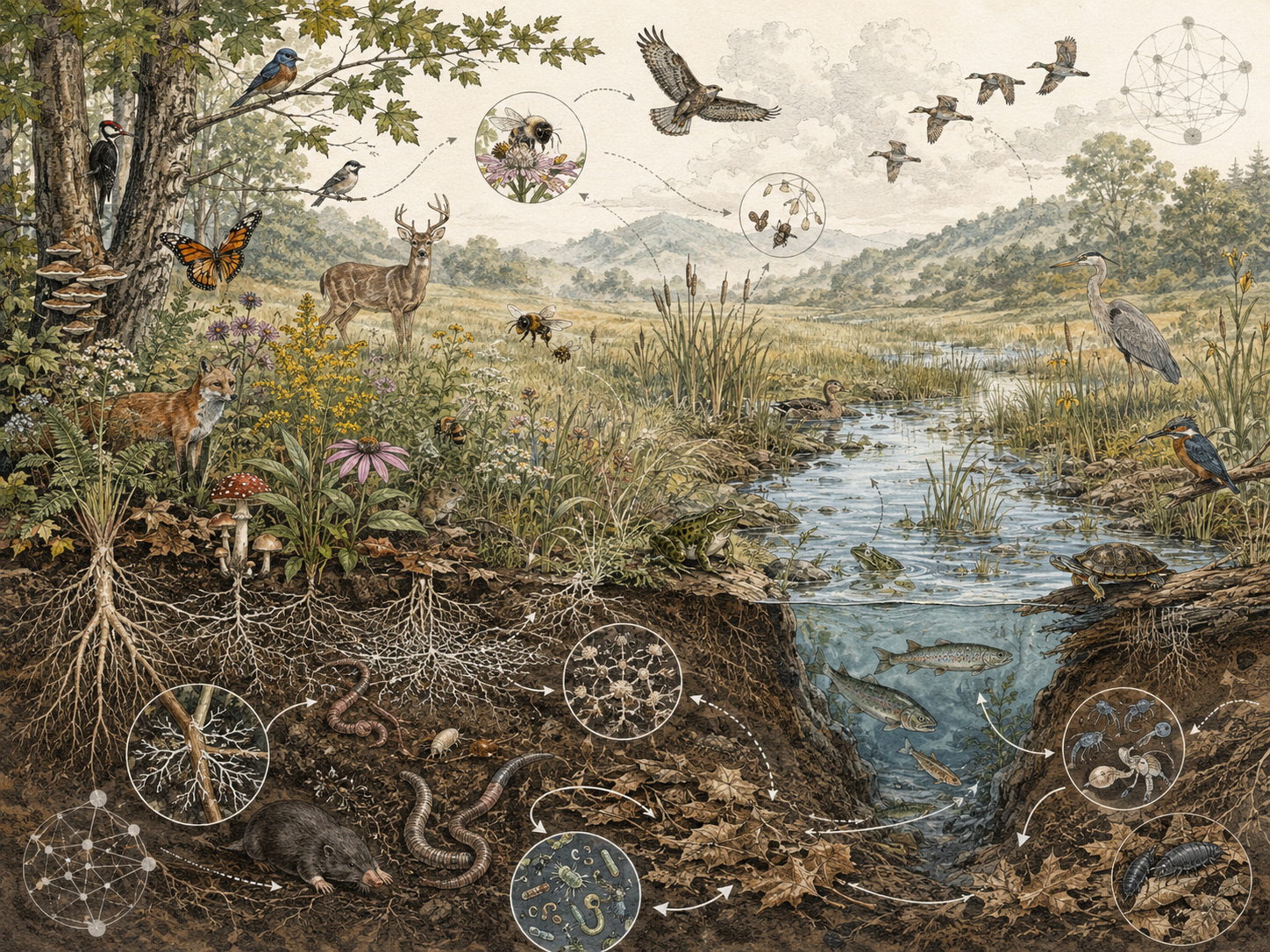
This article develops ecology as a relational and systems-oriented science of living interdependence. It examines niches, resources, competition, predation, mutualism, facilitation, food webs, energy flow, trophic organization, biogeochemical cycles, biodiversity, ecosystem function, disturbance, resilience, landscape ecology, marine systems, freshwater systems, soils, terrestrial systems, microbes, plants, animals, fungi, conservation biology, restoration ecology, disease ecology, and computational ecology.
The article is written for ecologists, marine biologists, freshwater scientists, medical and environmental-health readers, computational biology readers, biodiversity experts, restoration practitioners, conservation planners, soil biologists, agroecologists, foresters, disease ecologists, and research biologists who need a rigorous account of how living systems hold together through interaction, material dependence, and dynamic constraint.
The article also extends ecology into quantitative and computational biology through population-growth models, multi-species interaction models, ecosystem biomass balances, community-turnover matrices, ecological-condition screening, network metrics, R workflows, Python workflows, SQL provenance structures, and a linked full-stack GitHub repository containing Python, R, Julia, Fortran, Rust, Go, C, C++, SQL, notebooks, data files, and reproducibility documentation.
What ecology studies
Ecology is the study of the interrelationships of organisms with one another and with their environments. That definition remains valuable because it makes clear that ecology is not simply the study of “nature” in a loose scenic sense, nor only the study of habitat, nor only the study of populations. It is the study of life in relation. Organisms are always situated within thermal regimes, moisture gradients, nutrient limitations, predation pressures, competitive environments, symbiotic possibilities, pathogen exposures, disturbance histories, and material cycles that shape what forms of life are possible and what forms of persistence are fragile.
This matters because life is never merely internal. Organisms are shaped by temperature, water, nutrients, light, space, predators, competitors, pathogens, symbionts, and the wider systems of exchange in which they are embedded. Ecology therefore studies life in relation, not life abstracted from relation. The organism is still real, but its conditions of existence are irreducibly ecological.
Ecology also makes visible the fact that biological explanation changes with scale. A plant can be studied physiologically, genetically, behaviorally, evolutionarily, and ecologically. Ecology asks how that plant relates to light, soil, water, microbes, herbivores, pollinators, competitors, decomposers, climate, disturbance, and landscape position. An animal can be studied through anatomy, physiology, or behavior, but ecology asks how its survival and reproduction depend on food webs, habitat structure, population density, predation, disease, movement, and environmental variability.
For research biologists, this is one of ecology’s most enduring strengths. It does not replace physiology, genetics, behavior, microbiology, plant science, animal biology, or evolution. It provides the system of relations through which those fields become connected to one another in the living world.
Interdependence and the logic of ecological systems
Interdependence is one of ecology’s core realities. Ecosystems are not collections of separate organisms occupying the same place by accident. They are structured complexes of living organisms, physical conditions, and reciprocal influence. Organisms depend on one another directly and indirectly. Primary producers support consumers; decomposers return nutrients to circulation; predators regulate prey populations; pollinators support plant reproduction; soil communities sustain nutrient availability; fungi mediate exchange and decomposition; and physical conditions constrain all of the above. Interdependence therefore includes trophic relation, material exchange, habitat formation, shared vulnerability, and ecological feedback.
This matters because interdependence is not the same thing as balance or harmony. Ecological systems are full of asymmetry, conflict, competition, mortality, parasitism, invasion, exclusion, and destabilization. But even antagonistic systems remain interdependent. Predator and prey, parasite and host, competitor and competitor, plant and herbivore, pathogen and reservoir are all linked by reciprocal consequence. Ecology becomes scientifically powerful when it can describe those linkages without romanticizing them.
The concept of interdependence also helps explain why ecological disruption propagates. When one part of a system changes, the consequences often do not remain local. They move through trophic structure, habitat modification, nutrient pathways, dispersal networks, disease systems, hydrology, soil function, and patterns of resilience. A predator decline can release prey populations. A pollinator decline can reduce plant reproduction. A wetland loss can alter nutrient retention, flood buffering, fish nursery habitat, and disease exposure. A soil microbial shift can alter decomposition, nutrient availability, and plant productivity.
Ecology therefore treats living systems as relational systems. The central question is not only what organisms are present, but how their presence changes the possibilities of life for others.
Levels of ecological organization
Ecology works across multiple nested levels: organism, population, community, ecosystem, landscape, and biosphere. This hierarchy matters because no one level is sufficient. A population may decline because of physiology, predation, habitat fragmentation, disease, harvest, or nutrient change. A community may reorganize because one keystone interaction shifts. An ecosystem may change because biogeochemical cycling, hydrology, productivity, or disturbance regimes alter material flow. Ecology is therefore a multilevel science of organized relation.
The levels are conceptually distinct but causally entangled. Organisms experience environments through physiology and behavior. Populations translate those experiences into demographic change. Communities emerge through interaction among populations. Ecosystems add energy flow, decomposition, nutrient cycling, hydrology, and biophysical process. Landscapes add spatial arrangement, corridors, fragmentation, edges, and cross-site movement. The biosphere gathers these levels into a planetary whole.
For scientists, one of ecology’s great virtues is that it permits explanation to move across these levels without flattening them into one another. Not everything is explained at the scale of the gene, the individual, the species, or the biosphere alone. Ecology is strongest when it keeps the levels connected without pretending they are equivalent.
This multilevel structure also matters for applied work. A conservation plan may fail if it protects individuals but not populations, protects populations but not habitat connectivity, protects habitat patches but not ecosystem processes, or protects ecosystem processes while ignoring landscape-level change. Ecology teaches that persistence depends on relations across levels.
Niches, resources, and environmental relations
Species occupy ecological niches: ways of acquiring resources, tolerating conditions, and interacting with other species. A niche includes how a species uses resources and interacts within its community. Light, water, mineral nutrients, prey, shelter, breeding sites, thermal conditions, salinity, oxygen, substrate, host availability, and disturbance tolerance all shape persistence. Niches therefore link environmental constraint to evolutionary adaptation and community structure.
The niche concept remains important because it helps explain both coexistence and exclusion. When resource demands overlap strongly, competition intensifies. When species differ in timing, habitat use, diet, tolerance, rooting depth, host use, microhabitat, or behavior, coexistence becomes more likely. Niches are therefore not merely labels for “roles” in nature. They are ways of formalizing how organisms persist under conditions of limited possibility.
Niches also change with context. A species may occupy one niche under low competition and a narrower realized niche under strong competition. A plant may use different water sources across seasons. A fish may shift habitat across life stages. A disease vector may expand its effective niche under warming or land-use change. A microbial community may reorganize as oxygen or substrate availability changes.
For research biologists, niche thinking is especially powerful because it connects physiology, behavior, morphology, evolution, and environmental structure. It reveals that ecological position is not a static label but a dynamic outcome of traits, interactions, and context.
Competition, predation, mutualism, and community structure
Communities are structured through multiple interaction types, including competition, predation, parasitism, mutualism, facilitation, commensalism, herbivory, disease, and ecosystem engineering. Competition is a major organizing force where resource overlap is strong, but positive interactions and facilitation can be just as crucial, especially under stressful conditions. Interdependence is therefore not harmony alone. Organisms compete for limiting resources, prey on one another, and also support one another through pollination, shelter creation, microbiome assistance, nutrient exchange, stress buffering, or habitat formation.
This matters because ecology is strongest when it recognizes that communities are organized through mixtures of conflict and support rather than one dominant relationship type. Competition can shape exclusion, partitioning, and dominance. Predation can regulate abundance and maintain diversity. Mutualisms can create new ecological possibilities. Facilitation can make harsh environments more habitable and open pathways for succession. Parasitism and disease can regulate populations and restructure communities. Ecosystem engineers can alter the physical environment in ways that affect many other species.
The structure of communities depends not simply on which species are present, but on the architecture of their interactions. A community with the same number of species may behave differently depending on whether those species are linked by strong predation, weak competition, nested mutualism, redundant decomposer pathways, or a fragile dependence on one pollinator or foundation species. That is why interaction networks have become central to modern ecological reasoning.
For environmental-health and disease-ecology readers, this point is especially important. Community structure affects vectors, reservoirs, host competence, exposure pathways, and ecological buffering. A change in interaction structure can become a change in risk.
Food webs, energy flow, and trophic organization
Ecological interdependence is especially visible in food webs. When primary producers, herbivores, predators, parasites, scavengers, detritivores, and decomposers are linked together, a food web forms in which species interact directly and indirectly. Ecosystems depend on limited resources and trophic exchange among producers, consumers, and decomposers. Energy enters mainly through primary production, moves through trophic levels, and is continually transformed, dissipated, and partly re-routed through detrital pathways.
Food webs are therefore not decorative diagrams. They are one of the main ways ecology represents the dependence of living systems on organized energy flow. Their importance lies not only in showing “who eats whom,” but in revealing how top-down and bottom-up effects propagate, how indirect effects emerge, and how trophic structure constrains ecosystem function.
Classic trophic-dynamic ecology made clear that ecosystems could be studied through energy transfer and trophic relationships rather than only through species lists. Modern food-web ecology extends that insight through network structure, interaction strength, trophic cascades, omnivory, detrital pathways, body-size relationships, habitat coupling, and changing environmental conditions.
For research biologists, food webs remain central because they make interdependence measurable. Interaction strengths, trophic levels, network position, connectance, modularity, transfer efficiency, and indirect effects all become analyzable ecological variables.
Ecosystems, biogeochemical cycles, and material dependence
Ecology also concerns the cycling of matter through ecosystems. The ecosystem concept includes living organisms and their physical environment as one dynamic unit. Ecology at this level is not satisfied with species lists alone. It asks how carbon, nitrogen, phosphorus, water, oxygen, sulfur, minerals, and energy-relevant chemistry move through soils, waters, microbes, plants, animals, fungi, sediments, atmosphere, and ocean exchange.
This matters because interdependence is material as well as relational. The persistence of life depends on these cycles remaining sufficiently functional for growth, repair, reproduction, decomposition, buffering, and recovery. Organisms do not merely occupy space together. They participate in the exchange and transformation of matter that makes ecosystems viable.
This is one reason ecology and biogeochemistry cannot be cleanly separated. Material dependence is part of ecological explanation, not an external backdrop. Plants capture carbon and move water. Microbes transform nitrogen, sulfur, carbon, and phosphorus. Fungi decompose organic matter and mediate exchange. Animals redistribute nutrients through feeding, movement, excretion, and mortality. Rivers transport organic matter, sediments, and nutrients across landscapes. Oceans process carbon, oxygen, nutrients, and heat across enormous spatial scales.
Ecology therefore treats material flow as part of the living structure of ecosystems. The question is not only what organisms interact, but what matter and energy move through those interactions.
Biodiversity, complexity, and ecosystem function
Biodiversity and ecosystem function are closely linked. Biological systems are functionally complex, and that complexity is associated, often in partially hidden ways, with the diversity of their component species, traits, lineages, and interactions. Contemporary work on biodiversity and ecosystem functioning argues that biodiversity can influence productivity, nutrient cycling, stability, resilience, multifunctionality, invasion resistance, pollination, decomposition, and other ecological processes.
This matters because ecological systems are rarely reducible to one dominant species or one interaction. Diversity spreads functions across lineages, creates redundancy and complementarity, and supports resilience under shifting conditions. Different species may respond differently to drought, heat, disease, nutrient stress, flooding, grazing, or disturbance. That response diversity can stabilize ecosystem function when conditions fluctuate.
Biodiversity also shapes ecological complexity. More species do not automatically produce more stability in every context, and ecological theory has long debated complexity-stability relationships. But functional diversity, response diversity, trait complementarity, and interaction architecture all affect what systems can do and how they respond under pressure.
For scientists, biodiversity matters not only as an object of conservation, but as part of the causal architecture of ecosystem behavior. Diversity changes what systems can do.
Disturbance, resilience, and ecological change
Ecological systems are dynamic rather than fixed. Disturbance, succession, invasion, climate variability, nutrient change, disease, harvest, pollution, hydrological alteration, and species turnover all alter the structure of communities and ecosystems. Ecological phenomena are inherently complex, and systems respond differently depending on composition, interaction structure, material flows, disturbance history, spatial context, and environmental constraint.
This matters because interdependence does not imply static balance. Ecosystems may remain broadly stable while continuously changing internally. Resilience is therefore not the absence of change, but the capacity to absorb disturbance, reorganize, and retain core functions without total collapse or regime shift. That framing is especially important for ecologists, restoration scientists, conservation biologists, and environmental-health researchers working under accelerating environmental change.
Disturbance can also be necessary. Fire, flood pulses, storms, grazing, sediment movement, drought cycles, and insect outbreaks may maintain some systems when they occur within historical or functional ranges. Suppressing all disturbance can degrade some ecosystems, while intensifying disturbance beyond system capacity can push them into new states.
The mature ecological view is historical rather than static. Interdependence is real, but it is always unfolding through time.
Landscape ecology and the spatial organization of life
Ecology is spatial as well as biological. Landscape ecology studies the pattern and interaction among ecosystems within a region and how those interactions affect ecological processes. This perspective matters because organisms and ecosystems do not exist in isolation from surrounding mosaics of habitat, corridor, edge, matrix, fragmentation, and disturbance.
Interdependence often depends on movement across space: dispersal, migration, water flow, pollination, seed transport, fire spread, nutrient exchange, larval dispersal, floodplain connection, pathogen movement, and animal migration. Landscape ecology extends the idea of interdependence outward, showing that ecological function depends not only on what occurs within one site but on how sites relate spatially to one another.
Spatial structure changes ecological meaning. A habitat patch may support a population only if recolonization is possible. A wetland may matter not only as local habitat but as part of a watershed network. A riparian corridor may connect terrestrial and aquatic systems. A marine reserve may depend on larval connectivity. A forest fragment may lose species if it is too isolated from source populations.
For marine and freshwater systems, analogous logic applies through currents, river connectivity, floodplains, estuaries, deltas, shelf systems, and groundwater networks. Ecological space is never merely geometric. It is process-laden and relational.
Marine, freshwater, soil, and terrestrial interdependence
Interdependence takes distinct forms across marine, freshwater, soil, and terrestrial systems. Aquatic habitats integrate producers, grazers, predators, microbes, detritus, oxygen dynamics, and decomposers into tightly coupled webs. Soil systems organize microbial transformation, fungal exchange, root uptake, detrital decomposition, carbon stabilization, and nutrient availability. Terrestrial systems depend on plant structure, hydrology, herbivory, nutrient cycling, disturbance regimes, and climate. Marine systems depend on circulation, trophic coupling, oxygen conditions, carbonate chemistry, nutrient upwelling, and habitat structure.
This matters because ecology is not one generic template. Different media impose different constraints on movement, nutrient distribution, oxygen availability, light, temperature, salinity, pressure, signal transmission, and organismal life history. A river network is not spatially equivalent to a forest patch. A coral reef is not equivalent to a grassland. A soil microbial community is not equivalent to a plankton community. Each system has its own ecological medium.
Yet the principle of interdependence remains: organisms persist through structured relation to one another and to material conditions. Marine, freshwater, soil, and terrestrial ecology differ in mechanism, but they share a deeper systems logic. Life persists where relations among organisms, energy, matter, space, and disturbance remain viable.
For research biologists, this is a reminder that ecological theory gains explanatory power when it remains sensitive to realm, medium, and scale.
Microbes, plants, animals, and the relational biosphere
Ecology unites microbes, plants, fungi, and animals within one relational frame. The biosphere includes enormous diversity across these forms, and only a fraction has been studied thoroughly for ecological relationships. Microbes drive nutrient cycles, decomposition, disease systems, symbioses, and chemical transformations. Plants anchor much of terrestrial primary production, structure habitat, regulate water flux, and influence atmospheric exchange. Fungi mediate decomposition, nutrient exchange, root associations, and soil structure. Animals restructure food webs, pollination, seed dispersal, grazing, predation, nutrient movement, and ecosystem engineering.
Ecology is the science that shows how these distinct forms of life become one functioning world. A forest is not only trees. It is plants, fungi, microbes, animals, soils, water, carbon, nitrogen, disturbance, weather, herbivory, decomposition, pollination, disease, and regeneration. A reef is not only coral. It is symbiosis, carbonate chemistry, fish, algae, microbes, currents, light, grazing, recruitment, and disturbance. A soil is not merely substrate. It is a living matrix of organic matter, roots, minerals, microbial metabolism, fungal networks, moisture, and chemical exchange.
This matters because ecological thought prevents biology from fragmenting too completely into kingdoms or specialties. It shows that the biosphere is not merely a collection of taxa but a network of linked metabolic, trophic, spatial, and material processes.
For scientists working in specialized domains, ecology remains one of the principal ways to reconnect partial expertise to the whole living system.
Ecology, conservation, and systems-oriented biology
Ecology is foundational to conservation and systems-oriented biology because it clarifies the conditions under which systems remain viable. Habitat destruction, biodiversity loss, climate disruption, pollution, hydrologic change, soil degradation, invasive species, overexploitation, and nutrient imbalance are not isolated problems. They are disturbances to networks of interdependence. Ecology therefore provides one of the strongest scientific frames for understanding why long-horizon stewardship must be systemic rather than narrow or short-term.
This matters because conservation is not only about species presence. It is about interaction persistence, habitat structure, ecosystem function, landscape connectivity, population viability, and resilience under pressure. Restoration likewise depends on re-establishing relationships, not just replanting visible organisms. Disease ecology depends on host-reservoir-vector-environment structure. Agroecology depends on trophic regulation, soil function, pollination, hydrology, pest dynamics, and biodiversity. Forestry depends on regeneration, disturbance, succession, soil, water, carbon, and landscape mosaics.
Ecology is therefore not an optional add-on to applied biology. It is the framework that makes applied biological questions coherent. A species cannot be protected without understanding its habitat, interactions, population dynamics, and threats. A degraded ecosystem cannot be restored without understanding the processes that maintained it. A disease risk cannot be interpreted without understanding hosts, vectors, reservoirs, climate, and landscape change.
Applied biology becomes more rigorous when it becomes ecological.
Computational ecology and systems relevance
Modern ecology increasingly depends on network analysis, modeling, remote sensing, biodiversity data, environmental monitoring, spatial statistics, time-series analysis, and computational synthesis. Ecological complexity often exceeds what can be understood through intuition alone. Computational approaches help formalize food-web structure, landscape connectivity, biodiversity-function relations, population trajectories, ecosystem condition, disturbance response, disease spread, habitat suitability, and responses to environmental change.
This matters because modern ecology is not only descriptive. It is increasingly predictive, integrative, and systems-oriented. Interaction networks, long-term monitoring, trait datasets, eDNA, remote-sensing products, sensor networks, acoustic monitoring, camera traps, spatial rasters, and ecological time series all contribute to how ecologists reason about change, risk, and resilience.
Computational ecology also makes assumptions visible. A model can specify which processes are included, which are omitted, how uncertainty is handled, how sensitivity is tested, and how data are transformed. This transparency is especially important when ecological analysis supports conservation, restoration, fisheries, public health, or environmental risk decisions.
For computational readers and research biologists, ecology sits naturally alongside systems biology, Earth-system analysis, and reproducible data science. The living world is increasingly legible through ecological computation without becoming reducible to it.
Quantitative ecology: mathematics, R, and Python
Ecology is deeply quantitative because populations, interactions, networks, and material flows can often be represented mathematically. A simple population-growth model begins with:
N_{t+1}=rN_t
\]
Interpretation: \(N_t\) is population size at time \(t\), and \(r\) is the per-step growth multiplier. This is useful because persistence depends partly on whether populations replace themselves under ecological conditions.
Modern ecology moves well beyond that first-pass model. A more ecologically informative discrete-time interaction form can be written as:
N_{i,t+1}=N_{i,t}+r_iN_{i,t}\left(1-\frac{N_{i,t}}{K_i}\right)+\sum_j \alpha_{ij}N_{i,t}N_{j,t}
\]
Interpretation: \(N_{i,t}\) is the abundance of species \(i\) at time \(t\), \(r_i\) is intrinsic growth, \(K_i\) is carrying capacity, and \(\alpha_{ij}\) represents the effect of species \(j\) on species \(i\). This equation matters because it makes explicit that ecological dynamics are not only internal to a species. They are relational.
At the ecosystem level, a compact productivity-decomposition balance can be written as:
\frac{dB}{dt}=P-C-D+R
\]
Interpretation: \(B\) is a biomass or detrital pool, \(P\) is primary production, \(C\) is consumer removal, \(D\) is decomposition or other losses, and \(R\) is recovery or regrowth. This is not a complete ecosystem model, but it captures a central ecological truth: systems persist through coupled gains, losses, and transformations rather than through static presence.
Network ecology can also be represented mathematically. If \(A\) is an adjacency matrix where \(A_{ij}=1\) indicates an interaction from species \(i\) to species \(j\), connectance can be written as:
C=\frac{L}{S^2}
\]
Interpretation: \(L\) is the number of realized links and \(S\) is the number of species. Connectance is not a complete description of ecological structure, but it gives a compact way to compare how densely linked communities are.
Worked example: population continuity
Suppose a population begins at \(N_0=100\) and has \(r=1.1\). Then after one step:
N_1=1.1\times100=110
\]
Interpretation: Under the simplified model, the population grows because each time step multiplies abundance by a value greater than one.
If instead \(r=0.8\), then:
N_1=0.8\times100=80
\]
Interpretation: Under the simplified model, the population declines because each time step multiplies abundance by a value below one.
Ecology then asks what interaction or environmental conditions produce those different outcomes. That is where ecological modeling expands beyond arithmetic and into mechanism.
R and Python workflows
The following examples are compact article-level workflows. The full GitHub repository expands them into richer multi-language implementations with SQL provenance, validation notes, multi-species interaction simulations, disturbance scenarios, ecosystem biomass balances, community-turnover metrics, ecological-condition screening, network connectance, and reproducible computational ecology scaffolding.
R example: multi-species ecological dynamics with disturbance
# Multi-species ecological simulation in R
#
# This example includes:
# - producers, herbivores, carnivores, and a biomass or detrital pool
# - density dependence
# - trophic interaction terms
# - stochastic disturbance
# - a compact ecosystem-process proxy
#
# It is a transparent teaching scaffold, not a calibrated ecosystem model.

set.seed(42)

simulate_ecosystem <- function(
  time_steps = 150,
  producers_initial = 100,
  herbivores_initial = 30,
  carnivores_initial = 8,
  biomass_pool_initial = 60,
  producer_growth_rate = 0.10,
  producer_carrying_capacity = 250,
  producer_herbivore_attack = 0.0035,
  producer_to_herbivore_efficiency = 0.15,
  herbivore_carnivore_attack = 0.0020,
  herbivore_to_carnivore_efficiency = 0.10,
  herbivore_mortality = 0.04,
  carnivore_mortality = 0.03,
  biomass_loss_rate = 0.05,
  disturbance_probability = 0.04,
  disturbance_multiplier = 0.75
) {
  output <- data.frame(
    time = seq_len(time_steps),
    producers = NA_real_,
    herbivores = NA_real_,
    carnivores = NA_real_,
    biomass_pool = NA_real_
  )

  producers <- producers_initial
  herbivores <- herbivores_initial
  carnivores <- carnivores_initial
  biomass_pool <- biomass_pool_initial

  for (time_step in seq_len(time_steps)) {
    if (runif(1) < disturbance_probability) {
      producers <- producers * disturbance_multiplier
      herbivores <- herbivores * disturbance_multiplier
      biomass_pool <- biomass_pool * disturbance_multiplier
    }

    delta_producers <- producer_growth_rate * producers *
      (1 - producers / producer_carrying_capacity) -
      producer_herbivore_attack * producers * herbivores

    delta_herbivores <- producer_to_herbivore_efficiency *
      producer_herbivore_attack * producers * herbivores -
      herbivore_mortality * herbivores -
      herbivore_carnivore_attack * herbivores * carnivores

    delta_carnivores <- herbivore_to_carnivore_efficiency *
      herbivore_carnivore_attack * herbivores * carnivores -
      carnivore_mortality * carnivores

    delta_biomass_pool <- 0.18 * producers -
      0.07 * herbivores -
      0.05 * carnivores -
      biomass_loss_rate * biomass_pool +
      0.02 * (herbivores + carnivores)

    producers <- max(0, producers + delta_producers)
    herbivores <- max(0, herbivores + delta_herbivores)
    carnivores <- max(0, carnivores + delta_carnivores)
    biomass_pool <- max(0, biomass_pool + delta_biomass_pool)

    output[time_step, ] <- c(
      time_step,
      producers,
      herbivores,
      carnivores,
      biomass_pool
    )
  }

  output
}

results <- simulate_ecosystem()

matplot(
  results$time,
  results[, c("producers", "herbivores", "carnivores", "biomass_pool")],
  type = "l",
  lty = 1,
  lwd = 2,
  xlab = "Time",
  ylab = "State value",
  main = "Ecological Interdependence Through Time"
)

legend(
  "topright",
  legend = c("Producers", "Herbivores", "Carnivores", "Biomass pool"),
  lty = 1,
  lwd = 2,
  bty = "n"
)

print(summary(results))
This R workflow is more useful than a one-line growth projection because it links trophic structure, density dependence, disturbance, and a simple ecosystem-process pool in one reproducible model. A research biologist could adapt it for grasslands, forests, planktonic systems, restoration scenarios, disease-host systems, marine trophic shifts, or ecological reorganization under stress.
Python example: community turnover, network proxy, and ecosystem condition screening
import numpy as np
import pandas as pd
from scipy.spatial.distance import pdist, squareform
from sklearn.decomposition import PCA
from sklearn.preprocessing import StandardScaler

# Example site-by-species abundance matrix.
community = pd.DataFrame({
    "sp1": [15, 6, 1, 4, 9],
    "sp2": [9, 12, 4, 2, 5],
    "sp3": [1, 5, 10, 3, 2],
    "sp4": [4, 1, 8, 11, 7],
    "sp5": [3, 4, 7, 5, 8]
}, index=["site_A", "site_B", "site_C", "site_D", "site_E"])

# Relative abundance and Shannon diversity.
relative_abundance = community.div(community.sum(axis=1), axis=0)
safe_relative_abundance = relative_abundance.replace(0, np.nan)

shannon = -(
    safe_relative_abundance *
    np.log(safe_relative_abundance)
).sum(axis=1).fillna(0)

# Bray-Curtis turnover among sites.
bray_curtis = squareform(pdist(community.values, metric="braycurtis"))
bray_curtis_df = pd.DataFrame(
    bray_curtis,
    index=community.index,
    columns=community.index
)

# Site-level ecological variables.
environment = pd.DataFrame({
    "productivity": [0.84, 0.78, 0.62, 0.71, 0.75],
    "nutrient_retention": [0.80, 0.74, 0.58, 0.64, 0.70],
    "disturbance_pressure": [0.18, 0.27, 0.61, 0.44, 0.30],
    "connectivity": [0.86, 0.73, 0.41, 0.56, 0.68]
}, index=community.index)

# Simple ecosystem condition score.
condition = pd.DataFrame(index=community.index)
condition["shannon"] = shannon
condition["mean_turnover"] = bray_curtis_df.mean(axis=1)
condition["productivity"] = environment["productivity"]
condition["nutrient_retention"] = environment["nutrient_retention"]
condition["disturbance_pressure"] = environment["disturbance_pressure"]
condition["connectivity"] = environment["connectivity"]

condition["ecological_condition"] = (
    0.20 * (condition["shannon"] / condition["shannon"].max()) +
    0.20 * condition["productivity"] +
    0.20 * condition["nutrient_retention"] +
    0.15 * condition["connectivity"] -
    0.15 * condition["mean_turnover"] -
    0.20 * condition["disturbance_pressure"]
)

# Network proxy: potential trophic or interaction links among species.
interaction_matrix = pd.DataFrame(
    [
        [0, 1, 0, 0, 1],
        [0, 0, 1, 0, 1],
        [0, 0, 0, 1, 0],
        [1, 0, 0, 0, 0],
        [1, 1, 0, 0, 0]
    ],
    index=community.columns,
    columns=community.columns
)

species_count = interaction_matrix.shape[0]
link_count = interaction_matrix.to_numpy().sum()
connectance = link_count / (species_count ** 2)

# PCA ordination of multivariate ecological structure.
scaled = StandardScaler().fit_transform(condition)
pca = PCA(n_components=2)
scores = pca.fit_transform(scaled)

ordination = pd.DataFrame(
    scores,
    index=condition.index,
    columns=["PC1", "PC2"]
)

print("Community turnover matrix:")
print(bray_curtis_df.round(3))

print("\nEcological condition summary:")
print(condition.round(3))

print("\nInteraction connectance:")
print(round(connectance, 3))

print("\nOrdination scores:")
print(ordination.round(3))
This Python workflow is more useful because it combines community composition, turnover, environmental process variables, a simple ecological-condition score, and a network proxy in one extensible pipeline. It can be expanded with eDNA detections, trait data, remote sensing, soil chemistry, aquatic monitoring, disease-host observations, or restoration surveys. For computational ecologists and research biologists, that makes it closer to real ecological analysis than a simple scenario comparison alone.
Python example: disturbance-sensitive interaction-network summary
import numpy as np
import pandas as pd

species = ["producer_A", "producer_B", "herbivore_C", "predator_D", "decomposer_E"]

# Directed interaction matrix:
# 1 indicates an ecological link from row species to column species.
interaction_matrix = pd.DataFrame(
    [
        [0, 0, 1, 0, 1],
        [0, 0, 1, 0, 1],
        [0, 0, 0, 1, 1],
        [0, 0, 0, 0, 1],
        [1, 1, 0, 0, 0],
    ],
    index=species,
    columns=species,
)

S = interaction_matrix.shape[0]
L = int(interaction_matrix.to_numpy().sum())
connectance = L / (S ** 2)

degree_summary = pd.DataFrame(
    {
        "out_degree": interaction_matrix.sum(axis=1),
        "in_degree": interaction_matrix.sum(axis=0),
    }
)

# Example disturbance sensitivity score by species.
disturbance_sensitivity = pd.Series(
    {
        "producer_A": 0.35,
        "producer_B": 0.45,
        "herbivore_C": 0.55,
        "predator_D": 0.70,
        "decomposer_E": 0.30,
    }
)

degree_summary["disturbance_sensitivity"] = disturbance_sensitivity
degree_summary["network_vulnerability_proxy"] = (
    degree_summary["out_degree"] + degree_summary["in_degree"]
) * degree_summary["disturbance_sensitivity"]

print("Connectance:", round(connectance, 3))
print(degree_summary.round(3).to_string())
This compact network scaffold is useful because it treats ecological interaction structure as measurable rather than merely descriptive. A fuller workflow could add weighted links, trophic guilds, mutualistic networks, pathogen transmission pathways, temporal interaction strength, uncertainty, and sensitivity analysis under climate or disturbance scenarios.
These examples are still compact enough to fit inside an article, but they move toward the kinds of workflows scientists actually use: interaction structure, turnover matrices, disturbance-sensitive simulations, multivariate screening, network summaries, and reproducible ecological computation.
GitHub repository
The article body includes compact R and Python examples so the ecological and scientific argument remains readable. The full repository expands those examples into a broader computational ecology workflow, including multi-species interaction simulations, disturbance scenarios, ecosystem biomass balances, community-turnover metrics, ecological-condition screening, network connectance, SQL provenance structures, reproducible data files, and full-stack scientific-computing examples across Python, R, Julia, Fortran, Rust, Go, C, C++, SQL, and notebooks.
The full code distribution for this article, including selected article examples, expanded computational workflows, reproducible data structures, provenance documentation, and full-stack scientific-computing scaffolding, is available on GitHub.
Limits, complexity, and modern ecological thinking
Ecology is foundational, but it should not be simplified into static balance-of-nature language. Ecological phenomena are inherently complex, and modern ecological theory increasingly treats ecosystems as dynamic networks of interaction, heterogeneity, feedback, and change.
This matters because interdependence is real without implying permanence, harmony, or predictability. Some interactions are stabilizing, some destabilizing, some contingent on stress or scale. Some systems recover after disturbance; others reorganize. Some relationships persist for long periods; others shift under climate change, invasion, land use, hydrological alteration, nutrient loading, or disease pressure.
The mature use of ecological models therefore requires humility. They reveal structure, compare scenarios, and support judgment, but they do not replace the living systems from which they are built. A model can clarify how interaction, turnover, disturbance, or connectivity may matter, but it cannot remove the need for field observation, natural history, experimental evidence, monitoring, and ecological interpretation.
Modern ecology is strongest when it treats ecosystems as historically formed, spatially structured, materially constrained, and continuously changing systems of relation.
Why this matters for scientific work
Ecology and the interdependence of life matter across conservation biology, restoration ecology, agroecology, forestry, fisheries, freshwater biology, marine biology, soil ecology, disease ecology, environmental health, climate adaptation, biodiversity science, and Earth-system analysis because all of these fields depend on how organisms relate to one another and to environmental conditions. For ecologists, the value is obvious: ecology provides the central grammar of population, community, ecosystem, and landscape explanation. For marine biologists, it clarifies how circulation, trophic coupling, reef structure, plankton, oxygen, carbonate chemistry, and fisheries interact. For freshwater scientists, it shows why flow, habitat, oxygen, nutrients, riparian systems, and biological communities cannot be separated.
For medical and environmental-health readers, ecology explains how disease risk, exposure pathways, vector systems, water quality, harmful blooms, food webs, and environmental buffering depend on ecological relations. For computational readers, ecology supplies a domain where networks, time series, spatial models, statistical inference, simulation, and reproducible workflows become biologically meaningful. For research biologists more broadly, ecology reconnects specialized work to the living systems in which it matters.
Ecology is therefore one of biology’s main frameworks for long-horizon responsibility. It shows that life persists not as isolated organisms, but as systems of relation whose structure, resilience, and vulnerability must be understood together.
Conclusion
Ecology and the interdependence of life show that organisms persist through relation rather than isolation. Populations, communities, ecosystems, landscapes, and the biosphere are structured by interaction, energy flow, nutrient cycling, environmental constraint, spatial organization, disturbance, and the continuous coupling of living and nonliving systems.
To understand ecology is therefore to understand one of biology’s deepest organizing principles: life continues through networks of dependence, exchange, competition, facilitation, mortality, recovery, and material circulation. That is why ecology remains central not only to biology itself, but also to conservation, restoration, sustainable development, environmental health, climate adaptation, and the practical management of the biosphere.
Ecology is thus more than the study of organisms in place. It is one of the principal ways biology explains how life holds together at all. It is the science of relation, persistence, transformation, and consequence in the living world.
Related articles
- Biology
- Population Dynamics and Ecological Modeling
- Populations, Communities, and Ecosystem Dynamics
- Biodiversity and the Structure of Living Systems
- Biomes, Habitats, and the Geography of Life
- Biogeochemical Cycles and the Conditions of Habitability
- The Biosphere and Planetary Life Support Systems
- Plant Biology and the Life of Primary Producers
- Microbiology and the Hidden Majority of Life
- Fungi and the Networks of Decomposition and Exchange
- Behavior, Communication, and Biological Strategy
- Coevolution, Symbiosis, and the Dynamics of Mutual Change
- Conservation Biology and the Protection of Life
- Restoration Ecology and the Repair of Living Systems
Further reading
- National Research Council (1989) ‘Ecology and ecosystems’, in Opportunities in Biology. Washington, DC: National Academies Press. Available at: https://www.ncbi.nlm.nih.gov/books/NBK217802/
- OpenStax (2018) Biology 2e: Community Ecology. Available at: https://openstax.org/books/biology-2e/pages/45-6-community-ecology
- OpenStax (2018) Biology 2e: Ecology of Ecosystems. Available at: https://openstax.org/books/biology-2e/pages/46-1-ecology-of-ecosystems
- Nature Education (n.d.) Principles of Landscape Ecology. Available at: https://www.nature.com/scitable/knowledge/library/principles-of-landscape-ecology-13260702/
- Nature Education (n.d.) Spatial Ecology and Conservation. Available at: https://www.nature.com/scitable/knowledge/library/spatial-ecology-and-conservation-13900969/
- Lindeman, R.L. (1942) ‘The trophic-dynamic aspect of ecology’, Ecology, 23(4), pp. 399–417. Available at: https://doi.org/10.2307/1930126
- Paine, R.T. (1966) ‘Food web complexity and species diversity’, American Naturalist, 100(910), pp. 65–75. Available at: https://doi.org/10.1086/282400
- Holling, C.S. (1973) ‘Resilience and stability of ecological systems’, Annual Review of Ecology and Systematics, 4, pp. 1–23. Available at: https://doi.org/10.1146/annurev.es.04.110173.000245
- Levin, S.A. (1992) ‘The problem of pattern and scale in ecology’, Ecology, 73(6), pp. 1943–1967. Available at: https://doi.org/10.2307/1941447
- Loreau, M. et al. (2001) ‘Biodiversity and ecosystem functioning: Current knowledge and future challenges’, Science, 294(5543), pp. 804–808. Available at: https://doi.org/10.1126/science.1064088
- Hooper, D.U. et al. (2005) ‘Effects of biodiversity on ecosystem functioning: A consensus of current knowledge’, Ecological Monographs, 75(1), pp. 3–35. Available at: https://doi.org/10.1890/04-0922
- Millennium Ecosystem Assessment (2005) Ecosystems and Human Well-being: Synthesis. Washington, DC: Island Press. Available at: https://www.millenniumassessment.org/documents/document.356.aspx.pdf
- IPBES (2019) Global Assessment Report on Biodiversity and Ecosystem Services. Available at: https://www.ipbes.net/global-assessment
References
- Holling, C.S. (1973) ‘Resilience and stability of ecological systems’, Annual Review of Ecology and Systematics, 4, pp. 1–23. Available at: https://doi.org/10.1146/annurev.es.04.110173.000245
- Hooper, D.U., Chapin, F.S., Ewel, J.J., Hector, A., Inchausti, P., Lavorel, S., Lawton, J.H., Lodge, D.M., Loreau, M., Naeem, S., Schmid, B., Setälä, H., Symstad, A.J., Vandermeer, J. and Wardle, D.A. (2005) ‘Effects of biodiversity on ecosystem functioning: A consensus of current knowledge’, Ecological Monographs, 75(1), pp. 3–35. Available at: https://doi.org/10.1890/04-0922
- Hutchinson, G.E. (1957) ‘Concluding remarks’, Cold Spring Harbor Symposia on Quantitative Biology, 22, pp. 415–427. Available at: https://symposium.cshlp.org/content/22/415
- Intergovernmental Science-Policy Platform on Biodiversity and Ecosystem Services (2019) Global Assessment Report on Biodiversity and Ecosystem Services. Available at: https://www.ipbes.net/global-assessment
- Intergovernmental Science-Policy Platform on Biodiversity and Ecosystem Services (2019) Summary for Policymakers of the Global Assessment Report on Biodiversity and Ecosystem Services. Available at: https://files.ipbes.net/ipbes-web-prod-public-files/inline/files/ipbes_global_assessment_report_summary_for_policymakers.pdf
- Levin, S.A. (1992) ‘The problem of pattern and scale in ecology’, Ecology, 73(6), pp. 1943–1967. Available at: https://doi.org/10.2307/1941447
- Lindeman, R.L. (1942) ‘The trophic-dynamic aspect of ecology’, Ecology, 23(4), pp. 399–417. Available at: https://doi.org/10.2307/1930126
- Loreau, M., Naeem, S., Inchausti, P., Bengtsson, J., Grime, J.P., Hector, A., Hooper, D.U., Huston, M.A., Raffaelli, D., Schmid, B., Tilman, D. and Wardle, D.A. (2001) ‘Biodiversity and ecosystem functioning: Current knowledge and future challenges’, Science, 294(5543), pp. 804–808. Available at: https://doi.org/10.1126/science.1064088
- Millennium Ecosystem Assessment (2005) Ecosystems and Human Well-being: Synthesis. Washington, DC: Island Press. Available at: https://www.millenniumassessment.org/documents/document.356.aspx.pdf
- National Research Council (1989) ‘Ecology and ecosystems’, in Opportunities in Biology. Washington, DC: National Academies Press. Available at: https://www.ncbi.nlm.nih.gov/books/NBK217802/
- Nature Education (n.d.) Principles of Landscape Ecology. Available at: https://www.nature.com/scitable/knowledge/library/principles-of-landscape-ecology-13260702/
- Nature Education (n.d.) Spatial Ecology and Conservation. Available at: https://www.nature.com/scitable/knowledge/library/spatial-ecology-and-conservation-13900969/
- Odum, E.P. (1969) ‘The strategy of ecosystem development’, Science, 164(3877), pp. 262–270. Available at: https://doi.org/10.1126/science.164.3877.262
- OpenStax (2018) Biology 2e: Community Ecology. Available at: https://openstax.org/books/biology-2e/pages/45-6-community-ecology
- OpenStax (2018) Biology 2e: Ecology of Ecosystems. Available at: https://openstax.org/books/biology-2e/pages/46-1-ecology-of-ecosystems
- Paine, R.T. (1966) ‘Food web complexity and species diversity’, American Naturalist, 100(910), pp. 65–75. Available at: https://doi.org/10.1086/282400