
Last Updated May 8, 2026
Planetary boundaries are critical biophysical limits and threshold zones that help define a safe operating space for humanity within the Earth system. First introduced in 2009 by Johan Rockström and colleagues, the framework identifies the major planetary processes that regulate long-term stability, resilience, and habitability, and asks whether human activity is pushing those processes into increasingly dangerous territory. Its central claim is simple but profound: human societies do not exist outside nature or above it. They exist within an Earth system whose large-scale regulatory processes make organized civilization possible in the first place.
The importance of the framework lies in how it reframes environmental thought. Instead of treating ecological problems as isolated issues such as climate change, pollution, deforestation, biodiversity loss, water stress, or chemical contamination, planetary boundaries place them within a common systems perspective. The question is no longer only whether environmental harm is occurring. It is whether cumulative human pressures are destabilizing the planetary conditions under which societies can develop, endure, and adapt. In that sense, planetary boundaries are not just environmental indicators. They are a model of systemic risk, a precautionary architecture for governance, and a way of thinking about the material conditions of civilizational continuity.
Main Library
Publications
Article Map
Planetary Boundaries
Related Topic
Sustainable Development
Related Topic
Risk & Resilience
Related Topic
Environmental Science
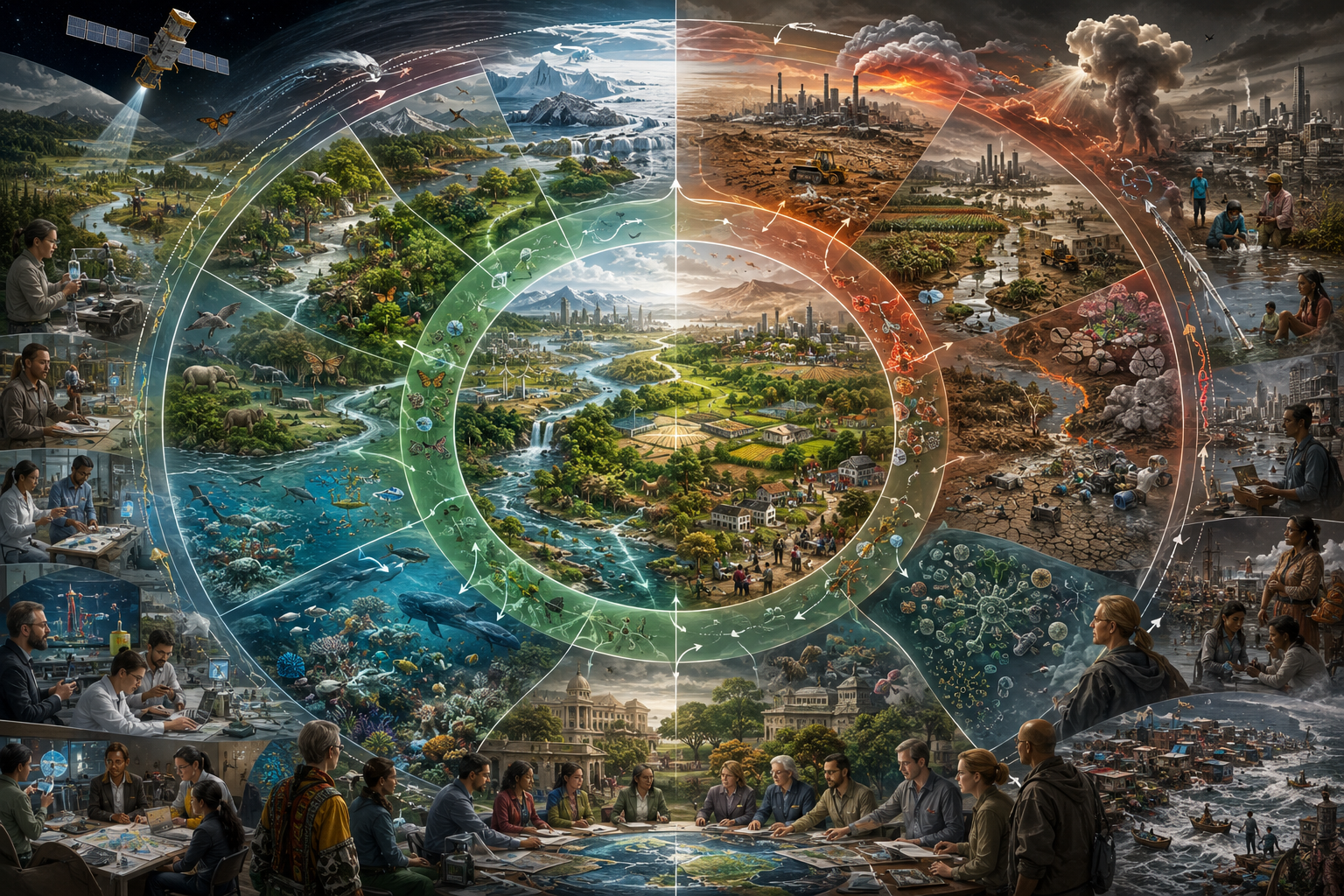
The framework also matters because it changes the unit of analysis. Climate change, biosphere integrity, freshwater change, land-system change, biogeochemical flows, ocean acidification, stratospheric ozone depletion, atmospheric aerosol loading, and novel entities are not merely separate environmental issues. They are interacting Earth-system processes. Pressure in one domain can amplify pressure in others. Land conversion weakens carbon storage and hydrological cycling. Climate change stresses ecosystems and water systems. Nutrient overload damages rivers, lakes, and coastal zones. Novel entities can accumulate faster than monitoring and governance systems can assess them. The framework therefore treats sustainability as a problem of Earth-system resilience rather than a list of disconnected environmental harms.
This article introduces the planetary boundaries framework as an Earth-system concept, a precautionary governance tool, and a foundational way of understanding limits in the twenty-first century. It explains where the idea came from, what the nine boundaries are, why they matter, how safe operating space should be interpreted, why boundaries are risk zones rather than hard walls, why justice must be central to boundary governance, and why the framework has become influential across sustainability science, governance, development, business strategy, finance, infrastructure planning, and long-horizon systems analysis.
The Basic Idea
The basic idea behind planetary boundaries is that the Earth system contains large-scale processes that must remain within certain ranges if humanity is to avoid destabilizing planetary conditions. These processes include climate regulation, biosphere integrity, land systems, freshwater, nutrient cycles, ocean chemistry, atmospheric composition, and emerging pressures from novel human-made substances. The framework does not claim that every boundary is perfectly known or that the Earth behaves like a machine with fixed engineering tolerances. Rather, it identifies scientifically informed zones of increasing risk. Crossing a boundary does not mean instant collapse, but it does mean that the likelihood of large-scale, nonlinear, or difficult-to-reverse change rises.
This matters because modern societies expanded under relatively stable Holocene conditions. Agriculture, large settlements, trade networks, political institutions, legal systems, religious institutions, and eventually industrial civilization all developed within an unusually favorable Earth-system context. The planetary boundaries framework therefore asks whether humanity is now undermining the very conditions that allowed complex societies to emerge. It is, in effect, a framework for thinking about civilizational viability under conditions of planetary stress.
The framework’s core contribution is not simply that it says “limits exist.” Many environmental traditions had already recognized ecological limits. Its deeper contribution is that it identifies specific Earth-system processes whose destabilization can alter planetary resilience. It connects limits to thresholds, feedbacks, nonlinear dynamics, safe operating space, and the possibility that human pressures can move the planet into less stable states.
That is why planetary boundaries should be understood as a systems framework rather than a moral slogan. They do not say that all human activity is destructive, or that development must stop. They say that development must remain compatible with the Earth-system processes that make development possible. Climate stability, biosphere integrity, freshwater circulation, land-system function, nutrient cycling, ocean chemistry, atmospheric protection, and chemical safety are not optional environmental amenities. They are conditions of organized life.
Read alongside Safe Operating Space and the Logic of Thresholds and Planetary Boundaries and Earth System Resilience, this opening idea becomes more than a definition. It becomes a theory of constrained human possibility on a finite planet.
Where the Framework Came From
The framework emerged from Earth-system science, resilience thinking, global change research, and growing concern that human activity had become powerful enough to alter planetary functioning itself. The original 2009 formulation identified a set of critical Earth-system processes and proposed that humanity should remain within a safe operating space defined by planetary boundaries. The point was not to predict apocalypse with precision. It was to introduce a precautionary, systems-based way of recognizing danger before large-scale destabilization became unmistakable.
The 2009 papers were significant because they translated a broad scientific insight into a usable conceptual architecture. The atmosphere, oceans, cryosphere, biosphere, freshwater systems, soils, and land surface were increasingly understood as interacting components of one Earth system. Human activity was no longer merely degrading local environments. It was altering the flows of carbon, nitrogen, phosphorus, water, heat, biomass, chemicals, and atmospheric particles at planetary scale.
The 2015 update refined the framework substantially. It strengthened the conceptual architecture, clarified the differentiation among boundaries, and emphasized two core boundaries in particular: climate change and biosphere integrity. These were treated as especially significant because major disruption in either could drive the Earth system toward a different and less hospitable state.
The 2023 global assessment advanced the framework further by quantifying all nine boundaries together and concluding that six of the nine had been transgressed. The 2025 Planetary Health Check reports that seven of the nine are now breached, with ocean acidification newly crossing the boundary in the current framing. This progression underscores that the framework is not a static theory but an evolving scientific effort to track worsening planetary risk. For the dedicated history, see The Origins of the Planetary Boundaries Framework.
The framework also emerged from a shift in how scientists and institutions understood the human place in nature. Earlier environmental debates often focused on conservation, pollution control, local resource management, or particular endangered ecosystems. Those remain essential. But planetary-boundary science added a larger question: what happens when human systems become powerful enough to alter the regulatory architecture of the planet itself?
That question is now central to sustainability, development, infrastructure, governance, finance, and long-term strategy. The planetary boundaries framework became influential because it gave scientists, policymakers, institutions, and analysts a shared language for discussing ecological limits without reducing them to a single issue or single metric.
The Nine Planetary Boundaries
The framework identifies nine planetary boundaries, each corresponding to a critical Earth-system process. Together they form an integrated picture of planetary stability rather than a set of unrelated environmental problems. Each boundary can be studied individually, but the deeper power of the framework lies in how it reveals interaction, co-dependence, and cascading risk across the Earth system.
1. Climate Change
This boundary concerns the stability of the climate system, especially atmospheric carbon dioxide concentration and radiative forcing. Climate change matters not only because it warms the planet, but because it influences water cycles, ecosystems, food systems, ice sheets, ocean circulation, sea-level rise, extreme events, infrastructure exposure, and human security. It is one of the framework’s two core boundaries because severe climate disruption can help push the Earth system toward a new state. See Climate Change as a Planetary Boundary.
2. Biosphere Integrity
This boundary emphasizes the integrity of the biosphere, including genetic diversity and functional integrity. It reflects the fact that living systems do not merely inhabit the planet. They help regulate and stabilize it. Forests store carbon and recycle moisture. Wetlands regulate water and nutrients. Soil organisms support fertility and decomposition. Marine ecosystems shape carbon pathways and food webs. Pollinators, seed dispersers, predators, microbes, and plant communities sustain ecological function. See Biosphere Integrity and the Stability of Life Systems.
3. Land-System Change
This boundary tracks large-scale transformations of forests, grasslands, wetlands, and other land systems, especially through agriculture, extraction, infrastructure, and urbanization. Land change matters because it affects habitats, carbon storage, regional climates, evapotranspiration, soil stability, biodiversity, and hydrological cycles. It is also closely tied to food systems, Indigenous land rights, commodity supply chains, and climate mitigation. See Land-System Change and Ecological Transformation.
4. Freshwater Change
Freshwater change includes both blue water, such as rivers, lakes, and groundwater, and green water, such as soil moisture available to plants. This reflects the deeper recognition that water is a planetary process as well as a local resource. Freshwater systems regulate ecosystems, agriculture, forests, soils, food security, regional climate feedbacks, and human settlements. See Freshwater Change and Earth System Risk.
5. Biogeochemical Flows
This boundary concerns the nitrogen and phosphorus cycles, which humans have radically altered through fertilizer use, industrial agriculture, manure management, mining, wastewater, and combustion. Excess nutrient flows degrade terrestrial, freshwater, and marine systems, contributing to eutrophication, harmful algal blooms, oxygen depletion, soil imbalance, biodiversity loss, and coastal dead zones. See Biogeochemical Flows: Nitrogen, Phosphorus, and Planetary Destabilization.
6. Ocean Acidification
Ocean acidification results from carbon dioxide being absorbed by the oceans, changing seawater carbonate chemistry and threatening coral systems, shell-forming organisms, plankton, food webs, fisheries, and marine carbon pathways. It shows that carbon emissions reshape the planet far beyond atmospheric warming alone. The 2025 Planetary Health Check identifies ocean acidification as the seventh boundary now breached. See Ocean Acidification and the Chemistry of Planetary Change.
7. Stratospheric Ozone Depletion
This boundary concerns the concentration of ozone in the stratosphere, which protects life from harmful ultraviolet radiation. It is often cited as evidence that coordinated international governance can reduce planetary risk. The Montreal Protocol and subsequent amendments demonstrate that scientific warning, treaty design, industrial substitution, and global cooperation can help reverse a major Earth-system threat. See Stratospheric Ozone Depletion and Global Environmental Governance.
8. Atmospheric Aerosol Loading
Aerosols affect cloud formation, monsoon systems, regional climates, air quality, public health, and radiation balance. This boundary is more difficult to quantify globally because aerosol impacts are often uneven across regions, but it remains important within the overall framework. Aerosol loading illustrates why some planetary-boundary processes require regional interpretation as well as global framing. See Atmospheric Aerosol Loading and Regional Planetary Risk.
9. Novel Entities
This boundary includes synthetic chemicals, plastics, radioactive materials, engineered materials, persistent pollutants, and other human-created substances or modified agents whose planetary effects can exceed the capacity of societies to assess and govern them safely. It captures a central reality of industrial modernity: technological production is accelerating faster than planetary stewardship. See Novel Entities and the Problem of Synthetic Overload.
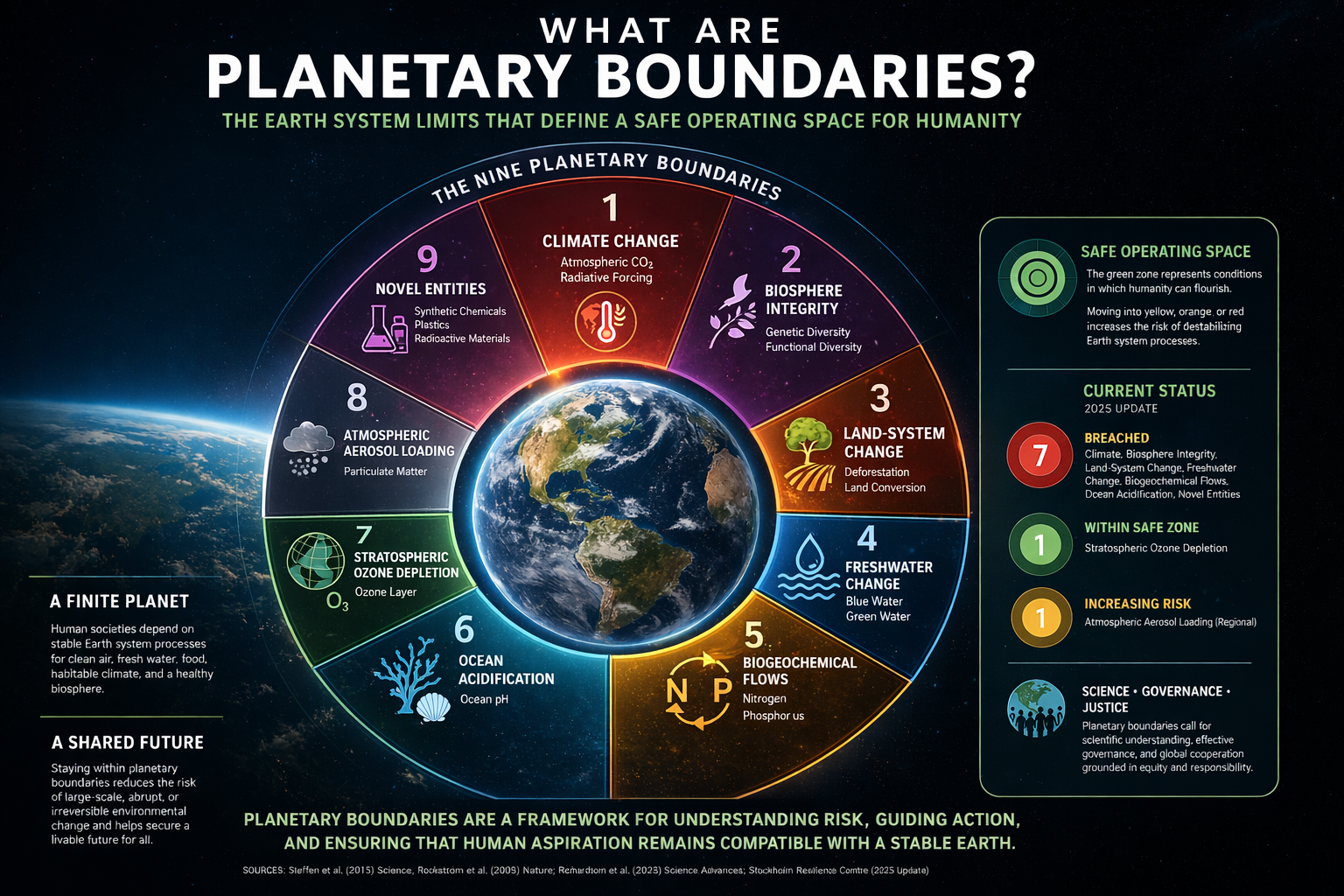
Read together, these nine boundaries demonstrate that planetary instability is not reducible to a single metric. The framework maps a field of interdependent stresses that together shape the conditions of life, governance, infrastructure, and development.
What Safe Operating Space Means
The phrase safe operating space is one of the framework’s most important contributions. It does not mean that the Earth is ever risk-free, nor that exact universal thresholds can always be identified with certainty. Instead, it refers to a zone within which humanity is more likely to avoid triggering destabilizing Earth-system change. The framework is precautionary by design. It tries to mark out a margin of safety before tipping dynamics, cascading effects, or irreversible degradation become more likely.
This is why planetary boundaries should be understood as boundary zones rather than simple on-off switches. They are closer to risk thresholds than to rigid walls. The closer human societies move toward or beyond them, the greater the danger that important Earth-system processes will shift into less stable and less hospitable states.
Safe operating space also has a useful engineering analogy. Engineers do not normally design bridges, aircraft, power grids, or medical systems to operate continuously at the edge of failure. They use safety margins, redundancy, monitoring, stress testing, and early-warning systems because uncertainty, fatigue, interaction, and extreme conditions matter. The planetary boundaries framework applies a similar logic to Earth-system governance, though the system is far larger, more complex, and more ethically consequential.
The concept is also useful because it separates prudence from fatalism. A boundary is not a declaration that collapse has already occurred. It is a warning that risk is increasing and that corrective action should begin before the system moves closer to dangerous thresholds. Safe operating space is therefore a governance concept as well as a scientific one. It asks institutions to preserve buffers, reduce pressure, monitor feedbacks, and act before damage becomes irreversible.
For deeper treatment, see Safe Operating Space and the Logic of Thresholds and Tipping Points, Feedback Loops, and Cascading Ecological Change. These pieces help extend the concept from abstract caution to concrete Earth-system dynamics.
Why Boundaries Are Not Hard Walls
A common misunderstanding is that planetary boundaries identify precise universal cut-off points beyond which collapse automatically occurs. The literature is more careful than that. The framework recognizes uncertainty, regional variation, proxy measurement problems, lag effects, and the complexity of feedbacks within Earth systems. Boundaries are proposed as scientifically informed guides to escalating danger, not as perfectly fixed lines in nature.
This is also why the framework has remained influential despite criticism. Its value lies less in the illusion of perfect quantification than in its ability to organize scientific knowledge into a coherent architecture of planetary risk. Planetary boundaries matter not because they eliminate uncertainty, but because they help societies think more seriously under conditions of uncertainty.
The distinction between a boundary and a threshold is important. A threshold may refer to a point at which a system shifts state. A boundary is often placed before such a threshold as a precautionary limit. In that sense, a planetary boundary is not necessarily the cliff edge. It is a warning line designed to keep societies away from the cliff edge when the exact location of that edge is uncertain.
This matters for public interpretation. If boundaries are treated as hard walls, people may assume that nothing matters until the boundary is crossed, or that nothing can be done after it is crossed. Both interpretations are wrong. Risk increases across zones. Corrective action matters before, near, and beyond boundary transgression. The framework is most useful when it is read as a map of rising risk, shrinking buffer, and urgent responsibility.
For a dedicated examination of these issues, see How Planetary Boundaries Are Measured and Uncertainty, Precaution, and Scientific Debate in Boundary Setting.
Why the Framework Matters
The planetary boundaries framework matters because it changes how environmental risk is understood. Instead of addressing climate, biodiversity, water, soils, oceans, chemicals, and land separately, it shows that these pressures interact within a single Earth system. Climate change worsens biodiversity loss. Land-system change affects water and carbon cycles. Nutrient overload damages freshwater and coastal ecosystems. Novel entities can compound other forms of instability. The framework therefore opposes siloed thinking and encourages a systems view of risk.
It also matters because it reconnects development to planetary conditions. Economic growth, infrastructure, food systems, energy systems, public health, trade, finance, and political stability all depend on a functioning biosphere and relatively stable Earth-system processes. Planetary boundaries therefore challenge the assumption that development can be understood apart from biophysical limits. They do not deny the legitimacy of human development. They insist that development must remain compatible with the ecological conditions that make it possible.
The framework also matters because it helps make cumulative risk visible. Many environmental harms become most dangerous not as isolated shocks but as accumulated pressures. Carbon dioxide accumulates in the atmosphere-ocean-land system. Nitrogen and phosphorus accumulate in soils and waterways. Synthetic chemicals accumulate across supply chains and ecosystems. Land conversion fragments habitats over time. Biodiversity loss reduces resilience gradually before visible collapse. Planetary boundaries provide a language for understanding these slow-moving systemic risks before they become impossible to ignore.
This is why the framework now shapes conversations across sustainability science, strategic foresight, public policy, ecological economics, Earth-system governance, risk disclosure, infrastructure planning, and long-range strategy. It is not only an environmental model. It is an interpretive framework for understanding how planetary instability enters institutions, markets, infrastructures, and futures thinking.
The framework also matters because it clarifies the stakes of governance failure. When institutions ignore planetary boundaries, they are not simply failing to protect nature in an abstract sense. They are increasing risk to food systems, water security, public health, infrastructure, insurance, migration, livelihoods, social stability, and future generations. Boundary transgression is not only ecological. It becomes social, economic, political, and moral.
To follow this thread further, see Sustainable Development Goals Within Planetary Boundaries, Earth System Governance in an Age of Limits, Business Strategy Within Planetary Boundaries, and Finance, Disclosure, and Systemic Environmental Risk.
Current Status of the Boundaries
According to the 2023 global assessment published in Science Advances, six of the nine planetary boundaries were transgressed: climate change, biosphere integrity, land-system change, freshwater change, biogeochemical flows, and novel entities. The same assessment described aerosol loading as a significant regional issue, ocean acidification as close to being breached, and stratospheric ozone depletion as remaining within the safe zone after partial recovery.
The 2025 Planetary Health Check reports that seven of the nine boundaries are now breached, with ocean acidification newly crossing the boundary. That means only stratospheric ozone depletion and atmospheric aerosol loading remain unbreached in the current global framing, although aerosol loading still presents serious regional risk and governance significance.
The importance of this status update is not merely numerical. It indicates that the framework’s central warning is becoming harder to dismiss: humanity is not simply generating isolated environmental harms, but moving deeper into a condition of systemic planetary destabilization. The pattern also shows why cross-boundary interaction matters. The more boundaries are transgressed at once, the more likely it becomes that Earth-system resilience will be weakened by compounding pressures.
The status of the boundaries should not be read as fatalism. Boundary transgression means that risk has risen and corrective action is urgent. It does not mean all outcomes are predetermined. The level of future risk still depends on decisions about energy, land use, food systems, chemicals, water governance, restoration, infrastructure, finance, and institutional accountability.
| Boundary process | Current interpretation | Why it matters |
|---|---|---|
| Climate change | Transgressed | Destabilizes temperature, hydrology, extremes, sea level, food systems, infrastructure, and ecosystem function. |
| Biosphere integrity | Transgressed | Weakens the living systems that regulate carbon, water, soils, pollination, disease dynamics, and recovery after disturbance. |
| Land-system change | Transgressed | Alters forests, habitats, carbon storage, hydrology, biodiversity, food systems, and regional climate feedbacks. |
| Freshwater change | Transgressed | Affects rivers, groundwater, soil moisture, food security, ecosystems, settlements, and public health. |
| Biogeochemical flows | Transgressed | Disrupts nitrogen and phosphorus cycles, contributing to eutrophication, dead zones, soil imbalance, and water pollution. |
| Ocean acidification | Transgressed in the 2025 assessment | Threatens coral systems, shell-forming organisms, marine food webs, fisheries, and ocean carbon pathways. |
| Novel entities | Transgressed | Reflects synthetic chemical, plastic, pollutant, and engineered-material pressures exceeding safe assessment and governance capacity. |
| Atmospheric aerosol loading | Not globally transgressed in the current framing, but regionally significant | Affects monsoon systems, air quality, cloud processes, radiation balance, and public health. |
| Stratospheric ozone depletion | Within safe operating space in the current framing | Shows that coordinated global action can reduce major planetary risk when science, law, and industrial substitution align. |
Major Debates and Clarifications
The framework has inspired serious debate. Some critics question whether global boundaries can oversimplify regional ecological realities. Others argue that the framework can become technocratic if it is interpreted as though scientific experts alone should determine acceptable futures. Still others emphasize that planetary limits must be integrated with questions of justice, inequality, sovereignty, development, land rights, and historical responsibility, since those least responsible for ecological destabilization are often the most exposed to its harms.
These debates do not weaken the framework. They make it more intellectually serious. Planetary boundaries are most powerful when treated as part of a larger conversation that includes governance, ethics, political economy, distributive justice, and institutional responsibility. Used in that way, the framework becomes more than a scientific dashboard. It becomes a way of thinking about how civilization can remain viable on a finite and increasingly stressed planet.
Another debate concerns measurement. Some boundaries have relatively clear global control variables, such as atmospheric carbon dioxide concentration or stratospheric ozone concentration. Others are more difficult to represent because they are regionally varied, functionally complex, or poorly monitored at global scale. Biosphere integrity, novel entities, atmospheric aerosols, and freshwater change all illustrate the difficulty of measuring complex Earth-system processes through simple indicators.
A further debate concerns governance translation. A global boundary does not automatically tell a community, city, company, watershed, farm, investor, or government what to do. It must be translated into context-specific responsibilities, thresholds, indicators, policies, and accountability systems. This translation problem is one of the central challenges of planetary-boundary governance.
The justice debate is especially important. A framework that identifies planetary limits but ignores unequal responsibility can become morally incomplete. The people most exposed to boundary transgression are often not the people most responsible for causing it. A boundary-aware politics must therefore distinguish survival needs from luxury consumption, public goods from private excess, development rights from extractive entitlement, and stewardship from enclosure.
For direct engagement with these issues, see Critiques of the Planetary Boundaries Framework, Planetary Boundaries, Justice, and Global Inequality, and Planetary Boundaries and Doughnut Economics.
Justice, Development, and Unequal Exposure
Planetary boundaries cannot be understood only as global biophysical limits. They must also be understood through justice. The pressures that drive boundary transgression are unevenly produced, and the harms of transgression are unevenly distributed. High-consuming societies, fossil-fuel-intensive economies, industrial agriculture, extractive industries, and wealthy states have contributed disproportionately to many planetary pressures. Meanwhile, low-income communities, Indigenous peoples, small island states, subsistence farmers, coastal populations, informal urban settlements, and future generations often face the most severe exposure.
This means that the framework must be joined to a development question: how can societies meet human needs while remaining within ecological ceilings? This is one reason the framework has been influential in debates around Doughnut Economics, sustainable development, just transition, climate finance, land governance, and ecological restoration. The safe operating space must be understood together with a social foundation. A planet inside ecological limits but marked by deprivation and exclusion is not an adequate vision of sustainability.
Justice also affects legitimacy. If planetary boundaries are interpreted as restrictions imposed equally on unequal societies, they risk obscuring responsibility and capacity. A credible planetary-boundary politics must distinguish between luxury emissions and survival needs, between historical responsibility and present vulnerability, between extractive land control and Indigenous stewardship, and between global aggregate indicators and lived exposure.
The framework becomes stronger when justice is placed at its center. The issue is not only whether humanity can remain within planetary limits. It is whether societies can do so in ways that protect dignity, reduce inequality, recognize historical responsibility, and preserve development possibilities for those who have been denied them.
This justice framing also clarifies why planetary boundaries are not anti-development. Many people still need more secure access to food, water, housing, energy, health care, education, sanitation, mobility, safety, and political voice. A boundary-aware development model must expand these social foundations while reducing destructive forms of overconsumption, waste, extraction, pollution, and ecological degradation. It must reduce pressure where excess dominates and expand capability where deprivation persists.
Planetary-boundary justice therefore requires a double movement: protect Earth-system stability and expand human dignity. One without the other is incomplete. Ecological limits without justice can become exclusionary. Development without limits can become self-undermining. The challenge is to hold both together.
Governance and Strategy Implications
If planetary boundaries define risk zones for Earth-system stability, then governance cannot remain organized around short time horizons, narrow jurisdictions, and isolated sectors. Climate, land, water, food, biodiversity, chemicals, finance, infrastructure, and trade are connected. Institutions that manage them as separate domains will systematically miss cross-boundary risk.
Planetary-boundary governance therefore requires monitoring, coordination, precaution, and accountability. It requires indicators that are traceable, assumptions that are transparent, and decision systems that can respond before visible collapse. It also requires stronger links between science and policy without reducing governance to technocracy. Scientific evidence can identify risk, but democratic institutions, legal systems, communities, and affected peoples must shape legitimate responses.
For business and finance, the framework has strategic significance. It challenges organizations to evaluate whether their operations, supply chains, products, portfolios, and disclosures are aligned with Earth-system resilience or contributing to boundary transgression. This does not mean every company can simply map itself cleanly onto global planetary boundaries. But it does mean that materiality, risk disclosure, investment strategy, and transition planning are incomplete if they ignore planetary-scale constraints.
For engineers, data scientists, infrastructure planners, and environmental analysts, the framework suggests a design problem: how can monitoring systems, models, dashboards, sensors, databases, APIs, and decision tools make boundary pressure visible, auditable, and actionable? The technical challenge is not merely to create another sustainability score. It is to build systems that preserve provenance, uncertainty, context, and cross-boundary interaction.
For public institutions, the framework demands long-term capacity. Governments need the ability to regulate, invest, restore, monitor, enforce, coordinate, and learn. Courts need ways to interpret ecological harm, rights, duties, and intergenerational responsibility. Cities need planning systems that link land, water, heat, housing, mobility, and ecological buffers. International institutions need cooperation mechanisms that address planetary risk without reproducing unequal power.
Planetary-boundary governance is therefore not only environmental policy. It is a form of civilizational risk management. It asks whether institutions can act before harm becomes irreversible, and whether they can do so in ways that are scientifically grounded, publicly accountable, and justice-centered.
Why This Matters for Planetary Boundaries
Planetary boundaries matter because they give ecological limits a systems architecture. They show that the Earth system is not a passive background for economic activity, but a living, physical, chemical, and biological foundation for civilization. The stability of climate, biodiversity, freshwater, land systems, nutrient cycles, ocean chemistry, atmospheric processes, and chemical safety is inseparable from the stability of food systems, public health, infrastructure, migration, finance, and governance.
The framework also matters because it forces a shift from damage response to risk prevention. Waiting until environmental breakdown is obvious is often too late. Some systems change gradually; others cross thresholds abruptly. Some harms can be reversed; others persist for centuries or longer. Boundary thinking supports precaution because it recognizes that uncertainty is not a reason for delay when the consequences of delay may be irreversible.
It also matters because it helps connect sustainability to justice. The question is not simply how to reduce humanity’s ecological footprint in the aggregate. The question is how to reduce destructive planetary pressure while securing dignified lives for people who have been denied basic capabilities. Planetary boundaries become more powerful when joined to social foundations, human rights, historical responsibility, public accountability, and ecological restoration.
To understand planetary boundaries is therefore to understand one of the central design problems of the twenty-first century: how can societies pursue human flourishing without destabilizing the Earth-system processes that make flourishing possible? That question cannot be answered by science alone, but it cannot be answered honestly without science.
The framework’s value is not that it ends debate. Its value is that it gives society a more serious way to begin the debate: with the Earth system itself in view.
Mathematical Lens: Boundary Pressure, Risk Zones, and System Interaction
Planetary boundaries can be represented mathematically as a set of Earth-system control variables, each compared against a boundary value. Let \(X_i(t)\) represent the observed pressure on boundary process \(i\) at time \(t\), and let \(B_i\) represent the proposed boundary value. A simple pressure ratio can be written as:
P_i(t) = \frac{X_i(t)}{B_i}
\]
Interpretation: Boundary pressure compares observed Earth-system pressure with a proposed boundary reference value.
If \(P_i(t) < 1\), the observed pressure remains below the boundary reference. If \(P_i(t) > 1\), the boundary is transgressed. Because planetary boundaries are risk zones rather than exact walls, a smooth risk score can be useful for interpretation:
R_i(t) = \frac{1}{1 + e^{-k(P_i(t) – 1)}}
\]
Interpretation: A smooth risk score rises as pressure approaches or exceeds the boundary. The parameter \(k\) controls how sharply risk increases near the boundary.
This does not imply that Earth-system risk follows a perfect logistic function. It is a transparent way to model increasing concern as pressure approaches and exceeds a boundary. Because boundaries interact, the framework also needs cross-boundary logic. Let \(W_{ij}\) represent the interaction weight between boundary process \(i\) and boundary process \(j\). An interaction-adjusted pressure score can be written as:
A_i(t) = P_i(t) + \sum_{j \neq i} W_{ij}R_j(t)
\]
Interpretation: Interaction-adjusted pressure captures the idea that stress in one boundary may be amplified by pressure in other boundary domains.
This captures the idea that risk in one boundary may be amplified by pressure in others. Climate change can intensify biosphere stress, land-system degradation can weaken carbon sinks, and biogeochemical flows can destabilize freshwater and marine systems.
Uncertainty can be represented through an uncertainty band \(\sigma_i\). A precautionary margin can be written as:
M_i(t) = \frac{B_i – X_i(t)}{\sigma_i}
\]
Interpretation: A smaller or negative margin indicates that the safety buffer has narrowed or disappeared relative to uncertainty.
A governance-adjusted systemic risk score can then include monitoring capacity, governance capacity, and reversibility:
S_i(t) = R_i(t)(1 + A_i(t))(1 – G_i)
\]
Interpretation: Systemic risk rises when threshold risk and cross-boundary amplification are high, and falls when governance, monitoring, and adaptive capacity are strong.
| Term | Meaning | Interpretive role |
|---|---|---|
| \(X_i(t)\) | Observed pressure | Represents the measured or estimated pressure on boundary process \(i\) at time \(t\). |
| \(B_i\) | Boundary value | Represents the proposed boundary reference for process \(i\). |
| \(P_i(t)\) | Pressure ratio | Compares observed pressure with the boundary value. |
| \(R_i(t)\) | Risk score | Represents increasing risk as pressure approaches or exceeds a boundary. |
| \(W_{ij}\) | Interaction weight | Represents how pressure in one boundary domain can amplify risk in another. |
| \(A_i(t)\) | Interaction-adjusted pressure | Combines direct pressure with cross-boundary amplification. |
| \(\sigma_i\) | Uncertainty band | Represents measurement, threshold, proxy, or model uncertainty. |
| \(M_i(t)\) | Precautionary margin | Represents remaining buffer relative to uncertainty. |
| \(G_i\) | Governance capacity | Represents monitoring, institutional response, adaptive capacity, and reversibility. |
| \(S_i(t)\) | Systemic risk score | Represents risk after boundary pressure, interaction effects, and governance capacity are considered. |
This simplified formulation captures the framework’s core logic: planetary risk rises when boundary pressure increases, uncertainty margins shrink, other boundaries amplify stress, and governance capacity is weak. It is not a substitute for Earth-system science. It is a transparent way to turn conceptual boundary thinking into reproducible diagnostics.
Advanced Python Workflow: Planetary Boundary Risk Diagnostics
The following Python workflow models the planetary boundaries framework as an integrated Earth-system risk architecture. It separates boundary pressure, uncertainty margin, risk-zone classification, cross-boundary amplification, monitoring capacity, governance capacity, reversibility capacity, social exposure, and response urgency. The values are illustrative, but the structure can be adapted for planetary-boundary dashboards, sustainability reporting, risk assessment, infrastructure planning, environmental intelligence systems, and reproducible governance workflows.
"""
Planetary boundary risk diagnostics.

This workflow models the planetary boundaries framework using:
- observed control-variable pressure
- boundary values
- uncertainty margins
- pressure ratios
- threshold risk scores
- risk-zone classification
- cross-boundary amplification
- monitoring capacity
- governance capacity
- reversibility capacity
- social exposure
- response urgency
- scenario comparison

The values are illustrative. Replace them with documented control variables,
boundary estimates, uncertainty ranges, monitoring records, source provenance,
and transparent assumptions before applied use.
"""

from __future__ import annotations

from dataclasses import dataclass
from pathlib import Path
from typing import Literal

import numpy as np
import pandas as pd


RiskZone = Literal[
    "safe_zone",
    "increasing_risk_zone",
    "high_risk_zone",
]


@dataclass(frozen=True)
class PlanetaryBoundaryProfile:
    """Planetary-boundary profile for Earth-system risk analysis."""

    boundary: str
    observed_value: float
    boundary_value: float
    uncertainty_band: float
    annual_pressure_trend: float
    monitoring_capacity: float
    governance_capacity: float
    reversibility_capacity: float
    interaction_weight: float
    social_exposure: float


def build_boundary_profiles() -> pd.DataFrame:
    """
    Create illustrative planetary-boundary profiles.

    Values are normalized for demonstration. They are not official estimates.
    """
    profiles = [
        PlanetaryBoundaryProfile(
            boundary="climate_change",
            observed_value=1.28,
            boundary_value=1.00,
            uncertainty_band=0.10,
            annual_pressure_trend=0.020,
            monitoring_capacity=0.84,
            governance_capacity=0.56,
            reversibility_capacity=0.42,
            interaction_weight=0.92,
            social_exposure=0.88,
        ),
        PlanetaryBoundaryProfile(
            boundary="biosphere_integrity",
            observed_value=1.75,
            boundary_value=1.00,
            uncertainty_band=0.18,
            annual_pressure_trend=0.030,
            monitoring_capacity=0.62,
            governance_capacity=0.44,
            reversibility_capacity=0.30,
            interaction_weight=0.96,
            social_exposure=0.82,
        ),
        PlanetaryBoundaryProfile(
            boundary="land_system_change",
            observed_value=1.22,
            boundary_value=1.00,
            uncertainty_band=0.14,
            annual_pressure_trend=0.018,
            monitoring_capacity=0.72,
            governance_capacity=0.52,
            reversibility_capacity=0.44,
            interaction_weight=0.78,
            social_exposure=0.70,
        ),
        PlanetaryBoundaryProfile(
            boundary="freshwater_change",
            observed_value=1.36,
            boundary_value=1.00,
            uncertainty_band=0.16,
            annual_pressure_trend=0.022,
            monitoring_capacity=0.66,
            governance_capacity=0.46,
            reversibility_capacity=0.38,
            interaction_weight=0.82,
            social_exposure=0.86,
        ),
        PlanetaryBoundaryProfile(
            boundary="biogeochemical_flows",
            observed_value=1.62,
            boundary_value=1.00,
            uncertainty_band=0.20,
            annual_pressure_trend=0.026,
            monitoring_capacity=0.70,
            governance_capacity=0.42,
            reversibility_capacity=0.36,
            interaction_weight=0.84,
            social_exposure=0.76,
        ),
        PlanetaryBoundaryProfile(
            boundary="ocean_acidification",
            observed_value=1.06,
            boundary_value=1.00,
            uncertainty_band=0.12,
            annual_pressure_trend=0.016,
            monitoring_capacity=0.76,
            governance_capacity=0.50,
            reversibility_capacity=0.34,
            interaction_weight=0.66,
            social_exposure=0.68,
        ),
        PlanetaryBoundaryProfile(
            boundary="novel_entities",
            observed_value=1.80,
            boundary_value=1.00,
            uncertainty_band=0.28,
            annual_pressure_trend=0.032,
            monitoring_capacity=0.48,
            governance_capacity=0.34,
            reversibility_capacity=0.22,
            interaction_weight=0.74,
            social_exposure=0.72,
        ),
        PlanetaryBoundaryProfile(
            boundary="atmospheric_aerosol_loading",
            observed_value=0.74,
            boundary_value=1.00,
            uncertainty_band=0.22,
            annual_pressure_trend=0.006,
            monitoring_capacity=0.54,
            governance_capacity=0.40,
            reversibility_capacity=0.46,
            interaction_weight=0.58,
            social_exposure=0.64,
        ),
        PlanetaryBoundaryProfile(
            boundary="stratospheric_ozone_depletion",
            observed_value=0.42,
            boundary_value=1.00,
            uncertainty_band=0.12,
            annual_pressure_trend=-0.004,
            monitoring_capacity=0.88,
            governance_capacity=0.82,
            reversibility_capacity=0.76,
            interaction_weight=0.36,
            social_exposure=0.38,
        ),
    ]

    return pd.DataFrame([profile.__dict__ for profile in profiles])


def logistic_risk(pressure_ratio: pd.Series, steepness: float = 8.0) -> pd.Series:
    """
    Convert a boundary pressure ratio into a smooth risk score.

    This is a transparent modeling choice, not a claim that Earth-system
    risk follows this exact mathematical form.
    """
    return 1 / (1 + np.exp(-steepness * (pressure_ratio - 1)))


def classify_risk_zone(pressure_ratio: float) -> RiskZone:
    """Classify boundary status using simple risk-zone thresholds."""
    if pressure_ratio < 0.80:
        return "safe_zone"
    if pressure_ratio < 1.00: return "increasing_risk_zone" return "high_risk_zone" def score_planetary_boundaries(data: pd.DataFrame) -> pd.DataFrame:
    """Calculate planetary-boundary risk diagnostics."""
    scored = data.copy()

    for column in ["boundary_value", "uncertainty_band"]:
        if (scored[column] <= 0).any(): raise ValueError(f"{column} must contain only positive values.") scored["boundary_pressure_ratio"] = ( scored["observed_value"] / scored["boundary_value"] ) scored["uncertainty_margin"] = ( scored["boundary_value"] - scored["observed_value"] ) / scored["uncertainty_band"] scored["threshold_risk_score"] = logistic_risk( scored["boundary_pressure_ratio"], steepness=8.0, ) scored["risk_zone"] = scored["boundary_pressure_ratio"].apply(classify_risk_zone) scored["trend_pressure"] = np.maximum(0, scored["annual_pressure_trend"]) scored["monitoring_gap"] = 1 - scored["monitoring_capacity"] scored["governance_gap"] = 1 - scored["governance_capacity"] scored["reversibility_gap"] = 1 - scored["reversibility_capacity"] mean_other_risk = scored["threshold_risk_score"].mean() scored["cross_boundary_amplification"] = ( scored["interaction_weight"] * mean_other_risk ) scored["systemic_boundary_risk"] = ( scored["threshold_risk_score"] * (1 + scored["cross_boundary_amplification"]) * (1 + 0.30 * scored["social_exposure"]) * ( 1 + 0.20 * scored["monitoring_gap"] + 0.30 * scored["governance_gap"] + 0.20 * scored["reversibility_gap"] + 0.10 * scored["trend_pressure"] ) ) scored["response_urgency"] = np.select( [ scored["boundary_pressure_ratio"] >= 1.50,
            scored["boundary_pressure_ratio"] >= 1.00,
            scored["boundary_pressure_ratio"] >= 0.80,
            scored["annual_pressure_trend"] > 0.01,
        ],
        [
            "immediate_systemic_response",
            "boundary_transgression_response",
            "precautionary_buffer_response",
            "trend_reversal_response",
        ],
        default="maintain_monitoring_and_resilience",
    )

    return scored.sort_values(
        "systemic_boundary_risk",
        ascending=False,
    ).reset_index(drop=True)


def run_policy_scenarios(data: pd.DataFrame) -> pd.DataFrame:
    """
    Test how planetary-boundary risk changes under governance scenarios.
    """
    scenarios = {
        "baseline": {
            "pressure_multiplier": 1.00,
            "trend_multiplier": 1.00,
            "monitoring_gain": 0.00,
            "governance_gain": 0.00,
            "reversibility_gain": 0.00,
        },
        "improved_monitoring": {
            "pressure_multiplier": 0.98,
            "trend_multiplier": 0.90,
            "monitoring_gain": 0.16,
            "governance_gain": 0.08,
            "reversibility_gain": 0.04,
        },
        "targeted_boundary_response": {
            "pressure_multiplier": 0.88,
            "trend_multiplier": 0.70,
            "monitoring_gain": 0.12,
            "governance_gain": 0.14,
            "reversibility_gain": 0.12,
        },
        "cross_boundary_risk_reduction": {
            "pressure_multiplier": 0.82,
            "trend_multiplier": 0.55,
            "monitoring_gain": 0.16,
            "governance_gain": 0.20,
            "reversibility_gain": 0.16,
        },
        "integrated_safe_operating_space_strategy": {
            "pressure_multiplier": 0.72,
            "trend_multiplier": 0.35,
            "monitoring_gain": 0.22,
            "governance_gain": 0.28,
            "reversibility_gain": 0.22,
        },
    }

    frames = []

    for scenario_name, params in scenarios.items():
        scenario = data.copy()

        scenario["observed_value"] = (
            scenario["observed_value"] * params["pressure_multiplier"]
        )

        scenario["annual_pressure_trend"] = (
            scenario["annual_pressure_trend"] * params["trend_multiplier"]
        )

        scenario["monitoring_capacity"] = np.minimum(
            1.0,
            scenario["monitoring_capacity"] + params["monitoring_gain"],
        )
        scenario["governance_capacity"] = np.minimum(
            1.0,
            scenario["governance_capacity"] + params["governance_gain"],
        )
        scenario["reversibility_capacity"] = np.minimum(
            1.0,
            scenario["reversibility_capacity"] + params["reversibility_gain"],
        )

        scored = score_planetary_boundaries(scenario)
        scored["scenario"] = scenario_name
        scored["rank"] = scored["systemic_boundary_risk"].rank(
            ascending=False,
            method="dense",
        )
        frames.append(scored)

    return pd.concat(frames, ignore_index=True)


def main() -> None:
    """Run planetary boundary risk diagnostics."""
    output_dir = Path(
        "articles/what-are-planetary-boundaries-earth-system-limits-explained/outputs"
    )
    output_dir.mkdir(parents=True, exist_ok=True)

    data = build_boundary_profiles()
    scored = score_planetary_boundaries(data)
    scenarios = run_policy_scenarios(data)

    scored.to_csv(output_dir / "planetary_boundary_risk_scores.csv", index=False)
    scenarios.to_csv(output_dir / "planetary_boundary_scenarios.csv", index=False)

    display_columns = [
        "boundary",
        "boundary_pressure_ratio",
        "uncertainty_margin",
        "threshold_risk_score",
        "cross_boundary_amplification",
        "systemic_boundary_risk",
        "risk_zone",
        "response_urgency",
    ]

    print("\nPlanetary boundary risk diagnostics:")
    print(scored[display_columns].round(3).to_string(index=False))

    print("\nScenario comparison:")
    print(
        scenarios[
            [
                "scenario",
                "boundary",
                "boundary_pressure_ratio",
                "systemic_boundary_risk",
                "risk_zone",
                "response_urgency",
                "rank",
            ]
        ].round(3).to_string(index=False)
    )


if __name__ == "__main__":
    main()
This workflow is useful because it turns the planetary boundaries framework into a transparent analytical structure. It does not pretend to replace the scientific literature. Instead, it shows how boundary pressure, uncertainty, risk zones, interaction effects, monitoring capacity, governance capacity, reversibility, and social exposure can be represented in a reproducible dashboard architecture.
A mature version of this workflow should include source provenance, uncertainty intervals, geographic scale, control-variable definitions, equity weighting, historical baselines, review notes, and audit trails. The goal is not false precision. The goal is disciplined interpretation under uncertainty.
Advanced R Workflow: Planetary Boundary Dashboarding
The following R workflow prepares dashboard-ready outputs for planetary-boundary analysis. It is designed for researchers, engineers, sustainability analysts, governance teams, environmental monitoring groups, risk analysts, and strategy teams who need to compare boundary pressure, uncertainty margins, risk zones, cross-boundary amplification, social exposure, and response urgency across all nine planetary-boundary processes.
# Planetary boundary risk dashboard
#
# This workflow scores planetary-boundary risk across:
# - observed pressure
# - boundary values
# - uncertainty margins
# - pressure ratios
# - threshold-risk scores
# - risk-zone classification
# - cross-boundary amplification
# - monitoring capacity
# - governance capacity
# - reversibility capacity
# - social exposure
#
# Values are illustrative and should be replaced with documented control
# variables, boundary estimates, uncertainty ranges, monitoring records,
# source provenance, and transparent assumptions before applied use.

library(readr)
library(dplyr)
library(tidyr)

boundary_profiles <- tibble::tibble(
  boundary = c(
    "climate_change",
    "biosphere_integrity",
    "land_system_change",
    "freshwater_change",
    "biogeochemical_flows",
    "ocean_acidification",
    "novel_entities",
    "atmospheric_aerosol_loading",
    "stratospheric_ozone_depletion"
  ),
  observed_value = c(1.28, 1.75, 1.22, 1.36, 1.62, 1.06, 1.80, 0.74, 0.42),
  boundary_value = c(1, 1, 1, 1, 1, 1, 1, 1, 1),
  uncertainty_band = c(0.10, 0.18, 0.14, 0.16, 0.20, 0.12, 0.28, 0.22, 0.12),
  annual_pressure_trend = c(0.020, 0.030, 0.018, 0.022, 0.026, 0.016, 0.032, 0.006, -0.004),
  monitoring_capacity = c(0.84, 0.62, 0.72, 0.66, 0.70, 0.76, 0.48, 0.54, 0.88),
  governance_capacity = c(0.56, 0.44, 0.52, 0.46, 0.42, 0.50, 0.34, 0.40, 0.82),
  reversibility_capacity = c(0.42, 0.30, 0.44, 0.38, 0.36, 0.34, 0.22, 0.46, 0.76),
  interaction_weight = c(0.92, 0.96, 0.78, 0.82, 0.84, 0.66, 0.74, 0.58, 0.36),
  social_exposure = c(0.88, 0.82, 0.70, 0.86, 0.76, 0.68, 0.72, 0.64, 0.38)
)

logistic_risk <- function(pressure_ratio, steepness = 8) {
  1 / (1 + exp(-steepness * (pressure_ratio - 1)))
}

scored <- boundary_profiles %>%
  mutate(
    boundary_pressure_ratio = observed_value / boundary_value,

    uncertainty_margin = (boundary_value - observed_value) / uncertainty_band,

    threshold_risk_score = logistic_risk(boundary_pressure_ratio, steepness = 8),

    risk_zone = case_when(
      boundary_pressure_ratio < 0.80 ~ "safe_zone",
      boundary_pressure_ratio < 1.00 ~ "increasing_risk_zone", TRUE ~ "high_risk_zone" ), trend_pressure = pmax(0, annual_pressure_trend), monitoring_gap = 1 - monitoring_capacity, governance_gap = 1 - governance_capacity, reversibility_gap = 1 - reversibility_capacity, cross_boundary_amplification = interaction_weight * mean(threshold_risk_score), systemic_boundary_risk = threshold_risk_score * (1 + cross_boundary_amplification) * (1 + 0.30 * social_exposure) * ( 1 + 0.20 * monitoring_gap + 0.30 * governance_gap + 0.20 * reversibility_gap + 0.10 * trend_pressure ), response_urgency = case_when( boundary_pressure_ratio >= 1.50 ~ "immediate_systemic_response",
      boundary_pressure_ratio >= 1.00 ~ "boundary_transgression_response",
      boundary_pressure_ratio >= 0.80 ~ "precautionary_buffer_response",
      annual_pressure_trend > 0.01 ~ "trend_reversal_response",
      TRUE ~ "maintain_monitoring_and_resilience"
    )
  ) %>%
  arrange(desc(systemic_boundary_risk))

dashboard_long <- scored %>%
  select(
    boundary,
    boundary_pressure_ratio,
    uncertainty_margin,
    threshold_risk_score,
    cross_boundary_amplification,
    social_exposure,
    systemic_boundary_risk
  ) %>%
  pivot_longer(
    cols = -boundary,
    names_to = "metric",
    values_to = "value"
  )

scenario_grid <- tibble::tibble(
  scenario = c(
    "baseline",
    "improved_monitoring",
    "targeted_boundary_response",
    "cross_boundary_risk_reduction",
    "integrated_safe_operating_space_strategy"
  ),
  pressure_multiplier = c(1.00, 0.98, 0.88, 0.82, 0.72),
  trend_multiplier = c(1.00, 0.90, 0.70, 0.55, 0.35),
  monitoring_gain = c(0.00, 0.16, 0.12, 0.16, 0.22),
  governance_gain = c(0.00, 0.08, 0.14, 0.20, 0.28),
  reversibility_gain = c(0.00, 0.04, 0.12, 0.16, 0.22)
)

scenario_scores <- boundary_profiles %>%
  crossing(scenario_grid) %>%
  mutate(
    observed_value = observed_value * pressure_multiplier,
    annual_pressure_trend = annual_pressure_trend * trend_multiplier,

    monitoring_capacity = pmin(1, monitoring_capacity + monitoring_gain),
    governance_capacity = pmin(1, governance_capacity + governance_gain),
    reversibility_capacity = pmin(1, reversibility_capacity + reversibility_gain),

    boundary_pressure_ratio = observed_value / boundary_value,
    uncertainty_margin = (boundary_value - observed_value) / uncertainty_band,
    threshold_risk_score = logistic_risk(boundary_pressure_ratio, steepness = 8),

    risk_zone = case_when(
      boundary_pressure_ratio < 0.80 ~ "safe_zone",
      boundary_pressure_ratio < 1.00 ~ "increasing_risk_zone", TRUE ~ "high_risk_zone" ), trend_pressure = pmax(0, annual_pressure_trend), monitoring_gap = 1 - monitoring_capacity, governance_gap = 1 - governance_capacity, reversibility_gap = 1 - reversibility_capacity, cross_boundary_amplification = interaction_weight * mean(threshold_risk_score), systemic_boundary_risk = threshold_risk_score * (1 + cross_boundary_amplification) * (1 + 0.30 * social_exposure) * ( 1 + 0.20 * monitoring_gap + 0.30 * governance_gap + 0.20 * reversibility_gap + 0.10 * trend_pressure ), response_urgency = case_when( boundary_pressure_ratio >= 1.50 ~ "immediate_systemic_response",
      boundary_pressure_ratio >= 1.00 ~ "boundary_transgression_response",
      boundary_pressure_ratio >= 0.80 ~ "precautionary_buffer_response",
      annual_pressure_trend > 0.01 ~ "trend_reversal_response",
      TRUE ~ "maintain_monitoring_and_resilience"
    )
  ) %>%
  group_by(scenario) %>%
  mutate(rank = dense_rank(desc(systemic_boundary_risk))) %>%
  ungroup()

risk_summary <- scored %>%
  group_by(risk_zone) %>%
  summarise(
    boundaries = n(),
    mean_boundary_pressure_ratio = mean(boundary_pressure_ratio),
    mean_threshold_risk_score = mean(threshold_risk_score),
    mean_systemic_boundary_risk = mean(systemic_boundary_risk),
    .groups = "drop"
  )

output_dir <- "articles/what-are-planetary-boundaries-earth-system-limits-explained/outputs"

dir.create(
  output_dir,
  recursive = TRUE,
  showWarnings = FALSE
)

write_csv(
  scored,
  file.path(output_dir, "r_planetary_boundary_scores.csv")
)

write_csv(
  dashboard_long,
  file.path(output_dir, "r_dashboard_long.csv")
)

write_csv(
  scenario_scores,
  file.path(output_dir, "r_policy_scenarios.csv")
)

write_csv(
  risk_summary,
  file.path(output_dir, "r_risk_summary.csv")
)

print(scored)
print(risk_summary)
This R workflow is designed for transparent interpretation rather than false precision. It shows how the nine planetary boundaries can be represented as a shared systems architecture while preserving the distinction between biophysical pressure, uncertainty, social exposure, cross-boundary amplification, and governance capacity. That distinction matters because the framework is not just a diagram. It is a way to structure decisions under uncertainty.
The R workflow also supports dashboarding because it outputs both wide and long tables. Wide tables support summaries and reports. Long tables support charts, filters, metric comparisons, and interactive dashboards. The scenario grid creates a basic structure for comparing monitoring improvements, targeted responses, cross-boundary strategies, and integrated safe-operating-space approaches.
Advanced Go Workflow: Lightweight Boundary Risk Scoring Service
The following Go workflow translates the same diagnostic logic into a lightweight scoring service. Go is useful for command-line tools, APIs, monitoring services, and operational scoring engines. This example reads boundary records from a CSV file and calculates pressure ratio, uncertainty margin, threshold risk, cross-boundary amplification, systemic boundary risk, risk zone, and response urgency.
package main

import (
	"encoding/csv"
	"errors"
	"fmt"
	"math"
	"os"
	"strconv"
)

type BoundaryRecord struct {
	Boundary              string
	ObservedValue          float64
	BoundaryValue          float64
	UncertaintyBand        float64
	AnnualPressureTrend    float64
	MonitoringCapacity     float64
	GovernanceCapacity     float64
	ReversibilityCapacity  float64
	InteractionWeight      float64
	SocialExposure         float64
	MeanOtherThresholdRisk float64
}

func parseFloat(value string) (float64, error) {
	parsed, err := strconv.ParseFloat(value, 64)
	if err != nil {
		return 0, fmt.Errorf("invalid numeric value %q: %w", value, err)
	}
	return parsed, nil
}

func parseRecord(row []string) (BoundaryRecord, error) {
	if len(row) < 10 {
		return BoundaryRecord{}, errors.New("expected at least 10 columns")
	}

	values := make([]float64, 9)
	for i := 1; i < 10; i++ {
		parsed, err := parseFloat(row[i])
		if err != nil {
			return BoundaryRecord{}, err
		}
		values[i-1] = parsed
	}

	return BoundaryRecord{
		Boundary:             row[0],
		ObservedValue:        values[0],
		BoundaryValue:        values[1],
		UncertaintyBand:      values[2],
		AnnualPressureTrend:  values[3],
		MonitoringCapacity:   values[4],
		GovernanceCapacity:   values[5],
		ReversibilityCapacity: values[6],
		InteractionWeight:    values[7],
		SocialExposure:       values[8],
	}, nil
}

func pressureRatio(record BoundaryRecord) float64 {
	if record.BoundaryValue <= 0 {
		return math.NaN()
	}
	return record.ObservedValue / record.BoundaryValue
}

func uncertaintyMargin(record BoundaryRecord) float64 {
	if record.UncertaintyBand <= 0 {
		return math.NaN()
	}
	return (record.BoundaryValue - record.ObservedValue) / record.UncertaintyBand
}

func thresholdRisk(record BoundaryRecord) float64 {
	steepness := 8.0
	ratio := pressureRatio(record)
	return 1 / (1 + math.Exp(-steepness*(ratio-1)))
}

func riskZone(record BoundaryRecord) string {
	ratio := pressureRatio(record)

	switch {
	case ratio < 0.80:
		return "safe_zone"
	case ratio < 1.00: return "increasing_risk_zone" default: return "high_risk_zone" } } func crossBoundaryAmplification(record BoundaryRecord) float64 { return record.InteractionWeight * record.MeanOtherThresholdRisk } func systemicBoundaryRisk(record BoundaryRecord) float64 { monitoringGap := 1 - record.MonitoringCapacity governanceGap := 1 - record.GovernanceCapacity reversibilityGap := 1 - record.ReversibilityCapacity trendPressure := math.Max(0, record.AnnualPressureTrend) return thresholdRisk(record) * (1 + crossBoundaryAmplification(record)) * (1 + 0.30*record.SocialExposure) * ( 1 + 0.20*monitoringGap + 0.30*governanceGap + 0.20*reversibilityGap + 0.10*trendPressure) } func responseUrgency(record BoundaryRecord) string { ratio := pressureRatio(record) switch { case ratio >= 1.50:
		return "immediate_systemic_response"
	case ratio >= 1.00:
		return "boundary_transgression_response"
	case ratio >= 0.80:
		return "precautionary_buffer_response"
	case record.AnnualPressureTrend > 0.01:
		return "trend_reversal_response"
	default:
		return "maintain_monitoring_and_resilience"
	}
}

func meanThresholdRisk(records []BoundaryRecord) float64 {
	if len(records) == 0 {
		return 0
	}

	total := 0.0
	for _, record := range records {
		total += thresholdRisk(record)
	}

	return total / float64(len(records))
}

func main() {
	if len(os.Args) < 2 {
		fmt.Println("usage: boundary-score boundary_profiles.csv")
		os.Exit(1)
	}

	file, err := os.Open(os.Args[1])
	if err != nil {
		fmt.Println("error opening file:", err)
		os.Exit(1)
	}
	defer file.Close()

	reader := csv.NewReader(file)
	rows, err := reader.ReadAll()
	if err != nil {
		fmt.Println("error reading CSV:", err)
		os.Exit(1)
	}

	records := make([]BoundaryRecord, 0)

	for i, row := range rows {
		if i == 0 {
			continue
		}

		record, err := parseRecord(row)
		if err != nil {
			fmt.Println("parse error:", err)
			continue
		}

		records = append(records, record)
	}

	meanRisk := meanThresholdRisk(records)

	for _, record := range records {
		record.MeanOtherThresholdRisk = meanRisk

		fmt.Printf(
			"boundary=%s pressure=%.3f margin=%.3f threshold=%.3f amplification=%.3f systemic_risk=%.3f zone=%s urgency=%s\n",
			record.Boundary,
			pressureRatio(record),
			uncertaintyMargin(record),
			thresholdRisk(record),
			crossBoundaryAmplification(record),
			systemicBoundaryRisk(record),
			riskZone(record),
			responseUrgency(record),
		)
	}
}
The Go workflow shows how planetary-boundary diagnostics can move into operational systems. A lightweight service could support dashboards, monitoring pipelines, API endpoints, scenario tools, or internal institutional risk registers. The important point is that the logic remains inspectable: pressure ratios, uncertainty margins, interaction assumptions, social exposure, and response rules are all visible.
A production system should include stronger validation, versioned boundary definitions, source metadata, audit logs, uncertainty intervals, role-based review, and careful documentation of what each score does and does not mean. Planetary-boundary analytics should help institutions think more clearly under uncertainty, not hide uncertainty behind a false sense of precision.
Engineering Extensions in the GitHub Repository
The accompanying GitHub repository extends the article workflow beyond Python, R, and Go into a broader engineering scaffold. The article body keeps Python and R visible because they are accessible tools for analytics, dashboard preparation, scenario testing, and reproducible reporting. Go provides a compact service layer. The repository, however, is structured for readers who want to translate planetary-boundary logic into more technical systems: auditable databases, scoring engines, APIs, embedded monitoring, scenario simulation, edge anomaly detection, and accelerator-aware environmental data workflows.
The SQL scaffold is intended for boundary definitions, observed control variables, uncertainty bands, pressure ratios, risk zones, trend indicators, cross-boundary interactions, monitoring capacity, governance capacity, reversibility capacity, social exposure, scenario runs, source provenance, and audit trails. Rust can support reliable boundary-risk scoring where type safety and reproducibility matter. Go can support lightweight diagnostic APIs. C and C++ can support embedded threshold alerts and high-performance scenario simulation. TinyML can support low-power anomaly detection at the edge, while PYNQ-oriented scaffolding can support accelerated preprocessing of environmental telemetry or dashboard inputs.
This engineering layer matters because planetary-boundary analysis is fundamentally a measurement, uncertainty, and decision-support problem as well as a scientific concept. A serious technical architecture should make boundary assumptions visible, uncertainty explicit, data provenance auditable, and response logic reproducible.
A mature repository implementation should also include documentation for indicator choice, control-variable definitions, normalization methods, uncertainty handling, missing data, cross-boundary interaction weights, equity interpretation, scenario provenance, and review workflows. Without this layer, planetary-boundary analytics can become decorative. With it, the technical system becomes a form of accountable knowledge infrastructure.
GitHub Repository
Complete Code Repository
The full code distribution for this article, including planetary-boundary risk diagnostics, safe-operating-space modeling, cross-boundary amplification scoring, SQL materials, optional service tooling, and edge-side engineering scaffolds, is available on GitHub.
Common Misunderstandings
A common misunderstanding is that planetary boundaries are predictions of immediate collapse. They are not. They are risk boundaries. Crossing a boundary means that the probability of large-scale, nonlinear, or difficult-to-reverse environmental change increases. It does not mean a single switch has been flipped or that all outcomes are fixed.
Another misunderstanding is that the framework is only about climate change. Climate change is central, but planetary boundaries are broader. The framework places climate within a wider Earth system that includes the biosphere, land, freshwater, nutrient cycles, oceans, atmospheric chemistry, aerosols, and novel entities. This broader framing is one of its main strengths.
A third misunderstanding is that planetary boundaries are purely natural limits unrelated to society. The boundary values concern Earth-system processes, but their causes and consequences are deeply social. Energy systems, food systems, land ownership, industrial production, finance, consumption, colonial histories, and governance institutions all shape boundary pressure.
A further misunderstanding is that uncertainty invalidates the framework. In threshold systems, uncertainty is one of the reasons precaution is needed. If the exact location of dangerous thresholds is uncertain, responsible governance should preserve buffers rather than wait until damage is unmistakable.
A fifth misunderstanding is that planetary-boundary thinking is anti-development. The framework does not reject development. It argues that development must remain compatible with the Earth-system conditions that make development possible. The central question is not whether human societies should flourish, but how they can flourish without destabilizing the planetary systems on which they depend.
A final misunderstanding is that planetary boundaries can be governed through dashboards alone. Measurement matters, but measurement is not governance. Boundary-aware systems require law, public investment, regulation, accountability, scientific independence, community participation, ecological restoration, and justice-centered decision-making.
Related Articles
- The Origins of the Planetary Boundaries Framework
- Safe Operating Space and the Logic of Thresholds
- Climate Change as a Planetary Boundary
- Biosphere Integrity and the Stability of Life Systems
- Land-System Change and Ecological Transformation
- Freshwater Change and Earth System Risk
- Biogeochemical Flows: Nitrogen, Phosphorus, and Planetary Destabilization
- Ocean Acidification and the Chemistry of Planetary Change
- Stratospheric Ozone Depletion and Global Environmental Governance
- Atmospheric Aerosol Loading and Regional Planetary Risk
- Novel Entities and the Problem of Synthetic Overload
- Planetary Boundaries and Earth System Resilience
- Tipping Points, Feedback Loops, and Cascading Ecological Change
- How Planetary Boundaries Are Measured
- Uncertainty, Precaution, and Scientific Debate in Boundary Setting
- Sustainable Development Goals Within Planetary Boundaries
- Planetary Boundaries, Justice, and Global Inequality
- Earth System Governance in an Age of Limits
- Business Strategy Within Planetary Boundaries
- Finance, Disclosure, and Systemic Environmental Risk
- Critiques of the Planetary Boundaries Framework
- Planetary Boundaries and Doughnut Economics
- The Future of Planetary Stewardship
Further Reading
- Planetary Boundaries
- Sustainable Development
- Risk & Resilience
- Environmental Science
- Earth Science
- Systems Thinking
- Stewardship & Ethics
References
- Kitzmann, N. et al. (2025) Planetary Health Check 2025: A Scientific Assessment of the State of the Planet. Potsdam: Potsdam Institute for Climate Impact Research. Available at: https://www.planetaryhealthcheck.org/.
- Planetary Health Check (2025) Planetary Boundaries. Available at: https://www.planetaryhealthcheck.org/planetary-boundaries/.
- Richardson, K., Steffen, W., Lucht, W., Bendtsen, J., Cornell, S.E., Donges, J.F., Drüke, M., Fetzer, I., Bala, G., von Bloh, W., Feulner, G., Fiedler, S., Gerten, D., Gleeson, T., Hofmann, M., Huiskamp, W., Jakobsson, C., Jürgensen, J.H., Kummu, M., Mohan, C., Nogués-Bravo, D., Petri, S., Porkka, M., Rahmstorf, S., Schaphoff, S., Schulte-Uebbing, L., Staal, A., Sun, Z., Sakschewski, B. and Wang-Erlandsson, L. (2023) ‘Earth beyond six of nine planetary boundaries’, Science Advances, 9(37), eadh2458. Available at: https://www.science.org/doi/10.1126/sciadv.adh2458.
- Rockström, J., Steffen, W., Noone, K., Persson, Å., Chapin, F.S. III, Lambin, E.F., Lenton, T.M., Scheffer, M., Folke, C., Schellnhuber, H.J., Nykvist, B., de Wit, C.A., Hughes, T., van der Leeuw, S., Rodhe, H., Sörlin, S., Snyder, P.K., Costanza, R., Svedin, U., Falkenmark, M., Karlberg, L., Corell, R.W., Fabry, V.J., Hansen, J., Walker, B., Liverman, D., Richardson, K., Crutzen, P. and Foley, J.A. (2009a) ‘A safe operating space for humanity’, Nature, 461, pp. 472–475. Available at: https://www.nature.com/articles/461472a.
- Rockström, J., Steffen, W., Noone, K., Persson, Å., Chapin, F.S. III, Lambin, E.F., Lenton, T.M., Scheffer, M., Folke, C., Schellnhuber, H.J., Nykvist, B., de Wit, C.A., Hughes, T., van der Leeuw, S., Rodhe, H., Sörlin, S., Snyder, P.K., Costanza, R., Svedin, U., Falkenmark, M., Karlberg, L., Corell, R.W., Fabry, V.J., Hansen, J., Walker, B., Liverman, D., Richardson, K., Crutzen, P. and Foley, J.A. (2009b) ‘Planetary boundaries: Exploring the safe operating space for humanity’, Ecology and Society, 14(2), 32. Available at: https://www.ecologyandsociety.org/vol14/iss2/art32/.
- Rockström, J. et al. (2024) ‘Planetary boundaries guide humanity’s future on Earth’, Nature Reviews Earth & Environment, 5, pp. 773–788. Available at: https://www.nature.com/articles/s43017-024-00597-z.
- Steffen, W., Richardson, K., Rockström, J., Cornell, S.E., Fetzer, I., Bennett, E.M., Biggs, R., Carpenter, S.R., de Vries, W., de Wit, C.A., Folke, C., Gerten, D., Heinke, J., Mace, G.M., Persson, L.M., Ramanathan, V., Reyers, B. and Sörlin, S. (2015) ‘Planetary boundaries: Guiding human development on a changing planet’, Science, 347(6223), 1259855. Available at: https://www.science.org/doi/10.1126/science.1259855.
- Stockholm Resilience Centre (n.d.) Planetary boundaries. Available at: https://www.stockholmresilience.org/research/planetary-boundaries.html.
- Stockholm Resilience Centre (2025) ‘Seven of nine planetary boundaries now breached’. Available at: https://www.stockholmresilience.org/news–events/general-news/2025-09-24-seven-of-nine-planetary-boundaries-now-breached.html.
- van Vuuren, D.P. et al. (2025) ‘Exploring pathways for world development within planetary boundaries’, Nature, 641, pp. 910–916. Available at: https://www.nature.com/articles/s41586-025-08928-w.
- Voyer, M., Hurlbert, M., Rockström, J., Gupta, J. and Folke, C. (eds.) (2025) Ethics and Planetary Boundaries. Cambridge: Cambridge University Press. Available at: https://www.cambridge.org/9781009443579.