
Last Updated June 2, 2026
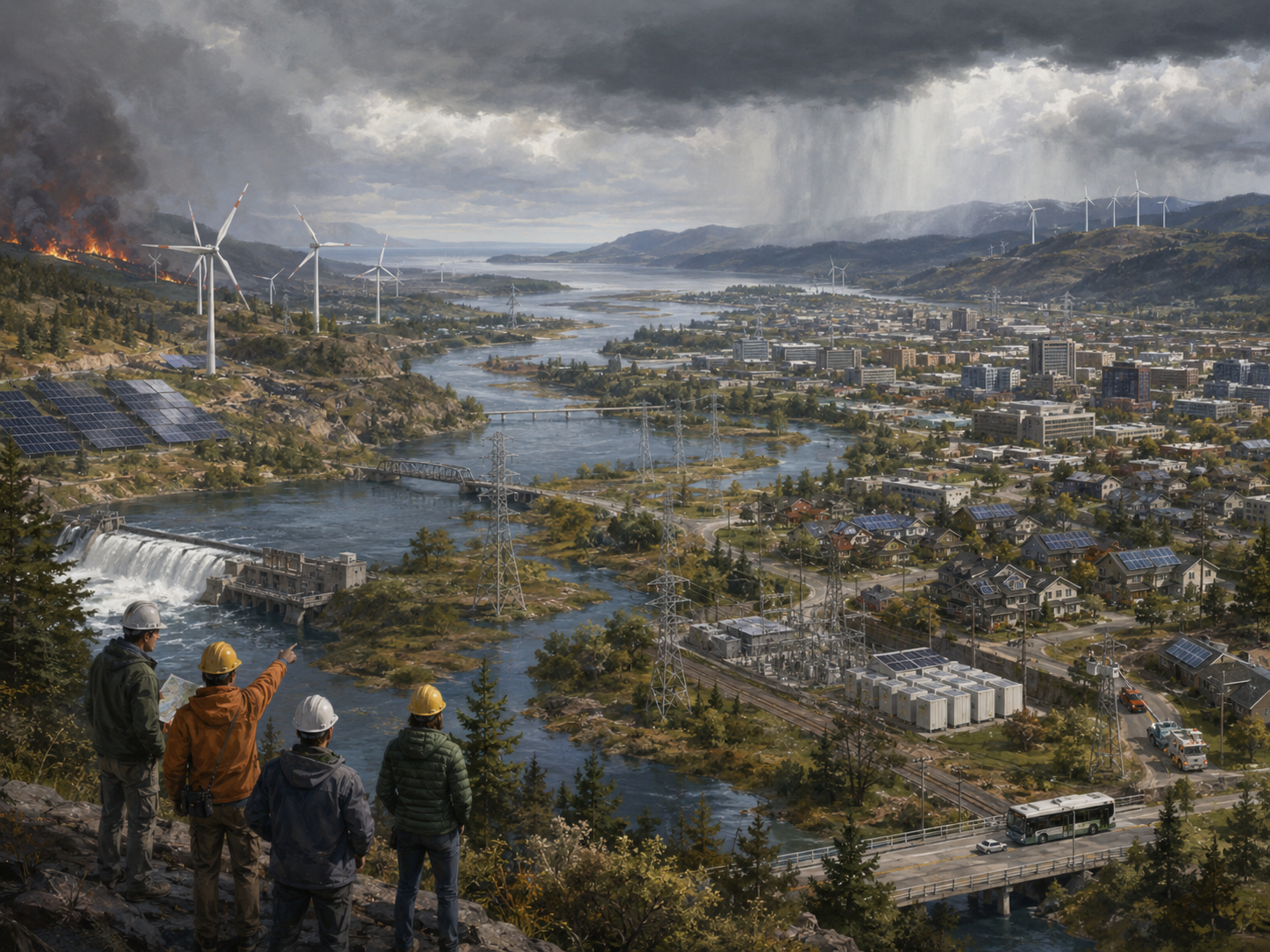
Energy system resilience is the capacity of electricity, fuels, heat, storage, transmission, distribution, markets, institutions, workforces, digital controls, and communities to anticipate disturbance, absorb shocks, maintain essential energy services, recover equitably, adapt to changing conditions, and transform when existing energy arrangements become unsafe, unjust, unaffordable, or ecologically unsustainable. It is not only grid hardening, backup generation, fuel security, emergency repair, or reliability engineering. It is the broader capacity of energy systems to keep homes habitable, hospitals operating, water systems pumping, communications functioning, food refrigerated, transport moving, industries productive, and communities protected under stress.
Energy systems are exposed to extreme weather, climate change, wildfire, heat, flooding, drought, storms, cyberattacks, fuel-price shocks, geopolitical disruption, equipment failure, aging infrastructure, underinvestment, workforce shortages, demand growth, electrification, market volatility, social inequality, and policy uncertainty. These risks do not remain inside the energy sector. Power outages can disrupt water, healthcare, communications, food systems, transportation, emergency response, finance, schools, and housing. Fuel shortages can cascade into heating, freight, agriculture, industry, and public services. Energy insecurity can become public-health risk, economic risk, and political risk.
This article examines energy system resilience as a core topic in resilience thinking. It explains why energy must be understood as a complex infrastructure and social system, how reliability and resilience differ, why climate adaptation and decarbonization must be integrated, how distributed energy resources and storage can support resilience, why fuel diversity alone is not enough, how cyber-physical systems create new vulnerabilities, and why energy resilience must be evaluated through equity, affordability, service continuity, and ecological constraint. It also provides applied R and Python workflows for comparing energy resilience strategies under uncertainty.
What Energy System Resilience Means
Energy system resilience means the ability to sustain essential energy services before, during, and after disruption while adapting to changing risk. It is broader than keeping the lights on. It includes electricity, heating, cooling, transport fuels, industrial energy, backup systems, digital controls, energy markets, supply chains, repair crews, emergency coordination, customer protection, and the social systems that determine who is harmed when energy fails.
Energy resilience is not only about assets. A substation can be hardened while households remain unable to afford safe cooling. A grid can restore average service quickly while medically vulnerable residents remain without power. A fuel system can maintain supply while price spikes push households into energy poverty. A utility can meet reliability standards while climate risk, cyber risk, and dependency risk accumulate. Resilience therefore requires looking beyond equipment survival toward service continuity, recovery, adaptation, equity, and long-term viability.
Energy systems are also undergoing transformation. Electrification, renewable generation, storage, distributed energy resources, digital grid controls, electric vehicles, hydrogen, advanced nuclear debates, climate adaptation, and decarbonization are changing how energy is produced, moved, stored, consumed, governed, and financed. These transitions can strengthen resilience if planned carefully. They can also create new vulnerabilities if systems become more complex, digitally dependent, supply-chain constrained, or socially unequal.
| Concept | Primary question | Energy-system example |
|---|---|---|
| Reliability | Can the system deliver expected service under normal and anticipated conditions? | Maintaining frequency, voltage, generation adequacy, and distribution performance during routine operations. |
| Security | Can the system resist intentional disruption, fuel disruption, cyberattack, or geopolitical risk? | Protecting critical infrastructure, grid controls, fuel supply, physical assets, and emergency operations. |
| Resilience | Can the system absorb disturbance, preserve critical functions, recover, learn, and adapt? | Maintaining power to hospitals, water systems, homes, communications, and shelters during extreme events. |
| Adaptation | Can the system adjust to changing climate, demand, technology, and social needs? | Updating planning models, asset standards, storage, redundancy, wildfire mitigation, and cooling-demand forecasts. |
| Transformation | When must the system change because the old structure creates unacceptable risk? | Redesigning fossil-dependent, centralized, brittle, high-emission, or inequitable energy systems. |
Energy system resilience is strongest when it protects essential services, reduces cascading risk, supports decarbonization, improves affordability, and strengthens public accountability at the same time.
Why Energy System Resilience Matters
Energy system resilience matters because energy is a foundational dependency for nearly every other modern system. Electricity powers hospitals, water treatment, sewage pumping, refrigeration, communications, schools, elevators, heating, cooling, payment systems, traffic signals, public transit, emergency dispatch, laboratories, data centers, and homes. Fuels power freight, emergency vehicles, agriculture, backup generators, aviation, maritime systems, industry, and heating in many places. When energy systems fail, failure spreads.
Energy disruption is also deeply unequal. The same outage affects people differently depending on housing quality, income, disability, age, medical dependence on electricity, access to transportation, neighborhood investment, social isolation, language access, and ability to afford backup power or temporary relocation. Energy resilience must therefore ask not only how quickly service is restored, but who loses service first, who is restored last, who can keep safe temperatures, who can refrigerate medicine, and who can pay the bill after a crisis.
Energy resilience also matters because climate change is shifting the conditions under which energy systems operate. Extreme heat increases cooling demand and stresses generation, transmission, and distribution equipment. Drought affects hydropower and thermal plant cooling. Wildfire threatens transmission corridors and communities. Flooding threatens substations, fuel terminals, pipelines, mines, ports, refineries, and power plants. Storms and ice damage distribution systems. Long-term planning based only on historical weather can understate future risk.
Why energy resilience is a systems priority
Critical-service dependence
Health care, water, communications, food, transport, emergency response, and housing safety depend on energy continuity.
Cascading failure
Power, fuel, digital, transport, water, and communications systems are tightly coupled.
Climate stress
Heat, storms, drought, wildfire, flooding, and changing demand patterns affect energy assets and operations.
Digital vulnerability
Modern energy systems rely on sensors, software, controls, communications, markets, and cyber-physical coordination.
Equity exposure
Energy insecurity, utility debt, unsafe housing, medical vulnerability, and restoration delays make outages unequal.
Transition risk and opportunity
Decarbonization, electrification, storage, and distributed energy can either reduce or create resilience risks.
Energy system resilience matters because energy is not a sectoral convenience. It is a public-systems lifeline.
Energy Systems as Complex Systems
Energy systems are complex adaptive systems. They include physical infrastructure, fuel supply chains, markets, regulations, technologies, customers, operators, repair crews, digital controls, weather patterns, ecological constraints, financial incentives, and political decisions. System behavior emerges from interactions across generation, transmission, distribution, storage, demand, fuel logistics, markets, and institutions.
This complexity means that resilience cannot be reduced to one technology. A system with abundant generation may still fail if transmission corridors are vulnerable. A system with strong transmission may still fail if distribution networks are exposed to storms, wildfire, or vegetation risk. A system with backup fuel may still fail if fuel delivery is disrupted. A system with distributed solar may still fail without islanding capability, storage, controls, and safe interconnection. A system with modern digital controls may still fail under cyberattack or communication outage.
Energy systems also contain feedback loops. High temperatures increase demand for cooling, which increases grid stress, which increases outage risk, which removes cooling, which increases health emergencies. Fuel price spikes increase energy costs, which increase utility arrears, which increase disconnection risk, which increases household vulnerability. Repeated outages may reduce public trust, increase private generator adoption, increase emissions, and change investment politics. Resilience thinking asks planners to identify these feedbacks before they lock systems into fragility.
| Energy subsystem | Primary resilience function | Potential cascade |
|---|---|---|
| Generation | Provide sufficient electricity across normal, peak, and emergency conditions | Plant outages or fuel shortages can reduce supply and trigger load shedding. |
| Transmission | Move bulk power across regions and connect resources to demand | Line failure can isolate resources, overload other corridors, or reduce import capacity. |
| Distribution | Deliver electricity to homes, facilities, businesses, and critical services | Storm, fire, heat, or equipment failure can create local outages even when bulk power is available. |
| Fuels | Provide gas, liquid fuels, coal, biomass, hydrogen, or backup fuel where used | Transport, pipeline, refinery, storage, port, or market disruption can affect power, heat, transport, and industry. |
| Digital controls | Coordinate monitoring, protection, dispatch, markets, and response | Cyber or communication failure can turn operational dependency into system risk. |
| Demand and customers | Shape load, flexibility, affordability, and critical-service needs | Unmanaged peak demand or energy poverty can become reliability and public-health risk. |
Energy resilience requires managing interdependence across physical, digital, economic, ecological, and social systems.
Reliability, Security, and Resilience
Energy reliability, security, and resilience are related but distinct. Reliability focuses on maintaining service under expected operating conditions and known contingencies. Energy security focuses on protection against intentional attacks, fuel disruption, geopolitical risk, and critical infrastructure threats. Resilience focuses on the ability to withstand, respond to, recover from, and adapt after high-impact disruption, including events that exceed design assumptions or combine in unexpected ways.
This distinction matters because a system can be reliable but not resilient. A grid may meet conventional reliability metrics under routine conditions while remaining vulnerable to wildfire, cyberattack, extreme heat, flood, ice storms, supply-chain failure, or black-start challenges. A fuel system may appear secure under normal market conditions while remaining exposed to geopolitical conflict, shipping bottlenecks, refinery outages, or price shocks. A resilience lens asks how systems perform under severe, compound, uncertain, and changing conditions.
Reliability and resilience should not be treated as competitors. Reliability disciplines daily operation. Resilience extends planning to rare, severe, and systemic disruptions. Energy security adds protection against hostile and strategic threats. A mature energy system integrates all three while also pursuing affordability, equity, decarbonization, and ecological constraint.
| Frame | Main concern | Typical tools | Blind spot if isolated |
|---|---|---|---|
| Reliability | Expected performance and routine contingencies | Resource adequacy, operating reserves, frequency control, voltage support, maintenance | May understate compound, climate, cyber, and social vulnerability. |
| Security | Protection from intentional attack and strategic disruption | Physical security, cybersecurity, fuel security, emergency coordination, intelligence sharing | May focus on threats without addressing chronic fragility or inequity. |
| Resilience | Absorb, recover, adapt, and transform after severe disturbance | Hardening, redundancy, distributed resources, black-start planning, adaptive recovery, community protection | Can become vague if not tied to measurable service continuity and recovery outcomes. |
| Justice | Fair access, affordability, restoration, participation, and burden sharing | Energy assistance, disconnection protection, community energy, targeted investment, participatory planning | Can be treated as secondary unless embedded in resilience metrics. |
Energy system resilience builds on reliability and security, but it also asks deeper questions about recovery, adaptation, equity, and the future viability of the system itself.
Core Dimensions of Energy System Resilience
Several dimensions recur across energy system resilience. These dimensions interact. A grid may be technically redundant but unaffordable. A system may be decarbonizing but not yet resilient to extreme heat. A community may have distributed generation but no islanding capability. A utility may restore average service quickly while critical customers and vulnerable households remain exposed. Energy resilience depends on whether technical, operational, economic, ecological, and social capacities reinforce one another.
Service Continuity
Service continuity is the ability to maintain or quickly restore essential energy services during disruption. It focuses on function rather than equipment alone: cooling, heating, refrigeration, medical devices, water pumping, communications, emergency response, lighting, transport charging, and critical facility operation. Energy resilience should define minimum service levels for life-safety, public health, and critical infrastructure.
Robustness and Hardening
Robustness refers to the ability of assets and networks to withstand stress without failing. Hardening includes undergrounding where appropriate, floodproofing, wildfire mitigation, stronger poles, vegetation management, substation protection, elevated equipment, thermal ratings, and facility resilience. Hardening is important, but it is not enough when systems remain highly centralized, digitally vulnerable, or socially unequal.
Redundancy and Diversity
Redundancy provides backup pathways, spare capacity, alternate suppliers, and restoration options. Diversity reduces dependence on a single fuel, asset class, corridor, supplier, technology, or market. In energy systems, resilience may require diverse generation, storage, demand flexibility, distributed resources, fuel contingency planning, spare transformers, repair crews, mutual aid, and black-start capability.
Flexibility and Adaptive Capacity
Flexibility is the ability to adjust supply, demand, storage, flows, operating modes, and institutional rules as conditions change. Adaptive capacity includes forecasting, scenario planning, climate-informed asset standards, demand response, flexible interconnection, distributed controls, market reform, learning from outages, and planning processes that update when assumptions fail.
Cyber-Physical Security
Modern energy systems depend on sensors, communications, control systems, market platforms, protection devices, customer data, and automated dispatch. Cyber-physical security protects digital systems, operational technology, physical assets, communications, and recovery procedures. Resilience requires manual fallback, segmentation, incident response, training, vendor accountability, and protection of critical control functions.
Equity and Affordability
Energy resilience is incomplete if it protects infrastructure while leaving households unable to afford safe energy service. Equity includes affordability, disconnection protection, medical baseline support, fair restoration, community participation, targeted investment, accessible communication, and protection for renters, low-income households, disabled people, older adults, rural communities, and historically disinvested neighborhoods.
| Dimension | Primary focus | Failure if neglected |
|---|---|---|
| Service continuity | Maintaining essential energy services for life, health, water, communications, and critical functions | Asset repair occurs while people and services remain unsafe. |
| Robustness and hardening | Reducing asset failure under heat, storm, flood, fire, cyber-physical, and mechanical stress | Infrastructure fails repeatedly under foreseeable hazards. |
| Redundancy and diversity | Providing backup pathways, resources, and restoration options | Single points of failure become cascading failures. |
| Flexibility and adaptive capacity | Adjusting operations, demand, planning, standards, and investments as conditions change | Energy planning remains locked to obsolete assumptions. |
| Cyber-physical security | Protecting digital controls, communications, data, and physical assets | Software, communication, or control failures become energy-system failures. |
| Equity and affordability | Ensuring resilience protects vulnerable users and remains publicly legitimate | Energy resilience becomes a privilege for those who can buy backup capacity. |
Energy system resilience is strongest when these dimensions are designed together rather than treated as separate utility, technology, market, or emergency-management concerns.
Climate Risk and Energy Infrastructure
Climate change affects energy systems on both the supply and demand sides. Extreme heat increases cooling demand and reduces the efficiency or capacity of some generation, transmission, and distribution assets. Drought affects hydropower, water-cooled thermal generation, biomass, and fuel logistics. Wildfire threatens transmission corridors, distribution lines, substations, and communities. Flooding threatens substations, underground networks, fuel terminals, ports, pipelines, refineries, mines, and power plants. Storms, ice, and high winds damage distribution networks and can interrupt fuel delivery.
Climate risk also changes planning uncertainty. Historical outage data remain useful, but they may not represent future hazard distributions. Energy planners must account for changing extremes, compound events, correlated regional weather, changing load profiles, electrification, cooling demand, hydrological shifts, and infrastructure aging. A grid planned for past weather may fail under future conditions even if it was reliable in the past.
Climate resilience for energy systems requires hazard mapping, climate-informed design standards, asset vulnerability assessments, scenario planning, stress testing, adaptive investment pathways, emergency restoration planning, and coordination with water, transport, land-use, public health, and emergency management agencies. Climate adaptation must become part of ordinary energy planning, not an appendix.
| Climate hazard | Energy-system pathway | Resilience response |
|---|---|---|
| Extreme heat | Cooling demand rises, equipment ratings fall, transformers overheat, wildfire risk increases | Demand response, storage, grid upgrades, thermal standards, cooling assistance, targeted peak reduction. |
| Drought | Hydropower declines, cooling water becomes constrained, fuel transport may be affected | Diversified resources, water-aware planning, efficiency, storage, flexible operations, hydrological stress testing. |
| Wildfire | Transmission and distribution assets ignite or are damaged; preventive shutoffs disrupt communities | Vegetation management, covered conductors, undergrounding where justified, microgrids, community backup, situational awareness. |
| Flooding and storm surge | Substations, fuel terminals, plants, underground networks, pipelines, and ports are inundated | Elevation, floodproofing, relocation, drainage, coastal risk planning, redundant routes, restoration staging. |
| Storms, ice, and high winds | Distribution lines, poles, trees, and substations are damaged; repair access is constrained | Grid hardening, vegetation management, sectionalization, mutual aid, spare parts, outage communications. |
Climate-informed energy resilience means planning for the hazards that are emerging, not only those recorded in the past.
Electric Grid Resilience
The electric grid is the backbone of modern energy resilience because electrification is expanding the role of electricity in transport, heating, industry, buildings, data systems, and public services. Grid resilience includes bulk power generation, transmission, distribution, substations, protective relays, control centers, communications, markets, distributed resources, storage, and customer-side capabilities.
Grid resilience requires more than stronger wires. It requires planning for cascading failure, correlated hazards, interregional transfers, resource adequacy, black-start capability, distribution automation, flexible demand, storage, protection coordination, vegetation management, cyber defense, restoration sequencing, and critical-load prioritization. Distribution systems are especially important because many customer outages occur at the local level. A robust transmission grid does not protect households if distribution lines fail repeatedly.
Electric grid resilience also depends on governance. Utilities, regulators, regional transmission organizations, reliability coordinators, emergency managers, public utility commissions, municipalities, tribal governments, and communities must align standards, incentives, investment, data, and accountability. Resilience investments can be expensive, and the benefits are often distributed unevenly unless equity is explicitly included.
Electric grid resilience priorities
Critical-load mapping
Identify hospitals, water systems, shelters, communications, emergency services, medically vulnerable users, and community hubs.
Distribution resilience
Strengthen feeders, substations, poles, vegetation management, sectionalization, and local restoration capacity.
Transmission resilience
Protect high-voltage corridors, interregional transfers, wildfire exposure, extreme weather, and system stability.
Black-start readiness
Ensure restoration can begin after widespread outage using tested resources, procedures, communications, and crews.
Flexible demand
Use demand response, efficiency, dynamic controls, and load prioritization to reduce stress during peak and emergency periods.
Restoration equity
Track who is restored first and last, and prioritize life-safety, medical, and high-vulnerability needs.
Grid resilience should be measured by service continuity and recovery for critical functions, not only by average outage statistics.
Generation Diversity and Resource Adequacy
Resource adequacy asks whether enough supply-side and demand-side resources are available to meet electricity demand under expected conditions and credible stress scenarios. Generation diversity can support resilience by reducing dependence on a single fuel, technology, region, or operational profile. But diversity is not automatically resilience. The resilience value of any resource depends on availability during stress, fuel access, weather correlation, flexibility, emissions, maintenance, location, grid connection, and operational reliability.
Energy systems are becoming more variable and more flexible at the same time. Wind and solar output depend on weather, but they can reduce fuel dependence and be distributed across regions. Storage can shift energy over time, support fast response, and protect critical loads, but duration and charging conditions matter. Hydropower can provide flexibility, but drought can constrain output. Gas plants can provide dispatchable capacity, but fuel supply and pipeline dependence can be vulnerable during extreme cold or geopolitical disruption. Nuclear plants can provide firm low-carbon power, but outages, cooling water, costs, and safety governance matter. Demand response and efficiency can reduce stress, but require customer participation and trust.
Resilience planning therefore requires resource portfolios rather than ideological attachment to any single technology. The question is not which resource is inherently resilient. The question is how a portfolio performs under stress, how it supports decarbonization, how it affects affordability, and how it protects essential services.
| Resource or capability | Resilience contribution | Resilience limitation |
|---|---|---|
| Wind and solar | Reduce fuel dependence, diversify supply, enable distributed generation | Weather variability, interconnection, storage, transmission, and inverter controls must be planned. |
| Storage | Provides fast response, peak support, backup, grid services, and critical-load protection | Duration, siting, charging availability, cost, and supply chains matter. |
| Hydropower | Can provide flexibility, storage, and low-carbon generation | Drought, ecological impacts, competing water demands, and climate uncertainty matter. |
| Gas-fired generation | Can provide dispatchable power and flexibility | Fuel supply, pipeline constraints, price volatility, methane, emissions, and cold-weather risk matter. |
| Nuclear power | Can provide firm low-carbon generation | Cost, cooling water, outage risk, safety governance, waste, and long lead times matter. |
| Efficiency and demand response | Reduce peak stress and lower energy burden | Requires participation, controls, compensation, and protections for vulnerable users. |
Resource adequacy becomes resilience when portfolios are tested against climate, fuel, cyber, market, and equity stress—not only expected peak demand.
Distributed Energy, Storage, and Microgrids
Distributed energy resources include rooftop solar, community solar, batteries, microgrids, combined heat and power, electric vehicles, controllable loads, building energy management, and local generation. These resources can strengthen resilience by placing energy capability closer to users, reducing dependence on long supply chains, supporting critical loads, and enabling communities or facilities to maintain limited service when the broader grid is disrupted.
Microgrids are especially important where critical facilities, remote communities, military installations, campuses, hospitals, water systems, shelters, or vulnerable neighborhoods need local energy continuity. A microgrid can disconnect from the larger grid and operate independently if it has adequate generation, storage, controls, protection, and fuel or renewable supply. But microgrids are not automatically equitable or resilient. They can protect private campuses while surrounding communities remain dark. They can rely on diesel fuel that may run out or increase pollution. They can be expensive, poorly maintained, or incompatible with utility operations.
Distributed resilience works best when it is integrated with the larger system. Local storage, solar, demand flexibility, and microgrids can support grid services during normal conditions and emergency service during outages. Community resilience hubs can use distributed energy to support cooling, charging, refrigeration, communications, medical devices, and supplies. But these systems require planning, maintenance, interconnection standards, ownership models, and public accountability.
Distributed energy resilience priorities
Critical-load design
Size systems for essential services: cooling, refrigeration, medical devices, communications, water, lighting, and charging.
Islanding capability
Distributed resources support resilience only if they can operate safely when the main grid is down.
Storage duration
Battery duration and recharge conditions determine how long critical services can continue.
Community ownership
Local benefits depend on governance, access, affordability, and whether vulnerable users are prioritized.
Grid services
Distributed resources can support peak reduction, frequency response, voltage support, and congestion relief.
Maintenance and testing
Backup systems fail when they are not exercised, maintained, fueled, updated, and staffed.
Distributed energy strengthens resilience when it protects essential services for people who need them most, not only when it creates private backup capacity.
Fuel Supply and Energy Security
Energy resilience includes fuel supply because many systems still depend on gas, diesel, gasoline, heating oil, propane, coal, biomass, uranium, hydrogen, or other fuels. Fuel disruption can affect electricity generation, heating, transport, emergency response, agriculture, freight, industry, backup power, and critical facilities. Fuel resilience depends on production, storage, transport, ports, rail, pipelines, refineries, terminals, market liquidity, geopolitics, price stability, and emergency allocation.
Fuel diversity can reduce exposure to a single supply chain, but it can also create new dependencies. A gas-dependent power system may be vulnerable to pipeline constraints during extreme cold. Diesel backup may fail if roads are blocked or fuel deliveries are delayed. Global commodity markets can transmit geopolitical shocks into local affordability. Fuel storage can support resilience but also creates safety, environmental, and emissions concerns.
Long-term energy resilience cannot be separated from decarbonization. Fossil fuel dependence creates climate risk, price volatility, air pollution, geopolitical exposure, and stranded asset risk. Yet transition must be managed carefully so that communities do not lose reliable, affordable service before clean, flexible, resilient alternatives are in place. Energy resilience therefore requires both near-term contingency planning and long-term transition planning.
| Fuel-system issue | Resilience concern | Planning response |
|---|---|---|
| Pipeline dependence | Fuel-constrained power systems may fail during cold, cyber, or supply disruption | Firm fuel planning, dual-fuel where appropriate, storage, demand response, diversified resources. |
| Refinery or terminal outage | Transport fuels and backup generation may be constrained | Regional contingency plans, storage, logistics mapping, alternate suppliers, emergency allocation. | Diesel backup reliance | Generators may fail if fuel is unavailable or emissions harm vulnerable communities | Testing, fuel contracts, battery backup, clean backup alternatives, prioritization of critical sites. |
| Global price shocks | Households, utilities, transit, agriculture, and industry face affordability stress | Efficiency, assistance, diversified supply, hedging, electrification where resilient, social protection. |
| Fossil fuel lock-in | Short-term resilience investments may increase long-term climate and transition risk | Evaluate lifecycle emissions, stranded assets, flexible infrastructure, and clean alternatives. |
Fuel security is part of energy resilience, but resilience cannot be reduced to preserving fuel supply. It must also reduce the risks that fuel dependence creates.
Cyber-Physical Energy Systems
Modern energy systems are cyber-physical systems. Physical assets depend on digital monitoring, control systems, communications, market platforms, sensors, protection devices, forecasting tools, customer systems, cloud services, and vendor software. Distributed energy resources, smart meters, inverter-based resources, electric vehicle charging, grid automation, and demand response increase the value of coordination while expanding the cyberattack surface.
Cyber resilience is not only about preventing intrusion. It is about maintaining safe operation, detecting anomalies, isolating compromise, preserving manual fallback, recovering systems, protecting data, coordinating with operators, and maintaining public trust. Energy cyber incidents can affect power flows, market operations, customer data, billing, dispatch, communications, and physical safety. Cyber-physical resilience requires both technical controls and operational procedures.
Digital dependency also raises equity concerns. Automated outage communication may fail people without connectivity. Smart devices may shift demand in ways that burden households without flexible appliances or stable housing. Dynamic rates may create risk for people who cannot shift load. Digital resilience must therefore include accessibility, privacy, fairness, and human fallback.
| Cyber-physical layer | Resilience function | Failure mode |
|---|---|---|
| Operational technology | Controls substations, generation, protection systems, and grid devices | Compromise can affect physical operation and safety. |
| Communications | Connects field devices, control centers, operators, crews, and customers | Communication loss can delay situational awareness and restoration. |
| Market and dispatch software | Coordinates generation, demand, pricing, and grid operations | Data or software failure can distort operations and resource allocation. |
| Distributed energy controls | Coordinates inverters, batteries, electric vehicles, microgrids, and flexible loads | Distributed devices can become resilience assets or attack surfaces. |
| Customer data systems | Support billing, outage reporting, assistance, and customer communication | Cyber or data failure can harm customers and undermine trust. |
Cyber-physical resilience requires treating software, communications, and data as energy infrastructure—not as secondary support systems.
Demand Flexibility and Load Resilience
Demand flexibility is the ability to adjust energy consumption in time, location, or intensity without undermining essential services. It includes energy efficiency, demand response, managed electric vehicle charging, thermal storage, smart thermostats, industrial load flexibility, building controls, time-varying rates, and customer programs. Flexibility can reduce peak stress, lower costs, integrate variable renewable energy, reduce outage risk, and support emergency operations.
But demand flexibility must be designed carefully. Not all loads are flexible. A medically necessary device, safe indoor temperature, refrigeration, elevator, water pump, or essential industrial process may not be safely curtailed. Low-income households may have less flexibility because of poor housing, inefficient appliances, work schedules, caregiving responsibilities, or lack of automation. Dynamic pricing without protection can expose vulnerable users to risk.
Load resilience means understanding which loads are critical, which are flexible, which can be shifted, which can be curtailed, and which require protection. It also means using efficiency as a resilience resource. A well-insulated home stays safer longer during outage. Efficient cooling reduces grid stress. Efficient appliances reduce backup power needs. Efficiency and flexibility are often the cheapest resilience resources, but they require equitable implementation.
Demand-side resilience priorities
Efficiency first
Reducing energy waste lowers peak demand, bills, emissions, and backup-power requirements.
Critical-load protection
Medical, heating, cooling, refrigeration, communications, water, and safety loads require priority protection.
Flexible loads
Water heating, EV charging, some industrial processes, and thermal storage can shift demand if designed well.
Customer safeguards
Demand programs must protect vulnerable users from unsafe curtailment or unaffordable price exposure.
Automated response
Smart controls can respond quickly, but require privacy, cybersecurity, and opt-out protections.
Community-scale planning
Aggregated flexibility can support local feeders, resilience hubs, and emergency grid operations.
Demand flexibility strengthens resilience when it reduces system stress without shifting risk onto households least able to manage it.
Energy Equity and Affordability
Energy resilience is inseparable from energy equity. Households cannot be resilient if they cannot afford safe energy service, if they are disconnected during dangerous weather, if their housing is inefficient, if they lack access to cooling or heating, if they cannot charge medical devices, or if restoration is delayed in their neighborhoods. Energy insecurity turns technical outages and price shocks into public-health and social crises.
Affordability is a resilience condition. High bills can force households to choose between energy, food, medicine, and rent. Utility arrears can increase disconnection risk. Inefficient housing can expose residents to heat, cold, mold, and high costs. Renters may have little control over building energy performance. Rural communities may face high delivery costs and long restoration times. Tribal communities, informal settlements, and historically disinvested neighborhoods may face infrastructure gaps and governance barriers.
Energy justice asks who benefits from resilience investment, who pays for grid upgrades, who receives distributed energy, who is protected during outages, who participates in planning, and who bears pollution or land-use burdens. A resilience strategy that raises bills, accelerates displacement, or concentrates backup power in wealthy communities can strengthen infrastructure while weakening social resilience.
| Equity issue | Energy resilience consequence | Justice-oriented response |
|---|---|---|
| Energy burden | High bills reduce household adaptive capacity and increase disconnection risk | Bill assistance, efficiency retrofits, affordable rates, weatherization, and arrears management. |
| Unsafe housing | Poor insulation and ventilation increase heat, cold, and outage vulnerability | Housing retrofits, tenant protections, public housing upgrades, cooling and heating standards. |
| Medical vulnerability | Outages threaten oxygen, refrigeration, mobility devices, dialysis, and home care | Medical baseline programs, priority restoration, backup power, outreach, privacy safeguards. |
| Unequal restoration | Some communities may lose power longer or receive fewer upgrades | Disaggregated outage data, restoration equity metrics, targeted investment, community oversight. |
| Private backup inequality | Wealthier users can buy batteries, generators, or relocation options | Community resilience hubs, public microgrids, grants, shared storage, and vulnerable-user programs. |
Energy resilience is legitimate only when it protects the people most exposed to energy insecurity, not only the assets most visible to planners.
Critical Services and Cascading Failure
Energy failure becomes cascading failure when it disrupts other essential systems. Water systems need power for pumping and treatment. Hospitals need power, fuel, oxygen, communications, and supply chains. Communications networks need electricity and backup power. Food systems need refrigeration, transport, processing, and retail power. Transit and traffic systems need electricity, signals, charging, fuel, and control systems. Emergency response needs fuel, communications, dispatch, and facility power.
Energy resilience planning should therefore begin with critical services, not only energy assets. Which loads must remain operational? How long can they operate without grid power? What backup systems exist? Are they tested? Do they depend on diesel deliveries? Are fuel contracts reliable under regional disruption? Do water, health, communications, and emergency agencies share outage priorities? Are vulnerable residents mapped with privacy safeguards? Are community shelters energy-resilient?
Cascading risk is especially important during compound events. A heatwave plus power outage can become a mass-casualty risk. A flood plus substation failure can disrupt water and sanitation. A cyberattack plus storm can complicate restoration. A fuel shortage plus cold event can threaten heating and power. Resilience requires stress-testing combinations rather than isolated hazards.
| Critical service | Energy dependency | Resilience planning need |
|---|---|---|
| Healthcare | Power, fuel, oxygen, refrigeration, ventilation, elevators, medical devices, records | Backup power, fuel assurance, microgrids, critical-load prioritization, downtime procedures. |
| Water and sanitation | Pumps, treatment, controls, monitoring, communications, emergency distribution | Backup power, generator testing, storage, priority restoration, fuel logistics. |
| Communications | Cell towers, data centers, emergency alert systems, dispatch, broadband | Battery backup, generator fuel, redundant networks, priority repair, manual fallback. |
| Food systems | Refrigeration, warehouses, grocery stores, processing, payments, transport fuel | Cold-chain backup, local distribution, fuel contingency, emergency food access. |
| Housing and shelters | Heating, cooling, elevators, lighting, refrigeration, charging, water pumps | Weatherization, backup power, cooling centers, resilience hubs, tenant protections. |
Energy resilience should be evaluated by whether critical services remain functional when energy systems are under stress.
Markets, Governance, and Planning
Energy resilience depends on governance because energy systems are shaped by utilities, regulators, grid operators, market rules, fuel suppliers, public agencies, private investors, local governments, tribal governments, emergency managers, customers, and communities. Technical resilience can fail if markets do not reward needed capacity, if utilities cannot recover prudent investments, if regulators lack data, if planning horizons are too short, or if community needs are excluded.
Energy markets can improve efficiency, but they may not automatically value resilience. Backup capacity, black-start capability, local distribution hardening, weatherization, community resilience hubs, spare transformers, cyber resilience, and long-duration storage may provide public value that is difficult to monetize. Conversely, poorly designed incentives can reward assets that appear economic under normal conditions but fail under stress.
Planning must connect resilience, affordability, decarbonization, reliability, environmental justice, and local land-use impacts. Integrated resource planning, transmission planning, distribution planning, climate vulnerability assessments, fuel contingency planning, emergency management, and community energy planning should be aligned rather than siloed. Resilience governance is strongest when it has clear authority, transparent metrics, public accountability, and community participation.
Energy resilience governance priorities
Integrated planning
Connect generation, transmission, distribution, fuels, demand, storage, climate risk, and equity.
Regulatory accountability
Require transparent resilience metrics, investment justification, outage equity, and public reporting.
Market design
Value flexibility, reserves, resource adequacy, fast response, local capacity, and critical-service continuity.
Public finance
Support investments that markets underprovide: weatherization, community hubs, grid hardening, and vulnerable-user protection.
Community participation
Local knowledge improves siting, priorities, restoration planning, and legitimacy.
Learning systems
Outage reviews, near misses, cyber incidents, and climate stress tests should change standards and budgets.
Energy resilience is a governance challenge as much as an engineering challenge.
Decarbonization and Resilience
Decarbonization and resilience must be planned together. Energy systems are a major source of greenhouse-gas emissions, and climate change increases energy-system risk. Reducing emissions is therefore a long-term resilience strategy because it reduces the severity of future climate hazards. At the same time, decarbonized systems must be reliable, affordable, flexible, and resilient under stress.
Clean energy can strengthen resilience. Energy efficiency lowers demand. Solar and wind reduce fuel dependence. Storage supports flexibility and backup. Distributed energy can protect critical loads. Electrification can reduce combustion pollution and improve efficiency. Transmission expansion can connect diverse resources across regions. Digital controls can improve visibility and coordination. But these benefits require careful design. Renewable integration needs transmission, storage, forecasting, inverter controls, flexible demand, and resource adequacy. Electrification increases dependence on the electric grid, making grid resilience even more important. Critical minerals and equipment supply chains require responsible governance.
Resilience can also support decarbonization. A resilient clean-energy transition builds public trust because it protects service continuity, affordability, and vulnerable users. A transition that produces outages, price shocks, land conflicts, or inequity can undermine legitimacy. The goal is not to choose between clean energy and resilience. The goal is to build energy systems that are clean, reliable, flexible, affordable, secure, and just.
| Transition pathway | Resilience opportunity | Resilience risk if poorly planned |
|---|---|---|
| Energy efficiency | Reduces peak demand, bills, emissions, and backup-power needs | Benefits may bypass renters, low-income households, and older buildings. |
| Renewable generation | Reduces fuel dependence and emissions; supports distributed options | Variability requires storage, transmission, flexibility, and reliability planning. |
| Storage | Supports peak management, fast response, backup, and renewable integration | Duration, cost, supply chains, siting, and recycling must be managed. |
| Electrification | Improves efficiency and reduces combustion emissions | Increases dependence on electric-grid resilience and winter/summer peak planning. |
| Transmission expansion | Connects diverse resources and supports regional balancing | Siting conflicts, permitting delays, ecological impacts, and community concerns must be addressed. |
| Distributed energy | Protects local critical loads and supports community resilience | May deepen inequality if only wealthy users can access backup benefits. |
Energy transition is resilient when decarbonization, reliability, affordability, equity, and adaptation are designed as one systems challenge.
Measuring Energy System Resilience
Energy resilience is difficult to measure because conventional reliability metrics do not capture every dimension of severe disruption, critical-service continuity, social vulnerability, or adaptive learning. Outage duration and frequency matter, but so do restoration equity, critical-load continuity, black-start readiness, fuel assurance, cyber recovery, climate exposure, customer vulnerability, resource adequacy under extreme events, and the ability to revise planning after near misses.
Measurement should distinguish routine reliability from resilience under severe stress. It should include asset-level vulnerability, network-level cascading risk, service-level continuity, community-level vulnerability, and system-level recovery. It should also include slow variables: aging infrastructure, workforce capacity, vegetation management, fuel dependence, customer debt, disconnection risk, cyber maturity, spare equipment availability, and climate-informed planning.
Metrics should support decisions. If a substation faces repeated flood risk, investment or relocation should be triggered. If a feeder serves medically vulnerable customers and has poor reliability, targeted resilience upgrades should be prioritized. If fuel supply is uncertain during extreme cold, resource adequacy modeling should change. If outage restoration is inequitable, restoration protocols and investments should be revised.
| Measurement domain | Example indicator | Dashboard risk |
|---|---|---|
| Reliability | Outage frequency, outage duration, resource adequacy, operating reserves | Routine metrics may miss severe, compound, and unequal outages. |
| Critical service continuity | Power duration for hospitals, water systems, shelters, communications, and medically vulnerable users | Average customer restoration can hide critical-load failure. |
| Recovery | Time to restore priority loads, full service, and vulnerable customers | Fast system averages can hide neighborhoods restored last. |
| Climate exposure | Assets exposed to heat, flood, wildfire, drought, storm, ice, and coastal hazards | Historical exposure can understate future climate risk. |
| Cyber resilience | Detection time, segmentation, backup systems, incident response, manual fallback | Compliance metrics can hide operational vulnerability. |
| Equity | Energy burden, disconnections, outage duration by vulnerability, access to backup, restoration equity | Equity can be treated as a side indicator instead of a resilience condition. |
| Adaptive learning | After-action implementation, updated standards, funded upgrades, scenario revisions | Lessons may be documented without changing investment or operations. |
Energy resilience measurement should reveal hidden fragility, critical-service risk, unequal harm, and adaptation needs—not merely display reliability performance.
A Practical Framework for Energy System Resilience Planning
A practical energy resilience process should begin with essential services and system dependencies. It should identify critical loads, hazard exposure, asset vulnerabilities, customer vulnerabilities, fuel dependencies, cyber dependencies, restoration constraints, governance gaps, and investment priorities. The result should be a portfolio of technical, operational, social, and institutional actions—not a single resilience project.
| Step | Question | Output |
|---|---|---|
| Define essential energy services | What must continue under disruption? | Critical loads for health, water, shelter, communications, food, emergency response, transport, and vulnerable users. |
| Map hazards and threats | What shocks and slow stresses affect the system? | Heat, storm, flood, wildfire, drought, cyberattack, fuel disruption, demand growth, aging infrastructure, price volatility. |
| Map dependencies | How does energy failure cascade? | Power-water-health-communications-food-transport-fuel-digital dependency maps. |
| Assess asset vulnerability | Which assets are exposed or fragile? | Substations, feeders, transmission corridors, plants, fuel terminals, pipelines, control centers, communications, spare parts. |
| Assess customer vulnerability | Who is most harmed by outage or price shock? | Medical needs, energy burden, housing quality, age, disability, income, rurality, language access, social isolation. |
| Stress test resource adequacy | Can the portfolio meet demand under compound extremes? | Climate-informed adequacy, fuel security, storage duration, interregional transfer, demand flexibility, contingency analysis. |
| Design resilience portfolio | What combination of hardening, redundancy, distributed resources, storage, demand flexibility, and social protection is needed? | Prioritized project portfolio with equity safeguards, cost, benefits, ownership, maintenance, and governance. |
| Plan restoration and continuity | How will critical services be prioritized and restored? | Restoration protocols, critical-load maps, medical-user support, communication plans, mutual aid, spare parts, fuel contracts. |
| Fund and govern implementation | How will resilience be paid for and held accountable? | Regulatory filings, public finance, grants, customer protections, community benefits, transparent metrics. |
| Monitor and learn | How will the system adapt after near misses and failures? | After-action reviews, climate updates, cyber lessons, outage equity reports, updated standards, revised investments. |
Energy resilience planning becomes meaningful when it connects technical analysis to public service, equity, funding, governance, and adaptive learning.
Mathematical Lens: Modeling Service Continuity, Recovery, Adaptation, and Equity
Energy system resilience cannot be captured fully in a single equation, but formal models can clarify the dimensions that must be balanced. A simplified resilience value \(R_i\) for energy system, region, feeder, or community \(i\) can be represented as a function of service continuity, robustness, redundancy, flexibility, cyber-physical security, adaptive capacity, and equity protection:
R_i = w_s S_i + w_b B_i + w_r D_i + w_f F_i + w_c C_i + w_a A_i + w_e E_i
\]
Interpretation: \(S_i\) represents service continuity, \(B_i\) robustness, \(D_i\) redundancy and diversity, \(F_i\) flexibility, \(C_i\) cyber-physical security, \(A_i\) adaptive capacity, and \(E_i\) equity protection.
System function under disturbance can be modeled dynamically. Let \(L_t\) represent energy service level at time \(t\), \(K_t\) hazard stress, \(Q_t\) resource adequacy, \(G_t\) grid condition, \(X_t\) cyber-physical stress, \(M_t\) repair and restoration capacity, and \(V_t\) customer vulnerability:
L_{t+1} = L_t – \alpha K_t – \delta X_t – \lambda V_t + \beta Q_t + \gamma G_t + \eta M_t
\]
Interpretation: Energy service continuity depends not only on hazard intensity, but on resource adequacy, grid condition, restoration capacity, cyber-physical stress, and the vulnerability of affected users.
Expected resilience across a portfolio of strategies \(j\) can be represented as:
E(P) = \sum_{j=1}^{n} p_j R_j
\]
Interpretation: Energy resilience emerges from portfolios: grid hardening, storage, distributed energy, demand flexibility, cyber defense, fuel planning, equity protections, and adaptive governance.
A justice-adjusted energy resilience score can include a penalty for unequal outage, energy burden, disconnection risk, pollution exposure, or exclusion from planning:
R_i^{*} = R_i – \lambda U_i
\]
Interpretation: \(U_i\) represents unequal energy vulnerability or harm. The penalty prevents system-wide resilience from hiding communities that remain unaffordable, unsafe, or restored last.
These equations do not replace engineering, operations, climate science, economics, regulatory review, community knowledge, or ethics. They help make assumptions visible so energy resilience strategies can be compared, stress-tested, and improved.
Advanced R Workflow: Comparing Energy Resilience Strategies
The R workflow below compares energy resilience strategies across service continuity, robustness, redundancy, flexibility, cyber-physical security, adaptive capacity, equity protection, and implementation burden. It then shows how rankings shift under different planning priorities.
# Install packages if needed.
# install.packages(c("tidyverse", "scales"))

library(tidyverse)
library(scales)

# -------------------------------------------------------------------
# Example energy resilience strategies.
# Higher implementation_burden is worse.
# Values are synthetic and for methodological demonstration only.
# -------------------------------------------------------------------

strategies <- tibble(
  strategy = c(
    "Critical Facility Microgrid and Storage Program",
    "Climate-Hardened Transmission and Distribution Upgrade",
    "Demand Flexibility and Efficiency Portfolio",
    "Cyber-Physical Grid Security Modernization",
    "Community Energy Resilience Hub Network",
    "Equity-Centered Energy Affordability and Backup Program"
  ),
  service_continuity = c(8.9, 8.3, 8.0, 8.1, 8.7, 8.4),
  robustness = c(7.8, 9.0, 7.6, 8.2, 7.7, 7.4),
  redundancy_diversity = c(8.7, 8.0, 7.8, 7.9, 8.5, 8.1),
  flexibility = c(8.4, 7.8, 8.9, 8.0, 8.3, 7.9),
  cyber_physical_security = c(7.7, 8.0, 7.5, 9.0, 7.6, 7.4),
  adaptive_capacity = c(8.2, 8.1, 8.5, 8.4, 8.7, 8.3),
  equity_protection = c(8.0, 7.6, 8.1, 7.4, 8.9, 9.2),
  implementation_burden = c(3.5, 3.8, 2.8, 3.4, 3.0, 2.7)
)

# -------------------------------------------------------------------
# Weighted resilience value function.
# -------------------------------------------------------------------

score_strategies <- function(data, ws, wb, wr, wf, wc, wa, we, wi) {
  data %>%
    mutate(
      resilience_value =
        ws * service_continuity +
        wb * robustness +
        wr * redundancy_diversity +
        wf * flexibility +
        wc * cyber_physical_security +
        wa * adaptive_capacity +
        we * equity_protection -
        wi * implementation_burden
    ) %>%
    arrange(desc(resilience_value))
}

# -------------------------------------------------------------------
# Scenario weights for different energy planning priorities.
# -------------------------------------------------------------------

scenarios <- tribble(
  ~scenario,                  ~ws,  ~wb,  ~wr,  ~wf,  ~wc,  ~wa,  ~we,  ~wi,
  "Balanced",                 0.15, 0.14, 0.14, 0.14, 0.13, 0.14, 0.14, 0.02,
  "Service-continuity-first", 0.38, 0.12, 0.12, 0.11, 0.09, 0.09, 0.08, 0.01,
  "Hardening-first",          0.12, 0.38, 0.12, 0.10, 0.10, 0.09, 0.08, 0.01,
  "Redundancy-first",         0.12, 0.12, 0.38, 0.10, 0.10, 0.09, 0.08, 0.01,
  "Flexibility-first",        0.12, 0.10, 0.12, 0.38, 0.10, 0.09, 0.08, 0.01,
  "Cyber-first",              0.12, 0.10, 0.10, 0.10, 0.38, 0.10, 0.09, 0.01,
  "Equity-first",             0.10, 0.10, 0.10, 0.10, 0.09, 0.12, 0.38, 0.01,
  "Implementation-sensitive", 0.13, 0.13, 0.13, 0.13, 0.12, 0.12, 0.12, 0.12
)

# -------------------------------------------------------------------
# Evaluate strategies across scenarios.
# -------------------------------------------------------------------

scenario_results <- scenarios %>%
  rowwise() %>%
  do(
    score_strategies(
      strategies,
      ws = .$ws,
      wb = .$wb,
      wr = .$wr,
      wf = .$wf,
      wc = .$wc,
      wa = .$wa,
      we = .$we,
      wi = .$wi
    ) %>%
      mutate(scenario = .$scenario)
  ) %>%
  ungroup()

ranked_results <- scenario_results %>%
  group_by(scenario) %>%
  arrange(desc(resilience_value), .by_group = TRUE) %>%
  mutate(rank = row_number()) %>%
  ungroup()

print(ranked_results)

# -------------------------------------------------------------------
# Visualize ranking shifts across priorities.
# -------------------------------------------------------------------

ggplot(ranked_results, aes(x = strategy, y = resilience_value, group = scenario)) +
  geom_point(size = 3) +
  geom_line(aes(color = scenario), linewidth = 1) +
  coord_flip() +
  labs(
    title = "Energy Resilience Strategy Value Across Priority Scenarios",
    x = "Strategy",
    y = "Weighted Resilience Value",
    color = "Scenario"
  ) +
  theme_minimal(base_size = 12)

# -------------------------------------------------------------------
# Summarize which strategies rank first most often.
# -------------------------------------------------------------------

top_rank_summary <- ranked_results %>%
  filter(rank == 1) %>%
  count(strategy, name = "times_ranked_first") %>%
  arrange(desc(times_ranked_first))

print(top_rank_summary)

# -------------------------------------------------------------------
# Export results for review.
# -------------------------------------------------------------------

write_csv(ranked_results, "energy_resilience_strategy_rankings.csv")
write_csv(top_rank_summary, "energy_resilience_top_rank_summary.csv")
This workflow shows why energy resilience rankings depend on planning priorities. A microgrid strategy, grid-hardening strategy, demand-flexibility strategy, cyber-security strategy, community-hub strategy, and affordability strategy may rank differently depending on whether the system prioritizes service continuity, hardening, redundancy, flexibility, cyber resilience, equity, or implementation feasibility.
Advanced Python Workflow: Uncertainty Analysis for Energy Resilience Choices
The Python workflow below extends the same logic with Monte Carlo simulation. Instead of assuming fixed values, it models uncertainty across service continuity, robustness, redundancy, flexibility, cyber-physical security, adaptive capacity, equity protection, and implementation burden.
# Install packages if needed:
# pip install pandas numpy matplotlib

import numpy as np
import pandas as pd
import matplotlib.pyplot as plt

# ---------------------------------------------------------------------
# Example energy resilience strategies.
# Values are synthetic and for methodological demonstration only.
# Higher implementation_burden is worse.
# ---------------------------------------------------------------------

strategies = pd.DataFrame({
    "strategy": [
        "Critical Facility Microgrid and Storage Program",
        "Climate-Hardened Transmission and Distribution Upgrade",
        "Demand Flexibility and Efficiency Portfolio",
        "Cyber-Physical Grid Security Modernization",
        "Community Energy Resilience Hub Network",
        "Equity-Centered Energy Affordability and Backup Program"
    ],
    "service_continuity": [8.9, 8.3, 8.0, 8.1, 8.7, 8.4],
    "robustness": [7.8, 9.0, 7.6, 8.2, 7.7, 7.4],
    "redundancy_diversity": [8.7, 8.0, 7.8, 7.9, 8.5, 8.1],
    "flexibility": [8.4, 7.8, 8.9, 8.0, 8.3, 7.9],
    "cyber_physical_security": [7.7, 8.0, 7.5, 9.0, 7.6, 7.4],
    "adaptive_capacity": [8.2, 8.1, 8.5, 8.4, 8.7, 8.3],
    "equity_protection": [8.0, 7.6, 8.1, 7.4, 8.9, 9.2],
    "implementation_burden": [3.5, 3.8, 2.8, 3.4, 3.0, 2.7]
})

# ---------------------------------------------------------------------
# Baseline weights.
# ---------------------------------------------------------------------

weights = {
    "service_continuity": 0.15,
    "robustness": 0.14,
    "redundancy_diversity": 0.14,
    "flexibility": 0.14,
    "cyber_physical_security": 0.13,
    "adaptive_capacity": 0.14,
    "equity_protection": 0.14,
    "implementation_burden": 0.02
}

# ---------------------------------------------------------------------
# Weighted resilience value function.
# ---------------------------------------------------------------------

def compute_resilience_value(df, weights_dict):
    result = df.copy()
    result["resilience_value"] = (
        weights_dict["service_continuity"] * result["service_continuity"]
        + weights_dict["robustness"] * result["robustness"]
        + weights_dict["redundancy_diversity"] * result["redundancy_diversity"]
        + weights_dict["flexibility"] * result["flexibility"]
        + weights_dict["cyber_physical_security"] * result["cyber_physical_security"]
        + weights_dict["adaptive_capacity"] * result["adaptive_capacity"]
        + weights_dict["equity_protection"] * result["equity_protection"]
        - weights_dict["implementation_burden"] * result["implementation_burden"]
    )

    result["diagnostic"] = np.select(
        [
            result["implementation_burden"] >= 3.6,
            result["equity_protection"] < 7.8,
            result["cyber_physical_security"] < 7.8,
            result["service_continuity"] < 8.2
        ],
        [
            "implementation burden review needed",
            "equity protection needs strengthening",
            "cyber-physical security review needed",
            "service continuity needs strengthening"
        ],
        default="promising but requires energy-system scenario validation"
    )

    return result.sort_values("resilience_value", ascending=False)

baseline_results = compute_resilience_value(strategies, weights)
print("Baseline energy resilience ranking:")
print(baseline_results[["strategy", "resilience_value", "diagnostic"]])

# ---------------------------------------------------------------------
# Monte Carlo simulation.
# Allow values to vary around current estimates.
# ---------------------------------------------------------------------

np.random.seed(42)
n_simulations = 5000
simulation_rows = []

for simulation_id in range(n_simulations):
    simulated = strategies.copy()

    for col in [
        "service_continuity",
        "robustness",
        "redundancy_diversity",
        "flexibility",
        "cyber_physical_security",
        "adaptive_capacity",
        "equity_protection",
        "implementation_burden"
    ]:
        simulated[col] = np.random.normal(
            loc=strategies[col],
            scale=0.6
        )
        simulated[col] = simulated[col].clip(1, 10)

    simulated_results = compute_resilience_value(simulated, weights)

    for rank, (_, row) in enumerate(simulated_results.iterrows(), start=1):
        simulation_rows.append({
            "simulation_id": simulation_id,
            "strategy": row["strategy"],
            "rank": rank,
            "resilience_value": row["resilience_value"],
            "diagnostic": row["diagnostic"],
            "winner": simulated_results.iloc[0]["strategy"]
        })

simulation = pd.DataFrame(simulation_rows)

summary = (
    simulation
    .groupby("strategy")
    .agg(
        mean_resilience_value=("resilience_value", "mean"),
        median_resilience_value=("resilience_value", "median"),
        probability_ranked_first=("rank", lambda x: (x == 1).mean() * 100),
        probability_top_two=("rank", lambda x: (x <= 2).mean() * 100),
        probability_bottom_two=("rank", lambda x: (x >= 5).mean() * 100),
        implementation_review_rate=("diagnostic", lambda x: (x == "implementation burden review needed").mean() * 100)
    )
    .reset_index()
    .sort_values("probability_ranked_first", ascending=False)
)

print("\nStrategy robustness under uncertainty:")
print(summary)

# ---------------------------------------------------------------------
# Plot robustness under uncertainty.
# ---------------------------------------------------------------------

plt.figure(figsize=(10, 6))
plt.bar(summary["strategy"], summary["probability_ranked_first"])
plt.xticks(rotation=20, ha="right")
plt.ylabel("Probability of Ranking First (%)")
plt.title("Robustness of Energy Resilience Choices Under Uncertainty")
plt.tight_layout()
plt.show()

# ---------------------------------------------------------------------
# Plot implementation-review rate.
# ---------------------------------------------------------------------

plt.figure(figsize=(10, 6))
plt.bar(summary["strategy"], summary["implementation_review_rate"])
plt.xticks(rotation=20, ha="right")
plt.ylabel("Implementation Review Rate (%)")
plt.title("How Often Energy Strategies Trigger Implementation Review")
plt.tight_layout()
plt.show()

# ---------------------------------------------------------------------
# Export summary for reporting.
# ---------------------------------------------------------------------

baseline_results.to_csv("energy_resilience_baseline_results.csv", index=False)
simulation.to_csv("energy_resilience_uncertainty_simulation.csv", index=False)
summary.to_csv("energy_resilience_uncertainty_summary.csv", index=False)
This workflow shows why energy resilience decisions should be evaluated under uncertainty. A strategy that appears strongest under fixed assumptions may not remain robust when service continuity, robustness, redundancy, flexibility, cyber-physical security, adaptive capacity, equity protection, and implementation burden vary. It also shows why a high aggregate score should not end the review process if equity, cyber-physical security, service continuity, or implementation feasibility remain weak.
GitHub Repository
The companion GitHub repository for this article is designed as an advanced energy-system-resilience modeling scaffold. It translates service continuity, robustness, redundancy, flexibility, cyber-physical security, adaptive capacity, equity protection, implementation burden, climate stress, fuel stress, cyber stress, outage recovery, and uncertainty into reproducible workflows for resilience analysis.
Complete Code Repository
Companion code for energy system resilience modeling, including service-continuity scoring, grid and fuel resilience diagnostics, cyber-physical security review, equity-adjusted resilience value, implementation-burden review, Monte Carlo uncertainty analysis, responsible-use notes, and multi-language computational examples.
The companion article directory is articles/energy-system-resilience/. It is structured to support a professional modeling workflow: Python for uncertainty analysis and scenario simulation; R for strategy comparison and ranking sensitivity; SQL for systems, assets, hazards, strategies, scenarios, model runs, and outputs; Julia for resilience-pathway examples; and Rust, Go, C, C++, and Fortran for lightweight diagnostic and simulation utilities.
The modeling objective is to explore how service continuity, robustness, redundancy, flexibility, cyber-physical security, adaptive capacity, equity protection, and implementation burden shape energy resilience choices under uncertainty. The scaffold includes synthetic data, validation notes, responsible-use documentation, generated outputs, and notebook placeholders.
This repository extends the article from conceptual energy system resilience into applied resilience modeling. It gives readers a reproducible foundation for examining when energy strategies strengthen long-term service continuity, when they risk implementation failure or inequity, and how priorities shift under different uncertainty assumptions.
Conclusion
Energy system resilience matters because energy is the infrastructure behind other infrastructures. When energy fails, health care, water, communications, food, transport, housing, emergency response, industry, and public trust can fail with it. Resilient energy systems therefore cannot be judged only by generation capacity, fuel diversity, average outage duration, or asset hardening. They must be judged by whether essential energy services continue under stress, whether recovery is equitable, whether systems learn from failure, and whether long-term energy pathways reduce climate and social risk.
Seen clearly, energy resilience is a systems practice. It includes reliability engineering, grid planning, distributed energy, storage, demand flexibility, fuel security, cyber-physical protection, workforce capacity, emergency restoration, affordability, public finance, community participation, and climate adaptation. It also includes decarbonization because the energy system cannot be resilient if it continues to intensify the climate hazards that threaten it.
The field is weakened when resilience is reduced to backup generation, fuel preservation, or infrastructure hardening alone. It is strongest when it protects critical services, reduces cascading risk, improves affordability, supports vulnerable users, integrates clean energy, and strengthens adaptive governance.
In the broader Resilience Thinking series, energy system resilience connects public health, urban resilience, infrastructure resilience, food and water resilience, community resilience, adaptive governance, economic resilience, technology system resilience, and just transformation. The central lesson is that resilient energy systems do not merely recover from outages. They protect life, dignity, public services, ecological futures, and social trust under conditions of uncertainty.
Related Articles
- Public Health System Resilience
- Community Resilience
- Infrastructure Resilience
- Urban Resilience and Adaptation
- Climate Resilience
- Resilience in Food and Water Systems
- Technology System Resilience
- Modularity and Cascading Failure
Further Reading
- International Energy Agency (IEA) (2022) Climate Resilience for Energy Security. Available at: https://www.iea.org/reports/climate-resilience-for-energy-security.
- Intergovernmental Panel on Climate Change (IPCC) (2022) Climate Change 2022: Mitigation of Climate Change, Chapter 6: Energy Systems. Available at: https://www.ipcc.ch/report/ar6/wg3/chapter/chapter-6/.
- U.S. Department of Energy (DOE) (no date) Electric Grids. Available at: https://www.energy.gov/topics/electric-grids.
- U.S. Department of Energy (DOE) Grid Deployment Office (no date) Grid Resilience and Innovation Partnerships (GRIP) Program. Available at: https://www.energy.gov/gdo/grid-resilience-and-innovation-partnerships-grip-program.
- U.S. Department of Energy (DOE), Office of Cybersecurity, Energy Security, and Emergency Response (no date) Energy Security. Available at: https://www.energy.gov/ceser/energy-security.
- National Renewable Energy Laboratory (NREL) (2022) Power System Resilience Evaluation Framework and Metrics Review. Available at: https://www.nrel.gov/docs/fy22osti/80817.pdf.
- National Academies of Sciences, Engineering, and Medicine (2017) Enhancing the Resilience of the Nation’s Electricity System. Washington, DC: National Academies Press. Available at: https://doi.org/10.17226/24836.
- North American Electric Reliability Corporation (NERC) (no date) Reliability Standards. Available at: https://www.nerc.com/pa/Stand/Pages/default.aspx.
References
- International Energy Agency (IEA) (2022) Climate Resilience for Energy Security. Paris: IEA. Available at: https://www.iea.org/reports/climate-resilience-for-energy-security.
- Intergovernmental Panel on Climate Change (IPCC) (2022) Climate Change 2022: Mitigation of Climate Change, Chapter 6: Energy Systems. Available at: https://www.ipcc.ch/report/ar6/wg3/chapter/chapter-6/.
- National Academies of Sciences, Engineering, and Medicine (2017) Enhancing the Resilience of the Nation’s Electricity System. Washington, DC: National Academies Press. Available at: https://doi.org/10.17226/24836.
- National Renewable Energy Laboratory (NREL) (2022) Power System Resilience Evaluation Framework and Metrics Review. Golden, CO: NREL. Available at: https://www.nrel.gov/docs/fy22osti/80817.pdf.
- North American Electric Reliability Corporation (NERC) (no date) Reliability Standards. Available at: https://www.nerc.com/pa/Stand/Pages/default.aspx.
- U.S. Department of Energy (DOE) (no date) Electric Grids. Available at: https://www.energy.gov/topics/electric-grids.
- U.S. Department of Energy (DOE) Grid Deployment Office (no date) Grid Resilience and Innovation Partnerships (GRIP) Program. Available at: https://www.energy.gov/gdo/grid-resilience-and-innovation-partnerships-grip-program.
- U.S. Department of Energy (DOE), Office of Cybersecurity, Energy Security, and Emergency Response (no date) Energy Security. Available at: https://www.energy.gov/ceser/energy-security.
- Yao, Y., et al. (2022) Power System Resilience Evaluation Framework and Metrics Review. National Renewable Energy Laboratory. Available at: https://www.nrel.gov/docs/fy22osti/80817.pdf.