
Last Updated June 2, 2026
Social vulnerability is the unequal capacity of people, households, communities, and institutions to anticipate, withstand, respond to, recover from, and adapt to disturbance because risk is distributed through social position, political power, economic security, health, housing, infrastructure, geography, institutional access, and historical injustice. It is a core concept in resilience thinking because disasters, climate impacts, public-health crises, infrastructure failures, and economic shocks do not harm everyone equally. Hazards become disasters through exposure, vulnerability, and capacity. Social vulnerability explains why the same flood, heatwave, wildfire, pandemic, power outage, or economic shock can produce radically different consequences across neighborhoods, regions, classes, racialized groups, age groups, disability communities, workers, migrants, Indigenous peoples, renters, and people with different degrees of political voice.
Social vulnerability is often misunderstood as weakness, fragility, or deficiency located inside a community. That framing is wrong and harmful. Vulnerability is not an identity. It is produced by systems. People become vulnerable when housing is unsafe, wages are low, healthcare is inaccessible, transportation is unreliable, institutions are distrusted, language access is absent, public services are underfunded, pollution is concentrated, emergency communication fails, insurance is unavailable, legal status is precarious, and recovery programs favor people who already have resources. Social vulnerability is therefore a political, economic, infrastructural, ecological, and institutional condition—not a moral judgment about people.
This article examines social vulnerability as a central resilience concept. It explains how vulnerability differs from exposure and hazard, why vulnerability is historically produced, how social vulnerability indices can help but also mislead, why intersectionality matters, how vulnerability interacts with adaptive capacity and recovery, how institutions can either reduce or intensify vulnerability, and why resilience strategies must be evaluated by whether they reduce unequal risk rather than simply improve average system performance. It also provides applied R and Python workflows for comparing vulnerability-reduction strategies under uncertainty.
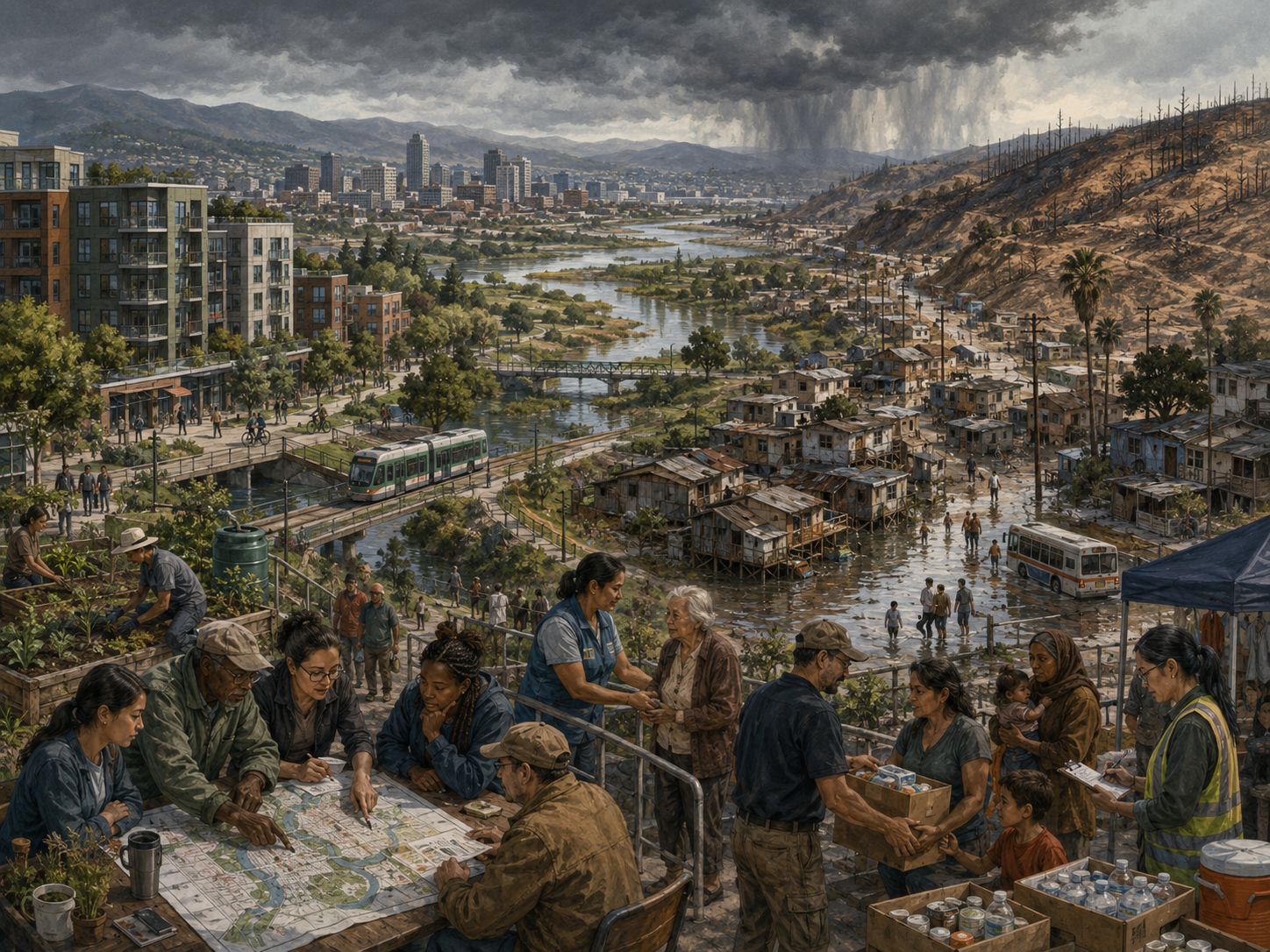
What Social Vulnerability Means
Social vulnerability refers to the social conditions that make some people more likely to be harmed by hazards, disruption, environmental stress, economic shock, disease, infrastructure failure, or institutional breakdown. It includes the unequal distribution of resources, power, exposure, protection, information, mobility, health, housing, recovery support, and political voice. In resilience thinking, social vulnerability helps explain why systems do not experience disturbance evenly. A hazard may be meteorological, biological, technological, economic, or infrastructural, but its consequences are shaped by social structure.
Social vulnerability does not mean that people are inherently vulnerable. It means that the systems surrounding them create unequal conditions of risk. A person who cannot evacuate during a flood may face danger because transit is unavailable, emergency warnings are not accessible, wages make missed work impossible, a landlord neglected repairs, disability services are absent, or shelters are not safe. A household that struggles after a heatwave may do so because energy costs are unaffordable, housing is poorly insulated, tree canopy is absent, healthcare access is limited, or labor protections are weak. These are social and institutional arrangements, not personal failures.
The concept is especially important because many resilience strategies focus on physical systems while overlooking the people most exposed to harm. Floodwalls, power grids, cooling centers, emergency apps, insurance programs, and recovery funds may all improve technical resilience while leaving socially vulnerable groups underprotected. Social vulnerability analysis asks whether resilience investments reach the people who need them most and whether they change the underlying conditions that produce unequal risk.
| Concept | Meaning | Resilience implication |
|---|---|---|
| Hazard | A potentially damaging event, process, or condition | Floods, heatwaves, wildfire, disease, cyber disruption, economic shocks, and infrastructure failures are hazards. |
| Exposure | The presence of people, assets, systems, or ecosystems in places where they can be harmed | Exposure is shaped by land use, housing, work location, infrastructure, and environmental conditions. |
| Social vulnerability | The social conditions that increase susceptibility to harm and reduce capacity to prepare, respond, recover, or adapt | Vulnerability explains why the same hazard harms some groups more severely than others. |
| Adaptive capacity | The ability to adjust, learn, access resources, and change behavior or systems under stress | Capacity determines whether people can reduce risk before, during, and after disturbance. |
| Resilience | The ability to resist, absorb, adapt, recover, and transform after disturbance | Resilience is incomplete if it improves average performance while leaving vulnerable groups exposed. |
Social vulnerability gives resilience thinking its ethical and distributional lens. It asks not only whether a system survives, but who is protected, who is sacrificed, and whose vulnerability was produced long before the hazard arrived.
Why Social Vulnerability Matters
Social vulnerability matters because disasters are not natural in their consequences. Hazards may originate in climate, geology, disease, technology, markets, or infrastructure, but harm is patterned by social conditions. A heatwave is more deadly where housing is poor, cooling access is unequal, tree canopy is sparse, workers cannot avoid exposure, public-health systems are under-resourced, and older or disabled residents are socially isolated. A flood becomes more destructive where development has been allowed in floodplains, renters lack protection, insurance is unavailable, evacuation is inaccessible, and recovery aid is difficult to navigate.
Social vulnerability also matters because resilience policies can reproduce inequality if they focus only on assets, averages, or rapid system restoration. A city may restore electricity quickly on average while medically vulnerable households remain without power. A disaster recovery program may distribute funds efficiently while excluding undocumented residents, renters, informal workers, or people without clear title. A climate adaptation project may protect property values while accelerating displacement. A resilience dashboard may show improved regional metrics while hiding neighborhoods where vulnerability worsens.
Vulnerability analysis changes the question. Instead of asking only, “How strong is the system?” it asks, “Strong for whom?” Instead of asking only, “How fast did recovery occur?” it asks, “Who recovered, who did not, and why?” Instead of asking only, “How much damage occurred?” it asks, “Which social conditions converted hazard into disaster?” This shift is essential for just resilience.
Why social vulnerability is a resilience priority
It reveals unequal harm
Disaster losses, health impacts, displacement, service outages, and recovery burdens are patterned by social conditions.
It prevents false averages
Aggregate resilience metrics can hide neighborhoods and groups where vulnerability remains high or worsens.
It improves targeting
Vulnerability analysis helps direct preparedness, adaptation, recovery, and public investment where support is most needed.
It strengthens legitimacy
Institutions are more trusted when resilience policies protect those most exposed and under-resourced.
It identifies root causes
Social vulnerability analysis shifts attention from hazard response to housing, health, income, rights, infrastructure, and governance.
It supports transformation
Some vulnerabilities cannot be solved by emergency response; they require structural change in development pathways.
Social vulnerability matters because resilience without vulnerability reduction can become protection for systems that continue to place some people in harm’s way.
Hazard, Exposure, Vulnerability, and Capacity
Disaster risk is commonly understood as an interaction among hazard, exposure, vulnerability, and capacity. A hazard is the potentially damaging event or process. Exposure refers to people, assets, infrastructure, and ecosystems located where harm can occur. Vulnerability refers to the conditions that increase susceptibility to harm. Capacity refers to the resources, institutions, knowledge, networks, and capabilities that help people prepare, respond, recover, and adapt.
These components interact. A household may face a high hazard but low vulnerability if it has safe housing, savings, insurance, transportation, health support, and institutional access. Another household may face a lower hazard but greater vulnerability if it lacks housing security, mobility, language access, public trust, legal protection, or recovery resources. Exposure is also socially produced. People do not simply choose where risk occurs. Housing markets, segregation, zoning, employment, land dispossession, infrastructure investment, and public policy often determine who lives or works in exposed places.
Capacity is equally uneven. Capacity includes household resources such as income, savings, transportation, social support, health, and information. It also includes collective and institutional resources: public services, emergency response, healthcare, social protection, trusted communication, legal rights, mutual aid, and infrastructure. A resilience strategy that increases capacity only for already-resourced groups can deepen inequality.
| Risk component | Key question | Social-vulnerability link |
|---|---|---|
| Hazard | What damaging event, process, or stressor may occur? | Climate change, pollution, disease, market shocks, and infrastructure failure may be intensified by human systems. |
| Exposure | Who or what is located where harm can occur? | Housing markets, land use, segregation, work conditions, and infrastructure determine who is exposed. |
| Vulnerability | Who is more likely to be harmed, and why? | Income, health, disability, age, race, housing, legal status, gender, language, and institutional access shape susceptibility. |
| Capacity | Who can prepare, respond, recover, and adapt? | Resources, public services, trust, social networks, insurance, transportation, rights, and recovery systems shape capacity. |
| Resilience outcome | Who returns to safety, dignity, function, and future possibility? | Recovery is unequal when support systems favor those who already have assets and administrative access. |
Understanding risk through hazard, exposure, vulnerability, and capacity prevents resilience planning from treating disasters as external shocks alone. It reveals the social structures that turn hazards into unequal harm.
Social Vulnerability and Resilience Thinking
Resilience thinking examines how systems absorb disturbance, adapt, recover, and transform. Social vulnerability adds a necessary question: whose resilience is being measured? A city, region, institution, or infrastructure network may be described as resilient because it resumes function after disruption. But if low-income neighborhoods remain damaged, renters are displaced, disabled residents lose services, informal workers lose income, and marginalized communities receive less recovery support, the system’s resilience is uneven and ethically incomplete.
Social vulnerability also helps distinguish between recovery and transformation. Recovery can restore the conditions that made people vulnerable in the first place. A community can rebuild unsafe housing after every flood. An energy system can restore power without reducing energy burden or protecting medically vulnerable households. A public-health system can recover from crisis without addressing underlying health inequity. Resilience thinking becomes stronger when it asks whether recovery reduces future vulnerability or simply returns people to the same risk structure.
Social vulnerability is especially important for identifying thresholds. Households and communities can absorb stress for a time, then cross points of severe harm. A family may manage rising rent until one missed paycheck leads to eviction. A neighborhood may endure repeated flooding until insurance withdrawal and property devaluation trigger decline. A medically vulnerable resident may survive routine heat but not a power outage during extreme temperatures. Social thresholds are often invisible until they are crossed.
| Resilience concept | Social-vulnerability question | Planning implication |
|---|---|---|
| Absorption | Who has enough resources, health, housing, mobility, and support to withstand the shock? | Build household security, service continuity, and targeted protective capacity before crisis. |
| Recovery | Who can access aid, return home, restore income, and rebuild safely? | Design recovery systems around renters, informal workers, disabled people, undocumented residents, and low-resource households. |
| Adaptation | Who has choices, information, finance, and institutional support to adjust? | Make adaptation accessible, affordable, rights-based, and community-guided. |
| Transformation | Which social conditions produce vulnerability and must change? | Address housing, labor, land use, health, environmental justice, public finance, and institutional access. |
| Thresholds | Where could cumulative stress become displacement, illness, debt, loss of trust, or social breakdown? | Monitor slow variables and intervene before irreversible harm. |
Resilience thinking without social vulnerability can overvalue system continuity. Social vulnerability analysis asks whether continuity protects people or preserves conditions of unequal risk.
Core Dimensions of Social Vulnerability
Social vulnerability is multidimensional. It cannot be reduced to poverty alone, although poverty is often central. Vulnerability is shaped by the interaction among income, housing, health, disability, age, race, ethnicity, Indigeneity, gender, care responsibilities, language, legal status, transportation, infrastructure, environmental exposure, social networks, public trust, institutional access, and political power. These dimensions interact rather than simply add together.
Economic Security
Economic security affects the ability to prepare, evacuate, miss work, buy supplies, repair damage, access healthcare, pay for energy, replace lost goods, and avoid debt after disruption. Low income, unstable work, lack of savings, debt, insurance gaps, and precarious employment increase vulnerability because they reduce choices before, during, and after crisis.
Housing and Place
Housing quality, affordability, tenure, overcrowding, location, building safety, energy efficiency, and displacement risk shape vulnerability. People in unsafe, unaffordable, poorly insulated, or exposed housing face greater harm from heat, flood, storm, wildfire smoke, cold, disease, and infrastructure failure. Renters and people without secure title may face special recovery barriers.
Health, Disability, and Care
Health status, disability, chronic illness, age, medication dependence, mobility needs, caregiving responsibilities, and access to healthcare shape risk. People who rely on electricity-dependent medical devices, accessible transportation, home care, medication refrigeration, or regular treatment may face severe consequences from service disruption.
Social Identity and Structural Inequality
Race, ethnicity, Indigeneity, caste, gender, migration status, language, religion, disability, age, and class can shape vulnerability through discrimination, exclusion, unequal enforcement, environmental injustice, labor precarity, land dispossession, housing segregation, and unequal institutional trust. The issue is not identity itself; it is the structure of unequal treatment attached to identity.
Infrastructure and Institutional Access
Transportation, energy, water, sanitation, broadband, healthcare, schools, emergency services, legal aid, benefits systems, and public communication determine whether people can access protection and recovery. Administrative burden, documentation requirements, digital-only systems, language barriers, and distrust can make formal services inaccessible in practice.
Social Networks and Political Voice
Social networks, mutual aid, community institutions, local leadership, civic participation, labor organizations, faith groups, cultural associations, and political representation shape resilience. Networks can provide care, information, resources, and advocacy, but they should not be used as a substitute for public responsibility or institutional investment.
| Dimension | Primary resilience function | Failure if neglected |
|---|---|---|
| Economic security | Provides choices, preparedness capacity, recovery resources, and protection from debt | Shocks become eviction, hunger, debt, job loss, or delayed recovery. |
| Housing and place | Determines exposure, shelter quality, recovery rights, and displacement risk | Hazards become chronic housing insecurity and neighborhood loss. |
| Health, disability, and care | Shapes sensitivity to disruption and need for continuity of services | Service outages become medical crises or preventable deaths. |
| Structural inequality | Shapes exposure, institutional treatment, and access to protection | Resilience policy reproduces historical injustice. |
| Infrastructure and institutional access | Provides the practical means to prepare, respond, recover, and adapt | Formal programs exist but remain inaccessible. |
| Social networks and political voice | Supports mutual aid, trusted communication, advocacy, and local knowledge | Communities are treated as recipients of policy rather than partners in resilience. |
Social vulnerability is produced by the interaction among these dimensions. A serious resilience strategy must treat them as connected conditions rather than isolated demographic indicators.
The Historical Production of Vulnerability
Social vulnerability is historically produced. It is shaped by land dispossession, colonization, racial segregation, exclusionary zoning, redlining, discriminatory lending, labor exploitation, uneven infrastructure investment, environmental racism, underfunded schools, public-health inequity, policing, immigration policy, disability exclusion, gendered care burdens, and unequal access to political power. These histories do not disappear when a hazard arrives. They determine who is exposed, who has resources, who trusts institutions, who can leave, who can return, and who receives support.
This historical perspective is essential because vulnerability is often described as if it were a snapshot. A map may show high social vulnerability in a neighborhood, but the map itself does not explain why that vulnerability exists. It may reflect decades of disinvestment, highway construction, industrial pollution, exclusion from mortgages, weak tenant protections, lack of tree canopy, health inequity, and limited political representation. Without historical analysis, vulnerability mapping can unintentionally blame communities for conditions imposed upon them.
Historical analysis also changes what resilience requires. If vulnerability is produced by structural conditions, then resilience cannot be achieved only through emergency kits, warnings, shelters, or individual preparedness. Those measures matter, but they do not address root causes. Resilience requires housing justice, public-health investment, environmental remediation, labor protection, accessible services, infrastructure equity, land rights, anti-displacement policy, and institutional accountability.
| Historical process | Vulnerability pathway | Resilience response |
|---|---|---|
| Segregation and redlining | Unequal housing quality, wealth accumulation, infrastructure, tree canopy, and environmental exposure | Targeted investment, housing repair, anti-displacement protections, environmental remediation, and wealth-building policy. |
| Colonization and land dispossession | Loss of land, governance authority, cultural continuity, ecological stewardship, and resource access | Respect Indigenous sovereignty, land rights, cultural protocols, co-governance, and restoration led by affected communities. |
| Industrial siting and environmental racism | Pollution burdens, health vulnerability, flood risk, heat exposure, and reduced property values | Remediation, cumulative-impact assessment, pollution control, community monitoring, and regulatory accountability. |
| Underinvestment in public services | Weak healthcare, transit, schools, emergency response, parks, water, sanitation, and public infrastructure | Public investment aligned with vulnerability, not only market value or political influence. |
| Labor precarity | Limited savings, unsafe work, inability to evacuate, heat exposure, and income loss after disruption | Wage protections, paid leave, worker safety, unemployment support, childcare, and heat labor standards. |
Social vulnerability is not merely a present condition. It is the accumulated result of past decisions, and resilience planning must be honest about that inheritance.
Intersectionality and Compounded Risk
Social vulnerability is intersectional. People do not experience income, race, gender, disability, age, language, immigration status, housing, health, and geography separately. These conditions interact. A low-income older adult with a disability living alone in a poorly insulated apartment faces different heat risk than a younger high-income homeowner in the same neighborhood. An undocumented worker may face evacuation, wage, legal, language, and healthcare barriers simultaneously. A renter with children may face school disruption, food insecurity, transportation barriers, and displacement risk after flooding.
Intersectionality matters because single indicators can obscure real vulnerability. Income alone does not capture disability-related evacuation needs. Age alone does not capture social isolation or housing quality. Race alone does not capture language access, income, legal status, environmental exposure, or institutional trust. A social vulnerability analysis that treats categories separately may miss the cumulative burden created by their interaction.
Compounded risk also operates across events. A household recovering from one disruption may be less able to withstand the next. A family that used savings after a flood may be more vulnerable to a heatwave. A community recovering from pandemic losses may have reduced capacity to respond to wildfire smoke or economic shock. Social vulnerability is therefore cumulative and dynamic, not fixed.
Intersectional vulnerability examples
Older renters during heatwaves
Age, fixed income, energy costs, housing quality, social isolation, and health conditions can combine into severe risk.
Disabled residents during outages
Medical devices, elevator access, medication refrigeration, accessible transit, and caregiver availability shape survival.
Migrant workers during wildfire smoke
Outdoor labor, legal precarity, language access, housing crowding, healthcare barriers, and wage pressure interact.
Single caregivers during floods
Childcare, transport, school closure, income loss, evacuation logistics, and aid eligibility can compound recovery burden.
Indigenous communities under climate stress
Land rights, cultural heritage, subsistence practices, governance authority, ecological change, and historical dispossession are linked.
Low-income households after disaster
Debt, insurance gaps, damaged housing, lost work, administrative burden, and displacement risk can reinforce one another.
Intersectionality helps resilience planning move beyond demographic checklists toward a deeper understanding of how vulnerability is lived and compounded.
Poverty, Income, and Livelihood Insecurity
Economic insecurity is one of the most powerful drivers of social vulnerability. Income, savings, debt, credit access, insurance, employment security, benefits access, and workplace protections shape the ability to prepare for disruption and recover afterward. A household with savings can buy supplies, relocate temporarily, replace spoiled food, repair damage, miss work, pay deductibles, and access healthcare. A household living paycheck to paycheck may face cascading harm from the same event.
Livelihood insecurity matters before a disaster. Workers in low-wage, informal, seasonal, or precarious jobs may not have paid leave, hazard pay, safe working conditions, unemployment protection, or flexibility to evacuate. Outdoor workers may be exposed to heat, wildfire smoke, storms, or unsafe air. Service workers may lose wages when businesses close. Care workers may be expected to continue working during crisis while facing their own household risk.
Recovery programs often assume economic capacity. People may need documentation, internet access, bank accounts, property title, insurance, transportation, time, and English-language forms to receive aid. These requirements can exclude the people most affected. Vulnerability reduction therefore requires not only emergency relief, but economic security: living wages, social protection, unemployment support, paid leave, affordable utilities, food security, debt relief, and accessible recovery finance.
| Economic condition | How it increases vulnerability | Resilience response |
|---|---|---|
| Low income | Limits preparedness, evacuation, repair, healthcare, cooling, insurance, and recovery options | Cash assistance, living wages, utility support, food security, and accessible recovery grants. |
| Lack of savings | Small disruptions become debt, eviction, hunger, or delayed recovery | Emergency cash, disaster unemployment assistance, debt protection, and rapid relief. |
| Precarious work | Workers cannot miss work, evacuate, shelter, or avoid exposure without losing income | Paid leave, worker protection, heat standards, unemployment support, and wage replacement. |
| Insurance gaps | Damage recovery depends on personal wealth or limited aid | Affordable insurance, public risk pools, renter support, and grants for low-income households. |
| Administrative barriers | Aid is difficult to access for those with limited time, internet, documentation, or language access | Simple applications, navigators, multilingual support, presumptive eligibility, and low-burden delivery. |
Economic resilience is not simply market recovery. It is the ability of households and workers to avoid cascading harm when shocks interrupt income, services, housing, and care.
Housing, Land Tenure, and Displacement Risk
Housing is one of the most important determinants of social vulnerability. Housing location determines exposure to flood, heat, pollution, wildfire, landslide, industrial hazard, and infrastructure failure. Housing quality determines whether people are protected from heat, cold, mold, smoke, storm, disease, and power outage. Housing affordability determines whether households have resources for preparedness and recovery. Tenure determines rights after damage. Displacement determines whether recovery becomes community loss.
Renters are often especially vulnerable. They may lack control over building improvements, air conditioning, insulation, floodproofing, mold remediation, or energy efficiency. They may be displaced if landlords do not repair damage or if rents rise after recovery investment. They may not qualify for homeowner-oriented recovery programs. People in informal housing, mobile homes, shelters, encampments, public housing, or overcrowded units face additional exposure and institutional barriers.
Land tenure also matters. Indigenous communities, informal settlements, heirs’ property owners, residents without clear title, and people living in legally precarious housing may struggle to access recovery aid or defend land rights. Resilience policy must therefore treat housing and land as central—not peripheral—to vulnerability reduction.
| Housing factor | Vulnerability pathway | Resilience response |
|---|---|---|
| Exposure location | Homes are located in floodplains, heat islands, wildfire zones, polluted corridors, or unstable slopes | Risk-informed land use, buyouts with justice, relocation support, restoration, and anti-displacement protections. |
| Housing quality | Unsafe, inefficient, crowded, or poorly maintained buildings increase harm | Repair grants, weatherization, cooling, ventilation, mold remediation, and code enforcement with tenant protection. |
| Tenure insecurity | Renters and informal residents lack control, legal protection, or recovery eligibility | Tenant rights, renter recovery aid, eviction moratoria, legal aid, and landlord accountability. |
| Displacement pressure | Recovery and adaptation investment can raise land values and push residents out | Community land trusts, rent protections, affordable housing preservation, and anti-speculation measures. |
| Land-title barriers | Residents without clear title may be excluded from aid or rebuilding support | Title assistance, flexible documentation, heirs’ property support, and culturally appropriate land-rights policy. |
Housing resilience is not only about buildings surviving hazards. It is about people remaining safely housed, connected, and able to recover without displacement.
Health, Disability, Age, and Care Dependency
Health, disability, age, and care dependency shape social vulnerability because disruption often affects bodies before it appears in economic or infrastructure statistics. People with chronic illnesses, disabilities, limited mobility, sensory disabilities, cognitive disabilities, mental-health conditions, pregnancy, medication dependence, respiratory vulnerability, dialysis needs, or electricity-dependent medical devices may face severe risk from heat, smoke, flood, disease, power outage, transportation disruption, or healthcare interruption.
Older adults may face elevated risk because of health conditions, mobility limitations, social isolation, fixed incomes, medication needs, and sensitivity to heat or cold. Children face different vulnerabilities: dependency on caregivers, school disruption, developmental needs, food access, air pollution sensitivity, and trauma. Caregivers carry additional burdens during crisis, especially when childcare, schools, healthcare, home care, or transportation systems fail.
Disability access must be designed into resilience systems from the start. Emergency warnings must be accessible. Shelters must accommodate mobility, sensory, medical, and care needs. Evacuation must include paratransit and personal assistance. Recovery programs must be navigable for people with cognitive, sensory, language, and mobility barriers. Power resilience must account for medical devices. Public-health resilience must include continuity of care.
Health, disability, age, and care priorities
Medical continuity
Medication, dialysis, oxygen, refrigeration, durable medical equipment, and treatment schedules require continuity plans.
Accessible warnings
Alerts must be available in visual, auditory, plain-language, multilingual, and accessible formats.
Evacuation support
Mobility assistance, paratransit, caregiver coordination, and accessible shelters must be planned before crisis.
Cooling and clean air
Heat and smoke resilience require safe indoor environments, energy support, filtration, and health outreach.
Care infrastructure
Schools, childcare, eldercare, home care, and disability services are essential resilience systems.
Mental health and trauma
Disaster exposure, displacement, uncertainty, and repeated loss require long-term psychosocial support.
Health and disability are not special cases within resilience planning. They reveal whether resilience systems protect real human needs under stress.
Race, Ethnicity, Indigeneity, and Structural Inequality
Race, ethnicity, and Indigeneity shape vulnerability through structural inequality rather than biological difference. In many societies, racialized and Indigenous communities have experienced land dispossession, segregation, discriminatory housing policy, unequal infrastructure, environmental injustice, underinvestment, policing, exclusion from finance, cultural erasure, and unequal access to institutions. These histories shape present exposure, health, wealth, trust, and recovery capacity.
Environmental justice research has repeatedly shown that marginalized communities are more likely to face pollution burdens, industrial hazards, poor air quality, flood exposure, heat islands, and infrastructure neglect. Disaster recovery can also reproduce inequality when aid systems favor homeowners, people with insurance, people with clear title, English speakers, digitally connected households, and communities with political influence.
Indigenous communities face specific forms of vulnerability and resilience. Climate change can threaten land, water, food systems, cultural heritage, sacred sites, subsistence practices, and self-determination. At the same time, Indigenous knowledge systems and governance traditions often hold deep ecological memory and stewardship practice. Resilience planning must respect sovereignty, consent, land rights, knowledge protocols, and community-led priorities rather than extracting Indigenous knowledge for externally defined adaptation plans.
| Structural condition | Vulnerability pathway | Resilience response |
|---|---|---|
| Racialized housing inequality | Concentrated exposure, poor housing quality, wealth gaps, and displacement risk | Housing repair, anti-displacement policy, fair recovery aid, and targeted infrastructure investment. |
| Environmental racism | Pollution, cumulative health burden, industrial exposure, and reduced ecosystem protection | Cumulative-impact regulation, remediation, community monitoring, and environmental justice enforcement. |
| Institutional distrust | Warnings, aid, and public guidance may be ignored or feared because of historical harm | Trusted messengers, accountability, transparency, rights protection, and community-led governance. |
| Indigenous land dispossession | Loss of land, ecological stewardship authority, cultural continuity, and resource access | Sovereignty, land return where appropriate, co-governance, cultural protocols, and Indigenous-led adaptation. |
| Unequal recovery systems | Aid distribution favors property owners, insured households, and administratively advantaged groups | Renter aid, flexible documentation, title support, language access, and disaggregated recovery tracking. |
Social vulnerability analysis should never treat race, ethnicity, or Indigeneity as risk factors in themselves. The risk factor is structural inequality.
Gender, Care Labor, and Household Resilience
Gender shapes vulnerability through labor markets, caregiving roles, income inequality, safety, health access, political representation, and social expectations. Women, girls, LGBTQ+ people, gender-diverse people, caregivers, and people experiencing domestic violence may face specific risks before, during, and after disruption. These risks are not uniform, and they vary by class, race, age, disability, legal status, and cultural context.
Care labor is especially important. Households and communities rely on paid and unpaid care: childcare, eldercare, disability support, healthcare, food preparation, emotional labor, school coordination, and family logistics. During disaster or climate stress, care burdens often increase. Schools close, health services are disrupted, transportation fails, children need supervision, elders need assistance, and families must navigate recovery systems. If resilience planning ignores care, it misses one of the main systems that holds society together.
Gendered vulnerability also appears in safety and recovery. Shelters may not feel safe for all residents. Disaster displacement can increase risk of violence or exploitation. Recovery programs may assume male-headed households or property ownership. Labor recovery may ignore care responsibilities. A gender-responsive resilience strategy must include safety, income support, reproductive health, childcare, eldercare, disability care, worker protections, and participation by those who perform care work.
| Gender and care dimension | Vulnerability pathway | Resilience response |
|---|---|---|
| Unpaid care burden | Care responsibilities increase during crisis and reduce ability to work, evacuate, or recover | Childcare, eldercare, disability support, paid leave, and caregiver-inclusive emergency planning. |
| Income inequality | Lower earnings and wealth reduce preparedness and recovery options | Cash assistance, wage protections, employment support, and recovery programs designed for caregivers. |
| Safety in shelters and displacement | Displacement can increase risk of harassment, violence, exploitation, or family separation | Safe shelter design, privacy, trauma-informed services, gender-responsive protection, and legal support. |
| Health and reproductive needs | Pregnancy, reproductive healthcare, menstrual hygiene, and medication needs can be disrupted | Health continuity, accessible supplies, reproductive healthcare, and targeted outreach. |
| Participation gaps | Care burdens and exclusion reduce ability to participate in planning | Compensated participation, meeting accessibility, childcare support, and decision authority. |
Care is resilience infrastructure. A system that cannot protect care work under stress is less resilient than its technical metrics suggest.
Language, Legal Status, and Institutional Access
Language access, legal status, and institutional access are major determinants of social vulnerability. Emergency warnings, public-health guidance, disaster aid, insurance claims, legal rights, evacuation instructions, shelter information, and recovery applications often depend on language, documentation, digital access, and trust. People who cannot access information or fear institutions may face greater harm even when services technically exist.
Legal status can shape vulnerability through fear of deportation, labor exploitation, housing insecurity, exclusion from public benefits, limited healthcare access, and reluctance to seek help. Mixed-status families may avoid shelters, hospitals, public agencies, or aid systems if they fear exposure. Informal workers may lose wages without protection. Migrants may lack documentation required for recovery assistance. These conditions are institutional, not personal.
Language access is also essential. Translation alone may not be enough. Communication must be timely, culturally relevant, accessible, trusted, and delivered through channels people actually use. Plain language matters. Visual formats matter. Community messengers matter. Public institutions must build trust before crisis rather than assume people will trust them during crisis.
Institutional access priorities
Multilingual warnings
Emergency information should be available in relevant languages before, during, and after disruption.
Trusted messengers
Community organizations, faith groups, clinics, schools, and local leaders can reach people formal agencies may not.
Low-burden aid
Applications should minimize documentation, digital barriers, repeated forms, and confusing eligibility rules.
Legal protections
People should be able to seek shelter, healthcare, and recovery support without fear of enforcement harm.
Digital alternatives
Online systems should be supplemented with phone, in-person, paper, and navigator-supported access.
Cultural competence
Communication and services must respect community histories, norms, concerns, and institutional distrust.
Resilience systems fail when support exists on paper but is inaccessible in practice. Institutional access is therefore a core resilience condition.
Infrastructure, Mobility, and Service Access
Infrastructure shapes vulnerability because essential services determine whether people can remain safe during disruption. Energy, water, sanitation, transportation, communications, healthcare, schools, food distribution, emergency services, and public buildings all structure resilience. Infrastructure failure is socially unequal when some neighborhoods experience longer outages, weaker maintenance, fewer backup systems, poorer transit, lower tree canopy, or slower restoration.
Mobility is especially important. People need transportation to evacuate, reach cooling centers, access healthcare, buy food, get to work, check on family, and obtain aid. Car-dependent resilience planning excludes people without cars, disabled residents, older adults, youth, low-income households, and people who rely on transit or paratransit. Evacuation orders that assume private vehicles are not equitable.
Service access also includes proximity and reliability. A cooling center is not accessible if it is far away, open only during work hours, not served by transit, unsafe, not disability-accessible, or unknown to residents. A public-health clinic is not accessible if it lacks language services or cannot operate during outages. A digital alert system is not accessible if residents lack smartphones, broadband, or trust. Infrastructure resilience must be evaluated by actual access, not just asset presence.
| Infrastructure system | Vulnerability pathway | Resilience response |
|---|---|---|
| Energy | Outages threaten medical devices, cooling, heating, refrigeration, communication, and safety | Backup power, distributed energy, energy assistance, medically vulnerable registries, and restoration equity. |
| Water and sanitation | Service disruption creates health risks, hygiene barriers, and household burden | Redundancy, water distribution, affordability, repair, contamination monitoring, and public communication. |
| Transportation | Car dependence limits evacuation, aid access, work, health, and family care | Transit resilience, paratransit, evacuation support, accessible shelters, and mobility planning. |
| Communications | Disconnected households miss warnings, aid information, and public guidance | Multichannel alerts, community messengers, broadband equity, radio, door-knocking, and trusted networks. |
| Healthcare and care systems | Disruption affects treatment, medication, home care, eldercare, childcare, and mental health | Continuity plans, mobile care, telehealth alternatives, accessible transport, and backup power. |
Infrastructure resilience should be measured by whether essential services remain available to the people most likely to be harmed by their failure.
Environmental Justice and Unequal Exposure
Social vulnerability is inseparable from environmental justice. Many communities experience disproportionate exposure to pollution, heat, flooding, industrial hazards, wildfire smoke, poor air quality, contaminated water, traffic emissions, waste facilities, and degraded ecosystems. These exposures are not random. They are shaped by land-use decisions, industrial siting, zoning, infrastructure investment, housing markets, political power, and regulatory enforcement.
Environmental exposure increases vulnerability before a disaster occurs. Chronic pollution can increase respiratory and cardiovascular disease, making heatwaves, smoke events, pandemics, and outages more dangerous. Lack of tree canopy can increase heat exposure. Flood-prone land can produce repeated damage, mold, insurance stress, and displacement. Industrial corridors can create compound risk when storms, fires, or power failures interact with hazardous facilities.
Environmental justice also changes recovery and adaptation. A community that has experienced decades of pollution may distrust agencies promising resilience improvements. A green infrastructure project may improve flood management but increase property values and displacement pressure. A climate adaptation project may protect assets while ignoring cumulative health burden. Social vulnerability analysis must therefore include cumulative exposure, historical harm, and distributional accountability.
| Environmental justice issue | Vulnerability effect | Resilience response |
|---|---|---|
| Industrial pollution | Chronic health burden increases sensitivity to heat, smoke, disease, and chemical release | Cumulative-impact regulation, emissions reduction, monitoring, remediation, and health investment. |
| Urban heat islands | Heat exposure rises where tree canopy is low and surfaces absorb heat | Tree-canopy equity, cool roofs, housing retrofits, cooling access, and worker protections. |
| Flood exposure | Repeated flooding damages housing, health, finances, and community stability | Floodplain restoration, drainage, buyouts with justice, renter protections, and risk-informed land use. |
| Water contamination | Health risks increase and public trust erodes | Infrastructure repair, testing, public reporting, accountability, and safe-water access. |
| Green displacement | Environmental improvements raise land values and push residents out | Anti-displacement protections, community land trusts, affordable housing, and community ownership. |
Environmental justice reframes resilience: protecting ecosystems and infrastructure is not enough if environmental burdens remain concentrated on communities with the least political power.
Information, Trust, and Risk Communication
Information is a resilience resource, but it is not distributed equally. People need timely, accurate, accessible, trusted information before, during, and after disruption. Risk communication includes warnings, evacuation instructions, public-health guidance, recovery aid, shelter locations, cooling center availability, insurance support, water safety notices, and service restoration updates. If communication fails, vulnerability increases.
Trust matters as much as message content. Communities that have experienced discrimination, neglect, broken promises, environmental harm, policing, deportation fear, or exclusion may distrust official messages. That distrust may be rational. Resilience planning should not assume that better messaging alone will solve trust deficits. Institutions must earn trust through accountability, transparency, fairness, follow-through, and partnership with trusted community organizations.
Communication must also be accessible. Messages should be multilingual, plain-language, disability-accessible, culturally relevant, available across multiple channels, and usable by people without broadband or smartphones. Risk communication should also be two-way. Institutions need channels for residents to report unmet needs, misinformation, local conditions, and barriers to services.
Risk communication priorities
Accessible alerts
Warnings should reach people across languages, disabilities, digital access levels, and communication preferences.
Trusted channels
Community groups, clinics, schools, libraries, faith institutions, worker centers, and local leaders can strengthen reach.
Plain-language guidance
People need clear instructions, not technical jargon or vague risk statements.
Uncertainty transparency
Institutions should explain what is known, what is uncertain, and when guidance may change.
Two-way feedback
Residents should be able to report conditions, confusion, unmet needs, and service failures.
Accountability through communication
Agencies should communicate not only instructions, but follow-through, decisions, tradeoffs, and corrections.
Risk communication reduces vulnerability only when information is trusted, accessible, actionable, and connected to material support.
Social Capital, Mutual Aid, and Network Capacity
Social networks can reduce vulnerability. Neighbors check on older residents. Community organizations distribute food, water, masks, information, and supplies. Faith groups provide shelter and emotional support. Worker centers protect labor rights. Mutual aid networks identify unmet needs faster than formal systems. Local leaders translate warnings and help people navigate recovery. These networks are often essential during crisis.
But social capital should be interpreted carefully. Communities with strong networks may still be highly vulnerable if public institutions are absent, infrastructure is weak, poverty is high, housing is unsafe, or hazards are severe. Community solidarity should not become an excuse for institutional abandonment. Mutual aid is powerful, but it cannot replace public responsibility for housing, healthcare, infrastructure, social protection, environmental justice, and disaster recovery.
Social networks also differ in reach and power. Some networks are bonding networks, connecting people within a group. Others are bridging networks, connecting across groups. Linking networks connect communities to institutions and decision makers. Resilience often depends on all three. A community may have strong internal support but limited influence over public resources. Another may have political access but weak neighborhood cohesion. Vulnerability reduction requires strengthening networks while also building institutional accountability.
| Network type | Resilience function | Risk if isolated |
|---|---|---|
| Bonding networks | Support close relationships, care, identity, mutual aid, and immediate assistance | May be overwhelmed if all members face the same disruption. |
| Bridging networks | Connect groups across neighborhoods, identities, sectors, and organizations | Can remain weak without trust, resources, or shared purpose. |
| Linking networks | Connect communities to institutions, funding, technical support, and decision authority | Can become patronage or symbolic consultation if power is unequal. |
| Mutual aid networks | Provide flexible, rapid, community-led support during crisis | Can be strained if institutions shift responsibility without resources. |
| Community institutions | Provide trusted spaces, leadership, memory, communication, and organizing capacity | May be underfunded despite being essential resilience infrastructure. |
Network capacity is a major source of resilience, but it should be supported by public investment rather than romanticized as a substitute for public systems.
Institutional Vulnerability and Administrative Burden
Social vulnerability is not only located in households or communities. Institutions can create vulnerability through administrative burden, exclusion, weak coordination, underfunding, poor communication, delayed aid, inaccessible services, and unequal enforcement. A recovery program may exist but be practically unreachable. A shelter may exist but be inaccessible. A warning system may exist but fail to reach those at risk. A benefits system may exist but require documentation people lost in the disaster.
Administrative burden refers to the learning, compliance, and psychological costs people face when accessing public services. These burdens include complex forms, confusing eligibility rules, repeated documentation, long wait times, digital access requirements, stigma, office hours that conflict with work, language barriers, and fear of institutions. Administrative burden increases vulnerability because it makes support harder to obtain when people are already under stress.
Institutional vulnerability also includes the weakness of agencies themselves. Understaffed, fragmented, distrusted, or underfunded institutions may be unable to protect vulnerable groups. If public health, housing, transit, utilities, social services, and emergency management cannot coordinate, social vulnerability deepens. Resilience planning must therefore examine institutional capacity and administrative justice as central to vulnerability reduction.
| Institutional barrier | Vulnerability effect | Resilience response |
|---|---|---|
| Complex aid applications | People most in need may be least able to complete forms quickly | Presumptive eligibility, simplified applications, navigators, and automatic enrollment. |
| Documentation requirements | Renters, informal workers, migrants, heirs’ property owners, and disaster-affected residents may be excluded | Flexible documentation, legal aid, affidavits, and low-barrier verification. |
| Digital-only services | People without broadband, devices, literacy, or trust are excluded | Phone, paper, in-person, mobile, and community-based access channels. |
| Fragmented agencies | People must navigate multiple systems during crisis | One-stop recovery centers, case management, shared data with privacy protections, and coordinated service delivery. |
| Unequal enforcement | Rules may punish vulnerable groups while overlooking powerful actors | Equity audits, due process, oversight, complaint systems, and enforcement transparency. |
Reducing social vulnerability requires making institutions easier to access, more accountable, and more capable of reaching people before harm compounds.
Social Vulnerability Indices
Social vulnerability indices are tools that combine indicators—such as income, age, disability, language, housing, race, transportation, and household composition—to identify places where people may need additional support before, during, and after hazards. In the United States, the CDC/ATSDR Social Vulnerability Index is a widely used place-based tool for public health and emergency planning. Similar approaches are used in disaster risk reduction, climate adaptation, environmental justice, and public-health preparedness.
Indices can be useful because they make inequality visible in planning. They help agencies target outreach, plan shelters, prioritize cooling centers, allocate preparedness resources, identify transportation needs, and evaluate recovery gaps. They can also support public accountability if used transparently. But indices have limitations. They depend on available data, indicator choices, geographic units, weighting methods, and assumptions about what counts as vulnerability. They may not capture informal networks, undocumented residents, local trust, recent displacement, institutional access, or lived experience.
Indices should therefore be used as starting points, not final judgments. A map can identify patterns, but it cannot replace community knowledge. An index score can help prioritize, but it should not label a community as deficient. Vulnerability data should be interpreted with local organizations, residents, public-health workers, planners, emergency managers, disability advocates, Indigenous authorities where relevant, and people directly affected by risk.
| Use of index | Potential value | Necessary caution |
|---|---|---|
| Preparedness planning | Identifies areas needing outreach, supplies, evacuation support, or cooling access | Local conditions may change faster than census-based data. |
| Resource allocation | Helps target funds and services to areas with high need | Index scores should not be the only basis for allocating resources. |
| Risk communication | Supports multilingual, culturally appropriate, and accessible communication planning | Trust networks must be identified through community engagement. |
| Recovery equity | Allows agencies to compare aid distribution with vulnerability patterns | Recovery metrics should include renters, informal workers, and undocumented residents where possible. |
| Accountability | Makes inequality visible to decision makers and the public | Maps can stigmatize communities if not framed as system-produced vulnerability. |
Social vulnerability indices are valuable when they support action, participation, and accountability. They are harmful when they become substitutes for political judgment, local knowledge, or structural reform.
Measuring Social Vulnerability Responsibly
Responsible social vulnerability measurement requires more than selecting indicators and producing a map. Measurement choices carry ethical and political consequences. Which variables are included? What scale is used? Are groups labeled as vulnerable, or are systems identified as producing vulnerability? Are data disaggregated enough to reveal inequality? Are privacy risks addressed? Are communities involved in interpreting results? Does the measurement trigger investment, or does it merely document need?
Measurement should combine quantitative and qualitative evidence. Quantitative data can reveal broad patterns: poverty, age, disability, housing, transportation, insurance, language, health, race, environmental exposure, and service access. Qualitative evidence can reveal lived experience, trust, informal networks, institutional barriers, recent changes, hidden populations, and local priorities. Participatory mapping and community review can identify errors or missing factors.
Measurement should also be dynamic. Vulnerability changes with rent increases, displacement, disasters, infrastructure projects, policy changes, public-health conditions, migration, economic shocks, and climate impacts. Static maps can become outdated. Resilience planning should include monitoring, updating, and public accountability for whether vulnerability is being reduced over time.
Responsible measurement principles
Measure systems, not blame
Frame vulnerability as produced by housing, infrastructure, policy, institutions, and inequality—not as community deficiency.
Disaggregate carefully
Averages hide inequality; small-area and group-specific data can reveal need but require privacy safeguards.
Combine data and lived knowledge
Indices should be interpreted with community organizations, frontline workers, and affected residents.
Track change over time
Vulnerability shifts with displacement, policy, climate, infrastructure, health, and economic conditions.
Connect metrics to action
Indicators should trigger investment, service changes, outreach, accountability, and policy reform.
Protect privacy and dignity
Data should not expose people to stigma, surveillance, enforcement harm, or exclusion.
The purpose of measuring social vulnerability is not to classify communities. It is to change the conditions that expose people to harm.
Reducing Social Vulnerability
Reducing social vulnerability requires structural resilience strategy. Emergency preparedness matters, but vulnerability reduction begins long before crisis. It includes affordable housing, safe buildings, living wages, healthcare access, disability services, clean air and water, public transit, social protection, tenant rights, worker protections, language access, public trust, environmental remediation, accessible infrastructure, and democratic participation. These are not separate from resilience; they are resilience.
Vulnerability reduction also requires targeted investments. Universal resilience strategies may miss unequal need if they assume equal starting conditions. Cooling centers should be placed where heat vulnerability is highest. Flood mitigation should protect renters and low-income residents, not only high-value property. Recovery funds should reach people without insurance, clear title, or digital access. Energy resilience should protect medically vulnerable households and people facing energy burden.
Vulnerability reduction must also avoid displacement and maladaptation. Investments in green infrastructure, flood protection, transit, parks, and housing repair can increase land values and displace the people they were meant to protect. Resilience planning should include anti-displacement safeguards, community ownership, tenant protections, affordable housing preservation, and long-term monitoring of who benefits from investment.
| Strategy area | Vulnerability-reduction action | Resilience effect |
|---|---|---|
| Housing | Repair unsafe housing, weatherize homes, protect renters, preserve affordability, reduce displacement | Reduces exposure to heat, cold, flood, mold, smoke, and recovery instability. |
| Health and care | Expand access to healthcare, home care, disability services, mental health, cooling, and clean air | Protects people most sensitive to disruption. |
| Income and work | Provide living wages, paid leave, unemployment support, worker safety, and rapid cash aid | Prevents shocks from cascading into poverty, debt, and displacement. |
| Infrastructure | Invest in energy, water, transit, broadband, public facilities, and service continuity in high-need areas | Ensures essential services remain accessible during disturbance. |
| Environmental justice | Reduce pollution, restore ecosystems, expand tree canopy, remediate hazards, and monitor cumulative burden | Reduces chronic health vulnerability and hazard exposure. |
| Institutional access | Simplify aid, provide language access, reduce documentation barriers, fund navigators, and build trust | Transforms formal programs into practical support. |
| Community power | Support community organizations, participatory budgeting, local leadership, and decision authority | Improves legitimacy, local knowledge, and accountability. |
Reducing vulnerability means changing the social conditions that convert hazards into unequal harm. It is one of the most important forms of resilience investment.
A Practical Framework for Vulnerability-Responsive Resilience Planning
A practical vulnerability-responsive resilience process should begin by identifying who is likely to be harmed, why, and what systems create that risk. It should then connect vulnerability analysis to concrete decisions: budgets, infrastructure, outreach, service design, land use, housing policy, public health, recovery rules, and institutional accountability. The goal is not simply to map vulnerability. The goal is to reduce it.
| Step | Question | Output |
|---|---|---|
| Define the hazard and system | What disturbance is being considered, and what systems does it affect? | Hazard-system map for climate, health, infrastructure, economic, ecological, or institutional stress. |
| Map exposure | Who lives, works, travels, or receives services in places of potential harm? | Exposure map including housing, workplaces, schools, care facilities, infrastructure, and public spaces. |
| Analyze social vulnerability | What conditions increase susceptibility to harm? | Vulnerability profile including income, housing, health, disability, age, language, race, environment, legal status, and service access. |
| Assess capacity | Who has resources, networks, mobility, information, rights, and institutional access? | Capacity map for households, community organizations, public services, healthcare, transit, and mutual aid. |
| Identify institutional barriers | What programs, rules, or administrative burdens prevent support from reaching people? | Administrative-burden review and institutional access plan. |
| Engage affected communities | Who must interpret the data and shape decisions? | Participatory planning process with compensated participation, language access, disability access, and decision influence. |
| Prioritize interventions | Which actions reduce root vulnerability rather than only respond to symptoms? | Portfolio for housing, health, income, infrastructure, environmental justice, service access, and community power. |
| Prevent displacement and harm | Could resilience investment create new vulnerability? | Anti-displacement safeguards, tenant protections, rights review, and benefit-distribution tracking. |
| Monitor outcomes | Is vulnerability actually declining over time? | Indicators for exposure, service access, recovery equity, health, displacement, income, trust, and infrastructure continuity. |
| Institutionalize accountability | Who is responsible for correcting unequal outcomes? | Public reporting, deadlines, oversight, budget commitments, and community review. |
Vulnerability-responsive resilience planning becomes meaningful when analysis changes decisions and when communities affected by risk have power over what resilience means in practice.
Mathematical Lens: Modeling Vulnerability, Capacity, Exposure, and Recovery
Social vulnerability cannot be reduced to a single number, but formal models can clarify relationships among exposure, vulnerability, capacity, and resilience. A simplified social vulnerability score \(V_i\) for group or place \(i\) can be represented as a weighted combination of economic insecurity, housing risk, health sensitivity, institutional access, environmental exposure, and social support:
V_i = w_e E_i + w_h H_i + w_s S_i + w_a A_i + w_p P_i – w_c C_i
\]
Interpretation: \(E_i\) represents economic insecurity, \(H_i\) housing risk, \(S_i\) health sensitivity, \(A_i\) institutional access barriers, \(P_i\) environmental pressure or exposure, and \(C_i\) protective capacity.
Risk can be expressed as an interaction among hazard intensity \(K_i\), exposure \(X_i\), vulnerability \(V_i\), and capacity \(C_i\):
R_i = K_i \times X_i \times \frac{V_i}{C_i + \epsilon}
\]
Interpretation: Risk increases with hazard, exposure, and vulnerability, and decreases as capacity rises. The small \(\epsilon\) prevents division by zero in computational models.
Recovery can be modeled dynamically. Let recovery level at time \(t\) be \(Q_t\), aid access be \(A_t\), household capacity be \(C_t\), administrative burden be \(B_t\), and displacement pressure be \(D_t\):
Q_{t+1} = Q_t + \alpha A_t + \beta C_t – \gamma B_t – \delta D_t
\]
Interpretation: Recovery improves when aid and capacity are accessible, but slows when administrative burden and displacement pressure increase.
A vulnerability-reduction strategy can be evaluated through expected resilience benefit across pathways \(j\):
E(P) = \sum_{j=1}^{n} p_j (C_j – V_j)
\]
Interpretation: Strategies are more valuable when they increase protective capacity while reducing vulnerability across plausible future conditions.
An equity-adjusted resilience score can include a penalty for unequal recovery or benefit distribution:
R_i^{*} = R_i – \theta U_i
\]
Interpretation: \(U_i\) represents unequal burden or recovery inequity. A system is less resilient when average performance improves while vulnerable groups remain harmed.
These equations do not replace ethical judgment, community knowledge, public health, social science, or policy analysis. They make assumptions visible so vulnerability-reduction strategies can be compared, challenged, and improved.
Advanced R Workflow: Comparing Vulnerability-Reduction Strategies
The R workflow below compares vulnerability-reduction strategies across exposure reduction, economic security, housing stability, health protection, institutional access, community capacity, equity protection, and implementation burden. It then shows how rankings shift under different strategic priorities.
# Install packages if needed:
# install.packages(c("tidyverse", "scales"))

library(tidyverse)
library(scales)

# -------------------------------------------------------------------
# Example vulnerability-reduction strategies.
# Higher implementation_burden is worse.
# Values are synthetic and for methodological demonstration only.
# -------------------------------------------------------------------

strategies <- tibble(
  strategy = c(
    "Targeted Housing Repair and Anti-Displacement Program",
    "Heat Health Outreach and Energy Affordability Plan",
    "Accessible Evacuation and Mobility Support System",
    "Low-Burden Recovery Aid and Benefits Navigation",
    "Environmental Justice Remediation and Monitoring",
    "Community Resilience Hubs and Mutual Aid Support"
  ),
  exposure_reduction = c(8.4, 7.9, 8.0, 7.3, 8.7, 7.8),
  economic_security = c(8.2, 8.1, 7.6, 8.8, 7.4, 7.9),
  housing_stability = c(9.1, 7.8, 7.4, 8.0, 7.6, 7.5),
  health_protection = c(7.9, 9.0, 8.2, 8.0, 8.5, 8.1),
  institutional_access = c(8.0, 8.1, 8.5, 9.2, 8.0, 8.4),
  community_capacity = c(7.8, 8.2, 8.3, 8.5, 8.1, 9.1),
  equity_protection = c(8.8, 8.4, 8.6, 8.9, 8.7, 8.5),
  implementation_burden = c(3.5, 3.0, 3.2, 2.8, 3.6, 3.1)
)

# -------------------------------------------------------------------
# Weighted vulnerability-reduction value function.
# -------------------------------------------------------------------

score_strategies <- function(data, wx, we, wh, wp, wa, wc, wq, wi) {
  data %>%
    mutate(
      vulnerability_reduction_value =
        wx * exposure_reduction +
        we * economic_security +
        wh * housing_stability +
        wp * health_protection +
        wa * institutional_access +
        wc * community_capacity +
        wq * equity_protection -
        wi * implementation_burden,
      burden_review = implementation_burden >= 3.5,
      access_gap = pmax(0, 8.2 - institutional_access),
      adjusted_value = vulnerability_reduction_value - 0.08 * access_gap,
      diagnostic = case_when(
        implementation_burden >= 3.5 ~ "implementation-burden review needed",
        institutional_access < 8.0 ~ "institutional-access safeguards need strengthening",
        equity_protection < 8.5 ~ "equity safeguards need strengthening",
        housing_stability < 7.6 ~ "housing-stability review needed",
        TRUE ~ "promising but requires local validation"
      )
    ) %>%
    arrange(desc(adjusted_value))
}

# -------------------------------------------------------------------
# Scenario weights for different priorities.
# -------------------------------------------------------------------

scenarios <- tribble(
  ~scenario,                 ~wx,  ~we,  ~wh,  ~wp,  ~wa,  ~wc,  ~wq,  ~wi,
  "Balanced",                0.14, 0.14, 0.15, 0.14, 0.14, 0.14, 0.15, 0.02,
  "Exposure-first",          0.38, 0.10, 0.11, 0.10, 0.10, 0.10, 0.10, 0.01,
  "Economic-security-first", 0.10, 0.38, 0.11, 0.10, 0.10, 0.10, 0.10, 0.01,
  "Housing-first",           0.10, 0.11, 0.38, 0.10, 0.10, 0.10, 0.10, 0.01,
  "Health-first",            0.10, 0.10, 0.11, 0.38, 0.10, 0.10, 0.10, 0.01,
  "Access-first",            0.10, 0.10, 0.11, 0.10, 0.38, 0.10, 0.10, 0.01,
  "Community-first",         0.10, 0.10, 0.11, 0.10, 0.10, 0.38, 0.10, 0.01,
  "Equity-first",            0.10, 0.10, 0.11, 0.10, 0.10, 0.10, 0.38, 0.01,
  "Implementation-aware",    0.13, 0.13, 0.14, 0.13, 0.13, 0.13, 0.13, 0.10
)

# -------------------------------------------------------------------
# Evaluate strategies across scenarios.
# -------------------------------------------------------------------

scenario_results <- scenarios %>%
  rowwise() %>%
  do(
    score_strategies(
      strategies,
      wx = .$wx,
      we = .$we,
      wh = .$wh,
      wp = .$wp,
      wa = .$wa,
      wc = .$wc,
      wq = .$wq,
      wi = .$wi
    ) %>%
      mutate(scenario = .$scenario)
  ) %>%
  ungroup()

ranked_results <- scenario_results %>%
  group_by(scenario) %>%
  arrange(desc(adjusted_value), .by_group = TRUE) %>%
  mutate(rank = row_number()) %>%
  ungroup()

print(ranked_results)

# -------------------------------------------------------------------
# Visualize ranking shifts across priorities.
# -------------------------------------------------------------------

ggplot(ranked_results, aes(x = strategy, y = adjusted_value, group = scenario)) +
  geom_point(size = 3) +
  geom_line(aes(color = scenario), linewidth = 1) +
  coord_flip() +
  labs(
    title = "Vulnerability-Reduction Strategy Value Across Priority Scenarios",
    x = "Strategy",
    y = "Adjusted Vulnerability-Reduction Value",
    color = "Scenario"
  ) +
  theme_minimal(base_size = 12)

# -------------------------------------------------------------------
# Summarize which strategies rank first most often.
# -------------------------------------------------------------------

top_rank_summary <- ranked_results %>%
  filter(rank == 1) %>%
  count(strategy, name = "times_ranked_first") %>%
  arrange(desc(times_ranked_first))

print(top_rank_summary)

# -------------------------------------------------------------------
# Export results for review.
# -------------------------------------------------------------------

write_csv(ranked_results, "social_vulnerability_strategy_rankings.csv")
write_csv(top_rank_summary, "social_vulnerability_top_rank_summary.csv")
This workflow shows why vulnerability-reduction choices depend on planning priorities. Housing repair, heat-health outreach, accessible evacuation, low-burden recovery aid, environmental justice remediation, and community resilience hubs may rank differently depending on whether planners prioritize exposure, income, housing, health, access, community capacity, equity, or implementation feasibility.
Advanced Python Workflow: Uncertainty Analysis for Social Vulnerability and Resilience
The Python workflow below extends the same logic with Monte Carlo simulation. Instead of assuming fixed values, it models uncertainty across exposure reduction, economic security, housing stability, health protection, institutional access, community capacity, equity protection, and implementation burden.
# Install packages if needed:
# pip install pandas numpy matplotlib

import numpy as np
import pandas as pd
import matplotlib.pyplot as plt

# ---------------------------------------------------------------------
# Example vulnerability-reduction strategies.
# Values are synthetic and for methodological demonstration only.
# Higher implementation_burden is worse.
# ---------------------------------------------------------------------

strategies = pd.DataFrame({
    "strategy": [
        "Targeted Housing Repair and Anti-Displacement Program",
        "Heat Health Outreach and Energy Affordability Plan",
        "Accessible Evacuation and Mobility Support System",
        "Low-Burden Recovery Aid and Benefits Navigation",
        "Environmental Justice Remediation and Monitoring",
        "Community Resilience Hubs and Mutual Aid Support"
    ],
    "exposure_reduction": [8.4, 7.9, 8.0, 7.3, 8.7, 7.8],
    "economic_security": [8.2, 8.1, 7.6, 8.8, 7.4, 7.9],
    "housing_stability": [9.1, 7.8, 7.4, 8.0, 7.6, 7.5],
    "health_protection": [7.9, 9.0, 8.2, 8.0, 8.5, 8.1],
    "institutional_access": [8.0, 8.1, 8.5, 9.2, 8.0, 8.4],
    "community_capacity": [7.8, 8.2, 8.3, 8.5, 8.1, 9.1],
    "equity_protection": [8.8, 8.4, 8.6, 8.9, 8.7, 8.5],
    "implementation_burden": [3.5, 3.0, 3.2, 2.8, 3.6, 3.1]
})

# ---------------------------------------------------------------------
# Baseline weights.
# ---------------------------------------------------------------------

weights = {
    "exposure_reduction": 0.14,
    "economic_security": 0.14,
    "housing_stability": 0.15,
    "health_protection": 0.14,
    "institutional_access": 0.14,
    "community_capacity": 0.14,
    "equity_protection": 0.15,
    "implementation_burden": 0.02
}

benefit_columns = [
    "exposure_reduction",
    "economic_security",
    "housing_stability",
    "health_protection",
    "institutional_access",
    "community_capacity",
    "equity_protection"
]

# ---------------------------------------------------------------------
# Weighted vulnerability-reduction value function.
# ---------------------------------------------------------------------

def compute_strategy_value(df, weights_dict):
    result = df.copy()
    result["vulnerability_reduction_value"] = (
        weights_dict["exposure_reduction"] * result["exposure_reduction"]
        + weights_dict["economic_security"] * result["economic_security"]
        + weights_dict["housing_stability"] * result["housing_stability"]
        + weights_dict["health_protection"] * result["health_protection"]
        + weights_dict["institutional_access"] * result["institutional_access"]
        + weights_dict["community_capacity"] * result["community_capacity"]
        + weights_dict["equity_protection"] * result["equity_protection"]
        - weights_dict["implementation_burden"] * result["implementation_burden"]
    )

    result["access_gap"] = np.maximum(0, 8.2 - result["institutional_access"])
    result["housing_gap"] = np.maximum(0, 8.0 - result["housing_stability"])
    result["adjusted_value"] = (
        result["vulnerability_reduction_value"]
        - 0.08 * result["access_gap"]
        - 0.06 * result["housing_gap"]
    )

    result["diagnostic"] = np.select(
        [
            result["implementation_burden"] >= 3.5,
            result["institutional_access"] < 8.0,
            result["equity_protection"] < 8.5,
            result["housing_stability"] < 7.6,
            result["economic_security"] < 7.8
        ],
        [
            "implementation-burden review needed",
            "institutional-access safeguards need strengthening",
            "equity safeguards need strengthening",
            "housing-stability review needed",
            "economic-security review needed"
        ],
        default="promising but requires local validation"
    )

    return result.sort_values("adjusted_value", ascending=False)

baseline_results = compute_strategy_value(strategies, weights)
print("Baseline vulnerability-reduction ranking:")
print(baseline_results[["strategy", "adjusted_value", "diagnostic"]])

# ---------------------------------------------------------------------
# Monte Carlo simulation.
# Allow values to vary around current estimates.
# ---------------------------------------------------------------------

np.random.seed(42)
n_simulations = 5000
simulation_rows = []

for simulation_id in range(n_simulations):
    simulated = strategies.copy()

    for col in benefit_columns + ["implementation_burden"]:
        simulated[col] = np.random.normal(
            loc=strategies[col],
            scale=0.6
        )
        simulated[col] = simulated[col].clip(1, 10)

    simulated_results = compute_strategy_value(simulated, weights)

    for rank, (_, row) in enumerate(simulated_results.iterrows(), start=1):
        simulation_rows.append({
            "simulation_id": simulation_id,
            "strategy": row["strategy"],
            "rank": rank,
            "adjusted_value": row["adjusted_value"],
            "diagnostic": row["diagnostic"],
            "winner": simulated_results.iloc[0]["strategy"]
        })

simulation = pd.DataFrame(simulation_rows)

summary = (
    simulation
    .groupby("strategy")
    .agg(
        mean_adjusted_value=("adjusted_value", "mean"),
        median_adjusted_value=("adjusted_value", "median"),
        probability_ranked_first=("rank", lambda x: (x == 1).mean() * 100),
        probability_top_two=("rank", lambda x: (x <= 2).mean() * 100),
        probability_bottom_two=("rank", lambda x: (x >= 5).mean() * 100),
        implementation_review_rate=("diagnostic", lambda x: (x == "implementation-burden review needed").mean() * 100),
        access_review_rate=("diagnostic", lambda x: (x == "institutional-access safeguards need strengthening").mean() * 100)
    )
    .reset_index()
    .sort_values("probability_ranked_first", ascending=False)
)

print("\nStrategy robustness under uncertainty:")
print(summary)

# ---------------------------------------------------------------------
# Plot robustness under uncertainty.
# ---------------------------------------------------------------------

plt.figure(figsize=(10, 6))
plt.bar(summary["strategy"], summary["probability_ranked_first"])
plt.xticks(rotation=20, ha="right")
plt.ylabel("Probability of Ranking First (%)")
plt.title("Robustness of Vulnerability-Reduction Strategies Under Uncertainty")
plt.tight_layout()
plt.show()

# ---------------------------------------------------------------------
# Plot implementation-review rates.
# ---------------------------------------------------------------------

plt.figure(figsize=(10, 6))
plt.bar(summary["strategy"], summary["implementation_review_rate"])
plt.xticks(rotation=20, ha="right")
plt.ylabel("Implementation Review Rate (%)")
plt.title("How Often Strategies Trigger Implementation Review")
plt.tight_layout()
plt.show()

# ---------------------------------------------------------------------
# Export summary for reporting.
# ---------------------------------------------------------------------

baseline_results.to_csv("social_vulnerability_baseline_results.csv", index=False)
simulation.to_csv("social_vulnerability_uncertainty_simulation.csv", index=False)
summary.to_csv("social_vulnerability_uncertainty_summary.csv", index=False)
This workflow shows why social vulnerability and resilience decisions should be evaluated under uncertainty. A strategy that appears strongest under fixed assumptions may not remain robust when housing, health, institutional access, community capacity, equity protection, and implementation burden vary. It also shows why a high aggregate score should not end review if institutional access, housing stability, or equity safeguards remain weak.
GitHub Repository
The companion GitHub repository for this article is designed as an advanced social-vulnerability and resilience modeling scaffold. It translates exposure reduction, economic security, housing stability, health protection, institutional access, community capacity, equity protection, implementation burden, recovery barriers, and uncertainty into reproducible workflows for resilience analysis.
Complete Code Repository
Companion code for social vulnerability and resilience modeling, including vulnerability-reduction strategy scoring, institutional-access diagnostics, housing-stability review, equity safeguards, implementation-burden analysis, Monte Carlo uncertainty simulation, responsible-use notes, and multi-language computational examples.
The companion article directory is articles/social-vulnerability-and-resilience/. It is structured to support a professional modeling workflow: Python for uncertainty analysis and strategy simulation; R for scenario comparison and ranking sensitivity; SQL for strategies, indicators, vulnerability profiles, scenarios, model runs, and outputs; Julia for vulnerability-reduction pathway examples; and Rust, Go, C, C++, and Fortran for lightweight diagnostic and simulation utilities.
The modeling objective is to explore how exposure reduction, economic security, housing stability, health protection, institutional access, community capacity, equity protection, and implementation burden shape vulnerability-reduction choices under uncertainty. The scaffold includes synthetic data, validation notes, responsible-use documentation, generated outputs, and notebook placeholders.
This repository extends the article from conceptual vulnerability analysis into applied resilience modeling. It gives readers a reproducible foundation for examining when resilience strategies reduce unequal risk, when they risk implementation failure or exclusion, and how priorities shift under different uncertainty assumptions.
Conclusion
Social vulnerability is one of the most important concepts in resilience thinking because it reveals that harm is not distributed evenly. Hazards become disasters through social systems: housing, health, income, infrastructure, environmental exposure, institutions, communication, discrimination, land use, labor markets, legal status, public investment, and political power. A resilience strategy that ignores these conditions may strengthen systems while leaving people vulnerable.
Seen clearly, social vulnerability is not a label attached to people. It is a diagnosis of social arrangements that expose people to harm and limit their ability to recover. It is produced historically and institutionally. It is shaped by poverty, housing, disability, age, race, Indigeneity, gender, language, legal status, mobility, environmental injustice, and administrative burden. It is compounded through intersectionality and cumulative stress. It can be reduced through policy, investment, rights protection, public services, community power, and institutional accountability.
The field is weakened when vulnerability is treated as a demographic checklist or a map of “at-risk populations.” It is strongest when vulnerability analysis changes decisions: where money goes, who participates, which infrastructure is repaired, which households receive support, which environmental harms are removed, which administrative barriers are eliminated, and which systems are transformed. Social vulnerability analysis should not simply describe inequality. It should help end it.
In the broader Resilience Thinking series, social vulnerability connects adaptive governance, local knowledge, community resilience, institutional resilience, climate resilience, disaster risk reduction, public health system resilience, infrastructure resilience, and just transformation. The central lesson is that resilience is not real unless it reaches the people and places most exposed to harm.
Related Articles
- Adaptive Governance and Resilience
- Local Knowledge and Resilience Practice
- Community Resilience
- Institutional Resilience
- Public Health System Resilience
- Disaster Risk Reduction and Resilience
- Climate Resilience
- Resilience and Sustainable Development
Further Reading
- Adger, W.N. (2006) ‘Vulnerability’, Global Environmental Change, 16(3), pp. 268–281. Available at: https://doi.org/10.1016/j.gloenvcha.2006.02.006.
- Agency for Toxic Substances and Disease Registry (ATSDR) (no date) CDC/ATSDR Social Vulnerability Index. Available at: https://www.atsdr.cdc.gov/place-health/php/svi/index.html.
- Cutter, S.L., Boruff, B.J. and Shirley, W.L. (2003) ‘Social vulnerability to environmental hazards’, Social Science Quarterly, 84(2), pp. 242–261. Available at: https://doi.org/10.1111/1540-6237.8402002.
- Flanagan, B.E. et al. (2011) ‘A social vulnerability index for disaster management’, Journal of Homeland Security and Emergency Management, 8(1). Available at: https://doi.org/10.2202/1547-7355.1792.
- Intergovernmental Panel on Climate Change (IPCC) (2022) Climate Change 2022: Impacts, Adaptation and Vulnerability. Available at: https://www.ipcc.ch/report/ar6/wg2/.
- Tate, E. (2012) ‘Social vulnerability indices: A comparative assessment using uncertainty and sensitivity analysis’, Natural Hazards, 63, pp. 325–347. Available at: https://doi.org/10.1007/s11069-012-0152-2.
- United Nations Office for Disaster Risk Reduction (UNDRR) (no date) Definition: Vulnerability. Available at: https://www.undrr.org/terminology/vulnerability.
- Wisner, B., Blaikie, P., Cannon, T. and Davis, I. (2004) At Risk: Natural Hazards, People’s Vulnerability and Disasters. 2nd edn. London: Routledge. Available at: https://www.routledge.com/At-Risk-Natural-Hazards-Peoples-Vulnerability-and-Disasters/Wisner-Blaikie-Cannon-Davis/p/book/9780415252164.
References
- Adger, W.N. (2006) ‘Vulnerability’, Global Environmental Change, 16(3), pp. 268–281. Available at: https://doi.org/10.1016/j.gloenvcha.2006.02.006.
- Agency for Toxic Substances and Disease Registry (ATSDR) (no date) CDC/ATSDR Social Vulnerability Index. Available at: https://www.atsdr.cdc.gov/place-health/php/svi/index.html.
- Agency for Toxic Substances and Disease Registry (ATSDR) (2024) SVI Data and Documentation Download. Available at: https://www.atsdr.cdc.gov/place-health/php/svi/svi-data-documentation-download.html.
- Blaikie, P., Cannon, T., Davis, I. and Wisner, B. (1994) At Risk: Natural Hazards, People’s Vulnerability and Disasters. London: Routledge. Available at: https://www.routledge.com/At-Risk-Natural-Hazards-Peoples-Vulnerability-and-Disasters/Wisner-Blaikie-Cannon-Davis/p/book/9780415252164.
- Cutter, S.L., Boruff, B.J. and Shirley, W.L. (2003) ‘Social vulnerability to environmental hazards’, Social Science Quarterly, 84(2), pp. 242–261. Available at: https://doi.org/10.1111/1540-6237.8402002.
- Cutter, S.L. and Finch, C. (2008) ‘Temporal and spatial changes in social vulnerability to natural hazards’, Proceedings of the National Academy of Sciences, 105(7), pp. 2301–2306. Available at: https://doi.org/10.1073/pnas.0710375105.
- Flanagan, B.E. et al. (2011) ‘A social vulnerability index for disaster management’, Journal of Homeland Security and Emergency Management, 8(1). Available at: https://doi.org/10.2202/1547-7355.1792.
- Fothergill, A. and Peek, L.A. (2004) ‘Poverty and disasters in the United States: A review of recent sociological findings’, Natural Hazards, 32, pp. 89–110. Available at: https://doi.org/10.1023/B:NHAZ.0000026792.76181.d9.
- Intergovernmental Panel on Climate Change (IPCC) (2012) Managing the Risks of Extreme Events and Disasters to Advance Climate Change Adaptation, Chapter 1: Climate Change: New Dimensions in Disaster Risk, Exposure, Vulnerability, and Resilience. Available at: https://www.ipcc.ch/report/managing-the-risks-of-extreme-events-and-disasters-to-advance-climate-change-adaptation/climate-change-new-dimensions-in-disaster-risk-exposure-vulnerability-and-resilience/.
- Intergovernmental Panel on Climate Change (IPCC) (2022) Climate Change 2022: Impacts, Adaptation and Vulnerability. Available at: https://www.ipcc.ch/report/ar6/wg2/.
- Tate, E. (2012) ‘Social vulnerability indices: A comparative assessment using uncertainty and sensitivity analysis’, Natural Hazards, 63, pp. 325–347. Available at: https://doi.org/10.1007/s11069-012-0152-2.
- United Nations Office for Disaster Risk Reduction (UNDRR) (no date) Definition: Disaster Risk. Available at: https://www.undrr.org/terminology/disaster-risk.
- United Nations Office for Disaster Risk Reduction (UNDRR) (no date) Definition: Disaster Risk Reduction. Available at: https://www.undrr.org/terminology/disaster-risk-reduction.
- United Nations Office for Disaster Risk Reduction (UNDRR) (no date) Definition: Resilience. Available at: https://www.undrr.org/terminology/resilience.
- United Nations Office for Disaster Risk Reduction (UNDRR) (no date) Definition: Vulnerability. Available at: https://www.undrr.org/terminology/vulnerability.