
Last Updated June 2, 2026
Resilience scenarios and futures thinking examine how communities, institutions, ecosystems, infrastructure systems, organizations, and societies can prepare for uncertainty by exploring multiple possible futures rather than assuming that the future will resemble the past. Resilience is not only the ability to recover from known shocks. It is also the capacity to think ahead, imagine disruption, test assumptions, identify weak signals, protect vulnerable groups, preserve adaptive capacity, and transform when old arrangements no longer fit emerging conditions.
Resilience thinking and futures thinking belong together because complex systems rarely fail in simple, predictable ways. Climate hazards combine with housing vulnerability, infrastructure stress, financial fragility, public-health strain, ecological degradation, political conflict, and technological dependence. A flood may become a housing crisis. A cyberattack may become a hospital crisis. A drought may become an energy, food, migration, and political crisis. A supply-chain disruption may reveal hidden dependencies across continents. Scenario thinking helps planners ask what could happen before disruption forces choices under pressure.
Scenarios are not predictions. They are structured stories, models, maps, or analytical exercises that explore plausible futures, uncertainty, trade-offs, thresholds, and strategic choices. A resilience scenario might examine how a city responds to repeated heat waves, how a watershed adapts to drought, how a public-health system handles compound emergencies, how infrastructure fails under cascading stress, or how a community navigates managed retreat. The value of scenario work lies not in guessing the future correctly, but in improving preparedness, learning, imagination, coordination, and decision quality under uncertainty.
This article examines resilience scenarios and futures thinking as a practical discipline for anticipating disturbance, adaptation, transformation, and justice. It connects scenario planning, strategic foresight, horizon scanning, weak signals, backcasting, stress testing, adaptive pathways, social-ecological systems, climate adaptation, infrastructure resilience, public health, governance, and futures literacy. The central argument is that resilient systems are not those that predict the future perfectly. They are systems that can learn across possible futures, preserve options, act under uncertainty, and revise course before crisis becomes irreversible.
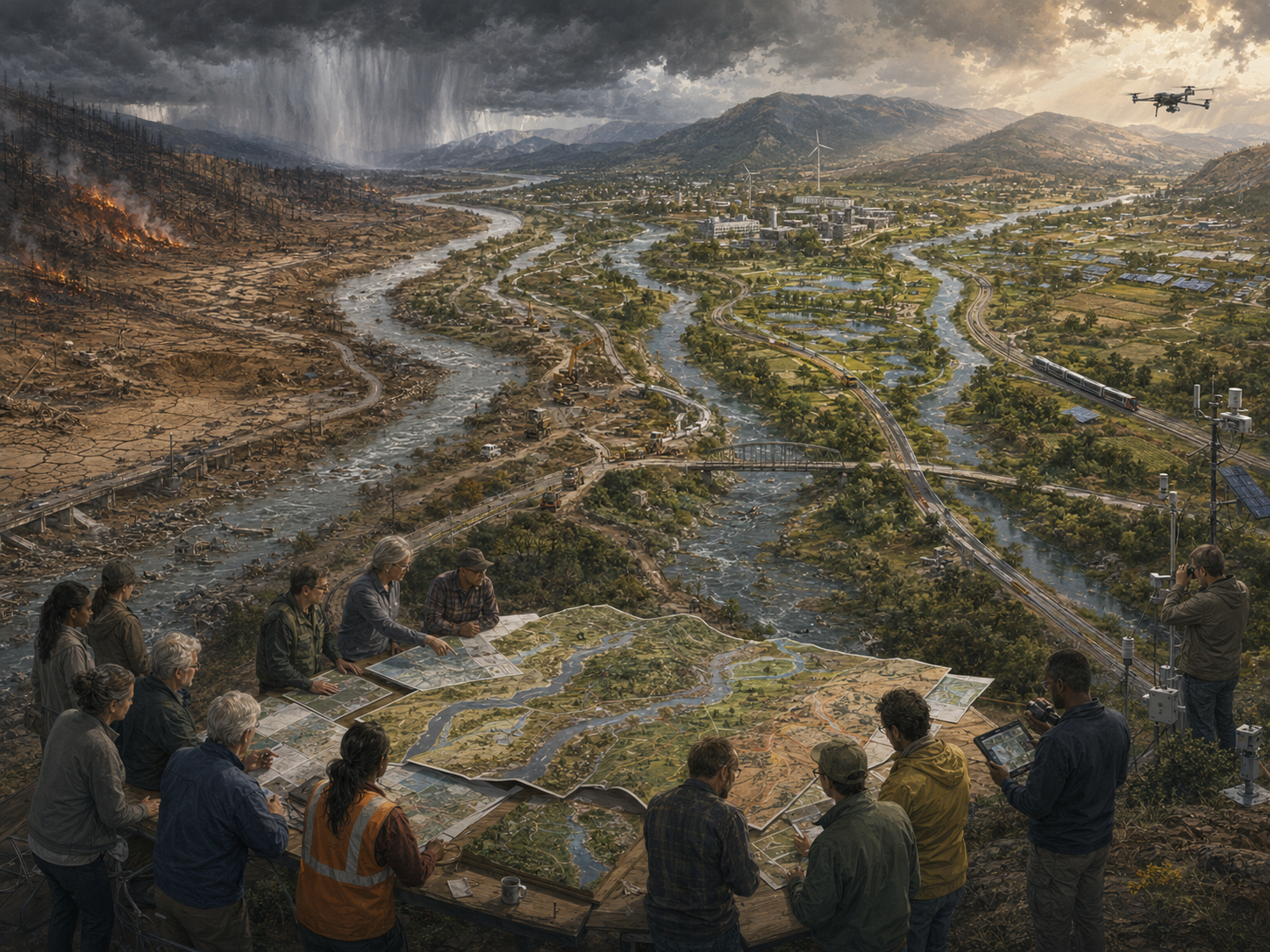
What Resilience Scenarios and Futures Thinking Mean
Resilience scenarios are structured explorations of possible future conditions that test how systems may absorb disturbance, adapt under uncertainty, cross thresholds, recover from shocks, or transform when existing pathways become unsafe or unjust. Futures thinking is the broader discipline of examining possible, plausible, probable, and preferable futures in order to improve present decisions. Together, they help decision-makers avoid treating the future as a straight-line extension of the past.
A resilience scenario might explore how a coastal city manages sea-level rise, how a food system responds to drought and price volatility, how a hospital network handles cyberattack during extreme heat, how a small business ecosystem survives repeated flooding, how a watershed crosses ecological thresholds, or how a region decides between incremental adaptation and managed retreat. These scenarios can be qualitative narratives, quantitative simulations, participatory workshops, maps, dashboards, systems diagrams, policy exercises, or combinations of all of them.
Futures thinking helps resilience practice because resilience depends on time. Some disturbances arrive quickly, such as storms, cyberattacks, financial shocks, disease outbreaks, or infrastructure failures. Others unfold slowly, such as climate change, soil degradation, biodiversity loss, demographic change, institutional erosion, technical debt, public distrust, and maintenance backlog. Scenario practice makes both fast shocks and slow variables visible.
| Concept | Meaning | Resilience relevance |
|---|---|---|
| Scenario | A structured exploration of a possible future | Tests assumptions, vulnerabilities, options, and response capacity. |
| Futures thinking | The practice of examining multiple possible futures | Expands imagination beyond prediction and short-term planning. |
| Strategic foresight | Organized methods for anticipating change and informing strategy | Helps institutions prepare before disruption becomes crisis. |
| Stress testing | Testing systems under extreme or compound conditions | Reveals hidden fragility, thresholds, and cascading failure. |
| Backcasting | Starting from a desired future and working backward to present actions | Supports transformation rather than only defensive adaptation. |
| Adaptive pathways | Decision sequences that change as conditions evolve | Preserves options and avoids premature lock-in. |
Resilience scenarios are useful because they make uncertainty practical. They do not remove uncertainty. They help people think, plan, coordinate, and learn within it.
Why Scenarios Matter for Resilience
Scenarios matter for resilience because many of the systems that support human life are now exposed to compound, interacting, and unfamiliar risks. Climate hazards affect infrastructure, health, housing, insurance, migration, agriculture, water, energy, and local economies. Cyber systems connect hospitals, utilities, transportation, finance, public agencies, schools, and supply chains. Ecological change alters water cycles, food systems, disease patterns, livelihoods, and cultural life. Institutions must act under uncertainty before evidence is complete.
Scenario thinking helps organizations and communities ask better questions. What if the most likely future is not the most dangerous? What if several moderate disruptions occur at the same time? What if a system appears stable because slow variables are hidden? What if current adaptation protects wealthy assets but leaves vulnerable communities behind? What if recovery restores a fragile system instead of transforming it? What if today’s efficient system has lost the slack needed for tomorrow’s disturbance?
Scenarios also help reveal values. Every future is political because it involves choices about protection, investment, land, infrastructure, labor, ecosystems, rights, and responsibility. Scenario work can expose who is assumed to adapt, who is expected to move, who receives resources, who bears risk, who defines “normal,” and who gets to imagine the future.
Why scenarios strengthen resilience
They reveal hidden assumptions
Scenarios expose beliefs about growth, risk, technology, governance, climate, infrastructure, behavior, and institutional capacity.
They test systems under stress
Scenario exercises can reveal where systems fail when shocks combine or exceed historical experience.
They preserve options
Futures thinking helps avoid lock-in by identifying decisions that keep multiple adaptation pathways open.
They improve coordination
Shared scenarios help agencies, communities, firms, and institutions understand interdependence before crisis.
They support transformation
Scenarios can show when incremental adaptation is insufficient and structural change is necessary.
They surface justice questions
Scenario work can reveal who is protected, excluded, relocated, surveilled, compensated, or forgotten.
Scenarios matter because they help systems rehearse possible futures while there is still time to change course.
Prediction Is Not the Same as Preparedness
One of the most important lessons in futures thinking is that prediction and preparedness are different. Prediction asks what will happen. Preparedness asks what could happen, what would matter, what would fail, who would be harmed, what options exist, and how systems can adapt. In complex systems, prediction is often limited because interactions are nonlinear, data are incomplete, feedback loops shift, and human behavior changes in response to expectations.
Resilience scenarios do not require certainty to be useful. A city does not need to know the exact date of a major flood to evaluate floodplain development, drainage capacity, emergency shelters, insurance stress, transportation access, and recovery equity. A hospital does not need to predict the exact cyberattack to test backup procedures, paper workflows, patient safety, communications, and clinical prioritization. A watershed authority does not need a perfect rainfall forecast to examine drought thresholds, groundwater depletion, ecological stress, and water-allocation conflict.
Preparedness is strengthened by plural futures. A single forecast may narrow attention. Multiple scenarios can widen it. They can include probable futures, high-impact low-probability events, slow-burn degradation, optimistic transformation, maladaptive responses, and justice-centered alternatives. This plurality matters because resilient systems need both vigilance and imagination.
| Approach | Primary question | Risk if overused |
|---|---|---|
| Prediction | What is most likely to happen? | May narrow attention to average conditions and miss surprise. |
| Forecasting | What trends can be projected from available data? | May assume continuity where systems are changing structurally. |
| Scenario planning | What plausible futures should be considered? | May become abstract if not tied to decisions and action. |
| Stress testing | What happens under severe or compound conditions? | May focus on failure without building adaptive pathways. |
| Backcasting | What must change to reach a preferred future? | May become aspirational if power, conflict, and constraints are ignored. |
| Adaptive pathways | What decisions are needed now, later, and if thresholds are crossed? | May fail if monitoring and governance are too weak to trigger action. |
Resilience planning should use prediction when useful, but it should not become dependent on prediction. The future may surprise the model. Resilient systems prepare for that possibility.
Resilience Scenarios as Systems Practice
Resilience scenarios are systems practice because they examine relationships among parts rather than treating risks as isolated events. A heat wave is not only a weather event. It is also a housing, energy, health, labor, transportation, water, urban design, communication, and inequality event. A drought is not only low rainfall. It is also agriculture, ecosystems, energy, food prices, groundwater, governance, migration, and conflict. A technology outage is not only software failure. It can become payment failure, logistics failure, public-service failure, healthcare failure, and trust failure.
Systems-based scenario practice asks how variables interact. It looks for feedback loops, bottlenecks, thresholds, dependencies, delays, trade-offs, and unintended consequences. It asks what happens when short-term recovery increases long-term vulnerability, when efficiency removes redundancy, when infrastructure repair restores unequal exposure, or when emergency response strengthens surveillance rather than safety.
Resilience scenarios should therefore be built around system structure. They should include slow variables, hidden dependencies, social vulnerability, ecological function, institutional capacity, power, and learning. Without these elements, scenarios may become dramatic event stories that miss the deeper causes of fragility.
| Systems feature | Scenario question | Example |
|---|---|---|
| Feedback loops | What responses amplify or dampen risk? | Insurance withdrawal increases disinvestment, which increases vulnerability. |
| Thresholds | When does gradual change become abrupt system shift? | A lake, watershed, housing market, or grid crosses a stability boundary. |
| Interdependence | Which systems depend on each other? | Hospitals depend on power, water, staffing, supply chains, and communications. |
| Delays | Where do impacts appear long after decisions are made? | Deferred maintenance accumulates until infrastructure fails during stress. |
| Path dependence | How do past decisions constrain future options? | Development in floodplains makes retreat politically and financially difficult. |
| Power | Whose future is protected, imagined, funded, or sacrificed? | Adaptation protects high-value districts while low-income renters are displaced. |
Good scenario work does not only ask what event might occur. It asks what kind of system would experience that event as manageable, catastrophic, transformative, or unjust.
Core Components of Resilience Scenario Practice
Resilience scenario practice includes horizon scanning, weak-signal detection, uncertainty mapping, scenario construction, stress testing, vulnerability analysis, adaptive pathways, backcasting, participatory deliberation, monitoring, governance, and learning. These components work together. Scenarios that lack weak-signal awareness can miss emerging risks. Scenarios that lack participation can miss lived vulnerability. Scenarios that lack governance can fail to change decisions. Scenarios that lack monitoring can become documents rather than adaptive systems.
Horizon Scanning
Horizon scanning systematically looks for emerging trends, disruptions, technologies, social changes, ecological shifts, legal developments, geopolitical pressures, and institutional risks that may affect resilience over time.
Weak-Signal Detection
Weak signals are early, ambiguous indicators of possible change. They may appear as unusual events, local observations, new conflicts, emerging failures, behavior changes, ecological anomalies, or technological shifts.
Uncertainty Mapping
Uncertainty mapping distinguishes what is known, uncertain, contested, emerging, and unknowable. It helps planners avoid treating fragile assumptions as facts.
Scenario Construction
Scenario construction creates plausible future pathways using drivers, uncertainties, system relationships, stakeholder perspectives, and narrative or quantitative models.
Stress Testing
Stress testing examines how systems perform under extreme, compound, or unfamiliar conditions. It reveals brittle dependencies, response gaps, thresholds, and cascading failure.
Adaptive Pathways
Adaptive pathways identify decision points, trigger indicators, thresholds, options, and sequences of action that can change as future conditions unfold.
Participatory Deliberation
Participatory scenario work includes communities, frontline workers, technical experts, local knowledge holders, public agencies, and vulnerable groups in defining risk and preferred futures.
Learning and Revision
Scenario practice should be iterative. New data, incidents, near misses, monitoring results, and community feedback should revise assumptions, triggers, and adaptation pathways.
| Component | Primary resilience function | Failure if neglected |
|---|---|---|
| Horizon scanning | Identifies emerging changes before they become dominant | Institutions are surprised by visible trends they failed to track. |
| Weak-signal detection | Notices early signs of system stress or transformation | Small warnings are dismissed until they become crisis. |
| Uncertainty mapping | Clarifies what is known, uncertain, contested, and unknowable | Plans become overconfident and brittle. |
| Scenario construction | Creates plausible futures for discussion and testing | Planning remains trapped in a single assumed future. |
| Stress testing | Reveals failure modes under extreme or compound conditions | Systems appear safe because they were never tested beyond normal conditions. |
| Adaptive pathways | Links present decisions to future triggers and options | Institutions lock into pathways that later become unsafe or unjust. |
| Participatory deliberation | Includes lived experience, local knowledge, and contested values | Scenarios ignore those most affected by disruption. |
| Learning and revision | Updates scenarios as conditions change | Scenario work becomes static planning theater. |
Resilience scenario practice is strongest when it connects imagination, evidence, participation, modeling, governance, and action.
Horizon Scanning and Weak Signals
Horizon scanning is the disciplined practice of looking beyond immediate pressures to identify emerging changes that may affect the future. In resilience work, horizon scanning may examine climate data, ecological conditions, infrastructure performance, public-health trends, demographic change, migration, political conflict, technology, supply chains, financial markets, housing, insurance, law, public trust, and cultural change. It helps systems avoid being trapped by present-day assumptions.
Weak signals are early, incomplete, or ambiguous signs that something may be changing. A weak signal might be recurring nuisance flooding, unusual heat-related illness, rising insurance withdrawal, small but repeated supply delays, local species decline, community distrust, increasing emergency-call volume, new cyber probing, staff burnout, abnormal maintenance data, or informal workarounds by frontline workers. Weak signals are easy to dismiss because they do not yet look like decisive evidence.
Resilience thinking values weak signals because complex systems often show stress before collapse. The challenge is to detect signals without overreacting to noise. This requires plural evidence: quantitative indicators, field observation, local knowledge, Indigenous and traditional ecological knowledge where appropriate, frontline experience, community reporting, and institutional memory.
| Weak signal | Possible resilience implication | Follow-up question |
|---|---|---|
| Repeated minor flooding | Drainage capacity, land use, and climate assumptions may be changing | Are small events becoming more frequent, severe, or unequal in impact? |
| Rising heat illness calls | Housing, grid, public health, labor, and urban design vulnerability may be increasing | Who is affected, and which protections are missing? |
| Insurance withdrawal | Risk pricing may be signaling growing climate or infrastructure exposure | Does market retreat precede displacement or disinvestment? |
| Staff burnout | Operational resilience may be relying on unsustainable human strain | What functions depend on heroic effort rather than institutional capacity? |
| Maintenance workarounds | Technical debt or infrastructure backlog may be hidden | Are workers compensating for systems that should be repaired? |
| New community distrust | Governance legitimacy may be weakening | Which decisions created distrust, and how can accountability be restored? |
Horizon scanning and weak-signal work are not about panic. They are about disciplined attention before disruption becomes undeniable.
Scenario Archetypes and Uncertainty
Scenario work often uses archetypes to organize uncertainty. A scenario set might include a continuation future, a crisis future, a transformation future, and a fragmented or unequal future. These archetypes are not fixed templates, but they help ensure that planning does not focus only on the preferred or most probable future. Resilience work needs uncomfortable scenarios because systems often fail where imagination is weakest.
Uncertainty can be mapped along several dimensions: environmental uncertainty, technological uncertainty, institutional uncertainty, social uncertainty, economic uncertainty, geopolitical uncertainty, ecological uncertainty, and moral uncertainty. Some uncertainties are measurable. Others are deep uncertainties where probabilities are contested or unknowable. Futures thinking helps institutions remain serious even when probabilities are unavailable.
Scenario sets should be diverse enough to challenge assumptions but focused enough to guide decisions. Too few scenarios can create tunnel vision. Too many can create confusion. The most useful scenarios connect uncertainty to decisions: what would we do differently if this future became more likely? Which choices are robust across several futures? Which choices create irreversible lock-in? Which signals would tell us a pathway is changing?
| Scenario archetype | Description | Resilience question |
|---|---|---|
| Continuation | Current trends continue with incremental change | Where does business-as-usual quietly accumulate risk? |
| Disruption | Major shocks or compound crises interrupt normal function | Which systems fail first, and who is harmed most? |
| Fragmentation | Coordination weakens and inequality grows | How does resilience differ across communities, sectors, and institutions? |
| Transformation | Systems reorganize around new values, technologies, or governance | What structural changes are necessary, and who controls them? |
| Maladaptation | Adaptation protects some interests while increasing long-term risk | Which responses appear resilient but deepen vulnerability? |
| Just transition | Transformation reduces vulnerability while expanding dignity and ecological care | What would resilience look like if justice were central rather than secondary? |
Good scenario practice uses uncertainty to expand strategic imagination, not to avoid responsibility.
Stress Testing and Compound Risk
Stress testing examines how a system performs when conditions become severe. In resilience work, stress tests should include compound risk: multiple disturbances that interact. A heat wave during a power outage is different from heat alone. A flood during a cyberattack is different from either event alone. A public-health surge during staff shortages, supply disruption, misinformation, and transport failure is a different kind of challenge from a single-sector emergency.
Compound risk matters because systems are interconnected. Energy, water, transport, communications, health, housing, food, finance, emergency response, and public trust are linked. Stress tests should therefore evaluate both direct impacts and cascade pathways. They should also examine social vulnerability. A system may look resilient in aggregate while failing people who lack money, mobility, documentation, language access, disability accommodations, social support, or political representation.
Stress testing can be technical, participatory, or both. A utility may run grid simulations. A city may run emergency exercises. A hospital may test downtime procedures. A community may map heat-risk networks. A regional planning agency may model flood impacts across housing, roads, schools, hospitals, and small businesses. The best stress tests combine quantitative evidence with practical knowledge from those who operate and live within the system.
Examples of compound resilience scenarios
Heat + power outage
Tests cooling access, backup power, medical device dependence, communications, public health, transit, and building safety.
Flood + housing crisis
Tests evacuation, shelters, insurance, renters, recovery finance, displacement, mold, and long-term affordability.
Cyberattack + hospital surge
Tests downtime procedures, clinical safety, data access, emergency communication, staffing, and recovery priorities.
Drought + food-price shock
Tests agriculture, water allocation, energy, household budgets, nutrition, trade, and social protection.
Supply disruption + small business fragility
Tests inventories, local procurement, credit access, workforce stability, rent pressure, and community wealth.
Storm + communications failure
Tests emergency alerts, dispatch, repair coordination, public information, backup networks, and neighborhood mutual aid.
Stress testing should not be used to prove that systems are ready. It should be used to discover where they are not ready while change is still possible.
Adaptive Pathways and Decision Points
Adaptive pathways are sequences of decisions that change as conditions evolve. They are especially useful when uncertainty is deep and irreversible decisions are risky. Instead of choosing one fixed plan, adaptive pathways define near-term actions, monitoring indicators, trigger points, thresholds, contingency options, and future decision moments. This approach fits resilience thinking because systems change over time.
For example, a coastal community might maintain protective infrastructure for a period, restrict new development in high-risk areas, expand wetlands, buy repetitive-loss properties, monitor flood frequency, and define when managed retreat becomes necessary. A water authority might combine conservation, leak reduction, reuse, watershed restoration, groundwater monitoring, and staged allocation rules. A health system might expand flexible staffing, backup communications, supply reserves, cyber downtime procedures, and surge triggers.
Adaptive pathways help avoid two common errors: premature lock-in and delayed action. Premature lock-in occurs when institutions commit to one path too early and lose flexibility. Delayed action occurs when uncertainty becomes an excuse for waiting until options narrow. Adaptive pathways create a disciplined middle ground: act now, monitor carefully, preserve options, and revise when thresholds approach.
| Pathway element | Purpose | Example |
|---|---|---|
| Near-term action | Reduces current vulnerability without waiting for certainty | Upgrade cooling centers, repair drainage, improve backup power, expand mutual aid. |
| Monitoring indicator | Tracks whether conditions are changing | Flood frequency, heat illness, groundwater decline, outage duration, maintenance backlog. |
| Trigger point | Defines when a decision should be revisited | If flood days exceed a threshold, restrict rebuilding or begin relocation planning. |
| Contingency option | Prepares an alternative before crisis | Backup suppliers, emergency routes, alternate service locations, staged water rules. |
| Lock-in review | Assesses whether a decision closes future options | A seawall may protect property now but deepen long-term coastal dependence. |
| Equity check | Examines who benefits or loses along the pathway | Adaptation funding must not displace renters or exclude informal workers. |
Adaptive pathways turn scenario work into decision practice. They link futures thinking with governance, monitoring, investment, and accountability.
Backcasting and Transformative Capacity
Backcasting begins with a desired future and works backward to identify the changes required to reach it. In resilience thinking, backcasting is useful because some futures cannot be achieved through incremental adaptation alone. A just, climate-resilient city; a regenerative watershed; a resilient public-health system; a low-carbon energy system; or an equitable food system may require structural change in land use, infrastructure, finance, governance, labor, technology, and public values.
Backcasting differs from forecasting. Forecasting moves forward from current trends. Backcasting starts with a normative goal and asks what must change now. It is especially useful for transformative resilience because it can make visible the gap between present systems and preferred futures. It can also expose conflicts: whose preferred future is being used, whose sacrifice is assumed, and whose power must change?
Transformative capacity is the ability to reorganize systems when existing structures become untenable. Scenario work can support transformation by showing when adaptation is no longer enough, when recovery would restore harm, and when new institutions, infrastructures, laws, or social arrangements are needed. Transformation should not be romanticized. It is difficult, contested, and often unequal. Backcasting can help make transformation more deliberate and accountable.
Backcasting questions for resilient futures
What future is preferred?
Define the future in terms of safety, dignity, ecology, justice, livelihood, care, and public accountability.
What must change structurally?
Identify needed shifts in land use, infrastructure, finance, law, governance, technology, ownership, and social protection.
What must stop?
Name practices that deepen vulnerability, emissions, extraction, exclusion, surveillance, or maladaptation.
Who must be protected?
Identify people, communities, workers, ecosystems, and future generations at risk during transition.
What decisions are needed now?
Translate long-term transformation into immediate policies, investments, pilots, protections, and institutional reforms.
How will learning occur?
Build monitoring, participation, feedback, review, and revision into the pathway.
Backcasting helps resilience practice move beyond defending the present. It asks what futures are worth building and what present decisions make those futures possible.
Climate Resilience Scenarios
Climate resilience is one of the most important domains for scenario practice because climate risks involve deep uncertainty, long time horizons, local variation, compound hazards, and irreversible decisions. Climate scenarios can examine temperature, precipitation, sea-level rise, drought, wildfire, storm intensity, heat stress, ecosystem change, migration, public health, infrastructure performance, insurance, agriculture, water, and social vulnerability.
Climate scenarios should not be limited to physical hazards. A heat scenario should include housing, energy, labor, public health, cooling access, urban tree canopy, outdoor workers, schools, prisons, elder care, transit, and emergency communications. A flood scenario should include drainage, land use, renters, small businesses, insurance, mold, displacement, public benefits, schools, hospitals, and recovery finance. A wildfire scenario should include smoke, evacuation, grid risk, insurance, communications, respiratory health, biodiversity, and land stewardship.
Climate futures also require justice-centered imagination. Some adaptation pathways protect property while displacing people. Some infrastructure investments reduce risk in wealthy areas while leaving marginalized neighborhoods exposed. Some resilience measures become green gentrification. Some managed retreat policies compensate homeowners while ignoring renters, informal workers, Indigenous rights, cultural heritage, and community ties. Scenario practice must make these distributional questions explicit.
| Climate scenario | Systems to include | Justice question |
|---|---|---|
| Extreme heat future | Energy, housing, health, labor, urban canopy, transit, schools, communications | Who can cool safely, and who pays the cost of heat exposure? |
| Repeated flood future | Drainage, roads, housing, insurance, small businesses, schools, recovery finance | Who can recover, who is displaced, and who is left with mold, debt, and loss? |
| Drought future | Water, agriculture, ecosystems, energy, food prices, groundwater, governance | Whose water use is protected, restricted, priced, or sacrificed? |
| Wildfire and smoke future | Land management, grid, health, evacuation, air quality, insurance, biodiversity | Who has clean air, evacuation access, insurance, and recovery support? |
| Coastal transition future | Sea-level rise, ports, housing, wetlands, cultural heritage, managed retreat | Who decides when to defend, adapt, relocate, or restore? |
| Compound climate future | Multiple hazards interacting with infrastructure, health, finance, and governance | Which communities face layered exposure and the least support? |
Climate resilience scenarios should help societies avoid both denial and fatalism. They should support serious action before adaptation choices narrow.
Infrastructure and Technology Scenarios
Infrastructure and technology scenarios examine how physical and digital systems may perform under future stress. Modern infrastructure depends on energy, water, transport, communications, software, sensors, cloud services, AI models, cybersecurity, supply chains, maintenance crews, public agencies, and private vendors. Futures thinking is essential because failure can cascade across these dependencies.
A technology resilience scenario may test what happens when an AI-enabled infrastructure system faces model drift, sensor failure, cyberattack, communications outage, vendor collapse, or public distrust. An infrastructure scenario may test what happens when extreme heat stresses the grid, water demand rises, transit fails, hospitals lose backup power, and communications networks become overloaded. Intelligent infrastructure can improve scenario analysis, but it can also become part of the risk.
Scenario work should also examine technological path dependence. A city that locks into a proprietary platform may lose future flexibility. A utility that automates control without manual fallback may lose operational resilience. A public agency that outsources expertise may lose institutional memory. A system that uses AI to optimize efficiency may remove redundancy. Resilience scenarios should ask what technology choices preserve future options.
Infrastructure and technology scenario questions
What if communications fail?
Test emergency alerts, utility coordination, dispatch, repair crews, public information, and manual operations.
What if the model is wrong?
Test human review, uncertainty communication, field validation, override, and correction.
What if a vendor fails?
Test data portability, contract rights, alternate suppliers, migration pathways, and public control.
What if automation is unavailable?
Test manual procedures, operator training, local control, and safe fallback.
What if cyber and physical stress combine?
Test operational technology security, segmentation, backups, physical safety, and incident governance.
What if optimization removes slack?
Test whether efficiency has reduced buffers, spare parts, staffing, redundancy, or repair capacity.
Infrastructure and technology scenarios should treat digital systems as both resilience tools and resilience dependencies.
Public Health, Community, and Institutional Scenarios
Public health, community resilience, and institutional resilience depend heavily on scenario practice because emergencies often involve uncertainty, behavior, trust, care networks, logistics, and social vulnerability. A public-health scenario may examine pandemic resurgence, heat illness, wildfire smoke, hospital surge, medication shortages, mental-health strain, misinformation, staff burnout, or loss of data systems. A community resilience scenario may examine mutual aid, housing, food access, social isolation, schools, faith institutions, neighborhood trust, and local businesses.
Institutions need scenarios because institutional failure is often invisible until crisis. A government agency may have plans but no staffing. A hospital may have technology but no downtime practice. A nonprofit may have trust but no funding slack. A school system may have communication channels but no transportation options. A public-benefits system may have digital access but no accessible fallback. Scenarios can reveal where formal plans depend on assumptions that do not hold under stress.
Community scenarios are especially important because resilience is not only centralized response. Communities often provide first response through neighbors, families, local organizations, mutual aid, religious institutions, clinics, libraries, schools, small businesses, and informal care. Scenario work should include these networks, not merely treat communities as recipients of official action.
| Scenario domain | What to test | Hidden vulnerability to examine |
|---|---|---|
| Public health | Surge capacity, staffing, supplies, communication, data systems, trust | People excluded by insurance, language, disability, transportation, or documentation barriers |
| Community resilience | Mutual aid, food access, local businesses, shelters, schools, care networks | Social isolation, rent burden, informal work, distrust, and displacement risk |
| Institutional continuity | Staffing, authority, budgets, data access, procurement, legal flexibility | Plans that assume unavailable workers, systems, or emergency powers |
| Public communication | Alerts, multilingual messaging, trusted messengers, misinformation response | Digital-only systems that exclude offline or low-trust communities |
| Service access | Benefits, healthcare, transport, childcare, utilities, legal support | Procedures that fail people without documents, bank accounts, phones, or stable addresses |
| Recovery governance | Aid distribution, rebuilding, finance, anti-displacement, accountability | Recovery systems that reproduce inequality or create long-term debt |
Public health and community scenarios should ask not only whether institutions can respond, but whether people can survive, participate, trust, recover, and shape what comes next.
Justice, Power, and Contested Futures
Futures are contested. Scenario work can either democratize imagination or reinforce elite control. It can open space for communities to define safety, dignity, livelihood, land, care, and ecological responsibility. Or it can become a managerial exercise where powerful institutions imagine futures for others without sharing power. Resilience scenarios must therefore be examined ethically.
Power enters scenario work through problem definition, data selection, model assumptions, participation, funding, language, time horizons, risk tolerance, and policy options. A scenario that centers asset protection may produce different priorities than a scenario that centers renters, elders, disabled people, outdoor workers, Indigenous stewardship, small businesses, ecosystems, or future generations. A scenario that treats relocation as a technical solution may ignore grief, culture, land, community, sovereignty, and memory.
Justice-centered futures thinking asks whose futures are considered plausible, whose futures are treated as unrealistic, whose losses are normalized, whose knowledge counts, who benefits from adaptation, and who bears the burden of uncertainty. It also asks whether resilience means returning to a harmful normal or transforming the conditions that made people vulnerable.
Justice questions for resilience scenarios
Who defines resilience?
Does resilience mean protecting assets, preserving livelihoods, defending ecosystems, sustaining culture, or transforming unjust systems?
Who is represented?
Are renters, workers, disabled people, migrants, Indigenous communities, elders, youth, and low-income neighborhoods included?
Who bears uncertainty?
Do powerful institutions transfer risk to households, workers, communities, ecosystems, or future generations?
Who controls data?
Are vulnerable communities treated as data sources or as decision-makers with rights and authority?
Who benefits from adaptation?
Do investments reduce vulnerability or increase property values while displacing residents?
Who can contest the future?
Are scenario assumptions open to challenge, revision, and democratic deliberation?
Resilience scenarios should not be neutral stories about change. They should make visible the moral and political choices embedded in adaptation, recovery, and transformation.
Governance, Learning, and Scenario Use
Scenario work is only useful if it changes learning and decisions. Many organizations produce scenarios that sit on shelves because they are disconnected from budgets, authority, monitoring, operations, procurement, law, public communication, and accountability. Resilience scenarios should be embedded in governance. They should inform investment, maintenance, land use, emergency planning, social protection, climate adaptation, infrastructure design, public-health preparedness, and institutional reform.
Governance determines how scenarios are used. Who decides which scenarios matter? Who updates them? Who monitors indicators? Who has authority when trigger points are reached? How are community concerns incorporated? How are trade-offs documented? How is uncertainty communicated to the public? How do after-action reviews change the scenario set? Without governance, scenario thinking remains analysis without adaptive capacity.
Learning is central. Scenarios should not be one-time exercises. They should be revised after disasters, near misses, policy failures, community feedback, new data, scientific developments, and changing social conditions. Scenario practice becomes resilient when the process itself is adaptive.
| Governance function | Scenario role | Practical mechanism |
|---|---|---|
| Strategic planning | Connects scenarios to long-term goals and public values | Scenario-informed plans, pathway maps, and transformation goals |
| Budgeting | Links scenario risks to investment decisions | Resilience funds, maintenance budgets, contingency reserves, and equity-weighted allocation |
| Monitoring | Tracks signals that indicate which futures are emerging | Indicators, dashboards, community reporting, and trigger thresholds |
| Public deliberation | Allows affected people to contest assumptions and define preferred futures | Workshops, assemblies, participatory modeling, and public review |
| Emergency preparedness | Tests response under plausible stress conditions | Exercises, drills, tabletop scenarios, and after-action reviews |
| Institutional learning | Updates plans after incidents and new evidence | Corrective-action tracking, scenario revision, and governance reform |
Scenarios become resilience tools when institutions use them to make decisions, monitor change, share power, and learn.
Measuring Scenario Quality
Scenario quality should not be judged by whether a scenario predicted the future exactly. In resilience work, a scenario is valuable if it improves understanding, reveals vulnerability, tests assumptions, expands strategic options, supports inclusive deliberation, identifies decision points, and changes action. The quality of a scenario process matters as much as the scenario document.
Useful criteria include plausibility, diversity, relevance, transparency, internal consistency, systems depth, uncertainty coverage, participatory legitimacy, justice sensitivity, decision usefulness, monitoring linkage, and learning capacity. A scenario set should include uncomfortable futures, not only desired ones. It should make assumptions visible. It should be connected to choices that institutions and communities can actually make.
Scenario quality also depends on whose knowledge is included. A technically sophisticated scenario can still be weak if it excludes local experience, Indigenous knowledge, frontline workers, vulnerable communities, or those who understand how systems fail in practice. Conversely, a participatory scenario can be powerful even if it is not mathematically complex, because it reveals lived vulnerability and practical response capacity.
| Quality criterion | Meaning | Warning sign |
|---|---|---|
| Plausibility | The scenario is credible enough to inform decisions | Scenarios are either fantasy or only business-as-usual. |
| Diversity | The set explores meaningfully different futures | Scenarios vary only slightly around the same assumption. |
| Systems depth | The scenario includes feedback, thresholds, dependencies, and delays | Risks are treated as isolated events. |
| Decision relevance | The scenario informs choices that can actually be made | Scenarios are interesting but disconnected from authority or budgets. |
| Justice sensitivity | The scenario examines unequal exposure, power, recovery, and voice | Aggregate resilience hides unequal harm. |
| Participatory legitimacy | Affected people and knowledge holders shape the scenario | Experts imagine futures for communities without community authority. |
| Monitoring linkage | The scenario includes indicators and triggers | No one knows when assumptions should be revised. |
| Learning capacity | The scenario process changes after evidence and experience | Scenarios are created once and never updated. |
Scenario quality is measured by whether futures thinking improves resilience practice, not whether it produces polished documents.
A Practical Framework for Resilience Scenarios
A practical resilience scenario framework begins with the system under stress, the functions that must continue, the communities and ecosystems affected, the uncertainties that matter, and the decisions that need support. It then develops scenarios, tests vulnerabilities, identifies pathways, and connects results to governance and monitoring.
| Step | Question | Output |
|---|---|---|
| Define the system and purpose | What system is being examined, and what decisions need support? | Scenario purpose statement and system boundary. |
| Identify essential functions | What must continue during disruption? | Critical-function inventory for services, ecosystems, institutions, and communities. |
| Map vulnerability and capacity | Who or what is exposed, sensitive, adaptive, or under-protected? | Vulnerability, capacity, and justice map. |
| Scan the horizon | What trends, weak signals, shocks, and slow variables may shape the future? | Driver and weak-signal inventory. |
| Define key uncertainties | Which uncertainties could change decisions most? | Uncertainty map and scenario axes or pathways. |
| Build scenario set | What plausible futures should be explored? | Scenario narratives, diagrams, maps, or models. |
| Stress-test systems | How do critical functions perform under each scenario? | Failure-mode, threshold, and cascade analysis. |
| Identify adaptive pathways | What actions are needed now, later, and if triggers are reached? | Pathway map with triggers, options, and lock-in warnings. |
| Deliberate with affected groups | Who must interpret, contest, and revise the scenarios? | Participatory review and justice assessment. |
| Connect to governance | How will scenarios change budgets, policies, monitoring, and responsibility? | Implementation plan, indicators, review schedule, and accountability structure. |
This framework keeps scenario work grounded in resilience practice. It prevents futures thinking from becoming abstract imagination disconnected from institutional responsibility and lived vulnerability.
Mathematical Lens: Modeling Resilience Scenarios
Resilience scenario analysis can be represented as a comparison of system performance across multiple plausible futures. Let \(R_{i,s}\) represent the resilience of system \(i\) under scenario \(s\):
R_{i,s} = w_f F_{i,s} + w_a A_{i,s} + w_r Q_{i,s} + w_g G_{i,s} + w_e E_{i,s} – w_v V_{i,s}
\]
Interpretation: \(F_{i,s}\) represents essential function, \(A_{i,s}\) adaptive capacity, \(Q_{i,s}\) redundancy or slack, \(G_{i,s}\) governance quality, \(E_{i,s}\) equity performance, and \(V_{i,s}\) vulnerability under scenario \(s\).
A robust strategy performs reasonably well across many scenarios, not only under the most expected one. Let \(S\) be the set of scenarios and \(R_{i,s}\) the outcome under each scenario:
R_i^{robust} = \min_{s \in S} R_{i,s}
\]
Interpretation: This maximin logic evaluates the worst-case performance across scenarios. It is useful when failure under one plausible future would be unacceptable.
Expected resilience can also be estimated if scenario probabilities are available or assumed:
\mathbb{E}[R_i] = \sum_{s=1}^{n} p_s R_{i,s}
\]
Interpretation: \(p_s\) is the probability or planning weight assigned to scenario \(s\). In deep uncertainty, these weights may be contested or intentionally avoided.
Adaptive pathways can be represented using trigger thresholds. Let \(X_t\) be a monitored indicator and \(\tau\) a threshold:
\text{Act if } X_t \geq \tau
\]
Interpretation: A trigger converts monitoring into action. For example, if heat illness, flood frequency, groundwater decline, or outage duration exceeds a threshold, the next pathway decision is activated.
Justice-adjusted scenario resilience can subtract unequal exposure, unequal recovery, or exclusion from decision-making:
R_{i,s}^{*} = R_{i,s} – \theta X_{i,s} – \lambda U_{i,s} – \mu P_{i,s}
\]
Interpretation: \(X_{i,s}\) represents unequal exposure, \(U_{i,s}\) unequal recovery or access, and \(P_{i,s}\) power exclusion from scenario design or governance.
These equations are simplified. Their value is to clarify assumptions: a strategy that performs well in one future may fail in another, and a strategy that protects aggregate function may still be unjust if burdens are unequally distributed.
Advanced R Workflow: Comparing Resilience Scenario Strategies
The R workflow below compares resilience scenario strategies across horizon scanning, stress testing, adaptive pathways, participatory legitimacy, data and modeling capacity, governance integration, equity sensitivity, transformation potential, scenario risk, and implementation burden. It uses synthetic values for methodological demonstration.
# Install packages if needed:
# install.packages(c("tidyverse", "scales"))

library(tidyverse)
library(scales)

# -------------------------------------------------------------------
# Synthetic resilience scenario strategies.
# Higher scenario_risk and implementation_burden are worse.
# -------------------------------------------------------------------

strategies <- tibble(
  strategy = c(
    "Horizon Scanning and Weak Signal System",
    "Compound Risk Stress Testing",
    "Adaptive Pathways and Trigger Framework",
    "Participatory Community Futures Lab",
    "Climate Resilience Scenario Portfolio",
    "Backcasting for Just Transformation",
    "Scenario Governance and Learning Cycle"
  ),
  horizon_scanning = c(9.3, 8.0, 8.2, 8.5, 8.6, 8.2, 8.8),
  stress_testing = c(8.0, 9.4, 8.5, 8.1, 8.9, 8.0, 8.4),
  adaptive_pathways = c(8.1, 8.5, 9.4, 8.2, 8.8, 8.6, 8.9),
  participation = c(8.2, 8.0, 8.3, 9.5, 8.4, 9.2, 8.7),
  data_modeling = c(8.5, 8.8, 8.5, 7.8, 8.9, 8.0, 8.4),
  governance_integration = c(8.3, 8.4, 8.9, 8.6, 8.7, 8.8, 9.4),
  equity_sensitivity = c(8.0, 8.1, 8.5, 9.3, 8.8, 9.5, 8.9),
  transformation_potential = c(7.8, 8.0, 8.7, 8.9, 8.6, 9.6, 8.8),
  scenario_risk = c(2.8, 2.9, 2.7, 2.6, 2.8, 2.6, 2.5),
  implementation_burden = c(3.2, 3.5, 3.7, 3.8, 3.7, 3.9, 3.6)
)

# -------------------------------------------------------------------
# Weighted scenario resilience value function.
# -------------------------------------------------------------------

score_strategies <- function(data, wh, ws, wa, wp, wd, wg, we, wt, wr, wi) {
  data %>%
    mutate(
      scenario_resilience_value =
        wh * horizon_scanning +
        ws * stress_testing +
        wa * adaptive_pathways +
        wp * participation +
        wd * data_modeling +
        wg * governance_integration +
        we * equity_sensitivity +
        wt * transformation_potential -
        wr * scenario_risk -
        wi * implementation_burden,
      governance_gap = pmax(0, 8.5 - governance_integration),
      equity_gap = pmax(0, 8.5 - equity_sensitivity),
      participation_gap = pmax(0, 8.5 - participation),
      adjusted_value =
        scenario_resilience_value -
        0.07 * governance_gap -
        0.08 * equity_gap -
        0.07 * participation_gap,
      diagnostic = case_when(
        implementation_burden >= 3.9 ~ "implementation-burden review needed",
        scenario_risk >= 3.0 ~ "scenario-design risk review needed",
        participation < 8.2 ~ "participation review needed",
        equity_sensitivity < 8.2 ~ "equity review needed",
        governance_integration < 8.4 ~ "governance integration review needed",
        TRUE ~ "promising but requires iterative revision"
      )
    ) %>%
    arrange(desc(adjusted_value))
}

# -------------------------------------------------------------------
# Scenario priority weights.
# -------------------------------------------------------------------

priority_sets <- tribble(
  ~priority,                 ~wh,  ~ws,  ~wa,  ~wp,  ~wd,  ~wg,  ~we,  ~wt,  ~wr,  ~wi,
  "Balanced",                0.12, 0.12, 0.13, 0.12, 0.11, 0.13, 0.13, 0.12, 0.04, 0.04,
  "Weak-signals-first",      0.32, 0.10, 0.10, 0.10, 0.12, 0.10, 0.08, 0.08, 0.04, 0.04,
  "Stress-test-first",       0.08, 0.32, 0.12, 0.08, 0.14, 0.10, 0.08, 0.08, 0.04, 0.04,
  "Pathways-first",          0.08, 0.12, 0.32, 0.08, 0.10, 0.14, 0.08, 0.08, 0.04, 0.04,
  "Participation-first",     0.08, 0.08, 0.10, 0.32, 0.08, 0.12, 0.14, 0.10, 0.04, 0.04,
  "Governance-first",        0.08, 0.10, 0.14, 0.10, 0.10, 0.32, 0.12, 0.08, 0.03, 0.03,
  "Equity-first",            0.08, 0.08, 0.12, 0.16, 0.08, 0.12, 0.32, 0.12, 0.03, 0.03,
  "Transformation-first",    0.08, 0.08, 0.13, 0.12, 0.08, 0.13, 0.14, 0.32, 0.03, 0.03,
  "Implementation-aware",    0.12, 0.12, 0.13, 0.12, 0.11, 0.13, 0.13, 0.12, 0.03, 0.12
)

# -------------------------------------------------------------------
# Evaluate strategies across priority sets.
# -------------------------------------------------------------------

results <- priority_sets %>%
  rowwise() %>%
  do(
    score_strategies(
      strategies,
      wh = .$wh,
      ws = .$ws,
      wa = .$wa,
      wp = .$wp,
      wd = .$wd,
      wg = .$wg,
      we = .$we,
      wt = .$wt,
      wr = .$wr,
      wi = .$wi
    ) %>%
      mutate(priority = .$priority)
  ) %>%
  ungroup()

ranked_results <- results %>%
  group_by(priority) %>%
  arrange(desc(adjusted_value), .by_group = TRUE) %>%
  mutate(rank = row_number()) %>%
  ungroup()

print(ranked_results)

ggplot(ranked_results, aes(x = strategy, y = adjusted_value, group = priority)) +
  geom_point(size = 3) +
  geom_line(aes(color = priority), linewidth = 1) +
  coord_flip() +
  labs(
    title = "Resilience Scenario Strategy Value Across Priority Sets",
    x = "Scenario Strategy",
    y = "Adjusted Scenario Resilience Value",
    color = "Priority"
  ) +
  theme_minimal(base_size = 12)

top_rank_summary <- ranked_results %>%
  filter(rank == 1) %>%
  count(strategy, name = "times_ranked_first") %>%
  arrange(desc(times_ranked_first))

print(top_rank_summary)

write_csv(ranked_results, "resilience_scenario_strategy_rankings.csv")
write_csv(top_rank_summary, "resilience_scenario_top_rank_summary.csv")
This workflow shows why scenario design should be matched to the planning problem. A region facing immediate compound risk may need stress testing. A government trying to avoid lock-in may need adaptive pathways. A community confronting unequal climate exposure may need participatory futures work. An institution that repeatedly ignores scenario results may need governance reform more than another model.
Advanced Python Workflow: Simulating Resilience Futures Under Uncertainty
The Python workflow below simulates several future pathways for a system under climate stress, infrastructure stress, social vulnerability, governance capacity, adaptive capacity, and transformation investment. It uses synthetic values to illustrate how scenario planning can compare resilience across futures rather than relying on a single forecast.
# Install packages if needed:
# pip install pandas numpy matplotlib

import numpy as np
import pandas as pd
import matplotlib.pyplot as plt

# ---------------------------------------------------------------------
# Synthetic future scenarios.
# Values range from 0 to 1.
# ---------------------------------------------------------------------

scenarios = pd.DataFrame({
    "scenario": [
        "Continuation with rising stress",
        "Compound disruption and weak coordination",
        "Adaptive pathways with delayed transformation",
        "Justice-centered transformation",
        "Maladaptive resilience and unequal recovery"
    ],
    "climate_stress_growth": [0.012, 0.018, 0.014, 0.010, 0.016],
    "infrastructure_stress_growth": [0.010, 0.018, 0.012, 0.008, 0.015],
    "social_vulnerability_growth": [0.008, 0.016, 0.006, -0.004, 0.014],
    "governance_capacity": [0.58, 0.42, 0.68, 0.86, 0.52],
    "adaptive_capacity": [0.56, 0.44, 0.74, 0.88, 0.58],
    "participation": [0.46, 0.38, 0.66, 0.90, 0.42],
    "equity_focus": [0.44, 0.36, 0.68, 0.92, 0.32],
    "transformation_investment": [0.32, 0.24, 0.62, 0.88, 0.38],
    "redundancy_and_slack": [0.48, 0.40, 0.68, 0.82, 0.46]
})

rows = []
rng = np.random.default_rng(42)
n_steps = 50

for _, s in scenarios.iterrows():
    function = 0.82
    vulnerability = 0.42
    climate_stress = 0.30
    infrastructure_stress = 0.34
    institutional_learning = 0.40
    social_trust = 0.48

    for t in range(n_steps):
        # Disturbance grows differently in each scenario.
        shock = 0.0
        if t in [10, 23, 37]:
            shock = rng.uniform(0.22, 0.38)

        climate_stress = np.clip(
            climate_stress + s["climate_stress_growth"] + rng.normal(0, 0.008) + 0.20 * shock,
            0,
            1
        )

        infrastructure_stress = np.clip(
            infrastructure_stress + s["infrastructure_stress_growth"] + rng.normal(0, 0.007) + 0.16 * shock,
            0,
            1
        )

        vulnerability = np.clip(
            vulnerability
            + s["social_vulnerability_growth"]
            + 0.08 * climate_stress
            + 0.06 * infrastructure_stress
            - 0.10 * s["equity_focus"]
            - 0.06 * s["participation"],
            0,
            1
        )

        institutional_learning = np.clip(
            institutional_learning
            + 0.07 * s["governance_capacity"]
            + 0.05 * s["participation"]
            + 0.05 * s["adaptive_capacity"]
            - 0.06 * shock,
            0,
            1
        )

        social_trust = np.clip(
            social_trust
            + 0.06 * s["participation"]
            + 0.06 * s["equity_focus"]
            + 0.04 * institutional_learning
            - 0.08 * vulnerability
            - 0.05 * shock,
            0,
            1
        )

        adaptive_buffer = np.clip(
            0.22 * s["adaptive_capacity"]
            + 0.18 * s["governance_capacity"]
            + 0.18 * s["redundancy_and_slack"]
            + 0.16 * institutional_learning
            + 0.14 * social_trust
            + 0.12 * s["transformation_investment"],
            0,
            1
        )

        transformation_effect = np.clip(
            0.30 * s["transformation_investment"]
            + 0.24 * s["equity_focus"]
            + 0.20 * s["participation"]
            + 0.16 * s["governance_capacity"]
            + 0.10 * institutional_learning,
            0,
            1
        )

        fragility_gap = max(
            0,
            0.35 * climate_stress
            + 0.30 * infrastructure_stress
            + 0.28 * vulnerability
            + 0.20 * shock
            - adaptive_buffer
        )

        function = np.clip(
            function
            - 0.22 * climate_stress
            - 0.18 * infrastructure_stress
            - 0.18 * vulnerability
            - 0.16 * shock
            - 0.12 * fragility_gap
            + 0.22 * adaptive_buffer
            + 0.16 * transformation_effect,
            0,
            1
        )

        equity_adjusted_resilience = np.clip(
            function * (0.70 + 0.30 * s["equity_focus"])
            - 0.12 * vulnerability
            + 0.08 * social_trust,
            0,
            1
        )

        robust_resilience_score = np.clip(
            0.20 * function
            + 0.18 * adaptive_buffer
            + 0.16 * transformation_effect
            + 0.14 * social_trust
            + 0.12 * institutional_learning
            + 0.10 * (1 - vulnerability)
            + 0.10 * s["redundancy_and_slack"],
            0,
            1
        )

        rows.append({
            "scenario": s["scenario"],
            "time": t,
            "shock": shock,
            "climate_stress": climate_stress,
            "infrastructure_stress": infrastructure_stress,
            "vulnerability": vulnerability,
            "institutional_learning": institutional_learning,
            "social_trust": social_trust,
            "adaptive_buffer": adaptive_buffer,
            "transformation_effect": transformation_effect,
            "fragility_gap": fragility_gap,
            "function": function,
            "equity_adjusted_resilience": equity_adjusted_resilience,
            "robust_resilience_score": robust_resilience_score
        })

simulation = pd.DataFrame(rows)

summary = (
    simulation
    .groupby("scenario")
    .agg(
        mean_function=("function", "mean"),
        minimum_function=("function", "min"),
        final_function=("function", "last"),
        final_vulnerability=("vulnerability", "last"),
        final_social_trust=("social_trust", "last"),
        mean_fragility_gap=("fragility_gap", "mean"),
        final_equity_adjusted_resilience=("equity_adjusted_resilience", "last"),
        final_robust_resilience_score=("robust_resilience_score", "last")
    )
    .reset_index()
    .sort_values("final_robust_resilience_score", ascending=False)
)

print(summary)

plt.figure(figsize=(10, 6))
for scenario, subset in simulation.groupby("scenario"):
    plt.plot(subset["time"], subset["function"], label=scenario)
plt.xlabel("Time")
plt.ylabel("System function")
plt.title("System Function Across Resilience Futures")
plt.legend()
plt.tight_layout()
plt.show()

plt.figure(figsize=(10, 6))
for scenario, subset in simulation.groupby("scenario"):
    plt.plot(subset["time"], subset["vulnerability"], label=scenario)
plt.xlabel("Time")
plt.ylabel("Social vulnerability")
plt.title("Vulnerability Across Scenario Futures")
plt.legend()
plt.tight_layout()
plt.show()

plt.figure(figsize=(10, 6))
for scenario, subset in simulation.groupby("scenario"):
    plt.plot(subset["time"], subset["robust_resilience_score"], label=scenario)
plt.xlabel("Time")
plt.ylabel("Robust resilience score")
plt.title("Resilience Score Across Futures")
plt.legend()
plt.tight_layout()
plt.show()

simulation.to_csv("resilience_futures_simulation.csv", index=False)
summary.to_csv("resilience_futures_summary.csv", index=False)
The simulation illustrates why scenario thinking matters. A pathway can appear functional in early periods while vulnerability quietly grows. Another pathway may require larger transformation investment but improve equity-adjusted resilience over time. Scenario analysis helps compare trajectories, not only immediate outcomes.
GitHub Repository
The companion GitHub repository for this article is designed as a resilience scenarios and futures thinking modeling scaffold. It translates horizon scanning, weak signals, stress testing, adaptive pathways, participatory scenario design, governance integration, equity sensitivity, transformation potential, scenario risk, implementation burden, climate stress, infrastructure stress, vulnerability, institutional learning, and social trust into reproducible workflows for resilience analysis.
Complete Code Repository
Companion code for resilience scenarios and futures thinking, including scenario strategy scoring, weak-signal diagnostics, compound-risk stress testing, adaptive pathway modeling, transformation backcasting examples, equity-adjusted resilience simulation, Monte Carlo uncertainty workflows, responsible-use notes, and multi-language computational examples.
The companion article directory is articles/resilience-scenarios-and-futures-thinking/. It is structured to support a professional modeling workflow: Python for simulation and uncertainty analysis; R for scenario strategy comparison and ranking sensitivity; SQL for scenario strategies, future pathways, indicators, model runs, and outputs; Julia for resilience pathway examples; and Rust, Go, C, C++, and Fortran for lightweight diagnostic and simulation utilities.
The modeling objective is to explore how scenario design strengthens or weakens resilience depending on horizon scanning, stress testing, adaptive pathways, participation, governance, equity, transformation potential, uncertainty, and implementation burden. The scaffold includes synthetic data, validation notes, responsible-use documentation, generated outputs, and notebook placeholders.
This repository extends the article from conceptual analysis into applied systems modeling. It gives readers a reproducible foundation for examining why resilient planning should compare multiple futures, not merely optimize for a single forecast.
Conclusion
Resilience scenarios and futures thinking are essential because the future will not arrive as a single, predictable line. It will arrive through disturbance, delay, surprise, conflict, adaptation, loss, innovation, power, memory, and choice. Complex systems rarely fail only because a shock occurred. They fail because hidden vulnerability, weak governance, deferred maintenance, ecological degradation, unequal exposure, institutional rigidity, and narrow imagination made the shock more damaging than it had to be.
Scenario practice helps systems think before crisis. It reveals weak signals, tests compound risks, exposes hidden dependencies, compares adaptive pathways, clarifies thresholds, and supports transformation. It also helps communities and institutions ask moral questions: whose future is being protected, whose risk is being normalized, whose knowledge counts, and what kind of recovery should not be restored because it was unjust in the first place?
The most useful scenarios are not the most dramatic. They are the scenarios that change decisions. They inform budgets, land use, infrastructure design, public-health preparation, ecological restoration, emergency planning, governance reform, social protection, and community participation. They create monitoring systems and trigger points. They preserve options. They make uncertainty actionable without pretending it can be eliminated.
In the broader Resilience Thinking series, resilience scenarios and futures thinking connect intelligent infrastructure, AI, technology systems, climate resilience, disaster risk reduction, adaptive governance, transformation, social vulnerability, and ethical resilience. The central lesson is that resilient societies do not wait passively for the future. They practice imagining it, testing it, contesting it, and shaping it with justice, humility, evidence, and care.
Related Articles
- Intelligent Infrastructure and Resilience
- AI and Resilience Thinking
- Technology System Resilience
- Climate Resilience
- Disaster Risk Reduction and Resilience
- Adaptive Governance and Resilience
- Transformation in Complex Systems
- System Thresholds and Tipping Points
Further Reading
- Bishop, P., Hines, A. and Collins, T. (2007) ‘The current state of scenario development: an overview of techniques’, Foresight, 9(1), pp. 5–25. Available at: https://doi.org/10.1108/14636680710727516.
- Folke, C. (2006) ‘Resilience: The emergence of a perspective for social–ecological systems analyses’, Global Environmental Change, 16(3), pp. 253–267. Available at: https://doi.org/10.1016/j.gloenvcha.2006.04.002.
- Hines, A. and Bishop, P. (2015) Thinking about the Future: Guidelines for Strategic Foresight. 2nd edn. Houston: Hinesight.
- Intergovernmental Panel on Climate Change (2022) Climate Change 2022: Impacts, Adaptation and Vulnerability. Available at: https://www.ipcc.ch/report/ar6/wg2/.
- Ramírez, R. and Wilkinson, A. (2016) Strategic Reframing: The Oxford Scenario Planning Approach. Oxford: Oxford University Press.
- UNESCO (2018) Transforming the Future: Anticipation in the 21st Century. Available at: https://unesdoc.unesco.org/ark:/48223/pf0000264644.
- United Nations Office for Disaster Risk Reduction (2015) Sendai Framework for Disaster Risk Reduction 2015–2030. Available at: https://www.undrr.org/publication/sendai-framework-disaster-risk-reduction-2015-2030.
- Walker, B. and Salt, D. (2006) Resilience Thinking: Sustaining Ecosystems and People in a Changing World. Washington, DC: Island Press.
References
- Amer, M., Daim, T.U. and Jetter, A. (2013) ‘A review of scenario planning’, Futures, 46, pp. 23–40. Available at: https://doi.org/10.1016/j.futures.2012.10.003.
- Bishop, P., Hines, A. and Collins, T. (2007) ‘The current state of scenario development: an overview of techniques’, Foresight, 9(1), pp. 5–25. Available at: https://doi.org/10.1108/14636680710727516.
- Folke, C. (2006) ‘Resilience: The emergence of a perspective for social–ecological systems analyses’, Global Environmental Change, 16(3), pp. 253–267. Available at: https://doi.org/10.1016/j.gloenvcha.2006.04.002.
- Hines, A. and Bishop, P. (2015) Thinking about the Future: Guidelines for Strategic Foresight. 2nd edn. Houston: Hinesight.
- Holling, C.S. (1973) ‘Resilience and stability of ecological systems’, Annual Review of Ecology and Systematics, 4, pp. 1–23. Available at: https://doi.org/10.1146/annurev.es.04.110173.000245.
- Intergovernmental Panel on Climate Change (2022) Climate Change 2022: Impacts, Adaptation and Vulnerability. Available at: https://www.ipcc.ch/report/ar6/wg2/.
- Ramírez, R. and Wilkinson, A. (2016) Strategic Reframing: The Oxford Scenario Planning Approach. Oxford: Oxford University Press.
- Schoemaker, P.J.H. (1995) ‘Scenario planning: A tool for strategic thinking’, Sloan Management Review, 36(2), pp. 25–40.
- UNESCO (2018) Transforming the Future: Anticipation in the 21st Century. Available at: https://unesdoc.unesco.org/ark:/48223/pf0000264644.
- United Nations Office for Disaster Risk Reduction (2015) Sendai Framework for Disaster Risk Reduction 2015–2030. Available at: https://www.undrr.org/publication/sendai-framework-disaster-risk-reduction-2015-2030.
- Vervoort, J.M., Kok, K., van Lammeren, R. and Veldkamp, T. (2010) ‘Stepping into futures: Exploring the potential of interactive media for participatory scenarios on social-ecological systems’, Futures, 42(6), pp. 604–616. Available at: https://doi.org/10.1016/j.futures.2010.04.031.
- Walker, B. and Salt, D. (2006) Resilience Thinking: Sustaining Ecosystems and People in a Changing World. Washington, DC: Island Press.