
Last Updated June 2, 2026
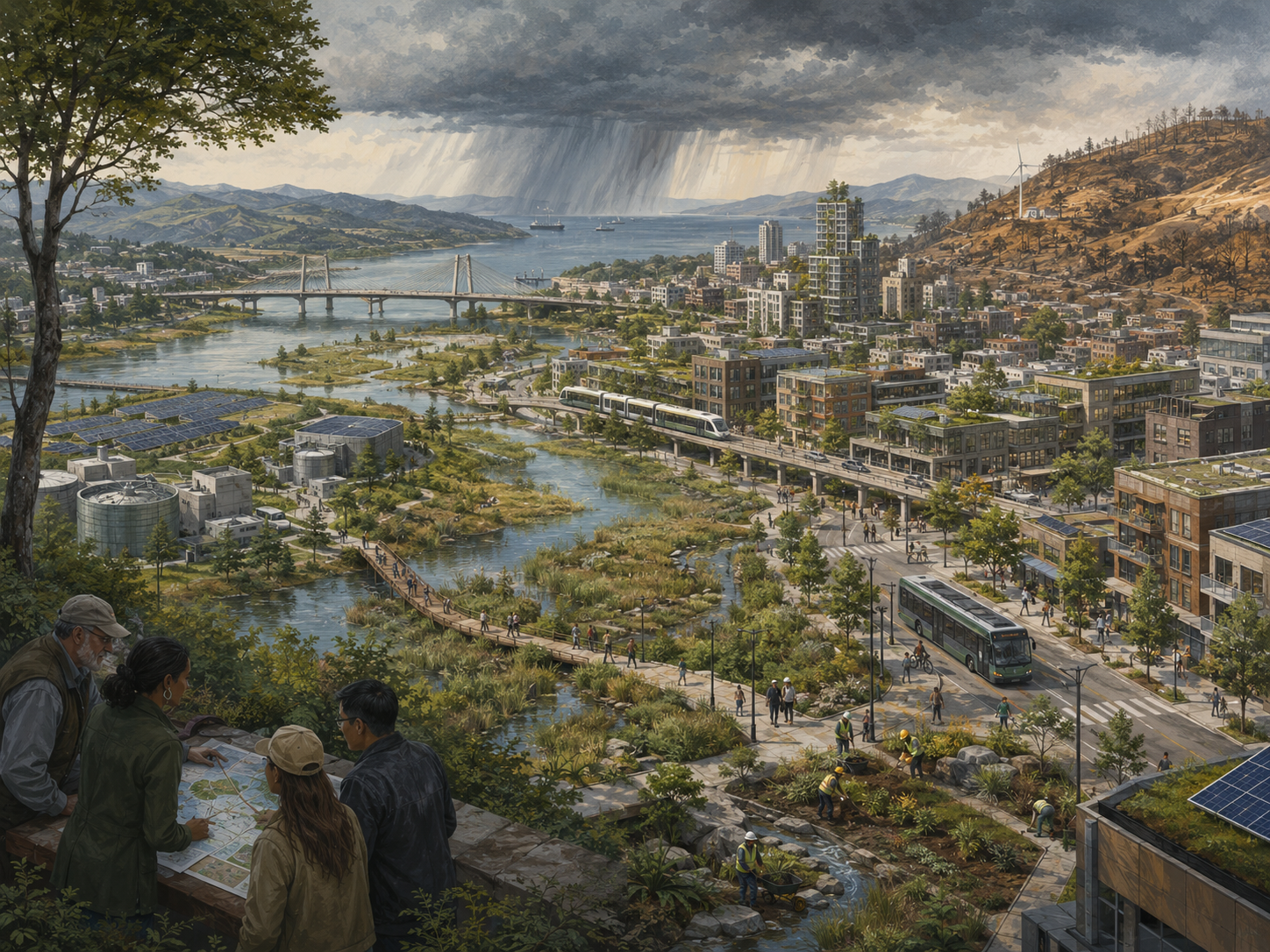
Urban resilience and adaptation describe the capacity of cities, towns, neighborhoods, infrastructure systems, ecosystems, economies, and communities to anticipate disturbance, absorb shocks, maintain essential functions, recover equitably, adapt to changing conditions, and transform when existing urban forms become unsafe, unjust, or ecologically unsustainable. Urban resilience is not simply the ability of buildings to survive storms or of city governments to respond after disasters. It is the broader capacity of urban systems to keep people housed, mobile, connected, healthy, supplied, protected, and included under conditions of climate change, infrastructure stress, economic volatility, social inequality, ecological degradation, public-health risk, and institutional strain.
Cities concentrate people, assets, infrastructure, services, institutions, cultural life, economic activity, and political power. That concentration can create efficiency, opportunity, creativity, public service capacity, and collective learning. It can also concentrate risk. Heat islands, floodplains, aging infrastructure, housing precarity, informal settlements, impermeable surfaces, air pollution, social isolation, transport dependence, energy demand, digital vulnerability, and unequal access to services can turn urban hazards into cascading harm. Urban resilience therefore requires more than emergency management. It requires spatial planning, housing justice, infrastructure renewal, climate adaptation, public health, ecological restoration, economic inclusion, community capacity, and accountable governance.
This article examines urban resilience and adaptation as a core topic in resilience thinking. It explains why cities must be understood as complex social-ecological-infrastructural systems, why urban hazards cascade through housing, water, energy, transport, health, logistics, and governance, why climate adaptation must be integrated with development and justice, how green and blue infrastructure support resilience, why informal and marginalized communities must be central to planning, and how city resilience can be modeled through exposure, vulnerability, service continuity, adaptive capacity, and equity. It also extends the discussion into applied R and Python workflows for comparing urban resilience strategies under uncertainty.
What Urban Resilience Means
Urban resilience is the ability of cities and urban communities to maintain essential functions, reduce vulnerability, adapt to changing conditions, recover from disruption, and transform when existing urban arrangements create unacceptable risk. It applies to physical systems such as buildings, roads, drains, water networks, power grids, hospitals, schools, transit, ports, digital systems, and waste systems. It also applies to social systems: households, workers, neighborhoods, community organizations, care networks, local economies, public institutions, cultural spaces, and informal systems of support.
The urban resilience question is not simply whether a city “bounces back.” In many cases, returning to the previous state means returning to the same flood exposure, heat vulnerability, housing insecurity, infrastructure backlog, segregation, pollution burden, or political exclusion that made the disaster damaging in the first place. Resilience is strongest when recovery reduces future vulnerability, protects essential services, preserves community dignity, and changes the conditions that convert hazards into crisis.
Urban adaptation is closely related. Adaptation refers to adjustments in urban systems in response to actual or expected climate conditions and other changing risks. Cities adapt through land-use planning, housing retrofits, heat action plans, floodplain restoration, drainage upgrades, transit investments, emergency preparedness, cooling corridors, public-health systems, building codes, green infrastructure, social protection, and governance reform. Adaptation becomes resilience when these adjustments improve system function under disturbance while reducing future vulnerability.
| Concept | Primary question | Urban example |
|---|---|---|
| Urban resilience | Can the city maintain essential functions and recover equitably under stress? | Water, power, transit, health care, food access, cooling, communications, and shelter remain available or are restored quickly. |
| Urban adaptation | How does the city adjust to actual or expected hazards and changing baselines? | Heat action plans, stormwater redesign, coastal protection, retrofits, land-use reform, and community preparedness. |
| Urban transformation | When must deeper structural change replace incremental adjustment? | Managed retreat, zoning reform, transit-oriented development, housing justice, ecological restoration, or redesign of energy and water systems. |
| Urban justice | Who is protected, who participates, who pays, and who recovers? | Anti-displacement protections, equitable restoration, accessible cooling, renter protections, and community-led planning. |
Urban resilience therefore combines physical infrastructure, social infrastructure, ecological function, public institutions, and community capacity. It is a citywide systems capability, not a single project category.
Why Urban Resilience Matters
Urban resilience matters because cities are where many of the world’s most important sustainability, development, public-health, infrastructure, and climate risks intersect. Cities concentrate economic activity and public services, but they also concentrate exposure. Dense infrastructure networks, housing markets, transport corridors, informal settlements, heat islands, flood-prone surfaces, aging drainage, high energy demand, and unequal service access can make urban systems both powerful and fragile.
Urban systems are also highly interdependent. A power outage can interrupt water pumping, elevators, hospitals, cooling centers, telecommunications, digital payments, refrigeration, traffic signals, public transit, and emergency response. A flood can damage roads, basements, schools, substations, sewage systems, water quality, and housing. A heatwave can affect mortality, labor, transit reliability, grid stability, outdoor air quality, sleep, learning, and public safety. A housing crisis can increase vulnerability to heat, flood, disease, displacement, and economic shock.
Urban resilience matters because failures in cities are rarely only technical. They are lived through bodies, homes, commutes, care responsibilities, health systems, jobs, neighborhoods, and public trust. A resilient city is not merely a city with stronger infrastructure. It is a city that protects essential services, reduces vulnerability, supports communities, and adapts without sacrificing the people who already face the greatest risk.
Why urban resilience is a systems priority
Concentrated exposure
Cities concentrate people, buildings, infrastructure, services, assets, and hazards in the same space.
Cascading failure
Urban systems are tightly coupled, so disruption in one network can spread quickly into others.
Climate amplification
Urban heat islands, impermeable surfaces, coastal development, and drainage constraints can amplify climate hazards.
Unequal vulnerability
Housing quality, income, health, race, age, disability, legal status, and neighborhood investment shape risk.
Public service dependence
Urban residents depend on shared water, power, transit, sanitation, health, waste, and communication systems.
Adaptation opportunity
Cities also concentrate governance capacity, innovation, public investment, social networks, and institutional learning.
Urban resilience matters because cities are not only places where risk accumulates. They are also places where adaptation, justice, and systems transformation can be organized at meaningful scale.
Cities as Complex Systems
Cities are complex adaptive systems. They are made of interacting people, buildings, infrastructures, ecosystems, markets, institutions, technologies, cultures, and daily routines. Urban outcomes emerge from feedback loops among housing, transportation, land use, energy demand, public health, employment, policing, schooling, water, sanitation, governance, and ecological conditions. A change in one part of the city can produce effects elsewhere.
This complexity is why urban resilience cannot be understood through a single sector. Flood resilience involves land use, stormwater infrastructure, housing, emergency response, insurance, transport, public finance, watershed management, and community trust. Heat resilience involves buildings, energy, public health, labor, trees, parks, social isolation, cooling access, urban design, and affordability. Housing resilience involves zoning, rent, building quality, transport access, social support, public health, and displacement risk. The city is not a set of independent departments; it is a system of systems.
Urban complexity also means that resilience policies can produce unintended consequences. A new flood barrier may reduce risk in one district while increasing risk downstream. Green infrastructure may reduce heat while increasing land values and displacement pressure. Transit-oriented development may lower emissions while excluding low-income residents if housing protections are weak. Digital infrastructure may improve emergency management while excluding residents without reliable connectivity. Resilience thinking asks planners to look for these feedbacks before they become crises.
| Urban subsystem | Key resilience function | Potential cascade |
|---|---|---|
| Housing | Shelter, thermal safety, health protection, stability, social continuity | Poor housing increases heat mortality, flood displacement, disease, debt, and school/work disruption. |
| Transport | Mobility, evacuation, emergency access, labor access, logistics, social connection | Transport disruption affects hospitals, food access, repair crews, employment, and emergency response. |
| Energy | Power, cooling, communications, water pumping, elevators, refrigeration, digital systems | Power loss can cascade into water, health, housing, mobility, logistics, and communications. |
| Water and sanitation | Drinking water, hygiene, waste removal, stormwater, public health | Water or sanitation failure can trigger disease, contamination, business closures, and public distrust. |
| Social infrastructure | Care, trust, local coordination, mutual aid, information flow, belonging | Weak social networks can increase isolation, poor warning uptake, delayed recovery, and trauma. |
Cities are resilient when they can manage interdependence rather than pretending that urban problems belong neatly to separate sectors.
Urban Adaptation and Resilience Thinking
Urban adaptation applies resilience thinking to the built environment, social systems, ecological systems, and institutions of cities. It asks how urban systems can adjust to changing risk while preserving essential function and reducing vulnerability. Adaptation includes incremental changes, such as installing shade, improving drainage, updating building codes, and expanding cooling centers. It also includes deeper changes, such as land-use reform, relocation from repeatedly damaged areas, redesign of transport systems, public housing retrofits, watershed restoration, and governance transformation.
Resilience thinking adds several important questions to urban adaptation. Does the adaptation reduce future vulnerability or only protect the current system temporarily? Does it strengthen adaptive capacity or lock the city into fragile infrastructure? Does it protect vulnerable residents or increase displacement? Does it reduce cascading risk across systems? Does it improve ecological function? Does it create feedback loops for learning? Does it define thresholds where incremental adaptation is no longer enough?
This links urban resilience to Climate Resilience, Infrastructure Resilience, Disaster Risk Reduction and Resilience, Adaptive Capacity in Complex Systems, Feedback Loops in Resilient Systems, and System Thresholds and Tipping Points. Cities are where these concepts often become visible as practical planning questions.
Urban adaptation through a resilience-thinking lens
Reduce exposure
Avoid locating people, assets, and critical services in repeatedly hazardous areas where safer alternatives exist.
Reduce vulnerability
Improve housing, health, income security, service access, and environmental conditions before hazards arrive.
Protect essential functions
Maintain water, power, mobility, sanitation, health care, cooling, food access, and communications under stress.
Build adaptive capacity
Use monitoring, flexible standards, participation, finance, and institutional learning to adjust over time.
Avoid maladaptation
Prevent adaptation from shifting risk, displacing residents, increasing emissions, or creating false security.
Plan transformation
Identify when deeper urban redesign is necessary because old spatial patterns are no longer viable.
Urban adaptation becomes resilient when it reduces vulnerability, preserves essential services, supports communities, and improves future options rather than merely defending existing urban form.
Core Dimensions of Urban Resilience and Adaptation
Several dimensions recur across urban resilience research and practice. These dimensions are connected. A city can have strong infrastructure but weak housing security, ambitious climate plans but weak implementation, green infrastructure that reduces heat but accelerates displacement, or emergency capacity that responds quickly while leaving chronic vulnerability unchanged. Urban resilience depends on whether physical, social, ecological, economic, and institutional capacities reinforce one another.
Exposure Reduction
Exposure reduction limits the degree to which people, homes, infrastructure, ecosystems, and services are located in harm’s way. In cities, it includes land-use planning, floodplain management, coastal buffers, wildfire interface planning, heat-sensitive design, safe siting of critical facilities, relocation where necessary, and avoiding new development that expands future risk. Exposure reduction is especially important because urban development decisions can lock in risk for decades.
Vulnerability Reduction
Vulnerability reduction addresses the social, economic, health, environmental, and infrastructural conditions that make exposed people and places more likely to suffer harm. It includes safe housing, renter protections, energy affordability, public health capacity, clean air, floodproofing, accessible transit, income support, disability inclusion, safe water, sanitation, and protection for communities facing historical disinvestment.
Service Continuity
Service continuity is the ability to maintain or quickly restore essential urban services during disruption. Urban residents depend on power, water, sanitation, transport, food access, health care, communications, waste systems, emergency response, schools, cooling, and shelter. A resilient city defines minimum service levels, maps dependencies, protects critical nodes, and prioritizes restoration for high-risk users.
Adaptive Capacity
Adaptive capacity is the ability to learn, revise rules, reallocate resources, update standards, mobilize knowledge, and change urban systems as conditions shift. It depends on monitoring, data quality, community participation, public finance, institutional memory, flexible planning, scenario analysis, trained staff, and governance structures that can act before repeated crisis forces action.
Ecological Integration
Ecological integration treats urban ecosystems as resilience infrastructure rather than decorative space. Trees, parks, wetlands, streams, soils, green roofs, urban forests, permeable surfaces, coastal marshes, and restored floodplains can reduce heat, absorb water, improve air quality, support biodiversity, protect public health, and create social space. Ecological integration must also protect communities from green displacement.
Equity and Legitimacy
Equity and legitimacy determine whether urban resilience protects the whole public or primarily shields privileged districts and assets. Resilient adaptation must address unequal exposure, unequal service quality, displacement risk, procedural exclusion, and unequal recovery. Legitimacy depends on meaningful participation, transparent priorities, public accountability, community authority, and recognition of local knowledge.
| Dimension | Primary focus | Failure if neglected |
|---|---|---|
| Exposure reduction | Keeping people and critical systems out of avoidable hazard zones | Urban development locks in repeated flood, heat, fire, or coastal risk. |
| Vulnerability reduction | Reducing susceptibility to harm before shocks occur | Hazards produce concentrated damage among already burdened groups. |
| Service continuity | Maintaining water, power, transport, health, sanitation, cooling, and communications | Infrastructure failure cascades into health, housing, economic, and emergency crises. |
| Adaptive capacity | Learning and adjusting as hazards, populations, and systems change | Plans become obsolete while risks intensify. |
| Ecological integration | Using ecosystems to reduce heat, flood, air-quality, and public-health risk | Urban form remains grey, impermeable, hot, and ecologically fragile. |
| Equity and legitimacy | Ensuring protection, participation, and recovery are fair | Adaptation protects privileged areas while worsening displacement or exclusion elsewhere. |
Urban resilience is strongest when these dimensions are planned together rather than delegated to separate projects, agencies, or funding streams.
Climate Risk in Cities
Climate risk in cities is shaped by the interaction between hazards and urban form. Heat, flooding, coastal storms, drought, wildfire smoke, air pollution, sea-level rise, extreme precipitation, and compound events affect cities through buildings, streets, pipes, power systems, transit, housing markets, health systems, land use, ecosystems, and social inequality. The same hazard can produce very different outcomes depending on infrastructure, planning, and vulnerability.
Climate change also destabilizes historical assumptions. Drainage systems designed for past rainfall may be undersized. Building standards may not protect residents from prolonged heat. Roads and rails may deform under higher temperatures. Coastal infrastructure may face sea-level rise and storm surge beyond design conditions. Water systems may face new extremes of scarcity and flooding. Health systems may face more frequent heat, smoke, vector-borne disease, and disaster-related trauma.
Cities must therefore plan for changing baselines, not only for past hazards. This means climate scenarios, stress tests, risk mapping, adaptation pathways, decision triggers, and investment planning must be embedded in ordinary urban governance. Climate adaptation cannot remain a special plan disconnected from housing, infrastructure, transport, land use, public health, and budgeting.
| Climate hazard | Urban risk pathway | Adaptation priority |
|---|---|---|
| Extreme heat | Heat islands, poor housing, grid stress, labor risk, health emergencies, social isolation | Cooling access, tree canopy, cool roofs, housing retrofits, labor protections, public-health outreach. |
| Urban flooding | Impermeable surfaces, drainage overload, basement flooding, road closures, contamination | Stormwater redesign, green infrastructure, floodplain restoration, drainage maintenance, safe housing. |
| Coastal storms and sea-level rise | Storm surge, erosion, salinity, infrastructure damage, displacement, insurance retreat | Coastal buffers, land-use change, managed retreat where necessary, protective infrastructure, justice safeguards. |
| Drought and water stress | Water restrictions, treatment stress, ecosystem decline, household affordability, fire risk | Demand management, reuse, leakage control, watershed protection, drought planning, equitable allocation. |
| Wildfire smoke and air quality | Respiratory burden, school/work disruption, clean-air access, emergency communication | Filtration, clean-air shelters, health outreach, building standards, worker protections, communication systems. |
Urban climate risk is not only produced by weather. It is produced by the way cities are built, governed, maintained, financed, and inhabited.
Heat Islands and Thermal Risk
Heat is one of the most important urban resilience challenges because cities can amplify heat through dark surfaces, dense construction, limited vegetation, waste heat, air pollution, high energy demand, and building design. Urban heat islands make some neighborhoods significantly hotter than surrounding areas or greener districts. Heat risk is also deeply unequal. Poor housing, lack of air conditioning, high utility costs, limited tree canopy, outdoor work, social isolation, chronic illness, disability, age, and homelessness all shape vulnerability.
Heat resilience requires both emergency response and structural adaptation. Emergency response includes heat warnings, cooling centers, outreach, hydration, medical monitoring, worker protections, and transportation to safe cooling. Structural adaptation includes tree canopy, shade, cool roofs, reflective surfaces, building retrofits, ventilation, energy affordability, reliable grids, public housing upgrades, school cooling, transit shelter design, and urban design that reduces thermal stress.
Heat also creates cascading risk. High temperatures increase electricity demand, which can stress grids. Grid failure can eliminate cooling and refrigeration. Heat can reduce labor productivity and increase health emergencies. Transit systems may become unreliable. Schools and care facilities may become unsafe. Urban heat resilience therefore links climate adaptation, infrastructure resilience, public health, labor rights, housing policy, and energy planning.
Urban heat resilience priorities
Cooling access
Ensure vulnerable residents can reach safe cooling without cost, stigma, distance, or accessibility barriers.
Housing retrofits
Improve insulation, ventilation, shading, cooling efficiency, and tenant protections in heat-vulnerable buildings.
Urban canopy
Expand tree canopy and shade where heat burden is highest while preventing green displacement.
Energy resilience
Protect grids, microgrids, backup systems, and affordability so cooling remains available under peak demand.
Labor protections
Protect outdoor and indoor workers exposed to dangerous heat through standards, breaks, shade, and enforcement.
Public health outreach
Use trusted networks to reach isolated residents, medically vulnerable people, older adults, children, and unhoused people.
Urban heat adaptation succeeds when it reduces exposure, protects bodies, improves housing, strengthens public health, and prevents cooling from becoming a privilege rather than a public safety necessity.
Flooding, Stormwater, and Coastal Risk
Urban flooding occurs when rainfall, rivers, storm surge, groundwater, drainage systems, impermeable surfaces, land subsidence, or coastal processes overwhelm the capacity of the built environment. Flooding is not only a water problem. It is a housing problem, sanitation problem, transport problem, public-health problem, insurance problem, land-use problem, and infrastructure-maintenance problem. In dense cities, flood impacts can cascade through roads, tunnels, basements, substations, hospitals, schools, sewage systems, and logistics networks.
Stormwater resilience requires both grey and green infrastructure. Pipes, pumps, drains, detention basins, culverts, seawalls, tide gates, and levees may be necessary in some places. But wetlands, floodplains, permeable surfaces, rain gardens, urban streams, parks, trees, restored soils, and coastal marshes can absorb, slow, filter, and store water. Hybrid systems often perform better than either purely grey or purely green approaches when designed, maintained, and governed together.
Flood resilience also requires land-use honesty. If cities continue building in high-risk areas while relying on protective infrastructure, they may create false security. If flood protections raise property values and displace lower-income residents, adaptation becomes unjust. If upstream development increases runoff into downstream communities, risk is shifted rather than reduced. Flood adaptation must therefore include watershed planning, housing protections, insurance reform, maintenance, public finance, and community participation.
| Flood pathway | Urban consequence | Resilience response |
|---|---|---|
| Drainage overload | Street flooding, basement flooding, road closures, contaminated water | Drainage upgrades, maintenance, permeable surfaces, green infrastructure, emergency pumping. |
| Riverine flooding | Neighborhood inundation, displacement, infrastructure damage, business interruption | Floodplain restoration, land-use controls, elevation, safe housing, relocation support where needed. |
| Coastal surge | Port damage, subway flooding, saltwater intrusion, housing loss, service disruption | Coastal buffers, surge barriers where appropriate, retreat pathways, critical asset protection. |
| Sanitation failure | Pathogens, mold, sewage overflow, water contamination, public-health burden | Sewer resilience, treatment backup, floodproofing, monitoring, emergency public-health response. |
| Transport disruption | Emergency delay, food access loss, repair delays, worker immobility | Alternate routes, elevated corridors, transit resilience, local hubs, logistics planning. |
Urban flood resilience is not simply a matter of moving water away faster. It is a matter of reshaping urban surfaces, land use, infrastructure, ecosystems, and recovery systems so that water does not become cascading harm.
Housing, Land Use, and Spatial Justice
Housing is central to urban resilience because people experience disaster and climate stress through the places they live. Housing determines exposure to heat, flood, mold, air pollution, crowding, structural danger, energy burden, displacement, disease, and recovery debt. Land use determines whether new risk is created through development in floodplains, fire-prone edges, heat islands, transit-poor districts, or areas without adequate water, sanitation, drainage, and public services.
Urban resilience requires safe, affordable, stable, and climate-adapted housing. A city cannot be resilient if residents are priced out of safe areas, trapped in poor-quality housing, displaced by adaptation investments, or left without resources after shocks. Housing retrofits, tenant protections, anti-displacement policies, public housing investment, code enforcement, cooling access, floodproofing, insurance reform, and community land strategies are therefore resilience tools.
Spatial justice matters because urban risk is often the legacy of planning decisions: segregation, redlining, highway placement, industrial zoning, disinvestment, informal settlement exclusion, unequal infrastructure, and environmental racism. Adaptation that ignores this history can reproduce harm. Green corridors, transit upgrades, flood protections, and waterfront redevelopment can improve resilience while increasing displacement pressure if housing protections and community authority are absent.
| Housing or land-use issue | Resilience consequence | Justice-oriented response |
|---|---|---|
| Poor housing quality | Heat, mold, flood damage, energy burden, disease, and displacement risk increase | Retrofits, repairs, code enforcement, tenant protections, public housing investment. |
| High-risk development | Future exposure is locked into urban form | Risk-sensitive zoning, buyouts where appropriate, safe siting, floodplain and coastal planning. |
| Informal settlements | Residents may lack secure tenure, infrastructure, sanitation, and recovery support | Upgrading, tenure security, participatory planning, services, and anti-eviction safeguards. |
| Green gentrification | Resilience investments increase property values and displacement | Affordable housing, community land trusts, rent protections, local ownership, inclusive planning. |
| Spatial segregation | Risk and service quality differ sharply by neighborhood | Targeted investment, environmental justice, service equity, and community-led repair. |
Urban resilience is not possible without housing resilience. People cannot adapt to climate risk if they cannot remain safely housed.
Infrastructure and Service Continuity
Urban resilience depends on infrastructure service continuity. Cities rely on water, sanitation, power, waste, transit, roads, telecommunications, hospitals, schools, ports, logistics, digital systems, emergency services, and public buildings. These systems are interdependent. A power outage can disrupt water pumping, traffic signals, transit, communications, elevators, cooling, refrigeration, and hospitals. A transport disruption can delay repair crews, food deliveries, emergency response, and medical access. A water failure can close schools, businesses, hospitals, and shelters.
Service continuity shifts the focus from asset survival to public function. The key question is not only whether pipes, bridges, substations, or data systems survive. It is whether residents can still access safe water, cooling, food, health care, mobility, sanitation, communications, and emergency support. This connects directly to Infrastructure Resilience and Modularity and Cascading Failure.
Urban infrastructure resilience requires redundancy, modularity, maintenance, monitoring, recovery planning, backup systems, mutual aid, spare parts, workforce capacity, cyber-physical protection, and equitable restoration protocols. It also requires public accountability: who decides which services are restored first, which neighborhoods receive investment, and which risks are disclosed before failure occurs?
Urban service-continuity priorities
Minimum service levels
Define acceptable levels for water, power, transit, cooling, sanitation, health care, and communications.
Dependency mapping
Map how power, water, transport, health, communications, logistics, and digital systems rely on one another.
Critical-node protection
Protect substations, pumps, hospitals, shelters, transit hubs, data systems, and emergency operation centers.
Redundant pathways
Use backups, alternate routes, distributed capacity, microgrids, storage, and interoperable systems.
Equitable restoration
Prioritize medically vulnerable users, public housing, shelters, schools, clinics, and high-risk neighborhoods.
Maintenance discipline
Treat deferred maintenance, asset data gaps, and workforce shortages as resilience risks.
Urban infrastructure is resilient only when essential services continue or return fast enough to prevent cascading social harm.
Mobility, Transport, and Access
Urban mobility systems shape resilience because they determine access to work, care, school, food, shelter, emergency services, evacuation, repair, social connection, and public life. Roads, sidewalks, transit, bike networks, rail, ports, airports, bridges, tunnels, paratransit, freight corridors, and informal transport systems all contribute to urban resilience. When mobility fails, many other functions fail with it.
Transport resilience is not only about protecting roads and rails. It is about maintaining access. A resilient city has multiple ways for people and goods to move, including public transit, safe walking, cycling, accessible paratransit, emergency routes, freight alternatives, and neighborhood-level services. Car dependence can become a resilience risk when fuel, roads, income, parking, traffic, or evacuation capacity are constrained. Transit dependence can also become a risk if systems are underfunded, flood-prone, inaccessible, or unreliable.
Mobility resilience is strongly connected to land use. If housing is far from jobs, clinics, groceries, schools, and transit, everyday life becomes more fragile. If emergency shelters are inaccessible, they are not functional. If evacuation plans assume private vehicles, many residents are excluded. If sidewalks, shade, and transit stops are unsafe during heat, mobility becomes a health risk. Urban adaptation must therefore treat mobility as access, not only movement.
| Mobility issue | Resilience concern | Adaptation strategy |
|---|---|---|
| Transit disruption | Workers, students, patients, caregivers, and low-income residents lose access | Floodproofing, backup power, bus bridges, redundant routes, operating reserves, accessible service. |
| Road flooding or heat damage | Emergency access, freight, repair, and evacuation are delayed | Elevated routes, drainage, maintenance, alternate corridors, local logistics hubs. |
| Car-dependent evacuation | Residents without vehicles or fuel are excluded | Transit evacuation, neighborhood pickup points, paratransit, multilingual communication, shelters nearby. |
| Unsafe walking conditions | Heat, flooding, poor lighting, and inaccessible sidewalks reduce daily resilience | Shade, drainage, safe crossings, universal design, cooling corridors, complete streets. |
| Freight bottlenecks | Food, medicine, fuel, and repair materials cannot reach communities | Freight redundancy, local storage, port resilience, emergency logistics planning. |
Urban mobility resilience means preserving access under stress, especially for those with the fewest private alternatives.
Public Health and Care Systems
Urban resilience depends on public health and care systems because hazards become disasters through bodies. Heat, flooding, air pollution, wildfire smoke, infectious disease, contaminated water, food insecurity, displacement, violence, trauma, and service outages all create health burdens. Cities concentrate health resources, but they also concentrate exposure and inequality. Hospitals, clinics, pharmacies, emergency medical services, shelters, schools, cooling centers, long-term care facilities, mutual aid networks, and public-health departments all form part of the urban resilience system.
Public-health resilience must operate before, during, and after disruption. Before disruption, it identifies vulnerability, strengthens housing and environmental conditions, prepares outreach, and builds trust. During disruption, it provides warning, emergency care, surveillance, cooling, clean air, water safety, sanitation, medication access, and mental-health support. After disruption, it tracks recovery, trauma, displacement, disease, mold, food insecurity, and unequal service restoration.
Care systems are often overlooked. Childcare, elder care, disability support, home health care, community health workers, mutual aid, family networks, and neighborhood organizations can determine whether residents survive and recover. A city that ignores care infrastructure is not fully resilient. This connects directly to the next article in the series, Public Health System Resilience.
| Health pathway | Urban vulnerability | Resilience response |
|---|---|---|
| Extreme heat | Older adults, children, outdoor workers, unhoused residents, tenants, medically vulnerable people | Cooling access, outreach, housing retrofits, utility protections, worker standards, health surveillance. |
| Flood and contamination | Mold, sewage exposure, unsafe water, injury, displacement, chronic illness | Water testing, sanitation, remediation, emergency housing, public-health communication. |
| Air pollution and smoke | Respiratory illness, school disruption, outdoor worker exposure, unequal filtration access | Clean-air shelters, filtration, monitoring, worker protections, school and care facility plans. |
| Service outage | Medical devices, elevators, medication refrigeration, dialysis, emergency communication | Medical registries with safeguards, backup power, priority restoration, home-care continuity. |
| Displacement and trauma | Loss of housing, social networks, school stability, employment, and mental health | Stable recovery housing, mental-health support, community continuity, legal aid, social services. |
Urban resilience should be measured by whether health, care, dignity, and social support endure—not only whether physical systems are repaired.
Green, Blue, and Hybrid Infrastructure
Green, blue, and hybrid infrastructure are central to urban resilience because cities are ecological systems as well as built systems. Green infrastructure includes trees, parks, green roofs, urban forests, vegetated corridors, community gardens, soils, and permeable landscapes. Blue infrastructure includes rivers, streams, wetlands, ponds, canals, waterfronts, floodplains, coastal marshes, and water-sensitive design. Hybrid infrastructure combines ecological systems with engineered systems such as drains, pumps, levees, retention basins, seawalls, and treatment systems.
These systems can reduce heat, absorb rainfall, improve air quality, support biodiversity, provide recreation, improve mental health, reduce flood peaks, filter water, store carbon, create habitat, and strengthen social connection. They also provide redundancy and adaptability that purely engineered systems may lack. A restored floodplain can absorb water dynamically. Tree canopy can reduce thermal stress across neighborhoods. Wetlands can buffer floods and improve water quality.
But green infrastructure is not automatically just or resilient. It can be unevenly distributed. It can be undermaintained. It can be used as aesthetic branding rather than risk reduction. It can raise land values and accelerate displacement. It can fail if climate stress, pollution, invasive species, drought, or poor maintenance undermines ecological function. Urban ecological adaptation must therefore be designed with local stewardship, anti-displacement protections, maintenance, monitoring, and equity.
Green, blue, and hybrid resilience functions
Heat reduction
Trees, shade, parks, cool corridors, and vegetated surfaces reduce thermal stress.
Stormwater absorption
Permeable surfaces, rain gardens, wetlands, and restored soils reduce runoff and flooding.
Water quality
Wetlands, riparian buffers, and green infrastructure can filter pollutants and reduce sediment.
Ecological function
Urban habitats support biodiversity, pollinators, cooling, infiltration, and environmental learning.
Social infrastructure
Parks, gardens, and public green space can support gathering, mutual aid, health, and belonging.
Hybrid protection
Grey and green systems can work together when designed and maintained as one resilience portfolio.
Urban ecological infrastructure is resilient when it protects people, supports ecosystems, reduces risk, and remains publicly accessible rather than becoming a driver of displacement.
Economic Resilience and Urban Livelihoods
Urban resilience has an economic dimension because cities depend on employment, small businesses, informal work, public finance, supply chains, housing markets, services, local commerce, and household income. Disasters and climate shocks can disrupt work, close businesses, damage commercial corridors, interrupt transport, raise insurance costs, increase rents, reduce public revenue, and deepen household debt. Economic resilience is therefore not only about large firms or financial recovery. It is about whether people can maintain livelihoods and whether local economies can recover without displacement and exclusion.
Urban economic resilience depends on diversity, redundancy, affordability, local capacity, public investment, social protection, and financial tools that do not punish the vulnerable. A city dependent on one industry, one freight corridor, one tax base, one employer, or one fragile supply chain may be economically brittle. A city with diverse livelihoods, strong neighborhood businesses, public services, local procurement, emergency cash support, worker protections, and affordable space is better able to absorb disruption.
Economic resilience also intersects with climate adaptation. Retrofitting buildings creates jobs. Transit investment expands access. Green infrastructure can support maintenance and stewardship work. Public housing upgrades protect residents and stabilize neighborhoods. But adaptation investment can also trigger land speculation, rising rents, and displacement if safeguards are absent. This connects urban resilience to Economic Resilience and Community Resilience.
| Economic pathway | Urban resilience issue | Policy response |
|---|---|---|
| Small business disruption | Floods, outages, rent pressure, and supply disruption can close neighborhood businesses | Grants, insurance reform, local procurement, recovery loans, rent support, infrastructure repair. |
| Informal and precarious work | Workers may lack protections, savings, insurance, or remote-work options | Cash support, labor protections, heat standards, emergency benefits, inclusive recovery programs. |
| Housing-market pressure | Adaptation investment can increase land values and displacement | Affordable housing, tenant protections, community land trusts, anti-speculation tools. |
| Supply-chain disruption | Food, medicine, fuel, and construction materials may be delayed | Local storage, diversified suppliers, emergency logistics, resilient freight corridors. |
| Public finance stress | Disasters reduce revenue while increasing recovery costs | Resilience bonds where appropriate, public reserves, federal support, preventive investment, transparent budgeting. |
Urban economic resilience should be judged by whether livelihoods, services, and neighborhoods remain viable—not only whether aggregate economic activity resumes.
Digital Systems and Urban Resilience
Digital systems now shape urban resilience through emergency communication, transit operations, utility controls, outage maps, sensor networks, building systems, public benefits, health records, logistics, traffic management, 311 systems, geospatial data, payment systems, cybersecurity, social media, and public information. Digital infrastructure can improve situational awareness and coordination, but it also creates new dependencies and exclusion risks.
A digitally supported city is not automatically resilient. If residents lack connectivity, language access, digital literacy, accessible interfaces, or trust, digital warning systems may not reach them. If a city relies heavily on platforms that fail during outages, emergencies, cyberattacks, or vendor disruptions, digital systems can become single points of failure. If data systems ignore informal settlements, renters, unhoused people, disabled residents, or undocumented communities, dashboards may miss those most at risk.
Urban digital resilience therefore requires redundancy, cybersecurity, data governance, privacy, manual fallback, public accountability, accessibility, and low-tech alternatives. Digital tools should support human coordination and public service, not replace trust, local knowledge, or institutional responsibility.
| Digital system | Resilience function | Risk if poorly governed |
|---|---|---|
| Emergency alerts | Communicate warnings, evacuation, heat risk, water safety, and shelter information | May exclude people without phones, language access, trust, accessibility, or connectivity. |
| Utility control systems | Monitor and operate water, power, transit, buildings, and public services | Cyber or network failures can disrupt physical infrastructure. |
| Urban sensors and dashboards | Track heat, flooding, air quality, traffic, outages, and service disruptions | May create false precision or hide data gaps in vulnerable places. |
| Digital benefits systems | Distribute aid, vouchers, payments, permits, and recovery support | Can exclude residents facing documentation, connectivity, disability, or language barriers. |
| Geospatial platforms | Support risk mapping, asset management, and emergency coordination | Can misrepresent risk if informal, local, or lived data are missing. |
Digital systems strengthen urban resilience when they increase transparency, coordination, access, and accountability while preserving human fallback and public trust.
Community Networks and Social Infrastructure
Urban resilience depends on social infrastructure: the relationships, organizations, spaces, and practices that help people communicate, care, coordinate, and recover. Libraries, schools, faith institutions, community centers, mutual aid groups, neighborhood associations, clinics, parks, tenant unions, local businesses, cultural organizations, worker centers, and informal networks all support resilience. They help identify vulnerable residents, distribute information, organize supplies, check on neighbors, provide trusted communication, and preserve social continuity.
Community networks are especially important because official systems often do not see all forms of vulnerability. Residents may know which basements flood, which elders live alone, which tenants lack cooling, which blocks lose power, which routes are unsafe, which languages are needed, which organizations are trusted, and where formal plans fail. Local knowledge is not a supplement to urban resilience; it is part of the evidence base.
At the same time, cities should not use “community resilience” as an excuse to offload public responsibility onto underfunded neighborhoods. Community capacity should be supported with resources, authority, staffing, space, and integration into formal planning. Social infrastructure is not free. It requires investment, respect, and durable partnerships.
Social infrastructure functions in urban resilience
Trusted communication
Local organizations can translate warnings into trusted, accessible, neighborhood-specific action.
Mutual aid
Neighbors and community groups can distribute supplies, check on residents, and fill gaps quickly.
Local knowledge
Residents often know risk patterns, service gaps, informal systems, and recovery barriers before agencies do.
Care networks
Families, caregivers, clinics, schools, and community organizations support children, elders, disabled residents, and patients.
Public spaces
Libraries, parks, schools, and community centers can become cooling, shelter, distribution, and coordination sites.
Accountability
Community organizations can track whether adaptation and recovery reach those most exposed.
Urban resilience is stronger when social infrastructure is treated as critical infrastructure rather than as informal support that appears only after formal systems fail.
Governance, Finance, and Institutional Capacity
Urban resilience depends on governance because cities must coordinate land use, housing, infrastructure, transport, public health, environment, emergency management, economic development, finance, and community participation. Fragmented governance can turn manageable risks into cascading failures. Agencies may optimize their own assets while ignoring cross-system dependencies. Capital budgets may fund visible projects while maintenance backlogs grow. Planning departments may approve development that emergency managers later struggle to protect.
Institutional capacity includes staff expertise, data systems, funding, legal authority, public procurement, interagency coordination, community partnerships, and the ability to act over long time horizons. Many resilience failures are not caused by lack of technical knowledge. They are caused by weak implementation, underfunding, fragmented accountability, political short-termism, and failure to connect risk information to budgeting and land-use decisions.
Finance is especially important. Urban adaptation requires investment in housing, drainage, transit, water, power, public health, parks, data systems, emergency preparedness, and ecological restoration. Preventive investment is often politically harder than post-disaster recovery because avoided losses are less visible than visible repairs. A resilient city must make the case for maintenance, prevention, and adaptation before crisis forces action.
| Governance capacity | Urban resilience function | Failure mode |
|---|---|---|
| Integrated planning | Connects housing, land use, infrastructure, climate, public health, and transport | Sectoral plans solve one problem while creating another. |
| Public finance | Funds prevention, maintenance, adaptation, recovery, and social protection | Underinvestment produces hidden fragility and expensive crisis response. |
| Interagency coordination | Aligns utilities, departments, emergency managers, regional agencies, and communities | Dependencies are missed and responsibilities remain unclear. |
| Community participation | Improves legitimacy, local knowledge, priority setting, and accountability | Plans lack trust, exclude vulnerable residents, or miss lived risk. |
| Institutional learning | Uses near misses, disasters, audits, and monitoring to improve systems | Lessons are documented but not implemented. |
Urban resilience is a governance practice. It depends on whether cities can turn risk knowledge into funded, accountable, equitable action.
Equity, Justice, and Maladaptation
Urban resilience is inseparable from equity because cities often contain sharp spatial inequalities. One neighborhood may have tree canopy, transit, safe housing, drainage, hospitals, grocery access, parks, and political influence. Another may have heat islands, industrial pollution, undermaintained infrastructure, flooding, insecure housing, weak transit, poor air quality, and delayed services. Aggregate citywide resilience indicators can hide these differences.
Justice asks who is protected, who participates, who pays, and who recovers. Distributive justice concerns where investments go. Procedural justice concerns who has power in planning. Recognitional justice concerns whose histories, knowledge, and communities are respected. Restorative justice concerns repair for past harm. Intergenerational justice concerns whether cities avoid shifting risk to future residents.
Maladaptation occurs when adaptation reduces one risk while increasing another. Urban examples include flood defenses that shift water downstream, green infrastructure that triggers displacement, air conditioning expansion that increases emissions and grid stress without clean energy, seawalls that worsen erosion elsewhere, smart-city systems that exclude digitally disconnected residents, and relocation programs that destroy social networks. A city can call a project resilient while making some communities less secure.
Urban maladaptation risks
Risk transfer
Protection in one district increases flood, heat, pollution, or displacement risk elsewhere.
Green displacement
Parks, waterfront restoration, and green corridors raise rents without housing protections.
False security
Defenses encourage more development in places that remain unsafe under future conditions.
Emissions-intensive adaptation
Cooling and protection strategies increase emissions or energy fragility without mitigation.
Digital exclusion
Emergency and recovery systems depend on apps, accounts, language, or connectivity some residents lack.
Social disruption
Relocation, redevelopment, or recovery breaks social networks, livelihoods, culture, and care systems.
Urban resilience is only legitimate when it reduces vulnerability without shifting risk onto people with less power.
Measuring Urban Resilience
Urban resilience is difficult to measure because cities are multidimensional and dynamic. A useful measurement system must include exposure, vulnerability, service continuity, recovery time, adaptive capacity, ecological function, social infrastructure, economic stability, governance capacity, and justice. No single score can capture the city. A city may have high economic output but weak housing resilience. It may have strong emergency response but deep chronic vulnerability. It may have advanced climate plans but weak implementation. It may recover quickly in affluent areas while vulnerable neighborhoods remain damaged for years.
Urban resilience metrics should therefore combine structural indicators, performance indicators, participatory indicators, and scenario-based stress tests. Structural indicators reveal underlying conditions before disruption. Performance indicators show how systems behave during and after disruption. Participatory indicators reveal lived experience and local knowledge. Stress tests explore how systems might perform under future hazards and compound events.
Measurement should also identify thresholds and decision triggers. When does heat risk require mandatory retrofits? When does repeated flooding require relocation support? When does infrastructure outage risk require redundancy investment? When does displacement pressure require anti-speculation measures? Metrics should support action rather than merely reporting dashboard status.
| Measurement domain | Example indicator | Dashboard risk |
|---|---|---|
| Exposure | Population, housing, infrastructure, and services exposed to heat, flood, fire, or coastal risk | Coarse maps can hide block-level variation and informal vulnerability. |
| Vulnerability | Housing quality, income insecurity, health burden, age, disability, social isolation, pollution exposure | Aggregate vulnerability can hide concentrated risk among specific groups. |
| Service continuity | Water, power, transit, health, sanitation, cooling, communications, and food access during disruption | Citywide uptime can hide unequal outage and recovery. |
| Recovery | Time to restore homes, services, businesses, schools, and public health | Fast recovery metrics can ignore renters, informal workers, and displaced residents. |
| Ecological function | Tree canopy, flood storage, air quality, water infiltration, biodiversity, heat reduction | Green coverage can hide access, maintenance, displacement, or ecological quality problems. |
| Governance | Plan implementation, funding, accountability, participation, interagency coordination | Plans may be counted as capacity even when they lack budget or authority. |
| Justice | Disaggregated exposure, service quality, participation, displacement risk, restoration order | Justice can be treated as a side indicator rather than a core resilience condition. |
Urban resilience measurement should reveal hidden vulnerability, unequal recovery, and emerging thresholds—not produce a polished city score that obscures reality.
A Practical Framework for Urban Resilience Planning
A practical urban resilience process should begin with the functions that must continue under stress: housing, water, power, health, sanitation, cooling, mobility, food access, communication, emergency response, and community support. It should then map hazards, exposure, vulnerability, dependencies, slow variables, governance capacity, and equity. The goal is not a generic resilience plan, but a decision process that connects risk evidence to investment, regulation, implementation, and learning.
| Step | Question | Output |
|---|---|---|
| Define essential urban functions | What must continue under disruption? | Minimum service levels for housing, water, power, health, sanitation, mobility, cooling, communications, and food access. |
| Map hazards and slow stresses | What shocks and chronic pressures affect the city? | Heat, flooding, coastal risk, drought, smoke, housing stress, infrastructure backlog, economic volatility, public-health burden. |
| Assess exposure | Who and what is in harm’s way? | Block-level exposure maps for people, homes, services, assets, ecosystems, and critical facilities. |
| Assess vulnerability | Why does exposure become harm? | Housing, health, income, disability, age, service access, social isolation, pollution, legal status, and historical disinvestment. |
| Map dependencies | How could urban failure cascade? | Power-water-health-transport-communications-food-housing dependency maps. |
| Identify thresholds | When does incremental adaptation become insufficient? | Decision triggers for repeated flooding, heat exceedance, infrastructure overload, displacement pressure, and ecosystem decline. |
| Design resilience portfolios | What combination of housing, infrastructure, ecological, health, economic, and governance actions reduces risk? | Project portfolio with priorities, costs, equity safeguards, timelines, and responsible institutions. |
| Fund implementation | How will prevention, maintenance, adaptation, and recovery be financed? | Capital budgets, grants, public finance tools, maintenance funding, community benefits, and anti-displacement protections. |
| Monitor and revise | How will the city learn? | Dashboards, audits, after-action reviews, participatory monitoring, public reporting, and adaptive policy updates. |
Urban resilience planning becomes meaningful when it moves from risk language to funded, accountable, equity-centered implementation.
Mathematical Lens: Modeling Exposure, Service Continuity, Adaptation, and Equity
Urban resilience cannot be captured fully in a single equation, but formal models can clarify the dimensions that must be balanced. One useful abstraction is to represent urban resilience \(R_i\) for neighborhood or system \(i\) as a function of exposure reduction, vulnerability reduction, service continuity, adaptive capacity, ecological buffering, and equity protection:
R_i = w_e E_i + w_v V_i + w_s S_i + w_a A_i + w_g G_i + w_j J_i
\]
Interpretation: \(E_i\) represents reduced exposure, \(V_i\) reduced vulnerability, \(S_i\) service continuity, \(A_i\) adaptive capacity, \(G_i\) green-blue ecological buffering, and \(J_i\) justice or equity protection.
This model is useful because urban adaptation often improves one dimension while neglecting another. A city may improve drainage but not housing security. It may expand green infrastructure but fail to prevent displacement. It may improve emergency response while leaving chronic vulnerability unchanged. Explicit variables make these trade-offs visible.
Urban system performance can also be represented dynamically. Let \(F_t\) be the level of essential urban function at time \(t\), \(K_t\) the combined hazard stress, \(I_t\) infrastructure support, \(C_t\) community and care capacity, and \(D_t\) dependency amplification:
F_{t+1} = F_t – \alpha K_t – \delta D_t + \beta I_t + \gamma C_t
\]
Interpretation: Urban function depends not only on hazard intensity, but on infrastructure, community capacity, and whether dependencies amplify disruption across systems.
A pathway framing helps evaluate alternative adaptation strategies. If each pathway \(j\) has probability \(p_j\) of sustaining urban functions under future stress, expected resilience can be represented as:
E(P) = \sum_{j=1}^{n} p_j R_j
\]
Interpretation: Urban resilience emerges from portfolios: housing, transport, water, energy, health, ecological systems, governance, finance, and community capacity working together.
Finally, a justice-adjusted resilience score can include a penalty for unequal exposure, displacement risk, unequal service recovery, or exclusion from planning:
R_i^{*} = R_i – \lambda U_i
\]
Interpretation: \(U_i\) represents unequal vulnerability or harm. The penalty prevents aggregate city resilience from hiding neighborhoods that remain exposed, displaced, or underserved.
These equations do not replace planning practice, engineering, public-health evidence, community knowledge, ecological monitoring, legal review, or democratic accountability. They help make assumptions visible so urban resilience strategies can be tested, debated, and improved.
Advanced R Workflow: Comparing Urban Resilience Strategies
The R workflow below compares urban resilience strategies across exposure reduction, vulnerability reduction, service continuity, adaptive capacity, ecological buffering, equity protection, and maladaptation risk. It then shows how rankings shift under different strategic priorities.
# Install packages if needed.
# install.packages(c("tidyverse", "scales"))

library(tidyverse)
library(scales)

# -------------------------------------------------------------------
# Example urban resilience strategies.
# Higher maladaptation_risk is worse.
# Values are synthetic and for methodological demonstration only.
# -------------------------------------------------------------------

strategies <- tibble(
  strategy = c(
    "Heat-Resilient Housing Retrofit Program",
    "Green-Blue Stormwater and Floodplain Network",
    "Critical Service Microgrid and Water Backup Program",
    "Transit Access and Evacuation Equity Plan",
    "Community Resilience Hub Network",
    "Anti-Displacement Climate Adaptation Framework"
  ),
  exposure_reduction = c(7.8, 8.6, 7.7, 7.9, 7.2, 7.5),
  vulnerability_reduction = c(8.8, 8.0, 7.9, 8.2, 8.5, 8.9),
  service_continuity = c(8.1, 7.8, 8.8, 8.3, 8.0, 7.7),
  adaptive_capacity = c(8.0, 8.4, 8.1, 8.2, 8.6, 8.4),
  ecological_buffering = c(7.4, 8.9, 7.2, 7.0, 7.6, 7.5),
  equity_protection = c(8.6, 7.9, 7.8, 8.7, 8.9, 9.1),
  maladaptation_risk = c(2.9, 3.2, 3.5, 2.8, 2.6, 2.5)
)

# -------------------------------------------------------------------
# Weighted resilience value function.
# -------------------------------------------------------------------

score_strategies <- function(data, we, wv, ws, wa, wg, wj, wm) {
  data %>%
    mutate(
      resilience_value =
        we * exposure_reduction +
        wv * vulnerability_reduction +
        ws * service_continuity +
        wa * adaptive_capacity +
        wg * ecological_buffering +
        wj * equity_protection -
        wm * maladaptation_risk
    ) %>%
    arrange(desc(resilience_value))
}

# -------------------------------------------------------------------
# Scenario weights for different urban planning priorities.
# -------------------------------------------------------------------

scenarios <- tribble(
  ~scenario,                  ~we,  ~wv,  ~ws,  ~wa,  ~wg,  ~wj,  ~wm,
  "Balanced",                 0.16, 0.17, 0.17, 0.15, 0.14, 0.15, 0.06,
  "Exposure-first",           0.40, 0.12, 0.12, 0.10, 0.12, 0.10, 0.04,
  "Vulnerability-first",      0.12, 0.40, 0.12, 0.10, 0.12, 0.10, 0.04,
  "Service-continuity-first", 0.12, 0.12, 0.40, 0.10, 0.12, 0.10, 0.04,
  "Adaptation-first",         0.12, 0.12, 0.12, 0.38, 0.12, 0.10, 0.04,
  "Ecology-first",            0.12, 0.12, 0.12, 0.10, 0.38, 0.12, 0.04,
  "Equity-first",             0.10, 0.14, 0.12, 0.10, 0.12, 0.38, 0.04,
  "Maladaptation-sensitive",  0.13, 0.13, 0.13, 0.12, 0.12, 0.11, 0.26
)

# -------------------------------------------------------------------
# Evaluate strategies across scenarios.
# -------------------------------------------------------------------

scenario_results <- scenarios %>%
  rowwise() %>%
  do(
    score_strategies(
      strategies,
      we = .$we,
      wv = .$wv,
      ws = .$ws,
      wa = .$wa,
      wg = .$wg,
      wj = .$wj,
      wm = .$wm
    ) %>%
      mutate(scenario = .$scenario)
  ) %>%
  ungroup()

ranked_results <- scenario_results %>%
  group_by(scenario) %>%
  arrange(desc(resilience_value), .by_group = TRUE) %>%
  mutate(rank = row_number()) %>%
  ungroup()

print(ranked_results)

# -------------------------------------------------------------------
# Visualize ranking shifts across priorities.
# -------------------------------------------------------------------

ggplot(ranked_results, aes(x = strategy, y = resilience_value, group = scenario)) +
  geom_point(size = 3) +
  geom_line(aes(color = scenario), linewidth = 1) +
  coord_flip() +
  labs(
    title = "Urban Resilience Strategy Value Across Priority Scenarios",
    x = "Strategy",
    y = "Weighted Resilience Value",
    color = "Scenario"
  ) +
  theme_minimal(base_size = 12)

# -------------------------------------------------------------------
# Summarize which strategies rank first most often.
# -------------------------------------------------------------------

top_rank_summary <- ranked_results %>%
  filter(rank == 1) %>%
  count(strategy, name = "times_ranked_first") %>%
  arrange(desc(times_ranked_first))

print(top_rank_summary)

# -------------------------------------------------------------------
# Export results for review.
# -------------------------------------------------------------------

write_csv(ranked_results, "urban_resilience_strategy_rankings.csv")
write_csv(top_rank_summary, "urban_resilience_top_rank_summary.csv")
This workflow shows why urban resilience rankings depend on values and assumptions. A heat-risk strategy, stormwater strategy, service-continuity strategy, community-hub strategy, and anti-displacement framework may rank differently depending on whether the city prioritizes exposure reduction, vulnerability reduction, essential services, ecological buffering, equity, or maladaptation avoidance.
Advanced Python Workflow: Uncertainty Analysis for Urban Adaptation Choices
The Python workflow below extends the same logic with Monte Carlo simulation. Instead of assuming fixed values, it models uncertainty across exposure reduction, vulnerability reduction, service continuity, adaptive capacity, ecological buffering, equity protection, and maladaptation risk.
# Install packages if needed:
# pip install pandas numpy matplotlib

import numpy as np
import pandas as pd
import matplotlib.pyplot as plt

# ---------------------------------------------------------------------
# Example urban resilience strategies.
# Values are synthetic and for methodological demonstration only.
# Higher maladaptation_risk is worse.
# ---------------------------------------------------------------------

strategies = pd.DataFrame({
    "strategy": [
        "Heat-Resilient Housing Retrofit Program",
        "Green-Blue Stormwater and Floodplain Network",
        "Critical Service Microgrid and Water Backup Program",
        "Transit Access and Evacuation Equity Plan",
        "Community Resilience Hub Network",
        "Anti-Displacement Climate Adaptation Framework"
    ],
    "exposure_reduction": [7.8, 8.6, 7.7, 7.9, 7.2, 7.5],
    "vulnerability_reduction": [8.8, 8.0, 7.9, 8.2, 8.5, 8.9],
    "service_continuity": [8.1, 7.8, 8.8, 8.3, 8.0, 7.7],
    "adaptive_capacity": [8.0, 8.4, 8.1, 8.2, 8.6, 8.4],
    "ecological_buffering": [7.4, 8.9, 7.2, 7.0, 7.6, 7.5],
    "equity_protection": [8.6, 7.9, 7.8, 8.7, 8.9, 9.1],
    "maladaptation_risk": [2.9, 3.2, 3.5, 2.8, 2.6, 2.5]
})

# ---------------------------------------------------------------------
# Baseline weights.
# ---------------------------------------------------------------------

weights = {
    "exposure_reduction": 0.16,
    "vulnerability_reduction": 0.17,
    "service_continuity": 0.17,
    "adaptive_capacity": 0.15,
    "ecological_buffering": 0.14,
    "equity_protection": 0.15,
    "maladaptation_risk": 0.06
}

# ---------------------------------------------------------------------
# Weighted resilience value function.
# ---------------------------------------------------------------------

def compute_resilience_value(df, weights_dict):
    result = df.copy()
    result["resilience_value"] = (
        weights_dict["exposure_reduction"] * result["exposure_reduction"]
        + weights_dict["vulnerability_reduction"] * result["vulnerability_reduction"]
        + weights_dict["service_continuity"] * result["service_continuity"]
        + weights_dict["adaptive_capacity"] * result["adaptive_capacity"]
        + weights_dict["ecological_buffering"] * result["ecological_buffering"]
        + weights_dict["equity_protection"] * result["equity_protection"]
        - weights_dict["maladaptation_risk"] * result["maladaptation_risk"]
    )

    result["diagnostic"] = np.select(
        [
            result["maladaptation_risk"] >= 3.4,
            result["equity_protection"] < 8.0,
            result["ecological_buffering"] < 7.5,
            result["service_continuity"] < 8.0
        ],
        [
            "maladaptation review needed",
            "equity protection needs strengthening",
            "ecological buffering needs strengthening",
            "service continuity needs strengthening"
        ],
        default="promising but requires urban scenario validation"
    )

    return result.sort_values("resilience_value", ascending=False)

baseline_results = compute_resilience_value(strategies, weights)
print("Baseline urban resilience ranking:")
print(baseline_results[["strategy", "resilience_value", "diagnostic"]])

# ---------------------------------------------------------------------
# Monte Carlo simulation.
# Allow values to vary around current estimates.
# ---------------------------------------------------------------------

np.random.seed(42)
n_simulations = 5000
simulation_rows = []

for simulation_id in range(n_simulations):
    simulated = strategies.copy()

    for col in [
        "exposure_reduction",
        "vulnerability_reduction",
        "service_continuity",
        "adaptive_capacity",
        "ecological_buffering",
        "equity_protection",
        "maladaptation_risk"
    ]:
        simulated[col] = np.random.normal(
            loc=strategies[col],
            scale=0.6
        )
        simulated[col] = simulated[col].clip(1, 10)

    simulated_results = compute_resilience_value(simulated, weights)

    for rank, (_, row) in enumerate(simulated_results.iterrows(), start=1):
        simulation_rows.append({
            "simulation_id": simulation_id,
            "strategy": row["strategy"],
            "rank": rank,
            "resilience_value": row["resilience_value"],
            "diagnostic": row["diagnostic"],
            "winner": simulated_results.iloc[0]["strategy"]
        })

simulation = pd.DataFrame(simulation_rows)

summary = (
    simulation
    .groupby("strategy")
    .agg(
        mean_resilience_value=("resilience_value", "mean"),
        median_resilience_value=("resilience_value", "median"),
        probability_ranked_first=("rank", lambda x: (x == 1).mean() * 100),
        probability_top_two=("rank", lambda x: (x <= 2).mean() * 100),
        probability_bottom_two=("rank", lambda x: (x >= 5).mean() * 100),
        maladaptation_review_rate=("diagnostic", lambda x: (x == "maladaptation review needed").mean() * 100)
    )
    .reset_index()
    .sort_values("probability_ranked_first", ascending=False)
)

print("\nStrategy robustness under uncertainty:")
print(summary)

# ---------------------------------------------------------------------
# Plot robustness under uncertainty.
# ---------------------------------------------------------------------

plt.figure(figsize=(10, 6))
plt.bar(summary["strategy"], summary["probability_ranked_first"])
plt.xticks(rotation=20, ha="right")
plt.ylabel("Probability of Ranking First (%)")
plt.title("Robustness of Urban Adaptation Choices Under Uncertainty")
plt.tight_layout()
plt.show()

# ---------------------------------------------------------------------
# Plot maladaptation-review rate.
# ---------------------------------------------------------------------

plt.figure(figsize=(10, 6))
plt.bar(summary["strategy"], summary["maladaptation_review_rate"])
plt.xticks(rotation=20, ha="right")
plt.ylabel("Maladaptation Review Rate (%)")
plt.title("How Often Urban Strategies Trigger Maladaptation Review")
plt.tight_layout()
plt.show()

# ---------------------------------------------------------------------
# Export summary for reporting.
# ---------------------------------------------------------------------

baseline_results.to_csv("urban_resilience_baseline_results.csv", index=False)
simulation.to_csv("urban_resilience_uncertainty_simulation.csv", index=False)
summary.to_csv("urban_resilience_uncertainty_summary.csv", index=False)
This workflow shows why urban resilience decisions should be evaluated under uncertainty. A strategy that appears strongest under fixed assumptions may not remain robust when exposure reduction, vulnerability reduction, service continuity, adaptive capacity, ecological buffering, equity protection, and maladaptation estimates vary. A strategy may also score well on aggregate while still requiring equity review, service-continuity review, or maladaptation review.
GitHub Repository
The companion GitHub repository for this article is designed as an advanced urban-resilience modeling scaffold. It translates exposure reduction, vulnerability reduction, service continuity, adaptive capacity, ecological buffering, equity protection, maladaptation risk, urban hazard stress, infrastructure dependency, and uncertainty into reproducible workflows for resilience analysis.
Complete Code Repository
Companion code for urban resilience and adaptation modeling, including exposure and vulnerability scoring, service-continuity diagnostics, ecological-buffering assessment, equity-adjusted resilience value, maladaptation-risk review, Monte Carlo uncertainty analysis, responsible-use notes, and multi-language computational examples.
The companion article directory is articles/urban-resilience-and-adaptation/. It is structured to support a professional modeling workflow: Python for uncertainty analysis and scenario simulation; R for strategy comparison and ranking sensitivity; SQL for urban systems, neighborhoods, indicators, hazards, strategies, scenarios, model runs, and outputs; Julia for resilience-pathway examples; and Rust, Go, C, C++, and Fortran for lightweight diagnostic and simulation utilities.
The modeling objective is to explore how exposure reduction, vulnerability reduction, service continuity, adaptive capacity, ecological buffering, equity protection, and maladaptation risk shape urban adaptation choices under uncertainty. The scaffold includes synthetic data, validation notes, responsible-use documentation, generated outputs, and notebook placeholders.
This repository extends the article from conceptual urban resilience into applied resilience modeling. It gives readers a reproducible foundation for examining when urban adaptation strengthens long-term viability, when it risks maladaptation or displacement, and how priorities shift under different uncertainty assumptions.
Conclusion
Urban resilience and adaptation matter because cities are where many social, ecological, infrastructural, economic, and climate pressures converge. Cities can amplify risk through heat islands, flood-prone surfaces, housing insecurity, infrastructure interdependence, social inequality, and governance fragmentation. They can also organize adaptation through public investment, community networks, planning authority, ecological restoration, infrastructure renewal, and institutional learning.
Seen clearly, urban resilience is not simply the capacity to recover from disasters. It is the capacity to protect essential functions, reduce vulnerability, maintain services, adapt to changing baselines, preserve community dignity, and transform urban systems when old patterns become unsafe or unjust. It requires housing, infrastructure, public health, ecosystems, mobility, digital systems, local economies, and governance to be planned together.
The field is weakened when resilience becomes branding for isolated projects, emergency preparedness, smart-city dashboards, or infrastructure hardening alone. It is strongest when it becomes a public systems practice: evidence-based, participatory, climate-aware, anti-displacement, ecologically informed, and accountable to those most exposed to harm.
In the broader Resilience Thinking series, urban resilience and adaptation connect infrastructure resilience, climate resilience, disaster risk reduction, public health system resilience, community resilience, adaptive governance, social vulnerability, economic resilience, and just transformation. The central lesson is that a resilient city is not merely a city that survives shocks. It is a city that uses disturbance, evidence, memory, and public accountability to become safer, fairer, more adaptive, and more livable over time.
Related Articles
- Resilience in Food and Water Systems
- Public Health System Resilience
- Infrastructure Resilience
- Climate Resilience
- Community Resilience
- Adaptive Governance and Resilience
- Social Vulnerability and Resilience
- Modularity and Cascading Failure
Further Reading
- Intergovernmental Panel on Climate Change (IPCC) (2022) Climate Change 2022: Impacts, Adaptation and Vulnerability, Chapter 6: Cities, Settlements and Key Infrastructure. Available at: https://www.ipcc.ch/report/ar6/wg2/chapter/chapter-6/.
- UN-Habitat (no date) Urban Resilience Hub. Available at: https://unhabitat.org/network/urban-resilience-hub.
- UN-Habitat (no date) Climate Change. Available at: https://unhabitat.org/topic/climate-change.
- United Nations Office for Disaster Risk Reduction (UNDRR) (no date) Making Cities Resilient 2030. Available at: https://mcr2030.undrr.org/.
- United Nations Office for Disaster Risk Reduction (UNDRR) (2015) Sendai Framework for Disaster Risk Reduction 2015–2030. Available at: https://www.undrr.org/publication/sendai-framework-disaster-risk-reduction-2015-2030.
- World Bank (2011) Cities Building Resilience for a Changing World. Available at: https://www.worldbank.org/en/topic/urbandevelopment/publication/Cities-Building-Resilience-for-a-Changing-World.
- World Bank and GFDRR (no date) City Resilience Program. Available at: https://www.worldbank.org/en/topic/disasterriskmanagement/brief/city-resilience-program.
- Meerow, S., Newell, J.P. and Stults, M. (2016) ‘Defining urban resilience: A review’, Landscape and Urban Planning, 147, pp. 38–49. Available at: https://doi.org/10.1016/j.landurbplan.2015.11.011.
References
- Bulkeley, H. (2013) Cities and Climate Change. London: Routledge. Available at: https://www.routledge.com/Cities-and-Climate-Change/Bulkeley/p/book/9780415592864.
- Cutter, S.L., Burton, C.G. and Emrich, C.T. (2010) ‘Disaster resilience indicators for benchmarking baseline conditions’, Journal of Homeland Security and Emergency Management, 7(1). Available at: https://doi.org/10.2202/1547-7355.1732.
- Intergovernmental Panel on Climate Change (IPCC) (2022) Climate Change 2022: Impacts, Adaptation and Vulnerability, Chapter 6: Cities, Settlements and Key Infrastructure. Available at: https://www.ipcc.ch/report/ar6/wg2/chapter/chapter-6/.
- Meerow, S., Newell, J.P. and Stults, M. (2016) ‘Defining urban resilience: A review’, Landscape and Urban Planning, 147, pp. 38–49. Available at: https://doi.org/10.1016/j.landurbplan.2015.11.011.
- National Institute of Standards and Technology (NIST) (2015) Community Resilience Planning Guide for Buildings and Infrastructure Systems, Volume I. Gaithersburg, MD: NIST. Available at: https://www.nist.gov/publications/community-resilience-planning-guide-buildings-and-infrastructure-systems-volume-i.
- UN-Habitat (no date) Climate Change. Available at: https://unhabitat.org/topic/climate-change.
- UN-Habitat (no date) Urban Resilience Hub. Available at: https://unhabitat.org/network/urban-resilience-hub.
- United Nations Office for Disaster Risk Reduction (UNDRR) (no date) Making Cities Resilient 2030. Available at: https://mcr2030.undrr.org/.
- United Nations Office for Disaster Risk Reduction (UNDRR) (2015) Sendai Framework for Disaster Risk Reduction 2015–2030. Available at: https://www.undrr.org/publication/sendai-framework-disaster-risk-reduction-2015-2030.
- World Bank (2011) Cities Building Resilience for a Changing World. Available at: https://www.worldbank.org/en/topic/urbandevelopment/publication/Cities-Building-Resilience-for-a-Changing-World.
- World Bank and GFDRR (no date) City Resilience Program. Available at: https://www.worldbank.org/en/topic/disasterriskmanagement/brief/city-resilience-program.