
Last Updated June 2, 2026
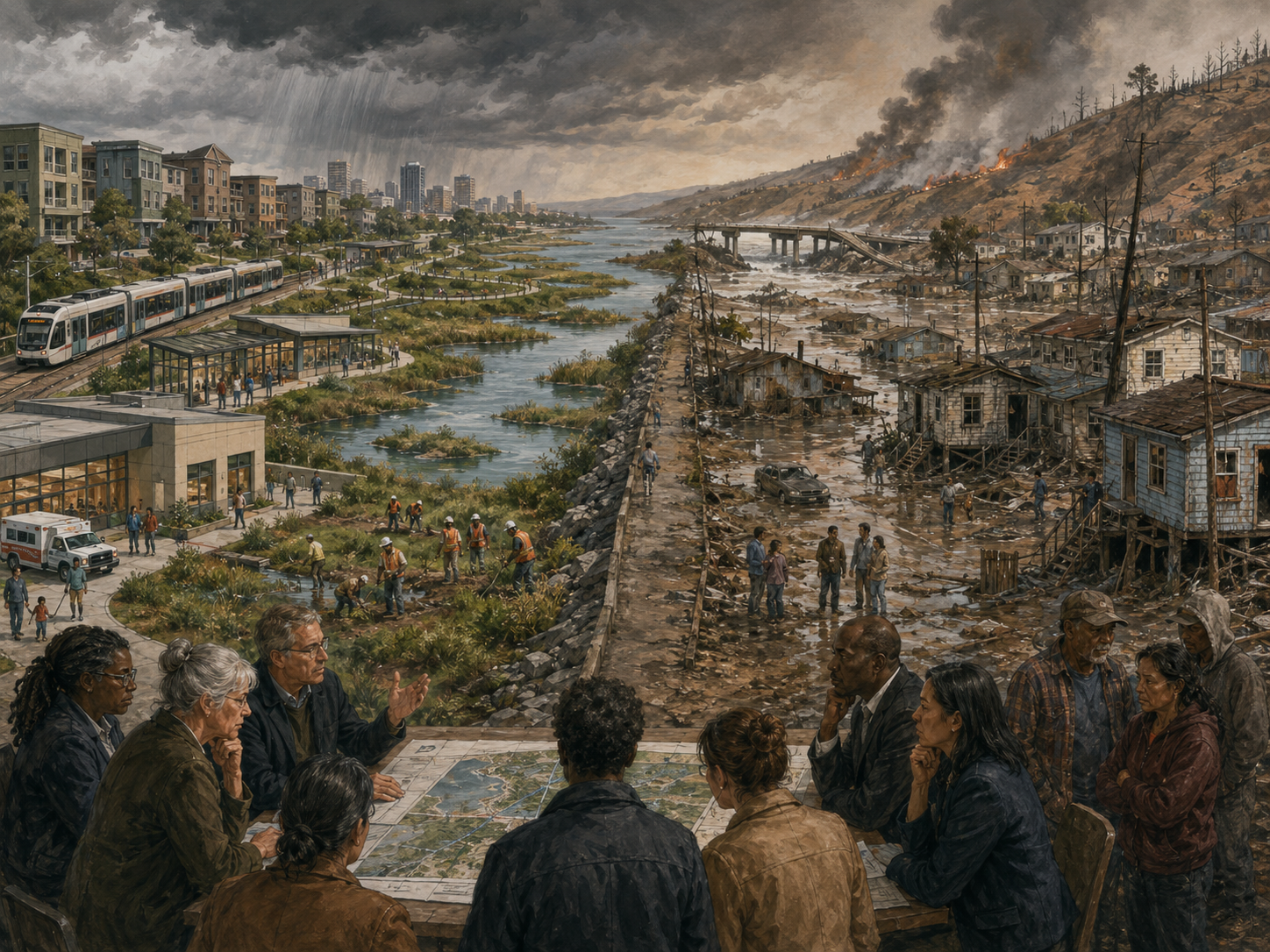
“Resilience or abandonment?” is one of the sharpest ethical questions in resilience thinking because resilience language can either support protection, adaptation, and transformation—or disguise the withdrawal of responsibility from people and places exposed to harm. In its strongest form, resilience helps communities, ecosystems, institutions, infrastructures, and social-ecological systems absorb disturbance, adapt under uncertainty, learn from disruption, and transform when existing arrangements become unsafe or unjust. In its weakest or most dangerous form, resilience becomes a polite word for being left to endure crisis with inadequate support.
The distinction matters because many systems now face accelerating climate risk, infrastructure fragility, unaffordable housing, public-health stress, ecological degradation, supply-chain volatility, digital dependence, fiscal constraint, disaster exposure, and institutional distrust. Under these conditions, asking people to “be resilient” can mean very different things. It can mean investing in public capacity, reducing vulnerability, repairing infrastructure, strengthening social protection, supporting local knowledge, and creating just transition pathways. It can also mean telling communities to adapt to risk that powerful actors helped create while public institutions, markets, or governing bodies retreat from responsibility.
Abandonment is not always explicit. It often appears through slow disinvestment, delayed maintenance, weak disaster recovery, unaffordable insurance, inaccessible aid, fragmented governance, inadequate public health capacity, underfunded social services, relocation without justice, disaster bureaucracy, unaffordable adaptation costs, surveillance without care, or resilience plans that praise community strength while leaving structural vulnerability untouched. A neighborhood may be called resilient because residents survive repeated flooding, heat waves, outages, displacement, and neglect. But endurance under imposed vulnerability is not the same as justice.
This article examines the boundary between resilience and abandonment. It asks when resilience becomes a demand placed on vulnerable communities rather than a public commitment to reduce harm. It connects resilience thinking with ethics, politics, disaster risk reduction, climate adaptation, infrastructure, housing, public health, social vulnerability, managed retreat, community resilience, governance, and just transformation. The central argument is that resilience is only defensible when it is paired with responsibility, resources, participation, repair, and structural change. Without those commitments, resilience can become abandonment by another name.
What “Resilience or Abandonment?” Means
The phrase “resilience or abandonment?” asks whether resilience planning is reducing vulnerability or merely asking people to survive conditions that institutions, markets, and governing systems refuse to fix. It draws attention to a recurring problem in resilience practice: the same language that can justify public investment, ecological restoration, community capacity, and institutional learning can also justify withdrawal, austerity, privatized responsibility, and normalized suffering.
Resilience is not inherently abandonment. Resilience can be life-sustaining. It can support disaster preparedness, climate adaptation, public health, infrastructure repair, biodiversity protection, community networks, social protection, and democratic governance. But resilience becomes ethically dangerous when it shifts attention away from the causes of vulnerability and toward the capacity of exposed people to cope. It becomes dangerous when endurance is praised instead of harm being reduced.
Abandonment often happens through omission rather than direct declaration. A city may publish a resilience plan while failing to repair drainage in flood-prone neighborhoods. A state may promote household preparedness while underfunding public health. An insurer may retreat from high-risk markets without ensuring affordable protection. A recovery program may technically exist but remain inaccessible to renters, undocumented residents, disabled people, small businesses, or people without documentation. A public agency may ask communities to prepare while infrastructure, housing, and social services deteriorate.
| Resilience as public responsibility | Resilience as abandonment |
|---|---|
| Reduces exposure and vulnerability before crisis | Normalizes repeated exposure as something people must endure |
| Invests in public systems, infrastructure, and social protection | Shifts responsibility to households, volunteers, or local communities |
| Includes affected communities in decisions | Consults symbolically after major choices have already been made |
| Connects adaptation to justice, repair, and accountability | Treats adaptation as individual coping or market adjustment |
| Addresses root causes of vulnerability | Manages symptoms while preserving harmful structures |
| Uses recovery to reduce future harm | Restores unsafe or unequal conditions after disaster |
The key distinction is responsibility. Ethical resilience asks what institutions, governments, firms, communities, and broader systems owe to people and ecosystems under conditions of risk. Abandonment tells exposed people that their survival is evidence of resilience while leaving the sources of exposure intact.
Why the Question Matters
The question matters because resilience language is increasingly used in climate policy, disaster planning, infrastructure investment, public health, urban planning, economic development, supply-chain management, humanitarian work, community development, and corporate strategy. As the concept becomes more influential, its political meaning becomes more important. Resilience can justify care, repair, and transformation. It can also justify lower expectations.
When people face repeated crises, resilience can become a flattering description of endurance. Communities are praised for “bouncing back” after floods, fires, hurricanes, heat waves, violence, unemployment, eviction, or public-health emergencies. But some communities are forced to bounce back because they are repeatedly pushed down. If resilience language celebrates recovery without addressing the repeated production of harm, it becomes part of the problem.
The question also matters because abandonment is often distributed unequally. Wealthy households can buy insurance, cooling, backup power, relocation options, legal support, and private protection. Low-income renters, disabled people, elders, outdoor workers, undocumented residents, informal workers, Indigenous communities, rural communities, and historically disinvested neighborhoods often face higher exposure and weaker recovery support. A resilience strategy that ignores these inequalities may strengthen aggregate system performance while deepening injustice.
Why “resilience or abandonment?” is a central question
It exposes responsibility
The question asks whether risk is being reduced by capable institutions or shifted onto those least able to absorb it.
It challenges empty resilience language
Plans, dashboards, and slogans are not enough if material vulnerability remains unchanged.
It protects against austerity logic
Resilience should not become a substitute for public investment, maintenance, care, and social protection.
It centers vulnerable groups
The test of resilience is not only system continuity, but whether the most exposed people are safer.
It clarifies transformation
Some systems should not be restored if restoration reproduces harm.
It makes resilience accountable
Resilience should be judged by outcomes, participation, repair, and responsibility—not rhetoric.
The question matters because it prevents resilience from becoming a moral demand placed on the already burdened. It asks whether resilience planning is protecting people or merely teaching them to live with abandonment.
Resilience as Support vs. Resilience as Withdrawal
Resilience as support strengthens the conditions that allow people, ecosystems, institutions, and infrastructures to endure, adapt, and transform safely. It includes public investment, maintenance, social protection, hazard reduction, ecological restoration, inclusive governance, early warning, accessible recovery, and long-term adaptation. It does not ask communities to absorb unlimited risk. It reduces the risk they are asked to absorb.
Resilience as withdrawal looks very different. It frames resilience as local coping while higher-capacity actors retreat. Governments reduce services and tell communities to prepare. Firms protect their operations while transferring volatility to workers and suppliers. Insurers withdraw protection while households face unaffordable risk. Public agencies create preparedness campaigns while failing to repair infrastructure. Philanthropic or volunteer networks are praised for filling gaps left by public neglect. Community strength becomes a substitute for institutional responsibility.
The same language may appear in both cases. Words such as adaptation, preparedness, flexibility, self-reliance, recovery, innovation, and resilience can describe genuine support or disguised withdrawal. The difference lies in whether resources, authority, protection, and accountability move toward exposed people—or away from them.
| Dimension | Support-oriented resilience | Withdrawal-oriented resilience |
|---|---|---|
| Responsibility | Matches responsibility to capacity, authority, and contribution to risk | Transfers responsibility to households and communities |
| Resources | Funds infrastructure, social protection, adaptation, and recovery | Offers advice, toolkits, or dashboards without material support |
| Governance | Shares authority with affected communities | Uses participation symbolically or after decisions are made |
| Risk reduction | Reduces exposure, sensitivity, and structural vulnerability | Normalizes exposure and emphasizes coping |
| Recovery | Uses recovery to repair inequity and reduce future harm | Restores prior vulnerability or leaves recovery to private capacity |
| Transformation | Changes systems that repeatedly produce harm | Preserves systems while asking people to adapt to them |
Support-oriented resilience expands real options. Withdrawal-oriented resilience narrows options and then praises people for surviving the narrowing.
Core Dimensions of Abandonment Risk
Abandonment risk is the danger that resilience language will mask the withdrawal, insufficiency, or misallocation of public responsibility. It appears when people are told to adapt without adequate protection, when recovery systems are inaccessible, when infrastructure is allowed to deteriorate, when relocation is imposed without justice, when social vulnerability is treated as a local weakness rather than a structural condition, and when resilience plans fail to change material realities.
Material Support Gap
A material support gap exists when resilience plans encourage preparedness or adaptation without providing the funding, services, infrastructure, housing, healthcare, transportation, insurance, legal support, or public capacity needed to act.
Responsibility Shift
Responsibility shift occurs when risk created by structural forces is reframed as a burden for individuals, households, neighborhoods, or volunteers to manage on their own.
Exposure Normalization
Exposure normalization occurs when repeated flooding, heat, smoke, violence, service failure, or displacement becomes treated as an expected condition rather than an unacceptable pattern requiring intervention.
Recovery Exclusion
Recovery exclusion occurs when official aid, insurance, rebuilding, relocation, or public benefits are inaccessible to people because of tenure, documentation, language, disability, income, legal status, technology access, or bureaucratic design.
Symbolic Participation
Symbolic participation occurs when affected communities are asked for input but lack real authority over priorities, budgets, relocation, infrastructure, monitoring, and accountability.
Status Quo Restoration
Status quo restoration occurs when recovery rebuilds the same vulnerability, reproduces unequal exposure, or protects existing assets without addressing the systems that made people unsafe.
Burden Shifting
Burden shifting occurs when resilience for one group, institution, or market is achieved by imposing risk, cost, labor, debt, surveillance, displacement, or ecological harm on another.
Accountability Failure
Accountability failure occurs when no institution is answerable for unmet resilience promises, repeated losses, delayed repair, inaccessible aid, or worsening vulnerability.
| Abandonment-risk dimension | Key question | Warning sign |
|---|---|---|
| Material support gap | Are people given the resources needed to adapt? | Preparedness advice is offered without funding, services, or infrastructure. |
| Responsibility shift | Who is expected to manage risk? | Households and volunteers are asked to absorb structural failures. |
| Exposure normalization | Is repeated harm treated as acceptable? | Recurring disasters are described as normal or inevitable. |
| Recovery exclusion | Who can access recovery support? | Aid systems exclude renters, migrants, disabled people, or informal workers. |
| Symbolic participation | Can affected people change decisions? | Consultation occurs after priorities and budgets are fixed. |
| Status quo restoration | Does recovery reduce future vulnerability? | Rebuilding restores the same unsafe conditions. |
| Burden shifting | Who pays the cost of resilience? | Risk is transferred to poorer groups, workers, ecosystems, or future generations. |
| Accountability failure | Who is answerable when resilience fails? | No public mechanism links harm to corrective action. |
These dimensions help distinguish genuine resilience practice from abandonment wrapped in resilience language.
The Politics of Responsibility
The politics of responsibility are central to the difference between resilience and abandonment. Risk is often produced by actors with unequal power: governments, developers, employers, fossil-fuel producers, infrastructure authorities, insurers, financial institutions, landlords, platform companies, supply-chain managers, and historical systems of land use, segregation, extraction, and disinvestment. Yet the burdens of adaptation often fall on people with the fewest resources.
When responsibility is misallocated, resilience becomes a form of moral displacement. A renter is told to prepare for heat while living in unsafe housing with no control over insulation, cooling, ventilation, or energy affordability. A coastal community is told to relocate without adequate compensation or cultural protection. A worker is told to be flexible while absorbing income volatility from a brittle supply chain. A neighborhood is told to organize mutual aid while public infrastructure remains neglected. A household is told to buy insurance in a market that has become unaffordable or unavailable.
Ethical resilience requires matching responsibility to capacity, authority, and contribution to risk. Those with the power to reduce systemic vulnerability should not be allowed to reframe resilience as a private duty for those exposed to harm. This does not mean communities lack agency. It means community agency should be supported, not exploited as a substitute for public responsibility.
| Actor | Possible responsibility | Abandonment pattern |
|---|---|---|
| Public agencies | Infrastructure, social protection, public health, emergency management, regulation, recovery | Promote preparedness while underfunding implementation and repair |
| Private firms | Risk reduction, labor protection, supply-chain accountability, emissions reduction, continuity planning | Build resilience by shifting volatility to workers, suppliers, or communities |
| Insurers and finance | Risk pricing, recovery capital, adaptation finance, affordability, transition support | Withdraw from high-risk areas without equitable alternatives |
| Landlords and property owners | Safe housing, maintenance, heat protection, flood mitigation, tenant protection | Transfer adaptation costs to tenants or defer repair |
| Higher-level governments | Climate finance, disaster aid, infrastructure investment, legal frameworks | Leave local governments to manage risks beyond local fiscal capacity |
| Communities | Local knowledge, mutual aid, participation, monitoring, care networks | Expected to compensate for systemic neglect without authority or resources |
The ethical question is not whether people and communities should act. They often do, creatively and powerfully. The ethical question is whether their action is supported by systems that reduce harm or exploited by systems that withdraw from responsibility.
Climate Adaptation and the Risk of Abandonment
Climate adaptation is one of the clearest places where the line between resilience and abandonment becomes visible. Adaptation can protect people from heat, flood, drought, wildfire, storms, sea-level rise, food insecurity, disease, water stress, and infrastructure failure. It can also become a way of telling exposed communities to live with escalating risk while mitigation, public investment, housing reform, and structural responsibility lag behind.
Adaptation becomes abandonment when the burden of climate adjustment is placed on those least responsible for climate risk and least able to pay for protection. Households may be asked to install cooling, floodproof homes, buy insurance, relocate, or recover from repeated disasters without adequate support. Local governments may be asked to manage climate hazards with insufficient fiscal capacity. Low-income countries may be expected to adapt to climate impacts produced largely by historical emissions elsewhere while facing debt, limited adaptation finance, and infrastructure constraints.
A just climate resilience strategy must therefore reduce exposure, increase protective capacity, and address responsibility. Adaptation cannot be treated as a substitute for mitigation, nor can it be used to normalize escalating harm. Climate resilience requires public investment, climate finance, land-use change, infrastructure repair, social protection, ecosystem restoration, and democratic participation.
| Climate adaptation domain | Resilience pathway | Abandonment pathway |
|---|---|---|
| Extreme heat | Cooling access, housing standards, tree canopy, public health, worker protections, energy affordability | Households are told to cool themselves while housing, labor, and energy systems remain unsafe |
| Flooding | Drainage repair, floodplain restoration, housing protection, relocation support, renter protections | Repeated flood losses are treated as individual property or insurance problems |
| Wildfire and smoke | Land stewardship, evacuation support, clean-air shelters, health protection, housing and insurance support | People are expected to buy filters, evacuate privately, or absorb smoke exposure |
| Drought | Water governance, conservation, ecosystem protection, agricultural transition, household affordability | Scarcity burdens are shifted to low-power users while structural demand remains unchanged |
| Coastal transition | Participatory adaptation, just retreat, cultural protection, compensation, ecological restoration | Retreat is imposed without adequate resources, consent, or community continuity |
| Global adaptation | Climate finance, loss and damage support, technology access, debt relief, capacity building | Exposed countries are expected to adapt without resources proportional to risk and responsibility |
Climate resilience is ethically serious only when it asks who created risk, who has the capacity to reduce it, and who is being asked to live with its consequences.
Managed Retreat, Displacement, and Justice
Managed retreat is often discussed as a climate adaptation strategy for places facing repeated flooding, sea-level rise, erosion, wildfire, or other hazards. In some cases, relocation may be necessary to protect life and prevent repeated loss. But retreat can easily become abandonment if it is imposed without justice, compensation, participation, cultural continuity, housing security, and long-term support.
The ethical difficulty is that staying and leaving can both involve harm. Staying in place may expose people to escalating risk. Leaving may sever community ties, cultural memory, livelihoods, land relationships, school networks, local institutions, and identity. For Indigenous communities and other place-based communities, relocation can carry meanings that cannot be captured by property value. For renters and low-income households, retreat programs designed around homeowners may produce exclusion rather than protection.
Managed retreat is therefore not only a technical land-use tool. It is a question of rights, dignity, consent, compensation, culture, governance, and future belonging. If retreat protects public budgets or property markets while leaving displaced people worse off, it is abandonment. If retreat is participatory, adequately funded, culturally sensitive, anti-displacement, and connected to long-term community wellbeing, it may become part of just transformation.
| Retreat question | Justice concern | Protective design principle |
|---|---|---|
| Who decides? | Relocation can become coercive if affected people lack authority | Use participatory planning, consent, and appeal mechanisms |
| Who is compensated? | Homeowner-centered programs can exclude renters and informal residents | Include renters, small businesses, workers, and community institutions |
| What is valued? | Property value may ignore culture, memory, land relationships, and social networks | Include cultural, social, ecological, and community continuity values |
| Where do people go? | Relocation can reproduce housing insecurity or segregation | Guarantee safe, affordable, accessible, and connected housing options |
| What happens after relocation? | One-time payments may not support long-term recovery | Provide long-term support, services, and livelihood continuity |
| What happens to land? | Vacated land can become speculation or exclusionary green space | Use ecological restoration, public stewardship, and anti-speculation rules |
The ethical question is not only whether retreat reduces exposure. It is whether retreat protects dignity, rights, continuity, and future options for the people most affected.
Infrastructure Neglect and Public Capacity
Infrastructure neglect is one of the most common ways abandonment becomes visible. Roads, bridges, drainage systems, water systems, public housing, schools, hospitals, transit, energy systems, broadband, parks, cooling centers, and public facilities all shape resilience. When maintenance is deferred, services become unreliable, exposure increases, and households are forced to compensate privately for public failure.
Neglect often appears gradual. A drainage system fails repeatedly. Water infrastructure leaks or contaminates. Public transit becomes unreliable. Schools overheat. Hospitals lack surge capacity. Public housing deteriorates. Roads flood. Energy outages become routine. A city may still have a resilience plan, but without repair and maintenance, resilience remains symbolic. Abandonment occurs when public systems are allowed to degrade and communities are expected to adapt to degradation.
Public capacity is therefore a core resilience asset. Resilience depends on staffing, maintenance crews, procurement systems, emergency managers, public-health workers, engineers, social workers, planners, community liaisons, data stewards, inspectors, and local institutions. A society cannot outsource resilience entirely to households, volunteers, dashboards, or private markets. If public systems lack capacity, resilience plans cannot become real.
Infrastructure neglect as abandonment risk
Deferred maintenance
Backlog accumulates quietly until a shock exposes years of underinvestment.
Unequal service reliability
Some neighborhoods experience repeated outages, flooding, heat exposure, or transit gaps.
Public capacity erosion
Agencies lack the staff, budgets, procurement systems, or authority needed to act.
Private coping costs
Households buy generators, filters, repairs, rides, cooling, insurance, or relocation options privately.
Symbolic modernization
Dashboards and pilots are funded while basic repair remains incomplete.
Delayed recovery
Weak infrastructure and public capacity slow recovery after each disruption.
Infrastructure resilience is not only about hardening assets against shocks. It is also about maintaining the public capacity required to protect people before, during, and after disruption.
Housing, Health, and Social Protection
Housing, health, and social protection are central to the distinction between resilience and abandonment because they determine whether people can actually act on resilience advice. A household cannot prepare effectively if housing is unsafe, rent is unaffordable, income is unstable, healthcare is inaccessible, transportation is unreliable, and public benefits are difficult to obtain. Resilience depends on the material conditions of life.
Housing is especially important. Unsafe housing amplifies heat risk, flood risk, mold exposure, respiratory illness, displacement, energy burden, and financial precarity. Renters may lack authority to retrofit, install cooling, repair damage, or make flood protections. Homeowners with low incomes may lack funds for adaptation. People experiencing homelessness or housing insecurity are exposed to hazards in direct and severe ways. Resilience that ignores housing is often resilience in name only.
Health systems also reveal abandonment risk. During compound crises, people depend on hospitals, clinics, pharmacies, home health services, emergency medical systems, public-health communication, mental-health support, and long-term care. If these systems are underfunded, understaffed, inaccessible, or digitally fragile, communities are asked to endure risk without sufficient care infrastructure. Social protection—income support, food assistance, utility assistance, childcare, legal aid, disability support, and unemployment protection—provides the buffer that makes adaptation possible.
| Domain | Support-oriented resilience | Abandonment risk |
|---|---|---|
| Housing | Safe, affordable, energy-secure, climate-adapted housing with tenant protections | People are told to prepare while living in unsafe or unaffordable housing |
| Public health | Accessible care, surge capacity, prevention, communication, and community health networks | Households absorb health risk because systems lack capacity |
| Income support | Cash, unemployment support, disaster aid, paid leave, and recovery finance | People cannot evacuate, recover, or adapt because they lack financial buffers |
| Food security | Accessible food systems, school meals, emergency distribution, local supply resilience | Supply shocks and price spikes become household crises |
| Utilities | Affordable energy, water, cooling, heating, communications, and shutoff protections | Basic services become unaffordable precisely when risk rises |
| Legal and administrative access | Simple, multilingual, accessible pathways to aid and rights protection | Bureaucracy excludes those most in need of recovery support |
Resilience is not created by telling people to cope. It is created by building the social conditions that make safe coping, adaptation, and recovery possible.
Community Resilience Without Romanticizing Endurance
Community resilience is real and important. Communities often provide the first layer of care during crisis: neighbors check on elders, local organizations distribute food, faith groups open shelters, informal networks share information, mutual-aid groups mobilize supplies, and residents draw on local knowledge that outside agencies lack. These forms of care can save lives and sustain dignity.
But community resilience can be romanticized when it is used to excuse institutional failure. If communities repeatedly fill gaps left by weak public systems, their strength should not be used as evidence that formal support is unnecessary. Mutual aid should not become a permanent substitute for public health, housing, infrastructure, disaster recovery, or social protection. Community agency is valuable because it expresses care and local knowledge, not because it allows powerful systems to withdraw.
Ethical resilience thinking must therefore hold two truths together. Communities are not helpless. They possess knowledge, relationships, creativity, memory, and capacity. At the same time, communities should not be forced to compensate endlessly for structural abandonment. The goal is not to replace community resilience with institutional control. The goal is to support community capacity with resources, authority, protection, and accountability.
| Community resilience strength | How it helps | Risk if romanticized |
|---|---|---|
| Local knowledge | Identifies risks, needs, informal systems, and practical solutions | Institutions extract knowledge without sharing decision authority |
| Mutual aid | Provides rapid care, food, supplies, information, and social support | Volunteers are expected to replace public systems |
| Trust networks | Improve communication and response when official systems are distrusted | Trust is exploited without repairing institutional legitimacy |
| Cultural continuity | Supports identity, memory, belonging, and recovery | Culture is praised while material protection is neglected |
| Neighborhood organization | Supports advocacy, preparedness, and collective action | Communities are blamed if they lack capacity after disinvestment |
| Care work | Protects vulnerable people during crisis | Unpaid care burdens fall unequally on women, families, and informal networks |
The ethical test is whether community resilience is supported or exploited. Strong communities deserve resources, authority, and protection—not applause in place of responsibility.
Data, Dashboards, and the Risk of Symbolic Resilience
Data systems, dashboards, indicators, digital twins, risk maps, sensors, and analytics can improve resilience planning. They can reveal exposure, monitor infrastructure, identify vulnerable populations, track recovery, detect weak signals, and compare scenarios. But technical visibility is not the same as protection. A dashboard that shows risk without changing budgets, authority, maintenance, recovery, or rights can become a symbol of resilience rather than a tool for reducing harm.
Symbolic resilience appears when institutions measure vulnerability better than they reduce it. A city may know which neighborhoods overheat but fail to fund housing retrofits. A public agency may map flood exposure but delay drainage repair. A health system may identify vulnerable populations but lack accessible outreach. A disaster program may collect data but design aid systems that people cannot use. A digital platform may improve monitoring while increasing surveillance, dependency, or exclusion.
Ethical resilience analytics require a connection between data and action. Indicators should trigger resources, accountability, and revision. Data should be disaggregated without exposing vulnerable people to harm. Models should be transparent about uncertainty. Community knowledge should shape interpretation. Digital systems should support human judgment, public accountability, and material protection.
Warning signs of symbolic resilience analytics
Risk is mapped but not reduced
Exposure data accumulate while infrastructure, housing, and services remain unchanged.
Indicators lack triggers
Dashboards report worsening conditions but do not activate funding, repair, outreach, or legal duties.
Models hide uncertainty
Technical outputs appear precise while assumptions, gaps, and limitations remain unclear.
Data excludes lived experience
Local knowledge, disability needs, informal housing, language access, and cultural ties are not captured.
Monitoring becomes surveillance
Safety systems collect data without rights safeguards, consent, oversight, or purpose limits.
Analytics replace accountability
Better measurement becomes a substitute for public responsibility and corrective action.
Data can strengthen resilience only when it is connected to responsibility. Measurement without repair can become another form of abandonment.
Warning Signs of Abandonment Framed as Resilience
Abandonment framed as resilience has recognizable patterns. It often uses empowering language while reducing material support. It emphasizes flexibility while ignoring insecurity. It celebrates local initiative while underfunding public systems. It praises recovery while neglecting repeated exposure. It asks people to adapt while preserving the structures that made adaptation necessary.
These warning signs are especially important because abandonment rarely announces itself as abandonment. It often appears as pragmatism, fiscal constraint, innovation, risk-based planning, household responsibility, community empowerment, or market efficiency. Each of these can be legitimate in the right context. But each can also become a way to move responsibility away from institutions with capacity and toward people already under stress.
| Warning sign | How it sounds | What to ask |
|---|---|---|
| Preparedness without resources | “Residents should be ready.” | Do residents have money, housing, transport, health access, and information? |
| Community empowerment without authority | “The community will lead.” | Does the community control budgets, priorities, data, and implementation? |
| Recovery without repair | “We will rebuild stronger.” | Will rebuilding reduce vulnerability or restore the same unsafe conditions? |
| Adaptation without responsibility | “People must adjust to new realities.” | Who created the risk, who benefits, and who has capacity to reduce it? |
| Risk-based withdrawal | “This area is too risky.” | Are people being supported to move safely, or simply losing protection? |
| Innovation without maintenance | “We need smart solutions.” | Are basic infrastructure, staffing, and repair being funded? |
| Resilience without rights | “Monitoring improves safety.” | Are privacy, consent, due process, and data governance protected? |
| Transformation without justice | “The system must change.” | Who bears the cost of change, and who has decision authority? |
The warning signs do not mean every resilience policy is abandonment. They mean resilience claims should be tested against resources, responsibility, authority, and outcomes.
Resilience as Repair
A stronger alternative is to understand resilience as repair. Repair does not mean returning systems to the exact conditions that existed before disruption. It means repairing the social, ecological, institutional, and infrastructural conditions that make safe life possible. It means reducing exposure, restoring trust, rebuilding public capacity, correcting disinvestment, strengthening social protection, and transforming systems that repeatedly produce vulnerability.
Repair-oriented resilience is different from coping-oriented resilience. Coping helps people survive the next disruption. Repair reduces the likelihood that the same people will face the same harm again. Coping may be necessary in emergencies, but it should not become the long-term horizon of resilience. If people must repeatedly cope with the same preventable harms, the system has failed to repair.
Repair also has historical meaning. Many vulnerabilities are not accidental. They reflect patterns of segregation, colonialism, extraction, environmental injustice, underinvestment, labor exploitation, housing exclusion, infrastructure neglect, and uneven political power. Repair-oriented resilience recognizes that future protection may require addressing past and present harm. It connects resilience with justice, not merely continuity.
Principles of resilience as repair
Reduce exposure
Do not ask people to repeatedly endure preventable hazard, pollution, heat, flood, displacement, or service failure.
Build public capacity
Fund the institutions, workers, infrastructure, maintenance, care systems, and governance needed for real protection.
Correct unequal vulnerability
Direct resources toward those facing the greatest exposure, least recovery capacity, and longest histories of disinvestment.
Protect rights and dignity
Adaptation and recovery should preserve consent, access, culture, disability rights, housing security, and community continuity.
Transform harmful systems
When existing systems repeatedly produce harm, resilience requires redesign rather than restoration.
Make accountability durable
Resilience promises should be tied to budgets, deadlines, public reporting, and corrective action.
Resilience as repair moves the field beyond admiration for survival. It asks what must be changed so survival is not constantly demanded from the same people.
A Practical Framework for Distinguishing Resilience from Abandonment
A practical framework for distinguishing resilience from abandonment should examine responsibility, resources, participation, exposure reduction, recovery access, transformation, rights, and accountability. It should be applied before plans are adopted, during implementation, and after disruptions reveal gaps. The question is not whether a plan uses the word resilience. The question is whether it materially reduces vulnerability while protecting dignity and public responsibility.
| Step | Question | Evidence to examine |
|---|---|---|
| Define the resilience claim | What is being called resilient? | Plan language, target systems, protected functions, stated beneficiaries |
| Identify exposed groups | Who faces the greatest risk and lowest recovery capacity? | Disaggregated exposure, income, housing, health, disability, tenure, language, age, and geography |
| Trace responsibility | Who created or intensified the risk, and who has capacity to reduce it? | Land use, emissions, infrastructure decisions, regulation, ownership, maintenance, finance |
| Assess material support | Are affected people given the resources needed to adapt or recover? | Budgets, aid access, housing support, healthcare, transport, legal support, insurance, services |
| Evaluate participation | Can affected communities shape decisions? | Decision authority, co-design, public review, appeal mechanisms, community-led priorities |
| Test exposure reduction | Does the strategy reduce future harm or normalize repeated exposure? | Hazard reduction, infrastructure repair, housing improvement, ecological restoration, relocation support |
| Check burden shifting | Does protection for some increase burden for others? | Costs, displacement, debt, unpaid care, labor burden, surveillance, ecological harm |
| Review recovery access | Who can actually receive support after disruption? | Aid eligibility, documentation, disability access, language access, renter access, small business access |
| Consider transformation | Should the system be restored, adapted, or redesigned? | Status quo review, maladaptation analysis, transition pathways, anti-lock-in assessment |
| Institutionalize accountability | Who is answerable if resilience promises fail? | Public reporting, corrective-action deadlines, budgets, audits, legal obligations, community oversight |
This framework helps resilience practitioners ask whether a strategy is building protection or merely asking people to survive preventable harm.
Mathematical Lens: Modeling Support, Exposure, and Abandonment Risk
Abandonment risk cannot be reduced to a formula, but mathematical framing can clarify the relationship between exposure, support, responsibility, and burden shifting. A simple support-adjusted resilience value for group \(j\) under strategy \(i\) can be represented as:
R_{ij}^{support} = P_{ij} + S_{ij} + A_{ij} + G_{ij} – E_{ij} – B_{ij}
\]
Interpretation: \(P_{ij}\) represents protective effectiveness, \(S_{ij}\) material support, \(A_{ij}\) accessible recovery and adaptation capacity, \(G_{ij}\) governance inclusion, \(E_{ij}\) exposure, and \(B_{ij}\) burdens shifted onto group \(j\).
Abandonment risk can be modeled as the gap between exposure and support:
AR_j = E_j – (S_j + A_j + G_j)
\]
Interpretation: If exposure is high while support, adaptation capacity, and governance inclusion are low, abandonment risk rises. This equation is not a final measure; it is a diagnostic structure.
Responsibility can also be represented as a mismatch between who has capacity to reduce risk and who is asked to carry the burden:
M = C_{responsible} – C_{burdened}
\]
Interpretation: \(C_{responsible}\) represents the capacity and authority of actors responsible for reducing risk, while \(C_{burdened}\) represents the capacity of those expected to absorb risk. A high mismatch suggests responsibility is being displaced.
A justice-adjusted resilience score can penalize repeated exposure and inaccessible recovery:
R_i^{*} = R_i – \theta X_i – \lambda U_i – \mu D_i
\]
Interpretation: \(X_i\) represents unequal exposure, \(U_i\) inaccessible support, and \(D_i\) displacement or burden shifting. A strategy that looks resilient in aggregate may become weak once these penalties are included.
The purpose of these equations is not to mechanize ethics. It is to make visible the conditions under which resilience claims become suspect: high exposure, low support, weak participation, shifted burden, and absent accountability.
Advanced R Workflow: Comparing Resilience Support and Abandonment Risk
The R workflow below compares several resilience strategies across protective effectiveness, material support, accessible recovery, governance inclusion, transformation potential, exposure reduction, burden shifting, and implementation burden. It illustrates how a strategy can appear strong on protection while still carrying abandonment risk if support is weak or burdens are shifted.
# Install packages if needed:
# install.packages(c("tidyverse", "scales"))

library(tidyverse)
library(scales)

# -------------------------------------------------------------------
# Synthetic strategies for distinguishing resilience from abandonment.
# Higher burden_shift and implementation_burden are penalties.
# -------------------------------------------------------------------

strategies <- tibble(
  strategy = c(
    "Household Preparedness Campaign",
    "Public Housing Climate Retrofit",
    "Community-Led Cooling and Care Network",
    "Flood Defense for High-Value Assets",
    "Managed Retreat with Long-Term Support",
    "Drainage Repair and Social Protection Package",
    "Risk Mapping Dashboard Without Funding"
  ),
  protective_effectiveness = c(5.8, 8.4, 7.8, 8.6, 8.0, 8.5, 6.2),
  material_support = c(3.2, 8.8, 7.6, 5.2, 8.7, 8.6, 2.8),
  accessible_recovery = c(4.1, 8.5, 8.0, 5.4, 8.9, 8.7, 3.1),
  governance_inclusion = c(4.5, 8.2, 9.0, 5.0, 8.4, 8.5, 4.2),
  transformation_potential = c(4.0, 8.2, 7.7, 5.2, 8.8, 8.4, 4.6),
  exposure_reduction = c(3.8, 8.5, 7.4, 7.6, 8.9, 8.7, 3.5),
  burden_shift = c(6.8, 2.8, 3.1, 5.9, 2.9, 2.7, 6.5),
  implementation_burden = c(2.6, 3.8, 3.2, 3.4, 4.0, 3.9, 2.7)
)

# -------------------------------------------------------------------
# Weighted support-oriented resilience score.
# -------------------------------------------------------------------

score_strategies <- function(data, wp, ws, wa, wg, wt, wx, wb, wi) {
  data %>%
    mutate(
      support_resilience_value =
        wp * protective_effectiveness +
        ws * material_support +
        wa * accessible_recovery +
        wg * governance_inclusion +
        wt * transformation_potential +
        wx * exposure_reduction -
        wb * burden_shift -
        wi * implementation_burden,
      support_gap = pmax(0, 8.0 - material_support),
      recovery_gap = pmax(0, 8.0 - accessible_recovery),
      governance_gap = pmax(0, 8.0 - governance_inclusion),
      abandonment_risk =
        0.32 * support_gap +
        0.24 * recovery_gap +
        0.22 * governance_gap +
        0.14 * burden_shift +
        0.08 * pmax(0, 8.0 - exposure_reduction),
      adjusted_value = support_resilience_value - abandonment_risk,
      diagnostic = case_when(
        abandonment_risk >= 2.4 ~ "high abandonment-risk review needed",
        burden_shift >= 5.5 ~ "burden-shifting review needed",
        material_support < 6.0 ~ "material-support gap",
        accessible_recovery < 6.0 ~ "recovery-access gap",
        governance_inclusion < 6.0 ~ "participation and authority gap",
        TRUE ~ "support-oriented resilience candidate"
      )
    ) %>%
    arrange(desc(adjusted_value))
}

# -------------------------------------------------------------------
# Priority scenarios.
# -------------------------------------------------------------------

scenarios <- tribble(
  ~scenario,               ~wp,  ~ws,  ~wa,  ~wg,  ~wt,  ~wx,  ~wb,  ~wi,
  "Balanced",              0.18, 0.18, 0.16, 0.14, 0.13, 0.16, 0.04, 0.01,
  "Protection-first",      0.38, 0.12, 0.12, 0.10, 0.10, 0.14, 0.03, 0.01,
  "Support-first",         0.12, 0.36, 0.16, 0.12, 0.10, 0.12, 0.03, 0.01,
  "Recovery-first",        0.12, 0.16, 0.36, 0.12, 0.10, 0.12, 0.03, 0.01,
  "Governance-first",      0.12, 0.14, 0.14, 0.34, 0.10, 0.12, 0.03, 0.01,
  "Transformation-first",  0.12, 0.14, 0.14, 0.12, 0.34, 0.12, 0.03, 0.01,
  "Exposure-reduction",    0.12, 0.14, 0.14, 0.12, 0.10, 0.36, 0.03, 0.01,
  "Burden-sensitive",      0.16, 0.16, 0.14, 0.12, 0.12, 0.14, 0.14, 0.02
)

ranked_results <- scenarios %>%
  rowwise() %>%
  do(
    score_strategies(
      strategies,
      wp = .$wp,
      ws = .$ws,
      wa = .$wa,
      wg = .$wg,
      wt = .$wt,
      wx = .$wx,
      wb = .$wb,
      wi = .$wi
    ) %>%
      mutate(scenario = .$scenario)
  ) %>%
  ungroup() %>%
  group_by(scenario) %>%
  arrange(desc(adjusted_value), .by_group = TRUE) %>%
  mutate(rank = row_number()) %>%
  ungroup()

print(ranked_results)

ggplot(ranked_results, aes(x = strategy, y = adjusted_value, group = scenario)) +
  geom_point(size = 3) +
  geom_line(aes(color = scenario), linewidth = 1) +
  coord_flip() +
  labs(
    title = "Support-Oriented Resilience vs. Abandonment Risk",
    x = "Strategy",
    y = "Adjusted Support Resilience Value",
    color = "Priority"
  ) +
  theme_minimal(base_size = 12)

top_rank_summary <- ranked_results %>%
  filter(rank == 1) %>%
  count(strategy, name = "times_ranked_first") %>%
  arrange(desc(times_ranked_first))

write_csv(ranked_results, "resilience_or_abandonment_strategy_rankings.csv")
write_csv(top_rank_summary, "resilience_or_abandonment_top_rank_summary.csv")

print(top_rank_summary)
This workflow shows why resilience cannot be evaluated by protective effectiveness alone. A strategy that hardens infrastructure but provides little support, weak recovery access, and poor governance inclusion may score lower once abandonment risk is included.
Advanced Python Workflow: Simulating Abandonment Risk Under Compound Stress
The Python workflow below simulates how abandonment risk changes over time when climate stress, infrastructure stress, public capacity, material support, governance inclusion, and burden shifting interact. It uses synthetic data for methodological demonstration.
# Install packages if needed:
# pip install pandas numpy matplotlib

import numpy as np
import pandas as pd
import matplotlib.pyplot as plt

# ---------------------------------------------------------------------
# Synthetic resilience pathways.
# ---------------------------------------------------------------------

pathways = pd.DataFrame({
    "pathway": [
        "Preparedness without material support",
        "Public repair and social protection",
        "Community-led resilience with public backing",
        "Asset protection with weak inclusion",
        "Just retreat and long-term support"
    ],
    "initial_exposure": [0.72, 0.66, 0.68, 0.70, 0.74],
    "material_support": [0.32, 0.84, 0.76, 0.48, 0.86],
    "accessible_recovery": [0.38, 0.82, 0.78, 0.46, 0.88],
    "governance_inclusion": [0.40, 0.80, 0.90, 0.42, 0.84],
    "public_capacity": [0.42, 0.82, 0.78, 0.50, 0.80],
    "burden_shift": [0.78, 0.28, 0.32, 0.70, 0.30],
    "transformation": [0.30, 0.74, 0.70, 0.42, 0.86]
})

rng = np.random.default_rng(42)
rows = []
n_steps = 60

for _, p in pathways.iterrows():
    exposure = p["initial_exposure"]
    trust = 0.50
    recovery_capacity = p["accessible_recovery"]
    public_capacity = p["public_capacity"]

    for t in range(n_steps):
        shock = 0.0
        if t in [10, 22, 36, 50]:
            shock = rng.uniform(0.22, 0.40)

        climate_pressure = 0.18 + 0.008 * t + 0.25 * shock
        infrastructure_pressure = 0.20 + 0.006 * t + 0.20 * shock

        exposure = np.clip(
            exposure
            + 0.04 * climate_pressure
            + 0.03 * infrastructure_pressure
            - 0.08 * p["transformation"]
            - 0.06 * public_capacity,
            0,
            1
        )

        recovery_capacity = np.clip(
            recovery_capacity
            + 0.04 * p["material_support"]
            + 0.04 * public_capacity
            + 0.03 * p["governance_inclusion"]
            - 0.05 * shock,
            0,
            1
        )

        trust = np.clip(
            trust
            + 0.05 * p["governance_inclusion"]
            + 0.04 * recovery_capacity
            + 0.03 * p["material_support"]
            - 0.07 * p["burden_shift"]
            - 0.04 * shock,
            0,
            1
        )

        support_strength = np.clip(
            0.28 * p["material_support"]
            + 0.24 * recovery_capacity
            + 0.20 * p["governance_inclusion"]
            + 0.16 * public_capacity
            + 0.12 * trust,
            0,
            1
        )

        abandonment_risk = np.clip(
            exposure
            + 0.45 * p["burden_shift"]
            + 0.25 * shock
            - support_strength,
            0,
            1
        )

        justice_adjusted_resilience = np.clip(
            0.32 * support_strength
            + 0.22 * recovery_capacity
            + 0.18 * trust
            + 0.16 * p["transformation"]
            + 0.12 * (1 - exposure)
            - 0.20 * abandonment_risk,
            0,
            1
        )

        rows.append({
            "pathway": p["pathway"],
            "time": t,
            "shock": shock,
            "climate_pressure": climate_pressure,
            "infrastructure_pressure": infrastructure_pressure,
            "exposure": exposure,
            "recovery_capacity": recovery_capacity,
            "trust": trust,
            "support_strength": support_strength,
            "abandonment_risk": abandonment_risk,
            "justice_adjusted_resilience": justice_adjusted_resilience
        })

simulation = pd.DataFrame(rows)

summary = (
    simulation
    .groupby("pathway")
    .agg(
        mean_abandonment_risk=("abandonment_risk", "mean"),
        max_abandonment_risk=("abandonment_risk", "max"),
        final_abandonment_risk=("abandonment_risk", "last"),
        mean_justice_adjusted_resilience=("justice_adjusted_resilience", "mean"),
        final_justice_adjusted_resilience=("justice_adjusted_resilience", "last"),
        final_exposure=("exposure", "last"),
        final_trust=("trust", "last")
    )
    .reset_index()
    .sort_values("final_justice_adjusted_resilience", ascending=False)
)

print(summary)

plt.figure(figsize=(10, 6))
for pathway, subset in simulation.groupby("pathway"):
    plt.plot(subset["time"], subset["abandonment_risk"], label=pathway)
plt.xlabel("Time")
plt.ylabel("Abandonment risk")
plt.title("Abandonment Risk Across Resilience Pathways")
plt.legend()
plt.tight_layout()
plt.show()

plt.figure(figsize=(10, 6))
for pathway, subset in simulation.groupby("pathway"):
    plt.plot(subset["time"], subset["justice_adjusted_resilience"], label=pathway)
plt.xlabel("Time")
plt.ylabel("Justice-adjusted resilience")
plt.title("Justice-Adjusted Resilience Across Pathways")
plt.legend()
plt.tight_layout()
plt.show()

simulation.to_csv("resilience_or_abandonment_simulation.csv", index=False)
summary.to_csv("resilience_or_abandonment_summary.csv", index=False)
The simulation illustrates why abandonment risk rises when exposure grows faster than support, recovery access, governance inclusion, and public capacity. It also shows why pathways that combine community participation with material backing are fundamentally different from pathways that ask communities to cope without resources.
GitHub Repository
The companion GitHub repository for this article is designed as a resilience-or-abandonment modeling scaffold. It translates protective effectiveness, material support, accessible recovery, governance inclusion, transformation potential, exposure reduction, burden shifting, abandonment risk, and justice-adjusted resilience into reproducible workflows for ethical resilience analysis.
Complete Code Repository
Companion code for Resilience or Abandonment?, including support-oriented resilience scoring, abandonment-risk diagnostics, compound-stress simulation, burden-shift analysis, justice-adjusted resilience comparison, responsible-use notes, and multi-language computational examples.
The companion article directory is articles/resilience-or-abandonment/. It is structured to support a professional modeling workflow: Python for abandonment-risk simulation and uncertainty analysis; R for strategy comparison across ethical priorities; SQL for support and abandonment-risk data structures; and lightweight examples in Julia, C, C++, Go, Rust, and Fortran.
The modeling objective is to show why resilience must be evaluated through support, responsibility, participation, exposure reduction, recovery access, and burden shifting. A strategy can look resilient when measured by system continuity alone but become ethically weak when abandonment risk is included.
Conclusion
“Resilience or abandonment?” is not a rhetorical flourish. It is a necessary test for resilience thinking. If resilience means reducing exposure, increasing public capacity, strengthening social protection, supporting communities, repairing infrastructure, restoring ecosystems, and transforming harmful systems, then resilience can be a powerful framework for care and adaptation. But if resilience means asking people to endure preventable harm with fewer resources and less institutional responsibility, then resilience becomes abandonment by another name.
The distinction turns on responsibility. Ethical resilience does not praise people for surviving conditions that should have been changed. It does not ask communities to become endlessly adaptive to heat, flood, fire, displacement, poverty, unsafe housing, weak health systems, infrastructure neglect, or institutional failure. It asks what must be repaired, funded, governed, transformed, and made accountable so that survival is not repeatedly demanded from the same people.
Community strength matters. Local knowledge matters. Mutual aid matters. Adaptation matters. But none of these should be used to excuse public withdrawal, corporate externalization, or structural neglect. Resilience should expand people’s real options, not narrow them and call the narrowing empowerment.
In the broader Resilience Thinking series, this article connects ethics, politics, maladaptive resilience, just transformation, climate adaptation, disaster risk reduction, institutional resilience, community resilience, social vulnerability, infrastructure, and governance. The central lesson is clear: resilience is defensible only when it protects dignity, reduces vulnerability, distributes responsibility fairly, and gives affected people real power over the futures they are being asked to endure or build.
Related Articles
- Ethics and Politics of Resilience
- Maladaptive Resilience
- Just Transformation and Resilience
- Social Vulnerability and Resilience
- Community Resilience
- Institutional Resilience
- Climate Resilience
- Disaster Risk Reduction and Resilience
Further Reading
- Davoudi, S. (2012) ‘Resilience: A bridging concept or a dead end?’, Planning Theory & Practice, 13(2), pp. 299–333.
- Intergovernmental Panel on Climate Change (2022) Climate Change 2022: Impacts, Adaptation and Vulnerability. Available at: https://www.ipcc.ch/report/ar6/wg2/.
- Intergovernmental Panel on Climate Change (2022) Chapter 18: Climate Resilient Development Pathways. Available at: https://www.ipcc.ch/report/ar6/wg2/chapter/chapter-18/.
- Meerow, S. and Newell, J.P. (2019) ‘Urban resilience for whom, what, when, where, and why?’, Urban Geography, 40(3), pp. 309–329. Available at: https://doi.org/10.1080/02723638.2016.1206395.
- Pelling, M. (2011) Adaptation to Climate Change: From Resilience to Transformation. London: Routledge.
- United Nations Office for Disaster Risk Reduction (2015) Sendai Framework for Disaster Risk Reduction 2015–2030. Available at: https://www.undrr.org/publication/sendai-framework-disaster-risk-reduction-2015-2030.
- Walker, J. and Cooper, M. (2011) ‘Genealogies of resilience: From systems ecology to the political economy of crisis adaptation’, Security Dialogue, 42(2), pp. 143–160. Available at: https://doi.org/10.1177/0967010611399616.
- Wisner, B., Blaikie, P., Cannon, T. and Davis, I. (2004) At Risk: Natural Hazards, People’s Vulnerability and Disasters. 2nd edn. London: Routledge.
References
- Adger, W.N. (2000) ‘Social and ecological resilience: Are they related?’, Progress in Human Geography, 24(3), pp. 347–364. Available at: https://doi.org/10.1191/030913200701540465.
- Bankoff, G. (2001) ‘Rendering the world unsafe: “Vulnerability” as Western discourse’, Disasters, 25(1), pp. 19–35. Available at: https://doi.org/10.1111/1467-7717.00159.
- Davoudi, S. (2012) ‘Resilience: A bridging concept or a dead end?’, Planning Theory & Practice, 13(2), pp. 299–333.
- Folke, C. et al. (2010) ‘Resilience thinking: integrating resilience, adaptability and transformability’, Ecology and Society, 15(4). Available at: https://www.ecologyandsociety.org/vol15/iss4/art20/.
- Intergovernmental Panel on Climate Change (2022) Climate Change 2022: Impacts, Adaptation and Vulnerability. Available at: https://www.ipcc.ch/report/ar6/wg2/.
- Meerow, S. and Newell, J.P. (2019) ‘Urban resilience for whom, what, when, where, and why?’, Urban Geography, 40(3), pp. 309–329. Available at: https://doi.org/10.1080/02723638.2016.1206395.
- Pelling, M. (2011) Adaptation to Climate Change: From Resilience to Transformation. London: Routledge.
- United Nations Office for Disaster Risk Reduction (2015) Sendai Framework for Disaster Risk Reduction 2015–2030. Available at: https://www.undrr.org/publication/sendai-framework-disaster-risk-reduction-2015-2030.
- Walker, J. and Cooper, M. (2011) ‘Genealogies of resilience: From systems ecology to the political economy of crisis adaptation’, Security Dialogue, 42(2), pp. 143–160. Available at: https://doi.org/10.1177/0967010611399616.
- Wisner, B., Blaikie, P., Cannon, T. and Davis, I. (2004) At Risk: Natural Hazards, People’s Vulnerability and Disasters. 2nd edn. London: Routledge.