
Last Updated June 2, 2026
Local knowledge is the place-based, practice-based, historically situated understanding that people develop through living, working, caring, governing, farming, fishing, building, repairing, monitoring, surviving, remembering, and adapting within particular environments and communities over time. In resilience practice, local knowledge matters because many risks are first recognized by the people closest to them: residents who know where streets flood before official maps are updated, fishers who notice ecological change before it appears in aggregate data, farmers who read soil and rainfall patterns through long experience, caregivers who know which households are medically vulnerable during outages, Indigenous communities whose stewardship knowledge carries generations of ecological memory, and frontline workers who see system failure before administrators do.
Local knowledge is not a romantic alternative to science. It is not folklore placed against evidence. It is one form of evidence among others, with its own methods, histories, limitations, and standards of credibility. Resilience practice becomes stronger when local knowledge is brought into accountable dialogue with scientific research, engineering analysis, public health, ecological monitoring, administrative data, and institutional decision-making. The question is not whether local knowledge or expert knowledge should dominate. The question is how knowledge systems can be respectfully combined without extracting, tokenizing, distorting, or subordinating the people who hold place-based knowledge.
This article examines local knowledge as a core element of resilience practice. It explains why local knowledge matters for social-ecological systems, disaster risk reduction, climate adaptation, public health, infrastructure resilience, environmental justice, adaptive governance, and community resilience. It distinguishes local knowledge from symbolic consultation, explains the importance of Indigenous knowledge and sovereignty, examines community science and participatory mapping, and shows how local knowledge can improve early warning, vulnerability assessment, recovery, adaptive management, and long-term transformation. It also provides applied R and Python workflows for comparing local-knowledge integration strategies under uncertainty.
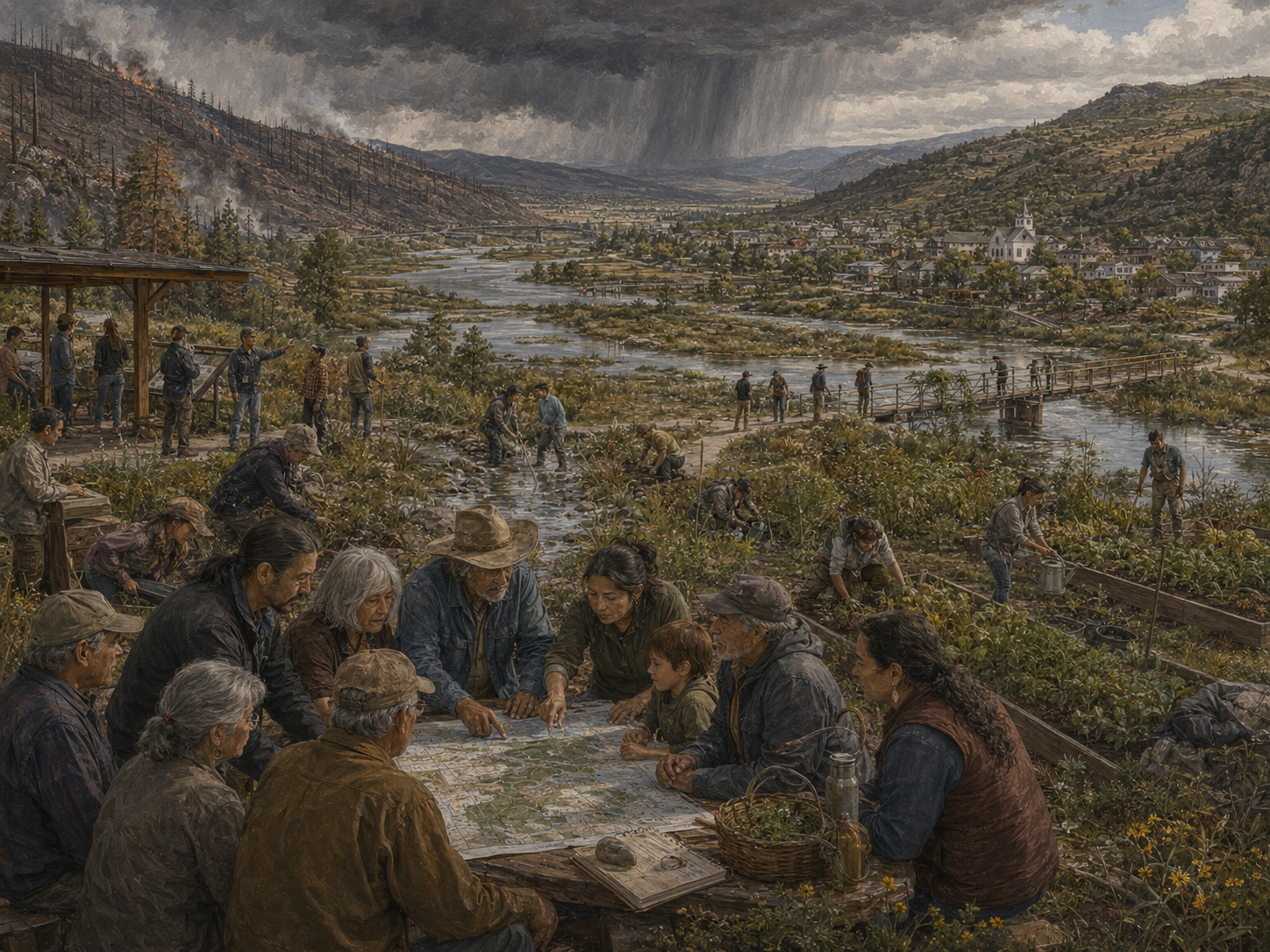
What Local Knowledge Means
Local knowledge is knowledge grounded in place, practice, memory, relationship, and lived experience. It includes the knowledge people develop through everyday interaction with landscapes, infrastructure, households, institutions, hazards, weather, ecosystems, markets, services, and social networks. It may be held by residents, elders, Indigenous communities, workers, farmers, fishers, caregivers, emergency responders, organizers, teachers, clinicians, utility workers, neighborhood leaders, migrants, renters, and others whose experience gives them insight into how systems actually behave.
Local knowledge can be ecological, infrastructural, social, historical, cultural, occupational, or institutional. It may concern where water flows during heavy rain, which homes lose power first, which households need medical support, which informal routes remain passable after flooding, which areas are avoided for safety, which institutions are trusted, which crops fail under changing weather, which species are disappearing, where pollution smells are strongest, or how recovery programs fail in practice. Much of this knowledge is invisible in official datasets until institutions ask the right questions and build the right relationships.
Local knowledge is not inherently perfect. It can be partial, contested, shaped by memory, affected by power, or limited by individual perspective. But scientific and administrative knowledge are also partial. Resilience practice requires combining different kinds of knowledge in ways that reveal blind spots, improve decisions, and respect the authority of people who live with risk. Local knowledge becomes powerful when it is treated as decision-relevant, not merely anecdotal.
| Type of local knowledge | What it reveals | Resilience value |
|---|---|---|
| Ecological knowledge | Changes in species, water, soils, seasons, fire, pests, fisheries, and habitat | Detects slow variables and early warning signals that formal monitoring may miss. |
| Infrastructure knowledge | Outage patterns, drainage failures, transit gaps, road conditions, service interruptions, and repair histories | Improves infrastructure resilience by identifying lived service failure. |
| Social knowledge | Household vulnerability, trusted networks, informal care, mutual aid, and institutional barriers | Improves targeting, communication, evacuation, public health, and recovery. |
| Historical knowledge | Past disasters, displacement, land-use change, institutional harm, and community memory | Reveals why current vulnerability exists and which promises were broken. |
| Occupational knowledge | Workplace exposure, practical constraints, system operations, and frontline failure | Improves safety, implementation, maintenance, and operational realism. |
| Cultural knowledge | Values, language, identity, stewardship, sacred sites, care practices, and social meaning | Supports legitimate adaptation that respects community life and belonging. |
Local knowledge is not merely information about a place. It is knowledge generated through relationship with a place and through responsibility for what happens there.
Why Local Knowledge Matters for Resilience
Local knowledge matters because resilience problems are often too situated, dynamic, and uneven for distant analysis alone. A flood model may show regional inundation, but residents know which drains clog first, which basement apartments flood repeatedly, which streets become impassable, and which households lack transportation. A heat map may identify high-temperature areas, but caregivers and community groups know who lives alone, who cannot afford cooling, who depends on oxygen, and who distrusts official warnings. A wildfire model may map hazard, but Indigenous fire knowledge, local land practice, and community evacuation experience can reveal patterns that technical models alone do not capture.
Local knowledge also improves legitimacy. People are more likely to support resilience strategies when their knowledge, memory, and concerns shape decisions. Participation that treats residents as sources of data but not decision partners weakens trust. By contrast, resilience practice that respects local knowledge can strengthen public legitimacy, reveal hidden vulnerabilities, identify feasible interventions, and prevent maladaptation.
Local knowledge is especially important where official systems have failed or harmed communities. Marginalized communities may have strong reasons to distrust agencies that ignored pollution, delayed recovery aid, displaced residents, over-policed neighborhoods, neglected infrastructure, or treated communities as problems rather than partners. Listening to local knowledge is therefore not only an epistemic practice. It is part of repairing governance relationships.
Why local knowledge improves resilience practice
It reveals hidden exposure
Residents often know micro-flooding, heat, pollution, infrastructure failure, and access barriers before official datasets do.
It identifies real capacity
Community networks know which households need help, which institutions are trusted, and which supports actually work.
It strengthens early warning
Place-based observation can detect ecological, infrastructural, and social changes before formal indicators trigger alerts.
It prevents maladaptation
Local knowledge can warn when a project will displace residents, ignore cultural sites, or fail under everyday conditions.
It improves implementation
Practitioners and residents understand logistical constraints that technical designs may miss.
It builds legitimacy
Resilience decisions become more trustworthy when affected communities shape what counts as knowledge and success.
Local knowledge matters because resilience is lived locally, even when the forces creating risk are regional, national, or global.
Local Knowledge and Resilience Thinking
Resilience thinking emphasizes disturbance, adaptation, feedback, thresholds, learning, transformation, and social-ecological systems. Local knowledge connects directly to each of these concepts. It can identify slow variables before collapse, track feedback loops in everyday life, reveal where thresholds are being approached, show how recovery actually unfolds, and identify when transformation is necessary rather than continued repair.
Local knowledge is especially important for understanding feedback. A policy may look effective in a report but fail in practice because people cannot access it, distrust it, or experience unintended consequences. A drainage project may reduce flooding in one area while worsening it downstream. A green infrastructure investment may reduce heat while increasing rents. A recovery program may reach homeowners while excluding renters. Local knowledge detects these feedbacks because people experience them directly.
Local knowledge also matters for transformation. Communities may understand that repeated recovery is no longer enough. Farmers may know that crop calendars have shifted beyond old assumptions. Coastal residents may recognize that erosion has changed the future of settlement. Indigenous communities may identify ecological loss that is invisible to agencies using narrow metrics. Workers may see that infrastructure maintenance failures are becoming systemic. Local knowledge helps resilience practice distinguish between adaptation within a system and transformation of the system itself.
| Resilience concept | Local-knowledge contribution | Practice implication |
|---|---|---|
| Feedback | Reveals how policies, infrastructure, ecological change, and social behavior interact in lived experience | Use community feedback to revise plans, not merely evaluate satisfaction. |
| Thresholds | Detects signs of social, ecological, or infrastructure stress before failure becomes official | Combine local observation with monitoring systems and decision triggers. |
| Adaptive capacity | Identifies practical resources, trusted networks, skills, and barriers | Invest in community institutions and local capacity, not only technical infrastructure. |
| Recovery | Shows who is recovering, who is excluded, and why formal programs fail | Redesign recovery systems around lived access and equity. |
| Transformation | Clarifies when repeated repair is no longer viable or just | Support community-led transition, relocation, restoration, or institutional reform when needed. |
Local knowledge makes resilience thinking more grounded because it connects systems concepts to lived conditions, institutional practice, and place-based responsibility.
Local Knowledge Is Not Symbolic Consultation
Local knowledge is often invoked but not actually used. Agencies may hold listening sessions after decisions are already made. Consultants may extract stories for reports without changing plans. Community members may be asked to volunteer time while professionals are paid. Indigenous knowledge may be cited without respecting sovereignty or consent. Residents may be asked to validate official assumptions rather than define the problem. This is not meaningful local-knowledge practice. It is symbolic consultation.
Meaningful local-knowledge practice requires decision influence. Communities and knowledge holders should help define questions, choose indicators, interpret evidence, identify tradeoffs, set priorities, design interventions, monitor outcomes, and evaluate success. Their knowledge should shape budgets, infrastructure, land use, emergency planning, public health, ecosystem restoration, and recovery rules. Participation should be compensated, accessible, multilingual, disability-inclusive, and transparent about what decisions are actually open to change.
Symbolic consultation weakens resilience because it creates the appearance of legitimacy without changing power. It can deepen distrust, waste community time, and produce plans that fail under real conditions. A resilience process that collects local knowledge but does not alter decisions treats knowledge as extraction. A process that shares authority treats knowledge as governance.
| Symbolic consultation | Meaningful local-knowledge practice | Why the difference matters |
|---|---|---|
| Residents comment after plans are drafted | Residents help define the problem and shape alternatives before plans are drafted | Early influence changes what is considered possible. |
| Community input is summarized but not tied to decisions | Agencies explain how input changed budgets, rules, designs, or priorities | Transparency builds accountability. |
| Participation is unpaid and inconvenient | Participation is compensated, accessible, multilingual, and scheduled around community needs | Equity requires reducing participation burden. |
| Knowledge is extracted for reports | Knowledge holders retain rights, context, and influence over use | Prevents exploitation and distortion. |
| Local knowledge is treated as anecdotal | Local knowledge is treated as decision-relevant evidence | Improves planning accuracy and legitimacy. |
Local knowledge improves resilience only when it changes decisions, resources, authority, and accountability.
Core Dimensions of Local Knowledge Practice
Local knowledge practice requires more than collecting community input. It depends on trust, reciprocity, contextual understanding, decision relevance, knowledge protection, participation resources, institutional learning, and accountability. These dimensions interact. Trust without power can become tokenism. Data without context can become misinterpretation. Participation without compensation can reproduce inequality. Knowledge-sharing without governance protections can become extraction.
Place-Based Observation
Place-based observation includes everyday knowledge of weather, water, soil, species, infrastructure, hazards, services, social networks, and public institutions. It reveals patterns that broad-scale datasets may miss, especially at neighborhood, household, workplace, watershed, and culturally significant scales.
Community Memory
Community memory preserves knowledge of past disasters, recovery failures, displacement, institutional promises, land-use change, environmental harm, social networks, and survival strategies. It helps explain why current vulnerability exists and why some institutions are trusted or distrusted.
Knowledge Co-Production
Knowledge co-production means affected communities, practitioners, scientists, public agencies, and knowledge holders jointly define questions, interpret evidence, design interventions, and evaluate outcomes. It treats local knowledge as part of the decision process rather than as a comment appended to expert analysis.
Trust and Reciprocity
Local knowledge practice requires relationships built through respect, follow-through, compensation, transparency, shared benefit, and accountability. Communities should not be asked to share knowledge without seeing how that knowledge will be used, protected, and returned in useful form.
Knowledge Protection
Some knowledge should not be public, digitized, mapped, or extracted. Sacred sites, Indigenous ecological knowledge, undocumented residents, vulnerable households, informal care networks, and sensitive community resources require privacy, consent, governance protocols, and community control over data use.
Decision Accountability
Local knowledge practice is credible only when knowledge changes decisions. Agencies and institutions should document how local knowledge shaped plans, budgets, infrastructure, risk communication, monitoring, restoration, recovery, or governance reform—and explain when it did not.
| Dimension | Primary function | Failure if neglected |
|---|---|---|
| Place-based observation | Reveals fine-grained conditions, hazards, service failures, and ecological change | Plans miss lived risk and micro-scale exposure. |
| Community memory | Preserves history of risk, harm, recovery, stewardship, and institutional relationships | Planning repeats past mistakes and ignores historical injustice. |
| Knowledge co-production | Combines local, scientific, Indigenous, practitioner, and administrative knowledge | Knowledge remains siloed and decisions lack practical fit. |
| Trust and reciprocity | Builds legitimacy, participation, and shared responsibility | Engagement becomes extractive or symbolic. |
| Knowledge protection | Prevents misuse, surveillance, cultural harm, and privacy violations | Local knowledge becomes a source of risk for the people who share it. |
| Decision accountability | Links knowledge to actual decisions, investments, and institutional change | Participation produces reports but not resilience. |
Local knowledge practice works when knowledge holders are treated as partners in resilience governance, not as raw data sources for plans made elsewhere.
Indigenous Knowledge, Sovereignty, and Stewardship
Indigenous knowledge is often discussed under the broad category of local knowledge, but it requires distinct treatment. Indigenous knowledge systems are not merely local observations. They are living systems of law, ethics, stewardship, ecological relationship, language, ceremony, governance, intergenerational memory, and responsibility. They are tied to sovereignty, land, water, culture, and self-determination. Resilience practice must therefore treat Indigenous knowledge with respect for rights, consent, and authority—not as a resource to be extracted for adaptation planning.
Indigenous communities have long stewarded ecosystems through practices such as cultural burning, water governance, habitat management, seasonal observation, relational land care, and community-based adaptation. In many places, colonial governance disrupted these practices, suppressed Indigenous authority, dispossessed land, and degraded ecological resilience. Recognizing Indigenous knowledge is not enough if governance systems continue to exclude Indigenous authority or treat knowledge as detached from land rights.
Resilience practice involving Indigenous knowledge should follow principles of free, prior, and informed consent; data sovereignty; cultural protocols; community benefit; co-governance; protection of sensitive knowledge; and respect for Indigenous law and leadership. Some knowledge should remain within the community. Some knowledge should not be mapped. Some knowledge should not be translated into conventional datasets. The goal is not to absorb Indigenous knowledge into institutional systems unchanged by Indigenous authority. The goal is to transform governance relationships.
| Principle | Meaning | Resilience practice implication |
|---|---|---|
| Sovereignty | Indigenous nations and communities have authority over land, knowledge, governance, and self-determination | Resilience planning must respect Indigenous decision-making authority, not merely consult Indigenous stakeholders. |
| Consent | Knowledge sharing requires free, prior, and informed consent | Projects should not extract knowledge, map sites, or publish findings without consent and agreed use. |
| Data sovereignty | Indigenous communities have rights over data about their lands, people, resources, and knowledge | Data governance should follow community protocols, access rules, and benefit-sharing agreements. |
| Cultural protocol | Knowledge may be sacred, seasonal, gendered, restricted, or context-specific | Not all knowledge should be public, digitized, generalized, or translated into external categories. |
| Co-governance | Resilience decisions should share authority where land, water, ecosystems, and cultural continuity are affected | Institutions should support Indigenous-led stewardship, land return where appropriate, and shared governance frameworks. |
Indigenous knowledge strengthens resilience when it is respected as part of Indigenous sovereignty, not reduced to a technical input for external decision-making.
Community Memory and Historical Risk
Community memory is a major resilience resource. It preserves knowledge of past floods, fires, storms, evacuations, outages, public-health crises, contamination events, displacement, recovery failures, broken promises, informal shelters, mutual aid, trusted leaders, and institutional harm. This memory can reveal risk patterns that official records overlook or erase.
Historical risk matters because many hazards are repeated. Neighborhoods know which streets flood, which landlords do not repair damage, which agency forms are impossible to complete, which industrial facilities release odors after storms, which roads close, which shelters are unsafe, and which communities wait longest for service restoration. These memories may not appear in official datasets, especially when past events were underreported or dismissed.
Community memory also explains trust. Agencies may ask why residents distrust warnings, recovery programs, or environmental assessments. Community memory may hold the answer: previous warnings failed, recovery aid was denied, pollution was ignored, relocation promises were broken, or engagement was symbolic. Resilience practice that ignores memory cannot repair legitimacy.
What community memory can reveal
Repeated hazard locations
Residents often know micro-flooding, heat, landslide, traffic, smoke, and outage patterns not visible in coarse data.
Recovery barriers
Communities remember which programs were inaccessible, delayed, discriminatory, or poorly communicated.
Institutional trust history
Past neglect, broken promises, policing, exclusion, or environmental harm shape present willingness to engage.
Informal response systems
Community memory tracks who provided care, shelter, food, transport, translation, and repair when formal systems failed.
Displacement pathways
Residents can identify how disasters, redevelopment, insurance, rent increases, and recovery programs displaced people.
Cultural and ecological loss
Memory preserves meaning attached to places, species, livelihoods, rituals, and landscapes that metrics may miss.
Community memory helps resilience practice move from event response to historical accountability.
Place-Based Observation and Early Warning
Local knowledge can strengthen early warning because people often observe changes before formal systems detect them. Fishers may notice shifts in fish behavior, water clarity, or species composition. Farmers may observe soil moisture changes, pest timing, crop stress, and rainfall variability. Residents may notice recurring drainage failures, worsening heat, unusual odors, unstable slopes, or infrastructure deterioration. Public-health workers may see illness clusters, medication access problems, or care interruptions before administrative data are updated.
Early warning systems are strongest when formal monitoring and local observation are linked. Sensor networks, satellite data, climate models, hydrological models, epidemiological surveillance, and infrastructure dashboards provide important evidence. Local observation adds context, interpretation, and ground truth. It can identify whether alerts are meaningful, whether warnings reach people, whether thresholds are locally appropriate, and whether response options are realistic.
Place-based observation also reveals slow variables. Groundwater decline, soil degradation, public trust erosion, informal displacement, infrastructure wear, species loss, and care network fatigue may unfold gradually. People living and working in a system may sense these shifts before they become measurable crisis. Resilience practice should create channels for these observations to influence monitoring and decision triggers.
| Observed change | Local-knowledge signal | Resilience response |
|---|---|---|
| Flood risk | Repeated street pooling, basement seepage, clogged drains, informal detours, mold after storms | Update drainage maps, prioritize repairs, protect renters, and revise flood outreach. |
| Heat risk | Unlivable indoor temperatures, high energy bills, isolated elders, unsafe workplaces, tree canopy gaps | Target cooling, weatherization, tree planting, energy support, and labor protections. |
| Ecosystem change | Species shifts, altered seasons, water changes, crop stress, fishery decline, unusual pests | Integrate local observation with ecological monitoring and adaptive management. |
| Infrastructure decline | Recurring outages, low water pressure, road damage, inaccessible transit, delayed repairs | Use service reports and resident observation to prioritize maintenance and redundancy. |
| Public-health vulnerability | Medication gaps, isolation, untreated illness, care-worker strain, shelter avoidance, misinformation | Strengthen outreach, trusted communication, continuity of care, and community health networks. |
Early warning becomes more effective when it listens to people as sensors of lived system change, not only as recipients of official alerts.
Local Knowledge and Social Vulnerability
Local knowledge is essential for understanding Social Vulnerability and Resilience because vulnerability is often hidden in everyday life. Official indicators may show poverty, age, disability, language, housing, or transportation patterns, but they may not reveal who lacks medication, who fears shelters, who cannot use digital applications, which households are isolated, which informal workers cannot miss work, or which residents are excluded from aid because of documentation barriers.
Community organizations, caregivers, public-health workers, tenant organizers, disability advocates, legal aid workers, faith leaders, mutual aid groups, and neighborhood residents often know vulnerability patterns that datasets miss. They understand practical access: whether a cooling center is reachable, whether a shelter is trusted, whether aid forms are usable, whether warning messages are understood, and whether residents can safely interact with institutions.
Local knowledge also prevents harmful labeling. Vulnerability maps can stigmatize communities if interpreted without context. Residents can explain how vulnerability was produced by disinvestment, environmental harm, unaffordable housing, labor precarity, and institutional exclusion. This changes the meaning of the data. It shifts attention from “vulnerable communities” as a label to vulnerability-producing systems as the object of reform.
| Vulnerability issue | What local knowledge adds | Planning implication |
|---|---|---|
| Heat vulnerability | Who lives alone, who lacks cooling, which buildings overheat, which workers face exposure | Target outreach, cooling, energy support, housing repair, and labor protection. |
| Evacuation barriers | Who lacks cars, who needs mobility assistance, who cannot leave pets, who fears institutions | Design accessible evacuation, paratransit, trusted shelters, and culturally appropriate support. |
| Recovery access | Which forms are impossible, who lacks documents, who needs legal aid, who is excluded from benefits | Reduce administrative burden and fund benefits navigation. |
| Displacement risk | Which residents are at risk from rent increases, redevelopment, or unsafe rebuilding | Use anti-displacement safeguards and community ownership strategies. |
| Institutional trust | Which agencies are trusted, which are feared, and why | Use trusted messengers and repair institutional relationships. |
Local knowledge makes vulnerability analysis more accurate, more accountable, and less likely to blame people for the systems that expose them to harm.
Participatory Mapping and Risk Visibility
Participatory mapping is a method for making local knowledge visible in spatial form. Residents and knowledge holders identify places of risk, care, memory, access, exclusion, ecological value, infrastructure failure, cultural meaning, and informal support. Participatory maps can reveal micro-flooding, unsafe intersections, heat islands, informal evacuation routes, inaccessible shelters, community gathering points, pollution hot spots, sacred sites, displacement pressure, and places where official maps are wrong.
Participatory mapping can improve resilience planning, but it must be handled carefully. Maps can expose sensitive knowledge. Mapping undocumented residents, informal settlements, sacred sites, mutual aid networks, or vulnerable households can create risks if data are public or accessible to harmful actors. Communities should decide what is mapped, who controls the data, what remains private, and how maps will be used.
Participatory mapping is strongest when it is linked to decisions. A map that reveals flood risk should influence drainage investment, housing repair, emergency outreach, and land-use planning. A map that identifies trusted community institutions should shape communication and resilience hubs. A map that shows displacement risk should trigger anti-displacement policy. Mapping without action can become another form of extraction.
What participatory mapping can identify
Hazard micro-sites
Recurring flood corners, overheated blocks, blocked drains, smoke corridors, unsafe slopes, and industrial exposure points.
Access barriers
Transit gaps, inaccessible shelters, unsafe routes, language barriers, digital exclusion, and service deserts.
Care infrastructure
Clinics, libraries, schools, faith institutions, mutual aid sites, cooling locations, and trusted community spaces.
Historical harm
Displacement, contamination, broken infrastructure, past recovery failures, and sites of institutional neglect.
Cultural value
Places of memory, identity, stewardship, sacred significance, livelihood, and community connection.
Decision priorities
Maps can show where communities want investment, repair, protection, restoration, or transformation.
Participatory mapping makes risk visible when it is governed by communities, interpreted with context, and connected to institutional accountability.
Community Science and Environmental Monitoring
Community science can strengthen resilience by allowing residents to collect, interpret, and use environmental and social data. Communities may monitor air quality, water contamination, heat, noise, flooding, biodiversity, soil, industrial odors, disease vectors, infrastructure conditions, or public-health concerns. These efforts can reveal problems that official monitoring misses, especially in environmental justice communities where institutional monitoring has been inadequate or mistrusted.
Community monitoring is not only a data activity. It is often a form of civic power. When residents document pollution, flooding, heat, or service failure, they can demand accountability, challenge official claims, and shape public investment. Community-generated data can support legal action, regulatory enforcement, public health, infrastructure repair, and adaptation planning. It can also strengthen local capacity by building technical skills and shared understanding.
But community science requires support. Sensors need calibration. Data need interpretation. Communities need training, funding, technical assistance, privacy protections, and control over how information is used. Agencies should not shift monitoring responsibility onto communities without resources. Community science should complement public responsibility, not replace it.
| Monitoring focus | Local-knowledge contribution | Resilience use |
|---|---|---|
| Air quality | Residents identify smoke, traffic, industry, odor, and respiratory burden patterns | Target clean-air shelters, enforcement, filtration, public health, and cumulative-impact review. |
| Flooding | Residents document street flooding, basement flooding, drainage failure, and mold | Prioritize drainage, housing repair, flood warnings, and renter protections. |
| Heat | Residents identify overheated buildings, unsafe workplaces, cooling gaps, and shaded routes | Target tree canopy, cooling centers, energy assistance, and housing retrofits. |
| Water quality | Communities track contamination concerns, taste, odor, access, and infrastructure failures | Support testing, pipe repair, public reporting, safe-water access, and health intervention. |
| Biodiversity and ecosystems | Local observers track species, seasonal shifts, invasive species, habitat change, and restoration results | Improve ecological monitoring, restoration, adaptive management, and stewardship. |
Community science strengthens resilience when it gives communities better evidence, stronger voice, and more power to change the conditions they monitor.
Local Knowledge and Disaster Risk Reduction
Disaster risk reduction requires understanding hazard, exposure, vulnerability, and capacity. Local knowledge contributes to all four. Communities know where hazards occur, who is exposed, who is vulnerable, what capacities exist, which institutions are trusted, and which recovery systems have failed before. This knowledge can improve preparedness, early warning, evacuation, shelter design, emergency communication, mutual aid, recovery, and long-term risk reduction.
Local knowledge also helps shift disaster planning from response to prevention. Residents may identify unsafe land use, deferred maintenance, housing neglect, blocked drainage, polluted sites, absent transit, inaccessible shelters, and repeated recovery failures. These are not merely emergency-management issues. They are development, housing, infrastructure, public-health, and governance issues. Local knowledge can therefore reveal risk creation before disaster occurs.
In disaster recovery, local knowledge helps identify who is being left behind. Formal systems often track applications processed, funds distributed, roads reopened, and utilities restored. Communities can identify households still displaced, renters denied aid, people unable to navigate forms, informal workers losing income, disabled residents without services, and neighborhoods where recovery investment is driving displacement.
| Disaster-risk phase | Local-knowledge role | Resilience practice |
|---|---|---|
| Risk assessment | Identifies lived hazards, vulnerability, access barriers, and historical harm | Combine community mapping with hazard models and social vulnerability analysis. |
| Preparedness | Identifies trusted messengers, evacuation needs, care networks, and supply gaps | Design accessible warnings, shelters, mobility support, and community preparedness. |
| Response | Provides real-time information about unmet needs, blocked routes, isolated residents, and service failure | Use two-way communication and community organizations in emergency operations. |
| Recovery | Identifies who is excluded, displaced, undercompensated, or unable to access aid | Track recovery equity and redesign aid around lived barriers. |
| Risk reduction | Reveals root causes such as housing insecurity, poor drainage, pollution, weak services, and land-use failure | Invest in structural vulnerability reduction and prevention. |
Local knowledge makes disaster risk reduction more accurate because it connects hazard planning to everyday vulnerability, institutional trust, and recovery reality.
Local Knowledge and Climate Adaptation
Climate adaptation depends on local knowledge because climate impacts are experienced through place. Heat, drought, flood, sea-level rise, wildfire, ecosystem change, crop stress, water scarcity, disease risk, infrastructure strain, and displacement do not occur in abstraction. They occur in neighborhoods, farms, watersheds, coasts, workplaces, homes, schools, clinics, and cultural landscapes.
Climate projections provide essential information about possible futures, but adaptation requires translating those projections into local decisions. Which homes need cooling? Which roads flood first? Which crops are becoming unreliable? Which households cannot afford insurance? Which community sites can serve as resilience hubs? Which ecosystems provide protection? Which cultural places are threatened? Which adaptation project could cause displacement? Local knowledge answers questions that models alone cannot.
Local knowledge also improves adaptive pathways. As climate conditions change, communities can help define decision triggers: when water rules should change, when heat protections should expand, when relocation planning should begin, when restoration is failing, when insurance withdrawal signals a threshold, and when repeated repair is no longer just. Adaptation becomes more legitimate when those who live with the consequences help define the pathway.
Local knowledge in climate adaptation
Heat adaptation
Residents identify overheated housing, isolated people, unsafe work, cooling access gaps, and trusted outreach channels.
Water adaptation
Farmers, watershed groups, and residents track drought, flooding, water quality, soil moisture, and access conflicts.
Coastal adaptation
Communities identify erosion, cultural sites, evacuation barriers, housing risk, ecosystem change, and relocation concerns.
Food-system adaptation
Growers and food workers observe crop shifts, pest changes, supply fragility, labor exposure, and food access stress.
Wildfire adaptation
Residents, Indigenous fire practitioners, land managers, and workers identify fuel conditions, smoke exposure, and evacuation realities.
Adaptation justice
Local knowledge reveals when adaptation investments risk displacement, exclusion, or unequal burden.
Climate adaptation is more likely to be durable when it combines climate science with the place-based knowledge of people who understand how climate risk becomes lived vulnerability.
Local Knowledge and Public Health Resilience
Public health resilience depends on knowing how people actually access care, information, food, housing, transportation, medication, social support, and trusted guidance. Local knowledge can reveal barriers that public-health systems miss: people without primary care, elders living alone, households without cooling, workers exposed to heat or smoke, people unable to quarantine, migrants afraid to seek care, disabled residents without accessible transport, or neighborhoods where misinformation spreads because institutions are distrusted.
Community health workers, local clinics, mutual aid groups, disability advocates, schools, faith institutions, tenant organizations, and neighborhood leaders often hold practical knowledge of health vulnerability. They know who needs check-ins, which messages are trusted, which households lack supplies, and which services are inaccessible. This knowledge can improve emergency response, heat planning, vaccination, mental health, chronic disease management, clean-air shelter planning, and continuity of care.
Public health systems should not extract local knowledge only during crisis. They should build standing relationships, fund community organizations, support local data interpretation, and compensate community expertise. Trust is built before emergencies, not during them.
| Public-health issue | Local-knowledge contribution | Resilience response |
|---|---|---|
| Heat illness | Identifies isolated residents, overheated buildings, energy insecurity, unsafe work, and cooling barriers | Target outreach, cooling, energy aid, housing retrofits, and worker protections. |
| Chronic disease | Reveals medication, treatment, mobility, diet, and care continuity needs | Plan for power backup, medication access, mobile care, and care coordination. |
| Infectious disease | Identifies trusted messengers, crowded housing, workplace exposure, and isolation barriers | Use community-led communication, workplace protections, testing, vaccination, and support services. |
| Mental health | Reveals trauma, grief, stress, displacement, social isolation, and culturally appropriate care needs | Provide long-term psychosocial support and community-based healing resources. |
| Healthcare access | Identifies transportation, cost, language, disability, trust, and documentation barriers | Use mobile clinics, navigators, language access, disability access, and trusted institutions. |
Public health resilience improves when communities are treated as knowledge partners in care, not merely as populations to be messaged.
Local Knowledge and Infrastructure Resilience
Infrastructure resilience is often measured through assets: bridges, grids, pipes, roads, pumps, substations, hospitals, broadband networks, transit systems, and treatment plants. Local knowledge shifts attention toward service experience. Which homes lose power first? Which bus stops flood? Which elevators trap disabled residents during outages? Which water-pressure failures recur? Which roads become unsafe? Which buildings overheat? Which households cannot use digital alerts? Which repairs are repeatedly delayed?
Infrastructure users and frontline workers often understand system fragility before asset metrics show failure. Utility workers know maintenance shortcuts and failure patterns. Transit riders know route gaps. Nurses know backup-power weaknesses. Residents know drainage problems. School staff know shelter constraints. Local knowledge can improve asset management, maintenance prioritization, outage planning, service restoration, and infrastructure equity.
Local knowledge also reveals that infrastructure resilience is not only about physical survival. A power system can restore service quickly on average while medically vulnerable households remain at risk. A road network can reopen while transit-dependent residents remain isolated. A water system can meet regional standards while some neighborhoods experience repeated contamination. Infrastructure resilience should be measured through access and service continuity for vulnerable users.
| Infrastructure system | Local knowledge reveals | Planning implication |
|---|---|---|
| Energy | Outage frequency, medically vulnerable households, unsafe indoor temperatures, energy burden, and restoration inequity | Use equity-based restoration, backup power, energy assistance, and distributed resilience. |
| Water and drainage | Low pressure, contamination concerns, basement flooding, drainage blockages, and service complaints | Prioritize repairs, green infrastructure, testing, communication, and flood mitigation. |
| Transit and mobility | Route gaps, inaccessible stops, unsafe transfers, paratransit failures, and evacuation barriers | Design mobility resilience for people without private vehicles and disabled residents. |
| Digital infrastructure | Broadband gaps, device access, digital literacy, language barriers, and distrust of online systems | Provide analog channels, community access points, and inclusive communication. |
| Public facilities | Which schools, libraries, clinics, and community centers are trusted and physically accessible | Develop resilience hubs, cooling sites, charging centers, and care infrastructure. |
Local knowledge helps infrastructure resilience move from asset protection to equitable service continuity.
Knowledge Co-Production and Adaptive Governance
Adaptive Governance and Resilience depends on knowledge co-production because governance under uncertainty requires learning from multiple sources. Scientific models, administrative data, local observation, Indigenous knowledge, practitioner expertise, and lived experience each reveal different parts of the system. Co-production creates processes where these knowledge systems shape decisions together.
Co-production is not simply combining datasets. It is a governance relationship. Communities and knowledge holders help define the problem, determine what evidence matters, interpret findings, evaluate tradeoffs, and hold institutions accountable for action. Co-production changes whose questions guide the analysis. It also changes who can challenge official interpretations.
Adaptive governance requires feedback loops, monitoring, learning, and revision. Local knowledge can strengthen all four. It can improve monitoring by adding ground truth. It can improve learning by identifying unintended consequences. It can improve revision by showing what needs to change. It can improve legitimacy by making governance more responsive to lived risk.
Co-production practices
Joint problem framing
Community members, scientists, and agencies define the resilience problem together before selecting methods.
Shared indicator design
Indicators reflect official data and lived measures of access, trust, safety, recovery, and cultural meaning.
Participatory interpretation
Residents and practitioners help interpret maps, models, surveys, and monitoring results.
Decision triggers
Local observation and formal data are linked to thresholds that require institutional action.
Implementation review
Communities evaluate whether resilience investments actually reduce vulnerability and improve access.
Public accountability
Institutions report how local knowledge changed decisions, budgets, designs, and recovery rules.
Knowledge co-production turns local knowledge from consultation into adaptive governance capacity.
Power, Extraction, and Knowledge Justice
Local knowledge practice must confront power. Knowledge is not shared in a neutral field. Agencies, universities, consultants, companies, and funders often have more resources, credentials, legal authority, and control over publication than communities do. Without safeguards, local knowledge can be extracted: residents share stories, histories, data, and relationships, but decisions remain unchanged and benefits flow elsewhere.
Knowledge extraction can take many forms. Community members are asked to provide unpaid expertise. Indigenous knowledge is separated from sovereignty. Sensitive sites are mapped without protection. Data about vulnerable households are stored without community control. Local observations are used to validate external models but not to challenge assumptions. Community testimony is quoted in reports while budgets remain unchanged. These practices damage trust and weaken resilience.
Knowledge justice means recognizing who produces knowledge, who controls it, who benefits from it, who is harmed by its use, and whose knowledge changes decisions. It requires compensation, consent, data governance, accessible results, shared authorship where appropriate, community ownership, and institutional accountability. It also requires the humility to recognize that some knowledge should not be taken.
| Knowledge justice issue | Risk | Resilience practice response |
|---|---|---|
| Unpaid community expertise | Participation burden falls on people already managing risk | Compensate participants, fund community organizations, and budget for participation. |
| Extractive research | Knowledge is collected but not returned or used for community benefit | Use community benefit agreements, shared products, and implementation accountability. |
| Sensitive data exposure | Maps or datasets can expose vulnerable people, sacred sites, or informal networks | Use privacy safeguards, community control, aggregation, and data-access rules. |
| Tokenistic inclusion | Local knowledge is cited without decision influence | Document how knowledge changed decisions and explain unresolved disagreements. |
| Indigenous knowledge extraction | Knowledge is detached from sovereignty, protocol, and land rights | Follow Indigenous data sovereignty, consent, cultural protocols, and co-governance. |
Resilience practice that uses local knowledge without knowledge justice may reproduce the same power relations that created vulnerability.
Data Governance, Privacy, and Community Control
Local knowledge often becomes data: maps, surveys, interviews, sensor readings, photographs, oral histories, household lists, risk reports, community asset inventories, and monitoring dashboards. Once knowledge becomes data, governance becomes critical. Who owns it? Who can access it? Who can publish it? Who can combine it with other datasets? Who benefits from it? Who might be harmed by it?
Privacy matters especially in resilience practice. Identifying vulnerable households, undocumented residents, informal settlements, mutual aid networks, sacred sites, shelters, or politically sensitive information can expose people to surveillance, stigma, enforcement, harassment, displacement, or exploitation. Community data should be collected only when necessary, protected carefully, and governed with consent.
Community control can take many forms: data-sharing agreements, community review boards, Indigenous data sovereignty protocols, controlled-access maps, aggregation rules, anonymization, community-owned databases, consent processes, and rules for deletion or withdrawal. Data governance should be designed before collection begins, not after.
Data governance priorities
Purpose limitation
Collect only data needed for clear resilience decisions, and do not reuse it beyond agreed purposes.
Consent and control
Knowledge holders should understand and influence how data will be stored, shared, mapped, and used.
Privacy protection
Sensitive information should be aggregated, anonymized, restricted, or not collected when risk is too high.
Community benefit
Data products should return useful information, resources, and decision leverage to the communities providing knowledge.
Right to correct
Communities should be able to review, contest, correct, or contextualize data about them.
Data sovereignty
Indigenous and community data governance protocols should shape access, ownership, and publication.
Local knowledge should never be transformed into data in ways that make communities less safe, less powerful, or less able to govern their own futures.
Measuring Local Knowledge Integration
Measuring local knowledge integration is difficult because the most important question is not whether engagement occurred, but whether knowledge changed decisions. A process may include meetings, surveys, workshops, and mapping exercises while still leaving authority unchanged. Measurement should therefore focus on influence, reciprocity, protection, legitimacy, and implementation.
Useful indicators include the share of planning questions defined with community input, participant compensation, accessibility of meetings, diversity and representativeness of participation, use of local indicators, existence of data governance agreements, documented decision changes, budget shifts resulting from local knowledge, community review of outputs, trust changes, and whether vulnerable groups report improved access or reduced harm. But indicators should be interpreted qualitatively as well. A high number of participants does not prove influence. A published map does not prove accountability.
Measurement should also track whether local knowledge is protected. Were sensitive data withheld or governed properly? Were Indigenous protocols followed? Were participants able to review outputs? Did communities receive usable products? Did agencies explain decisions? Did knowledge holders benefit? Did the process reduce or increase participation burden?
| Measurement domain | Example indicators | Interpretive caution |
|---|---|---|
| Participation access | Compensation, language access, disability access, childcare, meeting location, schedule flexibility | Attendance does not prove influence. |
| Knowledge influence | Questions changed, indicators added, maps revised, budgets shifted, designs modified | Influence should be documented specifically. |
| Trust and legitimacy | Community trust, perceived fairness, follow-through, complaint response, transparency | Trust may vary across groups and histories. |
| Data governance | Consent agreements, privacy controls, community review, Indigenous data protocols, access rules | Public data products may create harm if sensitive knowledge is exposed. |
| Implementation accountability | Action deadlines, funding commitments, public reporting, community monitoring, corrective mechanisms | Reports do not matter unless actions follow. |
| Resilience outcome | Reduced vulnerability, improved access, better early warning, less displacement, stronger service continuity | Outcomes should be disaggregated and locally interpreted. |
The best measure of local knowledge integration is whether knowledge holders can point to decisions that changed because their knowledge mattered.
A Practical Framework for Local-Knowledge Resilience Practice
A practical local-knowledge resilience process should begin with relationships, not data extraction. It should identify who holds relevant knowledge, what histories shape trust, what decisions are open to influence, what protections are needed, how participation will be resourced, and how knowledge will change action. The framework below treats local knowledge as part of governance, not as a supplement to technical analysis.
| Step | Question | Output |
|---|---|---|
| Define the resilience decision | What decision, investment, rule, plan, or monitoring system will local knowledge influence? | Clear decision scope and explanation of what is open to change. |
| Map knowledge holders | Who has place-based, Indigenous, practitioner, occupational, caregiving, ecological, or lived knowledge? | Knowledge-holder map that includes marginalized and under-recognized groups. |
| Assess trust and history | What past institutional harms, broken promises, or exclusions shape the process? | Trust and accountability plan. |
| Design participation access | How will people participate without unpaid burden or exclusion? | Compensation, language access, disability access, childcare, transport, and flexible scheduling. |
| Set knowledge protections | What knowledge is sensitive, restricted, private, sacred, or governed by community protocols? | Consent, privacy, data governance, and knowledge-protection agreement. |
| Co-produce evidence | How will local knowledge be combined with scientific, administrative, and technical evidence? | Shared indicators, participatory maps, monitoring design, and interpretation process. |
| Connect to action | How will knowledge change infrastructure, policy, budgets, outreach, recovery, or monitoring? | Decision-change log and implementation plan. |
| Report back | How will institutions explain what changed and why? | Accessible public reporting, community review, and disagreement documentation. |
| Monitor outcomes | Did the action reduce vulnerability, improve capacity, or strengthen trust? | Community-defined evaluation and disaggregated outcomes. |
| Institutionalize learning | How will local knowledge remain part of governance over time? | Standing advisory bodies, funded community partnerships, review cycles, and adaptive decision triggers. |
Local-knowledge resilience practice becomes meaningful when relationships, knowledge, authority, and accountability are designed together.
Mathematical Lens: Modeling Knowledge Fit, Trust, and Adaptive Capacity
Local knowledge cannot be reduced to a formula, but formal models can clarify how knowledge integration affects resilience. A simplified local-knowledge integration score \(K_i\) for project \(i\) can be represented as a function of participation access, knowledge diversity, decision influence, trust, data protection, reciprocity, and implementation accountability:
K_i = w_p P_i + w_d D_i + w_f F_i + w_t T_i + w_s S_i + w_r R_i + w_a A_i
\]
Interpretation: \(P_i\) represents participation access, \(D_i\) knowledge diversity, \(F_i\) decision influence, \(T_i\) trust, \(S_i\) safeguards, \(R_i\) reciprocity, and \(A_i\) accountability.
Resilience value can be adjusted by knowledge fit. Let technical strategy value be \(V_i\), local knowledge integration be \(K_i\), and implementation mismatch be \(M_i\):
V_i^{*} = V_i + \alpha K_i – \beta M_i
\]
Interpretation: Strategies gain value when local knowledge improves fit and lose value when implementation mismatches local conditions.
Trust can be modeled dynamically. Let trust at time \(t\) be \(T_t\), institutional follow-through be \(F_t\), participation burden be \(B_t\), and knowledge extraction risk be \(E_t\):
T_{t+1} = T_t + \gamma F_t – \delta B_t – \lambda E_t
\]
Interpretation: Trust increases when institutions follow through and declines when participation is burdensome or extractive.
A portfolio of local-knowledge practices can be evaluated through expected resilience benefit across strategies \(j\):
E(P) = \sum_{j=1}^{n} p_j (K_j + C_j – H_j)
\]
Interpretation: A strategy is stronger when it improves knowledge integration and community capacity while reducing knowledge harm.
An equity-adjusted score can include a penalty for exclusion or unequal participation burden:
K_i^{**} = K_i – \theta U_i
\]
Interpretation: \(U_i\) represents unequal participation burden, exclusion, or knowledge harm. Local knowledge practice is weaker when participation is extractive or inaccessible.
These equations do not replace community judgment, Indigenous governance, qualitative interpretation, public deliberation, or ethical review. They make assumptions visible so local-knowledge integration strategies can be compared and improved.
Advanced R Workflow: Comparing Local-Knowledge Integration Strategies
The R workflow below compares local-knowledge integration strategies across participation access, knowledge diversity, decision influence, trust building, knowledge protection, reciprocity, implementation accountability, and implementation burden. It then shows how rankings shift under different strategic priorities.
# Install packages if needed:
# install.packages(c("tidyverse", "scales"))

library(tidyverse)
library(scales)

# -------------------------------------------------------------------
# Example local-knowledge integration strategies.
# Higher implementation_burden is worse.
# Values are synthetic and for methodological demonstration only.
# -------------------------------------------------------------------

strategies <- tibble(
  strategy = c(
    "Participatory Risk Mapping and Action Triggers",
    "Community Science Environmental Monitoring Network",
    "Indigenous Knowledge Governance Protocol",
    "Funded Community Resilience Advisory Council",
    "Trusted Messenger and Local Warning System",
    "Recovery Feedback and Administrative Burden Review"
  ),
  participation_access = c(8.7, 8.1, 8.4, 9.0, 8.3, 8.6),
  knowledge_diversity = c(8.8, 8.5, 9.2, 8.7, 8.4, 8.1),
  decision_influence = c(8.4, 7.9, 8.8, 9.1, 8.0, 8.6),
  trust_building = c(8.2, 8.0, 8.9, 8.8, 9.0, 8.4),
  knowledge_protection = c(8.0, 8.1, 9.4, 8.5, 8.2, 8.6),
  reciprocity = c(8.3, 8.2, 9.0, 8.9, 8.5, 8.4),
  implementation_accountability = c(8.5, 8.0, 8.7, 9.0, 8.2, 8.8),
  implementation_burden = c(3.2, 3.4, 3.5, 3.3, 2.9, 3.1)
)

# -------------------------------------------------------------------
# Weighted local-knowledge integration value function.
# -------------------------------------------------------------------

score_strategies <- function(data, wp, wd, wf, wt, ws, wr, wa, wi) {
  data %>%
    mutate(
      knowledge_integration_value =
        wp * participation_access +
        wd * knowledge_diversity +
        wf * decision_influence +
        wt * trust_building +
        ws * knowledge_protection +
        wr * reciprocity +
        wa * implementation_accountability -
        wi * implementation_burden,
      extraction_risk_gap = pmax(0, decision_influence - implementation_accountability),
      protection_gap = pmax(0, 8.4 - knowledge_protection),
      adjusted_value =
        knowledge_integration_value -
        0.08 * extraction_risk_gap -
        0.08 * protection_gap,
      diagnostic = case_when(
        implementation_burden >= 3.5 ~ "implementation-burden review needed",
        knowledge_protection < 8.2 ~ "knowledge-protection safeguards need strengthening",
        decision_influence < 8.0 ~ "decision-influence review needed",
        participation_access < 8.2 ~ "participation-access review needed",
        implementation_accountability < 8.2 ~ "implementation-accountability review needed",
        TRUE ~ "promising but requires community validation"
      )
    ) %>%
    arrange(desc(adjusted_value))
}

# -------------------------------------------------------------------
# Scenario weights for different priorities.
# -------------------------------------------------------------------

scenarios <- tribble(
  ~scenario,                   ~wp,  ~wd,  ~wf,  ~wt,  ~ws,  ~wr,  ~wa,  ~wi,
  "Balanced",                  0.14, 0.14, 0.15, 0.14, 0.14, 0.14, 0.15, 0.02,
  "Participation-first",       0.38, 0.10, 0.11, 0.10, 0.10, 0.10, 0.10, 0.01,
  "Knowledge-diversity-first", 0.10, 0.38, 0.11, 0.10, 0.10, 0.10, 0.10, 0.01,
  "Decision-influence-first",  0.10, 0.11, 0.38, 0.10, 0.10, 0.10, 0.10, 0.01,
  "Trust-first",               0.10, 0.10, 0.11, 0.38, 0.10, 0.10, 0.10, 0.01,
  "Protection-first",          0.10, 0.10, 0.11, 0.10, 0.38, 0.10, 0.10, 0.01,
  "Reciprocity-first",         0.10, 0.10, 0.11, 0.10, 0.10, 0.38, 0.10, 0.01,
  "Accountability-first",      0.10, 0.10, 0.11, 0.10, 0.10, 0.10, 0.38, 0.01,
  "Implementation-aware",      0.13, 0.13, 0.14, 0.13, 0.13, 0.13, 0.13, 0.10
)

# -------------------------------------------------------------------
# Evaluate strategies across scenarios.
# -------------------------------------------------------------------

scenario_results <- scenarios %>%
  rowwise() %>%
  do(
    score_strategies(
      strategies,
      wp = .$wp,
      wd = .$wd,
      wf = .$wf,
      wt = .$wt,
      ws = .$ws,
      wr = .$wr,
      wa = .$wa,
      wi = .$wi
    ) %>%
      mutate(scenario = .$scenario)
  ) %>%
  ungroup()

ranked_results <- scenario_results %>%
  group_by(scenario) %>%
  arrange(desc(adjusted_value), .by_group = TRUE) %>%
  mutate(rank = row_number()) %>%
  ungroup()

print(ranked_results)

# -------------------------------------------------------------------
# Visualize ranking shifts across priorities.
# -------------------------------------------------------------------

ggplot(ranked_results, aes(x = strategy, y = adjusted_value, group = scenario)) +
  geom_point(size = 3) +
  geom_line(aes(color = scenario), linewidth = 1) +
  coord_flip() +
  labs(
    title = "Local-Knowledge Integration Strategy Value Across Priority Scenarios",
    x = "Strategy",
    y = "Adjusted Knowledge Integration Value",
    color = "Scenario"
  ) +
  theme_minimal(base_size = 12)

# -------------------------------------------------------------------
# Summarize which strategies rank first most often.
# -------------------------------------------------------------------

top_rank_summary <- ranked_results %>%
  filter(rank == 1) %>%
  count(strategy, name = "times_ranked_first") %>%
  arrange(desc(times_ranked_first))

print(top_rank_summary)

# -------------------------------------------------------------------
# Export results for review.
# -------------------------------------------------------------------

write_csv(ranked_results, "local_knowledge_strategy_rankings.csv")
write_csv(top_rank_summary, "local_knowledge_top_rank_summary.csv")
This workflow shows why local-knowledge integration choices depend on planning priorities. Participatory mapping, community science, Indigenous knowledge governance, community advisory councils, trusted messenger systems, and recovery feedback reviews may rank differently depending on whether planners prioritize participation access, knowledge diversity, decision influence, trust, knowledge protection, reciprocity, accountability, or implementation feasibility.
Advanced Python Workflow: Uncertainty Analysis for Local Knowledge and Resilience Practice
The Python workflow below extends the same logic with Monte Carlo simulation. Instead of assuming fixed values, it models uncertainty across participation access, knowledge diversity, decision influence, trust building, knowledge protection, reciprocity, implementation accountability, and implementation burden.
# Install packages if needed:
# pip install pandas numpy matplotlib

import numpy as np
import pandas as pd
import matplotlib.pyplot as plt

# ---------------------------------------------------------------------
# Example local-knowledge integration strategies.
# Values are synthetic and for methodological demonstration only.
# Higher implementation_burden is worse.
# ---------------------------------------------------------------------

strategies = pd.DataFrame({
    "strategy": [
        "Participatory Risk Mapping and Action Triggers",
        "Community Science Environmental Monitoring Network",
        "Indigenous Knowledge Governance Protocol",
        "Funded Community Resilience Advisory Council",
        "Trusted Messenger and Local Warning System",
        "Recovery Feedback and Administrative Burden Review"
    ],
    "participation_access": [8.7, 8.1, 8.4, 9.0, 8.3, 8.6],
    "knowledge_diversity": [8.8, 8.5, 9.2, 8.7, 8.4, 8.1],
    "decision_influence": [8.4, 7.9, 8.8, 9.1, 8.0, 8.6],
    "trust_building": [8.2, 8.0, 8.9, 8.8, 9.0, 8.4],
    "knowledge_protection": [8.0, 8.1, 9.4, 8.5, 8.2, 8.6],
    "reciprocity": [8.3, 8.2, 9.0, 8.9, 8.5, 8.4],
    "implementation_accountability": [8.5, 8.0, 8.7, 9.0, 8.2, 8.8],
    "implementation_burden": [3.2, 3.4, 3.5, 3.3, 2.9, 3.1]
})

# ---------------------------------------------------------------------
# Baseline weights.
# ---------------------------------------------------------------------

weights = {
    "participation_access": 0.14,
    "knowledge_diversity": 0.14,
    "decision_influence": 0.15,
    "trust_building": 0.14,
    "knowledge_protection": 0.14,
    "reciprocity": 0.14,
    "implementation_accountability": 0.15,
    "implementation_burden": 0.02
}

benefit_columns = [
    "participation_access",
    "knowledge_diversity",
    "decision_influence",
    "trust_building",
    "knowledge_protection",
    "reciprocity",
    "implementation_accountability"
]

# ---------------------------------------------------------------------
# Weighted local-knowledge integration value function.
# ---------------------------------------------------------------------

def compute_strategy_value(df, weights_dict):
    result = df.copy()
    result["knowledge_integration_value"] = (
        weights_dict["participation_access"] * result["participation_access"]
        + weights_dict["knowledge_diversity"] * result["knowledge_diversity"]
        + weights_dict["decision_influence"] * result["decision_influence"]
        + weights_dict["trust_building"] * result["trust_building"]
        + weights_dict["knowledge_protection"] * result["knowledge_protection"]
        + weights_dict["reciprocity"] * result["reciprocity"]
        + weights_dict["implementation_accountability"] * result["implementation_accountability"]
        - weights_dict["implementation_burden"] * result["implementation_burden"]
    )

    result["extraction_risk_gap"] = np.maximum(0, result["decision_influence"] - result["implementation_accountability"])
    result["protection_gap"] = np.maximum(0, 8.4 - result["knowledge_protection"])
    result["adjusted_value"] = (
        result["knowledge_integration_value"]
        - 0.08 * result["extraction_risk_gap"]
        - 0.08 * result["protection_gap"]
    )

    result["diagnostic"] = np.select(
        [
            result["implementation_burden"] >= 3.5,
            result["knowledge_protection"] < 8.2,
            result["decision_influence"] < 8.0,
            result["participation_access"] < 8.2,
            result["implementation_accountability"] < 8.2
        ],
        [
            "implementation-burden review needed",
            "knowledge-protection safeguards need strengthening",
            "decision-influence review needed",
            "participation-access review needed",
            "implementation-accountability review needed"
        ],
        default="promising but requires community validation"
    )

    return result.sort_values("adjusted_value", ascending=False)

baseline_results = compute_strategy_value(strategies, weights)
print("Baseline local-knowledge integration ranking:")
print(baseline_results[["strategy", "adjusted_value", "diagnostic"]])

# ---------------------------------------------------------------------
# Monte Carlo simulation.
# Allow values to vary around current estimates.
# ---------------------------------------------------------------------

np.random.seed(42)
n_simulations = 5000
simulation_rows = []

for simulation_id in range(n_simulations):
    simulated = strategies.copy()

    for col in benefit_columns + ["implementation_burden"]:
        simulated[col] = np.random.normal(
            loc=strategies[col],
            scale=0.6
        )
        simulated[col] = simulated[col].clip(1, 10)

    simulated_results = compute_strategy_value(simulated, weights)

    for rank, (_, row) in enumerate(simulated_results.iterrows(), start=1):
        simulation_rows.append({
            "simulation_id": simulation_id,
            "strategy": row["strategy"],
            "rank": rank,
            "adjusted_value": row["adjusted_value"],
            "diagnostic": row["diagnostic"],
            "winner": simulated_results.iloc[0]["strategy"]
        })

simulation = pd.DataFrame(simulation_rows)

summary = (
    simulation
    .groupby("strategy")
    .agg(
        mean_adjusted_value=("adjusted_value", "mean"),
        median_adjusted_value=("adjusted_value", "median"),
        probability_ranked_first=("rank", lambda x: (x == 1).mean() * 100),
        probability_top_two=("rank", lambda x: (x <= 2).mean() * 100),
        probability_bottom_two=("rank", lambda x: (x >= 5).mean() * 100),
        implementation_review_rate=("diagnostic", lambda x: (x == "implementation-burden review needed").mean() * 100),
        protection_review_rate=("diagnostic", lambda x: (x == "knowledge-protection safeguards need strengthening").mean() * 100)
    )
    .reset_index()
    .sort_values("probability_ranked_first", ascending=False)
)

print("\nStrategy robustness under uncertainty:")
print(summary)

# ---------------------------------------------------------------------
# Plot robustness under uncertainty.
# ---------------------------------------------------------------------

plt.figure(figsize=(10, 6))
plt.bar(summary["strategy"], summary["probability_ranked_first"])
plt.xticks(rotation=20, ha="right")
plt.ylabel("Probability of Ranking First (%)")
plt.title("Robustness of Local-Knowledge Integration Strategies Under Uncertainty")
plt.tight_layout()
plt.show()

# ---------------------------------------------------------------------
# Plot knowledge-protection review rates.
# ---------------------------------------------------------------------

plt.figure(figsize=(10, 6))
plt.bar(summary["strategy"], summary["protection_review_rate"])
plt.xticks(rotation=20, ha="right")
plt.ylabel("Knowledge-Protection Review Rate (%)")
plt.title("How Often Strategies Trigger Knowledge-Protection Review")
plt.tight_layout()
plt.show()

# ---------------------------------------------------------------------
# Export summary for reporting.
# ---------------------------------------------------------------------

baseline_results.to_csv("local_knowledge_baseline_results.csv", index=False)
simulation.to_csv("local_knowledge_uncertainty_simulation.csv", index=False)
summary.to_csv("local_knowledge_uncertainty_summary.csv", index=False)
This workflow shows why local knowledge and resilience decisions should be evaluated under uncertainty. A strategy that appears strongest under fixed assumptions may not remain robust when participation access, decision influence, knowledge protection, trust, reciprocity, accountability, and implementation burden vary. It also shows why a high aggregate score should not end review if knowledge protection, participation access, or decision accountability remain weak.
GitHub Repository
The companion GitHub repository for this article is designed as an advanced local-knowledge and resilience-practice modeling scaffold. It translates participation access, knowledge diversity, decision influence, trust building, knowledge protection, reciprocity, implementation accountability, implementation burden, knowledge harm, and uncertainty into reproducible workflows for resilience analysis.
Complete Code Repository
Companion code for local knowledge and resilience practice modeling, including local-knowledge integration strategy scoring, participation-access diagnostics, knowledge-protection safeguards, decision-influence review, trust and reciprocity analysis, implementation-burden review, Monte Carlo uncertainty simulation, responsible-use notes, and multi-language computational examples.
The companion article directory is articles/local-knowledge-and-resilience-practice/. It is structured to support a professional modeling workflow: Python for uncertainty analysis and strategy simulation; R for scenario comparison and ranking sensitivity; SQL for strategies, indicators, knowledge systems, scenarios, model runs, and outputs; Julia for local-knowledge integration examples; and Rust, Go, C, C++, and Fortran for lightweight diagnostic and simulation utilities.
The modeling objective is to explore how participation access, knowledge diversity, decision influence, trust building, knowledge protection, reciprocity, implementation accountability, and implementation burden shape local-knowledge integration choices under uncertainty. The scaffold includes synthetic data, validation notes, responsible-use documentation, generated outputs, and notebook placeholders.
This repository extends the article from conceptual knowledge practice into applied resilience modeling. It gives readers a reproducible foundation for examining when local knowledge strengthens resilience, when knowledge practices risk extraction or exclusion, and how priorities shift under different uncertainty assumptions.
Conclusion
Local knowledge is essential to resilience practice because resilience is experienced, interpreted, and enacted in place. Models, dashboards, plans, and regulations are necessary, but they are incomplete without the knowledge of people who live with hazards, maintain systems, care for others, steward ecosystems, remember past failures, and understand how institutions work in practice. Local knowledge reveals hidden exposure, practical capacity, trust, vulnerability, cultural meaning, early warning signals, recovery barriers, and transformation needs.
Seen clearly, local knowledge is not a decorative addition to expert analysis. It is a form of evidence and governance. It can improve science, planning, public health, infrastructure, disaster risk reduction, climate adaptation, environmental monitoring, and institutional learning. But it must be handled ethically. Knowledge can be extracted, distorted, exposed, or tokenized. Local knowledge practice must therefore include consent, compensation, data governance, knowledge protection, reciprocity, Indigenous sovereignty where relevant, and transparent decision accountability.
The field is weakened when local knowledge is reduced to consultation or anecdote. It is strongest when knowledge holders help define questions, interpret evidence, design strategies, monitor outcomes, and revise decisions. Resilience practice must ask not only what knowledge is available, but who controls it, who benefits from it, who is protected by it, and how it changes action.
In the broader Resilience Thinking series, local knowledge connects social vulnerability, adaptive governance, community resilience, disaster risk reduction, public health system resilience, infrastructure resilience, ecological resilience, and just transformation. The central lesson is that resilient systems learn from the people and places most directly affected by change.
Related Articles
- Social Vulnerability and Resilience
- Adaptive Governance and Resilience
- Community Resilience
- Public Health System Resilience
- Disaster Risk Reduction and Resilience
- Social-Ecological Systems
- Feedback Loops in Resilient Systems
- Resilience and Sustainable Development
Further Reading
- Berkes, F. (2018) Sacred Ecology. 4th edn. New York: Routledge. Available at: https://www.routledge.com/Sacred-Ecology/Berkes/p/book/9781138071490.
- Berkes, F., Colding, J. and Folke, C. (2000) ‘Rediscovery of traditional ecological knowledge as adaptive management’, Ecological Applications, 10(5), pp. 1251–1262. Available at: https://doi.org/10.1890/1051-0761(2000)010[1251:ROTEKA]2.0.CO;2.
- Chambers, R. (1994) ‘The origins and practice of participatory rural appraisal’, World Development, 22(7), pp. 953–969. Available at: https://doi.org/10.1016/0305-750X(94)90141-4.
- Folke, C. (2004) ‘Traditional knowledge in social–ecological systems’, Ecology and Society, 9(3), art. 7. Available at: https://www.ecologyandsociety.org/vol9/iss3/art7/.
- International Science Council (2021) Opening the Record of Science: Making Scholarly Publishing Work for Science in the Digital Era. Available at: https://council.science/publications/opening-the-record-of-science/.
- Reed, M.S. et al. (2018) ‘A theory of participation: What makes stakeholder and public engagement in environmental management work?’, Restoration Ecology, 26(S1), pp. S7–S17. Available at: https://doi.org/10.1111/rec.12541.
- Turnhout, E., Metze, T., Wyborn, C., Klenk, N. and Louder, E. (2020) ‘The politics of co-production: Participation, power, and transformation’, Current Opinion in Environmental Sustainability, 42, pp. 15–21. Available at: https://doi.org/10.1016/j.cosust.2019.11.009.
- United Nations Department of Economic and Social Affairs (2007) United Nations Declaration on the Rights of Indigenous Peoples. Available at: https://social.desa.un.org/issues/indigenous-peoples/united-nations-declaration-on-the-rights-of-indigenous-peoples.
References
- Berkes, F. (2018) Sacred Ecology. 4th edn. New York: Routledge. Available at: https://www.routledge.com/Sacred-Ecology/Berkes/p/book/9781138071490.
- Berkes, F., Colding, J. and Folke, C. (2000) ‘Rediscovery of traditional ecological knowledge as adaptive management’, Ecological Applications, 10(5), pp. 1251–1262. Available at: https://doi.org/10.1890/1051-0761(2000)010[1251:ROTEKA]2.0.CO;2.
- Chambers, R. (1994) ‘The origins and practice of participatory rural appraisal’, World Development, 22(7), pp. 953–969. Available at: https://doi.org/10.1016/0305-750X(94)90141-4.
- Danielsen, F. et al. (2009) ‘Local participation in natural resource monitoring: A characterization of approaches’, Conservation Biology, 23(1), pp. 31–42. Available at: https://doi.org/10.1111/j.1523-1739.2008.01063.x.
- Folke, C. (2004) ‘Traditional knowledge in social–ecological systems’, Ecology and Society, 9(3), art. 7. Available at: https://www.ecologyandsociety.org/vol9/iss3/art7/.
- Gadgil, M., Berkes, F. and Folke, C. (1993) ‘Indigenous knowledge for biodiversity conservation’, Ambio, 22(2/3), pp. 151–156. Available at: https://www.jstor.org/stable/4314060.
- Intergovernmental Panel on Climate Change (IPCC) (2022) Climate Change 2022: Impacts, Adaptation and Vulnerability. Available at: https://www.ipcc.ch/report/ar6/wg2/.
- Reed, M.S. et al. (2018) ‘A theory of participation: What makes stakeholder and public engagement in environmental management work?’, Restoration Ecology, 26(S1), pp. S7–S17. Available at: https://doi.org/10.1111/rec.12541.
- Turnhout, E., Metze, T., Wyborn, C., Klenk, N. and Louder, E. (2020) ‘The politics of co-production: Participation, power, and transformation’, Current Opinion in Environmental Sustainability, 42, pp. 15–21. Available at: https://doi.org/10.1016/j.cosust.2019.11.009.
- United Nations Department of Economic and Social Affairs (2007) United Nations Declaration on the Rights of Indigenous Peoples. Available at: https://social.desa.un.org/issues/indigenous-peoples/united-nations-declaration-on-the-rights-of-indigenous-peoples.
- United Nations Office for Disaster Risk Reduction (UNDRR) (no date) Words into Action Guidelines: National Disaster Risk Assessment. Available at: https://www.undrr.org/publication/words-action-guidelines-national-disaster-risk-assessment.
- United Nations Office for Disaster Risk Reduction (UNDRR) (no date) Terminology: Disaster Risk Reduction. Available at: https://www.undrr.org/terminology/disaster-risk-reduction.
- Whyte, K. (2018) ‘What do Indigenous knowledges do for Indigenous peoples?’, in Nelson, M.K. and Shilling, D. (eds.) Traditional Ecological Knowledge: Learning from Indigenous Practices for Environmental Sustainability. Cambridge: Cambridge University Press. Available at: https://doi.org/10.1017/9781108552998.005.