
Last Updated August 5, 2026
Ocean acidification is one of the most revealing boundaries in the planetary boundaries framework because it shows that planetary destabilization is not only a matter of warming, land conversion, visible pollution, or ecological loss. It is also a matter of chemistry. As the ocean absorbs increasing amounts of atmospheric carbon dioxide, seawater chemistry changes in ways that reduce pH, lower carbonate ion availability, alter calcium carbonate saturation states, and make it harder for many marine organisms to build and maintain shells, skeletons, plates, and reef structures. What appears at first to be a subtle chemical shift is in fact a major transformation in one of the Earth system’s most important regulatory environments.
The ocean is not merely a passive sink for carbon. It is a central component of Earth-system stability: a vast heat reservoir, carbon store, climate regulator, oxygen-linked biological system, habitat for enormous biodiversity, food source, cultural world, and living chemical medium. When seawater chemistry changes at planetary scale, the consequences extend far beyond pH measurement. They affect marine organisms, food webs, coral reefs, shellfish, planktonic calcifiers, fisheries, coastal communities, carbon cycling, ocean buffering capacity, and the wider conditions under which the ocean helps sustain planetary habitability.
Main Library
Publications
Article Map
Planetary Boundaries
Related Article
Climate Change
Related Article
Biogeochemical Flows
Related Topic
Chemistry
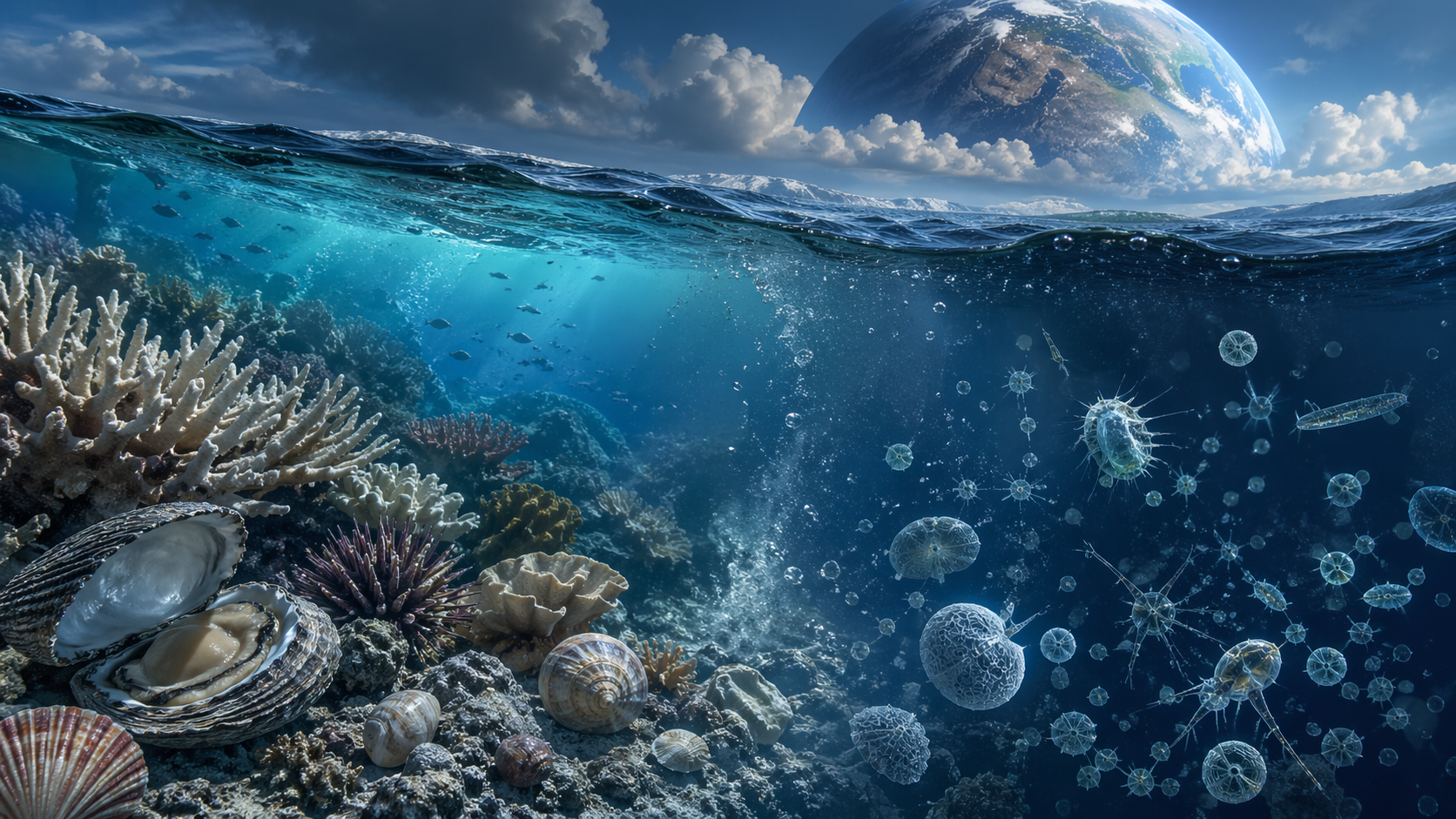
Ocean acidification occupies a distinctive place in the planetary boundaries framework because it is closely linked to climate change while remaining analytically distinct from it. Both are driven primarily by rising atmospheric carbon dioxide, but they operate through different pathways. Climate change describes the warming and broader physical disruption of the climate system. Ocean acidification describes the chemical reorganization of seawater as absorbed carbon dioxide alters the carbonate system. The same emissions source therefore destabilizes the Earth system through more than one channel: thermal, chemical, ecological, biogeochemical, and social.
This distinction matters. The ocean remains alkaline, but it is becoming less alkaline. “Acidification” does not mean the ocean is turning acidic in the everyday sense. It means that pH is declining and carbonate chemistry is shifting away from the conditions under which many marine organisms evolved. Because the pH scale is logarithmic, small numerical changes can represent meaningful chemical changes. Because marine organisms depend on chemical conditions that are not visible to casual observation, acidification can reorganize ecosystems before the public fully recognizes the scale of the change.
This article examines ocean acidification as a planetary boundary by explaining the chemistry behind the process, why carbonate ions and aragonite saturation states matter, how the boundary is defined and assessed, why calcifying organisms and marine ecosystems are vulnerable, how acidification interacts with climate change, deoxygenation, biogeochemical flows, biosphere integrity, freshwater change, land-system change, and novel entities, and why this chemical transformation is now one of the clearest examples of planetary change in the Anthropocene.
Why Ocean Acidification Matters
Ocean acidification matters because the ocean is one of the central stabilizing systems of the planet. It absorbs heat, stores carbon, circulates nutrients, supports marine food webs, influences atmospheric and climate dynamics, sustains fisheries, protects coastlines, and anchors cultural, spiritual, and economic relationships for coastal and island communities. When ocean chemistry is altered at scale, the consequences do not remain confined to chemical measurements. They affect the living organization of the sea.
Within the planetary boundaries framework, ocean acidification is significant because it reveals that atmospheric carbon dioxide can destabilize the Earth system through multiple pathways at the same time. Carbon dioxide warms the atmosphere and ocean, but it also dissolves into seawater and changes carbonate chemistry. This makes ocean acidification one of the clearest examples of how a single human pressure can propagate through climate, chemistry, ecology, food systems, and governance simultaneously.
The boundary is also important because the chemical change is not always immediately visible. A forest fire, flood, bleaching event, heat wave, or dead zone can be seen directly. A decline in carbonate ion availability is less visible, but it can still reshape marine life. Ocean acidification reminds us that planetary destabilization can proceed through changes in background environmental conditions that are initially quiet but ecologically profound.
The ocean’s chemistry matters because marine ecosystems are not peripheral to planetary stability. Phytoplankton, planktonic calcifiers, coral reefs, shellfish, marine microbes, pteropods, foraminifera, coccolithophores, seagrasses, kelp forests, fish communities, and deep-sea organisms all participate in the cycling of carbon, nutrients, energy, oxygen, and life. When seawater chemistry changes, the consequences can move through food webs, reef structures, fisheries, coastal economies, cultural relations, and the ocean’s ability to support life.
Ocean acidification is therefore not simply an environmental issue about charismatic reefs or shellfish. It is a planetary chemistry issue. It asks whether the ocean remains within the chemical conditions that support marine habitability, biological productivity, carbonate formation, food-web resilience, and the ocean’s role as a stabilizing component of the Earth system.
The danger is not that every marine organism responds in the same way or that the ocean crosses one simple biological threshold everywhere at once. The danger is that a global chemical trend is changing the operating conditions of marine ecosystems while those ecosystems are also being stressed by warming, deoxygenation, pollution, overfishing, habitat loss, nutrient runoff, and coastal development. Acidification is one pressure among many, but it is a foundational pressure because it changes the chemistry of the medium in which marine life lives.
The Basic Chemistry
The basic chemistry of ocean acidification begins when carbon dioxide from the atmosphere dissolves into seawater. Once absorbed, carbon dioxide reacts with water to form carbonic acid. Carbonic acid then dissociates, increasing hydrogen ion concentration and lowering pH. At the same time, hydrogen ions react with carbonate ions, reducing the availability of carbonate needed by many organisms to build calcium carbonate shells and skeletons.
CO_2 + H_2O \rightleftharpoons H_2CO_3
\]
Interpretation: Atmospheric carbon dioxide dissolves into seawater and reacts with water to form carbonic acid.
H_2CO_3 \rightleftharpoons H^+ + HCO_3^-
\]
Interpretation: Carbonic acid dissociates, increasing hydrogen ion concentration and shifting seawater toward lower pH.
H^+ + CO_3^{2-} \rightleftharpoons HCO_3^-
\]
Interpretation: Hydrogen ions bind with carbonate ions, reducing carbonate availability for organisms that build calcium carbonate structures.
This is why ocean acidification is better understood as a shift in carbonate chemistry than as a simple fall in pH alone. The pH decline matters, but the redistribution of dissolved carbon species matters just as much. As more carbon dioxide enters seawater, the balance among dissolved carbon dioxide, carbonic acid, bicarbonate, and carbonate changes. Carbonate ions become relatively less available, saturation states decline, and calcifying organisms face more difficult chemical conditions.
The ocean remains alkaline overall, with pH above 7, but that fact does not make acidification harmless. The term “acidification” names a direction of change: a reduction in pH relative to prior conditions and a shift toward less favorable carbonate chemistry. The scientific concern is not that the ocean becomes acid like vinegar. The concern is that a vast alkaline system is moving away from the carbonate conditions that support many forms of marine life.
The chemistry also matters because seawater is buffered but not infinitely buffered. Carbonate ions help resist large pH changes, but when they bind with excess hydrogen ions, their availability declines. That buffering response is protective in one sense, because it slows pH change, but it is biologically consequential because the same carbonate ions are needed by shell-building and reef-building organisms. The ocean’s chemical buffering therefore has ecological costs under sustained carbon dioxide loading.
The result is a planetary chemical trade-off. The ocean absorbs a large share of human-emitted carbon dioxide, slowing atmospheric accumulation and climate warming. But that absorption changes seawater chemistry. The ocean is protecting the atmosphere at the cost of its own chemical stability.
Carbonate Chemistry and Calcification
Carbonate chemistry matters because many marine organisms depend on calcium carbonate to build shells, skeletons, plates, tests, and reef structures. Corals, mollusks, oysters, clams, mussels, pteropods, foraminifera, coccolithophores, echinoderms, and other calcifying organisms use carbonate chemistry in different ways, but they all depend on conditions that allow calcium carbonate formation or maintenance. When carbonate ions decline, calcification may become more difficult, slower, more energetically expensive, or less reliable.
A key concept is calcium carbonate saturation state. For a calcium carbonate mineral such as aragonite, the saturation state can be represented as:
\Omega_{arag} = \frac{[Ca^{2+}][CO_3^{2-}]}{K_{sp}^{arag}}
\]
Interpretation: Aragonite saturation state compares the availability of calcium and carbonate ions with the solubility product for aragonite. Lower values indicate less favorable conditions for aragonite-forming organisms.
When aragonite saturation declines, the chemical environment becomes less favorable for organisms that use aragonite to build shells or skeletons. When saturation states become low enough, calcium carbonate structures may become more vulnerable to dissolution, especially in cold waters, deep waters, upwelling zones, or coastal systems affected by local acidification and hypoxia.
This matters at ecosystem scale because calcifiers are not isolated curiosities. Coral reefs build three-dimensional habitat. Shellfish filter water and support coastal food systems. Pteropods provide food for fish and other marine organisms. Foraminifera and coccolithophores participate in carbon cycling and sediment formation. Calcifying organisms help structure marine ecosystems physically, chemically, and trophically.
Reef systems illustrate the importance of carbonate chemistry especially clearly. Coral reefs are not simply collections of coral animals. They are living geological structures that support biodiversity, fish nurseries, coastal protection, cultural value, tourism, fisheries, and complex biological interactions. If acidification slows reef growth, weakens skeletal structures, or makes recovery from bleaching and storm damage harder, the effects extend beyond corals alone. They affect the architecture of entire ecosystems.
Carbonate chemistry is therefore not a narrow laboratory concern. It is a condition of marine habitability for organisms that help structure biological complexity across the ocean. A shift in carbonate chemistry can become a shift in the conditions under which marine ecosystems organize, recover, and endure.
The difficulty is that biological responses vary. Some organisms may tolerate or partially compensate for lower pH. Some may be more vulnerable during larval stages than adult stages. Some ecosystems may be buffered by local alkalinity, seagrass productivity, or circulation patterns. Others may be exposed to multiple stressors at once. The planetary boundary does not claim identical effects everywhere. It identifies a global chemical trend that raises systemic risk across many marine systems.
Ocean Acidification as a Planetary Boundary
The planetary boundaries framework treats ocean acidification as one of the major Earth-system processes whose destabilization threatens the safe operating space for humanity. In the original framework and subsequent updates, ocean acidification was identified as a distinct boundary because the ocean’s carbonate chemistry plays a central role in marine ecosystem stability and the long-term carbon cycle. The boundary has commonly been expressed through the saturation state of aragonite in surface seawater, with concern focused on keeping global mean saturation sufficiently close to preindustrial conditions.
This distinction is important. Ocean acidification is not merely “part of climate change” in a loose sense. It is a chemically distinct process with its own control logic, ecological vulnerabilities, measurement systems, and boundary dynamics. Warming and acidification are both consequences of rising atmospheric carbon dioxide, but they operate through different mechanisms. Warming alters heat content, circulation, oxygen solubility, stratification, ice dynamics, thermal stress, and sea level. Acidification alters pH, carbonate ions, calcium carbonate saturation state, and calcification conditions.
The planetary-boundary perspective highlights that Earth-system destabilization can occur through interlinked but analytically distinct pathways. The same emissions source can destabilize the planet through thermal, chemical, ecological, and biophysical channels at once. That is why ocean acidification belongs next to climate change rather than underneath it. It names a different mode of planetary change.
This separation also improves governance reasoning. If policy treats acidification only as a climate side effect, it may overlook marine-specific monitoring, carbonate chemistry data, adaptation planning, fisheries management, reef protection, shellfish hatchery risk, coastal vulnerability, and the need to track ocean chemistry directly. A planetary-boundary framing keeps the chemistry visible.
Aragonite saturation state functions as a useful control variable because it connects chemical change to biological relevance. It is not a perfect indicator of every ecological effect, but it captures an important aspect of carbonate availability for organisms that build calcium carbonate structures. It also allows ocean acidification to be expressed in boundary terms: how far has the system moved from preindustrial conditions, and how close is it to a zone of higher risk?
The boundary therefore translates marine chemistry into Earth-system warning language. It says that chemical change in the sea is not a technical detail. It is part of the same planetary overshoot pattern that includes climate change, biosphere integrity, land-system change, freshwater change, biogeochemical flows, and novel entities.
The Boundary and Its Current Status
Ocean acidification has undergone an important status change in the most recent planetary-boundaries framing. In the 2023 planetary-boundaries assessment, ocean acidification was worsening but still assessed as within the safe operating space at planetary scale. The 2025 Planetary Health Check, however, assessed ocean acidification as the seventh transgressed planetary boundary. This marks a significant shift in the current interpretation of planetary overshoot.
The importance of this development is not that every marine ecosystem has already collapsed. It means the Earth system has moved into a zone where ocean-chemistry risk is no longer marginal. The chemistry of the ocean is now formally part of the wider pattern of planetary-boundary transgression. Ocean acidification joins the group of breached boundaries alongside climate change, biosphere integrity, land-system change, freshwater change, biogeochemical flows, and novel entities.
This status change is conceptually important because it shows that planetary overshoot is not confined to the atmosphere, land, freshwater, or visible ecological degradation. It now explicitly includes the changing chemistry of the sea itself. Carbon dioxide emissions are not only warming the planet. They are altering the chemical foundations of marine life.
The 2025 Planetary Health Check uses aragonite saturation state as a key indicator for the boundary. The boundary is defined in relation to global mean surface aragonite saturation state, with the Planetary Health Check describing the boundary as 80 percent of the preindustrial value. In this framing, ocean acidification has moved beyond safe limits, increasingly endangering marine ecosystems.
| Assessment element | Current interpretation | Why it matters |
|---|---|---|
| Primary driver | Anthropogenic carbon dioxide emissions absorbed by the ocean. | Links ocean acidification directly to fossil fuel combustion, land-use change, and the global carbon cycle. |
| Primary chemical pathway | CO₂ uptake lowers pH and reduces carbonate ion availability. | Changes the chemical conditions needed by calcifying organisms and carbonate-based ecosystems. |
| Control variable | Surface-ocean aragonite saturation state. | Connects carbonate chemistry to biological risk for organisms such as corals and shellfish. |
| Boundary status | Assessed as transgressed in the 2025 Planetary Health Check. | Makes ocean acidification the seventh breached planetary boundary in that assessment. |
| Governance implication | Carbon mitigation is essential, but marine monitoring and local stress reduction also matter. | Requires climate policy, ocean policy, fisheries governance, coastal adaptation, and pollution control to work together. |
Boundary status should be interpreted carefully. A transgressed boundary is not a prediction of immediate universal collapse. It is a warning that the Earth system has moved outside a safer operating range. For ocean acidification, that warning is especially serious because chemical changes accumulate, biological effects are uneven, local vulnerability can be severe, and recovery depends strongly on reducing atmospheric carbon dioxide.
The current status also has a temporal meaning. Ocean chemistry changes slowly relative to news cycles, political cycles, or corporate reporting cycles. A boundary breach therefore represents accumulated risk, not a single event. The ocean has been absorbing human carbon for generations. The chemical consequences are now visible enough to be treated as planetary-boundary transgression.
Marine Life, Reefs, and Food Webs
Ocean acidification affects marine life unevenly, but its consequences can be profound. Calcifying organisms are often highlighted because of their dependence on carbonate ions, but the wider ecological implications extend beyond shell formation alone. Acidification can affect growth, development, metabolism, reproduction, behavior, sensory systems, larval survival, species interactions, and ecological resilience, especially when combined with warming, deoxygenation, nutrient stress, pollution, overfishing, or habitat disturbance.
Coral reef systems are particularly important because they combine chemical vulnerability with ecological significance. Reef-building corals depend on calcium carbonate structures to create habitat complexity. As carbonate saturation declines, reef growth can slow, skeletal structures can weaken, and recovery after bleaching or storm damage can become more difficult. Acidification does not act alone. It compounds the effects of marine heat waves, bleaching, pollution, sedimentation, overfishing, storm damage, and disease.
Planktonic calcifiers matter as well because they occupy important positions in marine food webs and biogeochemical cycling. Pteropods, foraminifera, and coccolithophores are not as visually familiar as coral reefs, but they are ecologically and chemically significant. Changes in their calcification, survival, abundance, or distribution can affect predators, carbon export, sediment formation, and marine ecosystem structure.
Shellfish systems illustrate the link between chemistry and livelihoods. Oysters, clams, mussels, scallops, and other shellfish rely on carbonate chemistry at sensitive stages of development. Shellfish hatcheries in vulnerable regions may require careful monitoring of pH, alkalinity, aragonite saturation, temperature, salinity, and dissolved carbon conditions. These are not abstract chemistry variables for the people whose livelihoods depend on aquaculture, fisheries, and coastal food systems.
Food webs are affected because calcifiers are often prey, habitat builders, filter feeders, or participants in carbon and nutrient cycling. If acidification reduces shell integrity, larval survival, reef complexity, or planktonic calcification, effects can move upward and outward through ecosystems. The strongest scientific reading is therefore not that acidification destroys all marine life in a simple uniform way. It is that acidification changes the environmental conditions under which marine communities organize, reproduce, recover, and persist.
This makes ocean acidification a boundary issue rather than a single-species issue. The concern is not only the fate of one organism or habitat. It is the reorganization of marine conditions that support ecosystem complexity, fisheries, biodiversity, and the ocean’s role in planetary stability.
Regional Vulnerability and Coastal Risk
Ocean acidification is planetary in cause, but its effects are regionally uneven. Polar and high-latitude waters are often more vulnerable because colder water absorbs more carbon dioxide and carbonate saturation states are naturally lower. Upwelling regions can bring carbon-rich, lower-pH waters toward the surface, affecting coastal ecosystems and fisheries. Estuaries and nearshore systems can experience acidification in combination with nutrient pollution, freshwater inputs, hypoxia, organic matter decomposition, and local biological processes.
This regional unevenness matters for governance. A global boundary assessment is useful, but communities experience acidification through fisheries, shellfish hatcheries, coral reefs, tourism, coastal protection, food security, cultural relationships, and local monitoring systems. The impacts are therefore mediated by ecology, geography, economy, infrastructure, governance capacity, and social vulnerability.
Coastal communities dependent on shellfish, reef fisheries, aquaculture, marine tourism, or subsistence harvesting may face risks earlier and more directly than inland societies. Indigenous and traditional communities with deep cultural, spiritual, and subsistence ties to marine ecosystems may experience losses that are not captured by market valuation alone. Ocean acidification is therefore not only a chemical or ecological problem. It is also a justice, livelihood, and cultural-continuity issue.
Regional vulnerability also reinforces the need for local monitoring. Global averages can conceal intense local, seasonal, or depth-specific acidification. Monitoring networks, coastal observing systems, autonomous sensors, shellfish hatchery monitoring, local ecological knowledge, and community-linked data programs are essential for translating planetary chemistry into actionable regional knowledge.
Upwelling zones are especially important because they can experience naturally lower pH waters that become more stressful under anthropogenic acidification. These regions can be highly productive and economically important, supporting fisheries and marine food webs, but they may also expose organisms to corrosive or near-corrosive conditions earlier than other systems. In such regions, acidification interacts with deoxygenation, temperature, nutrient dynamics, and fisheries pressure.
Coral reef regions face a different pattern of vulnerability. Tropical reefs may have relatively high aragonite saturation states compared with polar waters, but they are also under severe heat stress, bleaching pressure, coastal pollution, sedimentation, disease, and overfishing. Acidification weakens the chemical conditions for reef growth at the same time warming increases bleaching and mortality risk. The result is not one isolated stressor, but an accumulation of pressures on the architecture of reef ecosystems.
Deoxygenation, Warming, and Multiple Stressors
Ocean acidification rarely acts alone. Marine ecosystems are being reshaped by warming, deoxygenation, stratification, nutrient pollution, overfishing, habitat damage, plastic pollution, chemical contamination, sedimentation, and coastal development. Acidification is therefore best understood as part of a multiple-stressor environment in which chemical change interacts with physical, biological, and social pressures.
Warming can intensify acidification-related risk by increasing metabolic stress, driving coral bleaching, altering species ranges, changing circulation, and reducing oxygen solubility. Deoxygenation can compound acidification because low-oxygen waters often coincide with high carbon dioxide and lower pH conditions, especially in upwelling regions and eutrophic coastal systems. Nutrient pollution can worsen coastal acidification when algal blooms decompose, consuming oxygen and releasing carbon dioxide.
This multi-stressor logic matters because ecological thresholds may be crossed not by one pressure alone but by combined stress. A coral reef may withstand some acidification under cooler, cleaner, well-managed conditions, but not under acidification plus bleaching, pollution, disease, overfishing, and storm damage. A shellfish system may tolerate seasonal variation until acidification coincides with upwelling, low oxygen, temperature stress, and poor monitoring. A coastal ecosystem may appear resilient until nutrient pollution and acidification reinforce each other.
Planetary-boundary thinking is useful here because it discourages single-variable complacency. Ocean acidification cannot be governed separately from climate change, nutrient flows, oxygen decline, fisheries, pollution, and coastal land use. The chemistry is central, but the consequences are systemic.
Multiple stressors also complicate attribution. If a population declines, acidification may not be the only cause. But uncertainty about the exact contribution of each stressor does not reduce the need for action. In many cases, local stress reduction is precisely what can improve resilience under unavoidable chemical change. Reducing nutrient pollution, habitat destruction, overfishing, sedimentation, and toxic exposures can help marine systems better withstand acidification even while global carbon mitigation addresses the root driver.
This is why marine resilience governance must be integrated. Carbon dioxide reduction is essential, but it should be paired with coastal ecosystem protection, pollution control, reef and shellfish monitoring, marine protected areas, fisheries management, and restoration of habitats such as seagrasses, mangroves, salt marshes, kelp forests, and oyster reefs where appropriate.
Ocean Acidification and Climate Regulation
Ocean acidification also matters because the ocean is a major regulator of the global carbon cycle. By absorbing anthropogenic carbon dioxide, the ocean slows the rate at which carbon dioxide accumulates in the atmosphere. This buffering function is one of the reasons climate change is not even faster than it already is. But the same process that buffers the atmosphere changes seawater chemistry.
The ocean’s capacity to absorb carbon is not a free service without consequences. Carbon uptake alters dissolved inorganic carbon, pH, carbonate ion concentration, alkalinity relationships, and calcium carbonate saturation states. As carbonate ions decline, the ocean’s buffering chemistry changes, and more carbon remains in forms that affect marine organisms. The ocean is therefore both protector and victim within the carbon cycle.
This climate-regulation role complicates public understanding. The ocean’s absorption of carbon dioxide is often described as beneficial because it slows atmospheric warming. That is true in one sense. But it is incomplete. The ocean’s carbon sink function reduces one form of risk while creating another: chemical stress in marine ecosystems. A planetary-boundary approach makes both sides visible.
Acidification can also interact with biological carbon cycling. Calcifying organisms, plankton communities, food webs, sediment formation, and the biological pump all participate in carbon movement through the ocean. Changes in marine chemistry and ecosystem structure can affect these pathways, though the direction and magnitude of feedbacks vary by region and process. The key point is that marine chemistry is part of the Earth system’s carbon architecture, not a marginal detail.
Long-term climate strategy therefore cannot focus only on atmospheric temperature. It must also consider ocean chemistry. A world that limits warming too slowly may still leave the ocean exposed to prolonged carbon dioxide loading. Deep decarbonization is therefore not only a climate target. It is a marine-chemistry target and an ocean-biosphere target.
The ocean has absorbed a great deal of human pressure, but it cannot do so without changing. Ocean acidification is the chemical record of that burden.
Ocean Justice and Coastal Livelihoods
Ocean acidification is also a justice issue. The people most exposed to acidification-related harms are not necessarily those most responsible for carbon dioxide emissions. Coastal communities, small-scale fishers, Indigenous peoples, island societies, shellfish growers, reef-dependent communities, and low-income coastal populations may face risks to livelihoods, food security, cultural identity, coastal protection, and ecological continuity from emissions produced largely elsewhere.
This justice dimension is especially important because ocean acidification is often discussed in technical chemistry language. The chemistry is essential, but it must not obscure the social geography of harm. A decline in aragonite saturation state can become a shellfish hatchery crisis, a reef fishery decline, a tourism loss, a cultural wound, a food-security risk, or a disruption of Indigenous and local relationships with the sea.
Small island and coastal communities face layered vulnerability. Many depend on marine ecosystems for food, employment, shoreline protection, cultural identity, and intergenerational knowledge. Coral reefs can buffer waves and storms while supporting fisheries and tourism. Shellfish systems can sustain livelihoods and local food cultures. When acidification weakens these systems, the loss is not simply economic. It can affect sovereignty, memory, community resilience, and belonging.
Ocean justice also requires attention to monitoring inequity. Wealthier regions may have dense observing systems, research vessels, laboratory capacity, autonomous sensors, and institutional support. Other regions may face high exposure with little monitoring infrastructure. A planetary-boundary response must therefore include data justice: the capacity of vulnerable communities and regions to observe, interpret, and respond to changing ocean chemistry.
Indigenous and local knowledge should be treated as part of ocean intelligence. Communities that have long observed shellfish, reefs, fish migration, seasonal cycles, water color, harvest timing, storms, and ecological relationships often hold knowledge that can complement instrumental monitoring. Serious ocean governance should not separate scientific measurement from lived marine knowledge.
Finally, justice requires responsibility. Carbon dioxide emissions are global, but their benefits and harms are unevenly distributed. Ocean acidification makes this inequality chemically visible. The atmosphere carries emissions into the sea, and the sea carries their consequences into the lives of communities that may have contributed little to the cause.
Interactions with Other Boundaries
Ocean acidification is tightly linked to climate change because both are driven primarily by anthropogenic carbon dioxide emissions. It also interacts with biosphere integrity because marine ecosystems under chemical stress may lose resilience, biodiversity, and functional complexity. Nutrient pollution and altered biogeochemical flows can compound marine stress, especially in coastal areas where eutrophication, hypoxia, harmful algal blooms, and acidification may reinforce one another.
Freshwater change and land-system change can alter runoff, sediment delivery, organic matter inputs, alkalinity, nutrient loading, and ecological conditions in ways that affect marine chemistry and coastal vulnerability. Watersheds connect land to sea. Agricultural runoff, sewage, deforestation, wetland loss, river modification, and soil erosion can all affect coastal water chemistry. This means ocean acidification is not governed only through ocean policy. It is also shaped by land, water, agriculture, cities, energy systems, and coastal development.
Ocean acidification also interacts with novel entities. Chemical pollutants, plastics, metals, pesticides, pharmaceuticals, and industrial residues can stress organisms already coping with changing pH and carbonate availability. Atmospheric aerosol loading can influence ocean conditions indirectly through climate, deposition, radiation, and regional circulation. The boundary is therefore embedded in a larger matrix of Earth-system change rather than operating as an isolated marine chemistry problem.
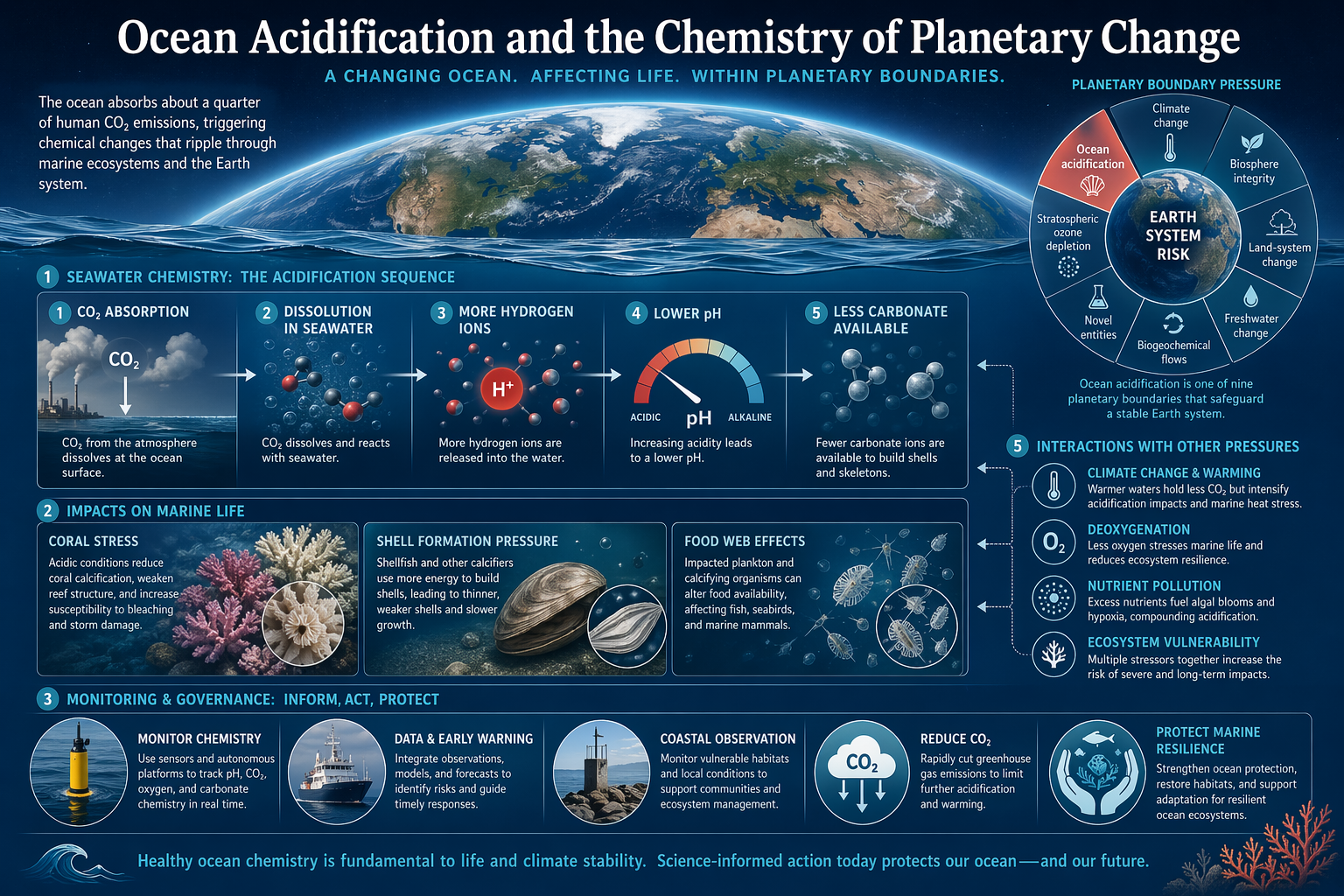
The interaction with biogeochemical flows is especially important in coastal waters. Nutrient runoff can stimulate algal blooms. When algae die and decompose, microbial respiration can consume oxygen and release carbon dioxide, lowering pH and worsening acidification locally. This means a global carbon-driven process can be intensified by regional nutrient mismanagement. In some places, reducing nutrient pollution may be one of the most direct ways to reduce local acidification stress.
For companion essays, see Climate Change as a Planetary Boundary, Biosphere Integrity and the Stability of Life Systems, Freshwater Change and Earth System Risk, Biogeochemical Flows: Nitrogen, Phosphorus, and Planetary Destabilization, Land-System Change and Ecological Transformation, and Novel Entities and the Problem of Synthetic Overload.
Chemistry, Thresholds, and Earth-System Risk
Ocean acidification is an especially powerful example of threshold logic because chemical systems can change gradually while ecological consequences emerge unevenly, nonlinearly, or in combination with other pressures. The ocean does not suddenly become “acid” in the everyday sense, but a progressive shift in carbonate chemistry can still push organisms and ecosystems beyond tolerable conditions. This is one reason the boundary concept is useful: it identifies risk not only in dramatic discontinuities, but also in chemical trends that erode resilience over time.
The Earth-system significance of ocean acidification lies in this combination of subtlety and consequence. Small chemical changes, when global in scale and sustained over time, can alter habitats, ecosystem engineering, carbon cycling, food-web relationships, and marine biological productivity. The danger is not that chemistry changes in a vacuum. It is that chemistry changes the operating conditions of the biosphere.
Thresholds differ by species, life stage, region, and ecosystem context. Larvae may be more vulnerable than adults. Cold-water organisms may experience lower saturation states sooner than tropical organisms. Reef systems may be damaged not by one factor but by the interaction of acidification, warming, bleaching, storm damage, and pollution. Shellfish hatcheries may face episodic exposure to low-pH waters rather than smooth annual averages. This makes the governance challenge more difficult: there is no single universal ecological response threshold that covers all marine life.
Chemical thresholds can also be depth-dependent. The aragonite saturation horizon marks the depth below which aragonite becomes undersaturated and more prone to dissolution. As acidification progresses, this horizon can move upward, exposing organisms and habitats to less favorable conditions. Cold-water corals and deep-sea ecosystems are especially important in this respect because they may be exposed to changing saturation conditions before many surface observers recognize the scale of the problem.
This is why ocean acidification belongs in the same family of concerns as climate tipping points and biosphere degradation. It is a slow-moving but structurally important shift in the environmental conditions that organize life. Its danger lies partly in the fact that chemical deterioration can be underway long before public attention catches up.
The boundary therefore functions as a precautionary signal. It warns that the chemical foundations of marine life are being altered, and that waiting for universal ecological collapse before acting would be a profound governance failure.
Monitoring Ocean Acidification
Monitoring ocean acidification requires more than measuring pH alone. A scientifically useful monitoring system should track dissolved inorganic carbon, total alkalinity, pH, partial pressure of carbon dioxide, carbonate ion concentration, calcium carbonate saturation states, temperature, salinity, dissolved oxygen, nutrients, biological responses, and regional ecological indicators. These measurements help distinguish global carbon-driven acidification from local and regional drivers such as upwelling, eutrophication, freshwater inputs, or biological respiration.
Monitoring also requires multiple platforms. Ships, fixed time-series stations, autonomous floats, moorings, gliders, coastal sensors, laboratory measurements, satellite-informed models, global observing networks, and community-based monitoring programs all contribute different forms of knowledge. Because ocean chemistry varies by depth, season, region, circulation, and biological activity, no single observing method is enough.
This is especially important for engineering and data systems. Acidification monitoring depends on calibration, uncertainty reporting, metadata, sensor drift correction, quality control, reproducible workflows, and transparent provenance. Without careful data architecture, ocean chemistry dashboards can give a false impression of precision. Serious monitoring must preserve the difference between direct measurement, interpolation, model output, and scenario projection.
The planetary-boundary framing strengthens the case for monitoring because it gives ocean chemistry global significance. pH and carbonate saturation are not merely marine science variables. They are indicators of whether the ocean remains within a safer operating range for life-supporting functions.
Monitoring also has governance value. Fisheries managers need to know when shellfish or reef systems are exposed to corrosive conditions. Coastal planners need to know where acidification, hypoxia, and warming overlap. Communities need early warning when local waters threaten food systems or livelihoods. Researchers need long-term time series to separate trends from variability. Policymakers need credible indicators to assess whether carbon mitigation and local stress reduction are working.
A mature observing system should therefore be global, regional, coastal, and community-linked. It should include open data, interoperable formats, uncertainty metadata, local context, and accountability. Ocean acidification is a planetary process, but it is experienced in specific waters by specific organisms and communities.
Governance Implications
If ocean acidification is a planetary boundary, then governance cannot treat marine chemistry as an issue confined to scientific monitoring alone. The central driver is atmospheric carbon dioxide, which means rapid reduction of fossil fuel emissions remains the primary long-term response. There is no serious substitute for reducing the carbon pressure that causes acidification. Climate mitigation is therefore also ocean-chemistry protection.
At the same time, marine governance, fisheries management, reef protection, coastal monitoring, pollution control, and ecosystem resilience planning all matter because acidification does not unfold in a social vacuum. Communities, industries, and ecosystems experience its effects unevenly. Local stress reduction can improve resilience even when global carbon dioxide remains the main driver. Reducing nutrient pollution, protecting habitats, restoring seagrasses and mangroves, managing fisheries, limiting destructive coastal development, and monitoring shellfish hatcheries can all help reduce vulnerability.
The governance challenge is that ocean acidification is easy to overlook compared with more visible environmental harms. It is less immediately legible than wildfire, flood, deforestation, heat waves, plastic pollution, or coral bleaching, yet it may be just as consequential in the long run. A planetary-boundary perspective makes the problem governable by clarifying that marine chemistry is part of Earth-system stability, not a secondary scientific detail.
Governance must also be anticipatory. By the time acidification becomes obvious only through damaged reefs, shellfish losses, food-web disruption, or ecological simplification, the underlying chemistry may already have shifted far beyond safer conditions. The boundary’s warning is therefore temporal as well as chemical: act while the system still has room to recover.
Ocean governance must also be multilevel. Global climate policy addresses the root driver. National policy shapes emissions, monitoring, fisheries, pollution control, coastal development, and research capacity. Regional ocean governance can coordinate across shared seas, upwelling systems, fisheries, and transboundary pollution. Local communities need adaptation tools, monitoring access, and protection from pollution and habitat destruction. No single scale is sufficient.
Finally, governance must be just. Communities most dependent on marine ecosystems should not be left to absorb the consequences of carbon emissions they did not create. Adaptation finance, monitoring infrastructure, local scientific capacity, Indigenous and local knowledge recognition, and coastal resilience planning should be part of any serious response to ocean acidification.
For adjacent essays, see Earth System Governance in an Age of Limits, Business Strategy Within Planetary Boundaries, Finance, Disclosure, and Systemic Environmental Risk, and Environmental Monitoring Systems.
Why This Matters for Planetary Boundaries
Ocean acidification matters for planetary boundaries because it reveals that Earth-system stability depends on chemistry as well as climate, land, water, and biodiversity. The ocean’s carbonate chemistry helps support marine organisms, food webs, reefs, fisheries, carbon cycling, and long-term planetary regulation. When that chemistry shifts beyond safer operating conditions, the ocean’s role as a life-support system is weakened.
The boundary also matters because it shows how planetary change can be invisible until it becomes severe. A decline in aragonite saturation state does not look like a burning forest or a flooded city. But it can make it harder for organisms to build shells, weaken reefs, disrupt food webs, and reduce resilience in systems that support human communities. Planetary risk often begins as changes in conditions before it appears as visible crisis.
Ocean acidification also deepens the meaning of carbon responsibility. Carbon dioxide emissions do not only warm the air. They enter the sea and rewrite its chemistry. A carbon-intensive economy therefore imposes burdens on marine life, coastal communities, future generations, and the ocean’s capacity to regulate the Earth system.
This matters for strategy because climate mitigation, ocean monitoring, pollution reduction, fisheries governance, coastal adaptation, and marine justice must be linked. Reducing carbon dioxide remains the central response, but it should be accompanied by strong local and regional actions that reduce nutrient stress, protect habitats, support monitoring, and strengthen vulnerable communities.
To understand ocean acidification as a planetary boundary is to understand that the chemistry of the sea is part of the stability of civilization. The ocean can absorb carbon, but it cannot do so without changing. The planetary-boundary warning is that the change has now gone far enough to demand urgent, integrated, and just response.
The Carbonate System Beyond pH
pH is a central indicator of ocean acidification, but it does not describe the carbonate system by itself. Marine carbonate chemistry is organized through dissolved inorganic carbon, total alkalinity, dissolved carbon dioxide, bicarbonate, carbonate ions, temperature, salinity, pressure, nutrients, and equilibrium constants. These variables are linked, which is why scientists commonly measure at least two carbonate-system parameters and calculate the others using documented methods.
Total alkalinity represents the seawater system’s acid-neutralizing capacity under a defined chemical convention. Dissolved inorganic carbon represents the combined concentration of dissolved carbon dioxide, bicarbonate, and carbonate. Their relationship helps determine pH, partial pressure or fugacity of carbon dioxide, and calcium carbonate saturation states.
DIC=[CO_2^*]+[HCO_3^-]+[CO_3^{2-}]
\]
Interpretation: Dissolved inorganic carbon includes the major inorganic carbon species whose balance shifts as additional carbon dioxide enters seawater.
A monitoring system that reports pH without scale, temperature, calibration, uncertainty, and supporting carbonate parameters can create false precision. The scientific task is not merely to record whether pH fell. It is to reconstruct the chemical state and the processes that produced it.
Alkalinity, Buffer Capacity, and the Revelle Factor
The ocean resists chemical change through buffering, but that resistance is neither uniform nor unlimited. Buffer capacity varies with temperature, salinity, alkalinity, dissolved inorganic carbon, circulation, and biological activity. The same atmospheric carbon-dioxide increase can therefore produce different carbonate-system responses across regions.
The Revelle factor describes how sensitively surface-ocean carbon-dioxide partial pressure responds to a fractional change in dissolved inorganic carbon. Regions with a higher Revelle factor have lower capacity to absorb additional carbon without a relatively large increase in seawater carbon-dioxide pressure. This helps explain why carbon uptake and acidification do not proceed uniformly.
Alkalinity can be altered by weathering, river inputs, evaporation and precipitation, biological production, calcium carbonate formation or dissolution, sediment processes, and human interventions. It should not be treated as a simple protective quantity. Higher alkalinity can improve buffering under some conditions, but local chemistry, mixing, ecological response, and material sources remain essential.
Buffer capacity is therefore part of the boundary problem. The ocean’s absorption of anthropogenic carbon has delayed atmospheric accumulation while progressively changing the chemistry that made this absorption possible.
Measurement Scales, Calibration, and Uncertainty
Ocean pH can be expressed on different scales, including total, seawater, free, and National Bureau of Standards conventions. Values are not interchangeable without conversion. A credible dataset should state the scale, temperature, pressure, reference materials, calibration method, sensor model, processing steps, and uncertainty.
Carbonate-system consistency can be tested by measuring more than two core parameters and comparing measured values with calculations. Dissolved inorganic carbon, total alkalinity, pH, and carbon-dioxide fugacity each have distinct analytical requirements and error structures. Calculated aragonite saturation inherits uncertainty from the measured inputs, equilibrium constants, temperature, salinity, nutrients, and pressure.
Autonomous sensors expand temporal and spatial coverage but face drift, biofouling, power, calibration, and maintenance constraints. Discrete laboratory samples provide stronger chemical reference but lower frequency. The most reliable observing systems combine platforms and preserve traceability.
Uncertainty should be propagated rather than hidden. A dashboard should distinguish direct measurement, quality-controlled calculation, mapped estimate, interpolation, model reconstruction, and future scenario. These are different forms of evidence.
Air–Sea Carbon Exchange and Physical Controls
Ocean acidification is driven by atmospheric carbon dioxide, but the rate and location of uptake depend on physical circulation and air–sea exchange. Wind, temperature, mixed-layer depth, sea ice, currents, stratification, upwelling, freshwater input, and biological production influence how quickly carbon enters surface water and how it is transported.
Cold water can hold more dissolved carbon dioxide than warm water, contributing to high-latitude vulnerability. Upwelling can bring naturally carbon-rich, lower-pH, lower-saturation water toward the surface. Stratification can reduce mixing and alter oxygen, nutrient, and carbon distributions. River discharge changes salinity, alkalinity, dissolved carbon, organic matter, and residence time in coastal systems.
These physical controls complicate trend interpretation. A temporary rise in local pH does not necessarily indicate declining anthropogenic pressure; warming, biological uptake, mixing, or salinity change can mask the underlying signal. Conversely, local respiration and nutrient pollution can intensify acidification beyond the global atmospheric contribution.
Attribution therefore requires carbonate chemistry, hydrography, circulation, oxygen, nutrients, and biological context rather than pH alone.
Vertical Structure and the Saturation Horizon
Ocean acidification varies with depth. Respiration adds carbon dioxide below the sunlit surface, pressure affects mineral solubility, and colder deep water generally supports lower calcium carbonate saturation states. The aragonite saturation horizon marks the depth at which aragonite shifts from supersaturation to undersaturation under the selected calculation.
As anthropogenic carbon penetrates the ocean, saturation horizons can shoal, exposing organisms and habitats to less favorable chemistry. The consequences are especially important for cold-water corals, pteropods, deep-sea ecosystems, and regions where upwelling connects subsurface chemistry to productive coastal waters.
Surface averages can therefore miss biologically significant exposure. A region may have acceptable annual mean surface conditions while larvae, benthic organisms, or deep habitats experience recurrent corrosive events. Monitoring should resolve depth, season, and duration.
The planetary boundary uses a global surface-ocean indicator, but regional management requires three-dimensional chemistry. Boundary governance should connect the global control variable to the depths and habitats where ecological effects occur.
Coastal, Estuarine, and Upwelling Acidification
Coastal acidification results from interacting global and local drivers. Atmospheric carbon dioxide sets a long-term background trend, while nutrient enrichment, respiration, wastewater, freshwater inflow, alkalinity change, sediment metabolism, aquaculture, wetland processes, and upwelling shape local exposure.
Estuaries can experience large daily, seasonal, and spatial variation. Photosynthesis may raise pH during daylight while respiration lowers it at night. Freshwater can reduce buffering or introduce alkalinity depending on geology and watershed conditions. Nutrient-driven blooms can temporarily remove carbon and later intensify acidification and hypoxia during decomposition.
This variability does not make anthropogenic acidification irrelevant. It means that the anthropogenic signal interacts with a naturally and socially dynamic environment. Coastal management can reduce nutrient and organic-matter loading, protect habitats, improve wastewater treatment, and strengthen monitoring even though only carbon mitigation addresses the primary global driver.
Local action should be evaluated honestly: it can reduce vulnerability and severe episodes, but it cannot restore global carbonate chemistry while atmospheric carbon dioxide continues to rise.
Biological Response, Acclimation, and Adaptation
Marine organisms do not respond uniformly to acidification. Responses vary by species, population, genotype, life stage, nutrition, temperature, oxygen, habitat, exposure history, and the rate of chemical change. Some organisms regulate internal chemistry effectively; others face high energetic costs. Some photosynthetic organisms may benefit from additional carbon while still being affected indirectly through food webs and competition.
Acclimation occurs within an organism’s lifetime, while adaptation involves changes across generations. Both can alter sensitivity, but neither should be assumed to protect ecosystems automatically. Evolutionary potential depends on genetic variation, generation time, population size, connectivity, and the pace of environmental change.
Experimental design matters. Short laboratory studies under constant conditions may not represent fluctuating coastal environments, food limitation, predation, disease, or multi-generational response. Conversely, field observations can make causal attribution difficult.
A strong evidence synthesis therefore reports the chemical exposure, biological endpoint, duration, life stage, multiple stressors, and study context. The appropriate conclusion is not that every species will decline, but that acidification reorganizes costs, interactions, and habitat suitability across marine systems.
Coral-Reef Carbonate Budgets
Reef persistence depends on more than coral calcification. A carbonate budget compares production of calcium carbonate by corals and other calcifiers with physical, chemical, and biological erosion. A reef can continue to contain living coral while losing three-dimensional structure if erosion exceeds construction.
Acidification can reduce calcification, increase dissolution, weaken skeletal density, and change the communities that produce or remove carbonate. Warming, bleaching, storms, disease, overfishing, pollution, and sedimentation simultaneously affect reef growth and recovery.
B_{\text{reef}}
=
G_{\text{calcification}}
–
L_{\text{dissolution}}
–
L_{\text{bioerosion}}
–
L_{\text{physical erosion}}
\]
Interpretation: Reef structural persistence depends on net carbonate production, not calcification alone.
Reef monitoring should therefore include carbonate production, erosion, rugosity, recruitment, bleaching history, water quality, herbivory, and storm damage. The social consequences include fisheries, coastal protection, tourism, cultural continuity, and place-based identity.
Food Webs, Fisheries, and Aquaculture Risk
Ocean acidification can affect fisheries and aquaculture through calcification, larval survival, physiology, prey availability, habitat structure, harmful algal dynamics, disease, and interactions with warming and oxygen loss. These pathways are rarely linear, and catch outcomes depend strongly on management, mobility, species interactions, and market conditions.
Shellfish hatcheries demonstrate the value of actionable chemistry. Monitoring intake water, carbonate conditions, temperature, salinity, and oxygen can guide timing, buffering, and selective breeding. These interventions protect production but require finance, technical capacity, energy, and reliable data.
Small-scale fisheries and subsistence harvests may have fewer technical options and weaker insurance. Loss of reef habitat, pteropod prey, shellfish recruitment, or accessible species can affect food security and cultural practice even when aggregate national seafood supply remains stable.
Risk assessment should therefore connect chemistry to ecological pathways, livelihood dependence, substitution options, market power, and adaptive capacity. A global biochemical trend becomes a development risk through specific food systems and communities.
Observing Networks, SDG 14.3.1, and Data Justice
The Global Ocean Acidification Observing Network coordinates international efforts to understand ocean-acidification conditions, ecosystem responses, and the data needed for modeling and decision support. Its portal connects observing assets with metadata and data providers. IOC-UNESCO serves as custodian for Sustainable Development Goal indicator 14.3.1 on average marine acidity measured at representative sampling stations.
A global network must still confront uneven coverage. Long-term, quality-controlled carbonate observations are concentrated in some regions, while many small-island, African, coastal, polar, and developing-country systems remain under-observed. Missing data can make high-vulnerability regions appear less urgent simply because evidence is sparse.
Data justice includes access to instruments, reference materials, laboratories, training, maintenance, computing, connectivity, and authority to interpret and use data. It also includes community and Indigenous participation in determining what is monitored and what responses follow.
Open data are valuable, but openness without capacity can reproduce inequality. A just observing system links global standards with regional ownership, local knowledge, durable finance, and practical decision pathways.
Attribution, Baselines, and Counterfactuals
Attribution asks how much observed chemical change is caused by anthropogenic atmospheric carbon dioxide, warming, circulation, upwelling, freshwater change, nutrient enrichment, organic-matter respiration, alkalinity shifts, or other processes. The answer varies by region and timescale.
Baselines are also consequential. Preindustrial conditions may be reconstructed from models, proxies, historical data, or process understanding rather than observed directly at each site. A recent reference period may be useful for operational monitoring but can normalize already altered conditions.
Counterfactual analysis compares observed or modeled chemistry with a plausible world without anthropogenic carbon loading or with different local stressors. This can separate global forcing from local amplification and identify which interventions are available to local managers.
The purpose is not to delay action until attribution is perfect. It is to match interventions to mechanisms. Carbon mitigation addresses the global driver; nutrient management, habitat restoration, wastewater control, and fisheries governance address local vulnerability and amplification.
Mitigation, Adaptation, and Local Stress Reduction
Rapid and sustained reduction of carbon-dioxide emissions is the primary response to ocean acidification because it addresses the global driver. Adaptation and local stress reduction can protect particular ecosystems and livelihoods, but they cannot substitute for atmospheric stabilization.
Adaptation options include observing and early warning, hatchery buffering, selective breeding, flexible harvest and aquaculture practices, livelihood diversification, habitat protection, nutrient reduction, wastewater improvement, marine protected areas, and restoration of seagrass, kelp, wetlands, shellfish reefs, mangroves, or coral systems where ecologically appropriate.
Local interventions should be tested for durability, distribution, and unintended effects. A technically advanced hatchery may protect commercial production while small-scale harvesters remain exposed. Habitat restoration may improve local resilience but fail under repeated marine heat waves and continued carbon loading.
An integrated response distinguishes root-cause mitigation, exposure reduction, sensitivity reduction, adaptive capacity, compensation, and loss. These are different functions and should not be reported as interchangeable progress.
Ocean Alkalinity Enhancement and Carbon-Removal Governance
Ocean alkalinity enhancement is being investigated as a form of carbon-dioxide removal that would increase seawater alkalinity and potentially allow additional carbon uptake. Proposed approaches vary in materials, processing, delivery, location, scale, and monitoring requirements.
The concept should be separated from ordinary adaptation. It is an intervention in marine chemistry intended to affect carbon removal and storage. Potential questions include mineral sourcing, energy use, contaminants, particle behavior, ecological effects, additionality, permanence, leakage, transboundary impact, verification, and public legitimacy.
Measurement, reporting, and verification are particularly demanding because natural carbonate chemistry is variable and carbon uptake may occur across time and space. A local alkalinity change is not automatically equivalent to durable atmospheric carbon removal.
Research and carefully governed trials may improve understanding, but uncertainty should not be used to weaken emissions reduction. Any deployment pathway requires transparent evidence, independent review, environmental safeguards, legal clarity, affected-community participation, and the ability to stop or reverse activity when harms emerge.
Early Warning, Thresholds, and Adaptive Pathways
Ocean-acidification governance operates under uncertainty about future emissions, circulation, biological response, local stressors, and social adaptation. A single forecast is therefore insufficient. Adaptive pathways identify actions that are useful across several futures and define decision points for escalation or revision.
Early-warning indicators can include pH, aragonite saturation, dissolved oxygen, nutrient load, carbonate-budget decline, larval mortality, shell dissolution, recruitment failure, harmful algal events, habitat loss, and livelihood stress. Indicators should be paired with thresholds, accountable institutions, finance, and response protocols.
Thresholds differ by organism and ecosystem. Management should avoid turning one universal chemical value into a biological verdict. A useful trigger can still be precautionary when it is transparent, locally validated, and periodically reviewed.
Adaptive pathways preserve options. They combine carbon mitigation with monitoring, local stress reduction, ecological protection, social support, and staged decisions rather than betting marine futures on one intervention or one model.
Worked Diagnostic: A Temperate Shellfish and Upwelling Coast
Consider a coastal region supporting wild fisheries, shellfish aquaculture, Indigenous harvests, tourism, estuaries, and an upwelling ecosystem. Hatcheries have experienced episodic larval failure, while low oxygen and nutrient pollution are also increasing.
Step 1: Define the chemical and social system
The boundary includes atmospheric forcing, upwelling, estuarine inputs, wastewater, nutrients, hatchery intake, wild populations, livelihoods, and the institutions that manage water quality and fisheries.
Step 2: Build a carbonate-system evidence base
pH, total alkalinity, dissolved inorganic carbon or carbon-dioxide pressure, temperature, salinity, oxygen, and nutrients are measured with documented scales, calibration, quality control, and uncertainty.
Step 3: Resolve time and depth
High-frequency coastal sensors are combined with discrete samples and depth profiles to identify seasonal, diel, upwelling, and bottom-water exposure that annual surface averages conceal.
Step 4: Separate global and local drivers
Models and observations compare atmospheric carbon loading with respiration, nutrient inputs, freshwater chemistry, circulation, and biological production.
Step 5: Map ecological and livelihood sensitivity
Larval shellfish, pteropods, benthic habitats, fisheries, hatcheries, small-scale harvesters, and cultural practices are assessed separately rather than represented by one aggregate exposure score.
Step 6: Compare response pathways
Carbon mitigation, nutrient reduction, wastewater upgrades, habitat restoration, hatchery buffering, monitoring expansion, and livelihood support are compared by mechanism and timescale.
Step 7: Establish thresholds and safeguards
Chemical and biological triggers activate intake management, public warnings, pollution controls, additional sampling, harvest review, or financial support. Data and decisions remain publicly documented.
Step 8: Review learning and distribution
The region tests whether interventions reduce exposure and loss across commercial, subsistence, Indigenous, ecological, and public interests—not only whether aggregate production is maintained.
| Pathway | Immediate contribution | Structural limitation |
|---|---|---|
| Hatchery buffering only | Protects sensitive production stages. | Does not address wild ecosystems, unequal capacity, or the global carbon driver. |
| Local pollution reduction | Reduces nutrient-driven respiration, hypoxia, and coastal amplification. | Cannot reverse open-ocean anthropogenic acidification alone. |
| Integrated pathway | Combines mitigation, chemistry monitoring, ecological management, and social protection. | Requires sustained governance, finance, and coordination across scales. |
The diagnostic demonstrates that one pH series cannot stand in for the whole system. Chemistry, physical circulation, ecological response, livelihood dependence, and institutional capacity must be interpreted together.
Mathematical Lens: Carbonate Chemistry, Saturation State, and Boundary Pressure
Ocean acidification can be represented through carbonate chemistry, saturation state, and boundary-distance logic. A simplified pH expression is:
pH = -\log_{10}[H^+]
\]
Interpretation: As hydrogen ion concentration rises, pH falls. Because the pH scale is logarithmic, small numerical changes can represent meaningful chemical shifts.
Dissolved inorganic carbon can be represented as the sum of major dissolved carbon species:
DIC = [CO_2^*] + [HCO_3^-] + [CO_3^{2-}]
\]
Interpretation: Dissolved inorganic carbon includes dissolved carbon dioxide and carbonic acid, bicarbonate, and carbonate ions. Acidification changes the balance among these forms.
The aragonite saturation state is:
\Omega_{arag} = \frac{[Ca^{2+}][CO_3^{2-}]}{K_{sp}^{arag}}
\]
Interpretation: Lower carbonate availability reduces aragonite saturation state, making conditions less favorable for aragonite-forming organisms.
A planetary-boundary pressure ratio can be written as:
R_t = \frac{\Omega_{preindustrial} – \Omega_t}{\Omega_{preindustrial} – \Omega_{boundary}}
\]
Interpretation: Boundary pressure compares the observed decline in aragonite saturation state with the boundary-distance from preindustrial conditions.
If \(R_t < 1\), the system remains inside the boundary range under this simplified formulation. If \(R_t \geq 1\), the boundary has been reached or crossed. A biological vulnerability score for region \(r\) can combine saturation-state pressure, ecological sensitivity, exposure, and adaptive capacity:
V_r = R_r \times S_r \times E_r \times (1 – A_r)
\]
Interpretation: Vulnerability rises when boundary pressure, sensitivity, and exposure are high, and when adaptive capacity is weak.
A combined marine chemistry risk score can include acidification, warming, deoxygenation, and nutrient stress:
M_r = \alpha R_{acid,r} + \beta R_{temp,r} + \gamma R_{oxy,r} + \delta R_{nutrient,r}
\]
Interpretation: Marine risk is often driven by multiple stressors, not acidification alone.
| Term | Meaning | Interpretive role |
|---|---|---|
| \([H^+]\) | Hydrogen ion concentration | Determines pH through a logarithmic relationship. |
| \(DIC\) | Dissolved inorganic carbon | Represents the major non-organic carbon species in seawater. |
| \([CO_3^{2-}]\) | Carbonate ion concentration | Critical for calcium carbonate formation by many marine organisms. |
| \(\Omega_{arag}\) | Aragonite saturation state | Indicates how favorable seawater is for aragonite formation and maintenance. |
| \(\Omega_{boundary}\) | Boundary reference saturation state | Represents the planetary-boundary reference value. |
| \(R_t\) | Boundary-pressure ratio | Shows distance toward or beyond the boundary under a simplified formulation. |
| \(S_r\) | Ecological sensitivity | Represents biological vulnerability to acidification stress. |
| \(E_r\) | Exposure | Represents the degree to which a region or ecosystem experiences acidification pressure. |
| \(A_r\) | Adaptive capacity | Represents monitoring, governance, ecological resilience, and social capacity to respond. |
This formulation is simplified, but it captures the main planetary-boundary lesson: ocean acidification risk is not only a pH problem. It is a coupled chemical, biological, regional, and governance problem.
Advanced Python Workflow: Ocean Acidification and Carbonate-Risk Diagnostics
The following Python workflow models ocean acidification as a carbonate-chemistry and ecosystem-risk problem. It separates pH, carbonate ion availability, aragonite saturation state, preindustrial reference values, boundary values, ecological sensitivity, exposure, adaptive capacity, warming stress, deoxygenation stress, nutrient stress, monitoring capacity, and governance capacity. The values are illustrative, but the structure can be adapted for teaching, scenario analysis, ocean monitoring programs, marine-risk dashboards, and reproducible reporting.
from __future__ import annotations

import csv
import math
from collections import defaultdict
from pathlib import Path
from statistics import mean

ARTICLE_ROOT = Path(__file__).resolve().parents[1]
DATA_FILE = ARTICLE_ROOT / "data" / "ocean_acidification_regions.csv"
TABLES = ARTICLE_ROOT / "outputs" / "tables"

STRESS_COLUMNS = [
    "warming_stress",
    "deoxygenation_stress",
    "nutrient_stress",
    "habitat_pressure",
]

CAPACITY_COLUMNS = [
    "monitoring_capacity",
    "governance_capacity",
    "ecological_resilience",
    "livelihood_adaptive_capacity",
    "data_completeness",
]

def clamp(value: float, low: float = 0.0, high: float = 1.0) -> float:
    return max(low, min(high, value))

def load_profiles(path: Path = DATA_FILE) -> list[dict[str, object]]:
    with path.open(newline="", encoding="utf-8") as handle:
        rows = list(csv.DictReader(handle))

    numeric = [
        "current_ph",
        "preindustrial_ph",
        "carbonate_ion_index",
        "total_alkalinity_index",
        "dissolved_inorganic_carbon_index",
        "aragonite_saturation_state",
        "preindustrial_aragonite_state",
        "boundary_aragonite_state",
        "ecological_sensitivity",
        "livelihood_exposure",
        *STRESS_COLUMNS,
        *CAPACITY_COLUMNS,
    ]
    for row in rows:
        for column in numeric:
            row[column] = float(row[column])
        if float(row["preindustrial_aragonite_state"]) <= float(row["boundary_aragonite_state"]):
            raise ValueError("Preindustrial aragonite state must exceed boundary state.")
    return rows

def score_profile(row: dict[str, object]) -> dict[str, object]:
    ph_decline = max(0.0, float(row["preindustrial_ph"]) - float(row["current_ph"]))
    hydrogen_ion_ratio = 10 ** ph_decline

    denominator = (
        float(row["preindustrial_aragonite_state"])
        - float(row["boundary_aragonite_state"])
    )
    boundary_pressure = max(
        0.0,
        (
            float(row["preindustrial_aragonite_state"])
            - float(row["aragonite_saturation_state"])
        )
        / denominator,
    )

    carbonate_deficit = clamp(1.0 - float(row["carbonate_ion_index"]))
    buffer_stress = clamp(
        0.45 * (1.0 - float(row["total_alkalinity_index"]))
        + 0.55 * float(row["dissolved_inorganic_carbon_index"])
    )
    multi_stressor = (
        0.34 * float(row["warming_stress"])
        + 0.27 * float(row["deoxygenation_stress"])
        + 0.23 * float(row["nutrient_stress"])
        + 0.16 * float(row["habitat_pressure"])
    )
    adaptive_capacity = (
        0.22 * float(row["monitoring_capacity"])
        + 0.22 * float(row["governance_capacity"])
        + 0.22 * float(row["ecological_resilience"])
        + 0.20 * float(row["livelihood_adaptive_capacity"])
        + 0.14 * float(row["data_completeness"])
    )

    normalized_boundary = clamp(boundary_pressure / 1.5)
    ecosystem_vulnerability = clamp(
        normalized_boundary
        * float(row["ecological_sensitivity"])
        * (0.55 + 0.45 * float(row["livelihood_exposure"]))
        * (1.25 - 0.45 * adaptive_capacity)
    )
    chemistry_pressure = clamp(
        0.46 * normalized_boundary
        + 0.29 * carbonate_deficit
        + 0.25 * buffer_stress
    )
    marine_risk = clamp(
        0.38 * chemistry_pressure
        + 0.28 * ecosystem_vulnerability
        + 0.22 * multi_stressor
        + 0.12 * (1.0 - adaptive_capacity)
    )
    justice_burden = clamp(
        0.55 * float(row["livelihood_exposure"])
        + 0.25 * (1.0 - float(row["livelihood_adaptive_capacity"]))
        + 0.20 * (1.0 - float(row["monitoring_capacity"]))
    )

    if marine_risk >= 0.72:
        risk_band = "Severe synthetic risk"
    elif marine_risk >= 0.56:
        risk_band = "High synthetic risk"
    elif marine_risk >= 0.38:
        risk_band = "Moderate synthetic risk"
    else:
        risk_band = "Lower synthetic risk"

    priority_values = {
        "carbonate chemistry": chemistry_pressure,
        "multiple stressors": multi_stressor,
        "monitoring and governance": 1.0 - adaptive_capacity,
        "livelihood justice": justice_burden,
    }
    priority = max(priority_values, key=priority_values.get)

    return {
        **row,
        "ph_decline": round(ph_decline, 4),
        "hydrogen_ion_ratio": round(hydrogen_ion_ratio, 4),
        "aragonite_boundary_pressure": round(boundary_pressure, 4),
        "carbonate_deficit": round(carbonate_deficit, 4),
        "buffer_stress": round(buffer_stress, 4),
        "multi_stressor_pressure": round(multi_stressor, 4),
        "adaptive_capacity_score": round(adaptive_capacity, 4),
        "ecosystem_vulnerability": round(ecosystem_vulnerability, 4),
        "marine_chemistry_risk": round(marine_risk, 4),
        "justice_burden": round(justice_burden, 4),
        "risk_band": risk_band,
        "priority": priority,
    }

def group_summary(scored: list[dict[str, object]]) -> list[dict[str, object]]:
    groups: dict[str, list[dict[str, object]]] = defaultdict(list)
    for row in scored:
        groups[str(row["system_type"])].append(row)

    output = []
    for group, rows in sorted(groups.items()):
        output.append({
            "system_type": group,
            "regions": len(rows),
            "mean_marine_chemistry_risk": round(mean(float(r["marine_chemistry_risk"]) for r in rows), 4),
            "mean_boundary_pressure": round(mean(float(r["aragonite_boundary_pressure"]) for r in rows), 4),
            "mean_multi_stressor_pressure": round(mean(float(r["multi_stressor_pressure"]) for r in rows), 4),
            "mean_adaptive_capacity": round(mean(float(r["adaptive_capacity_score"]) for r in rows), 4),
            "mean_justice_burden": round(mean(float(r["justice_burden"]) for r in rows), 4),
        })
    return output

def scenario_analysis(profiles: list[dict[str, object]]) -> list[dict[str, object]]:
    scenarios = {
        "Baseline": {
            "omega_gain": 0.00,
            "nutrient_multiplier": 1.00,
            "warming_multiplier": 1.00,
            "monitoring_gain": 0.00,
            "governance_gain": 0.00,
        },
        "Monitoring expansion": {
            "omega_gain": 0.00,
            "nutrient_multiplier": 1.00,
            "warming_multiplier": 1.00,
            "monitoring_gain": 0.22,
            "governance_gain": 0.08,
        },
        "Local stress reduction": {
            "omega_gain": 0.00,
            "nutrient_multiplier": 0.58,
            "warming_multiplier": 1.00,
            "monitoring_gain": 0.10,
            "governance_gain": 0.14,
        },
        "Strong carbon mitigation": {
            "omega_gain": 0.20,
            "nutrient_multiplier": 0.88,
            "warming_multiplier": 0.76,
            "monitoring_gain": 0.10,
            "governance_gain": 0.15,
        },
        "Integrated ocean resilience": {
            "omega_gain": 0.26,
            "nutrient_multiplier": 0.52,
            "warming_multiplier": 0.72,
            "monitoring_gain": 0.24,
            "governance_gain": 0.25,
        },
    }

    output = []
    for scenario_name, settings in scenarios.items():
        for base in profiles:
            row = dict(base)
            row["aragonite_saturation_state"] = (
                float(row["aragonite_saturation_state"]) + settings["omega_gain"]
            )
            row["nutrient_stress"] = (
                float(row["nutrient_stress"]) * settings["nutrient_multiplier"]
            )
            row["warming_stress"] = (
                float(row["warming_stress"]) * settings["warming_multiplier"]
            )
            row["monitoring_capacity"] = clamp(
                float(row["monitoring_capacity"]) + settings["monitoring_gain"]
            )
            row["governance_capacity"] = clamp(
                float(row["governance_capacity"]) + settings["governance_gain"]
            )
            scored = score_profile(row)
            output.append({
                "scenario": scenario_name,
                "region": scored["region"],
                "marine_chemistry_risk": scored["marine_chemistry_risk"],
                "aragonite_boundary_pressure": scored["aragonite_boundary_pressure"],
                "multi_stressor_pressure": scored["multi_stressor_pressure"],
                "adaptive_capacity_score": scored["adaptive_capacity_score"],
                "justice_burden": scored["justice_burden"],
                "risk_band": scored["risk_band"],
            })
    return output

def dimension_summary(rows: list[dict[str, object]]) -> list[dict[str, object]]:
    dimensions = [
        "current_ph",
        "carbonate_ion_index",
        "total_alkalinity_index",
        "dissolved_inorganic_carbon_index",
        "aragonite_saturation_state",
        "ecological_sensitivity",
        "livelihood_exposure",
        *STRESS_COLUMNS,
        *CAPACITY_COLUMNS,
    ]
    output = []
    for column in dimensions:
        values = [float(row[column]) for row in rows]
        output.append({
            "dimension": column,
            "mean": round(mean(values), 4),
            "minimum": round(min(values), 4),
            "maximum": round(max(values), 4),
            "range": round(max(values) - min(values), 4),
        })
    return output

def write_csv(path: Path, rows: list[dict[str, object]]) -> None:
    path.parent.mkdir(parents=True, exist_ok=True)
    if not rows:
        raise ValueError(f"No rows generated for {path}")
    with path.open("w", newline="", encoding="utf-8") as handle:
        writer = csv.DictWriter(handle, fieldnames=list(rows[0].keys()))
        writer.writeheader()
        writer.writerows(rows)

def main() -> None:
    profiles = load_profiles()
    scored = [score_profile(row) for row in profiles]
    scored.sort(key=lambda row: float(row["marine_chemistry_risk"]), reverse=True)

    write_csv(TABLES / "ocean_acidification_region_diagnostics.csv", scored)
    write_csv(TABLES / "ocean_acidification_system_summary.csv", group_summary(scored))
    write_csv(TABLES / "ocean_acidification_scenarios.csv", scenario_analysis(profiles))
    write_csv(TABLES / "ocean_acidification_dimension_summary.csv", dimension_summary(profiles))

    print("Ocean acidification workflow complete.")
    print(TABLES / "ocean_acidification_region_diagnostics.csv")

if __name__ == "__main__":
    main()
This workflow is useful because it separates acidification into interpretable components: pH decline, hydrogen-ion increase, carbonate deficit, aragonite boundary pressure, ecosystem vulnerability, multi-stressor pressure, monitoring capacity, and governance capacity. That separation matters because marine chemistry risk is not the same everywhere. Coral reefs, polar waters, upwelling regions, and shellfish coasts face different combinations of chemical exposure, biological sensitivity, local stress, and governance capacity.
The scenario section makes the strategic logic visible. Improved monitoring does not change chemistry directly, but it improves response capacity. Coastal pollution reduction lowers local nutrient stress. Strong carbon mitigation improves the carbonate trajectory over time. Integrated ocean resilience combines carbon mitigation, local stress reduction, monitoring, and governance because ocean acidification is chemical, ecological, social, and institutional at the same time.
Advanced R Workflow: Ocean Acidification Dashboarding
The following R workflow prepares dashboard-ready outputs for ocean acidification and marine chemistry risk. It is designed for researchers, engineers, sustainability analysts, ocean-monitoring teams, fisheries planners, coastal managers, and governance practitioners who need to compare acidification pressure, carbonate chemistry, ecological vulnerability, monitoring capacity, and policy scenarios.
# Base R ocean-acidification diagnostics.
args <- commandArgs(trailingOnly = FALSE)
file_arg <- grep("^--file=", args, value = TRUE)

if (length(file_arg) > 0) {
  script_path <- normalizePath(sub("^--file=", "", file_arg[1]), mustWork = TRUE)
  article_root <- normalizePath(file.path(dirname(script_path), ".."), mustWork = TRUE)
} else {
  article_root <- getwd()
}

input_file <- file.path(article_root, "data", "ocean_acidification_regions.csv")
output_file <- file.path(article_root, "outputs", "tables", "ocean_acidification_diagnostics_r.csv")

ocean <- read.csv(input_file, stringsAsFactors = FALSE)

ocean$ph_decline <- pmax(0, ocean$preindustrial_ph - ocean$current_ph)
ocean$hydrogen_ion_ratio <- 10 ^ ocean$ph_decline

denominator <- (
  ocean$preindustrial_aragonite_state -
  ocean$boundary_aragonite_state
)

ocean$aragonite_boundary_pressure <- pmax(
  0,
  (
    ocean$preindustrial_aragonite_state -
    ocean$aragonite_saturation_state
  ) / denominator
)

ocean$multi_stressor_pressure <- (
  0.34 * ocean$warming_stress +
  0.27 * ocean$deoxygenation_stress +
  0.23 * ocean$nutrient_stress +
  0.16 * ocean$habitat_pressure
)

ocean$adaptive_capacity_score <- (
  0.22 * ocean$monitoring_capacity +
  0.22 * ocean$governance_capacity +
  0.22 * ocean$ecological_resilience +
  0.20 * ocean$livelihood_adaptive_capacity +
  0.14 * ocean$data_completeness
)

ocean$marine_chemistry_risk <- pmin(
  1,
  pmax(
    0,
    0.46 * pmin(1, ocean$aragonite_boundary_pressure / 1.5) +
    0.22 * ocean$multi_stressor_pressure +
    0.16 * ocean$ecological_sensitivity +
    0.16 * (1 - ocean$adaptive_capacity_score)
  )
)

dir.create(dirname(output_file), recursive = TRUE, showWarnings = FALSE)
write.csv(ocean, output_file, row.names = FALSE)

cat("Base R ocean-acidification diagnostics complete.\n")
cat(output_file, "\n")
This R workflow is designed for transparent interpretation rather than false precision. It separates carbonate chemistry, ecosystem vulnerability, multi-stressor pressure, monitoring capacity, and governance capacity. That distinction matters because the right response differs by region. A coral reef region may require urgent carbon mitigation and reef resilience; an upwelling coast may require shellfish monitoring and deoxygenation planning; a coastal system with nutrient stress may require watershed and pollution governance alongside climate mitigation.
The scenario outputs are useful because they show that no single intervention fully addresses ocean acidification. Monitoring improves visibility. Coastal pollution reduction reduces local stress. Strong carbon mitigation addresses the root driver. Integrated ocean resilience combines these approaches, which is the most realistic governance model for a planetary-boundary problem.
Advanced Go Workflow: Lightweight Ocean-Acidification Scoring Service
The following Go workflow translates ocean-acidification diagnostics into a lightweight scoring service. Go is useful for command-line tools, APIs, monitoring systems, and operational scoring engines. This example reads ocean chemistry profiles from a CSV file and reports pH decline, hydrogen-ion increase, aragonite boundary pressure, marine chemistry risk score, risk class, and priority.
package main

import (
	"encoding/csv"
	"fmt"
	"math"
	"os"
	"path/filepath"
	"strconv"
)

type Profile struct {
	Region                string
	CurrentPH             float64
	PreindustrialPH       float64
	CurrentAragonite      float64
	PreindustrialAragonite float64
	BoundaryAragonite     float64
	EcologicalSensitivity float64
	WarmingStress         float64
	DeoxygenationStress   float64
	NutrientStress        float64
	MonitoringCapacity    float64
	GovernanceCapacity    float64
}

func parseFloat(record map[string]string, key string) (float64, error) {
	value, err := strconv.ParseFloat(record[key], 64)
	if err != nil {
		return 0, fmt.Errorf("%s: %w", key, err)
	}
	return value, nil
}

func loadProfiles(path string) ([]Profile, error) {
	file, err := os.Open(path)
	if err != nil {
		return nil, err
	}
	defer file.Close()

	reader := csv.NewReader(file)
	rows, err := reader.ReadAll()
	if err != nil {
		return nil, err
	}
	if len(rows) < 2 {
		return nil, fmt.Errorf("no data rows")
	}

	headers := rows[0]
	profiles := make([]Profile, 0, len(rows)-1)
	for _, row := range rows[1:] {
		record := map[string]string{}
		for index, header := range headers {
			record[header] = row[index]
		}
		currentPH, _ := parseFloat(record, "current_ph")
		preindustrialPH, _ := parseFloat(record, "preindustrial_ph")
		currentAragonite, _ := parseFloat(record, "aragonite_saturation_state")
		preindustrialAragonite, _ := parseFloat(record, "preindustrial_aragonite_state")
		boundaryAragonite, _ := parseFloat(record, "boundary_aragonite_state")
		sensitivity, _ := parseFloat(record, "ecological_sensitivity")
		warming, _ := parseFloat(record, "warming_stress")
		deoxygenation, _ := parseFloat(record, "deoxygenation_stress")
		nutrient, _ := parseFloat(record, "nutrient_stress")
		monitoring, _ := parseFloat(record, "monitoring_capacity")
		governance, _ := parseFloat(record, "governance_capacity")

		profiles = append(profiles, Profile{
			Region: record["region"],
			CurrentPH: currentPH,
			PreindustrialPH: preindustrialPH,
			CurrentAragonite: currentAragonite,
			PreindustrialAragonite: preindustrialAragonite,
			BoundaryAragonite: boundaryAragonite,
			EcologicalSensitivity: sensitivity,
			WarmingStress: warming,
			DeoxygenationStress: deoxygenation,
			NutrientStress: nutrient,
			MonitoringCapacity: monitoring,
			GovernanceCapacity: governance,
		})
	}
	return profiles, nil
}

func clamp(value float64) float64 {
	return math.Max(0, math.Min(1, value))
}

func main() {
	input := filepath.Join("..", "data", "ocean_acidification_regions.csv")
	output := filepath.Join("..", "outputs", "tables", "ocean_acidification_scores_go.csv")

	profiles, err := loadProfiles(input)
	if err != nil {
		panic(err)
	}

	file, err := os.Create(output)
	if err != nil {
		panic(err)
	}
	defer file.Close()

	writer := csv.NewWriter(file)
	defer writer.Flush()
	writer.Write([]string{
		"region",
		"ph_decline",
		"hydrogen_ion_ratio",
		"boundary_pressure",
		"multi_stressor_pressure",
		"governance_monitoring_gap",
		"risk_score",
	})

	for _, profile := range profiles {
		phDecline := math.Max(0, profile.PreindustrialPH-profile.CurrentPH)
		hydrogenRatio := math.Pow(10, phDecline)
		denominator := profile.PreindustrialAragonite - profile.BoundaryAragonite
		boundaryPressure := math.Max(
			0,
			(profile.PreindustrialAragonite-profile.CurrentAragonite)/denominator,
		)
		multiStress := 0.42*profile.WarmingStress +
			0.33*profile.DeoxygenationStress +
			0.25*profile.NutrientStress
		gap := 1 - (0.5*profile.MonitoringCapacity + 0.5*profile.GovernanceCapacity)
		risk := clamp(
			0.45*clamp(boundaryPressure/1.5) +
			0.25*multiStress +
			0.18*profile.EcologicalSensitivity +
			0.12*gap,
		)

		writer.Write([]string{
			profile.Region,
			fmt.Sprintf("%.4f", phDecline),
			fmt.Sprintf("%.4f", hydrogenRatio),
			fmt.Sprintf("%.4f", boundaryPressure),
			fmt.Sprintf("%.4f", multiStress),
			fmt.Sprintf("%.4f", gap),
			fmt.Sprintf("%.4f", risk),
		})
	}

	fmt.Println("Go ocean-acidification scoring complete.")
	fmt.Println(output)
}
The Go workflow shows how ocean-acidification diagnostics can move from article-level explanation into operational systems. A lightweight scoring service could support coastal dashboards, shellfish hatchery monitoring, ocean-observing APIs, marine protected area planning, research data systems, or policy-support tools.
A production implementation should include schema validation, unit checking, sensor metadata, calibration records, uncertainty intervals, carbonate-system calculation methods, structured logging, test coverage, ocean-region metadata, observing-platform metadata, and audit trails. Ocean-acidification scoring should not hide chemistry behind a single score. It should make pH, carbonate availability, aragonite saturation, multi-stressor exposure, monitoring capacity, and governance capacity visible enough to support better decisions.
Engineering Extensions in the GitHub Repository
The accompanying GitHub repository extends the article workflow beyond Python, R, and Go into a broader engineering scaffold. The article body keeps Python and R visible because they are accessible tools for analytics, dashboard preparation, scenario testing, and reproducible reporting. Go provides a compact service layer. The repository, however, is structured for readers who want to translate ocean-acidification analysis into more technical systems: auditable databases, scoring engines, APIs, embedded monitoring, scenario simulation, edge anomaly detection, and accelerator-aware environmental data pipelines.
The SQL scaffold is intended for ocean regions, pH measurements, dissolved inorganic carbon, total alkalinity, carbonate ion indexes, aragonite saturation states, boundary reference values, ecosystem vulnerability, multi-stressor indicators, monitoring capacity, governance capacity, scenario runs, source provenance, and audit trails. Rust can support reliable scoring engines or command-line tools where type safety and reproducibility matter. Go can support lightweight diagnostic APIs. C and C++ can support embedded threshold monitoring, local sensor processing, or scenario simulation. TinyML can support low-power anomaly detection at the edge, while PYNQ-oriented scaffolding can support accelerated preprocessing of marine sensor streams or autonomous monitoring platforms.
This engineering layer matters because ocean acidification is fundamentally a measurement and integration problem as well as a climate problem. Monitoring seawater chemistry requires calibrated sensors, quality control, metadata, uncertainty handling, and reproducible carbonate-system calculations. A serious technical architecture should make marine chemistry risk inspectable rather than hiding it behind a single score.
A mature implementation should include documentation for indicator selection, unit conventions, carbonate-system assumptions, uncertainty handling, spatial resolution, temporal resolution, observing-platform limitations, sensor drift correction, calibration procedures, community monitoring, fisheries relevance, environmental justice fields, and review workflows. Without that layer, ocean-acidification analytics can become decorative. With it, the technical system becomes accountable marine-chemistry knowledge infrastructure.
GitHub Repository
The full code distribution for this article, including Python, R, and Go workflows plus extended engineering scaffolding for SQL, Rust, C, C++, TinyML, and PYNQ-oriented ocean-acidification and carbonate-risk diagnostics, is available on GitHub.
Common Misunderstandings
A common misunderstanding is that ocean acidification means the ocean will soon become chemically acid in the everyday sense. The actual process is a reduction in pH and a reorganization of carbonate chemistry within still-alkaline seawater. The ocean remains basic, but it is becoming less basic, and that directional shift has major biological consequences.
Another misunderstanding is that acidification is just a marine side effect of climate change. It is closely linked to climate change because both are driven by carbon dioxide, but it is a distinct chemical process with distinct ecological consequences. Warming and acidification often interact, but they are not the same mechanism.
A third misunderstanding is that the issue concerns only coral reefs or shellfish. Those are important and highly visible examples, but the deeper concern is the reconfiguration of marine chemistry and the wider ecosystems that depend on it. Planktonic organisms, food webs, carbon cycling, fisheries, reef systems, shellfish, deep-sea habitats, and coastal livelihoods may all be affected in different ways.
A further misunderstanding is that because acidification is invisible to casual observation, it is secondary or speculative. The scientific consensus is the opposite: it is measurable, chemically understood, ecologically meaningful, and now important enough in the planetary-boundary framework to be classified as transgressed in the 2025 Planetary Health Check.
Another misunderstanding is that local marine adaptation can solve the problem by itself. Local action is important for resilience, but the primary driver is atmospheric carbon dioxide. Without rapid emissions reduction, adaptation becomes increasingly constrained by the chemistry itself.
A final misunderstanding is that ocean acidification has the same effects everywhere. It does not. Polar waters, tropical reefs, upwelling zones, estuaries, shellfish coasts, and deep-sea coral systems have different exposure pathways and vulnerabilities. The common thread is not uniform impact, but global chemical shift.
A Practical Method for Assessing Ocean-Acidification Risk
1. Define the decision, region, depth, and time horizon
Specify whether the assessment concerns planetary status, a coastal ecosystem, a fishery, an aquaculture system, a habitat, or a community decision.
2. Define the carbonate-system variables
Identify pH scale, total alkalinity, dissolved inorganic carbon, carbon-dioxide pressure or fugacity, saturation state, temperature, salinity, pressure, oxygen, and nutrients.
3. Document measurement and calculation quality
Record standards, calibration, reference materials, sensor drift, laboratory methods, constants, software, uncertainty, and provenance.
4. Reconstruct baseline and trend
Separate preindustrial reconstruction, historical observation, operational baseline, seasonal variability, and long-run trend.
5. Resolve physical and local drivers
Examine circulation, upwelling, stratification, freshwater, biology, respiration, nutrient enrichment, wastewater, and sediment processes.
6. Map ecological sensitivity and exposure
Disaggregate by species, life stage, habitat, depth, duration, multiple stressors, and capacity for acclimation or adaptation.
7. Map human dependence and unequal burden
Identify food, livelihood, cultural, coastal-protection, tourism, and public-capacity dependencies, including communities underrepresented in monitoring.
8. Compare root-cause and local interventions
Separate carbon mitigation, local stress reduction, adaptation, restoration, compensation, monitoring, and experimental carbon-removal approaches.
9. Test multiple scenarios and compound stressors
Include warming, deoxygenation, nutrient pressure, habitat loss, harvest pressure, and uncertainty rather than changing pH alone.
10. Define biological and governance safeguards
Preserve minimum evidence standards, rights, ecological protections, independent review, and explicit limits on what composite scores can justify.
11. Connect indicators to action
Assign thresholds, owners, finance, public reporting, review dates, and response protocols for chemical and biological warning signals.
12. Reassess as chemistry and institutions change
Update data, assumptions, methods, distributional effects, and intervention performance while preserving a transparent decision record.
Common Pitfalls in Ocean-Acidification Assessment
- Treating pH as the whole carbonate system: pH alone does not reveal alkalinity, dissolved inorganic carbon, carbonate availability, or saturation state.
- Omitting the pH scale and temperature: values expressed on different scales or conditions cannot be compared safely without conversion.
- Using annual surface means for benthic or larval exposure: depth, duration, season, and high-frequency extremes can drive biological risk.
- Interpreting all coastal pH change as atmospheric forcing: upwelling, respiration, nutrients, freshwater, and alkalinity can amplify or mask the trend.
- Assuming every organism responds identically: sensitivity varies by species, population, life stage, nutrition, habitat, and interacting stressors.
- Equating saturation above one with ecological safety: organisms can experience stress well before bulk seawater becomes undersaturated.
- Using a planetary boundary as a local biological threshold: the global control variable is not a universal species-response line.
- Reporting calculated chemistry without uncertainty: input measurements, constants, interpolation, and models all contribute error.
- Treating local adaptation as a substitute for carbon mitigation: buffering and pollution reduction cannot stabilize global ocean chemistry alone.
- Ignoring monitoring inequality: sparse data can hide severe exposure and weaken the ability of communities to respond.
- Treating carbon-removal claims as verified from alkalinity addition alone: durable atmospheric removal requires rigorous additionality, permanence, and leakage analysis.
- Ending the assessment at publication: observing systems, thresholds, ecological response, and governance performance require continuing review.
The central mistake is to reduce a coupled chemical, physical, biological, and social process to one number without preserving its measurement conditions, uncertainty, mechanisms, and distributional consequences.
Related Articles
- What Are Planetary Boundaries?
- The Origins of the Planetary Boundaries Framework
- Safe Operating Space and the Logic of Thresholds
- How Planetary Boundaries Are Measured
- Uncertainty, Precaution, and Scientific Debate in Boundary Setting
- Climate Change as a Planetary Boundary
- Biosphere Integrity and the Stability of Life Systems
- Freshwater Change and Earth System Risk
- Biogeochemical Flows: Nitrogen, Phosphorus, and Planetary Destabilization
- Land-System Change and Ecological Transformation
- Stratospheric Ozone Depletion and Global Environmental Governance
- Atmospheric Aerosol Loading and Regional Planetary Risk
- Novel Entities and the Problem of Synthetic Overload
- Planetary Boundaries and Earth System Resilience
- Tipping Points, Feedback Loops, and Cascading Ecological Change
- Sustainable Development Goals Within Planetary Boundaries
- Planetary Boundaries, Justice, and Global Inequality
- Earth System Governance in an Age of Limits
- Business Strategy Within Planetary Boundaries
- Finance, Disclosure, and Systemic Environmental Risk
- Critiques of the Planetary Boundaries Framework
- Planetary Boundaries and Doughnut Economics
- The Future of Planetary Stewardship
Further Reading
- IAEA Ocean Acidification International Coordination Centre (2026) Best practices and method comparisons. Available at: https://www.iaea.org/services/oa-icc/science-and-collaboration/best-practices-and-method-comparisons
- IOC-UNESCO (2026) Ocean Acidification and SDG indicator 14.3.1. Available at: https://www.ioc.unesco.org/en/ocean-acidification
- Global Ocean Acidification Observing Network (2026) GOA-ON Data Portal. Available at: https://portal.goa-on.org/
- NOAA National Marine Ecosystem Status (2026) Ocean Acidification: regional aragonite-saturation indicators. Available at: https://ecowatch.noaa.gov/thematic/ocean-acidification
- NOAA Ocean Acidification Program (2023) Acidification of the Global Surface Ocean: What We Have Learned from Observations. Available at: https://oceanacidification.noaa.gov/oap_pubs/acidification-of-the-global-surface-ocean-what-we-have-learned-from-observations/
- Planetary Health Check (2025) Ocean Acidification: seventh transgressed Planetary Boundary. Available at: https://www.planetaryhealthcheck.org/boundary/ocean-acidification/
- Doney, S.C., Fabry, V.J., Feely, R.A. and Kleypas, J.A. (2009) ‘Ocean acidification: The other CO2 problem’, Annual Review of Marine Science, 1, pp. 169–192. Available at: https://www.annualreviews.org/content/journals/10.1146/annurev.marine.010908.163834.
- Feely, R.A., Doney, S.C. and Cooley, S.R. (2009) ‘Ocean acidification: Present conditions and future changes in a high-CO2 world’, Oceanography, 22(4), pp. 36–47. Available at: https://tos.org/oceanography/article/ocean-acidification-present-conditions-and-future-changes-in-a-high-co2-world.
- Gattuso, J.-P. and Hansson, L. (eds.) (2011) Ocean Acidification. Oxford: Oxford University Press. Available at: https://global.oup.com/academic/product/ocean-acidification-9780199591091.
- Global Ocean Acidification Observing Network (GOA-ON) (n.d.) Global Ocean Acidification Observing Network. Available at: https://www.goa-on.org/.
- IAEA Ocean Acidification International Coordination Centre (n.d.) Ocean Acidification International Coordination Centre. Vienna: International Atomic Energy Agency. Available at: https://www.iaea.org/services/oa-icc.
- IPCC (2022) ‘Chapter 3: Oceans and coastal ecosystems and their services’, in Climate Change 2022: Impacts, Adaptation and Vulnerability. Cambridge: Cambridge University Press. Available at: https://www.ipcc.ch/report/ar6/wg2/chapter/chapter-3/.
- Kleypas, J.A. et al. (1999) ‘Geochemical consequences of increased atmospheric carbon dioxide on coral reefs’, Science, 284(5411), pp. 118–120. Available at: https://www.science.org/doi/10.1126/science.284.5411.118.
- NOAA Ocean Acidification Program (n.d.) What Is Ocean Acidification? Washington, DC: National Oceanic and Atmospheric Administration. Available at: https://oceanacidification.noaa.gov/what-is-ocean-acidification/.
- Orr, J.C. et al. (2005) ‘Anthropogenic ocean acidification over the twenty-first century and its impact on calcifying organisms’, Nature, 437, pp. 681–686. Available at: https://www.nature.com/articles/nature04095.
- Planetary Health Check (2025) Ocean Acidification. Potsdam: Potsdam Institute for Climate Impact Research. Available at: https://www.planetaryhealthcheck.org/boundary/ocean-acidification/.
- Richardson, K. et al. (2023) ‘Earth beyond six of nine planetary boundaries’, Science Advances, 9(37), eadh2458. Available at: https://www.science.org/doi/10.1126/sciadv.adh2458.
- Steffen, W. et al. (2015) ‘Planetary boundaries: Guiding human development on a changing planet’, Science, 347(6223), 1259855. Available at: https://www.science.org/doi/10.1126/science.1259855.
References
- IAEA Ocean Acidification International Coordination Centre (2026) Best practices and method comparisons. Available at: https://www.iaea.org/services/oa-icc/science-and-collaboration/best-practices-and-method-comparisons
- IOC-UNESCO (2026) Ocean Acidification and SDG indicator 14.3.1. Available at: https://www.ioc.unesco.org/en/ocean-acidification
- Global Ocean Acidification Observing Network (2026) GOA-ON Data Portal. Available at: https://portal.goa-on.org/
- NOAA National Marine Ecosystem Status (2026) Ocean Acidification: regional aragonite-saturation indicators. Available at: https://ecowatch.noaa.gov/thematic/ocean-acidification
- NOAA Ocean Acidification Program (2023) Acidification of the Global Surface Ocean: What We Have Learned from Observations. Available at: https://oceanacidification.noaa.gov/oap_pubs/acidification-of-the-global-surface-ocean-what-we-have-learned-from-observations/
- Planetary Health Check (2025) Ocean Acidification: seventh transgressed Planetary Boundary. Available at: https://www.planetaryhealthcheck.org/boundary/ocean-acidification/
- Doney, S.C., Fabry, V.J., Feely, R.A. and Kleypas, J.A. (2009) ‘Ocean acidification: The other CO2 problem’, Annual Review of Marine Science, 1, pp. 169–192. Available at: https://www.annualreviews.org/content/journals/10.1146/annurev.marine.010908.163834.
- Feely, R.A., Doney, S.C. and Cooley, S.R. (2009) ‘Ocean acidification: Present conditions and future changes in a high-CO2 world’, Oceanography, 22(4), pp. 36–47. Available at: https://tos.org/oceanography/article/ocean-acidification-present-conditions-and-future-changes-in-a-high-co2-world.
- Global Ocean Acidification Observing Network (GOA-ON) (n.d.) Global Ocean Acidification Observing Network. Available at: https://www.goa-on.org/.
- IAEA Ocean Acidification International Coordination Centre (n.d.) Ocean Acidification. Vienna: International Atomic Energy Agency. Available at: https://www.iaea.org/services/oa-icc.
- IPCC (2022) ‘Chapter 3: Oceans and coastal ecosystems and their services’, in Climate Change 2022: Impacts, Adaptation and Vulnerability. Cambridge: Cambridge University Press. Available at: https://www.ipcc.ch/report/ar6/wg2/chapter/chapter-3/.
- Kitzmann, N. et al. (2025) Planetary Health Check 2025: A Scientific Assessment of the State of the Planet. Potsdam: Potsdam Institute for Climate Impact Research. Available at: https://www.planetaryhealthcheck.org/.
- Kleypas, J.A. et al. (1999) ‘Geochemical consequences of increased atmospheric carbon dioxide on coral reefs’, Science, 284(5411), pp. 118–120. Available at: https://www.science.org/doi/10.1126/science.284.5411.118.
- NOAA National Ocean Service (2024) What Is Ocean Acidification? Washington, DC: National Oceanic and Atmospheric Administration. Available at: https://oceanservice.noaa.gov/facts/acidification.html.
- NOAA Ocean Acidification Program (n.d.) What Is Ocean Acidification? Washington, DC: National Oceanic and Atmospheric Administration. Available at: https://oceanacidification.noaa.gov/what-is-ocean-acidification/.
- Orr, J.C. et al. (2005) ‘Anthropogenic ocean acidification over the twenty-first century and its impact on calcifying organisms’, Nature, 437, pp. 681–686. Available at: https://www.nature.com/articles/nature04095.
- Planetary Health Check (2025) Ocean Acidification. Potsdam: Potsdam Institute for Climate Impact Research. Available at: https://www.planetaryhealthcheck.org/boundary/ocean-acidification/.
- Richardson, K., Steffen, W., Lucht, W., Bendtsen, J., Cornell, S.E., Donges, J.F., Drüke, M., Fetzer, I., Bala, G., von Bloh, W., Feulner, G., Fiedler, S., Gerten, D., Gleeson, T., Hofmann, M., Huiskamp, W., Jakobsson, C., Jürgensen, J.H., Kummu, M., Mohan, C., Nogués-Bravo, D., Petri, S., Porkka, M., Rahmstorf, S., Schaphoff, S., Schulte-Uebbing, L., Staal, A., Sun, Z., Sakschewski, B. and Wang-Erlandsson, L. (2023) ‘Earth beyond six of nine planetary boundaries’, Science Advances, 9(37), eadh2458. Available at: https://www.science.org/doi/10.1126/sciadv.adh2458.
- Rockström, J., Steffen, W., Noone, K., Persson, Å., Chapin, F.S. III, Lambin, E.F., Lenton, T.M., Scheffer, M., Folke, C., Schellnhuber, H.J., Nykvist, B., de Wit, C.A., Hughes, T., van der Leeuw, S., Rodhe, H., Sörlin, S., Snyder, P.K., Costanza, R., Svedin, U., Falkenmark, M., Karlberg, L., Corell, R.W., Fabry, V.J., Hansen, J., Walker, B., Liverman, D., Richardson, K., Crutzen, P. and Foley, J.A. (2009a) ‘A safe operating space for humanity’, Nature, 461, pp. 472–475. Available at: https://www.nature.com/articles/461472a.
- Rockström, J., Steffen, W., Noone, K., Persson, Å., Chapin, F.S. III, Lambin, E.F., Lenton, T.M., Scheffer, M., Folke, C., Schellnhuber, H.J., Nykvist, B., de Wit, C.A., Hughes, T., van der Leeuw, S., Rodhe, H., Sörlin, S., Snyder, P.K., Costanza, R., Svedin, U., Falkenmark, M., Karlberg, L., Corell, R.W., Fabry, V.J., Hansen, J., Walker, B., Liverman, D., Richardson, K., Crutzen, P. and Foley, J.A. (2009b) ‘Planetary boundaries: Exploring the safe operating space for humanity’, Ecology and Society, 14(2), 32. Available at: https://www.ecologyandsociety.org/vol14/iss2/art32/.
- Steffen, W., Richardson, K., Rockström, J., Cornell, S.E., Fetzer, I., Bennett, E.M., Biggs, R., Carpenter, S.R., de Vries, W., de Wit, C.A., Folke, C., Gerten, D., Heinke, J., Mace, G.M., Persson, L.M., Ramanathan, V., Reyers, B. and Sörlin, S. (2015) ‘Planetary boundaries: Guiding human development on a changing planet’, Science, 347(6223), 1259855. Available at: https://www.science.org/doi/10.1126/science.1259855.
- Stockholm Resilience Centre (2025) ‘Seven of nine planetary boundaries now breached’. Available at: https://www.stockholmresilience.org/news–events/general-news/2025-09-24-seven-of-nine-planetary-boundaries-now-breached.html.