
Last Updated June 3, 2026
Urban futures examine how cities evolve as complex, interdependent systems shaped by infrastructure, housing, mobility, technology, migration, climate stress, public finance, governance, ecological constraint, and political economy. Futures thinking provides a framework for understanding how these forces interact under uncertainty and how urban systems can remain resilient, adaptive, just, and sustainable over time. A serious analysis of urban futures must treat cities not as isolated planning units, but as coupled systems embedded in wider economic, climatic, technological, demographic, ecological, and geopolitical networks.
Cities are where global systems become materially real. Economic production, technological innovation, environmental stress, migration, public finance, land speculation, institutional conflict, infrastructure dependency, public health, and social inequality are increasingly concentrated in urban environments. As a result, cities function not only as local places, but as strategic nodes within larger systems of circulation, coordination, vulnerability, extraction, adaptation, and risk.
The defining condition for urban futures is that cities are not governed by single forces, but by the interaction of multiple systems operating simultaneously under constraint, uncertainty, and feedback. Understanding urban futures therefore requires moving beyond isolated planning approaches toward a systems-based perspective that integrates infrastructure, governance, digital systems, population dynamics, capital allocation, climate exposure, land use, public services, ecological capacity, and institutional learning.
This article examines urban futures through layered systems, complex adaptive behavior, infrastructure lock-in, cascade failure, urban metabolism, network topology, digital governance, migration, informality, climate stress, political economy, finance, inequality, temporal conflict, governance failure, comparative urban pathways, adaptive versus extractive urban systems, scenario planning, mathematical modeling, and reproducible computational workflows.
Main Library
Publications
Article Map
Futures Thinking
Related Topic
Systems Thinking
Related Topic
Resilience Thinking
Related Topic
Intelligent Infrastructure
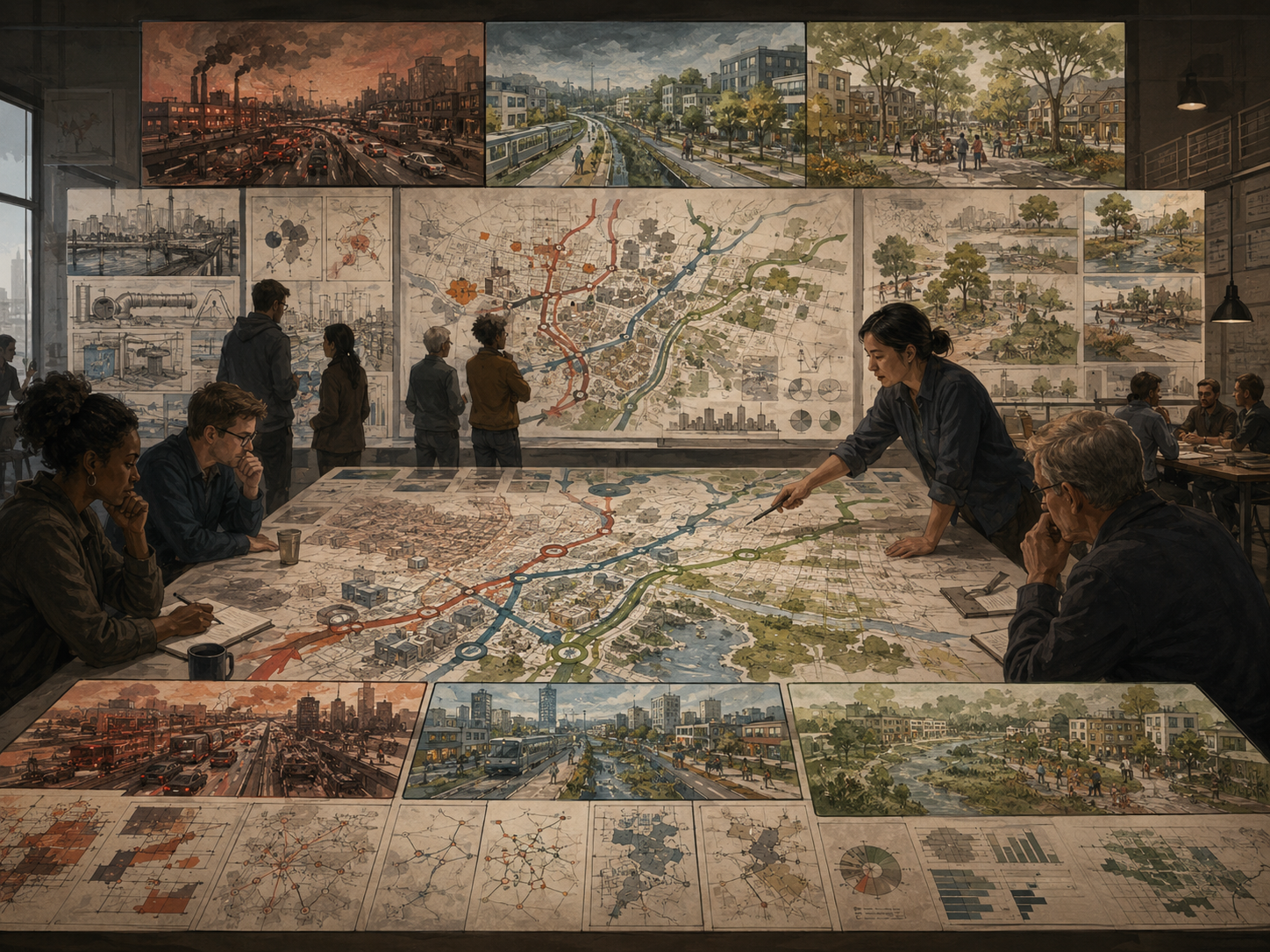
Cities are among the most important laboratories of long-term transformation because they concentrate both capacity and risk. They can accelerate innovation, social mobility, cultural exchange, and ecological transition, but they can also deepen inequality, intensify exposure, lock in carbon-intensive patterns, financialize basic needs, and transfer risk onto marginalized communities. Urban futures therefore require both technical systems analysis and morally serious attention to power, justice, and institutional responsibility.
Cities as Layered and Interdependent Systems
Urban systems can be understood as layered structures composed of interacting subsystems: physical infrastructure, housing markets, mobility networks, digital systems, population systems, environmental systems, institutional systems, public finance, land governance, and capital systems. This aligns directly with Systems Modeling, where behavior emerges from interaction among components rather than from isolated variables.
Crucially, these layers are not independent. Infrastructure shapes access to employment and services. Migration reshapes housing and service demand. Climate stress alters infrastructure performance. Governance determines whether systems adapt intelligently or drift into fragmentation. Capital allocation influences land use, affordability, investment geography, tax capacity, and the unequal distribution of risk. Digital systems increasingly mediate the relationship between residents and public services. Public finance determines whether maintenance, adaptation, and social protection are funded before crisis.
Urban futures are therefore determined not by one subsystem, but by how these layers interact over time. A city may appear prosperous in one layer and fragile in another. A digitally efficient city may still be fiscally weak or ecologically exposed. A rapidly growing city may still suffer from deep infrastructural deficits or governance fragmentation. A wealthy city may be highly unequal, spatially segregated, carbon-intensive, and vulnerable to climate shocks.
| Urban Layer | Core Function | Future Risk if Mismanaged |
|---|---|---|
| Physical infrastructure | Water, energy, transport, waste, buildings, communications, public facilities. | Maintenance backlog, cascade failure, service disruption, climate exposure. |
| Housing and land | Shelter, property, neighborhood structure, affordability, spatial access. | Displacement, speculation, segregation, homelessness, political conflict. |
| Mobility systems | Movement of people, goods, labor, services, and emergency response. | Congestion, exclusion, emissions, labor-market friction, isolation. |
| Digital systems | Data, platforms, sensors, service delivery, public administration, coordination. | Surveillance, cyber risk, vendor lock-in, algorithmic inequality, dependency. |
| Population systems | Migration, demographics, households, labor force, social networks. | Service overload, aging stress, social fragmentation, integration failure. |
| Environmental systems | Heat, water, air, biodiversity, soil, floodplains, urban ecology. | Climate stress, ecological decline, public health burden, infrastructure damage. |
| Governance systems | Decision-making, regulation, coordination, participation, accountability. | Fragmentation, capture, delay, policy contradiction, legitimacy loss. |
| Capital systems | Investment, municipal finance, real estate, debt, insurance, development flows. | Speculation, unequal investment, fiscal fragility, public value leakage. |
Cities must be read as stacked, interacting systems rather than as single planning objects. The future of a city is not only its skyline, population, or technology base. It is the pattern of relationships among infrastructure, land, people, money, ecology, governance, and time.
Cities as Complex Adaptive Systems
Cities are complex adaptive systems because they continuously reorganize in response to internal and external pressures. They contain many actors—governments, households, firms, utilities, developers, migrants, landlords, financial institutions, transit agencies, community organizations, informal networks, universities, hospitals, and platform companies—whose decisions interact without complete central coordination. These interactions produce emergent urban outcomes that no single actor fully designs or controls.
Urban systems display familiar characteristics of complexity: feedback loops, nonlinearity, emergence, adaptation, path dependence, and unintended consequences. Growth attracts investment. Investment attracts more growth. Rising demand increases land values. Rising land values change social composition. Altered social composition changes political incentives. Infrastructure expansion changes accessibility, which changes development patterns, which changes travel demand, which changes fiscal pressure, which changes infrastructure priorities.
Small interventions can generate large outcomes, while large interventions can have unexpectedly weak effects if they fail to alter structural relationships. A new transit line may reduce car dependence or accelerate displacement depending on housing policy, zoning, land ownership, public finance, and anti-displacement protections. A smart-city platform may improve service coordination or deepen surveillance and privatized governance depending on procurement, accountability, and data rights.
| Complexity Feature | Urban Meaning | Futures Thinking Implication |
|---|---|---|
| Feedback loops | Land values, investment, mobility, services, and political incentives reinforce one another. | Urban strategy must identify reinforcing and balancing loops. |
| Nonlinearity | Small changes can produce disproportionate effects under certain conditions. | Planning should include threshold and stress testing. |
| Emergence | Neighborhood change, congestion, informality, innovation, and segregation emerge from many interactions. | Formal plans must account for distributed behavior. |
| Adaptation | Residents, firms, institutions, and informal systems adjust around constraints. | Policy must anticipate response behavior and unintended consequences. |
| Path dependence | Past infrastructure, zoning, segregation, debt, and land ownership shape future options. | Long-term urban change requires lock-in analysis. |
| Heterogeneity | Different neighborhoods experience the same policy differently. | Aggregate metrics must be paired with distributional analysis. |
This matters because urban planning cannot be reduced to top-down design. Formal plans matter, but so do informal adaptation, private incentives, institutional fragmentation, social networks, ecological feedback, and distributed responses. Futures thinking is valuable here because it accommodates uncertainty and interaction effects better than linear projection models.
Infrastructure Systems and Path Dependency
Infrastructure forms the physical backbone of cities, enabling mobility, energy distribution, water access, waste processing, communications, public safety, health systems, education, economic exchange, and social coordination. Yet infrastructure also introduces powerful path dependency. It is expensive, long-lived, politically embedded, technically specialized, and slow to change. Once built, it channels future development into specific forms.
Urban futures are heavily shaped by decisions made decades earlier. Roads shape land use and commuting patterns. Transit systems alter accessibility and density. Water and sewer networks determine where intensive settlement is viable. Energy systems influence building form, industrial clustering, emissions, and resilience capacity. Broadband infrastructure shapes digital participation and economic opportunity. Flood control shapes settlement patterns while sometimes creating false security.
Infrastructure is therefore not merely reactive to urban growth; it actively organizes the future geography of the city. It determines which neighborhoods become accessible, which land becomes valuable, which communities receive services, which systems are exposed to failure, and which forms of mobility, energy, and housing become normalized.
| Infrastructure System | Future-Shaping Effect | Path-Dependency Risk |
|---|---|---|
| Road networks | Shape commuting, freight, land use, emissions, and suburban expansion. | Car dependence, sprawl, congestion, high maintenance burden. |
| Public transit | Shapes accessibility, density, labor access, and low-carbon mobility. | Underfunding, displacement near stations, uneven service geography. |
| Water and sewer | Determine development capacity, public health, flood resilience, and environmental quality. | Aging systems, contamination, combined sewer overflows, water stress. |
| Energy systems | Support buildings, industry, data infrastructure, transport, and emergency services. | Grid fragility, fossil lock-in, unequal reliability, climate vulnerability. |
| Digital infrastructure | Enables service delivery, remote work, education, commerce, and data systems. | Digital exclusion, cyber risk, platform dependency, privatized control. |
| Public facilities | Anchor schools, libraries, clinics, emergency response, civic life, and care systems. | Unequal investment, service deserts, weak social infrastructure. |
Infrastructure systems are also interdependent. Power outages disrupt communications and transport. Transport disruption alters labor access and logistics. Water system failures affect public health and political stability. Telecom disruption weakens emergency response. Hospitals depend on energy, water, supply chains, labor mobility, and digital systems. This is why urban infrastructure should be judged not only by efficiency, but by redundancy, modularity, recoverability, flexibility, and justice under altered future conditions. This connects directly to Resilience Thinking.
Urban Risk and Cascade Failure Dynamics
Cities concentrate risk as well as opportunity. Because density and interdependence are high, urban systems are especially vulnerable to cascade failure. Climate events overwhelm infrastructure. Infrastructure failure disrupts economic systems. Economic disruption fuels social instability. Social instability weakens governance response. A transit outage can become a labor-market disruption. A flood can become a housing crisis. A cyberattack can become a public safety event. A heat wave can become a public health, energy, labor, and mortality crisis.
Small shocks can produce disproportionate outcomes when systems are tightly coupled. Urban futures must therefore be designed with attention to thresholds, failure propagation pathways, cross-sector dependence, redundancy, recoverability, and social vulnerability. This is where deep urban foresight differs from conventional planning. It asks not merely how to improve normal performance, but how to prevent one disrupted subsystem from destabilizing the wider urban organism.
| Initial Shock | Cascade Pathway | Potential Systemic Outcome |
|---|---|---|
| Extreme heat | Energy demand rises, grid stress increases, health systems surge, outdoor labor becomes unsafe. | Mortality, service disruption, worker vulnerability, political pressure. |
| Flooding | Transit disruption, housing damage, wastewater overflow, business interruption, insurance stress. | Displacement, fiscal burden, public health risk, neighborhood decline. |
| Power outage | Traffic signals fail, elevators stop, cooling fails, telecom weakens, hospitals rely on backup systems. | Public safety crisis and cascading infrastructure failure. |
| Cyberattack | Payment, utilities, traffic, records, emergency response, or service platforms are disrupted. | Operational paralysis and public trust decline. |
| Housing shock | Rent burden rises, displacement increases, homelessness grows, school stability weakens. | Social fragmentation and public service strain. |
| Transit breakdown | Workers cannot reach jobs, logistics slow, care access declines, congestion rises. | Economic loss and unequal mobility exclusion. |
Urban risk analysis should therefore examine how systems fail together, not only how single assets fail separately. A bridge, grid node, data center, hospital, tunnel, transit line, pumping station, or housing district may be more important because of what depends on it than because of its isolated replacement cost.
Urban Metabolism and Resource Flow Systems
Cities can also be understood as metabolic systems that consume, transform, distribute, and externalize energy, water, materials, labor, food, data, capital, and waste. The concept of urban metabolism captures the fact that cities are open systems dependent on continuous flows rather than self-contained units.
Energy flows support buildings, mobility, industry, communications, and care systems. Water sustains population and economic activity. Material flows enable construction and maintenance. Waste systems determine ecological pressure and public health outcomes. Food systems link urban stability to regional and global supply chains. Labor flows sustain services, logistics, education, healthcare, construction, and governance. Data flows increasingly mediate urban coordination, surveillance, commerce, and service delivery.
Cities are open systems that depend on external inputs and externalized outputs. Their apparent local stability often depends on distant infrastructures, regional ecosystems, national grids, logistics networks, agricultural systems, watersheds, extraction zones, and global supply chains. Urban futures are therefore inseparable from planetary and regional constraints. This connects directly to Futures Thinking and Sustainability.
| Urban Flow | Function | Future Constraint |
|---|---|---|
| Energy | Buildings, transit, industry, digital systems, health, cooling, emergency response. | Grid stress, decarbonization, affordability, reliability, climate extremes. |
| Water | Drinking water, sanitation, industry, cooling, public health, ecosystems. | Drought, flooding, contamination, aging infrastructure, unequal access. |
| Food | Nutrition, logistics, retail, public health, regional agriculture. | Supply-chain disruption, food deserts, climate impacts, affordability. |
| Materials | Construction, repair, infrastructure, housing, manufacturing, waste cycles. | Embodied carbon, extraction, landfill burden, circularity gaps. |
| Labor | Care, logistics, services, governance, construction, maintenance, informal work. | Housing affordability, commuting burden, precarity, demographic change. |
| Waste | Sanitation, recycling, landfill, pollution control, circular material systems. | Environmental injustice, contamination, methane, material inefficiency. |
| Data | Coordination, public services, platforms, sensors, AI, emergency response. | Privacy, exclusion, cyber risk, vendor lock-in, algorithmic governance. |
Urban metabolism is also political. Some neighborhoods receive cleaner flows and better services; others receive pollution, waste facilities, truck traffic, flooding, heat, and infrastructural neglect. A serious urban futures analysis must therefore ask not only how resources move, but who benefits from them, who controls them, and who absorbs their externalities.
Network Topology and Urban Form
Urban systems are networks. Roads, rail, utilities, service corridors, broadband, stormwater systems, energy grids, logistics platforms, social networks, and institutional relationships form topologies that shape movement, density, service access, exposure, and development intensity. The structure of these networks affects not only flow efficiency but also the geography of opportunity and vulnerability.
Centralized systems often increase efficiency but also concentrate risk. Distributed systems may improve resilience but can be more expensive or less optimized. Highly connected systems can move people, goods, energy, and information quickly, but they can also propagate disruption rapidly. Segmented systems can contain some failures but also reproduce exclusion and spatial inequality.
Cities must balance efficiency with robustness. A transit-oriented city develops differently from a highway-oriented city. A city with distributed energy systems has different resilience properties from one dependent on a small number of centralized assets. Digital networks reshape labor patterns, commercial geography, public service delivery, and emergency coordination. The structure of the network determines who can reach jobs, who is excluded, where development clusters, and how shocks propagate.
| Network Pattern | Urban Advantage | Urban Risk |
|---|---|---|
| Centralized hub-and-spoke | Efficient coordination and high-capacity flows. | Critical hub failure can disrupt the whole system. |
| Distributed network | Greater redundancy and local resilience. | Higher coordination cost and uneven standards. |
| Highly connected network | Fast access and strong integration. | Rapid cascade failure and congestion propagation. |
| Segmented network | Can contain some disruptions locally. | May deepen inequality and reduce citywide opportunity. |
| Platform-mediated network | Dynamic allocation of transport, delivery, services, and labor. | Private governance, data extraction, labor precarity, algorithmic exclusion. |
Urban futures therefore depend not only on what networks exist, but on how they are configured, governed, maintained, financed, and made accountable to public needs.
Smart Cities and Digital Governance
Digital systems increasingly form a second layer atop physical infrastructure. Sensor networks, AI-assisted traffic systems, automated utilities, digital governance platforms, urban dashboards, predictive policing tools, online permitting, platform labor systems, smart meters, and algorithmic service allocation all change the operational logic of cities. This produces gains in coordination, speed, measurement, and visibility, but it also introduces new dependencies and forms of power.
Urban systems now operate through a dual architecture: physical infrastructure and digital control systems. Failures can propagate across both layers, increasing systemic complexity. A traffic platform, emergency communication system, utility control network, payment platform, or data vendor can become part of the operational nervous system of the city. This connects directly to Technology Foresight.
A city can become “smarter” while becoming less democratic, more surveilled, more opaque, or more dependent on private platforms. Digital urbanism is not a neutral upgrade. It is a governance choice embedded in power structures.
| Digital Urban System | Potential Value | Governance Risk |
|---|---|---|
| Urban sensors | Real-time monitoring of traffic, air quality, water, infrastructure, and public space. | Surveillance, data bias, uneven monitoring, consent gaps. |
| AI-assisted operations | Optimization of traffic, energy, emergency response, maintenance, and service delivery. | Opaque decision-making, automation bias, exclusion, accountability gaps. |
| Digital service platforms | Faster access to permits, benefits, reporting, and public information. | Digital divide, usability barriers, privatized infrastructure. |
| Predictive analytics | Early detection of infrastructure risk, service demand, and environmental stress. | False precision, biased data, punitive targeting, weak explainability. |
| Platform mobility and delivery | Flexible transport, logistics, and labor coordination. | Congestion, labor precarity, curb conflicts, private control of public space. |
| Cyber-physical utilities | More efficient energy, water, waste, and building management. | Cyberattack, vendor lock-in, cascading operational failure. |
Future-ready cities should treat digital systems as public-interest infrastructure subject to transparency, security, accountability, interoperability, civil rights protections, and democratic oversight. The question is not whether cities use technology, but whether technology strengthens public capacity or transfers urban governance into opaque technical systems.
Migration and Urban System Pressure
Cities function as hubs in regional and global migration systems. Migration is driven by economic opportunity, conflict, ecological pressure, regional inequality, education, family networks, housing markets, labor demand, and political instability. This connects directly to Geopolitical Futures, Climate Futures and Environmental Change, and Economic Futures and Global Development.
Migration introduces both dynamism and stress. It can increase labor supply, entrepreneurship, cultural vitality, demographic renewal, tax base, and innovation. It can also intensify pressure on housing, schools, healthcare, language services, public space, transportation, sanitation, and informal support systems. The systemic question is not whether migration is “good” or “bad,” but whether urban systems are institutionally and physically capable of absorbing population shocks while preserving cohesion, service capacity, rights, and dignity.
Cities must absorb population change while maintaining system stability. Migration is not merely a demographic variable. It reshapes labor markets, fiscal capacity, spatial demand, public sentiment, social cohesion, and long-term urban form.
| Migration Pressure | Urban System Affected | Future Governance Question |
|---|---|---|
| Rapid population growth | Housing, transit, schools, water, sanitation, healthcare, public administration. | Can services scale without informal exclusion or social conflict? |
| Climate displacement | Emergency shelter, labor markets, public health, housing, regional planning. | Are cities preparing for mobility as adaptation, not only crisis? |
| International migration | Language services, rights, employment, integration, schooling, community networks. | Are newcomers included as residents with dignity and access? |
| Internal rural-urban migration | Informal settlements, labor markets, transport, infrastructure expansion. | Can formal systems keep pace with actual settlement patterns? |
| Aging and demographic change | Care systems, housing design, mobility, healthcare, public finance. | Can the city support intergenerational wellbeing? |
| Displacement within the city | Neighborhood stability, schools, social networks, commute burdens. | Can development avoid pushing vulnerable residents out? |
Urban migration futures should be approached through capability rather than fear: housing capacity, public services, rights protection, labor integration, community institutions, and regional coordination determine whether migration becomes a source of renewal or unmanaged stress.
Informality and Parallel Urban Systems
Formal planning frameworks rarely capture the full reality of urban systems. In many rapidly urbanizing contexts, informal systems play a central role in housing, labor, transit, service provision, childcare, waste management, street commerce, mutual aid, repair, and social protection. Informal settlements, unregulated labor markets, community service networks, and self-organized survival systems are not anomalies. They are often adaptive responses to the limits of formal institutions.
Urban resilience often depends on systems that operate outside formal governance structures. Ignoring informality produces incomplete and often misleading models of urban futures. In many cities, the future will be shaped not by master plans alone, but by hybrid interaction between formal and informal systems.
Informality is not romantic. It can involve exploitation, insecurity, unsafe housing, weak labor protection, lack of tenure, and exposure to violence or eviction. But it is also a form of practical urban intelligence: people build shelter, livelihoods, mobility, care networks, and service systems where formal provision fails. A serious urban analysis must therefore include shadow systems, unofficial adaptation, and parallel urban logics—not just official infrastructure and policy architecture.
| Informal System | Adaptive Function | Risk if Ignored or Criminalized |
|---|---|---|
| Informal housing | Provides shelter where formal housing is unaffordable or unavailable. | Eviction, unsafe conditions, exclusion from infrastructure investment. |
| Informal transit | Fills mobility gaps left by formal networks. | Regulatory conflict, safety risk, exclusion from planning models. |
| Street commerce | Supports livelihoods, food access, and neighborhood vitality. | Displacement, enforcement abuse, loss of local economic resilience. |
| Mutual aid networks | Provide care, information, emergency support, and social protection. | Underestimation of community capacity and crisis response. |
| Informal repair and reuse | Maintains goods, equipment, housing, and local systems with limited resources. | Missed circular economy and resilience capacity. |
| Shadow service provision | Creates workarounds for water, energy, waste, and communication gaps. | Unsafe systems persist when formal institutions fail to upgrade access. |
Urban futures require formal recognition without exploitative absorption. The goal is not to erase informal systems, but to understand where they reveal unmet need, institutional failure, and community capacity that should inform future planning.
Climate Stress and Environmental Constraints
Cities are highly exposed to climate risk. Urban climate stress includes heat islands, flooding, sea-level rise, water stress, wildfire smoke, air pollution, ecological degradation, stormwater overload, energy demand spikes, and infrastructure performance decline under more volatile environmental conditions. Climate acts not as an external variable but as a system-level constraint on urban development.
These pressures interact with infrastructure, finance, housing, labor, insurance, health, emergency response, and population systems, amplifying risk across layers. Climate risk is also spatially unequal. Low-income neighborhoods often have less green cover, older infrastructure, weaker services, greater industrial exposure, less insurance access, and higher flood or heat risk. Urban climate futures are therefore inseparable from inequality.
Urban futures must be assessed not only in terms of aggregate resilience, but in terms of differentiated vulnerability across neighborhoods, classes, and social groups. Climate stress is not only environmental. It is infrastructural, fiscal, political, and social.
| Urban Climate Stress | System Interaction | Unequal Impact |
|---|---|---|
| Extreme heat | Energy demand, public health, labor safety, tree cover, housing quality. | Older adults, outdoor workers, renters, unhoused people, low-canopy neighborhoods. |
| Flooding | Stormwater, transit, housing, insurance, public health, business continuity. | Basement apartments, informal settlements, low-income floodplains, uninsured households. |
| Water stress | Supply, sanitation, industry, public health, regional ecosystems. | Informal areas, poor households, peripheral settlements, climate-exposed regions. |
| Air pollution and smoke | Transport, industry, wildfire, public health, school and work disruption. | Children, elderly residents, people with respiratory illness, polluted neighborhoods. |
| Sea-level rise | Coastal infrastructure, housing, ports, wastewater, insurance, public finance. | Low-income coastal communities and workers tied to exposed economies. |
| Ecological degradation | Heat, biodiversity, stormwater, recreation, mental health, food systems. | Communities lacking parks, wetlands, tree cover, and environmental protection. |
Climate-ready cities need mitigation, adaptation, public health planning, green infrastructure, managed retreat where unavoidable, affordable resilient housing, energy reliability, cooling access, watershed governance, and environmental justice. Without justice, urban climate adaptation can protect wealth while abandoning vulnerability.
The Political Economy of Cities
Urban systems are shaped by power, incentives, and resource allocation. Questions of who controls land, who directs infrastructure investment, which populations receive services, how value is captured, how debt is structured, and whose neighborhoods are protected are central to the future of cities. Urban development is never purely technical. It is political and economic.
Cities do not simply “grow.” They are built through contestation over land use, zoning, taxation, development rights, public spending, infrastructure access, policing, environmental regulation, and public finance. This is why serious urban analysis must ask not only whether a city is efficient or innovative, but efficient for whom, resilient for which neighborhoods, and sustainable under what distribution of benefit and burden.
Urban futures are shaped by political economy: the institutions and interests that decide who gets infrastructure, who bears risk, and who captures value from transformation.
| Political-Economy Force | Urban Effect | Futures Question |
|---|---|---|
| Land ownership | Shapes development rights, displacement, speculation, and public value capture. | Is land governed as shelter, infrastructure, commons, asset class, or extraction site? |
| Zoning and regulation | Determines density, segregation, land use, housing supply, and environmental exposure. | Do rules reproduce exclusion or support equitable adaptation? |
| Public finance | Funds infrastructure, schools, transit, utilities, adaptation, and public services. | Can the city invest before crisis rather than repair after damage? |
| Real estate capital | Channels investment, speculation, redevelopment, and displacement pressure. | Does development serve residents or primarily asset appreciation? |
| Labor markets | Shape commuting, wages, care systems, service provision, and inequality. | Can workers afford to live in the city they sustain? |
| Institutional capture | Concentrated interests shape policy, procurement, land use, and infrastructure. | Who has voice in decisions that define the urban future? |
Urban futures become more realistic when they treat planning, design, technology, and sustainability as embedded in power relations. A city’s future is not just what it can build; it is what its institutions choose to protect, value, and fund.
Urban Finance, Capital Flows, and Speculative Dynamics
Urban development is shaped by financial systems as much as by spatial planning. Capital flows determine which districts receive investment, how infrastructure is funded, how housing markets behave, and whether land is used for shelter, speculation, or extraction. Real estate cycles, municipal debt, tax increment financing, sovereign investment, private equity, infrastructure funds, insurance markets, and speculative capital all shape the material form of cities.
Cities are shaped by capital allocation, not purely by planning objectives. Housing can function simultaneously as shelter, asset class, and speculative vehicle. That changes the future of affordability, density, displacement, and social cohesion. Financialization can disconnect development from social need, producing impressive skylines alongside worsening exclusion, vacancy, rent burden, or public underinvestment.
| Finance Mechanism | Urban Function | Future Risk |
|---|---|---|
| Municipal bonds and public debt | Finance infrastructure, schools, utilities, and public facilities. | Debt service can crowd out maintenance, adaptation, and social investment. |
| Real estate investment | Funds housing, commercial districts, redevelopment, and land transformation. | Speculation, displacement, vacancy, affordability crisis. |
| Infrastructure finance | Builds or upgrades transport, energy, water, and digital systems. | Public-private risk transfer, user fees, privatized governance. |
| Insurance markets | Price risk and enable property finance. | Climate exposure can create coverage retreat and property devaluation. |
| Tax base dependency | Links municipal capacity to property values and economic activity. | Unequal service levels and vulnerability to downturns. |
| Platform capital | Funds delivery, mobility, logistics, housing platforms, and digital services. | Labor precarity, data extraction, congestion, public-space conflict. |
Urban futures depend in part on whether cities are governed as places to live, platforms for accumulation, or unstable hybrids attempting to reconcile both. Financial foresight must therefore be part of urban foresight. A city cannot plan seriously for housing, infrastructure, climate adaptation, or public services without understanding the capital systems shaping those outcomes.
Urban Inequality, Fragmentation, and Social Cohesion
Urban systems often reflect and intensify inequality. This includes unequal access to housing, mobility, education, utilities, digital systems, environmental safety, healthcare, public space, cultural institutions, parks, broadband, and political influence. Spatial segregation can turn one city into multiple urban realities, each with different forms of resilience, exposure, and institutional trust.
In one part of the city, resilience may mean insurance coverage, backup power, high-capacity transit, private security, high-quality schools, and digital access. In another, it may mean informal solidarity, improvisation, mutual aid, and survival in the absence of state support. That divergence matters because fragmentation can make cities more productive in narrow metrics while eroding the social foundations of long-term stability.
A city that expands while deepening fragmentation may become more dynamic in the short term and more unstable in the long term. Urban futures must therefore address not only growth and efficiency, but equity, dignity, public trust, and cohesion.
| Inequality Domain | Urban Expression | Long-Term Risk |
|---|---|---|
| Housing inequality | Rent burden, displacement, homelessness, overcrowding, segregation. | Instability, school disruption, health stress, political conflict. |
| Mobility inequality | Unequal transit access, long commutes, car dependence, unsafe streets. | Labor exclusion, time poverty, emissions, reduced opportunity. |
| Environmental inequality | Heat, pollution, flood exposure, low tree cover, poor air quality. | Higher mortality, illness, property loss, ecological injustice. |
| Digital inequality | Unequal broadband, platform access, digital literacy, data rights. | Exclusion from services, education, work, and civic participation. |
| Fiscal inequality | Uneven tax base, school funding, services, and infrastructure quality. | Self-reinforcing neighborhood divergence. |
| Political inequality | Unequal voice in zoning, policing, development, and infrastructure decisions. | Legitimacy loss and governance capture. |
Social cohesion is not a soft add-on. It is a resilience asset. Trust, shared institutions, inclusive public space, community networks, and fair service provision affect whether cities can navigate crisis without fragmentation or authoritarian control.
Temporal Dynamics and Conflicting Planning Horizons
Urban systems operate across conflicting time horizons: short-term political cycles, medium-term infrastructure and housing timelines, and long-term climate, demographic, ecological, technological, and fiscal change. These horizons rarely align. Politicians optimize for visible near-term gains. Developers optimize for return cycles. Utilities optimize for continuity. Residents face immediate housing and service needs. Climate adaptation may require decades of anticipation and front-loaded investment.
Urban futures are shaped by decisions made under misaligned temporal incentives. Many urban failures are therefore not failures of knowledge, but failures of temporal coordination. Cities often know what needs to be done long before they create the institutional conditions to do it.
| Planning Horizon | Typical Urban Logic | Risk |
|---|---|---|
| Election cycle | Visible delivery, announcements, short-term wins. | Maintenance, adaptation, and structural reform are delayed. |
| Development cycle | Project finance, permitting, construction, return on investment. | Private timing may override public need and long-term resilience. |
| Infrastructure lifecycle | Decades-long asset performance, maintenance, replacement, lock-in. | Poor decisions persist across generations. |
| Climate horizon | Slow-onset risk, thresholds, cumulative emissions, adaptation needs. | Visible damage arrives after choices have narrowed. |
| Community horizon | Intergenerational stability, cultural continuity, neighborhood belonging. | Redevelopment can destroy social infrastructure. |
| Fiscal horizon | Debt service, tax base, pension obligations, maintenance backlog. | Short-term balancing can create long-term fragility. |
Urban futures require institutions capable of governing across time. Backcasting, long-range capital planning, climate adaptation pathways, maintenance accounting, intergenerational budgeting, and public participation can help align short-term decisions with long-term viability.
Governance and Urban Decision-Making
Urban futures are shaped by governance systems spanning local, regional, national, and sometimes international institutions. Major challenges include coordination across levels of government, alignment between land use and infrastructure, management of competing stakeholder interests, integration of environmental and fiscal policy, and accountability for digital and private-sector systems.
Urban transformation depends not only on technical solutions, but on governance capacity and institutional alignment. Many cities fail not because solutions are unknown, but because responsibility is fragmented. The agency responsible for transit may not control land use. The city may not control the tax base. Climate adaptation may fall between jurisdictions. Housing policy may be constrained by state law. Digital systems may be privately procured while public accountability remains weak.
| Governance Challenge | Urban Consequence | Future-Oriented Response |
|---|---|---|
| Jurisdictional fragmentation | Transit, housing, climate, water, schools, and land use are governed separately. | Regional coordination and cross-sector planning authority. |
| Fiscal constraint | Maintenance, adaptation, public services, and social infrastructure are underfunded. | Long-term public finance strategy and equitable revenue tools. |
| Stakeholder conflict | Development, preservation, affordability, environment, and growth collide. | Participatory planning and transparent tradeoff analysis. |
| Institutional capture | Concentrated interests shape land use, procurement, and investment. | Public accountability, disclosure, and value-capture mechanisms. |
| Implementation gap | Plans are written but not funded, enforced, or monitored. | Milestones, budgets, responsibilities, and evaluation systems. |
| Data governance weakness | Digital systems operate without public oversight. | Data rights, audits, cybersecurity, interoperability, and democratic control. |
Urban futures are therefore governance problems as much as design problems. The central issue is not whether cities can imagine better futures, but whether institutions can coordinate action, fund priorities, learn from feedback, and remain accountable to residents.
Governance Failure Modes
Urban governance systems face recurring failure modes: fragmentation across jurisdictions, misalignment between policy and system behavior, reactive crisis management replacing long-range planning, and capture by concentrated interests. These failures can produce systemic inefficiency and amplify vulnerability to shocks that were manageable in principle.
This matters especially in cities facing simultaneous pressures from climate adaptation, digital transformation, migration, housing stress, fiscal stress, ecological constraint, and declining public trust. Governance failure is often the mechanism through which manageable risk becomes systemic crisis. A city rarely collapses because one variable changed. It fails because institutions cannot coordinate across interacting pressures.
| Failure Mode | Pattern | Long-Term Damage |
|---|---|---|
| Fragmentation | Multiple agencies and jurisdictions manage connected systems separately. | Contradictory policies and unmanaged cross-sector risk. |
| Reactive crisis governance | Institutions respond after damage rather than preparing before disruption. | Higher costs, preventable harm, and eroded trust. |
| Maintenance neglect | Visible new projects are prioritized over repair and lifecycle management. | Aging infrastructure and sudden service failure. |
| Planning without implementation | Strategies lack budget, authority, metrics, or enforcement. | Scenario theater and policy credibility loss. |
| Capture | Land, procurement, and infrastructure decisions favor concentrated interests. | Public value leakage and unequal urban futures. |
| Participation failure | Communities are consulted symbolically but not empowered materially. | Resistance, distrust, and unjust transition. |
Future-ready governance requires more than better plans. It requires institutional capacity, public trust, credible financing, transparent decision rules, cross-sector coordination, monitoring, accountability, and meaningful resident participation.
Comparative Urban Systems and Development Pathways
Urban futures differ significantly across regions and development pathways. In many high-income urban systems, infrastructure is established but aging, growth is slower, and digital systems are layered onto legacy networks. In many rapidly urbanizing regions, population growth outpaces formal planning, infrastructure lags demand, and informality is central rather than peripheral. In climate-exposed coastal cities, adaptation, insurance, ports, stormwater, housing, and public finance become central. In shrinking or post-industrial cities, vacancy, fiscal stress, legacy infrastructure, and economic transition dominate the future agenda.
Universal urban models often obscure more than they reveal. The future of Lagos is not the future of Copenhagen. The future of Phoenix is not the future of Jakarta. The future of Detroit is not the future of Singapore. Comparative analysis is essential because identical global pressures generate different outcomes depending on material and institutional context.
| Urban Pathway | Typical Conditions | Futures Priority |
|---|---|---|
| Legacy industrial metropolis | Aging infrastructure, economic transition, fiscal constraints, entrenched inequality. | Repair, reuse, equitable redevelopment, climate adaptation, institutional trust. |
| High-growth emerging megacity | Rapid population growth, informal systems, infrastructure deficit, service pressure. | Inclusive infrastructure, housing, sanitation, transport, governance capacity. |
| Climate-stressed coastal city | Flooding, sea-level rise, insurance stress, port exposure, stormwater risk. | Adaptation, managed retreat where needed, public finance, ecological buffers. |
| Digitally integrated global city | High capital flows, platform systems, inequality, data governance challenges. | Accountable digital systems, affordability, public value capture, cyber resilience. |
| Resource-constrained inland city | Water stress, heat, energy demand, growth pressure, land-use conflict. | Water governance, cooling, ecological design, demand management. |
| Shrinking or slow-growth city | Population loss, vacancy, fiscal stress, overbuilt infrastructure. | Right-sizing, repair, social infrastructure, ecological reuse, fiscal stabilization. |
Comparative urban futures analysis should avoid both universal optimism and universal decline. Cities are different systems with different histories, capacities, constraints, and political economies. Serious foresight begins with that specificity.
Urban Futures as Adaptive vs Extractive Systems
One useful distinction is between adaptive and extractive urban systems. Adaptive systems reinvest in resilience, public goods, redundancy, coordination, maintenance, ecological repair, affordability, and long-term capacity. Extractive systems prioritize short-term value extraction, defer maintenance, underinvest in resilience, financialize basic needs, and shift risk onto vulnerable populations.
This distinction clarifies why cities with similar resources can have radically different futures. The key issue is not only capacity, but the logic of system management. Does the city organize itself to reproduce long-term viability, or to extract short-term gain while externalizing long-term risk?
| Urban Logic | Adaptive City | Extractive City |
|---|---|---|
| Housing | Treated as shelter, stability, and public-interest infrastructure. | Treated mainly as speculative asset and rent stream. |
| Infrastructure | Maintained, upgraded, made redundant, and climate-adapted. | Deferred until failure, privatized, or unevenly protected. |
| Land value | Partly captured for public benefit and community stability. | Privatized through speculation and displacement. |
| Digital systems | Governed as accountable public-interest infrastructure. | Used for surveillance, vendor dependency, or platform extraction. |
| Climate adaptation | Prioritizes vulnerability reduction and ecological repair. | Protects high-value assets while abandoning low-power communities. |
| Governance | Participatory, coordinated, transparent, and learning-oriented. | Fragmented, captured, reactive, and legitimacy-poor. |
| Finance | Funds long-term capacity, resilience, maintenance, and public goods. | Rewards short-term returns while socializing risk. |
Urban futures are therefore shaped not only by what cities have, but by what they are optimized to do. Adaptive urbanism builds capacity before crisis. Extractive urbanism monetizes the city while leaving residents to absorb the consequences.
Core Dimensions of Urban Futures
Urban futures can be evaluated across several interacting dimensions. These dimensions should not be treated separately. Infrastructure capacity affects housing and mobility. Housing affects labor markets and public health. Climate exposure affects public finance and insurance. Digital systems affect governance and access. Inequality affects resilience. Public finance affects maintenance, adaptation, and social infrastructure. A strong urban future is not merely large, smart, wealthy, or efficient. It is adaptive, inclusive, resilient, ecologically responsible, and publicly accountable.
1. Infrastructure Capacity
Infrastructure capacity refers to the ability of water, energy, transport, waste, housing, communications, health, education, and public facilities to support urban life under normal and stressed conditions.
2. Housing and Land Justice
Housing and land justice assess whether land and housing systems support shelter, stability, affordability, dignity, and access—or whether they intensify speculation, displacement, segregation, and extraction.
3. Mobility and Access
Mobility and access concern whether residents can reach work, school, healthcare, food, public space, care networks, and civic life safely, affordably, and sustainably.
4. Climate and Ecological Resilience
Climate and ecological resilience include heat mitigation, flood protection, water security, air quality, green infrastructure, biodiversity, watershed health, and environmental justice.
5. Digital and Data Governance
Digital and data governance evaluate whether smart systems, AI, sensors, platforms, and public-service technologies are secure, accountable, interoperable, inclusive, and rights-protective.
6. Public Finance and Maintenance
Public finance and maintenance determine whether cities can fund infrastructure, services, adaptation, social protection, repair, and long-term public goods without falling into fiscal fragility.
7. Governance and Participation
Governance and participation include institutional coordination, democratic legitimacy, transparency, public voice, anti-capture safeguards, and the ability to learn and revise policy over time.
8. Social Cohesion and Vulnerability Reduction
Social cohesion and vulnerability reduction concern whether urban systems protect marginalized groups, strengthen community networks, reduce unequal exposure, and build shared capacity under stress.
| Dimension | Core Question | Failure if Ignored |
|---|---|---|
| Infrastructure capacity | Can essential systems function under growth and stress? | Service failure, cascade risk, maintenance collapse. |
| Housing and land justice | Does the city provide stable shelter or reward displacement? | Segregation, homelessness, speculation, social instability. |
| Mobility and access | Can residents reach opportunity affordably and safely? | Exclusion, congestion, emissions, time poverty. |
| Climate resilience | Can the city withstand heat, flood, water stress, and ecological disruption? | Unequal climate harm and public finance crisis. |
| Digital governance | Do smart systems strengthen public capacity and rights? | Surveillance, cyber risk, platform dependency, algorithmic exclusion. |
| Public finance | Can the city fund maintenance, adaptation, and services? | Deferred repair, austerity, fragile infrastructure. |
| Governance | Can institutions coordinate, learn, and remain accountable? | Fragmentation, capture, delay, legitimacy loss. |
| Social cohesion | Are vulnerability and fragmentation reduced over time? | Distrust, instability, unequal resilience, civic breakdown. |
Urban futures are strongest when infrastructure, housing, mobility, climate adaptation, public finance, governance, digital systems, and social cohesion reinforce one another rather than being optimized separately.
Scenario Planning and Urban Transformation
Urban futures are uncertain and multidimensional. This connects directly to Scenario Planning. Scenario planning allows cities to explore alternative growth trajectories, climate pathways, migration pressures, technological adoption patterns, fiscal constraints, governance breakdowns, housing futures, and institutional successes.
Scenario planning helps distinguish among futures that are likely if present trajectories continue, futures that become possible under disruption, and futures that are preferable but require deliberate transition. Combined with Backcasting and Strategic Planning, urban futures can move from description to design.
The value of urban foresight lies not in forecasting one city future, but in designing strategies that remain viable across multiple futures while preserving room for adaptation.
| Urban Foresight Tool | Urban Use | Example Application |
|---|---|---|
| Scenario planning | Explores alternative urban futures under uncertainty. | Housing, migration, climate, fiscal, and technology futures. |
| Backcasting | Starts from a desired future city and works backward to present actions. | Planning a low-carbon, affordable, transit-rich, climate-resilient city. |
| Stress testing | Tests systems under severe but plausible disruptions. | Heat wave plus grid stress plus public health surge. |
| Systems mapping | Identifies feedbacks, dependencies, and unintended consequences. | Housing-transit-land-value-displacement dynamics. |
| Early warning | Tracks indicators of system stress before crisis. | Rent burden, flood claims, vacancy, service delays, heat mortality. |
| Participatory foresight | Includes residents and affected communities in future-making. | Neighborhood climate adaptation and anti-displacement planning. |
Urban futures work should be connected to budgets, land-use decisions, capital plans, infrastructure maintenance schedules, climate adaptation pathways, zoning reform, service delivery, and community accountability. Otherwise, foresight becomes scenario theater rather than governance capacity.
Urban Futures Scenarios
Urban futures can unfold across multiple plausible pathways. These scenarios are not predictions. They are structured contexts for testing assumptions about infrastructure, housing, climate, migration, technology, finance, governance, and social cohesion.
| Scenario | Description | Urban Risk | Strategic Opportunity |
|---|---|---|---|
| Adaptive Public City | The city invests in housing, transit, climate resilience, public services, digital accountability, and ecological repair. | Requires sustained finance, governance capacity, and public legitimacy. | Builds long-term resilience and shared urban capability. |
| Financialized Growth City | Real estate, platform capital, and speculative development dominate urban transformation. | Displacement, inequality, vacancy, public value leakage, and fragile tax dependency. | Value capture, affordability policy, public land governance, and anti-displacement tools. |
| Climate-Stressed Fragmented City | Heat, flood, infrastructure stress, and insurance pressure expose unequal vulnerability. | Unequal adaptation, fiscal strain, public health stress, and migration pressure. | Justice-centered adaptation, green infrastructure, public health resilience, and housing protection. |
| Smart but Opaque City | Digital platforms and AI expand across public services and infrastructure management. | Surveillance, vendor lock-in, cyber risk, algorithmic exclusion, weak public oversight. | Digital public infrastructure, data rights, transparency, audits, and democratic control. |
| Informal Adaptive City | Formal systems lag behind growth while informal networks provide housing, labor, transit, and services. | Unsafe conditions, exclusion, enforcement conflict, weak infrastructure access. | Recognition, upgrading, tenure security, participatory planning, and service integration. |
| Regional Resilience City | The city coordinates housing, transport, watersheds, food systems, energy, and economic development regionally. | Coordination complexity and jurisdictional conflict. | Stronger system-level resilience and reduced cross-border externalities. |
| Governance Breakdown City | Fiscal stress, fragmented authority, climate shocks, and declining trust overwhelm institutions. | Deferred maintenance, service failure, social instability, and emergency governance. | Institutional repair, fiscal stabilization, public trust rebuilding, and resilience investment. |
Scenario analysis reveals that urban futures are not only spatial futures. They are governance, finance, infrastructure, ecological, technological, and social futures.
Strategic Questions for Urban Futures
Urban futures analysis should guide strategic questions for planners, public officials, infrastructure agencies, researchers, community organizations, developers, utilities, transit agencies, public health systems, and residents. These questions reveal hidden assumptions about growth, governance, finance, climate exposure, technology, and justice.
| Strategic Question | What It Reveals | Why It Matters |
|---|---|---|
| What future does this urban plan assume? | Embedded assumptions about growth, climate, finance, migration, technology, and governance. | Plans fail when assumptions remain invisible. |
| Which systems are tightly coupled? | Dependencies among energy, water, transit, health, digital systems, and housing. | Coupling determines cascade failure risk. |
| Who benefits from urban transformation? | Distribution of land value, services, infrastructure, and public investment. | Urban growth can deepen inequality if value capture and protection are weak. |
| Who bears climate and infrastructure risk? | Neighborhood-level exposure, vulnerability, and adaptive capacity. | Aggregate resilience can hide unequal abandonment. |
| What is being locked in? | Infrastructure, zoning, debt, land use, emissions, technology, and displacement patterns. | Urban choices can shape decades of future constraint. |
| What should be made redundant? | Critical systems where efficiency alone creates fragility. | Redundancy supports resilience under disruption. |
| What public capacities are missing? | Finance, coordination, maintenance, data governance, participation, enforcement. | Good plans fail without institutions capable of implementation. |
| What early signals show urban stress is rising? | Rent burden, service delays, flood claims, heat illness, vacancy, debt pressure, distrust. | Early warning allows correction before crisis. |
Urban futures work is strongest when it connects technical systems, public finance, land politics, ecological constraint, and community wellbeing into one integrated field of decision-making.
Limitations and Failure Modes
Urban futures analysis has limits. Cities are complex, politically contested, data-rich but often poorly understood, and shaped by informal behavior that models can miss. Forecasts can overstate precision. Smart-city narratives can confuse measurement with wisdom. Sustainability plans can ignore displacement. Resilience plans can protect high-value assets while leaving vulnerable communities exposed. Scenario work can become detached from budgets, governance authority, and land-use power.
There is also the risk of aesthetic urbanism: judging cities by skylines, design renderings, innovation districts, or technology deployments rather than by housing stability, public health, ecological integrity, accessibility, care systems, democratic legitimacy, and the lived conditions of residents.
| Failure Mode | Problem | Corrective Practice |
|---|---|---|
| Smart-city solutionism | Technology is treated as a substitute for governance, equity, and maintenance. | Use public-interest data governance and rights-based digital systems. |
| Scenario theater | Future scenarios are created but not linked to budgets or decisions. | Connect foresight to capital planning, zoning, infrastructure, and accountability. |
| Growth bias | Urban success is measured mainly by development, population, or GDP. | Include affordability, health, resilience, justice, and ecological indicators. |
| Displacement blindness | Improvement strategies raise land values and push residents out. | Pair investment with anti-displacement, public land, and housing protections. |
| Infrastructure invisibility | Maintenance is ignored until failure occurs. | Use lifecycle accounting, preventive repair, and transparent infrastructure audits. |
| Aggregate resilience | Citywide metrics hide neighborhood-level vulnerability. | Use spatial equity and social vulnerability analysis. |
| Formalism | Official plans ignore informal systems and lived urban realities. | Recognize informal adaptation and community knowledge. |
| Depoliticized planning | Power, ownership, finance, and contestation are treated as secondary. | Analyze political economy and public value capture directly. |
The purpose of urban futures analysis is not to make cities look futuristic. It is to help cities become more livable, resilient, just, ecologically responsible, and institutionally capable under uncertainty.
Mathematical Lens: Urban Systems, Load, and Adaptive Capacity
Urban systems can be represented conceptually as interacting layers of demand, capacity, and adaptive response. A simple stylized form is:
U_t = I_t + G_t + C_t – L_t
\]
Interpretation: \(U_t\) is urban system viability at time \(t\), \(I_t\) is infrastructure support, \(G_t\) is governance capacity, \(C_t\) is community and coordination capacity, and \(L_t\) is accumulated system load or stress. Cities remain viable when adaptive and coordinative capacity exceeds stress concentration.
Cascade risk can be represented as:
L_{i,t+1} = L_{i,t} + \sum_{j \in N(i)} \alpha_{ij}D_{j,t}
\]
Interpretation: \(L_{i,t}\) is stress on subsystem \(i\), \(D_{j,t}\) is disruption in neighboring subsystem \(j\), and \(\alpha_{ij}\) is propagation intensity across the connection. This illustrates why localized breakdowns can propagate through interdependent urban systems.
An affordability-stability relationship can be represented as:
A_t = \frac{H_t}{Y_t}
\]
Interpretation: \(A_t\) is housing affordability burden, \(H_t\) is housing cost, and \(Y_t\) is household income. Rising affordability burden can reduce household stability, increase displacement, weaken labor access, and intensify social fragmentation.
A climate-adjusted urban resilience score can be represented as:
R^*_t = R_t – \theta V_t – \lambda X_t
\]
Interpretation: \(R^*_t\) is climate-adjusted urban resilience, \(R_t\) is baseline resilience capacity, \(V_t\) is social vulnerability, and \(X_t\) is climate exposure. A city with strong infrastructure but high inequality and exposure may be less resilient than aggregate indicators suggest.
A scenario-based planning view can be expressed as:
\Pi_k = \{V_{k1}, V_{k2}, \dots, V_{kn}\}
\]
Interpretation: \(\Pi_k\) is the performance profile of urban strategy \(k\) across multiple futures, and \(V_{ks}\) is strategy performance under scenario \(s\). The planning question is not which strategy is optimal under one forecast, but which remains viable across climate, migration, fiscal, technological, and governance variation.
These equations are conceptual tools. They are not complete predictive models. Their purpose is to make assumptions explicit: urban futures depend on infrastructure, governance, community capacity, system load, cascade risk, affordability, climate exposure, vulnerability, and strategic robustness across futures.
Computational Modeling for Urban Futures
Computational modeling can help compare urban futures, identify system stress, test scenarios, and make urban assumptions transparent. It should not be used to create false precision or hide political choices behind technical language. Its value lies in revealing interdependencies, comparing pathways, exposing distributional consequences, and linking strategy to measurable indicators.
A professional urban futures workflow may include:
- Urban system profiles: infrastructure strength, governance capacity, housing affordability, climate exposure, inequality, digital integration, public finance, and social cohesion.
- Scenario records: adaptive public city, financialized growth city, climate-stressed fragmented city, smart but opaque city, informal adaptive city, and governance breakdown city.
- Risk indicators: heat exposure, flood risk, rent burden, infrastructure age, fiscal stress, service delay, digital exclusion, and displacement pressure.
- Strategy options: transit investment, affordable housing, green infrastructure, public land banking, digital governance reform, adaptation finance, regional coordination, and maintenance-first capital planning.
- Outputs: urban viability scores, fragility rankings, stress pathways, adaptive capacity trajectories, risk-priority lists, and reproducibility reports.
Urban futures modeling should support public judgment, community accountability, and institutional learning—not replace democratic decision-making or lived knowledge.
Advanced R Workflow: Comparing Urban System Profiles
The R workflow below compares several stylized city types across infrastructure strength, governance capacity, housing affordability, climate exposure, inequality, digital integration, public finance, and social cohesion. It is designed as an evergreen illustration of how urban futures can be analyzed as interacting system profiles rather than isolated planning categories.
# ------------------------------------------------------------
# R Workflow: Comparing Urban System Profiles
# Purpose:
#   Build stylized profiles across several city types using
#   core dimensions relevant to urban futures: infrastructure,
#   governance, housing, climate exposure, inequality,
#   digital systems, public finance, and social cohesion.
#
# Optional dependency:
#   install.packages(c("tidyverse"))
# ------------------------------------------------------------

library(tidyverse)

cities <- tibble(
  city_type = c(
    "Legacy Industrial Metropolis",
    "High-Growth Emerging Megacity",
    "Climate-Stressed Coastal City",
    "Digitally Integrated Global City",
    "Financialized Growth City",
    "Adaptive Public City"
  ),
  infrastructure_strength = c(0.68, 0.49, 0.57, 0.74, 0.66, 0.78),
  governance_capacity = c(0.61, 0.42, 0.55, 0.71, 0.48, 0.78),
  housing_affordability = c(0.52, 0.38, 0.46, 0.44, 0.30, 0.74),
  climate_exposure = c(0.46, 0.58, 0.82, 0.51, 0.56, 0.42),
  inequality = c(0.63, 0.78, 0.69, 0.56, 0.82, 0.40),
  digital_integration = c(0.54, 0.38, 0.47, 0.88, 0.72, 0.68),
  public_finance_capacity = c(0.56, 0.40, 0.48, 0.70, 0.50, 0.76),
  social_cohesion = c(0.50, 0.44, 0.46, 0.60, 0.34, 0.74)
)

cities <- cities %>%
  mutate(
    urban_viability_profile =
      0.17 * infrastructure_strength +
      0.16 * governance_capacity +
      0.14 * housing_affordability -
      0.14 * climate_exposure -
      0.14 * inequality +
      0.09 * digital_integration +
      0.12 * public_finance_capacity +
      0.14 * social_cohesion,

    urban_fragility_profile =
      0.16 * climate_exposure +
      0.16 * inequality +
      0.14 * (1 - infrastructure_strength) +
      0.14 * (1 - governance_capacity) +
      0.14 * (1 - housing_affordability) +
      0.10 * (1 - public_finance_capacity) +
      0.10 * (1 - social_cohesion) +
      0.06 * digital_integration,

    profile_class = case_when(
      urban_viability_profile >= 0.42 & urban_fragility_profile < 0.48 ~ "Stronger adaptive urban profile",
      urban_fragility_profile >= 0.62 ~ "High urban fragility",
      TRUE ~ "Mixed or transitional urban future"
    )
  ) %>%
  arrange(desc(urban_viability_profile))

print(cities)

cities_long <- cities %>%
  select(
    city_type,
    infrastructure_strength,
    governance_capacity,
    housing_affordability,
    climate_exposure,
    inequality,
    digital_integration,
    public_finance_capacity,
    social_cohesion
  ) %>%
  pivot_longer(
    cols = -city_type,
    names_to = "dimension",
    values_to = "value"
  )

ggplot(cities_long, aes(x = dimension, y = value, fill = city_type)) +
  geom_col(position = "dodge") +
  labs(
    title = "Stylized Urban Futures Dimensions",
    x = "Dimension",
    y = "Value",
    fill = "City Type"
  ) +
  theme_minimal(base_size = 12) +
  coord_flip()

ggplot(cities, aes(x = reorder(city_type, urban_viability_profile), y = urban_viability_profile)) +
  geom_col() +
  coord_flip() +
  labs(
    title = "Stylized Urban Futures Viability Profile",
    x = "City Type",
    y = "Viability Score"
  ) +
  theme_minimal(base_size = 12)

ggplot(cities, aes(x = urban_viability_profile, y = urban_fragility_profile, label = city_type)) +
  geom_point(size = 3) +
  geom_text(nudge_y = 0.02, size = 3) +
  labs(
    title = "Urban Viability vs Urban Fragility",
    x = "Urban Viability Profile",
    y = "Urban Fragility Profile"
  ) +
  theme_minimal(base_size = 12)

dir.create("outputs", showWarnings = FALSE)
write_csv(cities, "outputs/urban_futures_profiles.csv")
This workflow illustrates why urban futures should be evaluated through infrastructure, governance, housing, climate exposure, inequality, digital systems, public finance, and social cohesion—not growth or technology alone.
Advanced Python Workflow: Simulating Urban Stress and Adaptive Response
The Python workflow below simulates stylized urban trajectories under repeated climate, infrastructure, housing, fiscal, and governance stress. It is useful for showing how adaptive capacity, infrastructure strength, housing stability, public finance, social cohesion, and governance quality change urban outcomes under pressure.
# ------------------------------------------------------------
# Python Workflow: Simulating Urban Stress and Adaptive Response
# Purpose:
#   Compare stylized urban trajectories under repeated stress
#   with different levels of infrastructure, governance,
#   housing stability, public finance, social cohesion,
#   climate exposure, and digital dependency.
#
# Optional dependencies:
#   pip install pandas numpy matplotlib
# ------------------------------------------------------------

from pathlib import Path

import numpy as np
import pandas as pd
import matplotlib.pyplot as plt

OUTPUT_DIR = Path("outputs")
OUTPUT_DIR.mkdir(exist_ok=True)

time_steps = np.arange(1, 41)

cities = [
    {
        "city": "Adaptive Public City",
        "infrastructure": 0.78,
        "governance": 0.78,
        "housing_stability": 0.74,
        "public_finance": 0.76,
        "social_cohesion": 0.74,
        "climate_exposure": 0.42,
        "digital_dependency": 0.58
    },
    {
        "city": "Financialized Growth City",
        "infrastructure": 0.66,
        "governance": 0.48,
        "housing_stability": 0.30,
        "public_finance": 0.50,
        "social_cohesion": 0.34,
        "climate_exposure": 0.56,
        "digital_dependency": 0.72
    },
    {
        "city": "Climate-Stressed Coastal City",
        "infrastructure": 0.57,
        "governance": 0.55,
        "housing_stability": 0.46,
        "public_finance": 0.48,
        "social_cohesion": 0.46,
        "climate_exposure": 0.82,
        "digital_dependency": 0.47
    },
    {
        "city": "High-Growth Emerging Megacity",
        "infrastructure": 0.49,
        "governance": 0.42,
        "housing_stability": 0.38,
        "public_finance": 0.40,
        "social_cohesion": 0.44,
        "climate_exposure": 0.58,
        "digital_dependency": 0.38
    }
]

def simulate_city(
    infrastructure,
    governance,
    housing_stability,
    public_finance,
    social_cohesion,
    climate_exposure,
    digital_dependency,
    initial_viability=1.0
):
    viability = np.zeros(len(time_steps))
    system_load = np.zeros(len(time_steps))
    adaptive_capacity = np.zeros(len(time_steps))

    viability[0] = initial_viability

    system_load[0] = (
        0.20 * climate_exposure
        + 0.16 * (1 - infrastructure)
        + 0.16 * (1 - housing_stability)
        + 0.14 * (1 - public_finance)
        + 0.14 * (1 - governance)
        + 0.12 * (1 - social_cohesion)
        + 0.08 * digital_dependency
    )

    adaptive_capacity[0] = (
        0.20 * infrastructure
        + 0.22 * governance
        + 0.18 * public_finance
        + 0.16 * housing_stability
        + 0.16 * social_cohesion
        + 0.08 * (1 - climate_exposure)
    )

    for t in range(1, len(time_steps)):
        shock = 0.18 if (t + 1) % 8 == 0 else 0.07

        response_gain = (
            0.18 * infrastructure
            + 0.22 * governance
            + 0.18 * public_finance
            + 0.16 * housing_stability
            + 0.16 * social_cohesion
            + 0.10 * (1 - climate_exposure)
        )

        system_load[t] = np.clip(
            system_load[t - 1]
            + 0.05 * shock
            + 0.03 * climate_exposure
            + 0.02 * digital_dependency
            - 0.03 * infrastructure
            - 0.03 * governance
            - 0.02 * housing_stability,
            0,
            1.5
        )

        adaptive_capacity[t] = np.clip(
            adaptive_capacity[t - 1]
            + 0.03 * governance
            + 0.03 * public_finance
            + 0.02 * social_cohesion
            + 0.02 * infrastructure
            - 0.03 * shock,
            0,
            1.6
        )

        viability[t] = np.clip(
            viability[t - 1]
            + 0.07 * response_gain
            + 0.04 * adaptive_capacity[t]
            - shock
            - 0.06 * system_load[t],
            0,
            1.8
        )

    return viability, system_load, adaptive_capacity

rows = []

for city in cities:
    viability, load, capacity = simulate_city(
        city["infrastructure"],
        city["governance"],
        city["housing_stability"],
        city["public_finance"],
        city["social_cohesion"],
        city["climate_exposure"],
        city["digital_dependency"]
    )

    for t, v, l, c in zip(time_steps, viability, load, capacity):
        rows.append({
            "city": city["city"],
            "time": t,
            "urban_viability": v,
            "system_load": l,
            "adaptive_capacity": c
        })

df = pd.DataFrame(rows)

summary = (
    df.groupby("city")
    .agg(
        final_urban_viability=("urban_viability", "last"),
        mean_urban_viability=("urban_viability", "mean"),
        mean_system_load=("system_load", "mean"),
        final_adaptive_capacity=("adaptive_capacity", "last")
    )
    .reset_index()
    .sort_values("final_urban_viability", ascending=False)
)

print(summary)

plt.figure(figsize=(10, 6))
for city_name in df["city"].unique():
    subset = df[df["city"] == city_name]
    plt.plot(subset["time"], subset["urban_viability"], label=city_name)

plt.xlabel("Time Step")
plt.ylabel("Urban Viability")
plt.title("Urban Stress and Adaptive Response Under Repeated Disruption")
plt.legend()
plt.tight_layout()
plt.savefig(OUTPUT_DIR / "urban_viability_paths.png", dpi=150)
plt.close()

plt.figure(figsize=(10, 6))
for city_name in df["city"].unique():
    subset = df[df["city"] == city_name]
    plt.plot(subset["time"], subset["system_load"], label=city_name)

plt.xlabel("Time Step")
plt.ylabel("System Load")
plt.title("Urban System Load Under Repeated Stress")
plt.legend()
plt.tight_layout()
plt.savefig(OUTPUT_DIR / "urban_system_load_paths.png", dpi=150)
plt.close()

df.to_csv(OUTPUT_DIR / "urban_stress_adaptive_response.csv", index=False)
summary.to_csv(OUTPUT_DIR / "urban_stress_adaptive_response_summary.csv", index=False)
This workflow illustrates how urban futures can be compared as dynamic trajectories rather than static labels. Cities with stronger governance, public finance, housing stability, infrastructure, and social cohesion remain more viable under repeated stress.
GitHub Repository
The companion repository for this article contains computational examples for urban futures, infrastructure systems, housing affordability, climate exposure, public finance, digital governance, migration pressure, cascade risk, adaptive capacity, scenario comparison, and reproducible urban foresight workflows.
Complete Code Repository
The companion code includes Python, R, Julia, SQL, Rust, Go, C++, Fortran, C, documentation, synthetic datasets, outputs, and notebook placeholders for applied urban futures workflows.
Why This Matters
Urban futures represent the convergence of global systems at the local level. Cities are where economic, environmental, technological, demographic, financial, and social forces interact most intensely. Understanding urban futures therefore requires integrating infrastructure, housing, technology, migration, finance, climate, land, public services, ecology, and governance into a unified framework.
Futures thinking provides that framework. It allows cities to anticipate change, manage risk, interpret systemic interactions, and design systems that remain viable under uncertainty. It helps decision-makers move beyond isolated projects and ask whether the city as a whole is becoming more adaptive, just, resilient, and livable—or more extractive, fragile, unequal, and exposed.
Ultimately, the future of cities is not predetermined. It emerges from how interdependent systems are governed, financed, stressed, repaired, contested, and transformed over time.
Urban futures matter because cities shape the everyday conditions of human life: shelter, mobility, safety, health, work, care, culture, education, belonging, and political participation. They also shape the future of climate adaptation, energy transition, social cohesion, public finance, migration, and ecological pressure. If cities fail, many wider systems fail with them. If cities become more just and resilient, they can become major engines of public transformation.
A serious urban future is not simply smart, dense, green, global, or economically competitive. It is publicly accountable, affordable, ecologically grounded, socially cohesive, digitally responsible, climate-adapted, and capable of protecting residents under stress. That kind of city is not produced automatically by markets, technology, or growth. It requires governance, public investment, community power, long-term planning, and institutions willing to treat urban life as a shared public project.
The city is not just where global change happens. It is where global change becomes materially real.
Related Articles
- Futures Thinking
- Climate Futures and Environmental Change
- Infrastructure Futures
- Food, Water, and Land-Use Futures
- Planetary Boundaries and Future Pathways
- Economic Futures and Global Development
- Geopolitical Futures
- Technology Foresight
- Scenario Planning
- Backcasting and Strategic Planning
- Systems Modeling
- Resilience Thinking
- Intelligent Infrastructure Systems
- Risk & Resilience
Further Reading
- Angel, S. (2012) Planet of Cities. Cambridge, MA: Lincoln Institute of Land Policy.
- Batty, M. (2013) The New Science of Cities. Cambridge, MA: MIT Press.
- Brenner, N. (2019) New Urban Spaces: Urban Theory and the Scale Question. Oxford: Oxford University Press.
- Glaeser, E.L. (2011) Triumph of the City. New York: Penguin Press.
- Harvey, D. (2012) Rebel Cities: From the Right to the City to the Urban Revolution. London: Verso.
- Jacobs, J. (1961) The Death and Life of Great American Cities. New York: Random House.
- Seto, K.C., Parnell, S. and Elmqvist, T. (eds.) (2014) Urbanization, Biodiversity and Ecosystem Services: Challenges and Opportunities. Dordrecht: Springer.
- UN-Habitat (no date) World Cities Report. Available at: https://unhabitat.org/wcr/.
- World Bank (no date) Urban Development. Available at: https://www.worldbank.org/en/topic/urbandevelopment.
- OECD (no date) Cities, Urban Policies and Sustainable Development. Available at: https://www.oecd.org/regional/cities/.
References
- Angel, S. (2012) Planet of Cities. Cambridge, MA: Lincoln Institute of Land Policy.
- Batty, M. (2013) The New Science of Cities. Cambridge, MA: MIT Press.
- Brenner, N. (2019) New Urban Spaces: Urban Theory and the Scale Question. Oxford: Oxford University Press.
- Glaeser, E.L. (2011) Triumph of the City. New York: Penguin Press.
- Harvey, D. (2012) Rebel Cities: From the Right to the City to the Urban Revolution. London: Verso.
- Jacobs, J. (1961) The Death and Life of Great American Cities. New York: Random House.
- Organisation for Economic Co-operation and Development (OECD) (no date) Cities, Urban Policies and Sustainable Development. Available at: https://www.oecd.org/regional/cities/.
- Seto, K.C., Parnell, S. and Elmqvist, T. (eds.) (2014) Urbanization, Biodiversity and Ecosystem Services: Challenges and Opportunities. Dordrecht: Springer.
- United Nations Department of Economic and Social Affairs (UN DESA) (no date) Population and Urbanization. Available at: https://www.un.org/development/desa/pd/.
- United Nations Human Settlements Programme (UN-Habitat) (no date) Urbanization and Development. Available at: https://unhabitat.org/topic/urbanization-and-development.
- United Nations Human Settlements Programme (UN-Habitat) (no date) World Cities Report. Available at: https://unhabitat.org/wcr/.
- World Bank (no date) Urban Development. Available at: https://www.worldbank.org/en/topic/urbandevelopment.