
Last Updated May 11, 2026
Privacy and local data processing at the edge examine how embedded and edge systems can reduce privacy risk by keeping sensitive data closer to where they are generated, transforming them before transfer, limiting unnecessary exposure to centralized platforms, and making the data lifecycle more predictable, manageable, and less unnecessarily associating. For engineers, privacy at the edge is not simply a legal principle, a consent screen, or a cloud architecture choice. It is a systems-design discipline that determines what data are sensed, transformed, retained, linked, disclosed, logged, debugged, and governed across devices, gateways, local runtimes, models, accelerators, and upstream platforms.
Local processing matters because many edge systems generate data that are intimate, persistent, and operationally revealing: audio, video, biometrics, location traces, machine behavior, occupancy, environmental conditions, physiological signals, and behavioral patterns. When these signals are centralized in raw form, privacy risk expands across storage systems, operators, analytics pipelines, vendors, models, logs, incident workflows, and secondary-use possibilities.
But local processing alone does not automatically create privacy. A system can process data on-device and still over-collect, over-retain, over-link identities, preserve raw debug logs, expose sensitive derived features, or provide users and operators with little visibility into what is happening. Good edge privacy design is therefore not anti-data. It is selective, structured, purpose-bounded, observable, testable, and governed across the full processing chain.
Main Library
Publications
Article Map
Embedded & Edge Systems
Related Topic
Data Systems & Analytics
Related Topic
Artificial Intelligence Systems
Related Topic
Intelligent Infrastructure Systems
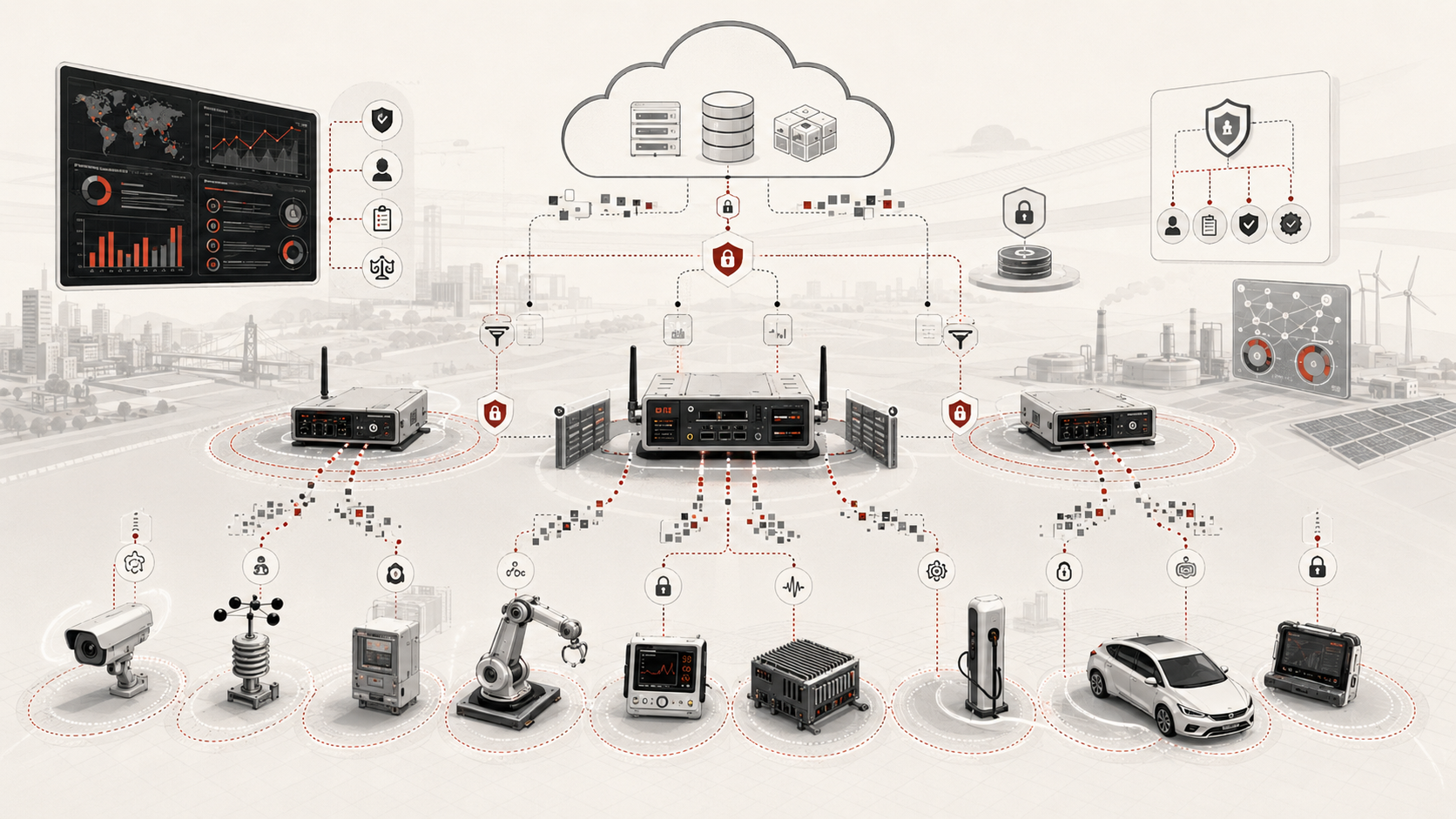
The engineering question is therefore not only whether edge systems can keep data local, but which data should remain local, what transformations should happen before uplink, what evidence proves those transformations occurred, how long local buffers persist, how derived outputs remain linkable, and how privacy protections interact with debugging, analytics, safety, security, model performance, and operational usefulness.
Engineering Problem
The engineering problem is direct: how do you design an embedded or edge system so that it can sense, infer, respond, and report without unnecessarily exposing raw personal or person-revealing data?
In a centralized design, engineers often send raw data upstream and solve privacy later with policy, access control, retention settings, or downstream filtering. Edge systems create a better design option: reduce exposure at the point of collection. A device, gateway, local runtime, TinyML model, or FPGA-backed pipeline can transform data before it spreads into broader systems.
That option creates new engineering responsibilities. A privacy-preserving edge system must define which data are collected, which are processed locally, which raw signals are suppressed, which derived features are disclosed, how long buffers persist, which identifiers are retained, what logs are created, and how operators can prove that the system actually follows the intended privacy design.
Without this discipline, “processed locally” can become a misleading claim. A camera may process video at the edge but still retain raw frames for debugging. A voice assistant may classify commands locally but store long-lived event histories tied to persistent identifiers. A wearable may transmit only derived scores while those scores remain highly sensitive. A gateway may redact payloads while preserving linkable metadata. A TinyML model may reduce bandwidth while creating new behavioral classifications. A PYNQ or HDL stream filter may reduce raw data but leave no evidence of what was filtered, when, and under which policy.
For engineers, privacy at the edge is therefore an implementation problem, not only a compliance problem. It must be represented in architectures, schemas, manifests, filters, retention policies, model metadata, tests, logs, and operational dashboards.
Reference Architecture
A practical privacy-preserving edge architecture can be understood as a data-reduction and disclosure-control pipeline. The goal is not to eliminate all data processing. The goal is to transform the data lifecycle so raw signals are minimized, sensitive associations are reduced, retention is bounded, and upstream disclosure is limited to what the purpose requires.
| Layer | Engineering Role | Privacy Concern | Evidence Artifact |
|---|---|---|---|
| Sensor or input layer | Captures audio, video, telemetry, location, biometrics, occupancy, or environmental signals | Collection breadth, signal sensitivity, sampling rate, raw-data exposure | Sensor profile, collection-purpose record, sampling policy |
| Device preprocessing layer | Filters, thresholds, compresses, redacts, or classifies data close to generation | Raw-data suppression, event-only reporting, local transformation quality | Transformation manifest, firmware logic, local-processing log |
| Microcontroller or firmware layer | Runs constrained local logic, buffers events, reports device status | Local buffer duration, debug logging, device identifiers, firmware state | Firmware version, buffer policy, telemetry schema |
| TinyML or local inference layer | Classifies data locally and emits derived labels, scores, or alerts | Model-output sensitivity, feature-schema linkage, fallback behavior | Model manifest, input schema, output disclosure policy |
| PYNQ, FPGA, or HDL acceleration layer | Performs low-latency filtering, stream reduction, feature extraction, or redaction | Raw-stream export, overlay compatibility, evidence of local reduction | Overlay manifest, bitstream version, HDL interface contract |
| Gateway and local runtime layer | Aggregates, routes, buffers, and enforces local disclosure policies | Metadata linkage, transformation logs, retention, routing policy | Gateway policy, retention table, transformation audit log |
| Upstream platform layer | Receives selected events, aggregates, alerts, or governance evidence | Disclosure scope, secondary use, long-term retention, cross-system linkage | Disclosure record, purpose record, retention record |
This architecture is useful because it shows where privacy is actually engineered. Privacy does not live in one place. It appears in sensor selection, firmware behavior, model design, gateway policy, stream filters, metadata design, retention rules, logs, identifiers, and upstream disclosure contracts.
Implementation Pattern
A practical implementation pattern begins by defining the narrowest useful output. Instead of asking, “Can this device send raw data to the cloud?” the engineer asks, “What is the least revealing data product that still serves the system’s purpose?”
For example, a smart camera may not need to transmit video. It may only need to transmit zone occupancy. A microphone may not need to transmit audio. It may only need to transmit a local command label. A wearable may not need to transmit a continuous physiological stream. It may only need to transmit a local threshold event. A building sensor may not need to report individual-level movement. It may only need to report aggregate occupancy bands.
A minimal privacy-preserving edge implementation should include:
| Artifact | Purpose | Typical Format |
|---|---|---|
| Privacy policy | Defines local processing preference, raw-transfer restrictions, retention limits, and notice requirements | YAML or policy-as-code |
| Telemetry schema | Defines what transformed events can leave the edge environment | JSON Schema, SQL DDL, Avro, Protobuf, or equivalent |
| Retention policy | Defines how long raw signals, derived events, debug logs, and aggregates may persist | CSV, SQL table, YAML, or retention-management system |
| Transformation manifest | Documents what local filtering, aggregation, redaction, or inference occurred | JSON, YAML, firmware metadata, or gateway record |
| Model manifest | Defines TinyML model version, input schema, output labels, fallback behavior, and local-only rules | JSON |
| Overlay manifest | Defines PYNQ or FPGA overlay version, stream interfaces, raw-export rules, and fallback overlay | JSON |
| Disclosure record | Records what left the device or gateway, for what purpose, and under what policy | SQL table, event log, JSON event, or audit pipeline |
| Validation script | Checks that manifests, schemas, and policies are consistent before deployment | Bash, Python, CI workflow, or test suite |
The implementation pattern is strongest when privacy controls are testable. Engineers should be able to verify that raw data are not transferred, retention limits are enforced, transformed outputs match schema, identifiers are not overused, and policy files are consistent with deployed behavior.
What Is Privacy at the Edge?
Privacy at the edge refers to the design of systems that limit unnecessary collection, movement, linkage, disclosure, and retention of personal or person-revealing data by performing more processing near the point of generation. What makes edge privacy distinct is not merely geography. It is the possibility of changing the data lifecycle itself: raw data may stay local, only selected features or events may move upstream, and some data may never leave the device at all.
Local processing can reduce exposure, but privacy is not guaranteed just because data stay on-device. A local system may still create privacy risk through persistent identifiers, expansive logging, broad retention, opaque inference, unclear user controls, or secondary uses that exceed the original purpose. Privacy depends on what the system collects, what it transforms, what it keeps, what it links, what it shares, and what people or operators can understand and manage.
NIST’s privacy engineering objectives are especially useful here because they move privacy from abstract principle into system capability. A privacy-preserving edge system should support predictable processing, manageable data flows, and reduced unnecessary association between people, devices, events, and identities.
In strong architectures, privacy is therefore a property of the full processing chain: collection, local transformation, selective disclosure, retention, access, deletion, identity design, and governance evidence. Edge processing is a powerful tool, but it only becomes privacy-preserving when these stages are designed deliberately.
For engineers, the practical question is not whether the system is “edge-based.” The practical question is whether the architecture reduces exposure in measurable ways: less raw collection, less upstream transfer, shorter retention, weaker linkability, clearer user or operator control, and stronger evidence of policy enforcement.
Why Local Data Processing Matters for Privacy
Local data processing matters because centralization often multiplies exposure. Sending raw sensor feeds, voice recordings, camera streams, telemetry, or behavioral traces to the cloud can increase the number of systems, operators, vendors, workflows, models, and logs that touch personal data. Each additional transfer, store, transformation, and reuse expands privacy risk, even when security controls are strong.
Edge processing can improve privacy in several ways. It can reduce data volume before transfer, confine raw data to local environments, enable event-only reporting instead of continuous streaming, support local inference, make short-lived processing more feasible, and allow only derived states, alerts, or aggregates to leave the system.
This is especially important for signals that are person-revealing even when they do not look like traditional identifiers. Video can reveal presence, movement, disability, work routines, and social relationships. Audio can reveal identity, emotion, background context, and household life. Occupancy data can reveal behavior. Machine telemetry can reveal labor patterns. Local processing can reduce exposure before those signals become centralized records.
Still, the key word is can. Local processing changes the design space, but whether it actually improves privacy depends on what the system chooses to retain, infer, associate, and disclose. A privacy-preserving edge design must therefore be judged by the lifecycle it creates, not by the marketing claim that processing occurs “on-device.”
Engineers should evaluate local processing by asking what changes downstream. Does the upstream system receive fewer fields? Are raw inputs discarded? Are identifiers shortened, rotated, or removed? Are outputs aggregated? Are debug logs bounded? Are local buffers ephemeral? If not, local processing may provide latency or bandwidth benefits without providing meaningful privacy protection.
Data Minimisation and Purpose-Bounded Collection
Data minimisation is one of the most important principles in privacy-oriented edge design. The basic idea is simple: collect and process only the data necessary for the stated purpose. At the edge, minimisation becomes an architectural question, not merely a compliance phrase.
Does the system need raw audio, or only local wake-word detection? Does it need continuous video, or only occupancy counts? Does it need identifiable trajectories, or only zone-level movement? Does it need physiological streams, or only local threshold alerts? Does it need device-level histories forever, or only short-lived operational evidence?
These questions determine sensor design, local compute requirements, storage needs, model architecture, telemetry schemas, retention policies, and what kind of cloud analytics remain possible later. In privacy-preserving systems, raw data are not the default. They are the highest-risk representation, and they should only be retained or transmitted when the purpose truly requires them.
Purpose-bounded collection also helps prevent privacy creep. Edge systems often begin with a narrow operational purpose and then become attractive for broader analytics. A building sensor installed for energy optimization may become useful for workforce monitoring. A camera installed for safety may become useful for behavior analytics. A wearable installed for health may become useful for productivity scoring. Strong privacy architecture defines these boundaries early and makes secondary use visible, contestable, and governed.
For engineers, minimisation should be reflected in technical artifacts: sensor settings, sampling frequency, feature selection, schema design, model inputs, retention policy, debug-log configuration, and disclosure contracts. If the technical configuration permits broader collection than the stated purpose requires, the system is not minimized in practice.
Transformation Before Transfer: Filtering, Aggregation, and Redaction
One of the strongest privacy advantages of local edge processing is the ability to transform data before transfer. This can include filtering irrelevant observations, aggregating over time or space, redacting personal fields, converting rich media into sparse events, suppressing raw inputs, or generating derived features that are useful for operations without exposing the original signal.
Transformation before transfer changes what downstream systems can know. A cloud platform that receives a raw video stream can infer far more than a platform that receives a count of occupied zones. A system that receives raw audio can infer more than a system that receives a local command label. A platform that receives device-level location traces can infer more than one that receives coarse aggregate states.
But transformation is not automatically privacy-preserving. Aggregates may still reveal individuals in small populations. Derived features may remain linkable. Event logs may reconstruct behavior over time. Local analytics may create new sensitive outputs even when raw data are discarded. This is why transformation should be treated as an engineering decision about what information remains inferable after reduction, not merely as a bandwidth-saving step.
Strong architectures preserve enough internal clarity to answer three questions: what raw data were seen, what transformation occurred, and what privacy risk remains in the transformed output. Without that discipline, local reduction can give the appearance of privacy without materially reducing identifiability, linkability, or behavioral exposure.
Engineers should document transformations as part of the system contract. A gateway that emits “occupancy_count” should define how the count is produced, over what time window, at what spatial resolution, with what minimum group size, under what retention rule, and whether the transformed output can be joined with other identifiers.
Privacy-Enhancing Techniques in Edge Systems
Privacy-enhancing techniques, or PETs, are especially relevant to edge systems because local processing creates opportunities to apply safeguards before data spread outward. In edge environments, PETs may include local pseudonymisation, anonymisation where appropriate, selective disclosure, local feature extraction, privacy-preserving aggregation, encrypted local storage, short-lived buffers, secure enclaves, federated learning, differential privacy, or tightly scoped retention.
The important point is that PETs should be chosen in relation to the system’s actual data flows. A privacy technique is useful only if it reduces meaningful privacy risk in the context of the system’s purpose, identifiers, retention behavior, population size, linkage possibilities, and potential for re-identification.
Edge design helps because PETs can operate early in the data lifecycle. A local device can classify a signal and discard the raw input. A gateway can aggregate events before forwarding. A microcontroller can emit only thresholds. A local model can support decision-making without transmitting raw personal signals. A PYNQ or FPGA-backed pipeline can filter high-volume streams before wider distribution.
At the same time, PETs should not become a substitute for governance. Pseudonymised data can still be linkable. Aggregates can still be revealing. Federated learning can still leak information without appropriate safeguards. A strong privacy-preserving architecture combines PETs with purpose limitation, retention rules, transparency, access control, audit evidence, and decision rights.
For engineers, PET selection should start with a threat model and data-flow map. The question is not “Which privacy technique is fashionable?” The question is “Which privacy risk remains after local processing, and which control actually reduces that risk without breaking the system’s purpose?”
Predictability, Manageability, and User Control
NIST’s privacy engineering objectives are valuable in edge systems because they translate privacy into system capabilities. Predictability means users, operators, and stakeholders can make reliable assumptions about how data are processed. Manageability means the system supports granular administration of personal information, including alteration, deletion, selective disclosure, and preference expression.
These concepts are directly relevant to edge systems, where processing may be distributed, embedded, and partially invisible if not designed carefully. People may not know which sensors are active, what local processing occurs, what leaves the device, what is stored at the gateway, or which downstream systems receive derived outputs.
This means privacy at the edge is not only about minimising transfer. It is also about whether people and accountable operators can understand what stays local, what leaves the device, how long data remain, what controls exist over sharing, and what governance records prove that policy is being followed.
Good edge systems therefore make local privacy legible. They do not hide behind claims like “processed on-device” while leaving users unable to understand or influence the actual data lifecycle. A system that processes locally but remains opaque may reduce some exposure while still failing as privacy architecture.
For engineers, manageability requires interfaces. A privacy-preserving edge system should expose configuration, retention, deletion, disclosure, logging, and policy controls in ways that authorized operators can inspect and manage. If privacy behavior is hard-coded, undocumented, or invisible to operations teams, it will be difficult to verify or correct in production.
Disassociability, Linkability, and Local Identity Design
Disassociability refers to enabling the processing of personal information or events without associating them with individuals, devices, places, or contexts beyond operational requirements. This concept is especially important in edge systems because local processing can reduce central exposure while still preserving strong local linkage if identifiers are poorly designed.
This means privacy at the edge depends partly on identity architecture. Are device identifiers persistent? Are user identifiers reused across functions? Can event streams be linked over time? Can transformed outputs still be joined back to identifiable individuals? Can sensor locations reveal people even without names? Can gateway logs reconstruct behavior?
A system that keeps data local but maintains excessive linkability may still create substantial privacy risk. For example, local occupancy events may seem less sensitive than video, but if they are tied to a specific person, room, badge, device, or household over time, they can become behavior records.
Strong design asks not only how to protect identities, but when identities are actually needed. In many edge use cases, temporary pseudonyms, coarse-grained states, local-only identifiers, aggregate counts, or role-based context may be sufficient. That kind of restraint is what turns local processing into real privacy architecture rather than simply local surveillance.
For engineers, identity design should be reviewed at the schema level. Persistent identifiers, timestamps, device locations, room identifiers, user IDs, IP addresses, Bluetooth identifiers, and event sequences can all create linkage. Removing names is not enough if the remaining metadata still reconstructs a person’s behavior.
Retention, Buffering, and Ephemeral Processing
Retention is one of the clearest places where edge privacy can succeed or fail. A system may process data locally and still undermine privacy by storing raw inputs indefinitely, buffering more than it needs, retaining debug logs, syncing old records upstream, or keeping transformed outputs long enough to reconstruct behavior.
Local storage is not automatically safer than cloud storage if it is excessive, insecure, or operationally opaque. A poorly governed local gateway can become a shadow database. A device buffer can become a forensic archive. A local cache can become a disclosure risk. Privacy depends on retention discipline as much as processing location.
Good edge privacy design treats ephemeral processing as a serious architectural option. Data may be processed in memory and discarded once an event is classified, an action is taken, or an aggregate is updated. Where buffering is necessary, the system should define why, for how long, under what protection, and under what disclosure rules.
Strong architectures make retention legible at every layer: device, gateway, local edge server, management platform, and cloud. Otherwise “local processing” may only shift accumulation from one place to another.
For engineers, retention rules should be executable rather than aspirational. Raw buffers, transformed events, model outputs, gateway logs, debug traces, and operational telemetry should each have explicit retention limits, deletion behavior, and exception handling. Privacy fails when retention exists only in policy documents and not in system behavior.
Data and Configuration Artifacts
Privacy engineering becomes stronger when privacy assumptions are represented as data and configuration artifacts. Engineers should be able to inspect how the system defines raw data, derived events, retention limits, transformation rules, disclosure permissions, model outputs, and upstream transfer policy.
| Artifact | What It Captures | Engineering Purpose |
|---|---|---|
privacy_policy.yml |
Local-processing preference, raw-transfer restrictions, retention defaults, notice requirements | Turns privacy requirements into machine-readable configuration |
telemetry_schema.json |
Allowed transformed events, required fields, retention fields, disclosure flags | Prevents raw or excessive data from entering upstream pipelines |
retention_policy.csv |
Data classes, retention windows, raw retention permission, upstream transfer permission | Makes retention enforceable and reviewable |
model_manifest.json |
TinyML model version, input features, output labels, local-only rules, fallback behavior | Prevents local inference from becoming undocumented privacy risk |
overlay_manifest.json |
PYNQ overlay version, stream interfaces, raw-export rules, local filtering requirements | Tracks privacy behavior in accelerated edge pipelines |
schema.sql |
Tables for privacy events, disclosure records, retention policies, and transformation evidence | Makes privacy governance queryable and auditable |
validate_manifests.sh |
Local validation of JSON/YAML configuration and policy files | Supports repeatable engineering checks before deployment |
privacy_risk_scores.csv |
Residual risk score by event, signal type, site, or device class | Supports privacy review, remediation, and engineering prioritization |
The point is not to make every deployment use these exact names. The point is to make privacy behavior explicit, testable, and visible to engineering teams. If privacy requirements cannot be represented in schemas, manifests, policies, logs, and tests, they will be difficult to maintain as the system evolves.
Mathematical Lens: Privacy Risk Reduction Through Local Transformation
Privacy-preserving edge design can be understood as a problem of reducing exposure while preserving enough information for a legitimate operational purpose. A simple model can help represent the relationship between collection, identifiability, retention, linkage, sharing, minimisation, transformation, and ephemeral processing.
R_{\mathrm{privacy}} = w_cC + w_iI + w_rR + w_lL + w_sS – w_mM – w_tT – w_eE
\]
Interpretation: \(R_{\mathrm{privacy}}\) represents residual privacy risk. \(C\) is collection breadth, \(I\) is identifiability, \(R\) is retention duration, \(L\) is linkability across contexts, and \(S\) is upstream sharing scope. \(M\) is minimisation strength, \(T\) is local transformation strength, and \(E\) is ephemeral processing strength. The weights \(w\) reflect how important each factor is for a particular system.
The value of this model is not that it produces a universal privacy score. It makes design assumptions visible. A system with high collection breadth, long retention, strong identity linkage, and broad sharing scope remains risky even if it processes locally. A system with narrow collection, strong transformation, short retention, and limited sharing may reduce privacy risk substantially even when it still supports useful analytics.
The model also helps avoid vague privacy claims. “Processed locally” is not enough. The more important question is whether local processing actually reduces collection, identifiability, retention, linkability, and disclosure in ways that match the system’s purpose.
For engineers, the model can become a practical review tool. Devices, data flows, and signal types can be scored before deployment. High-risk flows can be held for redesign, stronger local transformation, shorter retention, weaker identifiers, or narrower upstream disclosure.
Python Workflow: Local Data Minimisation and Privacy Risk Scoring
The companion Python workflow models edge privacy events as records with collection breadth, identifiability, retention duration, linkability, sharing scope, minimisation strength, local transformation strength, and ephemeral processing strength. It calculates a residual privacy-risk score and recommends governance actions for high-risk data flows.
This workflow is useful because privacy design often fails when principles remain qualitative. By turning local processing into a scoring and reporting workflow, operators can compare device classes, signal types, sites, and disclosure patterns. The goal is not to automate privacy judgment away. It is to make privacy trade-offs explicit enough to review, challenge, and improve.
# Python Workflow: Local Data Minimisation and Privacy Risk Scoring

risk = (
    0.18 * raw_collection
    + 0.22 * identifiability
    + 0.12 * normalized_retention
    + 0.18 * linkability
    + 0.18 * sharing_scope
    - 0.16 * minimisation
    - 0.18 * local_transformation
    - 0.14 * ephemeral_processing
)
The full companion script expands this model with CSV loading, risk-band classification, site-level summaries, and recommended actions. The workflow is especially useful for identifying cases where raw inputs are not transferred but privacy risk remains high because retention, linkage, or derived-output disclosure is still excessive.
For engineering teams, the workflow can be connected to real data-flow inventories, telemetry schemas, local-processing logs, gateway disclosure records, and retention-policy tables. Once connected, it becomes a review mechanism for detecting privacy risk before it becomes embedded in production infrastructure.
R Workflow: Edge Privacy Reporting and Retention Governance
The companion R workflow focuses on reporting. It summarizes privacy risk by site, signal type, output type, retention pattern, and risk band. Where Python is useful for scoring and workflow automation, R is useful for descriptive summaries, review tables, reporting graphics, and governance-ready documentation.
This workflow can support privacy reviews, data protection impact assessments, engineering review boards, procurement evaluations, and operational monitoring. It helps distinguish systems that merely claim local processing from systems that demonstrably reduce exposure.
# R Workflow: Edge Privacy Reporting and Retention Governance

privacy_summary <- events_scored |>
  dplyr::group_by(site, signal_type, privacy_risk_band) |>
  dplyr::summarise(
    events = dplyr::n(),
    mean_privacy_risk = mean(privacy_risk_score, na.rm = TRUE),
    mean_retention_hours = mean(retention_hours, na.rm = TRUE),
    .groups = "drop"
  )
The R workflow complements the mathematical lens by turning privacy architecture into an observable reporting cycle. Local processing should produce evidence: what was collected, what was transformed, what was retained, what was disclosed, and what risk remains.
For engineers and technical leads, reporting helps locate where risk concentrates. One signal type may dominate privacy exposure. One site may retain data longer than expected. One device class may create linkable derived outputs. One gateway configuration may transmit more upstream than the design intended. Reporting turns those patterns into actionable review.
Systems Code: MicroPython, TinyML, PYNQ, HDL, Gateways, Bash, and Configuration
The companion repository is designed to make the article useful to engineers by connecting privacy architecture to implementation scaffolds. Privacy at the edge touches constrained devices, local inference, gateway services, schemas, manifests, stream filters, test scripts, and operational workflows.
| Folder | Engineering Role | Privacy Use |
|---|---|---|
python/ |
Risk scoring and workflow automation | Calculates residual privacy risk and recommended governance actions |
r/ |
Reporting and descriptive analytics | Summarizes privacy risk, retention, signal types, and disclosure patterns |
sql/ |
Governance records and queryable evidence | Stores privacy events, disclosure records, retention policies, and checks |
c/ |
Constrained embedded logic | Suppresses raw values and emits only transformed event states |
cpp/ |
Gateway and firmware-style policy logic | Applies local transformation and upstream disclosure rules |
rust/ |
Safe policy validation | Checks retention and disclosure rules for person-revealing data |
go/ |
Local gateway services | Transforms observations into disclosure-controlled local events |
micropython/ |
Microcontroller prototypes | Reads local signals and publishes reduced event records without raw values |
tinyml/ |
On-device inference | Classifies signals locally and reports only event labels or derived outputs |
pynq/ |
FPGA-backed edge acceleration | Validates privacy-preserving overlay metadata and stream-filter constraints |
hdl/ |
Hardware stream processing | Implements simple raw-stream reduction before broader disclosure |
bash/ |
Repeatable workflow execution | Runs manifest validation, workflows, output generation, and cleanup |
config/ |
Machine-readable governance metadata | Defines privacy policy, telemetry schema, deployment manifest, and device profile |
This stack is intentionally cross-layer. A privacy-preserving edge design should not stop at policy or analytics. It should show how privacy appears in firmware logic, gateway decisions, local inference, hardware acceleration, manifests, schemas, tests, and reporting.
Testing and Validation
Privacy controls should be tested like other system requirements. If raw data are not supposed to leave the device, tests should verify that. If retention is limited, tests should verify expiration behavior. If local models should emit only derived labels, tests should verify output shape and logging behavior. If gateway policies block raw transfer, tests should confirm that blocked data cannot enter upstream pipelines.
A practical privacy validation suite should answer these questions:
- Do telemetry schemas exclude raw personal or person-revealing fields unless explicitly justified?
- Do local transformation functions suppress raw values before upstream disclosure?
- Are retention limits defined for raw data, derived events, logs, buffers, and model outputs?
- Are debug logs prevented from retaining raw sensitive signals?
- Are device identifiers, timestamps, and locations minimized where possible?
- Can transformed outputs still be linked to individuals or households over time?
- Do TinyML model manifests declare input features, output labels, local-only rules, and fallback behavior?
- Do PYNQ overlays or HDL stream filters prevent raw stream export when policy requires local reduction?
- Do disclosure records show what left the device or gateway, for what purpose, and under which policy?
- Can operators delete or expire local records according to retention policy?
Testing should include negative cases. Engineers should deliberately test whether raw fields can slip through schemas, whether logs capture sensitive inputs, whether identifiers can reconstruct behavior, whether aggregations are too small, and whether downstream joins can undo local minimisation.
Operational Signals and Privacy Observability
Privacy observability is the ability to monitor whether the system’s actual data behavior matches its intended privacy design. This does not mean collecting more sensitive data for monitoring. It means collecting enough governance evidence to verify transformation, retention, disclosure, and policy enforcement.
| Signal | What It Reveals | Why Engineers Need It |
|---|---|---|
| Raw-transfer count | Whether raw data left the device or gateway | Detects violations of local-processing policy |
| Transformation type | Filtering, aggregation, redaction, feature extraction, inference, or suppression | Shows how data were reduced before disclosure |
| Output type | Event label, aggregate, alert, score, feature, or raw payload | Clarifies what upstream systems actually receive |
| Retention age | How long local records, buffers, logs, or outputs persist | Detects stale or excessive local storage |
| Identifier scope | Persistent, rotating, local-only, pseudonymous, aggregate, or none | Reveals linkability and identity risk |
| Disclosure destination | Which upstream service or system received the output | Supports accountability and purpose limitation |
| Privacy risk score | Residual risk after minimisation, transformation, and retention controls | Supports review, prioritization, and remediation |
| Policy exception state | Whether a system is operating outside default privacy policy | Prevents exceptions from becoming permanent hidden behavior |
Engineers should design these signals carefully. Privacy observability should not become surveillance of the privacy system itself. It should collect metadata about data handling, not unnecessary copies of the sensitive data being protected.
Common Failure Modes
Engineers should design privacy-preserving edge systems around predictable failure modes. These failures are common because privacy can be weakened at any stage of the data lifecycle.
- Raw-data leakage through logs: application logs, debug traces, or error reports capture sensitive inputs even when the main pipeline suppresses them.
- Derived-output sensitivity: event labels, risk scores, or model outputs reveal sensitive behavior even without raw inputs.
- Linkability through metadata: timestamps, device IDs, site IDs, room IDs, or sequence patterns reconstruct individual behavior.
- Excessive local retention: raw data stay on the device or gateway longer than the purpose requires.
- Small-group aggregation: aggregates reveal individuals because the population is too small or too specific.
- Secondary-use drift: data collected for one purpose become useful for another purpose without adequate redesign or governance.
- Model-output overexposure: a TinyML model avoids raw-data transfer but emits sensitive classifications upstream.
- Gateway policy bypass: alternate routes, fallback modes, or maintenance channels transmit data outside the privacy path.
- Accelerator invisibility: PYNQ, FPGA, or HDL stream filters transform data without producing evidence of what was filtered or disclosed.
- Unmanaged exceptions: privacy safeguards are disabled for debugging, testing, or maintenance and never restored.
A mature privacy architecture does not assume these failures are rare. It makes them testable, observable, and correctable.
Trade-Offs Between Privacy, Utility, and Observability
Privacy-preserving edge systems are shaped by trade-offs that cannot all be optimized at once. More local processing can improve privacy while reducing central observability. Stronger minimisation may reduce analytic flexibility. Richer local redaction may preserve dignity or confidentiality while making debugging harder. Shorter retention improves privacy but may weaken forensic capability. Event-only reporting can reduce exposure while limiting retrospective model improvement.
The right design depends on purpose and consequence. A voice assistant, industrial camera, wearable sensor, smart building system, autonomous platform, connected medical device, and environmental monitoring network all require different balances of local utility, privacy risk, and operational visibility.
Good edge privacy architecture is therefore proportional. It reduces unnecessary exposure without pretending that privacy comes for free or without cost to some kinds of central insight. A privacy-preserving design should be honest about what it gives up, what it preserves, and why the selected trade-off is justified by purpose.
This is one reason edge privacy should be treated as a systems discipline rather than a legal afterthought. The privacy value of local processing depends on how it changes the whole data lifecycle, not on whether one processing stage happens to run on-device.
Engineers should document these trade-offs explicitly. If raw data are retained for debugging, that exception should have a retention limit and approval path. If derived features are sent upstream, their sensitivity should be evaluated. If local processing reduces central observability, alternative health and governance signals should be designed.
Applications in Embedded and Edge Systems
Voice assistants and local audio processing. Systems that perform wake-word detection or command classification locally can reduce the transfer of raw audio and better align processing with minimisation principles, though only if retention and secondary use remain bounded.
Smart cameras and vision analytics. Edge vision systems can convert video into counts, zones, alerts, or anonymised features before transmission, reducing central exposure to raw imagery while still supporting operational use.
Wearables and personal sensing. Edge processing can allow sensitive physiological or behavioral signals to be summarized locally rather than continuously uploaded in raw form, though privacy still depends on identity design, retention, and downstream sharing rules.
Industrial and building systems. Occupancy, environmental, and operational telemetry can often be aggregated or filtered locally so that central systems receive only the state needed for optimization or alerting, not every underlying personal or location-linked signal.
Edge AI and TinyML devices. On-device models can classify events locally and disclose only derived states rather than raw inputs. But model outputs still require governance because they may reveal behavior, identity, health, activity, or risk classifications.
FPGA-backed gateways and accelerated filtering. PYNQ or HDL-based edge filters can reduce high-volume streams before disclosure, especially in video, sensing, signal-processing, and industrial contexts where raw data are expensive, sensitive, or unnecessary.
The unifying pattern is not one device class. It is the need to make the data lifecycle narrower, more purposeful, more legible, and less unnecessarily associating.
Engineer Checklist
- Define the narrowest useful output before designing the data pipeline.
- Classify each signal type by sensitivity, identifiability, retention need, and upstream-disclosure need.
- Prefer local filtering, aggregation, redaction, event extraction, or inference over raw transfer where the purpose allows.
- Represent privacy behavior in machine-readable policy, schema, model, overlay, and retention artifacts.
- Set explicit retention limits for raw inputs, transformed events, local buffers, model outputs, and debug logs.
- Review identifiers, timestamps, device IDs, locations, and metadata for linkability risk.
- Validate that raw data cannot bypass the privacy pipeline through logs, fallback modes, maintenance tools, or alternate routes.
- Document TinyML model inputs, outputs, fallback behavior, and local-only processing rules.
- Document PYNQ, FPGA, or HDL stream-filter behavior and raw-export restrictions.
- Monitor privacy observability signals without collecting unnecessary sensitive data for monitoring itself.
- Treat privacy exceptions as temporary, owned, documented, and expiring.
- Review whether local processing actually reduces collection, retention, linkability, and disclosure—not only bandwidth or latency.
This checklist is intentionally practical. A privacy-preserving edge system is not defined by where computation happens alone. It is defined by what the system collects, transforms, retains, links, discloses, and proves over time.
GitHub Repository
This article is supported by a companion workflow that models privacy and local data processing at the edge using reproducible code, privacy-risk scoring, retention policy records, local transformation examples, event-only reporting, TinyML inference stubs, PYNQ overlay metadata, HDL stream filters, and governance manifests.
The companion repository includes Python, R, SQL, C, C++, Rust, Go, MicroPython, TinyML, PYNQ, HDL, Bash, YAML/JSON configuration, notebooks, firmware-style scaffolds, privacy telemetry schemas, local minimisation workflows, retention-policy examples, privacy-risk scoring, disclosure-record examples, and privacy-governance tests for embedded and edge systems.
Where This Fits in the Series
This article extends the foundation established in Edge Analytics and Local Data Processing, Cloud-Edge Coordination and Hybrid Architectures, Security in Embedded and Edge Systems, and Gateways, Aggregation Layers, and Distributed Edge Infrastructure by focusing specifically on how privacy shapes local data architecture at the edge.
It also connects directly to articles on edge AI, TinyML, observability, lifecycle governance, standards, and infrastructure accountability. Privacy at the edge is not an isolated concern. It shapes how embedded systems sense, infer, retain, disclose, and justify what they know.
Related articles
- Embedded and Edge Systems: Real-Time Computing in Devices, Sensors, and Infrastructure
- Edge Analytics and Local Data Processing
- Cloud-Edge Coordination and Hybrid Architectures
- Security in Embedded and Edge Systems
- Gateways, Aggregation Layers, and Distributed Edge Infrastructure
- Edge AI and On-Device Machine Learning
- Standards, Interoperability, and Governance in Edge Infrastructure
- Device Lifecycle Management and Over-the-Air Updating
Further reading
- ENISA (2023) Fog and Edge Computing in 5G. Available at: https://www.enisa.europa.eu/publications/fog-and-edge-computing-in-5g
- NIST (2017) An Introduction to Privacy Engineering and Risk Management in Federal Systems. Available at: https://csrc.nist.gov/pubs/ir/8062/final
- NIST (2020) NIST Privacy Framework: A Tool for Improving Privacy through Enterprise Risk Management. Available at: https://www.nist.gov/privacy-framework
- ICO (n.d.) Data minimisation. Available at: https://ico.org.uk/for-organisations/uk-gdpr-guidance-and-resources/data-protection-principles/a-guide-to-the-data-protection-principles/data-minimisation/
- ICO (n.d.) Privacy-enhancing technologies. Available at: https://ico.org.uk/for-organisations/uk-gdpr-guidance-and-resources/data-sharing/privacy-enhancing-technologies/
- EDPB (2021) Guidelines 02/2021 on virtual voice assistants. Available at: https://www.edpb.europa.eu/our-work-tools/our-documents/guidelines/guidelines-022021-virtual-voice-assistants_en
References
- ENISA (2023) Fog and Edge Computing in 5G. Available at: https://www.enisa.europa.eu/publications/fog-and-edge-computing-in-5g
- EDPB (2021) Guidelines 02/2021 on virtual voice assistants. Available at: https://www.edpb.europa.eu/our-work-tools/our-documents/guidelines/guidelines-022021-virtual-voice-assistants_en
- ICO (n.d.) Data minimisation. Available at: https://ico.org.uk/for-organisations/uk-gdpr-guidance-and-resources/data-protection-principles/a-guide-to-the-data-protection-principles/data-minimisation/
- ICO (n.d.) Privacy-enhancing technologies. Available at: https://ico.org.uk/for-organisations/uk-gdpr-guidance-and-resources/data-sharing/privacy-enhancing-technologies/
- NIST (2017) An Introduction to Privacy Engineering and Risk Management in Federal Systems. Available at: https://csrc.nist.gov/pubs/ir/8062/final
- NIST (2020) NIST Privacy Framework: A Tool for Improving Privacy through Enterprise Risk Management. Available at: https://www.nist.gov/privacy-framework