
Last Updated May 11, 2026
Device lifecycle management and over-the-air updating examine how embedded and edge devices are provisioned, identified, configured, monitored, updated, recovered, and eventually retired across long operational lives. For engineers, lifecycle management is not merely inventory administration, and OTA updating is not simply remote file delivery. Together they form the engineering discipline that keeps deployed devices identifiable, patchable, recoverable, observable, trustworthy, and supportable after they leave the lab and enter real operating environments.
Lifecycle management matters because embedded and edge devices do not remain static after installation. They acquire credentials, configuration, software dependencies, policy bindings, operational histories, update states, support obligations, and sometimes safety or security responsibilities that evolve over years. A device may begin life as a provisioned asset, become part of a fleet, receive multiple updates, drift from baseline conditions, require recovery, and eventually reach end of support or decommissioning.
OTA updating is one of the most visible lifecycle functions because it is the main way remote devices remain secure, compliant, and operationally useful after deployment. But OTA is not only a transport problem. It is also a targeting, compatibility, validation, rollback, recovery, observability, and governance problem. A serious OTA system must answer not only whether an update can be delivered, but whether it should be delivered, to which devices, under which conditions, with what rollback path, and with what evidence of success or failure.
Main Library
Publications
Article Map
Embedded & Edge Systems
Related Topic
Data Systems & Analytics
Related Topic
Artificial Intelligence Systems
Related Topic
Intelligent Infrastructure Systems
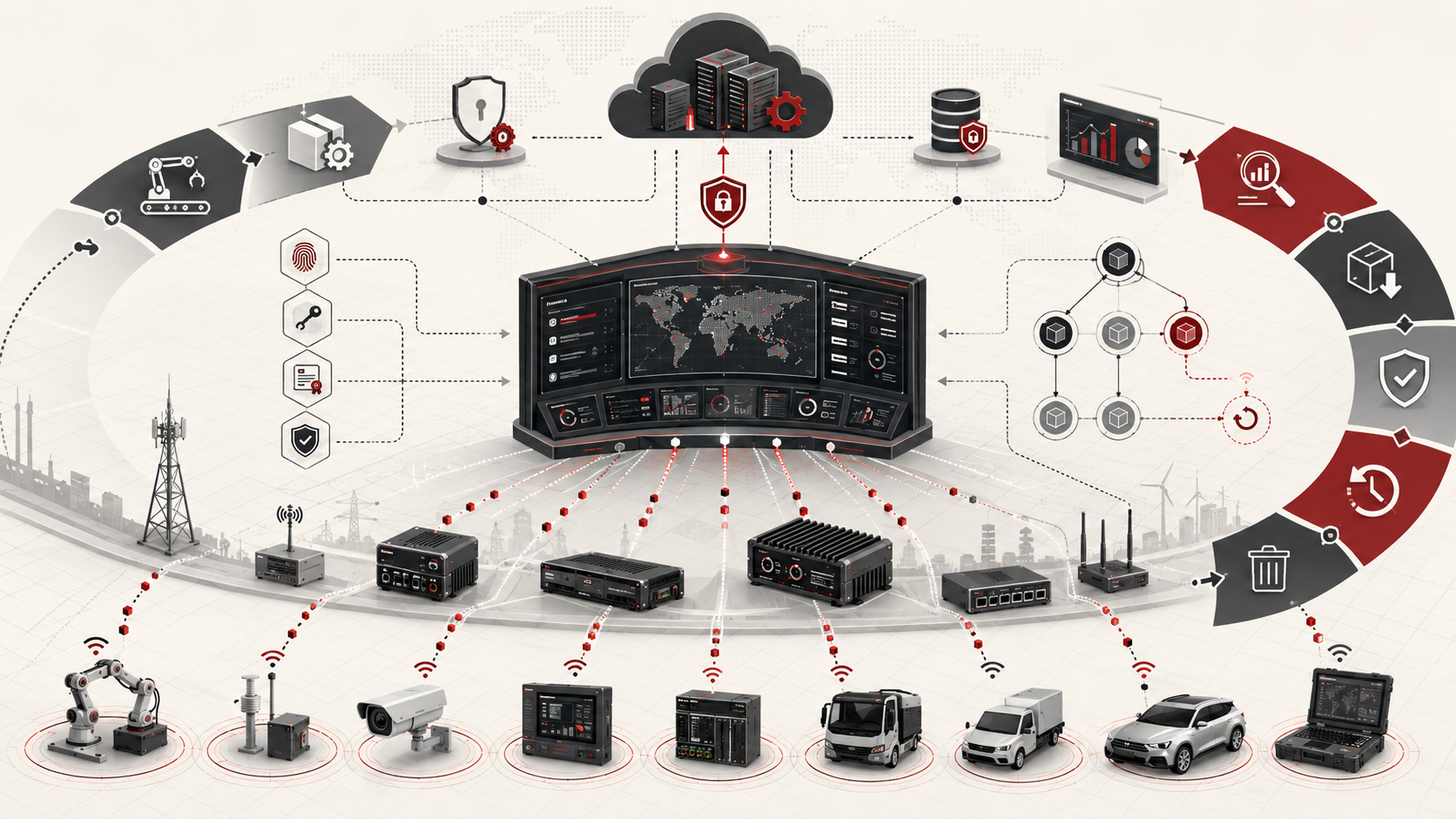
The architectural question is therefore not merely how to push new software to devices, but how to manage device trust across onboarding, configuration, update, recovery, verification, and retirement. A strong lifecycle architecture does not just deliver updates. It ensures that devices can be identified, grouped, updated safely, restored after failure, monitored for drift, and retired before unsupported conditions become systemic risk.
Engineering Problem
The engineering problem is simple to state and hard to solve: how do you keep thousands of distributed devices trustworthy after deployment, especially when they differ by hardware revision, firmware version, operating environment, connectivity pattern, security baseline, local configuration, model version, and support state?
In prototypes, engineers can update devices manually, rebuild images when necessary, and recover from failure by physically accessing the device. Production edge systems do not have that luxury. Devices may be installed in buildings, factories, vehicles, farms, substations, remote monitoring stations, clinics, warehouses, homes, or public infrastructure. They may be intermittently connected, physically inaccessible, power-constrained, or safety-relevant. They may also outlive the software assumptions that originally made them deployable.
A production lifecycle architecture must therefore answer practical engineering questions: Which devices exist? Which are authentic? Which firmware version are they running? Which configuration is active? Which update package applies to which device class? Which devices are eligible for rollout? Which devices failed? Which rolled back? Which are unsupported? Which must be retired?
Without lifecycle discipline, OTA updating becomes risky. An update may be sent to the wrong hardware revision. A device may lose power during installation. A gateway may update successfully while dependent services fail. A TinyML model may be updated without matching the expected feature schema. A PYNQ overlay may change the accelerator interface without updating the runtime. A device may remain online but drift outside the trust boundary required by the system.
For engineers, lifecycle management is therefore not an administrative overlay. It is the control plane for keeping deployed physical-digital systems patchable, recoverable, and accountable.
Reference Architecture
A practical lifecycle and OTA architecture can be understood as a chain of trust, state, deployment, recovery, and evidence. The exact implementation varies by platform, but the engineering layers are consistent.
| Layer | Engineering Role | Lifecycle Concern | Evidence Artifact |
|---|---|---|---|
| Manufacturing and provisioning | Creates or injects device identity, keys, certificates, and hardware metadata | Authenticity, ownership, initial trust, hardware revision | Manufacturing record, certificate, device identity record |
| Onboarding and enrollment | Binds device to a fleet, tenant, site, policy domain, or management system | Trust anchor, registration, ownership, bootstrap configuration | Enrollment record, device profile, onboarding log |
| Fleet organization | Groups devices by compatibility, site, role, risk, hardware, firmware, or runtime | Safe targeting, rollout rings, exception handling | Compatibility matrix, group manifest, rollout ring definition |
| Update packaging | Defines firmware, runtime, model, overlay, or configuration update packages | Integrity, compatibility, dependency state, package metadata | Update manifest, signature, checksum, dependency file |
| Deployment control | Stages rollout, applies hold rules, monitors installation, and records status | Canary release, staged rollout, maintenance windows, deployment evidence | Deployment event log, rollout report, failed-update record |
| Recovery and rollback | Restores devices to safe or previous known-good states after failure | A/B slots, fallback images, watchdogs, protected boot, recovery state | Rollback record, recovery event, fallback version record |
| Monitoring and verification | Checks whether devices remain compliant after deployment | Drift, health, support state, security baseline, firmware status | Telemetry record, compliance report, lifecycle score |
| Retirement and decommissioning | Removes unsupported or obsolete devices from service | End of support, credential revocation, data handling, asset disposal | Decommissioning record, support-state inventory, revocation log |
This architecture matters because OTA updating is only one stage in the lifecycle. A device that is poorly provisioned, incorrectly grouped, poorly monitored, or impossible to recover should not be treated as an ordinary OTA target. Update delivery depends on identity, compatibility, state, rollback, and evidence.
Implementation Pattern
A practical implementation pattern begins with machine-readable lifecycle metadata. Each device should have a profile that records its identity, hardware revision, firmware version, configuration version, support state, security baseline, update eligibility, rollback capability, and last known operational state. Each update package should have a manifest that records target device classes, compatible versions, signatures, checksums, dependency constraints, rollout ring, and rollback plan.
A minimal engineering implementation should include:
| Artifact | Purpose | Typical Format |
|---|---|---|
| Device profile | Defines device identity, class, hardware revision, firmware version, support state, and capabilities | JSON or YAML |
| Compatibility matrix | Maps update packages to device classes, hardware revisions, firmware baselines, runtime versions, and model schemas | CSV, SQL table, YAML, or release-management system |
| Update manifest | Defines package version, target group, checksum, signature, dependencies, rollout ring, and rollback version | YAML, JSON, or platform-specific manifest |
| Lifecycle policy | Defines onboarding, update, rollback, support-state, exception, and decommissioning rules | YAML, policy-as-code, or governance record |
| Deployment log | Records which devices were targeted, accepted, installed, failed, deferred, or rolled back | SQL table, event stream, CSV export, log pipeline |
| Recovery record | Tracks rollback, fallback image, watchdog trigger, or recovery intervention | SQL table, JSON event, device log |
| Compliance report | Summarizes fleet readiness, update status, drift, support state, and high-risk devices | Python/R output, dashboard, notebook, PDF, CSV |
The implementation goal is to make update decisions reproducible. A deployment decision should be explainable from evidence: device identity, compatibility, package integrity, validation status, rollback readiness, support state, and operational risk. Engineers should not have to infer update eligibility from informal notes, vendor promises, or tribal knowledge.
What Is Device Lifecycle Management?
Device lifecycle management is the structured administration of devices from onboarding through operation, maintenance, update, recovery, and retirement. What makes this domain distinct in embedded and edge systems is that lifecycle events are security-critical, operationally consequential, and often distributed across many devices with uneven connectivity and long service lives.
A managed device is not simply “installed.” It is provisioned with trust anchors, bound to identities, associated with policy or compatibility groups, monitored for state, and kept aligned with the software, firmware, and security expectations of the wider system. Lifecycle management turns a device from a physical object into a governable participant in a distributed infrastructure.
In strong architectures, lifecycle management is not a back-office function. It is one of the main ways a fleet remains trustworthy after real-world deployment begins. It links technical evidence, operational ownership, cybersecurity policy, update readiness, recovery planning, and end-of-life decision-making into a single system of accountability.
For engineers, the lifecycle view prevents a common mistake: treating deployed devices as static endpoints. A deployed device is a changing system. Its identity, configuration, firmware, local data, credentials, dependencies, update eligibility, and support status all change over time. A lifecycle architecture exists to keep those changes visible and controlled.
Provisioning, Onboarding, and Initial Trust
The lifecycle begins with onboarding. Devices need an initial trust relationship, whether through manufacturing credentials, injected keys, certificates, secure bootstrap flows, or trusted enrollment into a management domain. Without credible onboarding, later lifecycle claims become weak because the system cannot confidently distinguish legitimate devices from replacements, clones, misbound assets, or compromised endpoints.
Provisioning is therefore more than registration. It includes establishing identity, trust anchors, compatibility context, ownership, configuration baselines, and the service relationships through which the device will later receive updates and policy. A device that is poorly onboarded may still function technically, but it cannot be governed with confidence.
Good lifecycle design treats onboarding as the start of an ongoing trust chain, not as a one-time administrative event. The same identity and trust assumptions that allow a device to join the fleet also shape whether it can receive an update, report status, prove compliance, recover from failure, or be retired cleanly.
For engineers, onboarding should produce artifacts that can be tested and audited: device identifier, hardware revision, firmware baseline, certificate or key record, tenant or site association, policy domain, initial configuration, and supported update channel. If those records do not exist, OTA governance will later depend on incomplete assumptions.
Identity, Grouping, and Fleet Organization
Lifecycle management at scale depends on structure. Devices are not usually updated one by one forever. They are grouped by model, hardware revision, firmware baseline, operating system, deployment site, risk profile, operational role, network context, or update compatibility. Fleet organization is therefore part of correctness, not just convenience.
This grouping matters because updates are contextual. A firmware package that is valid for one board revision or operating system configuration may be invalid or unsafe for another. A runtime update that works on a gateway may be irrelevant to a microcontroller. A machine-learning model update may require a particular sensor schema or inference runtime. A security update may need staged deployment because the device is part of a safety-relevant system.
Strong lifecycle architecture should make explicit how devices are identified, how compatibility is determined, how groups are formed, and how exceptions are handled when devices no longer match their intended baseline. A fleet that cannot be grouped accurately cannot be updated safely.
Engineers should avoid using only human-readable names or site labels as fleet identifiers. Update targeting should depend on stable technical facts: hardware revision, firmware baseline, runtime version, dependency state, support status, security posture, and rollback capability. A site name may be useful for operations, but it is not enough to determine update safety.
Configuration, State, and Operational Drift
Devices do not only drift through software versions. They also drift through configuration changes, failed updates, local modifications, altered credentials, storage wear, dependency mismatches, sensor calibration changes, environmental exposure, and operational exceptions. Lifecycle management therefore has to govern state, not just binaries.
This makes configuration management a core architectural layer. The system should know not only which image a device runs, but what operational state it is in, what features are enabled, what policies apply, what credentials are active, and whether the device still conforms to its intended support posture.
Without that visibility, OTA success can become misleading. A package may install successfully on a device whose broader state is already unstable, misconfigured, unsupported, or incompatible. The update event may look successful while the device remains outside the trust boundary expected by the system.
Good lifecycle management therefore includes baselines, state awareness, and some mechanism for detecting when devices diverge too far from supported assumptions. Drift detection is not an optional monitoring feature. It is part of lifecycle trust.
For engineers, this means update readiness should include configuration checks. A device should not be considered ready merely because it is online. It should be checked for baseline configuration, adequate storage, valid credentials, supported firmware path, runtime health, clock correctness, telemetry availability, and rollback readiness.
What OTA Updating Really Involves
OTA updating is often described as remote update delivery, but that description is too narrow. In practice, OTA includes targeting the right devices, validating package compatibility, verifying package integrity, staging deployment, monitoring installation results, and handling partial failure. The hard part of OTA is not sending bits. The hard part is preserving trust and recoverability when devices are heterogeneous, remotely deployed, intermittently connected, or safety-relevant.
A serious OTA architecture includes update manifests, compatibility metadata, signed packages, device-side agents, rollout groups, deployment status reporting, hold conditions, retry logic, and rollback behavior. It also requires evidence: which devices were targeted, which accepted the update, which deferred it, which failed, which rolled back, and which now require operator review.
An update that is easy to deliver but hard to verify or recover from is not a good lifecycle architecture. Strong OTA systems combine signed packages, compatibility awareness, policy-based rollout, telemetry about installation state, and disciplined handling of devices that fail, defer, or partially apply updates.
Engineers should also distinguish update types. Firmware updates, operating-system updates, container updates, configuration updates, certificate rotations, TinyML model updates, PYNQ overlay updates, and HDL bitstream changes do not carry the same risk. Each update type has different compatibility requirements, rollback paths, validation checks, and operational consequences.
Update Validation, Staging, and Safe Rollout
Good OTA updating is staged rather than impulsive. Updates should be validated before broad rollout, deployed progressively, and observed for adverse effects before wider expansion. This can involve test groups, canary deployments, phased release rings, maintenance windows, or explicit hold points where human operators evaluate field behavior.
The need for staging is particularly strong in embedded systems because updates may affect firmware, drivers, local runtimes, AI models, gateway orchestration, network behavior, or control software that participates directly in physical operations. A bad rollout can therefore have operational or safety consequences beyond normal software defects.
Strong lifecycle architecture separates package creation from deployment confidence. It should be clear how an update is validated, which population receives it first, what success criteria are checked, what telemetry is monitored, which signals block progression, and who has authority to approve broader rollout.
Validation also needs to account for dependency behavior. In edge runtimes, updating one component may restart other services, alter local message routing, change dependency versions, or interrupt connected client devices. Lifecycle governance should therefore model update impact, not merely update availability.
An engineering rollout plan should specify the validation gate before each rollout ring. For example: manifest validation, signature check, compatibility check, device health check, storage check, rollback check, canary deployment, telemetry observation window, error-rate threshold, and operator approval for broader deployment.
Rollback, Recovery, and Resilient Failure Handling
Rollback and recovery are central because some updates will fail. Devices may lose power, lose connectivity, run out of storage, fail validation, encounter incompatible dependencies, or enter degraded states after installation. Lifecycle architecture must assume imperfect field conditions rather than ideal deployment paths.
Resilient platforms often depend on mechanisms such as A/B slots, fallback images, signed recovery packages, protected boot paths, watchdogs, local validation, and remote status reporting. The purpose is not only to make updates possible, but to prevent failed updates from turning devices into untrustworthy or unrecoverable assets.
Good design treats recovery as part of the normal lifecycle, not as an exceptional afterthought. A device should be able to fail safely, report evidence, preserve a rollback path, and re-enter a trusted state. If rollback is unavailable, the deployment decision should reflect that risk before the update begins.
For engineers, rollback should be tested rather than assumed. A recovery plan that has never been exercised is only a design intention. Teams should test interrupted updates, failed integrity checks, bad configurations, incompatible model versions, storage exhaustion, watchdog-triggered restarts, and connectivity loss during deployment.
Monitoring, Compliance, and Continuous Verification
Lifecycle management requires evidence. Operators need to know which devices are current, which are drifting, which failed updates, which have not checked in, which remain within policy, and which require support-state review. Lifecycle observability should therefore not be limited to version numbers.
Useful lifecycle telemetry includes update status, compatibility state, support status, firmware version, rollback state, security baseline, configuration drift, device health, last check-in time, error codes, and deployment phase. These records allow operators to distinguish “updated successfully” from “updated into a degraded or misconfigured state.”
Strong architectures define what lifecycle telemetry is collected, how it is protected, what counts as compliance, and how exceptions are escalated when devices stop conforming to expected baselines. Continuous verification turns lifecycle management from an inventory spreadsheet into an operational control system.
Engineers should design lifecycle observability as a first-class system interface. If update agents, gateways, and control planes cannot report enough status to diagnose deployment behavior, OTA operations will eventually depend on guesswork. A good lifecycle dashboard should show readiness, deployment state, failure cause, rollback status, drift, support state, and devices requiring manual review.
End of Support, Retirement, and Decommissioning
Device lifecycles do not end automatically when vendor support ends. Unsupported devices can remain deployed, continue passing traffic, continue collecting data, or continue controlling local processes even after patches, security updates, or vendor assurance have ended. End of support is therefore a lifecycle event, not a footnote.
Good lifecycle architecture includes retirement planning from the beginning. Operators should know when devices become unsupported, how to identify them, what mitigations are possible, which functions they perform, what dependencies they support, and when decommissioning is mandatory rather than discretionary.
A fleet that can provision and update devices but cannot remove obsolete ones remains strategically weak. Strong systems make end-of-support states visible and actionable. They do not allow unsupported devices to fade silently into the operational background.
For engineers, decommissioning should be treated as a workflow with evidence: remove the device from update groups, revoke credentials, remove network access, migrate dependencies, archive necessary telemetry, wipe local data where appropriate, record disposal or replacement, and update the asset inventory. Retirement is part of security architecture, not an administrative afterthought.
Security and Trust Across the Lifecycle
Lifecycle management is inseparable from security because every lifecycle stage changes trust. Onboarding introduces trust. Configuration shapes trust. Updates modify trust. Monitoring verifies trust. Recovery restores trust. Retirement removes trust relationships. Lifecycle and OTA updating should therefore be understood as trust-management disciplines rather than logistics alone.
Trusted lifecycle management depends on multiple layers: roots of trust, device identity, signed or verified updates, protected storage, controlled deployment, rollback paths, support-state awareness, evidence retention, and the ability to maintain device compliance with policy over time.
Good lifecycle design asks not only whether a device can update, but whether it can update while remaining identifiable, verifiable, recoverable, and supportable under real deployment conditions. A device that cannot prove its identity, verify an update package, preserve rollback, or report status should not be treated as an ordinary update target.
Security also means protecting the update channel itself. Update infrastructure is a high-value target because it can change what devices run. Engineers should therefore treat signing keys, manifests, deployment permissions, rollback controls, update logs, and fleet-group definitions as security-sensitive assets.
Data and Configuration Artifacts
Device lifecycle engineering becomes much stronger when lifecycle assumptions are represented as data and configuration artifacts rather than informal procedures. YAML, JSON, SQL, firmware metadata, telemetry logs, and test outputs make lifecycle state visible and reviewable.
| Artifact | What It Captures | Engineering Purpose |
|---|---|---|
device_profile.json |
Device identity, class, hardware revision, firmware version, rollback capability, support state | Supports targeting, compatibility checks, and lifecycle inventory |
update_manifest.yml |
Package version, target group, checksum, signature, dependencies, rollback version | Makes update packages testable and auditable |
compatibility_matrix.csv |
Valid combinations of device class, firmware, runtime, model, overlay, and configuration | Prevents unsafe updates to incompatible devices |
deployment_events.sql |
Targeted, accepted, installed, failed, deferred, rolled back, or blocked events | Creates queryable update evidence |
lifecycle_policy.yml |
Rules for onboarding, rollout, rollback, exception approval, support state, and retirement | Connects update behavior to explicit governance requirements |
model_manifest.json |
TinyML model version, input schema, quantization, fallback model, update eligibility | Prevents model lifecycle drift at the edge |
overlay_manifest.json |
PYNQ overlay version, bitstream file, stream interface, fallback overlay | Tracks FPGA-backed acceleration as a governed lifecycle component |
run_workflows.sh |
Repeatable local execution of readiness scoring, validation, and reporting workflows | Gives engineers a predictable workflow entry point |
The goal is not to force every engineering team into the same file names. The goal is to make lifecycle state explicit enough that update decisions can be tested, reviewed, repeated, and explained.
Mathematical Lens: OTA Readiness as Lifecycle Trust Capacity
OTA readiness can be treated as a lifecycle trust capacity rather than a binary yes-or-no decision. A device may be technically reachable but not safe to update. Another may be compatible but lack rollback readiness. Another may pass package validation but be too far out of baseline configuration. A simple scoring model can help make these factors visible.
S_{\mathrm{OTA}} = w_iI + w_cC + w_pP + w_vV + w_rR + w_oO – w_dD
\]
Interpretation: \(S_{\mathrm{OTA}}\) represents OTA readiness. \(I\) is identity assurance, \(C\) is compatibility match, \(P\) is package integrity, \(V\) is validation status, \(R\) is rollback readiness, \(O\) is observability, and \(D\) is lifecycle drift. The weights \(w\) reflect the relative importance of each factor for a particular fleet or deployment context.
This model does not prove that an update is safe. It creates a structured way to compare devices, rollout rings, and deployment candidates. It also makes the penalty of lifecycle drift explicit. A device with good identity and package integrity may still be a poor update target if it has weak observability, poor rollback support, or unresolved configuration drift.
In mature edge operations, OTA readiness should be calculated before deployment, monitored during rollout, and revised after failure, rollback, or support-state change. Lifecycle governance becomes stronger when update decisions are tied to measurable evidence rather than informal confidence.
For engineers, the model can be implemented as a pre-rollout gate. Devices below a readiness threshold can be held automatically, routed into a recovery group, or flagged for manual review. The model can also help compare rollout rings, identify weak sites, and justify why some devices are excluded from a deployment.
Python Workflow: OTA Fleet Readiness and Rollout Risk Scoring
The companion Python workflow models an edge fleet as a set of devices with identity assurance, compatibility match, package integrity, validation status, rollback readiness, observability, lifecycle drift, support state, rollout ring, and last check-in time. It calculates an OTA readiness score for each device and recommends rollout decisions such as approve, canary-only, hold, hold for recovery review, or block.
This workflow is useful for translating lifecycle governance into operational evidence. Rather than treating OTA deployment as a button press, it turns device metadata into a repeatable readiness assessment that can support canary planning, maintenance windows, exception handling, and fleet modernization.
# Python Workflow: OTA Fleet Readiness and Rollout Risk Scoring

score = (
    0.16 * identity_assurance
    + 0.18 * compatibility_match
    + 0.16 * package_integrity
    + 0.16 * validation_status
    + 0.16 * rollback_readiness
    + 0.13 * observability
    - 0.15 * lifecycle_drift
)
The full companion script expands this model with CSV loading, typed scoring logic, support-state handling, rollout-ring summaries, and exportable readiness reports. The purpose is not to automate judgment away. It is to make update judgment more visible, repeatable, and accountable.
For engineering teams, the practical next step is to connect the workflow to real inventory exports, update-service logs, device-health telemetry, support-state records, and firmware manifests. Once connected, the same workflow can become a rollout gate, compliance report, or modernization planning tool.
R Workflow: Lifecycle Compliance and Update Status Reporting Across Device Fleets
The companion R workflow focuses on reporting. It summarizes OTA readiness by site, rollout ring, support state, and deployment outcome. Where Python is useful for readiness scoring and automation logic, R is useful for compliance summaries, update status reporting, descriptive statistics, and publication-ready fleet tables.
This workflow can support operational reviews, maintenance planning, lifecycle governance meetings, procurement decisions, and risk reporting. It can also help distinguish fleets that are merely online from fleets that are actually maintainable, recoverable, and supportable.
# R Workflow: Lifecycle Compliance and Update Status Reporting Across Device Fleets

lifecycle_summary <- fleet_scored |>
  dplyr::group_by(site, support_state, rollout_ring) |>
  dplyr::summarise(
    devices = dplyr::n(),
    mean_ota_readiness = mean(ota_readiness_score, na.rm = TRUE),
    blocked_or_held = sum(rollout_decision %in% c("block", "hold"), na.rm = TRUE),
    .groups = "drop"
  )
The R workflow complements the mathematical lens by showing how OTA readiness becomes part of a reporting cycle. A score has value only if it changes operational behavior: delaying unsafe rollouts, prioritizing recovery improvements, replacing unsupported devices, and documenting why update decisions were made.
For engineers and technical leads, reporting is useful because rollout risk is rarely uniform. One site may contain most unsupported devices. One hardware revision may fail at a higher rate. One rollout ring may expose a dependency problem. Reporting helps separate isolated failures from fleet-level patterns.
Systems Code: Firmware, Gateways, TinyML, PYNQ, HDL, Bash, and Configuration
The companion repository should be useful to engineers because lifecycle management cuts across the full embedded and edge stack. OTA is not only a cloud-service feature. It touches device firmware, gateway orchestration, local telemetry, system services, constrained inference, hardware acceleration, manifests, tests, and operational scripts.
| Folder | Engineering Role | Lifecycle / OTA Use |
|---|---|---|
c/ |
Constrained embedded logic | Device-side update state, watchdog behavior, fallback checks |
cpp/ |
Firmware, gateway, and streaming abstractions | Update-state machines, compatibility checks, gateway update policy |
rust/ |
Safe systems tooling and policy validation | Lifecycle-policy validator, support-state checks, rollback rules |
go/ |
Operational services and gateway utilities | OTA status service, telemetry gateway, deployment event handler |
micropython/ |
Microcontroller telemetry prototypes | Lightweight device status reporting, firmware metadata, update readiness flags |
tinyml/ |
Constrained on-device inference | Model-version manifests, feature-schema compatibility, fallback model behavior |
pynq/ |
FPGA-backed edge acceleration | Overlay-version tracking, bitstream compatibility, accelerator lifecycle evidence |
hdl/ |
Hardware/software co-design | Stream-processing modules that may require versioned hardware lifecycle control |
bash/ |
Repeatable workflow execution | Run validation, generate outputs, clean artifacts, test manifests |
config/ |
Machine-readable governance metadata | Device profiles, update policy, lifecycle policy, telemetry schema, deployment manifest |
This stack is intentionally broad because lifecycle management is not confined to one language or one layer. An OTA architecture that updates firmware but ignores model versions, overlays, configuration, rollback evidence, or support-state reporting is incomplete. Engineers need a cross-layer view of what changes, how it is validated, and how the system recovers.
Testing and Validation
Lifecycle and OTA workflows should be tested before they are needed in the field. Validation should cover device metadata, update manifests, signatures, compatibility rules, staged rollout logic, rollback behavior, telemetry reporting, and decommissioning workflows.
A practical validation suite should answer these questions:
- Does every device have a stable identity and valid profile?
- Can the system distinguish hardware revisions and firmware baselines?
- Does the update manifest declare target versions, dependencies, checksums, signatures, and rollback version?
- Can the update agent reject incompatible packages?
- Can the device recover from interrupted installation?
- Can the system detect a failed update and record a clear failure reason?
- Can the device roll back to a known-good state?
- Are TinyML model updates checked against input schemas and fallback policy?
- Are PYNQ overlays or bitstreams validated before loading?
- Are end-of-support devices excluded from ordinary rollout groups?
- Are decommissioning workflows tested, including credential revocation?
Testing should include negative cases. The most important OTA failures are often not happy-path deployment problems. They are partial failures: lost connectivity, insufficient storage, wrong hardware revision, expired certificate, failed signature check, corrupted package, dependency conflict, model-schema mismatch, unsupported device, or rollback failure.
Operational Signals and Lifecycle Observability
Lifecycle observability should show whether the fleet is maintainable, not merely whether devices are online. A device that is online but unsupported, misconfigured, unable to roll back, or no longer reporting update status is not healthy from a lifecycle perspective.
| Signal | What It Reveals | Why Engineers Need It |
|---|---|---|
| Last check-in time | Whether the device is reachable and reporting | Identifies offline or stale devices before rollout |
| Firmware version | Current software baseline | Supports vulnerability and compatibility assessment |
| Configuration version | Active policy and configuration state | Detects drift from expected baseline |
| Rollback readiness | Whether the device can recover from update failure | Prevents unsafe rollout to unrecoverable devices |
| Support state | Supported, limited-support, end-of-support, or decommissioned | Prevents unsupported devices from remaining hidden in production |
| Deployment phase | Targeted, downloading, installing, validating, complete, failed, rolled back | Supports rollout monitoring and incident response |
| Failure reason | Why an update failed or was blocked | Separates connectivity, compatibility, integrity, and runtime problems |
| Model or overlay version | Current TinyML or PYNQ/FPGA lifecycle state | Prevents AI and acceleration components from drifting outside compatibility bounds |
Operational signals should be designed before production rollout. If the system cannot report where updates fail, engineers will struggle to distinguish a bad package from a bad network, wrong target group, configuration drift, storage exhaustion, or recovery failure.
Common Failure Modes
Engineers should design lifecycle and OTA systems around predictable failure modes. These are not edge cases. They are normal outcomes in real distributed device fleets.
- Wrong target group: an update is sent to devices with incompatible hardware, firmware, runtime, or configuration state.
- Interrupted installation: power loss, connectivity loss, or storage failure leaves the device in a partial state.
- No rollback path: the device fails after update but cannot return to a known-good image.
- Silent drift: devices appear online but deviate from expected configuration, security baseline, or firmware assumptions.
- Weak package integrity: updates are not properly signed, verified, or protected from tampering.
- Telemetry gap: devices fail but do not report enough status to diagnose the cause.
- Support-state blindness: end-of-support devices remain active because retirement is not tracked as a lifecycle event.
- Model-schema mismatch: a TinyML model update expects features that the device or gateway does not produce.
- Overlay compatibility failure: a PYNQ or FPGA overlay changes the accelerator interface without matching runtime updates.
- Credential residue: retired devices keep valid credentials, network access, or management bindings.
A mature lifecycle architecture does not assume these failures can be eliminated. It makes them visible, recoverable, and governable.
Trade-Offs in Lifecycle and OTA Design
Lifecycle and OTA systems are shaped by trade-offs that cannot all be optimized at once. More frequent updates can reduce vulnerability exposure while increasing operational churn. Richer telemetry can improve observability while increasing bandwidth, storage, privacy, or cost burdens. Strong rollback protections can improve recoverability while increasing memory and storage requirements. Compatibility grouping improves safety while making fleet organization more complex.
The right design depends on context. A consumer device, industrial controller, edge server, environmental sensor, autonomous platform, and safety-relevant medical device all require different balances of update frequency, recovery guarantees, visibility, and change control.
Good lifecycle architecture is therefore proportional. It matches governance and recovery rigor to the seriousness of the device role and deployment consequence. Systems that participate in physical control, critical infrastructure, safety, public services, or sensitive data processing require stronger update evidence and stronger rollback guarantees than low-consequence endpoints.
This is one reason lifecycle management should be treated as a systems discipline rather than a maintenance utility. The meaning of an update depends on how it interacts with identity, configuration, trust, recovery, support state, and operational accountability across the full life of the device.
Engineers should make these trade-offs explicit. A small environmental sensor may tolerate delayed rollout and minimal rollback if replacement is simple. A gateway controlling industrial integration may require staged rollout, strong recovery, maintenance windows, and operator approval. A medical or safety-relevant device may require formal validation and certification constraints before update deployment.
Applications in Embedded and Edge Systems
IoT fleets. Large device fleets rely on onboarding, grouping, OTA deployment, compatibility tracking, and end-of-support visibility to remain patchable and governable at scale.
Edge runtimes and gateways. Local runtimes and gateway systems require disciplined OTA flows because updates may affect communication, local analytics, orchestration, dependency behavior, and site-critical integration points all at once.
Industrial and infrastructure platforms. These systems often require staged rollout, strong rollback, compliance verification, and explicit handling of unsupported assets because lifecycle failures can affect operations directly.
Environmental monitoring networks. Remote monitoring systems need OTA updating because field devices may be geographically dispersed, difficult to access, and dependent on firmware, sensor calibration, communication protocols, and local storage behavior.
Safety-relevant and physically consequential devices. Systems with actuation, autonomy, or control functions require lifecycle design that treats updates as governed operational events rather than casual software refreshes.
Edge AI devices. AI-enabled edge systems may require not only firmware and runtime updates, but also model updates, feature-schema compatibility checks, inference logging, fallback logic, and policy controls over when new models can become active.
Accelerated edge nodes. PYNQ, FPGA, and HDL-based acceleration layers require lifecycle governance because bitstreams, overlays, stream interfaces, and hardware/software contracts can change independently of ordinary application code.
The unifying pattern is not one device class. It is the need to keep deployed systems trustworthy across long operational lifetimes.
Engineer Checklist
- Define stable device identities, hardware revisions, firmware versions, configuration versions, and support states.
- Maintain machine-readable device profiles and update manifests.
- Use compatibility matrices before targeting updates.
- Require signatures, checksums, and package-integrity validation.
- Stage rollouts through canary, pilot, and production rings where appropriate.
- Check readiness before deployment: identity, compatibility, package integrity, validation, rollback, observability, and drift.
- Test interrupted update, failed validation, rollback, storage exhaustion, and connectivity-loss scenarios.
- Track model versions, feature schemas, fallback behavior, and edge AI lifecycle state.
- Track PYNQ overlays, HDL interfaces, bitstream versions, and accelerator compatibility.
- Monitor update status, failure reason, last check-in, support state, firmware version, and configuration drift.
- Exclude unsupported or end-of-support devices from ordinary rollout groups.
- Make decommissioning explicit: revoke credentials, remove access, migrate dependencies, and record retirement.
The checklist is intentionally practical. A lifecycle system is strong when engineers can explain what exists, what state it is in, what can be safely updated, what failed, what recovered, and what must be retired.
GitHub Repository
This article is supported by a companion workflow that models device lifecycle management and OTA updating using reproducible code, device metadata, update-package records, deployment events, firmware-style examples, analytical notebooks, systems-language examples, configuration manifests, and lifecycle governance evidence.
The companion repository includes Python, R, SQL, C, C++, Rust, Go, MicroPython, TinyML, PYNQ, HDL, Bash, YAML/JSON configuration, Jupyter notebooks, firmware-style examples, device update profiles, OTA readiness scoring, rollout reporting, lifecycle policy validation, and recovery evidence workflows for embedded and edge systems.
Where This Fits in the Series
This article extends the foundation established in Security in Embedded and Edge Systems, Gateways, Aggregation Layers, and Distributed Edge Infrastructure, Cloud-Edge Coordination and Hybrid Architectures, and Edge Computing Architectures by focusing on how devices remain governable across onboarding, operation, updating, recovery, and retirement.
It also prepares the ground for articles on standards and interoperability, observability, firmware resilience, edge AI lifecycle governance, fleet telemetry, security operations, privacy-preserving local processing, and the broader question of how distributed physical-digital systems remain trustworthy after deployment.
Related articles
- Embedded and Edge Systems: Real-Time Computing in Devices, Sensors, and Infrastructure
- Security in Embedded and Edge Systems
- Gateways, Aggregation Layers, and Distributed Edge Infrastructure
- Cloud-Edge Coordination and Hybrid Architectures
- Edge Computing Architectures
- Privacy and Local Data Processing at the Edge
- Standards, Interoperability, and Governance in Edge Infrastructure
Further reading
- Amazon Web Services (n.d.) Update the AWS IoT Greengrass Core software (OTA). Available at: https://docs.aws.amazon.com/greengrass/v2/developerguide/update-greengrass-core-v2.html
- Microsoft (n.d.) Device Update for IoT Hub documentation. Available at: https://learn.microsoft.com/en-us/azure/iot-hub-device-update/
- Microsoft (2024) What is Device Update for IoT Hub? Available at: https://learn.microsoft.com/en-us/azure/iot-hub-device-update/understand-device-update
- NIST (2018) Platform Firmware Resiliency Guidelines. Available at: https://csrc.nist.gov/pubs/sp/800/193/final
- NIST (2021) IoT Device Cybersecurity Guidance for the Federal Government. Available at: https://csrc.nist.gov/pubs/sp/800/213/final
- NIST NCCoE (2024) Trusted IoT Device Network-Layer Onboarding and Lifecycle Management. Available at: https://www.nccoe.nist.gov/projects/trusted-iot-device-network-layer-onboarding-and-lifecycle-management
- CISA (2026) BOD 26-02: Mitigating Risk From End-of-Support Edge Devices. Available at: https://www.cisa.gov/news-events/directives/bod-26-02-mitigating-risk-end-support-edge-devices
References
- Amazon Web Services (n.d.) Update the AWS IoT Greengrass Core software (OTA). Available at: https://docs.aws.amazon.com/greengrass/v2/developerguide/update-greengrass-core-v2.html
- CISA (2026) BOD 26-02: Mitigating Risk From End-of-Support Edge Devices. Available at: https://www.cisa.gov/news-events/directives/bod-26-02-mitigating-risk-end-support-edge-devices
- Microsoft (n.d.) Device Update for IoT Hub documentation. Available at: https://learn.microsoft.com/en-us/azure/iot-hub-device-update/
- Microsoft (2024) What is Device Update for IoT Hub? Available at: https://learn.microsoft.com/en-us/azure/iot-hub-device-update/understand-device-update
- NIST (2018) Platform Firmware Resiliency Guidelines. Available at: https://csrc.nist.gov/pubs/sp/800/193/final
- NIST (2021) IoT Device Cybersecurity Guidance for the Federal Government: Establishing IoT Device Cybersecurity Requirements. Available at: https://csrc.nist.gov/pubs/sp/800/213/final
- NIST NCCoE (2024) Trusted IoT Device Network-Layer Onboarding and Lifecycle Management. Available at: https://www.nccoe.nist.gov/sites/default/files/2024-05/nist-sp-1800-36b-draft.pdf