
Last Updated May 12, 2026
Calibration, noise, and measurement integrity in sensor systems examine the conditions under which an embedded device can treat a sensed value as trustworthy rather than merely available. In embedded and edge systems, measurement quality depends not only on the sensing element, but on calibration practice, analog front-end design, reference stability, wiring, filtering, sampling strategy, timing integrity, uncertainty management, firmware behavior, lifecycle traceability, and the preservation of provenance from physical input to reported value.
Embedded systems increasingly depend on sensor-derived values to drive control loops, diagnostics, alerts, dashboards, predictive maintenance, safety logic, environmental monitoring, and machine-learning pipelines. Yet the usefulness of those values depends on whether the system can preserve the relationship between the physical phenomenon and the digital number that represents it. A sensor reading may be numerically precise, visually stable, and operationally useless all at once if the acquisition chain is poorly conditioned, the calibration has drifted, the reference is unstable, the channel has not settled, the wiring is noisy, the firmware is hiding faults, or the transformation from signal to value has become opaque.
Measurement integrity is therefore not a narrow instrumentation concern. It is a systems property. It links the physical sensor, analog front end, reference, ADC, sampling schedule, firmware, calibration coefficients, filtering logic, uncertainty model, metadata, quality flags, and downstream interpretation. When any part of that chain is treated as invisible, the reported value can begin to look more authoritative than it deserves. Strong embedded measurement architecture does not merely emit values. It preserves enough evidence for engineers, operators, and downstream systems to understand what was measured, how it was conditioned, how it was converted, how it was corrected, how much uncertainty remains, and whether the result is fit for its intended use.
The deeper issue is interpretability. A trustworthy sensor system does not merely provide data. It provides qualified measurements whose limits remain visible. That means calibration state, uncertainty, timing, provenance, signal quality, saturation state, filtering history, reference health, wiring context, coefficient binding, and validation outcome must remain part of the measurement record. Without that structure, sensor values may still flow through dashboards, databases, edge analytics, or control systems, but their connection to the physical world becomes progressively weaker.
Main Library
Publications
Article Map
Embedded & Edge Systems
Related Topic
Data Systems & Analytics
Related Topic
Environmental Monitoring
Related Topic
Intelligent Infrastructure
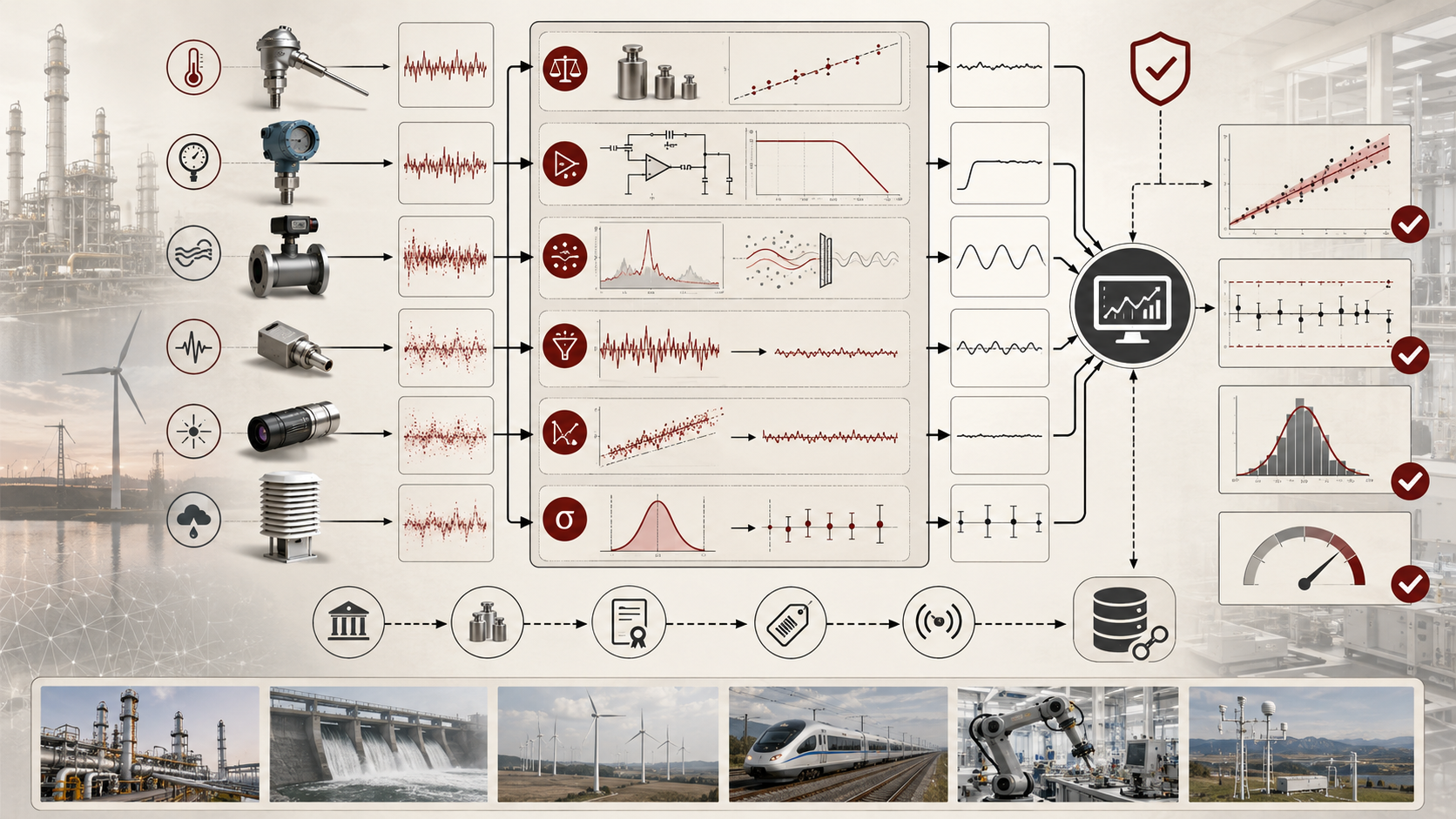
For engineers, the central question is not whether a sensor produces a number. The question is whether that number remains traceable, calibrated, bounded, timely, and physically meaningful enough to support the decision being made. A fast control loop, environmental monitoring station, medical device, industrial vibration system, energy monitor, or edge AI pipeline may all require different levels of precision and uncertainty. But all require measurement integrity: the disciplined preservation of meaning from physical signal to digital record.
Engineering Problem
The engineering problem is how to preserve measurement meaning across the entire sensor chain, from the physical phenomenon being observed to the digital value consumed by firmware, edge analytics, dashboards, control logic, databases, or machine-learning models. A measurement is not trustworthy simply because a sensor produced it. It is trustworthy only when the system can explain its calibration state, signal path, uncertainty, timing, filtering, quality status, fault status, and operational context.
This problem becomes harder in embedded and edge systems because sensing rarely occurs under ideal laboratory conditions. Devices operate across temperature ranges, vibration, electromagnetic interference, long cable runs, aging components, unstable supplies, multiplexed inputs, intermittent connectivity, constrained memory, firmware updates, and field maintenance practices. The same measurement chain that behaves well on a bench may degrade after installation, after thermal cycling, after cable replacement, after coefficient mismatch, or after a firmware change that alters the acquisition schedule.
Weak sensor architectures treat measurement as a single number. Strong architectures treat measurement as an evidence chain. They preserve the relationship between raw signal, conditioned signal, converted value, calibration coefficients, filtered value, final reported value, quality flag, uncertainty estimate, and provenance record. Without this chain, downstream systems may treat a low-quality or stale value as authoritative merely because it is numeric.
The practical question is therefore: can the embedded system produce measurements that remain calibrated, bounded, traceable, and fit for their intended use across deployment conditions, component aging, field noise, firmware changes, operational drift, and maintenance events?
Reference Architecture
A practical measurement-integrity architecture separates the sensor chain into layers. Each layer contributes to the trustworthiness of the final reported value. When these layers are not documented, failures become difficult to localize. A noisy reading may be caused by the sensing element, excitation circuit, reference, ADC, multiplexer, cable, grounding scheme, filter, timing schedule, calibration coefficient, firmware logic, or downstream transformation.
| Layer | Engineering Role | Integrity Risk | Evidence Artifact |
|---|---|---|---|
| Physical phenomenon | The real-world variable being measured | Ambiguous measurand, uncontrolled environmental condition | Measurement specification, operating envelope |
| Sensing element | Converts physical quantity into electrical or digital signal | Drift, hysteresis, saturation, aging, cross-sensitivity | Sensor datasheet, calibration record, health status |
| Excitation and reference | Provides stimulus or reference against which measurement is interpreted | Reference drift, supply ripple, thermal instability, poor decoupling | Reference manifest, excitation log, voltage/current measurement |
| Analog front end | Amplifies, filters, buffers, protects, or level-shifts the signal | Noise, offset, gain error, bandwidth mismatch, settling error | AFE configuration, filter version, gain/offset record |
| Wiring and installation | Moves signal from sensor to acquisition electronics | EMI, grounding error, shielding failure, connector degradation, cable pickup | Installation record, cable/shielding map, inspection status |
| Sampling and conversion | Digitizes the conditioned signal | Quantization, aliasing, incomplete settling, channel interaction, timing jitter | ADC configuration, sampling schedule, channel sequence, timing budget |
| Firmware processing | Applies scaling, compensation, filtering, validation, and fault handling | Stale coefficients, undocumented filters, hidden clipping, timing defects | Firmware version, calibration coefficient version, filter manifest |
| Measurement record | Stores value with uncertainty, quality flag, timestamp, and provenance | Loss of context, stale timestamps, missing quality state | Measurement schema, uncertainty record, quality flag |
| Downstream interpretation | Uses measurement for control, analytics, dashboards, or models | Overconfidence, unqualified aggregation, invalid comparisons | Use-case requirements, acceptance thresholds, data contract |
This architecture makes measurement integrity visible. It prevents engineers from treating the sensor as the only source of measurement quality and forces attention to the complete chain that turns a physical phenomenon into a digital decision input.
Implementation Pattern
A rigorous measurement-integrity implementation begins by defining the measurand, the required decision quality, the acquisition chain, the calibration method, the uncertainty model, the noise budget, the sampling strategy, the validation rules, the metadata contract, the recalibration policy, and the quality-gating behavior. The system should specify not only how values are produced, but how their fitness for use is evaluated.
| Artifact | Purpose | Typical Format |
|---|---|---|
| Measurement requirements document | Defines measurand, operating range, accuracy requirement, latency requirement, and decision context | Markdown, YAML, engineering specification |
| Sensor inventory | Maps sensor ID, type, location, range, unit, calibration status, and owner | CSV, SQL, JSON |
| Calibration manifest | Stores coefficient version, calibration date, reference source, method, validity interval, and uncertainty | YAML, JSON, database record |
| Traceability record | Links field calibration to reference device, standard, procedure, and uncertainty chain | YAML, certificate record, database table |
| Analog front-end manifest | Defines gain, offset, bandwidth, filter, reference, source impedance assumptions, and protection | YAML, schematic metadata |
| ADC and sampling configuration | Defines resolution, reference, sampling rate, channel sequence, settling delay, averaging, and trigger behavior | YAML, firmware config, device tree overlay |
| Noise and uncertainty budget | Allocates expected error sources across sensor, reference, AFE, ADC, wiring, temperature, and processing | CSV, notebook, engineering report |
| Filtering manifest | Documents filter type, parameters, latency, bandwidth effect, and whether raw values remain available | YAML, JSON, firmware metadata |
| Quality-flag policy | Defines valid, stale, saturated, clipped, inferred, low-confidence, drift-warning, and calibration-expired states | YAML, schema contract |
| Measurement schema | Preserves raw value, calibrated value, filtered value, uncertainty, timestamp, unit, coefficient version, and provenance | JSON Schema, SQL, protobuf |
| Recalibration and drift policy | Defines scheduled recalibration, field checks, collocation, drift detection, and coefficient update process | YAML, SOP, maintenance record |
The implementation goal is to make measurements auditable. Engineers should be able to reconstruct how a value was produced, which assumptions qualified it, whether it was within the calibrated operating range, whether it was filtered or compensated, whether the acquisition chain was healthy, and whether the uncertainty was acceptable for the downstream decision.
Research-Grade Framing: Measurement as an Evidence Chain
Measurement integrity should be framed as an evidence-chain problem. The reported value is the endpoint of a process, not the process itself. A physical quantity is transduced, conditioned, referenced, sampled, digitized, corrected, filtered, validated, time-stamped, stored, and interpreted. Each step can preserve or degrade meaning.
This framing is especially important because embedded and edge systems often detach values from their origin. Sensor readings may move into time-series databases, edge analytics pipelines, machine-learning systems, digital twins, predictive-maintenance models, public dashboards, or control layers. Once values leave the local acquisition context, metadata becomes the only way to preserve interpretive honesty.
| Evidence Dimension | Question | Required Record |
|---|---|---|
| Identity | Which sensor produced the value? | Sensor ID, channel ID, device ID, installation location |
| Calibration | Which calibration state qualified the value? | Calibration coefficient version, calibration date, reference source |
| Traceability | Can the calibration be connected to a reference chain? | Reference device ID, certificate, procedure, uncertainty statement |
| Signal path | How did the physical signal move into the converter? | AFE configuration, wiring record, channel sequence, reference state |
| Timing | When was the value acquired and processed? | Acquisition timestamp, processing timestamp, clock status |
| Transformation | What was applied between raw and reported value? | Scaling, compensation, filtering, validation, firmware version |
| Uncertainty | How much confidence should be attached to the result? | Uncertainty estimate, confidence interval, error-budget version |
| Quality | Is the value fit for its intended use? | Quality flag, validity state, saturation/clipping/staleness status |
| Lineage | Can the final value be traced back to its source assumptions? | Measurement provenance record, data contract, audit trail |
In this framing, calibration and noise control are not isolated procedures. They are part of the evidence infrastructure that allows a sensor-derived value to be believed, questioned, compared, replayed, corrected, or rejected.
Formal Model: Calibration, Noise, Uncertainty, and Trust
A useful formal model begins with the distinction between the true physical quantity, the sensor response, the acquisition chain, and the reported measurement. Let \(x\) represent the physical quantity of interest and \(y\) the reported measurement.
y = f_{\mathrm{cal}}(g_{\mathrm{afe}}(s(x)) + n) + \epsilon_{\mathrm{proc}}
\]
Interpretation: The reported value \(y\) is produced by the sensing response \(s(x)\), analog front-end transformation \(g_{\mathrm{afe}}\), noise \(n\), calibration function \(f_{\mathrm{cal}}\), and processing error \(\epsilon_{\mathrm{proc}}\).
y_{\mathrm{cal}} = a y_{\mathrm{raw}} + b
\]
Interpretation: A simple linear calibration corrects raw measurement \(y_{\mathrm{raw}}\) using gain \(a\) and offset \(b\). More complex systems may use polynomial, piecewise, temperature-compensated, or multivariate calibration models.
u_c = \sqrt{u_{\mathrm{sensor}}^2 + u_{\mathrm{ref}}^2 + u_{\mathrm{afe}}^2 + u_{\mathrm{adc}}^2 + u_{\mathrm{cal}}^2 + u_{\mathrm{env}}^2}
\]
Interpretation: Combined standard uncertainty \(u_c\) can be modeled as the root-sum-square of major independent uncertainty components.
\mathrm{SNR}_{\mathrm{dB}} = 20 \log_{10}\left(\frac{A_{\mathrm{signal}}}{A_{\mathrm{noise}}}\right)
\]
Interpretation: Signal-to-noise ratio compares signal amplitude to noise amplitude. A higher SNR generally supports more stable measurement, but it does not guarantee accuracy if calibration or bias is poor.
q = \frac{V_{\mathrm{ref}}}{2^N}
\]
Interpretation: ADC quantization step \(q\) depends on reference voltage \(V_{\mathrm{ref}}\) and resolution \(N\). More bits are only useful when the analog path, reference, and noise floor justify them.
T_{\mathrm{meas}} = T_{\mathrm{cal}} \cdot T_{\mathrm{signal}} \cdot T_{\mathrm{timing}} \cdot T_{\mathrm{quality}} \cdot T_{\mathrm{lineage}}
\]
Interpretation: Measurement trust depends jointly on calibration, signal quality, timing integrity, quality status, and lineage. A weakness in any one dimension can compromise the final value.
This model helps prevent a common engineering mistake: treating measurement accuracy as a property of the sensor alone. In practice, the measurement is produced by the whole chain.
What Are Calibration, Noise, and Measurement Integrity?
Calibration is the process by which a sensor system’s output is related to a known or accepted reference. Properly understood, calibration is not merely a one-time adjustment applied to a device. It is the formal basis on which a reported measurement becomes interpretable. It defines how raw readings become corrected values and what uncertainty still qualifies those corrected values.
Noise is unwanted variation or interference superimposed on the signal of interest. In practical embedded systems, noise may arise from thermal behavior, supply ripple, reference instability, grounding flaws, switching activity, cable pickup, quantization effects, electromagnetic interference, or timing interactions in the acquisition path. Noise may be random, periodic, correlated, environmental, or introduced by the system itself.
Measurement integrity is the broader property that determines whether a reported value remains fit for use. It includes calibration state, uncertainty, acquisition quality, processing history, timing integrity, physical installation, signal conditioning, and whether the system can explain how the value was produced. A system with strong measurement integrity does not merely provide numbers. It provides qualified measurements whose limitations remain visible.
These three ideas belong together. Calibration without noise awareness can overstate confidence. Noise filtering without calibration can make wrong values look stable. Measurement integrity without provenance can make downstream interpretation impossible. A trustworthy embedded measurement system needs all three.
Calibration as a Maintained Relationship
Calibration is best understood as a maintained relationship between the physical world and the embedded system’s reported state. A sensor does not become trustworthy simply because it was once factory adjusted. The full measurement chain — sensing element, excitation circuit, analog front end, converter, reference, scaling coefficients, and software application of those coefficients — must remain aligned with known references over time.
In practice, calibration may involve offset and gain correction, multipoint fitting, field comparison against reference devices, collocation, software compensation, temperature correction, or periodic coefficient updates. The specific method matters less than the architectural principle: the system should know what calibration state is active, when it was established, how it was derived, what reference was used, what uncertainty was assigned, and what operating assumptions still qualify it.
| Calibration Element | Engineering Purpose | Failure Risk | Record to Preserve |
|---|---|---|---|
| Offset correction | Removes zero-point error | False baseline, biased readings | Offset coefficient, calibration date, reference reading |
| Gain correction | Corrects slope or scale factor | Wrong magnitude across range | Gain coefficient, calibration points, fit residuals |
| Multipoint calibration | Handles nonlinearity across range | Accurate at one point but poor elsewhere | Calibration curve, polynomial/piecewise model, range validity |
| Temperature compensation | Corrects environmental sensitivity | Drift under field temperature | Compensation model, temperature sensor source, coefficient version |
| Field validation | Checks deployed system against reference or collocated sensor | Unnoticed aging or installation effects | Field-check record, comparison result, next due date |
| Coefficient management | Applies correct calibration state to correct hardware | Coefficient/device mismatch | Sensor ID, coefficient version, firmware version, checksum |
A mature sensor architecture therefore treats calibration as lifecycle infrastructure. It stores coefficients in a traceable way, versions them when needed, prevents accidental mismatch between hardware and calibration state, and preserves enough metadata that downstream users can distinguish recently validated measurements from values produced under aging or uncertain assumptions.
Metrological Traceability and Calibration Control
Calibration becomes stronger when it is controlled as part of a traceable measurement lifecycle. In high-integrity systems, the question is not simply whether a coefficient exists. The question is whether the coefficient can be connected to a known sensor, a known channel, a known calibration method, a known reference, a known uncertainty statement, and a known validity interval. Without that connection, calibration becomes a loose software parameter rather than an engineering control.
Traceability does not mean every edge device must become a laboratory instrument. It means that the system preserves a defensible chain of evidence appropriate to the use case. A low-cost environmental station, industrial condition-monitoring node, medical device, and laboratory data-acquisition system will require different levels of rigor. But each should make clear how the reported value is connected to a reference and how much confidence remains.
| Control Layer | Question | Engineering Record |
|---|---|---|
| Reference source | What reference or standard was used? | Reference device ID, certificate or specification, uncertainty statement |
| Calibration method | How were coefficients derived? | Procedure version, calibration points, fit method, residuals |
| Coefficient binding | Are coefficients tied to the correct device and channel? | Sensor ID, channel ID, hardware revision, coefficient checksum |
| Validity interval | How long should the calibration state be trusted? | Calibration date, expiration date, operating assumptions |
| Firmware compatibility | Does the firmware apply the coefficients correctly? | Firmware version, transformation function, rollback record |
| Field verification | Does deployed behavior still match expectation? | Collocation result, reference comparison, drift trend |
This is where measurement integrity overlaps with lifecycle governance. A calibration coefficient should be treated like a controlled artifact: versioned, bound, validated, reviewed, and rolled back when needed. In distributed edge systems, that discipline prevents fleets from silently mixing old coefficients, new firmware, replaced sensors, and stale assumptions.
Uncertainty, Accuracy, Precision, Resolution, and Bias
Measurement integrity depends on more than whether a value is stable. A sensor may produce tightly clustered readings and still be wrong because of offset, gain error, hysteresis, thermal drift, or stale calibration. Another sensor may be noisier in the short term yet more accurate in the long run because it remains unbiased and well characterized. Engineers should therefore distinguish precision, accuracy, resolution, bias, repeatability, and uncertainty rather than collapsing all of them into “sensor quality.”
Precision concerns repeatability or spread. Accuracy concerns closeness to a reference or accepted value. Resolution concerns the smallest distinguishable increment. Bias concerns systematic offset. Uncertainty concerns the quantified limits within which the result should be interpreted. A device that reports values without preserving some sense of these distinctions invites overconfidence.
| Concept | Meaning | Common Misinterpretation | Engineering Remedy |
|---|---|---|---|
| Resolution | Smallest reported increment or ADC step | Assumed to equal accuracy | Compare against noise floor, reference quality, and uncertainty budget |
| Precision | Repeatability or spread of repeated measurements | Assumed to mean correctness | Check against calibrated reference and bias estimate |
| Accuracy | Closeness to true or accepted value | Used without defining reference or conditions | Preserve calibration method and uncertainty statement |
| Bias | Systematic error | Hidden by averaging | Use reference comparison and offset/gain correction |
| Uncertainty | Quantified doubt about the result | Omitted from reported measurement | Carry uncertainty estimate or confidence category with value |
| Repeatability | Consistency under same conditions | Assumed to survive field deployment | Validate under operating temperature, wiring, and installation conditions |
Good architecture does not seek abstract perfection. It seeks sufficient characterization for the decisions that the measurement will support. That requires making error sources visible enough that the system can distinguish high-confidence readings from low-confidence ones rather than presenting all values as equally authoritative.
Noise as a Multi-Layer Disturbance
Noise enters sensor systems at multiple layers. Some noise originates in the sensing element itself. Some enters through excitation circuits, references, supplies, front-end amplifiers, multiplexers, PCB traces, cables, connectors, or external interference. Some is created by digital switching activity, PWM edges, clock harmonics, ground return behavior, or software-driven acquisition timing.
This layered view matters because noise is often misdiagnosed. Engineers may treat unstable measurements as “sensor noise” when the dominant problem is supply coupling, reference weakness, poor shielding, channel interaction, aliasing, grounding error, or timing artifacts in the acquisition schedule. Conversely, excessive filtering may hide an underlying analog or installation problem rather than solving it.
| Noise Source | Where It Appears | Engineering Symptom | Mitigation Pattern |
|---|---|---|---|
| Thermal noise | Sensor, resistor networks, amplifiers | Random variation, floor that does not disappear with software changes | Bandwidth control, low-noise components, averaging where latency permits |
| Supply ripple | Reference, sensor excitation, analog front end | Periodic variation correlated with power subsystem | Regulation, decoupling, filtering, layout separation |
| Ground loops | Field wiring and shared returns | Common-mode artifacts, installation-dependent offsets | Differential measurement, isolation, grounding strategy |
| EMI pickup | Cables, traces, high-impedance nodes | Noise correlated with motors, switching supplies, radios, PWM | Shielding, twisted pairs, routing, filtering, enclosure design |
| Multiplexer charge injection | ADC channel switching | Channel-to-channel interaction, first-sample error | Settling delay, dummy read, buffering, channel ordering |
| Aliasing | Sampling process | False low-frequency content from higher-frequency signals | Anti-alias filtering, higher sample rate, bandwidth discipline |
| Quantization | ADC conversion | Stair-step behavior, limited low-amplitude resolution | Appropriate ADC range, oversampling where valid, better analog scaling |
| Firmware timing jitter | Sampling schedule | Irregular sample intervals, spectral artifacts, inconsistent timing | Timer-triggered acquisition, DMA, RTOS scheduling discipline |
Noise should not be treated as a post-processing nuisance alone. It is a system-design issue spanning PCB layout, grounding, cable routing, filtering, front-end bandwidth, acquisition sequencing, and software interpretation. A design that addresses noise only after digitization often begins too late.
Analog Front Ends, References, and Signal Conditioning
The analog front end is often where measurement integrity is either preserved or compromised. Signal conditioning may include amplification, buffering, impedance matching, level shifting, filtering, excitation, isolation, protection, and common-mode rejection. Many raw sensor outputs are too small, too offset, too source-sensitive, too noisy, or too bandwidth-limited to be sent directly into a converter without degrading the result.
Reference behavior is equally central. An ADC does not measure absolute truth; it measures relative to its reference. If the reference is noisy, temperature-sensitive, poorly decoupled, or shared carelessly across a noisy system, every reported value inherits that weakness. This is one reason high nominal resolution can produce disappointing practical accuracy. Resolution without reference integrity is often just finer-grained uncertainty.
| Front-End Element | Purpose | Integrity Risk | Validation Signal |
|---|---|---|---|
| Instrumentation amplifier | Amplifies small differential signals | Offset, drift, common-mode limits, input bias effects | Gain/offset check, temperature sweep, common-mode test |
| Input buffer | Reduces source loading and improves settling | Instability, noise, bandwidth mismatch | Step response, settling-time measurement |
| Anti-alias filter | Limits bandwidth before sampling | Phase delay, response-time penalty, wrong cutoff | Frequency response, latency record |
| Voltage/current reference | Defines measurement scale | Drift, ripple, thermal instability, shared-noise coupling | Reference monitor, drift trend, temperature correlation |
| Protection network | Protects against transients and faults | Leakage, capacitance, clamp distortion | Input leakage test, transient test, linearity check |
| Excitation circuit | Provides bridge, RTD, or sensor excitation | Self-heating, supply drift, mismatch | Excitation current/voltage log, thermal compensation |
Filtering decisions also demand discipline. Anti-alias filtering may be necessary to prevent out-of-band content from folding into the measured band, but filtering changes bandwidth, response time, and settling behavior. Cleaner-looking analog paths can still become less trustworthy if the sampling strategy and settling windows are poorly matched.
Sampling, Settling, Quantization, and Conversion Effects
Measurement integrity can degrade at the exact moment of conversion. In multiplexed systems especially, conversion quality depends not only on ADC resolution and nominal sample rate, but on whether the input path has actually settled before the conversion is taken. Multiplexer switching, source impedance, sample-and-hold capacitance, amplifier recovery, and programmable-gain settling can all affect the next converted value.
Such errors often masquerade as noise. What appears to be random instability may actually be deterministic crosstalk, incomplete settling, or residual charge from a prior channel. These effects are especially dangerous because they may produce values that look realistic enough to pass simple plausibility checks.
| Conversion Concern | Failure Mode | Engineering Control | Evidence to Preserve |
|---|---|---|---|
| ADC resolution | More bits than the analog path can support | Compare effective noise-free resolution to actual requirement | Noise-floor estimate, effective-number-of-bits estimate |
| Reference voltage | Scale error and correlated drift | Use stable reference and monitor reference health | Reference measurement, reference part ID, temperature record |
| Multiplexer settling | Prior channel contaminates next channel | Dummy reads, settling delay, channel ordering, buffering | Channel sequence, settling-time budget, dummy-read policy |
| Sampling jitter | Timing uncertainty distorts dynamic signals | Timer-triggered sampling, DMA, real-time scheduling | Sample timestamp, jitter estimate, trigger source |
| Aliasing | High-frequency energy appears as false lower-frequency signal | Anti-alias filter and adequate sample rate | Filter cutoff, sample rate, bandwidth assumption |
| Quantization | Step-size limits usable resolution | Match range, reference, and ADC resolution to signal | ADC configuration, range, quantization step |
Good acquisition design includes explicit timing margin, awareness of source impedance, and sometimes dummy reads, channel-ordering strategies, oversampling, or buffer stages when channels differ substantially in amplitude or behavior. Conversion architecture is not only about speed and bits. It is about whether the analog path has reached a trustworthy state before the sample becomes part of the digital record.
Wiring, Grounding, Shielding, and Physical Installation Effects
Sensor systems are often weakened by physical implementation rather than by the sensing element or converter itself. Long cable runs, poor shielding, connector degradation, shared returns, moisture ingress, mechanical strain, and proximity to switching equipment can all distort the signal before the acquisition electronics ever see it. In practical deployments, wiring is not a neutral transport medium. It is part of the measurement chain.
This becomes especially important in industrial, automotive, infrastructure, environmental, and outdoor settings where sensors may be remote from the processing electronics. Installation context directly influences common-mode behavior, coupling, susceptibility to interference, contact resistance, leakage, and practical noise floor. A clean laboratory signal path may degrade significantly once routed through real cables, connectors, and field conditions.
| Installation Issue | Measurement Effect | Engineering Control |
|---|---|---|
| Long cable run | Capacitive pickup, resistance error, slower settling | Differential signaling, current loop, shielding, buffer near sensor |
| Ground loop | Offset, hum, common-mode interference | Isolation, single-point grounding, differential input |
| Unshielded cable near switching equipment | Periodic noise and spikes | Shielding, routing separation, filtering, twisted pair |
| Connector degradation | Intermittent values, increased resistance, drift | Inspection interval, contact quality checks, environmental protection |
| Moisture ingress | Leakage paths, corrosion, unstable readings | Ingress protection, conformal coating, humidity monitoring |
| Mechanical strain | Intermittent wiring faults, sensor offset, fatigue | Strain relief, mounting specification, installation audit |
Strong measurement systems treat physical installation as part of calibration and integrity control. They account for cable effects, shielding, grounding strategy, connector quality, ingress protection, and local electrical environment instead of assuming that bench performance will survive deployment unchanged.
Drift, Aging, Recalibration, and Field Validation
Even well-designed sensor systems drift over time. Sensors age, references shift, analog components respond to temperature exposure, contamination accumulates, connectors degrade, mechanical installation changes, and field environments produce stress that laboratory specifications do not fully capture. Measurement integrity is therefore a temporal property as much as an instantaneous one.
This is why recalibration strategy matters. The system should define when recalibration occurs, what reference or comparison method is used, how coefficients are updated, how old versus new calibration states are tracked, and how downstream systems know when measurements were produced under expired or uncertain calibration assumptions. In some systems, scheduled recalibration is sufficient. In others, field comparison against reference devices, collocation, redundancy, or drift-detection logic may be required.
| Drift Mechanism | Typical Indicator | Control Strategy | Metadata to Preserve |
|---|---|---|---|
| Sensor aging | Slow bias trend relative to reference | Scheduled recalibration, field comparison | Calibration age, drift estimate, next due date |
| Reference drift | Multiple channels shift together | Reference monitoring, stable reference, temperature compensation | Reference reading, reference temperature, drift trend |
| Environmental exposure | Measurement changes correlated with temperature, humidity, contamination | Environmental compensation, enclosure improvement, maintenance | Environmental state, compensation model, exposure history |
| Mechanical installation change | Step change after maintenance or vibration | Installation audit, mounting checks, recalibration after service | Maintenance event, installer note, post-service validation |
| Firmware or coefficient mismatch | Shift after update or device replacement | Coefficient binding, version check, rollback | Firmware version, coefficient version, hardware ID |
A mature architecture treats drift as expected behavior, not as an embarrassing surprise. It plans for degradation, preserves calibration lineage, and makes it possible to determine whether a current value was produced under recently validated conditions or under aging assumptions that should qualify its use.
Firmware, Filtering, and Measurement Provenance
Firmware is part of the measurement system, not just the consumer of measurements. It controls sample timing, channel sequencing, bus reads, averaging, smoothing, compensation, calibration application, quality-flag generation, and fault handling. Competent analog design can still be undermined by firmware that sequences channels poorly, applies stale coefficients, filters without documentation, hides saturation, or suppresses acquisition faults behind superficially stable outputs.
Filtering in firmware is especially double-edged. Averaging, smoothing, outlier rejection, median filters, Kalman filters, and low-pass filters can improve usability and reduce visible noise, but they can also obscure transient behavior, conceal instability, increase latency, and erase evidence of acquisition faults if applied indiscriminately. The integrity question is not simply whether filtering exists, but whether its effect remains visible and justified.
| Firmware Function | Integrity Benefit | Integrity Risk | Required Provenance |
|---|---|---|---|
| Sample scheduling | Controls timing and repeatability | Jitter, channel interaction, missed samples | Trigger source, timestamp, channel order |
| Calibration application | Converts raw values into corrected values | Stale or wrong coefficients | Coefficient version, sensor ID binding, firmware version |
| Filtering | Reduces noise and improves usability | Latency, hidden transients, over-smoothed faults | Filter type, parameters, latency, raw-value availability |
| Compensation | Corrects temperature or cross-sensitivity effects | Invalid compensation outside model range | Compensation model, auxiliary sensor source, validity range |
| Fault handling | Detects saturation, disconnects, bus errors, invalid states | Silent substitution or hidden clipping | Fault flag, fallback value, substitution reason |
| Quality flagging | Qualifies measurement for downstream use | Flags omitted or ignored | Quality state, rule version, validation result |
Good firmware architecture preserves the distinction between raw values, compensated values, filtered values, fused values, and final reported state. It should remain possible to determine what was measured directly, what was corrected, what was inferred, and under what timing or calibration assumptions the final number was produced. Without such lineage, debugging becomes guesswork and trust degrades rapidly.
Validation, Plausibility, and Quality Flags
Trustworthy sensor systems do not treat every value as equally acceptable. They validate measurements against plausibility bounds, timing expectations, calibration status, acquisition health, reference behavior, sensor limits, cross-sensor relationships, and known physical constraints. A number can be internally consistent and still be physically implausible. If such a value flows unqualified into control logic or analytics, the system has failed not at sensing but at interpretation.
Quality flags are therefore part of measurement integrity. A reading may be freshly calibrated, stale, saturated, clipped, delayed, inferred, substituted, low-confidence, drift-warning, reference-warning, or outside expected conditions. These qualifiers should not be treated as optional decorations for dashboards. They are part of the meaning of the measurement itself.
| Quality State | Meaning | Downstream Behavior |
|---|---|---|
valid |
Measurement is within calibration, range, timing, and validation requirements | Eligible for normal control, analytics, and reporting |
calibration_expired |
Calibration validity interval has passed | Use with caution, exclude from high-confidence analytics, schedule service |
stale |
Measurement is older than freshness requirement | Do not use for real-time control; show age in dashboards |
saturated |
Sensor or ADC range exceeded | Do not interpret magnitude as true value; raise range warning |
clipped |
Processing or acquisition clipped the signal | Flag as incomplete representation of physical signal |
low_snr |
Signal-to-noise ratio below requirement | Reduce confidence, require averaging or maintenance check |
reference_warning |
Reference drift or instability detected | Qualify all affected channels, check reference system |
drift_warning |
Trend suggests sensor or chain drift | Schedule recalibration or comparison against reference |
coefficient_mismatch |
Sensor, firmware, or channel does not match expected calibration state | Block high-consequence use and require configuration review |
inferred |
Value was estimated from model or related sensors | Mark as derived, not directly measured |
This is especially important in distributed and IoT settings, where sensor values travel far from the device that produced them. Once values are detached from local context, flags and metadata become the only remaining way to preserve interpretive honesty.
Fault Containment and Measurement Quality Gating
Measurement integrity also requires fault containment. A weak value should not be allowed to move through an edge system as though it were a normal value. Instead, measurement quality should gate downstream behavior. A stale temperature reading may be acceptable for historical reporting but not for real-time thermal protection. A low-SNR vibration feature may be acceptable for exploratory analysis but not for a maintenance alarm. A calibration-expired reading may be useful for trend context while still being excluded from high-confidence model training.
Quality gating is the practice of deciding what each measurement state is allowed to influence. This is especially important in embedded and edge systems where sensor values may drive local alarms, control loops, model features, dashboards, digital twins, or automated work orders.
| Measurement State | Allowed Use | Restricted Use | Engineering Action |
|---|---|---|---|
valid |
Control, analytics, alarms, reporting | None under normal requirements | Continue monitoring |
stale |
Historical display with age marker | Real-time control, fresh alarm generation | Check connectivity or acquisition schedule |
low_snr |
Trend context, low-confidence analytics | High-confidence alarms, model training without flag | Check wiring, shielding, noise source, filter settings |
calibration_expired |
Provisional trend analysis | Compliance reporting, high-consequence decisions | Schedule recalibration or field validation |
reference_warning |
Diagnostic review | Unqualified multi-channel comparison | Inspect reference and affected channels |
coefficient_mismatch |
Diagnostic logging only | Control, alarms, model features, reporting | Block use until binding is corrected |
saturated |
Range-exceeded alarm | Magnitude interpretation | Review sensor range and event conditions |
This gating layer is what prevents measurement defects from becoming system defects. The goal is not to discard every imperfect value. The goal is to prevent a value from being used in a way that exceeds its evidence quality.
Worked Example: Calibrated Industrial Temperature and Vibration Monitoring
Consider an industrial edge system that monitors motor temperature and vibration. The system uses an RTD or thermistor channel for temperature, an accelerometer for vibration, an ADC with multiplexed channels, a local gateway, and a site-level edge node that reports anomalies upstream. The engineering risk is not simply that a sensor might fail. The risk is that measurement degradation may remain hidden while downstream logic continues to act on the values.
| Subsystem | Integrity Requirement | Failure Scenario | Required Evidence |
|---|---|---|---|
| Temperature sensor | Correct scaling, known calibration state, valid range | Sensor drift causes gradual underreporting | Calibration date, coefficient version, drift check, quality flag |
| Vibration sensor | Known bandwidth, mounting state, noise floor | Loose mounting changes vibration response | Installation record, baseline comparison, spectral quality metric |
| Analog front end | Stable gain, reference, filtering, and protection | Reference drift affects multiple channels | Reference monitor, temperature trend, affected-channel list |
| ADC multiplexer | Settled channels before conversion | High-amplitude prior channel contaminates next channel | Channel sequence, settling delay, dummy-read policy |
| Firmware | Applies correct coefficients and preserves raw/calibrated distinction | Firmware update loads stale calibration coefficients | Firmware version, coefficient checksum, sensor ID binding |
| Edge analytics | Uses quality flags and uncertainty | Model treats low-confidence measurements as normal | Feature quality record, excluded-window log, model input provenance |
A robust implementation would report not only the latest temperature and vibration values, but also the calibration state, uncertainty estimate, SNR or noise category, reference state, timestamp, filter version, quality flag, and provenance pointer. If the temperature channel’s calibration expires, if vibration noise rises above a threshold, if a coefficient mismatch appears after a firmware update, or if the ADC channel sequence produces settling risk, the system should mark affected measurements accordingly rather than silently forwarding polished but weak values.
This example shows why measurement integrity is foundational to edge intelligence. A sophisticated anomaly detector is only as trustworthy as the measurement chain feeding it. If calibration, noise, quality flags, and provenance are missing, the analytics layer may become a mechanism for amplifying hidden measurement error.
Deployment Readiness Gate
An engineering-grade sensor system should pass a measurement-integrity readiness gate before field deployment. The gate should verify not only that the sensor produces values, but that those values remain calibrated, bounded, traceable, and qualified for the decisions they will support.
| Readiness Check | Pass Condition | Why It Matters |
|---|---|---|
| Measurand defined | Physical quantity, range, unit, and decision context documented | Prevents ambiguous measurement goals |
| Calibration manifest complete | Coefficients, reference, date, method, validity, and uncertainty recorded | Preserves measurement interpretability |
| Traceability record present | Reference source, procedure, certificate or standard, and uncertainty chain documented | Connects calibration to defensible evidence |
| Analog front-end validated | Gain, offset, bandwidth, reference, and protection behavior tested | Prevents analog-chain defects from appearing as sensor errors |
| Sampling and settling tested | ADC timing, channel order, settling delay, and alias protection verified | Protects conversion integrity |
| Noise budget evaluated | Noise floor, SNR, supply effects, EMI risk, and filtering impact characterized | Prevents overconfidence in unstable values |
| Wiring and installation reviewed | Cabling, shielding, grounding, connectors, and physical mounting documented | Connects field installation to measurement quality |
| Firmware provenance preserved | Raw, calibrated, filtered, and reported values remain distinguishable | Supports debugging and audit |
| Quality flags implemented | Stale, saturated, clipped, low-SNR, calibration-expired, coefficient-mismatch, and inferred states available | Qualifies downstream interpretation |
| Quality gates enforced | Low-confidence values cannot silently drive high-consequence decisions | Prevents measurement defects from becoming system defects |
| Uncertainty carried forward | Measurement record includes uncertainty estimate or confidence category | Prevents values from appearing more certain than they are |
| Recalibration policy defined | Schedule, trigger, field-check method, and coefficient update process documented | Controls drift over the lifecycle |
This readiness gate separates a sensor that merely works from a measurement system that can be trusted in the field.
Data and Configuration Artifacts
Measurement integrity becomes easier to maintain when assumptions are represented as machine-readable artifacts. These artifacts allow engineers to test, validate, reproduce, and audit the measurement chain rather than relying on memory, informal diagrams, or undocumented firmware behavior.
| Artifact | What It Captures | Engineering Purpose |
|---|---|---|
sensor_inventory.csv |
Sensor ID, type, location, range, unit, owner, calibration status | Creates a fleet-level view of measurement assets |
calibration_manifest.yml |
Coefficients, calibration method, reference, date, validity, uncertainty | Preserves calibration lineage |
traceability_record.yml |
Reference device, procedure, certificate, standard, and uncertainty chain | Documents how calibration claims are grounded |
afe_configuration.yml |
Gain, offset, filter, reference, impedance, protection, bandwidth | Makes analog-chain assumptions inspectable |
adc_sampling_plan.yml |
Resolution, reference, channel sequence, sample rate, settling delay, trigger source | Prevents conversion and timing ambiguity |
noise_budget.csv |
Sensor, reference, AFE, ADC, wiring, environmental, and processing noise components | Supports uncertainty and SNR analysis |
quality_flag_policy.yml |
Definitions of valid, stale, saturated, clipped, low-SNR, drift-warning, inferred states | Standardizes downstream interpretation |
quality_gate_policy.yml |
Allowed and restricted uses for each quality state | Prevents weak measurements from silently driving high-consequence actions |
measurement_record_schema.json |
Raw value, calibrated value, filtered value, uncertainty, timestamp, unit, provenance | Preserves meaning in databases and pipelines |
drift_monitoring_policy.yml |
Trend checks, recalibration triggers, field comparison, collocation, alert thresholds | Controls lifecycle degradation |
firmware_filter_manifest.yml |
Filter type, parameters, latency, version, and raw-value retention behavior | Prevents invisible firmware transformations |
deployment_readiness.yml |
Pre-field measurement-integrity checks | Turns trustworthiness into a testable gate |
The goal is not documentation for its own sake. The goal is operational memory. When measurements are challenged, debugged, compared, or replayed, the system should be able to reconstruct the conditions under which each value was produced.
Mathematical Lens: Calibration, Noise, Uncertainty, Drift, and Confidence
A practical mathematical lens for measurement integrity begins with the measurement equation. Even simple systems should distinguish raw value, calibrated value, uncertainty, noise, drift, and confidence.
y_{\mathrm{cal}} = a y_{\mathrm{raw}} + b
\]
Interpretation: A linear calibration applies gain \(a\) and offset \(b\) to a raw sensor value. The calibrated value is meaningful only if the coefficient version is correct for the sensor and operating range.
e = y_{\mathrm{cal}} – y_{\mathrm{ref}}
\]
Interpretation: Calibration error \(e\) compares calibrated output to a reference. Error trends over time can reveal drift, installation changes, or coefficient mismatch.
u_c = \sqrt{\sum_{i=1}^{n} u_i^2}
\]
Interpretation: Combined uncertainty can be approximated as the root-sum-square of independent uncertainty components.
U = k u_c
\]
Interpretation: Expanded uncertainty \(U\) multiplies combined standard uncertainty \(u_c\) by coverage factor \(k\), often used to express an interval around the measurement.
\mathrm{SNR}_{\mathrm{dB}} = 20 \log_{10}\left(\frac{A_{\mathrm{signal}}}{A_{\mathrm{noise}}}\right)
\]
Interpretation: Signal-to-noise ratio indicates how strongly the signal stands above the noise floor. It should be interpreted alongside calibration and bias, not as a standalone guarantee of correctness.
D(t) = y_{\mathrm{cal}}(t) – y_{\mathrm{ref}}(t)
\]
Interpretation: Drift \(D(t)\) compares calibrated value to a reference or expected baseline over time. Persistent change may trigger recalibration or maintenance.
C_{\mathrm{meas}} = w_1 C_{\mathrm{cal}} + w_2 C_{\mathrm{snr}} + w_3 C_{\mathrm{fresh}} + w_4 C_{\mathrm{range}} + w_5 C_{\mathrm{lineage}} + w_6 C_{\mathrm{trace}}
\]
Interpretation: Measurement confidence can combine calibration validity, signal-to-noise quality, freshness, range validity, lineage completeness, and traceability completeness into a practical confidence score.
The key engineering point is that measurement quality should be measured, not assumed. Calibration error, noise floor, uncertainty, drift, freshness, saturation, traceability, and provenance completeness should be visible operational signals.
Python Workflow: Sensor Calibration, Noise, and Measurement Integrity Analysis
The companion Python workflow should model the measurement chain from raw readings to calibrated values, uncertainty estimates, drift warnings, SNR categories, and quality flags. It can generate synthetic sensor readings, apply calibration coefficients, estimate noise, compute uncertainty components, detect drift, and export measurement-integrity reports.
# Python Workflow: Sensor Calibration, Noise, and Measurement Integrity Analysis

raw_value = adc_counts * reference_voltage / (2 ** adc_bits)

calibrated_value = gain_coefficient * raw_value + offset_coefficient

combined_uncertainty = (
    sensor_uncertainty**2
    + reference_uncertainty**2
    + afe_uncertainty**2
    + adc_uncertainty**2
    + calibration_uncertainty**2
    + environmental_uncertainty**2
) ** 0.5

expanded_uncertainty = coverage_factor * combined_uncertainty

snr_db = 20 * math.log10(signal_rms / noise_rms)

quality_flags = []

if calibration_expired:
    quality_flags.append("calibration_expired")

if coefficient_mismatch:
    quality_flags.append("coefficient_mismatch")

if snr_db < minimum_snr_db:
    quality_flags.append("low_snr")

if abs(calibrated_value - reference_value) > drift_threshold:
    quality_flags.append("drift_warning")

if calibrated_value < valid_min or calibrated_value > valid_max:
    quality_flags.append("out_of_range")

allowed_uses = quality_gate_policy.allowed_uses(quality_flags or ["valid"])

measurement_record = {
    "sensor_id": sensor_id,
    "raw_value": raw_value,
    "calibrated_value": calibrated_value,
    "expanded_uncertainty": expanded_uncertainty,
    "snr_db": snr_db,
    "quality_flags": quality_flags or ["valid"],
    "allowed_uses": allowed_uses,
    "calibration_version": calibration_version,
    "traceability_record": traceability_record_id,
    "firmware_version": firmware_version,
    "filter_version": filter_version,
    "acquisition_time": acquisition_time,
    "processing_time": processing_time,
    "lineage_complete": lineage_complete,
}
This workflow is useful because it converts measurement integrity from prose into a reproducible engineering process. Engineers can inspect the influence of calibration coefficients, reference quality, noise levels, filtering, drift, uncertainty propagation, and quality gates before values enter control logic or analytics.
For production systems, the same workflow can be connected to sensor inventories, calibration databases, edge telemetry streams, firmware manifests, ADC configuration records, field validation data, and quality-flag policies.
R Workflow: Sensor Fleet Calibration and Measurement Quality Reporting
The companion R workflow should focus on fleet-level reporting: calibration age, uncertainty distribution, drift warning rate, low-SNR rate, quality-flag prevalence, firmware/coefficient version mismatches, and measurement confidence across sites, sensor families, and deployment environments.
# R Workflow: Sensor Fleet Calibration and Measurement Quality Reporting

sensor_quality_summary <- measurement_records |>
  dplyr::group_by(site_id, sensor_family, calibration_version, firmware_version) |>
  dplyr::summarise(
    sensors = dplyr::n_distinct(sensor_id),
    measurements = dplyr::n(),
    mean_uncertainty = mean(expanded_uncertainty, na.rm = TRUE),
    p95_uncertainty = quantile(expanded_uncertainty, 0.95, na.rm = TRUE),
    mean_snr_db = mean(snr_db, na.rm = TRUE),
    low_snr_rate = mean(quality_state == "low_snr", na.rm = TRUE),
    calibration_expired_rate = mean(quality_state == "calibration_expired", na.rm = TRUE),
    coefficient_mismatch_rate = mean(quality_state == "coefficient_mismatch", na.rm = TRUE),
    drift_warning_rate = mean(quality_state == "drift_warning", na.rm = TRUE),
    out_of_range_rate = mean(quality_state == "out_of_range", na.rm = TRUE),
    lineage_completeness_rate = mean(lineage_complete == TRUE, na.rm = TRUE),
    traceability_completeness_rate = mean(traceability_complete == TRUE, na.rm = TRUE),
    .groups = "drop"
  )
This reporting layer helps engineers distinguish sensor problems from system problems. A rising drift-warning rate may indicate aging or environmental stress. A low-SNR cluster may reveal wiring or grounding problems. A calibration-expired cluster may indicate maintenance backlog. A firmware/coefficient mismatch may reveal lifecycle governance failure. A lineage gap may reveal that values are being forwarded without enough context to support downstream trust.
For embedded and edge fleets, this reporting is essential because measurement problems can become invisible once values are aggregated upstream. Fleet-level measurement-integrity reporting makes calibration and signal quality operational rather than incidental.
Systems Code: C, C++, Rust, Go, MicroPython, TinyML, PYNQ, HDL, SQL, Bash, and Configuration
The companion repository should be useful to engineers because measurement integrity crosses the full embedded stack. It touches analog acquisition, ADC timing, firmware filtering, calibration coefficient management, field telemetry, uncertainty reporting, local quality flags, edge aggregation, fleet analysis, and hardware/software co-design.
| Folder | Engineering Role | Measurement Integrity Use |
|---|---|---|
python/ |
Calibration, uncertainty, drift, and SNR analysis | Applies calibration coefficients, computes uncertainty, detects drift, exports quality reports |
r/ |
Fleet reporting and descriptive measurement analytics | Summarizes calibration age, uncertainty, SNR, quality flags, and lineage completeness |
sql/ |
Queryable measurement evidence | Stores sensor inventory, calibration records, measurement records, quality flags, and validation results |
c/ |
Firmware-adjacent measurement conversion | Implements raw-to-calibrated conversion, range checks, and quality flags |
cpp/ |
Measurement state-machine abstraction | Models valid, stale, saturated, low-SNR, calibration-expired, and drift-warning states |
rust/ |
Safe validation of measurement records | Checks schema completeness, coefficient version, range validity, and uncertainty requirements |
go/ |
Operational services and telemetry routing | Routes low-confidence, drift-warning, and calibration-expired measurement events |
micropython/ |
Microcontroller prototype | Applies simple calibration, quality flags, and measurement heartbeat reporting |
tinyml/ |
Constrained local quality classification | Classifies measurement health from noise, drift, range, and uncertainty features |
pynq/ |
FPGA-backed acquisition validation | Supports low-latency timestamping, filtering, and measurement-quality pipelines |
hdl/ |
Hardware/software co-design | Implements timestamp capture, ADC-valid windows, saturation flags, and quality frame generation |
bash/ |
Repeatable workflow execution | Runs manifest validation, analysis workflows, tests, and output inventory generation |
config/ |
Machine-readable measurement assumptions | Stores calibration, ADC, AFE, quality-flag, drift, uncertainty, and readiness policies |
This stack matters because measurement integrity is not produced by a single sensor component. It is produced by the interaction among hardware, firmware, calibration, filtering, metadata, validation, and operations.
Testing and Validation
Measurement-integrity validation should test the conditions that actually threaten field systems: noise, drift, reference instability, cable effects, channel interaction, thermal exposure, stale coefficients, firmware filtering, sampling jitter, saturation, clipping, and missing provenance.
A practical validation suite should answer these questions:
- Is the measurand clearly defined?
- Does the sensor remain within its calibrated operating range?
- Are calibration coefficients correctly bound to the sensor, channel, and firmware version?
- Can calibration be traced to a reference source, procedure, and uncertainty statement?
- Does the analog front end settle before conversion?
- Is the reference stable enough for the claimed resolution and accuracy?
- Is the noise floor acceptable for the decision the measurement supports?
- Are anti-alias filtering and sampling rate appropriate for the signal bandwidth?
- Are wiring, grounding, shielding, and installation effects validated under field conditions?
- Does firmware preserve raw, calibrated, filtered, and final reported values where needed?
- Are stale, saturated, clipped, inferred, low-SNR, calibration-expired, coefficient-mismatch, and drift-warning states surfaced?
- Does the measurement record include uncertainty, timestamp, calibration version, firmware version, and lineage?
- Can downstream systems reject or qualify measurements based on quality flags?
Testing should include negative cases. Engineers should deliberately test unplugged sensors, shorted inputs, saturated channels, noisy supplies, high source impedance, insufficient settling delay, expired calibration, coefficient mismatch, invalid reference, extreme temperature, EMI exposure, stale timestamps, and missing metadata. A sensor system that cannot fail visibly will eventually fail silently.
Operational Signals and Measurement Integrity Observability
Measurement integrity should remain observable after deployment. A sensor value may be present but stale, precise but biased, stable but over-filtered, fresh but uncalibrated, or within range but low-confidence. Operational telemetry must therefore describe not only the value but the conditions under which the value was produced.
| Operational Signal | What It Reveals | Why Engineers Need It |
|---|---|---|
| Calibration age | How long since the sensor was calibrated | Detects maintenance and confidence risks |
| Calibration version | Which coefficients were applied | Detects coefficient mismatch and update issues |
| Traceability status | Whether calibration is connected to reference evidence | Supports defensible measurement claims |
| Uncertainty estimate | How much doubt qualifies the value | Prevents overconfident downstream decisions |
| SNR or noise category | Whether the signal stands above the noise floor | Detects wiring, shielding, reference, and EMI problems |
| Reference state | Whether ADC reference or excitation is stable | Detects systemic scale errors across channels |
| Settling status | Whether the channel had time to settle before conversion | Detects multiplexing and source-impedance problems |
| Saturation or clipping flag | Whether the signal exceeded measurement range | Prevents false interpretation of capped values |
| Freshness | Age of the measurement | Prevents stale values from driving real-time decisions |
| Filter version | What smoothing or processing was applied | Supports reproducibility and latency interpretation |
| Lineage completeness | Whether source, coefficient, timing, and quality metadata are present | Supports debugging and audit |
| Drift warning | Whether values are departing from reference or baseline | Triggers recalibration or maintenance |
| Quality state | Whether the value is valid, stale, low-confidence, inferred, or invalid | Allows downstream systems to qualify use |
Engineers should design these signals before deployment. If measurement quality cannot be observed in the field, it cannot be maintained in the field.
Common Failure Modes
Calibration, noise, and measurement integrity fail in predictable ways. The most dangerous failures are often not dramatic. They are gradual, plausible, and numerically smooth.
- Calibration treated as a one-time event: coefficients age, sensors drift, and no recalibration policy exists.
- Traceability missing: coefficients exist but cannot be tied to a reference source, procedure, uncertainty statement, or validity interval.
- Resolution mistaken for accuracy: high ADC bit depth is treated as evidence of trustworthy measurement despite noise or reference weakness.
- Reference instability ignored: multiple channels inherit scale error from an unstable or noisy reference.
- Multiplexer settling overlooked: prior channel behavior contaminates subsequent measurements.
- Noise misdiagnosed: wiring, grounding, EMI, or firmware timing problems are blamed on the sensor alone.
- Filtering hides faults: smoothing makes values look stable while masking transients, clipping, drift, or intermittent wiring failures.
- Coefficient mismatch: firmware applies coefficients from the wrong sensor, channel, hardware revision, or calibration state.
- Quality flags omitted: downstream systems cannot distinguish valid, stale, saturated, low-SNR, inferred, or calibration-expired readings.
- Quality gates missing: weak values are allowed to drive control, alarms, analytics, or model features without restriction.
- Uncertainty not carried forward: reported values appear more precise and more authoritative than they are.
- Field installation breaks bench assumptions: cable runs, shielding, grounding, vibration, moisture, or thermal exposure change system behavior.
- Lineage lost: values are stored or transmitted without calibration version, firmware version, filter version, timestamp, or provenance.
- Downstream overconfidence: analytics, models, or control logic consume values without respecting measurement quality.
A mature measurement architecture does not assume these failures can be eliminated. It makes them visible, bounded, testable, and correctable.
Trade-Offs in Measurement Integrity Design
Calibration, noise control, and measurement integrity all involve trade-offs. More filtering can reduce noise while increasing latency and obscuring transients. Higher converter resolution can increase power use, cost, or acquisition time. More frequent recalibration improves confidence while increasing operational overhead. Richer metadata and provenance improve trust while increasing storage and transport requirements. Greater analog sophistication can improve fidelity while complicating layout, maintenance, and reproducibility.
The right design therefore depends on purpose. A fast control loop, environmental sensor, wearable device, laboratory instrument, industrial monitor, and medical system all require different balances of freshness, uncertainty expression, bandwidth, and cost. Measurement integrity is not maximalism. It is proportional design aligned to the seriousness of the downstream decision the measurement will inform.
This is why the phrase “good enough” must be used carefully. In competent architecture, it means good enough for a clearly defined purpose with known uncertainty and preserved lineage. In weak architecture, it often means that uncertainty has merely gone unexamined.
Applications in Embedded and Edge Systems
Industrial instrumentation. Factory and process sensors depend on calibration, reference stability, wiring quality, and drift control. A slowly biased sensor can mislead maintenance, process optimization, or safety monitoring without triggering a visible fault.
Environmental monitoring. Field sensors face temperature, humidity, contamination, power constraints, long deployment intervals, and intermittent connectivity. Measurement integrity requires calibration lineage, drift detection, uncertainty estimates, and quality flags that survive upstream aggregation.
Power and energy systems. Current, voltage, temperature, and vibration measurements influence asset monitoring, load analysis, and fault detection. Reference quality, isolation, sampling timing, and noise rejection are central to reliable interpretation.
Robotics and control systems. Sensors feed perception, localization, motion control, and safety behavior. Timing, latency, noise, bias, and saturation can change system behavior in ways that are not obvious from the raw value alone.
Wearables and medical devices. Measurements often occur under motion, contact variability, biological variation, and power constraints. Calibration, uncertainty, quality flags, and context awareness are essential to prevent false confidence.
Edge analytics and machine learning. Models trained or deployed on sensor data inherit the quality of the measurement chain. Calibration drift, low SNR, missing provenance, or silent filtering can produce model failures that look like algorithmic problems but originate in sensing.
In all of these contexts, the system’s intelligence is bounded by the trustworthiness of its inputs. A sophisticated embedded system built on weak measurement integrity remains epistemically weak no matter how advanced its software appears.
Engineer Checklist
- Define the measurand, units, range, accuracy requirement, latency requirement, and decision context.
- Preserve sensor ID, channel ID, firmware version, calibration version, filter version, and acquisition timestamp.
- Bind calibration coefficients to the correct sensor, channel, hardware revision, and firmware version.
- Preserve traceability records for reference source, procedure, certificate or standard, and uncertainty statement.
- Validate reference stability, excitation quality, analog front-end behavior, and ADC range.
- Check source impedance, settling delay, channel ordering, dummy-read policy, and sampling trigger behavior.
- Measure noise floor, SNR, alias risk, filtering effect, and response latency.
- Document wiring, grounding, shielding, cable length, connector quality, and installation environment.
- Carry uncertainty or confidence category with the measurement where downstream decisions depend on trust.
- Preserve raw, calibrated, filtered, fused, and final reported values where debugging or audit requires them.
- Implement quality flags for stale, saturated, clipped, low-SNR, calibration-expired, coefficient-mismatch, drift-warning, inferred, and invalid states.
- Use quality gates so low-confidence values cannot silently drive high-consequence decisions.
- Test negative cases: unplugged sensor, shorted input, saturated input, noisy supply, expired calibration, channel interaction, and coefficient mismatch.
- Define recalibration schedule, field validation method, drift trigger, coefficient update process, and rollback behavior.
This checklist is intentionally practical. A sensor system becomes trustworthy when engineers can explain what was measured, how it was conditioned, how it was calibrated, how uncertainty was bounded, what quality state applied, and whether downstream systems respected those qualifications.
GitHub Repository
This article is supported by a companion workflow that models sensor calibration, noise, uncertainty, drift, quality flags, acquisition provenance, firmware filtering, and fleet-level measurement integrity using reproducible engineering artifacts.
Complete Code Repository
The companion repository includes Python, R, SQL, C, C++, Rust, Go, MicroPython, TinyML, PYNQ, HDL, Bash, YAML/JSON configuration, notebooks, calibration manifests, ADC sampling plans, analog front-end configuration, noise budgets, measurement schemas, quality-flag policies, drift monitoring, deployment readiness gates, and tests for calibration, noise, and measurement integrity in embedded and edge sensor systems.
View the Full GitHub Repository
Where This Fits in the Series
This article extends the foundation established in Data Acquisition and Embedded Sensor Interfaces, Environmental Sensor Networks, Distributed Monitoring Systems, and Internet of Things Sensor Architectures by focusing on the conditions under which sensor measurements remain trustworthy from acquisition through interpretation.
It also connects directly to Edge Analytics and Local Data Processing, Reliability and Fault Tolerance in Embedded Devices, and Device Lifecycle Management and Over-the-Air Updating, where measurement quality must be preserved across pipelines, failures, and firmware evolution.
Conclusion
Calibration, noise, and measurement integrity in sensor systems are not secondary concerns attached to otherwise finished devices. They are the conditions under which a sensor system earns the right to be believed. A strong embedded measurement architecture does not merely produce values that look stable. It preserves the calibration relationship, controls or characterizes noise, expresses uncertainty honestly, and retains enough provenance that the path from physical phenomenon to digital record remains intelligible.
In embedded systems, trust in sensing is not created by the sensor alone. It is created by the integrity of the whole measurement chain: physical installation, analog design, reference stability, acquisition timing, firmware behavior, calibration lifecycle, uncertainty management, quality flags, and downstream respect for measurement limits. When that chain is visible, sensor values can support control, analytics, and decision-making with appropriate confidence. When it is hidden, even precise-looking numbers can become a source of risk.
Related articles
- Embedded and Edge Systems: Real-Time Computing in Devices, Sensors, and Infrastructure
- Data Acquisition and Embedded Sensor Interfaces
- Environmental Sensor Networks
- Distributed Monitoring Systems
- Internet of Things Sensor Architectures
- Reliability and Fault Tolerance in Embedded Devices
- Edge Analytics and Local Data Processing
- Device Lifecycle Management and Over-the-Air Updating
Further reading
- JCGM (2008) Evaluation of Measurement Data — Guide to the Expression of Uncertainty in Measurement (GUM). Available at: https://www.bipm.org/documents/20126/2071204/JCGM_100_2008_E.pdf
- Taylor, B.N. and Kuyatt, C.E. (1994) Guidelines for Evaluating and Expressing the Uncertainty of NIST Measurement Results. NIST Technical Note 1297. Available at: https://emtoolbox.nist.gov/publications/nisttechnicalnote1297s.pdf
- Williams, J.M. (2014) Beginner’s Guide to Measurement in Electronic and Electrical Engineering. Teddington: National Physical Laboratory and The Institution of Engineering and Technology. Available at: https://eprintspublications.npl.co.uk/6120/1/mgpg132.pdf
- Microchip (2020) Analog Sensor Measurement and Acquisition. Available at: https://ww1.microchip.com/downloads/aemDocuments/documents/MCU08/ApplicationNotes/ApplicationNotes/Analog-Sensor-Measurement-and-Acquisition-DS00003521A.pdf
- NI (2024) Field Wiring and Noise Considerations for Analog Signals. Available at: https://www.ni.com/en/shop/data-acquisition/measurement-fundamentals/field-wiring-and-noise-considerations-for-analog-signals.html
- Zephyr Project (n.d.) Analog-to-Digital Converter (ADC). Available at: https://docs.zephyrproject.org/latest/hardware/peripherals/adc.html
References
- Analog Devices (n.d.) Data Converter Applications, Chapter 8. Available at: https://www.analog.com/media/en/training-seminars/design-handbooks/Data-Conversion-Handbook/Chapter8.pdf
- JCGM (2008) Evaluation of Measurement Data — Guide to the Expression of Uncertainty in Measurement (GUM). Available at: https://www.bipm.org/documents/20126/2071204/JCGM_100_2008_E.pdf
- Microchip (2020) Analog Sensor Measurement and Acquisition. Available at: https://ww1.microchip.com/downloads/aemDocuments/documents/MCU08/ApplicationNotes/ApplicationNotes/Analog-Sensor-Measurement-and-Acquisition-DS00003521A.pdf
- NI (2024) Field Wiring and Noise Considerations for Analog Signals. Available at: https://www.ni.com/en/shop/data-acquisition/measurement-fundamentals/field-wiring-and-noise-considerations-for-analog-signals.html
- Taylor, B.N. and Kuyatt, C.E. (1994) Guidelines for Evaluating and Expressing the Uncertainty of NIST Measurement Results. NIST Technical Note 1297. Available at: https://emtoolbox.nist.gov/publications/nisttechnicalnote1297s.pdf
- Williams, J.M. (2014) Beginner’s Guide to Measurement in Electronic and Electrical Engineering. Teddington: National Physical Laboratory and The Institution of Engineering and Technology. Available at: https://eprintspublications.npl.co.uk/6120/1/mgpg132.pdf
- Zephyr Project (n.d.) Analog-to-Digital Converter (ADC). Available at: https://docs.zephyrproject.org/latest/hardware/peripherals/adc.html