
Last Updated May 11, 2026
Edge AI and on-device machine learning examine how embedded systems perform inference directly on devices, microcontrollers, gateways, edge accelerators, or nearby local nodes rather than relying entirely on distant cloud services. In embedded and edge systems, this is not simply a matter of “running a model locally.” It is the architectural discipline of placing machine intelligence where latency, privacy, autonomy, bandwidth, energy, and operational continuity require interpretation to happen close to the point of sensing or action.
On-device machine learning has become important because many embedded systems cannot afford to send all raw inputs to the cloud and wait for a response. Some systems operate under hard or soft real-time constraints. Others face bandwidth ceilings, intermittent connectivity, privacy obligations, battery limits, harsh field environments, or local safety requirements that make centralized inference a poor fit. In those environments, local inference becomes more than a deployment option. It becomes part of the architecture of responsiveness, selectivity, and control.
Edge AI changes what an embedded system is allowed to decide locally. A device that performs keyword spotting, gesture recognition, vibration classification, environmental event detection, object screening, anomaly scoring, or local condition monitoring is no longer only sensing. It is interpreting. That interpretive step changes the role of the device, the nature of its outputs, and the governance burden around model updates, trust, failure modes, evidence, and field validation.
Main Library
Publications
Article Map
Embedded & Edge Systems
Related Topic
AI Systems
Related Topic
Data Systems & Analytics
Related Topic
Intelligent Infrastructure
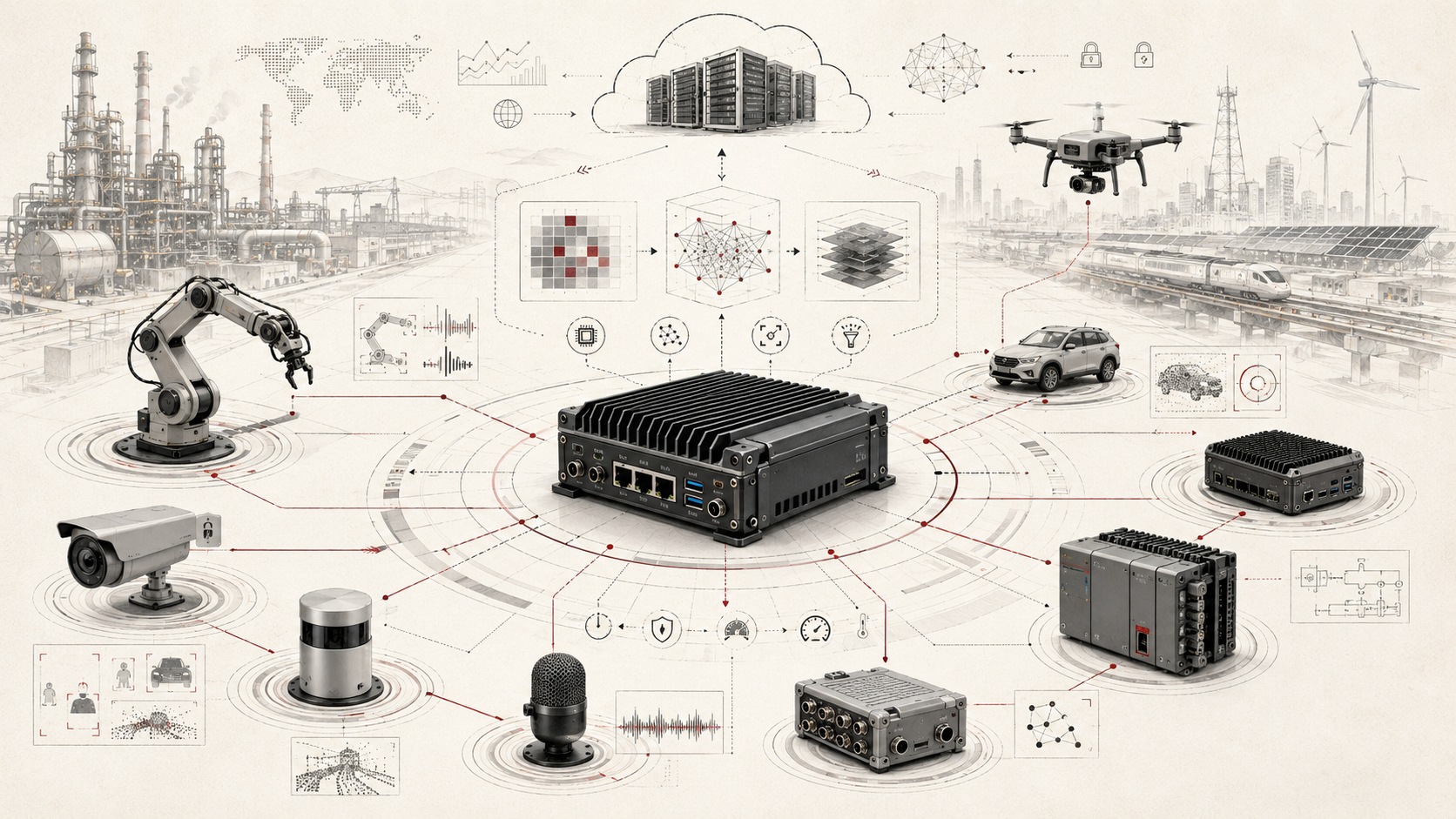
The architectural question is therefore not merely whether a model can be made to run on a device. It is what kind of model should run there, under what memory and power constraints, with what accelerator support, with what confidence logic, with what update discipline, with what monitoring evidence, and with what relationship to upstream analytics and control. Edge AI is strongest when local intelligence improves responsiveness and resilience without making system behavior opaque, unsafe, or operationally ungovernable.
Engineering Problem
The engineering problem is how to place machine-learning inference inside constrained, distributed, safety-adjacent, or intermittently connected systems without breaking timing, memory, energy, privacy, update, validation, or governance requirements. A useful on-device model must not only be accurate in a notebook or training environment. It must fit into an embedded execution path where sensing, preprocessing, scheduling, memory allocation, inference, confidence handling, local action, telemetry, and rollback all matter.
This is different from conventional cloud ML deployment. In the cloud, engineers can often scale compute, store large histories, monitor raw inputs, and redeploy centrally. At the edge, the model may run on a microcontroller with limited RAM and flash, a gateway with local buffering duties, a camera module with an NPU, a battery-powered device with strict duty cycles, or a ruggedized field node that cannot be physically accessed easily after deployment.
Edge AI systems become fragile when the model is treated as a portable artifact detached from its physical and operational context. A model may fit into memory but violate the timing budget. It may achieve strong offline accuracy but fail under sensor drift. It may reduce bandwidth but erase evidence needed for diagnosis. It may improve local autonomy while creating new governance problems because the fleet cannot observe why local predictions changed.
The practical question is therefore: can the system place the right model at the right layer, execute it within hardware limits, preserve enough evidence around its inputs and outputs, and govern its behavior over time?
Reference Architecture
A practical edge AI architecture can be understood as a layered inference-and-governance stack. The exact implementation may involve TensorFlow Lite Micro, LiteRT, ONNX Runtime, Edge Impulse, vendor SDKs, NPU toolchains, DSP kernels, PYNQ overlays, microcontroller firmware, gateway services, local databases, or cloud model registries, but the underlying responsibilities are consistent.
| Layer | Engineering Role | Edge AI Concern | Evidence Artifact |
|---|---|---|---|
| Sensing layer | Collects raw data from microphones, cameras, accelerometers, temperature sensors, current sensors, or other interfaces | Sampling rate, calibration, noise, placement, acquisition timing | Sensor manifest, calibration record, acquisition log |
| Signal conditioning layer | Filters, normalizes, windows, resamples, or denoises local inputs | Feature integrity, latency, numerical stability, reproducibility | Preprocessing manifest, filter configuration, feature version |
| Feature layer | Transforms raw signals into model-ready features | Window size, feature drift, memory footprint, compute cost | Feature schema, feature-extraction version, input-shape record |
| Inference runtime layer | Executes model locally on MCU, CPU, DSP, NPU, GPU, FPGA, or gateway runtime | Operator support, memory arena, acceleration backend, timing | Runtime manifest, model profile, latency report |
| Confidence and decision layer | Interprets model outputs using thresholds, rules, fallback logic, and safety envelopes | False positives, false negatives, uncertainty, local authority | Decision policy, threshold record, fallback log |
| Local action layer | Triggers alarms, local display, device behavior, gateway routing, or selective uplink | Decision authority, safety boundaries, operator visibility | Local decision log, action trace, authority record |
| Telemetry and evidence layer | Reports compact summaries, scores, versions, confidence, and diagnostics upstream | Privacy, bandwidth, interpretability, model monitoring | Inference event schema, telemetry record, evidence pointer |
| Model lifecycle layer | Trains, evaluates, compresses, quantizes, signs, deploys, monitors, and rolls back models | Version control, drift, rollout discipline, field validation | Model card, evaluation report, deployment manifest, rollback plan |
| Security and trust layer | Protects model artifacts, update channels, runtime integrity, and local decision boundaries | Tampering, model substitution, adversarial inputs, local compromise | Signing policy, attestation record, trust profile |
| Fleet monitoring layer | Tracks performance, drift proxies, device coverage, version skew, and incident records | Limited raw data, field heterogeneity, observability gaps | Fleet report, drift summary, model-version inventory |
This architecture makes the model’s role visible. It separates sensing from inference, inference from decision authority, decision authority from action, and local action from upstream governance. Without those distinctions, edge AI can appear technically impressive while remaining difficult to validate, update, or trust after deployment.
Implementation Pattern
A rigorous on-device ML implementation begins by defining the target device, model purpose, input pipeline, model budget, runtime environment, confidence policy, update path, and telemetry requirements. Engineers should specify not only what the model predicts, but how the system obtains inputs, prepares features, schedules inference, handles uncertainty, and reports enough evidence for monitoring.
| Artifact | Purpose | Typical Format |
|---|---|---|
| Device capability profile | Defines RAM, flash, CPU, accelerator, power, timing, and supported runtime constraints | YAML, JSON, hardware inventory |
| Model budget | Defines maximum model size, tensor arena, inference latency, energy, and operator set | YAML, benchmark report, deployment manifest |
| Sensor and feature schema | Defines raw input channels, sampling rate, window size, feature extraction, and input tensor shape | JSON Schema, YAML, CSV |
| Quantization profile | Defines numeric precision, calibration data, scale/zero-point assumptions, and accuracy impact | JSON, model-conversion report |
| Runtime manifest | Defines runtime, backend, operator support, memory behavior, and accelerator delegate | YAML, JSON, build manifest |
| Backend validation report | Compares CPU, accelerator, quantized, and reference outputs under representative inputs | CSV, benchmark report, test artifact |
| Decision policy | Defines confidence thresholds, fallback behavior, local authority, and action limits | YAML, policy-as-code, ruleset manifest |
| Model lifecycle manifest | Defines model version, training data lineage, evaluation metrics, rollout ring, rollback policy, and signature | Model card, YAML, registry metadata |
| Inference event schema | Defines what the device reports: model version, input window ID, confidence, class, latency, and action | SQL, JSON Schema, telemetry schema |
| Field monitoring plan | Defines drift proxies, confidence monitoring, anomaly rates, incident review, and retraining triggers | Runbook, dashboard config, R/Python workflow |
| Security profile | Defines signed model artifacts, secure update, runtime integrity, adversarial-risk controls, and rollback trust | YAML, attestation profile, update policy |
The implementation goal is to make local intelligence inspectable. Engineers should be able to reconstruct which model version ran, what feature pipeline produced the input, how long inference took, what confidence score was produced, what decision policy interpreted it, what local action occurred, and whether that behavior remained inside the device’s authority boundary.
Research-Grade Framing: Edge AI as Local Interpretation Infrastructure
Edge AI should be framed as local interpretation infrastructure. It determines what a device, gateway, or local edge node can infer about physical conditions before data move upstream. This matters because inference changes the meaning of local telemetry. A raw accelerometer stream, microphone waveform, thermal image, or camera frame becomes an interpreted event: normal, anomalous, fault-like, occupied, empty, overheated, damaged, detected, rejected, or uncertain.
That interpretive layer must be engineered with the same seriousness as sensors, communication, power, firmware, and control. If local inference is wrong, stale, biased, overconfident, unmonitored, or running under the wrong model version, the wider system can inherit a false picture of the field. Edge AI can reduce data movement, but it can also reduce visibility if the system emits only conclusions without evidence.
| Evidence Dimension | Question | Required Edge AI Evidence |
|---|---|---|
| Input lineage | Can the system identify what data window produced the inference? | Sensor ID, acquisition time, window ID, feature version |
| Model identity | Can the system identify the exact model that produced the output? | Model name, model version, hash, quantization profile |
| Runtime behavior | Did inference execute within memory, timing, and power budgets? | Latency, tensor arena, memory use, energy estimate, backend |
| Confidence | Was the prediction strong, weak, uncertain, or out-of-distribution? | Score, threshold, calibration record, uncertainty flag |
| Decision authority | What was the local prediction allowed to influence? | Decision policy, authority scope, fallback behavior |
| Update governance | Can engineers know what changed between deployed models? | Model card, evaluation report, rollout ring, rollback record |
| Fleet observability | Can the system detect drift without collecting all raw data? | Confidence distribution, anomaly rate, feature summary, incident log |
In this framing, edge AI is not merely a performance optimization. It is a local knowledge system embedded inside hardware, firmware, runtime, and operational governance.
Formal Model: Sensing, Features, Inference, Confidence, and Action
A useful formal model separates local sensing, feature construction, model inference, confidence handling, and action. Let \(x_t\) represent raw local sensor input, \(\phi(\cdot)\) the feature pipeline, \(f_{\theta}\) the deployed model, \(c_t\) a confidence or uncertainty signal, and \(a_t\) the action or telemetry output.
z_t = \phi(x_{t-k:t})
\]
Interpretation: Feature vector \(z_t\) is produced from a recent sensor window \(x_{t-k:t}\). On-device ML depends as much on feature construction as on the model itself.
\hat{y}_t = f_{\theta}(z_t)
\]
Interpretation: The deployed model \(f_{\theta}\) maps local features to a prediction, classification, anomaly score, or detection result.
c_t = C(\hat{y}_t, z_t, \theta, r_t)
\]
Interpretation: Confidence \(c_t\) can depend on model output, input features, model calibration, and runtime context \(r_t\), such as sensor health, operating mode, memory pressure, or accelerator backend.
a_t = \pi(\hat{y}_t, c_t, h_t, p_t)
\]
Interpretation: Local action \(a_t\) is governed by decision policy \(\pi\), using prediction, confidence, device health \(h_t\), and policy version \(p_t\). Prediction and action should not be collapsed into one step.
This formal structure matters because the model output is not the same thing as a system decision. A prediction must pass through confidence thresholds, policy rules, fallback logic, safety constraints, and local authority boundaries before it influences physical or operational behavior.
What Are Edge AI and On-Device Machine Learning?
Edge AI refers to the placement of artificial intelligence functions at or near the point where data are generated, rather than only in centralized environments. On-device machine learning is the narrower case in which inference runs directly on the endpoint itself: a phone, wearable, camera, industrial controller, microcontroller-based sensor node, gateway, or other embedded device.
What makes this architecture important is that local inference changes the operational role of the device. A system that classifies a sound, recognizes a gesture, detects a pattern in vibration data, identifies an object in a camera frame, or scores a local anomaly is creating interpretation at the device boundary. That makes the model part of the system’s real-time behavior rather than merely part of a remote analytics layer.
In strong architectures, on-device ML is not treated as “AI added on top.” It is treated as part of the sensing-and-decision chain, with explicit attention to memory limits, latency budgets, model lineage, confidence handling, feature integrity, accelerator support, update discipline, and what local predictions are actually authorized to do.
The Edge AI Continuum: MCU, Edge Device, Gateway, Cloud
Edge AI is best understood as a continuum rather than a single deployment pattern. At one end are microcontroller-class systems running highly constrained inference. In this class, inference is shaped by tiny RAM and flash budgets, tight real-time scheduling, limited operator support, and strict energy limits. Models are often quantized aggressively and deployed as inference-only artifacts with carefully bounded memory arenas.
Further along the continuum are larger embedded edge devices and gateways that can support richer runtimes, broader operator coverage, larger memory footprints, local databases, and hardware accelerators such as NPUs, DSPs, GPUs, or FPGAs. Here the model and runtime often have more room to breathe, but deployment is still shaped by latency, privacy, bandwidth, and local autonomy requirements rather than by the assumptions of a full cloud server.
At the far end of the continuum is the cloud, where model training, fleet-wide benchmarking, large-scale retraining, long-horizon analytics, and centralized governance often remain most practical. A coherent edge AI system does not try to force all intelligence into one location. It distributes intelligence according to what each layer can sustain responsibly.
| Layer | Typical AI Role | Primary Constraint | Governance Need |
|---|---|---|---|
| Microcontroller | TinyML inference, keyword spotting, simple anomaly classification | RAM, flash, energy, operator set | Model size, timing, firmware integration, safe fallback |
| Embedded edge device | Local perception, classification, signal screening | Latency, thermal limits, accelerator support | Runtime version, model version, input lineage |
| Gateway | Multi-device inference, aggregation, selective uplink | Buffering, protocol mediation, local policy | Model skew, child-device coverage, site-state evidence |
| Regional edge | Multi-site inference, low-latency coordination | Network topology, cross-site synchronization | Policy consistency, version convergence, incident review |
| Cloud | Training, benchmarking, model registry, fleet monitoring | Data governance, scale, central coordination | Model lifecycle, drift review, rollout and rollback |
The important design task is not choosing “edge” over “cloud,” but assigning each AI responsibility to the layer that can sustain it with the right balance of speed, evidence, privacy, resilience, and governance.
Why Inference Moves Onto the Device
Inference moves onto devices because local prediction often improves latency, privacy, bandwidth efficiency, and robustness under disconnection. A system that waits for cloud round trips to recognize a wake word, detect a machine fault, classify an environmental event, or react to a control-relevant pattern may lose much of the value of the prediction by the time that prediction arrives.
Bandwidth is another strong driver. Sending all raw audio, video, vibration, or sensor data upstream may be impractical or unnecessary when only classifications, alerts, or compact features are needed. On-device inference can therefore act as a filter for meaning: the device determines what deserves to leave the local environment.
Autonomy matters as well. If a device must continue to detect a wake word, identify a fault signature, screen for abnormal conditions, or classify local events during intermittent connectivity, then local inference is not a convenience. It is part of the system’s operational continuity.
Privacy can also motivate local inference, but privacy should not be treated as automatic. A device that keeps raw data local may still emit sensitive labels, embeddings, confidence scores, or event summaries. Strong systems therefore treat edge inference as data minimization plus governance, not as a guarantee that privacy risk disappears.
TinyML and Resource-Constrained Inference
TinyML is the part of the edge AI landscape most closely associated with ultra-low-power microcontrollers and deeply constrained embedded devices. In this setting, the design problem is not merely how to shrink a model, but how to preserve enough predictive utility under strict constraints of memory, storage, compute, timing, and energy.
This matters because TinyML is not simply “small AI.” It changes design assumptions. Training almost always occurs elsewhere. Inference dominates the deployed workload. Models are tightly bound to available operators, runtime features, and hardware limits. The rest of the system must often be reorganized around making the model feasible: signal conditioning, feature extraction, inference scheduling, memory allocation, quantization, and duty cycling all become part of deployment.
Good TinyML architecture therefore treats the model as one element in a larger embedded pipeline rather than as a self-sufficient intelligence layer. A model that fits into flash but breaks timing, drains the battery, or crowds out the rest of the firmware is not well deployed merely because it executes.
| TinyML Constraint | Engineering Question | Evidence Required |
|---|---|---|
| Flash size | Does the model and runtime fit alongside firmware? | Binary size, model size, operator set |
| RAM / tensor arena | Can inference execute without memory failure? | Tensor arena size, peak memory, stack/heap report |
| Latency | Does inference fit inside the timing budget? | Worst-case latency, scheduling profile |
| Energy | Does inference fit the duty cycle or battery budget? | Energy estimate, wake/sleep schedule |
| Operator support | Does the runtime support every model operation? | Operator compatibility report |
| Field update | Can the model be updated without unsafe device behavior? | Signed artifact, rollout ring, rollback plan |
TinyML is strongest when the model, firmware, sensor pipeline, runtime, and device lifecycle are engineered together.
Model Architectures, Quantization, and Compression
On-device machine learning depends heavily on model adaptation. Quantization, pruning, architecture simplification, operator selection, and sometimes knowledge distillation are often necessary to make models practical on embedded targets. In highly constrained systems, model form is inseparable from deployment environment.
This means model design is never only about headline accuracy. A model architecture that performs well in a workstation or cloud environment may be unusable on a small MCU, or may only become viable after quantization, compression, feature-pipeline redesign, or operator substitution. The deployment target constrains the model just as much as the training dataset does.
| Technique | Purpose | Risk | Evidence Needed |
|---|---|---|---|
| Post-training quantization | Reduce model size and improve inference efficiency | Accuracy loss, calibration mismatch | Pre/post quantization metrics, calibration data record |
| Quantization-aware training | Improve quantized model behavior during training | More complex training pipeline | Training configuration, quantized evaluation report |
| Pruning | Reduce unnecessary weights or channels | Potential degradation under field variation | Sparsity profile, validation metrics |
| Knowledge distillation | Train a smaller model using a larger model’s behavior | Teacher-model bias or hidden failure inheritance | Teacher/student evaluation comparison |
| Feature redesign | Move complexity from model to signal pipeline | Feature drift, loss of robustness | Feature schema, feature validation, drift monitoring |
| Operator substitution | Use runtime-compatible operations | Behavioral mismatch with original model | Operator compatibility and accuracy comparison |
The architectural question is therefore not only how accurate a model is, but how much memory it consumes, how much latency it introduces, what runtime features it needs, what fallback behavior exists if confidence is weak, and whether those requirements fit the platform’s power, timing, and lifecycle constraints.
NPUs, DSPs, GPUs, FPGAs, and Accelerator-Aware Deployment
Not all on-device ML runs on bare CPUs. Many embedded and edge platforms increasingly rely on DSP blocks, NPUs, GPUs, FPGAs, or vendor-optimized libraries to make local inference practical. Accelerator-aware deployment changes both performance and architecture. A model may be feasible only on platforms with the right backend support, memory topology, compiler flow, and operator coverage.
This means portability is never just about model file formats. It is about how model structure, runtime, and hardware capabilities fit together in practice. A design that looks portable in theory may behave very differently across CPU-only, DSP-assisted, NPU-backed, GPU-backed, and FPGA-assisted targets.
| Acceleration Target | Strength | Engineering Risk | Validation Need |
|---|---|---|---|
| CPU | Portable baseline execution | Latency and energy may be too high | Worst-case latency and memory benchmark |
| DSP | Efficient signal-processing and some inference workloads | Backend-specific operator limits | Operator coverage and numerical comparison |
| NPU | Efficient neural inference | Vendor toolchain lock-in, conversion constraints | Compiler report, backend benchmark |
| GPU | High-throughput local inference | Power, thermal, and scheduling complexity | Thermal and sustained-load test |
| FPGA / PYNQ | Low-latency feature extraction or custom pipeline acceleration | Hardware/software co-design complexity | Overlay validation, timing evidence, stream tests |
Strong on-device ML design does not treat hardware acceleration as a late-stage optimization discovered after model development. It treats accelerator availability, runtime compatibility, numerical parity, thermal stability, and sustained inference performance as early inputs to model selection, platform choice, and deployment planning.
Inference Runtimes and Embedded ML Toolchains
Inference on embedded targets depends on runtimes and toolchains that mediate between trained models and deployed systems. These runtimes determine operator support, tensor memory planning, debugging visibility, conversion constraints, and hardware backend integration. In practice, the runtime is part of the architecture, not just a library dependency.
This matters because a model is not really deployable until the runtime, toolchain, and hardware platform agree about how that model will execute. Conversion workflows, operator availability, static versus dynamic memory behavior, and accelerator delegates can all determine whether a promising model actually survives contact with the target system.
In mature systems, runtime choice is tied to governance as well as performance. It influences update workflows, testing discipline, portability across hardware families, field diagnostics, and how much control the engineering team retains over inference behavior once devices are deployed.
| Runtime Concern | Why It Matters | Evidence Artifact |
|---|---|---|
| Operator support | The runtime may not support all model operations | Operator compatibility report |
| Memory planning | Embedded inference often requires static memory discipline | Tensor arena profile, peak memory report |
| Conversion path | Model conversion can change numerical behavior | Conversion log, pre/post comparison |
| Backend delegate | Hardware acceleration may depend on vendor-specific delegates | Backend manifest, benchmark record |
| Diagnostics | Field failures require runtime-level evidence | Inference logs, error codes, watchdog records |
| Update compatibility | New models may require new runtime capabilities | Runtime version, compatibility matrix |
The runtime is where model theory becomes deployed system behavior. It deserves explicit architecture, testing, and lifecycle governance.
Runtime and Accelerator Validation
Runtime validation should prove that the deployed model behaves acceptably on the actual target path, not only in a training framework or conversion tool. Engineers should validate numerical parity, latency, memory, operator compatibility, thermal behavior, sustained inference performance, and fallback behavior across the hardware and runtime combinations that will exist in the field.
This is especially important when the same model may run across several hardware classes. A CPU-only gateway, NPU-backed device, DSP-assisted module, GPU-enabled edge box, and FPGA-assisted feature pipeline may all produce slightly different performance, latency, precision, memory, and thermal behavior. A deployment is not fully validated until those differences are measured and bounded.
| Validation Area | Engineer Test | Acceptance Evidence |
|---|---|---|
| Numerical parity | Compare reference model, converted model, quantized model, and backend output | Maximum output delta, class agreement, regression report |
| Operator compatibility | Verify all model operations are supported by the runtime and accelerator path | Operator coverage matrix, conversion log |
| Latency distribution | Measure p50, p95, p99, and worst-case latency under realistic input cadence | Latency histogram, timing-budget pass/fail |
| Memory behavior | Measure model size, tensor arena, stack, heap, buffers, and firmware coexistence | Memory budget report, peak memory trace |
| Sustained load | Run repeated inference under expected duty cycle and environmental conditions | Sustained benchmark, watchdog events, thermal state |
| Accelerator fallback | Test behavior when accelerator path is unavailable, degraded, or unsupported | Fallback path, error code, local decision restriction |
| Version compatibility | Confirm model artifact, runtime, firmware, and policy versions are compatible | Compatibility manifest, deployment gate result |
This validation layer turns “the model runs” into “the model runs correctly, within constraints, on the intended execution path, with recoverable evidence.” That distinction is central to engineering-grade edge AI.
Local ML Pipelines: Sensing, Features, Inference, Action
On-device ML should be understood as one stage inside a local intelligence pipeline rather than as a standalone artifact. Raw data are sensed, normalized or featurized, passed into a model, interpreted under confidence logic, and then linked to some action: local display, alarm, control adjustment, deferred transmission, selective export, or request for upstream review.
This matters because models rarely operate directly on the world. They operate on prepared inputs. In tiny embedded systems, feature extraction may be as important as the model itself. In larger edge systems, inference may still be only one step before post-processing, thresholding, business rules, or multi-signal fusion determine whether a decision is made locally.
| Pipeline Stage | Engineering Role | Failure Risk |
|---|---|---|
| Sensing | Acquire local physical signals | Noise, drift, placement error, calibration error |
| Windowing | Select the time interval or sample group for inference | Wrong window size, temporal mismatch, missing events |
| Preprocessing | Normalize, filter, resample, denoise, or transform inputs | Numerical mismatch between training and deployment |
| Feature extraction | Compute compact inputs for constrained inference | Feature drift, loss of important signal structure |
| Inference | Run model locally | Latency, memory failure, unsupported operators |
| Post-processing | Convert raw model output into interpretable local result | Bad thresholds, poor calibration, overconfidence |
| Decision policy | Determine what the prediction may influence | Unsafe automation, unclear authority |
| Telemetry | Report model output and evidence upstream | Loss of interpretability, privacy leakage, bandwidth pressure |
Strong architectures keep the pipeline legible. They preserve the distinction between raw inputs, engineered features, model outputs, confidence decisions, and final local actions. Without that structure, on-device intelligence becomes harder to debug, validate, and trust.
Confidence Logic, Thresholds, Fallbacks, and Safety Envelopes
A local model output should not automatically become a local action. On-device ML systems need confidence logic, thresholding, uncertainty handling, fallback behavior, and safety envelopes that determine when a prediction is strong enough to use and what it is allowed to influence.
This is especially important because field conditions often differ from training conditions. Sensors age, environments change, mounting positions shift, power conditions vary, and local noise patterns evolve. A model may still produce a numerical prediction even when the input is outside its intended operating region. That prediction needs interpretation.
| Decision Condition | Recommended Behavior | Evidence to Log |
|---|---|---|
| High confidence, healthy sensor, valid policy | Allow local decision within authority boundary | Prediction, confidence, model version, policy version |
| Low confidence | Defer, request more samples, or uplink for review | Confidence score, threshold, input window ID |
| Out-of-distribution proxy detected | Fail conservative or enter degraded mode | OOD flag, feature range, fallback action |
| Sensor health degraded | Suppress or qualify prediction | Sensor health, calibration status, quality flag |
| Model version stale | Restrict action or flag model lifecycle issue | Active model version, approved model version |
| Safety-relevant action requested | Require rule-based guard, human review, or safe envelope | Action request, guard result, override status |
Confidence logic is where machine learning becomes system design. The model may estimate, but the architecture decides what the estimate is allowed to do.
Model Versioning, Monitoring, and Field Governance
Once models are deployed into embedded systems, lifecycle governance becomes a core architectural issue. It is not enough to prove that a model can run on a device at one moment in time. The system must know which model version is running on which device, what data regime that model expects, how updates are staged and rolled back, and how degraded or drifting behavior is detected after deployment.
These questions become sharper at the edge because many systems cannot transmit all raw data continuously for centralized review. That makes monitoring harder. A fielded device may only emit features, scores, event labels, or local summaries, leaving engineers with less direct visibility into why performance has shifted. Monitoring deployed AI therefore becomes not only an MLOps problem but also an architectural observability problem.
A proof-of-concept may survive manual deployment. A real embedded AI fleet cannot. Mature edge AI architectures include version control, rollout discipline, model signing, field telemetry, rollback procedures, and explicit policy for what local predictions are allowed to influence without upstream review.
| Lifecycle Question | Why It Matters | Governance Artifact |
|---|---|---|
| Which model is running? | Different devices may run different versions | Model inventory, active-version telemetry |
| Was the model changed safely? | Compressed or quantized models may behave differently | Evaluation report, conversion report |
| How was the rollout staged? | Fleet-wide deployment can amplify failures | Rollout ring, canary result, rollback plan |
| Is the model drifting? | Raw data may not be available centrally | Confidence distribution, anomaly rate, feature summary |
| Can local decisions be reconstructed? | Edge predictions may influence physical or operational behavior | Inference event log, decision policy, action trace |
| Can unsafe behavior be reversed? | Field updates may fail or create version skew | Signed rollback artifact, recovery runbook |
Governance is not a bureaucratic add-on to edge AI. It is what keeps local intelligence from becoming invisible local authority.
Model Monitoring Modes for Edge AI Fleets
Edge AI monitoring is different from cloud model monitoring because raw data may be unavailable, incomplete, privacy-restricted, expensive to transmit, or intentionally retained locally. Engineers therefore need multiple monitoring modes. Each mode reveals a different part of field behavior, and no single signal is enough to prove that a deployed edge model remains trustworthy.
| Monitoring Mode | What It Tracks | Engineering Value | Limitation |
|---|---|---|---|
| Raw-data monitoring | Selected raw windows, images, audio clips, or sensor traces | Supports direct debugging, relabeling, and incident review | High bandwidth, storage, privacy, and governance burden |
| Feature-summary monitoring | Means, variance, ranges, spectral features, embeddings, or compressed input statistics | Supports drift detection without full raw-data upload | Can miss semantic changes not captured by selected features |
| Confidence-distribution monitoring | Prediction confidence, margin, entropy, uncertainty, or threshold proximity | Detects calibration changes and rising uncertainty | High confidence can still be wrong under distribution shift |
| Class-rate / anomaly-rate monitoring | Frequency of predicted classes, detections, alarms, or anomaly scores | Detects operational changes and possible model drift | Rate changes may reflect real-world change, not model failure |
| Fallback-rate monitoring | How often confidence logic suppresses action or enters degraded mode | Reveals weak confidence, sensor problems, or runtime constraints | Requires well-designed fallback taxonomy |
| Incident-triggered evidence capture | Raw or richer context captured only around anomalies, failures, or reviewed events | Balances bandwidth/privacy with forensic usefulness | May miss slow drift or normal-case degradation |
| Version-skew monitoring | Active, deployed, approved, and decision-used model versions | Supports rollout governance and incident reconstruction | Does not itself prove model quality |
A mature fleet uses these modes together. Raw-data review may be reserved for incidents or sampled audits. Feature summaries and confidence distributions can run continuously. Class-rate and anomaly-rate monitoring can show field behavior shifts. Fallback and version-skew signals can reveal whether the system is still operating within its validated model lifecycle.
Security, Privacy, and Trust in On-Device AI
On-device machine learning often improves privacy because raw data can remain local, but it also introduces new trust questions. A local model may handle sensitive inputs, make consequential decisions, or become a target for reverse engineering, tampering, model substitution, adversarial manipulation, or runtime compromise. The security challenge therefore shifts rather than disappears.
Good architecture should account for model confidentiality where needed, protection of update channels, integrity of runtime behavior, and the boundaries of local decision authority. A device that can infer locally is not only a sensor. It is a decision surface. That makes trust in the platform, runtime, update process, and model artifact as important as trust in the model’s predictive quality.
| Security / Privacy Concern | Risk | Control Pattern |
|---|---|---|
| Model substitution | Unauthorized model changes local behavior | Signed model artifacts, version pinning, secure boot where possible |
| Update-channel compromise | Attacker injects model or runtime update | Signed updates, encrypted transport, rollback verification |
| Adversarial input | Crafted inputs produce wrong local predictions | Input validation, confidence checks, fallback policy |
| Privacy leakage through outputs | Labels, embeddings, or scores reveal sensitive information | Data minimization, output review, selective uplink policy |
| Runtime tampering | Inference behavior differs from validated deployment | Runtime integrity checks, attestation, watchdogs |
| Overbroad local authority | Prediction triggers unsafe or unsupported action | Decision policy, safety envelope, human review where needed |
Strong on-device AI systems therefore combine privacy advantages with governance: local data minimization, secure model deployment, controlled updates, runtime integrity, and clear rules for when local inference may trigger consequential behavior.
Partitioning Edge and Cloud AI Responsibilities
On-device machine learning is strongest when paired with a clear partition between local and upstream AI responsibilities. The device is well suited to low-latency inference, privacy-preserving interpretation, wake-word detection, gesture recognition, local fault classification, and other immediate tasks. The cloud is often better suited to model training, fleet-wide benchmarking, cross-site comparison, large-scale retraining, and broader policy coordination.
This division should be explicit rather than accidental. A weak architecture pushes too much model dependence into tiny devices that cannot be managed or observed properly, or too much central dependence into systems that need local autonomy. A strong one ensures that each layer performs the AI functions it can sustain responsibly.
| AI Function | Usually Edge-Appropriate When… | Usually Cloud-Appropriate When… |
|---|---|---|
| Inference | Latency, privacy, bandwidth, or disconnection matters | Model is too large or requires broad context |
| Feature extraction | Raw data are high-volume or privacy-sensitive | Features require global context or expensive computation |
| Training | Rarely on tiny devices; possible for bounded adaptation on larger edge nodes | Fleet data, benchmarking, governance, and compute scale are needed |
| Model evaluation | Local smoke tests, runtime benchmarks, hardware validation | Cross-site validation, regression testing, representative test sets |
| Monitoring | Local health, confidence, latency, and fallback signals | Fleet drift, version skew, incident analysis, retraining triggers |
| Policy coordination | Local thresholds and fallback rules within defined authority | Approval, rollout, rollback, and lifecycle governance |
The question is not whether AI should run locally or centrally. It is which AI functions belong where if the overall system is to remain responsive, interpretable, secure, and governable.
Worked Example: TinyML Vibration Anomaly Detection at the Edge
Consider a battery-powered or gateway-connected vibration monitoring system for rotating equipment. The device samples accelerometer data, windows the signal, computes compact features, runs a quantized anomaly classifier locally, and sends only event summaries or diagnostic windows upstream. The cloud trains and evaluates candidate models, signs approved artifacts, coordinates rollout, and monitors field behavior through compact telemetry.
| Step | Edge AI Behavior | Engineering Evidence |
|---|---|---|
| Local acquisition | Accelerometer samples vibration at configured rate | Sensor ID, sampling rate, acquisition time, calibration status |
| Windowing | Device creates fixed-length signal windows | Window ID, window size, overlap, missing-sample count |
| Feature extraction | Firmware computes RMS, spectral energy, peak, crest factor, or learned features | Feature version, feature schema, numerical range checks |
| Quantized inference | TinyML model classifies normal, warning, or fault-like state | Model version, quantization profile, latency, tensor arena usage |
| Confidence handling | Decision policy interprets score and threshold | Confidence score, threshold, OOD proxy, fallback status |
| Local action | Device or gateway emits local alarm or marks event for priority uplink | Action log, policy version, authority status |
| Selective uplink | Only summary, anomaly score, and evidence pointer are sent upstream | Telemetry schema, raw-retention pointer, upload time |
| Fleet monitoring | Cloud tracks anomaly rates, confidence distributions, version skew, and incidents | Fleet report, drift proxy, model inventory, rollback status |
A concrete deployment budget makes the engineering problem sharper. The values below are illustrative, but the artifact type is important: every edge AI deployment should define target budgets before rollout and validate actual behavior against them.
| Deployment Budget | Example Target | Validation Evidence |
|---|---|---|
| Sampling rate | 1–4 kHz vibration stream, depending on equipment class | Acquisition log, missed-sample count |
| Window length | 256–1024 samples with documented overlap | Window manifest, feature pipeline test |
| Feature set | RMS, peak, crest factor, spectral energy, bandpower | Feature schema, numerical parity test |
| Model size | Fits inside flash budget alongside firmware and runtime | Binary size report, model artifact size |
| Tensor arena | Fits inside RAM after stack, heap, buffers, and firmware allocation | Tensor arena profile, peak memory test |
| Inference latency | p95 and worst-case latency below control or alerting budget | Latency benchmark, sustained-load test |
| Confidence threshold | Threshold chosen from validation data and field-risk tolerance | Calibration curve, false-positive / false-negative trade-off |
| Fallback behavior | Low confidence requests more samples or uplinks summary for review | Fallback log, decision-policy test |
| Uplink policy | Transmit event summary immediately; retain raw window locally for bounded period | Selective uplink record, retention pointer |
| Rollback path | Signed previous model remains deployable if field metrics degrade | Rollback test, signed artifact, recovery runbook |
This example shows why edge AI is more than a model file. The accuracy of the classifier matters, but so do the sensor pipeline, feature construction, quantization behavior, memory budget, latency budget, confidence logic, event evidence, and fleet governance. A model that works in training but fails to preserve inference evidence in the field is not an engineering-grade edge AI system.
Deployment Readiness Gate
An engineering-grade edge AI deployment should pass a readiness gate before field rollout. The gate should not only ask whether the model performs well on a validation set. It should ask whether the complete sensing-to-action pathway is ready for constrained execution, monitoring, update, and rollback.
| Readiness Check | Pass Condition | Why It Matters |
|---|---|---|
| Model artifact signed | Model hash, signature, and approved version recorded | Prevents unauthorized model substitution |
| Runtime compatible | All required operators supported on target backend | Prevents field failure after conversion or acceleration |
| Memory budget passed | Model, runtime, tensor arena, firmware, stack, heap, and buffers fit together | Prevents hidden instability on constrained devices |
| Latency budget passed | p95, p99, and worst-case sensing-to-action latency are within limits | Protects real-time and near-real-time behavior |
| Quantization regression passed | Quantized model meets accuracy, calibration, and confidence requirements | Prevents compression from quietly degrading behavior |
| Backend parity passed | Reference, converted, CPU, and accelerator outputs remain within tolerance | Protects against runtime-specific numerical surprises |
| Decision policy deployed | Thresholds, fallback logic, authority boundaries, and action rules are versioned | Separates prediction from local authority |
| Telemetry schema deployed | Inference events include model, feature, confidence, latency, action, and fallback fields | Makes local inference observable |
| Monitoring dashboard ready | Confidence, class rate, fallback, latency, drift proxy, and version-skew signals visible | Supports field governance after deployment |
| Rollback tested | Previous signed model can be restored and verified on target devices | Limits field damage from failed updates |
This readiness gate is what separates a promising edge AI prototype from a fieldable embedded system. It turns model deployment into an accountable engineering process.
Data and Configuration Artifacts
Edge AI systems become easier to build, test, and maintain when their assumptions are represented as machine-readable artifacts. Engineers should be able to inspect device capability, model budget, feature schema, quantization profile, runtime manifest, decision policy, lifecycle state, telemetry schema, and security profile without relying only on diagrams or undocumented deployment knowledge.
| Artifact | What It Captures | Engineering Purpose |
|---|---|---|
device_capability_profile.yml |
RAM, flash, CPU, accelerator, power, timing, and supported runtime constraints | Prevents models from being selected outside hardware limits |
model_budget.yml |
Model size, tensor arena, latency target, energy budget, and operator set | Makes deployment feasibility measurable |
sensor_feature_schema.json |
Input channels, sampling, windows, features, tensor shape, and units | Preserves training/deployment pipeline alignment |
quantization_profile.yml |
Precision, calibration data, scale/zero-point, and accuracy impact | Makes compression effects inspectable |
runtime_manifest.yml |
Runtime, backend, operator coverage, tensor memory, and accelerator delegate | Connects model behavior to execution platform |
backend_validation_report.csv |
Reference, converted, CPU, and accelerator output comparison | Detects runtime and accelerator parity issues |
decision_policy.yml |
Thresholds, confidence logic, fallback behavior, local authority, and action limits | Separates prediction from action |
model_lifecycle_manifest.yml |
Model version, training data lineage, evaluation, rollout, rollback, and signature | Supports model governance and field updates |
inference_event_schema.sql |
Model version, input window, confidence, class, latency, and local action | Makes local inference observable |
fleet_monitoring_plan.yml |
Confidence monitoring, drift proxies, incident review, and retraining triggers | Supports field governance when raw data are limited |
edge_ai_security_profile.yml |
Model signing, secure update, runtime integrity, and local decision boundaries | Protects the local inference surface |
The goal is not to force one edge AI stack. The goal is to make local intelligence inspectable. If the model, runtime, feature pipeline, and decision policy cannot be found in artifacts, they will be difficult to test, debug, update, or govern after deployment.
Mathematical Lens: Latency, Memory, Quantization, Confidence, and Drift
A practical mathematical lens for edge AI begins with feasibility. A model is deployable only if it fits memory, timing, energy, and runtime constraints while preserving enough accuracy and confidence behavior for the system’s purpose.
L_{\mathrm{total}} = L_{\mathrm{sense}} + L_{\mathrm{feature}} + L_{\mathrm{infer}} + L_{\mathrm{post}} + L_{\mathrm{action}}
\]
Interpretation: Total local latency includes sensing, feature extraction, inference, post-processing, and action. Model latency alone is not enough to validate real-time behavior.
M_{\mathrm{total}} = M_{\mathrm{model}} + M_{\mathrm{runtime}} + M_{\mathrm{tensor}} + M_{\mathrm{firmware}} + M_{\mathrm{buffer}}
\]
Interpretation: Total memory demand includes the model, runtime, tensor arena, firmware, and buffers. A model that fits alone may still fail inside the full embedded system.
\epsilon_q = \left| \mathrm{Metric}(f_{\theta}) – \mathrm{Metric}(Q(f_{\theta})) \right|
\]
Interpretation: Quantization error \(\epsilon_q\) measures the performance difference between the original model and quantized model. Compression must be evaluated, not assumed harmless.
\Delta_{\mathrm{backend}} = \left| f_{\mathrm{ref}}(z_t) – f_{\mathrm{target}}(z_t) \right|
\]
Interpretation: Backend deviation measures the difference between reference-model output and target-runtime output. Runtime and accelerator differences should be measured, not assumed equivalent.
a_t =
\begin{cases}
\mathrm{act}(\hat{y}_t), & c_t \geq \tau \ \mathrm{and}\ h_t = \mathrm{healthy} \\
\mathrm{fallback}, & c_t < \tau \ \mathrm{or}\ h_t \neq \mathrm{healthy}
\end{cases}
\]
Interpretation: Local action should depend on confidence threshold \(\tau\) and device health \(h_t\), not only on the predicted class.
D_t = d(P_{\mathrm{train}}(z), P_{\mathrm{field},t}(z))
\]
Interpretation: Drift proxy \(D_t\) measures how field features differ from the training feature distribution. Edge fleets often need feature and confidence proxies because raw data may not be continuously uploaded.
The key engineering point is that edge AI should be measurable. Latency, memory, quantization impact, backend deviation, confidence distribution, feature drift, model-version skew, and fallback rate should be operational signals, not hidden assumptions.
Python Workflow: Edge AI Model Budgeting, Quantization, and Deployment Simulation
The companion Python workflow should model the practical constraints that determine whether an on-device model is deployable: memory footprint, latency, quantization impact, confidence thresholds, device health, fallback behavior, rollout state, backend parity, and drift proxies.
# Python Workflow: Edge AI Model Budgeting, Quantization, and Deployment Simulation

deployment_feasible = (
    model_size_kb <= flash_budget_kb
    and tensor_arena_kb <= ram_budget_kb
    and total_latency_ms <= latency_budget_ms
    and estimated_energy_mj <= energy_budget_mj
    and backend_output_delta <= backend_delta_tolerance
)

local_action_allowed = (
    confidence >= confidence_threshold
    and sensor_health == "healthy"
    and model_version == approved_model_version
    and deployment_feasible
)

if local_action_allowed:
    action = decision_policy[predicted_class]
else:
    action = fallback_policy.reasoned_fallback(
        confidence=confidence,
        sensor_health=sensor_health,
        model_version=model_version,
        deployment_feasible=deployment_feasible,
        backend_output_delta=backend_output_delta
    )

inference_event = {
    "device_id": device_id,
    "model_version": model_version,
    "runtime_backend": runtime_backend,
    "feature_version": feature_version,
    "latency_ms": total_latency_ms,
    "confidence": confidence,
    "predicted_class": predicted_class,
    "backend_output_delta": backend_output_delta,
    "action": action,
    "fallback_used": not local_action_allowed
}
This workflow is useful because it makes edge AI constraints executable. Engineers can test what happens when a quantized model loses accuracy, tensor memory exceeds the device budget, confidence drops, sensor health degrades, model versions skew, backend parity fails, latency increases, or field features drift away from the training distribution.
For production systems, the same workflow can be connected to model registries, firmware build artifacts, device telemetry, gateway logs, runtime benchmarks, feature summaries, confidence distributions, and fleet monitoring systems.
R Workflow: Edge AI Fleet Monitoring and Model Performance Reporting
The companion R workflow should focus on reporting across devices, models, runtimes, hardware classes, confidence bands, fallback rates, latency budgets, memory budgets, backend deviations, and drift proxies. It can summarize whether deployed models remain within operational constraints across the fleet.
# R Workflow: Edge AI Fleet Monitoring and Model Performance Reporting

edge_ai_summary <- inference_events |>
  dplyr::group_by(device_class, model_version, runtime_backend) |>
  dplyr::summarise(
    events = dplyr::n(),
    mean_latency_ms = mean(latency_ms, na.rm = TRUE),
    p95_latency_ms = quantile(latency_ms, 0.95, na.rm = TRUE),
    p99_latency_ms = quantile(latency_ms, 0.99, na.rm = TRUE),
    mean_confidence = mean(confidence, na.rm = TRUE),
    low_confidence_rate = mean(confidence < confidence_threshold, na.rm = TRUE),
    fallback_rate = mean(fallback_used == TRUE, na.rm = TRUE),
    model_skew_rate = mean(model_version != approved_model_version, na.rm = TRUE),
    drift_proxy_mean = mean(drift_proxy, na.rm = TRUE),
    backend_delta_p95 = quantile(backend_output_delta, 0.95, na.rm = TRUE),
    memory_violation_rate = mean(memory_ok == FALSE, na.rm = TRUE),
    latency_violation_rate = mean(latency_ok == FALSE, na.rm = TRUE),
    .groups = "drop"
  )
This reporting layer helps distinguish model problems from deployment problems. High latency may point to runtime or accelerator mismatch. High fallback rate may indicate confidence calibration issues or field drift. Version skew may reveal weak rollout governance. Memory violations may indicate that the model budget does not reflect the full embedded workload. Backend-output deviation may reveal runtime conversion or accelerator parity problems.
For edge AI fleets, this kind of reporting is essential because models may continue producing predictions even when their operating conditions have shifted beyond the assumptions under which they were validated.
Systems Code: TinyML, MicroPython, C/C++, Rust, Go, PYNQ, HDL, Bash, and Configuration
The companion repository should be useful to engineers because edge AI crosses the full embedded and edge stack. It touches feature extraction, quantized inference, C/C++ firmware integration, MicroPython prototypes, TinyML model manifests, runtime validation, Rust safety checks, Go telemetry services, PYNQ acceleration, HDL stream handling, SQL evidence schemas, Python/R analysis, Bash workflows, and YAML/JSON deployment metadata.
| Folder | Engineering Role | Edge AI Use |
|---|---|---|
python/ |
Simulation, benchmarking, deployment analysis | Model budget checks, quantization impact, confidence logic, drift proxy |
r/ |
Fleet reporting and descriptive analytics | Model monitoring, fallback rates, latency reports, version skew |
sql/ |
Queryable inference evidence | Inference events, model inventory, feature summaries, drift records |
c/ |
Firmware-adjacent inference scaffolding | Feature extraction, thresholding, memory-budget checks, local action |
cpp/ |
Embedded runtime abstraction | Inference state machine, confidence policy, model lifecycle state |
rust/ |
Safe systems validation | Model budget validation, inference event validation, policy checks |
go/ |
Operational services and telemetry utilities | Inference event router, model-version inventory, fleet health API |
micropython/ |
Microcontroller prototypes | Sensor windowing, simple feature extraction, local classification stub |
tinyml/ |
Constrained ML artifacts | Quantized model manifest, anomaly classifier scaffold, runtime metadata |
pynq/ |
FPGA-backed edge acceleration | Feature extraction overlay validation and low-latency preprocessing |
hdl/ |
Hardware/software co-design | Stream timestamping, feature-windowing, inference trigger, telemetry framing |
bash/ |
Repeatable workflow execution | Runs simulations, validates manifests, generates outputs and inventory |
config/ |
Machine-readable deployment metadata | Device capability, model budget, quantization, runtime, decision policy |
This stack matters because edge AI is not produced by a single model file. It is produced by the interaction among sensors, features, runtimes, hardware, firmware, telemetry, governance, and operational monitoring.
Testing and Validation
Edge AI systems should be validated under the conditions that make on-device inference necessary: constrained memory, low power, changing sensor conditions, intermittent connectivity, runtime conversion, quantization, accelerator differences, model-version skew, and limited upstream visibility.
A practical validation suite should answer these questions:
- Does the model fit within flash, RAM, tensor arena, and firmware memory budgets?
- Does total pipeline latency fit the system timing budget, not only model inference latency?
- Does quantization preserve acceptable accuracy, calibration, and confidence behavior?
- Does the runtime support every model operator required by the converted model?
- Do CPU, accelerator, converted, and reference outputs remain within accepted numerical tolerance?
- Does the feature pipeline match the training pipeline in sampling, windowing, normalization, and units?
- Does local confidence logic prevent weak predictions from triggering unsupported action?
- Does the device log model version, feature version, confidence, latency, backend, and action?
- Can field monitoring detect version skew, confidence drift, fallback spikes, anomaly-rate changes, and backend-specific regressions?
- Can the model be rolled back safely if field behavior degrades?
- Are secure update, model signing, runtime integrity, and local decision boundaries tested?
Testing should include negative cases. Engineers should deliberately test low confidence, bad sensor health, unsupported operator conversion, quantization degradation, memory exhaustion, stale model version, high latency, backend-output drift, out-of-distribution feature proxies, adversarial-like inputs, and failed update rollback. Edge AI failures are dangerous when the model continues producing outputs while the system no longer understands whether those outputs are valid.
Operational Signals and Edge AI Observability
Edge AI observability is the ability to understand whether local inference remains trustworthy, not merely whether the device is online. A device can continue reporting predictions while its model is stale, its sensor is drifting, its confidence is collapsing, its runtime is overloaded, or its feature distribution has shifted.
| Signal | What It Reveals | Why Engineers Need It |
|---|---|---|
| Model version | Which model produced local outputs | Detects version skew and supports incident review |
| Runtime backend | CPU, DSP, NPU, GPU, FPGA, or MCU runtime path | Explains latency, memory, and numerical variation |
| Inference latency | Time required for local inference | Confirms timing-budget compliance |
| Tensor arena / memory use | Whether inference fits inside memory limits | Prevents hidden deployment instability |
| Backend-output delta | Difference between reference and target runtime outputs | Detects conversion or accelerator parity problems |
| Confidence distribution | Whether predictions remain strong or uncertain | Detects calibration and field-distribution problems |
| Fallback rate | How often local prediction is suppressed or degraded | Reveals weak confidence, sensor issues, or policy restrictions |
| Feature summary | How field inputs compare with expected ranges | Supports drift monitoring without uploading raw data |
| Anomaly / class rate | Frequency of predicted classes or anomaly events | Detects behavior shifts and operational changes |
| Sensor health | Input quality, calibration state, and missing samples | Prevents model outputs from hiding bad inputs |
| Decision-used policy version | Which local decision rule interpreted model output | Separates prediction from action governance |
| Rollback status | Whether recovery path is available and tested | Protects fleet after failed model updates |
| Privacy / uplink mode | What data or summaries leave the device | Connects local inference to data-minimization policy |
Engineers should design these signals before deployment. If the system cannot reconstruct model identity, feature context, confidence, latency, runtime backend, backend parity, and local action, then on-device intelligence becomes difficult to govern.
Common Failure Modes
Edge AI systems fail in predictable ways because they combine machine-learning uncertainty with embedded constraints. Engineers should design architecture, tests, and observability around these failure modes from the beginning.
- Model too large: the model fits in training but exceeds device flash, RAM, or tensor arena limits.
- Pipeline mismatch: deployed feature extraction differs from the training pipeline.
- Quantization degradation: compressed model behavior diverges from the original model.
- Unsupported operators: runtime or accelerator backend cannot execute the converted model cleanly.
- Backend parity failure: CPU, accelerator, reference, or converted outputs diverge beyond accepted tolerance.
- Latency violation: total sensing-to-action time exceeds the embedded timing budget.
- Thermal or sustained-load degradation: inference works briefly but fails under continuous operation.
- Overconfident local action: weak or invalid predictions trigger consequential behavior.
- Sensor drift: changing physical inputs degrade model performance without obvious model failure.
- Version skew: devices in the fleet run different model versions without clear evidence.
- Monitoring opacity: the fleet uploads labels but not enough feature, confidence, runtime, or fallback evidence.
- Privacy leakage: local predictions or embeddings reveal sensitive information even when raw data stay local.
- Update failure: model or runtime update breaks field behavior without safe rollback.
- Security compromise: model artifact, update channel, or runtime is tampered with.
A mature edge AI architecture does not assume these failures can be eliminated. It makes them detectable, bounded, testable, recoverable, and reviewable.
Trade-Offs in Edge AI Design
Edge AI designs are shaped by trade-offs that cannot all be optimized at once. Smaller models reduce memory and energy cost but may lose accuracy or robustness. Heavier models may improve predictive power but break timing or power budgets. More local inference improves autonomy but increases update and monitoring burden. More cloud dependence simplifies some governance but weakens resilience under disconnection.
The right design depends on purpose. Keyword spotting, industrial anomaly screening, environmental event classification, wearable activity detection, local vision screening, and robotics perception all require different balances of memory, latency, privacy, autonomy, and fleet management.
Good edge AI architecture is therefore proportional. It places only the necessary intelligence on-device, preserves enough lineage around what the model is doing, and ensures that local prediction strengthens rather than destabilizes the wider system. The model should be large enough to be useful, small enough to be dependable, and governed enough to remain trustworthy after deployment.
The central discipline is not putting AI everywhere. It is placing the right intelligence at the right layer under the right operational constraints.
Applications in Embedded and Edge Systems
Tiny embedded intelligence. Keyword spotting, gesture detection, sound classification, and simple predictive-maintenance screening are strong TinyML-style applications because they benefit from immediate local inference on constrained targets and do not always need full upstream raw-data transmission.
Industrial and operational edge. In equipment monitoring and site operations, local models can screen for abnormal vibration, classify operating states, or identify fault signatures so that higher-cost upstream analytics only activate when needed. This reduces bandwidth while preserving fast local response.
Vision and perception edge. Cameras and perception devices often use on-device ML because raw video is expensive to transport and useful decisions may need to happen locally. Detection, classification, or scene screening at the edge can turn continuous high-rate input into selective event output.
Wearables and personal devices. On-device ML is especially valuable when privacy and responsiveness matter together. Local inference can support activity recognition, wake-word detection, personalization, or health-adjacent pattern detection while minimizing raw-data exposure.
Environmental and infrastructure monitoring. Edge AI can classify acoustic events, detect water-level anomalies, screen camera traps, classify air-quality events, identify vibration patterns, or support remote infrastructure monitoring where bandwidth and connectivity are limited.
Robotics and autonomous systems. Local inference can support perception, obstacle detection, state classification, anomaly detection, and safety monitoring in systems that cannot wait for distant cloud responses.
The unifying pattern is not one framework or one chip class. It is the need to create useful local intelligence under real limits of memory, power, bandwidth, timing, and trust.
Engineer Checklist
- Define why inference belongs on-device rather than only in the cloud.
- Document device RAM, flash, CPU, accelerator, power, and timing constraints before model selection.
- Measure total sensing-to-action latency, not only model inference latency.
- Preserve training/deployment alignment for sampling, windowing, feature extraction, normalization, and units.
- Evaluate quantization, compression, pruning, or operator substitution against deployment metrics, not only accuracy.
- Validate runtime and accelerator parity across reference, converted, CPU, and target-backend outputs.
- Log model version, runtime backend, feature version, confidence, latency, backend delta, and decision-used policy version.
- Separate model output from local action through confidence thresholds, fallback logic, and safety envelopes.
- Track version skew, confidence distributions, fallback rate, feature drift proxies, anomaly-rate shifts, and backend-specific regressions across the fleet.
- Use signed model artifacts, secure update paths, rollback plans, and runtime integrity checks.
- Define what data stay local, what summaries are uplinked, and what evidence is retained for investigation.
- Test low confidence, sensor drift, memory exhaustion, runtime mismatch, accelerator variation, update failure, and rollback.
- Confirm that edge inference improves responsiveness without making system behavior opaque or ungovernable.
This checklist is intentionally practical. Edge AI becomes trustworthy when engineers can explain what the device sensed, how features were formed, which model ran, how confident it was, how the runtime behaved, what action was allowed, and how the fleet will detect when local intelligence stops behaving as expected.
GitHub Repository
This article is supported by a companion workflow that models on-device machine learning using model budgets, feature schemas, quantization profiles, runtime manifests, confidence logic, backend validation, local decision policy, inference telemetry, drift proxies, fleet monitoring, TinyML scaffolds, and hardware-aware deployment validation.
Complete Code RepositoryThe companion repository includes Python, R, SQL, C, C++, Rust, Go, MicroPython, TinyML, PYNQ, HDL, Bash, YAML/JSON configuration, notebooks, device capability profiles, model budget checks, quantization profiles, runtime manifests, backend validation reports, decision policies, inference event schemas, fleet monitoring workflows, secure update scaffolds, and tests for edge AI and on-device machine learning in embedded systems.
Where This Fits in the Series
This article extends the foundation established in Edge Computing Architectures, Edge Analytics and Local Data Processing, Internet of Things Sensor Architectures, and Data Acquisition and Embedded Sensor Interfaces by focusing on the machine-learning layer that allows devices to interpret local inputs directly.
It also connects directly to Gateways, Aggregation Layers, and Distributed Edge Infrastructure, Cloud-Edge Coordination and Hybrid Architectures, Privacy and Local Data Processing at the Edge, and Security in Embedded and Edge Systems Architecture, where local inference, lifecycle governance, selective uplink, trust, and operational monitoring become part of larger distributed systems.
Related articles
- Embedded and Edge Systems: Real-Time Computing in Devices, Sensors, and Infrastructure
- Edge Computing Architectures
- Edge Analytics and Local Data Processing
- Internet of Things Sensor Architectures
- Data Acquisition and Embedded Sensor Interfaces
- Gateways, Aggregation Layers, and Distributed Edge Infrastructure
- Cloud-Edge Coordination and Hybrid Architectures
- Security in Embedded and Edge Systems Architecture
Further reading
- Arm (n.d.) What is edge AI? Available at: https://www.arm.com/glossary/edge-ai
- Edge Impulse (n.d.) Machine learning on edge devices. Available at: https://edgeimpulse.com/
- Google AI Edge (2026) LiteRT overview. Available at: https://ai.google.dev/edge/litert/overview
- Google TensorFlow Lite (n.d.) TensorFlow Lite. Available at: https://www.tensorflow.org/lite
- Intel (n.d.) What is edge AI?. Available at: https://www.intel.com/content/www/us/en/artificial-intelligence/edge-ai.html
- Open Neural Network Exchange (n.d.) ONNX Runtime. Available at: https://onnxruntime.ai/
- TensorFlow (n.d.) TensorFlow Lite for Microcontrollers. Available at: https://www.tensorflow.org/lite/microcontrollers
- TVM Unity (n.d.) Apache TVM. Available at: https://tvm.apache.org/
- Warden, P. and Situnayake, D. (2019) TinyML: Machine Learning with TensorFlow Lite on Arduino and Ultra-Low-Power Microcontrollers. Sebastopol, CA: O’Reilly Media.
References
- Arm (n.d.) What is edge AI? Available at: https://www.arm.com/glossary/edge-ai
- Edge Impulse (n.d.) Machine learning on edge devices. Available at: https://edgeimpulse.com/
- Google AI Edge (2026) LiteRT overview. Available at: https://ai.google.dev/edge/litert/overview
- Google AI Edge (2026) On-device inference with LiteRT. Available at: https://ai.google.dev/edge/litert/inference
- Google TensorFlow Lite (n.d.) TensorFlow Lite. Available at: https://www.tensorflow.org/lite
- Intel (n.d.) What is edge AI?. Available at: https://www.intel.com/content/www/us/en/artificial-intelligence/edge-ai.html
- NIST (2022) Edge AI. Available at: https://www.nist.gov/programs-projects/edge-ai
- NIST (2026) New Report on the Challenges of Monitoring Deployed AI Systems. Available at: https://www.nist.gov/news-events/news/2026/03/new-report-challenges-monitoring-deployed-ai-systems
- NXP (2026) i.MX Machine Learning User’s Guide. Available at: https://www.nxp.com/docs/en/user-guide/UG10166.pdf
- NXP (n.d.) eIQ AI Development Environment. Available at: https://www.nxp.com/design/design-center/software/eiq-ai-development-environment%3AEIQ
- Open Neural Network Exchange (n.d.) ONNX Runtime. Available at: https://onnxruntime.ai/
- Shi, W., Cao, J., Zhang, Q., Li, Y. and Xu, L. (2016) ‘Edge Computing: Vision and Challenges’, IEEE Internet of Things Journal, 3(5), pp. 637–646.
- Silicon Labs (n.d.) TensorFlow Lite for Microcontrollers. Available at: https://docs.silabs.com/machine-learning/2.0.0/machine-learning-tensorflow-lite-for-microcontrollers/
- Stanford Encyclopedia of Philosophy (n.d.) Artificial Intelligence. Available at: https://plato.stanford.edu/entries/artificial-intelligence/
- TensorFlow (n.d.) TensorFlow Lite for Microcontrollers. Available at: https://github.com/tensorflow/tflite-micro
- TensorFlow (n.d.) TinyML. Available at: https://www.tensorflow.org/lite/microcontrollers
- TVM Unity (n.d.) Apache TVM. Available at: https://tvm.apache.org/
- Warden, P. and Situnayake, D. (2019) TinyML: Machine Learning with TensorFlow Lite on Arduino and Ultra-Low-Power Microcontrollers. Sebastopol, CA: O’Reilly Media.