
Last Updated May 7, 2026
The planetary boundaries framework has always involved uncertainty, precaution, and scientific debate because boundary setting is not an exercise in discovering perfectly visible lines already written into nature. It is an exercise in judging where human pressure on Earth-system processes becomes dangerous enough that societies should preserve a margin of safety before large-scale destabilization becomes obvious. From the 2009 origin papers onward, the framework was presented as a scientifically grounded but evolving attempt to identify a safe operating space for humanity under conditions of incomplete knowledge, threshold uncertainty, nonlinear dynamics, and complex system behavior.
That is why uncertainty is not a flaw external to the framework. It is built into the framework’s logic. The planetary-boundaries approach does not claim that scientists know the exact location of every tipping point, every interaction, or every threshold. It says that some Earth-system processes are sufficiently important, interconnected, and potentially nonlinear that waiting for complete certainty can become irresponsible. In such systems, the absence of perfect knowledge is not a reason to ignore risk. It is a reason to preserve resilience, reduce pressure, and keep human activity within a safer operating range.
Main Library
Publications
Article Map
Planetary Boundaries
Related Article
Safe Operating Space
Related Article
Measurement
Related Article
Earth-System Governance

The framework is therefore best understood as a disciplined way of reasoning under uncertainty. The 2015 Science update described planetary boundaries through a structure of safe zones, zones of uncertainty or increasing risk, and high-risk zones rather than pretending that every boundary is a perfectly sharp line. That is a precautionary structure rather than a claim of exact foresight. The boundary is not the point where collapse becomes certain. It is a guardrail placed before danger becomes harder to avoid.
This distinction matters because public debate often treats uncertainty as a reason to delay action. The planetary-boundaries framework reverses that logic. In threshold-prone systems, uncertainty can strengthen the case for early action because the consequences of being wrong may be severe, persistent, nonlinear, and unevenly distributed. If a society waits until every feedback is fully mapped, every threshold is directly observed, and every consequence is already visible, it may no longer be protecting a safe operating space. It may only be documenting the loss of one.
This article examines uncertainty, precaution, and scientific debate in boundary setting by explaining why uncertainty is unavoidable in Earth-system science, why the planetary-boundaries framework is precautionary rather than mechanically deterministic, what kinds of scientific debates surround the framework, how disagreement can improve rather than weaken boundary setting, and why the presence of uncertainty often strengthens the case for early action rather than undermining it.
Why Uncertainty Is Unavoidable
Uncertainty is unavoidable in planetary-boundary science because the Earth system is complex, nonlinear, heterogeneous, and historically dynamic. Many relevant processes involve long time lags, interacting feedbacks, incomplete data, regional variation, and thresholds that can often be estimated only probabilistically rather than observed with perfect precision in advance. The original 2009 papers acknowledged this directly by presenting the framework as a way to analyze risks and uncertainties and to apply a precautionary principle in order to avoid crossing undesired thresholds.
This matters because Earth-system science is not dealing with simple laboratory conditions. It is dealing with planetary processes such as climate regulation, biosphere integrity, freshwater change, nutrient cycling, aerosol effects, ocean chemistry, land-system transformation, and synthetic overload, all of which operate across multiple scales and through interacting mechanisms. In that context, uncertainty is not evidence that nothing meaningful can be said. It is a structural feature of the object being studied.
There is also more than one kind of uncertainty at work. Some uncertainty concerns measurement: whether the chosen control variable captures the process well enough. Some concerns mechanism: whether scientists fully understand how interacting processes reinforce or dampen one another. Some concerns timing: whether a threshold, once approached, will trigger near-term change or commit the system to slower transformation over decades or centuries. Some concerns scale: whether a process is best understood globally, regionally, or through interactions across both. Boundary setting has to work with all of these forms of uncertainty at once.
Uncertainty also differs across boundaries. Climate change has a long scientific literature, extensive observations, physical theory, and many models, yet uncertainty remains around feedbacks, tipping dynamics, regional expression, and social response. Biosphere integrity is harder to reduce to a single control variable because life systems are multidimensional, distributed, and functionally diverse. Novel entities are even more difficult because synthetic chemicals, plastics, engineered materials, radioactive substances, and other human-made entities vary enormously in persistence, mobility, toxicity, and interaction effects.
A serious boundary framework must therefore recognize that not all boundaries are known in the same way or with the same precision. The ozone boundary, climate boundary, freshwater boundary, biosphere boundary, aerosol boundary, and novel-entities boundary each involve different forms of evidence, different forms of uncertainty, and different governance challenges. The framework’s strength lies not in pretending these differences disappear, but in giving them a shared architecture for interpretation.
Uncertainty is therefore not a defect that sits outside planetary-boundary science. It is one of the reasons planetary-boundary science is needed. When the stakes are high, the systems are nonlinear, and knowledge is incomplete, societies need structured ways to preserve margin before damage becomes irreversible.
Why the Framework Is Precautionary
The framework is precautionary because it was designed to identify a safe operating space for humanity before estimated Earth-system thresholds are reached, not after irreversible or self-reinforcing change becomes unmistakable. The 2009 Nature paper framed the boundaries as limits that should not be transgressed if unacceptable environmental change is to be avoided, while the 2015 update emphasized that boundaries are placed before estimated thresholds in order to preserve a margin of safety.
This is one of the framework’s most important features. It does not claim perfect certainty about the exact location of every tipping point. Instead, it assumes that because some thresholds are uncertain and because complex systems can respond nonlinearly, prudent governance should avoid pushing key processes close to likely destabilization zones. Precaution is therefore not a substitute for science in this framework. It is a scientific response to the structure of Earth-system uncertainty itself.
Precaution here should not be confused with panic. It does not mean treating every uncertainty as proof of imminent catastrophe. It means recognizing that in systems with thresholds, lags, and irreversible losses, waiting for complete certainty can be a strategy of avoidable overshoot. The framework is cautious because the systems it studies can punish delay more severely than ordinary linear policy problems do.
This point is especially important for policy, engineering, finance, and infrastructure planning. Many institutions prefer retrospective proof: damage must be visible, measurable, attributable, and economically priced before strong action is taken. But Earth-system risk often does not behave that way. By the time change is fully visible and attributable, the system may have lost resilience, options may have narrowed, and the cost of correction may be far higher. A precautionary boundary is therefore a design constraint for avoiding damage before the full bill arrives.
The precautionary structure of the framework also matters because planetary risks are often asymmetric. If a society acts early and the risk turns out to be lower than expected, it may still gain cleaner systems, more resilient infrastructure, restored ecosystems, and reduced exposure. If it delays and the risk turns out to be worse than expected, it may face irreversible ecological loss, cascading instability, and harm that falls hardest on those least able to escape it. Precaution is a way of recognizing that these two errors are not morally or materially equal.
For this reason, precaution should be interpreted as disciplined responsibility. It is not a refusal to develop. It is a refusal to gamble the stability of the Earth system on the hope that uncertain thresholds will always be farther away than feared.
What Boundary Setting Is Actually Trying to Do
Boundary setting is not trying to identify one absolute metaphysical line beyond which the planet instantly collapses. It is trying to define scientifically credible guardrails around Earth-system processes whose destabilization would increase the risk of large-scale or difficult-to-reverse change. The 2015 update describes the framework as defining a safe operating space based on the intrinsic biophysical processes that regulate the stability and resilience of the Earth system. That means boundaries are resilience guardrails, not exact catastrophe switches.
This distinction is essential. A boundary is a scientific and governance judgment about where societies should avoid going, given what is known about thresholds, resilience, feedbacks, and uncertainty. It is not merely a measurement output. Nor is it a moral preference detached from science. It sits between empirical understanding and public judgment about acceptable risk.
That is why boundary setting cannot be reduced to pure data extraction. Data matter, but the framework also asks how much risk is acceptable when uncertainty is real and the consequences of overshoot may be severe. The proposed boundary marks not the first sign of damage, nor necessarily the exact threshold of systemic reorganization, but a prudent point before those outcomes become more likely.
In practice, boundary setting performs three tasks at once. It identifies a process that matters for Earth-system stability. It selects one or more control variables that can represent pressure on that process. It then proposes a boundary value or risk zone that indicates where human pressure should remain if societies want to preserve a safer operating space. Each task requires evidence, but each also involves judgment about scale, measurement, uncertainty, and acceptable risk.
This is why planetary-boundary setting should be read as a structured form of public reasoning. It does not replace democratic judgment, legal responsibility, or ethical debate. It gives those debates a scientific architecture. It says that if societies want to preserve the conditions for long-term human flourishing, then climate stability, biosphere integrity, freshwater systems, nutrient cycles, land systems, ocean chemistry, atmospheric processes, and chemical safety must be governed before they enter zones of deepening risk.
The purpose of boundary setting, then, is not to end debate. It is to make debate more serious: about the right evidence, the right margins, the right responsibilities, and the right forms of precaution under conditions of planetary risk.
Zones of Risk, Not Perfect Lines
One of the clearest ways the framework handles uncertainty is by working with zones of risk rather than pretending that every boundary is a perfectly sharp line. The 2015 paper explicitly distinguishes a safe zone, a zone of uncertainty or increasing risk, and a high-risk zone. The boundary itself is placed at the transition between the safe zone and the zone of increasing risk, not at the point where catastrophe is certain.
This approach is scientifically and politically important. It acknowledges uncertainty without lapsing into paralysis. Instead of requiring exact threshold detection, it asks whether enough evidence exists to justify remaining within a safer range. That is one reason the framework has proven durable despite criticism: it does not depend on the impossible standard of perfect precision.
It also changes how environmental decision-making should be understood. In many policy domains, action is delayed until damage is visible and quantifiable. The planetary-boundaries approach argues that for Earth-system processes this can be too late. Risk zones make it possible to think in terms of buffering capacity, not just direct harm. They encourage societies to protect the margin between manageable change and destabilizing change.
The zone-based structure is also useful for communication. It avoids the misleading impression that everything is safe until a single value is crossed. Instead, risk rises as pressure increases. A boundary should therefore be interpreted less like a cliff edge and more like the beginning of a zone where uncertainty, instability, and possible nonlinear change become more consequential. That interpretation is more faithful to complex systems than a simple pass-fail threshold.
| Zone | Meaning | How it should be interpreted |
|---|---|---|
| Safe zone | Pressure remains within a lower-risk operating range. | Maintain monitoring, preserve buffers, prevent degradation, and avoid complacency. |
| Zone of uncertainty / increasing risk | Pressure has moved beyond the safer range into a region where risk is rising. | Strengthen precaution, reduce pressure, improve measurement, and act before high-risk conditions deepen. |
| High-risk zone | Pressure has moved into a region where destabilizing change becomes more likely or more severe. | Prioritize urgent response, restoration, mitigation, governance reform, and justice-centered adaptation. |
Risk zones also help prevent fatalism. A boundary transgression is serious, but it is not the same as declaring that nothing can be done. It means the system has entered a region where pressure reduction, restoration, and governance response become more urgent. The framework’s purpose is not to describe doom. It is to preserve or recover room for action.
Major Forms of Scientific Debate
Scientific debate around boundary setting takes several forms. One set of debates concerns the choice of control variables: whether the selected metric best represents the Earth-system process in question. Another concerns threshold estimation: how close a given process may be to qualitative state change and how conservative the boundary should be. A third concerns scale: whether a process is globally mixed, globally cumulative, regionally expressed, or regionally heterogeneous but still planetary in significance. Aerosol loading and novel entities have been especially prominent in these debates because they resist simple globally uniform metrics.
There are also debates about social meaning. Critics have asked whether the framework can become technocratic, whether global thresholds oversimplify regional realities, and how justice and development should be incorporated into boundary interpretation. These debates have become especially important in later work that connects the original planetary-boundaries framework to safe-and-just Earth-system thinking.
Another important form of debate concerns interaction. Some critics have argued that individual boundaries can be made to appear more stable or more unstable depending on how strongly cross-boundary feedbacks are emphasized. This is not a trivial issue. If boundaries interact, then setting one boundary cannot always be done independently of the others. Climate change affects biosphere integrity, land systems, freshwater, and ocean chemistry. Land-system change affects carbon storage, hydrology, and habitat continuity. Nutrient flows affect freshwater and coastal ecosystems. Debate over this point has deepened the framework by forcing greater attention to Earth-system interdependence rather than weakening it.
There is also debate over downscaling. A global boundary may be scientifically meaningful at planetary scale, but local and regional decision-makers still need to know what it implies for cities, watersheds, firms, portfolios, farms, supply chains, and national policy. Translating a global boundary into a local allocation involves scientific assumptions, ethical choices, and governance judgment. That does not make downscaling impossible, but it does mean that transparent allocation methods are essential.
Another debate concerns whether the planetary-boundaries framework should focus only on biophysical safety or explicitly incorporate human harm, justice, and equity. Safe-and-just Earth-system boundary work has pushed this conversation forward by asking not only where Earth-system stability is at risk, but also where human communities face significant harm even before global thresholds are fully crossed.
These debates are not peripheral. They are part of what happens when a scientific framework becomes important enough to shape institutions, investment, policy, law, infrastructure, and public imagination. The more consequential the framework becomes, the more important it is that its assumptions remain visible and contestable.
Why Debate Does Not Discredit the Framework
Debate does not discredit the framework because scientific disagreement about metrics, thresholds, and interpretation is exactly what should be expected in a serious attempt to understand Earth-system risk. The question is not whether debate exists. The question is whether the framework can be refined in response to criticism while preserving its core purpose. The history of planetary boundaries suggests that it can. The framework has revised variables, expanded quantification, clarified risk zones, and responded to criticism while retaining its central safe-operating-space logic.
In that sense, debate is part of the framework’s scientific maturity. A framework that could not absorb criticism would not be robust. The planetary-boundaries literature has instead treated criticism as a reason to improve quantification, clarify concepts, and make assumptions more explicit. That is a sign of scientific seriousness, not of collapse.
Indeed, debate is often what allows a framework to remain useful over time. It forces sharper definitions, better measurement strategies, clearer distinctions between evidence and inference, and more honest treatment of uncertainty. A disputed framework can still be highly valuable if it continues to organize research and improve in response to challenge. Planetary boundaries have done exactly that.
The same is true in engineering and risk management. A risk model does not become useless because its uncertainty is documented. It becomes more useful when assumptions, margins, confidence intervals, and sensitivities are explicit. The weaker model is often the one that hides uncertainty behind a single number. The stronger model allows users to see how conclusions change as evidence, thresholds, or precautionary margins change.
Debate also prevents the framework from becoming dogma. Planetary boundaries should not be treated as sacred numbers immune from revision. They should be treated as serious scientific guardrails that must be updated as evidence improves. The point is not to defend every prior formulation. The point is to preserve the framework’s deeper function: identifying the Earth-system conditions within which humanity is more likely to remain safe, resilient, and capable of just development.
Scientific debate weakens the framework only if it is used cynically to suggest that uncertainty means ignorance. In reality, uncertainty can be mapped, bounded, debated, modeled, revised, and governed. The presence of debate means the science is alive.
Examples of Revision and Refinement
Several of the framework’s major developments show how uncertainty and debate have driven refinement. Freshwater use was reconceived as freshwater change, expanding the boundary from blue-water withdrawals to include green water and hydrological deviations from preindustrial conditions. Biosphere integrity evolved from a narrower biodiversity-loss framing toward a more multidimensional treatment of genetic diversity and functional integrity. The 2023 update quantified all nine boundaries together more systematically than earlier versions and clarified the status of boundaries such as atmospheric aerosol loading, ocean acidification, novel entities, and stratospheric ozone depletion.
These examples matter because they show that the framework is not fixed to its earliest formulations. It moves as evidence moves. The existence of revision is not a weakness in this context. It is evidence that the framework is operating as a living scientific architecture rather than as dogma.
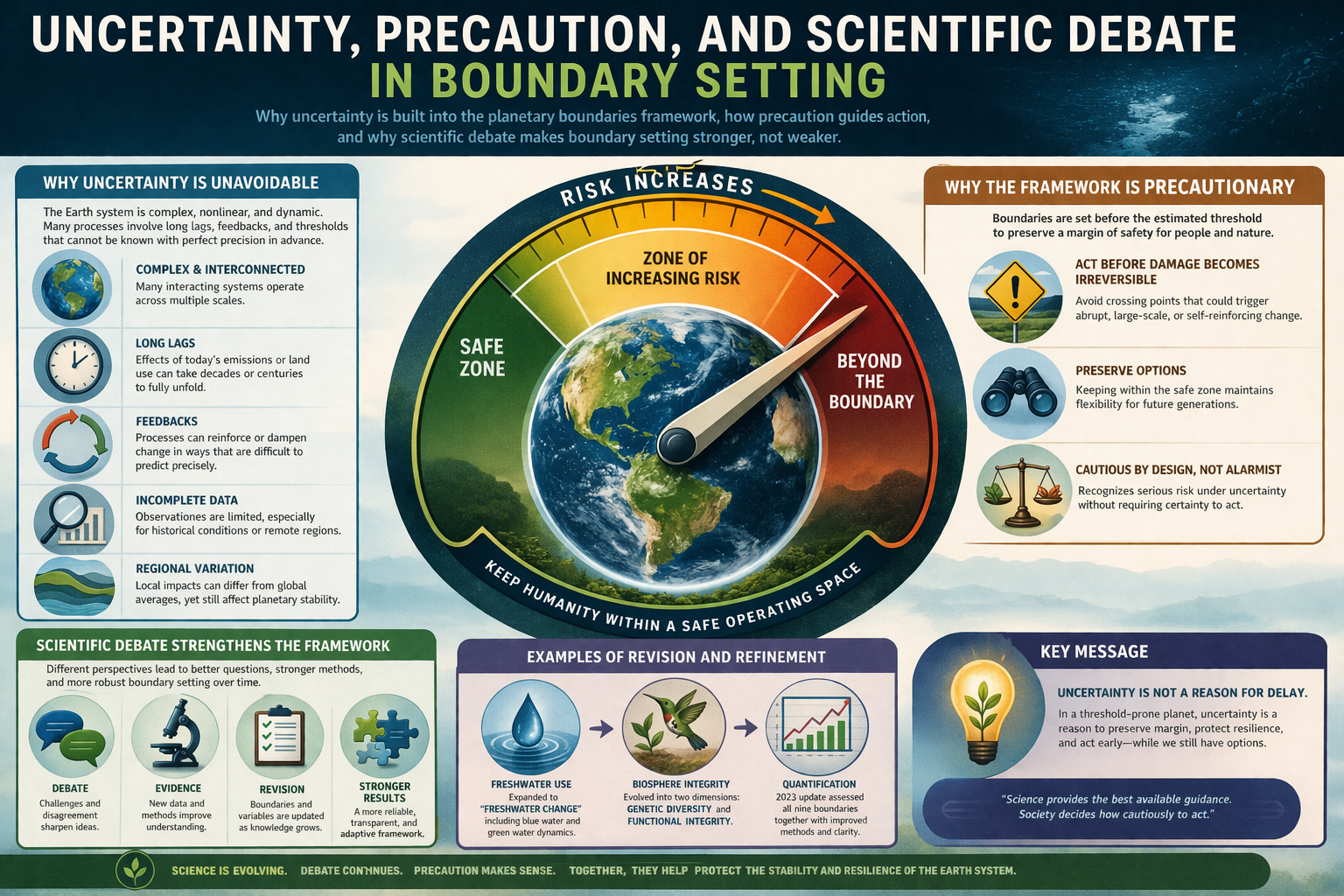
The same is true of later scenario and pathway work, which asks not only where the boundaries are but how different development paths might remain within or move further beyond them. Once boundary setting becomes connected to modeling, governance, business strategy, finance, and planning, revision becomes even more important. A static framework would quickly lose relevance. An adaptive one can remain scientifically and politically meaningful.
Revision also helps prevent overconfidence. A mature scientific framework should be able to distinguish between high-confidence conclusions, provisional estimates, unresolved measurement questions, and areas requiring more research. Planetary-boundary science is strongest when it makes those distinctions visible rather than presenting all boundaries as equally certain, equally measurable, or equally global in the same way.
The same pattern applies to the relationship between planetary boundaries and justice. The original framework focused mainly on Earth-system stability and ecological ceilings. Later safe-and-just work, Doughnut Economics, and justice-centered critiques have pushed the framework toward more explicit attention to human harm, equity, historical responsibility, and unequal exposure. This does not erase the original framework. It deepens its public meaning.
The best way to understand revision is therefore not as retreat, but as learning. The planetary-boundaries framework becomes more useful when it can update its variables, improve its uncertainty treatment, incorporate justice concerns, and clarify where confidence is strong or still developing.
Uncertainty and the Logic of Early Action
One of the most important implications of the framework is that uncertainty often strengthens, rather than weakens, the case for early action. In systems with possible thresholds, long lags, and nonlinear dynamics, waiting for absolute certainty can mean waiting until resilience has already been eroded and safer options have narrowed. This is the practical meaning of precaution in the planetary-boundaries framework. The framework does not say that all uncertainty demands maximal intervention. It says that uncertainty around potentially irreversible Earth-system change is not a valid reason for indifference.
This logic is especially clear in the way boundaries are placed before estimated thresholds. The goal is to preserve buffering capacity under uncertainty. A governance system that acts only after exact thresholds are confirmed would, in many cases, be acting too late to preserve a safe operating space.
This is a difficult idea politically because many institutions are organized around retrospective proof rather than anticipatory judgment. But Earth-system governance cannot rely on hindsight alone. The framework’s deeper argument is that in threshold-prone systems, prudence means preserving margin before the last chance to do so is obvious.
The logic also matters for investment and infrastructure. Long-lived assets can lock societies into emissions, land-use patterns, water demand, chemical flows, and material throughput for decades. If institutions wait until uncertainty disappears, the infrastructure already built may have narrowed future options. Precaution therefore belongs not only in environmental policy, but in capital allocation, engineering design, permitting, land-use planning, procurement, and technology governance.
Early action also preserves justice. When action is delayed, the costs are rarely distributed evenly. Communities with less wealth, weaker political power, higher exposure, and fewer mobility options often experience harm first and recover last. In that sense, delay under uncertainty is not neutral. It is often a decision to transfer risk downward, outward, and forward: to marginalized communities, distant regions, and future generations.
Precaution should therefore be understood as a form of intergenerational and distributive responsibility. It preserves options before they are lost. It keeps systems from being pushed to the edge merely because the exact edge remains uncertain.
Boundary Setting and Governance Judgment
Boundary setting is never purely technical because once science identifies plausible zones of increasing risk, societies still have to decide how cautiously they wish to act. This is where governance judgment enters. The framework provides a structured scientific basis for that judgment, but it does not eliminate the political questions. How much uncertainty is tolerable? How much margin of safety is ethically justified? How should risk be balanced across regions, generations, and unequal societies? These are not external to boundary setting. They are built into its public meaning.
This is also why the framework has generated such interest beyond Earth-system science itself. It speaks to law, governance, business, development, ethics, finance, and engineering because once uncertainty and precaution are taken seriously, boundary setting becomes a way of organizing collective judgment about risk rather than merely reporting environmental statistics.
There is therefore an important distinction between scientific debate and political choice. Science can clarify how a boundary process works, how uncertainty is structured, and what ranges of risk appear more or less plausible. But the decision about how much safety margin to preserve is inseparable from public values and institutional responsibility. Boundary setting is scientific, but it is never only scientific.
This distinction matters because critics sometimes treat the presence of values as evidence that the framework is not scientific. That is too simple. Many risk frameworks combine empirical evidence with normative judgment. Building codes, public health thresholds, flood protections, chemical exposure limits, and financial stress tests all require decisions about acceptable risk. The issue is not whether judgment exists. The issue is whether judgment is transparent, evidence-informed, precautionary, and accountable.
Boundary setting also requires institutions capable of acting on judgment. A boundary that is scientifically credible but politically ignored cannot protect safe operating space. Governance systems must be able to monitor indicators, update thresholds, interpret uncertainty, coordinate across sectors, regulate harmful pressures, finance transitions, protect vulnerable communities, and revise decisions when evidence changes.
In this sense, planetary-boundary governance is not only a scientific challenge. It is a test of whether institutions can act responsibly before all uncertainty disappears.
Uncertainty as a Feature of Serious Science
It is tempting in public debate to treat certainty as the mark of good science and uncertainty as a sign of weakness. In Earth-system science, that intuition is misleading. Serious science about complex systems often becomes more explicit about uncertainty as it becomes more mature, not less. What improves over time is not the elimination of uncertainty but the ability to specify what kind of uncertainty exists, where it matters most, and how it should shape judgment.
The planetary-boundaries framework is valuable partly because it models this kind of seriousness. It does not pretend that every threshold is known exactly, every interaction is fully mapped, or every boundary is equally measurable. Instead, it makes these asymmetries part of the framework itself. That intellectual honesty is one reason the approach remains credible even under criticism.
In this sense, uncertainty is not the opposite of rigor. In planetary-boundary science, explicit uncertainty is often the form rigor takes. It shows that the framework is engaged with the true structure of the problem rather than simplifying it beyond recognition.
The most responsible use of the framework is therefore neither blind acceptance nor dismissive skepticism. It is critical use: understanding what the framework is designed to do, where confidence is stronger, where uncertainty remains high, where measurement is evolving, and where governance judgment must remain explicit. Scientific debate should make this use more careful, not less urgent.
This is especially important in a public culture that often rewards false certainty. A framework that hides uncertainty can appear more authoritative in the short term, but it becomes brittle when challenged. A framework that documents uncertainty can be more durable because its assumptions, limitations, and margins are visible from the beginning.
The planetary-boundaries framework belongs in the second category. Its strongest versions do not ask readers to trust a single number. They ask readers to understand a structured judgment: pressure is rising, safe operating space is narrowing, uncertainty remains, and responsible societies should preserve resilience before irreversible damage becomes obvious.
Justice, Precaution, and Unequal Risk
Uncertainty and precaution cannot be separated from justice. The people who benefit most from boundary-transgressing systems are often not the people most exposed to the consequences. High-consuming societies, fossil-fuel-intensive economies, extractive industries, industrial agriculture, chemical production systems, and wealthy households have contributed disproportionately to many planetary pressures. Meanwhile, small island states, Indigenous peoples, low-income communities, subsistence farmers, informal settlements, coastal populations, children, and future generations often face disproportionate harm.
This means that uncertainty is not evenly distributed as a lived condition. For some actors, uncertainty is an argument for delay because delay preserves profit, convenience, or political advantage. For others, uncertainty is the condition under which their homes, water systems, crops, bodies, and futures become exposed to risk they did not create. A justice-centered interpretation of planetary boundaries must therefore ask who benefits from waiting and who bears the cost if waiting is wrong.
Precaution becomes more compelling when risk is imposed on vulnerable people without meaningful consent. If a chemical system, emissions pathway, land-use regime, or water-management strategy carries uncertain but potentially severe consequences, the ethical burden should not fall only on affected communities to prove harm after the fact. The burden should also fall on high-pressure actors and institutions to avoid imposing preventable risks.
This is why safe-and-just Earth-system boundary work matters. It pushes boundary thinking beyond the question of biophysical stability alone and asks where Earth-system change creates significant harm to humans, especially those already exposed to structural disadvantage. The planetary-boundaries framework becomes more complete when ecological ceilings are interpreted alongside human dignity, unequal exposure, historical responsibility, and the right of deprived communities to develop within a stable Earth system.
Justice also requires attention to epistemic inequality. Some communities have strong lived knowledge of ecological disruption but weak access to formal monitoring systems, scientific publication channels, legal recognition, or international policy forums. A more just planetary-boundary framework should therefore value community monitoring, Indigenous knowledge, local observation, and participatory science alongside global modeling and institutional assessment.
Precaution without justice can become technocratic. Justice without Earth-system science can underestimate planetary risk. The task is to hold both together: protect the Earth-system foundations of life while ensuring that the burdens and benefits of boundary governance are distributed fairly.
Why This Matters for Planetary Boundaries
Uncertainty, precaution, and scientific debate matter for planetary boundaries because they define the framework’s real intellectual character. Planetary boundaries are not simple lines of certainty. They are scientifically informed guardrails for governing Earth-system risk under conditions of incomplete but meaningful knowledge. Without uncertainty, the framework would be a mechanical dashboard. Without precaution, it would be a passive monitoring exercise. Without debate, it would become dogma.
The framework’s strength lies in the interaction among all three. Uncertainty shows why margins matter. Precaution explains why action should not wait for perfect knowledge. Scientific debate keeps the framework open to revision, critique, and improvement. Together, they make planetary boundaries a living architecture for responsible decision-making rather than a fixed set of environmental slogans.
This matters because the Earth system does not reward delay simply because societies prefer certainty. Climate, biosphere integrity, freshwater systems, nutrient cycles, land systems, oceans, aerosols, and novel entities all involve thresholds, feedbacks, lags, and interaction effects. A framework for governing those systems must be able to act before the evidence becomes catastrophic.
It also matters because planetary-boundary governance must remain publicly accountable. Scientific authority is necessary but not sufficient. Boundary setting must document assumptions, expose uncertainty, acknowledge disagreement, include justice concerns, and explain why particular margins of safety are justified. The more clearly those judgments are made, the stronger and more legitimate the framework becomes.
To understand planetary boundaries, then, is not only to understand the boundaries themselves. It is to understand how societies should reason when knowledge is incomplete, consequences are large, and the systems at stake support the conditions of life.
The danger is not that planetary-boundary science contains uncertainty. The danger is pretending that uncertainty gives societies permission to keep eroding resilience until the evidence arrives too late.
Mathematical Lens: Risk Zones, Uncertainty, and Precautionary Margins
Boundary setting can be represented mathematically as a problem of pressure, threshold uncertainty, and precautionary margin. Let \(P_i\) represent observed pressure on Earth-system process \(i\), and let \(T_i\) represent the estimated threshold at which the risk of destabilization becomes serious. Because \(T_i\) is uncertain, it should not be treated as a fixed known value. Instead, it can be represented as a distribution:
T_i \sim \mathcal{D}(\mu_i, \sigma_i)
\]
Interpretation: The threshold is represented as a distribution, where \(\mu_i\) is the estimated threshold and \(\sigma_i\) represents uncertainty around that estimate.
A precautionary boundary \(B_i\) can then be defined as a value below the estimated threshold:
B_i = \mu_i – k\sigma_i
\]
Interpretation: The precautionary factor \(k\) determines how far the boundary is placed from the estimated threshold. A larger \(k\) creates a wider safety margin.
This expresses the framework’s core logic: when uncertainty is large and consequences are severe, a more conservative boundary may be justified. Observed boundary pressure can then be written as:
R_i = \frac{P_i}{B_i}
\]
Interpretation: The pressure ratio compares observed pressure with the precautionary boundary.
If \(R_i < 1\), pressure remains below the precautionary boundary. If \(R_i \geq 1\), pressure has entered the zone of increasing risk. A more explicit risk score can combine pressure and uncertainty:
U_i = R_i \times (1 + \sigma_i)
\]
Interpretation: The uncertainty-adjusted pressure score makes uncertainty visible rather than hiding it behind a single boundary ratio.
A governance-adjusted version can add monitoring and adaptive capacity. Let \(C_i\) represent governance capacity for process \(i\), scaled from 0 to 1. Then:
G_i = U_i \times (1 – C_i)
\]
Interpretation: Governance-adjusted risk rises when uncertainty-adjusted pressure is high and governance capacity is weak.
| Term | Meaning | Interpretive role |
|---|---|---|
| \(P_i\) | Observed pressure | Represents human pressure on Earth-system process \(i\). |
| \(T_i\) | Estimated threshold | Represents the level at which destabilizing risk becomes serious. |
| \(\mu_i\) | Estimated threshold mean | Represents the central estimate of the threshold. |
| \(\sigma_i\) | Threshold uncertainty | Represents uncertainty around the threshold estimate. |
| \(k\) | Precautionary factor | Controls how wide the safety margin should be. |
| \(B_i\) | Precautionary boundary | Represents the guardrail placed before the estimated threshold. |
| \(R_i\) | Pressure ratio | Shows whether observed pressure is below or beyond the precautionary boundary. |
| \(U_i\) | Uncertainty-adjusted pressure | Combines observed pressure with threshold uncertainty. |
| \(C_i\) | Governance capacity | Represents monitoring, institutional response, adaptation, and reversibility capacity. |
| \(G_i\) | Governance-adjusted risk | Shows how weak governance can make uncertain boundary pressure more dangerous. |
This structure clarifies why boundary risk is not only about Earth-system pressure. It is also about whether institutions can monitor, interpret, and respond to uncertain risk before thresholds are crossed. High uncertainty becomes more dangerous when governance capacity is weak.
Advanced Python Workflow: Boundary Uncertainty and Precautionary Risk Scoring
The following Python workflow models boundary setting as a relationship among observed pressure, estimated thresholds, uncertainty, precautionary margins, governance capacity, and risk-zone classification. It is illustrative rather than definitive, but it provides an auditable structure for analyzing why uncertainty can strengthen the case for precaution.
"""
Boundary uncertainty and precautionary risk scoring workflow.

This workflow models planetary-boundary risk using:
- observed Earth-system pressure
- estimated thresholds
- threshold uncertainty
- precautionary safety margins
- governance capacity
- risk-zone classification
- precaution sensitivity analysis

The values are illustrative. Replace them with documented boundary data,
control variables, uncertainty estimates, expert elicitation, monitoring
systems, and transparent precautionary assumptions before applied use.
"""

from __future__ import annotations

from dataclasses import dataclass
from pathlib import Path
from typing import Literal

import numpy as np
import pandas as pd


RiskZone = Literal["safe_zone", "zone_of_increasing_risk", "high_risk_zone"]


@dataclass(frozen=True)
class BoundarySpec:
    """Specification for a boundary process under uncertainty."""

    boundary: str
    observed_pressure: float
    estimated_threshold: float
    threshold_uncertainty: float
    precaution_factor: float
    governance_capacity: float
    weight: float


def build_boundary_specs() -> pd.DataFrame:
    """
    Create illustrative planetary-boundary uncertainty data.

    observed_pressure, estimated_threshold, and uncertainty are scaled indexes.
    governance_capacity is scaled 0-1.
    """
    specs = [
        BoundarySpec("climate_change", 1.42, 1.20, 0.12, 1.0, 0.68, 1.4),
        BoundarySpec("biosphere_integrity", 1.80, 1.15, 0.20, 1.2, 0.46, 1.5),
        BoundarySpec("freshwater_change", 1.22, 1.10, 0.18, 1.1, 0.52, 1.1),
        BoundarySpec("land_system_change", 1.28, 1.10, 0.15, 1.0, 0.50, 1.0),
        BoundarySpec("biogeochemical_flows", 1.70, 1.20, 0.16, 1.1, 0.42, 1.2),
        BoundarySpec("ocean_acidification", 1.08, 1.10, 0.10, 1.0, 0.60, 1.0),
        BoundarySpec("novel_entities", 1.60, 1.05, 0.30, 1.3, 0.34, 1.3),
        BoundarySpec("atmospheric_aerosols", 0.88, 1.00, 0.28, 1.2, 0.38, 0.9),
        BoundarySpec("stratospheric_ozone", 0.72, 1.10, 0.08, 1.0, 0.74, 0.8),
    ]

    return pd.DataFrame([spec.__dict__ for spec in specs])


def classify_risk_zone(pressure_ratio: float) -> RiskZone:
    """Classify pressure relative to the precautionary boundary."""
    if pressure_ratio < 1.0:
        return "safe_zone"
    if pressure_ratio < 1.5: return "zone_of_increasing_risk" return "high_risk_zone" def score_uncertainty_risk(data: pd.DataFrame) -> pd.DataFrame:
    """Calculate precautionary boundary, pressure ratio, and risk scores."""
    scored = data.copy()

    scored["precautionary_boundary"] = (
        scored["estimated_threshold"]
        - scored["precaution_factor"] * scored["threshold_uncertainty"]
    )

    if (scored["precautionary_boundary"] <= 0).any(): raise ValueError("Precautionary boundary must remain positive.") scored["pressure_ratio"] = ( scored["observed_pressure"] / scored["precautionary_boundary"] ) scored["uncertainty_adjusted_pressure"] = ( scored["pressure_ratio"] * (1 + scored["threshold_uncertainty"]) ) scored["governance_gap"] = 1 - scored["governance_capacity"] scored["governance_adjusted_risk"] = ( scored["uncertainty_adjusted_pressure"] * scored["governance_gap"] * scored["weight"] ) scored["risk_zone"] = scored["pressure_ratio"].apply(classify_risk_zone) scored["dominant_issue"] = np.select( [ scored["pressure_ratio"] >= 1.5,
            scored["threshold_uncertainty"] >= 0.25,
            scored["governance_gap"] >= 0.60,
            scored["pressure_ratio"] >= 1.0,
        ],
        [
            "high_pressure",
            "high_uncertainty",
            "low_governance_capacity",
            "increasing_risk_zone",
        ],
        default="mixed_or_moderate_risk",
    )

    return scored.sort_values(
        "governance_adjusted_risk",
        ascending=False,
    ).reset_index(drop=True)


def summarize_by_zone(scored: pd.DataFrame) -> pd.DataFrame:
    """Summarize uncertainty-aware boundary status by risk zone."""
    return (
        scored.groupby("risk_zone")
        .agg(
            boundaries=("boundary", "count"),
            mean_pressure_ratio=("pressure_ratio", "mean"),
            mean_threshold_uncertainty=("threshold_uncertainty", "mean"),
            mean_governance_capacity=("governance_capacity", "mean"),
            mean_governance_adjusted_risk=("governance_adjusted_risk", "mean"),
        )
        .reset_index()
        .sort_values("mean_governance_adjusted_risk", ascending=False)
    )


def run_precaution_sensitivity(data: pd.DataFrame) -> pd.DataFrame:
    """
    Test how conclusions change under different precautionary factors.

    This is useful because the safety margin is a governance judgment
    informed by science, uncertainty, severity, reversibility, and justice.
    """
    scenarios = {
        "lower_precaution": 0.75,
        "baseline_precaution": 1.00,
        "higher_precaution": 1.25,
        "strong_precaution": 1.50,
    }

    frames = []

    for scenario_name, multiplier in scenarios.items():
        scenario = data.copy()
        scenario["precaution_factor"] = scenario["precaution_factor"] * multiplier
        scenario = score_uncertainty_risk(scenario)
        scenario["scenario"] = scenario_name
        scenario["rank"] = scenario["governance_adjusted_risk"].rank(
            ascending=False,
            method="dense",
        )
        frames.append(scenario)

    return pd.concat(frames, ignore_index=True)


def main() -> None:
    """Run the uncertainty and precaution workflow."""
    output_dir = Path(
        "articles/uncertainty-precaution-and-scientific-debate-in-boundary-setting/outputs"
    )
    output_dir.mkdir(parents=True, exist_ok=True)

    data = build_boundary_specs()
    scored = score_uncertainty_risk(data)
    zone_summary = summarize_by_zone(scored)
    sensitivity = run_precaution_sensitivity(data)

    scored.to_csv(output_dir / "boundary_uncertainty_scores.csv", index=False)
    zone_summary.to_csv(output_dir / "risk_zone_summary.csv", index=False)
    sensitivity.to_csv(output_dir / "precaution_sensitivity.csv", index=False)

    display_columns = [
        "boundary",
        "precautionary_boundary",
        "pressure_ratio",
        "threshold_uncertainty",
        "governance_capacity",
        "governance_adjusted_risk",
        "risk_zone",
        "dominant_issue",
    ]

    print("\nBoundary uncertainty scores:")
    print(scored[display_columns].round(3).to_string(index=False))

    print("\nRisk zone summary:")
    print(zone_summary.round(3).to_string(index=False))

    print("\nPrecaution sensitivity:")
    print(
        sensitivity[
            [
                "scenario",
                "boundary",
                "pressure_ratio",
                "governance_adjusted_risk",
                "risk_zone",
                "rank",
            ]
        ].round(3).to_string(index=False)
    )


if __name__ == "__main__":
    main()
This workflow is useful because it separates observed pressure, threshold uncertainty, precautionary margin, and governance capacity. That separation matters. A boundary can be concerning because pressure is already high, because uncertainty is large, because governance capacity is weak, or because all three are present together.
The workflow also makes the precautionary factor explicit so analysts can test how conclusions change when society chooses a wider or narrower margin of safety. This is important because boundary setting is not only a measurement exercise. It is a transparent decision about how much margin should be preserved when uncertainty is real and consequences may be severe.
Advanced R Workflow: Boundary-Risk Dashboarding Under Uncertainty
The following R workflow prepares dashboard-ready outputs for uncertainty-aware boundary analysis. It is designed for researchers, sustainability analysts, risk teams, engineers, and governance practitioners who need to compare observed pressure, estimated thresholds, uncertainty, precautionary margins, and governance capacity across multiple Earth-system processes.
# Boundary uncertainty and precaution dashboard
#
# This workflow scores planetary-boundary processes across observed pressure,
# estimated thresholds, uncertainty, precautionary margins, governance capacity,
# and risk-zone classification.
#
# Values are illustrative and should be replaced with documented boundary data,
# control variables, uncertainty estimates, expert review, and source provenance
# before applied use.

library(readr)
library(dplyr)
library(tidyr)

boundary_data <- tibble::tibble(
  boundary = c(
    "climate_change",
    "biosphere_integrity",
    "freshwater_change",
    "land_system_change",
    "biogeochemical_flows",
    "ocean_acidification",
    "novel_entities",
    "atmospheric_aerosols",
    "stratospheric_ozone"
  ),
  observed_pressure = c(1.42, 1.80, 1.22, 1.28, 1.70, 1.08, 1.60, 0.88, 0.72),
  estimated_threshold = c(1.20, 1.15, 1.10, 1.10, 1.20, 1.10, 1.05, 1.00, 1.10),
  threshold_uncertainty = c(0.12, 0.20, 0.18, 0.15, 0.16, 0.10, 0.30, 0.28, 0.08),
  precaution_factor = c(1.0, 1.2, 1.1, 1.0, 1.1, 1.0, 1.3, 1.2, 1.0),
  governance_capacity = c(0.68, 0.46, 0.52, 0.50, 0.42, 0.60, 0.34, 0.38, 0.74),
  weight = c(1.4, 1.5, 1.1, 1.0, 1.2, 1.0, 1.3, 0.9, 0.8)
)

scored <- boundary_data %>%
  mutate(
    precautionary_boundary = estimated_threshold -
      precaution_factor * threshold_uncertainty,

    pressure_ratio = observed_pressure / precautionary_boundary,

    uncertainty_adjusted_pressure = pressure_ratio *
      (1 + threshold_uncertainty),

    governance_gap = 1 - governance_capacity,

    governance_adjusted_risk = uncertainty_adjusted_pressure *
      governance_gap *
      weight,

    risk_zone = case_when(
      pressure_ratio < 1.0 ~ "safe_zone",
      pressure_ratio < 1.5 ~ "zone_of_increasing_risk", TRUE ~ "high_risk_zone" ), dominant_issue = case_when( pressure_ratio >= 1.5 ~ "high_pressure",
      threshold_uncertainty >= 0.25 ~ "high_uncertainty",
      governance_gap >= 0.60 ~ "low_governance_capacity",
      pressure_ratio >= 1.0 ~ "increasing_risk_zone",
      TRUE ~ "mixed_or_moderate_risk"
    )
  ) %>%
  arrange(desc(governance_adjusted_risk))

dashboard_long <- scored %>%
  select(
    boundary,
    observed_pressure,
    estimated_threshold,
    threshold_uncertainty,
    precautionary_boundary,
    pressure_ratio,
    governance_capacity,
    governance_adjusted_risk
  ) %>%
  pivot_longer(
    cols = -boundary,
    names_to = "metric",
    values_to = "value"
  )

precaution_scenarios <- tibble::tibble(
  scenario = c(
    "lower_precaution",
    "baseline_precaution",
    "higher_precaution",
    "strong_precaution"
  ),
  precaution_multiplier = c(0.75, 1.00, 1.25, 1.50)
)

sensitivity <- boundary_data %>%
  crossing(precaution_scenarios) %>%
  mutate(
    scenario_precaution_factor = precaution_factor * precaution_multiplier,

    precautionary_boundary = estimated_threshold -
      scenario_precaution_factor * threshold_uncertainty,

    pressure_ratio = observed_pressure / precautionary_boundary,

    uncertainty_adjusted_pressure = pressure_ratio *
      (1 + threshold_uncertainty),

    governance_gap = 1 - governance_capacity,

    governance_adjusted_risk = uncertainty_adjusted_pressure *
      governance_gap *
      weight,

    risk_zone = case_when(
      pressure_ratio < 1.0 ~ "safe_zone",
      pressure_ratio < 1.5 ~ "zone_of_increasing_risk", TRUE ~ "high_risk_zone" ) ) %>%
  group_by(scenario) %>%
  mutate(rank = dense_rank(desc(governance_adjusted_risk))) %>%
  ungroup()

risk_zone_summary <- scored %>%
  group_by(risk_zone) %>%
  summarise(
    count = n(),
    mean_governance_adjusted_risk = mean(governance_adjusted_risk),
    mean_threshold_uncertainty = mean(threshold_uncertainty),
    mean_governance_capacity = mean(governance_capacity),
    .groups = "drop"
  ) %>%
  arrange(desc(mean_governance_adjusted_risk))

output_dir <- "articles/uncertainty-precaution-and-scientific-debate-in-boundary-setting/outputs"

dir.create(
  output_dir,
  recursive = TRUE,
  showWarnings = FALSE
)

write_csv(
  scored,
  file.path(output_dir, "r_boundary_uncertainty_scores.csv")
)

write_csv(
  dashboard_long,
  file.path(output_dir, "r_dashboard_long.csv")
)

write_csv(
  sensitivity,
  file.path(output_dir, "r_precaution_sensitivity.csv")
)

write_csv(
  risk_zone_summary,
  file.path(output_dir, "r_risk_zone_summary.csv")
)

print(scored)
print(risk_zone_summary)
This R workflow is designed for transparent interpretation rather than false precision. It does not merely rank boundaries by pressure. It shows where uncertainty is high, where precautionary margins matter, where governance capacity is weak, and how conclusions change under different precautionary assumptions. That is the kind of reporting structure boundary setting requires: evidence-informed, assumption-aware, and explicit about uncertainty.
The sensitivity table is especially important because it makes the normative element visible. A narrower precautionary margin and a wider precautionary margin can produce different risk rankings. Instead of hiding that fact, the workflow exposes it so analysts, reviewers, and decision-makers can see how precautionary assumptions shape the result.
Advanced Go Workflow: Lightweight Uncertainty-Aware Boundary Scoring Service
The following Go workflow translates uncertainty-aware boundary setting into a lightweight scoring service. Go is useful for command-line tools, APIs, monitoring services, and operational scoring engines. This example reads boundary records from a CSV file and reports precautionary boundary, pressure ratio, uncertainty-adjusted pressure, governance-adjusted risk, risk zone, and dominant issue.
package main

import (
	"encoding/csv"
	"errors"
	"fmt"
	"os"
	"strconv"
)

type BoundarySpec struct {
	Boundary              string
	ObservedPressure       float64
	EstimatedThreshold     float64
	ThresholdUncertainty   float64
	PrecautionFactor       float64
	GovernanceCapacity     float64
	Weight                 float64
}

func parseFloat(value string) (float64, error) {
	parsed, err := strconv.ParseFloat(value, 64)
	if err != nil {
		return 0, fmt.Errorf("invalid numeric value %q: %w", value, err)
	}
	return parsed, nil
}

func parseBoundarySpec(row []string) (BoundarySpec, error) {
	if len(row) < 7 {
		return BoundarySpec{}, errors.New("expected at least 7 columns")
	}

	values := make([]float64, 6)
	for i := 1; i < 7; i++ {
		parsed, err := parseFloat(row[i])
		if err != nil {
			return BoundarySpec{}, err
		}
		values[i-1] = parsed
	}

	return BoundarySpec{
		Boundary:             row[0],
		ObservedPressure:     values[0],
		EstimatedThreshold:   values[1],
		ThresholdUncertainty: values[2],
		PrecautionFactor:     values[3],
		GovernanceCapacity:   values[4],
		Weight:               values[5],
	}, nil
}

func precautionaryBoundary(spec BoundarySpec) float64 {
	return spec.EstimatedThreshold -
		spec.PrecautionFactor*spec.ThresholdUncertainty
}

func pressureRatio(spec BoundarySpec) float64 {
	boundary := precautionaryBoundary(spec)
	if boundary <= 0 {
		return 0
	}
	return spec.ObservedPressure / boundary
}

func uncertaintyAdjustedPressure(spec BoundarySpec) float64 {
	return pressureRatio(spec) * (1 + spec.ThresholdUncertainty)
}

func governanceGap(spec BoundarySpec) float64 {
	return 1 - spec.GovernanceCapacity
}

func governanceAdjustedRisk(spec BoundarySpec) float64 {
	return uncertaintyAdjustedPressure(spec) *
		governanceGap(spec) *
		spec.Weight
}

func riskZone(spec BoundarySpec) string {
	ratio := pressureRatio(spec)

	switch {
	case ratio < 1.0:
		return "safe_zone"
	case ratio < 1.5: return "zone_of_increasing_risk" default: return "high_risk_zone" } } func dominantIssue(spec BoundarySpec) string { ratio := pressureRatio(spec) gap := governanceGap(spec) switch { case ratio >= 1.5:
		return "high_pressure"
	case spec.ThresholdUncertainty >= 0.25:
		return "high_uncertainty"
	case gap >= 0.60:
		return "low_governance_capacity"
	case ratio >= 1.0:
		return "increasing_risk_zone"
	default:
		return "mixed_or_moderate_risk"
	}
}

func main() {
	if len(os.Args) < 2 {
		fmt.Println("usage: boundary-uncertainty-score boundary_specs.csv")
		os.Exit(1)
	}

	file, err := os.Open(os.Args[1])
	if err != nil {
		fmt.Println("error opening file:", err)
		os.Exit(1)
	}
	defer file.Close()

	reader := csv.NewReader(file)
	rows, err := reader.ReadAll()
	if err != nil {
		fmt.Println("error reading CSV:", err)
		os.Exit(1)
	}

	for i, row := range rows {
		if i == 0 {
			continue
		}

		spec, err := parseBoundarySpec(row)
		if err != nil {
			fmt.Println("parse error:", err)
			continue
		}

		fmt.Printf(
			"boundary=%s precautionary_boundary=%.3f pressure_ratio=%.3f uncertainty_adjusted_pressure=%.3f governance_risk=%.3f zone=%s issue=%s\n",
			spec.Boundary,
			precautionaryBoundary(spec),
			pressureRatio(spec),
			uncertaintyAdjustedPressure(spec),
			governanceAdjustedRisk(spec),
			riskZone(spec),
			dominantIssue(spec),
		)
	}
}
The Go workflow shows how uncertainty-aware boundary setting can move from article-level explanation into operational systems. A lightweight service could support internal risk registers, dashboard backends, API endpoints, environmental monitoring pipelines, or policy-support tools. The important requirement is that the assumptions remain inspectable: estimated threshold, uncertainty, precautionary factor, governance capacity, and risk-zone rules should all be visible.
A production version should include schema validation, uncertainty intervals, versioned boundary definitions, source metadata, unit checking, structured logging, tests, review flags, and audit trails. The point of an operational service should not be to hide uncertainty behind a score. It should be to make uncertainty visible enough to govern responsibly.
Engineering Extensions in the GitHub Repository
The accompanying GitHub repository extends the article workflow beyond Python, R, and Go into a broader engineering scaffold. The article body keeps Python and R visible because they are accessible tools for uncertainty analysis, sensitivity testing, dashboard preparation, and reproducible reporting. Go provides a compact service layer. The repository, however, is structured for readers who want to translate uncertainty-aware boundary setting into more technical systems: auditable databases, scoring engines, APIs, embedded monitoring, scenario simulation, edge anomaly detection, and accelerator-aware environmental data pipelines.
The SQL scaffold is intended for boundary definitions, observed pressures, estimated thresholds, uncertainty ranges, precautionary factors, governance-capacity scores, risk-zone classifications, scoring runs, source provenance, model versions, review notes, and audit trails. Rust can support reliable scoring engines or command-line tools where type safety and reproducibility matter. Go can support lightweight services and diagnostic APIs. C and C++ can support embedded threshold monitoring, local signal processing, or scenario simulation. TinyML can support low-power anomaly detection at the edge, while PYNQ-oriented scaffolding can support accelerated preprocessing of environmental monitoring streams.
This engineering layer matters because uncertainty is not merely an academic concept. It is a systems-design problem. If a dashboard hides uncertainty, if thresholds are not versioned, if precautionary assumptions are not documented, or if risk-zone classifications cannot be reproduced, boundary setting can appear more precise than it really is. Responsible technical architecture should make uncertainty inspectable.
A mature implementation should also include uncertainty propagation, sensitivity analysis, review workflows, source versioning, expert-judgment notes, justice and exposure fields where relevant, and clear documentation of how precautionary factors are chosen. Without that layer, uncertainty-aware boundary science can become an opaque dashboard. With it, the technical system becomes accountable knowledge infrastructure.
GitHub Repository
Complete Code Repository
The full code distribution for this article, including Python, R, and Go workflows plus extended engineering scaffolding for SQL, Rust, C, C++, TinyML, and PYNQ-oriented uncertainty-aware planetary-boundary diagnostics, is available on GitHub.
Common Misunderstandings
A common misunderstanding is that scientific debate means the framework is too uncertain to be useful. In reality, the framework was designed precisely for conditions in which uncertainty exists but risk is still serious enough to justify guardrails.
Another misunderstanding is that precaution means guessing. In the planetary-boundaries literature, precaution is grounded in empirical evidence about resilience, thresholds, nonlinear risk, and the asymmetry between early prevention and late repair.
A third misunderstanding is that if exact boundary values change over time, the framework has failed. In fact, revision is part of how the framework improves its scientific quality. Freshwater change, biosphere integrity, novel entities, aerosol loading, and other boundary processes have all required refinement as measurement, theory, and evidence have advanced.
A further misunderstanding is that uncertainty and disagreement imply all viewpoints are equally strong. They do not. The presence of scientific debate does not erase asymmetries in evidence quality, explanatory power, or peer-reviewed support. Some interpretations are better grounded than others. The framework’s task is not to eliminate debate, but to organize the strongest available knowledge into a defensible precautionary structure.
Another misunderstanding is that uncertainty weakens the case for action. In ordinary political rhetoric, uncertainty is often used as a reason to delay. In threshold-prone Earth-system processes, however, uncertainty can strengthen the case for precaution because waiting for full certainty may allow irreversible change to unfold. The relevant question is not whether uncertainty exists, but what kind of uncertainty it is and what consequences follow from being wrong.
A final misunderstanding is that boundary setting can be purely technical. Boundary setting is grounded in science, but it also involves judgment about acceptable risk, safety margins, reversibility, justice, and governance capacity. The key is not to pretend judgment is absent. The key is to make judgment evidence-informed, transparent, and accountable.
Related Articles
- What Are Planetary Boundaries?
- The Origins of the Planetary Boundaries Framework
- Safe Operating Space and the Logic of Thresholds
- How Planetary Boundaries Are Measured
- Tipping Points, Feedback Loops, and Cascading Ecological Change
- Planetary Boundaries and Earth System Resilience
- Climate Change as a Planetary Boundary
- Biosphere Integrity and the Stability of Life Systems
- Freshwater Change and Earth System Risk
- Novel Entities and the Problem of Synthetic Overload
- Earth System Governance in an Age of Limits
- Critiques of the Planetary Boundaries Framework
- Planetary Boundaries, Justice, and Global Inequality
- Sustainable Development Goals Within Planetary Boundaries
- Planetary Boundaries and Doughnut Economics
- The Future of Planetary Stewardship
Further Reading
- Planetary Boundaries
- Risk & Resilience
- Systems Thinking
- Environmental Science
- Earth Science
- Stewardship & Ethics
- Institutions & Governance
References
- Richardson, K., Steffen, W., Lucht, W., Bendtsen, J., Cornell, S.E., Donges, J.F., Drüke, M., Fetzer, I., Bala, G., von Bloh, W., Feulner, G., Fiedler, S., Gerten, D., Gleeson, T., Hofmann, M., Huiskamp, W., Jakobsson, C., Jürgensen, J.H., Kummu, M., Mohan, C., Nogués-Bravo, D., Petri, S., Porkka, M., Rahmstorf, S., Schaphoff, S., Schulte-Uebbing, L., Staal, A., Sun, Z., Sakschewski, B. and Wang-Erlandsson, L. (2023) ‘Earth beyond six of nine planetary boundaries’, Science Advances, 9(37), eadh2458. Available at: https://www.science.org/doi/10.1126/sciadv.adh2458.
- Rockström, J., Steffen, W., Noone, K., Persson, Å., Chapin, F.S. III, Lambin, E.F., Lenton, T.M., Scheffer, M., Folke, C., Schellnhuber, H.J., Nykvist, B., de Wit, C.A., Hughes, T., van der Leeuw, S., Rodhe, H., Sörlin, S., Snyder, P.K., Costanza, R., Svedin, U., Falkenmark, M., Karlberg, L., Corell, R.W., Fabry, V.J., Hansen, J., Walker, B., Liverman, D., Richardson, K., Crutzen, P. and Foley, J.A. (2009a) ‘A safe operating space for humanity’, Nature, 461, pp. 472–475. Available at: https://www.nature.com/articles/461472a.
- Rockström, J., Steffen, W., Noone, K., Persson, Å., Chapin, F.S. III, Lambin, E.F., Lenton, T.M., Scheffer, M., Folke, C., Schellnhuber, H.J., Nykvist, B., de Wit, C.A., Hughes, T., van der Leeuw, S., Rodhe, H., Sörlin, S., Snyder, P.K., Costanza, R., Svedin, U., Falkenmark, M., Karlberg, L., Corell, R.W., Fabry, V.J., Hansen, J., Walker, B., Liverman, D., Richardson, K., Crutzen, P. and Foley, J.A. (2009b) ‘Planetary boundaries: Exploring the safe operating space for humanity’, Ecology and Society, 14(2), 32. Available at: https://www.ecologyandsociety.org/vol14/iss2/art32/.
- Rockström, J. et al. (2023) ‘Safe and just Earth system boundaries’, Nature, 619, pp. 102–111. Available at: https://www.nature.com/articles/s41586-023-06083-8.
- Rockström, J. et al. (2024) ‘Planetary boundaries guide humanity’s future on Earth’, Nature Reviews Earth & Environment, 5, pp. 773–788. Available at: https://www.nature.com/articles/s43017-024-00597-z.
- Steffen, W., Richardson, K., Rockström, J., Cornell, S.E., Fetzer, I., Bennett, E.M., Biggs, R., Carpenter, S.R., de Vries, W., de Wit, C.A., Folke, C., Gerten, D., Heinke, J., Mace, G.M., Persson, L.M., Ramanathan, V., Reyers, B. and Sörlin, S. (2015) ‘Planetary boundaries: Guiding human development on a changing planet’, Science, 347(6223), 1259855. Available at: https://www.science.org/doi/10.1126/science.1259855.
- Stockholm Resilience Centre (2012) ‘Addressing some key misconceptions’. Available at: https://www.stockholmresilience.org/research/research-news/2012-07-02-addressing-some-key-misconceptions.html.
- Stockholm Resilience Centre (2017) ‘A fundamental misrepresentation of the planetary boundaries framework’. Available at: https://www.stockholmresilience.org/research/research-news/2017-11-20-a-fundamental-misrepresentation-of-the-planetary-boundaries-framework.html.
- Stockholm Resilience Centre (n.d.) Planetary boundaries. Available at: https://www.stockholmresilience.org/research/planetary-boundaries.html.