
Last Updated May 28, 2026
Physics examines the fundamental principles that govern matter, energy, motion, force, fields, space, time, measurement, and physical reality across every scale of nature. It seeks to explain how natural phenomena arise, how systems behave, how measurement becomes knowledge, and how the observable world can be related to general laws through mathematics, experiment, computation, and disciplined inference. As a foundational natural science, physics provides one of the principal frameworks through which human beings understand causation, constraint, scale, symmetry, uncertainty, energy, structure, and the lawful behavior of the physical universe.
This content pillar brings together the major domains through which physics interprets the natural world. It treats physics not merely as a set of formulas or a collection of specialized subfields, but as a disciplined framework for understanding physical reality across scales: from motion, force, heat, waves, fields, and matter to quantum systems, spacetime, gravitation, materials, astrophysics, cosmology, scientific simulation, and the philosophy of reality itself. Across engineering, computation, technology, infrastructure, energy systems, climate analysis, medicine, materials research, instrumentation, and scientific measurement, physics provides an indispensable language for explaining law, structure, interaction, precision, uncertainty, and physical possibility.
Main Library
Publications
Article Map
Physics
Related Topic
Chemistry
Related Topic
Earth Science
Related Topic
Astronomy
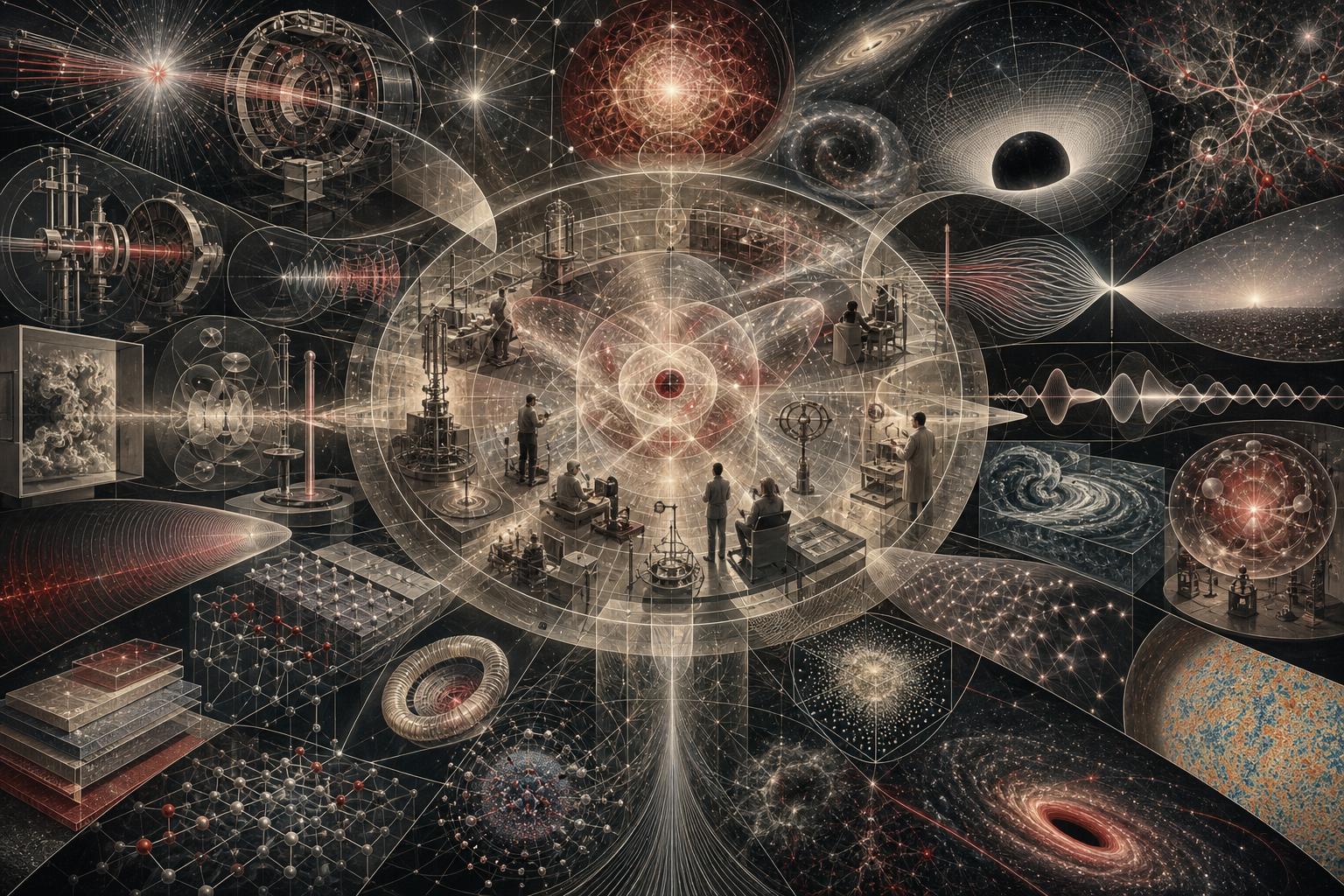
This series also approaches physics as a field that increasingly depends on formal reasoning, numerical methods, computational modeling, scientific simulation, uncertainty quantification, and reproducible scientific workflows. Many of the most important physical questions now require not only mathematical theory and experiment, but programmable environments capable of modeling systems that cannot be solved analytically under realistic conditions. For that reason, this pillar integrates physics with mathematics, Python, Julia, C++, Fortran, C, Rust, SQL, notebooks, reproducible data practices, and open scientific code.
Physics therefore appears here not only as a theoretical and experimental science, but also as a mathematical, computational, instrumental, technological, philosophical, and civilizational one. The aim of the series is to preserve the conceptual richness of physical thought while also showing how contemporary physics increasingly relies on mathematical structure, numerical approximation, computational simulation, reproducible workflows, uncertainty analysis, and high-performance scientific computing in order to understand physical systems under real conditions of complexity, scale, noise, nonlinearity, and constraint.
Physics Code Repository
The Physics knowledge series is supported by an open computational repository with article-level folders, reproducible examples, synthetic datasets, documentation, and full-stack scientific-computing scaffolding across Python, R, Julia, C++, Fortran, C, Rust, SQL, and notebooks where appropriate.
Physics as a Foundational Science
Physics occupies a distinctive place within the natural sciences because it provides many of the conceptual and mathematical foundations on which other fields depend. Chemistry relies on physical principles to explain atomic structure, bonding, energy transfer, spectroscopy, and reaction dynamics. Biology depends on physical constraints and material processes in molecular behavior, biomechanics, diffusion, membrane transport, protein folding, signaling, and energy transformation. Earth science and astronomy draw extensively on physics to explain planetary formation, atmospheric dynamics, gravitation, radiation, climate systems, and the evolution of matter in space.
This foundational role does not mean that physics stands above all other sciences in a simplistic hierarchy. Rather, it means that physics helps clarify some of the most general conditions under which natural systems can be described, measured, modeled, simulated, and understood. It offers a language of law, quantity, interaction, energy, structure, symmetry, probability, and field behavior through which many kinds of phenomena become intelligible.
Physics also provides an unusually strong bridge between abstraction and material practice. Its concepts are mathematical, but its claims remain answerable to experiment, observation, instrumentation, calibration, uncertainty, and reproducibility. It therefore occupies a powerful middle ground: it is at once theoretical, empirical, mathematical, technological, computational, and philosophical.
Physics as a Science of Law, Scale, and Constraint
Physics may be understood as one of the great sciences of law, scale, and constraint. It seeks patterns that remain stable across situations: conservation laws, equations of motion, field equations, symmetry principles, thermodynamic limits, quantum probabilities, relativistic invariants, and statistical regularities. These structures allow local observations to be related to general physical principles.
Physics also teaches scale. It connects the motion of ordinary objects to celestial mechanics, the behavior of heat to microscopic statistics, the propagation of light to electromagnetic fields, the structure of atoms to quantum mechanics, the behavior of materials to collective phenomena, the expansion of the universe to cosmological models, and the behavior of matter at the smallest scales to quantum fields. It asks how the same physical universe can contain particles, fluids, plasmas, stars, galaxies, black holes, and spacetime curvature.
This makes physics especially important within any broader intellectual project concerned with systems, infrastructure, sustainability, technology, and long-horizon responsibility. The physical world is not an inert backdrop. It is the structured condition under which energy systems, climate systems, materials, computation, communications, biological life, infrastructure, and planetary habitability become possible.
Physics as a Quantitative and Computational Science
Modern physics is deeply quantitative. Physical systems are not only observed and described; they are measured, modeled, simulated, inferred, visualized, and tested through formal methods. Motion can be represented by differential equations. Fields can be described through vector calculus and tensor structures. Quantum systems can be represented by Hilbert spaces, operators, amplitudes, and probabilities. Thermodynamic systems can be understood through statistical ensembles. Fluids, plasmas, climate systems, many-body materials, and gravitational systems often require numerical approximation, simulation, and high-performance computing.
This does not mean that physics ceases to be experimental or conceptual. Rather, it means that modern physical understanding often depends on moving across modes of inquiry. A researcher may develop a theory, derive limiting cases, design an experiment, collect data from instruments, calibrate measurement pipelines, simulate the governing equations, quantify uncertainty, compare numerical and empirical results, and publish reproducible code. Physics has become one of the clearest examples of a science in which conceptual understanding, mathematical formalism, measurement, computation, and physical interpretation must work together.
For that reason, this series treats mathematics, computation, numerical methods, scientific simulation, and reproducible code as central to modern physical literacy. Some articles remain primarily conceptual or historical. Others naturally require equations, simulation workflows, numerical solvers, uncertainty analysis, or GitHub-linked computational infrastructure. The aim is not to force code into every article, but to build a Physics pillar that reflects how the physical sciences are actually practiced.
What Physics Studies
Physics studies matter, energy, motion, force, fields, space, time, radiation, particles, waves, fluids, materials, spacetime, and the large-scale universe. At the classical level, it examines motion, force, work, energy, momentum, rotation, gravity, oscillation, waves, fluids, and continuum behavior. At the thermal and statistical level, it examines heat, entropy, temperature, phase transitions, fluctuations, irreversibility, and emergent macroscopic order.
At the electromagnetic and optical level, physics studies electric and magnetic fields, light, radiation, waves, optics, plasma, and charged matter. At the relativistic level, it reconstructs space, time, gravity, and geometry through the theory of special and general relativity. At the quantum level, it studies atoms, molecules, particles, fields, measurement, uncertainty, entanglement, quantum information, and the limits of classical intuition.
Physics further studies matter as collective organization. Condensed matter physics, materials physics, semiconductor physics, superconductivity, superfluidity, many-body physics, and topological phases reveal that matter can behave in ways not predictable from isolated parts alone. Astrophysics and cosmology extend physical inquiry to stars, galaxies, black holes, dark matter, dark energy, cosmic structure, and the history of the universe.
What This Pillar Covers
This pillar brings together the major domains through which physics interprets the natural world. It includes foundational questions about measurement and physical law; classical mechanics, rotation, gravitation, waves, fluids, and continuum behavior; thermodynamics, statistical physics, phase transitions, and nonequilibrium systems; electromagnetism, light, plasma, and fields; relativity, spacetime, and gravitation; quantum mechanics, quantum information, quantum field theory, scattering, and path integrals; condensed matter, semiconductors, topological phases, superconductivity, superfluidity, and biophysics; astrophysics, cosmology, and the large-scale universe; and the role of experiment, numerical methods, scientific simulation, and physics-informed machine learning in modern physical inquiry.
These domains differ in scale, method, and formalism, but together they form a coherent intellectual project: the attempt to describe the lawful behavior of the physical universe with conceptual clarity, empirical discipline, mathematical precision, computational accountability, and reproducible evidence. Physics is therefore not only a body of knowledge. It is also a way of asking questions about what exists, how change occurs, what can be measured, what can be inferred, what can be simulated, and how theory and evidence can be brought into durable relation.
The series also treats physics as a field that links the theoretical and the applied. Physical knowledge informs engineering, instrumentation, computation, energy systems, climate analysis, materials science, electronics, imaging, satellites, sensing, semiconductors, medical devices, and the broader technological foundations of modern life.
Mathematics, Computation, and Simulation in Physics
Mathematics provides the formal language through which physics expresses law, relation, and structure. Calculus describes rates and dynamics. Linear algebra supports vectors, operators, state spaces, normal modes, eigenvalue problems, and quantum mechanics. Differential equations describe motion, fields, waves, diffusion, heat flow, and dynamical systems. Tensor calculus supports relativity and continuum mechanics. Complex analysis, Fourier methods, variational principles, probability, statistics, group theory, and representation theory all play central roles in modern physical reasoning.
Computation is especially valuable where physical systems are too complex for closed-form analytic solutions. Python supports numerical modeling, data analysis, visualization, machine learning, simulation orchestration, and reproducible workflows. Julia supports high-performance scientific computing, differential equations, scientific machine learning, and large-scale numerical modeling. C++ supports performance-critical simulation, particle methods, numerical solvers, and scientific software infrastructure. Fortran remains important in legacy and high-performance scientific computing, especially in climate, fluids, numerical physics, and large-scale simulation. C supports low-level numerical kernels, instrumentation, and embedded scientific systems. Rust supports safe performance utilities, command-line tools, and reproducible computational infrastructure. SQL supports experiment logs, simulation metadata, reproducible provenance, and research data organization.
Used together, mathematics, computation, numerical methods, notebooks, SQL metadata, and open code repositories help make physics more explicit, testable, reproducible, and scalable. They allow physical systems to be explored through models as well as through experiments, uncertainty to be quantified rather than ignored, and complex phenomena to be simulated under controlled assumptions.
Major Domains of Physics
Physics includes a wide range of major domains, each of which illuminates a different dimension of physical reality. Classical mechanics studies motion, force, energy, momentum, rotation, gravitation, and dynamical systems. Thermodynamics and statistical physics study heat, entropy, temperature, equilibrium, nonequilibrium behavior, and the emergence of macroscopic order from microscopic states. Electromagnetism studies electric and magnetic fields, light, radiation, optics, and the unification of electricity and magnetism.
Relativity studies space, time, gravity, curvature, black holes, gravitational waves, and the geometric structure of the universe. Quantum mechanics studies atoms, molecules, wavefunctions, operators, measurement, uncertainty, tunneling, entanglement, and the limits of classical description. Quantum field theory studies particles as excitations of fields and provides the foundation for the Standard Model. Condensed matter physics studies solids, liquids, phases, materials, electronic structure, semiconductors, superconductivity, superfluidity, topological matter, and emergent collective behavior.
Astrophysics and cosmology study stars, galaxies, black holes, dark matter, dark energy, cosmic expansion, and the large-scale structure of the universe. Plasma physics studies ionized matter and collective electromagnetic behavior. Fluid dynamics studies flow, turbulence, pressure, viscosity, boundary layers, instabilities, and continuum motion. Experimental physics studies instruments, measurement, calibration, noise, inference, and the material practice of turning physical events into reliable knowledge. Computational physics studies numerical approximation, scientific simulation, verification, validation, uncertainty quantification, and physics-informed machine learning.
Why Physics Matters
Physics matters because it helps explain not only what happens in nature, but what kinds of explanation are possible. It links observation to law, experiment to theory, measurement to generalization, and mathematical structure to material reality. It establishes the conditions under which claims about motion, force, energy, radiation, fields, matter, probability, and spacetime can be tested, compared, refined, and sometimes overturned.
Physics also matters because it teaches scale. It reveals that the same universe contains quantum fields and galactic structure, thermal fluctuation and cosmic history, laboratory precision and astronomical vastness, local forces and global conservation laws. It shows that human beings inhabit a world governed by intelligible patterns that extend far beyond ordinary intuition.
Finally, physics matters because it disciplines imagination. It permits bold theoretical speculation, but only under the pressure of mathematics, evidence, measurement, reproducibility, and constraint. Its greatest advances often begin with conceptual rupture, but they become durable only when they survive calculation, observation, and experimental test.
Physics and Human Self-Understanding
Physics changes how human beings understand themselves because it places ordinary experience within a much larger physical order. It shows that everyday intuition is only a narrow layer of reality. The world described by physics includes quantum uncertainty, spacetime curvature, relativistic time, black holes, thermal irreversibility, electromagnetic fields, cosmic background radiation, microscopic fluctuations, and matter organized across scales far beyond unaided perception.
Yet physics also complicates self-understanding. It challenges simple ideas about determinism, objectivity, measurement, time, causation, locality, and reality. Quantum mechanics forces reflection on probability, observation, and measurement. Relativity reconstructs time and space. Statistical physics shows how order can emerge from multiplicity and chance. Cosmology situates human history within a universe whose timescales dwarf civilization.
For that reason, physics has philosophical as well as scientific significance. It raises enduring questions about whether nature is intelligible, whether mathematics reveals physical structure, how measurement produces knowledge, how models relate to reality, and how human beings should understand their place within a vast, lawful, and still deeply mysterious universe.
Physics Pillar Map
The map below organizes the Physics knowledge series into conceptual domains, moving from foundational principles and classical systems toward quantum theory, matter, computation, cosmology, technology, and philosophical significance.
The Physics pillar is organized to move from foundations and first principles into classical frameworks, modern theory, matter, scientific practice, computational physics, cosmic structure, and the wider human significance of physical inquiry. Mathematics, Python, Julia, C++, Fortran, C, Rust, SQL, and computational notebooks are integrated where they deepen physical understanding, especially in mechanics, numerical methods, fields, quantum systems, statistical physics, climate physics, many-body systems, scientific machine learning, and reproducible simulation workflows.
Foundations of Physics
- What Is Physics? — An opening article defining physics as the study of matter, energy, motion, force, fields, space, time, measurement, and physical reality. It establishes the scope of the series and clarifies why physics is at once empirical, mathematical, experimental, computational, and philosophical.
- The Scientific Revolution and the Rise of Physical Law — A historical foundation piece on experiment, mathematization, instruments, celestial mechanics, and the emergence of law-governed explanation. It explains how modern physical science separated itself from inherited authority and qualitative natural philosophy.
- Measurement, Mathematics, and the Structure of Physical Inquiry — A foundational treatment of quantification, units, dimensional reasoning, uncertainty, standards, reproducibility, and mathematical formulation. It shows why physical knowledge becomes durable only when concepts are rendered measurable and comparable.
- Mathematical Methods in Physics — A bridge between physical concepts and the formal tools used to express them, including vectors, tensors, differential equations, complex numbers, Fourier analysis, variational methods, operators, distributions, symmetry, and approximation.
Classical Mechanics, Motion, and Dynamical Systems
- Motion, Force, and the Foundations of Classical Mechanics — A study of motion, inertia, force, acceleration, reference frames, and the principles that made mechanics one of the first coherent mathematical descriptions of physical behavior.
- Energy, Work, and Conservation in Physical Systems — An exploration of work, energy, power, potential energy, kinetic energy, conservation, and the way energy concepts unify diverse physical systems across mechanics, heat, fields, and matter.
- Rotational Dynamics, Torque, and Angular Momentum — A treatment of rotation, torque, angular acceleration, moment of inertia, angular momentum, gyroscopic behavior, precession, rolling motion, and conservation in rotational systems.
- Gravitation, Orbits, and Celestial Mechanics — An article on gravitational force, orbital motion, Keplerian structure, Newtonian gravitation, escape velocity, tidal effects, orbital energy, and the classical bridge from terrestrial mechanics to planetary motion.
- Lagrangian and Hamiltonian Mechanics — A deeper formulation of mechanics through action, generalized coordinates, variational principles, constraints, canonical momentum, phase space, Hamilton’s equations, and conservation laws.
- Nonlinear Dynamics, Chaos, and Complex Physical Systems — A study of nonlinear systems, feedback, phase space, attractors, bifurcations, sensitivity to initial conditions, deterministic chaos, pattern formation, and complex dynamics.
- Waves, Oscillations, and Resonance — A broad treatment of oscillatory systems, resonance, normal modes, damping, forced oscillation, interference, sound, mechanical waves, electromagnetic waves, and recurring wave behavior across physics.
Thermodynamics, Statistical Physics, and Nonequilibrium Systems
- Thermodynamics and the Physics of Heat — A major article on heat, temperature, entropy, equilibrium, engines, irreversibility, material systems, and the physical constraints governing energy transformation.
- Statistical Physics and the Emergence of Macroscopic Order — A synthesis of how macroscopic regularities emerge from microscopic behavior through probability, ensembles, fluctuations, entropy, and collective dynamics.
- Phase Transitions, Critical Phenomena, and the Renormalization Group — A research-grade treatment of phases, order parameters, symmetry breaking, critical exponents, universality, scale invariance, coarse-graining, and renormalization-group reasoning.
- Non-equilibrium Statistical Mechanics — A bridge article on stochastic processes, transport, entropy production, Langevin dynamics, Fokker–Planck equations, master equations, fluctuation–dissipation, Onsager reciprocity, and driven systems away from equilibrium.
Electromagnetism, Fields, Light, and Plasma
- Electromagnetism and the Unification of Fields — An account of electricity, magnetism, electromagnetic fields, Maxwellian unification, and the field concepts that made modern electronics, communications, sensing, and radiation physics possible.
- Light, Waves, and the Physics of Radiation — A focused treatment of wave behavior, optics, electromagnetic radiation, spectra, photons, interference, diffraction, and the central role of light in theory, experiment, and cosmology.
- Plasma Physics and the Fourth State of Matter — An article on ionized matter, charged-particle motion, Debye shielding, collective electromagnetic behavior, plasma waves, magnetohydrodynamics, fusion confinement, space plasma, and astrophysical plasma.
Fluid, Continuum, Climate, and Planetary Physics
- Fluid Dynamics and the Physics of Flow — A major extension on fluids, turbulence, pressure, continuity, viscosity, boundary layers, vortices, instabilities, compressible flow, and the behavior of liquids and gases in motion.
- Continuum Physics and Material Behavior — A treatment of elasticity, stress, strain, deformation, plasticity, constitutive relations, continuum descriptions of matter, and material response across engineering and physical systems.
- Climate Physics and Planetary Energy Balance — A physics-centered treatment of radiation, albedo, greenhouse effects, atmospheric heat transport, feedbacks, climate sensitivity, planetary habitability, and Earth’s energy balance.
Relativity, Spacetime, and Gravitation
- Relativity and the Reconstruction of Space and Time — A flagship article on special and general relativity, simultaneity, time dilation, spacetime, gravity, and the intellectual transformation introduced by Einstein’s theories.
- Gravity, Curvature, and the Structure of Spacetime — A deeper extension of relativity focused on gravity as geometry, curvature, geodesics, black holes, gravitational waves, and the large-scale structure of the universe.
- General Relativity: Geometry, Gravity, and Spacetime Curvature — A rigorous article on spacetime geometry, geodesics, curvature tensors, Einstein’s field equations, gravitational waves, black holes, cosmological solutions, and relativistic gravity.
Quantum Physics, Fields, and Fundamental Theory
- Quantum Mechanics and the Limits of Classical Intuition — A major article on wavefunctions, operators, probability amplitudes, measurement, uncertainty, tunneling, superposition, entanglement, and the conceptual limits of classical physics.
- Atoms, Molecules, and the Structure of Matter — An article showing how modern physics explains atomic structure, electron behavior, molecular organization, spectra, and the bridge between physics and chemistry.
- Atomic, Molecular, and Optical Physics — A specialized treatment of atomic spectra, molecular structure, lasers, optical transitions, precision measurement, quantum control, spectroscopy, and the interaction of light with atoms and molecules.
- Quantum Information, Decoherence, and Measurement — An article on qubits, entanglement, measurement, decoherence, quantum noise, information, open quantum systems, and the transition between quantum possibility and observed physical outcomes.
- Quantum Fields, Particles, and the Standard Model — A high-authority article on particle physics, quantum fields, fundamental interactions, gauge structure, symmetry breaking, and the Standard Model’s account of matter and forces.
- Quantum Field Theory I: Fields, Particles, and Second Quantization — A graduate-level introduction to fields as fundamental objects, particle excitations, second quantization, Fock space, creation and annihilation operators, propagators, and scattering amplitudes.
- Path Integrals and the Functional Formulation of Physics — A treatment of action, histories, functional integration, propagators, quantum amplitudes, Euclidean methods, statistical-field analogies, and path-integral methods.
- Scattering Theory, Cross Sections, and Physical Inference — A bridge article on scattering amplitudes, differential and total cross sections, S-matrix logic, Born approximation, partial waves, phase shifts, resonances, detector effects, event rates, and inference.
- Nuclear Physics and the Energetics of the Atomic Nucleus — An article on nuclear structure, radioactivity, fission, fusion, binding energy, isotopes, radiation, nuclear medicine, nuclear energy, weapons, and the broader stakes of nuclear science.
Symmetry, Mathematical Structure, and Advanced Formalism
- Symmetry, Law, and the Search for Physical Order — A conceptual article on symmetry, invariance, conservation, elegance, and mathematical structure in modern physics.
- Symmetry, Conservation, and Noether’s Theorem — A deeper treatment of continuous symmetries and conservation laws, including time translation and energy, spatial translation and momentum, rotational symmetry and angular momentum, gauge symmetry, and variational principles.
- Group Theory and Representation Theory in Physics — A mathematical physics article on groups, Lie groups, Lie algebras, representations, rotations, angular momentum, spinors, crystal symmetry, gauge symmetry, and classification.
Matter, Materials, and Collective Behavior
- Condensed Matter and the Physics of Materials — A major article on solids, phases, conductivity, superconductivity, semiconductors, lattice structure, quasiparticles, and the collective behavior of matter.
- Many-Body Physics and Emergent Collective Behavior — A research-grade article on interacting particles, correlations, quasiparticles, collective modes, spin chains, Fermi and Bose systems, emergence, superconductivity, superfluidity, and correlated matter.
- Superconductivity, Superfluidity, and Macroscopic Quantum Order — An article on coherent quantum matter, Cooper pairing, superconducting currents, magnetic-field expulsion, flux quantization, Josephson effects, superfluid vortices, and quantum order at macroscopic scale.
- Topological Matter and Quantum Phases — A treatment of Berry phase, Berry curvature, Chern numbers, quantum Hall effects, topological insulators, topological superconductors, protected edge states, Majorana modes, anyons, and global quantum structure.
- Semiconductor Physics and Electronic Materials — A focused article on band structure, charge carriers, doping, p-n junctions, transistors, photovoltaics, electronic materials, device physics, and the physical basis of modern computing.
- Biophysics and the Physical Principles of Life — A bridge article on molecular structure, protein folding, membranes, diffusion, Brownian motion, ion channels, molecular motors, cytoskeletal mechanics, soft biological matter, and physical constraints in living systems.
Computation, Numerical Methods, Experiment, and Physical Inference
- Computational Physics and Scientific Simulation — A dedicated treatment of numerical modeling, simulation, approximation, scientific software, reproducibility, uncertainty, and the role of code in modern physical inquiry.
- Numerical Methods in Physics — A spine article on discretization, truncation error, roundoff error, convergence, stability, conditioning, ODE and PDE solvers, finite differences, finite volumes, finite elements, sparse systems, eigenvalue problems, Monte Carlo methods, and VVUQ.
- Physics-Informed Machine Learning and Scientific Computing — A modern bridge article on PINNs, scientific machine learning, neural ODEs, universal differential equations, differentiable simulation, neural operators, surrogate modeling, inverse problems, conservation constraints, uncertainty, and reproducible workflows.
- Experiment, Instruments, and the Material Practice of Physics — An article focused on laboratories, detectors, telescopes, accelerators, calibration, notebooks, data discipline, and the material infrastructures that make physical inquiry possible.
- Experimental Physics: Measurement, Noise, Calibration, and Inference — A deeper article on uncertainty, calibration, noise, detector response, measurement models, signal processing, Bayesian inference, reproducibility, and the transformation of raw observations into credible physical knowledge.
Astrophysics, Cosmology, and Fundamental Frontiers
- Astrophysics and the Life of Stars — An article on stellar formation, stellar structure, nuclear processes in stars, nucleosynthesis, stellar evolution, remnants, spectra, and the cosmic origin of elements.
- Galaxies, Black Holes, and the Large-Scale Universe — A synthesis of galactic structure, black holes, clusters, lensing, relativistic astrophysics, large-scale cosmic organization, and the dynamic structure of the universe.
- Cosmology and the History of the Universe — A flagship article on expansion, cooling, nucleosynthesis, recombination, the cosmic microwave background, structure growth, dark matter, dark energy, and the reconstruction of cosmic history.
- Cosmology and the Large-Scale Structure of the Universe — A more advanced cosmology article on the cosmic web, galaxies, clusters, voids, dark matter halos, redshift surveys, baryon acoustic oscillations, gravitational lensing, and large-scale inference.
- Physics Beyond the Standard Model — A frontier article on dark matter, dark energy, neutrino mass, baryogenesis, unification, hidden sectors, quantum gravity, collider searches, cosmological constraints, and the unfinished structure of fundamental theory.
Physics in Human Knowledge
- Physics, Technology, and the Modern World — A synthetic article on how physics underlies electricity, electronics, semiconductors, imaging, telecommunications, sensing, satellites, energy systems, nuclear technologies, computation, and advanced materials.
- Physics and the Philosophy of Reality — A capstone article on realism, law, causation, determinism, indeterminacy, objectivity, time, reduction, quantum interpretation, spacetime ontology, and the intelligibility of nature.
Measurement, Experiment, and Scientific Practice
One of physics’s enduring contributions is its role in the development of measurement itself. Scientific knowledge depends not only on theory, but on reliable quantities, shared standards, reproducible methods, and disciplined forms of comparison. The history of physics is therefore also a history of instruments, calibration, precision, units, and the effort to render aspects of nature measurable in consistent and transferable ways.
This matters far beyond laboratory practice. Measurement standards support engineering, trade, manufacturing, communication systems, energy infrastructure, navigation, and the reproducibility of scientific work across institutions and nations. Physics is thus inseparable not only from discovery, but from the practical architectures that allow knowledge to circulate, stabilize, and accumulate.
Physics, Technology, and the Modern World
Modern societies are saturated with the practical consequences of physics. Electricity, semiconductors, telecommunications, imaging systems, materials engineering, sensors, satellites, nuclear technologies, computing hardware, and countless forms of infrastructure depend on physical principles that were once matters of abstract investigation. Physics demonstrates, with unusual clarity, how deep theoretical inquiry can eventually transform everyday life, industrial capability, and civilizational power.
At the same time, the technological fruitfulness of physics should not obscure its deeper intellectual significance. Physics remains one of the most ambitious forms of human inquiry because it asks whether the natural world is governed by intelligible order, whether diverse phenomena can be related through general laws, and whether mathematical description can disclose structures that are not immediately visible to ordinary experience.
Physics, Computation, and Scientific Simulation
Computational physics now functions as a third mode of inquiry alongside theory and experiment. Simulations make it possible to study nonlinear fluids, climate dynamics, many-body systems, quantum fields, materials, plasmas, gravitational systems, and detector pipelines that cannot be handled by analytic solution alone. But computation becomes scientific only when approximation is disciplined by units, convergence, stability, validation, uncertainty, and reproducibility.
The Physics code repository supports this layer of the series by organizing article-level folders, examples, synthetic datasets, notebooks, scripts, SQL metadata, and cross-language workflows. The goal is not to treat code as decoration. It is to make the mathematical and computational structure of modern physics auditable, extensible, and reusable.
Physics in a Wider Intellectual Context
Physics belongs not only to science, but to the broader history of human thought. Its development has shaped philosophical debates about causality, determinism, reduction, indeterminacy, objectivity, time, and the nature of reality. Questions raised by relativity and quantum mechanics, in particular, have influenced not only scientific practice but also wider reflection on what the world is like and how human beings can know it.
For that reason, physics should be understood as both a scientific and a civilizational achievement. It brings together observation, mathematics, experiment, computation, and theory in a sustained effort to understand the universe at its deepest levels. It remains indispensable not only for the natural sciences, but for any serious intellectual framework concerned with evidence, structure, scale, and the lawful character of the world.
Related Reading
- Chemistry
- Biology
- Earth Science
- Astronomy
- Mathematical Thinking
- Mathematical Modeling
- Data Systems & Analytics
- Embedded & Edge Systems
Further Reading
- American Physical Society (n.d.) About APS. Available at: https://www.aps.org/about.
- Bureau International des Poids et Mesures (2025) The International System of Units: SI Brochure. Available at: https://www.bipm.org/en/publications/si-brochure.
- CERN (n.d.) Physics. Available at: https://home.cern/science/physics.
- Feynman, R.P., Leighton, R.B. and Sands, M. (1963) The Feynman Lectures on Physics. Available at: https://www.feynmanlectures.caltech.edu/.
- MIT OpenCourseWare (n.d.) Physics Courses. Available at: https://ocw.mit.edu/search/?d=Physics.
- NASA (n.d.) Physical Sciences. Available at: https://science.nasa.gov/biological-physical/programs/physical-sciences/.
- NIST (n.d.) Physical Measurement Laboratory. Available at: https://www.nist.gov/pml.
References
- Bureau International des Poids et Mesures (2025) The International System of Units: SI Brochure. Available at: https://www.bipm.org/en/publications/si-brochure.
- CERN (n.d.) Physics. Available at: https://home.cern/science/physics.
- Feynman, R.P., Leighton, R.B. and Sands, M. (1963) The Feynman Lectures on Physics. Available at: https://www.feynmanlectures.caltech.edu/.
- National Institute of Standards and Technology (n.d.) Physical Measurement Laboratory. Available at: https://www.nist.gov/pml.
- Newton, I. (1726) Philosophiæ Naturalis Principia Mathematica, 3rd edn. Available through the Newton Project: https://www.newtonproject.ox.ac.uk/.