
Last Updated May 28, 2026
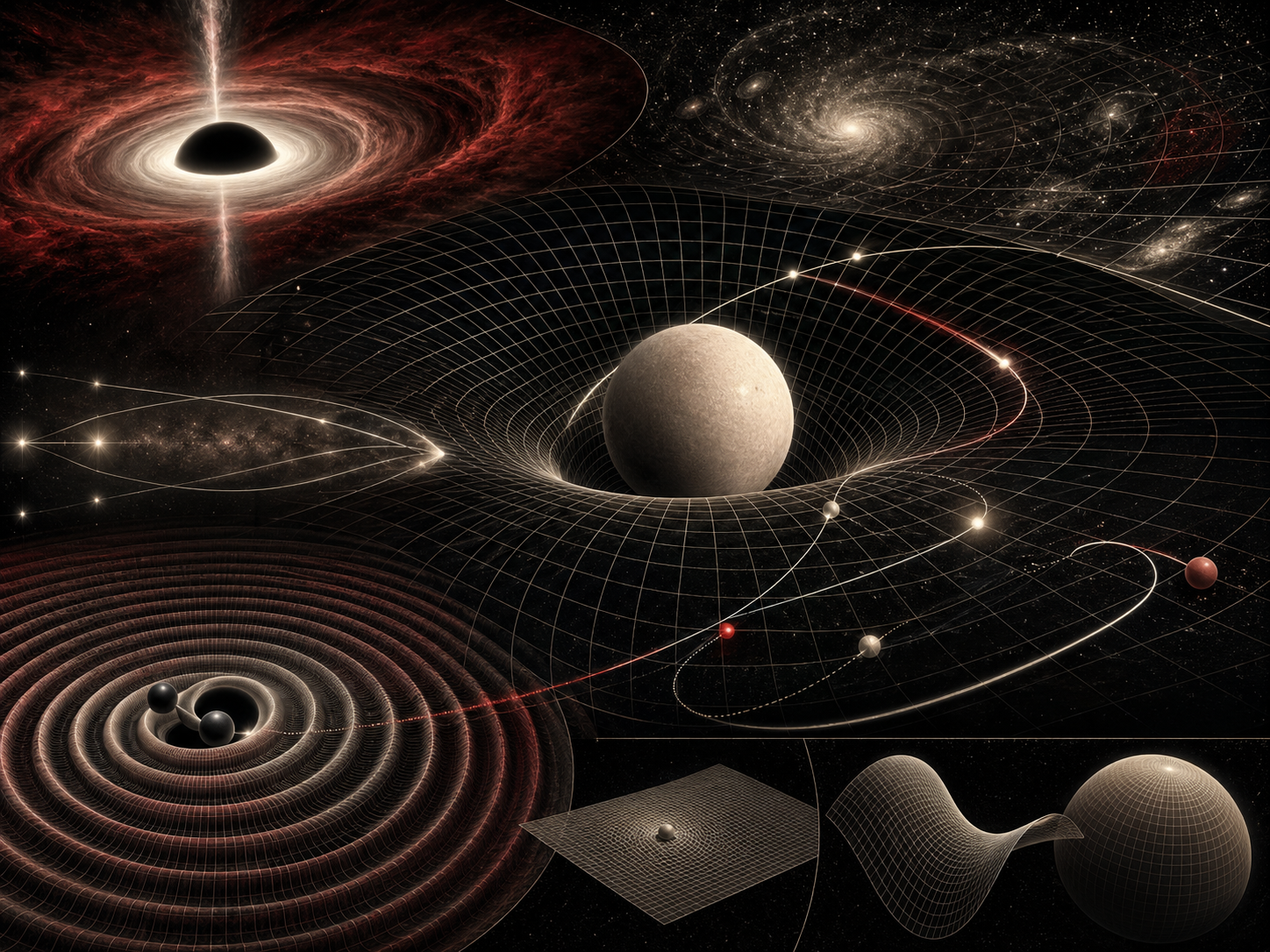
General relativity redefines gravity as the geometry of spacetime: matter and energy curve spacetime, and free-falling bodies move along the natural paths of that curved geometry. In Newtonian physics, gravity is a force acting across space. In Einstein’s theory, gravity is not added to spacetime from the outside. It is expressed through the metric, the curvature of spacetime, and the geodesic motion of particles and light. Planets orbit because spacetime geometry guides their motion. Light bends near massive bodies because null paths curve through geometry. Clocks tick differently in gravitational fields because time itself is part of the dynamical structure.
General relativity is one of the great conceptual revolutions in physics because it joins gravity, geometry, motion, causality, and measurement into a single framework. The theory replaces gravitational force with spacetime curvature, replaces inertial motion with geodesic motion, replaces Euclidean background space with Lorentzian manifolds, and replaces the Newtonian potential with the metric tensor. The gravitational field is no longer a scalar potential on a fixed stage. It is the stage itself: a dynamical geometry shaped by stress-energy.
This article develops General Relativity: Geometry, Gravity, and Spacetime Curvature as a research-grade Physics article within the Physics knowledge series. It explains the equivalence principle, spacetime intervals, Lorentzian geometry, metric tensors, geodesics, covariant derivatives, curvature, the Riemann tensor, Ricci curvature, scalar curvature, Einstein’s field equation, the stress-energy tensor, Newtonian limits, Schwarzschild geometry, gravitational time dilation, light bending, black holes, horizons, gravitational waves, cosmology, experimental tests, numerical relativity, and the unresolved tension between general relativity and quantum theory. Selected R and Python workflows appear in the article body, while the companion GitHub repository contains expanded computational resources for Schwarzschild scales, gravitational redshift, weak-field limits, geodesic diagnostics, curvature metadata, orbital precession, cosmological expansion, uncertainty propagation, SQL metadata, C/C++/Fortran/Rust examples, and reproducible relativity workflows.
Main Library
Publications
Article Map
Physics
Related Topic
Mathematics
Related Topic
Data Systems & Analytics
Related Topic
Astronomy
Series context: This article is part of the Physics knowledge series. It connects special relativity, differential geometry, tensor calculus, gravitation, black-hole physics, gravitational waves, cosmology, numerical relativity, quantum gravity, and computational physics into one integrated framework.
Why General Relativity Matters
General relativity matters because it provides the modern theory of gravity, spacetime, black holes, gravitational waves, relativistic cosmology, and the large-scale structure of the universe. It explains why Mercury’s orbit precesses beyond the Newtonian prediction, why light bends near the Sun, why clocks run differently at different gravitational potentials, why gravitational waves carry information from merging black holes and neutron stars, and why the expanding universe must be described through dynamical spacetime geometry.
The theory is also conceptually central. It shows that physical law cannot be separated from the structure of spacetime. In special relativity, space and time form a four-dimensional spacetime with a fixed Minkowski metric. In general relativity, that metric becomes dynamical. It is influenced by mass, energy, pressure, momentum, and stress. The gravitational field is not a force field laid over spacetime; it is encoded in spacetime geometry itself.
General relativity also serves as a model of theoretical unification. It connects the equivalence principle, tensor calculus, differential geometry, variational principles, conservation laws, field equations, experimental tests, and astronomical observation. It is both mathematically elegant and empirically powerful. Its predictions have been tested in the Solar System, binary pulsars, black-hole mergers, gravitational lensing, cosmology, satellite timing, and gravitational-wave astronomy.
For the Physics knowledge series, general relativity is a natural continuation of Relativity and the Reconstruction of Space and Time, Symmetry, Conservation, and Noether’s Theorem, Mathematical Methods in Physics, Gravitation, Orbits, and Celestial Mechanics, and Computational Physics and Scientific Simulation. It is also the gateway to black-hole physics, cosmology, gravitational waves, numerical relativity, and quantum gravity.
From Force to Geometry
Newtonian gravity describes attraction through a gravitational force. For two masses \(M\) and \(m\), the gravitational force magnitude is:
\[
F = \frac{GMm}{r^2} \]
Interpretation: Newtonian gravity treats gravitation as an attractive inverse-square force between masses.
where \(G\) is Newton’s gravitational constant and \(r\) is separation. This theory is extraordinarily successful for many ordinary problems, including planetary motion, projectiles, tides, and engineering approximations. But it treats gravity as a force acting in an absolute space and time. Special relativity made that picture unstable because no interaction can propagate instantaneously across space.
General relativity changes the question. Instead of asking what force gravity exerts, it asks what geometry spacetime has. Free-falling bodies do not feel gravitational force in the ordinary local sense. They follow geodesics, the natural paths determined by the metric. What appears as gravitational acceleration in a coordinate system is, more deeply, motion through curved spacetime.
This does not mean Newtonian gravity is simply discarded. General relativity must reproduce Newtonian predictions in the weak-field, slow-motion limit. The Newtonian gravitational potential \(\Phi\) reappears as part of the metric approximation:
\[
g_{00} \approx -\left(1+\frac{2\Phi}{c^2}\right) \]
Interpretation: In the weak-field limit, the Newtonian gravitational potential appears in the time-time component of the metric.
where \(c\) is the speed of light. Newtonian gravity becomes an approximation to spacetime geometry when gravitational fields are weak and velocities are small compared with \(c\).
The Equivalence Principle
The equivalence principle is the conceptual seed of general relativity. In its simplest form, it states that gravitational and inertial mass are equivalent. Objects in the same gravitational field fall with the same acceleration when non-gravitational forces such as air resistance are removed.
Einstein sharpened this into a deeper idea: locally, a freely falling observer can eliminate the effects of gravity. Inside a sufficiently small freely falling laboratory, objects float as though gravity has disappeared. Conversely, an observer in an accelerating rocket can experience effects similar to a gravitational field. This local equivalence between gravity and acceleration suggests that gravity is not an ordinary force.
The equivalence principle also explains why gravity affects all forms of energy and motion. If light travels in a straight line in a freely falling local frame, then in a larger accelerating or gravitational frame, the path of light can appear bent. If clocks behave normally in local inertial frames, then clocks at different gravitational potentials can accumulate different proper times.
The phrase “locally” is crucial. Gravity can be transformed away at a point or in a sufficiently small freely falling frame, but tidal effects cannot be eliminated over extended regions. Tidal effects reveal curvature. The equivalence principle removes gravity locally; curvature remains globally and physically.
Spacetime and the Interval
Relativity unifies space and time into spacetime. In flat spacetime, the invariant interval can be written as:
\[
ds^2 = -c^2dt^2 + dx^2 + dy^2 + dz^2 \]
Interpretation: The flat-spacetime interval is invariant under Lorentz transformations, using the \((-+++)\) sign convention.
Different inertial observers may disagree about spatial distances and time intervals separately, but they agree on the spacetime interval.
General relativity generalizes this idea. The interval becomes:
\[
ds^2 = g_{\mu\nu}dx^\mu dx^\nu \]
Interpretation: In curved spacetime, the metric tensor determines the spacetime interval.
where \(g_{\mu\nu}\) is the metric tensor. In flat spacetime, the metric can be written as the Minkowski metric. In curved spacetime, the metric varies from point to point and encodes gravitational geometry.
The interval classifies separations. Timelike intervals can be traversed by massive particles. Null intervals are followed by light. Spacelike intervals cannot be connected by causal motion at or below the speed of light. This causal structure is not merely geometry in the visual sense. It determines what can influence what.
General relativity therefore makes causal structure dynamical. Matter and energy shape the metric, and the metric shapes the light cones that define causal relationships.
Metric Tensor and Lorentzian Geometry
The metric tensor is the central object of general relativity. It determines distances, time intervals, angles, volumes, causal structure, and gravitational effects. In coordinates \(x^\mu\), the metric components \(g_{\mu\nu}\) define the line element:
\[
ds^2 = g_{\mu\nu}dx^\mu dx^\nu \]
Interpretation: The metric tensor defines the geometric structure through which intervals are measured.
where repeated indices are summed. A Lorentzian metric differs from an ordinary Euclidean metric because one dimension has time-like sign. This signature structure allows spacetime to distinguish timelike, null, and spacelike intervals.
The metric is not only a measuring device. It is the gravitational field. When the metric changes, the gravitational geometry changes. The motion of particles, the propagation of light, the ticking of clocks, and the curvature of spacetime all depend on the metric.
The inverse metric \(g^{\mu\nu}\) satisfies:
\[
g^{\mu\alpha}g_{\alpha\nu} = \delta^\mu_{\nu} \]
Interpretation: The inverse metric raises indices and satisfies the tensor identity with the metric.
It is used to raise indices, contract tensors, and construct curvature quantities. The determinant of the metric appears in invariant spacetime volume elements:
\[
\sqrt{-g}\,d^4x \]
Interpretation: The metric determinant supplies the invariant spacetime volume element in Lorentzian geometry.
where \(g\) is the determinant of \(g_{\mu\nu}\), using a common sign convention for Lorentzian metrics.
Proper Time and Free Fall
Proper time is the time measured by a clock moving along a timelike path. For a timelike worldline, proper time satisfies:
\[
d\tau = \frac{1}{c} \sqrt{-ds^2} \]
Interpretation: Proper time is the physical time measured along a timelike worldline, using the \((-+++)\) sign convention.
A freely falling massive particle follows a path that extremizes proper time between nearby events, subject to the geometry of spacetime. In flat spacetime, this reproduces inertial straight-line motion. In curved spacetime, it gives geodesic motion.
Proper time is physically measurable. A clock carried along one path can record a different elapsed time from a clock carried along another path. This occurs in special relativity through relative motion and in general relativity through gravitational potential and spacetime curvature.
Gravitational time dilation is not an illusion of coordinates. It is measured by real clocks. The operation of satellite navigation systems depends on relativistic time corrections because clocks on satellites experience different gravitational potential and motion relative to clocks on Earth.
Proper time is therefore one of the cleanest bridges between geometry and measurement. The metric determines proper time, and clocks measure it.
Geodesics and Motion Without Force
A geodesic is the natural generalization of a straight line to curved spacetime. In general relativity, freely falling particles follow timelike geodesics, while light follows null geodesics.
The geodesic equation is:
\[
\frac{d^2x^\mu}{d\lambda^2} + \Gamma^\mu_{\alpha\beta} \frac{dx^\alpha}{d\lambda} \frac{dx^\beta}{d\lambda} = 0 \]
Interpretation: The geodesic equation describes free-fall motion as motion determined by spacetime geometry.
where \(\lambda\) is an affine parameter and \(\Gamma^\mu_{\alpha\beta}\) are Christoffel symbols. These symbols are constructed from the metric:
\[
\Gamma^\mu_{\alpha\beta} = \frac{1}{2} g^{\mu\nu} \left( \partial_\alpha g_{\nu\beta} + \partial_\beta g_{\nu\alpha} – \partial_\nu g_{\alpha\beta} \right) \]
Interpretation: Christoffel symbols describe the connection induced by the metric and appear in geodesic motion.
The Christoffel symbols are not tensors. They depend on coordinates. This reflects the fact that gravitational acceleration can be changed by choosing a freely falling coordinate frame. Curvature, by contrast, is tensorial and cannot generally be transformed away over extended regions.
The geodesic equation can look like an equation of acceleration, but its meaning is different from Newton’s second law. In free fall, the particle is not being pushed by a gravitational force in its local inertial frame. It is following the straightest possible path in curved spacetime.
Covariant Derivatives and Parallel Transport
Curved spacetime requires a way to compare vectors at different points. In flat space, vectors can be moved without ambiguity. In curved geometry, moving a vector along different paths can produce different results. This is the idea behind parallel transport.
The covariant derivative extends ordinary differentiation to curved spacetime. For a vector \(V^\mu\), the covariant derivative is:
\[
\nabla_\nu V^\mu = \partial_\nu V^\mu + \Gamma^\mu_{\nu\alpha}V^\alpha \]
Interpretation: The covariant derivative corrects ordinary differentiation for curved-coordinate and curved-spacetime structure.
The connection coefficients \(\Gamma^\mu_{\nu\alpha}\) correct for the changing coordinate basis. They allow tensor equations to be written in a coordinate-independent way.
Parallel transport along a curve with tangent \(u^\nu\) is described by:
\[
u^\nu\nabla_\nu V^\mu=0 \]
Interpretation: Parallel transport keeps a vector covariantly constant along a curve.
If a vector is parallel transported around a closed loop in curved spacetime, it may return changed. The amount of change is related to curvature. This gives a deep geometric interpretation of gravity: curvature is measured by the failure of parallel transport to return vectors unchanged around infinitesimal loops.
Covariant derivatives therefore provide the technical bridge between local inertial physics and global curved geometry.
Curvature and the Riemann Tensor
The Riemann curvature tensor measures spacetime curvature. It can be defined through the commutator of covariant derivatives:
\[
[\nabla_\mu,\nabla_\nu]V^\rho = R^\rho_{\ \sigma\mu\nu}V^\sigma \]
Interpretation: The Riemann tensor measures how covariant derivatives fail to commute in curved spacetime.
The Riemann tensor can be written in terms of Christoffel symbols:
\[
R^\rho_{\ \sigma\mu\nu} = \partial_\mu \Gamma^\rho_{\nu\sigma} – \partial_\nu \Gamma^\rho_{\mu\sigma} + \Gamma^\rho_{\mu\lambda}\Gamma^\lambda_{\nu\sigma} – \Gamma^\rho_{\nu\lambda}\Gamma^\lambda_{\mu\sigma} \]
Interpretation: The Riemann tensor is built from derivatives and products of connection coefficients.
Curvature has physical meaning. It produces tidal effects: nearby freely falling particles can accelerate toward or away from each other because their geodesics converge or diverge. This is described by the geodesic deviation equation:
\[
\frac{D^2\xi^\mu}{d\tau^2} = – R^\mu_{\ \alpha\nu\beta} u^\alpha \xi^\nu u^\beta \]
Interpretation: Geodesic deviation connects curvature to tidal acceleration between neighboring freely falling paths.
where \(\xi^\mu\) is the separation vector between neighboring geodesics and \(u^\alpha\) is the four-velocity.
The Riemann tensor distinguishes real gravitational curvature from coordinate artifacts. A coordinate system can make Christoffel symbols vanish at a point, but it cannot generally make the Riemann curvature vanish if spacetime is genuinely curved.
Ricci Curvature, Scalar Curvature, and the Einstein Tensor
The Riemann tensor contains detailed information about curvature. The Ricci tensor is a contraction of the Riemann tensor:
\[
R_{\mu\nu} = R^\alpha_{\ \mu\alpha\nu} \]
Interpretation: The Ricci tensor contracts the Riemann tensor and enters the Einstein field equation.
The scalar curvature is another contraction:
\[
R = g^{\mu\nu}R_{\mu\nu} \]
Interpretation: Scalar curvature is the trace of the Ricci tensor.
The Einstein tensor is defined as:
\[
G_{\mu\nu} = R_{\mu\nu} – \frac{1}{2}Rg_{\mu\nu} \]
Interpretation: The Einstein tensor combines Ricci curvature and scalar curvature in a divergence-free geometric tensor.
It has a crucial property:
\[
\nabla_\mu G^{\mu\nu}=0 \]
Interpretation: The Einstein tensor is covariantly divergence-free.
This covariant divergence-free structure makes the Einstein tensor suitable for relating geometry to stress-energy, whose local conservation is expressed as:
\[
\nabla_\mu T^{\mu\nu}=0 \]
Interpretation: Local stress-energy conservation is expressed through covariant divergence in curved spacetime.
The Einstein tensor therefore packages curvature in a way that matches the conservation structure required by matter and energy. This is one reason it appears in the field equation.
Einstein’s Field Equation
Einstein’s field equation relates spacetime curvature to stress-energy:
\[
G_{\mu\nu} + \Lambda g_{\mu\nu} = \frac{8\pi G}{c^4} T_{\mu\nu} \]
Interpretation: Einstein’s field equation links geometry, cosmological constant, and matter-energy content.
where \(G_{\mu\nu}\) is the Einstein tensor, \(\Lambda\) is the cosmological constant, \(g_{\mu\nu}\) is the metric tensor, \(G\) is Newton’s gravitational constant, \(c\) is the speed of light, and \(T_{\mu\nu}\) is the stress-energy tensor.
This equation is compact, but it represents a coupled nonlinear system of equations for the metric. The left side describes geometry. The right side describes matter, energy, pressure, momentum, and stress. The equation says that spacetime geometry and physical content must be solved together.
In vacuum, where \(T_{\mu\nu}=0\), the equation becomes:
\[
G_{\mu\nu} + \Lambda g_{\mu\nu} = 0 \]
Interpretation: Vacuum spacetime can still have nontrivial geometry, including black-hole exteriors and gravitational waves.
Even in vacuum, spacetime can be curved. Black-hole exteriors and gravitational waves are examples of vacuum solutions with nontrivial geometry.
The nonlinearity of Einstein’s equation is essential. Gravity gravitates. The energy carried by the gravitational field contributes to the structure of spacetime in ways that have no direct Newtonian counterpart. This nonlinearity is one reason exact solutions are difficult and numerical relativity is so important.
Stress-Energy and the Source of Curvature
The stress-energy tensor \(T_{\mu\nu}\) is the source term in Einstein’s field equation. It contains energy density, momentum density, pressure, stress, and energy flux. In relativity, mass alone is not the source of gravity. Energy, pressure, momentum, and stress all contribute.
For a perfect fluid, the stress-energy tensor is often written as:
\[
T^{\mu\nu} = \left(\rho+\frac{p}{c^2}\right) u^\mu u^\nu + p g^{\mu\nu} \]
Interpretation: A perfect-fluid stress-energy tensor includes density, pressure, four-velocity, and metric structure.
depending on convention, where \(\rho\) is mass-energy density, \(p\) is pressure, and \(u^\mu\) is four-velocity.
This matters deeply in cosmology, stellar structure, neutron stars, black-hole accretion, and early-universe physics. Pressure is not merely a thermodynamic detail; in general relativity it can gravitate. Radiation, relativistic fluids, vacuum energy, and scalar fields all have stress-energy structures that influence spacetime evolution.
The local conservation law:
\[
\nabla_\mu T^{\mu\nu}=0 \]
Interpretation: Stress-energy is locally conserved in the covariant sense.
does not mean global energy is always conserved in the simple Newtonian sense for arbitrary curved spacetimes. In dynamical cosmological spacetimes, defining a global conserved energy can be subtle. Local conservation remains fundamental, but global conservation depends on spacetime symmetries.
The Newtonian Limit
A successful relativistic theory of gravity must reproduce Newtonian gravity in the appropriate limit. For weak gravitational fields and slow motion, the metric can be approximated by:
\[
g_{00} \approx -\left(1+\frac{2\Phi}{c^2}\right) \]
Interpretation: The Newtonian potential appears in the weak-field approximation to the metric.
where \(\Phi\) is the Newtonian gravitational potential. The geodesic equation then reduces approximately to Newton’s equation:
\[
\frac{d^2\mathbf{x}}{dt^2} = -\nabla\Phi \]
Interpretation: The weak-field, slow-motion geodesic equation reproduces Newtonian gravitational acceleration.
The field equation reduces to the Poisson equation:
\[
\nabla^2\Phi = 4\pi G\rho \]
Interpretation: In the Newtonian limit, Einstein’s equation recovers the Poisson equation for gravitational potential.
This limiting relation explains why Newtonian gravity works so well in many ordinary situations. General relativity contains Newtonian gravity as an approximation. It does not merely contradict it; it explains when and why Newtonian gravity is valid.
The Newtonian limit also helps interpret the metric physically. The time-time component of the metric encodes the familiar gravitational potential in weak fields. But the full theory includes spatial curvature, nonlinear geometry, relativistic motion, gravitational radiation, horizons, and cosmological dynamics beyond the Newtonian picture.
Schwarzschild Geometry
The Schwarzschild solution describes the exterior spacetime geometry around a non-rotating, spherically symmetric mass in vacuum. Its line element is:
\[
ds^2 = -\left(1-\frac{2GM}{rc^2}\right)c^2dt^2 + \left(1-\frac{2GM}{rc^2}\right)^{-1}dr^2 + r^2d\Omega^2 \]
Interpretation: The Schwarzschild metric describes the vacuum exterior of a static spherical mass.
where:
\[
d\Omega^2=d\theta^2+\sin^2\theta\,d\phi^2 \]
Interpretation: \(d\Omega^2\) is the angular part of the spherical line element.
The Schwarzschild radius is:
\[
r_s = \frac{2GM}{c^2} \]
Interpretation: The Schwarzschild radius is the event-horizon radius for a non-rotating black hole.
At \(r=r_s\), the Schwarzschild coordinate form has an apparent singular behavior. This radius corresponds to an event horizon for a black hole, not a physical curvature singularity. The true curvature singularity lies at \(r=0\), where curvature invariants diverge.
The Schwarzschild solution explains gravitational time dilation, light bending, orbital precession, photon spheres, black-hole horizons, and many weak-field relativistic corrections. It is one of the most important exact solutions in general relativity because it connects abstract geometry to measurable gravitational effects.
Gravitational Time Dilation, Redshift, and Light Bending
In Schwarzschild geometry, a stationary clock at radius \(r\) outside a spherical mass ticks relative to a distant observer according to:
\[
d\tau = dt \sqrt{ 1-\frac{2GM}{rc^2} } \]
Interpretation: A stationary clock deeper in a Schwarzschild gravitational field accumulates less proper time relative to distant coordinate time.
This means clocks deeper in a gravitational field tick more slowly relative to clocks far away. A photon climbing out of a gravitational field is redshifted. The gravitational redshift factor can be written as:
\[
1+z = \left( 1-\frac{2GM}{rc^2} \right)^{-1/2} \]
Interpretation: Gravitational redshift increases as the emission radius approaches the Schwarzschild radius.
for emission from radius \(r\) to a distant observer in the Schwarzschild idealization.
General relativity also predicts the bending of light near massive bodies. In the weak-field limit, the deflection angle for light passing with impact parameter \(b\) near a mass \(M\) is approximately:
\[
\Delta\phi \approx \frac{4GM}{bc^2} \]
Interpretation: Weak-field light deflection depends on mass, impact parameter, and the square of the speed of light.
This factor of \(4GM/(bc^2)\) is a famous relativistic result. It differs from simple Newtonian-like estimates because both time curvature and spatial curvature contribute to the bending of light.
Gravitational time dilation, redshift, and lensing are not exotic details. They are direct consequences of spacetime geometry and are central to astrophysics, satellite timing, gravitational lensing surveys, black-hole imaging, and precision tests of gravity.
Black Holes and Horizons
A black hole is a region of spacetime from which future-directed causal paths cannot escape to distant infinity. The boundary of this region is the event horizon. For a non-rotating Schwarzschild black hole, the horizon lies at:
\[
r_s = \frac{2GM}{c^2} \]
Interpretation: The Schwarzschild horizon radius scales linearly with mass.
Astrophysical black holes often rotate. The Kerr solution describes rotating black holes and introduces angular momentum, frame dragging, ergospheres, and richer horizon structure. Rotating black holes are central to high-energy astrophysics, accretion disks, relativistic jets, and gravitational-wave observations.
Black holes are not merely collapsed stars in a Newtonian sense. They are regions where spacetime causal structure is profoundly altered. Inside the event horizon, all future-directed timelike paths lead inward. The horizon is not a material surface; it is a causal boundary.
Black holes also create deep theoretical questions. Classical general relativity predicts singularities under broad conditions. Quantum theory predicts black-hole radiation in semiclassical treatments. The information problem, entropy, holography, and quantum gravity all arise from trying to reconcile black-hole physics with quantum mechanics.
Gravitational Waves
Gravitational waves are propagating disturbances in spacetime geometry. In the weak-field approximation, the metric can be written as:
\[
g_{\mu\nu} = \eta_{\mu\nu} + h_{\mu\nu} \]
Interpretation: Linearized gravity treats the metric as flat spacetime plus a small perturbation.
where \(\eta_{\mu\nu}\) is the flat Minkowski metric and \(h_{\mu\nu}\) is a small perturbation. In linearized general relativity, it is often useful to work with the trace-reversed perturbation \(\bar{h}_{\mu\nu}\). Under appropriate gauge choices and in vacuum, this perturbation satisfies a wave equation:
\[
\left( -\frac{1}{c^2}\frac{\partial^2}{\partial t^2} + \nabla^2 \right) \bar{h}_{\mu\nu} = 0 \]
Interpretation: In linearized vacuum gravity, weak metric perturbations propagate as waves at the speed of light.
This equation states that weak gravitational disturbances propagate as waves through spacetime at the speed of light. Gravitational waves are generated by accelerating mass-energy distributions with changing quadrupole moments. They are extremely weak by the time they reach Earth, but they carry information about compact objects, black-hole mergers, neutron-star mergers, strong-field gravity, and the dynamical behavior of spacetime.
The first direct detection of gravitational waves opened a new observational window. It confirmed that spacetime curvature can propagate as radiation and that black-hole mergers can be observed through geometry itself rather than light. Gravitational-wave astronomy now allows tests of general relativity in strong-field, highly dynamical regimes.
In the Physics pillar, gravitational waves connect general relativity to Waves, Oscillations, and Resonance, Computational Physics and Scientific Simulation, Astrophysics, and future articles on black holes, numerical relativity, and cosmology.
Cosmology and Dynamical Spacetime
General relativity provides the framework for modern cosmology. On large scales, the universe is often modeled as homogeneous and isotropic using the Friedmann–Lemaître–Robertson–Walker metric:
\[
ds^2 = -c^2dt^2 + a(t)^2 \left[ \frac{dr^2}{1-kr^2} + r^2d\Omega^2 \right] \]
Interpretation: The FLRW metric models a homogeneous and isotropic expanding universe.
where \(a(t)\) is the scale factor and \(k\) describes spatial curvature. The expansion of the universe is not ordinary motion through pre-existing space. It is described by the changing scale factor of spacetime geometry.
The Friedmann equation relates expansion to energy content:
\[
H^2 = \left(\frac{\dot a}{a}\right)^2 = \frac{8\pi G}{3}\rho – \frac{kc^2}{a^2} + \frac{\Lambda c^2}{3} \]
Interpretation: The Friedmann equation links cosmic expansion to energy density, spatial curvature, and the cosmological constant.
where \(H\) is the Hubble parameter, \(\rho\) is energy density, and \(\Lambda\) is the cosmological constant.
Cosmology uses general relativity to model the early universe, cosmic expansion, gravitational lensing, structure formation, black holes, dark energy, and the cosmic microwave background. It also exposes unresolved questions: the nature of dark matter, the nature of dark energy, the physics of inflation, the origin of cosmic initial conditions, and the quantum structure of the early universe.
Experimental Tests and Observational Relativity
General relativity is mathematically elegant, but its authority also rests on observation. Classic tests include Mercury’s perihelion precession, gravitational redshift, light deflection, and time delay. Later tests include binary pulsar orbital decay, frame dragging, satellite timing, gravitational lensing, black-hole observations, and gravitational-wave detection.
Mercury’s perihelion precession was an early success because general relativity accounted for a small residual precession not explained by Newtonian perturbations alone. Gravitational redshift tests show that clocks and light frequencies are affected by gravitational potential. Light-bending tests show that mass curves null paths. Shapiro time delay shows that signals passing near massive bodies experience additional travel time.
Binary pulsars provided indirect evidence for gravitational radiation because their orbital periods decay in agreement with energy loss predicted by general relativity. Direct gravitational-wave detections then confirmed spacetime radiation from compact binary mergers.
Modern tests increasingly probe strong-field gravity. Black-hole imaging, gravitational-wave ringdowns, neutron-star mergers, pulsar timing arrays, and future space-based detectors extend general relativity into regimes that were previously inaccessible.
Numerical Relativity and Computational Gravity
Einstein’s field equation is nonlinear, tensorial, and difficult to solve exactly. Exact solutions such as Schwarzschild, Kerr, and FLRW geometries are enormously important, but many realistic systems require computation. Numerical relativity solves the field equations on computers, especially for dynamical strong-field systems such as binary black-hole mergers and neutron-star collisions.
Numerical relativity requires decomposing spacetime into space plus time, choosing coordinates and gauge conditions, solving constraint equations, evolving fields stably, tracking horizons, extracting gravitational waves, and validating results against analytic limits and conservation diagnostics. It is a field where mathematical physics, numerical methods, high-performance computing, and astrophysical observation meet.
Computational gravity also includes geodesic integration, gravitational lensing simulations, relativistic hydrodynamics, cosmological structure formation, black-hole perturbation theory, waveform modeling, Bayesian inference for gravitational-wave data, and symbolic tensor computation.
For the repository strategy behind this article, the computational goal is not to reproduce professional numerical relativity codes. It is to provide transparent computational examples: Schwarzschild scales, redshift factors, weak-field limits, precession diagnostics, curvature metadata, geodesic toy models, cosmology calculations, and reproducible documentation that can grow into more advanced workflows.
Quantum Gravity and the Limits of Classical Spacetime
General relativity is a classical theory. Quantum mechanics and quantum field theory describe matter and fields at microscopic scales. Both frameworks are extraordinarily successful, but they are not yet unified into a complete theory of quantum gravity.
The tension becomes unavoidable in black-hole singularities, the early universe, Hawking radiation, Planck-scale physics, and attempts to quantize spacetime itself. General relativity treats spacetime geometry as dynamical but classical. Quantum theory treats fields as quantum but usually assumes a background spacetime. A complete theory likely requires rethinking at least one of these assumptions.
The Planck length is:
\[
\ell_P = \sqrt{\frac{\hbar G}{c^3}} \]
Interpretation: The Planck length combines quantum mechanics, gravity, and relativity into a characteristic length scale.
The Planck time is:
\[
t_P = \sqrt{\frac{\hbar G}{c^5}} \]
Interpretation: The Planck time is the corresponding quantum-gravitational time scale built from \(\hbar\), \(G\), and \(c\).
These scales are often interpreted as indicating where quantum gravitational effects may become significant, though the precise physical meaning depends on the theory.
Quantum gravity remains an open frontier. String theory, loop quantum gravity, causal dynamical triangulations, asymptotic safety, semiclassical gravity, holography, effective field theory, and quantum information approaches all address parts of the problem. General relativity remains the classical foundation that any deeper theory must recover in the appropriate limit.
Measurement, Units, and SI Interpretation
General relativity uses geometric quantities whose units can be subtle. In SI units, the speed of light \(c\) has units of meters per second, Newton’s constant \(G\) has units of \(\mathrm{m^3\,kg^{-1}\,s^{-2}}\), and the metric components may carry units depending on coordinate conventions. Many relativists use geometrized units where:
\[
G=c=1 \]
Interpretation: Geometrized units simplify relativistic equations by expressing mass, length, and time in compatible units.
In geometrized units, mass, length, and time can be expressed in the same units. This simplifies equations but can obscure dimensional interpretation for readers moving between theoretical and observational contexts.
The Schwarzschild radius has units of length:
\[
r_s = \frac{2GM}{c^2} \]
Interpretation: The combination \(2GM/c^2\) has dimensions of length.
The Einstein field equation balances curvature and stress-energy. Curvature terms have units of inverse length squared. The coupling constant:
\[
\frac{8\pi G}{c^4} \]
Interpretation: The gravitational coupling converts stress-energy density into curvature scale.
converts stress-energy density into curvature scale.
Careful unit handling is essential in computational relativity. A code that computes Schwarzschild radii, redshift factors, orbital precession, gravitational-wave strain, or cosmological expansion must clearly document whether it uses SI units, geometrized units, astronomical units, solar masses, parsecs, or mixed conventions.
Mathematical Lens
A mathematics-first view of general relativity begins with the metric:
\[
ds^2 = g_{\mu\nu}dx^\mu dx^\nu \]
Interpretation: The metric is the fundamental geometric object defining intervals and causal structure.
The Christoffel symbols are:
\[
\Gamma^\mu_{\alpha\beta} = \frac{1}{2} g^{\mu\nu} \left( \partial_\alpha g_{\nu\beta} + \partial_\beta g_{\nu\alpha} – \partial_\nu g_{\alpha\beta} \right) \]
Interpretation: Christoffel symbols encode metric-compatible connection information in a coordinate chart.
The geodesic equation is:
\[
\frac{d^2x^\mu}{d\lambda^2} + \Gamma^\mu_{\alpha\beta} \frac{dx^\alpha}{d\lambda} \frac{dx^\beta}{d\lambda} = 0 \]
Interpretation: Geodesics describe force-free motion in curved spacetime.
The Riemann curvature tensor is:
\[
R^\rho_{\ \sigma\mu\nu} = \partial_\mu \Gamma^\rho_{\nu\sigma} – \partial_\nu \Gamma^\rho_{\mu\sigma} + \Gamma^\rho_{\mu\lambda}\Gamma^\lambda_{\nu\sigma} – \Gamma^\rho_{\nu\lambda}\Gamma^\lambda_{\mu\sigma} \]
Interpretation: The Riemann tensor measures curvature through connection derivatives and quadratic connection terms.
The Ricci tensor and scalar curvature are:
\[
R_{\mu\nu} = R^\alpha_{\ \mu\alpha\nu} \]
Interpretation: Ricci curvature is a contraction of the Riemann tensor.
\[
R = g^{\mu\nu}R_{\mu\nu} \]
Interpretation: Scalar curvature is the trace of the Ricci tensor.
The Einstein tensor is:
\[
G_{\mu\nu} = R_{\mu\nu} – \frac{1}{2}Rg_{\mu\nu} \]
Interpretation: The Einstein tensor is the divergence-free curvature tensor used in the field equation.
Einstein’s field equation is:
\[
G_{\mu\nu} + \Lambda g_{\mu\nu} = \frac{8\pi G}{c^4}T_{\mu\nu} \]
Interpretation: The field equation equates geometric curvature structure with matter-energy content.
The Einstein–Hilbert action is:
\[
S = \frac{c^3}{16\pi G} \int (R-2\Lambda)\sqrt{-g}\,d^4x + S_{\mathrm{matter}} \]
Interpretation: The Einstein–Hilbert action gives general relativity a variational field-theory formulation.
Varying this action with respect to the metric gives the field equation under appropriate assumptions and boundary conditions. This mathematical lens shows that general relativity is not only a theory of curved spacetime; it is a variational field theory of geometry.
Variables, Units, and Physical Interpretation
General relativity depends on variables that connect geometry, matter, motion, and measurement. The table below summarizes several central quantities.
| Symbol or Term | Meaning | Typical Unit | Physical Interpretation |
|---|---|---|---|
| \(g_{\mu\nu}\) | Metric tensor | depends on coordinates | Defines spacetime intervals, causal structure, and gravitational geometry |
| \(ds^2\) | Spacetime interval | m² or s² convention-dependent | Invariant separation between neighboring events |
| \(\tau\) | Proper time | s | Time measured by a clock along a worldline |
| \(\Gamma^\mu_{\alpha\beta}\) | Christoffel symbols | inverse coordinate unit | Connection coefficients describing how basis vectors change |
| \(R^\rho_{\ \sigma\mu\nu}\) | Riemann tensor | m⁻² | Measures spacetime curvature and tidal effects |
| \(R_{\mu\nu}\) | Ricci tensor | m⁻² | Contraction of curvature entering the field equation |
| \(R\) | Scalar curvature | m⁻² | Trace of Ricci curvature |
| \(G_{\mu\nu}\) | Einstein tensor | m⁻² | Divergence-free curvature tensor matched to stress-energy |
| \(T_{\mu\nu}\) | Stress-energy tensor | Pa or J/m³ components | Energy density, momentum flux, pressure, and stress |
| \(\Lambda\) | Cosmological constant | m⁻² | Vacuum-energy-like curvature term in the field equation |
| \(r_s\) | Schwarzschild radius | m | Event-horizon radius for a non-rotating black hole |
| \(H\) | Hubble parameter | s⁻¹ | Expansion rate of the universe in cosmology |
Note: General-relativistic quantities often depend on coordinate conventions, sign conventions, and unit systems. Computational work should document whether it uses SI, geometrized, astronomical, or mixed units.
The table illustrates why general relativity is simultaneously geometric and physical. Curvature quantities describe geometry, while stress-energy quantities describe matter and energy. The field equation links them.
Worked Example: Schwarzschild Radius of the Sun
The Schwarzschild radius of a non-rotating mass \(M\) is:
\[
r_s = \frac{2GM}{c^2} \]
Interpretation: Schwarzschild radius gives the horizon radius associated with compressing mass \(M\) into a non-rotating black hole.
For the Sun, use:
\[
G = 6.67430\times10^{-11}\ \mathrm{m^3\,kg^{-1}\,s^{-2}} \]
Interpretation: Newton’s gravitational constant sets the gravitational coupling strength.
\[
M_\odot = 1.98847\times10^{30}\ \mathrm{kg} \]
Interpretation: The solar mass is the mass scale used in this worked example.
\[
c = 2.99792458\times10^8\ \mathrm{m\,s^{-1}} \]
Interpretation: The speed of light sets the relativistic causal scale.
Substituting:
\[
r_s = \frac{ 2(6.67430\times10^{-11})(1.98847\times10^{30}) }{ (2.99792458\times10^8)^2 } \]
Interpretation: Substitution uses SI units so the result is in meters.
The numerator is approximately:
\[
2GM_\odot \approx 2.65425\times10^{20}\ \mathrm{m^3\,s^{-2}} \]
Interpretation: The numerator combines gravitational coupling and solar mass.
The denominator is:
\[
c^2 \approx 8.98755\times10^{16}\ \mathrm{m^2\,s^{-2}} \]
Interpretation: Dividing by \(c^2\) converts the gravitational mass scale into a length scale.
Therefore:
\[
r_s \approx 2953\ \mathrm{m} \]
Interpretation: The Sun’s Schwarzschild radius is roughly 2,953 meters.
or approximately:
\[
r_s \approx 2.95\ \mathrm{km} \]
Interpretation: The same result expressed in kilometers is about 2.95 km.
This does not mean the Sun is a black hole. The Sun’s actual radius is vastly larger than its Schwarzschild radius. The calculation shows the radius within which the same mass would need to be compressed for a Schwarzschild event horizon to form.
Computational Modeling
Computational modeling helps turn general relativity into reproducible analysis. A simple model can compute Schwarzschild radii, gravitational redshift, weak-field time dilation, light-deflection scales, and orbital precession. A symbolic workflow can compute Christoffel symbols and curvature for simplified metrics. A geodesic integrator can trace particle or light paths. A cosmology workflow can solve Friedmann equations. A numerical relativity workflow can evolve spacetime fields under constraint equations. A metadata system can preserve constants, units, coordinate conventions, approximations, source provenance, and assumptions.
The selected examples below focus on Schwarzschild scales and weak-field relativistic precession because they are foundational, readable, and broadly useful. The GitHub repository extends the same logic into richer computational resources: R Schwarzschild and redshift tables, Python weak-field precession diagnostics, geodesic toy models, curvature-symbolic examples, cosmology expansion workflows, gravitational-wave strain-scale examples, uncertainty propagation, Julia relativity calculations, C++ orbit sweeps, Fortran Schwarzschild tables, SQL relativity metadata, Rust command-line utilities, C examples, documentation, and reproducible sample data.
R Workflow: Schwarzschild Radius and Gravitational Redshift
R is useful for parameter sweeps, reproducible tables, and scale comparisons. The following workflow computes Schwarzschild radius and gravitational redshift factors for several compact-object cases.
# Schwarzschild Radius and Gravitational Redshift
#
# This workflow computes:
#
#   r_s = 2 G M / c^2
#
# and the Schwarzschild redshift factor for a stationary emitter:
#
#   1 + z = 1 / sqrt(1 - r_s / r)
#
# where:
#   G = Newton's gravitational constant
#   c = speed of light
#   M = mass
#   r = emission radius
#
# The calculation is idealized: it assumes a non-rotating spherical
# mass and Schwarzschild exterior geometry.

library(tibble)
library(dplyr)

gravitational_constant <- 6.67430e-11
speed_of_light <- 299792458
solar_mass_kg <- 1.98847e30
earth_mass_kg <- 5.9722e24

object_table <- tibble(
  object = c(
    "Earth",
    "Sun",
    "white_dwarf_like",
    "neutron_star_like",
    "ten_solar_mass_black_hole"
  ),
  mass_kg = c(
    earth_mass_kg,
    solar_mass_kg,
    1.0 * solar_mass_kg,
    1.4 * solar_mass_kg,
    10.0 * solar_mass_kg
  ),
  radius_m = c(
    6.371e6,
    6.957e8,
    7.0e6,
    1.2e4,
    NA_real_
  )
) %>%
  mutate(
    schwarzschild_radius_m =
      2 * gravitational_constant * mass_kg / speed_of_light^2,
    compactness =
      schwarzschild_radius_m / radius_m,
    redshift_factor =
      if_else(
        !is.na(radius_m) & radius_m > schwarzschild_radius_m,
        1 / sqrt(1 - schwarzschild_radius_m / radius_m),
        NA_real_
      ),
    gravitational_redshift_z =
      redshift_factor - 1,
    schwarzschild_radius_km =
      schwarzschild_radius_m / 1000
  )

print(object_table)
This workflow shows how compactness controls relativistic effects. Earth and the Sun have very small compactness, so their surface redshifts are small. Neutron-star-like objects can have much larger compactness, making relativistic corrections essential.
Python Workflow: Weak-Field Relativistic Orbital Precession
Python is useful for numerical integration, parameter sweeps, and reproducible gravitational modeling. The following workflow compares Newtonian orbital motion with a simple weak-field relativistic correction that produces perihelion precession. It is a pedagogical model, not a full geodesic solver.
"""
Weak-Field Relativistic Orbital Precession

This workflow integrates planar orbital motion with a Newtonian
central acceleration plus a simple first post-Newtonian-style correction:

    a = -mu r / |r|^3 * (1 + 3 h^2 / (c^2 |r|^2))

where:
    mu = G M
    h  = specific angular momentum magnitude

This toy model is useful for showing how relativistic corrections
produce orbital precession. It is not a substitute for full geodesic
integration in Schwarzschild or Kerr spacetime.
"""

import numpy as np
import pandas as pd

GRAVITATIONAL_CONSTANT = 6.67430e-11
SPEED_OF_LIGHT = 299792458.0
SOLAR_MASS_KG = 1.98847e30

CENTRAL_MASS_KG = SOLAR_MASS_KG
MU = GRAVITATIONAL_CONSTANT * CENTRAL_MASS_KG

# Mercury-like initial scale, simplified for demonstration.
SEMI_MAJOR_AXIS_M = 5.7909e10
ECCENTRICITY = 0.2056

TIME_STEP_S = 2000.0
N_STEPS = 120000

def acceleration(position_m: np.ndarray, velocity_m_s: np.ndarray) -> np.ndarray:
    """
    Compute weak-field relativistic acceleration for a test particle.

    The correction is a simplified educational approximation that
    captures perihelion precession behavior in weak fields.
    """
    radius_m = np.linalg.norm(position_m)

    if radius_m == 0.0:
        raise ValueError("Orbital radius cannot be zero.")

    specific_angular_momentum = (
        position_m[0] * velocity_m_s[1]
        - position_m[1] * velocity_m_s[0]
    )

    correction = 1.0 + (
        3.0
        * specific_angular_momentum**2
        / (SPEED_OF_LIGHT**2 * radius_m**2)
    )

    return -MU * position_m / radius_m**3 * correction

def specific_energy(position_m: np.ndarray, velocity_m_s: np.ndarray) -> float:
    """
    Compute Newtonian specific orbital energy for diagnostics.
    """
    radius_m = np.linalg.norm(position_m)
    kinetic = 0.5 * np.dot(velocity_m_s, velocity_m_s)
    potential = -MU / radius_m
    return kinetic + potential

def main() -> None:
    """
    Integrate a Mercury-like orbit and estimate perihelion angles.
    """
    perihelion_distance_m = SEMI_MAJOR_AXIS_M * (1.0 - ECCENTRICITY)

    perihelion_speed_m_s = np.sqrt(
        MU
        * (1.0 + ECCENTRICITY)
        / (SEMI_MAJOR_AXIS_M * (1.0 - ECCENTRICITY))
    )

    position = np.array([perihelion_distance_m, 0.0], dtype=float)
    velocity = np.array([0.0, perihelion_speed_m_s], dtype=float)

    rows = []
    perihelion_events = []

    previous_radius = np.linalg.norm(position)
    previous_previous_radius = previous_radius

    current_acceleration = acceleration(position, velocity)

    for step in range(N_STEPS + 1):
        time_s = step * TIME_STEP_S
        radius = np.linalg.norm(position)
        angle = np.arctan2(position[1], position[0])

        rows.append(
            {
                "step": step,
                "time_s": time_s,
                "x_m": position[0],
                "y_m": position[1],
                "vx_m_s": velocity[0],
                "vy_m_s": velocity[1],
                "radius_m": radius,
                "angle_rad": angle,
                "specific_energy_j_kg": specific_energy(position, velocity),
            }
        )

        # Detect local radius minima as approximate perihelion passages.
        if (
            step > 2
            and previous_radius < previous_previous_radius
            and previous_radius < radius
        ):
            previous_row = rows[-2]
            perihelion_events.append(
                {
                    "step": previous_row["step"],
                    "time_s": previous_row["time_s"],
                    "angle_rad": previous_row["angle_rad"],
                    "radius_m": previous_row["radius_m"],
                }
            )

        if step < N_STEPS:
            next_position = (
                position
                + velocity * TIME_STEP_S
                + 0.5 * current_acceleration * TIME_STEP_S**2
            )

            next_acceleration = acceleration(next_position, velocity)

            next_velocity = (
                velocity
                + 0.5
                * (current_acceleration + next_acceleration)
                * TIME_STEP_S
            )

            previous_previous_radius = previous_radius
            previous_radius = radius
            position = next_position
            velocity = next_velocity
            current_acceleration = next_acceleration

    trajectory = pd.DataFrame(rows)
    perihelia = pd.DataFrame(perihelion_events)

    if len(perihelia) > 1:
        unwrapped_angles = np.unwrap(perihelia["angle_rad"].to_numpy())
        perihelia["unwrapped_angle_rad"] = unwrapped_angles
        perihelia["precession_since_first_rad"] = (
            unwrapped_angles - unwrapped_angles[0]
        )
        perihelia["precession_since_first_arcsec"] = (
            perihelia["precession_since_first_rad"] * 206264.806247
        )

    print("Trajectory sample:")
    print(trajectory.iloc[::12000, :].round(6).to_string(index=False))

    print("\nApproximate perihelion events:")
    if len(perihelia) == 0:
        print("No perihelion events detected. Increase N_STEPS or adjust parameters.")
    else:
        print(perihelia.head(10).round(8).to_string(index=False))

if __name__ == "__main__":
    main()
This workflow illustrates how small relativistic corrections can accumulate into observable orbital precession. A full treatment would integrate geodesics in Schwarzschild spacetime, use coordinate choices carefully, validate against analytic approximations, and document numerical error. The simplified workflow is useful because it makes the connection between weak-field corrections and measurable orbital effects transparent.
GitHub Repository
The article body includes only selected computational examples so the conceptual and mathematical argument remains readable. The full repository contains the expanded computational infrastructure: R Schwarzschild and redshift tables, Python weak-field precession diagnostics, geodesic toy models, curvature-symbolic examples, cosmology expansion workflows, gravitational-wave strain-scale examples, uncertainty propagation, Julia relativity calculations, C++ orbit sweeps, Fortran Schwarzschild tables, SQL relativity metadata, Rust command-line utilities, C examples, documentation, and reproducible sample data.
Complete Code Repository
The full code distribution for this article, including selected article examples and advanced research-grade computational resources for spacetime metrics, Schwarzschild geometry, gravitational redshift, weak-field limits, orbital precession, curvature diagnostics, cosmology, gravitational-wave scales, relativity metadata, reproducibility documentation, and performance-oriented scientific computing, is available on GitHub.
From General Relativity to the Geometry of Physical Law
General relativity transforms gravity from a force into geometry. The metric tells clocks how to tick and rulers how to measure. Geodesics tell free particles and light how to move. Curvature tells neighboring geodesics how to converge or diverge. Stress-energy tells spacetime how to curve. The field equation makes geometry and matter part of one dynamical system.
Within the Physics knowledge series, this article belongs near Relativity and the Reconstruction of Space and Time, Symmetry, Conservation, and Noether’s Theorem, Mathematical Methods in Physics, Gravitation, Orbits, and Celestial Mechanics, Lagrangian and Hamiltonian Mechanics, and Computational Physics and Scientific Simulation. It provides the geometric foundation for black holes, gravitational waves, relativistic astrophysics, and cosmology.
The next conceptual steps are natural. Black Holes, Horizons, and Relativistic Astrophysics develops the strong-field consequences of the theory. Cosmology: Expansion, Dark Matter, Dark Energy, and the Early Universe applies the field equation to the universe as a whole. Gravitational Waves and Precision Tests of Relativity connects geometry to observation. Quantum Gravity and the Problem of Spacetime addresses the unresolved boundary between relativity and quantum theory.
Related Articles
- What Is Physics?
- Measurement, Mathematics, and the Structure of Physical Inquiry
- Mathematical Methods in Physics
- Relativity and the Reconstruction of Space and Time
- Symmetry, Conservation, and Noether’s Theorem
- Gravitation, Orbits, and Celestial Mechanics
- Lagrangian and Hamiltonian Mechanics
- Motion, Force, and the Foundations of Classical Mechanics
- Energy, Work, and Conservation in Physical Systems
- Computational Physics and Scientific Simulation
- Nonlinear Dynamics, Chaos, and Complex Physical Systems
- Astrophysics
- Astronomy
- Calculus for Systems Modeling
- Linear Algebra for Systems Modeling
- Systems Modeling
- Data Systems & Analytics
Further Reading
- Carroll, S.M. (2019) Spacetime and Geometry: An Introduction to General Relativity. Cambridge: Cambridge University Press. Available at: https://www.cambridge.org/highereducation/books/spacetime-and-geometry/38EDAB86C7CC4375D7292C5B1E4B55D5 (Accessed: 25 April 2026).
- Einstein, A. (1916) ‘The Foundation of the Generalised Theory of Relativity’, translated in The Principle of Relativity. Available at: https://en.wikisource.org/wiki/The_Foundation_of_the_Generalised_Theory_of_Relativity (Accessed: 25 April 2026).
- Hartle, J.B. (2021) Gravity: An Introduction to Einstein’s General Relativity, 2nd edn. Cambridge: Cambridge University Press. Available at: https://www.cambridge.org/highereducation/books/gravity/B5E32AAB720F4B41157EF2D8DC44F142 (Accessed: 25 April 2026).
- LIGO Scientific Collaboration (2026) General Relativity and Gravitational Waves. Available at: https://www.ligo.caltech.edu/page/what-are-gw (Accessed: 25 April 2026).
- MIT OpenCourseWare (2020) General Relativity. Available at: https://ocw.mit.edu/courses/8-962-general-relativity-spring-2020/ (Accessed: 25 April 2026).
- MIT OpenCourseWare (2020) Lecture 10: Spacetime Curvature. Available at: https://ocw.mit.edu/courses/8-962-general-relativity-spring-2020/resources/lecture-10-spacetime-curvature/ (Accessed: 25 April 2026).
- MIT OpenCourseWare (2020) Lecture 12: The Einstein Field Equation. Available at: https://ocw.mit.edu/courses/8-962-general-relativity-spring-2020/resources/lecture-12-the-einstein-field-equation/ (Accessed: 25 April 2026).
- Misner, C.W., Thorne, K.S. and Wheeler, J.A. (1973) Gravitation. San Francisco: W.H. Freeman. Publisher information available at: https://press.princeton.edu/books/hardcover/9780691177793/gravitation (Accessed: 25 April 2026).
- Nobel Prize (2017) The Nobel Prize in Physics 2017. Available at: https://www.nobelprize.org/prizes/physics/2017/summary/ (Accessed: 25 April 2026).
- Schutz, B. (2009) A First Course in General Relativity, 2nd edn. Cambridge: Cambridge University Press. Available at: https://www.cambridge.org/highereducation/books/a-first-course-in-general-relativity/2B9F20E760F40DCCF295B0A59F776E6F (Accessed: 25 April 2026).
- Stanford Gravity Probe B (2026) Einstein’s Spacetime. Available at: https://einstein.stanford.edu/SPACETIME/spacetime2.html (Accessed: 25 April 2026).
- Wald, R.M. (1984) General Relativity. Chicago: University of Chicago Press. Available at: https://press.uchicago.edu/ucp/books/book/chicago/G/bo5952261.html (Accessed: 25 April 2026).
References
- Einstein, A. (1916) ‘The Foundation of the Generalised Theory of Relativity’, translated in The Principle of Relativity. Available at: https://en.wikisource.org/wiki/The_Foundation_of_the_Generalised_Theory_of_Relativity (Accessed: 25 April 2026).
- LIGO Scientific Collaboration (2026) What Are Gravitational Waves? Available at: https://www.ligo.caltech.edu/page/what-are-gw (Accessed: 25 April 2026).
- MIT OpenCourseWare (2020) General Relativity. Available at: https://ocw.mit.edu/courses/8-962-general-relativity-spring-2020/ (Accessed: 25 April 2026).
- MIT OpenCourseWare (2020) Lecture 10: Spacetime Curvature. Available at: https://ocw.mit.edu/courses/8-962-general-relativity-spring-2020/resources/lecture-10-spacetime-curvature/ (Accessed: 25 April 2026).
- MIT OpenCourseWare (2020) Lecture 12: The Einstein Field Equation. Available at: https://ocw.mit.edu/courses/8-962-general-relativity-spring-2020/resources/lecture-12-the-einstein-field-equation/ (Accessed: 25 April 2026).
- Nobel Prize (2017) The Nobel Prize in Physics 2017. Available at: https://www.nobelprize.org/prizes/physics/2017/summary/ (Accessed: 25 April 2026).
- Stanford Gravity Probe B (2026) Einstein’s Spacetime. Available at: https://einstein.stanford.edu/SPACETIME/spacetime2.html (Accessed: 25 April 2026).
- Wald, R.M. (1984) General Relativity. Chicago: University of Chicago Press. Available at: https://press.uchicago.edu/ucp/books/book/chicago/G/bo5952261.html (Accessed: 25 April 2026).