
Last Updated August 6, 2026
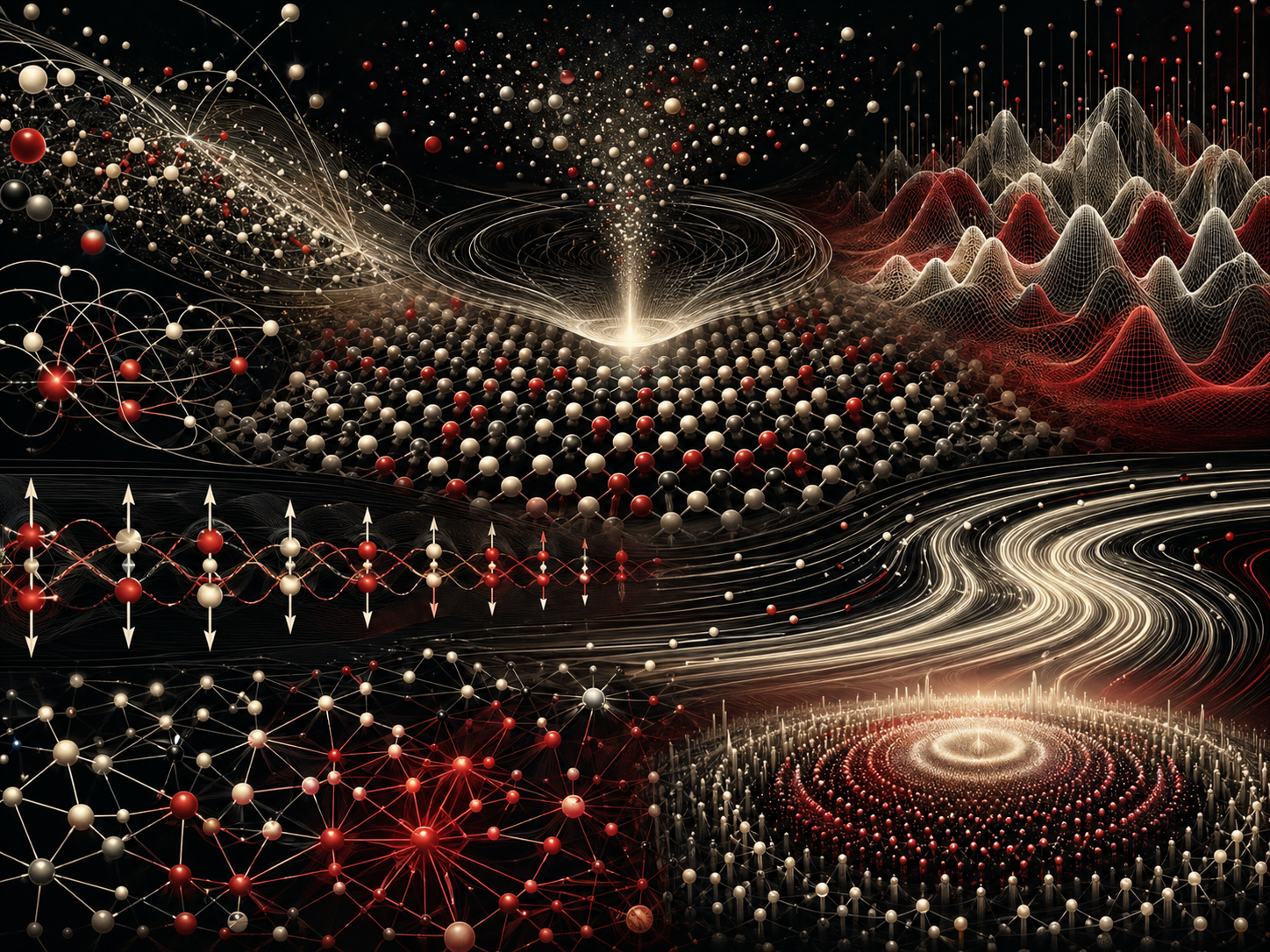
Many-body physics studies how large collections of interacting particles produce collective behavior that cannot be understood by simply multiplying one-particle physics. Electrons form metals, insulators, magnets, superconductors, and topological materials. Atoms form Bose–Einstein condensates and superfluids. Spins form ordered phases, frustrated magnets, spin liquids, and critical states. Lattices support phonons. Interacting quantum systems generate quasiparticles, collective modes, entanglement, broken symmetry, emergent fields, and phases of matter whose organizing principles appear only at scale.
The central lesson of many-body physics is that “more” is not merely more numerous. More can be different. When particles interact, the system can develop new effective laws, new excitations, new constraints, new symmetries, new broken symmetries, and new long-range patterns. A single electron does not make a metal. A single atom does not make a superfluid. A single spin does not make a magnet. Collective behavior emerges from many interacting degrees of freedom.
This article develops Many-Body Physics and Emergent Collective Behavior as a research-grade introduction within the Physics knowledge series. It explains interacting particles, quantum statistics, identical particles, Hilbert-space growth, second quantization, Fock space, correlation functions, entanglement, quasiparticles, phonons, magnons, Fermi liquids, Bose condensation, superfluidity, superconductivity, magnetism, the Hubbard model, strongly correlated systems, topological order, nonequilibrium many-body dynamics, numerical methods, and the meaning of emergence in physical science. Selected R and Python workflows appear in the article body, while the companion GitHub repository contains expanded computational resources for Hilbert-space scaling, occupation statistics, exact diagonalization, spin-chain models, correlation functions, entanglement entropy, structure factors, Hubbard-model metadata, uncertainty propagation, SQL provenance tables, C/C++/Fortran/Rust examples, and reproducible many-body physics workflows.
Main Library
Publications
Article Map
Physics
Related Topic
Mathematics
Related Topic
Data Systems & Analytics
Related Topic
Astronomy
Why Many-Body Physics Matters
Many-body physics matters because the observable world is overwhelmingly made of interacting many-particle systems. Solids, liquids, gases, plasmas, biological materials, stars, superconductors, semiconductors, magnets, fluids, nuclear matter, quantum devices, and planetary materials all require collective description. A theory of one particle is foundational, but it is not sufficient for explaining the macroscopic behavior of matter.
The essential difficulty is interaction. If particles did not interact, the many-body problem would often reduce to bookkeeping. But interacting particles generate correlations, collective excitations, fluctuations, constraints, order, disorder, and emergent structure. The system becomes more than a list of independent components.
Many-body physics also explains why effective descriptions work. A metal can be described using quasiparticles. A crystal can be described using phonons. A magnet can be described using spin waves. A superconductor can be described using an order parameter and paired electrons. A superfluid can be described using phase coherence and collective flow. These effective degrees of freedom are not obvious from a single-particle view. They emerge from collective organization.
For the Physics knowledge series, this article belongs near Statistical Physics and the Emergence of Macroscopic Order, Phase Transitions, Critical Phenomena, and the Renormalization Group, Quantum Field Theory I: Fields, Particles, and Second Quantization, Semiconductor Physics and Electronic Materials, Quantum Information, Decoherence, and Measurement, and Computational Physics and Scientific Simulation. It is the bridge between microscopic laws and emergent material behavior.
From Few-Body to Many-Body Systems
A few-body system contains a small number of interacting components. Examples include two-body orbital motion, the hydrogen atom, two coupled oscillators, or simple scattering problems. Many few-body problems can be solved exactly or with controlled approximations.
A many-body system contains a large number of interacting components. The number may be \(10^3\), \(10^6\), \(10^{23}\), or effectively infinite in the thermodynamic limit. The difficulty is not only large number. The difficulty is that interactions create correlations. The state of one part cannot be understood independently of the others.
A generic many-body Hamiltonian can be written schematically as:
\hat H = \sum_i \hat h_i + \sum_{i<j}\hat V_{ij} + \cdots \]
Interpretation: A many-body Hamiltonian combines one-body terms, interaction terms, and additional constraints or couplings.
where \(\hat h_i\) represents one-body terms and \(\hat V_{ij}\) represents interactions. The ellipsis may include higher-body interactions, external fields, constraints, disorder, lattice structure, or coupling to environments.
Even when the microscopic Hamiltonian is simple, the emergent behavior can be complex. The Ising model has simple binary spins and nearest-neighbor interactions, yet it exhibits phase transitions, critical phenomena, domains, fluctuations, finite-size effects, and universality. The Hubbard model has a compact form, yet it captures deep problems in magnetism, Mott physics, and strong electronic correlation.
Emergence and the Limits of Reduction
Emergence in physics does not mean magic or violation of microscopic law. It means that new organizing principles, effective variables, and collective behaviors appear at larger scales. These behaviors are compatible with microscopic physics but are not easily predicted by inspecting one component in isolation.
Reduction asks how a system is built from smaller parts. Emergence asks what new structures appear when those parts interact. Both perspectives are necessary. A superconductor is made of electrons and ions, but superconductivity is not a property of a single electron. A phonon is not an atom; it is a quantized collective vibration of a lattice. A magnon is not an individual spin; it is a collective excitation of spin order.
Many-body physics shows that laws can be scale-dependent. At one scale, electrons and nuclei are the relevant variables. At another scale, quasiparticles, order parameters, hydrodynamic modes, defects, or topological invariants are more useful. A good physical theory chooses the right degrees of freedom for the scale and question.
This is why emergence is central to condensed matter physics, statistical mechanics, materials science, and complex systems. It explains why macroscopic order can be robust even when microscopic details vary. It also explains why universality appears near critical points: different microscopic systems can share the same large-scale behavior.
Identical Particles and Quantum Statistics
Quantum many-body physics begins with identical particles. Classical particles can often be imagined as individually labeled. Quantum particles of the same species are fundamentally indistinguishable. This changes the structure of many-particle states.
For bosons, the many-particle wavefunction is symmetric under particle exchange:
\Psi(\ldots,x_i,\ldots,x_j,\ldots) = \Psi(\ldots,x_j,\ldots,x_i,\ldots) \]
Interpretation: A bosonic many-particle wavefunction is symmetric under exchange of identical particles.
For fermions, the wavefunction is antisymmetric:
\Psi(\ldots,x_i,\ldots,x_j,\ldots) = – \Psi(\ldots,x_j,\ldots,x_i,\ldots) \]
Interpretation: A fermionic many-particle wavefunction changes sign under exchange of identical particles.
The antisymmetry of fermions implies the Pauli exclusion principle. Two identical fermions cannot occupy the same quantum state. This principle shapes the periodic table, electronic band structure, metallic behavior, degeneracy pressure, white dwarfs, neutron stars, and the structure of ordinary matter.
Bosons, by contrast, can occupy the same state in large numbers. This makes Bose–Einstein condensation, superfluidity, lasers, coherent states, and collective quantum behavior possible. Quantum statistics are therefore not a minor correction. They organize entire classes of many-body phenomena.
Hilbert-Space Growth
The many-body problem becomes difficult partly because Hilbert space grows explosively. For \(N\) spin-\(\frac{1}{2}\) degrees of freedom, the Hilbert-space dimension is:
\dim \mathcal{H} = 2^N \]
Interpretation: The Hilbert-space dimension of \(N\) spin-\(\frac{1}{2}\) sites grows exponentially.
For \(N=10\), this is:
2^{10}=1024 \]
Interpretation: Ten spin-\(\frac{1}{2}\) sites already require 1,024 basis states.
For \(N=40\):
2^{40}\approx 1.10\times 10^{12} \]
Interpretation: Forty sites require over one trillion basis states.
For \(N=100\):
2^{100}\approx 1.27\times 10^{30} \]
Interpretation: One hundred sites create an astronomically large Hilbert space.
This exponential growth makes brute-force quantum simulation impossible for large systems. Exact diagonalization is powerful for small systems but quickly becomes limited. Many-body physics therefore depends on approximation, structure, symmetry, sparsity, tensor networks, Monte Carlo methods, mean-field theory, perturbation theory, renormalization, and effective models.
The exponential Hilbert-space problem also explains why quantum many-body systems are central to quantum computation. A controllable quantum system can naturally inhabit a Hilbert space that classical computers cannot represent directly at large scale.
Second Quantization and Fock Space
Second quantization is the natural language for many-body systems with identical particles and variable occupation. Instead of labeling particles individually, one labels modes and occupation numbers. A Fock state can be written as:
|n_1,n_2,n_3,\ldots\rangle \]
Interpretation: A Fock state specifies how many particles occupy each mode.
where \(n_i\) is the number of particles in mode \(i\). Creation and annihilation operators add or remove particles from these modes. For bosons:
[\hat a_i,\hat a_j^\dagger]=\delta_{ij} \]
Interpretation: Bosonic creation and annihilation operators obey commutation relations.
For fermions:
\{\hat c_i,\hat c_j^\dagger\}=\delta_{ij} \]
Interpretation: Fermionic creation and annihilation operators obey anticommutation relations.
The number operator is:
\hat n_i=\hat a_i^\dagger \hat a_i \]
Interpretation: The bosonic number operator counts particles in a mode.
for bosons, or:
\hat n_i=\hat c_i^\dagger \hat c_i \]
Interpretation: The fermionic number operator counts occupation of a mode.
for fermions. A general many-body Hamiltonian in second quantization may include hopping, interactions, pairing, spin coupling, disorder, and external fields.
Second quantization is not only a notation. It is an efficient conceptual architecture. It makes particle creation, particle destruction, identical-particle statistics, many-body interactions, field excitations, and condensed-matter Hamiltonians much easier to express.
Correlation Functions
Many-body systems are defined by correlations. A correlation function measures how degrees of freedom at different points, times, or modes are related. For a spin system, a two-point correlation function can be written as:
C_{ij} = \langle \hat S_i^z \hat S_j^z\rangle – \langle \hat S_i^z\rangle \langle \hat S_j^z\rangle \]
Interpretation: A connected spin correlation removes the product of independent average values.
For a field, a two-point function might be:
G(x,t;x’,t’) = \langle \hat\psi^\dagger(x,t)\hat\psi(x’,t’)\rangle \]
Interpretation: A field correlation measures coherence or propagation between spacetime points.
Correlation functions encode order, fluctuations, excitations, response, coherence, and critical behavior. In scattering experiments, structure factors are related to Fourier transforms of correlation functions. In condensed matter, correlation functions reveal whether a system has long-range order, short-range order, quasi-long-range order, or exponential decay.
A system with long-range order may have:
\lim_{|i-j|\rightarrow\infty} \langle \hat S_i^z\hat S_j^z\rangle \neq 0 \]
Interpretation: Long-range order persists even at arbitrarily large separations.
while a disordered phase may show exponential decay:
C(r)\sim e^{-r/\xi} \]
Interpretation: Exponential decay defines a finite correlation length \(\xi\).
where \(\xi\) is the correlation length. At criticality, correlations often decay as power laws, reflecting scale invariance.
Entanglement and Many-Body Structure
Quantum many-body states can contain entanglement across many degrees of freedom. Entanglement means that the state of a part cannot be fully described independently of the rest. It is not merely classical correlation. It is a structural feature of the quantum state.
If a system is divided into regions \(A\) and \(B\), the reduced density matrix of \(A\) is:
\rho_A=\mathrm{Tr}_B(\rho) \]
Interpretation: The reduced density matrix describes region \(A\) after tracing out region \(B\).
The von Neumann entanglement entropy is:
S_A = -\mathrm{Tr}(\rho_A\ln\rho_A) \]
Interpretation: Entanglement entropy quantifies quantum correlation between a subsystem and its complement.
Entanglement has become a central diagnostic in many-body physics. It helps classify phases, characterize critical systems, identify topological order, design tensor-network algorithms, and understand thermalization. Area laws, volume laws, entanglement spectra, and mutual information all reveal structure that ordinary order parameters may miss.
In one-dimensional gapped systems, entanglement often obeys an area law, which helps explain why matrix product state methods can be effective. At critical points, entanglement grows logarithmically with subsystem size in many conformal systems. In chaotic many-body systems, entanglement can grow rapidly under time evolution.
Quasiparticles and Collective Modes
A quasiparticle is an emergent excitation that behaves like a particle within an interacting many-body system. It is not a fundamental particle in the same sense as an electron. It is a collective, effective excitation. Phonons, magnons, excitons, polarons, plasmons, Cooper pairs, Bogoliubov quasiparticles, and holes are examples.
Phonons are quantized lattice vibrations. Magnons are quantized spin waves. Plasmons are collective oscillations of electron density. Holes behave like positively charged quasiparticles in a filled electronic band. Bogoliubov quasiparticles appear in superconductors and superfluids.
The quasiparticle idea is powerful because it turns an interacting many-body problem into an effective gas of weakly interacting excitations. In many systems, low-energy behavior is governed not by bare particles but by emergent quasiparticles.
Collective modes are closely related. They are coherent motions of many degrees of freedom. Sound waves, spin waves, density waves, phase modes, amplitude modes, and hydrodynamic modes are collective. They often reflect broken symmetry, conservation laws, or long-wavelength constraints.
Fermi Liquids and Electronic Matter
Fermi liquid theory explains why many interacting electron systems behave at low energy like a gas of quasiparticles. The quasiparticles carry the same quantum numbers as electrons but have renormalized properties such as effective mass and lifetime.
For noninteracting fermions, the Fermi–Dirac distribution is:
f(E) = \frac{1}{e^{(E-\mu)/(k_BT)}+1} \]
Interpretation: The Fermi–Dirac distribution gives the occupation probability for fermionic states.
At zero temperature, states below the Fermi energy are filled and states above are empty. Interactions deform this picture but do not always destroy it. In a Fermi liquid, low-energy excitations near the Fermi surface remain well-defined.
Fermi liquid theory is one of the great examples of emergence. The microscopic electrons interact strongly through Coulomb forces, yet the low-energy system can often be described using weakly interacting quasiparticles. This effective description explains many properties of ordinary metals.
But not all electronic matter is a Fermi liquid. Strongly correlated systems can produce non-Fermi liquids, Mott insulators, strange metals, heavy fermion systems, fractionalized excitations, spin liquids, and unconventional superconductors. These systems remain major frontiers in condensed matter physics.
Bose Condensation and Superfluidity
Bosons can occupy the same quantum state in macroscopic numbers. In Bose–Einstein condensation, a large fraction of particles occupies a single quantum state below a critical temperature. The Bose–Einstein distribution is:
n(E) = \frac{1}{e^{(E-\mu)/(k_BT)}-1} \]
Interpretation: The Bose–Einstein distribution permits large occupation near the chemical potential.
When the chemical potential approaches the ground-state energy, macroscopic occupation can occur. This is a many-body quantum effect visible at large scale.
Superfluidity is related but not identical. A superfluid flows without ordinary viscosity, supports quantized vortices, and exhibits collective quantum behavior. Superfluid helium and ultracold atomic gases provide major experimental platforms for studying many-body quantum physics.
The superfluid order parameter is often written as a complex field:
\Psi(\mathbf{x}) = |\Psi(\mathbf{x})|e^{i\theta(\mathbf{x})} \]
Interpretation: A superfluid order parameter has both amplitude and phase.
The phase \(\theta\) is physically important. Superfluid velocity is related to the gradient of the phase:
\mathbf{v}_s = \frac{\hbar}{m}\nabla\theta \]
Interpretation: Superfluid velocity is determined by spatial variation of the condensate phase.
This shows how collective phase coherence becomes a macroscopic physical variable.
Superconductivity
Superconductivity is a many-body quantum phase in which electrical resistance vanishes and magnetic fields are expelled through the Meissner effect. In conventional BCS theory, electrons form Cooper pairs through an effective attractive interaction mediated by lattice vibrations. These pairs condense into a coherent quantum state.
A simplified BCS ground state can be written schematically as:
|\mathrm{BCS}\rangle = \prod_{\mathbf{k}} (u_{\mathbf{k}}+v_{\mathbf{k}} \hat c_{\mathbf{k}\uparrow}^{\dagger} \hat c_{-\mathbf{k}\downarrow}^{\dagger}) |0\rangle \]
Interpretation: The BCS state is a coherent product of paired electronic states across momentum space.
The superconducting energy gap \(\Delta\) reflects the energy needed to create quasiparticle excitations. The existence of an energy gap, phase coherence, flux quantization, and the Meissner effect show that superconductivity is not merely perfect conductivity. It is an ordered quantum state of matter.
Superconductivity connects many-body physics to materials science, quantum field theory, symmetry breaking, gauge structure, low-temperature physics, quantum devices, and technological applications. Conventional superconductors are well described by BCS theory, while unconventional superconductors remain a major research frontier.
The broader lesson is emergence. Electrons repel through Coulomb interaction, yet under the right many-body conditions, they can form coherent paired states that carry current without resistance.
Magnetism, Spin Systems, and Frustration
Magnetism is a many-body phenomenon arising from spin, exchange interactions, statistics, and lattice structure. A simple spin Hamiltonian is the Heisenberg model:
\hat H = J\sum_{\langle i,j\rangle} \hat{\mathbf{S}}_i\cdot\hat{\mathbf{S}}_j \]
Interpretation: The Heisenberg Hamiltonian models exchange coupling between neighboring spins.
For ferromagnetic coupling, spins prefer to align. For antiferromagnetic coupling, neighboring spins prefer opposite alignment. Depending on lattice geometry, antiferromagnetic interactions may be frustrated: not all pairwise preferences can be satisfied simultaneously.
Frustration can generate highly degenerate states, strong fluctuations, exotic order, and spin-liquid behavior. In a quantum spin liquid, spins do not freeze into conventional magnetic order even at very low temperature. Instead, the system may exhibit long-range entanglement, fractionalized excitations, and emergent gauge structure.
Spin systems are central because they are simple enough to model yet rich enough to display quantum phases, criticality, topology, frustration, and nonequilibrium dynamics. They also connect to quantum information through spin chains, entanglement, and many-body localization.
The Hubbard Model and Strong Correlation
The Hubbard model is one of the central models of strongly correlated electron systems. It balances hopping and on-site repulsion:
\hat H = -t\sum_{\langle i,j\rangle,\sigma} ( \hat c_{i\sigma}^{\dagger}\hat c_{j\sigma} + \hat c_{j\sigma}^{\dagger}\hat c_{i\sigma} ) + U\sum_i \hat n_{i\uparrow}\hat n_{i\downarrow} \]
Interpretation: The Hubbard model balances kinetic hopping against on-site interaction energy.
The hopping parameter \(t\) favors delocalization. The interaction parameter \(U\) penalizes double occupation. The competition between kinetic energy and interaction energy generates rich behavior: metallic states, Mott insulating behavior, magnetism, pairing tendencies, and possible routes to unconventional superconductivity.
Strong correlation means that independent-particle pictures fail. Electrons cannot be treated as moving in an average background with small corrections. Instead, interactions qualitatively restructure the low-energy physics.
The Hubbard model is deceptively compact. Despite its simple form, it remains difficult in two and three dimensions. It is a major benchmark for exact diagonalization, quantum Monte Carlo, density matrix renormalization group, dynamical mean-field theory, tensor networks, cold-atom quantum simulation, and quantum computing approaches.
Topological Order and Beyond Landau
Traditional phase classification often relies on symmetry and symmetry breaking. But some phases cannot be distinguished by local order parameters. Topological phases and topological order require a broader framework.
Topological order may involve long-range entanglement, ground-state degeneracy depending on spatial topology, fractionalized excitations, anyons, and robust edge states. Symmetry-protected topological phases can be nontrivial even without intrinsic topological order, provided certain symmetries are preserved.
The quantum Hall effect is one of the canonical examples where topology enters physical measurement. Conductance can be quantized in robust integer or fractional units. Topological insulators and superconductors extend these ideas into new material classes.
Topological phases show that emergence can be global and nonlocal. The system’s important structure may not be visible in any local order parameter. Instead, it may be encoded in entanglement, topology, boundary states, or response coefficients.
Nonequilibrium Many-Body Physics
Many-body systems are often studied in equilibrium, but many important phenomena occur out of equilibrium. A quantum system may be quenched, driven, dissipative, periodically forced, coupled to a bath, or monitored. A material may be pumped by a laser, cooled rapidly, sheared, irradiated, or placed under time-dependent fields.
Nonequilibrium many-body physics asks how systems thermalize, fail to thermalize, transport energy and particles, spread entanglement, form patterns, respond to drives, and approach or avoid equilibrium. Concepts include thermalization, prethermalization, many-body localization, Floquet phases, quantum scars, transport coefficients, hydrodynamics, open quantum systems, and kinetic equations.
A closed quantum system evolves as:
|\psi(t)\rangle = e^{-i\hat Ht/\hbar}|\psi(0)\rangle \]
Interpretation: Closed quantum dynamics are generated by the Hamiltonian.
For an open system, the density matrix may evolve according to a master equation:
\frac{d\rho}{dt} = -\frac{i}{\hbar}[\hat H,\rho] + \mathcal{D}[\rho] \]
Interpretation: Open-system dynamics combine unitary evolution with dissipative effects.
where \(\mathcal{D}[\rho]\) represents dissipative effects. Nonequilibrium physics is one of the fastest-moving areas of many-body research because it connects quantum technology, ultracold atoms, materials control, transport, and information dynamics.
The Thermodynamic Limit and Statistical Ensembles
Many-body physics often becomes conceptually simpler only after the system becomes large. The thermodynamic limit sends particle number and volume to infinity while keeping density fixed. This suppresses some boundary effects, sharpens phase transitions, and allows intensive quantities such as energy density, magnetization density, and entropy density to remain finite.
N\rightarrow\infty,\qquad V\rightarrow\infty,\qquad \frac{N}{V}=\rho\;\text{fixed}
\]
Interpretation: The thermodynamic limit separates bulk collective behavior from finite-size boundaries.
Equilibrium descriptions use statistical ensembles. The microcanonical ensemble fixes energy, particle number, and volume. The canonical ensemble fixes temperature through contact with a heat bath. The grand-canonical ensemble also allows particle exchange and introduces a chemical potential. These ensembles are often equivalent for large short-range systems, but the equivalence can fail or require care for long-range interactions, phase coexistence, small systems, and nonequilibrium states.
Finite systems never display mathematically singular phase transitions. Instead, peaks broaden, gaps remain nonzero, and observables depend on boundary conditions. Finite-size scaling is therefore not an optional technical detail. It is the bridge between computable systems and bulk claims.
Symmetry, Order Parameters, and Spontaneous Breaking
Many phases of matter are organized by symmetry. A Hamiltonian may be invariant under spin reversal, spatial translation, rotation, gauge transformation, or a continuous internal symmetry. A state can nevertheless select one among several symmetry-related configurations.
An order parameter is a collective quantity that distinguishes phases. Magnetization identifies a ferromagnet, density modulation identifies a charge-density wave, and a complex pair amplitude characterizes a superconductor. In a finite isolated system, exact eigenstates may preserve the symmetry even when the thermodynamic phase is symmetry broken. The physical broken-symmetry state emerges through limits, perturbations, environments, or measurements.
m=\lim_{h\rightarrow 0^+}\lim_{N\rightarrow\infty}\frac{1}{N}\sum_i\langle \hat S_i^z\rangle_h
\]
Interpretation: The order of limits matters: the large-system limit precedes removal of the symmetry-breaking field.
Landau theory organizes phases through order parameters and free-energy functionals. It remains powerful, but topological phases, fractionalized states, and long-range entangled phases require structures beyond local symmetry breaking.
Goldstone Modes, Higgs Modes, and Topological Defects
When a continuous global symmetry is broken, low-energy collective excitations usually appear. These Goldstone modes describe slow spatial variation along the manifold of equivalent ordered states. Phonons, spin waves, and superfluid phase modes are canonical examples.
Amplitude fluctuations are distinct from phase fluctuations. In suitable systems, oscillations of the magnitude of an order parameter can produce a Higgs-like mode. Such modes are often damped, but they can become visible near quantum criticality or in controlled quantum simulators.
Ordered phases also support defects: domain walls, vortices, dislocations, skyrmions, monopoles, and other textures. Defects can control melting, transport, hysteresis, quench dynamics, and topological transitions. The Berezinskii–Kosterlitz–Thouless transition is driven by vortex unbinding rather than ordinary local-order-parameter collapse.
Collective modes and defects illustrate why many-body physics is a theory of organized patterns, not only energy levels.
Effective Hamiltonians and Low-Energy Degrees of Freedom
A microscopic Hamiltonian may contain far more information than a low-energy experiment requires. Effective Hamiltonians remove or integrate out high-energy degrees of freedom and retain the variables that control the scale of interest.
In a strongly interacting Hubbard model at half filling, virtual hopping can generate an effective antiferromagnetic Heisenberg model with exchange scale approximately:
J_{\mathrm{eff}}\approx \frac{4t^2}{U}
\]
Interpretation: High-energy charge fluctuations generate low-energy spin exchange.
Effective descriptions may involve quasiparticles, collective fields, hydrodynamic densities, spins, dimers, gauge fields, defects, or topological sectors. Their validity is bounded by energy, length, time, density, and parameter ranges.
The central modeling question is therefore not “What is the most microscopic theory available?” It is “Which degrees of freedom remain active at the scale of the observable?”
Green Functions, Spectral Functions, and Linear Response
Green functions connect microscopic dynamics to measurable response. A retarded Green function records how an operator responds after a perturbation:
G^R_{AB}(t)=-i\Theta(t)\langle[\hat A(t),\hat B(0)]_{\mp}\rangle
\]
Interpretation: Retarded response respects causality and uses a commutator or anticommutator appropriate to the operators.
The spectral function reveals excitation energies, linewidths, lifetimes, gaps, and incoherent continua. Angle-resolved photoemission, tunneling spectroscopy, neutron scattering, and optical spectroscopy can often be interpreted through spectral or dynamical correlation functions.
Linear-response theory connects weak external fields to induced currents, densities, or magnetization. The Kubo formula expresses transport coefficients through equilibrium correlation functions. This is one of the deepest links between statistical mechanics and experiment.
A many-body calculation becomes physically persuasive when its operators and correlators map clearly to an observable measurement.
Quantum Criticality, Scaling, and Renormalization
A quantum phase transition occurs at zero temperature when a nonthermal parameter such as field, pressure, density, or interaction strength changes the ground state. Quantum fluctuations, rather than thermal fluctuations, drive the transition.
Near a continuous critical point, the correlation length diverges:
\xi\sim |g-g_c|^{-\nu},\qquad \Delta\sim \xi^{-z}
\]
Interpretation: The correlation length exponent \(\nu\) and dynamical exponent \(z\) connect distance from criticality to spatial and temporal scales.
Renormalization explains how microscopic parameters flow as short-distance information is coarse-grained. Fixed points identify universality classes. Relevant perturbations grow under coarse-graining, irrelevant perturbations fade, and marginal perturbations require detailed analysis.
Quantum critical regions can influence finite-temperature transport and thermodynamics over broad parameter ranges. Finite-size and finite-temperature scaling are therefore essential tools for distinguishing a true critical point from a crossover.
Band Insulators, Mott Insulators, and Correlation-Driven Localization
A band insulator is insulating because filled and empty single-particle bands are separated by a gap. A Mott insulator can be insulating even when band theory predicts metallic behavior. Strong repulsion suppresses charge motion and reorganizes the low-energy state.
The distinction is conceptual and experimental. Band topology, symmetry, orbital occupancy, interaction scale, spectral weight transfer, magnetic correlations, and response to doping help identify the mechanism.
Correlation-driven localization does not imply that every particle is spatially frozen. Virtual fluctuations can remain active and generate spin exchange, collective modes, and entanglement. Doping a Mott insulator can produce strongly correlated metals, pseudogaps, strange-metal behavior, and competing orders.
The Mott problem is a central reminder that one-electron intuition can fail qualitatively when interaction energy competes with kinetic motion.
Kondo Physics, Heavy Fermions, and Emergent Mass
The Kondo effect arises when conduction electrons screen a localized magnetic moment. The screening scale is nonperturbative and can be exponentially small in the coupling. In a lattice of moments, Kondo screening competes with magnetic ordering interactions.
Heavy-fermion materials can develop quasiparticles with effective masses hundreds of times the bare electron mass. The large mass is not literal accumulation of matter. It is a measure of the strong renormalization of low-energy motion by collective correlations.
Quantum criticality, unconventional superconductivity, Fermi-surface reconstruction, and non-Fermi-liquid behavior can emerge near the competition between Kondo screening and magnetism.
Heavy-fermion physics demonstrates how a simple electronic quantum number can become embedded in a collective state with radically altered low-energy scales.
Spin Liquids, Fractionalization, and Emergent Gauge Fields
A quantum spin liquid avoids conventional magnetic order even at very low temperature while retaining strong quantum entanglement. It is not merely a disordered paramagnet. Its correlations and excitations can reflect long-range entanglement, fractionalization, and emergent gauge structure.
Fractionalization occurs when collective excitations carry only part of the quantum numbers of microscopic constituents. Spinons may carry spin without charge. Visons represent gauge-flux excitations. In one-dimensional systems, an electron can separate into collective spin and charge modes.
Candidate spin liquids are studied through broad excitation continua, thermal transport, field response, neutron scattering, NMR, numerical entanglement diagnostics, and comparison with microscopic models. No single signature is usually decisive.
The methodological lesson is important: exotic phases require converging evidence from spectroscopy, thermodynamics, transport, and theory rather than identification through one suggestive feature.
Anyons, Boundary States, and Topological Response
In two dimensions, quasiparticle exchange can generate statistics beyond the boson–fermion distinction. Abelian anyons accumulate a phase under exchange, while non-Abelian anyons act through transformations on a degenerate state space.
Topological phases can exhibit protected boundary modes, quantized response coefficients, ground-state degeneracy dependent on manifold topology, and robust entanglement patterns. Bulk–boundary correspondence connects topological invariants of the bulk to edge or surface states.
Robust does not mean indestructible. Disorder, interactions, finite temperature, symmetry breaking, coupling to leads, and finite size can modify observable protection. Topological classification must match the symmetry class, dimensionality, interaction regime, and measurement.
Topological matter widens the meaning of emergence from local order to global quantum organization.
Transport, Hydrodynamics, and Conservation Laws
At long wavelengths and late times, many-body dynamics are often governed by conserved densities rather than microscopic particles. Energy, momentum, charge, and particle number can obey hydrodynamic equations.
\partial_t n + \nabla\cdot \mathbf{j}=0
\]
Interpretation: A continuity equation expresses local conservation of density \(n\).
Transport may be ballistic, diffusive, subdiffusive, superdiffusive, or localized. The regime depends on conservation laws, dimensionality, integrability, disorder, interactions, and scattering.
Hydrodynamics can emerge even in quantum systems where microscopic coherence is important. Generalized hydrodynamics extends the approach to integrable systems with many conserved quantities. Quantum information measures such as operator spreading and out-of-time-ordered correlators provide additional views of transport and scrambling.
Transport coefficients are not merely material constants. They summarize the collective relaxation channels available to a phase.
Disorder, Anderson Localization, and Many-Body Localization
Anderson localization shows that disorder can suppress wave transport through interference even without interactions. The dimensionality, disorder distribution, symmetry class, and energy determine whether extended or localized states appear.
Interactions complicate this picture. Many-body localization was proposed as a regime in which an interacting isolated system retains memory of its initial conditions and fails to thermalize conventionally. Local integrals of motion, slow entanglement growth, and nonergodic dynamics provide theoretical diagnostics.
Finite size and finite observation time make many-body localization difficult to establish numerically and experimentally. Slow thermalization can imitate localization. Rare regions, long-range interactions, coupling to environments, and dimensionality can destabilize the regime.
The responsible claim is often not “localization proven,” but “dynamics inconsistent with ordinary thermalization over the accessible scales.”
Eigenstate Thermalization, Quantum Scars, and Prethermalization
The eigenstate thermalization hypothesis explains how individual many-body eigenstates of nonintegrable systems can encode thermal expectation values for local observables. Under suitable conditions, unitary evolution produces local equilibration without an external bath.
Integrable systems retain extensive conserved quantities and can relax to generalized ensembles. Quantum many-body scars provide exceptional nonthermal eigenstates embedded in an otherwise thermal spectrum, allowing special initial states to show long-lived revivals.
Prethermalization occurs when a system rapidly approaches a long-lived intermediate state before eventual thermalization. Separation of energy scales, weak integrability breaking, or high-frequency driving can create these plateaus.
Thermalization is therefore not a binary label. It has timescales, observables, initial-state dependence, finite-size effects, and exceptions that must be tested explicitly.
Open Quantum Systems, Lindblad Dynamics, and Dissipative Phases
Real many-body systems exchange energy and information with environments. Markovian open-system dynamics are often represented by a Lindblad master equation:
\frac{d\rho}{dt}=-\frac{i}{\hbar}[\hat H,\rho]+\sum_\alpha\left(\hat L_\alpha\rho\hat L_\alpha^\dagger-\frac{1}{2}\{\hat L_\alpha^\dagger\hat L_\alpha,\rho\}\right)
\]
Interpretation: Jump operators \(\hat L_\alpha\) encode loss, pumping, dephasing, measurement, or engineered dissipation.
Dissipation can destroy coherence, but it can also prepare states, stabilize phases, generate synchronization, produce exceptional points, and create nonequilibrium steady-state transitions.
The assumptions behind a master equation matter. Markovianity, weak coupling, bath timescales, complete positivity, and coarse-graining must be appropriate to the system.
Open-system many-body physics connects condensed matter, quantum optics, statistical mechanics, and quantum technology.
Floquet Engineering and Periodically Driven Matter
A periodically driven Hamiltonian can be analyzed through a Floquet operator over one drive period. The eigenphases define quasienergies analogous to crystal momentum in a spatially periodic lattice.
\hat U(T)=\mathcal{T}\exp\left[-\frac{i}{\hbar}\int_0^T \hat H(t)\,dt\right]
\]
Interpretation: One-period evolution defines the effective structure of a driven system.
Periodic driving can engineer effective couplings, synthetic gauge fields, topological bands, dynamical localization, discrete time crystals, and prethermal phases. It can also heat interacting systems toward featureless states.
Drive frequency, amplitude, resonance structure, disorder, conservation laws, and coupling to the environment determine whether useful engineered behavior survives.
Floquet systems show that phases of matter can be organized by dynamics, not only by equilibrium ground states.
Experimental Probes of Many-Body Structure
Different probes measure different correlation functions. Neutron and X-ray scattering resolve momentum- and energy-dependent structure factors. Angle-resolved photoemission measures occupied electronic spectral weight. Scanning tunneling microscopy probes local density of states. Optical conductivity measures current response. NMR and muon-spin techniques probe local magnetic environments and dynamics.
Ultracold-atom platforms add site-resolved imaging, quench control, correlation microscopy, number statistics, and programmable Hamiltonians. Pump–probe spectroscopy reveals ultrafast dynamics and transient states.
Every inference requires an instrument model, resolution function, background subtraction, calibration, and uncertainty. A theoretical peak narrower than experimental resolution cannot be compared directly. A finite-temperature experiment should not be interpreted solely through a zero-temperature ground state.
Research-grade many-body analysis therefore connects Hamiltonian, observable operator, measurement protocol, and data-reduction model.
Quantum Simulation Platforms
Quantum simulators realize controllable many-body Hamiltonians in physical hardware. Ultracold atoms in optical lattices emulate Hubbard and spin models. Rydberg arrays implement programmable interactions and constrained dynamics. Trapped ions realize long-range spin couplings. Superconducting circuits support driven spin and bosonic models. Photonic systems explore topology and nonequilibrium propagation.
Analog simulators implement a target Hamiltonian directly, while digital simulators decompose evolution into gates. Hybrid and variational approaches combine hardware with classical optimization.
Validation remains central. A simulator should be benchmarked in regimes accessible to classical calculation, checked against conservation laws and symmetries, calibrated for preparation and measurement errors, and tested for model mismatch.
Quantum simulation is most valuable where it offers controllable access to observables or regimes that are difficult for conventional methods—not merely because the Hilbert space is large.
Method Selection by Dimensionality, Entanglement, and Sign Structure
No numerical method is best for every many-body problem. Exact diagonalization is controlled but small. Matrix-product methods exploit low entanglement and excel in one dimension. Quantum Monte Carlo can reach large systems when sign problems are absent. Dynamical mean-field theory treats local quantum dynamics accurately in high coordination and correlated materials. Neural quantum states offer flexible variational representations but require difficult optimization and validation.
| Problem feature | Promising method | Primary limitation |
|---|---|---|
| Small finite lattice and full spectrum | Exact diagonalization or Krylov methods | Exponential Hilbert-space growth |
| One-dimensional low-entanglement ground state | DMRG or matrix-product states | High entanglement and long-time dynamics |
| Sign-problem-free finite-temperature lattice model | Quantum Monte Carlo | Statistical and autocorrelation error |
| Local strong correlations in a lattice material | DMFT or DFT+DMFT | Nonlocal correlations and impurity-solver cost |
| Flexible high-dimensional variational ansatz | Neural quantum states | Optimization, bias, and certification |
| Controlled programmable dynamics | Analog or digital quantum simulation | Noise, calibration, and model validation |
Method choice is a scientific hypothesis about structure. It should be justified by dimensionality, symmetry, entanglement, temperature, geometry, sign structure, desired observable, and available error control.
Tensor Networks, Area Laws, and Entanglement Structure
Tensor networks compress many-body wavefunctions by representing structured entanglement rather than storing every amplitude independently. Matrix product states underpin DMRG in one dimension. Projected entangled-pair states generalize the idea to higher dimensions. MERA incorporates scale structure and is naturally connected to criticality.
The success of tensor networks is physical. Many gapped ground states obey area-law entanglement, so their relevant correlations occupy a small corner of Hilbert space. Bond dimension controls the amount of entanglement the ansatz can represent.
Convergence should be tested against bond dimension, truncation error, system size, boundary condition, and initialization. Near criticality, in two dimensions, or during long-time evolution, entanglement growth can make calculations expensive.
Tensor networks are not merely numerical compression. They reveal entanglement as an organizing principle of quantum matter.
Quantum Monte Carlo and the Sign Problem
Quantum Monte Carlo converts expectation values into statistical sampling problems. World-line, path-integral, auxiliary-field, diffusion, and determinant methods are suited to different Hamiltonians and observables.
The sign problem occurs when weights are not nonnegative probabilities. Positive and negative contributions cancel, causing the signal-to-noise ratio to deteriorate rapidly with system size or inverse temperature.
Absence of a sign problem is representation dependent and model specific. Symmetry, lattice geometry, filling, and transformation choice can determine tractability. There is no universal numerical cure.
Good Monte Carlo practice reports equilibration, autocorrelation, effective sample size, variance, finite-size analysis, update scheme, random seeds, and sign statistics. Small error bars are not meaningful if chains have not mixed or systematic bias dominates.
Dynamical Mean-Field Theory and Quantum Impurity Solvers
Dynamical mean-field theory maps a lattice problem onto a quantum impurity embedded in a self-consistent bath. It treats local temporal fluctuations nonperturbatively and becomes exact in an infinite-coordination limit.
DMFT captures quasiparticle renormalization, Hubbard bands, Mott transitions, and temperature-dependent spectral evolution. Extensions include clusters, nonequilibrium DMFT, extended interactions, and combination with density-functional theory for materials.
The impurity solver—such as continuous-time quantum Monte Carlo, exact diagonalization, numerical renormalization group, or tensor-network methods—controls accuracy and accessible regimes.
Self-consistency convergence, analytic continuation, double counting, orbital choice, interaction parameters, and nonlocal correlations are major sources of uncertainty.
Neural Quantum States and Machine-Learning Representations
Neural quantum states represent wavefunction amplitudes or density matrices with trainable neural networks. Autoregressive models, restricted Boltzmann machines, graph networks, recurrent networks, and transformer-like architectures can encode complex correlations.
These representations can be used in variational Monte Carlo, tomography, dynamics, finite-temperature methods, and frustrated systems. Their expressivity is attractive in regimes where tensor-network geometry is unfavorable.
Optimization remains difficult. The energy landscape can be ill conditioned, sampling can be biased, symmetries may need to be enforced, and low variational energy does not guarantee accurate correlations or excitation structure.
Validation should compare multiple architectures, seeds, observables, exact small systems, known limits, variance, and physical constraints. Machine learning expands the ansatz space; it does not remove the need for physics-based verification.
Finite-Size Scaling, Convergence, and Error Budgets
A many-body result is only as strong as its error model. Relevant uncertainties include finite size, finite bond dimension, Trotter step, Monte Carlo statistics, analytic continuation, truncation, disorder averaging, solver tolerance, state-preparation error, and experimental calibration.
Convergence means varying the control parameter that limits the approximation. Agreement at one system size or one bond dimension is not convergence. Extrapolation should use a justified scaling form and should report sensitivity to fit range.
Near criticality, the system size must exceed the correlation length. In time evolution, the simulated window must precede reflection from boundaries and severe entanglement truncation. In disordered systems, enough realizations are required to characterize broad distributions.
A transparent error budget separates statistical uncertainty from systematic approximation and model-form uncertainty.
Reproducibility, Provenance, and Benchmark Design
Reproducible many-body computation records the Hamiltonian, basis, conventions, lattice geometry, boundary conditions, parameters, units, symmetries, solver version, tolerances, seeds, hardware, and post-processing.
Benchmarks should include exactly solvable limits, noninteracting cases, small-system exact diagonalization, conservation laws, symmetry sectors, sum rules, and cross-method comparison. A method should not be tested only where it is expected to succeed.
Data products should distinguish raw outputs, derived observables, fit results, and publication figures. Checksums and machine-readable metadata reduce ambiguity.
Reproducibility is not a clerical addition. It is part of the evidence that an emergent phenomenon is physical rather than an artifact of representation, implementation, initialization, or analysis.
The 2025–2026 Many-Body Research Context
Programmable quantum simulation is increasingly connecting model Hamiltonians to controlled experiments. A 2025 neutral-atom study implemented a two-dimensional fermionic architecture based on the Kitaev honeycomb model, while other Rydberg-array work observed string breaking in a synthetic lattice-gauge system and quantum coarsening across a two-dimensional Ising transition.
In February 2026, a large-scale analogue simulator based on atom-defined quantum-dot arrays reported a 15,000-site platform and observed a metal–insulator transition associated with Mott–Hubbard and Anderson physics. The scale is notable, but the physical interpretation still depends on temperature, disorder, transport modeling, calibration, and comparison with theory.
Many-body interactions themselves are also becoming more programmable. NIST-affiliated work reported engineered three- and four-body interactions between momentum states in a cavity, extending experimental access beyond pairwise Hamiltonians.
Computational research is broadening as well. Quantum Monte Carlo remains important for predictive materials calculations, while neural quantum states are being developed for dynamics, frustrated lattices, and nuclear many-body systems. These methods extend the accessible regime but introduce new optimization and verification challenges.
The current frontier is therefore not one technique replacing all others. It is the convergence of analytic theory, classical computation, data-driven representations, and quantum simulation under increasingly explicit validation standards.
Worked Diagnostic: Choosing a Method for a Frustrated Two-Dimensional Spin Model
Consider a fictional spin-\(\frac{1}{2}\) Hamiltonian on a frustrated two-dimensional lattice. The goal is to determine whether an intermediate phase is conventionally ordered, topological, or a finite-size crossover.
Step 1: Define the Hamiltonian and symmetry sector
Record couplings, lattice geometry, boundary conditions, conserved quantities, sign conventions, and the parameter range.
Step 2: Define discriminating observables
Choose local order parameters, structure factors, gaps, entanglement measures, topological diagnostics, and response functions before examining results.
Step 3: Establish exact small-system benchmarks
Use exact diagonalization to test energies, symmetries, degeneracies, and operator conventions.
Step 4: Test sign structure and entanglement
Determine whether quantum Monte Carlo is sign-problem free and whether tensor-network bond dimensions can capture the state.
Step 5: Use at least two method families
Compare, for example, DMRG on cylinders with variational Monte Carlo or neural quantum states rather than relying on one ansatz.
Step 6: Perform finite-size and convergence scaling
Vary circumference, length, bond dimension, sample size, fit window, and boundary condition.
Step 7: Compare with measurement-facing signatures
Translate candidate phases into structure factors, spectral continua, thermodynamics, and transport signatures.
Step 8: State the strongest justified conclusion
Separate evidence for absence of conventional order from positive evidence for topological order or fractionalization.
| Claim | Minimum evidence | Frequent failure |
|---|---|---|
| No conventional order | Order parameters and correlations extrapolate consistently toward zero. | Small clusters suppress order artificially. |
| Gapped spin liquid | Gap, short-range correlations, entanglement, and topology agree. | A featureless finite-size state is overinterpreted. |
| Gapless spin liquid | Controlled scaling of gaps and correlation functions. | Truncation or cylinder geometry creates false gaplessness. |
| Method consensus | Independent methods agree within quantified uncertainty. | Several implementations share the same structural bias. |
The diagnostic shows why many-body phase identification is a structured inference problem rather than a search for one visually compelling observable.
A Practical Method for Many-Body Analysis
1. State the physical question
Specify the phase, response, excitation, transport property, or dynamical process to be determined.
2. Define the model and scale
Record the active degrees of freedom, Hamiltonian, geometry, dimensionality, temperature, and validity range.
3. Identify symmetries and conserved quantities
Use them to classify phases, reduce computation, and establish exact checks.
4. Connect theory to observables
Define the operators and correlation functions that correspond to experimental probes.
5. Choose the method from system structure
Use entanglement, sign structure, dimensionality, interaction range, and desired observable to select methods.
6. Benchmark exact and solvable limits
Test noninteracting points, small clusters, symmetry sectors, sum rules, and known asymptotics.
7. Quantify convergence controls
Vary size, cutoff, bond dimension, timestep, sample count, solver tolerance, and fit range.
8. Separate statistical and systematic error
Report sampling uncertainty, finite-size bias, truncation, analytic continuation, and model-form uncertainty separately.
9. Use cross-method validation
Compare independent approximations where no single controlled method spans the regime.
10. Test alternative interpretations
Ask whether disorder, finite temperature, crossover, boundary effects, or metastability can explain the signal.
11. Preserve provenance
Store parameters, units, conventions, seeds, code versions, raw outputs, and transformations.
12. Match the claim to the evidence
State what is established, what is suggestive, and what remains method or scale dependent.
Common Pitfalls in Many-Body Physics
- Equating a large Hilbert space with physical complexity: Symmetry, locality, and low entanglement can make a large system simple.
- Using microscopic variables at every scale: Effective degrees of freedom may provide the correct explanation.
- Claiming a phase from one observable: Distinct phases can produce similar finite-size signals.
- Ignoring the order of limits: Thermodynamic, zero-field, zero-temperature, and long-time limits need not commute.
- Confusing absence of order with topological order: A disordered state is not automatically a spin liquid.
- Ignoring boundary and geometry effects: Cylinders, clusters, and open edges can select or suppress states.
- Treating numerical precision as physical accuracy: Solver precision does not remove model and truncation error.
- Assuming small error bars imply convergence: Statistical error can be tiny while systematic bias dominates.
- Overinterpreting slow dynamics: Prethermalization and finite-size effects can mimic localization.
- Using machine learning without physical checks: Expressive ansätze can optimize the wrong structure convincingly.
- Comparing theory and experiment at mismatched conditions: Temperature, resolution, disorder, and probe operators must align.
- Presenting method consensus as independence: Different codes can share the same ansatz, dataset, or scaling bias.
The central discipline is to make emergence testable: define the collective variable, the scale on which it is valid, the observable that detects it, and the errors that could imitate it.
Computational Many-Body Methods
Computational many-body physics is essential because exact analytic solutions are rare. Different methods are useful in different regimes.
Exact diagonalization constructs the Hamiltonian matrix and diagonalizes it. It is accurate for small systems but limited by exponential Hilbert-space growth. Quantum Monte Carlo samples configurations statistically and can be powerful, but fermionic sign problems can make some systems difficult. Density matrix renormalization group and matrix product states are highly effective for many one-dimensional systems. Tensor networks generalize entanglement-aware approximations. Dynamical mean-field theory treats local correlations nonperturbatively. Mean-field theory simplifies interactions into self-consistent effective fields. Perturbation theory works when a small parameter exists.
Each method has assumptions. A mean-field model may miss fluctuations. A small exact diagonalization system may suffer finite-size artifacts. A Monte Carlo method may have autocorrelation or sign problems. A tensor network may struggle with high entanglement. A perturbative expansion may fail at strong coupling.
Good many-body computation therefore requires model awareness, method awareness, convergence testing, finite-size analysis, uncertainty estimation, and reproducible code. The goal is not only to compute numbers but to understand which collective features are robust.
Measurement, Units, and SI Interpretation
Many-body physics uses several unit systems. Condensed matter often uses electronvolts, kelvin, reciprocal lattice units, angstroms, nanometers, tesla, hertz, and dimensionless lattice units. Quantum field theory and theoretical condensed matter often use natural units where:
\hbar=1 \]
Interpretation: Setting \(\hbar=1\) measures action in natural quantum units.
or:
k_B=1 \]
Interpretation: Setting \(k_B=1\) lets temperature be measured in energy units.
In lattice models, energy may be measured in units of hopping \(t\), exchange coupling \(J\), or interaction strength \(U\). Temperature may be written as:
\beta=\frac{1}{k_BT} \]
Interpretation: Inverse temperature controls thermal weighting in statistical mechanics.
or as a dimensionless ratio such as:
\frac{k_BT}{J} \]
Interpretation: Temperature can be compared directly to an interaction energy scale.
Careful unit documentation is essential. In the Hubbard model, \(t\) and \(U\) are energies. In the Heisenberg model, \(J\) is an energy coupling. In occupation distributions, \(E-\mu\) and \(k_BT\) must be expressed in compatible units. In simulations, lattice spacing may be set to one, but physical interpretation requires restoring units.
Many-body physics also uses dimensionless quantities such as filling fraction, magnetization per site, correlation length in lattice units, entanglement entropy, occupation number, and structure factors. These quantities are powerful because they compare systems across scales, but their definitions must be explicit.
Mathematical Lens
A mathematics-first view of many-body physics begins with the many-body Hamiltonian:
\hat H = \sum_i \hat h_i + \sum_{i<j}\hat V_{ij} \]
Interpretation: A many-body Hamiltonian combines single-particle and interaction contributions.
For a spin-\(\frac{1}{2}\) system:
\dim \mathcal{H}=2^N \]
Interpretation: Spin-chain Hilbert space grows exponentially with system size.
For fermionic creation and annihilation operators:
\{\hat c_i,\hat c_j^\dagger\}=\delta_{ij} \]
Interpretation: Fermionic anticommutation encodes exclusion and antisymmetry.
For bosonic operators:
[\hat a_i,\hat a_j^\dagger]=\delta_{ij} \]
Interpretation: Bosonic commutation permits multiple occupation of a mode.
The Hubbard model is:
\hat H = -t\sum_{\langle i,j\rangle,\sigma} ( \hat c_{i\sigma}^{\dagger}\hat c_{j\sigma} + \hat c_{j\sigma}^{\dagger}\hat c_{i\sigma} ) + U\sum_i \hat n_{i\uparrow}\hat n_{i\downarrow} \]
Interpretation: The Hubbard model captures hopping and local interaction competition.
The Heisenberg model is:
\hat H = J\sum_{\langle i,j\rangle} \hat{\mathbf{S}}_i\cdot\hat{\mathbf{S}}_j \]
Interpretation: The Heisenberg model describes exchange-coupled spins.
A two-point connected correlation function is:
C_{ij} = \langle \hat O_i\hat O_j\rangle – \langle \hat O_i\rangle \langle \hat O_j\rangle \]
Interpretation: Connected correlations measure relationships beyond independent averages.
The static structure factor is:
S(\mathbf{q}) = \frac{1}{N} \sum_{i,j} e^{i\mathbf{q}\cdot(\mathbf{r}_i-\mathbf{r}_j)} \langle \hat O_i\hat O_j\rangle \]
Interpretation: The structure factor transforms spatial correlations into momentum space.
The von Neumann entanglement entropy is:
S_A = -\mathrm{Tr}(\rho_A\ln\rho_A) \]
Interpretation: Entanglement entropy measures subsystem entanglement.
The partition function is:
Z=\mathrm{Tr}(e^{-\beta \hat H}) \]
Interpretation: The partition function normalizes thermal statistical weights.
and thermal expectation values are:
\langle \hat O\rangle = \frac{1}{Z} \mathrm{Tr}(\hat O e^{-\beta \hat H}) \]
Interpretation: Thermal expectation values average observables over Boltzmann-weighted states.
This mathematical lens shows why many-body physics connects quantum mechanics, statistical mechanics, field theory, computation, and emergent order.
Variables, Units, and Physical Interpretation
Many-body physics uses variables that connect microscopic interactions, collective states, emergent excitations, and large-scale behavior. The table below summarizes several central quantities.
| Symbol or Term | Meaning | Typical Unit or Dimension | Physical Interpretation |
|---|---|---|---|
| \(N\) | Number of particles or sites | dimensionless | System size or number of degrees of freedom |
| \(\hat H\) | Hamiltonian | energy | Operator governing energy and time evolution |
| \(t\) | Hopping amplitude | energy | Strength of particle motion between sites |
| \(U\) | On-site interaction | energy | Penalty or attraction for multiple occupancy |
| \(J\) | Exchange coupling | energy | Spin interaction strength |
| \(\mu\) | Chemical potential | energy | Controls particle number in grand-canonical systems |
| \(\beta\) | Inverse thermal energy | energy\(^{-1}\) | \(1/(k_BT)\), not to be confused with critical exponent \(\beta\) |
| \(C_{ij}\) | Correlation function | depends on operator | Measures connected relationship between sites or fields |
| \(\xi\) | Correlation length | m or lattice units | Length scale over which correlations persist |
| \(S_A\) | Entanglement entropy | dimensionless | Quantum entanglement between region \(A\) and its complement |
| \(S(\mathbf{q})\) | Structure factor | varies by convention | Momentum-space measure of correlations |
| \(\Delta\) | Gap | energy | Minimum energy needed to create an excitation |
Note: Many-body variables often describe collective structure, correlations, excitations, and emergent order rather than isolated particles.
Worked Example: Hilbert-Space Growth
Consider a chain of \(N\) spin-\(\frac{1}{2}\) particles. Each site has two basis states:
|\uparrow\rangle,\quad |\downarrow\rangle \]
Interpretation: Each spin-\(\frac{1}{2}\) site has two basis states.
For one spin:
\dim \mathcal{H}_1=2 \]
Interpretation: A single spin-\(\frac{1}{2}\) has a two-dimensional Hilbert space.
For two spins:
\dim \mathcal{H}_2=2\times2=4 \]
Interpretation: Combining two independent spin sites multiplies their Hilbert-space dimensions.
For \(N\) spins:
\dim \mathcal{H}_N=2^N \]
Interpretation: The full spin-chain Hilbert space grows exponentially with \(N\).
If \(N=20\):
2^{20}=1,048,576 \]
Interpretation: Twenty spin sites require more than one million basis states.
A state vector with complex amplitudes for each basis state requires over one million complex numbers. If \(N=30\):
2^{30}=1,073,741,824 \]
Interpretation: Thirty spin sites require more than one billion basis amplitudes.
Now the state vector requires over one billion complex amplitudes. If each complex number uses 16 bytes, storing the state alone requires roughly:
16\times 2^{30}\approx 17.2\ \mathrm{GB} \]
Interpretation: Memory requirements grow rapidly even before storing operators or intermediate results.
For \(N=40\):
16\times 2^{40}\approx 17.6\ \mathrm{TB} \]
Interpretation: Forty spin sites already push brute-force state storage into terabyte scale.
This example explains why many-body physics cannot rely on brute force alone. Physical structure must be exploited: symmetry sectors, sparse matrices, tensor networks, Monte Carlo sampling, effective field theories, mean-field approximations, low-entanglement structure, or quantum simulation.
Computational Modeling
Computational modeling helps many-body physics become concrete. A Hilbert-space scaling workflow can show why exact diagonalization becomes difficult. An occupation-statistics workflow can compare Bose and Fermi distributions. An exact-diagonalization workflow can compute spectra of small spin chains. A correlation workflow can estimate connected spin correlations. An entanglement workflow can compute reduced density matrices. A structure-factor workflow can convert correlations into momentum-space diagnostics. A metadata system can preserve Hamiltonians, parameters, lattice sizes, boundary conditions, random seeds, solver choices, assumptions, sources, and reproducibility details.
The selected examples below focus on occupation statistics and exact diagonalization because they are foundational, readable, and directly reusable. The GitHub repository extends the same logic into richer computational resources: R occupation statistics and Hilbert-space scaling, Python exact diagonalization, spin-chain spectra, correlation functions, entanglement entropy, structure factors, Hubbard-model metadata, quantum-statistics tables, Julia many-body calculations, C++ spin-chain sweeps, Fortran Hilbert-space tables, SQL many-body provenance, Rust command-line utilities, C examples, documentation, and reproducible sample data.
R Workflow: Bose and Fermi Occupation Statistics
R is useful for parameter sweeps, statistical summaries, and reproducible many-body tables. The following workflow compares Bose–Einstein and Fermi–Dirac occupation functions across energy and temperature.
# Bose and Fermi occupation statistics with finite-size scaling metadata

k_B_ev_per_k <- 8.617333262e-5

temperatures_k <- c(50, 100, 300, 1000)
energies_ev <- seq(-0.5, 1.5, by = 0.01)
chemical_potential_ev <- 0.0

rows <- list()
index <- 1

for (temperature_k in temperatures_k) {
  beta <- 1 / (k_B_ev_per_k * temperature_k)

  for (energy_ev in energies_ev) {
    x <- beta * (energy_ev - chemical_potential_ev)
    fermi <- 1 / (exp(x) + 1)
    bose <- if (energy_ev > chemical_potential_ev) {
      1 / (exp(x) - 1)
    } else {
      NA_real_
    }

    rows[[index]] <- data.frame(
      temperature_k = temperature_k,
      energy_ev = energy_ev,
      beta_ev_inverse = beta,
      fermi_occupation = fermi,
      bose_occupation = bose
    )
    index <- index + 1
  }
}

occupation_grid <- do.call(rbind, rows)

hilbert_scaling <- data.frame(
  n_sites = 4:40,
  hilbert_dimension = 2^(4:40),
  state_memory_gib = 16 * 2^(4:40) / 1024^3
)

print(head(occupation_grid))
print(tail(hilbert_scaling))
This workflow shows how quantum statistics shape many-body occupation. Fermions obey exclusion and produce a filled-to-empty crossover near the chemical potential. Bosons can accumulate large occupation near the chemical potential, preparing the conceptual ground for Bose condensation and collective coherence.
Python Workflow: Exact Diagonalization of a Transverse-Field Ising Chain
Python is useful for small exact-diagonalization studies that make many-body structure visible. The following workflow builds a transverse-field Ising chain:
\hat H = -J\sum_i \hat\sigma_i^z\hat\sigma_{i+1}^z – h\sum_i \hat\sigma_i^x \]
Interpretation: The transverse-field Ising Hamiltonian balances spin alignment with quantum spin flips.
and computes low-energy eigenvalues for small system sizes.
"""Small-system transverse-field Ising exact diagonalization.

The workflow computes the low-energy spectrum, magnetization, a long-range
correlator, and half-chain entanglement entropy. It is intentionally limited
to small systems because the Hilbert space grows as 2**N.
"""

from __future__ import annotations

import numpy as np


def spin_z(state: int, site: int) -> int:
    return 1 if ((state >> site) & 1) else -1


def build_hamiltonian(n_sites: int, coupling_j: float, field_h: float) -> np.ndarray:
    dimension = 2 ** n_sites
    matrix = np.zeros((dimension, dimension), dtype=float)

    for state in range(dimension):
        diagonal = 0.0
        for site in range(n_sites):
            neighbor = (site + 1) % n_sites
            diagonal += -coupling_j * spin_z(state, site) * spin_z(state, neighbor)
        matrix[state, state] = diagonal

        for site in range(n_sites):
            flipped = state ^ (1 << site)
            matrix[flipped, state] += -field_h

    return matrix


def expectation_sigma_x(psi: np.ndarray, n_sites: int) -> float:
    value = 0.0
    for state, amplitude in enumerate(psi):
        for site in range(n_sites):
            flipped = state ^ (1 << site)
            value += np.conjugate(amplitude) * psi[flipped]
    return float(np.real(value) / n_sites)


def connected_zz(psi: np.ndarray, n_sites: int, distance: int) -> float:
    probabilities = np.abs(psi) ** 2
    pair = 0.0
    one_a = 0.0
    one_b = 0.0
    for state, probability in enumerate(probabilities):
        za = spin_z(state, 0)
        zb = spin_z(state, distance % n_sites)
        pair += probability * za * zb
        one_a += probability * za
        one_b += probability * zb
    return float(pair - one_a * one_b)


def half_chain_entropy(psi: np.ndarray, n_sites: int) -> float:
    left_sites = n_sites // 2
    matrix = psi.reshape((2 ** left_sites, 2 ** (n_sites - left_sites)))
    singular_values = np.linalg.svd(matrix, compute_uv=False)
    probabilities = singular_values ** 2
    probabilities = probabilities[probabilities > 1e-15]
    return float(-np.sum(probabilities * np.log(probabilities)))


def run_case(n_sites: int, coupling_j: float, field_h: float) -> dict[str, float]:
    hamiltonian = build_hamiltonian(n_sites, coupling_j, field_h)
    eigenvalues, eigenvectors = np.linalg.eigh(hamiltonian)
    ground = eigenvectors[:, 0]

    return {
        'n_sites': n_sites,
        'hilbert_dimension': 2 ** n_sites,
        'field_ratio_h_over_j': field_h / coupling_j,
        'ground_energy_per_site': float(eigenvalues[0] / n_sites),
        'gap': float(eigenvalues[1] - eigenvalues[0]),
        'mean_sigma_x': expectation_sigma_x(ground, n_sites),
        'connected_zz_half_chain': connected_zz(ground, n_sites, n_sites // 2),
        'half_chain_entropy': half_chain_entropy(ground, n_sites),
    }


for ratio in (0.5, 1.0, 1.5):
    print(run_case(n_sites=8, coupling_j=1.0, field_h=ratio))
This workflow illustrates the computational reality of many-body physics. Exact diagonalization gives direct access to finite-system spectra, but Hilbert-space dimension grows as \(2^N\). The method is transparent and powerful for small systems, yet quickly gives way to sparse linear algebra, symmetry decomposition, tensor networks, Monte Carlo methods, and effective theories.
Go Workflow: Hilbert-Space and Memory Scaling
The Go workflow provides a dependency-free scaling table for spin-chain Hilbert dimension and state-vector memory. It is useful for release checks, command-line reproducibility, and communicating why brute-force methods fail rapidly.
package main

import (
    "fmt"
    "math"
)

func main() {
    for n := 4; n <= 40; n += 4 {
        dimension := math.Pow(2, float64(n))
        memoryGiB := 16 * dimension / math.Pow(1024, 3)
        fmt.Printf("N=%2d dimension=%.0f state_memory_GiB=%.6g\n", n, dimension, memoryGiB)
    }
}
Structured Research and Computational Companion
The companion build contains exact diagonalization for eight finite transverse-field Ising systems, ground-state observables, connected correlations, half-chain entanglement, Hilbert-space scaling, a computational-method suitability matrix, stress tests, and a deterministic uncertainty ensemble.
| Output | Scientific purpose | Interpretive limit |
|---|---|---|
| Exact finite-system spectra | Benchmark energies and gaps under controlled Hamiltonians. | Finite systems do not prove thermodynamic phases. |
| Correlations and entanglement | Compare local order and nonlocal quantum structure. | One diagnostic cannot classify a phase alone. |
| Method-suitability matrix | Match problem structure to numerical approaches. | Ratings are transparent heuristics, not solver guarantees. |
| Stress and uncertainty outputs | Test sensitivity to size, field ratio, truncation, noise, and evidence quality. | Input uncertainty is not a substitute for convergence. |
| Validation and checksums | Preserve computational integrity and reproducibility. | Technical validity does not establish physical truth. |
The bundle is an educational research environment. It does not claim quantum advantage, certify a material phase, or replace experimental calibration and expert method selection.
GitHub Repository
The article body includes only selected computational examples so the conceptual and mathematical argument remains readable. The full repository contains the expanded computational infrastructure: R occupation statistics and Hilbert-space scaling, Python exact diagonalization, spin-chain spectra, correlation functions, entanglement entropy, structure factors, Hubbard-model metadata, quantum-statistics tables, Julia many-body calculations, C++ spin-chain sweeps, Fortran Hilbert-space tables, SQL many-body provenance, Rust command-line utilities, C examples, documentation, and reproducible sample data.
The full code distribution for this article, including selected article examples and advanced research-style computational resources for many-body physics, Hilbert-space scaling, occupation statistics, exact diagonalization, spin-chain spectra, correlation functions, entanglement entropy, structure factors, Hubbard-model metadata, reproducibility documentation, and performance-oriented scientific computing, is available on GitHub.
From Many-Body Physics to Emergent Order
Many-body physics shows how collective behavior becomes a fundamental part of physical explanation. The microscopic laws remain essential, but the right explanatory variables often change with scale. Electrons become quasiparticles. Lattices produce phonons. Spins produce magnons. Interactions produce superconductivity, superfluidity, magnetism, criticality, and topological order. Entanglement and correlation become organizing principles.
Within the Physics knowledge series, this article belongs near Statistical Physics and the Emergence of Macroscopic Order, Phase Transitions, Critical Phenomena, and the Renormalization Group, Quantum Field Theory I: Fields, Particles, and Second Quantization, Semiconductor Physics and Electronic Materials, Continuum Physics and Material Behavior, and Computational Physics and Scientific Simulation. It provides the collective foundation for condensed matter, materials physics, quantum technology, and emergent physical law.
The next conceptual steps are natural. Renormalization: Scale, Divergence, and Effective Theory develops the scale logic behind effective descriptions. Topological Matter and Quantum Phases extends many-body physics beyond conventional symmetry breaking. Quantum Materials and Correlated Electron Systems develops the materials frontier. Nonequilibrium Physics: Driven Systems and Thermalization develops dynamics beyond equilibrium.
Related Articles
- Physics
- What Is Physics?
- Measurement, Mathematics, and the Structure of Physical Inquiry
- Statistical Physics and the Emergence of Macroscopic Order
- Phase Transitions, Critical Phenomena, and the Renormalization Group
- Quantum Field Theory I: Fields, Particles, and Second Quantization
- Quantum Information, Decoherence, and Measurement
- Semiconductor Physics and Electronic Materials
- Continuum Physics and Material Behavior
- Atomic, Molecular, and Optical Physics
- Computational Physics and Scientific Simulation
- Nonlinear Dynamics, Chaos, and Complex Physical Systems
- Systems Modeling
- Natural Science
Further Reading
- Schmitt and Heyl (2025) Simulating dynamics of correlated matter with neural quantum states. Available at: https://arxiv.org/abs/2506.03124
- NIST / Applied Physics Reviews (2025) Toward improved property prediction of 2D materials using many-body quantum Monte Carlo methods. Available at: https://www.nist.gov/publications/toward-improved-property-prediction-2d-materials-using-many-body-quantum-monte-carlo
- NIST / Science (2025) Realization of three- and four-body interactions between momentum states in a cavity. Available at: https://www.nist.gov/publications/realization-three-and-four-body-interactions-between-momentum-states-cavity
- Nature (2026) Large-scale analogue quantum simulation using atom dot arrays. Available at: https://www.nature.com/articles/s41586-025-10053-7
- Nature (2025) Quantum coarsening and collective dynamics on a programmable simulator. Available at: https://www.nature.com/articles/s41586-024-08353-5
- Nature (2025) Observation of string breaking on a (2 + 1)D Rydberg quantum simulator. Available at: https://www.nature.com/articles/s41586-025-09051-6
- Nature (2025) Probing the Kitaev honeycomb model on a neutral-atom quantum computer. Available at: https://www.nature.com/articles/s41586-025-09475-0
- Altland, A. and Simons, B. (2010) Condensed Matter Field Theory, 2nd edn. Cambridge: Cambridge University Press. Available at: https://www.cambridge.org/highereducation/books/condensed-matter-field-theory/50CCB6E159AB3B25F6F414C6D2A6910B (Accessed: 25 April 2026).
- Anderson, P.W. (1972) ‘More Is Different’, Science, 177(4047), pp. 393–396. Available at: https://www.science.org/doi/10.1126/science.177.4047.393 (Accessed: 25 April 2026).
- Coleman, P. (2015) Introduction to Many-Body Physics. Cambridge: Cambridge University Press. Available at: https://www.cambridge.org/highereducation/books/introduction-to-many-body-physics/5B6A12958A7A9280B614A4104C1F8098 (Accessed: 25 April 2026).
- Fetter, A.L. and Walecka, J.D. (2003) Quantum Theory of Many-Particle Systems. Mineola, NY: Dover. Publisher information available at: https://store.doverpublications.com/products/9780486428277 (Accessed: 25 April 2026).
- MIT OpenCourseWare (2003) Strongly Correlated Systems in Condensed Matter Physics. Available at: https://ocw.mit.edu/courses/8-514-strongly-correlated-systems-in-condensed-matter-physics-fall-2003/ (Accessed: 25 April 2026).
- MIT OpenCourseWare (2004) Many-Body Theory for Condensed Matter Systems. Available at: https://ocw.mit.edu/courses/8-513-many-body-theory-for-condensed-matter-systems-fall-2004/ (Accessed: 25 April 2026).
- MIT OpenCourseWare (2021) Modern Quantum Many-body Physics for Condensed Matter Systems. Available at: https://ocw.mit.edu/courses/8-513-modern-quantum-many-body-physics-for-condensed-matter-systems-fall-2021/ (Accessed: 25 April 2026).
- MIT OpenCourseWare (2021) Lecture Notes: Modern Quantum Many-body Physics for Condensed Matter Systems. Available at: https://ocw.mit.edu/courses/8-513-modern-quantum-many-body-physics-for-condensed-matter-systems-fall-2021/pages/lecture-notes/ (Accessed: 25 April 2026).
- NIST (2015) Quantum Many-Body Physics, Quantum Optics, and Quantum Information. Available at: https://www.nist.gov/programs-projects/quantum-many-body-physics-quantum-optics-and-quantum-information (Accessed: 25 April 2026).
- Nobel Prize (2003) The Nobel Prize in Physics 2003. Available at: https://www.nobelprize.org/prizes/physics/2003/summary/ (Accessed: 25 April 2026).
- Nobel Prize (2016) Press Release: The Nobel Prize in Physics 2016. Available at: https://www.nobelprize.org/prizes/physics/2016/press-release/ (Accessed: 25 April 2026).
- Wen, X.-G. (2004) Quantum Field Theory of Many-Body Systems. Oxford: Oxford University Press. Publisher information available at: https://global.oup.com/academic/product/quantum-field-theory-of-many-body-systems-9780199227259 (Accessed: 25 April 2026).
References
- Anderson, P.W. (1972) ‘More Is Different’, Science, 177(4047), pp. 393–396. Available at: https://www.science.org/doi/10.1126/science.177.4047.393 (Accessed: 25 April 2026).
- MIT OpenCourseWare (2003) Strongly Correlated Systems in Condensed Matter Physics. Available at: https://ocw.mit.edu/courses/8-514-strongly-correlated-systems-in-condensed-matter-physics-fall-2003/ (Accessed: 25 April 2026).
- MIT OpenCourseWare (2004) Many-Body Theory for Condensed Matter Systems. Available at: https://ocw.mit.edu/courses/8-513-many-body-theory-for-condensed-matter-systems-fall-2004/ (Accessed: 25 April 2026).
- MIT OpenCourseWare (2021) Modern Quantum Many-body Physics for Condensed Matter Systems. Available at: https://ocw.mit.edu/courses/8-513-modern-quantum-many-body-physics-for-condensed-matter-systems-fall-2021/ (Accessed: 25 April 2026).
- NIST (2015) Quantum Many-Body Physics, Quantum Optics, and Quantum Information. Available at: https://www.nist.gov/programs-projects/quantum-many-body-physics-quantum-optics-and-quantum-information (Accessed: 25 April 2026).
- Nobel Prize (2003) The Nobel Prize in Physics 2003. Available at: https://www.nobelprize.org/prizes/physics/2003/summary/ (Accessed: 25 April 2026).
- Nobel Prize (2016) Press Release: The Nobel Prize in Physics 2016. Available at: https://www.nobelprize.org/prizes/physics/2016/press-release/ (Accessed: 25 April 2026).