
Last Updated May 28, 2026
Quantum field theory is the framework in which fields are quantized, particles emerge as excitations of those fields, and creation and annihilation operators organize the many-particle states of relativistic and condensed-matter systems. In ordinary quantum mechanics, one often begins with a fixed number of particles and describes their wavefunctions. In quantum field theory, the field becomes the fundamental object, and particle number can change. Particles may be created, destroyed, scattered, absorbed, emitted, and transformed because the underlying theory is built from quantum fields rather than from a fixed list of permanent objects.
Second quantization is the language that makes this possible. A classical field is decomposed into modes. Each mode behaves like a harmonic oscillator. Quantization turns those modes into operator systems with creation and annihilation operators. Acting on the vacuum, creation operators generate particles. Acting on particles, annihilation operators remove them. The many-particle Hilbert space formed in this way is Fock space. In this framework, the vacuum is not empty in the everyday sense; it is the lowest-energy state of the field, structured by operators, symmetries, fluctuations, and correlations.
This article develops Quantum Field Theory I: Fields, Particles, and Second Quantization as a research-grade Physics article within the Physics knowledge series. It explains why relativistic quantum theory requires fields, how classical fields become quantum fields, how harmonic-oscillator quantization leads to creation and annihilation operators, how Fock space organizes particle states, how scalar fields are quantized, how commutation relations encode bosonic statistics, how propagators describe amplitude flow, how interactions produce scattering, how diagrams summarize perturbation theory, how renormalization enters as a scale problem, and how QFT connects particle physics, condensed matter, statistical physics, and modern field theory. Selected R and Python workflows appear in the article body, while the companion GitHub repository contains expanded computational resources for Fock states, ladder operators, scalar-field modes, propagator calculations, occupation-number systems, Wick-style contractions, perturbative toy models, uncertainty propagation, SQL metadata, C/C++/Fortran/Rust examples, and reproducible QFT workflows.
Main Library
Publications
Article Map
Physics
Related Topic
Mathematics
Related Topic
Data Systems & Analytics
Related Topic
Astronomy
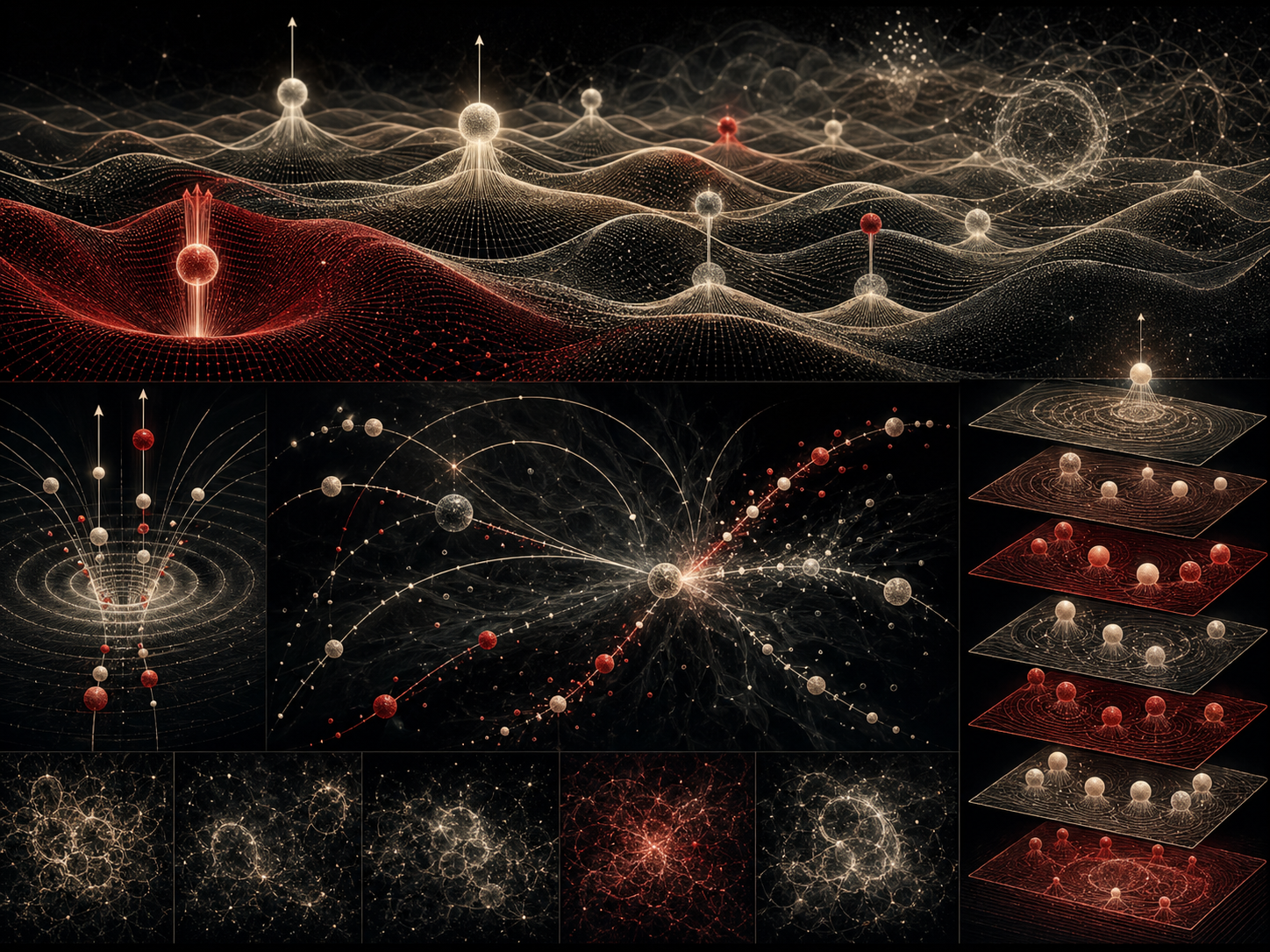
Why Quantum Field Theory Matters
Quantum field theory matters because it is the most successful language physicists have for describing relativistic quantum matter, elementary particles, gauge interactions, scattering, particle creation, many-body systems, critical phenomena, and the vacuum structure of modern physics. Quantum mechanics alone can describe atoms, spectra, bound states, spin, tunneling, and measurement. But when special relativity and quantum theory must both hold, particle number cannot remain fixed. Energy can become matter. Particles and antiparticles can appear. Fields must carry local degrees of freedom. Interactions must respect causality.
Quantum field theory is also broader than particle physics. It is used in condensed matter physics, statistical field theory, critical phenomena, superconductivity, superfluidity, quantum many-body systems, effective field theory, cosmology, curved spacetime quantum effects, and modern mathematical physics. In particle physics, QFT describes the Standard Model. In condensed matter, it describes quasiparticles, collective excitations, broken symmetries, and emergent fields. In statistical physics, it describes long-wavelength fluctuations and universality. In cosmology, it appears in inflationary fluctuations, early-universe fields, and semiclassical gravity.
QFT therefore changes the ontology of physics. Particles are not always the primitive objects. They are excitations of fields, often well-defined only under particular conditions. The electron is associated with an electron field. The photon is associated with the electromagnetic field. Phonons are quantized lattice vibrations. Magnons are quantized spin waves. The same mathematical architecture can describe elementary particles and emergent quasiparticles.
For the Physics knowledge series, this article belongs near Quantum Mechanics and the Limits of Classical Intuition, Symmetry, Conservation, and Noether’s Theorem, Relativity and the Reconstruction of Space and Time, Electromagnetism and the Unification of Fields, Mathematical Methods in Physics, and Statistical Physics and the Emergence of Macroscopic Order. It is the gateway to gauge theory, the Standard Model, renormalization, many-body physics, and effective field theory.
From Particles to Fields
Classical mechanics begins with particles. A particle has position, velocity, momentum, and energy. Quantum mechanics replaces definite trajectories with states, wavefunctions, operators, and probabilities. But much of introductory quantum mechanics still assumes a fixed number of particles. The wavefunction may describe one electron or two particles or a many-body system, but the number of particles is usually specified in advance.
Quantum field theory reverses the starting point. A field assigns degrees of freedom to every point in space or spacetime. The electromagnetic field, for example, is not a single coordinate. It is a distributed physical object with infinitely many degrees of freedom. A scalar field \(\phi(\mathbf{x},t)\) assigns a number to each point in space and time. A spinor field assigns spinor components. A gauge field assigns field components with transformation structure.
The transition from particles to fields is not merely mathematical elegance. Relativity requires local interactions. Particles can be created and destroyed. Vacuum fluctuations affect observable quantities. Identical particles are naturally handled through occupation numbers. Scattering amplitudes require a formalism that can connect incoming and outgoing particle states while allowing intermediate virtual processes.
In QFT, particles emerge after quantizing fields. A free field can be decomposed into independent modes. Each mode acts like a quantum harmonic oscillator. The excitations of these oscillators are interpreted as particles. The “particle” concept is therefore derived from the field and from the chosen background, state, and approximation.
Why Relativistic Quantum Mechanics Is Not Enough
Relativistic quantum mechanics tries to combine quantum wave equations with special relativity while keeping a particle-centered interpretation. In natural units, the Klein–Gordon equation can be written as:
\left(\frac{\partial^2}{\partial t^2} – \nabla^2 + m^2\right)\phi = 0
\]
Interpretation: The Klein–Gordon equation is a relativistic wave equation for a scalar field in natural units.
Here, \(\phi\) is the scalar field, \(m\) is mass, \(t\) is time, and \(\nabla^2\) is the spatial Laplacian. The expression \(\frac{\partial^2}{\partial t^2} – \nabla^2\) is the flat-spacetime wave operator written explicitly.
The Dirac equation is:
\left(i\gamma^\mu \partial_\mu – m\right)\psi = 0
\]
Interpretation: The Dirac equation describes relativistic spin-1/2 fields and naturally leads toward antiparticle structure.
These equations are essential, but their full interpretation is field-theoretic. The Klein–Gordon equation has difficulties as a single-particle probability equation. The Dirac equation predicts antiparticle structure. Relativistic energy permits particle creation when sufficient energy is available. A fixed-particle-number framework becomes inadequate.
Relativity and quantum mechanics together imply that localization, causality, energy, and particle number are deeply constrained. If energy can create particle-antiparticle pairs, then a theory of one permanent particle cannot be fundamental. Interactions must allow processes such as:
e^- + e^+ \rightarrow \gamma + \gamma
\]
Interpretation: Electron-positron annihilation illustrates why relativistic quantum theory must allow particle number to change.
or:
\gamma \rightarrow e^- + e^+
\]
Interpretation: Pair production processes require field-theoretic treatment and must obey conservation laws and kinematic constraints.
QFT resolves these tensions by quantizing fields. The field operator can create or annihilate particles, and relativistic causality is encoded through commutation or anticommutation relations at spacelike separation. The single-particle wavefunction is replaced by a framework in which particle number is not fixed and local fields are primary.
Classical Fields as Infinite Systems
A classical field has degrees of freedom at every point in space. A vibrating string can be described by a displacement field \(y(x,t)\). The electromagnetic field can be described by electric and magnetic fields \(\mathbf{E}(\mathbf{x},t)\) and \(\mathbf{B}(\mathbf{x},t)\), or by potentials. A scalar field can be described by \(\phi(\mathbf{x},t)\).
The action for a classical field is usually written as:
S[\phi]
=
\int \mathcal{L}(\phi,\partial_\mu \phi)\,d^4x
\]
Interpretation: The field action is the spacetime integral of the Lagrangian density.
where \(\mathcal{L}\) is the Lagrangian density. The Euler–Lagrange equation for a field is:
\frac{\partial \mathcal{L}}{\partial \phi}
–
\partial_\mu
\left(
\frac{\partial \mathcal{L}}
{\partial(\partial_\mu \phi)}
\right)
=
0
\]
Interpretation: The field Euler–Lagrange equation gives the classical equation of motion for a field.
For a free real scalar field, the Lagrangian density is:
\mathcal{L}
=
\frac{1}{2}
\partial_\mu\phi\,\partial^\mu\phi
–
\frac{1}{2}m^2\phi^2
\]
Interpretation: The free scalar-field Lagrangian contains kinetic and mass terms.
In natural units, the resulting equation of motion is the Klein–Gordon equation:
\left(\frac{\partial^2}{\partial t^2} – \nabla^2 + m^2\right)\phi = 0
\]
Interpretation: The Klein–Gordon equation follows from the free scalar-field action.
Here, \(\phi\) is the scalar field, \(m\) is the particle mass, \(t\) is time, and \(\nabla^2\) is the spatial Laplacian. Because fields have infinitely many degrees of freedom, they can be decomposed into modes. In a finite box, these modes become discrete. Each mode behaves like an oscillator. This is the structural clue that leads to quantization.
The Harmonic Oscillator as the Seed of QFT
The quantum harmonic oscillator is the seed of quantum field theory. Its Hamiltonian is:
\hat H
=
\hbar\omega
\left(
\hat a^\dagger \hat a
+
\frac{1}{2}
\right)
\]
Interpretation: The harmonic oscillator Hamiltonian is expressed in terms of creation and annihilation operators.
where \(\hat a^\dagger\) is the creation operator and \(\hat a\) is the annihilation operator. They satisfy:
[\hat a,\hat a^\dagger]=1
\]
Interpretation: The canonical oscillator commutator defines the ladder-operator algebra.
The number operator is:
\hat N
=
\hat a^\dagger \hat a
\]
Interpretation: The number operator counts occupation quanta in a mode.
Its eigenstates \(|n\rangle\) satisfy:
\hat N|n\rangle=n|n\rangle
\]
Interpretation: Number states are eigenstates of the occupation-number operator.
The creation operator raises the occupation number:
\hat a^\dagger |n\rangle
=
\sqrt{n+1}|n+1\rangle
\]
Interpretation: The creation operator adds one quantum to the oscillator mode.
The annihilation operator lowers it:
\hat a|n\rangle
=
\sqrt{n}|n-1\rangle
\]
Interpretation: The annihilation operator removes one quantum from the oscillator mode.
A free quantum field is essentially an infinite collection of coupled or decoupled harmonic oscillator modes, depending on the representation. Quantizing the field means quantizing these modes. Particles arise as occupation quanta of those modes.
Creation and Annihilation Operators
Creation and annihilation operators are central because they describe how many-particle states are built and transformed. The vacuum state \(|0\rangle\) is defined by:
\hat a|0\rangle=0
\]
Interpretation: The annihilation operator removes no quanta from the vacuum because the vacuum contains none in that mode.
A one-particle state is created by:
|1\rangle
=
\hat a^\dagger |0\rangle
\]
Interpretation: Applying the creation operator to the vacuum produces a one-quantum state.
An \(n\)-particle state is:
|n\rangle
=
\frac{(\hat a^\dagger)^n}{\sqrt{n!}}|0\rangle
\]
Interpretation: Repeated creation produces normalized \(n\)-particle occupation states.
For a field with many momentum modes, one introduces operators \(\hat a_{\mathbf{k}}\) and \(\hat a^\dagger_{\mathbf{k}}\). For bosonic modes:
[\hat a_{\mathbf{k}},\hat a^\dagger_{\mathbf{k}’}]
=
\delta_{\mathbf{k}\mathbf{k}’}
\]
Interpretation: Discrete bosonic modes satisfy canonical commutation relations.
in a discrete mode basis, or:
[\hat a(\mathbf{k}),\hat a^\dagger(\mathbf{k}’)]
=
(2\pi)^3\delta^3(\mathbf{k}-\mathbf{k}’)
\]
Interpretation: Continuum-normalized bosonic modes use a Dirac delta function.
The creation operator \(\hat a^\dagger_{\mathbf{k}}\) creates a quantum of the field with momentum \(\mathbf{k}\). The annihilation operator \(\hat a_{\mathbf{k}}\) removes one. This is the operational meaning of particles in the free-field basis.
Fock Space and Occupation Number
Fock space is the Hilbert space that contains states with zero, one, two, or many particles. It is built as a direct sum of fixed-particle-number sectors:
\mathcal{F}
=
\mathcal{H}_0
\oplus
\mathcal{H}_1
\oplus
\mathcal{H}_2
\oplus
\cdots
\]
Interpretation: Fock space combines all particle-number sectors into one Hilbert space.
A basis state can be labeled by occupation numbers:
|n_1,n_2,n_3,\ldots\rangle
\]
Interpretation: Occupation-number notation records how many quanta occupy each mode.
where \(n_i\) is the number of quanta in mode \(i\). For bosons, each \(n_i\) can be any nonnegative integer:
n_i=0,1,2,3,\ldots
\]
Interpretation: Bosonic modes can hold any nonnegative number of quanta.
For fermions, occupation is restricted by the Pauli principle:
n_i=0 \ \mathrm{or}\ 1
\]
Interpretation: Fermionic modes can be either empty or singly occupied.
Occupation-number notation is one of the major advantages of second quantization. It automatically handles identical particles and variable particle number. Instead of symmetrizing or antisymmetrizing wavefunctions by hand, the algebra of creation and annihilation operators enforces the correct statistics.
Second Quantization
The term “second quantization” is historically misleading. It does not mean quantizing a previously quantized wavefunction in a naive two-step sense. It means using field operators and occupation-number space to describe quantum systems whose particle number may vary. The language is especially natural for identical particles, many-body systems, and relativistic fields.
In nonrelativistic many-body physics, a field operator \(\hat\psi(\mathbf{x})\) annihilates a particle at position \(\mathbf{x}\), while \(\hat\psi^\dagger(\mathbf{x})\) creates one. For bosons:
[\hat\psi(\mathbf{x}),\hat\psi^\dagger(\mathbf{y})]
=
\delta^3(\mathbf{x}-\mathbf{y})
\]
Interpretation: Bosonic field operators satisfy equal-time commutation relations.
For fermions:
\{\hat\psi(\mathbf{x}),\hat\psi^\dagger(\mathbf{y})\}
=
\delta^3(\mathbf{x}-\mathbf{y})
\]
Interpretation: Fermionic field operators satisfy equal-time anticommutation relations.
A one-body Hamiltonian can be written as:
\hat H
=
\int d^3x\,
\hat\psi^\dagger(\mathbf{x})
\left(
-\frac{\hbar^2\nabla^2}{2m}
+
V(\mathbf{x})
\right)
\hat\psi(\mathbf{x})
\]
Interpretation: In second quantization, one-body dynamics are written using field creation and annihilation operators.
A two-body interaction can be written as:
\hat H_{\mathrm{int}}
=
\frac{1}{2}
\int d^3x\,d^3y\,
\hat\psi^\dagger(\mathbf{x})
\hat\psi^\dagger(\mathbf{y})
V(\mathbf{x}-\mathbf{y})
\hat\psi(\mathbf{y})
\hat\psi(\mathbf{x})
\]
Interpretation: Two-body interactions are compactly represented by products of field operators.
This compact notation is one reason second quantization is essential in condensed matter, atomic physics, quantum optics, nuclear physics, and relativistic QFT.
The Free Real Scalar Field
The free real scalar field is the simplest relativistic quantum field. Its Lagrangian density is:
\mathcal{L}
=
\frac{1}{2}
\partial_\mu\phi\,\partial^\mu\phi
–
\frac{1}{2}m^2\phi^2
\]
Interpretation: A free real scalar field has a kinetic term and a mass term.
The conjugate momentum field is:
\pi(\mathbf{x},t)
=
\frac{\partial\mathcal{L}}{\partial \dot\phi}
=
\dot\phi(\mathbf{x},t)
\]
Interpretation: The conjugate momentum field is the derivative of the Lagrangian density with respect to the field velocity.
The Hamiltonian density is:
\mathcal{H}
=
\frac{1}{2}\pi^2
+
\frac{1}{2}(\nabla\phi)^2
+
\frac{1}{2}m^2\phi^2
\]
Interpretation: The scalar-field Hamiltonian density contains momentum, gradient, and mass contributions.
The field can be expanded in modes:
\hat\phi(\mathbf{x},t)
=
\int
\frac{d^3k}{(2\pi)^3}
\frac{1}{\sqrt{2\omega_{\mathbf{k}}}}
\left[
\hat a_{\mathbf{k}}
e^{-i\omega_{\mathbf{k}}t+i\mathbf{k}\cdot\mathbf{x}}
+
\hat a^\dagger_{\mathbf{k}}
e^{i\omega_{\mathbf{k}}t-i\mathbf{k}\cdot\mathbf{x}}
\right]
\]
Interpretation: The scalar field operator is expanded into annihilation and creation parts over momentum modes.
where:
\omega_{\mathbf{k}}
=
\sqrt{\mathbf{k}^2+m^2}
\]
Interpretation: In natural units, the mode frequency follows the relativistic dispersion relation.
This expansion shows the basic structure of free-field quantization: each momentum mode has a frequency, and the field operator contains both annihilation and creation parts.
Canonical Quantization
Canonical quantization promotes fields and conjugate momenta to operators and imposes equal-time commutation relations. For a real scalar field:
[\hat\phi(\mathbf{x},t),\hat\pi(\mathbf{y},t)]
=
i\hbar\delta^3(\mathbf{x}-\mathbf{y})
\]
Interpretation: Field and conjugate momentum obey canonical equal-time commutation relations.
and:
[\hat\phi(\mathbf{x},t),\hat\phi(\mathbf{y},t)]=0
\]
Interpretation: Equal-time scalar field operators commute with one another.
[\hat\pi(\mathbf{x},t),\hat\pi(\mathbf{y},t)]=0
\]
Interpretation: Equal-time conjugate momentum fields commute with one another.
These relations generalize the canonical commutator:
[\hat q,\hat p]=i\hbar
\]
Interpretation: Field quantization generalizes the canonical position-momentum commutator to infinitely many degrees of freedom.
from finite-dimensional quantum mechanics to fields with infinitely many degrees of freedom.
When the field is expanded into modes, these field commutators imply creation-annihilation commutators. The Hamiltonian becomes a sum over modes:
\hat H
=
\int d^3k\,
\omega_{\mathbf{k}}
\left(
\hat a^\dagger_{\mathbf{k}}\hat a_{\mathbf{k}}
+
\frac{1}{2}
\right)
\]
Interpretation: The free-field Hamiltonian is a continuum sum of oscillator-like mode energies, up to convention and regularization.
up to normalization conventions and regularization. The zero-point term is formally infinite in the continuum theory, foreshadowing the need for regularization, renormalization, and careful interpretation of vacuum energy.
Particles as Field Excitations
In QFT, particles arise as excitations of fields. A one-particle momentum eigenstate for a scalar field can be written as:
|\mathbf{k}\rangle
=
\hat a^\dagger_{\mathbf{k}}|0\rangle
\]
Interpretation: A one-particle momentum state is created by applying a mode creation operator to the vacuum.
A two-particle state is:
|\mathbf{k}_1,\mathbf{k}_2\rangle
=
\hat a^\dagger_{\mathbf{k}_1}
\hat a^\dagger_{\mathbf{k}_2}
|0\rangle
\]
Interpretation: Multiple-particle states are built by applying multiple creation operators to the vacuum.
For bosons, creation operators commute, so exchanging labels does not change the state except for normalization convention. For fermions, creation operators anticommute, producing antisymmetry and enforcing the exclusion principle.
This field-excitation view clarifies why particles can be created or destroyed. An interaction Hamiltonian contains products of field operators. When expanded in creation and annihilation operators, these products contain terms that can remove incoming quanta and create outgoing quanta, subject to conservation laws and amplitudes determined by the theory.
The particle concept is powerful but context-dependent. In flat spacetime with time-translation symmetry, free-particle states can be sharply defined by energy and momentum. In curved spacetime, accelerated frames, or strongly interacting systems, the definition of particle can become more subtle. The field is the more fundamental object.
Propagators and Correlation Functions
A propagator is a central object in QFT. It describes how field disturbances, amplitudes, or correlations connect spacetime points. For a scalar field, the time-ordered two-point function is:
\Delta_F(x-y)
=
\langle 0|
T\{\hat\phi(x)\hat\phi(y)\}
|0\rangle
\]
Interpretation: The Feynman propagator is the vacuum expectation value of a time-ordered two-point field product.
In momentum space, the Feynman propagator for a free scalar field has the form:
\frac{i}{p^2-m^2+i\epsilon}
\]
Interpretation: The momentum-space scalar propagator encodes mass, momentum, and causal boundary prescription.
in natural units and a common sign convention. The \(i\epsilon\) prescription encodes causal boundary conditions and contour behavior in momentum integrals.
Correlation functions are not merely mathematical conveniences. They contain physical information. In particle physics, they are related to scattering amplitudes. In condensed matter, they describe response, fluctuations, excitation spectra, and critical behavior. In statistical field theory, they characterize phases and scaling.
The two-point function is the simplest. Higher-order correlation functions encode interactions, multiparticle processes, and nonlinear structure. Much of perturbative QFT can be understood as a systematic method for computing correlation functions.
Interactions and Perturbation Theory
A free field describes noninteracting particles. Interactions enter through additional terms in the Lagrangian. A common scalar example is:
\mathcal{L}
=
\frac{1}{2}
\partial_\mu\phi\,\partial^\mu\phi
–
\frac{1}{2}m^2\phi^2
–
\frac{\lambda}{4!}\phi^4
\]
Interpretation: A \(\phi^4\) term introduces scalar self-interaction with coupling \(\lambda\).
The \(\phi^4\) term introduces self-interaction. The parameter \(\lambda\) is a coupling constant. If the coupling is small, one may expand physical quantities perturbatively in powers of \(\lambda\).
Perturbation theory separates the solvable free theory from interaction corrections. In operator language, interactions modify time evolution and scattering. In path-integral language, interactions modify the weight:
e^{iS/\hbar}
\]
Interpretation: In the path-integral formulation, the action determines the quantum phase weight.
and generate terms in an expansion. In diagrammatic language, interactions appear as vertices, propagators appear as lines, and integrals over internal momenta account for virtual processes.
Perturbation theory is powerful but not universal. Strong coupling, confinement, nonperturbative vacua, solitons, instantons, phase transitions, and topological effects require methods beyond simple perturbative expansion.
Feynman Diagrams as Bookkeeping
Feynman diagrams are often visually interpreted as particle paths, but their primary role is mathematical bookkeeping. They organize terms in a perturbation expansion. Lines represent propagators. Vertices represent interaction terms. External legs represent incoming and outgoing states. Loops represent internal momentum integrals.
For example, in a \(\phi^4\) theory, a vertex connects four scalar-field lines. Tree-level diagrams give leading-order scattering amplitudes. Loop diagrams give quantum corrections. These corrections often diverge and require regularization and renormalization.
A scattering amplitude can be related to measurable quantities such as cross sections and decay rates. But the diagram is not itself a literal spacetime movie of particles moving along definite tracks. It is a compact representation of terms in a quantum amplitude calculation.
Understanding diagrams as bookkeeping helps avoid confusion. QFT is not classical particle mechanics with hidden paths. It is an operator and path-integral theory of fields whose perturbative expansion can be represented diagrammatically.
Second Quantization in Condensed Matter
Second quantization is not limited to relativistic particle physics. It is central to condensed matter and many-body physics. Electrons in a lattice, phonons in a crystal, magnons in a magnet, Cooper pairs in a superconductor, and quasiparticles in interacting systems are naturally described with creation and annihilation operators.
A tight-binding Hamiltonian can be written as:
\hat H
=
-t
\sum_{\langle i,j\rangle}
\left(
\hat c_i^\dagger \hat c_j
+
\hat c_j^\dagger \hat c_i
\right)
\]
Interpretation: A tight-binding Hamiltonian describes hopping between neighboring lattice sites.
where \(\hat c_i^\dagger\) creates a particle on site \(i\), \(\hat c_j\) annihilates a particle on site \(j\), and \(t\) is a hopping amplitude. Interaction terms can be added, such as the Hubbard interaction:
\hat H_U
=
U\sum_i
\hat n_{i\uparrow}\hat n_{i\downarrow}
\]
Interpretation: The Hubbard interaction penalizes or favors double occupancy depending on the sign and magnitude of \(U\).
This notation makes many-body systems tractable. Instead of tracking labels for identical electrons, one tracks occupation of modes, sites, bands, or orbitals. The algebra enforces statistics, and the Hamiltonian describes hopping, interactions, pairing, scattering, and collective behavior.
This is why QFT belongs not only to high-energy theory but also to materials physics, quantum information, semiconductor physics, superconductivity, and emergent matter.
Fermions and Anticommutation
Bosonic creation and annihilation operators satisfy commutation relations. Fermionic operators satisfy anticommutation relations. For fermionic modes:
\{\hat c_i,\hat c_j^\dagger\}
=
\delta_{ij}
\]
Interpretation: Fermionic creation and annihilation operators satisfy canonical anticommutation relations.
and:
\{\hat c_i,\hat c_j\}=0
\]
Interpretation: Fermionic annihilation operators anticommute with one another.
\{\hat c_i^\dagger,\hat c_j^\dagger\}=0
\]
Interpretation: Fermionic creation operators anticommute with one another.
The anticommutation relation implies:
(\hat c_i^\dagger)^2=0
\]
Interpretation: A fermionic mode cannot be occupied twice, expressing the Pauli exclusion principle algebraically.
so a given fermionic mode cannot be occupied twice. This is the algebraic form of the Pauli exclusion principle.
Fermions require special care because signs matter. Exchanging fermionic operators changes sign. This affects many-body wavefunctions, perturbation theory, path integrals, determinants, anomalies, and quantum statistics. In relativistic QFT, spin-statistics connects half-integer spin fields to anticommutation and integer-spin fields to commutation under standard assumptions.
Fermionic second quantization is therefore essential for electrons, quarks, neutrinos, nucleons, atoms with fermionic statistics, and many-body systems where exclusion shapes physical behavior.
Symmetry, Conservation, and Fields
Quantum field theory is inseparable from symmetry. Spacetime translation symmetry gives energy and momentum conservation. Rotation and Lorentz symmetry organize angular momentum, spin, and relativistic covariance. Internal symmetries generate conserved charges. Gauge symmetries structure interactions.
Noether’s theorem connects continuous symmetries of the action to conserved currents. For a field theory, a conserved current satisfies:
\partial_\mu j^\mu=0
\]
Interpretation: A conserved current has vanishing four-divergence.
The associated charge is:
Q
=
\int d^3x\,j^0
\]
Interpretation: The conserved charge is the spatial integral of the time component of the current.
and under suitable conditions:
\frac{dQ}{dt}=0
\]
Interpretation: Conservation means the associated charge is time-independent.
A global \(U(1)\) phase symmetry of a complex field leads to charge conservation. Gauge symmetry, by contrast, has a more subtle role: it expresses local redundancy and imposes constraints while also guiding the form of interactions.
Symmetry is therefore not an afterthought in QFT. It is one of the main ways theories are built, classified, constrained, and interpreted.
Renormalization as a Scale Problem
Renormalization appears because quantum fields have fluctuations at all scales, and perturbative calculations often produce divergent integrals. At first glance, divergences may look like a failure of the theory. Modern QFT interprets renormalization more deeply: physical parameters depend on scale, and effective theories describe physics within domains of validity.
A loop integral may diverge at high momentum. Regularization introduces a controlled way to handle the divergence. Renormalization absorbs cutoff-dependent pieces into redefined physical parameters such as mass, charge, and coupling constants. The renormalization group then describes how these parameters change with scale.
The running of a coupling can be expressed schematically as:
\mu\frac{dg}{d\mu}
=
\beta(g)
\]
Interpretation: The beta function describes how a coupling changes with renormalization scale.
where \(\mu\) is the renormalization scale and \(\beta(g)\) is the beta function.
Renormalization is one reason QFT is central beyond particle physics. It explains universality in critical phenomena, effective descriptions in condensed matter, scale dependence in high-energy interactions, and the logic of effective field theory. This article introduces renormalization only as a preview; it deserves its own full treatment.
Measurement, Units, and SI Interpretation
Quantum field theory often uses natural units:
\hbar=c=1
\]
Interpretation: Natural units simplify QFT equations by measuring mass, energy, momentum, inverse length, and inverse time in compatible units.
In these units, energy, mass, momentum, inverse length, and inverse time can be expressed in the same units. This greatly simplifies equations, but it can obscure dimensional interpretation. In SI units, \(\hbar\) has units of joule seconds and \(c\) has units of meters per second. Restoring them is essential when connecting theoretical expressions to experimental scales.
The Compton wavelength is:
\lambda_C
=
\frac{\hbar}{mc}
\]
Interpretation: The Compton wavelength connects particle mass to a characteristic quantum-relativistic length scale.
It connects mass to a length scale. The energy of a relativistic particle is:
E^2
=
p^2c^2
+
m^2c^4
\]
Interpretation: The relativistic energy relation connects energy, momentum, rest mass, and the speed of light.
In natural units this becomes:
E^2=p^2+m^2
\]
Interpretation: Natural units simplify the relativistic energy relation by setting \(c=1\).
Field dimensions also depend on spacetime dimension and unit conventions. In four-dimensional natural units, a scalar field has mass dimension:
[\phi]=1
\]
Interpretation: In four spacetime dimensions, a scalar field has mass dimension one in natural units.
while a \(\phi^4\) coupling is dimensionless. Dimensional analysis is one of the main tools for identifying relevant, marginal, and irrelevant operators in effective field theory and renormalization.
Careful unit handling matters in computational workflows. A code that models oscillator occupation, propagators, mass scales, lattice cutoffs, or coupling constants must document whether it uses SI units, natural units, dimensionless lattice units, or mixed conventions.
Mathematical Lens
A mathematics-first view of QFT begins with the field action:
S[\phi]
=
\int d^4x\,\mathcal{L}(\phi,\partial_\mu\phi)
\]
Interpretation: The action functional determines field dynamics through the principle of stationary action.
The field Euler–Lagrange equation is:
\frac{\partial \mathcal{L}}{\partial \phi}
–
\partial_\mu
\left(
\frac{\partial \mathcal{L}}
{\partial(\partial_\mu \phi)}
\right)
=
0
\]
Interpretation: The field Euler–Lagrange equation gives the classical equation of motion implied by the action.
For a free scalar field:
\mathcal{L}
=
\frac{1}{2}\partial_\mu \phi \, \partial^\mu \phi
–
\frac{1}{2}m^2\phi^2
\]
Interpretation: The free scalar-field Lagrangian density contains kinetic and mass terms.
The equation of motion is:
\left(\frac{\partial^2}{\partial t^2} – \nabla^2 + m^2\right)\phi = 0
\]
Interpretation: The free scalar equation of motion is the Klein–Gordon equation.
The conjugate momentum is:
\pi
=
\frac{\partial\mathcal{L}}{\partial\dot\phi}
\]
Interpretation: The conjugate momentum is obtained by differentiating the Lagrangian density with respect to the field velocity.
Canonical quantization imposes:
[\hat\phi(\mathbf{x},t),\hat\pi(\mathbf{y},t)]
=
i\hbar\delta^3(\mathbf{x}-\mathbf{y})
\]
Interpretation: Canonical field quantization imposes equal-time field-momentum commutators.
The mode expansion has the schematic form:
\hat\phi(x)
=
\int
\frac{d^3k}{(2\pi)^3}
\frac{1}{\sqrt{2\omega_{\mathbf{k}}}}
\left(
\hat a_{\mathbf{k}}e^{-ikx}
+
\hat a^\dagger_{\mathbf{k}}e^{ikx}
\right)
\]
Interpretation: The field operator decomposes into creation and annihilation modes.
with:
\omega_{\mathbf{k}}
=
\sqrt{\mathbf{k}^2+m^2}
\]
Interpretation: The mode frequency follows the relativistic dispersion relation in natural units.
Creation and annihilation operators satisfy:
[\hat a_{\mathbf{k}},\hat a^\dagger_{\mathbf{k}’}]
=
(2\pi)^3\delta^3(\mathbf{k}-\mathbf{k}’)
\]
Interpretation: Creation and annihilation operators satisfy continuum commutation relations.
The propagator is:
\Delta_F(x-y)
=
\langle 0|T\{\hat\phi(x)\hat\phi(y)\}|0\rangle
\]
Interpretation: The Feynman propagator is a time-ordered two-point correlation function.
and in momentum space:
\Delta_F(p)
=
\frac{i}{p^2-m^2+i\epsilon}
\]
Interpretation: The momentum-space scalar propagator encodes mass-shell structure and causal prescription.
This mathematical lens shows the central architecture: fields become operators, modes become oscillators, particles become excitations, propagators encode correlations, and interactions produce scattering amplitudes.
Variables, Units, and Physical Interpretation
Quantum field theory uses variables that connect fields, operators, states, particles, amplitudes, and scales. The table below summarizes several central quantities.
| Symbol or Term | Meaning | Typical Unit or Dimension | Physical Interpretation |
|---|---|---|---|
| \(\phi(x)\) | Scalar field | mass dimension 1 in 4D natural units | Field degree of freedom at spacetime point \(x\) |
| \(\pi(x)\) | Conjugate momentum field | depends on field convention | Canonical momentum associated with \(\phi\) |
| \(\mathcal{L}\) | Lagrangian density | energy density or mass dimension 4 | Local density defining dynamics through the action |
| \(S\) | Action | J·s or dimensionless in \(\hbar=1\) phase units | Spacetime integral of the Lagrangian density |
| \(\hat a^\dagger\) | Creation operator | operator | Adds one quantum to a mode |
| \(\hat a\) | Annihilation operator | operator | Removes one quantum from a mode |
| \(\hat N\) | Number operator | dimensionless eigenvalues | Counts occupation number of a mode |
| \(|0\rangle\) | Vacuum state | state vector | Lowest-energy state annihilated by annihilation operators |
| \(\omega_{\mathbf{k}}\) | Mode frequency | s⁻¹ or energy in natural units | Energy-frequency scale of a field mode |
| \(\Delta_F\) | Feynman propagator | depends on field dimension | Time-ordered two-point correlation function |
| \(\lambda\) | Coupling constant | dimension depends on interaction and spacetime dimension | Strength of field interaction |
| \(\mu\) | Renormalization scale | energy or mass | Scale at which parameters are defined |
Note: QFT is both abstract and physically grounded. Operators and states build the quantum theory, while masses, couplings, propagators, and scales connect the formalism to measurable processes.
Worked Example: One-Mode Field Quantization
Consider a single field mode behaving like a harmonic oscillator with frequency \(\omega\). The Hamiltonian is:
\hat H
=
\hbar\omega
\left(
\hat a^\dagger\hat a+\frac{1}{2}
\right)
\]
Interpretation: A single quantized field mode has the Hamiltonian structure of a quantum harmonic oscillator.
The number operator is:
\hat N=\hat a^\dagger\hat a
\]
Interpretation: The number operator counts quanta in the mode.
The vacuum satisfies:
\hat a|0\rangle=0
\]
Interpretation: The vacuum is annihilated by the annihilation operator.
The first excited state is:
|1\rangle=\hat a^\dagger|0\rangle
\]
Interpretation: The first excited state is created by applying the creation operator to the vacuum.
The energy of the vacuum is:
E_0
=
\frac{1}{2}\hbar\omega
\]
Interpretation: The oscillator vacuum has zero-point energy.
The energy of the one-particle state is:
E_1
=
\hbar\omega
\left(
1+\frac{1}{2}
\right)
=
\frac{3}{2}\hbar\omega
\]
Interpretation: Adding one quantum raises the oscillator energy by \(\hbar\omega\).
The difference is:
E_1-E_0
=
\hbar\omega
\]
Interpretation: The energy difference between adjacent occupation levels is one quantum of mode energy.
This difference is interpreted as the energy of one quantum of that mode. For a field, each allowed momentum mode has its own oscillator. A one-particle state in mode \(\mathbf{k}\) has energy:
E_{\mathbf{k}}
=
\hbar\omega_{\mathbf{k}}
\]
Interpretation: A particle excitation in mode \(\mathbf{k}\) carries energy \(\hbar\omega_{\mathbf{k}}\).
and relativistically:
E_{\mathbf{k}}^2
=
\mathbf{p}^2c^2
+
m^2c^4
\]
Interpretation: Relativistic mode energy satisfies the energy-momentum-mass relation.
This example shows the conceptual leap of QFT. A particle is not inserted by hand. It appears as one excitation of a quantized field mode.
Computational Modeling
Computational modeling helps make QFT’s operator structure concrete. A finite-dimensional Fock-space truncation can represent creation and annihilation matrices. A mode-occupation model can compute Bose or Fermi occupation. A scalar-field mode model can compute \(\omega_{\mathbf{k}}\). A propagator model can evaluate simple momentum-space expressions. A symbolic workflow can track commutators. A lattice toy model can discretize a field. A metadata system can preserve conventions, units, cutoffs, normalization choices, Hamiltonians, sources, and assumptions.
The selected examples below focus on Bose occupation and truncated Fock-space ladder operators because they are foundational, readable, and directly reusable. The GitHub repository extends the same logic into richer computational resources: R mode occupation, Python ladder-operator matrices, scalar-field dispersion, propagator grids, harmonic oscillator field modes, Wick-style contractions, perturbative toy models, fermionic anticommutation examples, Julia QFT calculations, C++ Fock-space sweeps, Fortran mode tables, SQL QFT metadata, Rust command-line utilities, C examples, documentation, and reproducible sample data.
R Workflow: Bose Occupation of Quantized Modes
R is useful for parameter sweeps, reproducible summaries, and occupation-number tables. The following workflow computes Bose–Einstein occupation for quantized modes:
\langle n\rangle
=
\frac{1}{e^{\beta\hbar\omega}-1}
\]
Interpretation: The Bose–Einstein occupation number depends on mode energy and temperature.
# Bose Occupation of Quantized Modes
#
# This workflow computes the mean Bose occupation number:
#
#   n_bar = 1 / (exp(beta * hbar * omega) - 1)
#
# where:
#   beta = 1 / (k_B T)
#   hbar = reduced Planck constant
#   omega = angular frequency
#
# The result is useful for understanding occupation of bosonic
# field modes, harmonic oscillators, phonons, photons, and scalar modes.

library(tibble)
library(dplyr)
library(tidyr)

boltzmann_constant_j_k <- 1.380649e-23
hbar_j_s <- 1.054571817e-34

mode_grid <- crossing(
  temperature_k = c(1, 10, 100, 300, 1000),
  angular_frequency_rad_s = c(1e10, 1e11, 1e12, 1e13, 1e14)
) %>%
  mutate(
    beta_j_inverse = 1 / (boltzmann_constant_j_k * temperature_k),
    mode_energy_j = hbar_j_s * angular_frequency_rad_s,
    dimensionless_energy = beta_j_inverse * mode_energy_j,
    mean_occupation =
      1 / (exp(dimensionless_energy) - 1),
    zero_point_energy_j =
      0.5 * mode_energy_j,
    thermal_energy_j =
      boltzmann_constant_j_k * temperature_k
  )

summary_table <- mode_grid %>%
  group_by(temperature_k) %>%
  summarise(
    min_mean_occupation = min(mean_occupation),
    median_mean_occupation = median(mean_occupation),
    max_mean_occupation = max(mean_occupation),
    .groups = "drop"
  )

print(mode_grid)
print(summary_table)
This workflow shows how field modes become thermally populated depending on the ratio \(\hbar\omega/(k_BT)\). High-frequency modes at low temperature have low occupation. Low-frequency modes at high temperature can have large occupation.
Python Workflow: Creation and Annihilation Operators in Truncated Fock Space
Python is useful for matrix representations, numerical checks, and operator algebra. The following workflow builds creation and annihilation operators in a finite Fock-space truncation and verifies their action on number states.
"""
Creation and Annihilation Operators in Truncated Fock Space

This workflow builds finite-dimensional matrix approximations to the
harmonic oscillator ladder operators:

    a |n> = sqrt(n) |n-1>
    a† |n> = sqrt(n+1) |n+1>

and the number operator:

    N = a† a

The finite truncation approximates an infinite-dimensional Fock space.
The canonical commutator [a, a†] = I fails at the highest truncated state,
which is a useful reminder that truncation changes operator algebra.
"""

import numpy as np
import pandas as pd

FOCK_DIMENSION = 8
HBAR = 1.0
OMEGA = 2.0

def annihilation_operator(dimension: int) -> np.ndarray:
    """
    Construct annihilation operator matrix in a truncated Fock basis.
    """
    operator = np.zeros((dimension, dimension), dtype=float)

    for n in range(1, dimension):
        operator[n - 1, n] = np.sqrt(n)

    return operator

def creation_operator(dimension: int) -> np.ndarray:
    """
    Construct creation operator as the transpose of annihilation operator.
    """
    return annihilation_operator(dimension).T

def main() -> None:
    """
    Build ladder operators and summarize number-state diagnostics.
    """
    a = annihilation_operator(FOCK_DIMENSION)
    adag = creation_operator(FOCK_DIMENSION)

    number_operator = adag @ a
    hamiltonian = HBAR * OMEGA * (number_operator + 0.5 * np.eye(FOCK_DIMENSION))
    commutator = a @ adag - adag @ a

    diagnostics = []

    for n in range(FOCK_DIMENSION):
        basis_state = np.zeros(FOCK_DIMENSION)
        basis_state[n] = 1.0

        lowered = a @ basis_state
        raised = adag @ basis_state
        number_value = basis_state @ number_operator @ basis_state
        energy_value = basis_state @ hamiltonian @ basis_state

        diagnostics.append(
            {
                "n": n,
                "number_expectation": number_value,
                "energy_expectation": energy_value,
                "lowered_norm": np.linalg.norm(lowered),
                "raised_norm": np.linalg.norm(raised),
            }
        )

    diagnostics_table = pd.DataFrame(diagnostics)

    commutator_table = pd.DataFrame(
        {
            "basis_index": np.arange(FOCK_DIMENSION),
            "commutator_diagonal": np.diag(commutator),
        }
    )

    print("Number-state diagnostics:")
    print(diagnostics_table.round(8).to_string(index=False))

    print("\nCommutator diagonal in truncated space:")
    print(commutator_table.round(8).to_string(index=False))

    print("\nHamiltonian eigenvalues:")
    print(np.linalg.eigvalsh(hamiltonian).round(8))

if __name__ == "__main__":
    main()
This workflow makes second quantization concrete. The creation operator raises occupation, the annihilation operator lowers occupation, the number operator counts quanta, and the Hamiltonian assigns oscillator energy levels. The truncated commutator also teaches a crucial computational lesson: finite matrix approximations can preserve much of the structure while altering exact infinite-dimensional identities at the cutoff.
GitHub Repository
The article body includes only selected computational examples so the conceptual and mathematical argument remains readable. The full repository contains the expanded computational infrastructure: R mode-occupation workflows, Python ladder-operator matrices, scalar-field dispersion, propagator grids, harmonic-oscillator field modes, Wick-style contraction metadata, perturbative toy models, fermionic anticommutation examples, Julia QFT calculations, C++ Fock-space sweeps, Fortran mode tables, SQL QFT metadata, Rust command-line utilities, C examples, documentation, and reproducible sample data.
Complete Code Repository
The full code distribution for this article, including selected article examples and advanced research-style computational resources for second quantization, Fock space, creation and annihilation operators, scalar-field modes, propagators, occupation-number systems, interaction toy models, QFT metadata, reproducibility documentation, and performance-oriented scientific computing, is available on GitHub.
From QFT I to Modern Field Theory
Quantum field theory begins with a profound shift: the field is primary, and particles are excitations. Second quantization provides the operator language for this shift. Creation and annihilation operators build Fock space. Commutation and anticommutation relations encode statistics. Propagators express field correlations. Interactions produce scattering and particle transformation. Symmetry constrains the theory. Renormalization reveals scale dependence.
Within the Physics knowledge series, this article belongs near Quantum Mechanics and the Limits of Classical Intuition, Symmetry, Conservation, and Noether’s Theorem, Relativity and the Reconstruction of Space and Time, Electromagnetism and the Unification of Fields, Mathematical Methods in Physics, and Statistical Physics and the Emergence of Macroscopic Order. It provides the foundation for gauge theory, the Standard Model, many-body field theory, and modern renormalization.
The next conceptual steps are natural. Path Integrals and the Functional Formulation of Physics develops the action-based formulation of quantum amplitudes. Gauge Theory: Symmetry, Fields, and Interaction explains how local symmetry structures modern interactions. Renormalization: Scale, Divergence, and Effective Theory develops the scale logic of QFT. The Standard Model: Gauge Structure, Particles, and Symmetry Breaking applies QFT to known elementary particles and interactions.
Related Articles
- What Is Physics?
- Measurement, Mathematics, and the Structure of Physical Inquiry
- Mathematical Methods in Physics
- Quantum Mechanics and the Limits of Classical Intuition
- Quantum Information, Decoherence, and Measurement
- Quantum Fields, Particles, and the Standard Model
- Symmetry, Conservation, and Noether’s Theorem
- Relativity and the Reconstruction of Space and Time
- Electromagnetism and the Unification of Fields
- General Relativity: Geometry, Gravity, and Spacetime Curvature
- Atomic, Molecular, and Optical Physics
- Semiconductor Physics and Electronic Materials
- Statistical Physics and the Emergence of Macroscopic Order
- Computational Physics and Scientific Simulation
- Path Integrals and the Functional Formulation of Physics
- Gauge Theory: Symmetry, Fields, and Interaction
- Renormalization: Scale, Divergence, and Effective Theory
- The Standard Model: Gauge Structure, Particles, and Symmetry Breaking
Further Reading
- CERN Document Server (1995) An Introduction to Quantum Field Theory, bibliographic record for Peskin, M.E. and Schroeder, D.V. Available at: https://cds.cern.ch/record/257493 (Accessed: 25 April 2026).
- Kuhlmann, M. (2020) ‘Quantum Field Theory’, The Stanford Encyclopedia of Philosophy. Available at: https://plato.stanford.edu/entries/quantum-field-theory/ (Accessed: 25 April 2026).
- MIT OpenCourseWare (2023) Relativistic Quantum Field Theory I. Available at: https://ocw.mit.edu/courses/8-323-relativistic-quantum-field-theory-i-spring-2023/ (Accessed: 25 April 2026).
- MIT OpenCourseWare (2023) Lecture 3: Why Quantum Field Theory. Available at: https://ocw.mit.edu/courses/8-323-relativistic-quantum-field-theory-i-spring-2023/resources/ocw_8323_lecture03_2023feb13_mp4/ (Accessed: 25 April 2026).
- MIT OpenCourseWare (2010) Relativistic Quantum Field Theory II. Available at: https://ocw.mit.edu/courses/8-324-relativistic-quantum-field-theory-ii-fall-2010/ (Accessed: 25 April 2026).
- Peskin, M.E. and Schroeder, D.V. (1995) An Introduction to Quantum Field Theory. Reading, MA: Addison-Wesley. Bibliographic record available at: https://cds.cern.ch/record/257493 (Accessed: 25 April 2026).
- Srednicki, M. (2007) Quantum Field Theory. Cambridge: Cambridge University Press. Author page and prepublication draft available at: https://web.physics.ucsb.edu/~mark/qft.html (Accessed: 25 April 2026).
- Tong, D. (2026) Lectures on Quantum Field Theory. University of Cambridge. Available at: https://www.damtp.cam.ac.uk/user/tong/qft.html (Accessed: 25 April 2026).
- Weinberg, S. (2005) The Quantum Theory of Fields, Volume 1: Foundations. Cambridge: Cambridge University Press. Bibliographic record available at: https://openlibrary.org/books/OL3398947W (Accessed: 25 April 2026).
- Zee, A. (2010) Quantum Field Theory in a Nutshell, 2nd edn. Princeton: Princeton University Press. Publisher information available at: https://www.kitp.ucsb.edu/zee/books/quantum-field-theory-nutshell (Accessed: 25 April 2026).
References
- CERN Document Server (1995) An Introduction to Quantum Field Theory, bibliographic record for Peskin, M.E. and Schroeder, D.V. Available at: https://cds.cern.ch/record/257493 (Accessed: 25 April 2026).
- Kuhlmann, M. (2020) ‘Quantum Field Theory’, The Stanford Encyclopedia of Philosophy. Available at: https://plato.stanford.edu/entries/quantum-field-theory/ (Accessed: 25 April 2026).
- MIT OpenCourseWare (2023) Relativistic Quantum Field Theory I. Available at: https://ocw.mit.edu/courses/8-323-relativistic-quantum-field-theory-i-spring-2023/ (Accessed: 25 April 2026).
- MIT OpenCourseWare (2023) Lecture 3: Why Quantum Field Theory. Available at: https://ocw.mit.edu/courses/8-323-relativistic-quantum-field-theory-i-spring-2023/resources/ocw_8323_lecture03_2023feb13_mp4/ (Accessed: 25 April 2026).
- MIT OpenCourseWare (2010) Relativistic Quantum Field Theory II. Available at: https://ocw.mit.edu/courses/8-324-relativistic-quantum-field-theory-ii-fall-2010/ (Accessed: 25 April 2026).
- Srednicki, M. (2007) Quantum Field Theory. Cambridge: Cambridge University Press. Author page available at: https://web.physics.ucsb.edu/~mark/qft.html (Accessed: 25 April 2026).
- Tong, D. (2026) Lectures on Quantum Field Theory. University of Cambridge. Available at: https://www.damtp.cam.ac.uk/user/tong/qft.html (Accessed: 25 April 2026).
- Weinberg, S. (2005) The Quantum Theory of Fields, Volume 1: Foundations. Cambridge: Cambridge University Press. Bibliographic record available at: https://openlibrary.org/books/OL3398947W (Accessed: 25 April 2026).