
Last Updated May 30, 2026
Mathematical thinking examines the forms of reasoning through which mathematics becomes possible: pattern recognition, abstraction, proof, structure, representation, generalization, recursion, discrete reasoning, and logical inference. It is not identical with calculation, and it is not exhausted by procedure. It is a disciplined way of seeing relations, isolating form, testing necessity, inventing representations, and moving from examples toward general truths.
This content pillar brings together the major domains through which mathematical thinking becomes visible. It treats mathematics not as a fixed inventory of formulas, techniques, or school exercises, but as an architecture of reason: a structured intellectual practice built from definitions, patterns, invariants, symbolic systems, proof strategies, diagrams, recursive structures, historical development, computational reasoning, and the search for underlying form. Across arithmetic, algebra, geometry, logic, combinatorics, probability, discrete mathematics, algorithms, topology, mathematical modeling, computer science, and the history of mathematical ideas, mathematical thinking provides one of the clearest windows into how human beings make structure intelligible.
Mathematical thinking also belongs to the contemporary sciences of computation, formal modeling, symbolic representation, proof systems, algorithms, graph theory, reproducible notebooks, data structures, theorem exploration, mathematical visualization, and open analytical code. Many of the most important questions about mathematical reasoning now require not only conceptual explanation and historical interpretation, but programmable environments capable of modeling patterns, testing conjectures, visualizing structures, representing graphs, tracing recursive processes, comparing proof strategies, and connecting mathematical reasoning to computation. The field therefore stands at the intersection of mathematics, logic, education, history, philosophy, computer science, systems thinking, and formal knowledge architecture.
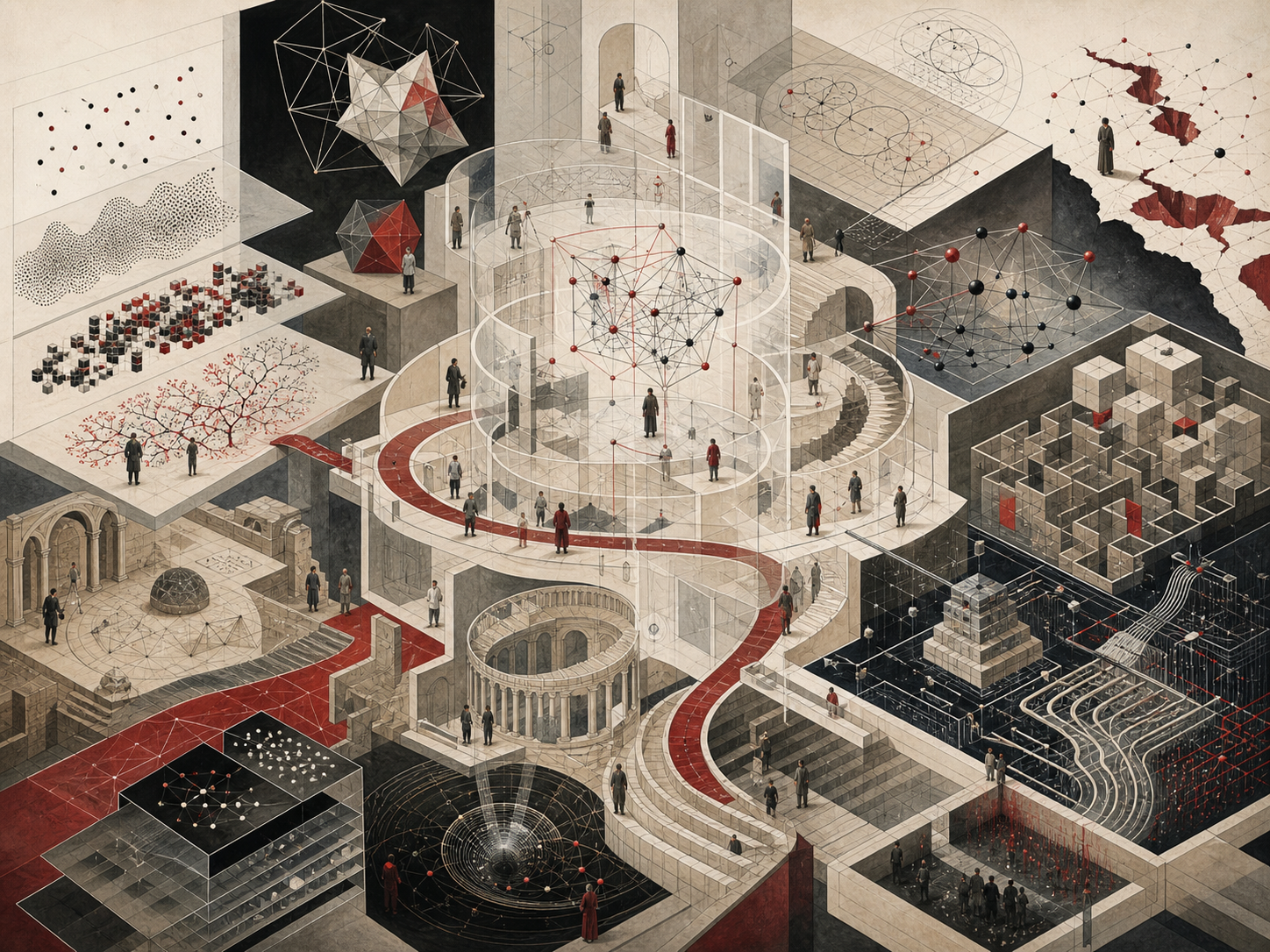
Mathematical thinking appears here not only as a way of solving mathematical problems, but as a way of constructing formal understanding. It explains how a learner moves from examples to patterns, from patterns to conjectures, from conjectures to proof, from proof to structure, and from structure to new domains of application. It also explains why mathematics has remained central to science, engineering, computation, economics, philosophy, and formal reasoning: it gives human thought a disciplined method for separating appearance from necessity.
The field matters because mathematical thinking is one of the most powerful forms of intellectual compression. A single definition can organize infinitely many cases. A proof can reveal why a result must hold beyond the examples that first suggested it. A graph can represent relationships across networks, systems, and computational structures. A recursion can express repeated self-similar construction. A formal language can make an argument checkable, generalizable, and extensible. Mathematical thinking is therefore not merely a school skill. It is a cultural, scientific, computational, and philosophical achievement.
Complete Code Repository
This knowledge series is supported by a computational repository with article-level folders, reproducible examples, synthetic datasets, documentation, pattern-recognition models, proof-structure examples, induction and recursion workflows, graph-theory scaffolds, symbolic-reasoning examples, mathematical-history metadata, and scientific-computing workflows across Python, R, Julia, C++, Fortran, C, Rust, SQL, Go, and notebooks where appropriate.
Mathematical Thinking as a Foundational Discipline
Mathematical thinking occupies a foundational place within the life of the mind because it studies how reason becomes exact. Many forms of thought recognize patterns, make comparisons, use analogies, or infer causes. Mathematical thinking takes those ordinary capacities and disciplines them through abstraction, definition, representation, proof, recursion, symbolic control, and formal structure. It asks not only whether something appears to be true, but what would make it necessarily true under stated assumptions.
This foundational role does not mean that mathematical thinking replaces mathematics itself, logic, philosophy, computer science, education, or the history of science. Rather, it provides a bridge among them. Mathematics supplies objects, theories, and results. Logic clarifies inference. Computer science formalizes symbolic and algorithmic process. History shows how mathematical ideas emerged. Philosophy asks what mathematical truth, structure, and proof mean. Mathematical thinking examines the habits of mind through which all of these become possible.
The field matters because calculation is now increasingly automated. Computers can execute numerical procedures, manipulate algebraic expressions, generate graphs, approximate solutions, search large spaces, and assist with proof. Yet automation does not eliminate the need for mathematical thinking. It makes it more important. Someone still has to ask what the problem means, what structure is being represented, what assumptions are being made, what evidence counts, what proof would require, what computation can and cannot justify, and whether a result is being interpreted correctly.
Mathematical Thinking as the Architecture of Reason
Mathematical thinking may be understood as an architecture of reason. It builds intellectual structures from definitions, axioms, conjectures, representations, examples, counterexamples, lemmas, theorems, proofs, diagrams, algorithms, and models. Each part has a role. Definitions stabilize meaning. Examples reveal possibility. Counterexamples discipline generalization. Proofs establish necessity. Notation compresses structure. Diagrams guide intuition. Algorithms formalize process. Models connect formal reasoning to the world.
This makes mathematical thinking different from a simple toolkit of techniques. A technique can solve a known class of problems. Mathematical thinking asks why the technique works, what structure it exploits, what assumptions it depends on, how far it generalizes, and where it fails. It is not satisfied with a correct answer alone. It seeks structural explanation.
The phrase “architecture of reason” also captures the cumulative character of mathematics. A theorem does not float by itself. It is built on definitions and prior results. A proof does not merely persuade. It fits a claim into a network of reasons. A field such as algebra, geometry, topology, or graph theory does not merely collect facts. It organizes objects, transformations, invariants, and forms of equivalence. Mathematical thinking is the practice of building and navigating these structures.
Mathematical Thinking as a Quantitative and Computational Practice
Mathematical thinking is often described through proof, abstraction, pattern recognition, and conceptual understanding. Those remain central. Yet modern mathematical thinking increasingly involves computational practice as well. Learners and researchers use code to explore examples, generate conjectures, visualize structures, test boundary cases, simulate recursions, search graphs, inspect symbolic patterns, and document reproducible reasoning.
This does not mean that computation replaces proof. A program can suggest a pattern, but it usually does not prove the theorem behind it. A simulation can reveal behavior, but it does not automatically explain necessity. A symbolic tool can manipulate expressions, but it does not decide what those expressions mean. Mathematical thinking becomes stronger when computation is integrated with proof-aware interpretation.
For that reason, this series treats mathematics, programming, graph theory, symbolic reasoning, R, Python, Julia, SQL metadata, reproducible notebooks, and open code repositories as increasingly useful parts of mathematical literacy. Some articles remain primarily conceptual, historical, philosophical, or pedagogical. Others naturally require pattern analysis, recursion experiments, graph models, symbolic workflows, proof-checking examples, discrete structures, algorithmic reasoning, or reproducible code. The aim is not to reduce mathematical thinking to computation, but to make mathematical exploration more transparent, inspectable, and extendable.
What Mathematical Thinking Studies
Mathematical thinking studies how formal insight is produced, justified, communicated, and extended. At the cognitive level, it examines pattern recognition, abstraction, analogy, spatial reasoning, symbolic manipulation, proof comprehension, generalization, and conceptual change. At the representational level, it studies notation, diagrams, formal languages, graphs, tables, equations, visual models, and the ways representations shape what becomes thinkable.
At the logical level, mathematical thinking studies implication, equivalence, contradiction, quantification, proof by induction, proof by contradiction, direct proof, contrapositive reasoning, construction, counterexample, and axiomatic structure. At the structural level, it studies invariance, symmetry, transformation, relation, function, set, graph, recursion, algorithm, category, and formal system. At the historical level, it studies how mathematical ideas developed across civilizations, notations, proof standards, and philosophical commitments.
Mathematical thinking further studies the gap between intuition and justification. A pattern may appear obvious but fail under a hidden case. A diagram may guide insight but conceal a logical gap. A computation may confirm many examples but leave the general result unproved. A symbolic transformation may be valid only under certain assumptions. Mature mathematical thinking learns how to use intuition without surrendering to it.
What This Pillar Covers
This pillar brings together the major domains through which mathematical thinking can be understood. It includes pattern, abstraction, generalization, proof, logic, symbols, diagrams, representation, problem solving, creativity, conjecture, counterexample, algebraic thinking, geometric thinking, discrete mathematics, recursion, combinatorics, sets, relations, functions, graphs, networks, algorithms, mathematical modeling, computer science, proof-writing, history of mathematics, mathematical education, automation, AI-assisted reasoning, and the philosophical meaning of mathematical structure.
These domains differ in method and emphasis, but together they form a coherent intellectual project: the attempt to understand how mathematical reason works. Mathematical thinking is therefore not only a way of learning mathematics. It is also a way of asking how knowledge becomes formal, how patterns become structures, how claims become justified, and how human beings learn to reason beyond immediate appearance.
The series also treats mathematical thinking as a bridge between pure reason and practical systems. Proof may appear detached from the world, but proof habits underlie secure computation, formal verification, algorithmic correctness, modeling assumptions, statistical interpretation, engineering logic, and scientific reasoning. Mathematical thinking gives both abstraction and application their disciplined form.
Mathematics, Computation, and Modeling in Mathematical Thinking
Mathematics provides its own formal language for studying mathematical thinking. Pattern recognition can begin with a sequence:
a_1, a_2, a_3, \ldots, a_n
\]
Interpretation: A sequence invites the question of whether the observed terms arise from an underlying rule, recurrence, structure, or generating process.
A general rule can be represented as:
a_n = f(n)
\]
Interpretation: Mathematical generalization turns a visible pattern into a rule that applies across cases, not merely to the examples already observed.
Recursive thinking represents a structure in terms of itself:
a_{n+1} = F(a_n)
\]
Interpretation: Recursion defines the next state from the previous state, making repeated construction, induction, algorithms, and self-similar processes formally intelligible.
Mathematical induction captures one of the clearest links between recursion and proof:
P(0) \land \forall n\,(P(n) \Rightarrow P(n+1)) \Rightarrow \forall n\,P(n)
\]
Interpretation: Induction proves a statement for all natural numbers by establishing a base case and a rule that carries truth from one case to the next.
Abstraction often depends on equivalence. A relation \(\sim\) partitions objects into classes when it is reflexive, symmetric, and transitive:
x \sim x,\quad x \sim y \Rightarrow y \sim x,\quad (x \sim y \land y \sim z) \Rightarrow x \sim z
\]
Interpretation: Equivalence relations allow mathematics to treat different objects as structurally the same for a given purpose.
Discrete structure can be represented through a graph:
G = (V,E)
\]
Interpretation: A graph consists of vertices and edges, making relationships, networks, paths, dependencies, and connectivity mathematically explicit.
A proof-aware model of mathematical thinking can be written semi-formally as:
MT = f(PA, AB, RE, PR, LG, CR, HS)
\]
Interpretation: Mathematical thinking depends on pattern awareness, abstraction, representation, proof, logic, creativity, and historical understanding.
A simple additive representation is:
MT = \beta_1 PA + \beta_2 AB + \beta_3 RE + \beta_4 PR + \beta_5 LG + \beta_6 CR + \beta_7 HS
\]
Interpretation: This model does not measure mathematical thought directly; it clarifies that mathematical maturity emerges from multiple interacting capacities rather than calculation alone.
These formulations do not reduce mathematical thinking to formulas. They clarify a central point: mathematics is a practice of structural movement. It moves from example to rule, from rule to proof, from proof to structure, from structure to representation, and from representation to new inquiry.
Computation is especially valuable where mathematical structures become too large, recursive, combinatorial, or networked for informal inspection. R supports sequence analysis, visualization, statistical pattern exploration, and reproducible reporting. Python supports graph reasoning, recursion experiments, symbolic workflows, algorithmic testing, and proof-aware modeling. Julia supports high-performance numerical and symbolic exploration. SQL supports structured mathematical metadata, theorem records, proof-step tables, example libraries, and reproducible provenance. C++, Fortran, C, Rust, and Go support efficient algorithmic experiments, command-line tools, formal structures, and mathematical infrastructure.
Major Domains of Mathematical Thinking
Mathematical thinking includes a wide range of major domains, each of which illuminates a different aspect of formal reasoning. Pattern and generalization study how repeated cases become rules. Abstraction studies how irrelevant detail is removed so structure can be isolated. Proof studies how claims become justified. Logic studies implication, quantification, contradiction, equivalence, and formal inference.
Representation studies notation, diagrams, graphs, algebraic forms, coordinate systems, tables, and symbolic languages. Creativity and problem-solving study conjecture, analogy, reframing, counterexample, and the movement from confusion to insight. Discrete mathematics studies logic, sets, relations, functions, combinatorics, recursion, graphs, algorithms, finite structures, and symbolic systems.
Computer-science-oriented mathematical thinking studies algorithmic reasoning, proof of correctness, complexity, formal languages, computability, verification, and data structures. Historical mathematical thinking studies how concepts such as number, proof, algebra, geometry, infinity, function, rigor, and structure emerged across time. Educational mathematical thinking studies how learners acquire mathematical habits of mind and how teaching can cultivate reasoning rather than mere procedure.
Why Mathematical Thinking Matters
Mathematical thinking matters because modern societies depend on formal reasoning even when that dependence is not visible. Algorithms, data systems, engineering models, financial systems, scientific simulations, cryptography, statistical inference, artificial intelligence, infrastructure planning, risk models, and software verification all rely on mathematical habits of abstraction, proof, structure, and representation.
The field also matters because mathematical reasoning protects against superficial pattern recognition. Human beings are naturally drawn to patterns, but not all patterns are meaningful. Some are accidental. Some are overfit. Some disappear under a new case. Some depend on hidden assumptions. Mathematical thinking disciplines pattern recognition through proof, counterexample, definition, and formal structure.
Finally, mathematical thinking matters because it cultivates intellectual humility. A claim may seem obvious but require proof. A conjecture may be beautiful but false. A calculation may be correct but irrelevant. A representation may be elegant but misleading. Mathematical maturity requires both imagination and restraint: the courage to conjecture and the discipline to justify.
Mathematical Thinking and Human Self-Understanding
Mathematical thinking changes how human beings understand reason because it shows that insight is not merely intuitive. It can be formalized, checked, communicated, and extended. Mathematics makes it possible for thought to escape local examples and reach general structure. It teaches that certainty, where available, is not produced by force of belief, but by disciplined inference from clearly stated assumptions.
Yet mathematical thinking also complicates simple ideas about rationality. Mathematics is not mechanical from beginning to end. Conjectures often arise from analogy, imagination, pattern sensitivity, diagrammatic intuition, and aesthetic judgment. The final proof may be rigorous, but discovery often begins in uncertainty. Mathematical thinking therefore joins creativity and rigor more deeply than common stereotypes suggest.
For that reason, mathematical thinking has philosophical as well as practical significance. It raises enduring questions about truth, necessity, abstraction, infinity, proof, structure, invention, discovery, representation, and the limits of formal thought. A serious Mathematical Thinking pillar should therefore not end with skills alone. It should clarify the wider implications of mathematical reason for knowledge, computation, science, education, and human understanding.
Mathematical Thinking Pillar Map
The map below organizes the Mathematical Thinking knowledge series into conceptual domains, moving from foundational reasoning and pattern recognition toward proof, representation, creativity, discrete structure, computer science, history, education, automation, and future mathematical learning.
The Mathematical Thinking pillar is organized to move from foundational definitions and habits of reasoning into pattern, abstraction, generalization, proof, logic, representation, diagrams, symbolic language, creativity, conjecture, counterexample, algebraic thinking, geometric thinking, discrete mathematics, sets, relations, functions, combinatorics, recursion, graphs, networks, algorithms, computer science, history of mathematics, mathematical education, automation, and the future of mathematical reasoning. Mathematics, R, Python, Julia, C++, Fortran, C, Rust, SQL, Go, and computational notebooks are integrated where they deepen understanding, especially in areas such as sequence exploration, induction, recursion, graph reasoning, proof-step modeling, symbolic patterns, mathematical-history metadata, and reproducible mathematical workflows.
Foundations, Pattern, Abstraction, and Generalization
- What Is Mathematical Thinking? — An opening article defining mathematical thinking as reasoning through pattern, abstraction, proof, structure, representation, and generalization.
- Patterns, Structure, and the Mathematical Imagination — An article on recurrence, invariance, symmetry, analogy, and the imaginative recognition of mathematical form.
- Abstraction and the Power of Generalization — A treatment of how mathematics strips away local detail to isolate form, relation, equivalence, and structure.
- Mathematics as the Science of Patterns — An article on structural and philosophical interpretations of mathematics as the study of pattern, relation, and form.
Proof, Logic, Representation, and Discovery
- Proof and the Logic of Mathematical Justification — A core article on why proof matters, how mathematical claims are justified, and how proof differs from repeated observation.
- Logic and the Structure of Formal Inference — An article on implication, equivalence, contradiction, quantification, validity, and formal inference.
- Symbols, Language, and Mathematical Representation — A study of notation, diagrams, symbolic systems, definitions, and representational tools as cognitive infrastructure.
- Conjecture, Creativity, and Mathematical Discovery — An article on mathematical imagination, analogy, insight, reframing, counterexample, and discovery before proof.
- Non-Algorithmic Reasoning and the Future of Mathematics Learning — A critical article on why mathematical learning must cultivate insight, structure, and proof beyond procedural execution.
Algebra, Geometry, Number, and Foundational Structures
- What Makes Algebraic Thinking Distinct? — An article on variable, relation, operation, structure, symbolic transformation, and generalized arithmetic.
- Geometry and the Visual Mind in Mathematics — A treatment of diagrammatic reasoning, spatial structure, construction, visualization, and the relation between intuition and proof.
- Number, Pattern, and the Origins of Mathematical Thought — An article on counting, quantity, order, number systems, and the emergence of mathematical abstraction.
- Sets, Relations, and Functions as Modes of Thought — A foundational article on membership, relation, mapping, equivalence, and functional structure as modes of mathematical organization.
Discrete Mathematics, Recursion, Algorithms, and Computer Science
- Discrete Mathematics and the Logic of Structure — A major article on logic, proof, sets, relations, functions, combinatorics, graphs, recursion, and finite structures.
- Combinatorics and the Mathematics of Possibility — An article on counting, arrangement, choice, enumeration, and the structure of finite possibility spaces.
- Recursion and Recursive Thinking — A study of recursive definition, recurrence, self-reference, induction, algorithms, and repeated construction.
- Graphs, Networks, and Discrete Structure — An article on vertices, edges, paths, connectivity, dependency, and network reasoning.
- Mathematical Thinking for Computer Science — A bridge article on proof, logic, recursion, algorithms, formal languages, data structures, and computational reasoning.
- Algorithms, Proof, and Formal Reasoning — An article on proof of correctness, invariants, termination, complexity, and formal algorithmic thinking.
History, Education, Automation, and Future Reasoning
- The Historical Development of Proof — An article on how standards of mathematical justification emerged and changed across Greek, Islamic, European, and modern traditions.
- The Evolution of Algebraic Notation — A study of how symbolic systems transformed algebraic reasoning and made new forms of thought possible.
- The History of Mathematical Thinking from Antiquity to Modernity — A wide historical article on mathematical concepts, cultures, notations, proof traditions, and standards of rigor.
- Foundations, Structure, and the Reimagining of Mathematics — A treatment of modern foundations, set theory, structuralism, abstraction, and the reorganization of mathematical knowledge.
- Historical Development and the Unity of Mathematical Ideas — An article on how apparently separate branches of mathematics become connected across time.
- The Historical Understanding of Mathematics — A methodological article on why historical context matters for understanding mathematical thought.
- Mathematical Thinking in an Age of Automation — A capstone-style article on calculators, computer algebra, AI, theorem provers, procedural outsourcing, and the future of mathematical education.
Proof Technologies, AI, Modeling, and Responsible Quantification
- Mathematical Thinking and Proof Assistants — An article on theorem provers, formal verification, proof languages, machine-checkable mathematics, and the changing meaning of proof.
- Mathematical Thinking and AI-Assisted Discovery — A study of pattern search, conjecture generation, symbolic systems, large language models, and the limits of automated mathematical reasoning.
- Mathematical Thinking and Visual Proof — An article on diagrams, geometric intuition, visual argument, proof gaps, and the relation between seeing and proving.
- Mathematical Thinking and Category-Level Abstraction — A higher-level article on maps, objects, transformations, structure-preserving relations, and the mathematics of abstraction itself.
- Mathematical Thinking and Scientific Modeling — A bridge article on how mathematical reasoning supports physical, biological, economic, social, and sustainability models.
- Mathematical Thinking and the Ethics of Quantification — A critical article on measurement, models, scores, uncertainty, abstraction, reduction, and responsible use of mathematical representation.
This structure keeps the pillar grounded in mathematical reasoning while reflecting the historical, computational, educational, philosophical, and systems depth required for a serious treatment of pattern, proof, and the architecture of reason.
Methods, Measurement, and Mathematical Practice
One of mathematical thinking’s central challenges is that its deepest habits are not always visible in final answers. A solution may conceal the failed attempts, examples, diagrams, conjectures, counterexamples, and reframings that made it possible. A clean proof may hide the messy search that produced it. A symbolic result may hide the representational breakthrough that made the structure visible.
This matters for education and for research. If mathematical thinking is taught only as procedure, learners may mistake mathematics for rule execution. If proof is taught only as formality, learners may miss its explanatory power. If computation is used only to obtain answers, learners may miss its exploratory value. A mature approach to mathematical thinking therefore needs methods that show the process: conjecture logs, example libraries, proof sketches, diagrams, computational notebooks, graph explorations, symbolic experiments, and historical reconstruction.
Modern mathematical practice benefits from both qualitative and computational documentation. Qualitative interpretation can examine why a representation works, how an analogy functions, or why a proof strategy is illuminating. Computational analysis can explore examples, test patterns, generate visualizations, and preserve reproducible mathematical workflows. A serious Mathematical Thinking pillar should treat both forms as part of the architecture of reason.
Mathematical Thinking, Technology, and the Modern World
Mathematical thinking has become increasingly important because modern technologies often hide formal reasoning inside tools. Search engines, cryptographic systems, recommender systems, statistical models, optimization engines, simulations, AI systems, spreadsheets, dashboards, and automated decision tools all depend on mathematical structures. Users may interact with the outputs without seeing the assumptions, transformations, approximations, or proofs beneath them.
Technology can strengthen mathematical thinking when it helps learners explore examples, visualize structures, test conjectures, simulate systems, and connect representations. It can also weaken mathematical thinking when it encourages answer retrieval without conceptual understanding. A symbolic tool may solve an equation, but the learner still needs to understand the structure of the equation, the domain of the solution, and the meaning of the result.
A mature mathematical thinking approach to technology must therefore ask not only what tools can compute, but what forms of reasoning they support or obscure. The future of mathematics education and mathematical work will increasingly depend on whether automation is used to replace thought or to deepen it.
Mathematical Thinking, Computation, and Proof-Aware Modeling
Computation has become valuable for mathematical thinking because many structures are too large, recursive, combinatorial, or networked to inspect manually. A graph may contain thousands of nodes. A recurrence may behave differently under small changes in initial conditions. A conjecture may need many examples before its underlying form becomes visible. A proof strategy may become clearer when examples are generated systematically.
Proof-aware modeling means using computation without confusing computation with proof. It allows code to support mathematical inquiry while preserving the distinction between evidence and justification. A program can reveal that a conjecture holds for many cases. A proof explains why it holds for all cases under stated assumptions. A simulation can show behavior. A theorem establishes structure.
For that reason, this pillar treats computation as a supporting discipline of mathematical thinking, not as a substitute for mathematical reason. The strongest form of computational mathematical thinking is auditable exploration: clear assumptions, reproducible examples, documented code, interpretable outputs, and an explicit distinction between observed pattern and proved result.
R Section: Modeling Pattern, Sequence, and Generalization
The R workflow below creates synthetic sequences, compares candidate rules, and visualizes how pattern recognition can become formal generalization. It is educational only, but it illustrates how computational exploration can support mathematical thinking without replacing proof.
# Synthetic mathematical thinking workflow in R
# Educational example only.
# This script explores patterns, candidate rules, and generalization.

# install.packages(c("tidyverse", "broom"))
library(tidyverse)
library(broom)

# -------------------------------------------------------------------
# Generate several mathematical sequences.
# -------------------------------------------------------------------

n_max <- 30

sequence_data <- tibble(
  n = 1:n_max,
  arithmetic = 3 * n + 2,
  quadratic = n^2 + n + 1,
  triangular = n * (n + 1) / 2,
  recursive_like = accumulate(1:n_max, ~ .x + .y, .init = 0)[-1]
)

print(sequence_data)

# -------------------------------------------------------------------
# Reshape for visualization.
# -------------------------------------------------------------------

long_sequences <- sequence_data |>
  pivot_longer(
    cols = -n,
    names_to = "sequence_type",
    values_to = "value"
  )

ggplot(long_sequences, aes(x = n, y = value, group = sequence_type)) +
  geom_line() +
  geom_point() +
  facet_wrap(~ sequence_type, scales = "free_y") +
  labs(
    title = "Synthetic Sequence Patterns",
    x = "n",
    y = "Sequence value"
  ) +
  theme_minimal()

# -------------------------------------------------------------------
# Compare linear and quadratic candidate models.
# -------------------------------------------------------------------

fit_candidates <- function(data, response_column) {
  response_formula_linear <- as.formula(paste(response_column, "~ n"))
  response_formula_quadratic <- as.formula(paste(response_column, "~ n + I(n^2)"))

  linear_fit <- lm(response_formula_linear, data = data)
  quadratic_fit <- lm(response_formula_quadratic, data = data)

  tibble(
    sequence = response_column,
    model = c("linear", "quadratic"),
    r_squared = c(
      glance(linear_fit)$r.squared,
      glance(quadratic_fit)$r.squared
    ),
    aic = c(
      AIC(linear_fit),
      AIC(quadratic_fit)
    )
  )
}

model_results <- bind_rows(
  fit_candidates(sequence_data, "arithmetic"),
  fit_candidates(sequence_data, "quadratic"),
  fit_candidates(sequence_data, "triangular")
)

print(model_results)

# -------------------------------------------------------------------
# First differences and second differences.
# These are classic exploratory tools for detecting polynomial structure.
# -------------------------------------------------------------------

difference_table <- sequence_data |>
  mutate(
    quadratic_first_difference = quadratic - lag(quadratic),
    quadratic_second_difference =
      quadratic_first_difference - lag(quadratic_first_difference),
    triangular_first_difference = triangular - lag(triangular),
    triangular_second_difference =
      triangular_first_difference - lag(triangular_first_difference)
  )

print(difference_table)

# -------------------------------------------------------------------
# Export outputs.
# -------------------------------------------------------------------

dir.create("outputs", showWarnings = FALSE, recursive = TRUE)
write_csv(sequence_data, "outputs/synthetic_sequences.csv")
write_csv(model_results, "outputs/sequence_candidate_model_results.csv")
write_csv(difference_table, "outputs/sequence_difference_table.csv")
This workflow models a core mathematical-thinking pattern: examples suggest structure, differences reveal hidden regularity, and candidate models help formalize conjectures. The important caution is that fitted patterns are not proofs. They are disciplined evidence for further reasoning.
Python Section: Exploring Proof Structure, Recursion, and Graph Reasoning
The Python workflow below combines recursion, induction-style testing, and graph reasoning. It demonstrates how computational exploration can help learners see formal structures that later require proof.
# Synthetic mathematical thinking workflow in Python
# Educational example only.
# This script explores recursion, induction-style checking, and graph reasoning.

from dataclasses import dataclass
from typing import Callable, Dict, List, Tuple
import networkx as nx
import pandas as pd
import matplotlib.pyplot as plt


# ---------------------------------------------------------------------
# Recursive sequence exploration.
# ---------------------------------------------------------------------

def generate_recursive_sequence(
    initial_value: int,
    update_rule: Callable[[int, int], int],
    n_terms: int
) -> List[int]:
    """
    Generate a recursive sequence.

    Parameters
    ----------
    initial_value:
        First value of the sequence.
    update_rule:
        Function that takes the current value and index, then returns next value.
    n_terms:
        Number of sequence terms to generate.
    """
    values = [initial_value]

    for index in range(1, n_terms):
        values.append(update_rule(values[-1], index))

    return values


arithmetic_like = generate_recursive_sequence(
    initial_value=2,
    update_rule=lambda current, index: current + 3,
    n_terms=20
)

doubling_like = generate_recursive_sequence(
    initial_value=1,
    update_rule=lambda current, index: current * 2,
    n_terms=20
)

print("Arithmetic-like recursive sequence:")
print(arithmetic_like)

print("\nDoubling-like recursive sequence:")
print(doubling_like)


# ---------------------------------------------------------------------
# Induction-style computational check.
# This does not prove the theorem, but it mirrors the structure of
# checking many cases before writing a proof.
# ---------------------------------------------------------------------

def triangular_number(n: int) -> int:
    return n * (n + 1) // 2


def sum_first_n_integers(n: int) -> int:
    return sum(range(1, n + 1))


checks = []

for n in range(1, 51):
    checks.append({
        "n": n,
        "sum_first_n": sum_first_n_integers(n),
        "formula_value": triangular_number(n),
        "matches": sum_first_n_integers(n) == triangular_number(n)
    })

check_table = pd.DataFrame(checks)
print("\nInduction-style computational check:")
print(check_table.head())
print(check_table.tail())
print("All checked cases match:", check_table["matches"].all())


# ---------------------------------------------------------------------
# Proof dependency graph.
# A proof can be represented as a directed dependency structure:
# definitions and lemmas point toward a theorem.
# ---------------------------------------------------------------------

proof_edges: List[Tuple[str, str]] = [
    ("Definition: natural numbers", "Lemma: successor structure"),
    ("Definition: addition", "Lemma: recursive sum"),
    ("Lemma: successor structure", "Induction principle"),
    ("Lemma: recursive sum", "Theorem: triangular number formula"),
    ("Induction principle", "Theorem: triangular number formula"),
    ("Base case", "Theorem: triangular number formula"),
    ("Inductive step", "Theorem: triangular number formula"),
]

G = nx.DiGraph()
G.add_edges_from(proof_edges)

metrics = pd.DataFrame({
    "node": list(G.nodes()),
    "in_degree": [G.in_degree(node) for node in G.nodes()],
    "out_degree": [G.out_degree(node) for node in G.nodes()],
    "degree_centrality": [
        nx.degree_centrality(G)[node] for node in G.nodes()
    ]
}).sort_values("degree_centrality", ascending=False)

print("\nProof dependency graph metrics:")
print(metrics)

plt.figure(figsize=(12, 8))
positions = nx.spring_layout(G, seed=42)

nx.draw_networkx_nodes(G, positions, node_size=1500)
nx.draw_networkx_edges(G, positions, arrows=True, arrowstyle="->", arrowsize=18)
nx.draw_networkx_labels(G, positions, font_size=8)

plt.title("Synthetic Proof Dependency Graph")
plt.axis("off")
plt.tight_layout()
plt.show()

check_table.to_csv("mathematical_thinking_induction_checks.csv", index=False)
metrics.to_csv("mathematical_thinking_proof_graph_metrics.csv", index=False)
This workflow reinforces a central distinction. Computational checking can strengthen conjecture, reveal structure, and organize proof dependencies. But it does not eliminate the need for proof. Mathematical thinking becomes mature when exploration and justification are held together.
Interpretive Limits and Mathematical Cautions
Mathematical thinking is powerful, but it can be misunderstood. It should not be reduced to speed, calculation, symbol manipulation, or procedural fluency alone. A student who calculates quickly is not necessarily thinking mathematically, and a student who thinks slowly may be doing deep structural work. Mathematical maturity is not measured only by answer production.
Analysts and educators should also avoid confusing abstraction with superiority. Abstract mathematics can reveal deep structure, but abstraction can also obscure context when used carelessly in applied settings. A model may be elegant and still misrepresent reality. A measure may be precise and still answer the wrong question. A formal system may be internally consistent and still poorly suited to the situation where it is applied.
The field is strongest when it combines rigor with interpretive humility. Mathematical thinking should clarify assumptions, expose structure, discipline inference, and make reasoning accountable. It should not be used to disguise uncertainty, overstate precision, or treat everything meaningful as if it must be formalized to matter.
Mathematical Thinking in a Wider Intellectual Context
Mathematical thinking belongs not only to mathematics education or technical training, but to the broader history of human thought about reason, truth, necessity, pattern, structure, representation, and proof. Philosophers, mathematicians, scientists, engineers, logicians, computer scientists, educators, and historians have long asked how formal knowledge becomes possible and why mathematical reasoning has such extraordinary reach.
The field changes the imagination of mathematics. It shows that mathematics is not merely a set of results handed down in finished form. It is a living discipline of inquiry: noticing, abstracting, conjecturing, representing, proving, refuting, generalizing, and reorganizing. It is both discovered and made, both rigorous and creative, both historical and formal.
For that reason, mathematical thinking should be understood as both a technical and humanistic achievement. It brings together proof and imagination, history and structure, computation and interpretation, symbolic economy and conceptual depth. It remains indispensable for any serious framework concerned with logic, science, systems, artificial intelligence, education, modeling, and the architecture of reason.
Related Reading
- Mathematical Modeling: Abstraction, Uncertainty, and the Structure of Reality
- Systems Thinking: Patterns, Interdependence, and Structural Change
- Knowledge Architecture
- Decision Science
- Futures Thinking
- Data Systems & Analytics
- Artificial Intelligence Systems
Further Reading
- Devlin, K. (2012) Introduction to Mathematical Thinking. Stanford University / Coursera. Available at: https://www.coursera.org/learn/mathematical-thinking (Accessed: 4 May 2026).
- Devlin, K. (n.d.) Introduction to Mathematical Thinking. Stanford Online. Available at: https://online.stanford.edu/courses/hstar-y0001-introduction-mathematical-thinking (Accessed: 4 May 2026).
- Devlin, K. (2000) The Math Gene: How Mathematical Thinking Evolved and Why Numbers Are Like Gossip. New York: Basic Books. Available at: https://www.basicbooks.com/titles/keith-devlin/the-math-gene/9780786725083/ (Accessed: 4 May 2026).
- Epp, S.S. (2019) Discrete Mathematics with Applications. 5th edn. Boston, MA: Cengage. Available at: https://www.cengage.com/c/discrete-mathematics-with-applications-5e-epp/9781337694193/ (Accessed: 4 May 2026).
- Katz, V.J. (2024) A History of Mathematics: An Introduction. 4th edn. Boston, MA: Pearson. Available at: https://www.pearson.com/en-us/subject-catalog/p/history-of-mathematics-an-introduction-a/P200000007105/9780136839064 (Accessed: 4 May 2026).
- Mathematical Association of America (n.d.) MAA Convergence. Available at: https://maa.org/publication/convergence/ (Accessed: 4 May 2026).
- Resnik, M.D. (1997) Mathematics as a Science of Patterns. Oxford: Oxford University Press. Available at: https://global.oup.com/academic/product/mathematics-as-a-science-of-patterns-9780198236085 (Accessed: 4 May 2026).
- Stillwell, J. (2010) Mathematics and Its History. 3rd edn. New York: Springer. Available at: https://link.springer.com/book/10.1007/978-1-4419-6053-5 (Accessed: 4 May 2026).
References
- Devlin, K. (1994) Mathematics: The Science of Patterns. New York: Scientific American Library.
- Devlin, K. (2000) The Math Gene: How Mathematical Thinking Evolved and Why Numbers Are Like Gossip. New York: Basic Books. Available at: https://www.basicbooks.com/titles/keith-devlin/the-math-gene/9780786725083/ (Accessed: 4 May 2026).
- Devlin, K. (2012) Introduction to Mathematical Thinking. Stanford University / Coursera. Available at: https://www.coursera.org/learn/mathematical-thinking (Accessed: 4 May 2026).
- Epp, S.S. (2019) Discrete Mathematics with Applications. 5th edn. Boston, MA: Cengage. Available at: https://www.cengage.com/c/discrete-mathematics-with-applications-5e-epp/9781337694193/ (Accessed: 4 May 2026).
- Katz, V.J. (2024) A History of Mathematics: An Introduction. 4th edn. Boston, MA: Pearson. Available at: https://www.pearson.com/en-us/subject-catalog/p/history-of-mathematics-an-introduction-a/P200000007105/9780136839064 (Accessed: 4 May 2026).
- Kline, M. (1972) Mathematical Thought from Ancient to Modern Times. New York: Oxford University Press. Available at: https://global.oup.com/academic/product/mathematical-thought-from-ancient-to-modern-times-volume-1-9780195061352 (Accessed: 4 May 2026).
- Mathematical Association of America (2022) What Is Mathematics? Available at: https://maa.org/math-values/what-is-mathematics/ (Accessed: 4 May 2026).
- Mathematical Association of America (n.d.) MAA Convergence. Available at: https://maa.org/publication/convergence/ (Accessed: 4 May 2026).
- Resnik, M.D. (1997) Mathematics as a Science of Patterns. Oxford: Oxford University Press. Available at: https://global.oup.com/academic/product/mathematics-as-a-science-of-patterns-9780198236085 (Accessed: 4 May 2026).
- Stillwell, J. (2010) Mathematics and Its History. 3rd edn. New York: Springer. Available at: https://link.springer.com/book/10.1007/978-1-4419-6053-5 (Accessed: 4 May 2026).