
Last Updated May 30, 2026
Mathematics is often described as the science of patterns. The phrase is useful because it moves mathematics away from the narrow idea that it is only calculation, formula manipulation, or the mechanical use of symbols. Mathematics studies regularity, structure, relation, transformation, symmetry, recurrence, quantity, space, uncertainty, and logical consequence. It asks how patterns arise, how they can be represented, what remains stable beneath change, and which claims can be proved rather than merely observed.
Yet calling mathematics the science of patterns does not mean that mathematics is simply the act of noticing repetition. A pattern becomes mathematical when it is clarified, abstracted, generalized, tested, represented, and justified. The visible regularity is only the beginning. Mathematical thinking asks what structure explains the pattern, what assumptions are required, what invariants are preserved, what counterexamples might exist, and what proof would establish the claim.
This article examines mathematics as a disciplined study of patterns: numerical patterns, spatial patterns, structural patterns, logical patterns, relational patterns, probabilistic patterns, dynamic patterns, and computational patterns. It also considers why mathematical pattern recognition is powerful, why it can mislead, and why proof, abstraction, and ethical interpretation are necessary companions to the search for order.
What It Means to Call Mathematics the Science of Patterns
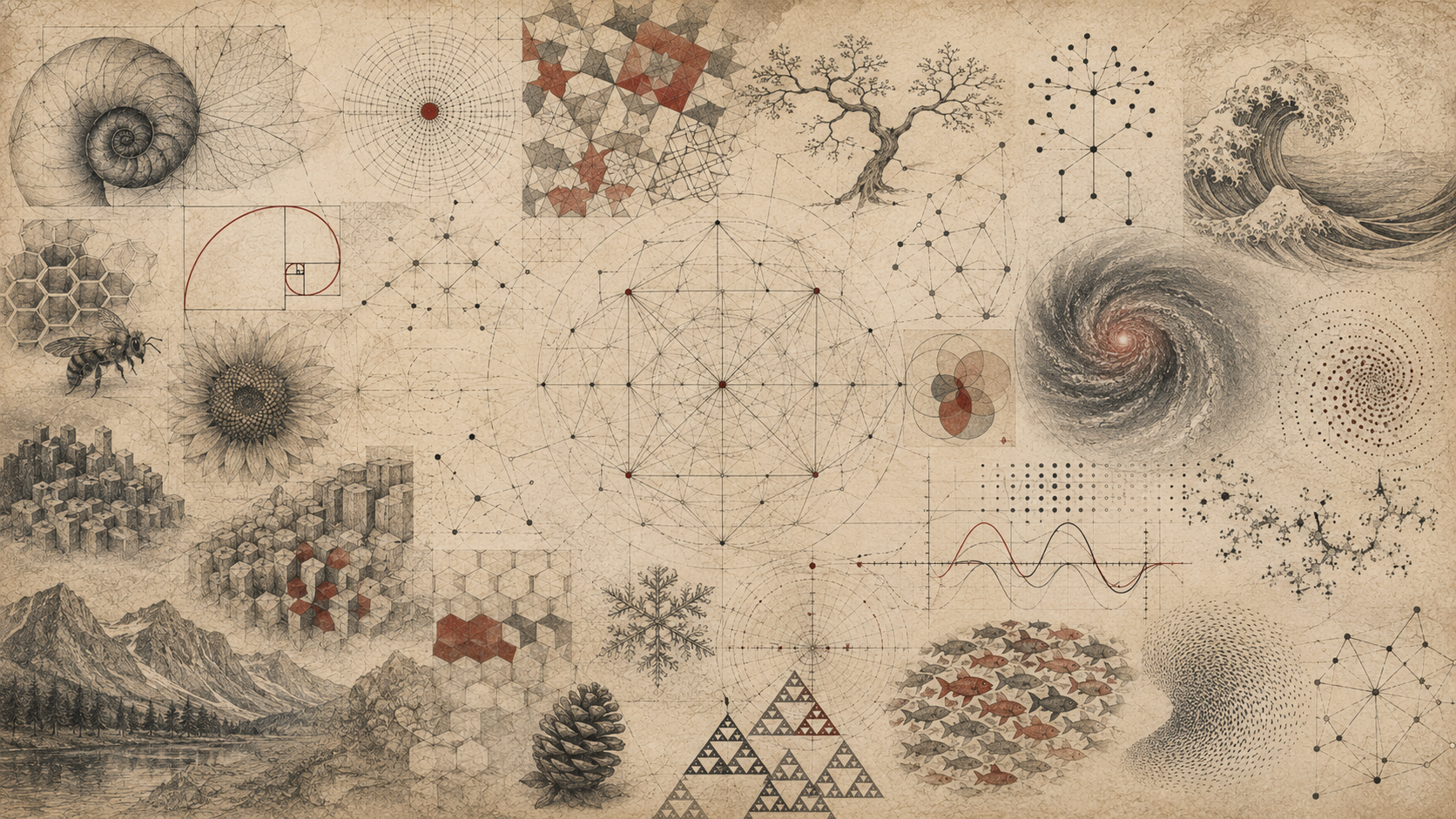
To call mathematics the science of patterns is to say that mathematics studies order in its most disciplined forms. Some patterns are visible, such as symmetry in a shape. Some are numerical, such as recurrence in a sequence. Some are logical, such as a repeated form of inference. Some are structural, such as isomorphism between two different systems. Some are probabilistic, appearing only in aggregate. Some are dynamic, emerging through iteration, feedback, or transformation over time.
The word “science” in this phrase should be understood carefully. Mathematics is not empirical science in the same way that biology, physics, chemistry, or sociology are empirical sciences. Mathematical claims are not established by observation alone. Observations may suggest a conjecture, examples may guide intuition, and computation may reveal hidden regularities, but mathematical knowledge depends on proof, formal justification, or logically controlled argument within stated assumptions.
At the same time, mathematics shares with science a deep concern for explanation, structure, classification, prediction, and systematic inquiry. It asks what makes a pattern possible. It develops languages for representing structure. It builds theories that unify many cases. It distinguishes genuine regularity from coincidence. It identifies where claims hold, where they fail, and why.
\text{Pattern} \rightarrow \text{Conjecture} \rightarrow \text{Structure} \rightarrow \text{Proof}
\]
Interpretation: Mathematical inquiry often begins with a perceived pattern, but the pattern becomes mathematical knowledge only through structure and justification.
This is why mathematics can connect such different domains. The same mathematical language can describe the growth of a sequence, the symmetry of a molecule, the flow of information through a network, the stability of an algorithm, the spread of disease, the shape of spacetime, or the dependency structure of a proof. Mathematics travels because patterns travel.
| Pattern Type | Mathematical Form | Typical Question |
|---|---|---|
| Numerical | Sequence, recurrence, function | What rule generates the terms? |
| Spatial | Geometry, topology, symmetry | What remains stable under transformation? |
| Relational | Graph, network, order relation | How are parts connected? |
| Logical | Proof, inference, formal system | What follows from what? |
| Probabilistic | Distribution, expectation, stochastic process | What regularity appears under uncertainty? |
| Dynamic | Recurrence, differential equation, system | How does behavior evolve over time? |
The science of patterns is therefore not a small definition of mathematics. It is a broad account of why mathematics matters: it gives human beings disciplined tools for recognizing, representing, testing, and explaining order.
Pattern Is More Than Repetition
In everyday language, pattern often means repetition: stripes on fabric, recurring sounds, repeating numbers, or visual designs. Mathematics includes repetition, but mathematical pattern is much broader. A pattern may be a relation, transformation, invariant, dependency, symmetry, distribution, limit, hierarchy, equivalence class, or proof form.
For example, the sequence \(2,4,6,8,10\) shows a simple additive pattern. But the theorem that there are infinitely many prime numbers is also a pattern claim in a deeper sense: it describes an inexhaustible structural property of the natural numbers. A topological invariant is a pattern of preservation under deformation. A logical inference rule is a pattern of valid reasoning. A probability distribution is a pattern in uncertainty. A group is a pattern of operation.
This matters because reducing pattern to visible repetition can make mathematics seem superficial. The deepest mathematical patterns are often not visible at first. They must be discovered through abstraction.
a_n = a_{n-1}+a_{n-2}
\]
Interpretation: A recurrence relation expresses a generative pattern. The pattern is not merely the list of terms; it is the rule of dependency among terms.
Mathematical pattern also depends on the level of description. Two objects may appear different visually but share a structure. Two graphs may use different labels but have the same adjacency relations. Two algebraic systems may arise from different concrete examples but obey the same operational laws. Two proofs may concern different topics but use the same argument pattern.
The mathematical imagination sees through surface variation toward preserved relation. The discipline of proof prevents that imagination from becoming mere resemblance.
| Ordinary Pattern | Mathematical Pattern | Deeper Question |
|---|---|---|
| Repeated numbers | Sequence rule or recurrence | What generates the sequence? |
| Visual balance | Symmetry group | What transformations preserve the object? |
| Similar examples | Shared structure | Are these cases instances of a general theorem? |
| Repeated argument | Proof schema | What form of reasoning is being reused? |
| Trend in data | Model, distribution, or stochastic process | Is the regularity real, stable, and justified? |
A mathematical pattern is therefore not simply what the eye notices. It is what reason can preserve, define, analyze, and justify.
Types of Mathematical Patterns
Mathematics studies many kinds of patterns, and each kind requires different tools. A numerical pattern may call for algebra, number theory, or analysis. A spatial pattern may call for geometry, topology, or group theory. A relational pattern may call for graph theory or category theory. A pattern in uncertainty may require probability and statistics. A pattern in change may require recurrence relations, dynamical systems, or differential equations.
The power of mathematics lies partly in its ability to translate between these forms. A geometric pattern may become algebraic. A network pattern may become a matrix. A logical pattern may become a formal proof. A dynamic pattern may become a recurrence or differential equation. A probabilistic pattern may become a distribution. Translation between representations often reveals structure that was hidden in the original form.
| Pattern Category | Mathematical Tools | Example | Typical Risk |
|---|---|---|---|
| Numerical | Number theory, algebra, sequences | Prime numbers, Fibonacci sequence | Overgeneralizing from early terms |
| Spatial | Geometry, topology, symmetry | Tilings, polyhedra, manifolds | Treating diagrams as proof |
| Structural | Algebra, category theory, graph theory | Groups, rings, networks, categories | Choosing abstraction that loses essential meaning |
| Logical | Proof theory, model theory, formal logic | Induction, contradiction, inference rules | Hidden assumptions in argument |
| Dynamic | Dynamical systems, recurrence, calculus | Feedback loops, population models | Confusing local trend with long-run behavior |
| Probabilistic | Probability, statistics, stochastic processes | Distributions, random walks, sampling patterns | Seeing signal where there is noise |
| Computational | Algorithms, simulations, proof assistants | Generated examples, search spaces, formal proofs | Confusing computed evidence with proof |
These categories overlap. A random walk is probabilistic and dynamic. A graph invariant is structural and relational. A proof assistant uses computational tools to verify logical patterns. A tiling pattern may involve geometry, algebra, combinatorics, and symmetry. Mathematical fields are not sealed compartments; they are different ways of studying form.
Seeing mathematics as the science of patterns helps explain this unity. The subject is diverse because patterns are diverse. The subject is unified because mathematics asks similar questions across that diversity: what is the structure, what is preserved, what follows, what generalizes, and what can be proved?
Numerical Patterns and Sequence Thinking
Numerical patterns are often the first patterns students meet. Counting, parity, divisibility, multiples, powers, squares, triangular numbers, primes, and recurrences all reveal that numbers are not isolated marks. They live inside systems of relation.
A sequence is a particularly important mathematical object because it turns pattern into ordered structure. The sequence may be finite or infinite, explicit or recursive, deterministic or stochastic, simple or highly complex. It invites questions about generation, growth, periodicity, convergence, divergence, modular behavior, and asymptotic form.
1,\;4,\;9,\;16,\;25,\ldots
\]
Interpretation: The square numbers form a visible numerical pattern, but the deeper structure is the rule \(a_n=n^2\).
Some numerical patterns are generated by explicit formulas:
a_n=n^2
\]
Interpretation: An explicit formula defines each term directly from its index.
Other patterns are generated recursively:
F_0=0,\quad F_1=1,\quad F_n=F_{n-1}+F_{n-2}
\]
Interpretation: A recursive definition defines each term from earlier terms, making dependency itself part of the pattern.
Numerical pattern recognition can be misleading because many formulas can fit the same finite list of numbers. A finite sequence does not uniquely determine an infinite rule without further assumptions. The first few terms may suggest a simple pattern, but a later term may violate it. This is why mathematics distinguishes pattern observation from proof.
| Numerical Pattern | Mathematical Structure | Question |
|---|---|---|
| Even numbers | Divisibility by 2 | What does parity preserve under addition and multiplication? |
| Prime numbers | Irreducibility under multiplication | How are primes distributed? |
| Square numbers | Quadratic growth | How does the sequence grow? |
| Fibonacci numbers | Second-order recurrence | What properties follow from the recurrence? |
| Modular cycles | Residue classes | When does behavior repeat modulo \(m\)? |
Number patterns are therefore a training ground for mathematical maturity. They teach the movement from seeing, to conjecturing, to defining, to proving.
Spatial Patterns, Symmetry, and Geometry
Spatial patterns are among the oldest sources of mathematical thought. Geometry began from the study of shape, measurement, proportion, and spatial relation. Patterns in triangles, circles, polygons, solids, tilings, and curves became the basis for systematic reasoning about space.
Symmetry is one of the deepest spatial patterns. A shape has symmetry when it can undergo a transformation while preserving some essential feature. Reflection, rotation, translation, scaling, and deformation can all be studied mathematically. Symmetry transforms visual balance into structure.
f(x)=f(-x)
\]
Interpretation: This equation expresses even symmetry. The graph is unchanged when \(x\) is replaced by \(-x\).
Geometry also shows why diagrams are powerful but not sufficient. A diagram can suggest a theorem, reveal a relationship, or guide a proof. But diagrams can hide special cases, distort scale, or imply assumptions not present in the theorem. Mathematical thinking uses diagrams as instruments of insight, not as substitutes for proof.
Topology extends spatial pattern thinking by asking what remains unchanged under continuous deformation. A square and a circle are different geometrically but similar topologically. A torus and a sphere are topologically different because one has a hole and the other does not. This shift from precise measurement to preserved structure is one of the great examples of abstraction in mathematics.
| Spatial Pattern | Mathematical Field | Preserved Structure |
|---|---|---|
| Triangle relationships | Euclidean geometry | Angle, side, congruence, similarity |
| Rotational symmetry | Group theory and geometry | Transformation structure |
| Tiling | Geometry and combinatorics | Coverage, adjacency, repetition |
| Continuous deformation | Topology | Connectedness, holes, compactness |
| Curvature | Differential geometry | Local shape and metric structure |
Spatial pattern teaches mathematics to see form. Symmetry teaches it to see transformation. Topology teaches it to see preservation beneath deformation.
Structural Patterns and Abstraction
Some of the most important mathematical patterns are not numerical or spatial in the ordinary sense. They are structural. A structural pattern appears when different objects obey the same relational rules.
For example, the rotations of a square, the addition of integers, and the composition of certain transformations may all be studied through algebraic structures. A transportation map, a proof dependency tree, a social network, and a computer program’s package dependencies may all be studied as graphs. The specific objects differ, but the structure makes comparison possible.
(G,\ast)
\]
Interpretation: An algebraic structure such as a group is defined not by the physical nature of its elements, but by how its elements behave under an operation.
Structural pattern is the reason abstraction is so powerful. Mathematics does not need every detail of a situation to reason about it. It needs the relevant structure. Once that structure is identified, the same theorem may apply across many different settings.
Graph theory is a clear example. A graph abstracts from the nature of objects and preserves relation. Vertices may represent people, cities, concepts, proteins, theorems, webpages, or software modules. Edges may represent friendship, roads, logical dependency, interaction, citation, or communication. The graph abstraction makes structural questions possible: connectivity, cycles, paths, centrality, coloring, flow, hierarchy, and vulnerability.
G=(V,E)
\]
Interpretation: A graph consists of vertices and edges. This simple abstraction can represent many forms of relational pattern.
| Concrete Domain | Structural Abstraction | Pattern Preserved |
|---|---|---|
| Road system | Graph | Connectivity among locations |
| Proof dependencies | Directed graph | Logical support among claims |
| Rotations of a polygon | Group | Composition of symmetries |
| Vector quantities | Vector space | Addition and scalar multiplication |
| Measurement space | Metric space | Distance relation |
Structural patterns show why mathematics can be both abstract and practical. The abstraction is what allows the pattern to travel.
Logical Patterns and Proof
Proof is the discipline that turns pattern into knowledge. A pattern may suggest a theorem, but proof establishes why the theorem must hold under stated assumptions. Logical patterns are therefore central to mathematics as the science of patterns.
Proofs themselves have patterns. Direct proof, contradiction, induction, construction, exhaustion, invariance arguments, and counterexample all represent recurring forms of mathematical reasoning. A proof pattern is not tied to one subject area. Induction appears in arithmetic, combinatorics, graph theory, recurrence analysis, computer science, and formal verification. Contradiction appears in number theory, logic, topology, and algebra. Invariance appears in geometry, games, dynamical systems, and combinatorics.
P(0)\land \forall n(P(n)\Rightarrow P(n+1))\Rightarrow \forall nP(n)
\]
Interpretation: Mathematical induction is a logical pattern that converts a base case and a preservation rule into a universal statement over natural numbers.
Logical pattern matters because it reveals reusable structure in reasoning. A proof is not only a sequence of sentences; it is an architecture of dependencies. Definitions support lemmas. Lemmas support propositions. Propositions support theorems. The same logical architecture can often be reused in different domains.
| Proof Pattern | Core Form | Pattern of Reasoning |
|---|---|---|
| Direct proof | Assumptions imply conclusion | Trace consequences from definitions |
| Contradiction | Negation implies impossibility | Show that denial of the claim cannot hold |
| Induction | Base case plus successor step | Propagate truth across an ordered structure |
| Construction | Build an object | Establish existence by explicit method |
| Invariant proof | Identify what cannot change | Use preserved structure to rule out possibilities |
| Counterexample | Find one failing case | Refute a universal claim |
When mathematics studies logical patterns, it studies not only what is true, but how truth is established. This is why proof belongs at the center of mathematics as the science of patterns.
Dynamic Patterns, Recurrence, and Systems
Many patterns unfold over time. A population changes from one generation to the next. An algorithm updates its state. A physical system evolves. A feedback loop amplifies or stabilizes behavior. A sequence grows, oscillates, converges, or diverges. Dynamic patterns require mathematics that can describe change.
Recurrence relations are one way to represent dynamic pattern in discrete time. Differential equations represent change in continuous time. Dynamical systems study how states evolve under repeated transformation. Systems thinking and mathematical modeling both depend on this ability to represent change structurally.
x_{t+1}=f(x_t)
\]
Interpretation: A discrete dynamical system updates a state by repeatedly applying a rule.
This simple form can describe many different systems. If \(f\) is linear, the behavior may be predictable and stable. If \(f\) is nonlinear, the system may show thresholds, cycles, sensitivity, or chaos. If \(f\) depends on multiple variables, the system may reveal interactions that are not visible in isolated parts.
Dynamic patterns are important because they show that structure is not always static. A pattern may be a trajectory, an attractor, a cycle, a transition, or a regime shift. Mathematics gives language to these forms of change.
| Dynamic Pattern | Mathematical Representation | Key Question |
|---|---|---|
| Repeated update | Recurrence relation | What does iteration produce? |
| Continuous change | Differential equation | How does the state change instantaneously? |
| Feedback | Dynamical system | Does feedback stabilize or amplify behavior? |
| Long-run behavior | Limit, attractor, equilibrium | Where does the system tend? |
| Threshold behavior | Nonlinear model | When does a small change produce a major shift? |
Dynamic pattern is especially important for scientific modeling, sustainability, economics, ecology, epidemiology, infrastructure systems, and artificial intelligence. In these areas, the central question is often not merely what exists, but how behavior changes under rules, constraints, shocks, and feedback.
Probabilistic Patterns and Uncertainty
Not all patterns are deterministic. Some patterns appear through uncertainty. Probability and statistics study regularities that emerge across random events, samples, populations, distributions, and stochastic processes. A single coin flip may be unpredictable, but many flips can reveal stable proportions. A single measurement may be noisy, but repeated measurements can reveal a distribution. A single event may be uncertain, but aggregate behavior can have mathematical structure.
Probabilistic patterns require careful interpretation. A trend in data may reflect a real signal, random fluctuation, sampling bias, measurement error, confounding, or model misspecification. Mathematics provides tools for distinguishing some of these possibilities, but the tools must be used responsibly.
P(A\mid B)=\frac{P(A\cap B)}{P(B)}
\]
Interpretation: Conditional probability describes how the probability of an event changes when another event or condition is known.
Probabilistic patterns are central to modern science and society. They appear in genetics, climate modeling, epidemiology, finance, machine learning, risk assessment, quality control, public policy, and social research. In each case, the pattern is not absolute certainty but structured uncertainty.
| Probabilistic Pattern | Mathematical Tool | Interpretive Risk |
|---|---|---|
| Average behavior | Expected value | Ignoring variation or distribution shape |
| Spread | Variance and standard deviation | Reducing uncertainty to one number |
| Association | Correlation | Confusing correlation with causation |
| Conditional information | Bayesian reasoning | Using poor priors or misunderstood evidence |
| Random evolution | Stochastic process | Assuming stationarity where conditions change |
The science of patterns therefore includes the science of uncertainty. Mathematics does not only ask what must happen. It also asks what is likely, what varies, what can be inferred, and how confidence should be justified.
Computational Pattern Discovery
Computation has expanded the ways mathematicians and scientists discover patterns. Programs can generate millions of cases, search large combinatorial spaces, visualize structures, simulate dynamic systems, test conjectures, compute invariants, and formalize proofs. Computational tools have become part of modern mathematical imagination.
But computation changes the practice of pattern discovery without changing the need for justification. A program may reveal a pattern, but the pattern still requires interpretation. A simulation may suggest a theorem, but the theorem still requires proof. A formal proof assistant may verify an argument, but the formalization still depends on definitions, libraries, and carefully stated claims.
Computational pattern discovery is strongest when it is integrated with mathematical discipline:
- Generate examples systematically.
- Track assumptions and parameters.
- Distinguish finite evidence from universal proof.
- Search for counterexamples.
- Represent structures explicitly.
- Export reproducible outputs.
- Connect computation to theory.
Modern mathematical work often moves between informal intuition, computational exploration, formal proof, visualization, and written explanation. None of these alone is the whole of mathematics. Together, they support a richer practice of pattern reasoning.
| Computational Activity | Mathematical Use | Limitation |
|---|---|---|
| Case generation | Reveals possible regularities | Finite evidence may mislead |
| Simulation | Explores dynamic behavior | Depends on model assumptions |
| Graph analysis | Identifies relational structure | Edges may oversimplify meaning |
| Symbolic computation | Manipulates algebraic expressions | May hide conceptual reasoning |
| Proof assistant formalization | Checks logical validity | Requires formal definitions and libraries |
Computation is therefore not outside the science of patterns. It is one of its modern instruments. The challenge is to use it as a partner in reasoning rather than as a substitute for understanding.
False Patterns, Overfitting, and Counterexample
The human mind is a powerful pattern detector, but it is also vulnerable to false patterns. Mathematics is valuable partly because it disciplines pattern recognition. It asks whether the pattern is real, whether it has been generalized too far, whether a counterexample exists, and whether a proof can be given.
False patterns arise in many ways. A small sample may appear regular by chance. A visual diagram may suggest a relationship that fails in edge cases. A sequence may fit many different rules. A statistical model may overfit noise. A machine learning system may detect correlations that do not represent meaningful structure. A metric may impose artificial order on a complex human situation.
\forall x\,P(x)\quad\text{is refuted by}\quad \exists x\,\neg P(x)
\]
Interpretation: A universal pattern claim can be defeated by one valid counterexample within the stated domain.
Counterexample is one of the great tools of mathematical honesty. It prevents the mind from confusing attractive regularity with truth. It also improves definitions and theorems. When a counterexample appears, the response is not merely failure. The theorem may need stronger assumptions, a narrower domain, a different conclusion, or a better abstraction.
| False Pattern Risk | Example | Mathematical Response |
|---|---|---|
| Small-sample pattern | Early sequence terms suggest a rule | Generate more cases and seek proof |
| Visual overconfidence | Diagram appears to prove a theorem | Translate intuition into formal argument |
| Incomplete invariant | Same degree sequence suggests graph isomorphism | Find stronger invariants or proof |
| Statistical overfitting | Model captures noise as signal | Validate on new data and inspect assumptions |
| Misleading abstraction | Metric simplifies complex reality | Audit what the abstraction omits |
The science of patterns must therefore include the science of pattern failure. Mathematics is not just the celebration of order. It is the disciplined testing of apparent order.
A Mathematical Lens: Pattern, Structure, Invariant, Proof
A useful lens for understanding mathematics as the science of patterns is the sequence: pattern, structure, invariant, proof. These four terms describe a movement from observation to knowledge.
A pattern is first noticed. A structure is then proposed to explain it. An invariant identifies what remains stable across transformations. A proof establishes what must be true under the stated assumptions.
I(T(x))=I(x)
\]
Interpretation: An invariant \(I\) remains unchanged when an allowed transformation \(T\) is applied to an object \(x\).
This lens appears across mathematics. In geometry, a visual symmetry becomes a transformation group. In topology, a shape becomes a space, and a preserved property becomes an invariant. In graph theory, a network becomes vertices and edges, and structural features become invariants. In proof theory, an argument becomes a dependency structure, and validity depends on inference rules.
| Stage | Question | Example |
|---|---|---|
| Pattern | What regularity appears? | Terms seem to follow a recurrence |
| Structure | What mathematical object explains it? | A sequence generated by a recurrence relation |
| Invariant | What remains stable under transformation? | Parity pattern, degree sequence, conserved quantity |
| Proof | Why must the claim hold? | Induction, contradiction, construction, formal verification |
This framework helps prevent two opposite errors. The first error is treating mathematics as mere calculation. The second error is treating pattern recognition as sufficient. Mathematics requires both imagination and discipline. It sees patterns, then asks what they mean and whether they can be justified.
Computational Companion Examples
The companion repository for this article should extend the Mathematical Thinking codebase with examples focused on pattern classification, sequence generation, graph invariants, probabilistic patterns, dynamic patterns, and counterexample workflows. The examples below are compact article-level previews; the repository can expand them into richer cross-language workflows.
Python: Pattern, Structure, and Invariant Detection
from collections import Counter
from dataclasses import dataclass

def finite_differences(values: list[int]) -> list[int]:
    return [b - a for a, b in zip(values, values[1:])]

def classify_sequence(values: list[int]) -> str:
    d1 = finite_differences(values)
    d2 = finite_differences(d1)

    if len(set(d1)) == 1:
        return "arithmetic pattern"
    if len(set(d2)) == 1:
        return "quadratic pattern"
    if all(values[i] != 0 and values[i + 1] % values[i] == 0 for i in range(len(values) - 1)):
        return "possible multiplicative pattern"
    return "undetermined finite pattern"

@dataclass(frozen=True)
class Graph:
    edges: tuple[tuple[str, str], ...]

    def degree_sequence(self) -> tuple[int, ...]:
        counts = Counter()
        for a, b in self.edges:
            counts[a] += 1
            counts[b] += 1
        return tuple(sorted(counts.values(), reverse=True))

sequences = {
    "linear": [2, 5, 8, 11, 14],
    "quadratic": [1, 4, 9, 16, 25],
    "powers_two": [1, 2, 4, 8, 16],
}

for name, values in sequences.items():
    print(name, classify_sequence(values))

cycle = Graph((("a", "b"), ("b", "c"), ("c", "d"), ("d", "a")))
print("cycle degree sequence:", cycle.degree_sequence())
R: Finite Pattern Audit
finite_differences <- function(values) {
  diff(values)
}

classify_sequence <- function(values) {
  d1 <- finite_differences(values)
  d2 <- finite_differences(d1)

  if (length(unique(d1)) == 1) {
    return("arithmetic pattern")
  }

  if (length(unique(d2)) == 1) {
    return("quadratic pattern")
  }

  return("undetermined finite pattern")
}

patterns <- list(
  linear = c(2, 5, 8, 11, 14),
  quadratic = c(1, 4, 9, 16, 25),
  triangular = c(1, 3, 6, 10, 15)
)

audit <- data.frame(
  name = names(patterns),
  classification = sapply(patterns, classify_sequence)
)

print(audit)
cat("Finite patterns support conjecture; proof establishes generality.\n")
Julia: Dynamic Pattern Exploration
function iterate_map(f, x0, n)
    values = Vector{Float64}(undef, n)
    values[1] = x0
    for i in 2:n
        values[i] = f(values[i - 1])
    end
    return values
end

linear_update(x) = 0.8x + 1.0
logistic_update(r) = x -> r * x * (1 - x)

println("Linear dynamic pattern:")
println(iterate_map(linear_update, 0.0, 20))

println("\nLogistic dynamic pattern:")
println(iterate_map(logistic_update(3.2), 0.2, 20))
SQL: Pattern Metadata and Proof Status
CREATE TABLE pattern_record (
  pattern_id TEXT PRIMARY KEY,
  name TEXT NOT NULL,
  pattern_type TEXT NOT NULL,
  mathematical_structure TEXT NOT NULL,
  evidence_type TEXT NOT NULL,
  proof_status TEXT NOT NULL
);

CREATE TABLE invariant_record (
  invariant_id TEXT PRIMARY KEY,
  name TEXT NOT NULL,
  object_class TEXT NOT NULL,
  transformation_class TEXT NOT NULL,
  description TEXT NOT NULL
);

CREATE TABLE counterexample_record (
  counterexample_id TEXT PRIMARY KEY,
  pattern_id TEXT NOT NULL,
  description TEXT NOT NULL,
  lesson TEXT NOT NULL,
  FOREIGN KEY (pattern_id) REFERENCES pattern_record(pattern_id)
);
Haskell: Typed Pattern Records, Evidence Status, and Proof Discipline
{-# OPTIONS_GHC -Wall #-}

module Main where

data PatternType
  = Numerical
  | Spatial
  | Structural
  | Logical
  | Dynamic
  | Probabilistic
  | Computational
  deriving (Eq, Show)

data EvidenceStatus
  = ObservedPattern
  | ComputedEvidence
  | Conjectured
  | Proved
  | RefutedByCounterexample
  | RequiresInterpretation
  deriving (Eq, Show)

data MathematicalStructure
  = Sequence
  | Recurrence
  | Graph
  | SymmetryGroup
  | ProbabilityDistribution
  | DynamicalSystem
  | ProofSchema
  deriving (Eq, Show)

data PatternRecord = PatternRecord
  { patternName :: String
  , patternType :: PatternType
  , structure :: MathematicalStructure
  , evidenceStatus :: EvidenceStatus
  , invariantOrRule :: String
  , reviewQuestion :: String
  } deriving (Eq, Show)

records :: [PatternRecord]
records =
  [ PatternRecord
      "square numbers"
      Numerical
      Sequence
      Proved
      "a_n = n^2"
      "Has the visible sequence been connected to a formula and proof?"
  , PatternRecord
      "Fibonacci recurrence"
      Numerical
      Recurrence
      Conjectured
      "F_n = F_{n-1} + F_{n-2}"
      "Which properties follow from the recurrence, and which still need proof?"
  , PatternRecord
      "four-cycle graph"
      Structural
      Graph
      ComputedEvidence
      "degree sequence remains stable under relabeling"
      "Is the computed invariant strong enough to characterize the graph?"
  , PatternRecord
      "mathematical induction"
      Logical
      ProofSchema
      Proved
      "base case plus preservation step"
      "What class of statements can this proof pattern justify?"
  , PatternRecord
      "logistic iteration"
      Dynamic
      DynamicalSystem
      RequiresInterpretation
      "x_{t+1} = r x_t (1 - x_t)"
      "What parameter values produce stability, cycles, or chaotic behavior?"
  ]

main :: IO ()
main = do
  putStrLn "Pattern, structure, invariant, and proof-status records:"
  mapM_ print records
GitHub Repository
The companion repository for this article is designed as a reproducible mathematical-thinking workspace focused on pattern classification, sequence reasoning, graph invariants, dynamic systems, probabilistic pattern interpretation, counterexample workflows, and proof-status metadata.
Complete Code Repository
Companion article folder with Python, R, Julia, SQL, Haskell, Rust, Go, C++, Fortran, and C examples for professional mathematical exploration of patterns, structures, invariants, recurrence, graph reasoning, probabilistic regularity, computational discovery, typed proof-status records, and counterexample discipline.
Pattern, Quantification, and Responsibility
Seeing mathematics as the science of patterns is powerful, but it also raises ethical questions. In applied settings, pattern recognition can become classification, prediction, ranking, surveillance, optimization, or intervention. A mathematical pattern may influence how people are evaluated, how resources are distributed, how risks are priced, how institutions make decisions, or how ecological systems are managed.
The ethical risk is not mathematics itself. The risk is treating detected patterns as neutral, complete, or self-justifying. A model may find a statistical pattern in historical data, but the data may reflect inequality, exclusion, measurement bias, or institutional harm. A metric may impose order on complexity while omitting dignity, context, or lived experience. An algorithm may detect correlation without understanding cause.
Responsible mathematical thinking asks several questions:
- What kind of pattern has been detected?
- What assumptions make the pattern visible?
- What data, variables, or relationships have been excluded?
- Is the pattern stable, causal, meaningful, or merely correlational?
- Who may be harmed if the pattern is used for decision-making?
- What forms of uncertainty, error, or contestability are being reported?
| Pattern Use | Possible Benefit | Ethical Risk | Responsible Practice |
|---|---|---|---|
| Risk modeling | Anticipates future harm or failure | Can encode structural inequality | Audit variables, uncertainty, and consequences |
| AI classification | Finds large-scale statistical regularities | May misclassify people or groups | Ensure transparency, appeal, and human oversight |
| Economic modeling | Clarifies relations among variables | May omit power, distribution, and institutions | Report assumptions and distributional effects |
| Environmental monitoring | Detects ecological change | May reduce complex systems to narrow indicators | Use plural measures and local knowledge |
| Performance metrics | Tracks selected outcomes | May distort behavior toward the metric | Pair metrics with qualitative judgment |
The science of patterns should therefore be joined to the ethics of interpretation. Mathematics can reveal order, but human judgment must decide how that order should be used.
Why the Science of Patterns Matters
Mathematics matters because patterns matter. Human beings live in a world of structure, change, uncertainty, relation, and consequence. Scientific theories depend on mathematical patterns. Technologies depend on algorithms and formal systems. Economies depend on models and measurement. Ecologies depend on dynamic relations. Institutions depend on rules, incentives, and information flows. Artificial intelligence depends on statistical pattern recognition. Public reasoning increasingly depends on interpreting models, metrics, and evidence.
To understand the modern world, it is not enough to know how to calculate. One must understand what kind of pattern is being represented, what structure has been assumed, what evidence supports the claim, what uncertainty remains, and what consequences follow from using the model.
Mathematics as the science of patterns gives a unified account of the discipline’s power. It explains why arithmetic, geometry, algebra, topology, probability, logic, graph theory, dynamical systems, statistics, and computation belong together. They are different ways of studying order.
But the phrase also points to a discipline of humility. Not every apparent pattern is real. Not every real pattern is meaningful. Not every meaningful pattern justifies action. Not every model captures the whole reality. Mathematical thinking must therefore combine imagination, abstraction, proof, counterexample, computation, and responsibility.
The deepest value of mathematics is not that it makes the world simple. The world is not simple. The value of mathematics is that it gives us disciplined ways to recognize structure without confusing structure for totality. It teaches us to ask what repeats, what changes, what remains invariant, what follows, what fails, and what can be known.
That is why mathematics remains one of humanity’s great intellectual achievements: it is the systematic study of patterns, and the disciplined search for the structures that make those patterns intelligible.
Related Articles
- What Is Mathematical Thinking? Pattern, Proof, Architecture, and Reason
- Patterns, Structure, and the Mathematical Imagination
- Abstraction and the Power of Generalization
- Proof and the Logic of Mathematical Justification
- Logic and the Structure of Formal Inference
- Symbols, Language, and Mathematical Representation
- Conjecture, Creativity, and Mathematical Discovery
- Number, Pattern, and the Origins of Mathematical Thought
- Graphs, Networks, and Discrete Structure
- Mathematical Thinking and Scientific Modeling
Further Reading
- Courant, R. and Robbins, H. (1996) What Is Mathematics? An Elementary Approach to Ideas and Methods. 2nd edn. Oxford: Oxford University Press. Available at: https://global.oup.com/academic/product/what-is-mathematics-9780195105193
- Devlin, K. (1994) Mathematics: The Science of Patterns. New York: Scientific American Library. Available at: https://www.worldcat.org/title/30112573
- Devlin, K. (2012) Introduction to Mathematical Thinking. Stanford University / Coursera course materials and related publications. Available at: https://web.stanford.edu/~kdevlin/
- Hadamard, J. (1945) The Psychology of Invention in the Mathematical Field. Princeton: Princeton University Press. Available at: https://press.princeton.edu/books/paperback/9780691029313/the-psychology-of-invention-in-the-mathematical-field
- Lakatos, I. (1976) Proofs and Refutations: The Logic of Mathematical Discovery. Cambridge: Cambridge University Press. Available at: https://www.cambridge.org/core/books/proofs-and-refutations/3B5BDF18C7A5F4E7D4B30F06E4E5A0F1
- Pólya, G. (1945) How to Solve It: A New Aspect of Mathematical Method. Princeton: Princeton University Press. Available at: https://press.princeton.edu/books/paperback/9780691164076/how-to-solve-it
References
- Courant, R. and Robbins, H. (1996) What Is Mathematics? An Elementary Approach to Ideas and Methods. 2nd edn. Oxford: Oxford University Press. Available at: https://global.oup.com/academic/product/what-is-mathematics-9780195105193
- Devlin, K. (1994) Mathematics: The Science of Patterns. New York: Scientific American Library. Available at: https://www.worldcat.org/title/30112573
- Devlin, K. (2012) Introduction to Mathematical Thinking. Stanford University / Coursera course materials and related publications. Available at: https://web.stanford.edu/~kdevlin/
- Hadamard, J. (1945) The Psychology of Invention in the Mathematical Field. Princeton: Princeton University Press. Available at: https://press.princeton.edu/books/paperback/9780691029313/the-psychology-of-invention-in-the-mathematical-field
- Hardy, G.H. (1940) A Mathematician’s Apology. Cambridge: Cambridge University Press. Available at: https://www.cambridge.org/core/books/mathematicians-apology/6F0C29793C928E41F9A7E5C3E7A413C3
- Lakatos, I. (1976) Proofs and Refutations: The Logic of Mathematical Discovery. Cambridge: Cambridge University Press. Available at: https://www.cambridge.org/core/books/proofs-and-refutations/3B5BDF18C7A5F4E7D4B30F06E4E5A0F1
- Mac Lane, S. (1998) Categories for the Working Mathematician. 2nd edn. New York: Springer. Available at: https://link.springer.com/book/10.1007/978-1-4757-4721-8
- Pólya, G. (1945) How to Solve It: A New Aspect of Mathematical Method. Princeton: Princeton University Press. Available at: https://press.princeton.edu/books/paperback/9780691164076/how-to-solve-it