
Last Updated May 30, 2026
Mathematical thinking is not simply the ability to calculate, memorize formulas, or manipulate symbols quickly. It is a disciplined way of recognizing pattern, preserving structure, testing conjectures, building arguments, and moving between concrete examples and abstract systems. At its best, mathematical thinking turns confusion into form: it asks what must be true, what follows from what, what can be generalized, what can be simplified, and what kind of proof would make the claim durable.
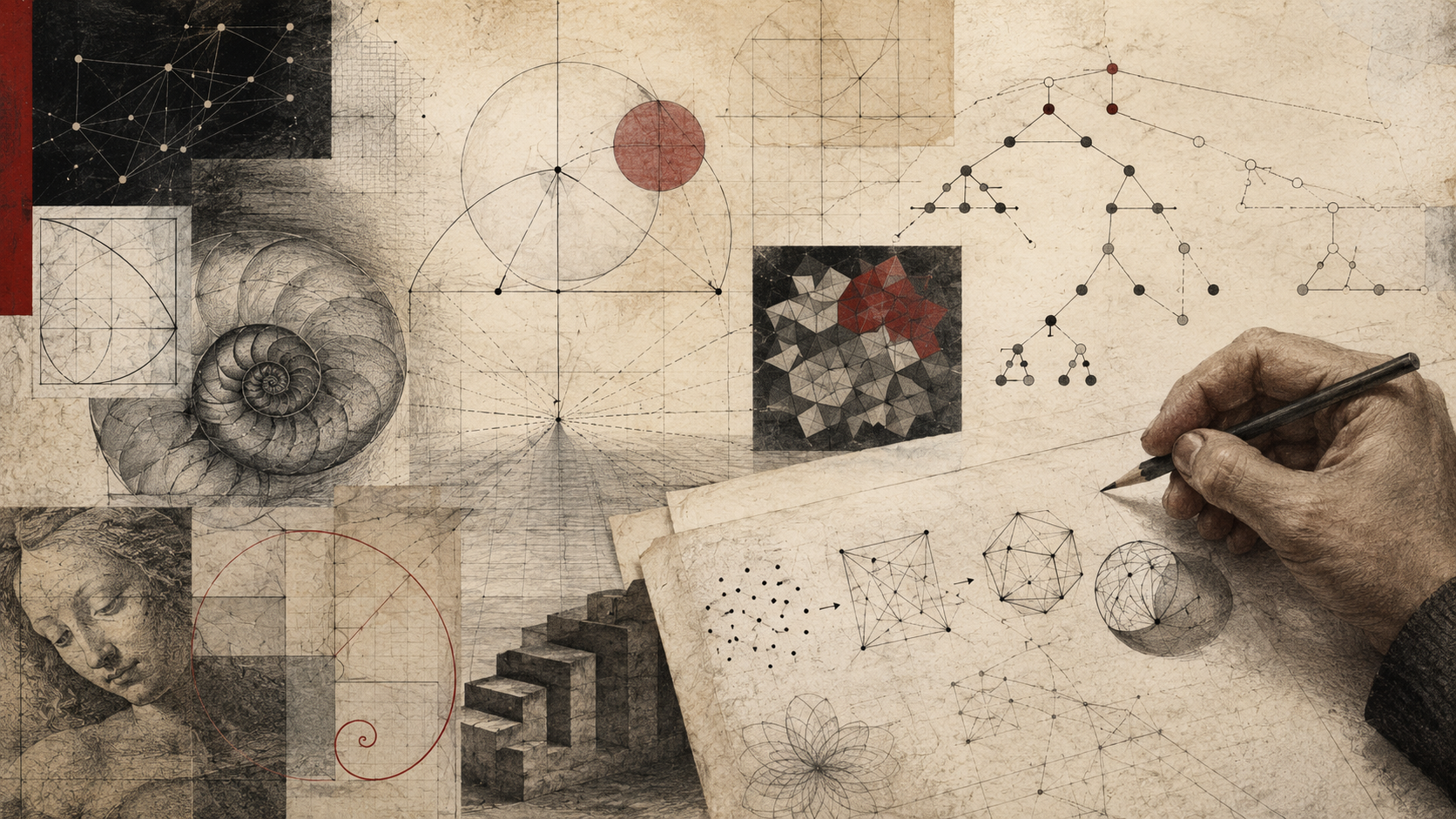
This article introduces mathematical thinking as a mode of reasoning built around four closely related practices: pattern, proof, architecture, and reason. Pattern gives mathematics its first foothold in repetition, symmetry, sequence, invariance, and analogy. Proof gives mathematics its distinctive standard of justification. Architecture organizes definitions, theorems, examples, models, and methods into coherent systems. Reason connects these practices to human judgment, formal logic, computation, science, ethics, and the limits of quantification.
Mathematical thinking therefore belongs not only to mathematicians, but also to scientists, engineers, computer scientists, economists, philosophers, designers, policy analysts, and anyone who must reason carefully about structure under constraint. Yet its deepest power comes from the standards it imposes: claims must be specified, assumptions must be exposed, consequences must be traced, and conclusions must be justified in a way that survives scrutiny.
Defining Mathematical Thinking
Mathematical thinking is the disciplined use of structure to understand relationships. It begins when a person asks not only what happened? but what form does this situation have? What varies? What remains invariant? What assumptions are being made? What follows if those assumptions are changed? What is the simplest object that preserves the essential relationships? What would count as evidence, proof, or refutation?
This distinguishes mathematical thinking from ordinary calculation. Calculation answers a local question: what is the result of this operation? Mathematical thinking asks a deeper question: what kind of situation is this, what structures govern it, and how can we know? A calculation may show that \(7 + 5 = 12\). Mathematical thinking asks what addition means, why addition is associative, how arithmetic can be axiomatized, how number systems extend from natural numbers to integers, rationals, reals, complex numbers, and beyond, and what kinds of structures preserve addition-like operations.
Mathematical thinking also differs from mere symbolic manipulation. Symbols are powerful because they compress relationships, but they can also obscure meaning when treated mechanically. A person may manipulate algebraic expressions without understanding the structure of the problem. Conversely, a strong mathematical thinker may understand the structure before formal notation is introduced. The best mathematical work moves between intuition and formalism: it feels the shape of a problem, tests it through examples, states it precisely, and then subjects it to proof.
| Mode | Primary Question | Typical Activity | Mathematical Risk |
|---|---|---|---|
| Calculation | What is the result? | Compute, simplify, evaluate | Correct answers without structural understanding |
| Pattern recognition | What repeats or remains invariant? | Observe examples, detect regularity, conjecture | Overgeneralizing from too few cases |
| Abstraction | What is essential? | Define, generalize, remove irrelevant detail | Abstraction detached from meaningful cases |
| Proof | Why must this be true? | Deduce, construct, contradict, formalize | Arguments that persuade but do not establish |
| Modeling | What structure approximates the world? | Represent, estimate, simulate, validate | Confusing model assumptions with reality |
Mathematical thinking, then, is both creative and critical. It invents concepts, searches for hidden order, and builds new symbolic worlds. But it also disciplines imagination through proof, counterexample, definition, and logical consequence. This is why mathematics can feel at once playful and severe: it permits extraordinary freedom, but only within the constraints of reason.
Pattern: The First Form of Mathematical Insight
Pattern is often the beginning of mathematical thought. A child notices that counting objects produces the same result regardless of their arrangement. A geometer notices that triangles with the same angle structure share proportional relationships. A number theorist notices regularities in primes, residues, divisibility, or modular cycles. A topologist notices that stretching and bending preserve some properties while destroying others. Pattern is the moment when repetition becomes intelligible.
Yet mathematical pattern is not just visual repetition. It may be algebraic, spatial, logical, combinatorial, probabilistic, categorical, dynamical, or relational. A pattern may appear as a sequence, a symmetry, an invariant, a transformation rule, a recurrence, a conservation law, a graph structure, or an equivalence class. Mathematical maturity involves learning to ask what kind of pattern one is seeing and what kind of explanation it requires.
1,\;1,\;2,\;3,\;5,\;8,\;13,\ldots
\]
Interpretation: A simple sequence can invite observation, conjecture, recursive definition, proof, representation, computation, and generalization.
A simple sequence such as the Fibonacci sequence can be recognized by pattern, defined recursively, represented through matrices, connected to combinatorics, approximated through closed forms, interpreted geometrically, generalized to other recurrence relations, and analyzed asymptotically. The same object can therefore support multiple levels of mathematical thinking: observation, definition, proof, representation, generalization, computation, and application.
The crucial step is not merely seeing a pattern, but asking whether the pattern is necessary, accidental, partial, or misleading. Many false conjectures begin with plausible patterns. A statement may hold for the first hundred cases and fail later. A diagram may suggest a theorem that collapses under degeneracy. A numerical experiment may point toward truth without establishing it. Mathematical thinking turns pattern into conjecture, then tests conjecture through proof, counterexample, or refinement.
| Pattern Type | Example | Mathematical Question |
|---|---|---|
| Sequential | Recurrence relations, integer sequences | What rule generates the terms? |
| Symmetric | Rotations, reflections, group actions | What transformations preserve the object? |
| Invariant | Euler characteristic, conserved quantities | What remains unchanged under transformation? |
| Relational | Graphs, networks, partial orders | How are objects connected? |
| Asymptotic | Growth rates, limits, convergence | What happens in the long run? |
Pattern therefore provides mathematical thinking with its generative spark, but not its final authority. A pattern invites the question. Proof determines whether the answer holds.
Abstraction and Generalization
Abstraction is the act of removing irrelevant detail while preserving essential structure. It allows mathematics to move from particular cases to general forms. Instead of studying one triangle, one studies triangles. Instead of studying one operation, one studies groups, rings, fields, modules, lattices, categories, or other algebraic structures. Instead of studying one process, one studies recurrence, iteration, convergence, stability, or transformation.
Generalization asks what broader class of objects shares the same underlying structure. A theorem about integers may generalize to rings. A geometric observation may generalize to metric spaces, manifolds, or topological spaces. A finite combinatorial result may suggest an infinite analogue. A proof in one setting may reveal a reusable argument pattern that works elsewhere. Mathematical progress often occurs when a problem is lifted into the right level of abstraction.
a_{n+1}=f(a_n)
\]
Interpretation: This recursive abstraction can describe repeated construction, iterative algorithms, approximation methods, dynamical systems, and mathematical models.
This simple recursive form can describe arithmetic growth, geometric growth, logistic dynamics, iterative algorithms, fixed-point methods, population models, approximation procedures, and discrete dynamical systems. The abstraction does not erase difference; it creates a common language for comparing different phenomena. Once the form is recognized, questions become portable: Does the sequence converge? Does it oscillate? Does it diverge? Does it approach a fixed point? How sensitive is it to initial conditions?
Abstraction can also fail. If it removes too much, the model becomes empty. If it preserves the wrong features, it misleads. If it treats a convenient formalization as the whole reality, it becomes reductive. Mathematical thinking therefore requires judgment about the appropriate level of abstraction. The best abstraction is not always the most general one. It is the one that reveals the structure relevant to the question.
This is why examples remain central even in highly abstract mathematics. Examples discipline abstraction. They show whether definitions are natural, whether theorems are meaningful, whether hypotheses are necessary, and whether a proposed generalization has substance. In advanced mathematics, a well-chosen example can be as illuminating as a long proof.
Proof as the Standard of Mathematical Knowledge
Proof is the defining standard of mathematical knowledge. It is the difference between “this seems true,” “this has always worked in examples,” and “this must be true under the stated assumptions.” A proof does not merely persuade psychologically; it establishes a claim by showing how it follows from definitions, axioms, previously established results, or accepted rules of inference.
Proofs can take many forms. Direct proof proceeds from assumptions to conclusion. Proof by contradiction assumes the negation of the desired result and derives an impossibility. Induction proves a base case and a rule that carries truth from one case to the next. Construction demonstrates existence by building an object. Exhaustion divides possibilities into cases. Invariance shows that a property remains unchanged under transformation. Probabilistic proof may establish existence without explicitly constructing an example. Category-theoretic proof may show that a result follows from universal properties rather than element-level manipulation.
| Proof Pattern | Core Strategy | Typical Use |
|---|---|---|
| Direct proof | Derive the conclusion from assumptions | Algebraic identities, inequalities, elementary theorems |
| Contradiction | Assume the opposite and derive impossibility | Irrationality, nonexistence, uniqueness |
| Induction | Prove base case and inductive step | Statements over natural numbers, recursively defined structures |
| Construction | Build an object satisfying the claim | Existence proofs, algorithms, examples |
| Counterexample | Show one case where a universal claim fails | Refuting conjectures, testing hypotheses |
| Invariant argument | Identify what cannot change | Combinatorics, geometry, games, dynamical systems |
A proof also has an architecture. It depends on definitions, lemmas, intermediate claims, transformations, and dependencies. In informal exposition, this architecture may be hidden inside prose. In formal proof systems, it becomes explicit: every dependency must be declared, every inference must type-check, and every gap must be closed. But even in ordinary mathematical writing, strong proof requires architectural awareness. One must know which result depends on which assumption, which lemma carries the burden, and where the argument would fail if a hypothesis were weakened.
Mathematical thinking includes the ability to read proofs critically. A reader asks: Are the definitions precise? Are the hypotheses used? Does the argument prove exactly the stated conclusion? Are there hidden assumptions? Does the proof cover boundary cases? Could the result be strengthened? Is there a simpler proof? Does the proof explain why the theorem is true, or merely verify that it is?
The explanatory dimension matters. Some proofs are correct but unenlightening. Others reveal the mechanism behind the theorem. A beautiful proof often does more than establish a result; it reorganizes understanding.
Mathematical Architecture: Definitions, Theorems, and Systems
Mathematics is not a loose collection of isolated results. It is an architecture of definitions, examples, lemmas, propositions, theorems, corollaries, methods, models, and open problems. Mathematical thinking includes the ability to see how these parts fit together.
Definitions are load-bearing structures. A good definition does not merely name an object; it selects the properties that make a theory possible. The definition of a group captures closure, associativity, identity, and inverse. The definition of continuity captures a disciplined relationship between input variation and output variation. The definition of compactness captures a deep finiteness-like property that behaves powerfully across topology and analysis. Definitions are not arbitrary labels. They are instruments for thought.
Theorems are structural consequences. They show what follows once the definitions and assumptions are in place. Lemmas often isolate smaller mechanisms. Corollaries reveal immediate consequences. Examples show the theory in motion. Counterexamples show its boundaries. Open problems mark the frontier where the architecture is incomplete.
| Architectural Element | Function in Mathematical Thinking | Failure Mode |
|---|---|---|
| Definition | Specifies the object or structure under study | Too broad, too narrow, unnatural, or ambiguous |
| Example | Shows how the definition behaves | Overreliance on familiar or special cases |
| Lemma | Builds reusable proof machinery | Fragmentation without conceptual purpose |
| Theorem | Establishes a major structural consequence | Result stated without explanatory context |
| Counterexample | Tests boundaries and refines claims | Ignored because it disrupts intuition |
| Open problem | Identifies unresolved structure | Confusing difficulty with importance |
This architectural view is especially important in modern mathematics because theories are often too large to grasp linearly. A field such as algebraic geometry, functional analysis, mathematical logic, topology, number theory, category theory, or combinatorics contains dense webs of dependency. Understanding requires more than knowing individual results. It requires knowing which concepts organize the field, which theorems act as bridges, which examples are canonical, and which proof techniques travel across domains.
In this sense, mathematical thinking is also a form of knowledge architecture. It asks how ideas should be arranged so that reasoning becomes possible.
Examples, Counterexamples, and Edge Cases
Examples are not decorative. They are central to mathematical reasoning. A strong example clarifies a definition, reveals the meaning of a theorem, exposes the necessity of a hypothesis, or suggests a new direction. Advanced mathematical thinking often depends on having a rich internal library of examples.
Counterexamples are equally important. A single counterexample can refute a universal claim. More deeply, a counterexample can teach why a proposed theorem almost works but fails under a specific missing condition. Many major mathematical refinements arise from counterexamples that force sharper definitions and more careful hypotheses.
Edge cases are the pressure points of mathematical thinking. What happens when a set is empty? When a denominator is zero? When a graph is disconnected? When a function is continuous but nowhere differentiable? When a sequence is bounded but not convergent? When a space is compact but not sequentially compact under a different setting? When a model assumes linearity but the phenomenon is nonlinear? Edge cases reveal whether the reasoning is robust.
| Reasoning Tool | What It Tests | Example Question |
|---|---|---|
| Canonical example | Basic meaning of a concept | What is the simplest object satisfying the definition? |
| Non-example | Boundary of a definition | What almost satisfies the definition but fails? |
| Counterexample | False universal claim | Where does this conjecture break? |
| Extreme case | Behavior under limits or degeneracy | What happens at zero, infinity, emptiness, or equality? |
| Pathological example | Hidden assumptions in intuition | Can the concept behave in an unexpected but valid way? |
The habit of searching for examples and counterexamples prevents mathematical thinking from becoming purely verbal. It forces definitions to meet objects, conjectures to meet cases, and intuition to meet resistance. This is one reason mathematics is both abstract and empirical in practice: not empirical in the sense that proof depends on experiment, but empirical in the sense that mathematicians explore examples, compute cases, draw diagrams, test conjectures, and learn from failure before proof arrives.
Representation: Symbols, Diagrams, Models, and Language
Mathematical thinking depends heavily on representation. The same structure can be represented symbolically, visually, verbally, computationally, geometrically, algebraically, or categorically. Each representation reveals some features and hides others.
A graph can represent relationships that would be difficult to see in a table. An equation can compress a general relationship that would be tedious to describe in words. A diagram can make an invariant visible. A proof tree can show logical dependency. A commutative diagram can express structural compatibility. A simulation can reveal dynamic behavior. A database schema can expose conceptual relationships among theorem, proof step, example, and dependency.
Representation is therefore not a secondary matter of communication. It is part of mathematical discovery itself. Choosing the right representation can turn a difficult problem into a tractable one. Choosing the wrong representation can obscure the structure that matters.
| Representation | Strength | Limitation |
|---|---|---|
| Symbolic notation | Precision, compression, manipulation | Can detach from intuition |
| Diagram | Spatial intuition, structure, dependency | May mislead if treated as proof |
| Natural language | Explanation, motivation, interpretation | Can hide ambiguity |
| Computational model | Experimentation, scale, search | May suggest truth without proof |
| Formal proof language | Machine-checkable rigor | Can obscure conceptual elegance if poorly written |
Strong mathematical thinkers move fluently between representations. They can translate a word problem into an equation, an equation into a graph, a graph into a matrix, a matrix into a transformation, a transformation into an invariant, and an invariant into a proof. This translational capacity is one of the deepest forms of mathematical understanding.
Computation, Formalization, and Proof Assistance
Computation has changed the practice of mathematical thinking without replacing its core standards. Numerical experiments, symbolic algebra systems, proof assistants, databases of mathematical objects, graph algorithms, and search tools now allow mathematicians to explore enormous spaces of examples, test conjectures, formalize arguments, and analyze dependencies at scales that would be impossible by hand.
Computational exploration can reveal patterns, but it does not by itself prove universal claims. A program may check many cases, generate examples, identify likely invariants, or suggest a conjecture. But the mathematical status of the result depends on the nature of the claim. Some results may be established by exhaustive finite verification if the finite search space and the verification process are themselves justified. Others require proof beyond computation.
Formal proof assistants sharpen this distinction. Systems such as Lean, Rocq/Coq, Isabelle, and related environments allow mathematical statements and proofs to be expressed in formal languages and checked by a kernel or trusted proof-checking mechanism. This does not make informal mathematical understanding obsolete. Instead, it creates a new relationship between informal insight, formal specification, library architecture, and machine-checked verification.
In the age of AI-assisted reasoning, this distinction becomes even more important. Language models may suggest proof sketches, find analogies, translate informal statements, or search for relevant lemmas. But mathematical reliability still depends on verification, proof structure, and the careful management of definitions and assumptions. The future of mathematical thinking is not likely to be a simple replacement of human reasoning by machines. It is more likely to be a hybrid discipline in which human judgment, formal systems, computational search, and proof architectures interact.
A Mathematical Lens: Sequence, Recursion, and Proof Graphs
One useful way to see mathematical thinking in action is to connect three ideas: sequence, recursion, and proof graphs. A sequence gives a visible pattern. Recursion defines how one stage depends on previous stages. A proof graph shows how claims depend on definitions, lemmas, and prior results.
Consider a sequence defined by a recurrence relation:
a_0 = 0,\quad a_1 = 1,\quad a_n = a_{n-1}+a_{n-2}\quad \text{for } n\geq 2.
\]
Interpretation: A recurrence relation defines each new term through earlier terms, making dependency explicit.
This is not merely a formula for generating terms. It is a compact representation of dependency. Each term is built from previous terms. The structure invites multiple mathematical questions: Can we prove properties of all terms by induction? Can we derive a closed form? Can we represent the recurrence using matrices? Can we study growth rates? Can we generalize the recurrence? Can we identify invariants or modular cycles?
The same dependency logic appears in proof. A theorem may depend on Lemma A and Lemma B. Lemma A may depend on a definition and a prior proposition. Lemma B may depend on a construction. A proof can therefore be represented as a directed graph: nodes are claims, definitions, examples, or transformations; edges are dependencies. This representation is especially useful for proof assistants, mathematical databases, educational systems, and large collaborative formalization projects.
G=(V,E),\qquad E\subseteq V\times V
\]
Interpretation: A graph represents objects as vertices and relationships or dependencies as edges.
In this lens, mathematical thinking becomes a discipline of dependency-aware reasoning. It asks not only whether a claim is true, but what it depends on, how it can be reached, what assumptions are essential, and how the proof architecture could be reused elsewhere.
| Object | Mathematical Role | Computational Representation |
|---|---|---|
| Sequence | Visible pattern across ordered terms | Array, table, generator, time series |
| Recurrence | Rule of dependency across terms | Recursive function, loop, matrix update |
| Conjecture | Proposed general claim | Predicate over generated objects |
| Proof step | Justified transition in reasoning | Graph edge, proof node, formal tactic |
| Theorem | Established result under assumptions | Verified node with dependencies |
This is the conceptual basis for the companion repository attached to this article. The repository is designed not as a toy coding exercise, but as a professional mathematical exploration scaffold: a small, extensible environment for sequence analysis, recursive structures, proof-pattern representation, theorem metadata, graph reasoning, and computational documentation.
Computational Companion Examples
The companion code folder is designed to support mathematical exploration across multiple languages. Each language emphasizes a different aspect of mathematical thinking: Python for graph reasoning and proof-pattern experimentation; R for sequence analysis and generalization workflows; Julia for high-performance recurrence exploration; SQL for theorem and proof-step metadata; Haskell for strongly typed representations of proof modes, evidence status, and mathematical concepts; Rust and Go for command-line and graph utilities; C, C++, and Fortran for lower-level numerical and discrete-structure examples.
Python: Recurrence and Proof-Graph Reasoning
Python is well suited for exploratory mathematical workflows because it combines readable syntax with strong libraries for data, graph analysis, symbolic manipulation, and visualization. A companion example can generate a sequence, test a conjectural property, and represent proof dependencies as a graph.
from dataclasses import dataclass

def fibonacci(n: int) -> list[int]:
    if n <= 0:
        return []
    if n == 1:
        return [0]
    seq = [0, 1]
    for _ in range(2, n):
        seq.append(seq[-1] + seq[-2])
    return seq

def is_even_fibonacci_pattern(seq: list[int]) -> list[tuple[int, int, bool]]:
    return [(i, value, value % 2 == 0) for i, value in enumerate(seq)]

@dataclass(frozen=True)
class ProofNode:
    key: str
    kind: str
    statement: str

@dataclass(frozen=True)
class ProofEdge:
    source: str
    target: str
    relation: str

nodes = [
    ProofNode("def_fib", "definition", "Fibonacci numbers are defined recursively."),
    ProofNode("lemma_mod", "lemma", "The parity pattern repeats modulo 2."),
    ProofNode("thm_even", "theorem", "F_n is even exactly when n is divisible by 3.")
]

edges = [
    ProofEdge("def_fib", "lemma_mod", "supports"),
    ProofEdge("lemma_mod", "thm_even", "supports")
]

if __name__ == "__main__":
    seq = fibonacci(15)
    print(seq)
    print(is_even_fibonacci_pattern(seq))
    print(nodes)
    print(edges)
R: Sequence Pattern Analysis
R is useful for exploratory analysis, tabular reasoning, and generalization workflows. A mathematical sequence can be represented as data, enriched with derived columns, and examined for periodicity, growth, residue classes, or conjectural structure.
fibonacci <- function(n) {
  if (n <= 0) return(integer(0))
  if (n == 1) return(c(0))
  x <- numeric(n)
  x[1] <- 0
  x[2] <- 1
  for (i in 3:n) {
    x[i] <- x[i - 1] + x[i - 2]
  }
  x
}

n <- 24
seq <- fibonacci(n)

sequence_table <- data.frame(
  index = 0:(n - 1),
  value = seq,
  parity = seq %% 2,
  mod_3 = seq %% 3,
  mod_5 = seq %% 5
)

print(sequence_table)

aggregate(value ~ parity, data = sequence_table, FUN = length)
Julia: High-Performance Recurrence Exploration
Julia is well suited for mathematical computing where readable notation, performance, and numerical experimentation matter. A recurrence exploration workflow can scale from small examples to larger experiments while retaining mathematical clarity.
function recurrence_sequence(n::Int, a0::Int, a1::Int)
    n <= 0 && return(Int[])
    n == 1 && return([a0])

    values = Vector{Int}(undef, n)
    values[1] = a0
    values[2] = a1

    for i in 3:n
        values[i] = values[i - 1] + values[i - 2]
    end

    return values
end

function residue_pattern(values::Vector{Int}, modulus::Int)
    return [v % modulus for v in values]
end

values = recurrence_sequence(30, 0, 1)
println(values)
println(residue_pattern(values, 7))
SQL: Theorem, Proof-Step, Concept, and Example Metadata
SQL is useful for representing mathematical knowledge architecture. Theorems, concepts, examples, proof steps, and dependencies can be modeled relationally. This supports search, teaching, formalization planning, and proof-library organization.
CREATE TABLE concept (
  concept_id INTEGER PRIMARY KEY,
  name TEXT NOT NULL,
  domain TEXT NOT NULL,
  definition TEXT NOT NULL
);

CREATE TABLE theorem (
  theorem_id INTEGER PRIMARY KEY,
  title TEXT NOT NULL,
  statement TEXT NOT NULL,
  domain TEXT NOT NULL,
  status TEXT NOT NULL
);

CREATE TABLE proof_step (
  proof_step_id INTEGER PRIMARY KEY,
  theorem_id INTEGER NOT NULL,
  step_order INTEGER NOT NULL,
  claim TEXT NOT NULL,
  justification TEXT NOT NULL,
  FOREIGN KEY (theorem_id) REFERENCES theorem(theorem_id)
);

CREATE TABLE theorem_dependency (
  theorem_id INTEGER NOT NULL,
  depends_on_theorem_id INTEGER NOT NULL,
  relation_type TEXT NOT NULL,
  PRIMARY KEY (theorem_id, depends_on_theorem_id),
  FOREIGN KEY (theorem_id) REFERENCES theorem(theorem_id),
  FOREIGN KEY (depends_on_theorem_id) REFERENCES theorem(theorem_id)
);

CREATE TABLE example (
  example_id INTEGER PRIMARY KEY,
  concept_id INTEGER NOT NULL,
  label TEXT NOT NULL,
  description TEXT NOT NULL,
  is_counterexample INTEGER NOT NULL DEFAULT 0,
  FOREIGN KEY (concept_id) REFERENCES concept(concept_id)
);
Haskell: Typed Mathematical Reasoning and Proof-Aware Concepts
Haskell is especially useful for mathematical thinking because it makes types explicit. A typed language can represent the distinction between a pattern, a conjecture, a proof, a theorem, a counterexample, a model, and a quantified metric. This does not make Haskell a proof assistant in the same sense as Lean, Rocq/Coq, or Isabelle, but it does make conceptual structure harder to hide. Types force the programmer to say what kind of mathematical object is being represented and how it may be used.
In a Mathematical Thinking context, Haskell can model proof status, evidence status, mathematical domains, reasoning modes, and dependency relations. This gives the article a stronger computational treatment because Haskell aligns naturally with formal structure, algebraic data types, functional composition, recursion, and symbolic representation.
{-# OPTIONS_GHC -Wall #-}

module Main where

data MathematicalMode
  = Calculation
  | PatternRecognition
  | Abstraction
  | Proof
  | Modeling
  | QuantificationEthics
  deriving (Eq, Show)

data EvidenceStatus
  = ObservedPattern
  | Conjectured
  | Proved
  | Computed
  | Simulated
  | RefutedByCounterexample
  | RequiresReview
  deriving (Eq, Show)

data MathematicalDomain
  = NumberTheory
  | Algebra
  | Geometry
  | DiscreteMathematics
  | GraphTheory
  | FormalLogic
  | ScientificModeling
  | ResponsibleQuantification
  deriving (Eq, Show)

data ReasoningRecord = ReasoningRecord
  { conceptName :: String
  , domain :: MathematicalDomain
  , mode :: MathematicalMode
  , evidenceStatus :: EvidenceStatus
  , reviewQuestion :: String
  } deriving (Eq, Show)

records :: [ReasoningRecord]
records =
  [ ReasoningRecord
      "Fibonacci parity pattern"
      NumberTheory
      PatternRecognition
      Conjectured
      "Has the observed pattern been proved for all natural numbers?"
  , ReasoningRecord
      "Triangular number formula"
      DiscreteMathematics
      Proof
      Proved
      "Which proof method best explains the formula: induction, geometry, or summation?"
  , ReasoningRecord
      "Proof dependency graph"
      FormalLogic
      Abstraction
      Computed
      "Do the edges represent real logical dependency or only organizational sequence?"
  , ReasoningRecord
      "Scientific model output"
      ScientificModeling
      Modeling
      RequiresReview
      "What assumptions, parameters, and validation limits shape the model?"
  , ReasoningRecord
      "AI benchmark score"
      ResponsibleQuantification
      QuantificationEthics
      RequiresReview
      "Does the benchmark measure real capability, or only performance on a narrow test set?"
  ]

main :: IO ()
main = mapM_ print records
This Haskell scaffold gives mathematical thinking a typed vocabulary. It prevents all computational outputs from being treated as the same kind of evidence. A pattern is not a theorem. A conjecture is not a proof. A simulation is not a validation. A benchmark is not a complete account of capability. Haskell helps encode these distinctions directly into the representation.
A second Haskell example can model proof dependencies as typed edges. This is useful for theorem metadata, educational proof maps, formalization planning, and proof-aware repositories.
{-# OPTIONS_GHC -Wall #-}

module ProofGraph where

data NodeKind
  = Definition
  | Lemma
  | Theorem
  | Example
  | Counterexample
  | Assumption
  deriving (Eq, Show)

data DependencyKind
  = UsesDefinition
  | UsesLemma
  | RequiresAssumption
  | RefutedBy
  | MotivatedBy
  deriving (Eq, Show)

data ProofNode = ProofNode
  { nodeId :: String
  , nodeKind :: NodeKind
  , statement :: String
  } deriving (Eq, Show)

data ProofEdge = ProofEdge
  { sourceNode :: String
  , targetNode :: String
  , dependencyKind :: DependencyKind
  } deriving (Eq, Show)

nodes :: [ProofNode]
nodes =
  [ ProofNode "def_induction" Definition "Mathematical induction proves a base case and an inductive step."
  , ProofNode "lemma_recursive_sum" Lemma "A recursive sum can be unfolded term by term."
  , ProofNode "thm_triangular" Theorem "The sum of the first n positive integers is n(n+1)/2."
  ]

edges :: [ProofEdge]
edges =
  [ ProofEdge "def_induction" "thm_triangular" UsesDefinition
  , ProofEdge "lemma_recursive_sum" "thm_triangular" UsesLemma
  ]

printGraph :: IO ()
printGraph = do
  putStrLn "Proof nodes:"
  mapM_ print nodes
  putStrLn "Proof dependencies:"
  mapM_ print edges
This typed treatment strengthens the article’s computational layer because it shows how mathematical reasoning can be represented as structured data without flattening the difference between definitions, lemmas, theorems, examples, assumptions, and counterexamples.
Rust: Command-Line Proof-Pattern Utility Scaffold
Rust is appropriate for reliable command-line utilities that parse structured data, enforce types, and support reproducible workflows. In the companion repository, Rust can provide a small proof-pattern inspection tool.
#[derive(Debug)]
struct ProofPattern {
    name: String,
    description: String,
    typical_use: String,
}

fn main() {
    let patterns = vec![
        ProofPattern {
            name: "induction".to_string(),
            description: "Prove a base case and an inductive step.".to_string(),
            typical_use: "Statements indexed by natural numbers or recursive structures.".to_string(),
        },
        ProofPattern {
            name: "contradiction".to_string(),
            description: "Assume the negation and derive impossibility.".to_string(),
            typical_use: "Nonexistence, irrationality, uniqueness, and impossibility results.".to_string(),
        },
    ];

    for pattern in patterns {
        println!("{:?}", pattern);
    }
}
Go: Graph and Pathway Analysis Scaffold
Go is useful for compact graph utilities and command-line tools. A proof dependency graph can be represented as an adjacency list and searched for paths between concepts, lemmas, and theorems.
package main

import "fmt"

type Graph map[string][]string

func main() {
    proofGraph := Graph{
        "definition:fibonacci":       {"lemma:parity-cycle"},
        "lemma:parity-cycle":         {"theorem:even-index"},
        "definition:modular-arithmetic": {"lemma:parity-cycle"},
    }

    for node, neighbors := range proofGraph {
        fmt.Printf("%s -> %v\n", node, neighbors)
    }
}
C++: Sequence and Growth Representation
C++ is useful for efficient mathematical routines and explicit data structures. A simple sequence generator can support recurrence experiments, performance comparisons, and low-level representation of mathematical objects.
#include <iostream>
#include <vector>

std::vector<long long> fibonacci(int n) {
    std::vector<long long> values;
    if (n <= 0) return values;

    values.push_back(0);
    if (n == 1) return values;

    values.push_back(1);

    for (int i = 2; i < n; ++i) {
        values.push_back(values[i - 1] + values[i - 2]);
    }

    return values;
}

int main() {
    auto values = fibonacci(20);

    for (int i = 0; i < static_cast<int>(values.size()); ++i) {
        std::cout << i << " " << values[i] << "\n";
    }

    return 0;
}
Fortran: Numerical Recurrence Scaffold
Fortran remains important in scientific and numerical computing. A recurrence example can show how mathematical definitions become efficient numerical procedures in older and still-relevant computational environments.
program fibonacci_sequence
  implicit none

  integer, parameter :: n = 20
  integer :: i
  integer(kind=8) :: a, b, next_value

  a = 0
  b = 1

  do i = 0, n - 1
     print *, i, a
     next_value = a + b
     a = b
     b = next_value
  end do

end program fibonacci_sequence
C: Low-Level Recurrence Example
C provides a compact view of recurrence and iteration at a low level. It is useful for showing how a mathematical recurrence becomes a memory-conscious loop.
#include <stdio.h>

void fibonacci(int n) {
    long long a = 0;
    long long b = 1;

    for (int i = 0; i < n; i++) {
        printf("%d %lld\n", i, a);
        long long next = a + b;
        a = b;
        b = next;
    }
}

int main(void) {
    fibonacci(20);
    return 0;
}
These examples are intentionally small in the article itself. The companion folder should extend them into professional workflows: richer datasets, reproducible notebooks, theorem metadata, graph export formats, proof-pattern documentation, validation checks, and language-specific implementations that can be compared across performance, clarity, type discipline, and mathematical expressiveness.
GitHub Repository
The companion repository for this article is designed as a reproducible mathematical-thinking workspace. It contains article-specific code, data, documentation, and generated outputs for sequence analysis, recurrence exploration, proof-pattern representation, theorem metadata, Haskell typed reasoning records, and graph-based dependency workflows.
Complete Code Repository
Companion article folder with Python, R, Julia, SQL, Haskell, Rust, Go, C++, Fortran, and C examples for professional mathematical exploration, proof architecture, recurrence analysis, sequence reasoning, theorem metadata, typed mathematical reasoning records, and graph-based dependency workflows.
Mathematical Thinking and the Ethics of Quantification
Mathematical thinking is powerful because it clarifies structure, exposes assumptions, and disciplines claims. But that power can be misused when mathematical form is mistaken for moral authority. A model may be precise and still unjust. A metric may be consistent and still distort the phenomenon it measures. An optimization problem may be mathematically well-posed while ignoring the people, communities, ecosystems, or historical conditions affected by its use.
The ethics of quantification begins with a simple recognition: measurement is not neutral merely because it uses numbers. Every model selects variables, boundaries, weights, proxies, assumptions, and objective functions. These choices determine what becomes visible and what disappears. Mathematical thinking should make those choices explicit rather than hiding them behind technical form.
This matters in public policy, economics, artificial intelligence, environmental modeling, education, finance, healthcare, risk assessment, and institutional governance. In each case, mathematical systems can improve reasoning, but they can also create false certainty. A score can become a substitute for judgment. A model can become a shield against accountability. A ranking can turn complex human realities into simplified administrative categories.
| Mathematical Practice | Ethical Question | Responsible Habit |
|---|---|---|
| Modeling | What has been included or excluded? | State assumptions and boundaries clearly |
| Measurement | Does the metric represent what it claims? | Validate proxies against lived and empirical realities |
| Optimization | Who benefits from the objective function? | Test tradeoffs, constraints, and distributional effects |
| Risk scoring | Whose risk is being quantified? | Audit errors, bias, uncertainty, and appeals |
| Ranking | What context is flattened? | Use rankings cautiously and show component measures |
| AI benchmarking | Does the test reflect real use? | Report limits, failure modes, and deployment uncertainty |
Responsible mathematical thinking therefore includes ethical interpretation. It asks whether a model is valid for its purpose, whether a metric is being overextended, whether uncertainty is visible, whether harms are distributed unequally, and whether people affected by quantified systems can understand and contest them.
Why Mathematical Thinking Matters
Mathematical thinking matters because modern life depends on formal structures that most people never see. Algorithms rank information. Models estimate risk. Simulations guide policy. Metrics define success. Optimization systems allocate resources. Statistical methods shape evidence. AI systems generate outputs that appear authoritative. Behind each of these systems are mathematical assumptions, representations, abstractions, and constraints.
A society that lacks mathematical thinking is vulnerable to two opposite errors. It may distrust all quantitative reasoning because numbers have been misused. Or it may overtrust numbers because they appear objective. Mathematical thinking offers a better path: use formal reasoning carefully, inspect assumptions, demand proof where proof is needed, distinguish evidence from certainty, and interpret models in context.
Mathematical thinking also matters for education. Students should not learn mathematics as a set of disconnected procedures. They should learn it as a way of asking disciplined questions: What is the structure? What changes? What remains invariant? What follows? What would refute the claim? What can be generalized? What has been proved? What remains uncertain?
Finally, mathematical thinking matters because it cultivates a rare intellectual habit: the ability to move from imagination to necessity. It begins with curiosity, pattern, analogy, and conjecture. It ends, when successful, in proof, structure, and understanding. That movement is one of humanity’s most powerful forms of disciplined reason.
Mathematical thinking is therefore not a narrow academic skill. It is one of the great forms of disciplined human imagination. It allows us to move from examples to structures, from patterns to proofs, from symbols to systems, and from uncertainty to justified understanding.
Related Articles
- Patterns, Structure, and the Mathematical Imagination
- Abstraction and the Power of Generalization
- Proof and the Logic of Mathematical Justification
- Logic and the Structure of Formal Inference
- Symbols, Language, and Mathematical Representation
- Conjecture, Creativity, and Mathematical Discovery
- Mathematical Thinking for Computer Science
- Mathematical Thinking and Proof Assistants
- Mathematical Thinking and AI-Assisted Discovery
- Mathematical Thinking and Scientific Modeling
- Mathematical Thinking and the Ethics of Quantification
Further Reading
- Avigad, J., de Moura, L., Kong, S. and Ullrich, S. (2026) Theorem Proving in Lean 4. Available at: https://leanprover.github.io/theorem_proving_in_lean4/
- Devlin, K. (2012) Introduction to Mathematical Thinking. Stanford University / Coursera course materials and related publications. Available at: https://web.stanford.edu/~kdevlin/
- Lakatos, I. (1976) Proofs and Refutations: The Logic of Mathematical Discovery. Cambridge: Cambridge University Press. Available at: https://www.cambridge.org/core/books/proofs-and-refutations/3B5BDF18C7A5F4E7D4B30F06E4E5A0F1
- Pólya, G. (1945) How to Solve It: A New Aspect of Mathematical Method. Princeton: Princeton University Press. Available at: https://press.princeton.edu/books/paperback/9780691164076/how-to-solve-it
- Rocq Prover Development Team (2026) The Rocq Prover. Available at: https://rocq-prover.org/
- The Isabelle Team (2026) Isabelle. Available at: https://isabelle.in.tum.de/
References
- Avigad, J., de Moura, L., Kong, S. and Ullrich, S. (2026) Theorem Proving in Lean 4. Available at: https://leanprover.github.io/theorem_proving_in_lean4/
- Devlin, K. (2012) Introduction to Mathematical Thinking. Stanford University / Coursera course and related materials. Available at: https://web.stanford.edu/~kdevlin/
- Hardy, G.H. (1940) A Mathematician’s Apology. Cambridge: Cambridge University Press. Available at: https://www.cambridge.org/core/books/mathematicians-apology/6F0C29793C928E41F9A7E5C3E7A413C3
- Hilbert, D. (1902) The Foundations of Geometry. Chicago: Open Court. Available at: https://archive.org/details/foundationsgeome00hilbrich
- Lakatos, I. (1976) Proofs and Refutations: The Logic of Mathematical Discovery. Cambridge: Cambridge University Press. Available at: https://www.cambridge.org/core/books/proofs-and-refutations/3B5BDF18C7A5F4E7D4B30F06E4E5A0F1
- Mac Lane, S. (1998) Categories for the Working Mathematician. 2nd edn. New York: Springer. Available at: https://link.springer.com/book/10.1007/978-1-4757-4721-8
- Pólya, G. (1945) How to Solve It: A New Aspect of Mathematical Method. Princeton: Princeton University Press. Available at: https://press.princeton.edu/books/paperback/9780691164076/how-to-solve-it
- Rocq Prover Development Team (2026) The Rocq Prover. Available at: https://rocq-prover.org/
- Reck, E. (2019) ‘Structuralism in the Philosophy of Mathematics’, The Stanford Encyclopedia of Philosophy. Available at: https://plato.stanford.edu/entries/structuralism-mathematics/
- The Isabelle Team (2026) Isabelle. Available at: https://isabelle.in.tum.de/