
Last Updated May 28, 2026
Biodiversity monitoring depends on reliable data about how animals move across landscapes. Migration routes, habitat boundaries, seasonal behavior patterns, dispersal events, foraging areas, breeding sites, and movement corridors all shape conservation strategies. Without measurement tools, wildlife movement often remains invisible except through occasional observation, indirect signs, or fragmented field records.
An Arduino wildlife tracking device offers a practical way to explore animal-movement monitoring using low-power embedded electronics. By combining GPS telemetry, microcontroller control logic, local data logging, and efficient power management, conservation researchers, students, educators, and advanced makers can study the basic engineering architecture behind compact field tracking systems.
This project demonstrates how to build a small prototype that collects GPS coordinates at regular intervals while minimizing energy consumption. The design reflects a key principle of sustainable environmental monitoring: measurement enables protection only when it is accurate, ethical, species-appropriate, and interpreted responsibly. When wildlife movement becomes visible through data, conservation strategies can become more precise, but the act of tracking must never be separated from animal welfare, permitting, data protection, and ecological context.
Main Library
Publications
Project Series
Arduino SDG Projects
Related Topic
Environmental Monitoring
Related Topic
Biosphere Integrity
Related Topic
Land Systems
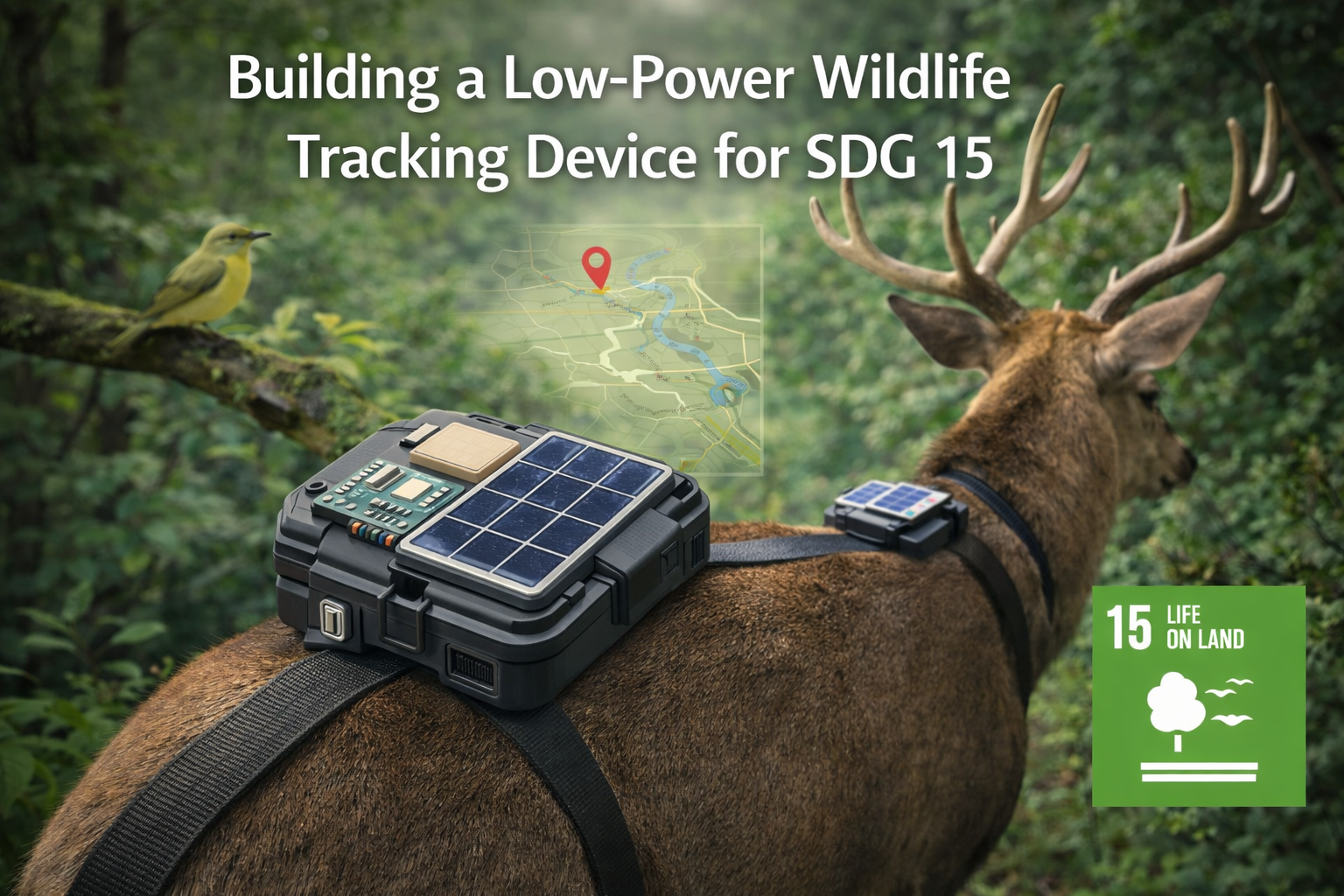
The project connects to broader site areas, including Environmental Monitoring Systems, Intelligent Infrastructure Systems, Biosphere Integrity and the Stability of Life Systems, Land-System Change and Ecological Transformation, and Sustainable Development Goals Within Planetary Boundaries. In that wider context, this device is not only a maker project. It is a small prototype of the field telemetry and biodiversity-data infrastructure needed for conservation, habitat protection, ecological-corridor analysis, and land-system stewardship.
Abstract
This project presents a prototype Arduino wildlife tracking device built around a low-power microcontroller, a GPS module, and local storage for coordinate logging. The system periodically wakes, attempts to acquire location data, records coordinates and metadata, and returns to a lower-power state in order to extend operational life.
From an engineering perspective, the platform demonstrates a compact field telemetry system with sensing, logging, timekeeping, storage, enclosure, and power-management layers. From a sustainability perspective, it illustrates how low-cost embedded systems can support biodiversity monitoring by making animal movement, habitat use, and spatial behavior visible through data.
The prototype is intentionally limited. It is not a certified wildlife telemetry collar, not a substitute for professional biologging equipment, and not a device that should be attached to animals without expert review, permits, and species-specific welfare assessment. Its value is educational and methodological: it teaches the engineering logic behind wildlife telemetry while foregrounding the ethical responsibilities that field tracking requires.
SDG Alignment: Biodiversity, Land Systems, Climate Pressure, and Field Telemetry
This project connects most directly to SDG 15: Life on Land, which emphasizes protecting terrestrial ecosystems, preserving biodiversity, restoring degraded land, and reducing the loss of species and habitats. Wildlife tracking supports that goal by helping researchers understand where animals move, which habitats they depend on, and how movement patterns change under pressure.
The project is not a complete conservation telemetry platform, and it should not be treated as one. Its contribution is narrower and still valuable: it demonstrates the measurement architecture behind movement ecology. It shows how a small embedded system can acquire location data, log coordinates, manage battery limits, and produce movement records that could later be interpreted alongside habitat maps, land-cover data, protected-area boundaries, climate variables, and field observations.
| Sustainable Development Goal | How the Project Relates | Project-Level Mechanism |
|---|---|---|
| SDG 15: Life on Land | Supports biodiversity monitoring, habitat-use analysis, ecological-corridor study, and conservation education. | GPS coordinate logging, movement-path reconstruction, habitat-context analysis, and field telemetry learning. |
| SDG 13: Climate Action | Relates to climate pressure because species movement, range shifts, and migration timing can change under warming, drought, fire, and habitat stress. | Time-stamped movement records that can later be compared with climate, weather, vegetation, and land-cover data. |
| SDG 9: Industry, Innovation and Infrastructure | Demonstrates field telemetry infrastructure for conservation, ecological research, and low-cost environmental monitoring. | Low-power electronics, GPS sensing, local storage, duty cycling, reproducible firmware, and deployable enclosure thinking. |
| SDG 4: Quality Education | Provides hands-on learning at the intersection of electronics, ecology, conservation ethics, spatial data, and field methods. | Open prototype with firmware, wiring logic, validation metrics, movement-data structure, and responsible-use boundaries. |
| SDG 11: Sustainable Cities and Communities | Connects indirectly to urban and peri-urban biodiversity corridors, roads, habitat fragmentation, green infrastructure, and land-use planning. | Movement data that can inform where wildlife intersects with roads, built environments, parks, riparian corridors, and fragmented habitat. |
The strongest SDG connection is SDG 15. Conservation cannot protect what it cannot observe. Wildlife tracking helps reveal whether animals are using protected areas, avoiding disturbed landscapes, crossing roads, moving through corridors, shifting seasonal ranges, or encountering habitat barriers. Those patterns are essential for conservation planning.
The connection to SDG 13 is also important. Climate change can alter the timing, availability, and geography of habitat. Tracking data can help researchers study whether species movements change as temperature, precipitation, snowpack, drought, vegetation, fire regimes, or food availability change. A small prototype does not prove climate impacts, but it makes the measurement logic tangible.
The connection to SDG 9 comes through infrastructure and innovation. Wildlife telemetry is environmental infrastructure. It depends on sensors, batteries, antennas, logging systems, data standards, analytics platforms, field protocols, and ethical governance. This prototype introduces the basic embedded-system architecture behind that infrastructure.
Because the Sustainable Development Goals are broad public frameworks, it is important not to overclaim. This project is not a certified animal tracking device, not a conservation study by itself, and not a substitute for ecological expertise, animal-care review, permits, Indigenous and local community engagement where relevant, or species-specific field protocols. Its value is educational, methodological, and technical: it teaches the measurement logic behind biodiversity telemetry while making the limits and responsibilities visible.
In that sense, the project works best as a bridge between sustainability language and field engineering practice. It turns a broad goal — protect biodiversity and terrestrial ecosystems — into a practical sequence: acquire a GPS fix, store time-stamped coordinates, manage battery energy, validate positional accuracy, protect data, minimize disturbance, and interpret movement patterns within ecological context.
Connections to Other Site Areas
This wildlife tracking device belongs to a wider body of work on measurement, ecological intelligence, and field monitoring. It connects most directly to Environmental Monitoring Systems, where sensors, telemetry, field data, remote sensing, and monitoring networks become tools for understanding environmental change.
It also connects to Intelligent Infrastructure Systems because biodiversity monitoring increasingly depends on infrastructure that can sense, log, transmit, and interpret environmental signals. A future version of this prototype could connect to wireless telemetry, edge filtering, conservation dashboards, or habitat-risk monitoring systems.
At the planetary-boundary level, the project relates to Biosphere Integrity and the Stability of Life Systems and Land-System Change and Ecological Transformation. Wildlife movement data can help reveal habitat fragmentation, changing migration routes, altered range boundaries, land-use pressure, and ecological disruption that are otherwise difficult to see.
The project also supports the broader development logic explored in Sustainable Development Goals Within Planetary Boundaries. Biodiversity protection, sustainable land management, and ecological resilience require more than policy commitments. They also require practical measurement systems capable of making ecological change visible.
System Architecture
The tracking device operates as a compact field telemetry system. Its architecture can be divided into five layers:
- Location-sensing layer: GPS module acquires latitude, longitude, and optional metadata such as time, altitude, speed, satellite count, or fix quality.
- Control layer: Arduino coordinates sensor reading, logging, timing, and sleep behavior.
- Storage layer: MicroSD module records location data for later retrieval.
- Power layer: battery, regulator, and optional solar charging support field operation.
- Deployment layer: enclosure, mounting method, antenna exposure, and ethical field constraints determine whether the electronics can function safely.
At a systems level, the architecture can be summarized as:
GPS Module → Arduino → Data Validation → MicroSD Logging → Sleep Cycle → RepeatThe most important architectural feature is the duty cycle. Instead of running continuously, the device periodically wakes, tries to acquire location, stores data, and returns to a low-power state. That cycle allows a small battery to support longer observation windows.
System Requirements
A wildlife tracking prototype becomes useful only when its requirements are explicit. The system must collect usable location data, conserve power, protect data integrity, and avoid being mistaken for a field-ready animal-mounted device.
| Requirement | Design Target | Reason |
|---|---|---|
| Location acquisition | Acquire valid GPS coordinates outdoors | Movement analysis depends on reliable position records |
| Time awareness | Record time or sampling sequence with each coordinate | Movement requires both position and temporal order |
| Local data logging | Store coordinates on a MicroSD card | Allows later analysis even without wireless telemetry |
| Power management | Use interval-based sampling and sleep behavior | Battery life is a primary constraint in field telemetry |
| Enclosure protection | Protect electronics from moisture, impact, dust, and movement | Field systems fail quickly if electronics are exposed |
| Ethical boundary | Use only in simulated, educational, or approved research contexts | Animal-mounted tracking requires permits, welfare review, and expert oversight |
| Data governance | Protect sensitive location data where species or habitats could be at risk | Wildlife location data can expose vulnerable animals to harm if misused |
These requirements can be reused across the Arduino sustainability project series. Each project should clarify what must be measured, what could fail, and where the prototype’s appropriate-use boundary lies.
Why an Arduino Wildlife Tracking Device Matters
Protecting biodiversity requires more than observation alone. Many of the most important ecological patterns — migration timing, habitat range, movement corridors, territorial behavior, dispersal, and seasonal shifts — unfold across large areas and over long periods of time. Without telemetry, much of that movement remains hidden.
A compact embedded tracking system demonstrates several important principles:
- ecological systems become easier to protect when movement can be measured
- low-power design is essential for real-world field monitoring
- local data logging can make telemetry concepts more accessible in low-budget educational settings
- movement data must be interpreted alongside habitat, climate, landscape, and behavioral context
- prototype systems help clarify the constraints of professional wildlife-tracking infrastructure
The value of the project is not that it replaces professional tracking collars, satellite systems, or certified conservation telemetry platforms. Its value is that it demonstrates the engineering logic behind wildlife telemetry in a form that can be built, tested, inspected, and extended.
It also teaches restraint. Attaching electronics to animals is not a casual maker activity. Even a technically working device may be inappropriate if it is too heavy, poorly shaped, unsafe, stressful, unreliable, or deployed without permission. A responsible wildlife telemetry article must keep animal welfare at the center of the engineering discussion.
System Overview
The wildlife tracking device records GPS coordinates at regular intervals and stores them for later analysis or transmission.
The system includes:
- Arduino microcontroller for device control
- GPS module for location tracking
- MicroSD module for data logging
- low-power sleep cycle for energy efficiency
- rechargeable battery with optional solar charging
- protective enclosure designed for field testing or simulated deployment
During operation, the device periodically wakes from low-power sleep mode, collects GPS data, stores the coordinates, and then returns to sleep. This duty cycle significantly extends battery life and makes the design more practical for field-oriented experiments.
The baseline article should be interpreted as a prototype for field telemetry education, not an instruction to attach devices to animals. For animal use, expert review and formal approval are essential.
Bill of Materials
- Arduino Pro Mini or Arduino Nano low-power microcontroller
- NEO-6M GPS module or equivalent GPS receiver
- MicroSD card module
- rechargeable LiPo battery
- solar charging module, optional
- voltage regulator appropriate for the selected battery and electronics
- low-power sleep circuit or low-power firmware configuration
- protective waterproof enclosure for simulated field testing
- mounting hardware for non-animal test rigs, backpacks, carts, or environmental test stations
The Arduino Pro Mini is commonly used in low-power prototypes because it can consume significantly less power than larger development boards, especially when configured for low-power duty cycling. For real field devices, board selection, regulator efficiency, GPS acquisition time, and SD-card current draw must all be evaluated together.
Important scope note: This bill of materials is for prototype telemetry learning and simulated field testing. Animal-mounted deployment requires professional biologging equipment or expert-reviewed custom hardware, welfare approval, permitting, species-specific attachment design, and a recovery plan.
Engineering Specifications
| Parameter | Reference Design |
|---|---|
| Microcontroller | Arduino Pro Mini, Arduino Nano, or equivalent low-power board |
| Location sensing | GPS module such as NEO-6M |
| Data storage | MicroSD logging over SPI |
| Power strategy | Duty-cycled operation with sleep intervals |
| Energy source | LiPo battery, optional solar recharge |
| Telemetry output | Local coordinate logging, optional future wireless transmission |
| Primary data fields | Latitude, longitude, timestamp, fix metadata, battery status where available |
| Target use case | Low-power biodiversity monitoring prototype and field-telemetry education |
| Deployment scope | Educational, simulated, non-animal, or formally approved research contexts |
The reference design is intentionally scoped to education and prototyping. Field deployment requires more rigorous engineering, safety, data, and ethical review than a classroom or bench prototype.
Measurement Principle: GPS, Location Fixes, and Movement Data
GPS tracking works by estimating a receiver’s position from satellite signals. A GPS module calculates latitude and longitude when it can receive enough satellite data with sufficient signal quality. In open outdoor environments, this can produce useful location records. Under dense canopy, near buildings, in valleys, inside enclosures, or with poor antenna orientation, the fix may be slow, inaccurate, or unavailable.
A single GPS point is not a movement pattern. Movement emerges from a sequence of time-stamped points. To interpret animal movement, the data must include position, time, sampling interval, and some understanding of uncertainty. The same set of coordinates can mean very different things depending on sampling frequency, GPS error, habitat context, behavior, and study design.
This is why metadata matters. A useful log should include not only latitude and longitude, but also timestamp, satellite count, fix age, horizontal accuracy or dilution-of-precision metrics when available, battery voltage, and the sampling interval used by the device.
The measurement principle is therefore not simply “record GPS coordinates.” It is: collect spatial data with enough temporal, technical, and ecological context to support responsible interpretation.
Mathematical Lens: From GPS Points to Movement Ecology
The wildlife tracking device produces a sequence of spatial observations. Those observations can be interpreted as movement only when position and time are analyzed together.
\Delta t = t_{i+1}-t_i
\]
Interpretation: The sampling interval is the elapsed time between consecutive GPS fixes.
Sampling interval affects what kinds of behavior can be observed. A long interval may capture broad movement patterns but miss short foraging events, resting periods, road crossings, or rapid behavioral changes.
d_i = \operatorname{dist}\left((\phi_i,\lambda_i),(\phi_{i+1},\lambda_{i+1})\right)
\]
Interpretation: Distance between consecutive GPS coordinates estimates step length between two recorded locations.
Here, \(\phi\) represents latitude and \(\lambda\) represents longitude. In practice, distance should be calculated using a geodesic or haversine method rather than a flat map approximation when coordinates cover meaningful geographic distance.
v_i=\frac{d_i}{\Delta t}
\]
Interpretation: Speed is estimated by dividing distance traveled between fixes by elapsed time.
Speed estimates are only as reliable as the position and timing data. GPS error can make stationary animals appear to move, especially when sampling intervals are short or signal quality is poor.
B \approx \frac{E_{\mathrm{battery}}}{P_{\mathrm{active}}D + P_{\mathrm{sleep}}(1-D)}
\]
Interpretation: Approximate battery life depends on battery energy, active-mode power, sleep-mode power, and duty cycle \(D\).
The duty cycle is the fraction of time the device spends awake and drawing higher current. Reducing the active fraction can extend field life, but it also reduces sampling frequency and may miss important movement behavior.
D=\frac{t_{\mathrm{active}}}{t_{\mathrm{active}}+t_{\mathrm{sleep}}}
\]
Interpretation: Duty cycle expresses how much of each sampling period the tracker spends active.
The mathematical lens shows why wildlife tracking is a design tradeoff. Higher sampling frequency can improve behavioral detail, but it consumes more energy and may increase device size. Longer battery life may require fewer fixes, but fewer fixes reduce temporal resolution. Ethical design means balancing data needs against device burden, welfare, and study purpose.
Circuit Logic, Storage, and Power Domains
The circuit has three core jobs: acquire location, store data, and conserve power. The GPS module draws significant current while acquiring a fix. The MicroSD module also draws current during writes. The Arduino coordinates these modules and should avoid keeping high-draw components active longer than necessary.
The GPS module communicates with the Arduino through serial data. The MicroSD module communicates over SPI. Both require stable power and reliable wiring. Loose connections, weak batteries, or unstable voltage regulation can corrupt logs or cause intermittent GPS behavior.
Power management is not an optional upgrade. It is central to the system. A device that logs perfectly on USB power may fail quickly on battery if the GPS and SD card remain powered continuously. For a more advanced version, module power could be controlled through transistor or MOSFET switching so that the GPS or SD subsystem is powered only when needed.
The core circuit lesson is that field telemetry is not only about reading a sensor. It is about coordinating sensing, storage, timing, energy, enclosure, and recovery under difficult outdoor conditions.
How the Wildlife Tracking Device Works
The tracking device operates using a periodic measurement cycle:
- device wakes from low-power sleep mode
- GPS module attempts to acquire satellite signal
- latitude and longitude are parsed when a valid fix is available
- coordinates and metadata are written to the MicroSD card
- system returns to sleep to conserve energy
- cycle repeats after the configured interval
This architecture allows the device to collect location data while reducing unnecessary energy use between fixes. Many professional telemetry systems rely on the same basic principle, though with far more sophisticated hardware, firmware, packaging, communication, and welfare safeguards.
For educational testing, the device should first be carried by a person, placed on a non-animal moving platform, attached to a field test rig, or used in a controlled outdoor walk. Animal attachment is a separate ethical and regulatory question, not a default deployment method.
Design Assumptions and Constraints
This prototype assumes:
- outdoor GPS visibility
- local coordinate logging rather than live telemetry
- educational, simulated, or approved research use
- limited battery capacity
- interval-based movement sampling rather than continuous tracking
- careful validation before any field deployment
- no animal attachment without expert oversight and formal approval
It also assumes that GPS coordinate logs are sufficient for the study question. For many ecological studies, they are not. Researchers may need accelerometer data, temperature, altitude, activity state, habitat layers, remote sensing data, camera observations, or field survey records to interpret movement meaningfully.
The prototype also assumes that data recovery is possible. If the system logs only to local MicroSD storage, the device must be recovered to access the data. That may be acceptable for classroom tests, but it creates serious design constraints for field wildlife work.
Wiring the Arduino Wildlife Tracking Device
- GPS VCC → Arduino 5V or regulated voltage appropriate for the selected module
- GPS GND → Arduino GND
- GPS TX → Arduino software serial RX pin
- GPS RX → Arduino software serial TX pin, if required
- MicroSD VCC → Arduino 5V or regulated voltage appropriate for the module
- MicroSD GND → Arduino GND
- MicroSD MOSI → Arduino pin 11
- MicroSD MISO → Arduino pin 12
- MicroSD SCK → Arduino pin 13
- MicroSD CS → Arduino pin 10
This configuration enables the Arduino to receive GPS coordinates and store them on a memory card for later retrieval. In practice, engineers should verify voltage compatibility and power stability across both the GPS and storage subsystems.
For battery-powered field testing, breadboard wiring is usually too fragile. Soldered connections, strain relief, connector locking, weather protection, and enclosure testing are much more appropriate for sustained outdoor use.
Field Deployment, Enclosure, and Attachment Considerations
Field telemetry devices face several physical constraints: weather, shock, vibration, mud, dust, water, temperature extremes, antenna exposure, battery aging, and possible mechanical damage. Even when the firmware works on a desk, the system may fail outdoors if the enclosure is poorly designed.
For simulated and non-animal field tests, the device should be protected by:
- a weather-resistant enclosure
- strain-relieved wiring
- secure battery mounting
- external access for charging or data retrieval where appropriate
- antenna placement that does not block GPS reception
- clear labeling of battery, storage, and recovery information
For animal-mounted deployment, additional requirements apply and should be handled only by qualified researchers under approved protocols. Device size, mass, shape, attachment method, breakaway design, waterproofing, drag, snag risk, behavioral effects, and retrieval strategy must all be evaluated for the target species and study design.
This article should therefore be used as a field-telemetry learning prototype, not as a direct guide for animal attachment.
Firmware Design Goals
The firmware in this project is designed to do more than continuously print coordinates. It attempts to support practical telemetry behavior by:
- acquiring valid GPS coordinates
- logging data in a reusable format
- supporting periodic rather than continuous measurement
- creating a foundation for low-power duty cycling
- providing simple serial output for testing and debugging
- including metadata fields that make later interpretation easier
These goals make the build more relevant for field telemetry and easier to extend later with sleep libraries, interval scheduling, wireless transmission modules, battery monitoring, or edge-based filtering.
Basic vs. Advanced Firmware
A minimal wildlife tracker could read GPS coordinates and print them to the Serial Monitor. That is useful for first testing a module, but it is not enough to teach field telemetry. A tracker must also store data reliably, track timing, manage invalid fixes, and support low-power operation.
The advanced version used here logs coordinates to MicroSD storage, checks for updated GPS data, prints debug output, and structures the code so that sleep behavior and battery monitoring can be added later. It remains simple enough for education while pointing toward the engineering problems that real field devices must solve.
The larger lesson for the project series is that code should teach the architecture of monitoring. A sustainability prototype should show not only how to read a sensor, but how to convert sensor readings into defensible environmental data.
Advanced Arduino Code
The firmware below provides a practical starting point for GPS logging using an Arduino, TinyGPS++, and local SD card storage. It is designed as prototype firmware, not a certified conservation telemetry system. Field deployment requires additional power optimization, enclosure testing, ethical review, and species-appropriate hardware design.
/*
  Arduino Wildlife Tracking Device

  Measures:
  - GPS latitude and longitude using a GPS module
  - Optional timestamp and satellite metadata through TinyGPS++
  - Local coordinate logs written to a MicroSD card

  Notes:
  - This is prototype firmware for education and experimental telemetry.
  - For real wildlife deployment, validate weight, enclosure safety,
    attachment method, animal welfare requirements, battery life,
    signal reliability, data sensitivity, and regulatory/ethical permissions.
*/

#include <TinyGPS++.h>
#include <SoftwareSerial.h>
#include <SD.h>

// GPS module serial pins.
// GPS TX connects to Arduino RXPin.
// GPS RX connects to Arduino TXPin if two-way communication is needed.
static const int RXPin = 4;
static const int TXPin = 3;

// Typical baud rate for many NEO-6M GPS modules.
static const uint32_t GPSBaud = 9600;

// MicroSD chip select pin.
static const int chipSelect = 10;

// Create GPS parser and software serial interface.
TinyGPSPlus gps;
SoftwareSerial gpsSerial(RXPin, TXPin);

// Name of the log file stored on the SD card.
const char logFileName[] = "gpslog.csv";

void setup() {
  // Start serial monitor output for debugging.
  Serial.begin(9600);

  // Start software serial connection to the GPS module.
  gpsSerial.begin(GPSBaud);

  // Initialize the SD card.
  if (!SD.begin(chipSelect)) {
    Serial.println("SD card initialization failed.");

    // Stop execution if the SD card cannot be initialized.
    while (true) {
      delay(10);
    }
  }

  // Add a header row if the log file is new or empty.
  File dataFile = SD.open(logFileName, FILE_WRITE);
  if (dataFile) {
    if (dataFile.size() == 0) {
      dataFile.println("date,time,latitude,longitude,satellites,hdop");
    }
    dataFile.close();
  }

  Serial.println("Wildlife tracking system initialized.");
  Serial.println("Waiting for GPS location updates...");
  Serial.println("------------------------------------");
}

void loop() {
  // Read incoming characters from the GPS module.
  while (gpsSerial.available() > 0) {
    gps.encode(gpsSerial.read());

    // Log only when the GPS parser reports an updated location.
    if (gps.location.isUpdated()) {
      logGpsRecord();
    }
  }
}

void logGpsRecord() {
  // Only log valid locations.
  if (!gps.location.isValid()) {
    Serial.println("GPS location is not valid yet.");
    return;
  }

  double latitude = gps.location.lat();
  double longitude = gps.location.lng();

  int satellites = gps.satellites.isValid() ? gps.satellites.value() : -1;
  double hdop = gps.hdop.isValid() ? gps.hdop.hdop() : -1.0;

  // Print coordinates to the serial monitor for debugging.
  Serial.print("Latitude: ");
  Serial.println(latitude, 6);

  Serial.print("Longitude: ");
  Serial.println(longitude, 6);

  Serial.print("Satellites: ");
  Serial.println(satellites);

  Serial.print("HDOP: ");
  Serial.println(hdop, 2);

  // Open the log file in append mode.
  File dataFile = SD.open(logFileName, FILE_WRITE);

  if (dataFile) {
    // Date and time may be invalid until GPS has a complete fix.
    if (gps.date.isValid()) {
      dataFile.print(gps.date.year());
      dataFile.print("-");
      dataFile.print(gps.date.month());
      dataFile.print("-");
      dataFile.print(gps.date.day());
    } else {
      dataFile.print("NA");
    }

    dataFile.print(",");

    if (gps.time.isValid()) {
      dataFile.print(gps.time.hour());
      dataFile.print(":");
      dataFile.print(gps.time.minute());
      dataFile.print(":");
      dataFile.print(gps.time.second());
    } else {
      dataFile.print("NA");
    }

    dataFile.print(",");
    dataFile.print(latitude, 6);
    dataFile.print(",");
    dataFile.print(longitude, 6);
    dataFile.print(",");
    dataFile.print(satellites);
    dataFile.print(",");
    dataFile.println(hdop, 2);

    dataFile.close();

    Serial.println("Coordinate logged to SD card.");
  } else {
    Serial.println("Error opening GPS log file.");
  }

  Serial.println("------------------------------------");
}GitHub Repository
The article body includes the core firmware and design explanation so the build remains readable. The full repository expands the project into a reproducible prototype package, including Arduino tracking firmware, setup documentation, deployment notes, ethical-use notes, bill of materials, example GPS log data, and wiring materials.
Complete Code Repository
The full code distribution for this project, including Arduino tracking firmware, setup documentation, deployment notes, bill of materials, and example GPS log data, is available on GitHub.
The repository contains the complete prototype build materials:
- Arduino tracking firmware
- bill of materials
- setup guide
- calibration and validation notes
- deployment and ethical-use notes
- example GPS logs
Repository Structure
arduino-wildlife-tracking-device/

README.md
LICENSE

BOM.csv

firmware/
  wildlife_tracker.ino

docs/
  setup_guide.md
  validation.md
  deployment_notes.md
  ethics_and_responsible_use.md

data/
  example_gps_log.csv

hardware/
Engineers can clone the repository, fork the design, or download the complete project using GitHub’s Download ZIP feature. All materials are released under the MIT License to support reuse in research, education, conservation technology, and prototype engineering work.
Power Optimization Strategies
Power efficiency is critical for wildlife tracking devices because field deployments may last days, weeks, or months without maintenance. The GPS module, SD card, voltage regulator, and microcontroller all contribute to the energy budget.
Several strategies help reduce energy consumption:
- using microcontroller sleep modes
- reducing GPS sampling frequency
- limiting GPS acquisition attempts when no fix is available
- using efficient voltage regulators
- power-gating GPS and SD modules when not needed
- adding solar charging systems where appropriate
- logging at meaningful intervals rather than continuously
- using lower-power hardware variants where possible
These techniques allow small embedded systems to operate for extended periods while collecting meaningful environmental data. In a real telemetry platform, power management is often as important as sensing accuracy.
Power optimization also creates tradeoffs. Logging less frequently extends battery life but reduces movement detail. Logging more frequently improves temporal resolution but increases battery drain and data volume. The correct sampling design depends on the ecological question, the target species, and the ethical limit on device size and maintenance disturbance.
Engineering Notes
A few technical issues matter significantly in wildlife telemetry prototypes:
- GPS acquisition time: slower fixes increase energy use and reduce logging efficiency.
- Antenna placement: enclosure geometry, animal posture, vegetation, and terrain can affect signal quality.
- Storage reliability: SD logging must remain consistent under repeated writes and fluctuating power.
- Mass and form factor: tracking systems intended for animals must remain lightweight, low-profile, and mechanically safe.
- Environmental protection: outdoor systems require enclosure design that protects electronics without blocking signal reception.
- Data sensitivity: location data for vulnerable species may require restricted access.
- Ethical deployment: any real animal-use case requires appropriate review, permissions, and species-specific safety standards.
These factors mean that a wildlife tracker is as much a field engineering and conservation-ethics problem as a firmware problem.
Failure Modes and Practical Risks
A useful telemetry article should explain not only how the device works, but how it can fail. Wildlife tracking devices operate in difficult environments and may fail silently unless the system is tested carefully.
- No GPS fix: canopy cover, buildings, terrain, weather, antenna orientation, or weak signal can prevent valid coordinates.
- Slow time to first fix: long acquisition time can consume battery before a location is recorded.
- SD write failure: storage errors can corrupt or lose location data.
- Power collapse: weak batteries or inefficient regulators can cause resets during GPS or SD activity.
- Clock and metadata gaps: missing timestamps make movement sequences difficult to interpret.
- Enclosure leakage: water or condensation can destroy electronics.
- Attachment risk: poorly designed mounting can harm animals, alter behavior, snag on vegetation, or fail to release.
- Data exposure: publishing sensitive location data can increase risk to vulnerable species or habitats.
- False confidence: a working bench prototype may appear more field-ready than it actually is.
These risks do not make the project unusable. They define the responsible scope. A prototype should be validated through non-animal tests first, and any wildlife deployment should occur only under expert-approved research protocols.
Ethics, Permits, and Animal Welfare
Wildlife tracking is not only a technical practice. It is an ethical and regulatory practice. Any device attached to or carried by an animal can affect movement, behavior, energy expenditure, predation risk, social behavior, reproduction, injury risk, or survival.
Before any real animal deployment, researchers must address:
- appropriate animal-care and use review
- permits from relevant wildlife agencies or land managers
- species-specific attachment methods
- device mass, shape, drag, and snag risk
- breakaway or retrieval design where appropriate
- capture, handling, and release protocols
- monitoring for behavioral effects
- data sensitivity and protection for threatened species
- engagement with Indigenous, local, or protected-area authorities where relevant
This article should therefore be used for learning the engineering architecture of telemetry, not for unsupervised wildlife tagging. A responsible prototype can be tested on a backpack, bicycle, model vehicle, field post, non-animal test rig, or controlled walking route before any animal-use question is even considered.
The ethical rule is simple: technical feasibility does not equal deployment permission. A device that can log coordinates is not automatically acceptable for wildlife use.
Validation and Testing
To bring this project closer to engineering-grade documentation, validation should include:
- verify that the GPS module acquires a stable fix outdoors
- compare logged coordinates against a known test location
- confirm that SD card logging remains consistent across repeated writes
- measure time to first valid GPS fix under typical test conditions
- evaluate battery runtime under repeated wake-log-sleep cycles
- test enclosure and mounting assumptions before any simulated field deployment
- compare logged paths against known walking or vehicle test routes
- check whether metadata such as timestamp, satellite count, and fix quality are recorded consistently
If the device logs inconsistently, the problem may come from power stability, antenna orientation, SD card behavior, enclosure interference, or GPS signal quality rather than from the coordinate parser itself.
Example GPS Validation Record
| Test Condition | Expected Result | Observed Result | Likely Issue | Action |
|---|---|---|---|---|
| Open sky, stationary point | Stable coordinates near known location | Valid fixes within expected range | None | Proceed to route test |
| Under trees | Some degraded fix quality | Longer time to first fix | Canopy interference | Record satellite count and HDOP |
| Walking route | Path follows known route | Occasional point jumps | GPS uncertainty or poor signal | Filter implausible jumps during analysis |
| Battery test | Device logs for expected duration | Resets during SD writes | Power instability | Improve regulator and battery capacity |
A validation record like this makes the prototype more useful because it connects field behavior to engineering causes. Movement data should be trusted only after the device has been tested under realistic conditions.
Suggested Performance Metrics
For a more rigorous evaluation, the platform can be assessed using several simple metrics:
- Fix reliability: how often the GPS acquires a valid coordinate set during wake cycles.
- Time to first fix: average acquisition time after wake-up.
- Logging integrity: whether coordinate records are stored consistently without corruption.
- Battery endurance: runtime under realistic wake and logging intervals.
- Position plausibility: whether logged coordinates remain coherent over repeated tests.
- Path reconstruction quality: whether logged points reproduce a known test route with acceptable gaps and noise.
- Field-readiness: enclosure performance, antenna visibility, mechanical stability, and safe form factor.
- Data governance readiness: whether sensitive coordinates can be protected or generalized before publication.
Even informal tracking of these metrics makes the prototype more useful as an engineering and conservation tool. Wildlife telemetry should be evaluated not by whether it logs one point, but by whether it produces reliable, interpretable, ethically collected movement data.
Data Logging Extension
The tracker becomes more useful when each location record includes technical metadata and deployment context. A simple coordinate-only log is often insufficient for later analysis because it does not explain fix quality, time intervals, battery behavior, or environmental conditions.
| Field | Example | Purpose |
|---|---|---|
| timestamp_utc | 2026-05-28T09:15:00Z | Records when the fix occurred |
| latitude | 38.627003 | GPS latitude |
| longitude | -90.199402 | GPS longitude |
| satellites | 8 | Indicates signal and fix context |
| hdop | 1.4 | Provides a rough measure of horizontal fix quality where available |
| battery_voltage | 3.86 | Tracks power state during deployment |
| fix_duration_s | 22 | Shows how long acquisition took |
| deployment_note | open sky route test | Preserves context for interpretation |
Data logging is especially important in wildlife telemetry because data gaps, GPS uncertainty, and battery failures can easily be mistaken for ecological patterns. Good metadata helps separate animal movement from device behavior.
Applications
Low-power wildlife tracking devices support several conservation and ecological monitoring applications:
- monitoring animal migration routes
- studying habitat usage patterns
- tracking movement corridors
- supporting endangered species research
- evaluating conservation interventions
- studying habitat fragmentation and land-use change
- supporting environmental education and prototype field telemetry labs
- testing movement-data workflows before professional equipment deployment
- connecting GPS tracks with GIS, land-cover, and remote-sensing layers
Data collected from responsible telemetry systems can inform conservation policies, habitat protection strategies, protected-area design, land-management decisions, road-crossing mitigation, and biodiversity monitoring programs. In a more advanced architecture, logged coordinates could be integrated with GIS tools, habitat maps, climate layers, land-cover data, camera traps, or conservation dashboards.
Future Improvements
Several upgrades could significantly expand this prototype:
- deep-sleep firmware with watchdog-based wake intervals
- GPS power gating to reduce idle current
- battery-voltage monitoring
- accelerometer-based activity sensing
- temperature or environmental sensing
- LoRa, cellular, or satellite telemetry where appropriate
- geofencing or event-based logging
- data encryption or access controls for sensitive locations
- GIS-ready CSV or GeoJSON output
- improved enclosure and antenna design for field testing
Each upgrade should be evaluated against power, mass, complexity, failure risk, and ethical constraints. More sensors are not automatically better if they make the device heavier, shorter-lived, less reliable, or less appropriate for the organism and context being studied.
Responsible Deployment
This prototype is appropriate for classrooms, makerspaces, field-methods education, non-animal route testing, conservation-technology demonstrations, and controlled telemetry experiments. It should not be attached to wildlife or used in real animal studies without formal animal-care review, permits, expert supervision, and species-appropriate hardware design.
Responsible deployment means matching the system to the consequence of error. A backpack route test can tolerate rough coordinates, enclosure flaws, and recovery by hand. A wildlife study cannot. A failed animal-mounted device may cause harm, produce biased data, fail to detach, expose sensitive locations, or interfere with behavior.
A responsible version should include species-specific welfare review, device mass and form-factor assessment, safe attachment or breakaway design, data-protection protocols, enclosure testing, battery runtime validation, retrieval planning, and a clear statement of what ecological question the device is intended to answer.
The project should therefore be treated as a learning platform for telemetry architecture and data workflows, not as a shortcut around professional conservation practice.
Supporting SDG 15: Life on Land
SDG 15 focuses on protecting terrestrial ecosystems, conserving biodiversity, restoring degraded land, and reducing species loss. Wildlife tracking supports that work by making movement patterns visible: where animals travel, where they stop, which corridors they use, how they respond to habitat fragmentation, and how their ranges may shift over time.
Tracking data can help conservation decisions become more spatially precise. Movement records may reveal whether animals cross roads, avoid disturbed areas, depend on riparian corridors, move between protected areas, or change seasonal behavior under climate pressure. These insights can support habitat protection, corridor planning, land-use decisions, restoration priorities, and conflict-reduction strategies.
Embedded systems like this Arduino wildlife tracking device demonstrate how accessible technologies can contribute to biodiversity protection when used responsibly. They also show how sustainable development can move from abstract commitments into practical measurement, data collection, validation, and field-ready experimentation.
The deeper lesson is that conservation data must be both technically reliable and ethically collected. Movement data can support protection, but only when tracking itself avoids unnecessary harm and respects the sensitivity of wildlife locations.
Reproducibility
All firmware, documentation, and supporting build materials necessary to reproduce the prototype are included in the project repository. The design intentionally relies on widely available educational and hobbyist hardware so that it can be rebuilt in classrooms, labs, makerspaces, and independent field-monitoring environments.
The device is intended as a reference implementation rather than a certified wildlife telemetry collar. Engineers adapting it for field use should validate enclosure protection, GPS performance, battery endurance, solar charging behavior, mounting design, data sensitivity, animal welfare requirements, and ethical deployment permissions under real operating conditions.
For the rest of this project series, reproducibility should mean more than making code available. Each article should include a clear bill of materials, wiring logic, validation notes, failure modes, test procedure, data interpretation guidance, and a realistic statement of appropriate use.
Conclusion
Building an Arduino wildlife tracking device demonstrates how embedded electronics can support environmental monitoring and conservation research. By combining GPS telemetry, data logging, and low-power design strategies, the system provides a compact platform for learning how ecological movement data can be collected.
Although simple, the project reflects a broader principle of sustainable infrastructure: when ecosystems can be measured responsibly, they can be protected more intelligently. Monitoring technologies make biodiversity patterns visible and enable more informed decisions about how natural systems are managed, restored, and protected.
For classrooms, conservation-technology labs, field-methods education, and prototype engineering, this project provides a practical foundation for thinking about movement ecology, spatial data, power constraints, data quality, and telemetry ethics.
The deeper lesson is not simply that an Arduino can log GPS coordinates. The deeper lesson is that biodiversity monitoring requires feedback, restraint, and responsibility. When location data is tied to validation, ethical deployment, animal welfare, data protection, and ecological interpretation, even a small prototype can demonstrate the logic of more intelligent conservation infrastructure.
Related Articles
- Arduino Projects for Sustainable Development: 10 SDG-Aligned Builds
- Environmental Monitoring Systems
- Intelligent Infrastructure Systems
- Biosphere Integrity and the Stability of Life Systems
- Land-System Change and Ecological Transformation
- Sustainable Development Goals Within Planetary Boundaries
- Planetary Boundaries
Further Reading
- Arduino (n.d.) SD Library. Available at: https://docs.arduino.cc/libraries/sd/
- Arduino (n.d.) SoftwareSerial Library. Available at: https://docs.arduino.cc/learn/built-in-libraries/software-serial/
- Movebank (n.d.) Movebank. Available at: https://www.movebank.org/
- United Nations (n.d.) Sustainable Development Goal 15: Life on Land. Available at: https://sdgs.un.org/goals/goal15
- U.S. Geological Survey (n.d.) USGS Alaska Science Center Wildlife Tracking Data Collection. Available at: https://www.usgs.gov/centers/alaska-science-center/science/usgs-alaska-science-center-wildlife-tracking-data-collection
- U.S. Geological Survey (2023) Tagged Animal Movement Explorer (TAME). Available at: https://www.usgs.gov/tools/tagged-animal-movement-tame
- U.S. Geological Survey (n.d.) Satellite Telemetry: A New Tool for Wildlife Research and Management. Available at: https://www.usgs.gov/publications/satellite-telemetry-a-new-tool-wildlife-research-and-management
- Beuchert, J., Matthes, A. and Rogers, A. (2022) SnapperGPS: Open Hardware for Energy-Efficient, Low-Cost Wildlife Location Tracking with Snapshot GNSS. Available at: https://arxiv.org/abs/2207.06310
References
- Arduino (n.d.) SD Library. Available at: https://docs.arduino.cc/libraries/sd/
- Arduino (n.d.) SoftwareSerial Library. Available at: https://docs.arduino.cc/learn/built-in-libraries/software-serial/
- Movebank (n.d.) Movebank. Available at: https://www.movebank.org/
- United Nations (n.d.) The 17 Sustainable Development Goals. Available at: https://sdgs.un.org/goals
- United Nations (n.d.) Sustainable Development Goal 4: Quality Education. Available at: https://sdgs.un.org/goals/goal4
- United Nations (n.d.) Sustainable Development Goal 9: Industry, Innovation and Infrastructure. Available at: https://sdgs.un.org/goals/goal9
- United Nations (n.d.) Sustainable Development Goal 11: Sustainable Cities and Communities. Available at: https://sdgs.un.org/goals/goal11
- United Nations (n.d.) Sustainable Development Goal 13: Climate Action. Available at: https://sdgs.un.org/goals/goal13
- United Nations (n.d.) Sustainable Development Goal 15: Life on Land. Available at: https://sdgs.un.org/goals/goal15
- U.S. Geological Survey (n.d.) USGS Alaska Science Center Wildlife Tracking Data Collection. Available at: https://www.usgs.gov/centers/alaska-science-center/science/usgs-alaska-science-center-wildlife-tracking-data-collection
- U.S. Geological Survey (2023) Tagged Animal Movement Explorer (TAME). Available at: https://www.usgs.gov/tools/tagged-animal-movement-tame
- U.S. Geological Survey (n.d.) Satellite Telemetry: A New Tool for Wildlife Research and Management. Available at: https://www.usgs.gov/publications/satellite-telemetry-a-new-tool-wildlife-research-and-management
- Beuchert, J., Matthes, A. and Rogers, A. (2022) SnapperGPS: Open Hardware for Energy-Efficient, Low-Cost Wildlife Location Tracking with Snapshot GNSS. Available at: https://arxiv.org/abs/2207.06310