
Last Updated May 28, 2026
Modern energy systems depend on visibility. Electricity powers nearly every aspect of modern life, yet the way energy flows through devices, sensors, batteries, motors, lighting, communications equipment, and small infrastructure systems is often invisible to the people who depend on it. Without measurement tools, inefficiencies remain hidden and energy consumption becomes difficult to manage.
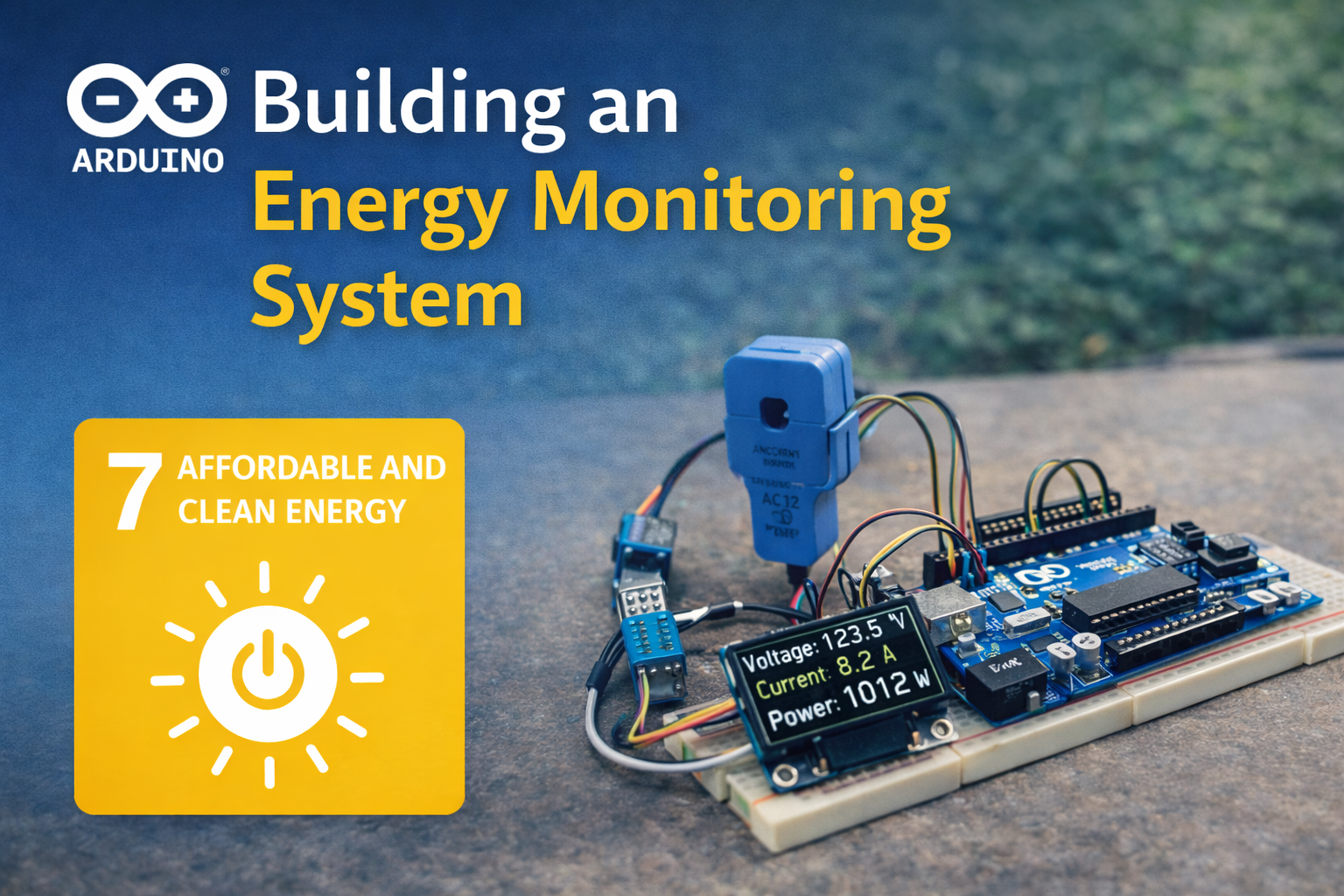
An Arduino energy monitoring system provides a practical way to observe electrical behavior in real time. By combining a microcontroller with a current and voltage sensor, it becomes possible to measure voltage, current, power, and cumulative energy consumption and translate electrical activity into usable data.
This project demonstrates how to build a small embedded system capable of monitoring low-voltage DC energy use. While simple, the design illustrates a key principle of sustainable infrastructure: systems improve when they can be measured clearly. Monitoring technologies like this support SDG 7: Affordable and Clean Energy by making electricity consumption transparent, interpretable, and easier to manage.
Main Library
Publications
Project Series
Arduino SDG Projects
Related Topic
Infrastructure Systems
Related Topic
Climate Boundary
Related Topic
Environmental Monitoring
The project connects to broader site areas, including Intelligent Infrastructure Systems, Sustainable Development Goals Within Planetary Boundaries, Climate Change as a Planetary Boundary, Environmental Monitoring Systems, and Planetary Boundaries. In that wider context, this energy monitor is not only a maker project. It is a small prototype of the measurement infrastructure needed for efficiency, clean-energy transition planning, resilient infrastructure, and responsible energy use.
Abstract
This project presents a prototype Arduino energy monitoring system built around a microcontroller and an INA219 current and voltage sensor. The system measures bus voltage and current, calculates instantaneous power, and estimates cumulative energy consumption over time.
From an engineering perspective, the build demonstrates a compact embedded metering system for low-voltage DC monitoring. From a sustainability perspective, it illustrates how real-time visibility into energy use can support efficiency, better design decisions, responsible infrastructure management, and clean-energy literacy.
The prototype is intentionally limited to low-voltage DC systems. It does not replace certified meters, professional energy audits, building electrical monitoring systems, or qualified electrical practice. Its value is educational and methodological: it shows how measurement converts invisible electrical behavior into data that can be interpreted, logged, compared, and improved.
SDG Alignment: Clean Energy, Efficiency, Infrastructure, and Climate Action
This project connects most directly to SDG 7: Affordable and Clean Energy, which emphasizes access to reliable, sustainable, and modern energy systems. Energy access and clean-energy transition are often discussed at the scale of grids, generation capacity, transmission systems, and policy. But the same transition also depends on measurement: people need to know how energy is being used before they can manage it responsibly.
This Arduino energy monitoring system is not a grid meter, utility-grade instrument, or certified energy-management platform. Its contribution is narrower and still important: it demonstrates the logic of energy visibility at the scale of low-voltage devices and prototypes. By measuring current, voltage, power, and cumulative energy consumption, the system helps make electrical use concrete, observable, and open to analysis.
| Sustainable Development Goal | How the Project Relates | Project-Level Mechanism |
|---|---|---|
| SDG 7: Affordable and Clean Energy | Supports energy literacy, efficiency awareness, and more transparent energy use in low-voltage systems. | Voltage, current, power, and cumulative energy monitoring through embedded sensing. |
| SDG 9: Industry, Innovation and Infrastructure | Demonstrates embedded monitoring infrastructure for devices, prototypes, sensors, and small energy systems. | Microcontroller-based sensing, I2C communication, telemetry, and reproducible measurement workflows. |
| SDG 11: Sustainable Cities and Communities | Relates to transparent energy use in built environments, community infrastructure, and distributed device networks. | Small-scale monitoring patterns that can support education around buildings, sensors, lighting, and local infrastructure loads. |
| SDG 12: Responsible Consumption and Production | Encourages more responsible electricity use by making consumption visible and comparable. | Power measurement, energy accumulation, load comparison, and efficiency testing before and after design changes. |
| SDG 13: Climate Action | Connects to climate mitigation because energy efficiency and clean-energy transition reduce pressure on fossil-fuel systems. | Energy-use data that can support efficiency analysis, load reduction, and clean-energy system evaluation. |
The strongest SDG connection is SDG 7. Clean energy is not only about producing electricity from renewable sources. It is also about understanding energy demand, reducing waste, and designing systems that use power efficiently. A solar panel, battery, sensor station, or embedded device can only be optimized if its electrical behavior is visible.
The connection to SDG 9 comes through infrastructure and innovation. Energy monitoring is part of the measurement layer of modern infrastructure. Embedded meters, smart sensors, dashboards, and feedback systems allow engineers to observe loads, identify abnormal behavior, test design alternatives, and build more resilient systems.
The connection to SDG 12 comes through responsible consumption. The project does not ask users simply to “use less energy” in the abstract. It gives them a way to measure what a device actually consumes. That shift from vague awareness to measured feedback is central to responsible resource use.
The connection to SDG 13 is indirect but important. Energy systems are deeply connected to greenhouse gas emissions, especially where electricity generation depends on fossil fuels. A small Arduino energy monitor does not decarbonize an energy system by itself, but it helps make the logic of climate-relevant energy management visible: measure demand, identify waste, compare alternatives, and improve system performance.
Because the Sustainable Development Goals are broad public frameworks, it is important not to overclaim. This project is not a certified power meter, not a building energy-management system, and not a substitute for professional electrical instrumentation. Its value is educational, methodological, and practical: it teaches the measurement-control logic behind energy visibility and efficiency.
In that sense, the project works best as a bridge between sustainability language and engineering practice. It turns a broad goal — use energy more responsibly — into a practical sequence: measure voltage and current, calculate power, integrate energy over time, compare loads, validate readings, log results, and use the evidence to improve design decisions.
Connections to Other Site Areas
This Arduino energy monitor belongs to a wider body of work on sensing, infrastructure, and sustainability. It connects directly to Intelligent Infrastructure Systems because modern energy systems increasingly require measurement layers that can sense, report, and support better operational decisions.
It also connects to Sustainable Development Goals Within Planetary Boundaries. Energy access, efficiency, decarbonization, and responsible consumption are development priorities, but they must be pursued in ways that reduce pressure on climate systems, material systems, and ecological boundaries.
At the planetary-boundary level, this project relates most directly to Climate Change as a Planetary Boundary. Energy systems are central to the climate problem because fossil fuel combustion remains a major source of greenhouse gas emissions. Even small-scale monitoring projects can help illustrate the larger principle that energy transition depends on visibility, measurement, and system-level feedback.
The project also overlaps with Environmental Monitoring Systems. Although this build monitors electrical rather than ecological variables, it uses the same general logic: sensors convert invisible system behavior into interpretable data that can guide decisions.
System Architecture
The Arduino energy monitoring system can be understood as a compact embedded measurement pipeline:
- Electrical layer: a low-voltage DC source powers a load.
- Sensing layer: the INA219 measures bus voltage and current through a shunt-based high-side current-sensing method.
- Acquisition layer: the Arduino reads sensor data over the I2C interface.
- Processing layer: firmware calculates power and estimates cumulative energy.
- Output layer: values are reported through the Serial Monitor and can later be logged, displayed, or transmitted.
DC Source / Load → INA219 Sensor → Arduino → Power / Energy Calculations → Serial Output / LoggingThis simple architecture mirrors the core logic used in larger energy metering systems: sense, calculate, record, and interpret. The important difference is scope. This prototype is designed for low-voltage educational and experimental systems, not high-voltage electrical infrastructure.
System Requirements
An energy monitoring prototype becomes more useful when the requirements are clear. The system must measure safely, calculate transparently, and avoid being mistaken for certified electrical instrumentation.
| Requirement | Design Target | Reason |
|---|---|---|
| Voltage measurement | Measure low-voltage DC bus voltage | Voltage is required for power and system-state interpretation |
| Current measurement | Measure current flowing through a load | Current reveals how much electrical demand the load places on the source |
| Power calculation | Calculate instantaneous power from voltage and current | Power makes device behavior easier to compare |
| Energy accumulation | Estimate watt-hours by integrating power over time | Energy use depends on both power level and duration |
| Telemetry | Print readable values to the Serial Monitor | Supports debugging, calibration, logging, and education |
| Validation | Compare sensor readings against a multimeter or known load | Prevents uncritical trust in unvalidated measurements |
| Safety boundary | Limit the prototype to low-voltage DC use | Protects users from dangerous electrical conditions outside the project scope |
These requirements can be reused across the Arduino sustainability project series. Each project should clarify what is being measured, how the measurement is interpreted, and where the prototype should not be overextended.
Why an Arduino Energy Monitoring System Matters
Energy systems are often discussed in terms of generation capacity, infrastructure investment, renewable deployment, or grid transition. But efficiency also depends on something more basic: knowing how electricity is actually being used.
An embedded monitoring system makes electrical behavior visible. That visibility matters for several reasons:
- it helps engineers understand how loads behave in real time
- it makes inefficiencies easier to identify
- it provides data for evaluating design changes
- it supports more responsible energy use at small scales
- it creates a foundation for later dashboards, logging, alerts, or automation
At a prototype level, the value of the system is not that it replaces commercial metering equipment. Its value is that it demonstrates the logic of measurement, analysis, and energy awareness in a form that can be built, tested, inspected, and extended.
For sustainability education, the deeper value is conceptual: energy is not just an abstract utility bill or grid statistic. It is a measurable flow through devices and systems. When that flow becomes visible, design choices become easier to evaluate.
System Overview
The monitoring system uses an INA219 current and voltage sensor connected to an Arduino microcontroller through the I2C interface. The INA219 measures bus voltage and current flowing through a low-voltage DC circuit.
Using these measurements, the Arduino calculates:
- voltage
- current
- instantaneous power
- cumulative energy consumption
The system continuously samples electrical values and reports the results through the Serial Monitor or an optional display module. In this form, it functions as a compact embedded energy meter for experimental monitoring, education, and low-voltage DC system analysis.
Bill of Materials
- Arduino Uno, Arduino Nano, or compatible microcontroller
- INA219 current and voltage sensor module
- SSD1306 OLED display, optional
- breadboard or secure terminal wiring
- jumper wires
- low-voltage DC power supply
- electrical load, such as LEDs, fan, small motor, sensor node, or embedded device
- multimeter for validation
- optional enclosure for longer-term bench testing
For stable results, use secure wiring and avoid loose breadboard connections when testing loads over longer periods. Energy measurements become less useful if the measurement setup itself is unreliable.
Engineering Specifications
| Parameter | Reference Design |
|---|---|
| Microcontroller | Arduino Uno, Arduino Nano, or equivalent ATmega328P-compatible board |
| Sensor | INA219 current and voltage sensor |
| Communication protocol | I2C |
| Measured values | Voltage and current |
| Calculated values | Power and cumulative energy |
| Energy calculation basis | Power integrated over elapsed time |
| Display output | Serial Monitor, optional OLED, optional logging or dashboard extension |
| Typical use case | Low-voltage DC monitoring |
| Deployment scope | Educational, prototype, and experimental energy monitoring |
The reference design is intentionally scoped to low-voltage DC systems. Any extension to higher voltages, higher currents, or AC power requires properly rated, isolated, certified equipment and qualified electrical practice.
Measurement Principle: Voltage, Current, Power, and Energy
Electrical monitoring begins with two basic quantities: voltage and current. Voltage describes electrical potential difference. Current describes the rate at which electric charge flows through a circuit. Power combines the two to describe the rate of energy transfer.
The INA219 measures voltage and current in a low-voltage DC circuit. Current is measured indirectly by sensing the voltage drop across a small shunt resistor. Because that voltage drop is related to current, the sensor can estimate how much current is flowing through the load.
Energy is not measured instantaneously in the same way. It is estimated over time. If a device draws power for a period of time, its energy consumption depends on both the power level and the duration. That is why the firmware tracks elapsed time and accumulates watt-hours.
This distinction matters. A device with high power draw used briefly may consume less total energy than a low-power device left on for many hours. Energy monitoring therefore requires both electrical measurement and time awareness.
Mathematical Lens: From Electrical Measurements to Energy Insight
The Arduino energy monitor can be understood as a small measurement and integration system. It samples voltage and current, converts those values into power, and estimates cumulative energy by accumulating power over elapsed time.
P = V \times I
\]
Interpretation: Electrical power equals voltage multiplied by current. This gives the instantaneous rate of energy use.
Here, \(P\) is power in watts, \(V\) is voltage in volts, and \(I\) is current in amperes. If current is measured in milliamps, it must be converted to amperes before calculating watts.
E = P \times t
\]
Interpretation: Energy equals power multiplied by time when power is approximately constant across the interval.
In the firmware, elapsed time is converted into hours so energy can be estimated in watt-hours.
E_{\mathrm{total}}=\sum_{k=1}^{n} P_k \Delta t_k
\]
Interpretation: Cumulative energy is estimated by summing each measured power value multiplied by its elapsed time interval.
This discrete approximation is appropriate for educational monitoring, especially when loads change slowly. Rapidly changing loads require shorter sample intervals or more sophisticated measurement methods.
\eta=\frac{P_{\mathrm{out}}}{P_{\mathrm{in}}}
\]
Interpretation: Efficiency compares useful output power with input power when both can be measured.
A future version of the project could use multiple sensors to compare input and output power across a converter, charger, or embedded device. That would allow students to study real efficiency losses rather than assuming ideal behavior.
\epsilon_V = \frac{|V_{\mathrm{sensor}} – V_{\mathrm{meter}}|}{V_{\mathrm{meter}}}
\]
Interpretation: Relative voltage error compares the sensor reading with a reference multimeter reading.
The mathematical lens shows why the project is more than a sensor readout. It is a small energy-accounting system. Its usefulness depends on sampling, units, calibration, timekeeping, and careful interpretation of error.
Circuit Logic, High-Side Current Sensing, and Measurement Boundaries
The INA219 sensor measures current by detecting the voltage drop across an internal shunt resistor. Because it operates as a high-side current sensor, it can measure current in the positive supply line without disturbing the ground reference of the circuit.
This is useful in many embedded systems because the load can keep a common ground while the sensor observes current flow on the supply side. The Arduino communicates with the sensor over I2C, reading bus voltage, shunt voltage, current, and power estimates.
The sensor must be placed in series with the load, not simply connected across the power supply. Current measurement requires current to pass through the sensing path. Voltage measurement alone is not enough to estimate energy use.
The boundary of the design is equally important: this is a low-voltage DC monitoring prototype. It should not be connected directly to household AC mains, high-voltage circuits, building wiring, utility systems, or loads outside the safe operating range of the sensor and wiring.
How the Energy Monitoring System Works
The low-voltage DC source supplies power to a load through the INA219 sensor. The sensor measures bus voltage and current. The Arduino reads those values through I2C and calculates power and cumulative energy over time.
During each sample interval, the firmware:
- checks whether enough time has elapsed for a new measurement
- reads bus voltage from the INA219
- reads current from the INA219
- reads or calculates power
- calculates elapsed time since the previous energy update
- adds the interval’s energy estimate to the cumulative total
- prints readable telemetry to the Serial Monitor
This control loop is simple, but it captures the core architecture of many monitoring systems: measure, calculate, store, and report.
Design Assumptions and Constraints
This prototype assumes:
- low-voltage DC operation
- a load within the measurement range of the INA219 module
- stable wiring and correct polarity
- educational, laboratory, bench, or prototype use
- non-certified measurement and interpretation
- loads that do not change faster than the chosen sample interval can reasonably capture
It also assumes that energy estimates are being used for learning, comparison, and prototype analysis rather than billing, compliance, safety-critical control, or certified metering.
For rapidly changing loads, the sample interval matters. A device that turns on and off quickly may consume energy between samples that the monitor does not capture accurately. This does not invalidate the project; it clarifies the importance of matching the measurement method to the behavior being measured.
Wiring the Arduino Energy Monitoring System
The INA219 and optional OLED display communicate through the Arduino’s I2C interface.
- Arduino 5V → INA219 VCC
- Arduino GND → INA219 GND
- Arduino A4 → SDA
- Arduino A5 → SCL
The sensor must be placed in series with the positive supply line:
- Power supply positive → INA219 VIN+
- INA219 VIN- → Load positive
- Power supply ground → Load ground
This configuration allows the sensor to measure current flowing into the load. Confirm polarity before powering the circuit, since incorrect wiring can affect both measurement accuracy and component safety.
If an OLED display is added, it usually shares the I2C bus with the INA219. Confirm that the display and sensor do not have conflicting I2C addresses before expanding the build.
Electrical Safety and Scope
This prototype is designed for low-voltage DC monitoring. It should not be connected directly to household AC mains, high-voltage circuits, building wiring, or any electrical system outside the safe operating range of the sensor and associated components.
For AC mains monitoring or higher-power energy systems, use properly rated current transformers, isolation, fusing, enclosures, certified meters, and qualified electrical procedures. Energy monitoring is useful because it makes electrical behavior visible, but measurement hardware must be appropriate to the voltage, current, and safety requirements of the system being observed.
Users should verify polarity, current range, wiring stability, and power supply behavior before each test. If a component becomes hot, behaves erratically, smells unusual, or produces unstable readings, power should be disconnected and the circuit inspected before continuing.
The safety boundary should be stated plainly: this article is for educational low-voltage DC monitoring, not household wiring, utility metering, or high-power electrical work.
Firmware Design Goals
The firmware in this project is designed to do more than read a single sensor value. It attempts to create a basic but meaningful metering system by:
- reading voltage and current consistently
- calculating instantaneous power
- estimating cumulative energy over time
- tracking elapsed time explicitly
- providing serial telemetry for observation and debugging
- creating a foundation for future displays, logging, dashboards, or alerts
These design goals make the build more useful as an educational and engineering tool, since the system produces not just raw measurements but interpretable operating data.
Basic vs. Advanced Firmware
A minimal energy monitor could print voltage or current readings to the Serial Monitor. That kind of sketch is useful for first contact with the sensor, but it does not show the full measurement problem.
The advanced version used here separates telemetry into a dedicated function, explicitly tracks elapsed time, estimates cumulative watt-hours, and keeps the measurement interval readable. Those additions make the prototype better suited for validation, energy comparison, and later data logging.
The larger lesson for the project series is that code should teach the structure of measurement. A sustainability prototype should show not only how to read a sensor, but how to convert sensor values into responsible interpretation.
Advanced Arduino Code
The firmware below improves on the simplest possible readout by separating telemetry into a dedicated function, explicitly tracking elapsed time for cumulative energy estimation, and keeping measurement timing clear.
/*
  Arduino Energy Monitoring System

  Measures:
  - Bus voltage using an INA219 current and voltage sensor
  - Current flowing through a low-voltage DC load
  - Instantaneous power
  - Estimated cumulative energy consumption in watt-hours

  Notes:
  - This project is intended for low-voltage DC monitoring.
  - Do not connect this prototype directly to household AC mains.
  - For higher-voltage or AC monitoring, use properly rated, isolated,
    certified equipment and follow electrical safety requirements.
*/

#include <Wire.h>
#include <Adafruit_INA219.h>

// Create INA219 sensor object.
Adafruit_INA219 ina219;

// Measurement interval in milliseconds.
const unsigned long sampleIntervalMs = 5000UL;

// Timestamp for controlling sample interval.
unsigned long lastSampleTime = 0;

// Timestamp used to calculate elapsed time between energy updates.
unsigned long previousMillis = 0;

// Running estimate of cumulative energy consumption.
float cumulativeEnergyWh = 0.0;

void setup() {
  // Start serial output for telemetry.
  Serial.begin(9600);

  // Initialize the INA219 sensor.
  if (!ina219.begin()) {
    Serial.println("INA219 not found. Check wiring.");

    // Stop execution if the sensor cannot be found.
    while (true) {
      delay(10);
    }
  }

  // Establish initial timestamp for energy integration.
  previousMillis = millis();

  Serial.println("Arduino Energy Monitor Starting");
  Serial.println("Low-voltage DC monitoring mode");
  Serial.println("--------------------------------");
}

void loop() {
  unsigned long now = millis();

  // Take a measurement only when the sample interval has elapsed.
  if (now - lastSampleTime >= sampleIntervalMs) {
    lastSampleTime = now;

    // Read bus voltage from the INA219.
    float busVoltage = ina219.getBusVoltage_V();

    // Read current in milliamps.
    float currentmA = ina219.getCurrent_mA();

    // Read power in milliwatts.
    float powermW = ina219.getPower_mW();

    /*
      Convert elapsed milliseconds into hours.

      Energy in watt-hours is calculated as:
      Wh = W × hours

      Because the INA219 reports power in milliwatts, divide by 1000
      to convert mW to W before accumulating energy.
    */
    float elapsedHours = (now - previousMillis) / 3600000.0;
    cumulativeEnergyWh += (powermW / 1000.0) * elapsedHours;

    // Update previousMillis after calculating elapsed time.
    previousMillis = now;

    // Print telemetry in a readable format.
    printTelemetry(busVoltage, currentmA, powermW, cumulativeEnergyWh);
  }
}

void printTelemetry(
  float busVoltage,
  float currentmA,
  float powermW,
  float energyWh
) {
  Serial.print("Bus Voltage: ");
  Serial.print(busVoltage, 2);
  Serial.print(" V | Current: ");
  Serial.print(currentmA, 2);
  Serial.print(" mA | Power: ");
  Serial.print(powermW, 2);
  Serial.print(" mW | Energy: ");
  Serial.print(energyWh, 6);
  Serial.println(" Wh");
}GitHub Repository
The article body includes the core firmware and design explanation so the build remains readable. The full repository expands the project into a reproducible prototype package, including Arduino monitoring firmware, setup documentation, calibration notes, deployment guidance, bill of materials, example energy readings, and wiring materials.
Complete Code Repository
The full code distribution for this project, including Arduino monitoring firmware, setup documentation, calibration notes, deployment guidance, bill of materials, and example energy readings, is available on GitHub.
The repository contains the complete prototype build materials:
- Arduino monitoring firmware
- bill of materials
- setup guide
- calibration notes
- deployment notes
- example energy readings
Repository Structure
arduino-energy-monitor/

README.md
LICENSE

BOM.csv

firmware/
  energy_monitor.ino

docs/
  setup_guide.md
  calibration.md
  deployment_notes.md

data/
  example_energy_readings.csv

hardware/
Engineers can clone the repository, fork the design, or download the complete project using GitHub’s Download ZIP feature. All materials are released under the MIT License to support reuse in research, education, and prototype engineering work.
Engineering Notes
A few technical details are worth emphasizing:
- High-side current sensing: the INA219 measures current without shifting the system ground reference.
- I2C communication: the Arduino communicates with the sensor through a shared data and clock bus.
- Energy estimation: cumulative energy is not measured directly; it is estimated by integrating power over elapsed time.
- Sampling interval: longer or shorter intervals affect the granularity of energy accumulation and telemetry output.
- Sensor limits: the INA219 is suitable for low-voltage DC monitoring, but it is not a universal metering solution for all electrical environments.
- Serial telemetry: structured output makes it easier to compare readings, log values externally, or extend the system later.
- Load behavior: steady loads are easier to measure accurately than rapidly changing loads because energy estimates depend on sampling frequency.
In more advanced implementations, the system could be extended with OLED display output, SD card logging, wireless telemetry, time-series dashboards, or event-based alerts when loads exceed expected thresholds.
The firmware is best understood as a stable educational reference implementation. It is more rigorous than a one-line sensor demo, but still simple enough to explain the core logic of embedded energy monitoring.
Failure Modes and Practical Risks
A useful energy-monitoring article should explain not only how the system works, but how it can fail. Measurement systems can fail electrically, mathematically, and interpretively.
- Incorrect wiring: the sensor must be placed in series with the load; incorrect placement may produce meaningless readings.
- Reversed polarity: incorrect polarity can damage components or produce invalid readings.
- Current overload: loads outside the sensor’s safe range can overheat or damage the sensor module.
- Power instability: weak supplies or unstable loads can create fluctuating readings and microcontroller resets.
- Sampling error: rapidly changing loads may be poorly represented by long sample intervals.
- Accumulation drift: energy estimates can drift if time intervals, units, or calibration assumptions are incorrect.
- False precision: serial output with many decimal places can look more accurate than the hardware and calibration justify.
- Safety overreach: adapting a low-voltage DC prototype to mains electricity without proper isolation and certification is dangerous.
These risks do not make the project unusable. They define the appropriate scope of use. A responsible prototype should be validated against reference measurements and kept within the safe electrical range of the hardware.
Validation and Testing
To bring this project closer to engineering-grade documentation, validation should include:
- compare INA219 voltage readings against a multimeter
- compare current readings against a known load or reference meter
- verify that calculated power is consistent with voltage multiplied by current
- run the system for a fixed interval under a stable load and evaluate cumulative energy estimates
- confirm that readings remain stable across repeated samples
- verify polarity and wiring integrity before each test condition
If results appear inconsistent, the problem may be related to wiring, unstable loads, sensor limits, calibration assumptions, or time-step assumptions in the energy calculation rather than an error in the basic monitoring concept.
Example Validation Record
| Load | Multimeter Voltage | Sensor Voltage | Sensor Current | Calculated Power | Notes |
|---|---|---|---|---|---|
| LED strip segment | 5.02 V | 5.00 V | 180 mA | 0.90 W | Stable load |
| Small fan | 5.01 V | 4.98 V | 310 mA | 1.54 W | Startup current briefly higher |
| Microcontroller sensor node | 5.03 V | 5.01 V | 75 mA | 0.38 W | Low-power load |
A validation table like this makes the project more useful because it connects sensor readings to reference checks. The goal is not laboratory-grade metrology; it is disciplined comparison so that the readings can be interpreted responsibly.
Suggested Performance Metrics
For a more rigorous evaluation, the system can be assessed using a few simple metrics:
- Voltage accuracy: agreement between sensor reading and multimeter reading.
- Current accuracy: consistency of measured current under a known load.
- Power calculation consistency: whether reported power aligns with the product of voltage and current.
- Energy accumulation drift: whether cumulative watt-hour estimates remain reasonable over longer runs.
- Telemetry stability: whether repeated output remains readable and consistent across samples.
- Sampling sensitivity: whether measured energy changes when the sampling interval changes under variable load conditions.
- Practical usefulness: whether readings help compare devices, test design changes, or identify unexpected loads.
Even informal measurement of these metrics improves the usefulness and credibility of the prototype. Energy monitoring becomes more valuable when readings are checked, recorded, and interpreted in relation to the system being tested.
Data Logging Extension
The monitor becomes more useful when voltage, current, power, energy, load state, and timestamps are logged over time. Even a simple CSV file can help evaluate whether a device consumes more energy than expected, whether a load changes over time, or whether a design modification improves efficiency.
| Field | Example | Purpose |
|---|---|---|
| timestamp | 2026-05-28 09:15:00 | Records when the measurement occurred |
| bus_voltage_v | 5.01 | Measured DC bus voltage |
| current_ma | 185.40 | Measured current draw |
| power_mw | 928.85 | Instantaneous power estimate |
| energy_wh | 0.012850 | Cumulative energy estimate |
| load_description | LED strip segment | Documents what is being measured |
| notes | after brightness reduction | Captures design changes or test conditions |
Data logging helps convert a live monitor into an engineering dataset. Once energy use is recorded over time, it becomes possible to compare loads, identify patterns, estimate battery runtime, and evaluate efficiency improvements.
Applications
Energy monitoring systems can support a wide range of engineering and sustainability applications:
- monitoring energy use in battery-powered devices
- analyzing energy efficiency of embedded systems
- evaluating small solar power installations
- supporting engineering education
- prototyping IoT energy analytics
- tracking loads in low-voltage DC systems
- testing power draw before and after design changes
- estimating battery runtime for field sensors or robotics projects
- comparing low-power modes in embedded devices
These measurements provide the data needed to understand how electrical systems behave in real-world conditions. In a more advanced architecture, readings could be logged to a database, visualized in dashboards, or connected to energy alerts and optimization workflows.
Future Improvements
Several upgrades could significantly expand this prototype:
- OLED display output for standalone monitoring
- SD card logging for long-duration tests
- Wi-Fi telemetry with ESP32
- dashboard visualization for time-series data
- multiple INA219 sensors for input/output comparison
- battery runtime estimation
- load threshold alerts
- efficiency testing across converters or chargers
- integration with a solar charging or sensor-station project
Future versions could also combine this project with the solar-powered Arduino charger. A solar charger generates and stores energy; an energy monitor reveals how that energy is consumed. Together, they form a stronger educational model of small renewable-energy systems.
Responsible Deployment
This prototype is appropriate for classrooms, electronics benches, low-voltage DC experiments, makerspaces, embedded-systems testing, and sustainability education. It should not be used for household mains monitoring, building energy audits, high-power systems, billing, regulatory reporting, or safety-critical electrical decisions.
Responsible deployment means matching the measurement tool to the consequence of error. A low-voltage LED test circuit can tolerate rough measurements. Building wiring, utility systems, and high-current loads require certified equipment, isolation, enclosures, and qualified electrical practice.
A responsible version should include clear labeling of voltage and current limits, secure wiring, insulated connections, reference-meter validation, safe power supplies, and careful documentation of what the monitor can and cannot measure. The prototype teaches the logic of energy monitoring; it does not authorize unsafe electrical work.
Supporting SDG 7: Affordable and Clean Energy
Sustainable energy systems depend on both generation and efficiency. Renewable energy technologies receive significant attention, but improving how energy is used is equally important. A clean energy system still wastes resources if loads are poorly designed, inefficient, oversized, or left running unnecessarily.
Monitoring technologies help engineers identify inefficiencies and optimize system performance. When energy consumption becomes visible, it becomes easier to reduce waste, compare design alternatives, estimate battery runtime, and build more efficient systems.
Embedded monitoring projects like this one help demonstrate how measurement tools can support responsible energy management. They also show how sustainable development can move from abstract commitments into practical sensing, telemetry, validation, and system optimization.
The deeper lesson is that energy transition is not only a supply-side challenge. It is also a measurement challenge. Systems must be instrumented before they can be improved intelligently.
Reproducibility
All firmware, documentation, and supporting build materials necessary to reproduce the prototype are included in the project repository. The design intentionally relies on widely available educational and hobbyist hardware so that it can be rebuilt in classrooms, labs, makerspaces, and independent engineering environments.
The system is intended as a reference implementation rather than a certified metering instrument. Engineers adapting it for more demanding or longer-term use should validate sensor accuracy, load range, thermal conditions, wiring safety, and long-duration energy accumulation behavior under real operating conditions.
For the rest of this project series, reproducibility should mean more than making code available. Each article should include a clear bill of materials, wiring logic, calibration notes, failure modes, test procedure, data interpretation guidance, and a realistic statement of appropriate use.
Conclusion
Building an Arduino energy monitoring system demonstrates how accessible electronics can contribute to a deeper understanding of energy infrastructure. By measuring voltage, current, power, and cumulative energy consumption, the system provides real-time insight into how electrical devices consume electricity.
While simple, the design reflects an important principle of sustainable infrastructure: measurement is the first step toward optimization. Monitoring technologies make energy systems visible, and visibility makes them easier to improve.
For classrooms, makerspaces, embedded-systems labs, sustainability education, and low-voltage prototype development, this project provides a practical foundation for thinking about efficiency, battery life, renewable-energy systems, and responsible electricity use.
The deeper lesson is not simply that an Arduino can read an energy sensor. The deeper lesson is that clean energy systems require feedback. When energy decisions are tied to measurement, calibration, validation, and responsible interpretation, even a small prototype can demonstrate the logic of more intelligent energy infrastructure.
Related Articles
- Arduino Projects for Sustainable Development: 10 SDG-Aligned Builds
- Intelligent Infrastructure Systems
- Environmental Monitoring Systems
- Sustainable Development Goals Within Planetary Boundaries
- Climate Change as a Planetary Boundary
- Planetary Boundaries
Further Reading
- Adafruit (n.d.) Adafruit INA219 Current Sensor Breakout. Available at: https://learn.adafruit.com/adafruit-ina219-current-sensor-breakout
- Arduino (n.d.) Wire Library. Available at: https://docs.arduino.cc/language-reference/en/functions/communication/wire/
- Arduino (n.d.) millis(). Available at: https://docs.arduino.cc/language-reference/en/functions/time/millis/
- International Energy Agency (2023) Energy Efficiency 2023. Available at: https://www.iea.org/reports/energy-efficiency-2023
- International Energy Agency (2023) Tracking Clean Energy Progress 2023. Available at: https://www.iea.org/reports/tracking-clean-energy-progress-2023
- Texas Instruments (2015) INA219 Zerø-Drift, Bidirectional Current/Power Monitor With I2C Interface. Available at: https://www.ti.com/product/INA219
- United Nations (n.d.) Sustainable Development Goal 7: Affordable and Clean Energy. Available at: https://sdgs.un.org/goals/goal7
- U.S. Department of Energy (n.d.) Energy Saver. Available at: https://www.energy.gov/energysaver/energy-saver
References
- Adafruit (n.d.) Adafruit INA219 Current Sensor Breakout. Available at: https://learn.adafruit.com/adafruit-ina219-current-sensor-breakout
- Arduino (n.d.) Wire Library. Available at: https://docs.arduino.cc/language-reference/en/functions/communication/wire/
- Arduino (n.d.) millis(). Available at: https://docs.arduino.cc/language-reference/en/functions/time/millis/
- International Energy Agency (2023) Energy Efficiency 2023. Available at: https://www.iea.org/reports/energy-efficiency-2023
- International Energy Agency (2023) Tracking Clean Energy Progress 2023. Available at: https://www.iea.org/reports/tracking-clean-energy-progress-2023
- Texas Instruments (2015) INA219 Zerø-Drift, Bidirectional Current/Power Monitor With I2C Interface. Available at: https://www.ti.com/product/INA219
- United Nations (n.d.) The 17 Sustainable Development Goals. Available at: https://sdgs.un.org/goals
- United Nations (n.d.) Sustainable Development Goal 7: Affordable and Clean Energy. Available at: https://sdgs.un.org/goals/goal7
- United Nations (n.d.) Sustainable Development Goal 9: Industry, Innovation and Infrastructure. Available at: https://sdgs.un.org/goals/goal9
- United Nations (n.d.) Sustainable Development Goal 11: Sustainable Cities and Communities. Available at: https://sdgs.un.org/goals/goal11
- United Nations (n.d.) Sustainable Development Goal 12: Responsible Consumption and Production. Available at: https://sdgs.un.org/goals/goal12
- United Nations (n.d.) Sustainable Development Goal 13: Climate Action. Available at: https://sdgs.un.org/goals/goal13
- U.S. Department of Energy (n.d.) Energy Saver. Available at: https://www.energy.gov/energysaver/energy-saver