
Last Updated May 28, 2026
Pollinators are foundational to global food systems, biodiversity, and ecosystem resilience. Honeybees and other pollinators contribute to agricultural productivity, wild plant reproduction, ecological stability, seed formation, fruit production, and food-system resilience. Yet pollinator populations face pressure from habitat loss, pesticide exposure, parasites, disease, climate variability, nutritional stress, land-use change, invasive species, and fragmented landscapes.
An Arduino beehive monitoring system provides a practical way to observe hive conditions using low-cost embedded electronics. By combining temperature, humidity, and hive-weight sensing, beekeepers, educators, researchers, conservation groups, and advanced makers can collect time-series data that helps reveal colony conditions without requiring constant physical inspection.
This project demonstrates how to build an Arduino-based beehive monitoring station capable of collecting environmental and weight data from a hive or simulated hive platform. While simple, the system reflects a broader sustainability principle: ecosystems become easier to protect when ecological conditions can be measured clearly, carefully, and responsibly. Sensor-based monitoring can support SDG 15: Life on Land, but it must remain grounded in bee welfare, field safety, calibration, beekeeper judgment, and ecological context.
Main Library
Publications
Project Series
Arduino SDG Projects
Related Topic
Environmental Monitoring
Related Topic
Biosphere Integrity
Related Topic
Land Systems
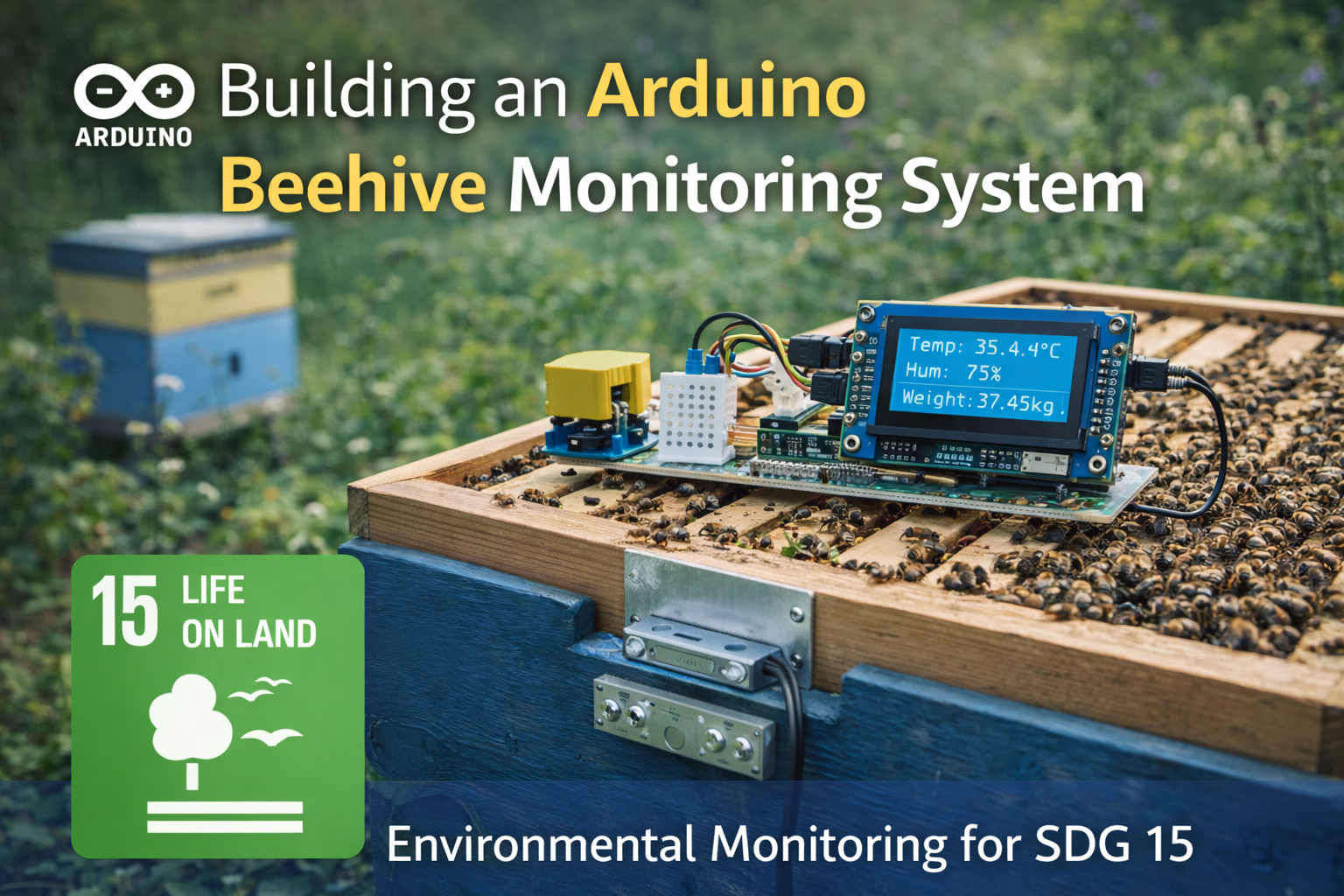
This project also connects to broader site areas, including Environmental Monitoring Systems, Intelligent Infrastructure Systems, Biosphere Integrity and the Stability of Life Systems, Land-System Change and Ecological Transformation, Climate Change as a Planetary Boundary, Sustainable Development Goals Within Planetary Boundaries, and Planetary Boundaries. In that wider context, this beehive monitoring system is not only a maker project. It is a small prototype of the ecological sensing infrastructure needed to observe pollinator health, habitat stress, food-system resilience, and biodiversity conditions more carefully.
Abstract
This project presents a prototype Arduino beehive monitoring system built around temperature, humidity, and hive-weight sensing. The system uses a DHT22 sensor to monitor internal or hive-adjacent environmental conditions and an HX711 load-cell amplifier to estimate hive weight. These measurements can be printed to the Serial Monitor, logged to an SD card, transmitted wirelessly, or extended into a dashboard-based pollinator monitoring workflow.
From an engineering perspective, the build demonstrates a compact ecological monitoring node with sensing, calibration, telemetry, data-logging, enclosure, and power-management layers. From a sustainability perspective, it illustrates how low-cost embedded systems can support pollinator health, biodiversity monitoring, and SDG 15-aligned ecological observation.
The system is intentionally limited. It is not a complete diagnostic platform for colony health, not a substitute for experienced beekeeping, not a veterinary or pest-management tool, and not a replacement for in-person hive inspection when inspection is needed. Its value is educational, methodological, and practical: it makes hive conditions more visible while teaching the measurement discipline required for responsible ecological monitoring.
SDG Alignment: Pollinators, Food Systems, Biodiversity, Climate, and Ecological Infrastructure
This project aligns most directly with SDG 15: Life on Land, which emphasizes protecting, restoring, and sustainably managing terrestrial ecosystems and biodiversity. Pollinators are central to that goal because they support wild plant reproduction, agricultural productivity, habitat resilience, and ecological continuity across landscapes.
The project is not a biodiversity monitoring program by itself and should not be treated as one. Its contribution is narrower and still valuable: it demonstrates how low-cost sensing can help observe conditions inside or around managed hives. Temperature, humidity, and weight data can provide early signals of environmental change, resource shifts, hive activity, possible disturbance, and management needs when interpreted with beekeeping expertise.
| Sustainable Development Goal | How the Project Relates | Project-Level Mechanism |
|---|---|---|
| SDG 15: Life on Land | Supports pollinator monitoring, biodiversity awareness, habitat-stress observation, and ecological stewardship. | Hive temperature, humidity, and weight telemetry interpreted alongside field observations and beekeeper knowledge. |
| SDG 2: Zero Hunger | Relates to food-system resilience because pollinators support many fruit, nut, vegetable, seed, and forage crops. | Monitoring colony conditions that may affect pollination services and managed-hive performance. |
| SDG 9: Industry, Innovation and Infrastructure | Demonstrates distributed ecological instrumentation and low-cost environmental monitoring infrastructure. | Arduino sensing, load-cell measurement, telemetry, data logging, power management, and reproducible ecological monitoring workflows. |
| SDG 12: Responsible Consumption and Production | Connects to responsible agricultural stewardship, pollinator-aware land management, and better-informed resource use. | Data-supported beekeeping decisions, reduced unnecessary disturbance, and clearer observation of colony and seasonal trends. |
| SDG 13: Climate Action | Relates to climate pressure because heat, drought, extreme weather, and phenological shifts can stress pollinators and floral resources. | Hive-condition time series that can be compared with weather, flowering periods, heat waves, drought, and seasonal change. |
The strongest SDG connection is SDG 15. Pollinator health is part of biodiversity protection. A beehive monitoring system does not measure all pollinator diversity, and honeybee data should not be mistaken for the condition of all wild pollinators. Still, managed hive telemetry can help illustrate how ecological conditions are measured and why pollinator systems require sustained observation.
The connection to SDG 2 comes through food systems. Pollinators contribute to the production of many crops and support broader food-system resilience. Hive weight trends can provide indirect information about nectar flows, foraging conditions, and resource availability, while temperature and humidity data can help identify internal environmental stress.
The connection to SDG 9 comes through ecological infrastructure. Monitoring systems are part of the infrastructure of conservation and agriculture. Sensors, data loggers, telemetry networks, dashboards, and calibration protocols help translate ecological signals into practical information.
The connection to SDG 13 is indirect but important. Pollinators are affected by heat, drought, changing flowering times, weather extremes, and land-use pressures that interact with climate change. Hive telemetry can help compare colony conditions with local weather and seasonal patterns, especially when data is collected consistently over time.
Because the Sustainable Development Goals are broad public frameworks, it is important not to overclaim. This project is not a professional pollinator-health diagnostic system, not a disease detector, not a parasite-monitoring tool, and not a substitute for ecological research or beekeeper inspection. Its value is educational, methodological, and practical: it teaches the sensing-and-interpretation logic behind pollinator monitoring while emphasizing responsible use.
In that sense, the project works best as a bridge between sustainability language and ecological engineering practice. It turns a broad goal — protect biodiversity and pollinator systems — into a practical sequence: measure hive temperature, track humidity, estimate hive weight, calibrate sensors, log trends, compare readings with field observations, reduce unnecessary disturbance, and interpret signals within ecological context.
Connections to Other Site Areas
This Arduino beehive monitoring system belongs to a wider body of work on environmental sensing, ecological observation, and biodiversity monitoring. It connects directly to Environmental Monitoring Systems, where field sensors, telemetry, data logging, and ecological observation tools help reveal environmental change.
It also connects to Intelligent Infrastructure Systems. A beehive monitor becomes more useful when it can sense internal hive conditions, store observations, identify threshold concerns, support dashboards, and help users interpret environmental patterns.
At the planetary-boundary level, this project connects most directly to Biosphere Integrity and the Stability of Life Systems. Pollinator health is part of the larger question of how biodiversity, ecological function, and food-system resilience are maintained under stress.
The project also connects to Land-System Change and Ecological Transformation because pollinator stress is shaped by land conversion, habitat fragmentation, pesticide exposure, agricultural intensification, floral resource availability, and landscape structure. It also relates to Climate Change as a Planetary Boundary because climate instability can alter flowering schedules, forage availability, temperature stress, drought patterns, and colony resource dynamics.
Pollinator Monitoring and Environmental Systems
Bee colonies regulate their internal environment carefully. Healthy colonies maintain hive conditions within functional ranges to support brood development, worker activity, food storage, comb maintenance, ventilation, thermoregulation, and colony function. Sudden or persistent changes in temperature, humidity, or hive weight can indicate environmental stress, disease pressure, resource scarcity, colony disturbance, swarming, equipment problems, or management needs.
Hive weight is especially useful because it provides indirect insight into colony activity. During nectar flows, hive weight may increase as bees store nectar and honey. During dearth periods, hive weight may decline as stores are consumed. Sudden weight loss may indicate swarming, disturbance, robbing, resource depletion, or measurement error. Combined with temperature and humidity data, weight trends can help create a more complete picture of hive condition.
By combining temperature, humidity, and hive-weight measurements, an embedded monitoring system can provide a useful observational layer without opening the hive as frequently. This can reduce disturbance and create a time-series record that can be reviewed across days, weeks, seasons, and management events.
The key is interpretation. A beehive monitor does not “know” colony health. It records signals. Those signals become meaningful only when compared with season, weather, inspection records, forage availability, hive management, disease history, colony strength, and local ecological conditions.
System Architecture
The beehive monitoring system operates as a small ecological monitoring node built around an Arduino-compatible microcontroller.
The system architecture includes several functional layers:
- Sensor layer: temperature, humidity, and weight sensors collect hive-condition data.
- Control layer: the Arduino reads sensors, applies basic validation, and formats telemetry.
- Data layer: readings can be printed to serial output, logged locally, or transmitted wirelessly.
- Power layer: low-power electronics, batteries, or solar-assisted systems support remote deployment.
- Interpretation layer: thresholds, trends, beekeeper review, and field observations help identify possible colony stress.
Typical architecture:
Hive Sensors → Arduino → Environmental Readings → Local Log / Serial Output / Wireless Telemetry → Review and InterpretationThese layers mirror the architecture used in larger environmental monitoring systems, but at a scale suitable for education, beekeeping, conservation prototyping, and ecological monitoring.
System Requirements
A beehive monitoring prototype becomes useful only when its requirements are explicit. The system must measure hive conditions without disrupting the colony, preserve data quality, withstand field exposure, and avoid being mistaken for a complete diagnostic platform.
| Requirement | Design Target | Reason |
|---|---|---|
| Temperature sensing | Measure internal or hive-adjacent temperature reliably | Temperature can indicate colony regulation, brood-area conditions, or environmental stress |
| Humidity sensing | Measure relative humidity near the selected hive zone | Humidity affects brood conditions, moisture balance, condensation, and hive environment interpretation |
| Weight measurement | Estimate hive weight using a calibrated load-cell platform | Weight trends can reveal nectar flow, food-store changes, swarming, disturbance, or seasonal dynamics |
| Bee-safe installation | Avoid crushing bees, blocking entrances, damaging frames, or disrupting hive ventilation | Monitoring must not compromise colony welfare or normal behavior |
| Weather protection | Protect electronics from rain, humidity, heat, wax, propolis, insects, and vibration | Apiary conditions can quickly damage exposed electronics |
| Telemetry | Print or log readable timestamped data | Supports calibration, trend review, and comparison with field observations |
| Responsible interpretation | Treat sensor signals as advisory, not diagnostic | Hive health requires beekeeper judgment, inspection, disease checks, and ecological context |
These requirements can be reused across the Arduino sustainability project series. Each project should clarify what must be measured, how measurements can fail, and what ethical or safety boundary applies.
Why Beehive Monitoring Matters
Pollinator health is shaped by many interacting pressures. These include habitat loss, fragmented landscapes, pesticide exposure, parasites, pathogens, nutritional stress, extreme heat, drought, changing flowering times, invasive species, and broader climate instability.
A beehive monitoring system cannot diagnose every colony problem. It cannot replace experienced beekeeping judgment, inspection, queen assessment, disease testing, mite monitoring, feeding decisions, or local ecological expertise. However, it can help reveal patterns that are otherwise difficult to observe continuously:
- temperature instability inside or near the hive
- high or low humidity conditions
- daily and seasonal weight changes
- possible nectar-flow periods
- possible swarming or sudden mass-loss events
- environmental stress during heatwaves or cold periods
- long-term differences between monitored hives
- relationships between hive conditions, weather, and management actions
The value of the system is not that it provides perfect colony diagnosis. Its value is that it creates a structured observational layer for pollinator health and makes time-series data available for review.
It also supports better timing. A beekeeper or educator may use monitoring data to decide when a closer inspection is warranted, when a hive appears stable enough to avoid unnecessary disturbance, or when weather and hive conditions suggest extra caution.
System Overview
The beehive monitoring system collects environmental and weight data from a hive or simulated hive platform.
The system includes:
- Arduino-compatible microcontroller for device control
- DHT22 temperature and humidity sensor
- HX711 load-cell amplifier
- load cell or load-cell platform for hive weight estimation
- optional MicroSD card module for local data logging
- optional real-time clock for timestamped records
- optional solar-assisted power system for remote deployment
During operation, the system periodically reads temperature, humidity, and weight, applies basic error handling, classifies simple advisory conditions, and outputs telemetry. More advanced versions could add timestamped logging, battery monitoring, wireless transmission, dashboards, weather integration, and anomaly detection.
Hardware Components
- Arduino Uno, Arduino Nano, or Arduino-compatible low-power board
- DHT22 temperature and humidity sensor
- HX711 load cell amplifier
- four load cells or one properly rated heavy-duty load cell
- MicroSD card module, optional for data logging
- DS3231 real-time clock module, optional but useful for timestamped logs
- solar panel and battery pack, optional for remote systems
- weather-resistant enclosure
- breadboard, prototype board, or custom PCB
- jumper wires or field-rated connectors
- mounting hardware for scale platform or hive base
- protective sensor housing or bee-safe sensor screen where appropriate
These components create a compact system capable of operating continuously in field conditions when properly protected from moisture, heat, insects, vibration, propolis, wax buildup, and physical disturbance.
For real apiary use, the mechanical design of the scale platform is as important as the electronics. Uneven support, ground shifting, hive tilt, wind, rain, and seasonal weight changes can all affect readings.
Engineering Specifications
| Parameter | Reference Design |
|---|---|
| Microcontroller | Arduino Uno, Arduino Nano, or compatible low-power board |
| Environmental sensor | DHT22 temperature and humidity sensor |
| Weight sensor interface | HX711 load cell amplifier |
| Weight measurement | Single heavy-duty load cell or multi-load-cell platform |
| Optional storage | MicroSD card module with timestamping from DS3231 RTC |
| Optional telemetry | LoRa, Wi-Fi, Bluetooth, or cellular module depending on deployment |
| Power options | USB, battery, or solar-assisted battery system |
| Deployment mode | Hive-adjacent or carefully hive-integrated ecological monitoring prototype |
| Target scope | Educational, beekeeping, research, and prototype pollinator monitoring |
The reference design should be understood as a prototype. It is suitable for learning, bench testing, hive-adjacent monitoring, and carefully supervised apiary experiments, but it is not a professional diagnostic platform or commercial hive scale without additional engineering and validation.
Measurement Principle: Hive Climate, Weight, and Colony Signals
The system measures three types of information: temperature, relative humidity, and hive weight. Each represents a different kind of hive signal.
Temperature and humidity describe the local microclimate at the sensor location. A sensor near the brood nest, hive entrance, inner cover, or outer box wall may produce different values. Therefore, the number should always be interpreted as “temperature and humidity at this sensor location,” not as a complete description of the whole hive.
Weight is a whole-hive or platform-level signal. It can reflect nectar intake, honey storage, feeding, water accumulation, colony growth, equipment changes, swarming, robbing, or beekeeper intervention. Weight is powerful because it provides a continuous proxy for colony and resource dynamics, but it is not self-explanatory.
The measurement principle is therefore not simply “read sensors.” It is: measure specific signals from specific locations, connect them to a documented hive context, and interpret them alongside weather, season, floral resources, inspections, and management records.
Mathematical Lens: From Hive Telemetry to Pollinator Insight
The beehive monitoring system can be understood as a time-series measurement system. It does not directly measure “colony health.” It measures signals that can help support interpretation when analyzed over time.
\bar{w}=\frac{1}{n}\sum_{i=1}^{n}w_i
\]
Interpretation: Averaging multiple load-cell readings reduces short-term noise before estimating hive weight.
Load-cell readings can fluctuate because of vibration, wind, uneven loading, electrical noise, bees moving inside the hive, and mechanical platform instability. Averaging helps stabilize the measurement.
\Delta W_t = W_t-W_{t-1}
\]
Interpretation: Weight change between readings can indicate gain, loss, disturbance, feeding, nectar flow, swarming, or measurement artifact.
A sudden weight drop may be meaningful, but it should not be interpreted automatically. It may reflect swarming, beekeeper handling, scale movement, equipment removal, robbing, wind, unstable mounting, or data error.
r_W=\frac{W_t-W_{t-\Delta t}}{\Delta t}
\]
Interpretation: Weight-change rate helps reveal whether the hive is gaining or losing mass over a defined interval.
Weight-change rate can help identify nectar-flow periods, resource depletion, feeding response, or seasonal transitions when interpreted with weather and flowering conditions.
\Delta T = T_{\mathrm{hive}}-T_{\mathrm{ambient}}
\]
Interpretation: The difference between hive temperature and ambient temperature can reveal colony thermoregulation or environmental stress when ambient data is available.
A future version can include an external ambient sensor so hive conditions can be interpreted relative to surrounding weather rather than as isolated readings.
S =
\begin{cases}
\text{review}, & |\Delta W_t| > T_W \\
\text{observe}, & |\Delta W_t| \leq T_W
\end{cases}
\]
Interpretation: A simple advisory rule can flag large weight changes for review without claiming a diagnosis.
The mathematical lens shows why this project is more than a sensor demo. It is a time-series observation system. The most useful information often comes from trends, differences, rates of change, and relationships among hive signals, weather, season, and beekeeper observations.
Sensor Design Considerations
Temperature and Humidity Monitoring
The DHT22 sensor measures both temperature and relative humidity. Compared with simpler sensors, it offers a useful range for environmental monitoring. For hive monitoring, the sensor should be placed where it can detect meaningful conditions while avoiding direct damage from bees, wax, propolis, moisture, or physical disturbance.
Important placement considerations include:
- avoid crushing, blocking, or contaminating the sensor
- shield the sensor from direct contact with bees where possible
- avoid creating openings that compromise hive integrity
- protect wiring from chewing, propolis buildup, and moisture
- ensure sensor placement does not interfere with normal colony activity
- document exactly where the sensor is placed so readings can be interpreted later
Hive Weight Measurement
Hive weight monitoring is implemented using load cells connected to an HX711 amplifier. Load cells convert mechanical strain into electrical signals, allowing the system to estimate the total weight of the hive or hive platform.
Weight measurement enables:
- honey production monitoring
- nectar-flow detection
- possible swarming event detection
- resource scarcity monitoring
- seasonal colony activity tracking
- comparison between hives or apiary locations
The HX711 provides high-resolution analog-to-digital conversion suitable for load-cell readings. However, useful weight monitoring depends heavily on mechanical design, stable mounting, calibration, temperature behavior, and protection from vibration, uneven ground, wind, rain, and weather exposure.
Circuit Logic, Load-Cell Measurement, and Field Reliability
The circuit has two main sensing domains: environmental sensing and load measurement. The DHT22 provides digital temperature and humidity readings. The HX711 reads very small signals from the load cell and converts them into digital values that the Arduino can process.
Load-cell measurement is sensitive to mechanical and electrical conditions. Uneven force distribution, platform flex, loose screws, unstable ground, moisture intrusion, poor wiring, temperature change, and mechanical stress can all alter the reading. A hive scale is therefore not only an electronic system; it is a mechanical measurement system.
Power stability also matters. If a data logger, radio module, or SD card is added, current draw may increase. Field deployments should use stable voltage regulation, secure wiring, weatherproof connectors, and strain relief. Breadboard wiring may work for bench tests but is usually too fragile for long-term apiary use.
The core circuit lesson is that ecological monitoring requires physical reliability. A correct sketch cannot compensate for a scale platform that shifts, a sensor covered in propolis, a battery box filled with condensation, or a cable damaged by animals or weather.
How the Beehive Monitoring System Works
The beehive monitoring system periodically reads temperature, humidity, and weight. The Arduino checks whether sensor readings are valid, averages multiple weight readings to reduce noise, applies the load-cell calibration factor, and prints a structured telemetry record.
During each measurement cycle, the system:
- reads temperature from the DHT22
- reads relative humidity from the DHT22
- checks whether the DHT22 returned valid values
- collects multiple readings from the HX711/load-cell system
- averages weight readings and applies the calibration factor
- compares current weight with the previous weight
- prints telemetry and advisory status messages
- waits until the next scheduled reading
More advanced versions could add timestamped logging, external weather readings, battery voltage, LoRa telemetry, cloud dashboards, or anomaly detection. The baseline system is intentionally transparent so that each reading can be traced back to a sensor, calibration choice, and interpretation rule.
Design Assumptions and Constraints
This prototype assumes:
- educational, beekeeper-support, or prototype ecological-monitoring use
- temperature and humidity readings from one sensor location
- hive weight estimated from a calibrated platform
- stable mounting and repeatable mechanical loading
- regular inspection and maintenance of electronics
- beekeeper interpretation rather than automated diagnosis
- no invasive or harmful installation practices
It also assumes that temperature, humidity, and weight are relevant to the monitoring question. They are useful indicators, but they do not directly diagnose queen status, brood health, mite load, disease, pesticide exposure, nutrition, genetic factors, or colony viability.
The project therefore teaches a monitoring pattern rather than claiming comprehensive colony assessment. Responsible beehive monitoring requires matching sensor data to the actual beekeeping or ecological question.
Beehive, Field, and Data-Ethics Considerations
Beehive monitoring should never compromise colony welfare. The system should be installed carefully, ideally with guidance from an experienced beekeeper, and should avoid disrupting hive ventilation, brood area, entrances, frames, or normal bee movement.
Important field considerations include:
- minimize disturbance during installation and maintenance
- avoid installing sensors in ways that crush bees or obstruct hive activity
- protect cables and electronics from rain, condensation, ants, wax, propolis, rodents, and other insects
- ensure the weight platform is stable, level, and properly rated for the hive
- avoid publishing precise hive locations where theft, vandalism, or disturbance may be a concern
- follow local beekeeping, land-access, and apiary safety rules
- avoid interpreting sensor alerts as diagnoses without inspection and context
This project is an educational and prototype monitoring system. It should support beekeeping judgment, not replace inspection, disease management, queen assessment, parasite monitoring, feeding decisions, or local ecological expertise.
System Wiring
The sensors connect to the Arduino using both digital and sensor-specific interfaces.
DHT22 Wiring
- DHT22 VCC → Arduino 5V
- DHT22 GND → Arduino GND
- DHT22 DATA → Arduino pin 2
HX711 and Load Cell Wiring
- HX711 DT → Arduino pin 3
- HX711 SCK → Arduino pin 4
- Load cell wires → HX711 amplifier terminals according to the load cell wiring color code
Optional MicroSD Logging
- SD CS → Arduino pin 10
- SD MOSI → Arduino pin 11
- SD MISO → Arduino pin 12
- SD SCK → Arduino pin 13
Load cells must be wired according to the specific sensor’s documentation. Color conventions are not universal, and incorrect wiring can produce unstable, inverted, or unusable readings. For field systems, soldered or secured connectors are preferable to loose breadboard connections.
Installation, Enclosure, and Hive-Safe Deployment
Beehive monitoring systems must survive weather, hive activity, animals, vibration, and seasonal change. A system that works on a bench may fail in an apiary because of humidity, condensation, rain, heat, ants, mice, propolis, wax, cable movement, or shifting ground.
For better reliability:
- use a weather-resistant enclosure with cable glands
- mount electronics outside the hive body unless internal placement is necessary and bee-safe
- protect sensors from direct bee contact where possible
- route cables without blocking entrances or frame movement
- ensure the load-cell platform remains level and stable
- protect batteries from heat, rain, and physical impact
- inspect the system regularly for propolis buildup, moisture, corrosion, or damage
- record installation location and sensor placement
Installation should be treated as part of the measurement system. Poor placement can produce misleading readings even when the electronics are functioning correctly.
Firmware Design Goals
The firmware should do more than print raw values. A more useful beehive monitoring sketch should:
- read temperature and humidity values reliably
- read hive weight using an HX711 load-cell amplifier
- average multiple weight samples to reduce noise
- detect invalid environmental sensor readings
- classify simple advisory states without claiming diagnosis
- print readable telemetry for monitoring and debugging
- make calibration constants easy to adjust
- provide a foundation for SD-card logging or wireless telemetry
These design goals make the system easier to test, calibrate, and extend into a more complete pollinator monitoring platform.
Basic vs. Advanced Firmware
A minimal beehive monitor could print temperature, humidity, and one load-cell reading. That first version is useful for confirming that the sensors work, but it does not provide enough structure for field-oriented interpretation.
The advanced version used here averages multiple weight samples, handles invalid DHT readings, separates classification logic into functions, prints structured telemetry, and makes calibration constants explicit. These additions make the prototype easier to validate and easier to extend into logging, dashboards, and long-term monitoring.
The larger lesson for the project series is that code should teach the architecture of monitoring. A sustainability prototype should show not only how to read a sensor, but how to convert sensor readings into interpretable environmental data without overclaiming.
Advanced Arduino Code
The following Arduino sketch reads temperature, humidity, and estimated hive weight. It includes sample averaging, basic error handling, alert classification, and readable serial telemetry. It is designed as a practical starting point rather than a final field-ready system.
/*
  Arduino Beehive Monitoring System

  Features:
  - Reads hive temperature and humidity using a DHT22 sensor
  - Reads hive weight using an HX711 load cell amplifier
  - Averages multiple weight samples to reduce noise
  - Prints readable serial telemetry
  - Classifies simple advisory states for temperature, humidity, and weight change

  Sustainability context:
  - Supports SDG 15: Life on Land
  - Demonstrates low-cost ecological monitoring for pollinator health

  Important:
  - Calibrate the load cell before interpreting weight values.
  - Do not disturb the hive unnecessarily during installation.
  - Protect electronics from moisture, propolis, insects, and weather.
  - Treat alerts as prompts for review, not as automatic diagnoses.
*/

#include <DHT.h>
#include <HX711.h>

// -------------------------
// Pin Configuration
// -------------------------

#define DHTPIN 2
#define DHTTYPE DHT22

#define HX_DT 3
#define HX_SCK 4

// -------------------------
// Sensor Objects
// -------------------------

DHT dht(DHTPIN, DHTTYPE);
HX711 scale;

// -------------------------
// Calibration Settings
// -------------------------

/*
  The calibration factor depends on the load cell, HX711 module,
  mechanical platform, wiring, and units.

  You must calibrate this value with a known weight before using the
  system for meaningful hive weight interpretation.
*/
float calibrationFactor = -7050.0;

// -------------------------
// Monitoring Settings
// -------------------------

const int weightSampleCount = 10;
const unsigned long readingIntervalMs = 5000;

// Basic environmental thresholds.
// These are simple prototype thresholds and should be adapted carefully.
const float lowBroodTempC = 32.0;
const float highBroodTempC = 36.0;
const float highHumidityPercent = 80.0;

// Weight-change thresholds for advisory messages.
// These require meaningful baseline tracking in real deployments.
const float largeWeightLossKg = 2.0;

// Store previous weight for simple change detection.
float previousWeightKg = 0.0;
bool previousWeightAvailable = false;

// -------------------------
// Helper Functions
// -------------------------

float readHiveWeightKg() {
  /*
    Read average weight from the HX711.

    scale.get_units(n) returns the average of n readings after applying
    the calibration factor. The returned unit depends on calibration.
  */
  if (!scale.is_ready()) {
    Serial.println("HX711 not ready.");
    return NAN;
  }

  float weightKg = scale.get_units(weightSampleCount);
  return weightKg;
}

const char* classifyTemperature(float temperatureC) {
  /*
    Classify hive temperature using simple advisory thresholds.

    Real interpretation depends on sensor placement, season, colony state,
    ambient weather, and whether brood is present.
  */
  if (temperatureC < lowBroodTempC) {
    return "LOW_TEMP_REVIEW";
  }

  if (temperatureC > highBroodTempC) {
    return "HIGH_TEMP_REVIEW";
  }

  return "TEMP_WITHIN_REFERENCE_RANGE";
}

const char* classifyHumidity(float humidityPercent) {
  /*
    Classify humidity using a simple high-humidity advisory threshold.

    Hive humidity interpretation depends on weather, ventilation, colony
    behavior, hive design, and sensor placement.
  */
  if (humidityPercent > highHumidityPercent) {
    return "HIGH_HUMIDITY_REVIEW";
  }

  return "HUMIDITY_WITHIN_REFERENCE_RANGE";
}

const char* classifyWeightChange(float currentWeightKg) {
  /*
    Detect a large weight drop between readings.

    This is only a simple event flag. Real swarming, robbing, collapse,
    resource loss, beekeeper handling, or scale movement interpretation
    requires beekeeping expertise and context.
  */
  if (!previousWeightAvailable) {
    previousWeightKg = currentWeightKg;
    previousWeightAvailable = true;
    return "BASELINE_SET";
  }

  float weightChangeKg = currentWeightKg - previousWeightKg;
  previousWeightKg = currentWeightKg;

  if (weightChangeKg <= -largeWeightLossKg) {
    return "LARGE_WEIGHT_DROP_REVIEW";
  }

  return "WEIGHT_CHANGE_WITHIN_REFERENCE_RANGE";
}

void printTelemetry(
  float temperatureC,
  float humidityPercent,
  float weightKg,
  const char* tempStatus,
  const char* humidityStatus,
  const char* weightStatus
) {
  /*
    Print one structured telemetry record to the Serial Monitor.
    A later version could write the same fields to SD card or transmit them.
  */
  Serial.println("Beehive Monitoring Reading");
  Serial.println("--------------------------");

  Serial.print("Temperature_C: ");
  Serial.println(temperatureC, 2);

  Serial.print("Humidity_percent: ");
  Serial.println(humidityPercent, 2);

  Serial.print("Hive_weight_kg: ");
  Serial.println(weightKg, 2);

  Serial.print("Temperature_status: ");
  Serial.println(tempStatus);

  Serial.print("Humidity_status: ");
  Serial.println(humidityStatus);

  Serial.print("Weight_status: ");
  Serial.println(weightStatus);

  Serial.println();
}

void setup() {
  Serial.begin(9600);

  dht.begin();

  scale.begin(HX_DT, HX_SCK);
  scale.set_scale(calibrationFactor);

  /*
    Tare the scale at startup.

    For field deployment, consider whether automatic tare is appropriate.
    If the hive is already on the scale, taring at startup may zero out
    the hive's actual weight. In that case, use a known calibration workflow
    instead of automatic tare.
  */
  scale.tare();

  Serial.println("Arduino Beehive Monitoring System");
  Serial.println("Initializing sensors...");
  Serial.println("----------------------------------");
}

void loop() {
  // Read environmental conditions.
  float temperatureC = dht.readTemperature();
  float humidityPercent = dht.readHumidity();

  // Validate DHT22 readings.
  if (isnan(temperatureC) || isnan(humidityPercent)) {
    Serial.println("DHT22 read error. Check wiring, power, and sensor placement.");
    delay(readingIntervalMs);
    return;
  }

  // Read hive weight.
  float weightKg = readHiveWeightKg();

  if (isnan(weightKg)) {
    Serial.println("Weight read error. Check HX711 wiring and load cell connection.");
    delay(readingIntervalMs);
    return;
  }

  // Classify simple advisory states.
  const char* tempStatus = classifyTemperature(temperatureC);
  const char* humidityStatus = classifyHumidity(humidityPercent);
  const char* weightStatus = classifyWeightChange(weightKg);

  // Print telemetry.
  printTelemetry(
    temperatureC,
    humidityPercent,
    weightKg,
    tempStatus,
    humidityStatus,
    weightStatus
  );

  delay(readingIntervalMs);
}GitHub Repository
The article body includes the core firmware and design explanation so the build remains readable. The full repository expands the project into a reproducible prototype package, including Arduino beehive monitoring firmware, DHT22 and HX711 examples, calibration notes, optional SD-card logging scaffolding, deployment guidance, bill of materials, and example hive telemetry.
Complete Code Repository
The full code distribution for this project, including Arduino beehive monitoring firmware, DHT22 and HX711 examples, calibration notes, optional SD-card logging scaffolding, deployment guidance, bill of materials, and example hive telemetry, is available on GitHub.
The repository contains the complete prototype build materials:
- Arduino monitoring firmware
- DHT22 temperature and humidity integration
- HX711 load-cell calibration example
- optional data-logging scaffolding
- bill of materials
- setup and deployment notes
- example hive-monitoring readings
Repository Structure
arduino-beehive-monitoring-system/

README.md
LICENSE

BOM.csv

firmware/
  beehive_monitoring_system.ino

docs/
  setup_guide.md
  calibration.md
  deployment_notes.md
  sensor_notes.md
  data_logging.md
  responsible_use.md

data/
  example_hive_readings.csv

hardware/
Engineers can clone the repository, fork the design, or download the complete project using GitHub’s Download ZIP feature. All materials are released under the MIT License to support reuse in research, education, conservation prototyping, and ecological monitoring projects.
Calibration and Interpretation
Calibration is especially important for hive weight monitoring. The HX711 and load-cell platform must be calibrated with known weights before readings can be interpreted meaningfully.
A practical calibration process should include:
- assemble the hive scale platform securely
- verify that the load cell is properly wired to the HX711
- place the platform on a stable, level surface
- tare the empty platform if appropriate
- place a known weight on the platform
- adjust the calibration factor until the reading matches the known weight
- repeat with several weights across the expected range
- test whether readings drift over time or with temperature changes
- repeat calibration after moving the scale or changing the platform
Temperature and humidity readings also require careful interpretation. Sensor placement matters. A sensor near the entrance may behave differently from one near the brood area. A sensor too close to bees, moisture, wax, or propolis may degrade or produce misleading values.
Example Hive Scale Calibration Record
| Calibration Step | Reference Weight | Sensor Reading | Adjustment | Notes |
|---|---|---|---|---|
| Empty platform | 0.0 kg | 0.2 kg | Tare or offset | Platform level checked |
| Known weight 1 | 10.0 kg | 9.6 kg | Adjust calibration factor | Centered load |
| Known weight 2 | 20.0 kg | 19.8 kg | Minor adjustment | Repeat after 5 minutes |
| Off-center load | 20.0 kg | 18.9 kg | Mechanical review | Platform flex detected |
A calibration record like this makes the weight data more trustworthy because it separates electrical calibration from mechanical platform behavior.
Power Management for Field Deployment
Beekeeping sites are often located away from convenient electrical infrastructure. A practical monitoring system should therefore support low-power operation and stable field power.
Common field-power strategies include:
- solar panels with rechargeable battery packs
- low-power Arduino-compatible boards
- sleep modes between readings
- less frequent measurement intervals
- local SD-card logging instead of constant wireless transmission
- weatherproof battery and electronics enclosures
- battery voltage monitoring
Reducing measurement frequency can significantly improve battery life. A hive monitor does not always need second-by-second readings; many useful ecological and beekeeping patterns can be observed with readings every few minutes or every hour, depending on the research goal.
Power design also affects data quality. Low battery voltage can cause sensor errors, corrupted logs, wireless dropouts, or unstable load-cell readings. For field deployments, battery state should be measured or inspected regularly.
Data Logging and Telemetry
The baseline sketch prints readings to the Serial Monitor. A more complete version could log observations to a MicroSD card or transmit readings wirelessly.
Useful telemetry fields include:
| Field | Example | Purpose |
|---|---|---|
| timestamp | 2026-05-28 09:15:00 | Records when the observation occurred |
| hive_id | apiary_a_hive_03 | Links data to a specific monitored hive |
| temperature_c | 34.2 | Hive or hive-adjacent temperature |
| humidity_percent | 61.5 | Relative humidity at the sensor location |
| hive_weight_kg | 42.8 | Estimated hive weight after calibration |
| weight_change_kg | +0.6 | Change since previous reading or daily baseline |
| battery_voltage | 3.91 | Power-state context |
| inspection_note | super added yesterday | Helps interpret changes caused by management actions |
| weather_note | heavy rain overnight | Preserves environmental context |
For larger apiaries, multiple monitored hives could generate comparative datasets showing differences in hive development, nectar flow, environmental stress, and seasonal colony behavior. The value of these datasets depends on consistent metadata: hive ID, sensor placement, calibration date, weather, management events, and inspection notes.
Engineering Notes
A few technical details matter significantly in this build:
- Load-cell mounting: weight data is only as reliable as the mechanical platform.
- Calibration factor: the HX711 calibration factor must be determined with known weights.
- Tare behavior: automatic tare can erase meaningful hive weight if the hive is already on the scale at startup.
- Sensor placement: temperature and humidity readings describe the sensor location, not the entire hive.
- Field exposure: moisture, propolis, bees, ants, rodents, and weather can damage sensors and wiring.
- Power stability: weak batteries and voltage drops can affect load-cell readings and data logging.
- Interpretation limits: sensor alerts should prompt review, not replace beekeeping judgment.
These details are not minor. They determine whether the monitoring system produces meaningful ecological data or simply noisy numbers in an apiary.
Failure Modes and Practical Risks
A useful beehive-monitoring article should explain not only how the system works, but how it can fail. Hive monitoring systems can fail through sensor error, mechanical instability, field exposure, bee behavior, and overinterpretation.
- Sensor fouling: wax, propolis, moisture, or bee contact can degrade environmental readings.
- Bad placement: a sensor placed in the wrong location may not represent the condition of interest.
- Load-cell drift: scale readings can shift because of temperature, platform flex, ground movement, or mechanical stress.
- Automatic tare error: taring while the hive is on the platform can zero out the hive’s actual weight.
- Unstable platform: uneven ground, wind, or hive movement can create noisy or biased weight readings.
- Power failure: weak batteries can cause missing data or unreliable readings.
- Weather damage: rain, condensation, heat, or freezing conditions can damage exposed electronics.
- False alarm interpretation: a threshold alert may reflect sensor error, beekeeper handling, or weather rather than colony stress.
- Hive disturbance: poor installation can disrupt bees or make inspections more difficult.
- Location exposure: publishing exact hive locations can create theft, vandalism, or disturbance risk.
These risks do not make the project unusable. They define responsible use. A beehive monitoring system should be treated as an advisory observation layer, not as an automatic colony-health authority.
Validation and Testing
To bring this project closer to engineering-grade documentation, validation should include:
- verify DHT22 readings under known temperature and humidity conditions
- verify HX711 communication and load-cell stability
- calibrate weight readings with known weights
- test whether readings remain stable when the hive platform is loaded unevenly
- observe whether sensor placement interferes with hive activity
- test data logging or telemetry before field deployment
- verify enclosure performance against humidity, rain, heat, insects, and vibration
- compare sensor readings with manual hive observations over time
- document management events such as inspections, feeding, super additions, or harvests
If the system behaves inconsistently, the issue may be related to sensor placement, load-cell mounting, calibration factor, unstable power, field exposure, loose wiring, or inappropriate tare behavior rather than to the ecological monitoring concept itself.
Example Validation Record
| Test | Expected Result | Observed Result | Likely Issue | Action |
|---|---|---|---|---|
| DHT bench test | Matches reference thermometer within acceptable range | Temperature slightly high | Sensor warmed by enclosure | Improve ventilation or placement |
| Known weight test | Scale reads 20.0 kg | Scale reads 19.7 kg | Calibration factor slightly off | Adjust calibration factor |
| Off-center load test | Reading remains stable | Reading changes by 1.1 kg | Platform flex or load-cell geometry | Reinforce platform |
| Field enclosure test | No water intrusion after rain | Condensation visible | Enclosure sealing or venting issue | Add protection and desiccant strategy |
Validation records like this help separate ecological signals from engineering artifacts. That distinction is essential in field monitoring.
Suggested Performance Metrics
For a more rigorous evaluation, the beehive monitoring system can be assessed using several simple metrics:
- temperature stability: whether readings are plausible and consistent under stable conditions
- humidity stability: whether readings respond reasonably to expected hive and weather changes
- weight accuracy: agreement between scale readings and known reference weights
- weight drift: whether readings change unexpectedly over time without real load changes
- logging reliability: whether observations are stored without data loss
- field endurance: how long the system operates under realistic apiary conditions
- installation safety: whether the system avoids interfering with bee movement or hive management
- beekeeper usefulness: whether readings support better timing of inspections, feeding, harvest, or intervention
Even simple tracking of these metrics improves the system’s value as a pollinator monitoring prototype. A monitoring system should be evaluated not only by whether it produces readings, but by whether those readings are stable, interpretable, and useful.
Applications
A beehive monitoring station can support several research, educational, and agricultural applications:
- monitoring colony environmental conditions
- tracking nectar flow during flowering seasons
- detecting possible swarming or sudden weight-change events
- studying environmental stress factors
- supporting beekeeper decision-making
- teaching ecological monitoring and embedded systems
- comparing conditions across hives or apiary locations
- contributing to broader biodiversity and pollinator research workflows
- connecting hive data with weather, land cover, flowering periods, and management events
Data collected from multiple hives can contribute to broader ecological monitoring programs when methods, metadata, and calibration practices are documented carefully. The strongest use cases combine sensor data with beekeeper observations and environmental context rather than treating telemetry as a standalone diagnosis.
Future Improvements
Several upgrades could significantly expand this prototype:
- SD-card logging with real-time clock timestamps
- LoRa telemetry for remote apiary monitoring
- solar-assisted battery charging
- battery-voltage monitoring
- external ambient weather sensor
- multiple internal temperature probes
- acoustic monitoring for hive sound patterns
- camera-free entrance activity counting where ethically and physically appropriate
- dashboard visualization of seasonal trends
- alerts for large weight changes or sensor failure
- weather and flowering-period annotation
Each upgrade should be evaluated against power use, installation complexity, disturbance risk, data quality, and maintenance burden. More sensors are not automatically better if they make the system intrusive, unreliable, or difficult to maintain.
Responsible Deployment
This prototype is appropriate for classrooms, makerspaces, beekeeping education, apiary experiments, conservation labs, and early-stage pollinator monitoring projects. It should not be used as a complete colony-health diagnostic platform, pest-management system, disease detector, queen-status monitor, or substitute for experienced inspection.
Responsible deployment means matching the system to the consequence of error. A classroom demonstration can tolerate rough readings. A working apiary requires bee-safe installation, field-rated enclosure design, stable power, reliable calibration, and careful interpretation. A research study requires documented methods, metadata, and appropriate ecological framing.
A responsible version should include clear sensor-placement documentation, calibration records, weatherproofing, safe cable routing, location privacy, inspection notes, battery monitoring, and explicit statements that telemetry alerts are prompts for review rather than automatic diagnoses.
The central rule is simple: monitoring should reduce unnecessary disturbance, not introduce new stress into the hive.
Supporting SDG 15: Life on Land
SDG 15 focuses on protecting terrestrial ecosystems, conserving biodiversity, restoring degraded land, and reducing species loss. Pollinators are part of the living infrastructure of terrestrial ecosystems. They support crop production, wild plant reproduction, food webs, habitat regeneration, and ecological resilience.
Beehive monitoring contributes to this larger goal by making colony conditions more visible over time. Temperature, humidity, and weight data can help identify seasonal patterns, possible stress periods, and management events that deserve closer attention.
Embedded monitoring systems provide researchers, educators, beekeepers, and conservation groups with environmental data that can support more resilient pollinator systems and stronger ecological stewardship. But the data must be interpreted carefully. Honeybee hive telemetry is not the same as a full pollinator biodiversity survey. Wild bees, butterflies, moths, flies, beetles, bats, birds, and other pollinators also matter, and many face different ecological pressures.
In this sense, beehive monitoring connects directly to the broader challenge of biosphere integrity. It is one useful window into pollinator conditions, but it should be understood as part of a wider landscape of habitat protection, pesticide reduction, ecological restoration, diversified agriculture, climate adaptation, and biodiversity monitoring.
Reproducibility
All firmware, setup notes, calibration guidance, and supporting build materials necessary to reproduce the prototype are included in the project repository. The design intentionally relies on widely available Arduino-compatible hardware, open-source libraries, and common environmental sensing components so that it can be rebuilt in classrooms, makerspaces, apiaries, conservation labs, and independent pollinator monitoring projects.
The system is intended as a reference implementation rather than a commercial hive scale, scientific field instrument, or professional beekeeping diagnostic platform. Engineers adapting it for long-term deployment should validate calibration, enclosure design, power systems, load-cell mounting, sensor placement, data retention, and bee-safe installation under real operating conditions.
For the rest of this project series, reproducibility should mean more than making code available. Each article should include a clear bill of materials, wiring logic, validation notes, failure modes, test procedure, data interpretation guidance, and a realistic statement of appropriate use.
Conclusion
Building an Arduino beehive monitoring system demonstrates how accessible electronics can contribute to biodiversity monitoring. By combining temperature, humidity, and hive-weight sensors with microcontroller-based data collection, the system provides continuous insight into hive conditions and creates a practical foundation for pollinator monitoring education.
Although the hardware is simple, the system reflects a powerful idea: environmental stewardship improves when ecosystems can be measured clearly and responsibly. Embedded monitoring systems like this one make it easier to observe ecological processes, support pollinator health, and respond more thoughtfully to environmental change.
For classrooms, makerspaces, apiaries, conservation labs, community science projects, and early-stage ecological monitoring, this Arduino beehive monitoring system provides a practical foundation for understanding how sensing, data, biodiversity protection, and sustainable development can work together.
The deeper lesson is not simply that an Arduino can read hive temperature, humidity, and weight. The deeper lesson is that pollinator monitoring requires feedback, restraint, and context. When hive data is tied to calibration, bee-safe installation, beekeeper observation, ecological interpretation, and responsible deployment, even a small prototype can demonstrate the logic of more intelligent biodiversity-monitoring infrastructure.
Related Articles
- Arduino Projects for Sustainable Development: 10 SDG-Aligned Builds
- Environmental Monitoring Systems
- Intelligent Infrastructure Systems
- Biosphere Integrity and the Stability of Life Systems
- Land-System Change and Ecological Transformation
- Climate Change as a Planetary Boundary
- Sustainable Development Goals Within Planetary Boundaries
- Planetary Boundaries
Further Reading
- Arduino (n.d.) DHT Sensor Library. Available at: https://docs.arduino.cc/libraries/dht-sensor-library/
- Arduino (n.d.) HX711 Arduino Library. Available at: https://www.arduino.cc/reference/en/libraries/hx711-arduino-library/
- Food and Agriculture Organization of the United Nations (2018) Why Bees Matter: The Importance of Bees and Other Pollinators for Food and Agriculture. Available at: https://www.fao.org/3/i9527en/i9527en.pdf
- IPBES (2016) The Assessment Report on Pollinators, Pollination and Food Production. Available at: https://ipbes.net/assessment-reports/pollinators
- United Nations (n.d.) Sustainable Development Goal 15: Life on Land. Available at: https://sdgs.un.org/goals/goal15
- USDA Natural Resources Conservation Service (n.d.) Pollinators. Available at: https://www.nrcs.usda.gov/conservation-basics/natural-resource-concerns/animals/pollinators
- U.S. Environmental Protection Agency (n.d.) Pollinator Protection. Available at: https://www.epa.gov/pollinator-protection
- U.S. Geological Survey (n.d.) Native Bee Inventory and Monitoring Lab. Available at: https://www.usgs.gov/centers/eesc/science/native-bee-inventory-and-monitoring-lab
References
- Arduino (n.d.) DHT Sensor Library. Available at: https://docs.arduino.cc/libraries/dht-sensor-library/
- Arduino (n.d.) HX711 Arduino Library. Available at: https://www.arduino.cc/reference/en/libraries/hx711-arduino-library/
- Food and Agriculture Organization of the United Nations (2018) Why Bees Matter: The Importance of Bees and Other Pollinators for Food and Agriculture. Available at: https://www.fao.org/3/i9527en/i9527en.pdf
- IPBES (2016) The Assessment Report on Pollinators, Pollination and Food Production. Available at: https://ipbes.net/assessment-reports/pollinators
- United Nations (n.d.) The 17 Sustainable Development Goals. Available at: https://sdgs.un.org/goals
- United Nations (n.d.) Sustainable Development Goal 2: Zero Hunger. Available at: https://sdgs.un.org/goals/goal2
- United Nations (n.d.) Sustainable Development Goal 9: Industry, Innovation and Infrastructure. Available at: https://sdgs.un.org/goals/goal9
- United Nations (n.d.) Sustainable Development Goal 12: Responsible Consumption and Production. Available at: https://sdgs.un.org/goals/goal12
- United Nations (n.d.) Sustainable Development Goal 13: Climate Action. Available at: https://sdgs.un.org/goals/goal13
- United Nations (n.d.) Sustainable Development Goal 15: Life on Land. Available at: https://sdgs.un.org/goals/goal15
- USDA Natural Resources Conservation Service (n.d.) Pollinators. Available at: https://www.nrcs.usda.gov/conservation-basics/natural-resource-concerns/animals/pollinators
- U.S. Environmental Protection Agency (n.d.) Pollinator Protection. Available at: https://www.epa.gov/pollinator-protection
- U.S. Geological Survey (n.d.) Native Bee Inventory and Monitoring Lab. Available at: https://www.usgs.gov/centers/eesc/science/native-bee-inventory-and-monitoring-lab