
Last Updated May 22, 2026
Developmental psychology examines how human beings grow, change, adapt, and age across the full life course. It studies the emergence, transformation, and organization of cognitive, emotional, social, linguistic, moral, biological, and behavioral capacities from prenatal life through infancy, childhood, adolescence, adulthood, and later life. Although the field was once identified primarily with childhood, mature developmental psychology now treats development as a lifelong, embodied, relational, cultural, institutional, and historical process rather than an early phase that ends at maturity.
This article map organizes the Developmental Psychology knowledge series around the major domains through which developmental science interprets human growth across time. It treats development not merely as a sequence of childhood milestones, but as a dynamic process shaped by biology, caregiving, attachment, language, play, self-regulation, moral development, identity, adolescence, adulthood, aging, education, family systems, neurodivergence, disability, trauma, resilience, culture, inequality, research design, and lifespan systems theory.
Developmental psychology also belongs to the contemporary sciences of longitudinal measurement, cohort analysis, developmental neuroscience, social ecology, intervention evaluation, life-course modeling, and reproducible research. Many of the field’s most important questions require more than static description. They require ways to study trajectories, timing, plasticity, cumulative risk, protective factors, institutional context, historical cohort effects, and the changing conditions under which human lives unfold.
Article Map
Developmental Psychology
Related Topic
Cognitive Psychology
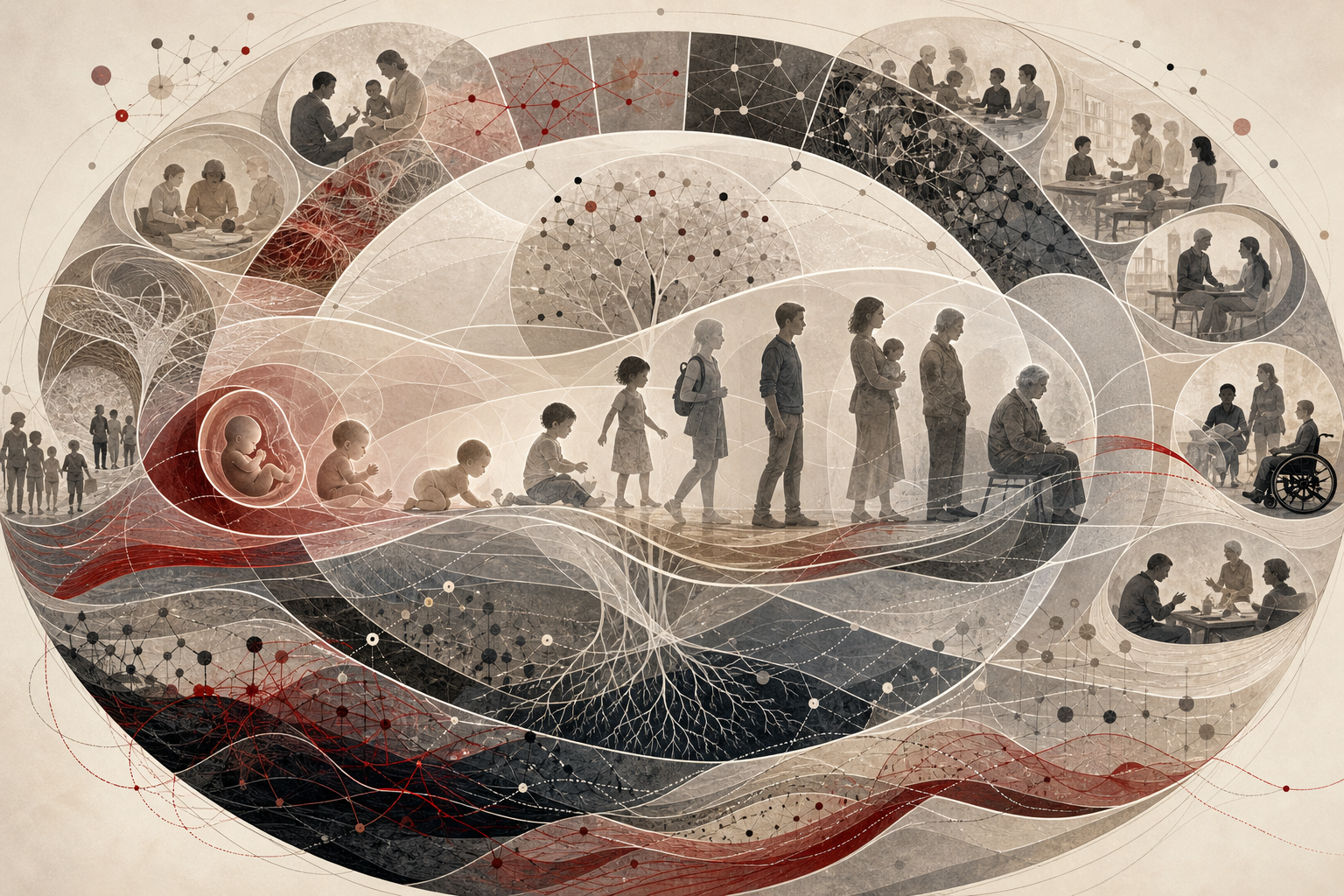
Developmental psychology appears here not only as a childhood science, but also as a lifespan, relational, biological, educational, cultural, institutional, ethical, quantitative, and computational field. The aim of this pillar is to preserve the conceptual richness of developmental psychology while also showing how contemporary developmental science increasingly relies on longitudinal evidence, statistical modeling, developmental neuroscience, social ecology, life-course analysis, reproducible workflows, and formal models of change.
The field matters because development is not simply a list of ages, stages, or milestones. Human beings become persons through time. They grow through dependence, attachment, language, schooling, embodiment, identity, work, care, loss, adaptation, and aging. Developmental psychology therefore provides one of the most consequential frameworks for understanding vulnerability, resilience, disability, neurodivergence, education, family life, social inequality, intergenerational responsibility, and the temporal structure of human life.
Developmental Psychology as a Foundational Science
Developmental psychology occupies a foundational place within psychological science because it supplies the temporal architecture of human life. Other branches of psychology often isolate particular processes such as memory, attention, personality, motivation, social influence, or decision making. Developmental psychology asks how those capacities emerge, reorganize, differentiate, stabilize, and sometimes decline across time. It therefore provides a framework without which many psychological findings remain incomplete.
This foundational role does not mean that developmental psychology replaces cognitive psychology, social psychology, personality psychology, educational psychology, clinical psychology, neuroscience, sociology, anthropology, or public health. Rather, it provides an integrating framework through which those fields can be understood developmentally. Cognitive capacities have developmental histories. Social behavior emerges through attachment, family systems, peer relations, schooling, and culture. Personality develops through temperament, relationship, identity, and life experience. Mental health vulnerability often unfolds through developmental pathways rather than isolated episodes.
Developmental psychology also provides one of the strongest bridges between the individual and the life course. It links biology, caregiving, education, family systems, culture, inequality, public health, disability, neurodivergence, aging, and institutional context within a single inquiry into the formation of persons. It asks not only what people are like, but how they become what they are.
Developmental Psychology as a Science of Growth, Context, and Lifespan Change
Developmental psychology may be understood as one of the great sciences of growth, context, and lifespan change. It studies how human beings become capable of perception, attachment, language, memory, reasoning, self-regulation, social understanding, moral judgment, identity, intimacy, work, generativity, adaptation, and later-life meaning. Its central object is not a fixed mind, but a life unfolding across time.
This makes developmental psychology different from a simple catalog of age-based milestones. Development is dynamic. It involves continuity and discontinuity, maturation and learning, stability and plasticity, biological constraint and environmental shaping, gains and losses, risk and resilience, vulnerability and adaptation. The field is concerned not only with what changes, but with why change occurs, how earlier conditions shape later possibilities, and how later contexts can revise or redirect developmental trajectories.
Development is also relational and ecological. It begins in dependence, unfolds through caregiving, expands through family systems, peer relations, schooling, culture, institutions, and historical conditions, and continues through adulthood and aging. Human development is never merely private growth. It is the socially and historically situated formation of human capacities across the course of life.
Developmental Psychology as a Quantitative and Computational Science
Modern developmental psychology is increasingly quantitative. Developmental change is not only described conceptually; it is measured, modeled, compared, tracked, visualized, and simulated. Longitudinal data can estimate developmental trajectories. Growth-curve models can examine change over time. Cohort designs can distinguish age effects from historical effects. Intervention studies can test whether support alters outcomes. Risk models can examine how adversity accumulates and how protective factors buffer developmental harm.
This does not mean that developmental psychology becomes a purely statistical field. Rather, it means that serious developmental explanation often requires moving across modes of inquiry. A researcher may observe early caregiving, measure attachment security, assess language development, track school readiness, model executive function, examine adolescent identity, compare cohorts, analyze aging trajectories, document assumptions in a notebook, store repeated observations in SQL, and interpret the results through developmental systems theory, neuroscience, family ecology, and social inequality.
For that reason, this series treats mathematics, statistics, longitudinal modeling, computational simulation, developmental measurement, SQL metadata, reproducible notebooks, and open code repositories as increasingly important parts of developmental literacy. Some articles remain primarily conceptual, historical, ethical, or theoretical. Others naturally require growth curves, repeated-measures analysis, simulations, developmental-risk models, cohort comparisons, or reproducible code. The aim is not to reduce development to numbers, but to build a Developmental Psychology pillar that reflects how the field is actually practiced when it is methodologically serious.
What Developmental Psychology Studies
Developmental psychology studies human growth and change across the lifespan. At the biological level, it examines prenatal development, brain development, temperament, puberty, embodiment, aging, stress physiology, disability, neurodivergence, and the biological foundations of developmental plasticity and constraint. At the cognitive level, it studies perception, attention, memory, executive function, language, learning, reasoning, problem solving, and conceptual development.
At the socioemotional level, developmental psychology studies attachment, caregiving, emotional regulation, empathy, trust, peer relations, social competence, moral development, identity, and relational life. At the institutional level, it studies schooling, family systems, cultural context, inequality, neighborhood effects, public health, developmental intervention, and the social ecology of growth. At the lifespan level, it studies adolescence, adulthood, aging, generativity, adaptation, loss, compensation, and later-life meaning.
Developmental psychology further studies the tension between stability and change. Some developmental patterns show continuity; others reorganize under new biological, relational, educational, cultural, or historical conditions. Human beings are shaped by early experience, but they are not simply determined by it. Developmental psychology studies both the power of early life and the continued possibility of adaptation.
What This Pillar Covers
This pillar brings together the major domains through which developmental psychology interprets human growth across time. It includes foundational theory, history, nature and nurture, continuity and discontinuity, stage theories, prenatal development, temperament, brain development, cognitive development, language development, attachment, play, self-regulation, social development, moral development, puberty, adolescence, gender development, adult development, aging, lifespan developmental psychology, developmental systems theory, genes and environment, family systems, education, disability, neurodivergence, developmental psychopathology, trauma, culture, inequality, research methods, sensitive periods, and the contemporary significance of developmental science.
These domains differ in method, scale, and emphasis, but together they form a coherent intellectual project: the attempt to understand how human beings become persons across time. Developmental psychology is therefore not only a body of knowledge about childhood, adolescence, adulthood, and aging. It is also a way of asking how capacities emerge, how vulnerability takes shape, how institutions affect growth, how inequality becomes embodied, and how human lives remain open to support, adaptation, and transformation.
The series also treats developmental psychology as a field that links the individual and the structural. Developmental knowledge informs caregiving, education, disability support, public health, social policy, mental health, aging services, early intervention, family systems, technology design, and intergenerational justice. For that reason, the pillar is designed not only to introduce developmental concepts, but to clarify why developmental reasoning remains indispensable for understanding the contemporary world.
Mathematics, Computation, and Modeling in Developmental Psychology
Mathematics provides part of the formal language through which developmental psychology understands change over time. Growth curves, transition models, probability, cumulative-risk scores, interaction effects, dynamic systems, resilience models, and longitudinal methods all clarify developmental processes that cannot be captured by static description alone.
A simplified recursive form can represent development as a dynamic process shaped by multiple interacting inputs:
D_{t+1} = D_t + \alpha B_t + \beta R_t + \gamma E_t + \delta L_t – \zeta S_t
\]
Interpretation: Developmental functioning at the next time point depends on prior functioning, biological maturation, relational support, environmental opportunity, learning, and stress or adversity.
where \(D_t\) represents developmental functioning at time \(t\), \(B_t\) biological maturation and embodied development, \(R_t\) relational support and caregiving, \(E_t\) environmental and educational opportunity, \(L_t\) learning and adaptation, and \(S_t\) stress, deprivation, adversity, or disorganizing risk.
The probability of an adaptive developmental outcome can also be expressed as a logistic model:
Pr(\text{adaptive outcome}) = \frac{1}{1 + e^{-Z_i}}
\]
Interpretation: The probability of an adaptive outcome can be modeled as a nonlinear function of developmental supports, opportunities, and risks.
where the latent developmental score may be written as:
Z_i = \theta_0 + \theta_1 A_i + \theta_2 C_i + \theta_3 O_i + \theta_4 P_i – \theta_5 R_i
\]
Interpretation: Adaptive outcomes are supported by attachment, cognitive support, opportunity, and protective resources, while cumulative risk reduces developmental probability.
Here \(A_i\) represents attachment security or relational stability, \(C_i\) cognitive and self-regulatory support, \(O_i\) opportunity structure and educational access, \(P_i\) protective factors and resilience resources, and \(R_i\) cumulative risk or adversity exposure.
A broader semi-formal model treats developmental flourishing across the life course as a function of biology, care, opportunity, regulation, identity, resilience, and cumulative risk:
DF = f(BM, CS, EO, SR, ID, RS, CR)
\]
Interpretation: Developmental flourishing is shaped by biological maturation, caregiving support, educational opportunity, self-regulation, identity development, resilience, and cumulative risk.
A simple additive representation is:
DF = \beta_1 BM + \beta_2 CS + \beta_3 EO + \beta_4 SR + \beta_5 ID + \beta_6 RS – \beta_7 CR
\]
Interpretation: Developmental functioning increases with support, opportunity, regulation, identity growth, and resilience, while cumulative risk reduces expected functioning.
A growth-curve expression can also represent developmental change across repeated observations:
Y_{it} = \pi_{0i} + \pi_{1i}t + \pi_{2i}t^2 + \epsilon_{it}
\]
Interpretation: A developmental outcome for person \(i\) at time \(t\) can be modeled through an individual starting point, linear change, nonlinear acceleration or deceleration, and measurement error.
These formulations do not reduce development to equations. They clarify a central developmental insight: growth is cumulative, recursive, path-sensitive, relational, and shaped by interaction among biological, psychological, educational, and social systems.
Computation is especially valuable where developmental systems become too complex for simple verbal explanation. R supports longitudinal modeling, mixed effects, growth curves, survey analysis, psychometrics, visualization, and reproducible reports. Python supports life-course simulation, trajectory modeling, developmental-risk analysis, data pipelines, machine learning, and agent-based models. Julia supports high-performance simulation and dynamic developmental systems. SQL supports structured participant records, repeated observations, developmental measures, cohort metadata, intervention data, and reproducible provenance. C++, Fortran, C, Rust, and Go support performance-sensitive simulation, command-line tools, embedded research utilities, and reproducible computational infrastructure.
Used carefully, mathematics and computation clarify developmental assumptions rather than replacing human interpretation. They make it possible to ask how early support compounds, how risk accumulates, how protective factors buffer adversity, how trajectories diverge, how interventions alter pathways, and how developmental systems remain open to change across time.
Major Domains of Developmental Psychology
Developmental psychology includes a wide range of major domains, each of which illuminates a different dimension of human change across time. Cognitive development studies perception, attention, memory, reasoning, conceptual understanding, executive function, problem solving, and the growth of mind. Language development examines speech, vocabulary, grammar, pragmatics, communication, and the social formation of linguistic competence. Attachment and socioemotional development study caregiving, emotional regulation, empathy, trust, peer relations, and the relational foundations of security and autonomy.
Moral development examines conscience, fairness, obligation, reciprocity, rule understanding, care, responsibility, and ethical judgment. Identity development studies how persons form coherent self-understandings in relation to history, role, aspiration, embodiment, culture, and social location. Biological development examines prenatal development, temperament, brain development, puberty, stress physiology, disability, neurodivergence, and aging. Lifespan development studies growth, transition, adaptation, compensation, generativity, decline, and meaning across adulthood and later life.
Developmental systems, family systems, education, culture, inequality, trauma, resilience, and developmental psychopathology extend this framework by showing that development is ecological. Growth unfolds through nested systems of body, family, school, community, culture, history, and institution. Developmental psychology therefore continues to broaden not only in subject matter, but also in methodological, ethical, and social depth.
Why Developmental Psychology Matters
Developmental psychology matters because no serious understanding of the person can remain static. Human beings are not completed psychological structures. They move through developmental transitions, maturational processes, relational dependencies, institutional settings, and shifting social roles that shape how they think, feel, learn, attach, judge, and act. Developmental psychology therefore addresses one of the most fundamental questions in the human sciences: how does a human life unfold across time?
The field also matters because development is not confined to one domain. Cognitive growth, attachment, emotional regulation, language acquisition, moral judgment, executive function, identity formation, embodiment, and social competence are deeply interwoven. Change in one domain often reshapes others. Developmental psychology is therefore one of the most integrative fields in psychology because it links biology, family life, caregiving, education, institutions, culture, inequality, and historical change within a single inquiry into the formation of persons.
Finally, developmental psychology matters because developmental conditions are socially consequential. Caregiving, poverty, trauma, educational opportunity, disability support, public health, family stability, and aging systems shape human lives across generations. Developmental psychology provides a vocabulary for understanding vulnerability without fatalism and plasticity without illusion.
Developmental Psychology and Human Self-Understanding
Developmental psychology changes how human beings understand themselves because it shows that personhood unfolds across time. Identity, cognition, attachment, morality, language, agency, and self-regulation do not appear fully formed. They develop through embodied maturation, relational dependency, learning, culture, social recognition, and historical context.
Yet developmental psychology also complicates simple narratives of progress. Not all change is improvement. Not all development is linear. Not all difference is deficit. Aging is not merely decline. Disability and neurodivergence are not reducible to developmental failure. Early experience matters deeply, but it does not exhaust later possibility. Developmental psychology is strongest when it recognizes both pattern and plurality.
For that reason, developmental psychology has philosophical as well as scientific significance. It raises enduring questions about dependence, vulnerability, autonomy, maturity, care, obligation, intergenerational responsibility, and the meaning of a life course. A serious Developmental Psychology pillar should therefore not end with stages or milestones alone. It should clarify the wider implications of developmental science for care, education, justice, aging, disability, policy, and human self-understanding.
Developmental Psychology Article Map
The article map below organizes the Developmental Psychology knowledge series into conceptual domains, moving from foundational theory and developmental questions toward biology, cognition, attachment, education, adolescence, adulthood, aging, systems theory, risk, resilience, culture, inequality, methods, and contemporary significance.
The Developmental Psychology pillar is organized to move from foundational theories and developmental questions into prenatal life, embodiment, cognition, language, attachment, play, self-regulation, moral development, adolescence, identity, adulthood, aging, family systems, education, disability, neurodivergence, trauma, resilience, culture, inequality, longitudinal methods, sensitive periods, and life-course interpretation. Mathematics, R, Python, Julia, C++, Fortran, C, Rust, SQL, Go, and computational notebooks are integrated within the series where they deepen understanding, especially in areas such as developmental trajectories, longitudinal analysis, cumulative risk, protective factors, cohort effects, developmental systems, lifespan simulation, resilience modeling, and reproducible developmental-science workflows.
Foundations, History, and Developmental Theory
- What Is Developmental Psychology? Human Development Across the Lifespan — An opening article defining developmental psychology as the study of human growth, change, adaptation, and aging across the lifespan, from prenatal life through later adulthood.
- The History of Developmental Psychology: From Child Study to Lifespan Science — An article on the development of the field from early child study and stage theory into modern lifespan science, developmental systems theory, and longitudinal research.
- Nature, Nurture, and the Developmental Question — A treatment of heredity, environment, gene-environment interaction, plasticity, biological constraint, and the long-running debate over what shapes developmental outcomes.
- Continuity, Discontinuity, and the Logic of Developmental Change — An article on gradual change, qualitative reorganization, developmental transitions, stability, plasticity, and the theoretical logic of change across time.
- Stage Theories of Development: Promise, Power, and Critique — A critical article on stage theories, including their historical importance, explanatory power, limitations, cultural assumptions, and continuing influence.
Biological Foundations, Embodiment, and Early Life
- Prenatal Development and the Earliest Foundations of Life — An article on fetal development, maternal environment, teratogens, stress, nutrition, early biological organization, and the earliest conditions of human development.
- Temperament and Individual Differences in Development — A study of biologically rooted differences in reactivity, regulation, attention, emotion, and behavioral style.
- Brain Development, Plasticity, and the Developing Nervous System — An article on neural maturation, plasticity, sensitive periods, brain organization, developmental neuroscience, and the biological basis of cognitive and emotional growth.
- Puberty, Embodiment, and Adolescent Transition — A treatment of hormonal change, bodily development, developmental timing, identity, social comparison, emotion, and the embodied transition into adolescence.
Cognition, Language, Learning, and Play
- Cognitive Development and the Growth of Mind — A core article on the development of perception, attention, memory, reasoning, conceptual understanding, problem solving, and executive function.
- Language Development and the Social Formation of Speech — An article on speech, vocabulary, grammar, pragmatics, caregiver interaction, communication, and the social ecology of language acquisition.
- Play, Imagination, and Development — A study of play as developmental work, including imagination, social learning, symbolic thought, regulation, creativity, and peer interaction.
- Self-Regulation and Executive Function Across Development — An article on inhibition, working memory, cognitive flexibility, emotion regulation, attention control, planning, and developmental self-management.
Attachment, Social Development, Morality, and Identity
- Attachment, Caregiving, and Early Emotional Development — A core article on attachment security, caregiver responsiveness, emotional regulation, trust, separation, and the relational foundations of development.
- Social Development, Peer Relations, and the Formation of the Self — An article on peer relationships, social competence, friendship, conflict, belonging, self-concept, and the developmental role of social life.
- Moral Development and the Growth of Conscience — A treatment of fairness, obligation, empathy, rule understanding, moral reasoning, care, responsibility, and the development of conscience.
- Adolescence, Identity, and Psychological Transition — An article on adolescence as a developmental transition involving identity, autonomy, peer relations, risk, emotional change, and future orientation.
- Gender Development and Sexual Development — A study of gender identity, sexual development, embodiment, socialization, cultural meaning, and developmental diversity.
Adulthood, Aging, Lifespan Development, and Meaning
- Adult Development and the Psychology of Life Stages — An article on adulthood as a developmental period involving work, intimacy, identity, parenthood, role transition, responsibility, and adaptation.
- Aging, Adaptation, and Development in Later Life — A treatment of aging, cognitive change, emotional adjustment, health, loss, compensation, social connection, and later-life development.
- Wisdom, Meaning, and Development in Later Life — An article on wisdom, life review, generativity, meaning, perspective, loss, resilience, and the developmental possibilities of later life.
- Lifespan Developmental Psychology and the Baltes Tradition — A focused article on the Baltes tradition, including gains and losses, plasticity, selection, optimization, compensation, and development across the full life course.
Systems, Families, Education, Risk, and Social Ecology
- Developmental Systems Theory and the Ecology of Human Growth — A systems article on organism-context interaction, nested environments, relational development, plasticity, and the ecology of human growth.
- Genes, Environment, and Developmental Plasticity — An article on gene-environment interaction, epigenetic influence, plasticity, sensitivity, and biological-contextual development.
- Parenting, Family Systems, and Human Development — A treatment of caregiving, family roles, siblings, kinship, parenting styles, attachment, conflict, stability, and the family as a developmental system.
- Education, Schooling, and Developmental Formation — An article on schooling, early childhood education, classroom climate, motivation, peer culture, learning, discipline, and developmental opportunity.
- Disability, Neurodivergence, and Development — A critical article on developmental difference, disability, neurodivergence, support, stigma, adaptation, and the limits of narrow norms of typical development.
- Developmental Psychopathology: Risk, Resilience, and Adaptation — A major article on developmental disorders, maladaptation, risk factors, protective factors, resilience, and developmental pathways of mental health.
- Trauma, Adversity, and the Life Course — An article on trauma, neglect, chronic adversity, stress physiology, developmental cascades, recovery, and the life-course impact of early and later adversity.
- Culture and Development Across Societies — A cross-cultural article on caregiving, autonomy, interdependence, family structure, moral development, schooling, and life-course expectations across societies.
- Development, Inequality, and the Life Course — An article on poverty, exclusion, discrimination, neighborhood effects, educational inequality, health disparities, and the developmental embodiment of social structure.
Methods, Timing, and Contemporary Significance
- Research Methods in Developmental Psychology: Longitudinal, Cross-Sectional, and Cohort Designs — A methodological article on studying change across time, distinguishing age effects from cohort effects, and designing rigorous developmental research.
- Critical Periods, Sensitive Periods, and the Timing of Development — An article on developmental timing, plasticity, sensitive windows, early experience, intervention, and the conditions under which timing matters.
- Why Developmental Psychology Matters Today — A capstone-style article on the contemporary significance of developmental science for care, education, public policy, inequality, aging, disability, technology, and human formation.
Planned Extensions
- Developmental Psychology and Early Childhood Intervention (planned) — An article on early support, developmental screening, family-centered intervention, early education, protective factors, and the ethics of acting during sensitive developmental periods.
- Developmental Psychology and Executive Function (planned) — A focused treatment of inhibition, working memory, cognitive flexibility, self-regulation, school readiness, adolescent control systems, and lifespan change in executive function.
- Developmental Psychology and Attachment Across the Lifespan (planned) — An article on attachment from infancy through adulthood, including caregiving, internal working models, close relationships, trauma, repair, and relational continuity.
- Developmental Psychology and Digital Childhood (planned) — A study of screens, social media, learning platforms, online peer culture, attention, identity, privacy, family mediation, and developmental technology design.
- Developmental Psychology and Life-Course Inequality (planned) — An article on how social inequality becomes developmental inequality through family resources, schooling, health, neighborhood context, discrimination, and cumulative advantage or disadvantage.
- Developmental Psychology, Aging, and Social Care (planned) — A lifespan article on later-life development, care systems, cognitive aging, social connection, disability, loss, adaptation, and dignity in aging societies.
This structure keeps the pillar grounded in developmental psychology while reflecting the longitudinal, quantitative, computational, ecological, ethical, and life-course depth of contemporary developmental science.
Measurement, Longitudinal Design, and Developmental Practice
One of developmental psychology’s enduring contributions is its insistence that human change must be studied across time. Developmental claims cannot be understood through a single snapshot alone. The field relies on longitudinal research, cross-sectional comparison, sequential designs, repeated observation, age-sensitive measurement, cohort analysis, developmental neuroscience, and careful interpretation of historical context.
This matters because developmental evidence is difficult. Chronological age is not the same as developmental level. Cohort differences can be mistaken for age differences. Historical conditions can alter life-course expectations. A construct such as attachment, self-regulation, identity, or moral reasoning cannot always be measured in the same way across infancy, adolescence, adulthood, and aging. Developmental psychology therefore requires careful methodological reasoning about time, measurement, equivalence, and inference.
Modern developmental practice increasingly depends on reproducible workflows. Studies generate repeated measures, participant histories, family context, educational data, observational ratings, biological measures, intervention records, and long-term outcomes. A serious Developmental Psychology pillar should therefore treat research design, ethics, longitudinal methods, measurement equivalence, data provenance, and reproducibility as central to developmental science.
Developmental Psychology, Technology, and the Modern World
Developmental psychology has become increasingly important because modern development unfolds inside technological environments. Children, adolescents, adults, and older adults now develop through digital media, educational platforms, social networks, video communication, algorithmic feeds, learning apps, assistive technologies, surveillance systems, AI tools, and digitally mediated peer cultures.
The connection between developmental psychology and technology is especially visible in attention, language, play, identity, social comparison, peer belonging, sleep, schooling, family communication, disability support, aging, and mental health. Digital environments do not merely add tools to development. They alter the contexts in which social learning, self-presentation, attention, communication, and belonging unfold.
At the same time, technology can support development when it is designed with human needs in mind. Assistive technologies can support disability access. Educational tools can personalize learning. Remote communication can reduce isolation. Digital records can improve continuity of care. A mature developmental psychology of technology must therefore ask how digital systems affect growth, vulnerability, agency, care, inequality, and life-course opportunity.
Developmental Psychology, Computation, and Lifespan Simulation
Computation has become central to developmental psychology because development unfolds dynamically across individuals, families, institutions, cohorts, and historical contexts. Risk accumulates. Protective factors buffer adversity. Educational opportunity compounds. Self-regulation develops recursively. Attachment and trust shape later relationships. Aging involves both decline and compensation. These processes cannot always be understood through static comparisons alone.
Lifespan simulation allows researchers to formalize assumptions about developmental systems. A model can test how early caregiving changes later self-regulation, how cumulative risk alters trajectories, how protective factors buffer adversity, how educational opportunity compounds over time, or how cohort conditions affect later-life outcomes. These models do not replace empirical developmental science, but they can clarify mechanisms and generate hypotheses.
For that reason, this pillar treats computation as a supporting discipline of developmental psychology, not as a substitute for human interpretation. Models must remain transparent, ethically grounded, empirically informed, and attentive to culture, disability, inequality, and context. The strongest form of computational developmental psychology is therefore not technocratic prediction, but auditable lifespan reasoning in service of better explanations of human growth.
R Section: Modeling Developmental Trajectories, Risk, and Protection
For analytical readers, R is useful for modeling repeated observations, developmental trajectories, cumulative risk, protective factors, cohort differences, and intervention outcomes. The example below creates a synthetic longitudinal dataset and estimates developmental functioning across repeated time points. It is not real research data. It is a reproducible scaffold for thinking clearly about growth, risk, and protection.
# Synthetic developmental psychology model in R
# Educational example only.
# This script simulates longitudinal developmental data and models change over time.

# install.packages(c("tidyverse", "lme4", "broom.mixed", "scales"))

library(tidyverse)
library(lme4)
library(broom.mixed)
library(scales)

set.seed(42)

n_participants <- 240
n_waves <- 6

participants <- tibble(
  participant_id = 1:n_participants,
  attachment_security = runif(n_participants, 0.10, 1.00),
  caregiver_support = runif(n_participants, 0.10, 1.00),
  educational_opportunity = runif(n_participants, 0.10, 1.00),
  cumulative_risk = runif(n_participants, 0.00, 1.00),
  protective_resources = runif(n_participants, 0.00, 1.00),
  cohort_group = sample(c("earlier_cohort", "later_cohort"), n_participants, replace = TRUE)
)

longitudinal_data <- expand_grid(
  participant_id = participants$participant_id,
  wave = 0:(n_waves - 1)
) |>
  left_join(participants, by = "participant_id") |>
  mutate(
    cohort_adjustment = if_else(cohort_group == "later_cohort", 2.5, 0),

    developmental_functioning =
      45 +
      cohort_adjustment +
      3.8 * wave +
      7.0 * attachment_security +
      6.5 * caregiver_support +
      5.5 * educational_opportunity +
      4.8 * protective_resources -
      8.0 * cumulative_risk +
      1.2 * wave * protective_resources -
      1.6 * wave * cumulative_risk +
      rnorm(n(), mean = 0, sd = 5)
  )

# Mixed-effects growth model with participant-level random intercepts.
growth_model <- lmer(
  developmental_functioning ~ wave + attachment_security + caregiver_support +
    educational_opportunity + protective_resources + cumulative_risk +
    wave:protective_resources + wave:cumulative_risk +
    (1 | participant_id),
  data = longitudinal_data
)

growth_summary <- tidy(growth_model, effects = "fixed", conf.int = TRUE)

print(growth_summary)

# Summarize developmental trajectories by cumulative-risk band.
trajectory_summary <- longitudinal_data |>
  mutate(risk_band = cut(
    cumulative_risk,
    breaks = c(0, 0.33, 0.66, 1),
    labels = c("Low cumulative risk", "Moderate cumulative risk", "High cumulative risk"),
    include.lowest = TRUE
  )) |>
  group_by(wave, risk_band) |>
  summarise(
    mean_functioning = mean(developmental_functioning),
    .groups = "drop"
  )

print(trajectory_summary)

ggplot(trajectory_summary, aes(x = wave, y = mean_functioning, group = risk_band)) +
  geom_line() +
  geom_point() +
  labs(
    title = "Synthetic Developmental Trajectories by Cumulative Risk",
    x = "Observation wave",
    y = "Mean developmental functioning",
    group = "Risk band"
  ) +
  theme_minimal()
This workflow models a central developmental intuition: trajectories are shaped by time, support, risk, protection, and context. Developmental outcomes do not emerge from a single cause. They unfold through repeated interaction among caregiving, opportunity, stress, resilience, maturation, and institutional conditions. In real research, such models require careful design, measurement equivalence, ethical handling of participant data, and caution about causal interpretation. In a pillar-level context, the value of the workflow is conceptual clarity: it shows how developmental claims can be translated into explicit variables, assumptions, and longitudinal model structures.
Python Section: Simulating Lifespan Developmental Dynamics
Python is useful for simulating developmental processes that unfold dynamically across time. Risk, support, opportunity, self-regulation, learning, stress, identity, and resilience can interact recursively. The example below creates a simple lifespan simulation in which developmental functioning changes across repeated periods as support and opportunity strengthen growth while cumulative risk and stress create countervailing pressure.
# Synthetic lifespan developmental simulation in Python
# Educational example only.
# This script simulates developmental functioning over time.

import numpy as np
import pandas as pd
import matplotlib.pyplot as plt

np.random.seed(42)

n_people = 120
n_periods = 80

# Person-level starting conditions.
caregiver_support = np.random.uniform(0.15, 1.0, n_people)
educational_opportunity = np.random.uniform(0.15, 1.0, n_people)
protective_resources = np.random.uniform(0.10, 1.0, n_people)
baseline_risk = np.random.uniform(0.00, 1.0, n_people)

# Initial developmental functioning.
development = (
    45
    + 10 * caregiver_support
    + 8 * educational_opportunity
    + 7 * protective_resources
    - 11 * baseline_risk
    + np.random.normal(0, 4, n_people)
)

history = np.zeros((n_periods, n_people))
history[0, :] = development

for t in range(1, n_periods):
    # Risk fluctuates but remains partly anchored to early conditions.
    current_risk = np.clip(
        0.70 * baseline_risk + 0.30 * np.random.uniform(0, 1, n_people),
        0,
        1
    )

    # Support can buffer risk, but not eliminate it.
    buffering = 0.40 * caregiver_support + 0.35 * protective_resources

    # Developmental change at each period.
    growth = (
        0.22
        + 0.10 * educational_opportunity
        + 0.08 * caregiver_support
        + 0.07 * protective_resources
        - 0.16 * current_risk
        + 0.10 * buffering
        + np.random.normal(0, 0.45, n_people)
    )

    # Late-life slowing can be represented modestly after a threshold.
    if t > 55:
        growth -= 0.18 + 0.04 * (t - 55)

    development = np.clip(development + growth, 0, 100)
    history[t, :] = development

simulation = pd.DataFrame(history)
simulation["period"] = np.arange(n_periods)

mean_development = history.mean(axis=1)
development_variance = history.var(axis=1)

summary = pd.DataFrame({
    "period": np.arange(n_periods),
    "mean_developmental_functioning": mean_development,
    "developmental_variance": development_variance
})

print(summary.head())
print(summary.tail())

plt.figure(figsize=(10, 6))
plt.plot(summary["period"], summary["mean_developmental_functioning"])
plt.xlabel("Developmental period")
plt.ylabel("Mean developmental functioning")
plt.title("Synthetic Lifespan Developmental Functioning Over Time")
plt.tight_layout()
plt.show()

plt.figure(figsize=(10, 6))
plt.plot(summary["period"], summary["developmental_variance"])
plt.xlabel("Developmental period")
plt.ylabel("Developmental variance")
plt.title("Synthetic Lifespan Developmental Inequality Over Time")
plt.tight_layout()
plt.show()

# Compare groups by early cumulative risk.
risk_group = np.where(baseline_risk >= np.median(baseline_risk), "Higher early risk", "Lower early risk")

comparison = pd.DataFrame({
    "person": np.arange(n_people),
    "risk_group": risk_group,
    "final_developmental_functioning": history[-1, :]
})

print(
    comparison.groupby("risk_group")["final_developmental_functioning"]
    .agg(["mean", "std", "min", "max"])
)
This simulation is intentionally modest. It does not claim that lifespan development can be explained by a few variables. Its value is that it makes assumptions visible. Early risk matters. Support matters. Opportunity matters. Protection matters. Later change remains possible. Development is not a single line of progress; it is a dynamic trajectory shaped by conditions that accumulate, interact, and sometimes change.
GitHub Repository
This knowledge series is supported by a companion repository for reproducible examples, synthetic datasets, longitudinal-analysis workflows, lifespan simulations, developmental-risk models, cohort-analysis scaffolding, intervention-evaluation examples, and scientific-computing workflows where appropriate.
Complete Code Repository
Access the full companion repository for this article map, including article-level folders, reproducible analysis materials, synthetic developmental datasets, longitudinal modeling scaffolds, lifespan simulation examples, and computational workflows for developmental psychology research.
Interpretive Limits and Developmental Cautions
Developmental psychology is powerful because it studies human beings across time. Yet the same strength can become a weakness when developmental claims are treated too rigidly. A stage model is not a destiny. A milestone is not a moral ranking. A delay is not automatically a defect. A statistical trajectory is not an individual life. A risk factor is not a sentence. A protective factor is not a guarantee.
Analysts and readers should therefore avoid confusing developmental patterns with universal laws, early experience with inevitability, age norms with human worth, or measurable outcomes with the whole meaning of a life. Developmental psychology can reveal the importance of early care, education, family systems, and public policy, but it must remain attentive to disability, neurodivergence, culture, historical context, inequality, trauma, plural life paths, and the dignity of persons whose development does not conform to narrow norms.
The field is strongest when it combines scientific discipline with ethical humility. It should not be used to pathologize difference, over-police childhood, reduce aging to decline, or define human value by productivity, independence, or standardized achievement. Its better purpose is explanatory and humane: to understand how lives unfold so that care, education, institutions, technologies, and public systems can better support human development across the full life course.
Developmental Psychology in a Wider Intellectual Context
Developmental psychology belongs not only to psychology, but to the broader history of human thought about growth, care, dependency, maturity, education, aging, personhood, and moral life. Philosophers, educators, theologians, physicians, novelists, political theorists, and social reformers have long asked how human beings become capable of judgment, responsibility, love, autonomy, wisdom, and participation in community. Developmental psychology brings empirical discipline to those questions.
The field changes the imagination of the person. It shows that human life is not a static possession, but a temporal process. It forces thought to move between infancy and old age, dependence and agency, biology and culture, vulnerability and resilience, continuity and transformation. It reveals that becoming a person is never a purely individual achievement. It depends on bodies, relationships, institutions, histories, and forms of care.
For that reason, developmental psychology should be understood as both a scientific and moral achievement. It brings together experiment, observation, longitudinal evidence, family systems, education, neuroscience, social ecology, disability studies, public health, ethics, and lifespan interpretation in a sustained effort to understand human becoming. It remains indispensable for any serious framework concerned with care, education, aging, vulnerability, resilience, justice, and the temporal structure of human life.
Related Reading
- Psychology
- Cognitive Psychology
- Social Psychology
- Personality Psychology
- Positive Psychology
- Organizational Psychology
- Institutional Psychology
- Cognitive Development and Learning
- Systems Thinking
- Data Systems & Analytics
- Artificial Intelligence Systems
Further Reading
- American Psychological Association (n.d.) Developmental Psychology. Available at: https://www.apa.org/education-career/guide/subfields/developmental (Accessed: 4 May 2026).
- American Psychological Association (n.d.) Developmental Psychology journal page. Available at: https://www.apa.org/pubs/journals/dev (Accessed: 4 May 2026).
- Baltes, P.B., Reese, H.W. and Lipsitt, L.P. (1980) ‘Life-span developmental psychology’, Annual Review of Psychology, 31, pp. 65–110. Available at: https://www.annualreviews.org/content/journals/10.1146/annurev.ps.31.020180.000433 (Accessed: 4 May 2026).
- Bornstein, M.H. and Lamb, M.E. (eds.) (2015) Developmental Science: An Advanced Textbook. 7th edn. New York: Psychology Press.
- Bronfenbrenner, U. (1979) The Ecology of Human Development: Experiments by Nature and Design. Cambridge, MA: Harvard University Press.
- Lerner, R.M. (2018) Concepts and Theories of Human Development. 4th edn. New York: Routledge.
- National Institute of Child Health and Human Development (n.d.) Child Development and Behavior Branch. Available at: https://www.nichd.nih.gov/about/org/der/branches/cdbb (Accessed: 4 May 2026).
- Overton, W.F. and Molenaar, P.C.M. (eds.) (2015) Handbook of Child Psychology and Developmental Science: Theory and Method. 7th edn. Hoboken, NJ: Wiley.
- Society for Research in Child Development (n.d.) Mission and Scientific Vision. Available at: https://www.srcd.org/about-us/mission-scientific-vision (Accessed: 4 May 2026).
- World Health Organization (2020) Decade of Healthy Ageing: Baseline Report. Available at: https://www.who.int/publications/i/item/9789240017900 (Accessed: 4 May 2026).
References
- American Psychological Association (n.d.) Developmental Psychology. Available at: https://www.apa.org/education-career/guide/subfields/developmental (Accessed: 4 May 2026).
- American Psychological Association (n.d.) Developmental Psychology journal page. Available at: https://www.apa.org/pubs/journals/dev (Accessed: 4 May 2026).
- Baltes, P.B., Reese, H.W. and Lipsitt, L.P. (1980) ‘Life-span developmental psychology’, Annual Review of Psychology, 31, pp. 65–110. Available at: https://www.annualreviews.org/content/journals/10.1146/annurev.ps.31.020180.000433 (Accessed: 4 May 2026).
- Bornstein, M.H. and Lamb, M.E. (eds.) (2015) Developmental Science: An Advanced Textbook. 7th edn. New York: Psychology Press.
- Bronfenbrenner, U. (1979) The Ecology of Human Development: Experiments by Nature and Design. Cambridge, MA: Harvard University Press.
- Lerner, R.M. (2018) Concepts and Theories of Human Development. 4th edn. New York: Routledge.
- National Institute of Child Health and Human Development (n.d.) Child Development and Behavior Branch. Available at: https://www.nichd.nih.gov/about/org/der/branches/cdbb (Accessed: 4 May 2026).
- Overton, W.F. and Molenaar, P.C.M. (eds.) (2015) Handbook of Child Psychology and Developmental Science: Theory and Method. 7th edn. Hoboken, NJ: Wiley.
- Society for Research in Child Development (n.d.) Mission and Scientific Vision. Available at: https://www.srcd.org/about-us/mission-scientific-vision (Accessed: 4 May 2026).
- World Health Organization (2020) Decade of Healthy Ageing: Baseline Report. Available at: https://www.who.int/publications/i/item/9789240017900 (Accessed: 4 May 2026).