
Last Updated May 21, 2026
Wisdom and meaning in later life are not decorative additions to aging. They are part of the developmental work through which older adults interpret memory, loss, time, relationship, finitude, dignity, and the question of what a life has amounted to. Later life is often discussed in terms of health, function, cognition, care, and dependency, and those dimensions matter profoundly. But a serious developmental psychology must also ask how older adults make meaning from long experience, how they revise values under changing bodily and social conditions, and how forms of reflection, perspective, acceptance, moral judgment, and life integration may deepen across the later years.
Wisdom is not guaranteed by age, and meaning is not automatically given by survival. Later life can deepen perspective, but it can also intensify regret, isolation, bitterness, fear, or unresolved grief. The developmental question is not whether aging produces wisdom by default, but how later life changes the conditions under which wisdom, narrative integration, humility, generativity, acceptance, and meaning-making may emerge. Older adulthood is not simply the final stage of decline. It is a psychologically serious period in which people continue to interpret experience, reorganize identity, maintain or rebuild connection, face finitude, and ask what remains worth sustaining.
Main Library
Publications
Article Map
Developmental Psychology
Related Topic
Positive Psychology
Related Topic
Cognitive Psychology
Related Topic
Risk & Resilience
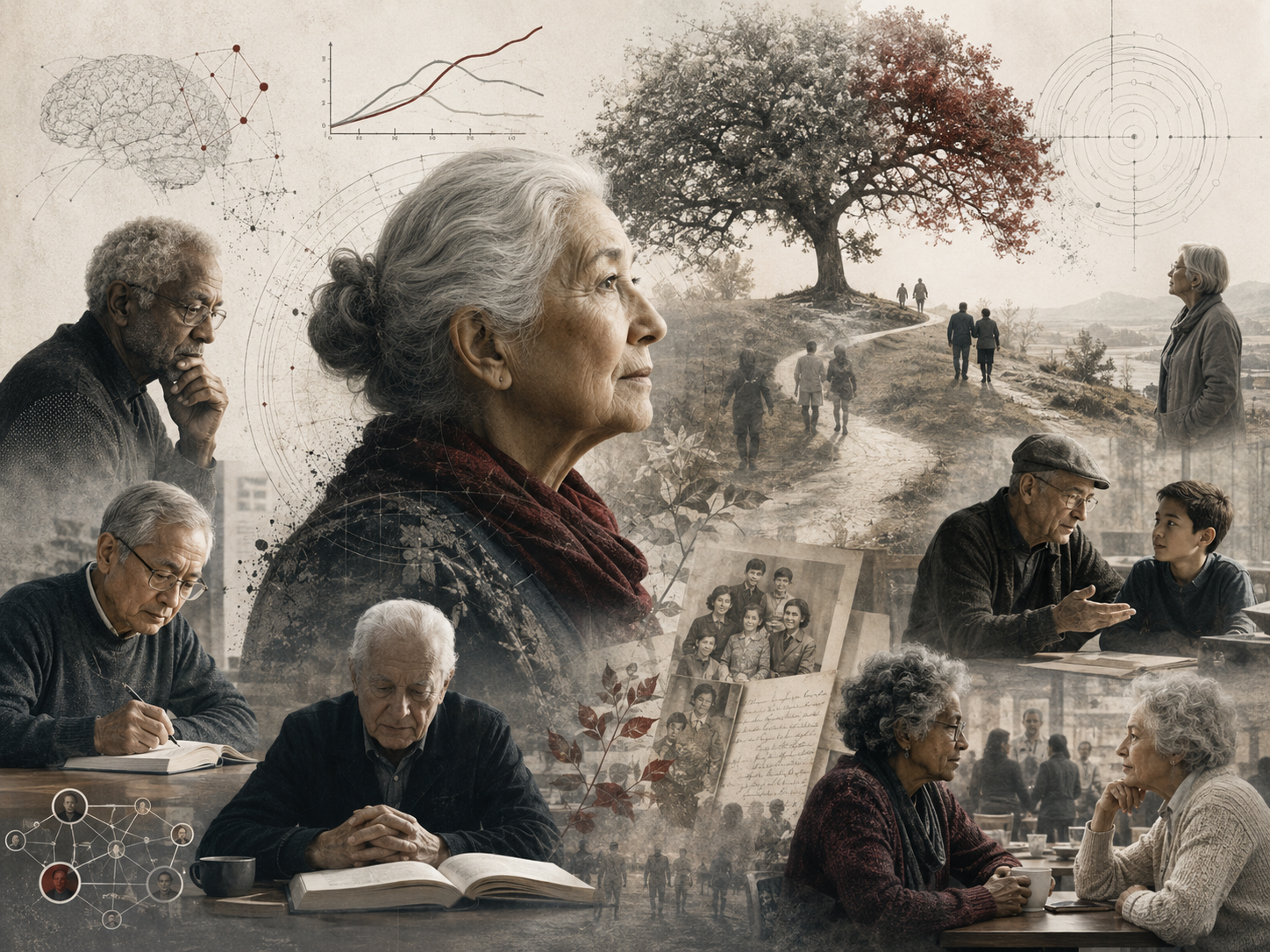
Current official sources support a broad developmental view of later life. WHO’s healthy-ageing framework centers functional ability and what people have reason to value, not merely disease avoidance. CDC’s healthy-aging guidance includes emotional well-being and social well-being alongside physical and mental functioning, and CDC’s social connection materials emphasize the role of high-quality relationships in longer, healthier lives. NIA likewise frames healthy aging around quality of life, independence where possible, and meaningful adaptation under changing conditions. These sources do not treat wisdom as a formal clinical variable, but they support the deeper developmental point: later life concerns not only how long one lives, but how one interprets, organizes, values, and inhabits life under conditions of aging.
A developmental psychology of later-life wisdom must therefore hold several truths together. Later life can bring loss, illness, bereavement, role change, loneliness, and dependence. It can also bring perspective, selective attention to what matters, reconciliation, moral clarity, spiritual depth, generativity, and a less performative relation to achievement. Aging does not automatically ennoble, but it can create distinctive developmental pressures: to integrate memory, accept limits, repair relationships, transmit value, live with unfinishedness, and find dignity in the face of time.
Why Wisdom and Meaning Matter
Wisdom and meaning matter in later life because aging changes the developmental weight of reflection. In childhood and adolescence, the future often dominates experience. In adulthood, obligation, work, care, and institutional roles can crowd the field of attention. In later life, especially as time horizons shorten and accumulated history becomes harder to ignore, questions of meaning often become more explicit: What mattered? What was worth building? What must be accepted? What can still be repaired? What should be released? What remains possible now?
Later life can therefore intensify developmental concerns that were always present but not always foregrounded. Human beings interpret their lives across the whole lifespan, but older adulthood may make interpretation more urgent because the relation among memory, time, body, relationship, and mortality changes. A person may have more past than future. Relationships may become fewer but more emotionally central. Health constraints may force revisions of autonomy. Roles may fall away. Legacy may become more concrete. The question of meaning becomes less abstract because the life being interpreted has already accumulated decades of consequence.
This does not mean wisdom automatically arrives with age. Age can deepen perspective, but it can also intensify rigidity, disappointment, fear, or isolation. The developmental question is not whether older adults become wise by default, but how later life changes the conditions under which perspective, acceptance, judgment, humility, and meaning-making may emerge. APA’s materials on older adults and aging treat later life as an active psychological phase, while CDC and NIA emphasize social, emotional, cognitive, and physical well-being as central parts of healthy aging. This broader framing supports a developmental psychology of wisdom rather than a stereotype of old age as either decline or automatic enlightenment.
Wisdom and meaning also matter because later life exposes the inadequacy of narrow productivity models. A life cannot be judged only by labor output, economic status, independence, or cognitive speed. Older adults continue to contribute through memory, counsel, care, presence, moral witness, intergenerational transmission, community participation, and the interpretation of experience. Developmental psychology therefore needs a vocabulary for later-life value that is not limited to performance or decline.
What Wisdom Is
Wisdom is difficult to define because it is not reducible to intelligence, age, education, knowledge, emotional calm, or mere experience. Developmentally, wisdom can be understood as a more mature way of judging life under conditions of complexity, uncertainty, finitude, conflict, and value pluralism. It often includes perspective-taking, interpretive breadth, emotional regulation, humility about control, tolerance for ambiguity, and the ability to situate immediate events within a wider frame of consequence and meaning.
Wisdom is not simply having many facts. A person can be informed without being wise. Nor is wisdom the same as happiness. A wise person may carry grief clearly rather than deny it. Nor is wisdom identical to optimism. It may involve sober recognition of loss, injustice, limitation, and mortality. Wisdom is better understood as a changed relation to knowledge, self, time, and consequence. It asks not only “What is true?” but “What matters?” “What can be known?” “What must be accepted?” “What should be done?” and “What does this mean in the wider pattern of a life?”
In later life, wisdom often becomes thinkable because long experience exposes the limits of simplification. Older adults may have lived through success and disappointment, intimacy and estrangement, productivity and loss, health and illness, certainty and reversal. Experience alone does not guarantee insight, but it can create the conditions in which simpler narratives no longer suffice. A developmental account therefore treats wisdom not as a mystical trait but as a possible outcome of long-term interpretive work under real conditions of life.
Wisdom also has social and ethical dimensions. A wise judgment is not merely self-protective; it often includes concern for others, awareness of interdependence, and recognition of limits. Later-life wisdom may appear in advice, restraint, forgiveness, humility, generativity, moral clarity, or the ability to distinguish what deserves energy from what should be released. It is not passive resignation. It is the disciplined interpretation of life under constraint.
What Meaning Is
Meaning in later life concerns how people understand the significance, coherence, and worth of their lives under changing conditions. It includes purpose, but it is not identical to productivity. Meaning can arise from love, care, memory, faith, craft, family, contribution, survival, beauty, endurance, reconciliation, service, witness, and continued presence. It is often less about constant striving than about whether one’s life can still be experienced as connected, intelligible, and worth inhabiting.
Meaning has at least three developmental dimensions. The first is coherence: whether the person can make sense of life as a narrative, even when the narrative includes rupture, regret, or loss. The second is significance: whether life feels as though it matters to oneself, others, a community, a tradition, or a larger moral or spiritual order. The third is purpose: whether there remains some orientation toward what is worth doing, protecting, repairing, enjoying, or transmitting.
Official healthy-aging sources often speak in terms of well-being, independence, connection, functional ability, quality of life, and valued activity rather than explicitly philosophical meaning. But the underlying question is similar. WHO’s emphasis on functional ability and what people have reason to value, CDC’s inclusion of emotional and social well-being, and NIA’s focus on quality of life all imply that aging well is not merely biomedical. It also concerns whether people can continue to live in ways that feel meaningful under changing constraints.
Meaning in later life is also not always peaceful. It can involve struggle. A person may need to reinterpret hardship, mourn lost possibilities, forgive or refuse forgiveness, accept illness, grieve relationships, revise identity, or make peace with unresolved chapters. Later-life meaning does not require pretending that everything was good. It requires some way of holding truth, value, and finitude together.
Later Life and the Deepening of Perspective
Later life can deepen perspective because time itself changes psychological orientation. When the future is no longer treated as indefinite, values may be reordered. Minor conflict can lose urgency. Certain relationships may gain weight. Ambitions that once seemed central may appear less compelling than peace, integrity, presence, reconciliation, or spiritual seriousness. This does not make later life automatically serene. It means that aging can reorganize attention toward what now matters most.
Socioemotional selectivity theory helps clarify this shift. As perceived time horizons shorten, people often prioritize emotionally meaningful goals and relationships. This can help explain why later life may bring greater selectivity in social contact, increased attention to close relationships, and less investment in peripheral status competition. Developmentally, this is not withdrawal alone. It can be a reorganization of motivation under changing time horizons.
Perspective may also deepen because older adults have lived through enough reversals to distrust simple formulas. They may know that success can become loss, failure can become formation, conflict can soften, and certainty can become error. Wisdom often emerges where experience has disturbed easy judgment. This is why later-life perspective can include humility: a recognition that control is partial, that people are complicated, and that lives rarely unfold according to plan.
CDC’s social connection guidance notes that close, supportive relationships are linked to better health and reduced loneliness, while WHO’s healthy-ageing framework emphasizes the ability to maintain relationships and contribute to society. These are not just public-health indicators. They suggest that later-life perspective often becomes more relational and evaluative: what bonds remain, what roles still matter, what forms of presence are worth sustaining, and what kind of person one still wants to be.
Memory, Narrative, and Life Review
Meaning in later life is often mediated through memory. Older adults do not simply possess more past; they may relate to the past differently. Later life often brings a stronger impulse toward life review: recalling, reinterpreting, integrating, or reconciling earlier chapters of experience. This process can be comforting, painful, unfinished, or transformative. The developmental point is that memory in later life is often not only retrieval. It is narrative work.
A human life is not experienced only as a sequence of events. It is also experienced as a story one continues to tell and revise. Regret, gratitude, grief, pride, estrangement, forgiveness, shame, endurance, and love may all become part of later-life narrative labor. Later adulthood can therefore involve a more explicit struggle over coherence: whether one’s life can still be gathered into something intelligible enough to inhabit with honesty.
Life review can support meaning when it allows a person to integrate contradictions rather than erase them. A person may come to see that painful periods also produced commitments, that failures were not the whole of the self, that relationships contained both harm and love, or that some unresolved losses must be mourned rather than solved. In this sense, later-life development may involve narrative complexity: the capacity to hold multiple truths about a life without collapsing into denial or despair.
Life review can also become difficult or destabilizing. Some memories return with force. Some regrets remain unresolved. Some people face trauma, estrangement, moral injury, or losses that resist integration. A serious developmental psychology should not treat life review as automatically therapeutic. Its effects depend on support, safety, emotional capacity, cultural context, and whether the person has relationships or institutions that can help hold the work of remembering.
Loss, Finitude, and the Search for Meaning
Later life is often marked by intensified encounter with loss: death of spouses or friends, illness, retirement, reduced mobility, sensory change, shrinking roles, changing home environments, or increasing dependence. WHO’s ageing and health materials emphasize that older adults are more likely to experience multiple conditions at once, and CDC’s healthy-aging resources foreground dementia, caregiving, arthritis, falls, and other public-health concerns. These realities mean that later-life meaning cannot be built on denial of vulnerability. It must often be built through it.
Finitude changes the search for meaning because time becomes less abstract. The later-life question is often no longer what can be done eventually, but what remains worth doing now. This can intensify sorrow, but it can also intensify clarity. Under conditions of loss, older adults may seek not grand achievement but reconciliation, dignity, love, continuity, spiritual depth, or simple presence. Later-life development is therefore often existential without being merely philosophical. It is lived under real conditions of mortality awareness.
Loss also changes the meaning of autonomy. A person may need help with mobility, medication, transportation, finances, food, or daily routines. In cultures that equate dignity with independence, these changes can be experienced as humiliation. A developmental view asks whether autonomy can be reinterpreted relationally: not as the absence of dependence, but as the preservation of agency, voice, preference, and dignity within networks of care.
Finitude can also clarify value. Some people become more direct, more forgiving, more selective, or more spiritually serious. Others become more anxious or withdrawn. There is no single developmental response to mortality. The task is not to prescribe meaning, but to understand how people make or lose meaning under conditions where time, body, and relationship are changing.
Relationships, Generativity, and Legacy
Meaning in later life is frequently relational. Older adults may orient strongly toward children, grandchildren, siblings, partners, communities, faith groups, neighbors, former colleagues, or younger generations more generally. Legacy should not be reduced to reputation, wealth, or achievement. It can mean what is transmitted, modeled, protected, remembered, repaired, or released.
Generativity, often associated with midlife, does not end in older adulthood. It may change form. A person may no longer build institutions or raise children directly, but may continue to offer counsel, memory, moral presence, care, ritual, financial support, emotional stability, or family continuity. An older adult may transmit stories, skills, recipes, language, faith, humor, warnings, songs, craft knowledge, civic memory, or hard-earned judgment. These forms of legacy are developmental because they connect the older person’s life to the lives of others.
Relationships also matter because later-life meaning is often sustained through being known. A person’s past is not only private memory. It lives in relationships that remember, confirm, contest, and carry it. Social isolation can therefore become developmentally damaging not only because loneliness is painful, but because it weakens the relational conditions under which a life remains witnessed and valued.
WHO’s healthy-ageing framework includes the ability to build and maintain relationships and contribute to society, while CDC’s healthy-aging guidance highlights social engagement as part of later-life well-being. These elements support a developmental view in which later life is not only about maintaining self but about re-situating self in relation to others, often through care, counsel, witness, and continuity.
Social Connection, Solitude, and Inner Life
Social connection is central to later-life well-being, but later life also changes the meaning of solitude. CDC’s social connectedness materials note that supportive relationships are associated with better health and reduced risk of negative outcomes. At the same time, later life may include more time alone, whether by choice, widowhood, disability, retirement, geographic separation, illness, or shrinking networks. Solitude can become either deprivation or an expanded inner life, depending on context and support.
This is why later-life wisdom cannot be understood only through social participation or only through private contemplation. Both outer connection and inward depth may matter. Developmental flourishing in later life may require conversation, companionship, touch, and community, but also time for memory, prayer, reading, mourning, silence, gratitude, reflection, or the disciplined acceptance of changed pace.
Solitude is most dangerous when it is imposed, unsupported, and accompanied by loneliness, neglect, or exclusion. It may be meaningful when it is chosen, connected to inner life, and balanced by relational security. An older adult living alone but embedded in meaningful relationships is in a different developmental position from an older adult who is socially invisible. The issue is not aloneness alone; it is whether the person remains connected, valued, and able to participate in life.
Later-life development therefore requires environments that support both connection and reflection. Community centers, libraries, faith communities, intergenerational programs, accessible transportation, digital inclusion, neighborhood design, age-friendly housing, and family practices can all shape whether older adults experience solitude as abandonment or as part of a meaningful life rhythm.
Health, Constraint, and Developmental Revision
Health constraint is one of the central developmental realities of later life. NIA notes that healthy aging involves managing health, maintaining independence where possible, and preserving quality of life. WHO emphasizes that healthy ageing depends on the interaction between intrinsic capacity and environment, and CDC’s healthy-aging materials similarly frame later life through physical, mental, emotional, and social well-being. These sources together point toward a key developmental truth: later-life development often proceeds through revision rather than unbroken expansion.
Revision may mean using assistive supports, changing routines, accepting help, downsizing goals, moving homes, rethinking work, adapting transportation, modifying diet, reducing obligations, changing social habits, or redefining autonomy in more relational terms. Such changes are often culturally misread as failure. But development in later life may depend precisely on the ability to reorganize life under altered conditions without surrendering dignity or meaning.
Adaptation is not always less than independence. It may be the form development takes when independence alone is no longer realistic. A person who uses a walker, hearing aid, medication reminder, ride service, home modification, caregiver, or social program is not simply declining. They may be compensating in ways that preserve participation. Developmental psychology should distinguish loss from the adaptive strategies that help people live with loss.
Health constraint also affects meaning because it changes what is possible. Pain, fatigue, cognitive change, sensory loss, or mobility limitation can narrow the world. Meaning may then depend on environmental fit: whether housing is accessible, care is respectful, transportation is available, communication is supported, and social roles remain open. The body changes, but the environment determines how much those changes restrict a life.
Spirituality, Morality, and Transcendence
For many people, later-life meaning cannot be understood without spirituality, moral reflection, or some relation to transcendence. This may take explicitly religious forms, but it may also appear as gratitude, awe, service, reconciliation, acceptance, devotion to family, reverence for nature, commitment to justice, or a sense of being part of something larger than the isolated self. Later life often intensifies these questions because mortality, memory, and dependency become more difficult to avoid.
Spirituality can support later-life development by giving language to suffering, continuity, forgiveness, hope, and finitude. It may help a person place individual life within a longer tradition, community, covenant, or sacred order. But spirituality can also be troubled by aging. Illness, grief, regret, or institutional neglect may produce spiritual distress. A serious developmental psychology should therefore not treat spirituality as automatically protective. It can be a source of strength, struggle, interpretation, or unresolved tension.
Morality also remains developmental in later life. Older adults may revisit earlier choices, seek reconciliation, bear witness to injustice, transmit ethical lessons, or confront moral regret. Wisdom often includes the ability to see moral complexity without abandoning responsibility. It may involve recognizing harm, accepting limits of repair, and still choosing dignity, care, or truthfulness.
Transcendence in later life does not necessarily mean escape from the world. It may mean a widening of perspective: less fixation on ego, status, competition, or immediate control, and more attention to continuity, gratitude, service, and peace. Developmentally, this can represent a shift from achievement toward integration.
Wisdom Without Romanticizing Aging
A developmental account of later-life wisdom must avoid two distortions. The first is decline-only thinking, where aging is reduced to loss, dependency, disease, or cognitive deterioration. The second is romantic idealization, where older adulthood is treated as automatically wise, serene, grateful, or spiritually complete. Both distortions flatten the complexity of later life.
Wisdom is possible in later life, but it is not guaranteed. Some people grow more open, compassionate, reflective, and integrated. Others become more fearful, rigid, resentful, or isolated. Many people experience both. Aging can deepen perspective, but it can also intensify prior wounds. A person who has been excluded, traumatized, impoverished, or unsupported may enter later life with burdens that make reflective integration harder. A person with strong relationships and resources may have more room for meaning-making.
Romanticizing wisdom can also place unfair expectations on older adults. It can imply that they should accept suffering gracefully, forgive automatically, or transform hardship into insight. That expectation can become cruel. Some losses are devastating. Some harms remain unresolved. Some people need care more than exhortation. Wisdom may include grief, anger, protest, or refusal.
The better developmental view is more humane: later life creates distinctive opportunities and pressures for wisdom, but whether wisdom emerges depends on personal history, social conditions, health, relationships, culture, support, and the capacity to integrate experience. Aging is not enlightenment. It is a developmental context in which meaning becomes urgent.
Inequality and the Unequal Conditions of Wisdom
Wisdom and meaning are not formed under equal conditions. WHO’s ageing and health materials stress that diversity in older age arises from environments and life-course influences, not from biology alone. NIA’s broader aging research mission spans social and economic research as well as biological and behavioral research, and CDC’s healthy-aging work reflects public-health disparities in how older adulthood is lived. Later-life reflection is therefore shaped by whether one has housing security, health care access, mobility support, social protection, digital access, safe neighborhoods, and freedom from chronic precarity.
This matters because later-life meaning is harder to sustain when survival itself is unstable. It is difficult to conduct reflective life review when facing eviction, untreated pain, inaccessible transportation, food insecurity, elder abuse, medical debt, racism, ageism, disability discrimination, or isolation. Developmental psychology should not romanticize hardship as though perspective simply blooms under deprivation. Older adults may display remarkable resilience under hardship, but hardship is not automatically ennobling.
Inequality also shapes who is allowed to age with dignity. Some older adults are treated as elders, bearers of memory, wisdom, and value. Others are treated as burdens, costs, risks, or administrative cases. These social meanings affect development. A person who is respected, consulted, and included ages under different conditions from a person who is ignored, displaced, or managed without voice.
A developmental psychology of wisdom must therefore include institutions, policy, and social justice. Wisdom is personal, but the conditions under which one can reflect, connect, adapt, and preserve dignity are structurally distributed. Later-life meaning is not only an inner achievement. It is supported or undermined by the social world.
Care, Institutions, and Dignity
Later-life wisdom and meaning are deeply affected by care systems. Health care, long-term care, home care, family caregiving, assisted living, nursing homes, social services, transportation systems, housing policy, and community organizations all shape whether older adults can live with dignity. Developmental psychology cannot treat care as a mere service layer added after psychological development. Care is part of the developmental ecology of aging.
Dignity in care requires more than safety. It requires voice, respect, continuity, privacy, cultural recognition, emotional presence, and meaningful participation in decisions. An older adult may need help, but needing help should not erase personhood. Institutional routines can either preserve or diminish the self. A care system that treats older adults only as bodies to be managed weakens the conditions for meaning. A care system that recognizes narrative, preference, relationship, and identity supports development even under constraint.
Family caregivers also live within this developmental ecology. They may provide love, labor, advocacy, transportation, medication management, emotional support, and daily care. But caregiving can also produce exhaustion, financial strain, role conflict, and grief. Later-life meaning often depends not only on the older adult’s inner life, but on whether caregivers and care institutions are supported enough to provide humane care.
Age-friendly institutions should therefore be understood developmentally. Accessible housing, respectful clinical communication, social connection programs, caregiver support, dementia-informed care, transportation, community participation, and protection from abuse all help sustain later-life meaning. Wisdom may be inward, but it requires a world that allows older adults to remain persons in relation.
Methods for Studying Wisdom and Meaning
Studying wisdom and meaning in later life is methodologically difficult because the constructs are complex, culturally shaped, and partly interpretive. Wisdom is not simply cognitive ability. Meaning is not simply happiness. Life review is not simply memory retrieval. Researchers therefore need methods that can capture subjective experience, social context, longitudinal change, and measurable indicators of well-being without reducing the person to a narrow score.
Quantitative measures can assess meaning in life, purpose, social connection, loneliness, wisdom-related reasoning, emotional well-being, life satisfaction, depressive symptoms, and functional ability. Longitudinal designs can examine how these factors change across later life, especially after transitions such as retirement, bereavement, illness, caregiving, relocation, or entry into care settings. Multilevel models can examine how individuals are nested within households, communities, care environments, or health systems.
Qualitative methods are equally important. Interviews, narrative analysis, life-history methods, ethnography, and participatory approaches can capture how older adults interpret their lives in their own terms. These methods are essential because later-life meaning is not always visible through standardized scales. A person’s sense of peace, regret, faith, continuity, or unfinishedness may require narrative context.
Mixed-methods research is often especially valuable. A study might measure social connection and health burden while also collecting life-review narratives. It might examine meaning scores before and after a community intervention while also interviewing participants about dignity, memory, and belonging. A serious methodology respects both measurable patterns and lived interpretation.
An Analytical Framework for Wisdom, Meaning, and Later-Life Development
A stylized later-life meaning outcome \(M_{it}\) for individual \(i\) at time \(t\) can be modeled as a function of social connection, reflective integration, adaptive support, health burden, and residual variation:
M_{it} = \alpha_i + \beta_i t + \gamma S_{it} + \delta R_{it} + \kappa A_{it} – \lambda H_{it} + \varepsilon_{it}
\]
Interpretation: \( \alpha_i \) is initial meaning orientation, \( \beta_i \) is developmental change across time, \(S_{it}\) represents social connection, \(R_{it}\) represents reflective or narrative integration, \(A_{it}\) represents adaptive support, and \(H_{it}\) represents health burden.
To capture continuity in later-life adaptation, prior meaning organization can be added:
M_{it} = \rho M_{i,t-1} + \beta_i t + \gamma S_{it} + \delta R_{it} + \kappa A_{it} – \lambda H_{it} + \varepsilon_{it}
\]
Interpretation: A larger value of \( \rho \) indicates that prior meaning organization strongly shapes later meaning organization. Earlier coping, worldview, and relational structure often condition how change and loss are interpreted.
To model wisdom more explicitly, let \(W_{it}\) represent perspective-taking and interpretive breadth:
W_{it} = \alpha_i + \theta_1 E_{it} + \theta_2 R_{it} + \theta_3 S_{it} – \theta_4 X_{it} + \varepsilon_{it}
\]
Interpretation: \(E_{it}\) is accumulated experience, \(R_{it}\) is reflective integration, \(S_{it}\) is social support, and \(X_{it}\) is destabilizing burden such as isolation, unmanaged illness, or severe stress. Experience alone is insufficient; how experience is integrated matters.
Because later-life development unfolds within households, care systems, communities, and institutions, a multilevel form is often more realistic:
M_{ijt} = \alpha + u_j + \beta t + \gamma S_{ijt} + \delta R_{ijt} + \kappa A_{ijt} – \lambda H_{ijt} + \varepsilon_{ijt}
\]
Interpretation: The term \(u_j\) captures contextual effects at the level of care environment, household, neighborhood, religious community, health system, or social infrastructure.
To represent the relation among wisdom, meaning, and health burden, a coupled framework can be written:
\begin{aligned}
W_{it} &= a_1W_{i,t-1} + a_2R_{it} + a_3S_{it} – a_4X_{it} + \eta_{it} \\
M_{it} &= b_1M_{i,t-1} + b_2W_{it} + b_3S_{it} + b_4A_{it} – b_5H_{it} + \nu_{it}
\end{aligned}
\]
Interpretation: Wisdom and meaning can mutually reinforce later-life adaptation, but both remain sensitive to support, health burden, isolation, and contextual conditions.
The point of this framework is not to reduce wisdom to a score. It is to clarify that later-life meaning and perspective are developmental, relational, embodied, and context-sensitive.
R: Simulating Meaning, Social Connection, and Later-Life Development
The following R example simulates older adults observed across repeated waves. It includes social connection, reflective integration, health burden, adaptive support, care context, and a broad meaning-development outcome. The data are synthetic and intended for demonstration only.
# Simulating wisdom, meaning, and development in later life
# --------------------------------------------------------
# This synthetic example models later-life meaning as a function of social
# connection, reflective integration, adaptive support, health burden,
# care context, and prior meaning organization.

suppressPackageStartupMessages({
  library(dplyr)
  library(lme4)
  library(ggplot2)
})

set.seed(2026)

n_older_adults <- 860
n_waves <- 10
n_contexts <- 28

older_adults <- data.frame(
  id = 1:n_older_adults,
  care_context_id = sample(1:n_contexts, n_older_adults, replace = TRUE),
  baseline_meaning = rnorm(n_older_adults, mean = 50, sd = 8),
  social_connection = rnorm(n_older_adults, mean = 0, sd = 1),
  reflective_integration = rnorm(n_older_adults, mean = 0, sd = 1),
  health_burden = rnorm(n_older_adults, mean = 0, sd = 1),
  adaptive_support = rnorm(n_older_adults, mean = 0, sd = 1),
  legacy_orientation = rnorm(n_older_adults, mean = 0, sd = 0.8)
)

care_contexts <- data.frame(
  care_context_id = 1:n_contexts,
  dignity_support = rnorm(n_contexts, mean = 0, sd = 0.6),
  service_access = rnorm(n_contexts, mean = 0, sd = 0.5),
  community_participation = rnorm(n_contexts, mean = 0, sd = 0.5)
)

panel_data <- older_adults |>
  slice(rep(1:n(), each = n_waves)) |>
  group_by(id) |>
  mutate(
    wave = 0:(n_waves - 1),
    current_connection = rnorm(n_waves, mean = social_connection, sd = 0.6),
    current_reflection = rnorm(n_waves, mean = reflective_integration, sd = 0.6),
    current_health = rnorm(n_waves, mean = health_burden, sd = 0.6),
    current_support = rnorm(n_waves, mean = adaptive_support, sd = 0.6),
    current_legacy = rnorm(n_waves, mean = legacy_orientation, sd = 0.5)
  ) |>
  ungroup() |>
  left_join(care_contexts, by = "care_context_id") |>
  arrange(id, wave)

panel_data <- panel_data |>
  mutate(
    wisdom_index =
      0.35 * current_reflection +
      0.25 * current_connection +
      0.20 * current_legacy +
      0.20 * dignity_support -
      0.20 * current_health,
    meaning_score =
      baseline_meaning +
      0.35 * wave +
      1.15 * current_connection +
      1.05 * current_reflection +
      0.90 * current_support +
      0.75 * current_legacy +
      0.75 * dignity_support +
      0.60 * service_access +
      0.55 * community_participation -
      1.15 * current_health +
      0.85 * wisdom_index +
      rnorm(n(), mean = 0, sd = 2.6)
  )

model <- lmer(
  meaning_score ~ wave + current_connection + current_reflection +
    current_support + current_legacy + current_health +
    dignity_support + service_access + community_participation +
    wisdom_index + (1 + wave | care_context_id/id),
  data = panel_data
)

summary(model)

panel_data <- panel_data |>
  mutate(connection_group = ntile(current_connection, 3))

trajectory_summary <- panel_data |>
  group_by(wave, connection_group) |>
  summarize(
    mean_meaning = mean(meaning_score),
    mean_wisdom = mean(wisdom_index),
    standard_error = sd(meaning_score) / sqrt(n()),
    .groups = "drop"
  ) |>
  mutate(
    lower = mean_meaning - 1.96 * standard_error,
    upper = mean_meaning + 1.96 * standard_error,
    group = case_when(
      connection_group == 1 ~ "Lower connection",
      connection_group == 2 ~ "Moderate connection",
      TRUE ~ "Higher connection"
    )
  )

ggplot(trajectory_summary, aes(x = wave, y = mean_meaning, linetype = group)) +
  geom_line(linewidth = 1) +
  geom_ribbon(aes(ymin = lower, ymax = upper, group = group), alpha = 0.12) +
  labs(
    title = "Simulated Wisdom, Meaning, and Development in Later Life",
    x = "Wave",
    y = "Meaning score",
    linetype = "Connection group"
  ) +
  theme_minimal()

context_summary <- panel_data |>
  group_by(care_context_id) |>
  summarize(
    dignity_support = mean(dignity_support),
    service_access = mean(service_access),
    community_participation = mean(community_participation),
    average_meaning = mean(meaning_score),
    average_wisdom = mean(wisdom_index),
    .groups = "drop"
  )

ggplot(context_summary, aes(x = dignity_support, y = average_meaning)) +
  geom_point() +
  geom_smooth(method = "lm", se = TRUE) +
  labs(
    title = "Synthetic Care Context, Dignity, and Later-Life Meaning",
    x = "Dignity support",
    y = "Average meaning score"
  ) +
  theme_minimal()

# Analysts can extend this model by:
# 1. separating wisdom, meaning, life satisfaction, and emotional well-being;
# 2. modeling bereavement or caregiving transitions;
# 3. adding household, neighborhood, or care-setting random effects;
# 4. simulating life-review or intergenerational programs;
# 5. comparing trajectories under different health burdens;
# 6. modeling loneliness, spiritual struggle, or legacy orientation separately.
This simulation highlights a central later-life point: meaning depends not only on reflective depth, but also on social connection, adaptive support, health context, dignity, and the institutional conditions that sustain a life worth inhabiting.
Python: Modeling Wisdom, Support, and Psychological Development in Later Life
The following Python example simulates later-life development over repeated periods using social connection, reflective integration, health burden, adaptive support, legacy orientation, dignity support, service access, and care context. The outcome can be read as a broad meaning-development score.
# Modeling wisdom, support, and psychological development in later life
# --------------------------------------------------------------------
# This synthetic example models later-life meaning as a dynamic relation among
# social connection, reflective integration, adaptive support, health burden,
# legacy orientation, care context, dignity support, and prior meaning state.

from __future__ import annotations

import numpy as np
import pandas as pd
import statsmodels.formula.api as smf
import matplotlib.pyplot as plt

np.random.seed(2026)

n_older_adults = 900
n_periods = 10
n_contexts = 30

older_adults = pd.DataFrame({
    "id": np.arange(1, n_older_adults + 1),
    "care_context_id": np.random.choice(np.arange(1, n_contexts + 1), size=n_older_adults),
    "baseline_meaning": np.random.normal(50, 8, n_older_adults),
    "social_connection": np.random.normal(0, 1, n_older_adults),
    "reflective_integration": np.random.normal(0, 1, n_older_adults),
    "health_burden": np.random.normal(0, 1, n_older_adults),
    "adaptive_support": np.random.normal(0, 1, n_older_adults),
    "legacy_orientation": np.random.normal(0, 0.8, n_older_adults),
})

care_contexts = pd.DataFrame({
    "care_context_id": np.arange(1, n_contexts + 1),
    "dignity_support": np.random.normal(0, 0.6, n_contexts),
    "service_access": np.random.normal(0, 0.5, n_contexts),
    "community_participation": np.random.normal(0, 0.5, n_contexts),
})

panel = older_adults.loc[older_adults.index.repeat(n_periods)].copy()
panel["time"] = np.tile(np.arange(n_periods), n_older_adults)
panel = panel.merge(care_contexts, on="care_context_id", how="left")

panel["current_connection"] = np.random.normal(panel["social_connection"], 0.70, len(panel))
panel["current_reflection"] = np.random.normal(panel["reflective_integration"], 0.70, len(panel))
panel["current_health"] = np.random.normal(panel["health_burden"], 0.70, len(panel))
panel["current_support"] = np.random.normal(panel["adaptive_support"], 0.70, len(panel))
panel["current_legacy"] = np.random.normal(panel["legacy_orientation"], 0.55, len(panel))

panel["wisdom_index"] = (
    0.35 * panel["current_reflection"]
    + 0.25 * panel["current_connection"]
    + 0.20 * panel["current_legacy"]
    + 0.20 * panel["dignity_support"]
    - 0.20 * panel["current_health"]
)

panel = panel.sort_values(["id", "time"]).reset_index(drop=True)
panel["meaning_score"] = np.nan

for person_id in panel["id"].unique():
    person_data = panel.loc[panel["id"] == person_id].copy()
    previous_score = person_data["baseline_meaning"].iloc[0] + np.random.normal(0, 2)

    for idx in person_data.index:
        time = panel.at[idx, "time"]
        connection = panel.at[idx, "current_connection"]
        reflection = panel.at[idx, "current_reflection"]
        health = panel.at[idx, "current_health"]
        support = panel.at[idx, "current_support"]
        legacy = panel.at[idx, "current_legacy"]
        dignity = panel.at[idx, "dignity_support"]
        services = panel.at[idx, "service_access"]
        community = panel.at[idx, "community_participation"]
        wisdom = panel.at[idx, "wisdom_index"]

        current_score = (
            0.70 * previous_score
            + 0.35 * time
            + 1.10 * connection
            + 1.05 * reflection
            + 0.90 * support
            + 0.75 * legacy
            + 0.75 * dignity
            + 0.60 * services
            + 0.55 * community
            - 1.15 * health
            + 0.85 * wisdom
            + np.random.normal(0, 2.5)
        )

        panel.at[idx, "meaning_score"] = current_score
        previous_score = current_score

panel["lag_score"] = panel.groupby("id")["meaning_score"].shift(1)
regression_data = panel.dropna(subset=["lag_score"]).copy()

model = smf.ols(
    formula="""
    meaning_score ~ lag_score + time + current_connection +
    current_reflection + current_support + current_legacy +
    current_health + dignity_support + service_access +
    community_participation + wisdom_index
    """,
    data=regression_data,
).fit(cov_type="HC3")

print(model.summary())

panel["connection_group"] = pd.qcut(
    panel["current_connection"],
    3,
    labels=["Lower connection", "Moderate connection", "Higher connection"],
)

trajectory = panel.groupby(["time", "connection_group"], as_index=False).agg(
    average_meaning=("meaning_score", "mean"),
    average_wisdom=("wisdom_index", "mean"),
    standard_error=("meaning_score", lambda x: x.std() / np.sqrt(len(x))),
)

trajectory["lower"] = trajectory["average_meaning"] - 1.96 * trajectory["standard_error"]
trajectory["upper"] = trajectory["average_meaning"] + 1.96 * trajectory["standard_error"]

plt.figure(figsize=(8, 5))
for group_name, subset in trajectory.groupby("connection_group"):
    plt.plot(subset["time"], subset["average_meaning"], marker="o", label=group_name)

plt.xlabel("Time")
plt.ylabel("Average meaning score")
plt.title("Simulated Wisdom, Meaning, and Development in Later Life")
plt.legend()
plt.tight_layout()
plt.show()

context_summary = panel.groupby("care_context_id", as_index=False).agg(
    dignity_support=("dignity_support", "mean"),
    service_access=("service_access", "mean"),
    community_participation=("community_participation", "mean"),
    average_meaning=("meaning_score", "mean"),
    average_wisdom=("wisdom_index", "mean"),
)

print(context_summary.sort_values("average_meaning", ascending=False).head())

# Analysts can extend this framework by:
# 1. separating wisdom and life satisfaction outcomes;
# 2. adding household, neighborhood, or care-setting clustering;
# 3. simulating bereavement, illness, relocation, or caregiving changes;
# 4. including spirituality, forgiveness, or moral repair variables;
# 5. testing alternative social-connection conditions;
# 6. modeling life-review interventions or intergenerational programs.
The analytical value of a model like this is that it makes visible a core developmental truth: later-life meaning is shaped not only by inward reflection but by health, support, dignity, social connection, and the care environments that sustain a life worth inhabiting.
GitHub Repository
Complete Code Repository
Access the full companion repository for this article, including reproducible analysis materials and multi-language code workflows for wisdom, meaning, social connection, reflective integration, health burden, adaptive support, dignity, care context, legacy orientation, and psychological development in later life.
Conclusion
Wisdom, meaning, and development in later life belong together because later life is not only a phase of bodily aging. It is a phase of interpretation. Older adults continue to adapt, remember, revise, connect, grieve, transmit, forgive, resist, accept, and evaluate what matters under changing conditions of health, role, relationship, and time. Official healthy-aging frameworks from WHO, CDC, and NIA support the broader claim that later life concerns maintaining valued function, connection, dignity, and well-being rather than merely surviving decline.
The strongest developmental psychology therefore treats later life neither as decline alone nor as automatic wisdom. It treats it as a psychologically serious period in which meaning must often be made under conditions of finitude, vulnerability, memory, and unequal support. Wisdom may deepen, but only through interpretive work. Meaning may endure, but only through relationships, values, practices, institutions, and environments that help sustain it.
In that sense, later life reveals one of the deepest truths of human development: understanding can continue to deepen even when time, health, and certainty do not expand. A person may lose speed, role, mobility, or status and still develop in perspective, moral seriousness, reconciliation, gratitude, or care. Aging does not guarantee wisdom, but it can make the work of wisdom unavoidable.
Related Articles
- What Is Developmental Psychology?
- Why Developmental Psychology Matters Today
- Lifespan Developmental Psychology and the Baltes Tradition
- Adult Development and the Psychology of Life Stages
- Aging, Adaptation, and Development in Later Life
- Lifespan Development from Childhood to Aging
- Moral Development and the Growth of Conscience
- Self-Regulation and Executive Function Across Development
- Development, Inequality, and the Life Course
- Developmental Psychology knowledge series
Further Reading
- American Psychological Association (n.d.) Aging and Older Adults. Available at: https://www.apa.org/topics/aging-older-adults.
- Ardelt, M. (2003) ‘Empirical assessment of a three-dimensional wisdom scale’, Research on Aging, 25(3), pp. 275–324. Available at: https://doi.org/10.1177/0164027503025003004.
- Baltes, P.B. and Staudinger, U.M. (2000) ‘Wisdom: A metaheuristic to orchestrate mind and virtue toward excellence’, American Psychologist, 55(1), pp. 122–136. Available at: https://doi.org/10.1037/0003-066X.55.1.122.
- Butler, R.N. (1963) ‘The life review: An interpretation of reminiscence in the aged’, Psychiatry, 26(1), pp. 65–76. Available at: https://doi.org/10.1080/00332747.1963.11023339.
- Carstensen, L.L., Isaacowitz, D.M. and Charles, S.T. (1999) ‘Taking time seriously: A theory of socioemotional selectivity’, American Psychologist, 54(3), pp. 165–181. Available at: https://doi.org/10.1037/0003-066X.54.3.165.
- Centers for Disease Control and Prevention (2024) Healthy Aging at Any Age. Available at: https://www.cdc.gov/healthy-aging/about/index.html.
- Centers for Disease Control and Prevention (2024) About Social Connectedness. Available at: https://www.cdc.gov/social-connectedness/about/index.html.
- National Institute on Aging (2022) What Do We Know About Healthy Aging? Available at: https://www.nia.nih.gov/health/healthy-aging/what-do-we-know-about-healthy-aging.
- Ryff, C.D. (1989) ‘Happiness is everything, or is it? Explorations on the meaning of psychological well-being’, Journal of Personality and Social Psychology, 57(6), pp. 1069–1081. Available at: https://doi.org/10.1037/0022-3514.57.6.1069.
- World Health Organization (2020) Healthy Ageing and Functional Ability. Available at: https://www.who.int/news-room/questions-and-answers/item/healthy-ageing-and-functional-ability.
- World Health Organization (2023) UN Decade of Healthy Ageing (2021–2030). Available at: https://www.who.int/initiatives/decade-of-healthy-ageing.
References
- American Psychological Association (n.d.) Aging and Older Adults. Available at: https://www.apa.org/topics/aging-older-adults.
- Ardelt, M. (2003) ‘Empirical assessment of a three-dimensional wisdom scale’, Research on Aging, 25(3), pp. 275–324. Available at: https://doi.org/10.1177/0164027503025003004.
- Baltes, P.B. and Staudinger, U.M. (2000) ‘Wisdom: A metaheuristic to orchestrate mind and virtue toward excellence’, American Psychologist, 55(1), pp. 122–136. Available at: https://doi.org/10.1037/0003-066X.55.1.122.
- Butler, R.N. (1963) ‘The life review: An interpretation of reminiscence in the aged’, Psychiatry, 26(1), pp. 65–76. Available at: https://doi.org/10.1080/00332747.1963.11023339.
- Carstensen, L.L., Isaacowitz, D.M. and Charles, S.T. (1999) ‘Taking time seriously: A theory of socioemotional selectivity’, American Psychologist, 54(3), pp. 165–181. Available at: https://doi.org/10.1037/0003-066X.54.3.165.
- Centers for Disease Control and Prevention (2024) About Social Connectedness. Available at: https://www.cdc.gov/social-connectedness/about/index.html.
- Centers for Disease Control and Prevention (2024) Healthy Aging at Any Age. Available at: https://www.cdc.gov/healthy-aging/about/index.html.
- Centers for Disease Control and Prevention (2024) Promising Approaches to Promote Social Connection. Available at: https://www.cdc.gov/social-connectedness/data-research/promising-approaches/index.html.
- Erikson, E.H. (1982) The Life Cycle Completed. New York: Norton. Available at: https://wwnorton.com/books/9780393317725.
- National Institute on Aging (2022) What Do We Know About Healthy Aging? Available at: https://www.nia.nih.gov/health/healthy-aging/what-do-we-know-about-healthy-aging.
- National Institute on Aging (n.d.) National Institute on Aging. Available at: https://www.nia.nih.gov/.
- Ryff, C.D. (1989) ‘Happiness is everything, or is it? Explorations on the meaning of psychological well-being’, Journal of Personality and Social Psychology, 57(6), pp. 1069–1081. Available at: https://doi.org/10.1037/0022-3514.57.6.1069.
- Tornstam, L. (2005) Gerotranscendence: A Developmental Theory of Positive Aging. New York: Springer. Available at: https://link.springer.com/book/10.1891/9780826131351.
- Webster, J.D. (2003) ‘An exploratory analysis of a self-assessed wisdom scale’, Journal of Adult Development, 10, pp. 13–22. Available at: https://doi.org/10.1023/A:1020782619051.
- World Health Organization (2020) Healthy Ageing and Functional Ability. Available at: https://www.who.int/news-room/questions-and-answers/item/healthy-ageing-and-functional-ability.
- World Health Organization (2023) UN Decade of Healthy Ageing (2021–2030). Available at: https://www.who.int/initiatives/decade-of-healthy-ageing.
- World Health Organization (2024) Ageing. Available at: https://www.who.int/health-topics/ageing.
- World Health Organization (2025) Ageing and Health. Available at: https://www.who.int/news-room/fact-sheets/detail/ageing-and-health.