
Last Updated May 21, 2026
Gender development and sexual development are related but distinct developmental processes through which children and adolescents come to understand embodied difference, social expectation, identity, attraction, intimacy, consent, relational safety, and the meanings attached to the body in family, peer, cultural, and institutional life. Developmental psychology is strongest when it does not collapse these processes into one another. Gender development concerns how young people come to understand gender categories, gendered norms, identity, expression, social positioning, and the expectations attached to bodies and roles. Sexual development concerns bodily maturation, puberty, sexual feelings, attraction, consent, relationships, sexual knowledge, reproductive health, and the gradual formation of sexual self-understanding. These processes intersect, but they are not identical. Children can develop a sense of gender long before adolescence, while many dimensions of sexual development intensify later with puberty, changing peer relationships, and the social meaning attached to sexual maturity.
This distinction matters because public discourse often treats gender, sex, sexuality, puberty, identity, and development as interchangeable, when developmental psychology needs more precision. Sex development refers to biological sex characteristics and bodily development. Gender development concerns social meaning, identity, expression, and cultural interpretation. Sexual development concerns puberty, attraction, intimacy, consent, knowledge, and relational health. Sexual orientation concerns patterns of attraction and identity. These domains overlap in lived experience, but they are not the same developmental process. Treating them carefully makes it possible to protect young people, respect diversity, support families and schools, reduce stigma, and avoid turning development into either silence or ideology.
Main Library
Publications
Article Map
Developmental Psychology
Related Topic
Social Psychology
Related Topic
Cognitive Psychology
Related Topic
Risk & Resilience
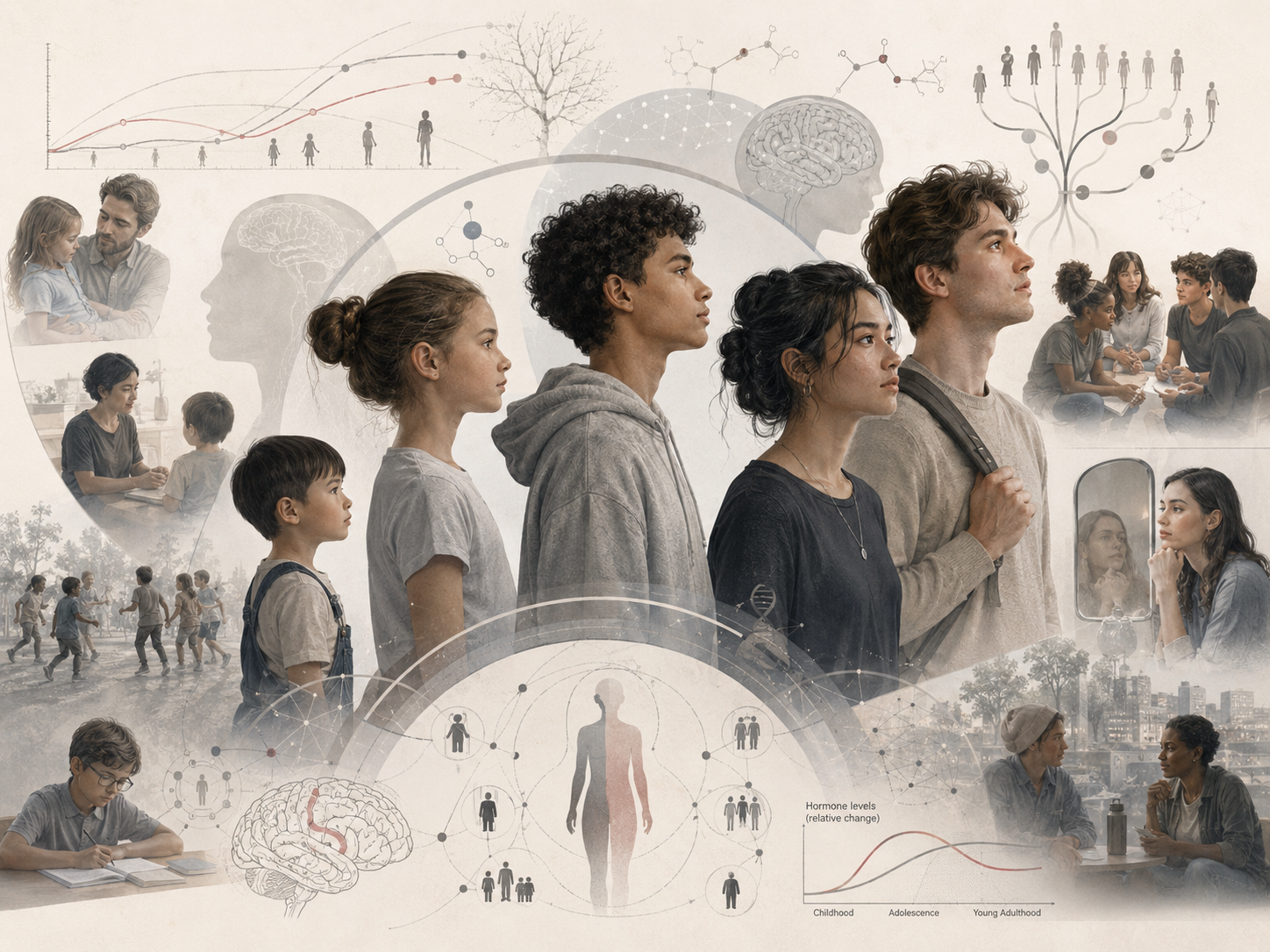
Current developmental and public-health sources support a careful distinction between gendered self-understanding, sexual development, puberty, sexual orientation, and sexual health. APA explains gender as involving attitudes, feelings, and behaviors that a culture associates with sex and explicitly describes gender as socially organized. CDC guidance on school-based sexual health education emphasizes that young people need knowledge and skills that support healthy sexuality, consent, communication, and protective behavior. WHO’s adolescent-health and sexuality-education materials emphasize age-appropriate information, safe environments, acceptable health services, and protection from coercion, exploitation, and misinformation. NICHD’s work on child development, puberty, and differences of sex development reinforces the need to understand development as bodily, social, relational, and contextual rather than as biology alone.
The most serious developmental account therefore does two things at once. It recognizes that bodies matter: puberty, sex characteristics, hormonal change, reproductive maturation, and embodied self-awareness are developmentally consequential. It also recognizes that bodies are never interpreted outside social life. Family norms, peer culture, religion, school rules, media, clinical systems, law, stigma, safety, discrimination, and access to accurate information all shape how gender and sexual development are lived. The developmental question is not only what changes in the body or identity, but what kind of world receives those changes.
Why This Distinction Matters
The distinction between gender development and sexual development matters because developmental psychology loses clarity when different processes are treated as if they were the same. Gender development concerns how young people learn, negotiate, resist, inhabit, or revise culturally organized meanings of gender. Sexual development concerns bodily maturation, attraction, sexual knowledge, boundaries, consent, relational safety, and sexual health. These domains interact powerfully, but they are not reducible to one another. A child can encounter gendered expectations long before puberty. An adolescent can experience sexual development without that development dictating a single identity, behavior, orientation, or relationship pathway. The developmental task is therefore interpretive as much as biological: young people must make sense of embodied change and social meaning at once.
Confusing these processes creates several problems. It can sexualize childhood gender expression when no sexual development is at issue. It can reduce adolescent sexual development to puberty alone, ignoring consent, knowledge, coercion, relational safety, identity, and health. It can conflate sexual orientation with gender identity. It can treat sex development as binary and simple when human biology includes variation. It can turn ordinary developmental exploration into moral panic. It can also obscure the real risks young people face when silence, stigma, coercion, misinformation, or violence replace accurate guidance and support.
Developmental psychology needs a vocabulary precise enough to hold several truths together. Gender development begins early because children are placed into gendered social worlds from birth or even before birth. Sexual development intensifies with puberty because bodily maturation, attraction, sexual knowledge, relational interest, and social exposure become more consequential. Sex development begins biologically and includes the development of sex characteristics, reproductive systems, hormones, and pubertal change. Sexual orientation and identity may emerge, be recognized, or be named on varied timelines. None of these processes is isolated from culture, family, school, peer life, religion, law, medicine, or media.
The distinction also matters ethically. Young people need protection from abuse, coercion, exploitation, shame, and misinformation. They also need recognition, privacy, accurate information, developmental patience, and environments where questions can be addressed without fear. Treating gender development and sexual development with care does not mean collapsing all differences or ignoring biology. It means refusing crude simplification. Development here is bodily, social, relational, cultural, and institutional all at once.
What Gender Development Is
Gender development refers to the developmental process through which children and adolescents come to understand gender categories, gender norms, gender identity, gender expression, and the social consequences attached to gendered expectations. Gender development includes how young people learn what their family, peers, school, media, religion, culture, and broader society associate with masculinity, femininity, nonconformity, status, behavior, appearance, voice, activity, emotion, work, leadership, vulnerability, and social role.
Gender development is not merely private self-description. It is also social positioning. Children learn whether certain behaviors are praised, laughed at, discouraged, policed, ignored, or punished. They learn what toys, clothes, sports, emotions, postures, interests, and ambitions are treated as appropriate. They learn which forms of softness, assertiveness, nurturance, anger, leadership, dependence, or independence are permitted. They learn how adults respond when they conform and what happens when they do not.
This is why gender development should not be trivialized as preference alone. Gendered expectations shape belonging, recognition, self-concept, peer status, discipline, safety, and imagination. A child who repeatedly hears that certain interests are “for boys” or “for girls” is not simply receiving casual language. They are receiving a map of social possibility. A child whose expression does not fit local expectations may discover early that selfhood can be conditional on conformity. A child whose gender expression is affirmed may experience wider developmental room.
Gender development includes both social learning and active interpretation. Children are not passive recipients of norms. They observe, imitate, test, resist, exaggerate, negotiate, and reinterpret gendered meanings. Some children strongly identify with available categories. Some feel constrained by them. Some move between forms of expression depending on context. Some experience a mismatch between assigned category and felt identity. Some are comfortable with their assigned gender but reject narrow role expectations. A serious developmental account must have room for all of these pathways without forcing them into one script.
Gender development is therefore a developmental process of meaning-making. It concerns how the child learns what the world says gender means, how the child locates themself within or against those meanings, and how the surrounding world responds to that emerging self-understanding.
What Sexual Development Is
Sexual development refers to the developmental growth of bodily sexual maturation, sexual feelings, attraction, sexual knowledge, sexual decision-making, consent, relationship understanding, sexual health, and sexual self-interpretation. It is not reducible to sexual behavior. It includes the development of boundaries, privacy, bodily knowledge, relational understanding, readiness, desire, attraction, communication, consent, and the ability to distinguish healthy relationships from coercive, exploitative, or unsafe ones.
Sexual development occurs across time. In childhood, it may involve body awareness, privacy rules, understanding appropriate boundaries, learning correct language for body parts, and knowing how to seek help if boundaries are violated. In adolescence, puberty brings bodily change, reproductive maturation, increased social attention to sexuality, possible attraction, peer comparison, romantic interest, sexual curiosity, and new vulnerability to pressure, misinformation, harassment, coercion, or exploitation. In young adulthood and beyond, sexual development may continue through intimacy, relationship negotiation, identity, health, values, and life experience.
A developmental approach to sexual development must therefore be protective rather than sensational. Young people need accurate, age-appropriate information precisely because ignorance does not protect them. It can make them more vulnerable to abuse, coercion, misinformation, shame, and unsafe decision-making. Developmentally appropriate sexual health education is not the premature adultification of children. Properly designed, it is a scaffold for bodily safety, consent, respect, health, and informed development.
Sexual development also involves moral and relational learning. Adolescents do not simply need biological facts about puberty or reproduction. They need to understand boundaries, pressure, respect, mutuality, privacy, coercion, digital risk, contraception, sexually transmitted infections, emotional readiness, and the right to say no. They also need to understand that others have boundaries, dignity, and rights. Developmental psychology should therefore treat sexual development as part of social, emotional, ethical, and health development broadly, not as a taboo domain beyond serious analysis.
Sex Development, Puberty, and Embodiment
Sex development concerns the biological development of sex characteristics, reproductive anatomy, hormones, chromosomes, gonadal development, and pubertal maturation. In typical public language, sex development is often flattened into a simple binary, but biological development is more complex. Most bodies follow common male or female developmental pathways, while some bodies develop variations in sex characteristics that require careful, dignified, medically informed, and developmentally sensitive interpretation. Sex development is therefore biological, but it is not always socially simple.
For developmental psychology, sex development matters because bodies are not neutral containers for psychological life. The body is part of development. Puberty changes height, shape, voice, skin, hair, menstruation, erections, reproductive capacity, hormone profiles, sleep, mood, sexual maturity, and social visibility. These changes affect self-consciousness, privacy, peer comparison, family boundaries, clothing, athletic participation, body image, social attention, and vulnerability. The body becomes more socially interpreted precisely when the adolescent is also developing more complex identity and self-reflection.
Embodiment is therefore central. Young people do not merely “have” bodies. They develop through bodies that others name, evaluate, sexualize, discipline, protect, medicalize, admire, shame, or ignore. A child who enters puberty early may be treated as older than they are. A late-maturing adolescent may feel socially behind. A young person whose body does not fit gendered expectation may experience distress, stigma, or pressure. A disabled or chronically ill adolescent may experience puberty through medical systems and accessibility barriers. These are developmental experiences, not just biological events.
Sex development and gender development meet in embodiment, but they do not collapse into each other. Puberty may intensify questions of gender expression, social recognition, privacy, safety, and body comfort. It may also intensify social pressure to conform to gendered expectations. A developmental account must therefore treat sex development as bodily formation and gender development as meaning-making around embodiment, identity, expression, and social role.
Early Gender Development in Childhood
Gender development typically becomes visible in childhood long before sexual development intensifies. Children learn how gender is named, sorted, rewarded, joked about, and policed in everyday life. They notice who is expected to act in particular ways, what clothing and play styles attract approval or disapproval, and what kinds of expression are treated as normal, funny, admirable, inappropriate, or suspect. These lessons may appear small, but they accumulate into a developmental world.
Early gender development occurs through family language, toys, media, sibling dynamics, peer play, school routines, clothing, sports, religious teaching, holidays, chores, emotional expectations, and adult correction. Children may learn that boys are expected to be tough or girls are expected to be agreeable; that some emotions are acceptable for one gender but not another; that some interests are praised while others are mocked; that appearance is heavily evaluated; or that belonging requires performance of a recognizable gender role.
Children are not merely shaped by these norms; they also interpret them. They may enforce gender rules on peers, challenge them, ignore them, exaggerate them, or search for categories that better fit their experience. Some children may become intensely invested in gendered symbols because these symbols help them organize social meaning. Others may feel constrained or alienated. Still others may move fluidly across expectations depending on context.
The developmental stakes are high because early gender development influences self-concept, peer inclusion, confidence, shame, aspiration, emotional expression, and belonging. A child who feels that their interests are unacceptable may learn self-monitoring early. A child whose expression is received with warmth may develop confidence. A child whose gender nonconformity is punished may associate authenticity with danger. Childhood gender development is therefore not trivial. It is one of the earliest places where identity, social expectation, and power meet.
Puberty and the Intensification of Sexual Development
Sexual development intensifies with puberty because bodily maturation changes how adolescents experience themselves and how they are perceived by others. Puberty brings physical changes that may include growth spurts, menstruation, breast development, genital development, voice change, body hair, skin changes, reproductive maturation, sexual feelings, and increased awareness of attraction or being seen as sexually mature. These changes alter not only biology but also privacy, self-consciousness, peer comparison, social vulnerability, and family boundaries.
Puberty does not begin sexual development from nothing, but it changes its developmental intensity. Questions of body image, desirability, modesty, attraction, embarrassment, privacy, consent, harassment, and relational interest may become more immediate. Adolescents may need new language for what is happening to their bodies, new boundaries with peers and adults, and new forms of guidance about health and safety. Without accurate information, they may rely on peers, pornography, social media, rumor, or misinformation.
Puberty also changes how others respond to the adolescent. Early-maturing youth may be treated as older, more responsible, more sexual, or more threatening than they are developmentally prepared to handle. Late-maturing youth may experience teasing, insecurity, or exclusion. Gendered expectations often intensify: boys may face pressure around masculinity and sexual conquest; girls may face pressure around appearance, modesty, desirability, and surveillance; gender-diverse youth may face heightened vulnerability when bodily changes do not align with their self-understanding or social safety.
But puberty does not produce one universal sexual pathway. Adolescents differ in timing, attraction, desire, identity, readiness, relational interest, body comfort, and cultural interpretation. Some adolescents experience intense romantic or sexual interest; others do not. Some identify early; others need time. Some experience puberty as empowering; others experience it as distressing or unsafe. Developmental psychology should therefore avoid turning puberty into a deterministic script. Puberty intensifies sexual development, but social meaning, support, education, family response, peer culture, and access to care shape how that transition is lived.
Identity, Expression, and Social Meaning
Gender development and sexual development intersect sharply in adolescence because identity becomes more explicit. Adolescents increasingly ask how they are seen, what kinds of relationships or attractions feel real, what bodily and social changes mean, and how they can live in ways that feel coherent. Identity development is not simply the discovery of a hidden internal fact. It is a developmental process shaped by language, recognition, experimentation, safety, relationship, culture, and time.
Gender identity, gender expression, sexual orientation, attraction, and sexual self-understanding may develop at different rates. A young person may have a clear sense of gender before having any clear sexual identity. Another may understand attraction before having language for gender expression. Another may reject labels altogether. Another may try on a label and later revise it. Developmental variation should not be treated automatically as confusion, pathology, or bad influence. Adolescence is a period of identity work, and identity work requires language, reflection, and room to mature.
Expression is also developmentally important. Clothing, hair, voice, body posture, name use, pronouns, social roles, friendship groups, music, online spaces, and aesthetic choices can all become ways young people negotiate gendered and sexual meaning. Adults sometimes dismiss these as superficial, but expression is often how adolescents test coherence between inner experience and social recognition. Expression can be exploratory, protective, symbolic, communal, or deeply personal.
Identity is shaped not only from within but through recognition and reaction. Families, peers, schools, religious settings, clinics, media, and law all affect whether identity development unfolds under conditions of safety or surveillance. This means identity is developmental but also social and political. A young person’s question about selfhood is never just an internal question once the surrounding world begins responding to it.
Consent, Relationships, and Sexual Health
Healthy sexual development includes learning about consent, boundaries, relationships, and sexual health. Consent is not only a legal concept. Developmentally, it involves communication, respect, bodily autonomy, recognition of pressure, understanding that silence is not agreement, and knowing that every person has the right to refuse unwanted touch or sexual activity. Young people need age-appropriate consent education long before they are making adult sexual decisions because boundaries, respect, and bodily safety begin earlier than adolescence.
Sexual health education is strongest when it is not reduced to fear, disease, or reproduction alone. Young people need accurate information about bodies, puberty, contraception, sexually transmitted infections, pregnancy prevention, consent, coercion, digital risks, pornography literacy, emotional readiness, respectful relationships, and how to access care. They also need adults who can answer questions without shaming them. Silence does not prevent sexual development. It only removes guidance.
Relationships are also developmental contexts. Adolescents learn how to express interest, handle rejection, communicate boundaries, recognize manipulation, respect privacy, and distinguish care from control. Romantic and sexual development can bring joy, vulnerability, confusion, peer pressure, emotional intensity, and risk. Healthy development depends on whether young people are supported in building judgment rather than forced to choose between ignorance and secrecy.
Sexual health must also be understood in relation to inequality. Access to healthcare, contraception, testing, confidential services, transportation, insurance, culturally competent care, disability-accessible information, and safe adults is not evenly distributed. Young people who face stigma, poverty, racism, disability barriers, rural isolation, family rejection, or harassment may have less access to protective information and care. Developmental psychology should therefore treat sexual health as a public-health and equity issue, not merely a matter of individual choices.
Sexual Orientation and Developmental Self-Understanding
Sexual orientation concerns patterns of attraction, identity, and sometimes behavior. It is related to sexual development but not identical to puberty, sexual behavior, or gender identity. A young person may recognize attraction before acting on it. They may have experiences before naming identity. They may use one label at one time and revise it later. They may experience attraction in ways that are fluid, stable, uncertain, or not easily captured by available categories. Developmental psychology should be precise enough to distinguish orientation, behavior, identity, and attraction without forcing premature closure.
Sexual orientation development is often shaped by language and social safety. A young person who has words for attraction and sees respected examples of diverse identities may be able to understand themselves with less shame. A young person in a hostile environment may hide, deny, delay, or struggle with self-recognition. This does not mean identity is created simply by social language. It means that development depends partly on whether language and safety are available.
Developmental timing varies. Some young people understand patterns of attraction early in adolescence or before. Others do not name or clarify their orientation until later adolescence or adulthood. Some never find fixed labels useful. These variations should not be treated as failure. Identity development often includes uncertainty, exploration, reflection, and revision. The developmental goal is not forced labeling. It is safe self-understanding, relational responsibility, and access to accurate information and care.
Supportive environments matter because stigma can turn ordinary identity development into chronic stress. Family rejection, bullying, religious condemnation, legal hostility, school harassment, and medical dismissal can all shape mental health and belonging. The risk is not inherent to orientation itself. Much of the risk comes from the social conditions surrounding identity. A developmental framework should therefore separate identity from stigma and ask how environments can reduce harm.
Culture, Power, and Social Norms
Gender development and sexual development are always culturally mediated. Children and adolescents learn what counts as appropriate masculinity, femininity, sexuality, modesty, desirability, purity, intimacy, family legitimacy, and adulthood inside historically specific social worlds. These meanings vary across families, communities, religions, states, schools, peer groups, and media environments. Culture does not merely decorate development. It helps structure what development is allowed to mean.
Cultural norms can provide belonging, moral guidance, continuity, and protection. They can also enforce shame, silence, exclusion, or unequal power. A developmental psychology that treats culture seriously should neither romanticize nor dismiss it. It should ask how norms are transmitted, who benefits from them, who is constrained by them, how young people negotiate them, and how cultural belonging can coexist with dignity and safety.
Power is central because gender and sexuality are not only personal domains. They are regulated by families, schools, clinics, law, religion, media, and peer hierarchies. Gender norms may determine who is expected to lead, care, obey, protect, desire, speak, hide, or sacrifice. Sexual norms may determine who is protected, blamed, believed, shamed, or controlled. These norms are developmental because young people internalize, resist, or reinterpret them while forming identity and relationships.
Developmental psychology should therefore avoid assuming that one social model of gender or sexuality is the natural endpoint of development. The field becomes stronger when it recognizes that norms are learned, enforced, negotiated, and sometimes resisted. Development unfolds not only through bodies and minds but through social worlds structured by power.
Families, Schools, and Health Systems
Families are often the first institutions of gender and sexual development. Through language, affection, discipline, privacy rules, religious teaching, emotional support, jokes, silence, and reaction to difference, families communicate what is safe to ask, express, or become. Family support can buffer stigma and confusion. Family rejection can intensify isolation, distress, secrecy, and risk. This does not mean families must have all answers immediately. It means that developmental safety depends heavily on whether young people can bring questions and vulnerabilities into relationships where they are not humiliated or abandoned.
Schools are also central because they organize peer life, health education, discipline, belonging, and exposure to difference. Schools can provide accurate information, respectful adult support, anti-harassment protections, confidential referral pathways, and curriculum that recognizes bodies, boundaries, consent, and diversity. They can also become sites of bullying, exclusion, misinformation, surveillance, or silence. School climate is therefore not peripheral to gender and sexual development. It is part of the developmental environment.
Health systems matter because puberty, reproductive health, sexual health, mental health, disability, intersex variation, gender distress, contraception, STI prevention, pregnancy prevention, and abuse disclosure may all enter clinical settings. Young people need health services that are accurate, confidential when appropriate, developmentally sensitive, culturally competent, trauma-informed, and respectful. A clinic that shames or dismisses a young person can reduce future care-seeking. A clinic that offers respectful guidance can become protective infrastructure.
Families, schools, and health systems should not be treated as separate from development. They are developmental institutions. They can help young people integrate body, identity, relationship, knowledge, and safety. Or they can make development more dangerous by replacing guidance with shame, coercion, or silence.
Inequality, Stigma, and Developmental Risk
Stigma and discrimination can distort both gender development and sexual development by making self-understanding dangerous. Developmental risk is not simply located inside the young person. It is often produced by the conditions surrounding identity, expression, embodiment, and attraction. Harassment, family rejection, peer bullying, sexual violence, homophobia, transphobia, misogyny, racism, poverty, ableism, religious exclusion, and lack of care access can all shape mental health, school belonging, health behavior, and developmental opportunity.
This distinction is essential. A young person’s identity or gender expression is not inherently a developmental problem. Hostile environments can make it one. A young person who is supported may develop self-understanding, resilience, relational capacity, and healthy boundaries. A young person who is shamed or threatened may develop secrecy, anxiety, depression, distrust, or unsafe coping. Developmental difficulty may therefore reflect social injury rather than intrinsic pathology.
Inequality also affects whose development is read as normal. Gender expression may be interpreted differently depending on race, class, disability, language, religion, and neighborhood. A behavior seen as confident in one child may be seen as threatening in another. A young person with a disability may be wrongly desexualized or denied sexual-health education. A young person in poverty may have less access to confidential care. A young person from a marginalized community may face both cultural belonging and external discrimination in complex ways.
Developmental psychology must therefore ask not only how gender and sexual development unfold, but under what conditions. Supportive environments can buffer risk, while hostile environments can turn ordinary developmental exploration into chronic stress. Inequality here is not metaphorical. It affects safety, mental health, school belonging, health access, bodily autonomy, and the capacity to imagine a livable future.
Developmental Variation and Diversity
Developmental psychology should approach gender development and sexual development with enough rigor to distinguish variation from pathology. Children and adolescents do not all move through identity, attraction, embodiment, puberty, relationship interest, and self-recognition on the same timeline. Variation in timing is developmentally ordinary. Variation in expression is developmentally meaningful. Variation in attraction and identity should not automatically be interpreted as confusion, deviance, or disorder.
Some young people have a stable and early sense of gender identity. Others develop their understanding gradually. Some conform to gendered expectations comfortably. Others experience those expectations as restrictive. Some adolescents experience attraction early. Others experience it later or not at all. Some seek romantic relationships; others do not. Some young people are curious and verbal; others are private or uncertain. Developmental diversity means that healthy development cannot be reduced to one timeline or one script.
The same principle applies to sexual knowledge and readiness. Young people need accurate information before they need to use it, because knowledge protects. But having information does not mean a young person is ready for sexual behavior. Developmental education should distinguish knowledge from action, safety from adultification, and consent from pressure. A mature developmental approach gives young people tools without forcing them into premature roles.
Developmental variation also requires humility from adults. Not every exploratory statement is permanent, but not every statement should be dismissed as a phase. Not every form of distress is pathology, but not every distress should be ignored. Not every question requires immediate identity closure, but every question deserves dignity. The task is not to force development into a rigid endpoint. It is to support safe, informed, respectful development over time.
Sex Development, Intersex Variation, and Differences of Sex Development
Sex development includes the development of chromosomes, gonads, hormones, internal reproductive structures, external genitalia, secondary sex characteristics, and pubertal maturation. For many people, these features align with common male or female developmental patterns. For some, sex development includes intersex traits or differences of sex development that do not fit typical binary assumptions. These variations are medically, psychologically, ethically, and socially important.
A serious developmental account must avoid using intersex variation or differences of sex development as rhetorical devices in culture-war arguments. These are lived realities involving children, adolescents, families, clinicians, privacy, bodily autonomy, medical uncertainty, social stigma, and long-term identity. Some variations require medical attention. Others may not. Some decisions involve urgent health concerns. Others involve questions of timing, consent, disclosure, and future autonomy. The developmental issue is not simply biological classification. It is how young people and families are supported with dignity.
Children and adolescents with intersex traits or differences of sex development may face medical procedures, secrecy, stigma, confusion, peer isolation, body shame, fertility questions, identity questions, or anxiety about disclosure. They may also thrive when families and clinicians provide honest, developmentally appropriate information, careful medical care, respect for bodily autonomy, and psychosocial support. The surrounding environment makes a profound difference.
Developmental psychology should therefore treat sex development as part of human variation while remaining attentive to medical realities. It should protect privacy, avoid sensationalism, reject stigma, and emphasize the rights and dignity of the developing person. Sex development is biological, but the meaning of bodily variation is shaped through family, medicine, culture, and social recognition.
Digital Life, Media, and Peer Context
Gender development and sexual development now unfold in digital environments as well as families, schools, clinics, and neighborhoods. Adolescents encounter gendered and sexual meanings through social media, messaging, gaming communities, influencers, pornography, online peer groups, fan cultures, health information, misinformation, harassment, and identity communities. Digital life can provide language, belonging, and information. It can also intensify comparison, sexual pressure, image anxiety, exploitation, bullying, and misinformation.
This matters developmentally because adolescents are forming identity under conditions of constant visibility and feedback. A young person’s gender expression may be affirmed online and mocked offline, or vice versa. A young person may find protective community online when family or school is hostile. Another may be exposed to coercive messages, sexualized content, body comparison, or grooming. Digital settings are not separate from development. They are part of the peer ecology.
Media literacy is therefore part of healthy gender and sexual development. Young people need help distinguishing accurate health information from misinformation, consensual relationships from coercive dynamics, curated images from ordinary bodies, and sexualized media scripts from real intimacy. They also need privacy skills, boundaries around sharing, awareness of digital permanence, and guidance about how to seek help when online interactions become unsafe.
Adults sometimes respond to digital risk with surveillance alone. Surveillance may be necessary in some safety contexts, but developmental support requires more than control. Young people need trust, conversation, skills, and safe adults. The goal is not to deny the digital world exists, but to help adolescents navigate it with dignity, critical judgment, and protection.
Methods for Studying Gender and Sexual Development
Studying gender development and sexual development requires methodological care because these domains involve identity, body, culture, stigma, privacy, family context, and changing social norms. Researchers may use longitudinal surveys, interviews, ethnography, clinical data, school-climate measures, health-education evaluations, peer-network analysis, developmental assessments, and mixed-methods designs. Each method captures part of the developmental picture. None is sufficient alone.
Longitudinal methods are especially important because identity, puberty, attraction, relationships, sexual knowledge, and social recognition change across time. A single cross-sectional snapshot may confuse age differences with cohort effects or local cultural context. Developmental timing matters: early puberty, late puberty, early identity recognition, family response, school climate, and exposure to stigma may each shape pathways differently.
Measurement must also be precise. Sex assigned at birth, sex characteristics, gender identity, gender expression, sexual orientation, attraction, sexual behavior, sexual knowledge, consent skills, relationship experience, and sexual health outcomes are not interchangeable variables. When research collapses them, interpretation becomes weak and sometimes harmful. Developmental science should measure what it means, name what it measures, and avoid turning categories into assumptions.
Qualitative methods are especially valuable because young people’s experiences of gender and sexual development are meaning-rich. Interviews, life histories, participatory research, and community-engaged methods can reveal how adolescents interpret embodiment, identity, silence, family response, faith, peer pressure, safety, and stigma. Ethical research must protect privacy, avoid outing, use developmentally appropriate consent procedures, and minimize risk to participants.
Good research also requires attention to culture and inequality. Samples drawn from narrow populations should not be treated as universal. Research should account for race, class, disability, religion, migration, geography, healthcare access, school climate, family structure, and legal context. Gender and sexual development are not isolated traits; they unfold inside social worlds.
Ethical Framing: Protection, Dignity, and Developmental Care
Gender development and sexual development must be discussed ethically because these topics are easily distorted by fear, ideology, shame, or adult projection. Young people need protection from abuse, exploitation, coercion, premature sexualization, harassment, and misinformation. They also need protection from stigma, silence, humiliation, rejection, and denial of accurate information. Ethical developmental science must hold both forms of protection together.
One ethical danger is adultification: treating children as though they are sexually mature before they are developmentally ready. Another danger is enforced ignorance: refusing to teach children and adolescents about bodies, boundaries, consent, puberty, and safety in age-appropriate ways. Both are harmful. Developmentally appropriate education gives young people language, boundaries, health knowledge, and protection without pushing them into adult roles.
Another ethical danger is identity surveillance. Young people should not be forced into public disclosure, interrogation, or labeling before they are ready. Privacy matters. Development requires room to think, ask, revise, and mature. At the same time, young people who seek support should not be dismissed, shamed, or treated as problems. Ethical care requires listening without coercion, protection without panic, and guidance without humiliation.
Finally, developmental responsibility belongs to systems as well as individuals. Families, schools, clinics, communities, and public-health institutions shape whether young people receive accurate information, support, recognition, and safety. A developmental framework should not reduce risk to individual choices while ignoring harassment, violence, poverty, racism, disability exclusion, homophobia, transphobia, misogyny, medical distrust, or lack of care access. Healthy development is not only a private achievement. It is a social responsibility.
An Analytical Framework for Gender Development and Sexual Development
A stylized gender-development outcome \(G_{it}\) for individual \(i\) at time \(t\) can be modeled as:
G_{it} = \alpha_i + \beta_i t + \gamma N_{it} + \delta F_{it} – \lambda S_{it} + \varepsilon_{it}
\]
Interpretation: \( \alpha_i \) represents initial developmental orientation around gendered norms and expectations, \( \beta_i \) developmental change across time, \(N_{it}\) normative pressure or social recognition, \(F_{it}\) family support, and \(S_{it}\) stigma or social sanction. The model expresses a developmental idea: gender development is shaped not only by the individual but by whether environments reward, constrain, recognize, or punish forms of identity and expression.
A stylized sexual-development outcome \(Q_{it}\) can be written as:
Q_{it} = \alpha_i + \beta_1 P_{it} + \beta_2 K_{it} + \beta_3 R_{it} – \beta_4 X_{it} + \varepsilon_{it}
\]
Interpretation: \(P_{it}\) represents pubertal progression, \(K_{it}\) sexual knowledge and consent education, \(R_{it}\) relational support, and \(X_{it}\) coercion, misinformation, stigma, or unsafe pressure. This makes clear that sexual development is not reducible to puberty alone.
To connect the two without collapsing them, broader adolescent adjustment can be modeled as:
A_{it} = \theta_1 G_{it} + \theta_2 Q_{it} + \theta_3 C_{it} – \theta_4 Z_{it} + \varepsilon_{it}
\]
Interpretation: \(A_{it}\) represents broader adolescent adjustment, \(C_{it}\) connectedness or belonging, and \(Z_{it}\) chronic exclusion, harassment, stigma, or coercive pressure. Gender development and sexual development may jointly affect well-being, but they do so through social mediation rather than through a single biological script.
Because these processes unfold within families, schools, clinics, peer networks, digital spaces, and communities, a multilevel version is often more realistic:
A_{ijt} = \alpha + u_j + \beta_1 G_{ijt} + \beta_2 Q_{ijt} + \beta_3 C_{ijt} – \beta_4 Z_{ijt} + \varepsilon_{ijt}
\]
Interpretation: \(u_j\) captures contextual effects at the level of school, family system, peer ecology, community, health-service environment, or policy context. Development is nested in institutions that can either support or constrain it.
To represent protective education and support as buffers against risk, a moderated model can be written as:
A_{it} = \alpha + \beta_1 R_{it} + \beta_2 E_{it} + \beta_3(R_{it} \times E_{it}) + \varepsilon_{it}
\]
Interpretation: \(R_{it}\) represents risk exposure, such as stigma, misinformation, coercion, or harassment. \(E_{it}\) represents protective education, family support, school connectedness, or access to care. A negative interaction would indicate that support reduces the developmental impact of risk.
The point of this framework is not to turn intimate development into abstraction. It is to clarify that gender development and sexual development are developmental, relational, embodied, and shaped by context, power, support, timing, and protection.
R: Simulating Gendered Context, Sexual Development, and Adolescent Adjustment
The following R example simulates adolescents observed across repeated waves. It includes family support, social recognition, consent knowledge, pubertal progression, school connectedness, chronic stigma, current stigma, and an overall adjustment outcome. The data are synthetic and intended for conceptual demonstration only.
# Simulating gendered context, sexual development, and adolescent adjustment
# ------------------------------------------------------------------------
# This synthetic example models adolescent adjustment as a function of
# pubertal progression, family support, social recognition, consent knowledge,
# school connectedness, stigma exposure, and state-dependent development.

suppressPackageStartupMessages({
  library(dplyr)
  library(lme4)
  library(ggplot2)
})

set.seed(2026)

n_adolescents <- 820
n_waves <- 8
n_schools <- 34

adolescents <- data.frame(
  id = 1:n_adolescents,
  school_id = sample(1:n_schools, n_adolescents, replace = TRUE),
  baseline_adjustment = rnorm(n_adolescents, mean = 50, sd = 8),
  family_support = rnorm(n_adolescents, mean = 0, sd = 1),
  social_recognition = rnorm(n_adolescents, mean = 0, sd = 1),
  consent_knowledge = rnorm(n_adolescents, mean = 0, sd = 1),
  school_connectedness = rnorm(n_adolescents, mean = 0, sd = 1),
  chronic_stigma = rbinom(n_adolescents, size = 1, prob = 0.24)
)

schools <- data.frame(
  school_id = 1:n_schools,
  school_climate = rnorm(n_schools, mean = 0, sd = 0.6),
  health_education_quality = rnorm(n_schools, mean = 0, sd = 0.6),
  anti_harassment_support = rnorm(n_schools, mean = 0, sd = 0.5)
)

panel_data <- adolescents |>
  slice(rep(1:n(), each = n_waves)) |>
  group_by(id) |>
  mutate(
    wave = 0:(n_waves - 1),
    pubertal_progress = wave + rnorm(n_waves, 0, 0.4),
    current_family_support = rnorm(n_waves, mean = family_support, sd = 0.6),
    current_recognition = rnorm(n_waves, mean = social_recognition, sd = 0.6),
    current_consent_knowledge = rnorm(n_waves, mean = consent_knowledge, sd = 0.6),
    current_connectedness = rnorm(n_waves, mean = school_connectedness, sd = 0.6),
    current_stigma = rnorm(n_waves, mean = 0.4 * chronic_stigma, sd = 0.7)
  ) |>
  ungroup() |>
  left_join(schools, by = "school_id") |>
  mutate(
    protective_context =
      current_family_support +
      current_recognition +
      current_consent_knowledge +
      current_connectedness +
      school_climate +
      health_education_quality +
      anti_harassment_support,
    adjustment_score =
      baseline_adjustment +
      0.75 * pubertal_progress +
      1.15 * current_family_support +
      1.05 * current_recognition +
      1.00 * current_consent_knowledge +
      0.95 * current_connectedness +
      0.70 * school_climate +
      0.70 * health_education_quality +
      0.65 * anti_harassment_support -
      1.40 * current_stigma -
      0.90 * chronic_stigma -
      0.35 * current_stigma * protective_context +
      rnorm(n(), mean = 0, sd = 2.7)
  )

model <- lmer(
  adjustment_score ~ pubertal_progress + current_family_support +
    current_recognition + current_consent_knowledge +
    current_connectedness + school_climate +
    health_education_quality + anti_harassment_support +
    current_stigma + chronic_stigma +
    current_stigma:protective_context +
    (1 + pubertal_progress | school_id/id),
  data = panel_data
)

summary(model)

trajectory_summary <- panel_data |>
  group_by(wave, chronic_stigma) |>
  summarize(
    mean_adjustment = mean(adjustment_score),
    standard_error = sd(adjustment_score) / sqrt(n()),
    .groups = "drop"
  ) |>
  mutate(
    lower = mean_adjustment - 1.96 * standard_error,
    upper = mean_adjustment + 1.96 * standard_error,
    group_label = ifelse(chronic_stigma == 1, "Higher stigma risk", "Lower stigma risk")
  )

ggplot(trajectory_summary, aes(x = wave, y = mean_adjustment, linetype = group_label)) +
  geom_line(linewidth = 1) +
  geom_ribbon(aes(ymin = lower, ymax = upper, group = group_label), alpha = 0.12) +
  labs(
    title = "Simulated Gender Development, Sexual Development, and Adjustment",
    x = "Wave",
    y = "Adjustment score",
    linetype = "Group"
  ) +
  theme_minimal()

support_summary <- panel_data |>
  group_by(wave) |>
  summarize(
    average_family_support = mean(current_family_support),
    average_recognition = mean(current_recognition),
    average_consent_knowledge = mean(current_consent_knowledge),
    average_connectedness = mean(current_connectedness),
    average_stigma = mean(current_stigma),
    average_adjustment = mean(adjustment_score),
    .groups = "drop"
  )

ggplot(support_summary, aes(x = average_stigma, y = average_adjustment)) +
  geom_point() +
  geom_smooth(method = "lm", se = TRUE) +
  labs(
    title = "Synthetic Stigma Exposure and Adolescent Adjustment",
    x = "Average stigma exposure",
    y = "Average adjustment"
  ) +
  theme_minimal()

# Analysts can extend this model by:
# 1. separating gendered social expectation from sexual health knowledge;
# 2. adding family, school, community, or clinic random effects;
# 3. modeling digital peer climate and online harassment;
# 4. simulating supportive education or hostile contexts;
# 5. distinguishing early, middle, and late adolescent development;
# 6. estimating whether protective contexts buffer stigma exposure.
This simulation highlights a central developmental point: gender development and sexual development are shaped by support, recognition, knowledge, consent, connectedness, and stigma rather than by age or puberty alone.
Python: Modeling Support and Sexual Development Across Time
The following Python example simulates adolescent development over repeated periods using pubertal progression, family support, social recognition, consent knowledge, school connectedness, school climate, health education quality, anti-harassment support, and stigma. The outcome can be read as a broad developmental-adjustment score.
# Modeling support, gendered context, and sexual development across time
# --------------------------------------------------------------------
# This synthetic example models adolescent adjustment as a dynamic relation
# among pubertal progression, family support, social recognition, consent
# knowledge, school connectedness, protective school climate, and stigma.

from __future__ import annotations

import numpy as np
import pandas as pd
import statsmodels.formula.api as smf
import matplotlib.pyplot as plt

np.random.seed(2026)

n_adolescents = 900
n_periods = 10
n_schools = 38

adolescents = pd.DataFrame({
    "id": np.arange(1, n_adolescents + 1),
    "school_id": np.random.choice(np.arange(1, n_schools + 1), size=n_adolescents),
    "baseline_adjustment": np.random.normal(50, 8, n_adolescents),
    "family_support": np.random.normal(0, 1, n_adolescents),
    "social_recognition": np.random.normal(0, 1, n_adolescents),
    "consent_knowledge": np.random.normal(0, 1, n_adolescents),
    "school_connectedness": np.random.normal(0, 1, n_adolescents),
    "chronic_stigma": np.random.binomial(1, 0.24, n_adolescents),
})

schools = pd.DataFrame({
    "school_id": np.arange(1, n_schools + 1),
    "school_climate": np.random.normal(0, 0.6, n_schools),
    "health_education_quality": np.random.normal(0, 0.6, n_schools),
    "anti_harassment_support": np.random.normal(0, 0.5, n_schools),
})

panel = adolescents.loc[adolescents.index.repeat(n_periods)].copy()
panel["time"] = np.tile(np.arange(n_periods), n_adolescents)
panel = panel.merge(schools, on="school_id", how="left")

panel["pubertal_progress"] = panel["time"] + np.random.normal(0, 0.4, len(panel))
panel["current_family_support"] = np.random.normal(
    loc=panel["family_support"],
    scale=0.7,
    size=len(panel),
)
panel["current_recognition"] = np.random.normal(
    loc=panel["social_recognition"],
    scale=0.7,
    size=len(panel),
)
panel["current_consent_knowledge"] = np.random.normal(
    loc=panel["consent_knowledge"],
    scale=0.7,
    size=len(panel),
)
panel["current_connectedness"] = np.random.normal(
    loc=panel["school_connectedness"],
    scale=0.7,
    size=len(panel),
)
panel["current_stigma"] = np.random.normal(
    loc=0.4 * panel["chronic_stigma"],
    scale=0.7,
    size=len(panel),
)

panel["protective_context"] = (
    panel["current_family_support"]
    + panel["current_recognition"]
    + panel["current_consent_knowledge"]
    + panel["current_connectedness"]
    + panel["school_climate"]
    + panel["health_education_quality"]
    + panel["anti_harassment_support"]
)

panel = panel.sort_values(["id", "time"]).reset_index(drop=True)
panel["adjustment_score"] = np.nan

for person_id in panel["id"].unique():
    person_data = panel.loc[panel["id"] == person_id].copy()
    previous_score = person_data["baseline_adjustment"].iloc[0] + np.random.normal(0, 2)

    for idx in person_data.index:
        puberty = panel.at[idx, "pubertal_progress"]
        family = panel.at[idx, "current_family_support"]
        recognition = panel.at[idx, "current_recognition"]
        consent = panel.at[idx, "current_consent_knowledge"]
        connectedness = panel.at[idx, "current_connectedness"]
        climate = panel.at[idx, "school_climate"]
        education = panel.at[idx, "health_education_quality"]
        anti_harassment = panel.at[idx, "anti_harassment_support"]
        stigma = panel.at[idx, "current_stigma"]
        chronic = panel.at[idx, "chronic_stigma"]
        protective = panel.at[idx, "protective_context"]

        current_score = (
            0.70 * previous_score
            + 0.75 * puberty
            + 1.15 * family
            + 1.05 * recognition
            + 1.00 * consent
            + 0.95 * connectedness
            + 0.70 * climate
            + 0.70 * education
            + 0.65 * anti_harassment
            - 1.40 * stigma
            - 0.90 * chronic
            - 0.35 * stigma * protective
            + np.random.normal(0, 2.5)
        )

        panel.at[idx, "adjustment_score"] = current_score
        previous_score = current_score

panel["lag_score"] = panel.groupby("id")["adjustment_score"].shift(1)
regression_data = panel.dropna(subset=["lag_score"]).copy()

model = smf.ols(
    formula="""
    adjustment_score ~ lag_score + pubertal_progress +
    current_family_support + current_recognition +
    current_consent_knowledge + current_connectedness +
    school_climate + health_education_quality +
    anti_harassment_support + current_stigma + chronic_stigma +
    current_stigma:protective_context
    """,
    data=regression_data
).fit(cov_type="HC3")

print(model.summary())

trajectory = panel.groupby(["time", "chronic_stigma"], as_index=False).agg(
    average_adjustment=("adjustment_score", "mean"),
    average_protective_context=("protective_context", "mean"),
    average_stigma=("current_stigma", "mean"),
    standard_error=("adjustment_score", lambda x: x.std() / np.sqrt(len(x))),
)

trajectory["group_label"] = trajectory["chronic_stigma"].map({
    0: "Lower stigma risk",
    1: "Higher stigma risk"
})
trajectory["lower"] = trajectory["average_adjustment"] - 1.96 * trajectory["standard_error"]
trajectory["upper"] = trajectory["average_adjustment"] + 1.96 * trajectory["standard_error"]

plt.figure(figsize=(8, 5))
for group_name, subset in trajectory.groupby("group_label"):
    plt.plot(subset["time"], subset["average_adjustment"], marker="o", label=group_name)

plt.xlabel("Time")
plt.ylabel("Average adjustment score")
plt.title("Simulated Gender Development and Sexual Development Across Time")
plt.legend()
plt.tight_layout()
plt.show()

school_summary = panel.groupby("school_id", as_index=False).agg(
    school_climate=("school_climate", "mean"),
    health_education_quality=("health_education_quality", "mean"),
    anti_harassment_support=("anti_harassment_support", "mean"),
    average_adjustment=("adjustment_score", "mean"),
    average_stigma=("current_stigma", "mean"),
)

print(school_summary.sort_values("average_adjustment", ascending=False).head())

# Analysts can extend this framework by:
# 1. modeling gendered social experience and sexual health knowledge separately;
# 2. adding family, school, community, or clinic clustering;
# 3. including digital media, peer climate, and online harassment;
# 4. simulating supportive education, hostile contexts, or care access;
# 5. distinguishing early, middle, and late adolescent development;
# 6. estimating whether protective contexts buffer stigma exposure.
The analytical value of a model like this is that it makes visible a core developmental truth: healthy development in these domains depends on support, safety, knowledge, recognition, and care rather than silence, stigma, misinformation, coercion, or shame.
GitHub Repository
Complete Code Repository
Access the full companion repository for this article, including reproducible analysis materials and multi-language code workflows for gender development, sexual development, puberty, social recognition, family support, consent knowledge, school connectedness, stigma exposure, health education, protective context, and adolescent adjustment.
Conclusion
Gender development and sexual development belong in the same developmental conversation because both concern how children and adolescents come to understand embodiment, social meaning, intimacy, identity, and selfhood. But they should not be collapsed into one process. Gender development concerns identity, expression, categories, social recognition, and the meanings attached to gender. Sexual development concerns bodily maturation, attraction, consent, relationship, sexual knowledge, and sexual health. Sex development concerns bodily characteristics and pubertal maturation. Sexual orientation concerns attraction and identity. Their overlap is real, but so is their distinctness.
The strongest developmental psychology therefore treats these as relational, embodied, and socially mediated processes rather than fixed scripts. Young people develop within families, peer groups, schools, cultures, clinics, digital environments, and institutions that can offer recognition or stigma, accurate information or silence, support or coercion, privacy or surveillance, dignity or shame. The developmental question is never only what young people are becoming. It is also what conditions surround that becoming.
In that sense, gender development and sexual development reveal one of the field’s deepest truths: bodies and identities are never interpreted outside social life. They are formed through it, protected or harmed by it, and made meaningful within it. A serious developmental account must therefore protect young people from coercion and exploitation while also protecting their dignity, knowledge, health, privacy, belonging, and right to develop safely over time.
Related Articles
- What Is Developmental Psychology?
- Why Developmental Psychology Matters Today
- Puberty, Embodiment, and Adolescent Transition
- Adolescence, Identity, and Psychological Transition
- Social Development, Peer Relations, and the Formation of the Self
- Moral Development and the Growth of Conscience
- Self-Regulation and Executive Function Across Development
- Attachment, Caregiving, and Early Emotional Development
- Development, Inequality, and the Life Course
- Disability, Neurodivergence, and Development
- Lifespan Development from Childhood to Aging
- Developmental Psychology knowledge series
Further Reading
- American Psychological Association Style (n.d.) Gender. Available at: https://apastyle.apa.org/style-grammar-guidelines/bias-free-language/gender.
- American Psychological Association (n.d.) Sexual Orientation and Gender Diversity. Available at: https://www.apa.org/topics/lgbtq.
- Centers for Disease Control and Prevention (2024) Sexual Health Education. Available at: https://www.cdc.gov/healthy-youth/what-works-in-schools/sexual-health-education.html.
- Centers for Disease Control and Prevention (2024) ‘Asking for Verbal Sexual Consent and Experiences of Violence Among High School Students’, Morbidity and Mortality Weekly Report, 73(Suppl. 4). Available at: https://www.cdc.gov/mmwr/volumes/73/su/su7304a7.htm.
- Eunice Kennedy Shriver National Institute of Child Health and Human Development (n.d.) Puberty and Precocious Puberty. Available at: https://www.nichd.nih.gov/health/topics/puberty.
- Eunice Kennedy Shriver National Institute of Child Health and Human Development (2014) Growing Up with Disorders of Sex Development. Available at: https://www.nichd.nih.gov/sites/default/files/about/meetings/2014/Documents/032714-summary.pdf.
- World Health Organization (n.d.) Adolescent Health. Available at: https://www.who.int/health-topics/adolescent-health.
- World Health Organization (n.d.) Adolescent Sexual and Reproductive Health and Rights. Available at: https://www.who.int/teams/sexual-and-reproductive-health-and-research-%28srh%29/areas-of-work/adolescent-and-sexual-and-reproductive-health-and-rights.
- World Health Organization (2026) Comprehensive Sexuality Education. Available at: https://www.who.int/news-room/fact-sheets/detail/comprehensive-sexuality-education.
References
- American Psychological Association Style (n.d.) Gender. Available at: https://apastyle.apa.org/style-grammar-guidelines/bias-free-language/gender.
- American Psychological Association (n.d.) Sexual Orientation and Gender Diversity. Available at: https://www.apa.org/topics/lgbtq.
- Centers for Disease Control and Prevention (2024) Sexual Health Education | Adolescent and School Health. Available at: https://www.cdc.gov/healthy-youth/what-works-in-schools/sexual-health-education.html.
- Centers for Disease Control and Prevention (2024) ‘Asking for Verbal Sexual Consent and Experiences of Violence Among High School Students’, Morbidity and Mortality Weekly Report, 73(Suppl. 4). Available at: https://www.cdc.gov/mmwr/volumes/73/su/su7304a7.htm.
- Eunice Kennedy Shriver National Institute of Child Health and Human Development (2026) Child Development and Behavior Branch. Available at: https://www.nichd.nih.gov/about/org/der/branches/cdbb.
- Eunice Kennedy Shriver National Institute of Child Health and Human Development (n.d.) Puberty and Precocious Puberty. Available at: https://www.nichd.nih.gov/health/topics/puberty.
- Eunice Kennedy Shriver National Institute of Child Health and Human Development (2014) Growing Up with Disorders of Sex Development. Available at: https://www.nichd.nih.gov/sites/default/files/about/meetings/2014/Documents/032714-summary.pdf.
- World Health Organization (n.d.) Adolescent Health. Available at: https://www.who.int/health-topics/adolescent-health.
- World Health Organization (n.d.) Adolescent Sexual and Reproductive Health and Rights. Available at: https://www.who.int/teams/sexual-and-reproductive-health-and-research-%28srh%29/areas-of-work/adolescent-and-sexual-and-reproductive-health-and-rights.
- World Health Organization (2026) Comprehensive Sexuality Education. Available at: https://www.who.int/news-room/fact-sheets/detail/comprehensive-sexuality-education.