
Last Updated May 21, 2026
Education and schooling are not merely channels for delivering information. They are developmental institutions through which children and adolescents learn cognition, self-regulation, belonging, authority, aspiration, discipline, cooperation, social comparison, and the lived meaning of participation in a wider social world. Developmental psychology is often tempted to treat learning as something that happens inside the individual mind and then gets measured by schools from the outside. A stronger account sees schooling differently. Schools do not simply evaluate development; they help organize it.
Through classroom routines, teacher relationships, peer climates, curriculum, conflict, support, exclusion, opportunity, assessment, health conditions, and institutional expectations, schooling becomes one of the major environments in which development is formed. A child does not only learn reading, mathematics, science, history, or writing at school. A child also learns whether adults can be trusted, whether mistakes are survivable, whether authority is fair, whether peers are safe, whether effort is recognized, whether exclusion is normal, and whether the future feels open or already narrowed.
Main Library
Publications
Article Map
Developmental Psychology
Related Topic
Cognitive Psychology
Related Topic
Social Psychology
Related Topic
Institutions & Governance
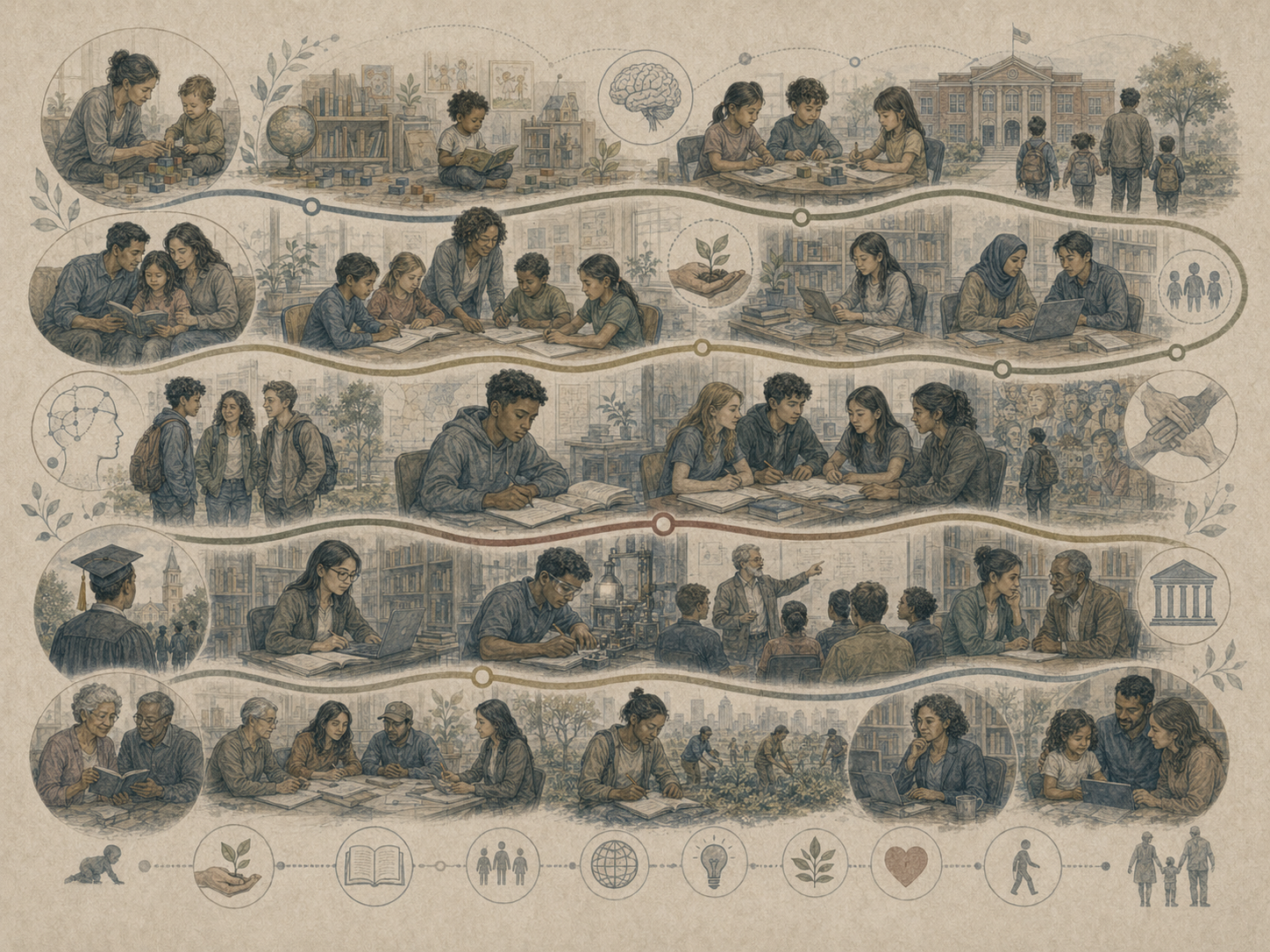
Current official and scholarly frameworks support a broad developmental view of education. Developmental psychology is concerned with growth and change across the lifespan. Early learning research emphasizes that foundational language, numeracy, attention, and relational experiences shape later learning. Public-health approaches to schools frame schools as settings for living, learning, working, health promotion, belonging, mental health, and social development. Taken together, these perspectives suggest that schooling should be understood not merely as academic delivery, but as part of the ecology through which human development is organized.
Why Education and Schooling Matter
Education and schooling matter because they are among the most powerful social institutions shaping development after the family. Children spend a large share of their lives in or around schooling, where they encounter adults outside the home, formal expectations, peer hierarchies, assessments of competence, structured time, institutional authority, and the social meanings of success, failure, inclusion, exclusion, effort, and aspiration.
This is why developmental psychology should treat schooling as more than instruction. A child does not only learn academic content at school. A child also learns whether authority is predictable or arbitrary, whether adults notice distress, whether peers can be trusted, whether effort changes outcomes, whether mistakes are tolerated, whether help is available, and whether institutions are places of recognition or humiliation. These lessons are not always explicit, but they are developmental.
Schooling also matters because it links individual development to social opportunity. Literacy, numeracy, scientific reasoning, historical knowledge, civic understanding, digital skill, and academic credentials affect later work, income, health, participation, and social mobility. But the developmental effects of schooling are wider than credentialing. Schools shape habits of attention, self-regulation, collaboration, future orientation, and institutional trust. They also shape the ways children come to understand themselves as capable, difficult, gifted, behind, disciplined, included, invisible, or excluded.
A developmental account must therefore examine schooling as a system of formation. It asks not only what students learn, but how schooling organizes their relationships, identities, opportunities, health, behavior, and imagined futures. Education is not merely a delivery system for information. It is a developmental environment.
What Education Is
Education is broader than schooling in the narrow institutional sense. It includes the organized cultivation of knowledge, attention, language, judgment, memory, reasoning, imagination, social participation, skill, moral understanding, and the capacities needed to interpret and act in the world. Education begins before formal schooling and continues beyond it. Families, peers, communities, books, religious traditions, media, work, play, art, technology, and public institutions all educate in different ways.
Schooling is one institutional form education takes. It formalizes learning through curriculum, sequencing, assessment, credentials, role differentiation, classroom management, and time structure. This formalization matters developmentally because it introduces children to durable systems of expectation. The student is not merely a child who learns; the student is a social role governed by rules, standards, ranking, attendance, performance, discipline, and institutional recognition.
Education also includes informal and relational learning. Children learn through conversation, imitation, observation, play, household responsibility, storytelling, conflict, repair, movement, music, ritual, digital media, community participation, and mentorship. These forms of learning shape school readiness, motivation, language development, self-regulation, and identity long before formal schooling begins.
A serious developmental account therefore avoids equating education with school alone. Schooling is powerful because it concentrates educational formation into an institution, but development is prepared before school, extended beyond school, and shaped by the fit or conflict among family, school, culture, community, and public life.
What Schooling Does Developmentally
Schooling shapes development by structuring repeated encounters among cognition, authority, social life, health, discipline, and institutional expectation. It regulates time, transitions, speech, silence, movement, attention, performance, and rule-following. It introduces children to comparison at scale: who reads faster, who struggles, who is praised, who is disciplined, who belongs, who is tracked, who is helped, and who is left behind.
These features are not incidental. They help organize children’s sense of self. A child who repeatedly receives meaningful feedback may learn that effort can improve performance. A child repeatedly humiliated for mistakes may learn avoidance. A child whose distress is noticed may learn that institutions can care. A child whose distress is punished may learn that institutions are unsafe. A child who is included in peer life may learn belonging. A child who is isolated may learn vigilance, shame, or withdrawal.
Schooling also shapes development through routine. The school day teaches punctuality, sequence, attention, persistence, turn-taking, self-monitoring, and delayed gratification. These are developmental capacities, but they are not learned only through internal maturation. They are practiced inside structured environments. The quality of those environments matters. Predictable, respectful, relational classrooms shape self-regulation differently from chaotic, punitive, or humiliating ones.
In this sense, schooling is a developmental institution because it produces repeated, patterned experience. It does not simply reveal who students already are. It helps form what they can become.
Early Learning and School Readiness
Schooling begins to shape development even before formal school starts, because school readiness is itself prepared through earlier developmental experience. Language exposure, shared reading, play, sleep, nutrition, routines, caregiver responsiveness, access to safe space, and early opportunities for problem-solving all shape how children enter formal schooling. School readiness is therefore not merely a trait of the child. It is an ecological outcome.
This matters because formal schooling often rests on unequal early conditions. Some children arrive already familiar with books, counting, routines, adult-led instruction, rich vocabulary, stable sleep, and predictable support. Others arrive with fewer early-learning opportunities, more stress, unstable housing, food insecurity, limited access to health care, language mismatch, trauma, or caregiving strain. Treating these differences as individual readiness alone obscures their developmental origins.
Early learning should therefore be understood as a bridge among family, community, care systems, and school. High-quality early childhood environments can support language, attention, social development, regulation, curiosity, and early numeracy. But access to those environments is uneven. A serious developmental approach asks not only whether a child is ready for school, but whether the surrounding institutions are ready to support the child.
School readiness also requires schools to adapt. Children do not arrive as standardized units. They arrive with different languages, temperaments, disabilities, family histories, cultural practices, attention profiles, strengths, and support needs. The developmental question is not simply whether the child conforms to school. It is whether school can become an environment where varied children can begin well.
Teachers, Relationships, and School Connectedness
Teacher relationships matter because school connectedness is not primarily a private feeling. It is a relational experience. Students experience school as meaningful when adults and peers notice them, care about their learning, respond to difficulty, and treat them as persons rather than as scores, disruptions, or attendance units. School connectedness is developmental because it helps determine whether school becomes a place where effort, help-seeking, risk-taking, and belonging feel possible.
Teachers are therefore not simply transmitters of curriculum. They are part of the social infrastructure through which development is protected, challenged, or destabilized. A teacher can become a secure adult outside the family, a mentor, a source of intellectual invitation, a witness to distress, or a pathway into opportunity. A teacher can also become a source of shame, fear, exclusion, or institutional mistrust.
The developmental power of teacher relationships is strongest when it is embedded in school structure. One caring teacher can matter greatly, but connectedness should not depend on chance. Schools can organize advisory systems, restorative practices, mentoring, family communication, teacher collaboration, mental-health referral pathways, and classroom routines that make relational support more reliable.
Connectedness also includes peers. A student who feels cared for by adults but rejected by peers may still experience school as unsafe. A student who belongs socially but is ignored academically may still be underserved. Developmental connection requires adult care, peer belonging, meaningful learning, safety, and recognition working together.
Peer Worlds, Belonging, and Social Comparison
School is one of the main places where peer life becomes developmentally organized. Peer groups in school shape belonging, status, comparison, imitation, cooperation, conflict, embarrassment, loyalty, exclusion, and identity. Children and adolescents learn not only with peers but through peer recognition. They learn what is admired, mocked, hidden, performed, and defended.
Peer belonging matters because school is a social world, not only an instructional site. A student who feels socially unsafe may struggle to attend, concentrate, speak, take risks, or persist. Bullying, isolation, humiliation, racialized exclusion, disability stigma, gender-based harassment, and social comparison can become developmental burdens. Conversely, friendship, peer support, collaborative learning, clubs, sports, arts, and shared projects can strengthen belonging and motivation.
Social comparison is developmentally double-edged. It can motivate effort and provide feedback, but it can also produce shame, hierarchy, avoidance, and identity narrowing. Students learn who is “smart,” “slow,” “bad,” “popular,” “weird,” “advanced,” “behind,” or “not college material.” These labels can become internalized, especially when reinforced by tracking, discipline, grading, peer status, and adult expectation.
A developmental psychology of schooling must therefore examine peer climate as seriously as curriculum. The student’s developmental experience depends on whether school is a livable social world. Belonging is not sentimental. It is a condition of engagement, persistence, mental health, and learning.
Discipline, Routines, and the Making of Self-Regulation
Schooling contributes to self-regulation because it organizes repeated demands on attention, turn-taking, delay, movement, persistence, emotion, and rule-following. Through schedules, transitions, assignments, classroom norms, and collective expectations, children learn how to coordinate conduct in shared settings. This developmental work is real, even when it is uneven or poorly supported.
Discipline is therefore not merely a response to misbehavior. It is a developmental practice. Punitive discipline teaches one kind of relation to authority. Restorative, relational, and repair-oriented discipline teaches another. Exclusionary discipline can remove students from learning, intensify shame, weaken connection, and disproportionately burden already marginalized students. Supportive discipline can preserve accountability while strengthening regulation, problem-solving, relationship, and repair.
Self-regulation develops through co-regulation, structure, and practice. A child who is dysregulated may need predictable routines, sensory supports, clear expectations, adult calm, movement opportunities, and relational repair. Treating dysregulation only as willful defiance can miss the developmental process. A student’s behavior may reflect stress, trauma, disability, hunger, fatigue, social threat, or misunderstanding. Discipline that ignores development often misreads the child.
The goal is not the absence of boundaries. Schools need boundaries to protect learning and safety. The developmental question is what kind of boundaries help students grow. Discipline is most constructive when it combines clarity, dignity, accountability, support, and restoration.
Curriculum, Opportunity, and Cognitive Development
Curriculum matters because formal schooling distributes exposure to language, mathematics, science, history, art, literature, technology, civic reasoning, and the symbolic tools through which cognitive development is extended. Curriculum is not merely content. It is a developmental sequence that shapes attention, memory, abstraction, explanation, argument, problem-solving, imagination, and intellectual identity.
Opportunity matters because curriculum is not equally available in practice. Students may attend the same nominal grade level while receiving very different developmental opportunities: experienced or inexperienced teachers, rich or thin curriculum, advanced or remedial tracks, safe or chaotic classrooms, well-resourced or under-resourced schools, supportive or punitive climates, inclusive or exclusionary systems. Cognitive development is therefore shaped by institutional access.
Curriculum also carries social meaning. What schools teach and omit shapes children’s understanding of history, science, citizenship, culture, identity, power, and possibility. A curriculum can widen the world or narrow it. It can help students see themselves as participants in knowledge, or it can teach them that knowledge belongs elsewhere. Developmental formation includes this symbolic dimension.
A developmental account of curriculum should therefore ask more than whether material was covered. It should ask whether students encountered deep thinking, meaningful feedback, intellectual challenge, cultural recognition, accessible materials, and opportunities to practice. The question is not only what a child is capable of learning. It is what forms of learning the institution makes available.
Assessment, Tracking, and the Formation of Self-Understanding
Assessment is developmentally powerful because it turns learning into recognized performance. Grades, tests, reading levels, report cards, standardized assessments, honors tracks, interventions, and disciplinary records become part of how students are seen and how they see themselves. Assessment can clarify growth, guide support, and reveal needs. It can also narrow identity, intensify anxiety, and confuse measurement with worth.
Tracking and grouping can have long developmental consequences. Placement in advanced, remedial, gifted, special education, or behavioral categories may open support and opportunity, but it may also create stigma, lowered expectations, segregation, or self-fulfilling pathways. Students learn what their placement is supposed to mean. They may internalize institutional categories as personal destiny.
This does not mean assessment should disappear. Development requires feedback. Students need information about progress, teachers need information for instruction, and systems need evidence of whether students are being served. The developmental issue is how assessment is designed, interpreted, and used. Does it support learning or rank children into fixed identities? Does it guide resources or justify exclusion? Does it recognize multiple forms of competence? Does it account for language, disability, poverty, stress, and unequal opportunity?
A developmental approach treats assessment as one part of formation. The question is not only whether a score is valid, but what the score does in a child’s life. A humane assessment system should support growth without making students feel reducible to numbers.
School Climate, Health, and Development
School climate affects development because schools are not only academic settings; they are health environments. Students’ daily experience of safety, respect, nutrition, movement, sleep disruption, stress, peer belonging, adult support, bathroom access, recess, physical education, and mental-health pathways all shape development. A school can be academically ambitious and still developmentally harmful if it produces chronic fear, humiliation, exhaustion, or exclusion.
Health-promoting school frameworks are important because they treat schools as settings for living, learning, and working. This broad view recognizes that learning is embodied. Children learn through bodies that need rest, food, safety, movement, regulation, and care. A child who is hungry, afraid, bullied, injured, chronically stressed, or unsupported is not simply less motivated. The developmental conditions for learning have been compromised.
School climate also shapes adult development. Teachers and staff work inside the same institutional environment. Teacher stress, burnout, turnover, lack of support, and unsafe working conditions can weaken relational continuity for students. Developmental schooling requires attention to the adults who sustain the environment. A school cannot provide stability to students if the adults inside it are constantly overwhelmed.
School health is therefore not a secondary issue. It is part of developmental infrastructure. Safe buildings, predictable routines, supportive relationships, physical activity, mental-health access, inclusive discipline, and family engagement all shape whether schooling supports or undermines development.
Mental Health, School Connectedness, and Development
School connectedness is one of the clearest bridges between education and mental health. Students who experience school as caring, safe, fair, and meaningful are more likely to remain engaged. Students who experience school as hostile, anonymous, punitive, or humiliating may disengage, withdraw, resist, or internalize distress. School mental health is therefore not only a clinical service issue. It is also a climate, relationship, and institutional design issue.
Mental-health support in schools can include counseling, referral pathways, social-emotional learning, peer support, restorative practices, trauma-informed approaches, crisis response, disability accommodations, and teacher training. But these supports work best when embedded in a school culture that reduces stigma and notices students early. A school that offers counseling but maintains a climate of shame and exclusion may still produce developmental harm.
Connectedness does not eliminate mental-health difficulties. Students may still struggle with anxiety, depression, trauma, grief, neurodivergence, disability, family stress, or peer conflict. But connectedness can make help more reachable. It can reduce isolation and increase the likelihood that a student will be seen before distress becomes more severe.
Developmentally, mental health and schooling are inseparable. Attention, memory, motivation, attendance, regulation, identity, and peer life are all affected by emotional well-being. Treating mental health as outside the academic mission misunderstands learning itself.
Family, School, and Community Ecologies
Schooling does not operate alone. It sits within a larger ecology that includes family life, neighborhood conditions, work schedules, housing, health care, transportation, language access, community organizations, digital infrastructure, and public policy. A child’s school development is shaped by whether the family can communicate with teachers, whether transportation is reliable, whether housing is stable, whether food is available, whether internet access exists, and whether caregivers have time and trust to engage.
Family-school relationships can become developmental supports when they are respectful, accessible, and collaborative. They can become burdens when schools blame families, communicate only through bureaucratic language, ignore work schedules, fail to provide translation, or treat caregiver concern as interference. A family’s capacity to support schooling is shaped by material and institutional conditions, not only by motivation.
Community also matters. Libraries, after-school programs, sports, arts, religious communities, youth organizations, mentorship networks, and safe public spaces extend the developmental ecology of schooling. They can buffer school stress, widen opportunity, and provide alternate sites of recognition. For some students, community organizations are where school identities are repaired or expanded.
A developmental account of education therefore needs ecological thinking. The school is a central institution, but it is never the only institution shaping educational development. Learning is distributed across settings.
Inequality and the Unequal Ecology of Schooling
Schooling is one of the clearest examples of how development is shaped by unequal institutions. Students do not enter the same educational world simply because they attend school. Funding differences, neighborhood segregation, transportation, food security, family strain, school discipline disparities, language access, disability services, teacher turnover, class size, building quality, and unequal access to supportive adults all shape what schooling becomes developmentally.
This means educational outcomes should not be interpreted only as individual achievement. Achievement is real, but it emerges through opportunity structures. A student’s reading growth may reflect motivation and effort, but also class size, teacher training, literacy instruction, home language, access to books, disability screening, sleep, nutrition, and stress. A student’s behavior may reflect temperament, but also trauma, school climate, discipline style, disability support, peer threat, or institutional mismatch.
Inequality also shapes how students are perceived. Some students are over-disciplined for behavior that others are supported through. Some are underdiagnosed and left without help. Some are tracked into lower expectations early. Some receive enrichment, mentorship, and college pathways. Others receive surveillance, remediation, and exclusion. These patterns shape developmental identity.
A serious developmental psychology of schooling must therefore analyze education as a stratified ecology. It asks who receives rich curriculum, who receives support, who receives punishment, who is believed, who is recognized, who is protected, and who must overcome the institution itself in order to develop.
Disability, Neurodivergence, and Access in Schooling
Disability and neurodivergence reveal how strongly schooling depends on environmental fit. A student with dyslexia may appear incapable in a print-only setting and capable with structured literacy, assistive technology, and accessible text. An autistic student may struggle in noisy, unpredictable environments and participate well in structured, sensory-considerate classrooms. A student with ADHD may be framed as defiant in rigid settings and thrive with movement, scaffolding, clear routines, and executive-function support.
Access is developmental. It changes what students can practice, attempt, communicate, and believe about themselves. When schools provide communication supports, sensory accommodations, mobility access, flexible assessment, assistive technology, and inclusive instruction, they expand developmental possibility. When they refuse or delay access, they can turn difference into failure.
Inclusive schooling is not satisfied by physical placement alone. A student may be present in the classroom but excluded from participation, friendship, communication, curriculum, or dignity. Developmentally meaningful inclusion requires participation, not mere proximity. It requires high expectations, appropriate support, peer belonging, and institutional willingness to change routines rather than force all students into one narrow pattern.
This matters for all students. Disability access often improves school design generally: clearer instructions, flexible materials, predictable routines, multimodal teaching, reduced sensory overload, and stronger relational support can benefit many learners. Disability and neurodivergence should therefore be central to educational development, not treated as marginal exceptions.
Culture, Language, and School Formation
Schooling is always cultural. It carries assumptions about language, authority, participation, time, achievement, family involvement, independence, competition, cooperation, and appropriate behavior. Students whose home cultures align closely with school expectations may experience school as natural. Students whose languages, traditions, communication styles, or family structures differ from dominant school norms may experience school as translation, negotiation, or conflict.
Language is especially important. Multilingual students may bring rich linguistic resources while being assessed through systems that underrecognize them. A student learning in a second language may be misread as less capable. A family that communicates in another language may be treated as less engaged if schools fail to provide accessible communication. Language access is therefore developmental, not administrative.
Culture also shapes what students see as meaningful knowledge. Curriculum that ignores students’ histories, communities, or identities can produce alienation. Curriculum that recognizes multiple traditions and prepares students for shared civic life can widen belonging. The goal is not to reduce schooling to identity affirmation alone, but to make knowledge feel accessible, serious, and connected to human worlds students can recognize.
Developmental formation requires cultural humility. Schools should not assume that one style of participation, family engagement, speech, or aspiration is the universal developmental norm. They should build bridges between home, community, and academic knowledge without treating difference as deficiency.
Adolescence, Schooling, and Future Orientation
Adolescence intensifies the developmental role of schooling because identity, autonomy, peer belonging, sexuality, moral reasoning, academic pressure, and future orientation all become more salient. School is not merely a place adolescents attend. It is a place where they test who they are becoming, who recognizes them, what futures seem available, and how much control they have over their lives.
Adolescent schooling can expand or narrow the future. Rigorous coursework, mentorship, arts, sports, vocational pathways, civic learning, college counseling, apprenticeships, and supportive adults can make futures imaginable. Tracking, exclusionary discipline, lack of guidance, unsafe peer climates, and chronic academic failure can narrow future orientation. Students often learn not only what they want, but what they believe institutions will allow them to want.
Peer life becomes especially powerful in adolescence. Belonging, status, embarrassment, romance, social media, bullying, identity formation, and peer recognition affect school engagement. Adolescents may reject school not because learning is unimportant, but because school has become a site of humiliation, threat, boredom, or meaninglessness. Developmentally intelligent schooling must understand this complexity.
Future orientation is not simply an individual attitude. It is shaped by visible pathways, adult guidance, family resources, social comparison, institutional trust, and whether students have experienced effort as meaningful. Adolescents need schools that connect learning to dignity, agency, work, citizenship, creativity, and real possibility.
Beyond Instruction: Schooling as Developmental Formation
The strongest developmental account of schooling goes beyond the question of what content is taught. It asks what sort of person the institution is helping to form. Schooling shapes not only knowledge but orientation to authority, habits of cooperation, comfort with institutions, ways of managing conflict, expectations about the future, and beliefs about whether one’s voice matters.
This does not mean schools fully determine development. Family, neighborhood, biology, culture, history, peer life, media, and public policy all matter. But schooling is one of the major organized environments in which these forces meet. It is where society tells children what counts as knowledge, behavior, success, intelligence, citizenship, and promise.
Schooling can therefore be developmental formation in both positive and harmful ways. It can cultivate curiosity, discipline, belonging, agency, literacy, civic imagination, and self-confidence. It can also cultivate shame, compliance, competition without purpose, distrust, exclusion, and narrowed identity. The question is not whether schools form development. They do. The question is what kind of formation they provide.
A developmental psychology of education must therefore include institutions, relationships, health, inequality, curriculum, discipline, identity, and access. Learning does not occur outside these conditions. It is made possible, constrained, or distorted through them.
An Analytical Framework for Education and Developmental Formation
A stylized developmental outcome \(D_{it}\) for student \(i\) at time \(t\) can be written as a function of school connectedness, teacher support, peer belonging, curriculum opportunity, stress, and residual variation:
D_{it} = \alpha_i + \beta S_{it} + \gamma T_{it} + \delta P_{it} + \eta C_{it} – \lambda R_{it} + \varepsilon_{it}
\]
Interpretation: Developmental outcomes depend on school connectedness \(S_{it}\), teacher support \(T_{it}\), peer belonging \(P_{it}\), curriculum opportunity \(C_{it}\), school-related stress \(R_{it}\), individual baseline differences \(\alpha_i\), and residual variation \(\varepsilon_{it}\).
To represent school-level context, the model can be expanded into a multilevel structure:
D_{ijt} = \alpha + u_j + \beta S_{ijt} + \gamma T_{ijt} + \delta P_{ijt} + \eta C_{ijt} – \lambda R_{ijt} + \varepsilon_{ijt}
\]
Interpretation: The term \(u_j\) captures shared school-level influence, including climate, leadership, discipline structure, resource environment, and institutional culture.
Because development is path-dependent, prior developmental state can also be included:
D_{it} = \rho D_{i,t-1} + \theta I_{it} + \beta S_{it} + \gamma T_{it} + \delta P_{it} – \lambda R_{it} + \varepsilon_{it}
\]
Interpretation: Current development depends partly on prior developmental state \(D_{i,t-1}\), while intervention or support \(I_{it}\) can redirect the pathway.
To represent inequality, opportunity can be modeled as a function of school resources, family resources, neighborhood context, and access:
O_{ijt} = \phi_1 Q_j + \phi_2 F_i + \phi_3 N_j + \phi_4 A_{ijt} + \varepsilon_{ijt}
\]
Interpretation: Opportunity \(O_{ijt}\) is shaped by school quality or resources \(Q_j\), family resources \(F_i\), neighborhood context \(N_j\), and access or accommodation \(A_{ijt}\). Educational opportunity is not simply an individual trait.
These equations are simplified, but they clarify the article’s central claim: schooling affects development through relationships, climate, curriculum, discipline, health, opportunity, and institutional design. Schools are developmental systems, not neutral containers.
R: Simulating School Connectedness, Support, and Development
The following R example simulates students across repeated waves with teacher support, peer belonging, school climate, curriculum opportunity, school stress, family support, and intervention exposure shaping developmental outcomes. The data are synthetic and intended for demonstration only.
# Simulating education, school connectedness, and developmental formation
# ----------------------------------------------------------------------
# This synthetic example models developmental outcomes as a function of
# teacher support, peer belonging, school climate, curriculum opportunity,
# family support, school stress, and intervention exposure across repeated waves.

suppressPackageStartupMessages({
  library(dplyr)
  library(lme4)
  library(ggplot2)
})

set.seed(2026)

n_students <- 820
n_waves <- 9
n_schools <- 34

students <- data.frame(
  student_id = 1:n_students,
  school_id = sample(1:n_schools, n_students, replace = TRUE),
  baseline_teacher_support = rnorm(n_students, 0, 1),
  baseline_peer_belonging = rnorm(n_students, 0, 1),
  baseline_school_stress = rnorm(n_students, 0, 1),
  family_support = rnorm(n_students, 0, 1),
  academic_confidence = rnorm(n_students, 0, 0.8),
  intervention = rbinom(n_students, 1, 0.35)
)

school_df <- data.frame(
  school_id = 1:n_schools,
  school_climate = rnorm(n_schools, 0, 0.6),
  curriculum_opportunity = rnorm(n_schools, 0, 0.6),
  restorative_practice = rnorm(n_schools, 0, 0.5),
  resource_capacity = rnorm(n_schools, 0, 0.5)
)

panel_data <- students |>
  slice(rep(1:n(), each = n_waves)) |>
  group_by(student_id) |>
  mutate(
    wave = 0:(n_waves - 1),
    current_teacher = rnorm(n_waves, mean = baseline_teacher_support, sd = 0.55),
    current_peer = rnorm(n_waves, mean = baseline_peer_belonging, sd = 0.55),
    current_stress = rnorm(n_waves, mean = baseline_school_stress, sd = 0.65),
    current_family = rnorm(n_waves, mean = family_support, sd = 0.50),
    current_confidence = rnorm(n_waves, mean = academic_confidence, sd = 0.50)
  ) |>
  ungroup() |>
  left_join(school_df, by = "school_id") |>
  arrange(student_id, wave)

panel_data <- panel_data |>
  mutate(
    connectedness_score =
      45 +
      0.45 * wave +
      1.20 * current_teacher +
      1.05 * current_peer +
      0.80 * school_climate +
      0.60 * restorative_practice -
      1.10 * current_stress +
      rnorm(n(), 0, 2.2),
    development_score =
      50 +
      0.70 * wave +
      1.15 * current_teacher +
      1.05 * current_peer +
      0.95 * school_climate +
      0.90 * curriculum_opportunity +
      0.75 * current_family +
      0.70 * current_confidence +
      0.65 * resource_capacity +
      0.85 * intervention +
      0.55 * connectedness_score / 10 -
      1.15 * current_stress +
      0.50 * current_teacher * current_peer +
      rnorm(n(), 0, 2.4)
  )

model <- lmer(
  development_score ~ wave + current_teacher + current_peer +
    school_climate + curriculum_opportunity + current_family +
    current_confidence + resource_capacity + intervention +
    connectedness_score + current_stress +
    current_teacher:current_peer +
    (1 + wave | school_id/student_id),
  data = panel_data
)

summary(model)

trajectory_summary <- panel_data |>
  group_by(wave, intervention) |>
  summarize(
    mean_development = mean(development_score),
    mean_connectedness = mean(connectedness_score),
    standard_error = sd(development_score) / sqrt(n()),
    .groups = "drop"
  ) |>
  mutate(
    lower = mean_development - 1.96 * standard_error,
    upper = mean_development + 1.96 * standard_error,
    group = ifelse(intervention == 1, "Support program", "No program")
  )

ggplot(trajectory_summary, aes(x = wave, y = mean_development, linetype = group)) +
  geom_line(linewidth = 1) +
  geom_ribbon(aes(ymin = lower, ymax = upper, group = group), alpha = 0.12) +
  labs(
    title = "Simulated Education, Schooling, and Developmental Formation",
    x = "Wave",
    y = "Average development score",
    linetype = "Group"
  ) +
  theme_minimal()

school_summary <- panel_data |>
  group_by(school_id) |>
  summarize(
    school_climate = mean(school_climate),
    curriculum_opportunity = mean(curriculum_opportunity),
    restorative_practice = mean(restorative_practice),
    average_development = mean(development_score),
    average_connectedness = mean(connectedness_score),
    .groups = "drop"
  )

ggplot(school_summary, aes(x = school_climate, y = average_connectedness)) +
  geom_point() +
  geom_smooth(method = "lm", se = TRUE) +
  labs(
    title = "Synthetic School Climate and Connectedness",
    x = "School climate",
    y = "Average connectedness"
  ) +
  theme_minimal()

# Analysts can extend this model by:
# 1. adding attendance, exclusionary discipline, and mobility;
# 2. modeling classrooms nested within schools;
# 3. separating academic, emotional, and social outcomes;
# 4. introducing language access and disability accommodations;
# 5. estimating differential effects across grade spans;
# 6. comparing restorative, punitive, and support-centered school climates.
This R workflow treats schooling as a developmental system rather than a neutral measurement site. The model represents school connectedness, teacher relationships, peer belonging, curriculum opportunity, family support, stress, and intervention exposure as conditions shaping development over time.
Python: Modeling Schooling and Developmental Change Over Time
The following Python example simulates developmental change over time with teacher support, peer belonging, school climate, curriculum opportunity, school stress, family support, and intervention exposure. It includes prior developmental state to represent path dependence.
# Modeling schooling and developmental change over time
# -----------------------------------------------------
# This synthetic example models development as a dynamic relation among
# teacher support, peer belonging, school climate, curriculum opportunity,
# school stress, family support, intervention exposure, and prior development.

from __future__ import annotations

import numpy as np
import pandas as pd
import statsmodels.formula.api as smf
import matplotlib.pyplot as plt

np.random.seed(2026)

n_students = 850
n_periods = 10
n_schools = 36

students = pd.DataFrame({
    "student_id": np.arange(1, n_students + 1),
    "school_id": np.random.choice(np.arange(1, n_schools + 1), size=n_students),
    "baseline_teacher_support": np.random.normal(0, 1, n_students),
    "baseline_peer_belonging": np.random.normal(0, 1, n_students),
    "baseline_school_stress": np.random.normal(0, 1, n_students),
    "family_support": np.random.normal(0, 1, n_students),
    "academic_confidence": np.random.normal(0, 0.8, n_students),
    "intervention": np.random.binomial(1, 0.35, n_students),
})

school_df = pd.DataFrame({
    "school_id": np.arange(1, n_schools + 1),
    "school_climate": np.random.normal(0, 0.6, n_schools),
    "curriculum_opportunity": np.random.normal(0, 0.6, n_schools),
    "restorative_practice": np.random.normal(0, 0.5, n_schools),
    "resource_capacity": np.random.normal(0, 0.5, n_schools),
})

panel = students.loc[students.index.repeat(n_periods)].copy()
panel["time"] = np.tile(np.arange(n_periods), n_students)
panel = panel.merge(school_df, on="school_id", how="left")

panel["current_teacher"] = np.random.normal(
    panel["baseline_teacher_support"],
    0.60,
    len(panel),
)

panel["current_peer"] = np.random.normal(
    panel["baseline_peer_belonging"],
    0.60,
    len(panel),
)

panel["current_stress"] = np.random.normal(
    panel["baseline_school_stress"],
    0.70,
    len(panel),
)

panel["current_family"] = np.random.normal(
    panel["family_support"],
    0.55,
    len(panel),
)

panel["current_confidence"] = np.random.normal(
    panel["academic_confidence"],
    0.55,
    len(panel),
)

panel = panel.sort_values(["student_id", "time"]).reset_index(drop=True)

panel["connectedness_score"] = (
    45
    + 0.45 * panel["time"]
    + 1.20 * panel["current_teacher"]
    + 1.05 * panel["current_peer"]
    + 0.80 * panel["school_climate"]
    + 0.60 * panel["restorative_practice"]
    - 1.10 * panel["current_stress"]
    + np.random.normal(0, 2.2, len(panel))
)

panel["development_score"] = np.nan

for student_id in panel["student_id"].unique():
    subset = panel.loc[panel["student_id"] == student_id].copy()
    previous_score = 50 + np.random.normal(0, 3)

    for idx in subset.index:
        time = panel.at[idx, "time"]
        teacher = panel.at[idx, "current_teacher"]
        peer = panel.at[idx, "current_peer"]
        climate = panel.at[idx, "school_climate"]
        curriculum = panel.at[idx, "curriculum_opportunity"]
        stress = panel.at[idx, "current_stress"]
        family = panel.at[idx, "current_family"]
        confidence = panel.at[idx, "current_confidence"]
        resources = panel.at[idx, "resource_capacity"]
        intervention = panel.at[idx, "intervention"]
        connectedness = panel.at[idx, "connectedness_score"]

        current_score = (
            0.70 * previous_score
            + 0.22 * time
            + 1.10 * teacher
            + 1.00 * peer
            + 0.95 * climate
            + 0.90 * curriculum
            + 0.75 * family
            + 0.70 * confidence
            + 0.65 * resources
            + 0.85 * intervention
            + 0.55 * connectedness / 10
            - 1.05 * stress
            + 0.50 * teacher * peer
            + np.random.normal(0, 2.3)
        )

        panel.at[idx, "development_score"] = current_score
        previous_score = current_score

panel["lag_score"] = panel.groupby("student_id")["development_score"].shift(1)
regression_data = panel.dropna(subset=["lag_score"]).copy()

model = smf.ols(
    formula="""
    development_score ~ lag_score + time + current_teacher +
    current_peer + school_climate + curriculum_opportunity +
    current_family + current_confidence + resource_capacity +
    intervention + connectedness_score + current_stress +
    current_teacher:current_peer
    """,
    data=regression_data,
).fit(cov_type="HC3")

print(model.summary())

trajectory = panel.groupby(["time", "intervention"], as_index=False).agg(
    average_development=("development_score", "mean"),
    average_connectedness=("connectedness_score", "mean"),
    standard_error=("development_score", lambda x: x.std() / np.sqrt(len(x))),
)

trajectory["lower"] = trajectory["average_development"] - 1.96 * trajectory["standard_error"]
trajectory["upper"] = trajectory["average_development"] + 1.96 * trajectory["standard_error"]
trajectory["group"] = trajectory["intervention"].map({0: "No program", 1: "Support program"})

plt.figure(figsize=(8, 5))
for group_name, subset in trajectory.groupby("group"):
    plt.plot(subset["time"], subset["average_development"], marker="o", label=group_name)
plt.xlabel("Time")
plt.ylabel("Average development score")
plt.title("Simulated Education, Schooling, and Developmental Formation")
plt.legend()
plt.tight_layout()
plt.show()

school_summary = panel.groupby("school_id", as_index=False).agg(
    school_climate=("school_climate", "mean"),
    curriculum_opportunity=("curriculum_opportunity", "mean"),
    restorative_practice=("restorative_practice", "mean"),
    average_development=("development_score", "mean"),
    average_connectedness=("connectedness_score", "mean"),
)

print(school_summary.sort_values("average_development", ascending=False).head())

# Analysts can extend this framework by:
# 1. adding attendance, mobility, and exclusionary discipline variables;
# 2. nesting students within classrooms and schools;
# 3. separating academic, emotional, and social pathways;
# 4. introducing disability accommodations and language access;
# 5. comparing resource differences across schools;
# 6. simulating restorative-practice and mental-health support scenarios.
The Python workflow makes the developmental claim explicit: schooling shapes development through prior developmental state, adult support, peer belonging, climate, curriculum, family support, resources, intervention exposure, school stress, and connectedness. It is a synthetic teaching scaffold, not a causal estimate from real students.
GitHub Repository
Complete Code Repository
Access the full companion repository for this article, including reproducible analysis materials and multi-language code workflows for education, school connectedness, teacher support, peer belonging, school climate, curriculum opportunity, intervention exposure, stress, inequality, and developmental formation over time.
Conclusion
Education, schooling, and developmental formation belong together because schools do more than deliver lessons. They organize recurring relationships, social expectations, health conditions, opportunities for belonging, patterns of discipline, access to curriculum, and forms of recognition that shape development across childhood and adolescence. Schooling is one of the major institutional environments in which children learn who they are, what they can do, how institutions treat them, and what futures seem possible.
The strongest developmental psychology therefore treats education neither as content alone nor as bureaucratic backdrop. It treats schooling as one of the major institutions through which human development is formed, protected, stratified, supported, and made socially meaningful. In that sense, education is not only about what children know. It is also about what kinds of selves, relationships, capacities, and futures schools make possible.
A serious developmental account of schooling must therefore study curriculum, teachers, peers, school connectedness, health, discipline, inequality, disability access, language, culture, family ecology, and institutional design together. Schools are developmental systems. The question is not whether they shape human growth. The question is whether they do so with dignity, fairness, support, intellectual depth, and real opportunity.
Related Articles
- What Is Developmental Psychology?
- Why Developmental Psychology Matters Today
- Parenting, Family Systems, and Human Development
- Developmental Systems Theory and the Ecology of Human Growth
- Social Development, Peer Relations, and the Formation of the Self
- Self-Regulation and Executive Function Across Development
- Disability, Neurodivergence, and Development
- Development, Inequality, and the Life Course
- Developmental Psychology knowledge series
Further Reading
- Bronfenbrenner, U. (1979) The Ecology of Human Development: Experiments by Nature and Design. Cambridge, MA: Harvard University Press. Available at: https://www.hup.harvard.edu/books/9780674224575.
- Centers for Disease Control and Prevention (2024) School Connectedness Helps Students Thrive. Available at: https://www.cdc.gov/youth-behavior/school-connectedness/index.html.
- Centers for Disease Control and Prevention (2025) Promoting School Connectedness Through Restorative Practices. Available at: https://www.cdc.gov/youth-behavior/school-connectedness/restorative-practices.html.
- Eccles, J.S. and Roeser, R.W. (2011) ‘Schools as developmental contexts during adolescence’, Journal of Research on Adolescence, 21(1), pp. 225–241. Available at: https://doi.org/10.1111/j.1532-7795.2010.00725.x.
- Eunice Kennedy Shriver National Institute of Child Health and Human Development (2021) Early Learning. Available at: https://www.nichd.nih.gov/health/topics/factsheets/early-learning.
- Pianta, R.C., Hamre, B.K. and Allen, J.P. (2012) ‘Teacher-student relationships and engagement: Conceptualizing, measuring, and improving the capacity of classroom interactions’, in Christenson, S.L., Reschly, A.L. and Wylie, C. (eds.) Handbook of Research on Student Engagement. Boston, MA: Springer, pp. 365–386. Available at: https://doi.org/10.1007/978-1-4614-2018-7_17.
- UNESCO (2020) Global Education Monitoring Report 2020: Inclusion and Education: All Means All. Available at: https://www.unesco.org/gem-report/en/inclusion.
- World Health Organization (n.d.) Health Promoting Schools. Available at: https://www.who.int/health-topics/health-promoting-schools.
- World Health Organization (n.d.) Promoting Healthy Growth and Development. Available at: https://www.who.int/activities/promoting-healthy-growth-and-development.
References
- American Psychological Association (n.d.) Developmental Psychology. Available at: https://www.apa.org/education-career/guide/subfields/developmental.
- Bronfenbrenner, U. (1979) The Ecology of Human Development: Experiments by Nature and Design. Cambridge, MA: Harvard University Press. Available at: https://www.hup.harvard.edu/books/9780674224575.
- Centers for Disease Control and Prevention (2019) Keep Recess in Schools. Available at: https://www.cdc.gov/physical-activity-education/media/pdfs/Recess_Data_Brief_CDC_Logo_FINAL_191106.pdf.
- Centers for Disease Control and Prevention (2024) School Connectedness Helps Students Thrive. Available at: https://www.cdc.gov/youth-behavior/school-connectedness/index.html.
- Centers for Disease Control and Prevention (2024) Youth Mental Health: The Numbers. Available at: https://www.cdc.gov/healthy-youth/mental-health/mental-health-numbers.html.
- Centers for Disease Control and Prevention (2025) Promoting School Connectedness Through Restorative Practices. Available at: https://www.cdc.gov/youth-behavior/school-connectedness/restorative-practices.html.
- Eccles, J.S. and Roeser, R.W. (2011) ‘Schools as developmental contexts during adolescence’, Journal of Research on Adolescence, 21(1), pp. 225–241. Available at: https://doi.org/10.1111/j.1532-7795.2010.00725.x.
- Eunice Kennedy Shriver National Institute of Child Health and Human Development (2021) Early Learning. Available at: https://www.nichd.nih.gov/health/topics/factsheets/early-learning.
- Eunice Kennedy Shriver National Institute of Child Health and Human Development (2021) Why Is Early Learning Important? Available at: https://www.nichd.nih.gov/health/topics/early-learning/conditioninfo/matter.
- Eunice Kennedy Shriver National Institute of Child Health and Human Development (2021) How Can Parents and Caregivers Promote Early Learning? Available at: https://www.nichd.nih.gov/health/topics/early-learning/conditioninfo/promote.
- Eunice Kennedy Shriver National Institute of Child Health and Human Development (2021) What Are Some Factors That Affect Early Learning? Available at: https://www.nichd.nih.gov/health/topics/early-learning/conditioninfo/factors.
- Pianta, R.C., Hamre, B.K. and Allen, J.P. (2012) ‘Teacher-student relationships and engagement: Conceptualizing, measuring, and improving the capacity of classroom interactions’, in Christenson, S.L., Reschly, A.L. and Wylie, C. (eds.) Handbook of Research on Student Engagement. Boston, MA: Springer, pp. 365–386. Available at: https://doi.org/10.1007/978-1-4614-2018-7_17.
- UNESCO (2020) Global Education Monitoring Report 2020: Inclusion and Education: All Means All. Available at: https://www.unesco.org/gem-report/en/inclusion.
- World Health Organization (n.d.) Child Health and Development. Available at: https://www.who.int/teams/maternal-newborn-child-adolescent-health-and-ageing/child-health.
- World Health Organization (n.d.) Health Promoting Schools. Available at: https://www.who.int/health-topics/health-promoting-schools.
- World Health Organization (n.d.) Investing in School Health. Available at: https://www.who.int/activities/investing-in-school-health.
- World Health Organization (n.d.) Promoting Healthy Growth and Development. Available at: https://www.who.int/activities/promoting-healthy-growth-and-development.