
Last Updated May 21, 2026
Developmental psychology matters today because many of the central problems of contemporary life are developmental problems. Mental health, schooling, inequality, caregiving, trauma, disability, aging, technology, work, family formation, and social belonging all involve questions about how people grow, adapt, learn, recover, participate, and change across time. The field is not only concerned with childhood milestones or academic theories of maturation. It asks how human lives unfold within families, schools, neighborhoods, cultures, health systems, technologies, economies, and institutions.
That makes developmental psychology one of the most important fields for understanding the present. When societies ask why children are struggling, why adolescents feel disconnected, why early support matters, why inequality compounds across generations, why mental health needs rise at particular life stages, why later-life dignity matters, or how public policy shapes human possibility, they are asking developmental questions. Developmental psychology gives those questions a disciplined vocabulary: growth, change, continuity, transition, plasticity, risk, protection, timing, context, adaptation, and lifespan development.
Main Library
Publications
Article Map
Developmental Psychology
Related Topic
Cognitive Psychology
Related Topic
Social Psychology
Related Topic
Positive Psychology
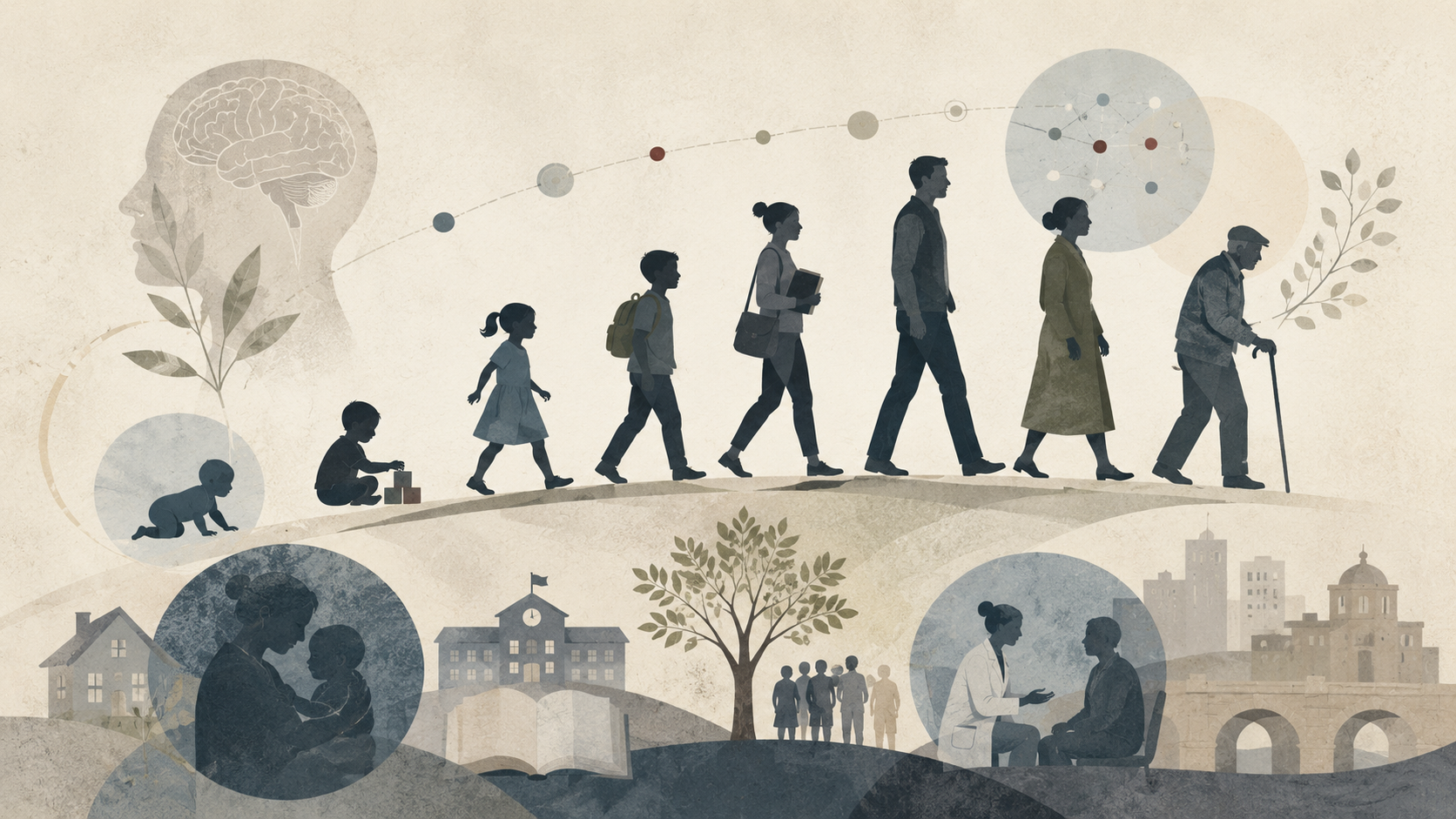
Developmental psychology begins with a simple premise: human beings are not fixed objects. They are living organisms embedded in relationships, histories, institutions, and environments. Their capacities emerge over time. Their vulnerabilities change over time. Their strengths are supported or constrained by conditions that are biological, psychological, social, cultural, economic, and political. This is why the field remains indispensable in a period marked by mental-health strain, widening inequality, educational disruption, demographic aging, technological acceleration, and renewed concern about care.
Why the Field Matters Now
The field matters now because the major pressures facing families, schools, communities, health systems, and aging societies are not isolated events. They are developmental pressures. A child’s mental health is not separable from family stability, school belonging, peer relationships, housing, community safety, and access to care. An adolescent’s sense of identity is not separable from friendship, institutional trust, digital life, cultural belonging, and the transition toward adulthood. An older adult’s well-being is not separable from functional ability, care systems, social participation, physical environments, and dignity.
Developmental psychology matters because it resists the temptation to treat people as snapshots. It asks how the present became the present. It asks how early conditions shape later possibilities, how later experiences can redirect earlier patterns, and how support can alter trajectories that might otherwise appear inevitable. That emphasis on change over time is essential for understanding human lives under real conditions.
The field also matters because many current debates become clearer when translated into developmental terms. Debates about school discipline become debates about self-regulation, belonging, authority, safety, and trust. Debates about childhood mental health become debates about stress, coping, attachment, early identification, access to services, and family support. Debates about inequality become debates about cumulative advantage and disadvantage. Debates about aging become debates about functional ability, care, autonomy, meaning, and participation. Developmental psychology does not replace moral, political, medical, or educational analysis, but it gives them a time-aware human foundation.
Contemporary official frameworks point in the same direction. The American Psychological Association defines developmental psychology as the study of human growth and change across the lifespan, including physical, cognitive, social, intellectual, perceptual, personality, and emotional growth. The Centers for Disease Control and Prevention emphasizes that children’s mental health is shaped by relationships and environments, and that adolescent well-being is supported by connectedness at school, home, and community. The World Health Organization frames health through the life course, social determinants, early childhood development, and healthy ageing. Together, these perspectives show why developmental psychology is not a narrow specialty. It is a core framework for understanding human lives in society.
What Developmental Psychology Actually Studies
Developmental psychology studies growth, change, continuity, and adaptation across the lifespan. It examines infancy, childhood, adolescence, adulthood, and later life. It asks how people acquire capacities such as perception, language, memory, emotion regulation, moral reasoning, identity, attachment, social understanding, executive function, and practical competence. It also asks how those capacities are shaped by biology, experience, relationships, culture, institutions, and history.
This breadth matters because developmental psychology is often misunderstood as a field of childhood stages alone. Childhood is central, but the field is larger than childhood. It studies how development begins before birth, how early years lay foundations, how middle childhood reorganizes learning and peer life, how adolescence transforms identity and autonomy, how adulthood involves work, intimacy, caregiving, responsibility, and reinvention, and how later life involves adaptation, memory, meaning, dependence, contribution, loss, and dignity.
Developmental psychology therefore studies both age-related change and context-shaped change. A purely chronological account asks what typically happens at age two, age seven, age fifteen, age forty, or age eighty. A deeper developmental account asks how biological maturation, family relationships, school structure, cultural expectations, adversity, opportunity, public policy, and historical timing shape the person’s pathway through those ages.
The field is especially powerful because it holds together questions that are often separated. It connects the infant’s need for responsive care to the adolescent’s need for belonging. It connects school climate to long-term well-being. It connects inequality in childhood to adult health and opportunity. It connects aging to the whole life course rather than treating later life as an isolated stage of decline. It connects human possibility to the environments that make growth possible or difficult.
From Stages to Systems
One reason developmental psychology matters today is that the field has moved beyond simple stage-based thinking. Stage theories remain historically important because they helped show that development has structure. But contemporary developmental thinking is more systems-oriented. It treats development as a dynamic relation among persons, bodies, relationships, environments, institutions, cultures, and historical conditions.
Bronfenbrenner’s ecological systems tradition helped make this shift visible by showing that children develop within nested contexts: family, school, neighborhood, community, culture, policy, and historical time. The life-course tradition added another crucial insight: lives are shaped by timing, transitions, linked lives, and historical context. Developmental systems theory, transactional models, and lifespan psychology further emphasize that development is not simply the unfolding of an internal program. It is an ongoing process of interaction.
This systems orientation is essential today. A child struggling in school cannot be understood only as an individual learner. The child is also situated within classroom climate, curriculum, teacher expectations, family stress, sleep, nutrition, peer relationships, disability supports, neighborhood conditions, health care, and policy. An adolescent experiencing distress cannot be understood only through symptoms. The adolescent is also navigating identity, belonging, social comparison, institutional pressure, family dynamics, digital environments, and an uncertain future. An older adult losing mobility cannot be understood only through medical decline. The person is also situated within housing design, transportation, care networks, social connection, economic security, and age norms.
Developmental psychology matters because it gives serious language to this complexity. It does not reduce persons to biology, but it does not ignore biology. It does not reduce lives to social conditions, but it does not ignore those conditions. It insists that development is embodied, relational, institutional, historical, and open to change.
Development and Mental Health
Mental health is developmental. Distress, resilience, coping, emotional regulation, identity, attachment, social trust, and help-seeking all unfold over time. Children and adolescents do not simply have mental health in the abstract. They develop emotionally and socially within relationships, families, schools, communities, health systems, and cultural expectations. This is why developmental psychology is indispensable for understanding mental health today.
Developmental thinking helps distinguish typical variation from persistent difficulty. Fear, sadness, anger, withdrawal, impulsivity, and conflict can appear at many points in development, but their meaning depends on age, duration, intensity, context, impairment, and relational pattern. A behavior that is typical at one age may be concerning at another. A reaction that is understandable after a stressful event may become serious if it persists or disrupts daily functioning. A child’s difficulty may reflect individual vulnerability, family stress, school climate, trauma exposure, neurodevelopmental difference, or some combination of these factors.
The field also matters because early support can change trajectories. Mental health problems are not merely private states. They affect learning, friendship, family functioning, decision-making, school engagement, and later opportunity. CDC guidance on children’s mental health emphasizes developmental milestones, coping, social skills, relationships, environments, early diagnosis, and access to services. CDC adolescent mental-health guidance emphasizes connectedness, safe and supportive environments, family engagement, school supports, and access to services. These are developmental ideas, even when they appear in public-health language.
Developmental psychology also helps resist fatalism. Risk matters, but risk is not destiny. Protective relationships, timely support, appropriate services, stable routines, school belonging, family resources, community trust, and institutional responsiveness can all alter developmental pathways. A developmental lens therefore asks not only what is wrong, but what conditions would make adaptation more possible.
Early Childhood and Nurturing Care
Early childhood remains one of the clearest reasons developmental psychology matters. The earliest years are formative because foundational capacities are developing rapidly: sensory processing, attachment, language, motor coordination, emotional regulation, social engagement, early cognition, stress response, and trust. These early capacities do not determine everything that follows, but they shape later learning, health, relationship, and adaptation.
WHO’s nurturing-care framework emphasizes that young children need health, nutrition, responsive caregiving, early learning, and safety and security. That framework is important because it treats early development as a whole ecology of care rather than a narrow matter of stimulation or instruction. Children need food, sleep, health care, protection, affection, language, play, routine, exploration, and emotionally available caregivers. They also need caregivers who are themselves supported by families, services, communities, and policies.
Developmental psychology matters here because it explains why early care is not merely sentimental. Responsive caregiving helps organize attention, emotional security, social expectation, language learning, and stress regulation. Early learning is not limited to formal teaching; it occurs through interaction, imitation, play, gesture, conversation, exploration, repetition, and shared attention. Safety is not only the absence of violence; it is the presence of predictable, supportive conditions in which the child can explore without being overwhelmed.
This does not mean early childhood should be treated deterministically. Development continues across the lifespan, and later support can still matter profoundly. But the earliest years are a period when investment, neglect, protection, stress, and relationship can have durable effects. A serious developmental society therefore cannot separate child development from parental leave, housing, nutrition, maternal and caregiver health, early learning, disability services, family support, and community safety.
Schooling, Belonging, and Institutional Development
Schooling is developmental, not merely instructional. Schools do not only transmit content. They organize time, authority, belonging, peer life, attention, self-regulation, aspiration, identity, conflict, and institutional trust. A child’s school experience can become a source of confidence, competence, and connection, or a source of exclusion, shame, instability, and disengagement.
This is why CDC’s school connectedness guidance is developmentally important. School connectedness refers to the sense that students are cared for, supported, and belong within the school environment. That sense of connection is associated with healthier behavior and well-being. The developmental point is straightforward: students learn better and adapt better when institutions treat them as developing persons rather than as test-taking units or discipline problems.
Developmental psychology helps explain why belonging matters. Belonging affects attention, motivation, threat perception, peer relationships, teacher trust, help-seeking, and future orientation. Students who feel unseen or unsafe may disengage not because they lack capacity, but because the school environment does not support developmental participation. Conversely, students who experience stable relationships, meaningful expectations, and fair support are more likely to see school as a place where effort has meaning.
The developmental lens also changes how school discipline is understood. Discipline is not only a behavioral-control problem. It is a developmental and institutional problem involving self-regulation, relationship repair, authority, fairness, safety, trauma, cultural interpretation, disability, and trust. Restorative practices, when carefully implemented, are developmentally significant because they focus on relationships, accountability, repair, and community connection rather than only punishment.
Developmental psychology therefore matters for educators, policy-makers, parents, and communities because it shows that schooling forms persons. It shapes not only what students know, but how they relate to themselves, others, institutions, and the future.
Adolescence, Identity, and Social Connection
Adolescence is one of the most consequential developmental periods because it involves intensified change across biology, cognition, emotion, peer life, identity, autonomy, sexuality, moral reasoning, and social belonging. It is not simply a period of risk or rebellion. It is a period in which young people reorganize their relation to family, peers, institutions, culture, and the future.
Developmental psychology matters today because adolescence is under pressure. Young people are navigating academic demands, economic uncertainty, digital comparison, social fragmentation, family stress, cultural polarization, identity formation, and mental-health challenges. A developmental lens does not romanticize adolescence, but it also does not pathologize it. It asks what adolescents are trying to become and what conditions help them become capable, connected, and morally serious persons.
Social connection is central. Adolescents need relationships in which they are known, respected, challenged, and supported. Peer belonging matters, but peer belonging alone is not enough. Young people also need adults who provide structure without humiliation, guidance without domination, and care without surveillance. They need institutions that create meaningful participation rather than treating adolescence as a problem to be managed.
Developmental psychology also helps explain why identity is not merely a private act of self-definition. Identity develops through recognition, belonging, aspiration, conflict, memory, culture, and future possibility. Adolescents ask, directly or indirectly: Who am I? Who sees me? Where do I belong? What kind of future is possible? What kind of person am I becoming? These are developmental questions with educational, familial, civic, and ethical significance.
Development, Inequality, and Social Determinants
Inequality is developmental. It does not appear only as an adult income gap, a test-score gap, a health gap, or a difference in life expectancy. It develops across time through unequal exposure to risk and unequal access to protection. It enters lives through prenatal care, nutrition, housing, stress, environmental hazards, neighborhood safety, school quality, disability services, health care, family resources, social capital, institutional treatment, and later opportunities.
WHO defines social determinants of health as the conditions in which people are born, grow, live, work, and age, along with access to power, money, and resources. That definition is profoundly developmental. It means that inequality is not only a matter of unequal outcomes. It is a matter of unequal developmental conditions.
Developmental psychology matters because it shows how early disadvantage can compound. A child exposed to chronic stress may struggle with sleep, attention, emotion regulation, school engagement, and health. School difficulty may then affect confidence, peer relationships, expectations, and future opportunity. Family instability may interact with institutional instability. Health burdens may interact with educational burdens. Over time, disadvantage can become cumulative, not because individuals are deficient, but because developmental systems are unequally organized.
At the same time, developmental psychology also shows where intervention can matter. If inequality develops through conditions, then conditions can be changed. Early childhood support, family assistance, stable housing, equitable schools, accessible mental-health care, disability inclusion, safe neighborhoods, anti-poverty policy, and dignified aging systems are not merely social programs. They are developmental interventions.
The field matters today because it helps make inequality visible as a temporal process. It asks not only who has less, but when disadvantage begins, how it accumulates, where it can be interrupted, and what forms of support change life trajectories.
Trauma, Adversity, and Developmental Risk
Trauma and adversity are developmental because their effects depend on timing, severity, duration, meaning, relationship, support, and recovery conditions. A stressful event does not affect all people in the same way. Its developmental significance depends on the person’s age, prior experience, coping resources, attachment relationships, social support, cultural context, and access to care.
Developmental psychology matters because it helps avoid two errors. The first error is minimization: treating adversity as something people should simply overcome through willpower. The second error is determinism: treating adversity as if it permanently defines a person’s future. Developmental thinking rejects both. It recognizes that adversity can have serious effects while also recognizing plasticity, repair, resilience, and recovery.
Protective relationships are especially important. CDC materials on adverse childhood experiences emphasize safe, stable, and nurturing relationships as protective factors. Developmental psychology helps explain why. Relationships can buffer stress, organize emotional regulation, restore trust, support meaning-making, and help children and adolescents interpret experience in less isolating ways. Care does not erase harm, but it can change how harm is carried.
Trauma-informed developmental thinking also matters for institutions. Schools, courts, clinics, child-welfare systems, workplaces, and elder-care systems can either compound harm or create conditions for recovery. An institution that responds to distress only with exclusion may intensify developmental risk. An institution that combines safety, accountability, predictability, respect, and support may help stabilize development.
This is why developmental psychology remains crucial in trauma research and practice. It gives a way to think about harm without reducing persons to harm, and about resilience without romanticizing suffering.
Disability, Neurodiversity, and Developmental Variation
Developmental psychology also matters because human development is variable. People do not develop in one uniform pattern. Development differs across sensory, motor, cognitive, emotional, communicative, social, and adaptive domains. Some differences are temporary; others are enduring. Some create disability primarily because environments are poorly designed. Others involve real support needs that require services, accommodations, assistive technologies, caregiving, and institutional responsibility.
A serious developmental perspective does not treat variation as failure. It asks how different developmental profiles interact with environments. A child with attentional differences may flourish in one classroom and struggle in another. A person with communication differences may be underestimated in a setting that recognizes only narrow forms of expression. An older adult with declining mobility may remain socially active in an accessible community but become isolated in an inaccessible one.
This perspective is important because developmental norms can be useful but also dangerous. Norms help identify support needs, delays, risks, and possible intervention points. But when treated too rigidly, norms can stigmatize difference, narrow expectations, and obscure context. Developmental psychology matters when it uses norms carefully: as tools for understanding, not weapons of exclusion.
The field also helps connect disability and development across the lifespan. Disability is not only a childhood topic. People may be born with disabilities, acquire disabilities, age into new functional limitations, or experience changing support needs over time. Developmental psychology therefore contributes to a more humane understanding of capacity, dependence, autonomy, accommodation, and dignity.
Development and the Life Course
Development does not end when childhood ends. One of the most important contributions of lifespan developmental psychology is the insistence that human development continues across the whole life course. Adulthood is not a static destination after childhood and adolescence. It is a long developmental period involving work, intimacy, caregiving, civic participation, health change, moral responsibility, loss, adaptation, and renewal.
WHO’s life-course approach emphasizes well-being at all ages and recognizes development across infancy, childhood, adolescence, youth, adulthood, and older age. This approach is important because it connects stages rather than separating them. It asks how early health affects later health, how adolescence shapes adult pathways, how adulthood reorganizes responsibility, and how aging is shaped by lifelong conditions.
Life-course thinking also emphasizes timing. The same experience may have different effects depending on when it occurs. A family disruption in early childhood, a school exclusion in adolescence, a job loss in midlife, or social isolation in later life may each carry different developmental meanings. Transitions matter because they reorganize roles, relationships, expectations, and vulnerabilities.
Developmental psychology matters today because contemporary lives are increasingly complex. Education extends longer for many people. Work is less stable. Family forms are diverse. Caregiving responsibilities stretch across generations. People may reinvent themselves multiple times. Aging populations require new forms of support. These conditions make life-course thinking more necessary, not less.
Aging, Functional Ability, and Dignity
Aging is development. It involves change in body, cognition, identity, social role, memory, relationship, autonomy, dependence, and meaning. Developmental psychology matters because it resists the reduction of aging to decline alone. Later life can include loss, vulnerability, illness, and dependence, but it can also include wisdom, contribution, adaptation, emotional depth, generativity, spiritual reflection, practical judgment, and social value.
WHO defines healthy ageing as developing and maintaining the functional ability that enables well-being in older age. Functional ability includes the capacities that allow people to meet basic needs, learn, grow, make decisions, remain mobile, build and maintain relationships, and contribute to society. This definition is deeply developmental because it focuses not only on disease status but on what people are able to be and do within their environments.
Developmental psychology matters here because later-life well-being depends on more than individual health behavior. It depends on housing, transportation, accessible design, long-term care, social connection, family support, community participation, health systems, economic security, and age norms. An older adult’s dignity is not only a personal trait. It is supported or undermined by institutions.
As societies age, developmental psychology becomes increasingly important for public life. It helps frame aging as a human-development issue rather than only a medical, fiscal, or demographic issue. It asks what forms of care, participation, autonomy, and social recognition are needed for people to live meaningfully in later life.
Development and Public Policy
Developmental psychology matters because policy shapes developmental conditions. Public policy determines whether families have support, whether children have access to early care, whether schools are safe and connected, whether mental-health services are available, whether disability accommodations are provided, whether communities are healthy, whether caregivers are supported, and whether older adults can live with dignity.
This makes developmental psychology relevant far beyond the clinic, classroom, or laboratory. It belongs in debates about early childhood, education, public health, housing, labor, family policy, disability rights, child welfare, juvenile justice, aging, social protection, and community design. The field gives policy-makers a way to ask whether institutions are helping people develop or making development harder.
A developmental policy lens asks several practical questions. What developmental period is being affected? What risks are being reduced? What protective factors are being strengthened? What relationships are being supported? What transitions are being stabilized? What forms of inequality are being interrupted? What capacities are being built? What unintended developmental harms might the policy create?
This lens also encourages prevention. Many systems spend heavily after developmental harm has already compounded: school failure, untreated mental distress, family crisis, chronic illness, isolation, incarceration, homelessness, or institutional neglect. Developmental psychology does not eliminate the need for later intervention, but it shows why earlier, more supportive conditions are often more humane and more effective.
In this sense, developmental psychology is not only descriptive. It is institutional and ethical. It asks what kind of society helps people become capable, connected, adaptive, and dignified across the lifespan.
Development and Human Possibility
At its deepest level, developmental psychology matters because it studies human possibility under conditions of change. It asks what people can become, what constrains them, what supports them, and how growth remains possible even under burden. That question matters in infancy, childhood, adolescence, adulthood, and later life.
The field is not naive about suffering. It studies risk, adversity, delay, disability, trauma, decline, exclusion, and loss. But it also studies repair, resilience, learning, caregiving, adaptation, identity, wisdom, and support. Its central contribution is not optimism for its own sake. Its central contribution is disciplined attention to change.
Developmental psychology therefore challenges both fatalism and abstraction. It challenges fatalism because it shows that trajectories can change. It challenges abstraction because it shows that change depends on real conditions: food, care, relationship, safety, school, health, culture, policy, technology, work, and community. Human possibility is not only an inner resource. It is also a social achievement.
This is why the field remains contemporary. It is not only about what humans are. It is about what humans become, how they become it, and what kinds of worlds make better forms of becoming more possible.
An Analytical Framework for Why Developmental Psychology Matters
A simple way to formalize the developmental argument is to treat a person’s observed developmental outcome as the result of supports, risks, institutional conditions, prior states, and context. Let \(D_{it}\) represent a developmental outcome for individual \(i\) at time \(t\). This outcome could represent mental health, school engagement, functional ability, social participation, developmental competence, or another domain-specific measure.
D_{it} = \alpha_i + \beta S_{it} – \gamma R_{it} + \delta P_{it} + \varepsilon_{it}
\]
Interpretation: Developmental outcomes are shaped by individual differences, developmental supports \(S_{it}\), developmental risks \(R_{it}\), policy or institutional conditions \(P_{it}\), and unobserved influences \(\varepsilon_{it}\).
In this simplified model, supports may include nurturing care, school connectedness, access to services, family stability, peer belonging, and safe environments. Risks may include instability, chronic stress, trauma, exclusion, untreated illness, poverty, isolation, or institutional neglect. Policy conditions may include early-childhood services, school resources, mental-health access, disability accommodations, housing security, and aging supports.
Development is also cumulative. Earlier experiences do not simply disappear. They may become embedded in habits, expectations, stress regulation, health, confidence, relationships, and institutional pathways. A cumulative model can be written as:
D_{it} = \alpha_i + \sum_{\tau=1}^{t} \beta S_{i\tau} – \sum_{\tau=1}^{t} \gamma R_{i\tau} + \delta P_{it} + \varepsilon_{it}
\]
Interpretation: Supports and risks accumulate across time. A life-course framework asks how repeated exposure to protection or adversity shapes later outcomes.
A more realistic model recognizes that people develop inside shared contexts such as families, classrooms, schools, neighborhoods, clinics, workplaces, communities, and policy systems. Let \(j\) represent a context.
D_{ijt} = \alpha + u_j + \beta S_{ijt} – \gamma R_{ijt} + \delta P_{ijt} + \varepsilon_{ijt}
\]
Interpretation: Developmental outcomes vary not only between individuals but also across contexts. The contextual effect \(u_j\) captures shared features of schools, neighborhoods, institutions, or care systems.
Finally, development is dynamic. The previous developmental state often influences the next one. A child’s earlier school engagement can affect later motivation. Earlier stress can affect later coping. Earlier functional ability can shape later independence. A dynamic model can be written as:
D_{it} = \rho D_{i,t-1} + \beta S_{it} – \gamma R_{it} + \delta P_{it} + \eta_i + \varepsilon_{it}
\]
Interpretation: Developmental outcomes often depend partly on prior developmental states. The coefficient \(\rho\) represents continuity, while supports, risks, and policy conditions represent possible sources of change.
These equations are stylized. They do not capture the full richness of developmental psychology. But they clarify the article’s central argument: developmental outcomes are not isolated events. They are shaped by time, context, accumulated exposure, relationships, institutions, and changeable conditions.
R: Simulating Developmental Conditions Across the Life Course
The following R example simulates developmental outcomes across repeated waves. It models individuals nested within contexts, with support, risk, policy conditions, and institutional climate shaping a developmental score over time.
# Simulating developmental conditions across the life course
# --------------------------------------------------------
# This example creates a synthetic longitudinal dataset in which
# people are nested within contexts. It estimates a mixed-effects
# model to show how developmental supports, risks, policy conditions,
# and institutional climate can shape developmental outcomes.

library(dplyr)
library(ggplot2)
library(lme4)

set.seed(2026)

n_people <- 780
n_waves <- 8
n_contexts <- 28

people <- data.frame(
  person_id = 1:n_people,
  context_id = sample(1:n_contexts, n_people, replace = TRUE),
  baseline_support = rnorm(n_people, mean = 0, sd = 1),
  baseline_risk = rnorm(n_people, mean = 0, sd = 1),
  baseline_policy_access = rnorm(n_people, mean = 0, sd = 1),
  baseline_health = rnorm(n_people, mean = 0, sd = 1)
)

context_df <- data.frame(
  context_id = 1:n_contexts,
  institutional_climate = rnorm(n_contexts, mean = 0, sd = 0.6),
  resource_level = rnorm(n_contexts, mean = 0, sd = 0.7)
)

panel_data <- people %>%
  slice(rep(1:n(), each = n_waves)) %>%
  group_by(person_id) %>%
  mutate(
    wave = 0:(n_waves - 1),
    current_support = rnorm(n_waves, mean = baseline_support, sd = 0.5),
    current_risk = rnorm(n_waves, mean = baseline_risk, sd = 0.6),
    current_policy = rnorm(n_waves, mean = baseline_policy_access, sd = 0.5),
    health_status = rnorm(n_waves, mean = baseline_health, sd = 0.5)
  ) %>%
  ungroup() %>%
  left_join(context_df, by = "context_id")

panel_data <- panel_data %>%
  mutate(
    development_score =
      50 +
      0.85 * wave +
      1.25 * current_support -
      1.20 * current_risk +
      0.90 * current_policy +
      0.75 * health_status +
      0.80 * institutional_climate +
      0.60 * resource_level +
      rnorm(n(), mean = 0, sd = 2.4)
  )

model <- lmer(
  development_score ~ wave + current_support + current_risk +
    current_policy + health_status + institutional_climate +
    resource_level + (1 + wave | context_id/person_id),
  data = panel_data
)

summary(model)

trajectory_summary <- panel_data %>%
  group_by(wave) %>%
  summarize(
    mean_development = mean(development_score),
    lower = mean(development_score) - 1.96 * sd(development_score) / sqrt(n()),
    upper = mean(development_score) + 1.96 * sd(development_score) / sqrt(n()),
    .groups = "drop"
  )

ggplot(trajectory_summary, aes(x = wave, y = mean_development)) +
  geom_line(linewidth = 1) +
  geom_ribbon(aes(ymin = lower, ymax = upper), alpha = 0.15) +
  labs(
    title = "Simulated Developmental Conditions Across the Life Course",
    subtitle = "Average developmental score across repeated waves",
    x = "Wave",
    y = "Development score"
  ) +
  theme_minimal()

# Possible extensions:
# 1. Separate early childhood, adolescence, adulthood, and aging.
# 2. Add sensitive-period effects for early support or early adversity.
# 3. Model school connectedness as a protective factor.
# 4. Introduce policy shocks across contexts.
# 5. Estimate heterogeneous effects for high-risk and low-risk groups.
This simulation is not meant to replace empirical developmental research. It is a conceptual workflow showing how developmental questions can be modeled longitudinally. The important point is that development is not treated as a single outcome. It is modeled as a pathway shaped by changing conditions across time.
Python: Modeling Developmental Support, Risk, and Life-Course Outcomes
The following Python example simulates developmental change using prior developmental state, current support, current risk, policy access, and institutional climate. It then estimates a regression model and plots the average developmental trajectory over time.
# Modeling developmental support, risk, and life-course outcomes
# --------------------------------------------------------------
# This example creates a synthetic longitudinal dataset and models
# developmental outcomes as dynamic processes shaped by previous
# state, support, risk, policy access, and institutional climate.

import numpy as np
import pandas as pd
import statsmodels.formula.api as smf
import matplotlib.pyplot as plt

np.random.seed(2026)

n_people = 820
n_periods = 10
n_contexts = 32

people = pd.DataFrame({
    "person_id": np.arange(n_people),
    "context_id": np.random.choice(np.arange(n_contexts), size=n_people),
    "baseline_support": np.random.normal(0, 1, n_people),
    "baseline_risk": np.random.normal(0, 1, n_people),
    "baseline_policy_access": np.random.normal(0, 1, n_people),
    "baseline_health": np.random.normal(0, 1, n_people)
})

context_df = pd.DataFrame({
    "context_id": np.arange(n_contexts),
    "institutional_climate": np.random.normal(0, 0.6, n_contexts),
    "resource_level": np.random.normal(0, 0.7, n_contexts)
})

panel = people.loc[people.index.repeat(n_periods)].copy()
panel["time"] = np.tile(np.arange(n_periods), n_people)
panel = panel.merge(context_df, on="context_id", how="left")

panel["current_support"] = np.random.normal(panel["baseline_support"], 0.6, len(panel))
panel["current_risk"] = np.random.normal(panel["baseline_risk"], 0.7, len(panel))
panel["current_policy"] = np.random.normal(panel["baseline_policy_access"], 0.6, len(panel))
panel["health_status"] = np.random.normal(panel["baseline_health"], 0.5, len(panel))

panel = panel.sort_values(["person_id", "time"]).reset_index(drop=True)
panel["development_score"] = np.nan

for person_id in panel["person_id"].unique():
    person_index = panel["person_id"] == person_id
    person_rows = panel.loc[person_index].copy()

    previous_score = 50 + np.random.normal(0, 3)

    for idx in person_rows.index:
        time = panel.at[idx, "time"]
        support = panel.at[idx, "current_support"]
        risk = panel.at[idx, "current_risk"]
        policy = panel.at[idx, "current_policy"]
        health = panel.at[idx, "health_status"]
        climate = panel.at[idx, "institutional_climate"]
        resources = panel.at[idx, "resource_level"]

        current_score = (
            0.70 * previous_score +
            0.20 * time +
            1.05 * support -
            1.10 * risk +
            0.95 * policy +
            0.75 * health +
            0.80 * climate +
            0.55 * resources +
            np.random.normal(0, 2.3)
        )

        panel.at[idx, "development_score"] = current_score
        previous_score = current_score

panel["lag_score"] = panel.groupby("person_id")["development_score"].shift(1)
regression_data = panel.dropna(subset=["lag_score"]).copy()

model = smf.ols(
    formula="""
    development_score ~ lag_score + time + current_support +
    current_risk + current_policy + health_status +
    institutional_climate + resource_level
    """,
    data=regression_data
).fit()

print(model.summary())

trajectory = panel.groupby("time", as_index=False).agg(
    average_development=("development_score", "mean"),
    standard_error=("development_score", lambda x: x.std() / np.sqrt(len(x)))
)

trajectory["lower"] = trajectory["average_development"] - 1.96 * trajectory["standard_error"]
trajectory["upper"] = trajectory["average_development"] + 1.96 * trajectory["standard_error"]

plt.figure(figsize=(8, 5))
plt.plot(trajectory["time"], trajectory["average_development"], linewidth=2)
plt.fill_between(
    trajectory["time"],
    trajectory["lower"],
    trajectory["upper"],
    alpha=0.2
)
plt.xlabel("Time")
plt.ylabel("Average development score")
plt.title("Simulated Developmental Trajectories Across Time")
plt.tight_layout()
plt.show()

# Possible extensions:
# 1. Replace the synthetic outcome with observed survey data.
# 2. Add school connectedness, family support, or caregiving variables.
# 3. Estimate multilevel models with schools, neighborhoods, or clinics.
# 4. Compare trajectories before and after policy interventions.
# 5. Model heterogeneity across developmental periods.
The Python workflow makes the article’s argument computationally explicit: development is dynamic. Prior states matter, but current conditions also matter. Support, risk, health, resources, and institutional climate shape trajectories over time.
GitHub Repository
Complete Code Repository
Access the full companion repository for this article, including reproducible analysis materials and multi-language code workflows for developmental psychology, life-course modeling, developmental risk, protective factors, and institutional support systems.
Conclusion
Developmental psychology matters today because the major challenges of the present are challenges of human growth under changing conditions. Mental health, early childhood, school belonging, inequality, trauma, disability, adolescence, life-course health, and aging are all developmental questions in one form or another. They concern how people change, how lives unfold, and how institutions support or undermine human possibility.
The field matters because it refuses to separate people from time. It asks how earlier experiences shape later ones, how later support can redirect earlier risk, how context becomes part of development, and how policy can alter life trajectories. It also refuses to reduce development to childhood alone. Human beings continue developing across the lifespan, from infancy through later life.
In this sense, developmental psychology is one of the most important frameworks for a society concerned with dignity, care, learning, resilience, and justice. It teaches that people are neither fixed nor infinitely malleable. They are developing beings whose lives are shaped by biology, relationship, culture, history, and institution. To take development seriously is to ask what kinds of conditions help people grow, adapt, participate, and live with dignity from the beginning of life to its end.
Related Articles
- What Is Developmental Psychology?
- Lifespan Developmental Psychology and the Baltes Tradition
- Developmental Systems Theory and the Ecology of Human Growth
- Development, Inequality, and the Life Course
- Education, Schooling, and Developmental Formation
- Trauma, Adversity, and the Life Course
- Aging, Adaptation, and Development in Later Life
- Wisdom, Meaning, and Development in Later Life
- Developmental Psychology knowledge series
Further Reading
- Baltes, P.B. (1987) Theoretical propositions of life-span developmental psychology: On the dynamics between growth and decline. Developmental Psychology, 23(5), pp. 611–626. Available at: https://doi.org/10.1037/0012-1649.23.5.611.
- Bronfenbrenner, U. (1979) The Ecology of Human Development: Experiments by Nature and Design. Cambridge, MA: Harvard University Press. Available at: https://www.hup.harvard.edu/books/9780674224575.
- Cicchetti, D. (ed.) (2016) Developmental Psychopathology. 3rd edn. Hoboken: Wiley. Available at: https://doi.org/10.1002/9781119125556.
- Elder, G.H., Johnson, M.K. and Crosnoe, R. (2003) ‘The emergence and development of life course theory’, in Mortimer, J.T. and Shanahan, M.J. (eds.) Handbook of the Life Course. Boston: Springer, pp. 3–19. Available at: https://doi.org/10.1007/978-0-306-48247-2_1.
- Sameroff, A. (2010) ‘A unified theory of development: A dialectic integration of nature and nurture’, Child Development, 81(1), pp. 6–22. Available at: https://doi.org/10.1111/j.1467-8624.2009.01378.x.
- World Health Organization (2018) Nurturing Care for Early Childhood Development: A Framework for Helping Children Survive and Thrive to Transform Health and Human Potential. Available at: https://www.who.int/publications/i/item/9789241514064.
- World Health Organization (2025) Framework to Implement a Life Course Approach in Practice. Available at: https://www.who.int/publications/i/item/9789240112575.
References
- American Psychological Association (n.d.) Developmental Psychology. Available at: https://www.apa.org/education-career/guide/subfields/developmental.
- American Psychological Association (n.d.) Developmental Psychology Journal. Available at: https://www.apa.org/pubs/journals/dev.
- Baltes, P.B. (1987) ‘Theoretical propositions of life-span developmental psychology: On the dynamics between growth and decline’, Developmental Psychology, 23(5), pp. 611–626. Available at: https://doi.org/10.1037/0012-1649.23.5.611.
- Bronfenbrenner, U. (1979) The Ecology of Human Development: Experiments by Nature and Design. Cambridge, MA: Harvard University Press. Available at: https://www.hup.harvard.edu/books/9780674224575.
- Centers for Disease Control and Prevention (2025) About Children’s Mental Health. Available at: https://www.cdc.gov/children-mental-health/about/index.html.
- Centers for Disease Control and Prevention (2024) Mental Health | Adolescent and School Health. Available at: https://www.cdc.gov/healthy-youth/mental-health/index.html.
- Centers for Disease Control and Prevention (2024) School Connectedness Helps Students Thrive. Available at: https://www.cdc.gov/youth-behavior/school-connectedness/index.html.
- Centers for Disease Control and Prevention (2025) Promoting School Connectedness Through Restorative Practices. Available at: https://www.cdc.gov/youth-behavior/school-connectedness/restorative-practices.html.
- Centers for Disease Control and Prevention (2024) Risk and Protective Factors: Adverse Childhood Experiences. Available at: https://www.cdc.gov/aces/risk-factors/index.html.
- Cicchetti, D. (ed.) (2016) Developmental Psychopathology. 3rd edn. Hoboken: Wiley. Available at: https://doi.org/10.1002/9781119125556.
- Elder, G.H., Johnson, M.K. and Crosnoe, R. (2003) ‘The emergence and development of life course theory’, in Mortimer, J.T. and Shanahan, M.J. (eds.) Handbook of the Life Course. Boston: Springer, pp. 3–19. Available at: https://doi.org/10.1007/978-0-306-48247-2_1.
- Sameroff, A. (2010) ‘A unified theory of development: A dialectic integration of nature and nurture’, Child Development, 81(1), pp. 6–22. Available at: https://doi.org/10.1111/j.1467-8624.2009.01378.x.
- World Health Organization (2018) Nurturing Care for Early Childhood Development: A Framework for Helping Children Survive and Thrive to Transform Health and Human Potential. Available at: https://www.who.int/publications/i/item/9789241514064.
- World Health Organization (2020) Improving Early Childhood Development. Available at: https://www.who.int/publications/i/item/97892400020986.
- World Health Organization (n.d.) Our Work: Life Course. Available at: https://www.who.int/our-work/life-course.
- World Health Organization (2025) Framework to Implement a Life Course Approach in Practice. Available at: https://www.who.int/publications/i/item/9789240112575.
- World Health Organization (n.d.) Healthy Ageing and Functional Ability. Available at: https://www.who.int/news-room/questions-and-answers/item/healthy-ageing-and-functional-ability.
- World Health Organization (n.d.) Ageing. Available at: https://www.who.int/health-topics/ageing.
- World Health Organization (n.d.) Social Determinants of Health. Available at: https://www.who.int/health-topics/social-determinants-of-health.