
Last Updated May 21, 2026
Parenting and family systems are not secondary influences on development. They are among the central relational processes through which human beings learn regulation, attachment, communication, trust, conflict, identity, responsibility, and the shared patterns of life that shape growth across childhood and beyond. Developmental psychology becomes weaker when it isolates the child as the main unit of analysis and treats parents or family life as background variables. A stronger account begins from relationship: children do not simply grow inside families as though the family were a container. They develop through recurring interaction with caregivers, siblings, routines, conflict, affection, discipline, expectations, roles, histories, and social conditions.
Parenting matters not only because adults transmit skills or values, but because family life organizes the emotional, behavioral, cognitive, and relational world in which development takes shape. Families teach children what distress means, whether care is reliable, how conflict is handled, how responsibility is distributed, how affection is expressed, how limits are set, how repair happens, and how the child’s needs fit into a shared world. Parenting is therefore not merely a set of techniques. It is a developmental relationship embedded in a family system.
Main Library
Publications
Article Map
Developmental Psychology
Related Topic
Social Psychology
Related Topic
Cognitive Psychology
Related Topic
Positive Psychology
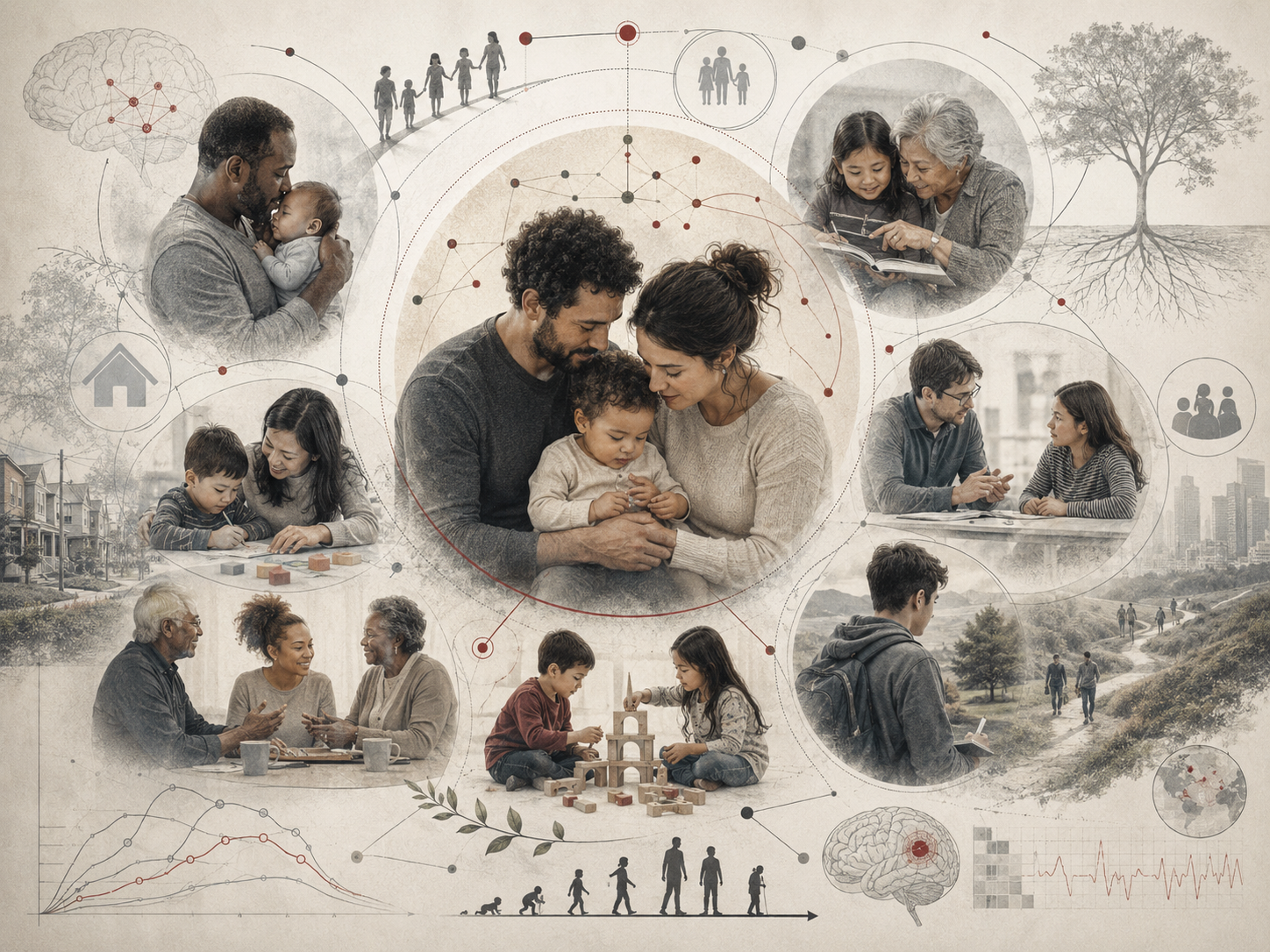
Current developmental and public-health frameworks support this relational view. Guidance on child development and positive parenting emphasizes responsive, stage-appropriate caregiving, safe and stable relationships, communication, consistency, routines, and support across childhood. Early childhood frameworks emphasize nurturing care, including health, nutrition, safety, responsive caregiving, and opportunities for learning. Developmental science similarly treats family and social relationships as part of the environment through which genetic, biological, cognitive, emotional, and social processes unfold. Together, these perspectives suggest that parenting is not an optional supplement to development. It is one of the primary relational systems through which development is organized.
Why Parenting and Family Systems Matter
Parenting and family systems matter because development begins in recurring relationships rather than in abstraction. Children learn how to regulate emotion, read social cues, trust others, tolerate frustration, ask for help, respond to conflict, participate in routines, and anticipate care through everyday patterns of family life. These patterns are not isolated events. They become repeated enough to organize expectation, emotion, behavior, and identity.
A child may learn through direct teaching, but just as much through tone, routine, conflict, silence, affection, repair, and the patterned ways adults and siblings respond. A caregiver’s repeated presence can teach safety. A caregiver’s repeated unpredictability can teach vigilance. A household’s routines can teach rhythm and responsibility. Chronic conflict can teach threat. Repair after conflict can teach that rupture is survivable. Family life is developmental because it gives emotional meaning to repeated experience.
This is why family systems thinking is so valuable. It shifts attention from isolated parental acts to ongoing patterns of interaction. Developmental outcomes are often best understood not by one moment of discipline, one affectionate gesture, or one conflict, but by the broader system in which these acts occur. The same rule, the same instruction, or the same expression of concern can have different developmental meanings depending on whether the family climate is warm, tense, chaotic, safe, shaming, predictable, or supportive.
Parenting also matters because it links biology, culture, and social structure. Caregivers help organize sleep, food, health care, play, learning, language, discipline, family obligations, religious or cultural practice, school preparation, and peer access. These are not small background details. They are the recurring conditions through which development becomes lived.
What Parenting Is
Parenting is more than supervision or rule-setting. Developmentally, it includes caregiving, protection, emotional attunement, co-regulation, teaching, boundary-setting, interpretation, encouragement, repair, advocacy, and the organization of a child’s everyday environment. It includes both practical care and symbolic meaning: feeding, bathing, reading, transporting, comforting, disciplining, explaining, protecting, listening, and making the child’s world intelligible.
Parenting is also not a single universal style that looks identical across families and cultures. Families differ in structure, language, religion, class, migration history, work schedules, authority patterns, gender expectations, disability, household size, kinship networks, and cultural values. The important developmental question is not whether all families match one idealized script. It is whether caregiving provides enough safety, responsiveness, structure, recognition, and support for development to proceed under livable conditions.
Parenting includes cognitive scaffolding. Caregivers help children learn language, memory strategies, counting, problem-solving, planning, attention, and curiosity. They name objects, explain rules, ask questions, tell stories, read books, introduce routines, and model how to interpret experience. They also shape motivation: whether learning feels safe, whether mistakes are tolerable, whether effort is meaningful, and whether help can be sought without shame.
Parenting includes emotional scaffolding. Caregivers help children understand fear, frustration, sadness, excitement, jealousy, embarrassment, and anger. A young child does not become emotionally regulated by being told to regulate in isolation. Regulation develops through repeated co-regulation: being soothed, guided, named, contained, and helped to recover. Over time, children internalize patterns of support that began between people.
Parenting also includes social interpretation. Caregivers teach children what others’ actions might mean, how to apologize, how to share, when to be cautious, how to read danger, how to respond to unfairness, and how to belong. Family life becomes the first school of social meaning.
What Family Systems Mean
Family systems thinking begins from the idea that families are organized relational wholes rather than collections of separate individuals. A child’s development is influenced not only by a parent-child dyad, but by interactions among caregivers, siblings, grandparents, household roles, stress patterns, alliances, routines, boundaries, and expectations. Changes in one part of the system can reverberate through the rest.
For example, caregiver stress may change discipline. Sibling conflict may alter parental attention. A grandparent’s support may stabilize routines. Economic strain may increase household tension. A child’s sleep difficulty may affect caregiver patience. A parent’s illness may shift responsibilities onto an older sibling. A school problem may reorganize family routines. In a family system, no developmental process remains isolated for long.
This systems view matters because many developmental problems are misread when family process is ignored. A child’s anxiety, aggression, withdrawal, perfectionism, dysregulation, or school refusal may not be reducible to an individual trait. It may reflect chronic conflict, unclear boundaries, caregiver depression, family instability, sibling comparison, inconsistent routines, divided authority, cultural mismatch with institutions, or broader material strain. Family systems theory does not deny temperament, biology, or individual difference. It asks how those differences are expressed inside organized relational contexts.
Family systems also include patterns that persist across time. Some families organize around avoidance of conflict. Others organize around high emotional intensity. Some families distribute caregiving widely. Others concentrate responsibility in one person. Some families protect children from adult problems. Others involve children in adult emotional burdens. These patterns can become developmental environments in themselves.
A systems view therefore asks not only “What does this parent do?” but “What pattern is the child developing within?” That broader question helps avoid simplistic blame and supports more accurate developmental understanding.
Caregiving, Attachment, and Early Regulation
Caregiving is developmentally powerful because early regulation is often interpersonal before it becomes internal. Infants and young children rely on caregivers for soothing, safety, rhythm, feeding, sleep, touch, protection, and basic physiological organization. Responsive caregiving does not mean perfect caregiving. It means that the child’s signals are noticed often enough, interpreted well enough, and answered reliably enough to support trust and regulation.
Attachment is not merely affection. It is a developmental organization of expectation. Through repeated caregiving experience, children learn whether distress brings comfort, whether adults return, whether exploration is safe, whether the caregiver can be used as a secure base, and whether closeness is reliable. These expectations shape early social and emotional development, though they do not determine the whole life course.
Early caregiving also organizes attention and learning. A child who feels sufficiently safe can explore. A child who is chronically frightened, ignored, overstimulated, or dysregulated may have fewer resources available for play, language, learning, and social engagement. Security and learning are therefore linked. Emotional safety is not separate from cognitive development.
Co-regulation is central. A caregiver helps the child move from distress to recovery, from chaos to rhythm, from impulse to delay, from fear to orientation, and from need to communication. Over time, these repeated interactions become part of the child’s own regulatory repertoire. Self-regulation grows from relational regulation.
This also means that caregiver support matters. Caregivers who are exhausted, isolated, depressed, unsafe, economically strained, or unsupported may struggle to provide consistent regulation even when deeply committed to the child. Supporting early development therefore means supporting the relationships that support the child.
Parenting Styles and Developmental Climate
Parenting is often discussed through broad styles such as authoritative, authoritarian, permissive, and neglectful. These categories can be useful when they clarify combinations of warmth, responsiveness, structure, and control. But they should not be treated as rigid boxes or universal judgments across all cultures. What matters developmentally is the broader climate of care, expectation, responsiveness, and boundary-setting in which the child lives.
Warmth without structure can leave children unsupported in learning limits. Structure without warmth can become fear-based compliance. High expectations without emotional attunement can produce anxiety or shame. Emotional acceptance without guidance can leave children without tools for self-control. Developmentally supportive parenting often combines responsiveness with clarity: the child is seen, but the child is also guided.
Developmental climate matters because children interpret rules through relationship. A limit set by a trusted caregiver may feel containing. A limit set in a hostile or unpredictable climate may feel threatening. A correction offered with explanation may teach. A correction delivered with humiliation may produce avoidance, anger, or fear. Parenting techniques do not operate independently from the emotional climate around them.
Family systems also change the meaning of parenting style. A parent may be warm individually but undermined by chronic conflict with another caregiver. A household may value obedience for cultural or safety reasons. A caregiver may become stricter under external threat. A style label alone cannot explain these conditions. Developmental analysis must ask what the child experiences repeatedly, what the family is responding to, and what supports would improve the system.
Discipline, Boundaries, and Self-Control
Discipline is often misunderstood as punishment alone. Developmentally, discipline is better understood as the process by which caregivers help children internalize limits, expectations, and forms of self-control. Children need boundaries not because control is valuable for its own sake, but because boundaries help organize safety, cooperation, responsibility, and participation in shared life.
Effective discipline depends on clarity, consistency, explanation, developmental timing, and relationship. A toddler needs different guidance from a teenager. A child who is overwhelmed needs different support from a child who is testing a rule. A child with trauma, disability, or neurodivergence may require different scaffolding. Discipline that ignores developmental stage often becomes misattuned.
Self-control develops more effectively through structure, repetition, modeling, and co-regulation than through arbitrary severity. Children learn self-control when adults help them pause, name feelings, understand consequences, repair harm, try again, and practice alternatives. Punishment alone may suppress behavior temporarily without teaching the child what to do instead.
In family-systems terms, discipline is not only a technique; it is part of the broader family climate. The same rule can feel containing or frightening depending on whether the family system is stable, affectionate, unpredictable, or chronically hostile. Children do not learn from rules in abstraction. They learn from how rules are enacted in relationship.
Discipline also teaches moral meaning. A child learns whether mistakes lead to guidance or humiliation, whether harm can be repaired, whether adults are accountable too, and whether rules are connected to care. The deepest goal of discipline is not compliance alone. It is the development of responsibility, empathy, self-regulation, and participation in a shared world.
Communication, Conflict, and Repair
All families have conflict. The developmental question is not whether conflict occurs, but how it is managed. Communication patterns teach children what emotions can be expressed, what must be hidden, who is heard, how disagreement is handled, and whether conflict leads to problem-solving, domination, withdrawal, or repair.
Family communication is a training ground for social and emotional interpretation. Children learn whether anger is dangerous, whether sadness is allowed, whether apology matters, whether adults listen, whether questions are welcome, and whether misunderstanding can be clarified. These lessons shape later friendships, romantic relationships, school participation, work life, and self-advocacy.
Repair is especially important. A family need not be conflict-free to support development. In fact, children can learn resilience from seeing conflict followed by accountability, explanation, apology, and reconnection. What is developmentally harmful is repeated rupture without repair, chronic contempt, fear, emotional abandonment, or the expectation that the child must manage adult conflict.
Repair teaches that relationships can survive tension. It teaches that harm can be acknowledged. It teaches that adults can be wrong and still remain trustworthy. It teaches that the child’s feelings can matter without controlling the entire system. This is one of the most important developmental lessons families can provide.
Communication is also shaped by culture and language. Some families value direct emotional expression; others value restraint, respect, indirectness, or collective harmony. A developmental account should not mistake one communication style for universal health. The key question is whether the family’s communication patterns support safety, dignity, understanding, and repair.
Siblings, Roles, and Relational Patterns
Siblings are often among the first enduring peers in a child’s life, but they are also part of the family system rather than merely an add-on to parenting. Through siblings, children may learn competition, cooperation, alliance, jealousy, negotiation, protection, imitation, fairness, and role differentiation. Sibling relationships can be affectionate, rivalrous, caregiving, conflictual, playful, distant, or deeply formative in multiple ways at once.
Sibling dynamics shape how children understand fairness and recognition. A child may experience being favored, overlooked, responsible, protected, compared, scapegoated, admired, or parentified. These roles can become part of identity. The “responsible one,” the “difficult one,” the “successful one,” the “sensitive one,” or the “caretaker” may become a family position that shapes development over time.
Family systems thinking is especially useful here because sibling roles are rarely isolated. They are influenced by parental expectations, household stress, disability, birth order interpretations, gender norms, caregiving demands, cultural meanings, and economic constraints. A sibling may become a helper because the family needs care. Another may act out because attention is scarce. Another may withdraw to avoid conflict. These patterns often make sense only at the systems level.
Siblings can also be powerful protective relationships. They may provide companionship, translation between child and adult worlds, emotional support, cultural continuity, and shared memory. In families under stress, sibling bonds can buffer difficulty. But children should not be forced into adult caregiving roles without recognition or support. Sibling care can be meaningful, but parentification can become developmental burden when responsibility exceeds the child’s capacity or freedom.
Routines, Culture, and Everyday Development
Development is shaped not only by dramatic events but by ordinary family routines. Meals, bedtime, reading, chores, school preparation, religious practice, caregiving rhythms, celebrations, screen habits, transportation, and household responsibilities all organize expectation and meaning. These routines teach time, obligation, belonging, language, memory, and the rhythms of shared life.
Routines are developmental because they make life predictable enough for children to participate. A bedtime routine can support sleep and regulation. Shared meals can support language, connection, and cultural transmission. Chores can teach competence and responsibility. Reading routines can support literacy and closeness. Repeated rituals can teach identity and continuity.
Culture matters because routines are never purely technical. They express values about respect, independence, interdependence, elders, gender, education, religion, food, language, privacy, and community. A family system is therefore also a cultural system, transmitting not only behavior but a way of inhabiting the world.
Developmental psychology should be careful not to treat middle-class routines as the universal standard of healthy family life. Families organize care under different conditions. Shift work, multigenerational households, migration, housing instability, disability, poverty, and cultural obligation all shape routines. The question is not whether routines look identical across families. It is whether they support care, predictability, participation, and dignity under the conditions available.
Everyday development is often invisible because it is ordinary. But the ordinary is precisely what repeats. What repeats often enough becomes developmental structure.
Parenting Across Developmental Stages
Parenting changes across development because children’s needs change. Infants need protection, soothing, sensory regulation, feeding, and responsive care. Toddlers need safety, language, boundaries, patience, and help with autonomy. Preschoolers need play, explanation, routines, emotional naming, and early social guidance. School-age children need structure, encouragement, literacy support, peer navigation, responsibility, and help interpreting institutions. Adolescents need autonomy, trust, monitoring, identity support, negotiation, and guidance toward future life.
Good parenting is therefore not one fixed behavior repeated forever. It is adaptive responsiveness. The caregiver gradually shifts from doing for the child, to doing with the child, to supporting the child’s increasing ability to act with judgment. This shift is rarely smooth. Development brings renegotiation, conflict, grief, pride, resistance, and adjustment for both child and caregiver.
Developmental stage also changes the meaning of control. Close monitoring may be necessary for a toddler but intrusive for an older adolescent. Physical closeness may soothe an infant but overwhelm a teenager. Explanation that works for a school-age child may not fit a preschooler. Support must be developmentally timed.
Parents also develop. Caregivers change as children grow. They learn the child’s temperament, revise expectations, confront their own histories, respond to new risks, and adjust to changing family roles. Parenting is not only something adults do to children. It is a developmental process for adults as well.
A life-course view of parenting also includes adulthood. Parent-child relationships continue to change through young adulthood, caregiving reversal, aging, grandparenthood, illness, and intergenerational responsibility. Family systems remain developmental long after childhood ends.
Stress, Inequality, and Family Context
Parenting and family life do not occur under equal conditions. Families are shaped by housing, work, income, health care, childcare, transportation, neighborhood safety, discrimination, immigration status, disability, social support, legal systems, and public policy. Caregiving may be deeply loving and still strained by impossible conditions. A developmental account that ignores these conditions risks turning systemic pressure into parental blame.
Stress affects family systems because it changes bandwidth. Chronic stress can reduce patience, increase conflict, disrupt routines, worsen sleep, strain caregiver mental health, and reduce access to learning opportunities. Economic insecurity can force caregivers to make tradeoffs between time, money, safety, work, and care. Families may be judged for instability produced by conditions beyond their control.
Inequality also shapes access to parenting support. Some caregivers can access therapy, parent coaching, flexible work, high-quality childcare, safe housing, supportive schools, transportation, and extended family help. Others face long waitlists, unaffordable services, unstable work schedules, punitive institutions, and limited respite. Parenting capacity is not distributed separately from social support.
This does not mean caregiver behavior is irrelevant. It means caregiver behavior must be understood inside conditions that make some forms of care easier and others harder. Developmental science should ask what families need in order to provide the care children need. Supporting children requires supporting caregiving environments.
A serious family-systems account is therefore ecological. It includes affection and discipline, but also rent, work hours, neighborhood safety, disability services, food access, family leave, health care, and institutional trust. Family development is nested in social structure.
Disability, Neurodivergence, and Family Systems
Disability and neurodivergence often reorganize family systems. A child may need communication supports, sensory accommodations, mobility assistance, therapy, medical care, school advocacy, predictable routines, assistive technology, or different forms of discipline and learning support. These needs do not make the child outside the family system; they reshape the system’s rhythms, responsibilities, stressors, and forms of care.
Families may become advocates, coordinators, translators, and protectors inside complex institutions. Caregivers may manage appointments, school meetings, insurance paperwork, assistive devices, behavioral supports, transportation, and crisis planning. Siblings may adjust to different routines or responsibilities. Extended family may provide support or misunderstanding. The family system becomes a site where disability is lived through access, belief, recognition, and institutional navigation.
A developmental account must avoid two errors. The first is treating disability or neurodivergence only as family burden. Many families experience joy, creativity, deep attachment, advocacy, identity, and changed understandings of personhood. The second error is romanticizing support needs or ignoring caregiver strain. Families can love deeply and still need respite, services, flexible schools, accessible health care, and community support.
Parenting a disabled or neurodivergent child also challenges narrow ideas of development. Progress may mean communication through a device, reduced sensory distress, better co-regulation, increased self-advocacy, supported participation, or a more accessible environment. The family’s developmental work is not simply to make the child appear typical. It is to support the child’s dignity, communication, agency, safety, and belonging.
Family systems become healthier when support does not depend entirely on heroic caregiver effort. Institutions should share responsibility for access, accommodation, and care.
Adolescence, Autonomy, and Family Renegotiation
Adolescence changes family systems because autonomy, identity, peer belonging, sexuality, moral reasoning, digital life, and future orientation become more salient. The child who once needed direct protection begins to seek privacy, independence, recognition, and authority over personal life. Parenting must shift from control toward guidance, negotiation, monitoring, and trust.
This transition is often conflictual, and some conflict is developmentally expected. Adolescents test boundaries because they are developing autonomy. Caregivers worry because risks become more serious. Families must renegotiate rules around friends, school, work, technology, dating, identity, sleep, transportation, and future plans. The developmental question is not whether conflict occurs, but whether conflict can be handled without breaking relationship.
Parental monitoring remains important, but its meaning changes. Monitoring works best when it is built through relationship and communication rather than surveillance alone. Adolescents are more likely to disclose when they expect to be heard rather than only punished. Trust becomes a developmental achievement negotiated by both sides.
Family systems also influence future orientation. Adolescents form expectations about college, work, family, community, responsibility, and adulthood partly through family narratives. Some families communicate possibility and support. Others communicate fear, pressure, limitation, or obligation. These messages may be realistic responses to social conditions, but they still shape how adolescents imagine the future.
Healthy family development in adolescence does not mean the absence of conflict. It means the family can change without losing connection.
Intergenerational Development and Family History
Families carry history. Parenting is shaped by what caregivers learned in their own families: how love was expressed, how anger was handled, how discipline worked, whether adults apologized, whether children were heard, whether safety was reliable, and whether vulnerability was protected. These histories do not mechanically determine parenting, but they provide emotional templates that often reappear under stress.
Intergenerational transmission can include strengths as well as harm. Families pass down language, faith, humor, endurance, craft, storytelling, food, music, responsibility, memory, and moral commitments. They may also pass down trauma, silence, fear, harsh discipline, emotional avoidance, or mistrust. Family development includes both inheritance and revision.
Caregivers often parent in dialogue with their own childhoods. Some repeat what felt safe. Some reject what hurt them. Some do both without fully realizing it. A parent may intend to be different from the past but find old patterns returning under exhaustion. A family-systems view makes space for this complexity without reducing caregivers to either victims or villains.
Intergenerational development also includes grandparents, kin networks, and extended family. Children may be shaped by family stories, caregiving from relatives, migration histories, ancestral memory, cultural obligations, and the presence or absence of older generations. Development is personal, but it is also historical.
The possibility of repair is central. Families can change patterns when they become visible, supported, and less burdened. Intergenerational history matters, but it is not destiny.
Beyond Blame: Parenting as Systemic Process
Developmental psychology often uses parenting to explain outcomes, but explanation can easily become blame. A systems view is more careful. It recognizes that caregiver behavior matters enormously while also recognizing that caregivers themselves are shaped by stress, support, health, relationship quality, history, culture, and social structure.
This shift is important ethically and scientifically. It prevents the field from imagining parents as all-powerful architects or as isolated sources of developmental success and failure. Children influence parents. Parents influence children. Siblings influence both. Schools, work, neighborhoods, health systems, and public policy influence the whole system. Development is reciprocal and ecological.
Moving beyond blame does not mean avoiding accountability. Harmful caregiving can damage development, and children need protection from abuse, neglect, chronic humiliation, violence, and emotional abandonment. But accountability becomes more effective when it is paired with support, prevention, and structural understanding. Families often need resources, treatment, safety, respite, and community—not shame alone.
Parenting is best understood as a systemic process through which adults and children influence one another within broader ecological conditions. A developmental science that supports families must therefore ask what caregivers need in order to provide responsive care, what children need in order to thrive, and what institutions must change so that family systems are not forced to carry impossible burdens alone.
An Analytical Framework for Parenting and Family Systems
A stylized developmental outcome \(D_{it}\) for child \(i\) at time \(t\) can be written as a function of parenting responsiveness, family climate, contextual support, stress, and residual variation:
D_{it} = \alpha_i + \beta P_{it} + \gamma F_{it} + \delta C_{it} – \lambda S_{it} + \varepsilon_{it}
\]
Interpretation: Developmental outcomes depend on parenting responsiveness \(P_{it}\), family climate \(F_{it}\), contextual support \(C_{it}\), stress \(S_{it}\), individual baseline differences \(\alpha_i\), and residual variation \(\varepsilon_{it}\).
To reflect reciprocity, parenting can also be modeled as responsive to the child’s prior developmental state and the family’s current conditions:
P_{it} = f(D_{i,t-1}, R_{it}, X_{it})
\]
Interpretation: Parenting is not a one-way cause. It responds to the child’s prior state \(D_{i,t-1}\), relational quality \(R_{it}\), and external stress or support \(X_{it}\).
A family-systems model can include family climate as an emergent process:
F_{it} = g(P_{it}, Q_{it}, H_{it}, X_{it})
\]
Interpretation: Family climate \(F_{it}\) is shaped by parenting, caregiver relationship quality \(Q_{it}\), household stability \(H_{it}\), and external context \(X_{it}\).
A nested ecological model can represent children within households, schools, neighborhoods, or service systems:
D_{ijt} = \alpha + u_j + \beta P_{ijt} + \gamma F_{ijt} + \delta C_{ijt} – \lambda S_{ijt} + \varepsilon_{ijt}
\]
Interpretation: The term \(u_j\) captures shared household, neighborhood, school, or service-context influence. Family development is nested within broader systems.
To represent caregiver support or intervention, we can add a support term:
D_{it} = \rho D_{i,t-1} + \theta I_{it} + \beta P_{it} + \gamma F_{it} + \delta C_{it} – \lambda S_{it} + \varepsilon_{it}
\]
Interpretation: Current development depends partly on prior development, while caregiver support or intervention \(I_{it}\) can redirect the pathway.
These equations are simplified, but they clarify the article’s central claim: parenting and family systems are developmental processes embedded in relationships, routines, stress, support, history, and social context.
R: Simulating Parenting Quality, Family Climate, and Development
The following R example simulates children across repeated waves with parenting responsiveness, family climate, household stability, external stress, caregiver support, and sibling support shaping developmental outcomes. The data are synthetic and intended for demonstration only.
# Simulating parenting, family systems, and development
# ----------------------------------------------------
# This synthetic example models child development as a function of parenting
# responsiveness, family climate, household stability, stress, caregiver support,
# sibling support, and family-system context across repeated waves.

suppressPackageStartupMessages({
  library(dplyr)
  library(lme4)
  library(ggplot2)
})

set.seed(2026)

n_children <- 820
n_waves <- 9
n_households <- 280

children <- data.frame(
  child_id = 1:n_children,
  household_id = sample(1:n_households, n_children, replace = TRUE),
  parenting_responsiveness = rnorm(n_children, 0, 1),
  family_climate = rnorm(n_children, 0, 1),
  external_stress = rnorm(n_children, 0, 1),
  sibling_support = rnorm(n_children, 0, 0.8),
  child_regulation = rnorm(n_children, 0, 0.8),
  caregiver_support = rbinom(n_children, 1, 0.35)
)

household_effects <- data.frame(
  household_id = 1:n_households,
  household_stability = rnorm(n_households, 0, 0.6),
  kin_support = rnorm(n_households, 0, 0.5),
  economic_security = rnorm(n_households, 0, 0.6)
)

panel_data <- children |>
  slice(rep(1:n(), each = n_waves)) |>
  group_by(child_id) |>
  mutate(
    wave = 0:(n_waves - 1),
    current_parenting = rnorm(n_waves, mean = parenting_responsiveness, sd = 0.55),
    current_family = rnorm(n_waves, mean = family_climate, sd = 0.55),
    current_stress = rnorm(n_waves, mean = external_stress, sd = 0.65),
    current_sibling = rnorm(n_waves, mean = sibling_support, sd = 0.50),
    current_regulation = rnorm(n_waves, mean = child_regulation, sd = 0.50)
  ) |>
  ungroup() |>
  left_join(household_effects, by = "household_id") |>
  arrange(child_id, wave)

panel_data <- panel_data |>
  mutate(
    family_support_index =
      current_parenting +
      current_family +
      household_stability +
      kin_support +
      economic_security -
      current_stress,
    development_score =
      50 +
      0.75 * wave +
      1.25 * current_parenting +
      1.10 * current_family +
      0.90 * household_stability +
      0.80 * kin_support +
      0.75 * economic_security +
      0.70 * current_sibling +
      0.65 * current_regulation +
      0.85 * caregiver_support -
      1.20 * current_stress +
      0.45 * current_parenting * current_family +
      rnorm(n(), 0, 2.4)
  )

model <- lmer(
  development_score ~ wave + current_parenting + current_family +
    current_stress + household_stability + kin_support +
    economic_security + current_sibling + current_regulation +
    caregiver_support + current_parenting:current_family +
    (1 + wave | household_id/child_id),
  data = panel_data
)

summary(model)

trajectory_summary <- panel_data |>
  group_by(wave, caregiver_support) |>
  summarize(
    mean_development = mean(development_score),
    mean_family_support = mean(family_support_index),
    standard_error = sd(development_score) / sqrt(n()),
    .groups = "drop"
  ) |>
  mutate(
    lower = mean_development - 1.96 * standard_error,
    upper = mean_development + 1.96 * standard_error,
    group = ifelse(caregiver_support == 1, "Caregiver support", "No added support")
  )

ggplot(trajectory_summary, aes(x = wave, y = mean_development, linetype = group)) +
  geom_line(linewidth = 1) +
  geom_ribbon(aes(ymin = lower, ymax = upper, group = group), alpha = 0.12) +
  labs(
    title = "Simulated Parenting, Family Systems, and Development",
    x = "Wave",
    y = "Average development score",
    linetype = "Group"
  ) +
  theme_minimal()

household_summary <- panel_data |>
  group_by(household_id) |>
  summarize(
    household_stability = mean(household_stability),
    kin_support = mean(kin_support),
    economic_security = mean(economic_security),
    average_development = mean(development_score),
    average_family_support = mean(family_support_index),
    .groups = "drop"
  )

ggplot(household_summary, aes(x = average_family_support, y = average_development)) +
  geom_point() +
  geom_smooth(method = "lm", se = TRUE) +
  labs(
    title = "Synthetic Family Support and Development",
    x = "Average family support index",
    y = "Average development score"
  ) +
  theme_minimal()

# Analysts can extend this model by:
# 1. adding explicit sibling order and household role variables;
# 2. modeling parent-child reciprocity across lagged waves;
# 3. separating emotional, cognitive, and social outcomes;
# 4. adding school, neighborhood, and childcare contexts;
# 5. simulating economic shocks and policy supports;
# 6. modeling caregiver mental health and respite access.
This R workflow treats parenting as a relational and ecological process. Development is shaped not only by individual parenting behavior, but by family climate, household stability, kin support, economic security, sibling support, child regulation, stress, and caregiver support.
Python: Modeling Family Systems and Human Development Over Time
The following Python example simulates development over time with parenting responsiveness, family climate, household stability, kin support, sibling support, child regulation, stress, and caregiver support. It includes prior developmental state to represent path dependence.
# Modeling family systems and human development over time
# ------------------------------------------------------
# This synthetic example models development as a dynamic relation among
# parenting responsiveness, family climate, household stability, kin support,
# sibling support, child regulation, stress, caregiver support, and prior state.

from __future__ import annotations

import numpy as np
import pandas as pd
import statsmodels.formula.api as smf
import matplotlib.pyplot as plt

np.random.seed(2026)

n_children = 850
n_periods = 10
n_households = 290

children = pd.DataFrame({
    "child_id": np.arange(1, n_children + 1),
    "household_id": np.random.choice(np.arange(1, n_households + 1), size=n_children),
    "parenting_responsiveness": np.random.normal(0, 1, n_children),
    "family_climate": np.random.normal(0, 1, n_children),
    "external_stress": np.random.normal(0, 1, n_children),
    "sibling_support": np.random.normal(0, 0.8, n_children),
    "child_regulation": np.random.normal(0, 0.8, n_children),
    "caregiver_support": np.random.binomial(1, 0.35, n_children),
})

household_df = pd.DataFrame({
    "household_id": np.arange(1, n_households + 1),
    "household_stability": np.random.normal(0, 0.6, n_households),
    "kin_support": np.random.normal(0, 0.5, n_households),
    "economic_security": np.random.normal(0, 0.6, n_households),
})

panel = children.loc[children.index.repeat(n_periods)].copy()
panel["time"] = np.tile(np.arange(n_periods), n_children)
panel = panel.merge(household_df, on="household_id", how="left")

panel["current_parenting"] = np.random.normal(
    panel["parenting_responsiveness"],
    0.60,
    len(panel),
)

panel["current_family"] = np.random.normal(
    panel["family_climate"],
    0.60,
    len(panel),
)

panel["current_stress"] = np.random.normal(
    panel["external_stress"],
    0.70,
    len(panel),
)

panel["current_sibling"] = np.random.normal(
    panel["sibling_support"],
    0.55,
    len(panel),
)

panel["current_regulation"] = np.random.normal(
    panel["child_regulation"],
    0.55,
    len(panel),
)

panel = panel.sort_values(["child_id", "time"]).reset_index(drop=True)

panel["family_support_index"] = (
    panel["current_parenting"]
    + panel["current_family"]
    + panel["household_stability"]
    + panel["kin_support"]
    + panel["economic_security"]
    - panel["current_stress"]
)

panel["development_score"] = np.nan

for child_id in panel["child_id"].unique():
    subset = panel.loc[panel["child_id"] == child_id].copy()
    previous_score = 50 + np.random.normal(0, 3)

    for idx in subset.index:
        time = panel.at[idx, "time"]
        parenting = panel.at[idx, "current_parenting"]
        family = panel.at[idx, "current_family"]
        stress = panel.at[idx, "current_stress"]
        stability = panel.at[idx, "household_stability"]
        kin = panel.at[idx, "kin_support"]
        security = panel.at[idx, "economic_security"]
        sibling = panel.at[idx, "current_sibling"]
        regulation = panel.at[idx, "current_regulation"]
        support = panel.at[idx, "caregiver_support"]

        current_score = (
            0.70 * previous_score
            + 0.24 * time
            + 1.15 * parenting
            + 1.05 * family
            + 0.90 * stability
            + 0.80 * kin
            + 0.75 * security
            + 0.70 * sibling
            + 0.65 * regulation
            + 0.85 * support
            - 1.10 * stress
            + 0.45 * parenting * family
            + np.random.normal(0, 2.3)
        )

        panel.at[idx, "development_score"] = current_score
        previous_score = current_score

panel["lag_score"] = panel.groupby("child_id")["development_score"].shift(1)
regression_data = panel.dropna(subset=["lag_score"]).copy()

model = smf.ols(
    formula="""
    development_score ~ lag_score + time + current_parenting +
    current_family + current_stress + household_stability +
    kin_support + economic_security + current_sibling +
    current_regulation + caregiver_support +
    current_parenting:current_family
    """,
    data=regression_data,
).fit(cov_type="HC3")

print(model.summary())

trajectory = panel.groupby(["time", "caregiver_support"], as_index=False).agg(
    average_development=("development_score", "mean"),
    average_family_support=("family_support_index", "mean"),
    standard_error=("development_score", lambda x: x.std() / np.sqrt(len(x))),
)

trajectory["lower"] = trajectory["average_development"] - 1.96 * trajectory["standard_error"]
trajectory["upper"] = trajectory["average_development"] + 1.96 * trajectory["standard_error"]
trajectory["group"] = trajectory["caregiver_support"].map({
    0: "No added support",
    1: "Caregiver support",
})

plt.figure(figsize=(8, 5))
for group_name, subset in trajectory.groupby("group"):
    plt.plot(subset["time"], subset["average_development"], marker="o", label=group_name)

plt.xlabel("Time")
plt.ylabel("Average development score")
plt.title("Simulated Parenting, Family Systems, and Human Development")
plt.legend()
plt.tight_layout()
plt.show()

household_summary = panel.groupby("household_id", as_index=False).agg(
    household_stability=("household_stability", "mean"),
    kin_support=("kin_support", "mean"),
    economic_security=("economic_security", "mean"),
    average_family_support=("family_support_index", "mean"),
    average_development=("development_score", "mean"),
)

print(household_summary.sort_values("average_development", ascending=False).head())

# Analysts can extend this framework by:
# 1. modeling sibling effects and birth-order roles;
# 2. adding neighborhood and school systems;
# 3. estimating multilevel household effects;
# 4. introducing economic, health, and housing shocks;
# 5. simulating parent-training or caregiver-support interventions;
# 6. modeling caregiver mental health and respite availability.
The Python workflow makes the article’s developmental claim explicit: family systems shape outcomes through prior developmental state, parenting responsiveness, family climate, household stability, kin support, economic security, sibling support, child regulation, caregiver support, and stress. It is a synthetic teaching scaffold, not a causal estimate from real families.
GitHub Repository
Complete Code Repository
Access the full companion repository for this article, including reproducible analysis materials and multi-language code workflows for parenting responsiveness, family systems, household stability, caregiver support, sibling support, stress, kin networks, family climate, and developmental outcomes over time.
Conclusion
Parenting, family systems, and human development belong together because development does not occur in a social vacuum. It unfolds through recurring relationships, patterned roles, daily routines, conflict, repair, care, and the broader conditions that shape how families function. Families are among the first developmental systems through which children learn trust, regulation, responsibility, communication, identity, and the emotional meaning of shared life.
The strongest developmental psychology therefore treats parenting neither as isolated technique nor as a moral blame category. It treats parenting and family systems as dynamic relational processes through which children and caregivers develop together under conditions of support, stress, history, culture, and unequal opportunity. Caregiver behavior matters, but caregiver behavior is itself shaped by social support, household stability, health, work, institutions, and the family histories adults carry into parenting.
In that sense, family life is not merely where development happens. It is one of the main ways development is made. To understand human development seriously, psychology must study not only children, but the systems of care, conflict, routine, meaning, and support through which children become persons.
Related Articles
- What Is Developmental Psychology?
- Why Developmental Psychology Matters Today
- Attachment, Caregiving, and Early Emotional Development
- Social Development, Peer Relations, and the Formation of the Self
- Self-Regulation and Executive Function Across Development
- Developmental Systems Theory and the Ecology of Human Growth
- Genes, Environment, and Developmental Plasticity
- Education, Schooling, and Developmental Formation
- Development, Inequality, and the Life Course
- Developmental Psychology knowledge series
Further Reading
- Bronfenbrenner, U. (1979) The Ecology of Human Development: Experiments by Nature and Design. Cambridge, MA: Harvard University Press. Available at: https://www.hup.harvard.edu/books/9780674224575.
- Centers for Disease Control and Prevention (n.d.) Positive Parenting Tips. Available at: https://www.cdc.gov/child-development/positive-parenting-tips/index.html.
- Centers for Disease Control and Prevention (n.d.) Child Development. Available at: https://www.cdc.gov/child-development/index.html.
- Centers for Disease Control and Prevention (n.d.) Essentials for Parenting Toddlers and Preschoolers. Available at: https://www.cdc.gov/parenting-toddlers/index.html.
- Eunice Kennedy Shriver National Institute of Child Health and Human Development (n.d.) Child Development and Behavior Branch. Available at: https://www.nichd.nih.gov/about/org/der/branches/cdbb.
- Eunice Kennedy Shriver National Institute of Child Health and Human Development (2021) How Can Parents and Caregivers Promote Early Learning? Available at: https://www.nichd.nih.gov/health/topics/early-learning/conditioninfo/promote.
- Minuchin, S. (1974) Families and Family Therapy. Cambridge, MA: Harvard University Press. Available at: https://www.hup.harvard.edu/books/9780674292369.
- Sameroff, A. (2010) ‘A unified theory of development: A dialectic integration of nature and nurture’, Child Development, 81(1), pp. 6–22. Available at: https://doi.org/10.1111/j.1467-8624.2009.01378.x.
- World Health Organization (2018) Nurturing Care for Early Childhood Development. Available at: https://www.who.int/publications/i/item/9789241514064.
- World Health Organization (2020) Improving Early Childhood Development. Available at: https://www.who.int/publications/i/item/97892400020986.
- World Health Organization (n.d.) Nurturing Care for Early Childhood Development. Available at: https://www.who.int/teams/maternal-newborn-child-adolescent-health-and-ageing/child-health/nurturing-care.
References
- American Psychological Association (n.d.) Developmental Psychology. Available at: https://www.apa.org/education-career/guide/subfields/developmental.
- Bowlby, J. (1969) Attachment and Loss, Volume 1: Attachment. New York: Basic Books. Available at: https://www.basicbooks.com/titles/john-bowlby/attachment/9780465005437/.
- Bronfenbrenner, U. (1979) The Ecology of Human Development: Experiments by Nature and Design. Cambridge, MA: Harvard University Press. Available at: https://www.hup.harvard.edu/books/9780674224575.
- Centers for Disease Control and Prevention (n.d.) Child Development. Available at: https://www.cdc.gov/child-development/index.html.
- Centers for Disease Control and Prevention (n.d.) Positive Parenting Tips. Available at: https://www.cdc.gov/child-development/positive-parenting-tips/index.html.
- Centers for Disease Control and Prevention (n.d.) Positive Parenting Tips: Infants. Available at: https://www.cdc.gov/child-development/positive-parenting-tips/infants.html.
- Centers for Disease Control and Prevention (n.d.) Positive Parenting Tips: Toddlers. Available at: https://www.cdc.gov/child-development/positive-parenting-tips/toddlers-1-2-years.html.
- Centers for Disease Control and Prevention (n.d.) Positive Parenting Tips: Preschoolers. Available at: https://www.cdc.gov/child-development/positive-parenting-tips/preschooler-3-5-years.html.
- Centers for Disease Control and Prevention (n.d.) Essentials for Parenting Toddlers and Preschoolers. Available at: https://www.cdc.gov/parenting-toddlers/index.html.
- Eunice Kennedy Shriver National Institute of Child Health and Human Development (n.d.) Child Development and Behavior Branch. Available at: https://www.nichd.nih.gov/about/org/der/branches/cdbb.
- Eunice Kennedy Shriver National Institute of Child Health and Human Development (2021) Early Learning. Available at: https://www.nichd.nih.gov/health/topics/factsheets/early-learning.
- Eunice Kennedy Shriver National Institute of Child Health and Human Development (2021) How Can Parents and Caregivers Promote Early Learning? Available at: https://www.nichd.nih.gov/health/topics/early-learning/conditioninfo/promote.
- Minuchin, S. (1974) Families and Family Therapy. Cambridge, MA: Harvard University Press. Available at: https://www.hup.harvard.edu/books/9780674292369.
- Sameroff, A. (2010) ‘A unified theory of development: A dialectic integration of nature and nurture’, Child Development, 81(1), pp. 6–22. Available at: https://doi.org/10.1111/j.1467-8624.2009.01378.x.
- World Health Organization (2018) Nurturing Care for Early Childhood Development. Available at: https://www.who.int/publications/i/item/9789241514064.
- World Health Organization (2020) Improving Early Childhood Development. Available at: https://www.who.int/publications/i/item/97892400020986.
- World Health Organization (n.d.) Nurturing Care for Early Childhood Development. Available at: https://www.who.int/teams/maternal-newborn-child-adolescent-health-and-ageing/child-health/nurturing-care.
- World Health Organization (n.d.) Promoting Healthy Growth and Development. Available at: https://www.who.int/activities/promoting-healthy-growth-and-development.