
Last Updated May 21, 2026
Disability and neurodivergence are not departures from development. They are part of human development itself, shaping and being shaped by embodiment, cognition, communication, sensory life, care, education, access, stigma, identity, technology, and the social conditions under which growth unfolds. Developmental psychology becomes weaker when it treats disability only as deficit, neurodivergence only as deviation, and typical development as the silent measure of human worth. A stronger developmental account begins from diversity: people grow through different bodies, minds, sensory worlds, communication systems, learning profiles, support needs, and environments.
This does not mean that impairment, pain, exclusion, or support needs are unreal. It means that developmental science must understand disability and neurodivergence through the full relation among person, body, mind, environment, institution, care, technology, culture, and time. A child with a mobility impairment, an autistic sensory profile, ADHD, dyslexia, intellectual disability, complex communication needs, chronic illness, or multiple disabilities is not developing outside the human story. That child is developing through a particular ecology of support, barrier, recognition, and participation.
Main Library
Publications
Article Map
Developmental Psychology
Related Topic
Cognitive Psychology
Related Topic
Social Psychology
Related Topic
Institutions & Governance
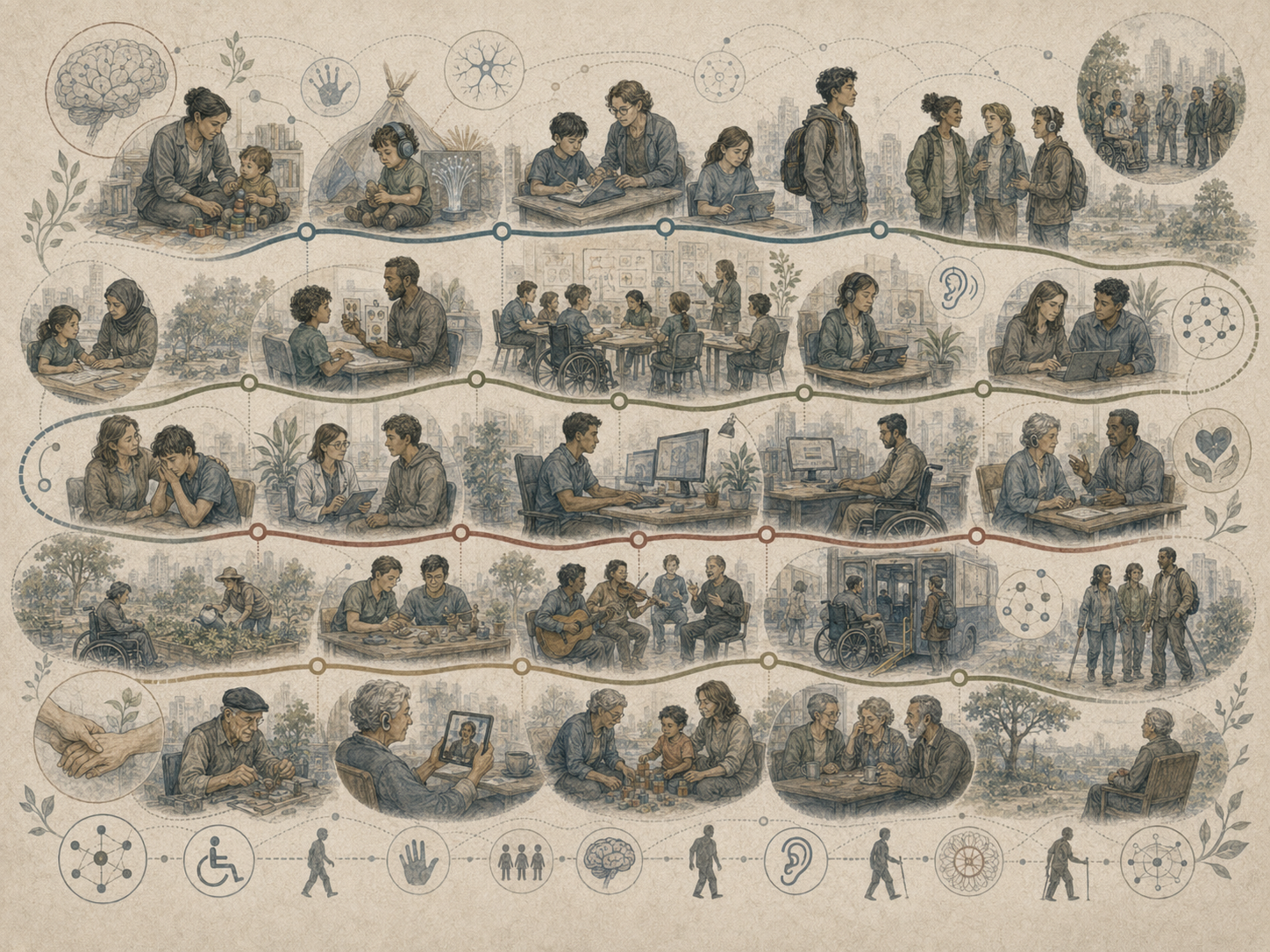
Contemporary developmental and public-health frameworks increasingly support this broader view. Developmental disabilities are commonly understood as conditions that begin during the developmental period and may affect physical, learning, language, intellectual, behavioral, or adaptive domains across the life course. Disability is also understood through the interaction of bodily or cognitive difference with environmental barriers, exclusion, inaccessible design, and unequal support. Neurodiversity provides a language for recognizing variation in minds and brains without assuming that all difference should be interpreted through pathology alone.
A serious developmental psychology must therefore ask a wider set of questions. What forms of support allow disabled and neurodivergent children to participate meaningfully? How do inaccessible schools, clinics, homes, technologies, and public spaces shape developmental outcomes? How do stigma, masking, misrecognition, and exclusion affect identity? How do families and caregivers become advocates inside fragmented systems? How do assistive technologies, inclusive design, and institutional flexibility change developmental pathways? The central question is not only how disabled and neurodivergent people develop, but how societies enable or disable that development.
Why Disability and Neurodivergence Matter
Disability and neurodivergence matter because developmental psychology cannot explain human growth if it silently centers only one version of the body, one version of cognition, one style of communication, one sensory profile, one school-readiness pattern, and one path toward competence. Human development includes variation in movement, language, attention, executive function, sensory processing, learning, memory, social communication, regulation, physical endurance, pain, perception, and participation. Some of that variation is disabling because the world is built around narrower assumptions.
This matters scientifically because developmental pathways vary in structure, timing, support need, and institutional meaning. A child who communicates through an augmentative device, learns best through structured visual supports, uses a wheelchair, needs predictable routines, processes sound intensely, reads slowly but reasons deeply, or requires assistance with daily living is not outside development. That child is developing through a different configuration of body, mind, environment, care, tools, and expectation.
It matters ethically because deficit-only models can turn social exclusion into individual failure. When a school lacks communication access, when a building lacks ramps, when instruction assumes a narrow attention profile, when sensory distress is treated as misbehavior, or when a diagnosis becomes a child’s entire identity, developmental harm is produced by the environment as much as by impairment. Developmental psychology must therefore study access, accommodation, stigma, and institutional design as developmental variables.
It also matters politically and institutionally. Disability and neurodivergence reveal how societies define competence, independence, maturity, productivity, intelligence, normality, and belonging. A developmental theory that cannot account for disabled and neurodivergent lives is not merely incomplete at the margins. It misunderstands human development at the center, because all development depends on fit between persons and worlds.
What Disability Is
Disability can be understood in more than one way, and developmental psychology needs that plural view. At one level, disability refers to impairments, conditions, or functional differences involving body or mind that affect activity, participation, communication, learning, mobility, self-care, sensory life, or everyday functioning. At another level, disability refers to the social and environmental barriers that turn impairment or difference into exclusion.
This distinction matters because it prevents reductionism. Disability is not only inside the body, and it is not only outside the body either. A person may have pain, fatigue, sensory difference, motor limitation, intellectual disability, communication difference, or chronic illness. Those realities are not erased by better access. But the extent to which a person is excluded, isolated, overburdened, or prevented from participating depends greatly on design, support, policy, technology, culture, and institutional flexibility.
Developmentally, disability is not a single category. It may be congenital or acquired, visible or invisible, stable or changing, episodic or progressive, mild or complex, recognized early or diagnosed late. It may affect one domain or many. It may be associated with support needs, stigma, pain, fatigue, identity, community, adaptation, advocacy, and technology. It may interact with family resources, school systems, health care access, language, race, class, gender, geography, and public policy.
A serious developmental account therefore asks not only what impairment or diagnosis is present, but what life becomes possible around it. Does the child have access to communication? Does the classroom support participation? Is the family believed? Are services affordable? Is the environment physically accessible? Are sensory needs taken seriously? Does the child experience dignity, friendship, agency, and belonging? These are developmental questions, not merely service questions.
What Neurodivergence Is
Neurodivergence refers to forms of neurological, cognitive, attentional, sensory, learning, and communicative difference that diverge from dominant expectations of typical functioning. The term is often used in relation to autism, ADHD, dyslexia, dyspraxia, Tourette syndrome, and other neurodevelopmental profiles, though its broader significance is conceptual. It challenges the assumption that one style of attention, social communication, sensory processing, executive function, or learning should be treated as the unquestioned standard of normal development.
Neurodivergence does not require denying difficulty. Many neurodivergent people experience distress, impairment, burnout, exclusion, sensory overload, executive-function difficulty, communication barriers, co-occurring mental health challenges, or substantial support needs. The neurodiversity perspective does not make those challenges disappear. It asks that they be understood without reducing the person to defect or treating forced normalization as the only developmental goal.
This distinction is important. A neurodivergent child may need support, therapy, accommodation, communication tools, medication, structure, sensory regulation, executive-function scaffolding, or specialized instruction. But the purpose of support should not be to erase difference for the comfort of institutions. It should be to reduce avoidable distress, expand participation, support agency, increase communication, protect dignity, and help the person develop well as themselves.
Developmental psychology benefits from this perspective because it pushes the field to distinguish difference from disorder, support need from inferiority, and adaptation from compliance. A child may communicate differently, attend differently, learn differently, move differently, or need different conditions for regulation. Those differences become developmentally harmful when the surrounding world treats them only as failure rather than as profiles requiring access, interpretation, and support.
Developmental Disabilities and Neurodevelopmental Profiles
Developmental disabilities are often defined as conditions beginning during the developmental period that may affect physical, learning, language, intellectual, behavioral, or adaptive functioning. This broad category can include intellectual disability, autism, cerebral palsy, hearing or vision impairments, speech and language disorders, genetic conditions, motor disabilities, and other lifelong or long-term developmental conditions. Neurodevelopmental profiles may overlap with these categories but also include differences in attention, learning, executive function, sensory processing, social communication, and regulation.
These categories matter because they can open access to services, recognition, accommodations, educational planning, clinical support, and legal protections. Naming a condition can help families understand needs, locate support, and advocate within institutions. Diagnosis can also validate experiences that were previously misunderstood as laziness, defiance, immaturity, lack of intelligence, or poor parenting.
But categories can also narrow perception. A diagnosis may become a totalizing label. A child may be seen only through limitation rather than potential, preference, identity, culture, relationship, and agency. A developmental disability may be treated as a fixed destiny rather than a profile shaped by support, access, learning conditions, technology, and opportunity. A neurodevelopmental profile may be interpreted only through impairment rather than also through difference, adaptation, and environmental fit.
Developmental psychology should therefore use diagnostic categories carefully. They are tools, not full descriptions of persons. They help identify support needs, but they do not exhaust the meaning of development. A diagnosis may explain some patterns while leaving open the larger developmental question: what conditions help this person communicate, learn, regulate, participate, belong, and flourish?
Developmental Diversity and Human Growth
Human development is diverse in timing, pathway, pace, and form. Some children speak early, others late. Some learn through language, others through pattern, visual structure, rhythm, repetition, movement, or assistive communication. Some need routine and predictability to participate well. Some need sensory modification, physical access, adaptive equipment, or extended time. Some development is rapid in one domain and slower in another. Some capacities appear only when the environment becomes accessible enough for them to be expressed.
Developmental diversity does not mean milestones are useless. Milestones can help identify support needs, plan services, and detect barriers early. But milestones become harmful when they are treated as measures of human worth or as proof that a single pathway is the only legitimate pathway. A child who develops differently may still be developing richly in ways that standard systems do not recognize.
This is especially important for disabled and neurodivergent children because developmental assessment often compares them against a narrow norm and stops there. A stronger approach asks what the person can do under different conditions. How does communication change with access to augmentative tools? How does regulation change in a sensory-considerate setting? How does learning change with multimodal instruction? How does participation change when barriers are removed?
Developmental diversity also changes the meaning of progress. Progress may be speech, but it may also be reliable communication through a device. It may be independent mobility, but it may also be supported mobility through accessible design. It may be self-regulation, but it may also be learning to request sensory breaks or use co-regulation. It may be academic achievement, but it may also be belonging, agency, safety, or reduced exhaustion. Development should be measured against humane participation, not only against conformity.
Impairment, Barrier, and Context
Many of the hardest parts of disability are not reducible to impairment itself. They emerge through interaction with context. A sensory-sensitive child may function well in predictable, low-noise settings and struggle in chaotic ones. A student with dyslexia may thrive with structured literacy support and accessible text while appearing incapable in a rigid print-only environment. A person using mobility supports may be limited less by the body than by stairs, inaccessible transit, poorly designed bathrooms, and institutional disregard.
Context changes developmental reality. A child’s functional capacity is not a fixed property independent of environment. It is shaped by tools, expectations, supports, fatigue, sensory load, communication access, emotional safety, and institutional flexibility. What looks like inability in one context may become competence in another. What looks like defiance may be distress. What looks like dependence may be the result of inaccessible design.
Developmental psychology must therefore treat barriers as developmental variables. Barriers do not merely inconvenience people after development has occurred. They shape development itself. Repeated exclusion from play, school, communication, mobility, friendship, or public life changes skills, confidence, identity, opportunity, and belonging. Access is not an add-on. It is part of the developmental environment.
This also means that support can change developmental trajectories. Assistive technology, communication access, sensory accommodations, physical accessibility, flexible instruction, peer inclusion, reliable transportation, family support, and respectful clinical care can alter what becomes possible. Disability is lived through the relation between person and world, and that relation can be changed.
Medical, Social, and Biopsychosocial Models
Disability has often been interpreted through different models. A medical model emphasizes diagnosis, impairment, treatment, function, and clinical support. This model can be useful when it helps identify pain, illness, support needs, intervention, therapy, medication, or adaptive equipment. It becomes limiting when it treats the person as a problem to be fixed and ignores the role of inaccessible environments.
A social model emphasizes barriers, exclusion, discrimination, inaccessible design, and the way society disables people. This model is powerful because it shifts attention from individual deficit to social responsibility. It shows that stairs, rigid classrooms, inaccessible communication, hostile attitudes, and inflexible institutions are not natural facts. They are design and policy choices. The social model becomes incomplete only if it denies the reality of impairment, pain, fatigue, or support needs that remain significant even in accessible environments.
A biopsychosocial or relational model can help developmental psychology hold both realities together. Bodies and brains matter. Environments matter. Relationships matter. Institutions matter. Culture and meaning matter. Development unfolds through their interaction. Disability is neither reducible to impairment nor reducible to barriers alone. It is shaped by the ongoing relation among embodied difference, social design, support, and time.
This integrated view is especially important for developmental work. A child’s needs may change as the child grows. A support that matters in early childhood may differ from one needed in adolescence. A barrier that was minor in one setting may become major in another. A diagnosis may remain stable while participation changes dramatically because of access, tools, relationships, and institutional response. Development requires dynamic models, not static labels.
Caregiving, Support, and Developmental Opportunity
Support is one of the most powerful moderators of developmental outcomes in disability and neurodivergence. Families, caregivers, therapists, educators, clinicians, peers, advocates, and community members can provide structure, communication scaffolding, emotional safety, mobility support, sensory regulation, skill-building, and institutional advocacy. Early support often matters greatly, not because it forces a child into normalcy, but because it can expand participation and reduce avoidable distress.
Caregiving also matters because families often become translators between the child and the institution. Parents and caregivers may coordinate appointments, navigate diagnosis, learn legal systems, request accommodations, contest school decisions, interpret behavior, manage sensory environments, and advocate for communication access. This labor is developmental because it shapes the child’s access to opportunity, but it is also burdensome. A serious account must include caregiver strain, time, cost, exhaustion, and the unequal distribution of advocacy capacity.
Support should be understood broadly. It includes emotional acceptance, predictable routines, assistive technology, accessible housing, inclusive schooling, transportation, respite care, therapy, peer relationships, income stability, and institutional responsiveness. It also includes the dignity of being believed. Families are often harmed when professionals dismiss concerns, blame parenting, minimize pain, delay evaluation, or treat support needs as exaggeration.
Developmental opportunity grows when support is reliable, respectful, and coordinated. A child may develop communication more fully when communication partners are trained. A student may learn more effectively when instruction matches cognitive profile. A neurodivergent adolescent may reduce masking and burnout when environments are safer. A disabled adult may participate more fully when public systems are accessible. Support is not charity. It is infrastructure for development.
Schooling, Inclusion, and Participation
School is one of the main places where disability and neurodivergence become socially organized. It can be a place of access, growth, friendship, identity, and belonging, or a place of exclusion, discipline, masking, underestimation, and chronic mismatch. Inclusion is therefore not satisfied merely by placing a disabled or neurodivergent child in a classroom. Developmentally meaningful inclusion requires participation, support, communication access, sensory consideration, relationship, high expectations, and flexible pathways to learning.
Schooling shapes self-concept as much as skill. A child repeatedly treated as disruptive, deficient, slow, incapable, or burdensome may internalize a developmental story of inadequacy. A child whose needs are understood and supported may develop competence, trust, agency, and belonging. Educational systems therefore do not simply reflect disability. They actively shape what disability becomes in lived experience.
Inclusive schooling requires design, not goodwill alone. Accessible curriculum, universal design for learning, structured literacy, assistive technology, communication supports, sensory spaces, movement access, flexible assessment, peer education, disability-informed discipline, and teacher training all matter. Inclusion also requires protection from bullying, humiliation, restraint, seclusion, and exclusionary discipline. A school cannot be inclusive if participation depends on constant masking or exhaustion.
The developmental question is not whether a child can survive a classroom designed for someone else. It is whether the school can create conditions for meaningful learning and belonging. A child’s success should not depend on the family’s ability to fight every barrier alone. Inclusion is an institutional responsibility.
Communication, Sensory Worlds, and Social Meaning
Disability and neurodivergence often involve differences in communication and sensory experience, and those differences are deeply developmental. Some people communicate through speech, some through devices, some through sign, some through gesture, some through behavior, some through writing, some through slower or more patterned language, and some through combinations of many modes. Communication access is therefore not a narrow technical issue. It is a condition for relationship, learning, agency, consent, and identity.
Sensory experience is equally important. Some people are highly sensitive to sound, light, texture, smell, movement, temperature, or crowding. Others seek movement, pressure, rhythm, or intensity. Sensory differences shape attention, distress, participation, learning, sleep, eating, social life, and public access. When sensory needs are ignored, people may be mislabeled as oppositional, avoidant, inattentive, immature, or disruptive.
Developmental psychology has often privileged one communication style and one sensory norm. A stronger account asks how relationships, schooling, care, and public life can be organized around multiple communication forms and sensory needs. A child who does not speak is not necessarily a child without language, preference, intention, or thought. A child who avoids eye contact may not be socially indifferent. A child who leaves a noisy room may be regulating, not rejecting participation.
Communication and sensory support change developmental pathways. Augmentative and alternative communication can expand agency. Sensory accommodations can reduce distress. Predictable routines can support participation. Respectful interpretation can reduce shame. The developmental question is not simply how to make the person fit the environment, but how to create environments where meaningful participation can occur.
Assistive Technology and Accessible Development
Assistive technology is developmental infrastructure. Communication devices, screen readers, mobility aids, hearing supports, captioning, adaptive keyboards, visual schedules, sensory tools, accessible software, prosthetics, powered mobility, and environmental controls can change what a person can do, how much effort participation requires, and how others interpret competence. Technology does not merely compensate for lack. It can create developmental possibility.
This matters because access to technology is uneven. Some children receive devices early and are surrounded by trained communication partners. Others wait years, receive poorly matched tools, lose access when systems change, or are denied technology because adults underestimate them. A child without communication access may be misread as less capable, less social, or less aware. The absence of technology can become a developmental barrier.
Assistive technology also requires social implementation. A device alone is not enough if teachers do not allow it, peers do not understand it, families cannot maintain it, or institutions treat it as optional. Technology becomes developmental when it is embedded in relationship, routine, training, repair, and respect. A communication system works best when the person’s communication is treated as real communication, not as a therapy exercise.
Accessible development therefore includes both tools and environments. It asks whether the built world, digital systems, classrooms, clinics, public services, and social practices allow disabled and neurodivergent people to participate with dignity. The measure is not whether a tool exists somewhere. The measure is whether it reliably expands agency in daily life.
Identity, Stigma, Masking, and Self-Understanding
Disability and neurodivergence shape identity because children and adolescents learn not only that they differ, but how the surrounding world interprets that difference. They may encounter pity, fear, overprotection, ridicule, admiration, disbelief, exclusion, or advocacy. These responses affect self-understanding. Development is therefore not only about functioning. It is also about what kind of self one is allowed to become under the gaze of others.
Stigma is developmentally consequential because it can transform ordinary participation into chronic self-monitoring. Some disabled and neurodivergent people are pushed toward masking, concealment, or forced performance of normality to survive schools, workplaces, families, or public spaces organized around narrow expectations. Masking may provide short-term safety, but it can carry long-term costs: exhaustion, anxiety, identity confusion, reduced self-advocacy, and disconnection from bodily or sensory needs.
At the same time, disability identity and neurodiversity frameworks can provide language, community, and dignity. A person may move from shame to understanding, from isolation to shared experience, from being labeled difficult to recognizing unmet access needs. Identity does not erase impairment or support needs. It can help people interpret difference without accepting degradation.
Developmental psychology should therefore treat identity, stigma, masking, and self-advocacy as central. A child’s development is shaped by whether difference is named respectfully, whether support is normalized, whether peers are educated, whether adults presume competence, and whether the person has access to communities that make difference livable. Self-understanding is a developmental outcome.
Adolescence, Transition, and Adult Development
Disability and neurodivergence do not stop being developmental after early childhood. Adolescence can intensify support needs because identity, peer belonging, autonomy, sexuality, school demands, emotional intensity, and future planning become more complex. A child who was supported in elementary school may face new barriers in adolescence: less structure, greater executive-function demands, peer stigma, inaccessible extracurriculars, higher academic pressure, or reduced tolerance for difference.
Transition to adulthood is especially important. Disabled and neurodivergent young people may encounter gaps between pediatric and adult services, limited employment support, inaccessible higher education, transportation barriers, guardianship questions, benefits complexity, housing challenges, and social isolation. Developmental systems often provide more support in childhood and then expect independence without building the infrastructure needed for it.
Independence itself should be interpreted carefully. For some people, development may involve more autonomous decision-making. For others, it may involve supported decision-making, interdependence, personal assistance, accessible housing, community participation, and stable care networks. Mature development should not be equated only with doing everything alone. Interdependence is part of human life, and for many disabled people it is also a practical condition of dignity.
Adult development includes work, relationships, parenting, community life, health care, civic participation, and aging. Disabled and neurodivergent adults continue to develop through changing bodies, changing institutions, changing support systems, and changing identity. A lifespan developmental psychology must therefore include disability and neurodivergence across the whole life course, not only as childhood diagnostic categories.
Family Systems, Caregiver Burden, and Advocacy
Disability and neurodivergence often reshape family systems. Caregivers may coordinate services, attend therapies, advocate at school meetings, manage equipment, learn specialized communication systems, adjust routines, monitor health, navigate insurance, and protect the child from exclusion. Siblings may take on roles as helpers, interpreters, advocates, companions, or witnesses to family stress. Extended family may provide support or become another source of misunderstanding.
Caregiver advocacy can be protective, but it can also be exhausting. Families with money, time, flexible work, transportation, language access, and professional knowledge often navigate systems more effectively. Families without those resources may be judged as less involved when they are actually overburdened. Developmental psychology must therefore avoid treating family advocacy as a simple individual trait. Advocacy capacity is socially distributed.
Caregiver burden should not be used to frame disabled children as burdensome persons. The burden often lies in inaccessible systems: repeated paperwork, service shortages, fragmented care, insurance denial, school resistance, transportation barriers, and lack of respite. Families are often strained not by the child alone, but by the constant need to fight for ordinary access.
A family-systems view also recognizes joy, attachment, pride, mutual learning, and changed values. Disability may bring stress, but it may also reshape families toward patience, advocacy, creativity, solidarity, and new understandings of personhood. A serious developmental account must hold both burden and meaning without romanticizing either one.
Inequality, Access, and the Distribution of Support
Support is not equally distributed. Diagnosis, therapy, educational accommodations, mobility aids, assistive technology, communication devices, transportation, specialist care, accessible housing, and legal advocacy are all shaped by class, geography, race, insurance, language access, immigration status, disability policy, and institutional design. Two children with similar profiles may have radically different developmental futures depending on whether support is available, affordable, timely, respectful, and culturally accessible.
This matters because disability outcomes are too often misread as individual destiny when they are partly outcomes of social distribution. A child without speech therapy, accessible curriculum, communication technology, or inclusive schooling may appear less capable than a child with those supports. A family unable to secure diagnosis may be excluded from services. A child in a punitive school may be disciplined for disability-related behavior that another school would accommodate.
Inequality also shapes recognition. Some children are over-surveilled and punished; others are underdiagnosed and unsupported. Some families are believed; others are blamed. Some communities have specialists nearby; others face long travel, waitlists, or no services at all. Disability and neurodivergence are therefore lived through systems of access, not only through bodies and minds.
A developmental psychology worthy of the name must analyze support systems, infrastructure, and institutional access as part of the ecology of growth. Development is not merely what the body or brain permits. It is also what society enables, funds, designs, respects, and sustains.
Disability, Neurodivergence, and Institutional Design
Institutions shape disability and neurodivergence by deciding what counts as normal participation. Schools decide how children should sit, listen, speak, move, test, read, write, and socialize. Clinics decide what counts as impairment and what services are authorized. Workplaces decide what productivity looks like. Public systems decide what access is funded and what families must prove. These decisions are not neutral. They define the conditions under which development unfolds.
Institutional design can either widen or narrow human possibility. A flexible classroom can support multiple ways of learning. A rigid classroom can turn difference into failure. A clinic that listens to families can open support pathways. A clinic that dismisses concerns can delay access for years. A public transit system can enable independence. An inaccessible one can create dependence. Design becomes developmental because it changes what people can practice, learn, attempt, and imagine.
This is why disability and neurodivergence should not be treated only as special topics. They reveal a general truth about development: all development occurs through designed environments. Most people notice design only when it fails them. Disabled and neurodivergent people make those failures visible. Their experiences show that normality is often built into architecture, schedules, testing, language, technology, and policy.
Developmental institutions should therefore be evaluated by their capacity to support varied forms of participation. An institution is not inclusive because it allows difference to be present while leaving the underlying design unchanged. It is inclusive when it changes enough for difference to participate with dignity, safety, and agency.
Beyond Deficit: Disability as Developmental Relation
A deficit-only account of disability narrows developmental understanding. It sees what is absent relative to a norm, but often misses adaptation, alternative skill formation, community, creativity, interdependence, technology, support, and the role of inaccessible systems. This does not mean every disability experience is empowering or that pain should be romanticized. It means developmental theory must be able to describe difficulty without collapsing the person into difficulty.
The strongest approach treats disability as developmental relation: a relation among body or mind difference, environment, support, time, access, and social meaning. That relation can produce burden, ingenuity, exclusion, dependence, identity, agency, exhaustion, pride, community, or new forms of participation. None of these meanings should be forced into a single story.
This relational view also changes what intervention means. The goal is not simply to make disabled or neurodivergent people appear less different. The goal is to reduce avoidable suffering, expand communication, support autonomy and interdependence, remove barriers, provide tools, protect dignity, and increase meaningful participation. Intervention should be judged not by normalization alone but by whether life becomes more livable.
Developmental science becomes more human when it can hold impairment and access, difficulty and dignity, support and agency, identity and need, vulnerability and strength. Disability and neurodivergence are not exceptions to development. They reveal how development always depends on the relation between persons and worlds.
An Analytical Framework for Disability, Neurodivergence, and Development
A stylized developmental outcome \(D_{it}\) for individual \(i\) at time \(t\) can be written as a function of neurodevelopmental or disability-related profile, support quality, accessibility, barrier burden, and residual variation:
D_{it} = \alpha_i + \beta N_i + \gamma S_{it} + \delta A_{it} – \lambda B_{it} + \varepsilon_{it}
\]
Interpretation: Developmental outcomes depend not only on profile \(N_i\), but on support \(S_{it}\), accessibility \(A_{it}\), barrier burden \(B_{it}\), individual baseline differences \(\alpha_i\), and residual variation \(\varepsilon_{it}\).
Participation can be modeled more explicitly:
P_{it} = \theta_1 S_{it} + \theta_2 A_{it} – \theta_3 B_{it} + \theta_4 C_{it} + \varepsilon_{it}
\]
Interpretation: Participation \(P_{it}\) is not a private trait. It is shaped by support, access, barrier burden, and contextual climate \(C_{it}\).
Because development is path-dependent, a dynamic model can include prior developmental state:
D_{it} = \rho D_{i,t-1} + \beta N_i + \gamma S_{it} + \delta A_{it} – \lambda B_{it} + \varepsilon_{it}
\]
Interpretation: Earlier access, exclusion, support, and participation shape later developmental organization. Developmental pathways are cumulative.
A multilevel version is often more realistic because disability and neurodivergence are lived through schools, clinics, households, neighborhoods, and service systems:
D_{ijt} = \alpha + u_j + \beta N_i + \gamma S_{ijt} + \delta A_{ijt} – \lambda B_{ijt} + \varepsilon_{ijt}
\]
Interpretation: The term \(u_j\) captures shared institutional or setting-level influence. Development is shaped by environments as well as individual profiles.
To represent access as a developmental moderator, support and barriers can be included as an interaction:
D_{it} = \alpha_i + \beta N_i + \gamma S_{it} – \lambda B_{it} + \phi(S_{it} \times B_{it}) + \varepsilon_{it}
\]
Interpretation: The effect of support may depend on barrier burden. Support can be weakened when environments remain inaccessible, fragmented, or hostile.
These equations are simplified, but they express the article’s central claim: disability and neurodivergence should not be modeled only as individual traits. Developmental outcomes emerge from the relation among profile, support, access, barriers, institutions, and time.
R: Simulating Support, Access, and Developmental Outcomes
The following R example simulates children across repeated waves with neurodevelopmental profile, support quality, accessibility, barrier burden, caregiver advocacy, inclusion climate, and participation shaping developmental outcomes. The data are synthetic and intended for demonstration only.
# Simulating disability, neurodivergence, support, and development
# ----------------------------------------------------------------
# This synthetic example models developmental outcomes as a function of
# profile, support, accessibility, barrier burden, caregiver advocacy,
# inclusion climate, and participation across repeated waves.

suppressPackageStartupMessages({
  library(dplyr)
  library(lme4)
  library(ggplot2)
})

set.seed(2026)

n_children <- 780
n_waves <- 9
n_settings <- 32

children <- data.frame(
  child_id = 1:n_children,
  setting_id = sample(1:n_settings, n_children, replace = TRUE),
  neuro_profile = rnorm(n_children, 0, 1),
  support_quality = rnorm(n_children, 0, 1),
  accessibility = rnorm(n_children, 0, 1),
  barrier_burden = rnorm(n_children, 0, 1),
  caregiver_advocacy = rnorm(n_children, 0, 0.8),
  communication_access = rnorm(n_children, 0, 0.8)
)

setting_df <- data.frame(
  setting_id = 1:n_settings,
  inclusion_climate = rnorm(n_settings, 0, 0.6),
  service_access = rnorm(n_settings, 0, 0.6),
  sensory_flexibility = rnorm(n_settings, 0, 0.5)
)

panel_data <- children |>
  slice(rep(1:n(), each = n_waves)) |>
  group_by(child_id) |>
  mutate(
    wave = 0:(n_waves - 1),
    current_support = rnorm(n_waves, mean = support_quality, sd = 0.55),
    current_access = rnorm(n_waves, mean = accessibility, sd = 0.55),
    current_barrier = rnorm(n_waves, mean = barrier_burden, sd = 0.65),
    current_communication = rnorm(n_waves, mean = communication_access, sd = 0.50),
    current_advocacy = rnorm(n_waves, mean = caregiver_advocacy, sd = 0.50)
  ) |>
  ungroup() |>
  left_join(setting_df, by = "setting_id") |>
  arrange(child_id, wave)

panel_data <- panel_data |>
  mutate(
    participation_score =
      45 +
      0.55 * wave +
      1.20 * current_support +
      1.10 * current_access +
      0.95 * current_communication +
      0.85 * inclusion_climate +
      0.75 * sensory_flexibility +
      0.65 * service_access -
      1.25 * current_barrier +
      rnorm(n(), 0, 2.2),
    development_score =
      50 +
      0.70 * wave +
      0.45 * neuro_profile +
      1.15 * current_support +
      1.10 * current_access +
      0.90 * current_communication +
      0.85 * participation_score / 10 +
      0.80 * inclusion_climate +
      0.65 * service_access -
      1.20 * current_barrier +
      0.55 * current_advocacy +
      0.50 * current_support * current_access -
      0.45 * current_barrier * abs(neuro_profile) +
      rnorm(n(), 0, 2.4)
  )

model <- lmer(
  development_score ~ wave + neuro_profile + current_support +
    current_access + current_communication + current_barrier +
    participation_score + current_advocacy + inclusion_climate +
    service_access + sensory_flexibility +
    current_support:current_access +
    current_barrier:neuro_profile +
    (1 + wave | setting_id/child_id),
  data = panel_data
)

summary(model)

trajectory_summary <- panel_data |>
  group_by(wave) |>
  summarize(
    mean_development = mean(development_score),
    mean_participation = mean(participation_score),
    standard_error = sd(development_score) / sqrt(n()),
    lower = mean_development - 1.96 * standard_error,
    upper = mean_development + 1.96 * standard_error,
    .groups = "drop"
  )

ggplot(trajectory_summary, aes(x = wave, y = mean_development)) +
  geom_line(linewidth = 1) +
  geom_ribbon(aes(ymin = lower, ymax = upper), alpha = 0.15) +
  labs(
    title = "Simulated Disability, Neurodivergence, and Development",
    x = "Wave",
    y = "Average development score"
  ) +
  theme_minimal()

access_profiles <- panel_data |>
  group_by(child_id) |>
  summarize(
    average_support = mean(current_support),
    average_access = mean(current_access),
    average_barrier = mean(current_barrier),
    final_development = development_score[wave == max(wave)],
    .groups = "drop"
  ) |>
  mutate(
    access_condition = case_when(
      average_access >= 0 & average_barrier < 0 ~ "higher access / lower barrier", average_access >= 0 & average_barrier >= 0 ~ "higher access / higher barrier",
      average_access < 0 & average_barrier < 0 ~ "lower access / lower barrier",
      TRUE ~ "lower access / higher barrier"
    )
  )

ggplot(access_profiles, aes(x = access_condition, y = final_development)) +
  geom_boxplot() +
  coord_flip() +
  labs(
    title = "Synthetic Final Development by Access and Barrier Condition",
    x = "Access-barrier condition",
    y = "Final development score"
  ) +
  theme_minimal()

# Analysts can extend this model by:
# 1. separating school, family, clinic, and community participation;
# 2. modeling communication access as a primary developmental outcome;
# 3. adding assistive-technology availability and continuity;
# 4. estimating subgroup-specific support effects;
# 5. simulating cumulative exclusion across time;
# 6. testing policy scenarios for universal design or service access.
This R workflow treats disability and neurodivergence as relational developmental conditions. The model does not ask whether difference alone predicts outcomes. It asks how support, access, barriers, communication, advocacy, and inclusive settings shape participation and development.
Python: Modeling Neurodivergence, Context, and Development Over Time
The following Python example simulates developmental change over time with neurodevelopmental profile, support quality, accessibility, barrier burden, communication access, caregiver advocacy, service access, and inclusion climate. It includes prior developmental state to represent path dependence.
# Modeling disability, neurodivergence, context, and development over time
# ----------------------------------------------------------------------
# This synthetic example models development as a dynamic relation among
# neurodevelopmental profile, support, accessibility, barrier burden,
# communication access, caregiver advocacy, and inclusion climate.

from __future__ import annotations

import numpy as np
import pandas as pd
import statsmodels.formula.api as smf
import matplotlib.pyplot as plt

np.random.seed(2026)

n_children = 820
n_periods = 10
n_settings = 35

children = pd.DataFrame({
    "child_id": np.arange(1, n_children + 1),
    "setting_id": np.random.choice(np.arange(1, n_settings + 1), size=n_children),
    "neuro_profile": np.random.normal(0, 1, n_children),
    "support_quality": np.random.normal(0, 1, n_children),
    "accessibility": np.random.normal(0, 1, n_children),
    "barrier_burden": np.random.normal(0, 1, n_children),
    "caregiver_advocacy": np.random.normal(0, 0.8, n_children),
    "communication_access": np.random.normal(0, 0.8, n_children),
})

settings = pd.DataFrame({
    "setting_id": np.arange(1, n_settings + 1),
    "inclusion_climate": np.random.normal(0, 0.6, n_settings),
    "service_access": np.random.normal(0, 0.6, n_settings),
    "sensory_flexibility": np.random.normal(0, 0.5, n_settings),
})

panel = children.loc[children.index.repeat(n_periods)].copy()
panel["time"] = np.tile(np.arange(n_periods), n_children)
panel = panel.merge(settings, on="setting_id", how="left")

panel["current_support"] = np.random.normal(panel["support_quality"], 0.60, len(panel))
panel["current_access"] = np.random.normal(panel["accessibility"], 0.60, len(panel))
panel["current_barrier"] = np.random.normal(panel["barrier_burden"], 0.70, len(panel))
panel["current_communication"] = np.random.normal(panel["communication_access"], 0.55, len(panel))
panel["current_advocacy"] = np.random.normal(panel["caregiver_advocacy"], 0.55, len(panel))

panel = panel.sort_values(["child_id", "time"]).reset_index(drop=True)

panel["participation_score"] = (
    45
    + 0.50 * panel["time"]
    + 1.15 * panel["current_support"]
    + 1.10 * panel["current_access"]
    + 0.95 * panel["current_communication"]
    + 0.85 * panel["inclusion_climate"]
    + 0.75 * panel["sensory_flexibility"]
    + 0.65 * panel["service_access"]
    - 1.25 * panel["current_barrier"]
    + np.random.normal(0, 2.2, len(panel))
)

panel["development_score"] = np.nan

for child_id in panel["child_id"].unique():
    subset = panel.loc[panel["child_id"] == child_id].copy()
    previous_score = 50 + np.random.normal(0, 3)

    for idx in subset.index:
        time = panel.at[idx, "time"]
        neuro = panel.at[idx, "neuro_profile"]
        support = panel.at[idx, "current_support"]
        access = panel.at[idx, "current_access"]
        barrier = panel.at[idx, "current_barrier"]
        communication = panel.at[idx, "current_communication"]
        advocacy = panel.at[idx, "current_advocacy"]
        participation = panel.at[idx, "participation_score"]
        climate = panel.at[idx, "inclusion_climate"]
        services = panel.at[idx, "service_access"]
        sensory = panel.at[idx, "sensory_flexibility"]

        current_score = (
            0.70 * previous_score
            + 0.20 * time
            + 0.45 * neuro
            + 1.10 * support
            + 1.05 * access
            + 0.90 * communication
            + 0.80 * participation / 10
            + 0.85 * climate
            + 0.70 * services
            + 0.65 * sensory
            + 0.55 * advocacy
            - 1.15 * barrier
            + 0.50 * support * access
            - 0.40 * barrier * abs(neuro)
            + np.random.normal(0, 2.3)
        )

        panel.at[idx, "development_score"] = current_score
        previous_score = current_score

panel["lag_score"] = panel.groupby("child_id")["development_score"].shift(1)
regression_data = panel.dropna(subset=["lag_score"]).copy()

model = smf.ols(
    formula="""
    development_score ~ lag_score + time + neuro_profile +
    current_support + current_access + current_barrier +
    current_communication + participation_score + current_advocacy +
    inclusion_climate + service_access + sensory_flexibility +
    current_support:current_access + current_barrier:neuro_profile
    """,
    data=regression_data,
).fit(cov_type="HC3")

print(model.summary())

trajectory = panel.groupby("time", as_index=False).agg(
    average_development=("development_score", "mean"),
    average_participation=("participation_score", "mean"),
    standard_error=("development_score", lambda x: x.std() / np.sqrt(len(x))),
)

trajectory["lower"] = trajectory["average_development"] - 1.96 * trajectory["standard_error"]
trajectory["upper"] = trajectory["average_development"] + 1.96 * trajectory["standard_error"]

plt.figure(figsize=(8, 5))
plt.plot(trajectory["time"], trajectory["average_development"], linewidth=2)
plt.fill_between(
    trajectory["time"],
    trajectory["lower"],
    trajectory["upper"],
    alpha=0.2,
)
plt.xlabel("Time")
plt.ylabel("Average development score")
plt.title("Simulated Disability, Neurodivergence, and Development")
plt.tight_layout()
plt.show()

child_summary = panel.groupby("child_id", as_index=False).agg(
    average_access=("current_access", "mean"),
    average_barrier=("current_barrier", "mean"),
    average_support=("current_support", "mean"),
    final_development=("development_score", "last"),
)

child_summary["access_condition"] = np.select(
    [
        (child_summary["average_access"] >= 0) & (child_summary["average_barrier"] < 0), (child_summary["average_access"] >= 0) & (child_summary["average_barrier"] >= 0),
        (child_summary["average_access"] < 0) & (child_summary["average_barrier"] < 0),
    ],
    [
        "higher access / lower barrier",
        "higher access / higher barrier",
        "lower access / lower barrier",
    ],
    default="lower access / higher barrier",
)

condition_summary = child_summary.groupby(
    "access_condition",
    as_index=False,
).agg(
    children=("child_id", "count"),
    average_final_development=("final_development", "mean"),
    average_access=("average_access", "mean"),
    average_barrier=("average_barrier", "mean"),
    average_support=("average_support", "mean"),
)

print(condition_summary)

# Analysts can extend this framework by:
# 1. modeling participation as a primary outcome;
# 2. adding family, school, clinic, and community contexts;
# 3. simulating communication supports and assistive technology;
# 4. estimating policy effects on access;
# 5. comparing high- and low-barrier settings;
# 6. modeling caregiver advocacy burden and service fragmentation.
The Python workflow makes the article’s argument computationally explicit: developmental outcomes are shaped not only by neurodevelopmental profile, but by access, barriers, communication, advocacy, participation, services, sensory flexibility, and institutional climate. It is a synthetic teaching scaffold, not a clinical or policy prediction tool.
GitHub Repository
Complete Code Repository
Access the full companion repository for this article, including reproducible analysis materials and multi-language code workflows for disability, neurodivergence, accessibility, support quality, barrier burden, participation, communication access, inclusive schooling, assistive technology, and developmental outcomes over time.
Conclusion
Disability, neurodivergence, and development belong together because disability and neurological difference are part of human development, not departures from it. Development unfolds through varied bodies, minds, sensory worlds, communication styles, support needs, technologies, and environments. Outcomes depend as much on access, accommodation, relationship, recognition, and social meaning as on the original condition itself.
The strongest developmental psychology therefore moves beyond deficit-only comparison. It asks how people grow through difference, how institutions enable or disable participation, and how support, access, dignity, technology, and inclusive design alter developmental pathways over time. It refuses both denial and reduction: impairment and support needs are real, but so are barriers, stigma, creativity, identity, agency, and community.
In that sense, disability and neurodivergence reveal one of the deepest truths of developmental psychology: human growth is diverse, relational, and shaped as much by the world’s response to difference as by difference itself. To study development seriously is to study the conditions under which all kinds of people are allowed to communicate, learn, belong, participate, and become.
Related Articles
- What Is Developmental Psychology?
- Why Developmental Psychology Matters Today
- Developmental Systems Theory and the Ecology of Human Growth
- Genes, Environment, and Developmental Plasticity
- Education, Schooling, and Developmental Formation
- Parenting, Family Systems, and Human Development
- Culture and Development Across Societies
- Developmental Psychopathology: Risk, Resilience, and Adaptation
- Developmental Psychology knowledge series
Further Reading
- American Psychological Association (n.d.) Disability and Neurodiversity: Development and Learning. Available at: https://www.apa.org/education-career/k12/infusing-diversity/development-learning/disability-neurodiversity.
- American Psychological Association (n.d.) Inclusive Language Guide. Available at: https://www.apa.org/about/apa/equity-diversity-inclusion/language-guidelines.
- Centers for Disease Control and Prevention (n.d.) Developmental Disability Basics. Available at: https://www.cdc.gov/child-development/about/developmental-disability-basics.html.
- Eunice Kennedy Shriver National Institute of Child Health and Human Development (n.d.) Intellectual and Developmental Disabilities. Available at: https://www.nichd.nih.gov/health/topics/idds.
- Oliver, M. (1990) The Politics of Disablement. London: Macmillan. Available at: https://doi.org/10.1007/978-1-349-20895-1.
- Shakespeare, T. (2014) Disability Rights and Wrongs Revisited. 2nd edn. London: Routledge. Available at: https://www.routledge.com/Disability-Rights-and-Wrongs-Revisited/Shakespeare/p/book/9780415527626.
- United Nations (2006) Convention on the Rights of Persons with Disabilities. Available at: https://www.ohchr.org/en/instruments-mechanisms/instruments/convention-rights-persons-disabilities.
- World Health Organization (n.d.) Disability. Available at: https://www.who.int/health-topics/disability.
- World Health Organization and UNICEF (2023) Global report on children with developmental disabilities. Available at: https://www.who.int/publications/i/item/9789240080539.
References
- American Psychological Association (n.d.) Developmental Psychology. Available at: https://www.apa.org/education-career/guide/subfields/developmental.
- American Psychological Association (n.d.) Disability and Neurodiversity: Development and Learning. Available at: https://www.apa.org/education-career/k12/infusing-diversity/development-learning/disability-neurodiversity.
- American Psychological Association (n.d.) Inclusive Language Guide. Available at: https://www.apa.org/about/apa/equity-diversity-inclusion/language-guidelines.
- Centers for Disease Control and Prevention (n.d.) Developmental Disability Basics. Available at: https://www.cdc.gov/child-development/about/developmental-disability-basics.html.
- Centers for Disease Control and Prevention (n.d.) Disability and Health Overview. Available at: https://www.cdc.gov/disability-and-health/about/index.html.
- Eunice Kennedy Shriver National Institute of Child Health and Human Development (n.d.) Intellectual and Developmental Disabilities. Available at: https://www.nichd.nih.gov/health/topics/idds.
- Eunice Kennedy Shriver National Institute of Child Health and Human Development (n.d.) About Intellectual and Developmental Disabilities. Available at: https://www.nichd.nih.gov/health/topics/idds/conditioninfo.
- Eunice Kennedy Shriver National Institute of Child Health and Human Development (n.d.) Intellectual and Developmental Disabilities Branch. Available at: https://www.nichd.nih.gov/about/org/der/branches/iddb.
- Harpur, P. (2012) ‘Embracing the new disability rights paradigm: The importance of the Convention on the Rights of Persons with Disabilities’, Disability & Society, 27(1), pp. 1–14. Available at: https://doi.org/10.1080/09687599.2012.631794.
- Oliver, M. (1990) The Politics of Disablement. London: Macmillan. Available at: https://doi.org/10.1007/978-1-349-20895-1.
- Shakespeare, T. (2014) Disability Rights and Wrongs Revisited. 2nd edn. London: Routledge. Available at: https://www.routledge.com/Disability-Rights-and-Wrongs-Revisited/Shakespeare/p/book/9780415527626.
- United Nations (2006) Convention on the Rights of Persons with Disabilities. Available at: https://www.ohchr.org/en/instruments-mechanisms/instruments/convention-rights-persons-disabilities.
- World Health Organization (n.d.) Disability. Available at: https://www.who.int/health-topics/disability.
- World Health Organization (2001) International Classification of Functioning, Disability and Health. Available at: https://www.who.int/standards/classifications/international-classification-of-functioning-disability-and-health.
- World Health Organization and UNICEF (2023) Global report on children with developmental disabilities. Available at: https://www.who.int/publications/i/item/9789240080539.