
Last Updated May 21, 2026
Trauma and adversity are not single moments sealed off from the rest of development. They can become part of the life course, shaping physiology, expectation, regulation, relationship, identity, health, trust, learning, and the ways human beings anticipate danger or seek support across time. Developmental psychology is weakest when it treats trauma as an event that simply happens and then leaves behind a stable wound. A stronger developmental account asks how adversity is encountered, interpreted, embodied, buffered, repeated, repaired, or redirected through changing developmental systems.
Trauma is never experienced outside age, caregiving, context, inequality, culture, embodiment, and institutional response. Early childhood adversity may alter safety expectations and regulation. Middle-childhood adversity may shape learning, peer life, and school belonging. Adolescent adversity may interact with identity, autonomy, risk, sexuality, peer recognition, and future orientation. Adult trauma may reorganize work, caregiving, health, trust, and family life. Across all periods, the developmental meaning of trauma depends not only on what happened, but on what followed.
Main Library
Publications
Article Map
Developmental Psychology
Related Topic
Social Psychology
Related Topic
Positive Psychology
Related Topic
Institutions & Governance
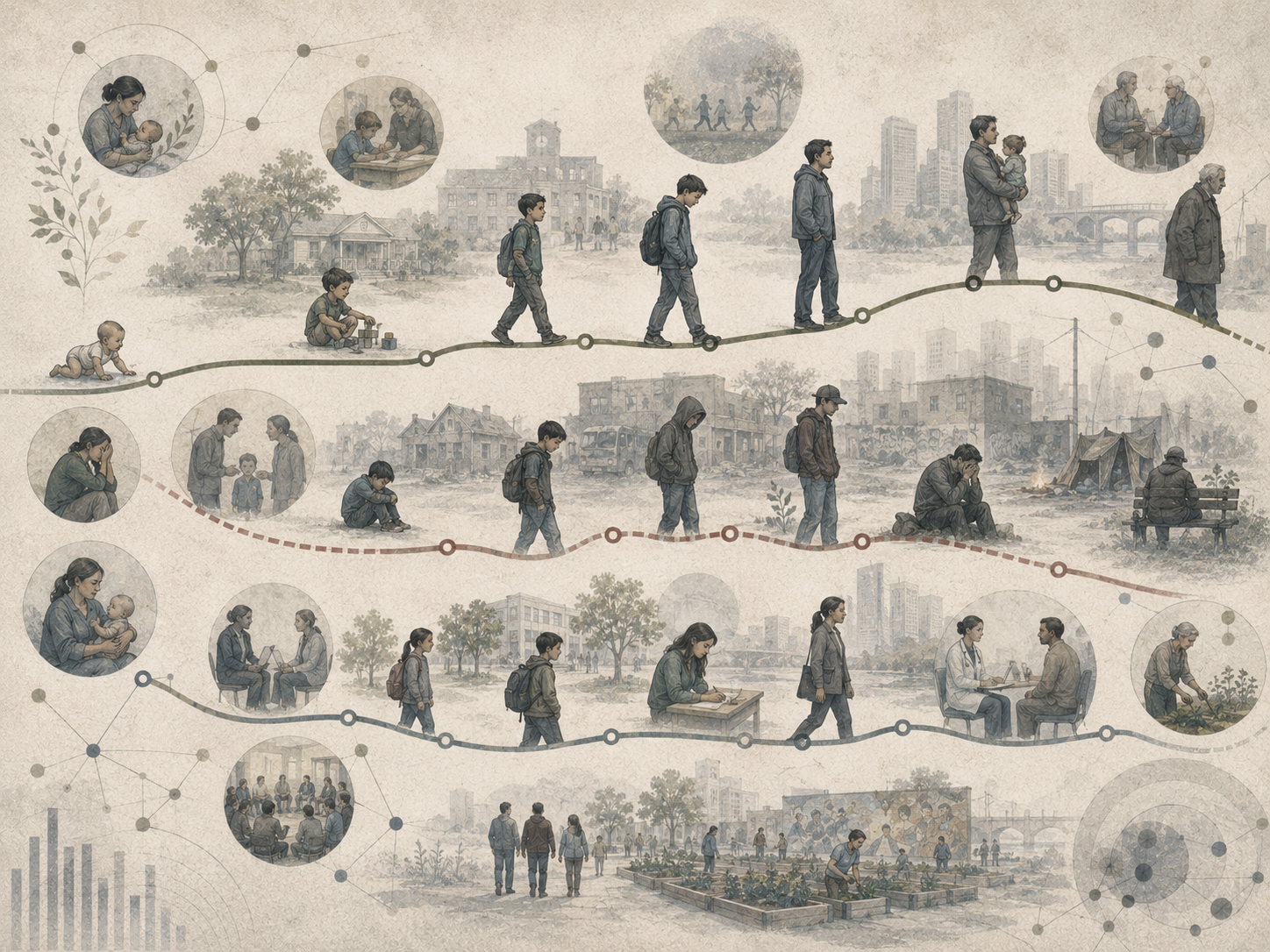
Public-health and developmental frameworks increasingly support a life-course view of adversity. Experiences such as abuse, neglect, violence exposure, household instability, displacement, discrimination, severe loss, poverty, coercion, and chronic threat do not have developmental effects only because they occur. Their effects depend on timing, duration, recurrence, interpretation, embodiment, social recognition, available protection, and the quality of care and institutional response that follows. Trauma and adversity therefore belong within developmental psychology not as side topics, but as core questions about adaptation, suffering, protection, repair, and human development under burden.
Why Trauma and Adversity Matter
Trauma and adversity matter because they alter developmental conditions rather than merely interrupting them for a moment. Experiences of violence, neglect, instability, humiliation, loss, coercion, disaster, abuse, exclusion, or chronic fear can shape how children and adolescents regulate emotion, interpret threat, trust caregivers, engage school, relate to peers, inhabit the body, and imagine the future. These effects are neither automatic nor uniform. Developmental consequences depend on timing, recurrence, duration, available support, prior vulnerability, institutional response, and whether later repair becomes possible.
This matters scientifically because it moves developmental psychology beyond static models of injury. Trauma should not be understood only as an event followed by symptoms. It should be understood as a developmental process in which threat, loss, or violation enters a person’s changing regulatory, relational, cognitive, and social systems. That process may narrow attention toward danger, increase vigilance, disrupt sleep, alter trust, change help-seeking, or reshape identity. But it may also be buffered, metabolized, reinterpreted, supported, and partially repaired through stable relationships and safer conditions.
It matters ethically because trauma and adversity are often patterned by family strain, social inequality, institutional failure, preventable violence, and unequal access to protection. When developmental science isolates trauma inside the individual alone, it risks turning social injury into private pathology. A life-course account asks not only what happened to a person, but what environments made the harm more likely, what systems failed to prevent it, and what supports were or were not available afterward.
Trauma belongs to the life course because its meaning and consequence unfold over time. An event may be brief, but its developmental afterlife may be long. A child may carry threat expectation into school. An adolescent may carry shame into identity formation. An adult may carry hypervigilance into parenting, intimacy, work, or health. The developmental question is therefore not only whether adversity occurred. It is how the person had to continue developing afterward.
What Trauma Is
Trauma can be understood as an experience, series of experiences, or set of conditions that overwhelm ordinary coping and reorganize perception, arousal, memory, trust, safety, and expectation. Trauma may arise from acute events such as violence, serious accidents, disasters, sudden loss, assault, forced displacement, or frightening medical experiences. It may also arise from chronic exposure to threat, coercion, humiliation, neglect, abuse, or instability. Developmentally, trauma matters not only because of the event itself, but because of how the event becomes integrated into the person’s ongoing life.
Children and adolescents often respond to traumatic events in varied ways. Some become withdrawn, fearful, angry, dysregulated, or highly vigilant. Others may appear numb, compliant, distracted, restless, avoidant, or seemingly unaffected for a time. Some show sleep disturbance, somatic complaints, school difficulties, startle responses, irritability, dissociation, or changes in play and attachment. The developmental point is that trauma does not have one single signature. It enters development through changing pathways of response.
Trauma also depends on meaning. The same outward event may carry different developmental consequences depending on whether it was understood, believed, named, hidden, repeated, blamed on the victim, or met with protection. A frightening event encountered with responsive support may unfold differently than the same event met with silence, disbelief, shame, retaliation, or abandonment. Trauma is therefore not only exposure to danger. It is also the collapse, absence, or failure of expected safety in relation to that danger.
A developmental definition of trauma should therefore remain broad enough to include acute shock, chronic threat, relational betrayal, institutional violence, and repeated instability. But it should also remain precise enough not to collapse all stress into trauma. Some stress is manageable and developmentally ordinary. Trauma refers to experiences that overwhelm or reorganize systems of safety, regulation, trust, and meaning.
What Adversity Is
Adversity is broader than trauma. It includes harmful, stressful, or destabilizing conditions that burden development, whether or not they are experienced as single overwhelming events. Adversity may include chronic household conflict, caregiver mental illness, poverty, housing instability, food insecurity, neglect, discrimination, violence exposure, family separation, institutional exclusion, environmental danger, and repeated uncertainty. Some adversities are dramatic and visible. Others are cumulative and ordinary enough to be socially normalized while still shaping development profoundly.
This distinction matters because not all adversity is acutely traumatic, yet repeated adversity can still alter the life course. A child facing chronic eviction risk, hunger, school instability, caregiver overload, and neighborhood danger may not be able to point to one singular traumatic event, but the cumulative burden may still reorganize attention, regulation, trust, learning, health, and future orientation. Developmental psychology needs the broader language of adversity to describe chronic burden, structural strain, and the accumulation of risk over time.
Adversity can also be relational, material, institutional, or symbolic. A child may experience adversity through neglect or violence within the family, through deprivation and instability in the material environment, through discrimination or punitive treatment in institutions, or through persistent messages of exclusion and worthlessness. These forms may overlap. Poverty can increase stress and exposure to unsafe environments. Discrimination can shape school discipline, health care access, policing, and self-understanding. Household instability can produce emotional and educational instability. Developmental burden is often layered.
Adversity should not be treated as destiny. Many people adapt, recover, and build meaningful lives under difficult conditions. But adaptation should not be used to minimize burden. The existence of resilience does not make adversity benign. The developmental task is to understand both harm and repair without romanticizing suffering.
Trauma, Stress, and Adversity: Why the Distinctions Matter
The distinctions among stress, adversity, and trauma matter because they shape interpretation and intervention. Stress refers broadly to challenge, demand, or pressure. Some stress can be manageable and even growth-supporting when it occurs within safe relationships and tolerable conditions. Adversity refers to harmful or destabilizing conditions that burden development. Trauma refers to overwhelming or threatening experiences that may reorganize safety, regulation, memory, and trust.
These categories overlap, but they should not be collapsed. A difficult exam is stressful, but not necessarily adverse. Chronic hunger is adverse, but may not always be experienced as one acute traumatic event. Sexual abuse, severe violence, forced displacement, or terrifying loss may be traumatic. A child can also experience trauma within broader conditions of adversity. The developmental meaning depends on intensity, recurrence, interpretation, support, and timing.
The distinction is important because overgeneralization can weaken both science and care. If every difficulty is called trauma, the term loses precision. If only dramatic events are called adversity, chronic conditions may be ignored. If stress is treated as uniformly harmful, ordinary challenge may be misunderstood. If adversity is treated as individual pathology, structural conditions disappear from view.
A strong developmental framework therefore uses all three concepts carefully. It asks what kind of burden is present, whether it overwhelms coping, whether it recurs, whether support is available, and how it interacts with age, caregiving, culture, institutions, and social inequality. The goal is not to label suffering for its own sake. The goal is to understand developmental consequences and identify conditions for protection and repair.
The Life-Course Perspective
A life-course perspective asks how early and later experiences connect across time rather than being treated as separate chapters. It assumes that development is cumulative, that earlier exposures may alter later vulnerability or strength, and that later supports can still redirect trajectories even after significant adversity. Trauma therefore belongs to the life course because it can shape later health, relationship, regulation, learning, work, parenting, and opportunity long after the initiating event has passed.
This perspective helps explain why the same adversity may not have the same consequence for everyone. A person enters later experiences with a prior history of care, instability, regulation, health, social support, and institutional treatment. A frightening event that occurs in the presence of trusted adults, stable housing, responsive care, and school support does not become part of the life course in the same way as a similar event followed by disbelief, further threat, displacement, or institutional punishment.
Life-course thinking also resists simplistic cause-and-effect models. Early adversity can matter greatly, but later development still matters. Adolescence may introduce new vulnerabilities and new opportunities. Adulthood may carry trauma forward through health, work, intimacy, parenting, and social participation. Later-life adversity may interact with aging, bereavement, dependency, health decline, and memory. The life course is not a single line from early trauma to later outcome. It is a sequence of interactions among exposure, support, adaptation, and context.
Timing, linked lives, transitions, and historical period are central. A child’s trauma may be shaped by caregiver response. A parent’s trauma may affect children. A community’s exposure to violence or disaster may influence many families at once. A public institution may either reduce harm or intensify it. A life-course perspective therefore treats trauma as developmental, relational, and institutional across time.
Timing, Accumulation, and Developmental Burden
Timing matters because developmental systems are changing. Adversity encountered during early caregiving, language formation, school transition, puberty, peer reorganization, emerging independence, parenthood, illness, or aging may affect different developmental tasks in different ways. A frightening disruption in early childhood may alter basic expectations of safety and care. Repeated adversity in adolescence may interact more strongly with identity, peer belonging, autonomy, sexuality, risk-taking, and future orientation. Later-life trauma may interact with health, dependency, memory, grief, and social isolation.
Accumulation matters because repeated burden can be more developmentally consequential than isolated stress. Multiple adversities can compound one another, especially when they occur without repair or protection. A child exposed to violence, housing instability, school exclusion, and caregiver distress is not simply experiencing four separate risks. Those risks may interact, making each harder to manage and reducing the availability of buffering relationships.
Developmental burden is therefore often cumulative rather than singular. The life-course question is not only what happened once, but what patterns of risk and protection were built across time. Did threat recur? Did safety return? Did adults respond? Did institutions protect or punish? Did the child remain connected to school, peers, family, language, culture, and community? Did later supports become available before burden compounded further?
Timing and accumulation also shape intervention. Early support may prevent adversity from becoming chronic. School-age support may protect learning and peer belonging. Adolescent support may reorient identity and future expectation. Adult support may reduce intergenerational transmission. Later-life support may restore dignity and reduce isolation. Different moments require different developmental responses.
Adverse Childhood Experiences and Development
Adverse childhood experiences, often discussed as ACEs, are one of the most widely used frameworks for linking early adversity to later developmental and health outcomes. ACE frameworks draw attention to childhood exposure to abuse, neglect, household instability, violence, and related forms of threat or disruption. Their value lies partly in showing that adversity is common and consequential, and partly in making visible the connection between childhood burden and later health, behavior, mental health, and social outcomes.
Yet ACEs should not be treated as a complete theory of trauma. A simple count of adverse experiences can obscure timing, severity, chronicity, interpretation, cultural context, and available support. The same ACE score may represent radically different life histories. One child may experience a brief period of household instability followed by sustained support. Another may experience chronic violence, neglect, poverty, and institutional punishment. Treating those histories as equivalent because they produce the same count can flatten the developmental reality.
ACE frameworks also need protective-factor analysis. A focus on adversity without support can make developmental life appear more deterministic than it is. Caregiver warmth, extended family, peer belonging, school support, cultural continuity, health care, safe housing, community organizations, and trauma-informed services can all shape whether adversity becomes more damaging, more contained, or more recoverable.
The ACE framework is therefore most useful as an entry point into life-course analysis rather than as a total explanation. It helps identify the developmental importance of early burden, but it should be extended with attention to timing, dose, duration, domain, meaning, support, culture, inequality, and institutional response.
Caregiving, Buffering, and Recovery
Supportive relationships can buffer adversity and change developmental outcomes. Trusted adults, stable caregivers, family members, peers, teachers, mentors, clinicians, coaches, elders, and community figures may help restore predictability, regulate fear, interpret experience, and reduce isolation. Buffering does not erase trauma, but it can alter its developmental meaning. A frightening event encountered with responsive support may unfold differently than the same event met with silence, disbelief, blame, retaliation, or abandonment.
Caregiving matters because children do not recover through internal will alone. They often recover through relationship, structure, safety, and the return of some sense that the world can again be navigated without constant danger. A caregiver who believes the child, protects the child, names what happened appropriately, maintains routines, and seeks help can help the child re-enter a world in which support remains possible.
Buffering also depends on the caregiver’s own conditions. Caregivers under poverty, violence, untreated trauma, social isolation, illness, housing instability, or institutional threat may struggle to provide stability even when they love the child deeply. Developmental trauma work should therefore support caregivers rather than simply evaluate them. Family support, respite, income stability, health care, housing protection, and community services are part of trauma recovery because they strengthen the relational environment in which children heal.
Recovery is not always linear. A child may improve and then struggle again during adolescence, transitions, anniversaries, court proceedings, family changes, or new stressors. Trauma recovery often requires repeated opportunities for safety and repair. A life-course perspective expects recovery to be developmental: it changes form as the person grows.
Trauma, Embodiment, and Regulation
Trauma and adversity are embodied. They can shape arousal, sleep, attention, vigilance, startle response, somatic discomfort, appetite, movement, pain, immune function, and broader stress physiology. Developmentally, this matters because regulation is never purely psychological. Children and adolescents may carry burden in the body as much as in explicit memory or narrative. Fear can become patterned anticipation; instability can become chronic readiness for disruption.
Embodiment helps explain why trauma may appear in classrooms, clinics, relationships, and families as behavior rather than as verbal report. A child who cannot sit still may be scanning for threat. A teenager who seems oppositional may be protecting against shame or control. A student who shuts down may be entering a defensive state rather than refusing to learn. A person who avoids help may be responding to a history in which help was unsafe, inconsistent, or humiliating.
This embodied dimension also helps explain why later recovery may require more than interpretation alone. Safety, routine, sleep, food security, predictable relationships, sensory regulation, movement, therapy, environmental stabilization, and social support can matter as much as insight. Trauma affects how the body learns the world, not only how the mind describes it.
Regulation should therefore be understood relationally and environmentally. A child’s ability to regulate depends partly on the availability of co-regulation, safe adults, stable settings, manageable demands, and appropriate accommodations. Trauma-informed development does not ask only what is wrong inside a child. It asks what conditions help the child’s nervous system, attention, relationships, and learning become safer again.
Memory, Meaning, and Threat Expectation
Trauma shapes memory and meaning. Some traumatic experiences are remembered vividly; others are fragmented, avoided, embodied, or difficult to narrate. Children may not have the language or developmental capacity to describe what happened, yet the experience may still shape play, sleep, attention, bodily response, emotional regulation, or relationship expectations. Developmental trauma can therefore be present even when explicit narrative is incomplete.
Meaning matters because traumatic events often alter what a person expects from the world. A child may learn that adults cannot protect them, that the body is unsafe, that love is unpredictable, that institutions punish rather than help, or that danger can arrive without warning. These expectations may be adaptive under threat but costly in safer settings. Hypervigilance may protect in danger but exhaust attention in school. Emotional numbing may reduce overwhelm but limit intimacy. Avoidance may prevent immediate distress but restrict learning and participation.
Trauma can also shape identity. Children and adolescents may blame themselves, feel contaminated by what happened, or interpret their reactions as weakness or badness. Social response is therefore crucial. Being believed, protected, and treated with dignity can reduce shame. Being dismissed, blamed, punished, or disbelieved can compound harm.
A developmental approach to trauma memory does not force premature narrative. It supports safety, regulation, trust, and age-appropriate meaning-making. Over time, the goal is not to erase memory, but to reduce its power to organize the entire future around danger.
Adolescence, Identity, and Trauma
Adolescence is a critical period for understanding trauma and adversity because identity, peer belonging, autonomy, sexuality, moral judgment, future orientation, and emotional intensity are reorganizing. Trauma during adolescence may affect not only safety and regulation, but also who the young person believes they are becoming. Shame, betrayal, exclusion, assault, community violence, online exploitation, bullying, family instability, or institutional punishment may enter directly into identity formation.
Adolescents also face developmental contradictions. They need autonomy, but trauma may make autonomy risky. They need peer belonging, but trauma may shape trust, intimacy, social threat, and status. They need future orientation, but adversity may narrow the imagined future. They may resist adult control while still requiring adult protection. Trauma-informed adolescent support must hold this complexity rather than treating adolescents either as children without agency or adults without developmental vulnerability.
Adolescent trauma may appear through risk-taking, withdrawal, anger, self-harm, dissociation, substance use, school disengagement, relationship conflict, or heightened sensitivity to humiliation. These responses should not be romanticized, but they should be interpreted developmentally. Many are attempts to manage unbearable arousal, regain control, belong, escape, or communicate distress when safer forms of support feel unavailable.
Adolescence is also a period of possible reorientation. Mentoring, therapy, peer support, school belonging, arts, sports, work opportunities, civic participation, cultural continuity, and trusted adult relationships can reshape future expectation. A trauma-informed life-course view treats adolescence not only as a period when adversity can intensify, but as a period when recovery and identity reconstruction can become possible.
Adulthood, Aging, and Later-Life Trauma
Trauma and adversity do not stop mattering after childhood and adolescence. Adult trauma may emerge through intimate partner violence, workplace exploitation, war, migration, discrimination, incarceration, illness, caregiving burden, medical trauma, sudden loss, disaster, assault, poverty, or homelessness. Adult development involves work, intimacy, parenting, community participation, health, and caregiving; trauma can reorganize each of these domains.
Earlier adversity may also reappear in adulthood under new conditions. Parenthood can activate memories of being parented. Intimacy can activate histories of betrayal. Medical procedures can activate bodily fear. Work authority can activate humiliation or coercion. Loss can reactivate earlier abandonment. A life-course view helps explain why trauma may be developmentally reinterpreted at later stages rather than remaining fixed in its original form.
Later life brings additional trauma-related questions. Older adults may face bereavement, health decline, dependency, isolation, elder abuse, displacement, war memory, or institutionalization. Earlier trauma may interact with cognitive aging, physical vulnerability, and social isolation. At the same time, older adults may also draw on meaning, faith, family, memory, community, and life experience as resources for adaptation.
A developmental account of trauma should therefore be lifespan-oriented. Childhood trauma matters, but adulthood and aging also contain vulnerabilities and possibilities for repair. The life course includes repeated moments when trauma may be remembered differently, supported differently, or compounded by new conditions.
School, Community, and Institutional Response
Trauma and adversity are mediated by institutions. Schools, clinics, courts, child welfare systems, health systems, neighborhoods, faith communities, youth organizations, employers, housing systems, and community organizations all help determine whether burden is recognized, intensified, or buffered. A trauma-exposed child may meet punitive discipline in one school and relational support in another. A family facing violence or instability may encounter care in one institution and bureaucratic exclusion in another.
This means trauma is never only private. Institutional response becomes part of the developmental pathway. Schools and communities can provide trusted adults, predictable routines, safety, continuity, belonging, accommodations, and pathways to care. They can also magnify shame, fear, exclusion, surveillance, and mistrust. A child who is punished for trauma-related behavior may learn that institutions are dangerous. A child who is supported may learn that help can be real.
Trauma-informed schooling is not simply leniency or lowered expectations. It is a disciplined approach to safety, predictability, relational trust, regulation support, accountability, and learning. It asks what happened, what the child needs now, what boundaries are necessary, and how repair can occur without humiliation or exclusion. It recognizes that behavior has meaning while still preserving the needs of classrooms and peers.
Communities also matter. Stable neighborhoods, accessible mental-health care, safe public spaces, youth programs, culturally trusted organizations, and family support systems can reduce isolation and expand protective networks. Trauma recovery is often strongest when it is not located in one professional relationship alone, but distributed across a safer ecology.
Resilience Without Minimizing Harm
Resilience is real, but it should not be used to soften the reality of harm. People can show positive adaptation under conditions of substantial adversity, yet that adaptation does not make the adversity benign. Survival, competence, achievement, humor, faith, responsibility, or later success do not retroactively justify violence, neglect, coercion, displacement, or chronic instability.
A serious developmental account treats resilience as process, not slogan. It asks what resources, relationships, opportunities, practices, cultural meanings, spiritual commitments, institutional supports, and personal capacities make continued adaptation possible. It does not turn resilience into a demand placed on the already burdened. It does not ask children to become inspirational evidence that systems can continue to fail them.
Resilience can also carry cost. A child who appears mature under adversity may be overburdened. A teenager who becomes hyper-independent may struggle to receive care. A survivor who performs competence may hide distress. Developmental psychology should therefore distinguish visible functioning from full recovery. Resilience may involve adaptation under constraint rather than freedom from harm.
The ethical use of resilience language requires two commitments. First, recognize the real capacities people develop under adversity. Second, refuse to use those capacities as an excuse for preventable suffering. The goal is to understand how positive pathways are built, not to celebrate hardship for producing them.
Inequality, Violence, and the Distribution of Adversity
Adversity is not randomly distributed. Violence, child maltreatment, household instability, displacement, poverty, environmental hazard, discrimination, institutional exclusion, and structural neglect are patterned by social and political conditions. Some children grow up with more exposure to danger, more institutional surveillance, less access to protection, and fewer pathways to repair. Trauma therefore belongs to the life course partly because inequality helps determine whose life course is burdened earliest and most repeatedly.
This matters because developmental outcomes are too often individualized. Symptoms may be treated as private problems while the unequal conditions producing them remain backgrounded. A child’s anxiety, aggression, withdrawal, or school difficulty may be interpreted as personal pathology while unsafe housing, family poverty, community violence, racism, disability exclusion, or lack of services remain invisible. A stronger developmental psychology recognizes that trauma is partly social in distribution, even when it is intimate in experience.
Inequality also shapes recovery. Families with resources may access therapy, stable housing, legal support, private space, school accommodations, and time for care. Families without resources may face waitlists, eviction, transportation barriers, job insecurity, punitive systems, and disbelief. The same traumatic event can therefore have different developmental consequences depending on the recovery environment.
A trauma-informed life-course approach must be inequality-informed. It should ask who is exposed, who is believed, who is protected, who is punished, who receives care, and who is expected to recover without support. Trauma prevention is inseparable from violence prevention, poverty reduction, housing stability, health access, school inclusion, and institutional accountability.
Intergenerational Transmission and Repair
Trauma can move across generations, not as a simple inherited fate, but through family systems, stress physiology, parenting, silence, poverty, displacement, violence, institutional treatment, and social memory. A caregiver who has survived trauma may struggle with regulation, trust, safety, or emotional availability. A family shaped by war, migration, enslavement, genocide, displacement, or community violence may carry histories that influence child development through story, silence, vigilance, grief, and protection.
Intergenerational transmission should be handled carefully. It should not be used to stigmatize families or communities. Many caregivers who experienced trauma become deeply protective, emotionally wise, and committed to giving children a different life. Transmission is not automatic. It is shaped by support, healing, material conditions, cultural meaning, and institutional response.
Repair can also be intergenerational. When caregivers receive support, when family violence is interrupted, when schools become safer, when communities rebuild trust, when cultural memory is honored, when health care is accessible, and when children experience stable love, pathways can change. Repair may not erase history, but it can alter what history requires of the next generation.
A developmental account should therefore study both transmission and transformation. Trauma may travel through families and institutions, but so can protection, meaning, care, and repair. The question is not whether the past matters. It is what conditions allow the past to stop organizing the future entirely around harm.
Trauma-Informed Developmental Systems
Trauma-informed developmental systems are institutions that recognize how adversity affects regulation, learning, behavior, relationship, health, and trust across time. They do not reduce people to trauma histories, but they also do not ignore the developmental effects of threat and instability. They organize care, education, justice, health, housing, and community support around safety, dignity, predictability, agency, and repair.
A trauma-informed system asks different questions. Instead of asking only “What is wrong with this child?” it asks “What has this child had to adapt to?” Instead of asking only “Why is this family noncompliant?” it asks “What barriers, fears, histories, or institutional failures shape this interaction?” Instead of asking only “How do we control behavior?” it asks “How do we restore safety, accountability, regulation, and relationship?”
Trauma-informed systems must also avoid becoming superficial branding. A poster about trauma is not enough. Institutions need training, staffing, supervision, accessible services, anti-racist and disability-aware practice, family partnership, meaningful accountability, and policies that reduce exclusion. A school that names trauma but continues to rely on humiliation and suspension is not trauma-informed in developmental substance.
The goal is not to excuse harm or remove boundaries. Trauma-informed systems still require accountability. But accountability should be developmentally intelligent. It should reduce danger without reproducing the very shame, fear, and exclusion that trauma has already created.
Beyond the Event: Trauma as Developmental Process
Trauma should not be reduced to the initiating event. What often matters most developmentally is the longer process through which the event is remembered, repeated, interpreted, embodied, responded to, or institutionalized. Some burdens recede under support. Others compound through further instability, disbelief, exposure, or untreated distress. Developmental process is what turns event into trajectory.
This process view makes trauma more legible within developmental psychology. It allows the field to ask not only what happened, but what followed. Was the child believed? Was danger stopped? Did school remain stable? Did the body regain safety? Did shame become identity? Did institutions protect or punish? Did family support strengthen or collapse? Did later relationships reopen the possibility of trust?
Trauma as developmental process also makes recovery visible. Recovery is not merely symptom reduction. It may include restored sleep, safer relationships, improved regulation, renewed learning, reduced shame, increased agency, trustworthy institutions, cultural reconnection, and a future that no longer feels entirely organized by danger. Recovery is developmental because it changes how the person continues to grow.
In that sense, trauma is not outside development. It is one of the conditions through which development may become more burdened, more vigilant, more constrained, or, under better support, more recoverable. A life-course perspective makes that complexity visible by asking not only what happened, but how a person had to go on becoming afterward.
An Analytical Framework for Trauma, Adversity, and the Life Course
A stylized developmental outcome \(D_{it}\) for individual \(i\) at time \(t\) can be written as a function of adversity burden, support, contextual stability, and residual variation:
D_{it} = \alpha_i – \beta A_{it} + \gamma S_{it} + \delta C_{it} + \varepsilon_{it}
\]
Interpretation: Developmental adaptation is shaped by adversity burden \(A_{it}\), support or buffering \(S_{it}\), contextual stability \(C_{it}\), individual baseline differences \(\alpha_i\), and residual variation \(\varepsilon_{it}\).
To reflect accumulation and timing, adversity can be summed across prior developmental periods with timing weights:
D_{it} = \alpha_i – \beta \sum_{\tau=1}^{t} w_{\tau}A_{i\tau} + \gamma S_{it} + \delta C_{it} + \varepsilon_{it}
\]
Interpretation: Adversity may accumulate across time, and some developmental periods may carry greater sensitivity. The timing weight \(w_{\tau}\) allows adversity at different periods to have different developmental influence.
To model buffering more explicitly, support can be represented as moderating the effect of adversity:
D_{it} = \alpha_i – \beta A_{it} + \gamma S_{it} + \theta(A_{it} \times S_{it}) + \varepsilon_{it}
\]
Interpretation: The interaction term \(A_{it} \times S_{it}\) represents the possibility that support changes the developmental effect of adversity. Buffering is modeled as a relation, not as a separate protective label.
A dynamic model includes prior developmental state:
D_{it} = \rho D_{i,t-1} – \beta A_{it} + \gamma S_{it} + \delta C_{it} + \varepsilon_{it}
\]
Interpretation: Developmental outcomes often depend partly on earlier developmental states. Continuity matters, but current burden, support, and stability can still redirect the pathway.
A multilevel version is often more realistic because trauma and adversity are mediated by schools, neighborhoods, families, clinics, care systems, and communities:
D_{ijt} = \alpha + u_j – \beta A_{ijt} + \gamma S_{ijt} + \delta C_{ijt} + \varepsilon_{ijt}
\]
Interpretation: The term \(u_j\) captures shared context-level influence. Trauma and recovery are shaped not only by individual experience, but by environments and institutions.
These equations are simplified, but they clarify the article’s central argument. Trauma and adversity should not be modeled only as one-time exposures. They are developmental conditions shaped by timing, accumulation, embodiment, support, institutional response, and life-course continuity.
R: Simulating Adversity, Support, and Life-Course Adaptation
The following R example simulates children across repeated waves with adversity burden, caregiver support, contextual stability, community buffering, and cumulative developmental effects shaping life-course adaptation. The data are synthetic and intended for demonstration only.
# Simulating adversity, support, and life-course adaptation
# --------------------------------------------------------
# This example creates synthetic repeated-observation data to show how
# adversity burden, support, timing, contextual stability, and community
# buffering can shape developmental adaptation across time.

suppressPackageStartupMessages({
  library(dplyr)
  library(lme4)
  library(ggplot2)
})

set.seed(2026)

n_children <- 820
n_waves <- 9
n_contexts <- 32

children <- data.frame(
  child_id = 1:n_children,
  context_id = sample(1:n_contexts, n_children, replace = TRUE),
  adversity_burden = rnorm(n_children, 0, 1),
  caregiver_support = rnorm(n_children, 0, 1),
  contextual_stability = rnorm(n_children, 0, 1),
  baseline_health = rnorm(n_children, 0, 1),
  child_resilience = rnorm(n_children, 0, 0.7)
)

context_df <- data.frame(
  context_id = 1:n_contexts,
  community_buffer = rnorm(n_contexts, 0, 0.6),
  institutional_safety = rnorm(n_contexts, 0, 0.6),
  service_access = rnorm(n_contexts, 0, 0.5)
)

panel_data <- children |>
  slice(rep(1:n(), each = n_waves)) |>
  group_by(child_id) |>
  mutate(
    wave = 0:(n_waves - 1),
    early_timing_weight = exp(-0.20 * wave),
    transition_weight = exp(-((wave - 5)^2) / (2 * 1.5^2)),
    current_adversity = rnorm(n_waves, mean = adversity_burden, sd = 0.65),
    current_support = rnorm(n_waves, mean = caregiver_support, sd = 0.55),
    current_stability = rnorm(n_waves, mean = contextual_stability, sd = 0.55),
    current_health = rnorm(n_waves, mean = baseline_health, sd = 0.45)
  ) |>
  ungroup() |>
  left_join(context_df, by = "context_id") |>
  arrange(child_id, wave)

panel_data <- panel_data |>
  mutate(
    weighted_adversity = current_adversity * early_timing_weight,
    transition_support = current_support * transition_weight
  ) |>
  group_by(child_id) |>
  mutate(
    cumulative_adversity = cumsum(weighted_adversity),
    cumulative_support = cumsum(current_support)
  ) |>
  ungroup()

panel_data <- panel_data |>
  mutate(
    adaptation_score =
      50 +
      0.65 * wave -
      0.95 * cumulative_adversity -
      1.10 * current_adversity * early_timing_weight +
      1.15 * current_support +
      0.95 * current_stability +
      0.85 * community_buffer +
      0.75 * institutional_safety +
      0.65 * service_access +
      0.75 * transition_support +
      0.65 * current_health +
      0.60 * child_resilience +
      0.70 * current_support * current_stability +
      rnorm(n(), 0, 2.4)
  )

model <- lmer(
  adaptation_score ~ wave + cumulative_adversity + current_adversity +
    early_timing_weight + current_support + current_stability +
    transition_support + community_buffer + institutional_safety +
    service_access + current_health + child_resilience +
    current_support:current_stability +
    (1 + wave | context_id/child_id),
  data = panel_data
)

summary(model)

trajectory_summary <- panel_data |>
  group_by(wave) |>
  summarize(
    mean_adaptation = mean(adaptation_score),
    standard_error = sd(adaptation_score) / sqrt(n()),
    lower = mean_adaptation - 1.96 * standard_error,
    upper = mean_adaptation + 1.96 * standard_error,
    .groups = "drop"
  )

ggplot(trajectory_summary, aes(x = wave, y = mean_adaptation)) +
  geom_line(linewidth = 1) +
  geom_ribbon(aes(ymin = lower, ymax = upper), alpha = 0.15) +
  labs(
    title = "Simulated Trauma, Adversity, and the Life Course",
    x = "Wave",
    y = "Average adaptation score"
  ) +
  theme_minimal()

risk_profiles <- panel_data |>
  group_by(child_id) |>
  summarize(
    average_adversity = mean(current_adversity),
    average_support = mean(current_support),
    average_stability = mean(current_stability),
    final_score = adaptation_score[wave == max(wave)],
    .groups = "drop"
  ) |>
  mutate(
    adversity_support_profile = case_when(
      average_adversity < 0 & average_support >= 0 ~ "lower adversity / higher support",
      average_adversity >= 0 & average_support >= 0 ~ "higher adversity / higher support",
      average_adversity < 0 & average_support < 0 ~ "lower adversity / lower support",
      TRUE ~ "higher adversity / lower support"
    )
  )

ggplot(
  risk_profiles,
  aes(x = adversity_support_profile, y = final_score)
) +
  geom_boxplot() +
  coord_flip() +
  labs(
    title = "Synthetic Final Adaptation Scores by Adversity-Support Profile",
    x = "Adversity-support profile",
    y = "Final adaptation score"
  ) +
  theme_minimal()

# Analysts can extend this model by:
# 1. separating acute trauma and chronic adversity;
# 2. modeling repeated trauma exposure;
# 3. adding school, clinic, and family systems explicitly;
# 4. estimating subgroup differences in buffering;
# 5. simulating intervention timing after trauma;
# 6. testing policy scenarios such as housing stability or service access.
This R workflow treats trauma and adversity as cumulative, timing-sensitive, and context-dependent. It also models support and stability as protective conditions rather than treating resilience as a purely individual trait.
Python: Modeling Trauma, Cumulative Risk, and Development Over Time
The following Python example simulates developmental change over time with adversity burden, caregiver support, contextual stability, health, institutional safety, service access, and community buffering. It includes a dynamic structure in which prior adaptation influences later adaptation.
# Modeling trauma, cumulative risk, and development over time
# -----------------------------------------------------------
# This example creates synthetic longitudinal data to demonstrate how
# adversity burden, caregiver support, contextual stability, community
# buffering, and institutional safety can shape developmental adaptation.

from __future__ import annotations

import numpy as np
import pandas as pd
import statsmodels.formula.api as smf
import matplotlib.pyplot as plt

np.random.seed(2026)

n_children = 850
n_periods = 10
n_contexts = 36

children = pd.DataFrame({
    "child_id": np.arange(1, n_children + 1),
    "context_id": np.random.choice(np.arange(1, n_contexts + 1), size=n_children),
    "adversity_burden": np.random.normal(0, 1, n_children),
    "caregiver_support": np.random.normal(0, 1, n_children),
    "contextual_stability": np.random.normal(0, 1, n_children),
    "baseline_health": np.random.normal(0, 1, n_children),
    "child_resilience": np.random.normal(0, 0.7, n_children),
})

context_df = pd.DataFrame({
    "context_id": np.arange(1, n_contexts + 1),
    "community_buffer": np.random.normal(0, 0.6, n_contexts),
    "institutional_safety": np.random.normal(0, 0.6, n_contexts),
    "service_access": np.random.normal(0, 0.5, n_contexts),
})

panel = children.loc[children.index.repeat(n_periods)].copy()
panel["time"] = np.tile(np.arange(n_periods), n_children)
panel["early_timing_weight"] = np.exp(-0.18 * panel["time"])
panel["transition_weight"] = np.exp(-((panel["time"] - 6) ** 2) / (2 * 1.8 ** 2))

panel = panel.merge(context_df, on="context_id", how="left")

panel["current_adversity"] = np.random.normal(
    panel["adversity_burden"],
    0.70,
    len(panel),
)

panel["current_support"] = np.random.normal(
    panel["caregiver_support"],
    0.60,
    len(panel),
)

panel["current_stability"] = np.random.normal(
    panel["contextual_stability"],
    0.60,
    len(panel),
)

panel["current_health"] = np.random.normal(
    panel["baseline_health"],
    0.50,
    len(panel),
)

panel = panel.sort_values(["child_id", "time"]).reset_index(drop=True)

panel["weighted_adversity"] = (
    panel["current_adversity"] * panel["early_timing_weight"]
)

panel["transition_support"] = (
    panel["current_support"] * panel["transition_weight"]
)

panel["cumulative_adversity"] = panel.groupby("child_id")[
    "weighted_adversity"
].cumsum()

panel["cumulative_support"] = panel.groupby("child_id")[
    "current_support"
].cumsum()

panel["adaptation_score"] = np.nan

for child_id in panel["child_id"].unique():
    subset = panel.loc[panel["child_id"] == child_id].copy()
    previous_score = 50 + np.random.normal(0, 3)

    for idx in subset.index:
        time = panel.at[idx, "time"]
        adversity = panel.at[idx, "current_adversity"]
        support = panel.at[idx, "current_support"]
        stability = panel.at[idx, "current_stability"]
        community = panel.at[idx, "community_buffer"]
        institutional = panel.at[idx, "institutional_safety"]
        services = panel.at[idx, "service_access"]
        health = panel.at[idx, "current_health"]
        resilience = panel.at[idx, "child_resilience"]
        timing = panel.at[idx, "early_timing_weight"]
        transition_support = panel.at[idx, "transition_support"]
        cumulative_adversity = panel.at[idx, "cumulative_adversity"]

        current_score = (
            0.70 * previous_score
            + 0.18 * time
            - 0.70 * cumulative_adversity
            - 1.05 * adversity * timing
            + 1.05 * support
            + 0.95 * stability
            + 0.85 * community
            + 0.75 * institutional
            + 0.65 * services
            + 0.70 * transition_support
            + 0.60 * health
            + 0.55 * resilience
            + 0.75 * support * stability
            + np.random.normal(0, 2.3)
        )

        panel.at[idx, "adaptation_score"] = current_score
        previous_score = current_score

panel["lag_score"] = panel.groupby("child_id")["adaptation_score"].shift(1)
regression_data = panel.dropna(subset=["lag_score"]).copy()

model = smf.ols(
    formula="""
    adaptation_score ~ lag_score + time + cumulative_adversity +
    current_adversity + early_timing_weight + current_support +
    current_stability + transition_support + community_buffer +
    institutional_safety + service_access + current_health +
    child_resilience + current_support:current_stability
    """,
    data=regression_data,
).fit(cov_type="HC3")

print(model.summary())

trajectory = panel.groupby("time", as_index=False).agg(
    average_adaptation=("adaptation_score", "mean"),
    standard_error=("adaptation_score", lambda x: x.std() / np.sqrt(len(x))),
    average_adversity=("current_adversity", "mean"),
    average_support=("current_support", "mean"),
    average_stability=("current_stability", "mean"),
)

trajectory["lower"] = (
    trajectory["average_adaptation"] - 1.96 * trajectory["standard_error"]
)

trajectory["upper"] = (
    trajectory["average_adaptation"] + 1.96 * trajectory["standard_error"]
)

plt.figure(figsize=(8, 5))
plt.plot(trajectory["time"], trajectory["average_adaptation"], linewidth=2)
plt.fill_between(
    trajectory["time"],
    trajectory["lower"],
    trajectory["upper"],
    alpha=0.2,
)
plt.xlabel("Time")
plt.ylabel("Average adaptation score")
plt.title("Simulated Trauma, Adversity, and the Life Course")
plt.tight_layout()
plt.show()

child_summary = panel.groupby("child_id", as_index=False).agg(
    average_adversity=("current_adversity", "mean"),
    average_support=("current_support", "mean"),
    average_stability=("current_stability", "mean"),
    final_score=("adaptation_score", "last"),
)

child_summary["adversity_support_profile"] = np.select(
    [
        (child_summary["average_adversity"] < 0) & (child_summary["average_support"] >= 0),
        (child_summary["average_adversity"] >= 0) & (child_summary["average_support"] >= 0),
        (child_summary["average_adversity"] < 0) & (child_summary["average_support"] < 0),
    ],
    [
        "lower adversity / higher support",
        "higher adversity / higher support",
        "lower adversity / lower support",
    ],
    default="higher adversity / lower support",
)

profile_summary = child_summary.groupby(
    "adversity_support_profile",
    as_index=False,
).agg(
    children=("child_id", "count"),
    average_final_score=("final_score", "mean"),
    average_adversity=("average_adversity", "mean"),
    average_support=("average_support", "mean"),
)

print(profile_summary)

# Analysts can extend this framework by:
# 1. distinguishing acute trauma from chronic adversity;
# 2. adding repeated exposure and recovery windows;
# 3. introducing school or neighborhood shocks;
# 4. modeling therapy or family intervention timing;
# 5. comparing stronger and weaker buffering ecologies;
# 6. simulating policy changes such as housing stability or service access.
The Python workflow makes the life-course argument explicit: adaptation is shaped by prior developmental state, cumulative adversity, timing-sensitive exposure, support, stability, institutional safety, service access, and community buffering. It is a structure for thinking about developmental pathways, not a diagnostic model.
GitHub Repository
Complete Code Repository
Access the full companion repository for this article, including reproducible analysis materials and multi-language code workflows for trauma, adversity, timing-sensitive exposure, cumulative risk, support buffering, institutional response, and life-course adaptation modeling.
Conclusion
Trauma, adversity, and the life course belong together because adversity is not merely something that happens once and ends. It can become part of developmental sequence, shaping regulation, expectation, embodiment, health, trust, identity, learning, relationship, and opportunity across time. The strongest developmental psychology therefore studies not only events, but timing, accumulation, buffering, meaning, institutional response, and the systems that either compound harm or make recovery more possible.
This perspective does not make trauma deterministic. It makes trauma developmental. Harm may persist, but pathways can change. Supportive relationships, safe environments, school belonging, community care, therapy, cultural meaning, institutional accountability, and material stability can redirect trajectories. Recovery does not require pretending the harm was small. It requires building conditions under which life is no longer organized primarily around threat.
In that sense, trauma is not outside development. It is one of the conditions through which development can become more burdened, more vigilant, more constrained, or, under better support, more recoverable. A life-course perspective makes that complexity visible by asking not only what happened, but how a person had to go on developing afterward.
Related Articles
- What Is Developmental Psychology?
- Why Developmental Psychology Matters Today
- Developmental Psychopathology: Risk, Resilience, and Adaptation
- Development, Inequality, and the Life Course
- Parenting, Family Systems, and Human Development
- Education, Schooling, and Developmental Formation
- Developmental Systems Theory and the Ecology of Human Growth
- Genes, Environment, and Developmental Plasticity
- Developmental Psychology knowledge series
Further Reading
- Centers for Disease Control and Prevention (n.d.) About Adverse Childhood Experiences. Available at: https://www.cdc.gov/aces/about/index.html.
- Centers for Disease Control and Prevention (n.d.) A Public Health Approach to Adverse Childhood Experiences. Available at: https://www.cdc.gov/aces/php/public-health-strategy/index.html.
- Felitti, V.J. et al. (1998) ‘Relationship of childhood abuse and household dysfunction to many of the leading causes of death in adults: The Adverse Childhood Experiences Study’, American Journal of Preventive Medicine, 14(4), pp. 245–258. Available at: https://doi.org/10.1016/S0749-3797(98)00017-8.
- National Institute of Mental Health (n.d.) Helping Children and Adolescents Cope With Traumatic Events. Available at: https://www.nimh.nih.gov/health/publications/helping-children-and-adolescents-cope-with-disasters-and-other-traumatic-events.
- National Child Traumatic Stress Network (n.d.) Trauma Types. Available at: https://www.nctsn.org/what-is-child-trauma/trauma-types.
- Nurius, P.S., Green, S., Logan-Greene, P. and Borja, S. (2015) ‘Life course pathways of adverse childhood experiences toward adult psychological well-being’, Child Abuse & Neglect, 45, pp. 143–153. Available at: https://pmc.ncbi.nlm.nih.gov/articles/PMC4470711/.
- Substance Abuse and Mental Health Services Administration (2014) SAMHSA’s Concept of Trauma and Guidance for a Trauma-Informed Approach. Available at: https://store.samhsa.gov/product/samhsas-concept-trauma-and-guidance-trauma-informed-approach/sma14-4884.
- World Health Organization (n.d.) Child Maltreatment. Available at: https://www.who.int/news-room/fact-sheets/detail/child-maltreatment.
- World Health Organization (n.d.) Violence Against Children. Available at: https://www.who.int/news-room/fact-sheets/detail/violence-against-children.
References
- American Psychological Association (n.d.) Developmental Psychology. Available at: https://www.apa.org/education-career/guide/subfields/developmental.
- Centers for Disease Control and Prevention (n.d.) About Adverse Childhood Experiences. Available at: https://www.cdc.gov/aces/about/index.html.
- Centers for Disease Control and Prevention (n.d.) Risk and Protective Factors. Available at: https://www.cdc.gov/aces/risk-factors/index.html.
- Centers for Disease Control and Prevention (n.d.) A Public Health Approach to Adverse Childhood Experiences. Available at: https://www.cdc.gov/aces/php/public-health-strategy/index.html.
- Felitti, V.J. et al. (1998) ‘Relationship of childhood abuse and household dysfunction to many of the leading causes of death in adults: The Adverse Childhood Experiences Study’, American Journal of Preventive Medicine, 14(4), pp. 245–258. Available at: https://doi.org/10.1016/S0749-3797(98)00017-8.
- Hajat, A. et al. (2020) ‘Differing trajectories of adversity over the life course: Implications for adult health and well-being’, available via PMC. Available at: https://pmc.ncbi.nlm.nih.gov/articles/PMC7259709/.
- National Child Traumatic Stress Network (n.d.) What Is Child Trauma? Available at: https://www.nctsn.org/what-is-child-trauma.
- National Institute of Mental Health (n.d.) Helping Children and Adolescents Cope With Traumatic Events. Available at: https://www.nimh.nih.gov/health/publications/helping-children-and-adolescents-cope-with-disasters-and-other-traumatic-events.
- National Institute of Mental Health (n.d.) Child and Adolescent Mental Health. Available at: https://www.nimh.nih.gov/health/topics/child-and-adolescent-mental-health.
- National Institute of Mental Health (n.d.) Post-Traumatic Stress Disorder. Available at: https://www.nimh.nih.gov/health/topics/post-traumatic-stress-disorder-ptsd.
- Nurius, P.S., Green, S., Logan-Greene, P. and Borja, S. (2015) ‘Life course pathways of adverse childhood experiences toward adult psychological well-being’, Child Abuse & Neglect, 45, pp. 143–153. Available at: https://pmc.ncbi.nlm.nih.gov/articles/PMC4470711/.
- Rudd, K.L. et al. (2021) ‘Developmental consequences of early life stress on risk for psychopathology’, available via PMC. Available at: https://pmc.ncbi.nlm.nih.gov/articles/PMC8691149/.
- Substance Abuse and Mental Health Services Administration (2014) SAMHSA’s Concept of Trauma and Guidance for a Trauma-Informed Approach. Available at: https://store.samhsa.gov/product/samhsas-concept-trauma-and-guidance-trauma-informed-approach/sma14-4884.
- Toth, S.L. and Cicchetti, D. (2013) ‘A developmental psychopathology perspective on child maltreatment’, available via PMC. Available at: https://pmc.ncbi.nlm.nih.gov/articles/PMC4520222/.
- World Health Organization (n.d.) Child Maltreatment. Available at: https://www.who.int/news-room/fact-sheets/detail/child-maltreatment.
- World Health Organization (n.d.) Violence Against Children. Available at: https://www.who.int/news-room/fact-sheets/detail/violence-against-children.