
Last Updated May 21, 2026
Developmental systems theory holds that human growth does not arise from the isolated action of genes, environments, fixed stages, or private traits, but from ongoing, reciprocal relations among biology, behavior, relationship, culture, institution, ecology, and history. The ecology of human growth is therefore not a backdrop to development. It is part of development itself. Human beings develop through patterned transactions with caregivers, peers, schools, neighborhoods, material conditions, symbolic worlds, technologies, public institutions, and historical structures that shape what kinds of growth become possible.
This family of perspectives rejects the old image of the organism as a self-contained unit that unfolds from within while surroundings merely influence or constrain it from the outside. Developmental systems approaches instead treat persons and contexts as co-constitutive. Children do not first develop as isolated organisms and then enter society. From the beginning, they develop through embodied relations with care, language, touch, nutrition, stress, safety, learning, culture, place, and power. Development is not simply inside the child. It is organized through the living relation between the child and the world.
Main Library
Publications
Article Map
Developmental Psychology
Related Topic
Biology & Living Systems
Related Topic
Risk & Resilience
Related Topic
Institutions & Governance
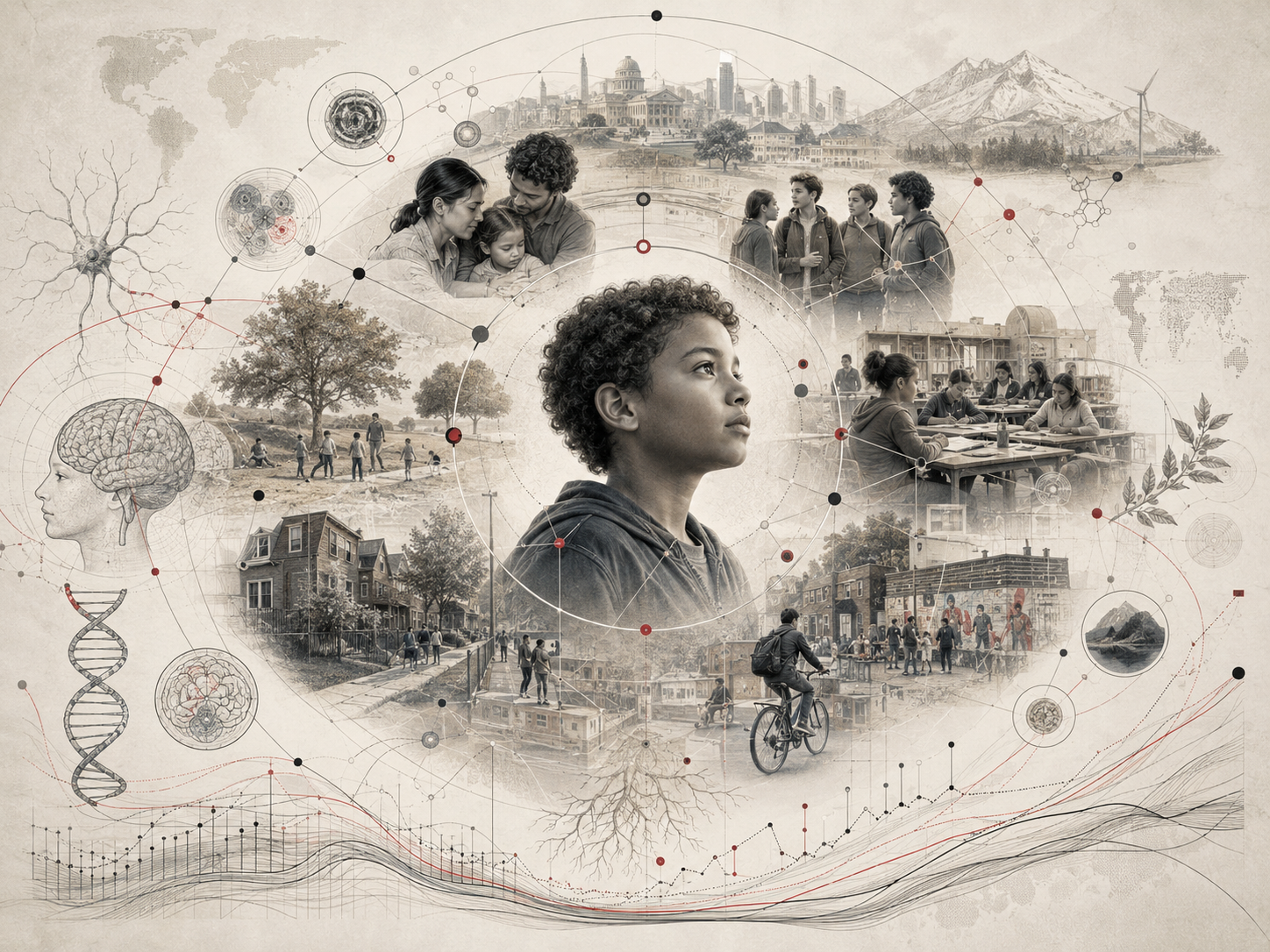
The developmental systems tradition is closely related to ecological and bioecological models of development, especially those associated with Urie Bronfenbrenner, but it reaches beyond simple contextual influence by making reciprocity, embodiment, and process central. Bronfenbrenner’s ecological work helped developmental psychology see nested environments such as family, school, community, culture, and historical time as developmentally consequential. Later relational developmental systems formulations argued even more strongly that individual and context cannot be treated as separable causes. Development emerges through their ongoing relation.
The result is a broader theory of human growth in which biology is real, environment is real, and development arises through their coordination over time. This approach is especially important for understanding attachment, learning, self-regulation, disability, neurodivergence, school formation, health, trauma, resilience, social inequality, and life-course change. It gives developmental psychology a way to think across levels without reducing human growth to any single level alone.
Why Developmental Systems Theory Matters
Developmental systems theory matters because it gives developmental psychology a stronger account of causation. Instead of asking whether a behavior comes from genes or environment, biology or culture, child or family, it asks how patterns of relation generate developmental pathways over time. This shift matters because many developmental phenomena do not reside cleanly in one level of analysis. Language growth, self-regulation, attachment, school engagement, health behavior, moral development, disability, neurodivergence, trauma, and resilience all arise through coordinated processes involving body, relationship, and setting.
Developmental systems theory also matters because it resists simplistic explanations of human difference. If a child struggles in school, the cause may not be located only in the child, only in the family, only in the teacher, only in the curriculum, or only in the neighborhood. Developmental outcomes are often produced through the fit or mismatch among multiple systems: biological sensitivity, household routines, instruction, peer climate, nutrition, sleep, transportation, school discipline, language access, disability support, stress exposure, and institutional expectation.
This approach also matters ethically. If development is relational and ecological, outcomes cannot be interpreted simply as the triumph or failure of isolated individuals. They must be understood in light of opportunity structures, care systems, histories of exclusion, institutional design, material conditions, and the availability of supportive environments. A systems view does not erase agency, responsibility, or individual difference. It places them inside the broader developmental relations that make agency and responsibility possible.
The theory is therefore useful not only for explanation but for intervention. If development is produced through systems, then support can operate at many levels: caregiving, school climate, peer networks, neighborhood safety, health care, disability access, early learning, environmental protection, income support, and institutional reform. Developmental systems theory turns human growth into a shared scientific and public question.
What Developmental Systems Theory Is
Developmental systems theory is a broad theoretical orientation that treats development as emerging from dynamic, reciprocal, multilevel interactions among biological, psychological, relational, cultural, ecological, and historical processes. Different authors formulate the approach in different ways, but the common core is clear: development is processual, relational, and organized across levels rather than reducible to a single cause.
At its strongest, developmental systems theory rejects the idea that causes can be neatly divided into innate and acquired, internal and external, biological and social. These distinctions may be analytically useful, but they become misleading if treated as separable engines of growth. A gene is expressed in a body. A body grows in a material and relational environment. A relationship is shaped by culture, stress, work, institutions, and history. An institution affects bodies through food, sleep, safety, stress, time, discipline, and care. Development happens in the connections among these levels.
Relational developmental systems theory makes this claim especially explicit. It argues that person and context are linked through mutually influential developmental regulation. The child changes the environment and is changed by it. A caregiver responds to the infant, and the infant’s behavior changes caregiving. A student responds to school, and school practices shape the student’s sense of competence. An adolescent selects peer groups, and those peer groups reshape identity. Development unfolds through transactions.
In this view, the developing person is active but never isolated. Agency is real, but agency develops inside systems of support, constraint, expectation, and meaning. Developmental systems theory therefore studies persons in relation: bodies in context, minds in culture, behavior in relationship, and lives in history.
Beyond Nature Versus Nurture
One of the strongest claims of developmental systems theory is that the familiar nature-versus-nurture debate is conceptually weak. The question assumes that causes can be sorted into internal and external bins and then weighed against one another. Developmental systems theorists instead argue that genes, bodies, behavior, relationships, and material settings coact across time.
This does not mean biology disappears. It means biology becomes developmental rather than deterministic. Genes matter, but gene expression depends on molecular, cellular, bodily, and environmental conditions. Bodies matter, but bodies are embedded in care, nutrition, stress, culture, sleep, pollution, language, and timing. Temperament matters, but temperament is expressed inside family routines, school expectations, peer responses, and social interpretation.
Likewise, environment is not an external force that acts on a finished organism. Environment is part of the developmental system. Caregiving, touch, food, temperature, infection, toxins, language, instruction, threat, affection, sleep, play, and social meaning are not merely influences added to development. They are conditions through which development is organized.
The theoretical gain is precision. Development is neither purely internal nor purely imposed from outside. It is emergent from organized interaction. Instead of asking whether nature or nurture matters more, developmental systems theory asks how biological and environmental processes are coordinated, when they matter, through what mechanisms, under what conditions, and with what consequences over time.
The Ecology of Human Growth
The ecology of human growth refers to the idea that development takes place within nested, interacting environments. Family, school, neighborhood, peer group, media environment, health care, work structures, legal systems, cultural narratives, environmental conditions, and public policy are not all equally proximate, but each can shape developmental pathways.
Ecological thought in developmental psychology became especially influential through Bronfenbrenner, whose model helped explain how development is situated in layered systems. Immediate settings such as home and school matter, but so do connections among settings, institutions that indirectly affect the child, broader cultural values, and historical change. A child’s classroom experience may depend on family work schedules, transportation, housing stability, school funding, language access, disability law, neighborhood safety, and social expectations about achievement.
The word ecology is important because it shifts attention from isolated variables to relations among settings. A child’s school life cannot be understood without family demands, community safety, health, nutrition, transportation, and institutional resources. A young person’s mental health cannot be understood without social belonging, discrimination, digital environments, family stress, school climate, and access to care. A disabled child’s participation cannot be understood without assistive technology, physical access, inclusive schooling, transportation, caregiver advocacy, and legal protection.
Ecological theory therefore expands the field’s sense of what counts as developmentally relevant context. It insists that development is not only a psychological process inside the person. It is also an ecological process organized through the environments that repeatedly structure experience.
Bronfenbrenner and Bioecological Thinking
Bronfenbrenner’s ecological and later bioecological models remain essential to developmental systems thinking because they gave developmental science a durable language for nested systems and proximal processes. His early ecological model described development through multiple environmental layers: the microsystem of immediate settings, the mesosystem of relations among settings, the exosystem of institutions that affect the child indirectly, the macrosystem of culture and social order, and later the chronosystem of time and historical change.
The later bioecological model placed stronger emphasis on proximal processes: recurrent, progressively more complex interactions between the developing person and the people, objects, and symbols in the immediate environment. Development is not driven by context in the abstract. It is driven through repeated, patterned engagement: feeding, talking, reading, arguing, playing, practicing, comforting, exploring, studying, working, and repairing.
The bioecological model also matters because it bridges organism and ecology more explicitly than earlier ecological formulations. It asks how person characteristics, processes, contexts, and time work together. A child’s temperament, a caregiver’s responsiveness, a school’s routines, a peer group’s norms, and a historical moment’s pressures all become developmentally meaningful through repeated interaction.
This framework remains powerful because it gives developmental psychology a way to move from general claims about context to more precise questions about process. Which interactions repeat? In which settings? With what quality? Under what constraints? Across what period of time? With what developmental consequences?
Relational Developmental Systems
Relational developmental systems theory extends ecological thinking by arguing that person and context are joined through bidirectional developmental regulation. The person changes the context, and the context changes the person. Development unfolds in that reciprocity.
This perspective avoids two opposite errors. It avoids the reductionist idea that context alone determines development from outside. Children are not passive products of environment. They act, interpret, select, resist, evoke, learn, and reorganize. But it also avoids the individualist idea that the developing organism simply expresses itself regardless of situation. Personhood emerges through relationship and context.
Relational developmental systems thinking is especially useful for topics where causation is clearly reciprocal. Infants influence caregiving through sleep, crying, gaze, temperament, and responsiveness. Caregiving influences infant regulation and attachment. Students influence classroom interactions, and classroom interactions shape students’ motivation and identity. Adolescents choose peers, and peer cultures shape behavior and self-understanding. Families shape children, and children reorganize family systems.
The key claim is not merely that both person and context matter. It is that they are developmentally fused. They can be distinguished for analysis, but they cannot be separated in life. Development is the pattern that emerges through their relation.
Proximal Processes and Developmental Regulation
Proximal processes are the recurring interactions through which development is organized. They include caregiving, play, conversation, reading, peer cooperation, conflict, practice, discipline, teaching, exploration, work, ritual, and everyday problem-solving. These processes are “proximal” because they occur close to the developing person, but they are never isolated from wider systems. A bedtime routine may depend on work schedules, housing stability, caregiver stress, cultural practice, and household crowding. A classroom discussion may depend on curriculum policy, class size, teacher preparation, school climate, and language access.
Developmental regulation refers to the way these repeated processes organize the person over time. A child who is repeatedly soothed learns patterns of regulation. A student who repeatedly receives meaningful feedback learns that effort can change competence. An adolescent who repeatedly experiences exclusion may reorganize identity around vigilance or withdrawal. A family that repeatedly repairs conflict teaches that rupture can be survived. Developmental regulation is built through repetition, timing, and meaning.
Proximal processes also vary by person. The same environment does not produce the same experience for every child. A sensory-sensitive child may experience a classroom differently from another child. A child with strong language skills may benefit differently from verbal instruction than a child with language delay or limited access to the school language. A highly reactive child may be more affected by harsh discipline and more responsive to supportive structure. The developmental process depends on fit.
This is why systems theory is not satisfied with listing contexts. It asks how contexts are lived through recurring processes. Context becomes developmental when it is enacted through time, relation, body, and meaning.
Embodiment, Biology, and Development
Developmental systems theory pushes developmental psychology to rethink biology as embodied process. Biology is not a lower-level explanation sitting beneath psychology and context. It is part of the developing system itself. Bodies develop through nourishment, sleep, movement, stress, touch, infection, toxins, care, learning, and social meaning. Biology is lived in context.
This matters because biological explanations are often treated as more fundamental than relational or social explanations. A systems view rejects that hierarchy. Stress affects physiology, but physiology also affects how experience is processed. Parenting affects neurodevelopment, but infant behavior also shapes parenting. Nutrition affects growth, but food access is shaped by household income, policy, geography, and culture. Sleep affects learning, but sleep is shaped by housing, work schedules, screens, stress, and family routines.
Embodiment also clarifies why social conditions matter biologically. Poverty, discrimination, environmental toxins, food insecurity, chronic threat, unsafe housing, and limited health care are not merely external hardships. They can become part of developmental physiology. Conversely, safety, care, nutrition, predictable routines, accessible environments, and supportive institutions can help organize healthier biological and behavioral pathways.
A systems view therefore does not weaken biology. It situates biology inside development. The child is not a brain in a vacuum or a genome in isolation. The child is an embodied organism developing through relationships, environments, histories, and institutions.
Plasticity, Process, and Change
Another core implication of developmental systems thinking is plasticity. If development is relational and processual, then developmental pathways are often modifiable. Plasticity does not imply limitless malleability, and it does not mean early harm is trivial. It means that development remains responsive to conditions, support, timing, and reorganization.
Plasticity is scientifically powerful because it prevents developmental theory from collapsing into fatalism. Biological sensitivity, early experience, family stress, school exclusion, trauma, poverty, or disability can shape development deeply, but they do not make development a closed script. Better support, safer environments, intervention, inclusive education, health care, stable relationships, and changed institutions can redirect pathways.
Plasticity is also ethically important because developmental openness cuts both ways. Support can help, but harm can also become embodied. A child can adapt to chronic threat by becoming vigilant. An adolescent can adapt to exclusion by disengaging. A family can adapt to institutional mistreatment by mistrusting services. These adaptations may be understandable and protective in one setting while costly in another.
A systems view therefore treats plasticity with seriousness rather than sentimentality. Development can change, but change requires conditions. Plasticity is not a reason to blame people for failing to transform themselves. It is a reason to build environments where healthier developmental pathways become possible.
Time, History, and the Chronosystem
Developmental systems theory is incomplete without time. Development unfolds through repeated interaction, cumulative exposure, transitions, sensitive periods, historical change, and life-course timing. A context does not affect development only because it exists. It affects development through duration, sequence, timing, predictability, and change.
Bronfenbrenner’s chronosystem made this temporal dimension explicit. Families, schools, neighborhoods, and cultural systems change over historical time. A child born during war, pandemic, economic recession, technological transformation, migration, environmental disaster, or major policy change develops under different conditions from a child born in another period. Cohort and history matter.
Time also matters inside individual lives. Early childhood, middle childhood, adolescence, adulthood, and aging involve different developmental tasks and different forms of plasticity. A move, divorce, diagnosis, school transition, death, illness, job loss, new sibling, neighborhood change, or intervention may have different consequences depending on when it occurs and what supports surround it.
Developmental systems theory therefore treats development as historical, not only biological or psychological. A life is organized through time: what came before, what repeats, what changes, what accumulates, and what becomes possible at a particular moment.
Family, School, and Community as Developmental Systems
Family, school, and community are not separate containers through which children pass. They are interacting developmental systems. The family organizes early regulation, attachment, language, routine, discipline, and identity. School organizes learning, peer comparison, institutional trust, curriculum, belonging, and future orientation. Community organizes safety, mobility, resources, cultural participation, and access to care.
These systems affect one another. A child’s school behavior may be shaped by sleep, housing, food, family stress, disability support, neighborhood safety, and transportation. A family’s ability to support school may depend on work schedules, language access, institutional trust, internet access, and school responsiveness. A community’s safety may shape peer networks, outdoor play, stress physiology, and parent monitoring. Development emerges through these links.
The mesosystem—the relations among settings—is especially important. A supportive school may not help fully if the family cannot communicate with teachers. A strong family may struggle if the school is punitive or inaccessible. A community program may buffer stress when school and home are strained. Developmental systems thinking asks how these settings connect, not only what happens inside each one.
This approach also makes visible why institutional fragmentation is developmentally harmful. When families, schools, clinics, disability services, mental-health providers, and community organizations fail to coordinate, children and caregivers experience the burden of the gaps. Developmental support is strongest when systems communicate, align, and share responsibility.
Inequality, Power, and Developmental Context
No serious ecology of human growth can ignore inequality. Contexts are not neutral containers. Families differ in resources. Neighborhoods differ in safety and environmental exposure. Schools differ in funding, staffing, curriculum, discipline, and stability. Health systems differ in access and quality. Institutions differ in whether they treat people with dignity or suspicion. These differences shape development.
Developmental systems theory matters because it makes it harder to blame individuals for outcomes that are clearly co-produced by social conditions. A child’s academic difficulty may reflect instruction, disability access, language mismatch, sleep, nutrition, class size, stress, and family resources. A young person’s behavior may reflect trauma, peer threat, exclusionary discipline, neurodivergence, racism, family strain, or institutional mistrust. A family’s instability may reflect housing costs, work schedules, illness, service gaps, and policy failure.
Power also shapes which contexts become visible. Some developmental environments are treated as normal because they serve dominant groups. Others are treated as deficient because they differ from institutional expectations. A systems view must therefore include culture, inequality, and power in its account of context. It should ask who defines normal development, who receives support, who is disciplined, who is believed, who is protected, and who is expected to adapt to systems that were not built for them.
At the same time, systems theory preserves agency and plasticity. People are shaped by structure, but not mechanically determined by it. Families resist, communities organize, children adapt, schools change, and policy can improve conditions. Development is organized in relation to structure, history, and lived process—not reducible to any one of them alone.
Risk, Resilience, and System Organization
Developmental systems theory gives a stronger way to understand risk and resilience. Risk is not merely a trait inside a child, and resilience is not merely a private virtue. Both are organized through systems. A risk factor becomes developmentally consequential through timing, accumulation, interpretation, biological sensitivity, available support, and the broader ecology of care. Resilience emerges through protective relationships, routines, resources, skills, institutions, culture, and opportunities for recovery.
This matters because resilience is often romanticized. A child who survives adversity may be praised as resilient while the harmful conditions remain unchanged. Systems thinking asks a different question: what protective processes allowed the child to adapt, and what conditions should have been changed so the burden did not fall so heavily on the child in the first place?
Risk also accumulates across levels. A child may face family stress, poor housing, unsafe streets, under-resourced schooling, environmental toxins, food insecurity, and limited health care. These are not separate risks simply added together. They interact. Stress can affect sleep. Sleep can affect learning. Learning difficulty can affect school discipline. School discipline can affect identity and future opportunity. Developmental pathways are organized through linked systems.
Resilience likewise depends on system organization. A stable caregiver, a supportive teacher, accessible services, safe transportation, inclusive schooling, peer belonging, and community programs can work together to protect development. The systems view shifts the question from “Why did this individual succeed or fail?” to “How were risk and protection organized across the developmental ecology?”
Methods and Measurement Challenges
Developmental systems theory is conceptually powerful, but it creates methodological challenges. If development is multilevel, reciprocal, and dynamic, then simple cross-sectional measures often miss the process. Researchers need designs that can capture time, nested context, reciprocal influence, and changing relations among variables.
Longitudinal designs are especially important because systems theory is about process. Repeated measures can show how early conditions relate to later outcomes, how changes in context alter trajectories, and how prior development influences later experience. Multilevel models are useful because children are nested within families, classrooms, schools, neighborhoods, clinics, and policy environments. Network models may help capture peer systems, family systems, and institutional relations. Dynamic systems approaches can model feedback and nonlinearity.
Measurement must also be careful. “Context” cannot mean everything at once. Good systems research specifies levels, mechanisms, timing, and pathways. Family support, school climate, neighborhood safety, institutional trust, stress physiology, language exposure, and policy context are different kinds of variables. Treating them all as generic context weakens the analysis.
The challenge is therefore to study complexity without becoming vague. A strong systems approach does not simply say that everything matters. It asks how specific relations among specific levels produce specific developmental patterns under specific conditions over time.
Strengths and Limits of the Systems View
The systems view is powerful because it integrates multiple levels of explanation without pretending that one level can explain the whole of development. It can connect biology, behavior, relationship, institution, culture, and history within a single conceptual frame. It also encourages more realistic causal thinking, since developmental outcomes are rarely produced by single variables acting alone.
It is especially strong for topics where reductionism fails: trauma, resilience, disability, neurodivergence, school achievement, family stress, health disparities, adolescent identity, aging, and inequality. These topics require attention to bodies, relationships, institutions, and time. Developmental systems theory provides that wider lens.
Its limits should also be named. Because it is broad, developmental systems theory can become conceptually rich but operationally imprecise. It can also become vague if every influence is treated as “systemic” without specifying mechanisms, timing, levels, and evidence. There is a risk of replacing one simplification with another: instead of reducing everything to genes or environment, one may simply invoke complexity without analysis.
The solution is disciplined systems thinking. Good developmental systems research should define the system, identify key levels, specify reciprocal pathways, measure change over time, distinguish mechanisms from background conditions, and remain ethically alert to inequality and power. The theory’s strength lies not in saying that everything is connected, but in helping researchers and practitioners understand which connections matter, how they work, and where change may be possible.
An Analytical Framework for Developmental Systems Theory
A stylized developmental outcome \(D_{it}\) for individual \(i\) at time \(t\) can be written as a function of biological state, relational experience, ecological context, and residual variation:
D_{it} = \alpha_i + \beta B_{it} + \gamma R_{it} + \delta E_{it} + \varepsilon_{it}
\]
Interpretation: \(B_{it}\) represents biological state, \(R_{it}\) relational experience, and \(E_{it}\) ecological or institutional context. The developmental systems claim is that these should not be treated as independent causes, but as analytically distinct components of a coacting developmental process.
To reflect reciprocity, relationship and context can be modeled as functions of prior development:
R_{it} = f(D_{i,t-1}, E_{it}), \qquad E_{it} = g(D_{i,t-1}, H_t)
\]
Interpretation: Prior development affects later relationships and contexts, while historical or cohort conditions \(H_t\) shape the environments available to the person.
A more explicitly nested model can represent children within schools, neighborhoods, households, clinics, or communities:
D_{ijt} = \alpha + u_j + \beta B_{ijt} + \gamma R_{ijt} + \delta E_{ijt} + \varepsilon_{ijt}
\]
Interpretation: The term \(u_j\) captures shared contextual influence. This matches ecological theory’s insistence that development is embedded in layered environments rather than private space alone.
To express plasticity and support, prior development and intervention can be added:
D_{it} = \rho D_{i,t-1} + \theta I_{it} + \beta B_{it} + \gamma R_{it} + \delta E_{it} + \varepsilon_{it}
\]
Interpretation: Development carries prior state forward, but intervention or support \(I_{it}\) can redirect the pathway by altering relational and ecological conditions.
To represent feedback among biology, relationship, and ecology more directly, a systems model can include coupled equations:
\begin{aligned}
B_{it} &= a_1B_{i,t-1} + a_2R_{i,t-1} + a_3E_{i,t-1} + \eta_{it} \\
R_{it} &= b_1R_{i,t-1} + b_2D_{i,t-1} + b_3E_{it} + \nu_{it} \\
D_{it} &= c_1D_{i,t-1} + c_2B_{it} + c_3R_{it} + c_4E_{it} + \epsilon_{it}
\end{aligned}
\]
Interpretation: Biological state, relational experience, ecological setting, and developmental outcome can be modeled as mutually evolving processes rather than one-directional causes.
These equations are simplified, but they express the core claim: human development is not produced by isolated variables. It emerges through reciprocal, nested, embodied, and historically situated processes.
R: Simulating Nested Contexts and Developmental Outcomes
The following R example simulates children across repeated waves, nested in schools and neighborhoods, with biological sensitivity, family support, school climate, neighborhood condition, ecological stress, and intervention exposure contributing to developmental outcomes. The data are synthetic and intended for demonstration only.
# Simulating developmental systems theory and the ecology of human growth
# ----------------------------------------------------------------------
# This synthetic example models development as a function of biological
# sensitivity, family support, school climate, neighborhood condition,
# ecological stress, and intervention exposure across repeated waves.

suppressPackageStartupMessages({
  library(dplyr)
  library(lme4)
  library(ggplot2)
})

set.seed(2026)

n_children <- 820
n_waves <- 10
n_schools <- 34
n_neighborhoods <- 22

children <- data.frame(
  child_id = 1:n_children,
  school_id = sample(1:n_schools, n_children, replace = TRUE),
  neighborhood_id = sample(1:n_neighborhoods, n_children, replace = TRUE),
  biological_sensitivity = rnorm(n_children, 0, 1),
  family_support = rnorm(n_children, 0, 1),
  peer_belonging = rnorm(n_children, 0, 0.8),
  intervention_exposure = rbinom(n_children, 1, 0.35)
)

school_effects <- data.frame(
  school_id = 1:n_schools,
  school_climate = rnorm(n_schools, 0, 0.6),
  curriculum_opportunity = rnorm(n_schools, 0, 0.5)
)

neighborhood_effects <- data.frame(
  neighborhood_id = 1:n_neighborhoods,
  neighborhood_safety = rnorm(n_neighborhoods, 0, 0.6),
  service_access = rnorm(n_neighborhoods, 0, 0.5),
  material_security = rnorm(n_neighborhoods, 0, 0.5)
)

panel_data <- children |>
  slice(rep(1:n(), each = n_waves)) |>
  group_by(child_id) |>
  mutate(
    wave = 0:(n_waves - 1),
    current_family = rnorm(n_waves, mean = family_support, sd = 0.55),
    current_peer = rnorm(n_waves, mean = peer_belonging, sd = 0.55)
  ) |>
  ungroup() |>
  left_join(school_effects, by = "school_id") |>
  left_join(neighborhood_effects, by = "neighborhood_id") |>
  arrange(child_id, wave)

panel_data <- panel_data |>
  mutate(
    ecological_support =
      current_family +
      current_peer +
      school_climate +
      curriculum_opportunity +
      neighborhood_safety +
      service_access +
      material_security,
    ecological_stress =
      rnorm(
        n(),
        mean = -0.25 * current_family -
          0.20 * school_climate -
          0.20 * neighborhood_safety -
          0.15 * material_security,
        sd = 0.70
      ),
    development_score =
      50 +
      0.65 * wave +
      0.85 * biological_sensitivity +
      1.20 * current_family +
      0.95 * current_peer +
      0.95 * school_climate +
      0.80 * curriculum_opportunity +
      0.85 * neighborhood_safety +
      0.70 * service_access +
      0.65 * material_security +
      0.90 * intervention_exposure -
      1.10 * ecological_stress +
      0.45 * biological_sensitivity * current_family -
      0.35 * biological_sensitivity * ecological_stress +
      rnorm(n(), 0, 2.4)
  )

model <- lmer(
  development_score ~ wave + biological_sensitivity +
    current_family + current_peer + school_climate +
    curriculum_opportunity + neighborhood_safety +
    service_access + material_security + intervention_exposure +
    ecological_stress + biological_sensitivity:current_family +
    biological_sensitivity:ecological_stress +
    (1 + wave | school_id/child_id),
  data = panel_data
)

summary(model)

trajectory_summary <- panel_data |>
  group_by(wave, intervention_exposure) |>
  summarize(
    mean_development = mean(development_score),
    mean_support = mean(ecological_support),
    mean_stress = mean(ecological_stress),
    standard_error = sd(development_score) / sqrt(n()),
    .groups = "drop"
  ) |>
  mutate(
    lower = mean_development - 1.96 * standard_error,
    upper = mean_development + 1.96 * standard_error,
    group = ifelse(intervention_exposure == 1, "Intervention", "No intervention")
  )

ggplot(trajectory_summary, aes(x = wave, y = mean_development, linetype = group)) +
  geom_line(linewidth = 1) +
  geom_ribbon(aes(ymin = lower, ymax = upper, group = group), alpha = 0.12) +
  labs(
    title = "Simulated Developmental Systems Trajectories",
    x = "Wave",
    y = "Average development score",
    linetype = "Group"
  ) +
  theme_minimal()

context_summary <- panel_data |>
  group_by(school_id) |>
  summarize(
    school_climate = mean(school_climate),
    curriculum_opportunity = mean(curriculum_opportunity),
    average_development = mean(development_score),
    average_ecological_support = mean(ecological_support),
    .groups = "drop"
  )

ggplot(context_summary, aes(x = average_ecological_support, y = average_development)) +
  geom_point() +
  geom_smooth(method = "lm", se = TRUE) +
  labs(
    title = "Synthetic Ecological Support and Development",
    x = "Average ecological support",
    y = "Average development score"
  ) +
  theme_minimal()

# Analysts can extend this model by:
# 1. adding peer networks and classroom-level clustering;
# 2. separating cognitive, emotional, social, and health outcomes;
# 3. modeling reciprocal family-child change explicitly;
# 4. adding cohort and policy shocks;
# 5. simulating cumulative inequality across time;
# 6. comparing school, neighborhood, and family intervention scenarios.
This R workflow treats development as nested and relational. Biological sensitivity, family support, peer belonging, school climate, neighborhood safety, service access, material security, stress, and intervention exposure are modeled as interacting developmental conditions rather than isolated predictors.
Python: Modeling Reciprocal Person–Context Development
The following Python example simulates development over time with child-level biological sensitivity, family support, peer belonging, school climate, neighborhood safety, ecological stress, and intervention exposure. It includes prior developmental state to represent path dependence.
# Modeling reciprocal person-context development
# ----------------------------------------------
# This synthetic example models development as a dynamic relation among
# biological sensitivity, family support, peer belonging, school climate,
# neighborhood condition, service access, ecological stress, intervention
# exposure, and prior developmental state.

from __future__ import annotations

import numpy as np
import pandas as pd
import statsmodels.formula.api as smf
import matplotlib.pyplot as plt

np.random.seed(2026)

n_children = 850
n_periods = 10
n_schools = 36
n_neighborhoods = 24

children = pd.DataFrame({
    "child_id": np.arange(1, n_children + 1),
    "school_id": np.random.choice(np.arange(1, n_schools + 1), size=n_children),
    "neighborhood_id": np.random.choice(np.arange(1, n_neighborhoods + 1), size=n_children),
    "biological_sensitivity": np.random.normal(0, 1, n_children),
    "family_support": np.random.normal(0, 1, n_children),
    "peer_belonging": np.random.normal(0, 0.8, n_children),
    "intervention_exposure": np.random.binomial(1, 0.35, n_children),
})

school_df = pd.DataFrame({
    "school_id": np.arange(1, n_schools + 1),
    "school_climate": np.random.normal(0, 0.6, n_schools),
    "curriculum_opportunity": np.random.normal(0, 0.5, n_schools),
})

neighborhood_df = pd.DataFrame({
    "neighborhood_id": np.arange(1, n_neighborhoods + 1),
    "neighborhood_safety": np.random.normal(0, 0.6, n_neighborhoods),
    "service_access": np.random.normal(0, 0.5, n_neighborhoods),
    "material_security": np.random.normal(0, 0.5, n_neighborhoods),
})

panel = children.loc[children.index.repeat(n_periods)].copy()
panel["time"] = np.tile(np.arange(n_periods), n_children)

panel = (
    panel
    .merge(school_df, on="school_id", how="left")
    .merge(neighborhood_df, on="neighborhood_id", how="left")
)

panel["current_family"] = np.random.normal(panel["family_support"], 0.60, len(panel))
panel["current_peer"] = np.random.normal(panel["peer_belonging"], 0.60, len(panel))

panel["ecological_support"] = (
    panel["current_family"]
    + panel["current_peer"]
    + panel["school_climate"]
    + panel["curriculum_opportunity"]
    + panel["neighborhood_safety"]
    + panel["service_access"]
    + panel["material_security"]
)

panel["ecological_stress"] = np.random.normal(
    -0.25 * panel["current_family"]
    -0.20 * panel["school_climate"]
    -0.20 * panel["neighborhood_safety"]
    -0.15 * panel["material_security"],
    0.70,
    len(panel),
)

panel = panel.sort_values(["child_id", "time"]).reset_index(drop=True)
panel["development_score"] = np.nan

for child_id in panel["child_id"].unique():
    subset = panel.loc[panel["child_id"] == child_id].copy()
    previous_score = 50 + np.random.normal(0, 3)

    for idx in subset.index:
        time = panel.at[idx, "time"]
        bio = panel.at[idx, "biological_sensitivity"]
        family = panel.at[idx, "current_family"]
        peer = panel.at[idx, "current_peer"]
        climate = panel.at[idx, "school_climate"]
        curriculum = panel.at[idx, "curriculum_opportunity"]
        safety = panel.at[idx, "neighborhood_safety"]
        services = panel.at[idx, "service_access"]
        security = panel.at[idx, "material_security"]
        intervention = panel.at[idx, "intervention_exposure"]
        stress = panel.at[idx, "ecological_stress"]

        current_score = (
            0.70 * previous_score
            + 0.24 * time
            + 0.85 * bio
            + 1.15 * family
            + 0.95 * peer
            + 0.95 * climate
            + 0.80 * curriculum
            + 0.85 * safety
            + 0.70 * services
            + 0.65 * security
            + 0.90 * intervention
            - 1.10 * stress
            + 0.45 * bio * family
            - 0.35 * bio * stress
            + np.random.normal(0, 2.3)
        )

        panel.at[idx, "development_score"] = current_score
        previous_score = current_score

panel["lag_score"] = panel.groupby("child_id")["development_score"].shift(1)
regression_data = panel.dropna(subset=["lag_score"]).copy()

model = smf.ols(
    formula="""
    development_score ~ lag_score + time + biological_sensitivity +
    current_family + current_peer + school_climate +
    curriculum_opportunity + neighborhood_safety + service_access +
    material_security + intervention_exposure + ecological_stress +
    biological_sensitivity:current_family +
    biological_sensitivity:ecological_stress
    """,
    data=regression_data,
).fit(cov_type="HC3")

print(model.summary())

trajectory = panel.groupby(["time", "intervention_exposure"], as_index=False).agg(
    average_development=("development_score", "mean"),
    average_ecological_support=("ecological_support", "mean"),
    average_ecological_stress=("ecological_stress", "mean"),
    standard_error=("development_score", lambda x: x.std() / np.sqrt(len(x))),
)

trajectory["lower"] = trajectory["average_development"] - 1.96 * trajectory["standard_error"]
trajectory["upper"] = trajectory["average_development"] + 1.96 * trajectory["standard_error"]
trajectory["group"] = trajectory["intervention_exposure"].map({
    0: "No intervention",
    1: "Intervention",
})

plt.figure(figsize=(8, 5))
for group_name, subset in trajectory.groupby("group"):
    plt.plot(subset["time"], subset["average_development"], marker="o", label=group_name)

plt.xlabel("Time")
plt.ylabel("Average development score")
plt.title("Simulated Developmental Systems Theory Trajectories")
plt.legend()
plt.tight_layout()
plt.show()

context_summary = panel.groupby("school_id", as_index=False).agg(
    school_climate=("school_climate", "mean"),
    curriculum_opportunity=("curriculum_opportunity", "mean"),
    average_development=("development_score", "mean"),
    average_ecological_support=("ecological_support", "mean"),
)

print(context_summary.sort_values("average_development", ascending=False).head())

# Analysts can extend this framework by:
# 1. modeling explicit feedback from child behavior to family support;
# 2. adding neighborhood-policy shocks;
# 3. distinguishing biological, social, cognitive, and health outcomes;
# 4. introducing peer network influence;
# 5. estimating multilevel models for school and neighborhood clustering;
# 6. comparing family, school, and community support scenarios.
The Python workflow makes the article’s developmental claim explicit: development is path-dependent, nested, relational, and shaped by reciprocal person–context processes. It is a synthetic teaching scaffold, not a causal estimate from real children, families, schools, or neighborhoods.
GitHub Repository
Complete Code Repository
Access the full companion repository for this article, including reproducible analysis materials and multi-language code workflows for developmental systems theory, ecological context, biological sensitivity, family support, school climate, neighborhood safety, reciprocal person-context development, intervention exposure, and developmental outcomes over time.
Conclusion
Developmental systems theory and the ecology of human growth belong together because both reject the idea that development can be explained by isolated internal traits or external forces taken one at a time. Human growth is generated through reciprocal, embodied, nested, and historically situated relations among organism, relationship, institution, culture, and environment.
The deepest insight of this tradition is that development is always development-in-relation. Children, adolescents, adults, and older people are not merely influenced by contexts; they are formed through them, and they also act back upon them. Biology is part of development, but not outside context. Environment is part of development, but not outside the organism. Relationship, time, history, and power organize how development unfolds.
This makes developmental systems theory one of the most important frameworks in developmental psychology. It provides a language for studying human growth without reducing it to genes, family, culture, school, brain, neighborhood, or policy alone. It shows that development is produced through the pattern of relations among them. To understand human growth seriously is to understand the ecology through which growth becomes possible.
Related Articles
- What Is Developmental Psychology?
- Why Developmental Psychology Matters Today
- Nature, Nurture, and the Developmental Question
- Genes, Environment, and Developmental Plasticity
- Critical Periods, Sensitive Periods, and the Timing of Development
- Parenting, Family Systems, and Human Development
- Education, Schooling, and Developmental Formation
- Development, Inequality, and the Life Course
- Lifespan Developmental Psychology and the Baltes Tradition
- Developmental Psychology knowledge series
Further Reading
- Bronfenbrenner, U. (1979) The Ecology of Human Development: Experiments by Nature and Design. Cambridge, MA: Harvard University Press. Available at: https://www.hup.harvard.edu/books/9780674224575.
- Bronfenbrenner, U. and Ceci, S.J. (1994) ‘Nature-nurture reconceptualized in developmental perspective: A bioecological model’, Psychological Review, 101(4), pp. 568–586. Available at: https://doi.org/10.1037/0033-295X.101.4.568.
- Lerner, R.M. and Overton, W.F. (2008) ‘Exemplifying the integrations of the relational developmental system: Synthesizing theory, research, and application to promote positive development and social justice’, Journal of Adolescent Research, 23(3), pp. 245–255. Available at: https://doi.org/10.1177/0743558408314385.
- Marshall, P.J. (2014) ‘Beyond different levels: Embodiment and the developmental system’, Frontiers in Psychology, 5, 929. Available at: https://pmc.ncbi.nlm.nih.gov/articles/PMC4138520/.
- Moore, D.S. (2016) ‘The Developmental Systems Approach and the Analysis of Human Development’, Advances in Child Development and Behavior, 50, pp. 181–204. Available at: https://pmc.ncbi.nlm.nih.gov/articles/PMC6701262/.
- National Academies of Sciences, Engineering, and Medicine (2019) Adolescent Development. Washington, DC: National Academies Press. Available at: https://www.ncbi.nlm.nih.gov/books/NBK545476/.
- National Academies / NCBI Bookshelf (2017) Adolescent Health Development: A Relational Developmental Perspective. Available at: https://www.ncbi.nlm.nih.gov/books/NBK543703/.
- National Academies / NCBI Bookshelf (2017) The Emerging Theoretical Framework of Life Course Health Development. Available at: https://www.ncbi.nlm.nih.gov/books/NBK543722/.
- Sameroff, A. (2010) ‘A unified theory of development: A dialectic integration of nature and nurture’, Child Development, 81(1), pp. 6–22. Available at: https://doi.org/10.1111/j.1467-8624.2009.01378.x.
- Tong, P. et al. (2024) ‘Review of studies applying Bronfenbrenner’s bioecological theory’, Frontiers in Psychology. Available at: https://pmc.ncbi.nlm.nih.gov/articles/PMC10801006/.
References
- American Psychological Association (n.d.) Developmental Psychology. Available at: https://www.apa.org/education-career/guide/subfields/developmental.
- American Psychological Association (n.d.) Developmental Psychology. Available at: https://www.apa.org/pubs/journals/dev.
- Bronfenbrenner, U. (1979) The Ecology of Human Development: Experiments by Nature and Design. Cambridge, MA: Harvard University Press. Available at: https://www.hup.harvard.edu/books/9780674224575.
- Bronfenbrenner, U. and Ceci, S.J. (1994) ‘Nature-nurture reconceptualized in developmental perspective: A bioecological model’, Psychological Review, 101(4), pp. 568–586. Available at: https://doi.org/10.1037/0033-295X.101.4.568.
- Jordahl, T. et al. (2009) ‘A Bioecological Analysis of Risk and Protective Factors’, available via PMC. Available at: https://pmc.ncbi.nlm.nih.gov/articles/PMC2805909/.
- Lerner, R.M. and Overton, W.F. (2008) ‘Exemplifying the integrations of the relational developmental system: Synthesizing theory, research, and application to promote positive development and social justice’, Journal of Adolescent Research, 23(3), pp. 245–255. Available at: https://doi.org/10.1177/0743558408314385.
- Lopez, M. et al. (2021) ‘The Social Ecology of Childhood and Early Life Adversity’, available via PMC. Available at: https://pmc.ncbi.nlm.nih.gov/articles/PMC7897233/.
- Marshall, P.J. (2014) ‘Beyond different levels: Embodiment and the developmental system’, Frontiers in Psychology, 5, 929. Available at: https://pmc.ncbi.nlm.nih.gov/articles/PMC4138520/.
- Maynard, B.R. et al. (2014) ‘Toward a Bioecological Model of School Engagement’, available via PMC. Available at: https://pmc.ncbi.nlm.nih.gov/articles/PMC4267850/.
- Moore, D.S. (2016) ‘The Developmental Systems Approach and the Analysis of Human Development’, Advances in Child Development and Behavior, 50, pp. 181–204. Available at: https://pmc.ncbi.nlm.nih.gov/articles/PMC6701262/.
- National Academies / NCBI Bookshelf (2017) Adolescent Health Development: A Relational Developmental Perspective. Available at: https://www.ncbi.nlm.nih.gov/books/NBK543703/.
- National Academies / NCBI Bookshelf (2017) The Emerging Theoretical Framework of Life Course Health Development. Available at: https://www.ncbi.nlm.nih.gov/books/NBK543722/.
- Sameroff, A. (2010) ‘A unified theory of development: A dialectic integration of nature and nurture’, Child Development, 81(1), pp. 6–22. Available at: https://doi.org/10.1111/j.1467-8624.2009.01378.x.
- Tong, P. et al. (2024) ‘Review of studies applying Bronfenbrenner’s bioecological theory’, available via PMC. Available at: https://pmc.ncbi.nlm.nih.gov/articles/PMC10801006/.