
Last Updated May 21, 2026
Developmental psychopathology is the study of how patterns of adaptation, maladaptation, risk, resilience, disorder, and recovery unfold across development. Its central insight is that psychological difficulty is not a fixed defect inside the individual, nor is mental health simply the absence of symptoms. Human functioning develops through time, biology, caregiving, temperament, culture, school, peers, inequality, trauma, opportunity, and lived experience. Distress is therefore not only something a person “has.” It is something that emerges, changes, stabilizes, recedes, or reorganizes within developmental systems.
This framework is one of the most important contributions of developmental psychology because it refuses two simplifications at once. It refuses the idea that mental disorders can be understood apart from development, and it refuses the idea that development can be understood without examining distress, dysregulation, impairment, risk, and disruption. Instead, developmental psychopathology asks how difficulties emerge, why they take different forms at different ages, how multiple pathways can lead to similar outcomes, why similar risks produce different trajectories, and how support can redirect lives that might otherwise become more burdened over time.
Main Library
Publications
Article Map
Developmental Psychology
Related Topic
Cognitive Psychology
Related Topic
Social Psychology
Related Topic
Positive Psychology
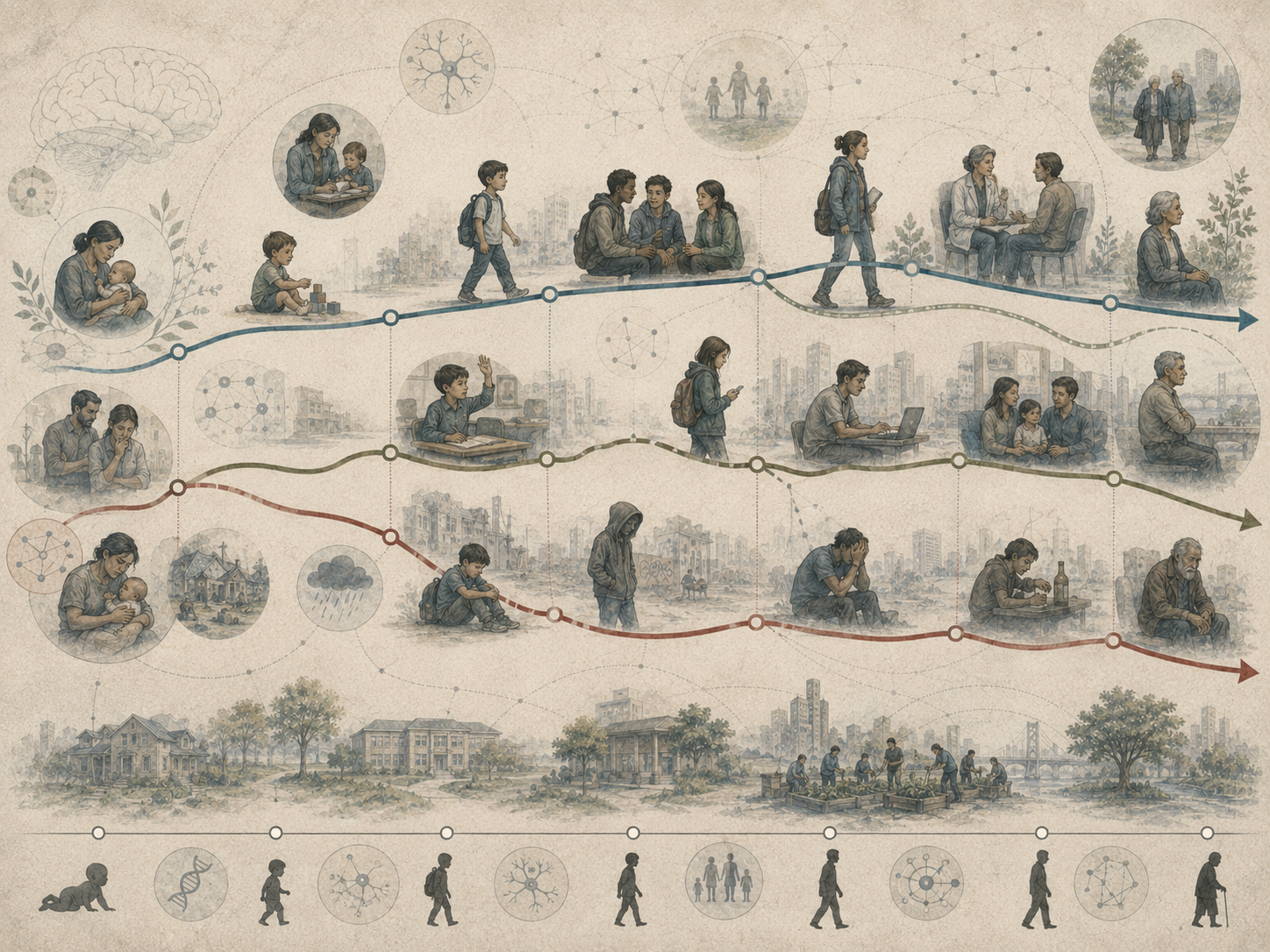
Developmental psychopathology does not reduce people to diagnoses. It studies pathways. A child may show anxiety, aggression, withdrawal, impulsivity, trauma response, sadness, rigidity, dissociation, or school refusal, but those patterns are not self-explanatory. They have histories. They may be shaped by temperament, caregiving, neurodevelopment, adversity, peer life, school systems, culture, social inequality, sleep, health, institutional treatment, and the availability or absence of trustworthy support. The question is not only what symptoms are present, but how they became organized and what conditions might redirect them.
Why Developmental Psychopathology Matters
Developmental psychopathology matters because psychological difficulties do not appear fully formed outside the life course. Emotional dysregulation, anxiety, depression, aggression, trauma response, dissociation, social withdrawal, compulsive behavior, and disruptive conduct emerge through development. They are shaped by age, timing, temperament, caregiving, family systems, peer life, schooling, adversity, culture, biology, institutional response, and opportunity. A child’s difficulty is not simply a smaller version of an adult disorder. It is part of a developing system.
This perspective matters scientifically because it shifts attention from static categories to pathways. A symptom observed at age six may have a different function than a similar behavior observed at age sixteen. Irritability may reflect sleep deprivation, fear, depressive distress, neurodevelopmental difficulty, trauma, family stress, school exclusion, or a combination of several processes. Developmental psychopathology asks how such patterns become organized over time and what conditions sustain, intensify, or reduce them.
It also matters ethically because it makes it harder to blame individuals for outcomes produced through accumulated risk, exclusion, trauma, instability, deprivation, or inadequate support. A developmental account does not deny responsibility or agency. It situates both within a wider ecology. It asks what the person has had to adapt to, what supports were available, what systems failed, and what opportunities for repair remain possible.
The framework is especially important because it holds competence and suffering in the same field of view. A child may be struggling and adapting at the same time. A behavior may be maladaptive in one setting while having developed as a survival response in another. A young person may show resilience in school while carrying significant distress in private. Developmental psychopathology is powerful because it studies these tensions without reducing the person to either deficit or triumph.
What Developmental Psychopathology Is
Developmental psychopathology is an interdisciplinary framework for understanding psychological disorder, maladaptation, resilience, and recovery through developmental process. It draws from developmental psychology, clinical psychology, psychiatry, neuroscience, family systems, education, public health, social work, epidemiology, genetics, sociology, and prevention science. Its basic question is not only “What disorder is present?” but “How did this pattern of functioning develop, and how might it change?”
The field examines how biological, psychological, relational, and ecological factors interact over time to shape outcomes ranging from healthy functioning to serious impairment. It asks how symptoms emerge, why some children recover while others do not, how adversity interacts with temperament and caregiving, why similar risks produce different outcomes, and how adaptation remains possible under burden.
Developmental psychopathology is not limited to childhood diagnosis. It is equally concerned with competence, resilience, prevention, recovery, and pathways of adaptation. It studies the emergence of disorder, but it also studies why disorder does not emerge despite substantial risk. It examines impairment, but it also examines protection. In that sense, it is not simply the study of pathology in developing people. It is the study of development under risk, stress, vulnerability, and support.
This distinction matters because diagnosis can name patterns, but it rarely explains their developmental history. A diagnostic label may describe current symptoms, guide treatment, and support access to services. But it does not by itself explain why a particular person developed that pattern, why it appeared when it did, why it takes that form, or what conditions might redirect it. Developmental psychopathology provides the broader process framework.
Developmental Psychopathology as a Systems Framework
Developmental psychopathology is fundamentally a systems framework. It assumes that mental health and difficulty emerge through interactions among multiple levels: genes, neurobiology, temperament, physiology, attachment, family relationships, peers, schools, neighborhoods, culture, poverty, discrimination, health care, and public institutions. No single level is sufficient by itself.
This does not mean every factor matters equally in every case. Some developmental pathways may be strongly shaped by genetic vulnerability, neurodevelopmental difference, trauma exposure, caregiving disruption, peer rejection, school exclusion, or chronic stress. But developmental psychopathology resists explanations that isolate one factor and treat it as the whole story. The same child is biological, relational, institutional, and historical at once.
A systems view also means that adaptation is organized across levels. A child’s emotion regulation may depend on sleep, neurodevelopment, caregiver co-regulation, classroom expectations, nutrition, trauma history, peer relationships, and cultural norms about expression. A young person’s depression may be shaped by temperament, family conflict, identity formation, social media, discrimination, academic pressure, sleep disruption, loneliness, and inherited vulnerability. Developmental systems are layered.
The systems approach is especially useful because it avoids the false choice between individual and social explanation. Developmental psychopathology can take biology seriously without becoming biologically reductionist. It can take adversity seriously without denying temperament. It can take diagnosis seriously without reducing persons to labels. It can take resilience seriously without pretending context does not matter.
Risk, Resilience, and Adaptation
Risk refers to conditions associated with a greater likelihood of negative developmental outcomes. Resilience refers to positive adaptation despite adversity or substantial risk exposure. Adaptation is the broader category that holds both together: it concerns how a person manages demands, constraints, threats, supports, opportunities, and developmental tasks across time.
A central insight of developmental psychopathology is that risk does not guarantee dysfunction, and resilience does not mean invulnerability. A child exposed to adversity may struggle in one domain and function well in another. Another child may show little outward difficulty at first but develop problems later. A third may experience significant risk but remain relatively well supported by stable caregiving, school belonging, extended family, cultural continuity, or community resources.
Risk is probabilistic, not deterministic. It changes the odds, but it does not dictate the outcome. Resilience is also dynamic, not fixed. It is not a permanent trait that some people simply possess. It often depends on relationships, timing, resources, opportunity, meaning, identity, culture, and institutional response. A person may be resilient in childhood but struggle in adolescence, or struggle early and recover later under better conditions.
This is why developmental psychopathology studies pathways rather than simple categories. It asks how risk accumulates, how protection enters, when support matters most, and why adaptation varies across developmental domains. A child may be academically resilient but socially isolated. An adolescent may function well at school but suffer privately. A family may protect one domain while another remains vulnerable. Risk, resilience, and adaptation are multidimensional.
Developmental Pathways and Timing
Timing matters because development is cumulative without being mechanically fixed. Experiences have different meanings depending on when they occur and what developmental systems are already in place. Early neglect, middle-childhood peer victimization, adolescent trauma, identity-based exclusion, family instability, or prolonged uncertainty may each shape development differently because the organism, the social world, and the developmental task are changing.
Early childhood difficulties often involve caregiving, attachment, sleep, language, sensory regulation, and emerging self-control. Middle childhood brings schooling, peer comparison, competence, rule systems, and widening social worlds. Adolescence reorganizes identity, autonomy, sexuality, peer recognition, future orientation, and risk. Adulthood introduces work, intimacy, caregiving, health, and social participation. A similar form of distress may therefore carry different developmental meaning across ages.
Developmental psychopathology is interested in sequence. A problem observed at one moment may be the product of earlier pathways. Early regulation difficulties may shape peer relations. Peer rejection may shape self-concept. School exclusion may shape behavior, motivation, and institutional trust. Family adversity may shape sleep and attention, which then shape academic functioning, which then shapes identity and opportunity. Developmental pathways are chains of influence, feedback, and adaptation.
Timing also matters for intervention. Support delivered early may prevent risk from compounding. Support delivered during school transitions may protect belonging. Support delivered during adolescence may alter identity and future expectation. Support delivered in adulthood may reduce intergenerational transmission. Developmental psychopathology is therefore not only a theory of disorder. It is also a framework for prevention and redirection.
Multifinality and Equifinality
Two of the most important concepts in developmental psychopathology are multifinality and equifinality. Multifinality means that similar early conditions can lead to different later outcomes. Equifinality means that different early conditions can lead to similar later outcomes. Together, they challenge simple cause-and-effect thinking.
Multifinality is visible when children exposed to similar adversity develop along different pathways. One child may show depression, another aggression, another school disengagement, another high achievement with hidden anxiety, and another relatively stable functioning. The initial risk may be similar, but the later pathways diverge because of temperament, caregiving, timing, support, meaning, health, school experience, peer relationships, and opportunity.
Equifinality is visible when different histories converge on similar outcomes. Depression, anxiety, self-harm, disruptive behavior, or school refusal may emerge from many developmental routes. One young person may become depressed after peer rejection, another after bereavement, another through chronic family conflict, another through genetic vulnerability and sleep disruption, another through discrimination and isolation. A shared symptom does not imply a single origin.
These concepts matter because they prevent developmental science from assuming that one cause produces one result or that one symptom has one explanation. They also make clinical and educational practice more careful. A behavior should not be interpreted only at face value. It may be the endpoint of several possible pathways, and it may open into several possible futures.
\text{Multifinality: } K_0 \rightarrow \{O_1, O_2, O_3, \ldots\}
\]
Interpretation: One early risk condition \(K_0\) can branch into multiple later outcomes depending on support, timing, context, biology, and subsequent experience.
\text{Equifinality: } \{K_1, K_2, K_3, \ldots\} \rightarrow O
\]
Interpretation: Different developmental histories can converge on a similar later outcome \(O\), which is why symptoms require developmental interpretation rather than simple origin stories.
Continuity, Discontinuity, and Turning Points
Developmental psychopathology studies both continuity and discontinuity. Some difficulties persist across time, changing form while maintaining an underlying pattern. A child with early regulation problems may later show peer conflict, academic trouble, oppositional behavior, anxiety, or depressive symptoms. This does not mean the outcome was inevitable. It means early patterns can become linked to later developmental demands.
Discontinuity is equally important. Some children show early difficulty and later improve. Others appear stable early and struggle later. Transitions can change pathways: school entry, puberty, migration, family separation, parental illness, bereavement, peer rejection, therapy, mentoring, removal from danger, stable housing, or entry into a supportive school can alter developmental trajectories. Development is not simply the unfolding of what was already there.
Turning points matter because they show that developmental pathways remain open to change. A trusted adult, a safer placement, a new diagnosis, a supportive school, a strong peer relationship, medication, therapy, cultural reconnection, economic stability, or meaningful achievement can redirect a pathway. Conversely, exclusion, punishment, untreated trauma, institutional disbelief, or repeated humiliation can intensify risk.
This is why developmental psychopathology is not fatalistic. It takes early risk seriously without treating early life as destiny. It understands continuity without denying redirection. It studies how people become more burdened, but also how they recover, compensate, reorganize, and find new developmental possibilities.
Risk and Protective Factors
Risk and protective factors operate across multiple levels of life. Individual characteristics matter, but so do relationships, families, schools, neighborhoods, communities, cultures, institutions, and public policy. Protective factors such as stable caregiving, trusted adults, school belonging, community support, access to care, predictable routines, safe housing, peer inclusion, and opportunities for competence can buffer adversity. Risk factors such as violence exposure, chronic instability, family strain, exclusion, discrimination, untreated health needs, and lack of support can intensify developmental burden.
This layered model matters because no child or adolescent develops in isolation. Psychological outcomes are often overexplained by internal traits and underexplained by ecology. A child’s impulsivity may be related to neurodevelopmental difference, but also to sleep, trauma, school fit, nutrition, caregiver stress, peer conflict, and classroom expectations. A teenager’s depression may involve neurobiology and temperament, but also loneliness, discrimination, academic pressure, family conflict, identity threat, and limited access to care.
Protective factors should not be understood as simple “positive variables” added to a risk equation. Their meaning depends on context. A supportive teacher may matter especially for a child with family instability. A stable caregiver may buffer community violence. Peer belonging may reduce the developmental impact of school stress. Cultural continuity may protect identity under migration or discrimination. Protection often works through relationships, meaning, and systems.
Risk and protection can also interact. A high-risk environment may reduce access to protective factors. A strong protective ecology may reduce the likelihood that risk becomes impairment. Developmental psychopathology therefore studies not only whether risk and protection are present, but how they combine, accumulate, and shift over time.
Biological Vulnerability and Developmental Plasticity
Biology matters in developmental psychopathology, but not as a closed fate. Temperament, genetic vulnerability, neurodevelopment, stress physiology, sleep, sensory processing, executive function, hormonal change, immune function, and brain development can all influence adaptation and maladaptation. Some children may be more sensitive to stress, novelty, threat, punishment, rejection, or inconsistent caregiving. Others may show different patterns of reactivity, inhibition, impulsivity, or regulation.
Developmental psychopathology treats biological vulnerability as embedded in context. A highly reactive temperament may become a risk factor in a harsh, unpredictable, or shaming environment, but may be manageable or even adaptive in a responsive and structured environment. Neurodevelopmental difference may produce impairment under rigid institutional demands but become more supported under accommodations, understanding, and better environmental fit.
Plasticity is central. The same openness that makes developing systems vulnerable can also make them responsive to support. Children can be harmed by chronic stress, but they can also benefit from stable caregiving, early intervention, therapy, school accommodations, health care, and improved safety. Biological sensitivity should not be interpreted only as fragility. It may also indicate responsiveness to context.
This framing avoids two errors. The first is biological determinism: treating mental health outcomes as fixed inside the individual. The second is social reductionism: ignoring temperament, neurodevelopment, physiology, and inherited vulnerability. Developmental psychopathology requires both biology and context because development is always embodied and situated.
Relationships, Care, and Regulation
Relationships are central because regulation is often interpersonal before it becomes internal. Infants and children learn to manage arousal, fear, frustration, attention, and recovery through repeated interactions with caregivers and other trusted adults. Supportive caregiving, stable routines, predictable responses, emotional availability, and repair after conflict can reduce risk and strengthen adaptation. Conversely, chaotic, harsh, neglectful, frightening, or inconsistent relationships can destabilize regulation and amplify vulnerability.
This does not mean caregivers are sole causes of psychological outcomes. It means relational systems are powerful developmental pathways. Caregivers themselves live within stress, work demands, housing conditions, health burdens, trauma histories, discrimination, family networks, and institutional systems. A caregiver’s capacity to provide stability is shaped by the support available to the caregiver.
Care relationships also shape how children interpret distress. A child learns whether fear brings comfort, punishment, ridicule, silence, or abandonment. A young person learns whether asking for help is safe. A family system teaches whether emotion can be named, whether conflict can be repaired, and whether vulnerability is met with protection. These relational lessons become part of later adaptation.
Developmental psychopathology therefore treats attachment, caregiving, co-regulation, family climate, and relational repair as core mechanisms in risk and resilience. It asks not only whether a child has symptoms, but whether the child has relationships capable of helping those symptoms change.
Adversity, Trauma, and Psychological Development
Adversity and trauma are among the clearest areas where developmental psychopathology demonstrates its value. Stressful or traumatic experiences can alter emotion regulation, attention, behavior, social trust, physiological arousal, sleep, learning, and expectations about safety and support. Yet responses to trauma vary. Some children show acute symptoms and later recover. Some display delayed difficulty. Some continue to function relatively well under strong support. Some appear outwardly competent while carrying hidden distress.
Trauma cannot be understood apart from development. A child’s response depends partly on age, caregiving, prior regulation, meaning, culture, institutional response, and what resources are available after the event. A frightening event followed by protection and stable care has a different developmental meaning from a frightening event followed by disbelief, further danger, displacement, punishment, or silence.
Adversity is also cumulative. Chronic poverty, housing instability, family conflict, peer victimization, discrimination, community violence, neglect, and school exclusion can interact. Developmental psychopathology asks how risk becomes layered and how one difficulty can create vulnerability to another. It also asks how protection can interrupt that layering before it becomes more entrenched.
This framework is especially important because trauma-related behavior is often misread. Hypervigilance may look like distractibility. Avoidance may look like defiance. Shutdown may look like disengagement. Aggression may be a response to perceived threat. Developmental psychopathology does not excuse harmful behavior, but it asks what developmental history gives the behavior its meaning and what forms of support can change the pathway.
Internalizing, Externalizing, and Developmental Expression
Psychological distress is often described through broad categories such as internalizing and externalizing problems. Internalizing difficulties include patterns such as anxiety, depression, withdrawal, fear, shame, rumination, and somatic distress. Externalizing difficulties include patterns such as aggression, impulsivity, rule-breaking, defiance, and disruptive conduct. These categories can be useful, but developmental psychopathology treats them as expressions of pathways rather than fixed identities.
A child may internalize distress because fear, shame, sadness, or self-blame becomes the dominant adaptation. Another may externalize distress because arousal, anger, threat expectation, or poor regulation becomes more visible. Some children show both. Externalizing behavior may conceal anxiety or trauma. Internalizing distress may follow years of social rejection or family instability. The categories describe patterns, but they do not explain them by themselves.
Developmental expression changes with age. Anxiety in early childhood may appear as clinging, sleep difficulty, stomachaches, tantrums, or separation distress. Adolescent depression may appear as irritability, withdrawal, risk-taking, exhaustion, academic decline, or self-harm. Trauma in children may appear in play, body symptoms, startle, regression, avoidance, aggression, or attention difficulty. Developmental meaning depends on age and context.
This is why developmental psychopathology is cautious about interpreting symptoms outside developmental stage. It asks whether the behavior is developmentally expected, contextually adaptive, clinically concerning, or part of a changing pathway. It also asks what functions the behavior serves: avoiding shame, managing arousal, seeking control, preserving attachment, escaping threat, or communicating distress when language is unavailable.
Resilience Without Romanticizing Suffering
Resilience is essential to developmental psychopathology, but it is often misused. It should not be reduced to toughness, silence, self-reliance, or the expectation that individuals endure harmful conditions without complaint. A child who adapts under chronic adversity may be showing remarkable developmental strength, but that does not make the adversity beneficial. Suffering is not justified because someone survives it.
A serious developmental account treats resilience as process, not slogan. It asks what relationships, resources, meanings, opportunities, institutions, and personal capacities make positive adaptation possible under risk. It asks how supportive adults, school belonging, cultural continuity, treatment, safety, and opportunity help redirect developmental pathways. It does not turn resilience into a moral demand placed on the already burdened.
Resilience can also carry cost. A child who appears mature under adversity may be overburdened. A teenager who becomes hyper-independent may struggle to receive care. A young person who performs competence may hide distress. Visible functioning should not be confused with full recovery. Developmental psychopathology asks what adaptation costs and whether the person has room to be supported rather than merely admired for surviving.
The ethical use of resilience language requires two commitments. First, recognize real capacities people develop under difficult conditions. Second, refuse to use those capacities as an excuse for preventable harm. Resilience research is most useful when it identifies protective conditions and pathways to better outcomes, not when it becomes a reason to tolerate unsafe environments.
Inequality, Context, and Developmental Burden
Risk is not distributed equally. Poverty, violence exposure, unstable housing, food insecurity, systemic discrimination, inaccessible care, school exclusion, family strain, environmental hazard, and chronic institutional neglect all shape the ecology in which developmental difficulties emerge. Developmental psychopathology is strongest when it recognizes that many psychological outcomes are not only individual matters but patterned consequences of unequal conditions.
This matters because a child’s symptoms may reflect not only temperament or biology, but also prolonged exposure to instability, humiliation, danger, exclusion, or unmet need. Likewise, resilience may depend partly on whether supportive adults, school structures, therapy, health care, community resources, and material stability are available. Development is not merely what the individual brings to the world. It is also what the world makes possible or impossible.
Inequality also affects recovery. Families with resources may access therapy, stable housing, private space, school accommodations, legal advocacy, and time for care. Families without resources may face waitlists, transportation barriers, job insecurity, eviction risk, punitive systems, and disbelief. The same psychological difficulty can therefore have different developmental consequences depending on whether repair is supported or blocked.
An inequality-aware developmental psychopathology does not deny individual variation. It places individual variation inside unequal opportunity structures. It asks who is exposed to risk, who receives protection, who is punished for distress, who is believed, and who has access to repair. This is essential for preventing psychological science from turning structural harm into private pathology.
Schools, Clinics, and Institutional Response
Developmental psychopathology has direct implications for schools, clinics, child welfare systems, juvenile justice systems, community services, and public health. Institutions can either recognize developmental pathways or flatten people into labels. A school can interpret dysregulation as willful defiance alone, or it can ask what regulation supports, boundaries, accommodations, and relationships are needed. A clinic can treat diagnosis as the whole explanation, or it can examine history, context, development, and support.
Schools are especially important because children spend much of development inside educational institutions. School belonging can be protective. School exclusion can intensify risk. A child who is suspended repeatedly for trauma-related or neurodevelopmental behavior may become more disconnected, more ashamed, more oppositional, and less likely to trust adults. A child who receives structure, accountability, care, and accommodations may remain connected to learning and support.
Clinical practice also benefits from a developmental psychopathology lens. Symptoms should be understood in relation to age, history, family, trauma, neurodevelopment, culture, and environment. Treatment should ask not only how to reduce symptoms, but how to strengthen developmental capacities: regulation, trust, safety, competence, relationships, identity, meaning, and participation. Intervention is not only symptom management. It is pathway redirection.
Institutions need humility. They can become part of the risk ecology when they shame, exclude, misdiagnose, overpolice, under-support, or ignore context. They can become part of the protective ecology when they provide safety, continuity, recognition, care, structure, and access to resources. Developmental psychopathology makes institutional response part of the developmental pathway rather than an external afterthought.
Developmental Psychopathology Across the Life Course
Although developmental psychopathology is often associated with childhood and adolescence, its logic extends across the life course. Adult mental health is shaped by earlier development, but it is also shaped by adult experiences: work, intimacy, parenting, caregiving, illness, trauma, loss, migration, disability, discrimination, and aging. Psychological difficulty remains developmental because life continues to reorganize demands and supports.
Childhood risk may reappear in adulthood under new conditions. Parenting may activate earlier attachment histories. Intimacy may activate fears of abandonment or betrayal. Work authority may activate shame or threat. Illness may alter identity and regulation. Later-life loss may interact with earlier trauma. A life-course view asks how earlier patterns are carried, transformed, or repaired in later stages.
Adulthood also contains turning points. Therapy, stable relationships, community belonging, meaningful work, medication, recovery from addiction, cultural reconnection, spiritual practice, and improved material stability can alter pathways. Later support can matter even when earlier risk was substantial. Developmental psychopathology therefore avoids the idea that childhood determines everything.
At the same time, early conditions should not be minimized. Developmental histories shape later vulnerability and possibility. The life-course perspective holds both truths: early experience matters deeply, and later development remains open to change. Psychological difficulty is not a fixed line from childhood to adulthood. It is a pathway continually shaped by new conditions.
Beyond Diagnosis: Developmental Psychopathology as Process
Diagnosis can be useful. It can support communication, research, treatment planning, insurance access, and recognition of suffering. But developmental psychopathology goes further. It asks how symptoms change, what functions they may serve, what developmental tasks are disrupted, what protective factors are missing, and how trajectories might be redirected.
This process orientation is one of the field’s greatest strengths because it prevents diagnostic labels from becoming complete explanations. A child is not only anxious, oppositional, traumatized, depressed, inattentive, or dysregulated. That child is developing through a specific biological, relational, cultural, and ecological history. A diagnosis may describe a pattern, but the developmental history explains how the pattern became meaningful and what might change it.
Developmental psychopathology also resists rigid divisions between normal and abnormal. Many forms of distress exist on continuums. Some behaviors are developmentally expected at one age and concerning at another. Some symptoms are understandable adaptations to difficult contexts. Some impairments arise from a mismatch between a person’s needs and an environment’s demands. The field asks where development is flexible, where it is constrained, and where intervention can help.
In this sense, developmental psychopathology is one of the richest frameworks for understanding psychological difficulty as lived process. It does not deny disorder. It deepens the account of disorder by placing it within time, relationship, body, context, and possibility.
An Analytical Framework for Risk, Resilience, and Adaptation
A stylized developmental outcome \(D_{it}\) for individual \(i\) at time \(t\) can be written as a function of risk, protection, relational support, and residual variation:
D_{it} = \alpha_i – \beta K_{it} + \gamma R_{it} + \delta P_{it} + \varepsilon_{it}
\]
Interpretation: Developmental adaptation depends on accumulated risk or adversity \(K_{it}\), resilience or protective process \(R_{it}\), positive relational or ecological support \(P_{it}\), individual baseline differences \(\alpha_i\), and residual variation \(\varepsilon_{it}\).
To represent timing, we can add a developmental sensitivity term:
D_{it} = \alpha_i – \beta K_{it} + \gamma R_{it} + \delta P_{it} + \theta T_{it} + \varepsilon_{it}
\]
Interpretation: The same risk may have different consequences depending on developmental timing \(T_{it}\). Risk during one period may not mean the same thing as risk during another.
A dynamic version includes prior developmental state:
D_{it} = \rho D_{i,t-1} – \beta K_{it} + \gamma R_{it} + \delta P_{it} + \varepsilon_{it}
\]
Interpretation: Current adaptation often depends partly on earlier adaptation. Developmental continuity matters, but current risk and protection can still redirect the pathway.
To model buffering, protection can be represented as moderating risk:
D_{it} = \alpha_i – \beta K_{it} + \gamma P_{it} + \lambda(K_{it} \times P_{it}) + \varepsilon_{it}
\]
Interpretation: The interaction term \(K_{it} \times P_{it}\) captures the idea that support may change the developmental effect of risk.
A multilevel version is often more realistic because risk and protection are distributed across families, schools, neighborhoods, communities, and institutions:
D_{ijt} = \alpha + u_j – \beta K_{ijt} + \gamma R_{ijt} + \delta P_{ijt} + \varepsilon_{ijt}
\]
Interpretation: The term \(u_j\) captures shared context-level influence. Developmental psychopathology is not only individual; it is organized through systems.
To express multifinality and equifinality in simplified form:
\{O_{it}^{(1)}, O_{it}^{(2)}, O_{it}^{(3)}\} = f(K_{i,t-1}, R_{i,t-1}, P_{i,t-1}, C_{i,t-1})
\]
Interpretation: Similar early conditions can branch into multiple later outcomes, while different earlier configurations can converge on similar outcomes. Developmental pathways are probabilistic and contingent.
These equations are simplified, but they clarify the field’s central argument: adaptation and maladaptation emerge through time, context, biology, relationship, support, risk, and opportunity. Diagnosis names a pattern; developmental psychopathology studies the pathway.
R: Simulating Risk, Protective Factors, and Developmental Trajectories
The following R example simulates children across repeated waves with accumulated risk, protective support, caregiver stability, baseline regulation, community support, and context-level variation shaping developmental adaptation. The data are synthetic and intended for demonstration.
# Simulating risk, protective factors, and developmental trajectories
# ------------------------------------------------------------------
# This example creates synthetic repeated-observation data to show how
# risk, support, regulation, caregiver stability, and community context
# can shape developmental adaptation over time.

suppressPackageStartupMessages({
  library(dplyr)
  library(lme4)
  library(ggplot2)
})

set.seed(2026)

n_children <- 820
n_waves <- 9
n_contexts <- 34

children <- data.frame(
  child_id = 1:n_children,
  context_id = sample(1:n_contexts, n_children, replace = TRUE),
  baseline_regulation = rnorm(n_children, 0, 1),
  protective_support = rnorm(n_children, 0, 1),
  accumulated_risk = rnorm(n_children, 0, 1),
  caregiver_stability = rnorm(n_children, 0, 1),
  biological_sensitivity = rnorm(n_children, 0, 0.7)
)

context_df <- data.frame(
  context_id = 1:n_contexts,
  community_support = rnorm(n_contexts, 0, 0.6),
  school_belonging = rnorm(n_contexts, 0, 0.6),
  service_access = rnorm(n_contexts, 0, 0.5)
)

panel_data <- children |>
  slice(rep(1:n(), each = n_waves)) |>
  group_by(child_id) |>
  mutate(
    wave = 0:(n_waves - 1),
    timing_weight = exp(-0.16 * wave),
    transition_weight = exp(-((wave - 5)^2) / (2 * 1.5^2)),
    current_support = rnorm(n_waves, mean = protective_support, sd = 0.55),
    current_risk = rnorm(n_waves, mean = accumulated_risk, sd = 0.65),
    current_stability = rnorm(n_waves, mean = caregiver_stability, sd = 0.55),
    current_regulation = rnorm(n_waves, mean = baseline_regulation, sd = 0.50)
  ) |>
  ungroup() |>
  left_join(context_df, by = "context_id") |>
  arrange(child_id, wave)

panel_data <- panel_data |>
  mutate(
    weighted_risk = current_risk * timing_weight,
    transition_support = current_support * transition_weight
  ) |>
  group_by(child_id) |>
  mutate(
    cumulative_risk = cumsum(weighted_risk),
    cumulative_support = cumsum(current_support)
  ) |>
  ungroup()

panel_data <- panel_data |>
  mutate(
    adaptation_score =
      50 +
      0.65 * wave +
      0.80 * current_regulation +
      1.15 * current_support +
      1.05 * current_stability +
      0.85 * community_support +
      0.75 * school_belonging +
      0.65 * service_access +
      0.70 * transition_support -
      0.95 * cumulative_risk -
      1.15 * current_risk * timing_weight +
      0.60 * biological_sensitivity * current_support +
      0.70 * current_support * current_stability +
      rnorm(n(), 0, 2.4)
  )

model <- lmer(
  adaptation_score ~ wave + current_regulation + current_support +
    current_stability + current_risk + cumulative_risk +
    community_support + school_belonging + service_access +
    transition_support + biological_sensitivity +
    current_support:current_stability +
    (1 + wave | context_id/child_id),
  data = panel_data
)

summary(model)

trajectory_summary <- panel_data |>
  group_by(wave) |>
  summarize(
    mean_adaptation = mean(adaptation_score),
    standard_error = sd(adaptation_score) / sqrt(n()),
    lower = mean_adaptation - 1.96 * standard_error,
    upper = mean_adaptation + 1.96 * standard_error,
    .groups = "drop"
  )

ggplot(trajectory_summary, aes(x = wave, y = mean_adaptation)) +
  geom_line(linewidth = 1) +
  geom_ribbon(aes(ymin = lower, ymax = upper), alpha = 0.15) +
  labs(
    title = "Simulated Developmental Psychopathology Trajectories",
    x = "Wave",
    y = "Average adaptation score"
  ) +
  theme_minimal()

profile_summary <- panel_data |>
  group_by(child_id) |>
  summarize(
    average_risk = mean(current_risk),
    average_support = mean(current_support),
    average_stability = mean(current_stability),
    final_score = adaptation_score[wave == max(wave)],
    .groups = "drop"
  ) |>
  mutate(
    risk_support_profile = case_when(
      average_risk < 0 & average_support >= 0 ~ "lower risk / higher support",
      average_risk >= 0 & average_support >= 0 ~ "higher risk / higher support",
      average_risk < 0 & average_support < 0 ~ "lower risk / lower support",
      TRUE ~ "higher risk / lower support"
    )
  )

ggplot(
  profile_summary,
  aes(x = risk_support_profile, y = final_score)
) +
  geom_boxplot() +
  coord_flip() +
  labs(
    title = "Synthetic Final Adaptation Scores by Risk-Support Profile",
    x = "Risk-support profile",
    y = "Final adaptation score"
  ) +
  theme_minimal()

# Analysts can extend this model by:
# 1. separating internalizing and externalizing outcomes;
# 2. adding trauma timing and recurrence;
# 3. modeling family and school supports separately;
# 4. simulating intervention after acute stress;
# 5. estimating subgroup differences in protective effects;
# 6. adding diagnostic thresholds as descriptive—not deterministic—outcomes.
This R workflow treats adaptation as a developmental trajectory shaped by risk, protection, timing, relationships, biological sensitivity, and context. It is useful as a conceptual scaffold, not as a clinical prediction model.
Python: Modeling Risk, Resilience, and Adaptation Over Time
The following Python example simulates developmental change over time with accumulated risk, protective support, caregiver stability, school belonging, community support, service access, and dynamic dependence on prior adaptation.
# Modeling risk, resilience, and adaptation over time
# --------------------------------------------------
# This example creates synthetic longitudinal data to demonstrate how
# accumulated risk, protective support, caregiver stability, community support,
# school belonging, and service access can shape developmental adaptation.

from __future__ import annotations

import numpy as np
import pandas as pd
import statsmodels.formula.api as smf
import matplotlib.pyplot as plt

np.random.seed(2026)

n_children = 850
n_periods = 10
n_contexts = 36

children = pd.DataFrame({
    "child_id": np.arange(1, n_children + 1),
    "context_id": np.random.choice(np.arange(1, n_contexts + 1), size=n_children),
    "baseline_regulation": np.random.normal(0, 1, n_children),
    "protective_support": np.random.normal(0, 1, n_children),
    "accumulated_risk": np.random.normal(0, 1, n_children),
    "caregiver_stability": np.random.normal(0, 1, n_children),
    "biological_sensitivity": np.random.normal(0, 0.7, n_children),
})

context_df = pd.DataFrame({
    "context_id": np.arange(1, n_contexts + 1),
    "community_support": np.random.normal(0, 0.6, n_contexts),
    "school_belonging": np.random.normal(0, 0.6, n_contexts),
    "service_access": np.random.normal(0, 0.5, n_contexts),
})

panel = children.loc[children.index.repeat(n_periods)].copy()
panel["time"] = np.tile(np.arange(n_periods), n_children)

panel["timing_weight"] = np.exp(-0.16 * panel["time"])
panel["transition_weight"] = np.exp(-((panel["time"] - 6) ** 2) / (2 * 1.8 ** 2))

panel = panel.merge(context_df, on="context_id", how="left")

panel["current_support"] = np.random.normal(
    panel["protective_support"],
    0.60,
    len(panel),
)

panel["current_risk"] = np.random.normal(
    panel["accumulated_risk"],
    0.70,
    len(panel),
)

panel["current_stability"] = np.random.normal(
    panel["caregiver_stability"],
    0.60,
    len(panel),
)

panel["current_regulation"] = np.random.normal(
    panel["baseline_regulation"],
    0.55,
    len(panel),
)

panel = panel.sort_values(["child_id", "time"]).reset_index(drop=True)

panel["weighted_risk"] = panel["current_risk"] * panel["timing_weight"]
panel["transition_support"] = panel["current_support"] * panel["transition_weight"]

panel["cumulative_risk"] = panel.groupby("child_id")["weighted_risk"].cumsum()
panel["cumulative_support"] = panel.groupby("child_id")["current_support"].cumsum()

panel["adaptation_score"] = np.nan

for child_id in panel["child_id"].unique():
    subset = panel.loc[panel["child_id"] == child_id].copy()
    previous_score = 50 + np.random.normal(0, 3)

    for idx in subset.index:
        time = panel.at[idx, "time"]
        regulation = panel.at[idx, "current_regulation"]
        support = panel.at[idx, "current_support"]
        risk = panel.at[idx, "current_risk"]
        stability = panel.at[idx, "current_stability"]
        community = panel.at[idx, "community_support"]
        school = panel.at[idx, "school_belonging"]
        services = panel.at[idx, "service_access"]
        timing = panel.at[idx, "timing_weight"]
        cumulative_risk = panel.at[idx, "cumulative_risk"]
        transition_support = panel.at[idx, "transition_support"]
        sensitivity = panel.at[idx, "biological_sensitivity"]

        current_score = (
            0.70 * previous_score
            + 0.20 * time
            + 0.75 * regulation
            + 1.10 * support
            + 1.00 * stability
            + 0.85 * community
            + 0.75 * school
            + 0.65 * services
            + 0.70 * transition_support
            - 0.85 * cumulative_risk
            - 1.10 * risk * timing
            + 0.60 * sensitivity * support
            + 0.75 * support * stability
            + np.random.normal(0, 2.3)
        )

        panel.at[idx, "adaptation_score"] = current_score
        previous_score = current_score

panel["lag_score"] = panel.groupby("child_id")["adaptation_score"].shift(1)
regression_data = panel.dropna(subset=["lag_score"]).copy()

model = smf.ols(
    formula="""
    adaptation_score ~ lag_score + time + current_regulation +
    current_support + current_risk + cumulative_risk +
    current_stability + community_support + school_belonging +
    service_access + transition_support + biological_sensitivity +
    current_support:current_stability
    """,
    data=regression_data,
).fit(cov_type="HC3")

print(model.summary())

trajectory = panel.groupby("time", as_index=False).agg(
    average_adaptation=("adaptation_score", "mean"),
    standard_error=("adaptation_score", lambda x: x.std() / np.sqrt(len(x))),
    average_risk=("current_risk", "mean"),
    average_support=("current_support", "mean"),
    average_stability=("current_stability", "mean"),
)

trajectory["lower"] = trajectory["average_adaptation"] - 1.96 * trajectory["standard_error"]
trajectory["upper"] = trajectory["average_adaptation"] + 1.96 * trajectory["standard_error"]

plt.figure(figsize=(8, 5))
plt.plot(trajectory["time"], trajectory["average_adaptation"], linewidth=2)
plt.fill_between(
    trajectory["time"],
    trajectory["lower"],
    trajectory["upper"],
    alpha=0.2,
)
plt.xlabel("Time")
plt.ylabel("Average adaptation score")
plt.title("Simulated Developmental Psychopathology: Risk, Resilience, and Adaptation")
plt.tight_layout()
plt.show()

child_summary = panel.groupby("child_id", as_index=False).agg(
    average_risk=("current_risk", "mean"),
    average_support=("current_support", "mean"),
    average_stability=("current_stability", "mean"),
    final_score=("adaptation_score", "last"),
)

child_summary["risk_support_profile"] = np.select(
    [
        (child_summary["average_risk"] < 0) & (child_summary["average_support"] >= 0),
        (child_summary["average_risk"] >= 0) & (child_summary["average_support"] >= 0),
        (child_summary["average_risk"] < 0) & (child_summary["average_support"] < 0),
    ],
    [
        "lower risk / higher support",
        "higher risk / higher support",
        "lower risk / lower support",
    ],
    default="higher risk / lower support",
)

profile_summary = child_summary.groupby(
    "risk_support_profile",
    as_index=False,
).agg(
    children=("child_id", "count"),
    average_final_score=("final_score", "mean"),
    average_risk=("average_risk", "mean"),
    average_support=("average_support", "mean"),
    average_stability=("average_stability", "mean"),
)

print(profile_summary)

# Analysts can extend this framework by:
# 1. distinguishing internalizing and externalizing outcomes;
# 2. adding acute trauma versus chronic adversity;
# 3. modeling family, school, and peer systems separately;
# 4. simulating intervention timing;
# 5. comparing protective-factor distributions across contexts;
# 6. treating diagnostic categories as downstream descriptive labels, not causes.
The Python workflow makes the developmental-psychopathology argument computationally explicit: adaptation is dynamic, risk is cumulative, support is contextual, and prior developmental state shapes later functioning. The example is synthetic and should be used as a teaching scaffold, not a clinical model.
GitHub Repository
Complete Code Repository
Access the full companion repository for this article, including reproducible analysis materials and multi-language code workflows for developmental psychopathology, risk and protective factors, resilience processes, timing-sensitive exposure, developmental trajectories, contextual support, and adaptation modeling.
Conclusion
Developmental psychopathology, risk, resilience, and adaptation belong together because psychological difficulty is developmental, not static. Distress, dysregulation, recovery, disorder, and resilience unfold through time, relationships, biology, ecology, culture, institutions, and unequal support. A person’s symptoms are never only symptoms. They are part of a life history and a developmental pathway.
The strongest developmental psychology therefore studies not only what goes wrong, but how pathways diverge, converge, recover, compensate, or become more burdened under different conditions. It asks how early vulnerability becomes later impairment, but also how support prevents impairment from emerging. It studies risk without fatalism and resilience without romanticizing suffering.
In that sense, developmental psychopathology offers one of the field’s most important lessons: adaptation and maladaptation are both part of the developing life course. Understanding either one requires understanding the whole system through which a person grows.
Related Articles
- What Is Developmental Psychology?
- Why Developmental Psychology Matters Today
- Trauma, Adversity, and the Life Course
- Development, Inequality, and the Life Course
- Developmental Systems Theory and the Ecology of Human Growth
- Genes, Environment, and Developmental Plasticity
- Parenting, Family Systems, and Human Development
- Education, Schooling, and Developmental Formation
- Disability, Neurodivergence, and Development
- Developmental Psychology knowledge series
Further Reading
- Cicchetti, D. (2016) ‘Developmental psychopathology’, in Cicchetti, D. (ed.) Developmental Psychopathology. Hoboken, NJ: Wiley. Available at: https://doi.org/10.1002/9781119125556.devpsy101.
- Doom, J.R. and Cicchetti, D. (2021) ‘Advantages of a developmental psychopathology approach to the study of adversity and physical health’, Development and Psychopathology, 33(3), pp. 786–801. Available at: https://pmc.ncbi.nlm.nih.gov/articles/PMC8939899/.
- Luthar, S.S., Cicchetti, D. and Becker, B. (2000) ‘The construct of resilience: A critical evaluation and guidelines for future work’, Child Development, 71(3), pp. 543–562. Available at: https://pmc.ncbi.nlm.nih.gov/articles/PMC1885202/.
- Masten, A.S. (2014) Ordinary Magic: Resilience in Development. New York: Guilford Press. Available at: https://www.guilford.com/books/Ordinary-Magic/Ann-Masten/9781462523719.
- National Institute of Mental Health (n.d.) Child and Adolescent Mental Health. Available at: https://www.nimh.nih.gov/health/topics/child-and-adolescent-mental-health.
- Pollak, S.D. et al. (2015) ‘Developmental psychopathology: Recent advances and future challenges’, World Psychiatry, 14(3), pp. 262–269. Available at: https://pmc.ncbi.nlm.nih.gov/articles/PMC4592638/.
- Rutter, M. (2006) ‘Implications of resilience concepts for scientific understanding’, Annals of the New York Academy of Sciences, 1094, pp. 1–12. Available at: https://doi.org/10.1196/annals.1376.002.
- Sameroff, A.J. (2000) ‘Developmental systems and psychopathology’, Development and Psychopathology, 12(3), pp. 297–312. Available at: https://doi.org/10.1017/S0954579400003035.
- Toth, S.L. and Cicchetti, D. (2013) ‘A developmental psychopathology perspective on child maltreatment’, Child Maltreatment, 18(3), pp. 135–139. Available at: https://pmc.ncbi.nlm.nih.gov/articles/PMC4520222/.
References
- American Psychological Association (n.d.) Developmental Psychology. Available at: https://www.apa.org/education-career/guide/subfields/developmental.
- Centers for Disease Control and Prevention (n.d.) About Children’s Mental Health. Available at: https://www.cdc.gov/children-mental-health/about/index.html.
- Centers for Disease Control and Prevention (n.d.) About Adverse Childhood Experiences. Available at: https://www.cdc.gov/aces/about/index.html.
- Centers for Disease Control and Prevention (n.d.) Risk and Protective Factors. Available at: https://www.cdc.gov/aces/risk-factors/index.html.
- Centers for Disease Control and Prevention (n.d.) Mental Health | Adolescent and School Health. Available at: https://www.cdc.gov/healthy-youth/mental-health/index.html.
- Chen, E. and Bonanno, G.A. (2024) ‘Reflections on resilience’, Perspectives on Psychological Science. Available at: https://pmc.ncbi.nlm.nih.gov/articles/PMC11341778/.
- Cicchetti, D. (2016) ‘Developmental psychopathology’, in Cicchetti, D. (ed.) Developmental Psychopathology. Hoboken, NJ: Wiley. Available at: https://doi.org/10.1002/9781119125556.devpsy101.
- Doom, J.R. and Cicchetti, D. (2021) ‘Advantages of a developmental psychopathology approach to the study of adversity and physical health’, Development and Psychopathology, 33(3), pp. 786–801. Available at: https://pmc.ncbi.nlm.nih.gov/articles/PMC8939899/.
- Luthar, S.S., Cicchetti, D. and Becker, B. (2000) ‘The construct of resilience: A critical evaluation and guidelines for future work’, Child Development, 71(3), pp. 543–562. Available at: https://pmc.ncbi.nlm.nih.gov/articles/PMC1885202/.
- Masten, A.S. (2006) ‘Competence and resilience in development’, Annals of the New York Academy of Sciences, 1094, pp. 13–27. Available at: https://europepmc.org/article/med/17347338.
- Masten, A.S. (2014) Ordinary Magic: Resilience in Development. New York: Guilford Press. Available at: https://www.guilford.com/books/Ordinary-Magic/Ann-Masten/9781462523719.
- National Institute of Mental Health (n.d.) Child and Adolescent Mental Health. Available at: https://www.nimh.nih.gov/health/topics/child-and-adolescent-mental-health.
- National Institute of Mental Health (n.d.) Helping Children and Adolescents Cope With Traumatic Events. Available at: https://www.nimh.nih.gov/health/publications/helping-children-and-adolescents-cope-with-disasters-and-other-traumatic-events.
- Pollak, S.D. et al. (2015) ‘Developmental psychopathology: Recent advances and future challenges’, World Psychiatry, 14(3), pp. 262–269. Available at: https://pmc.ncbi.nlm.nih.gov/articles/PMC4592638/.
- Rutter, M. (2006) ‘Implications of resilience concepts for scientific understanding’, Annals of the New York Academy of Sciences, 1094, pp. 1–12. Available at: https://doi.org/10.1196/annals.1376.002.
- Sameroff, A.J. (2000) ‘Developmental systems and psychopathology’, Development and Psychopathology, 12(3), pp. 297–312. Available at: https://doi.org/10.1017/S0954579400003035.
- Toth, S.L. and Cicchetti, D. (2013) ‘A developmental psychopathology perspective on child maltreatment’, Child Maltreatment, 18(3), pp. 135–139. Available at: https://pmc.ncbi.nlm.nih.gov/articles/PMC4520222/.