
Last Updated August 5, 2026
Planetary boundaries and Doughnut Economics form one of the most important syntheses in contemporary sustainability thought because together they connect Earth-system science, human wellbeing, justice, and economic purpose. The planetary boundaries framework identifies an ecological ceiling: a set of biophysical limits that humanity must not overshoot if it is to avoid destabilizing the Earth system. Doughnut Economics takes that ecological ceiling and places it alongside a social foundation, creating a model in which the challenge is not merely to remain within environmental limits, but to ensure that all people can meet life’s essential needs within them. The result is a shift from asking how humanity can avoid ecological breakdown alone to asking how humanity can flourish within a safe and just space.
This synthesis matters because neither framework is sufficient on its own. Planetary boundaries offers scientific clarity about ecological overshoot, threshold risk, feedbacks, and Earth-system resilience, but in its original form it says less about what a good society should deliver for people. Doughnut Economics supplies that missing social and moral dimension by making explicit that sustainability cannot mean preserving biophysical stability while leaving large populations in deprivation. At the same time, Doughnut Economics depends heavily on the scientific logic of planetary boundaries for its ecological outer ring. It does not replace the boundaries framework. It reinterprets and extends it by situating ecological ceilings within a broader normative project of justice, development, and economic redesign.
Main Library
Publications
Article Map
Planetary Boundaries
Related Article
SDGs Within Boundaries
Related Article
Justice & Inequality
Related Topic
Economic Systems
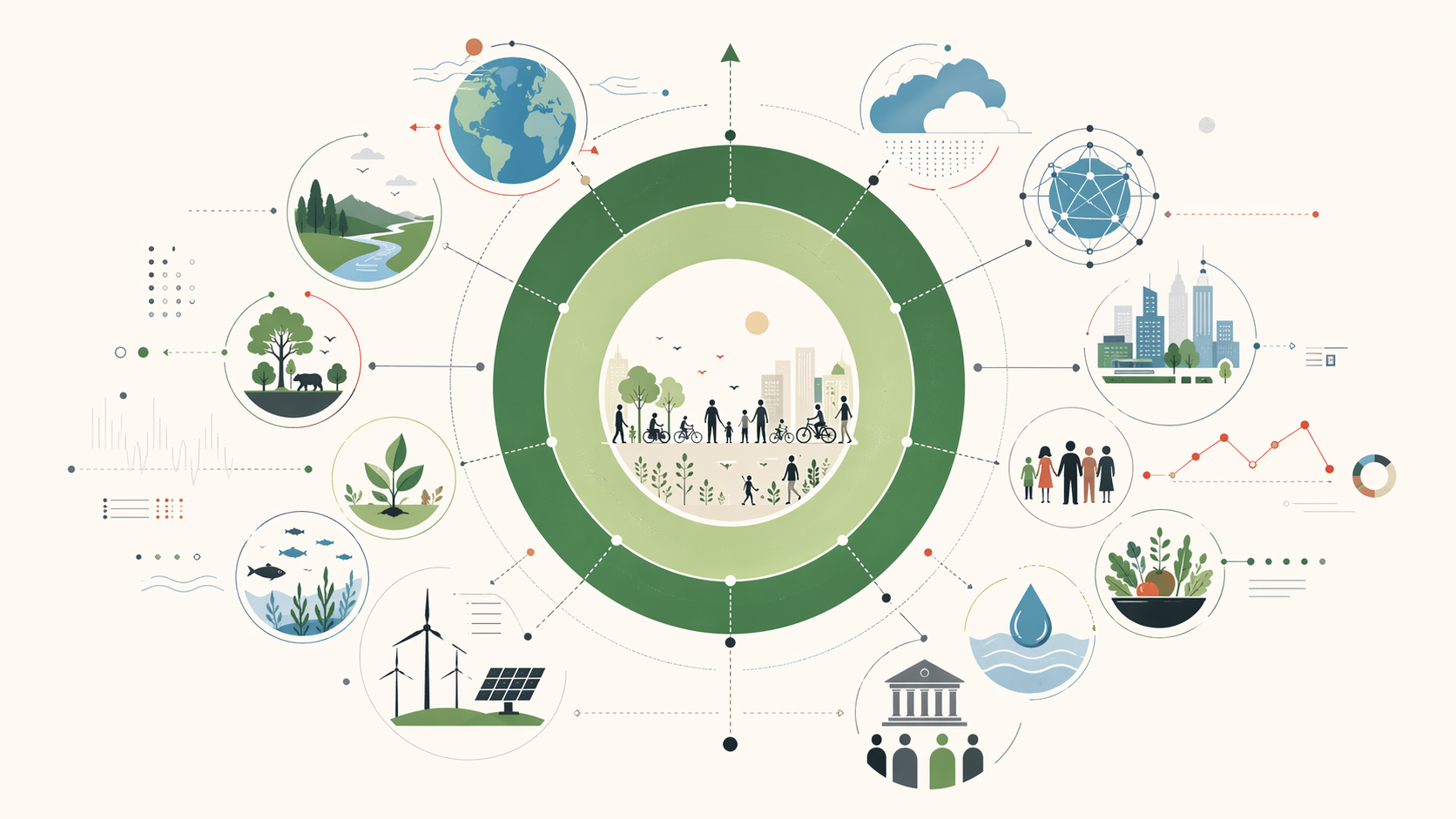
The relationship between the two frameworks is therefore not simply additive. It is structural. Planetary boundaries defines the outer conditions for a stable Earth system. Doughnut Economics defines the inner minimum conditions for human dignity. Between them lies the conceptual space in which twenty-first-century development must be reimagined: not as indefinite growth, not as austerity under ecological constraint, and not as technocratic environmental management detached from justice, but as the redesign of economies so that social foundations can be secured without intensifying planetary overshoot.
This article examines the relationship between planetary boundaries and Doughnut Economics by explaining what each framework contributes, how Doughnut Economics extends the logic of planetary boundaries, why the addition of a social foundation changes the meaning of sustainability, how the two frameworks differ in emphasis and application, why their combination has become influential in cities, business, finance, governance, and political economy, and what it would mean to use the Doughnut as a serious diagnostic framework rather than a decorative sustainability diagram.
What the Planetary Boundaries Framework Contributes
The planetary boundaries framework contributes a scientific account of ecological limits at Earth-system scale. Its central claim is that humanity can only safely develop within a bounded operating space defined by key biophysical processes that regulate the stability and resilience of the Earth system. Rather than treating environmental degradation as a loose accumulation of separate problems, the framework identifies a structured set of interacting pressures linked to climate change, biosphere integrity, land-system change, freshwater change, biogeochemical flows, ocean acidification, stratospheric ozone depletion, atmospheric aerosol loading, and novel entities. This is one of its most important achievements. It turns diffuse environmental concern into a coherent account of systemic overshoot.
That coherence matters because it reorients sustainability away from vague environmental responsibility and toward a more rigorous understanding of planetary conditions. The framework makes visible that ecological crises are not simply local accidents or isolated sectoral failures. They are interconnected expressions of how deeply human activity now affects Earth-system functioning. In that sense, planetary boundaries is not only a warning framework. It is also a conceptual map of the ecological conditions that have historically enabled organized human civilization.
Its power lies partly in what it excludes. It does not begin by asking what level of environmental damage is politically convenient, economically efficient, or institutionally easy to manage. It begins by asking what levels of pressure are compatible with a resilient Earth system. That gives the framework its scientific force. It establishes the ecological outer conditions within which any serious theory of sustainability must operate.
The framework also changes the time horizon of economic and political analysis. Many economic decisions are evaluated through short-term growth, investment, consumption, or electoral cycles. Planetary boundaries introduces a deeper temporal frame. It asks whether contemporary patterns of production and consumption are eroding the long-run biophysical conditions on which future societies will depend. This makes the framework especially important for climate policy, biodiversity protection, land-use planning, food systems, chemical governance, infrastructure finance, and institutional risk management.
In the context of Doughnut Economics, the planetary boundaries framework supplies the ecological ceiling. It defines the outer ring of the Doughnut not as a vague environmental preference, but as a set of Earth-system constraints that reflect the physical conditions of long-term habitability. Without this scientific outer ring, the Doughnut would risk becoming a general metaphor for balance. With it, the model becomes a structured account of human flourishing under biophysical constraint.
That is why planetary boundaries remains indispensable even when the conversation shifts toward economics and justice. It gives the sustainability debate a hard ecological edge: economies are not free-floating systems. They are embedded in a living planet with thresholds, feedbacks, nonlinear risks, and limits to safe disruption.
What Doughnut Economics Adds
Doughnut Economics adds something that the planetary boundaries framework, in its original form, did not foreground strongly enough: a social foundation below which no one should fall. If planetary boundaries provides the outer ecological ceiling, Doughnut Economics supplies an inner ring of minimum social requirements such as food, water, health, education, housing, energy, income, equity, political voice, peace, and social inclusion. This changes the conceptual structure of sustainability. The question is no longer only how to avoid ecological overshoot. It becomes how to meet human needs without overshooting.
This addition is not merely visual or rhetorical. It alters the moral architecture of the debate. A society cannot count as sustainable if it protects planetary systems while leaving large parts of humanity in preventable deprivation. Nor can it count as successful if it raises living standards by intensifying ecological destabilization. Doughnut Economics therefore insists on a dual condition: no one should be pushed below the social foundation, and humanity as a whole should not exceed the ecological ceiling.
That dual condition gives Doughnut Economics a broader public and political appeal. It translates ecological science into a language of human flourishing, fairness, and institutional purpose. It asks what economies are for, not only what they must avoid. In doing so, it extends the boundaries framework from a scientific guardrail model into a more explicitly normative model of development and social design.
The Doughnut also challenges the conventional assumption that economic success should be organized around endless output growth. It does not deny the importance of material provision, investment, innovation, or poverty reduction. Instead, it asks whether economies can be made distributive and regenerative by design. A distributive economy shares value, opportunity, and security more widely. A regenerative economy reduces extraction, waste, pollution, and ecological depletion. Together, these principles point toward an economy that does not treat social justice and ecological resilience as afterthoughts.
Doughnut Economics therefore contributes a theory of economic purpose. It asks economies to serve human wellbeing within the means of the living planet. This is a profound shift because much conventional economic reasoning treats growth, markets, consumption, and productivity as central objectives, while social foundations and ecological ceilings appear as external constraints. The Doughnut reverses that hierarchy. The economy becomes a means; human dignity and planetary stability become the ends.
The model’s strength lies in making that reversal visually and conceptually difficult to ignore. A successful economy is no longer one that expands indefinitely. It is one that brings people out of deprivation without pushing the Earth system into destabilization.
The Safe and Just Space for Humanity
The phrase “safe and just space for humanity” is the conceptual bridge between the two frameworks. “Safe” refers to the ecological outer boundary beyond which Earth-system instability intensifies. “Just” refers to the inner social foundation below which human deprivation becomes unacceptable. The space between the two is where societies are meant to organize their economies, institutions, and forms of development. It is not a utopia free of conflict or trade-offs. It is a structured normative space in which ecological resilience and human dignity are pursued together.
This idea is powerful because it resists two opposite errors that often distort sustainability thinking. The first is the illusion that development can continue indefinitely while treating ecological limits as secondary or negotiable. The second is the notion that ecological responsibility can be pursued in ways that are indifferent to poverty, exclusion, and social need. The safe-and-just space rejects both. It says that sustainability worthy of the name must be both biophysically grounded and socially adequate.
In this respect, Doughnut Economics is more than a communication device layered on top of planetary boundaries. It is a reorganization of the sustainability problem itself. It turns the challenge from one of ecological restraint alone into one of ecological restraint plus social provisioning. That shift has been central to its influence across academic, civic, municipal, and policy contexts.
The safe-and-just space also makes visible that sustainability cannot be reduced to aggregate efficiency. A society may become more efficient while remaining unequal, extractive, or ecologically damaging. Another may reduce certain environmental pressures while deepening social insecurity. The Doughnut requires a fuller diagnostic: where are ecological ceilings being exceeded, where are social foundations unmet, and what institutional changes could reduce both overshoot and shortfall at the same time?
The concept also clarifies why sustainability cannot be understood as a single-axis problem. A country, city, company, or sector can fail by ecological overshoot, by social shortfall, or by both simultaneously. Some places remain below the social foundation while producing relatively low ecological pressure. Others provide high material standards while exceeding ecological ceilings dramatically. Still others combine deprivation with environmental degradation. Each position requires a different strategy.
| Doughnut position | Condition | Strategic implication |
|---|---|---|
| Inside the safe-and-just space | Social foundations are met and ecological ceilings are respected. | Maintain resilience, equity, participation, and long-term stewardship. |
| Social shortfall | Ecological pressure may be low, but basic needs are unmet. | Expand access to health, energy, food, housing, water, education, and voice. |
| Ecological overshoot | Social provision may be strong, but planetary ceilings are exceeded. | Reduce excess throughput, emissions, waste, extraction, land pressure, and pollution. |
| Double failure | Social foundations are unmet while ecological ceilings are exceeded. | Transform systems of provisioning, production, distribution, and governance together. |
The safe-and-just space is therefore not merely the middle of a diagram. It is a demanding social-ecological standard for evaluating whether development is both materially durable and morally credible.
From Ecological Ceiling to Social Foundation
The ecological ceiling in Doughnut Economics is derived directly from the planetary boundaries logic, but the addition of a social foundation broadens the model’s purpose and political meaning. Under the boundaries framework alone, the central concern is to remain within a safe operating space in relation to Earth-system processes. Under the Doughnut, the central concern becomes inhabiting the space between an ecological ceiling and a social floor. The aim is no longer simply non-overshoot. It is the achievement of human wellbeing under conditions of ecological constraint.
This distinction matters because a society can fail in two directions at once. It can push beyond ecological ceilings through excessive throughput, pollution, land conversion, emissions, material extraction, or destabilizing growth patterns. But it can also fail to provide people with the material and institutional conditions of a decent life. Doughnut Economics makes both failures visible simultaneously. The image of the Doughnut shows that deprivation and overshoot are not separate agendas. They are coexisting problems of how economies are structured.
The model therefore changes the meaning of economic success. Success is not rising output alone, nor environmental restraint alone. It is the organization of an economy capable of meeting essential human needs while remaining within ecological limits. This makes the Doughnut especially important in policy and public discourse because it offers a more complete normative target than planetary boundaries alone.
The movement from ecological ceiling to social foundation also clarifies why the politics of sustainability cannot be separated from distribution. A small share of the global population is responsible for a disproportionate share of emissions, material consumption, land pressure, and financial power, while many communities remain below basic thresholds of health, income, energy, education, water, housing, and security. The Doughnut makes it harder to hide these asymmetries behind aggregate claims of “humanity’s” environmental impact. Humanity as a species is affecting the Earth system, but responsibility, exposure, vulnerability, and adaptive capacity are profoundly uneven.
That is why the social foundation is not a soft moral supplement. It is a structural component. Without it, planetary limits can be interpreted in ways that protect the comfort of those already wealthy while constraining the aspirations of those still deprived. With it, the question becomes more precise: how can the world reduce excess pressure while expanding dignified access?
The social foundation therefore turns the ecological ceiling into a justice problem. It asks not only how much humanity must reduce pressure, but who must reduce excess, who still needs more, and what kinds of systems can achieve both at once.
How the Frameworks Differ
The two frameworks differ primarily in origin, emphasis, and intended use. Planetary boundaries emerged from Earth-system science and resilience thinking. Its central concern is the stability of planetary processes under human pressure. Doughnut Economics emerged as an economic and developmental reframing of sustainability that integrates those ecological constraints with explicit social priorities. The former is more diagnostic about the biophysical conditions of planetary stability. The latter is more normative about the goals an economy should pursue within those conditions.
This means planetary boundaries generally speaks with greater precision about Earth-system processes, threshold risks, and ecological guardrails. Doughnut Economics speaks more directly to questions of development, justice, public purpose, and institutional redesign. The boundaries framework asks what ecological conditions are required to avoid destabilization. The Doughnut asks what economic arrangements can secure social wellbeing within those conditions.
Neither orientation is superior in every respect. Planetary boundaries offers stronger scientific discipline; Doughnut Economics offers stronger social articulation. The most fruitful approach is therefore not to choose between them, but to understand how they perform different intellectual tasks within a shared sustainability discourse.
They also differ in how they handle scale. Planetary boundaries is explicitly global in its core formulation, even though many of the pressures it describes have regional or local dynamics. Doughnut Economics is more easily adapted to cities, regions, institutions, and strategic planning contexts because it frames the problem through a combination of ecological responsibility and social need. That adaptability is a strength, but it also introduces methodological difficulty. Downscaling global ecological ceilings to local actors is not straightforward, and translating social foundations into measurable targets requires political judgment, cultural sensitivity, and institutional design.
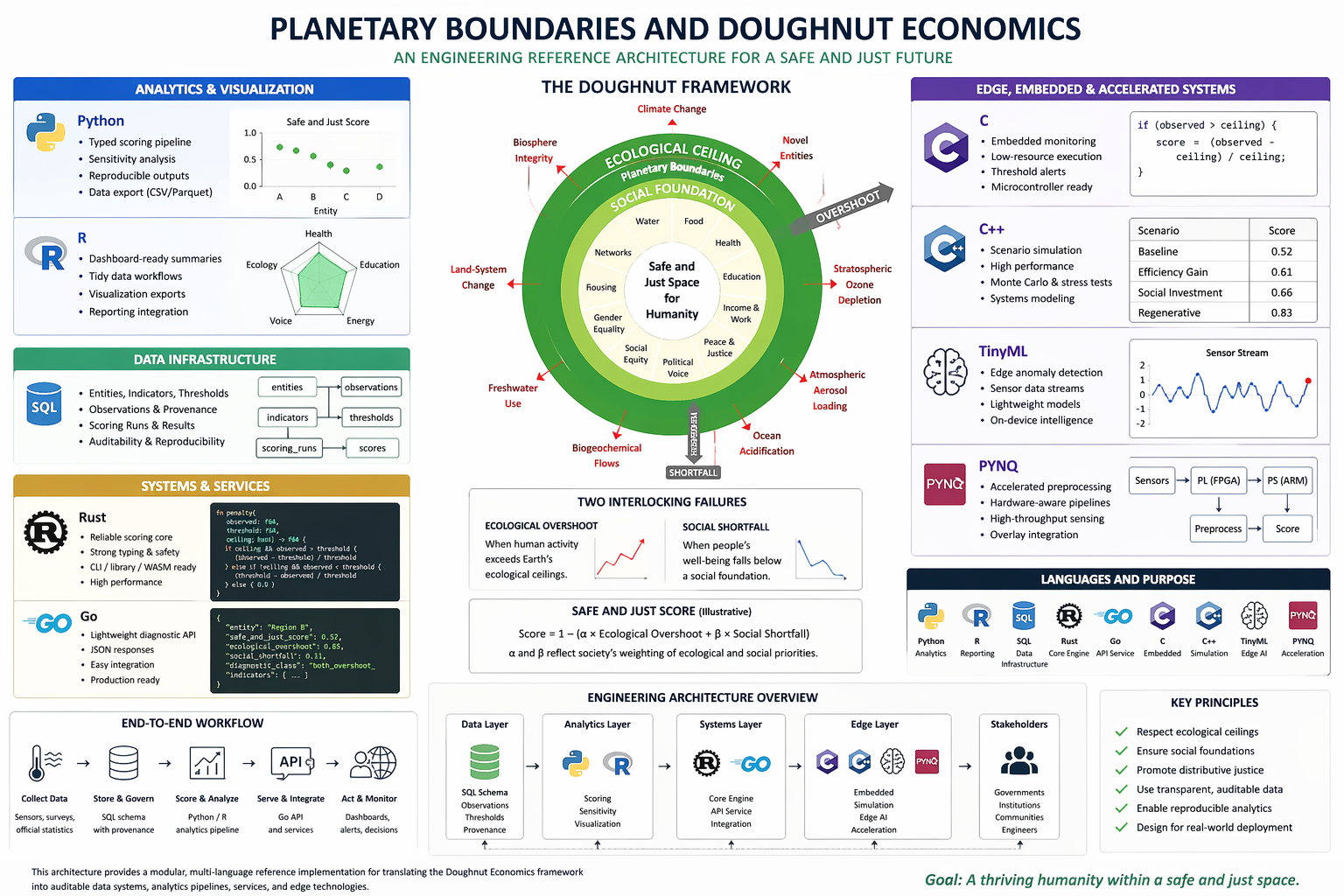
The two frameworks also differ in their relationship to economics. Planetary boundaries does not itself offer a theory of economic organization. It tells economies what Earth-system conditions they must respect. Doughnut Economics asks how economic thought must change if economies are to operate within those conditions while meeting social needs. It therefore moves from ecological diagnosis to political economy.
The difference can be summarized simply: planetary boundaries defines the outer guardrails; Doughnut Economics asks what kind of economy can thrive inside them without leaving people behind.
Why Doughnut Economics Is Not a Rejection of Planetary Boundaries
Doughnut Economics is not a rejection of planetary boundaries. It is best understood as an extension and reinterpretation of them. The ecological ceiling of the Doughnut depends conceptually on the planetary boundaries framework. Without the boundaries logic, the Doughnut would lose its scientific outer ring and risk becoming a purely aspirational social model. What Doughnut Economics changes is not the importance of ecological limits, but the larger frame within which those limits are interpreted.
This distinction is important because the two are sometimes contrasted too sharply. Planetary boundaries can be portrayed as cold, scientific, and restrictive, while Doughnut Economics is presented as humane, practical, and socially engaged. That contrast is misleading. The Doughnut depends on the scientific seriousness of the boundaries framework, while the boundaries framework becomes more publicly and politically legible when placed inside the Doughnut’s safe-and-just narrative.
In other words, the Doughnut does not move beyond planetary boundaries by leaving them behind. It moves beyond them by embedding them in a broader conception of human flourishing. That is why the two frameworks are better read as complementary rather than oppositional.
The stronger critique is not that Doughnut Economics abandons planetary boundaries, but that any practical use of the Doughnut must avoid weakening the scientific rigor of the ecological ceiling. A city, company, or government can adopt Doughnut language without changing material flows, emissions, procurement systems, land impacts, supply chains, or investment decisions. The model’s value depends on whether it is used as a serious diagnostic and redesign framework, not merely as a persuasive diagram.
That distinction is important for institutional practice. A superficial Doughnut application may identify social and ecological themes but avoid hard questions about growth dependence, land use, supply chains, procurement, tax systems, energy infrastructure, housing markets, transportation systems, or finance. A serious application asks how the underlying systems of provisioning must change.
Doughnut Economics is therefore most powerful when it preserves the scientific discipline of planetary boundaries while adding the social foundation that makes the ecological ceiling politically and ethically meaningful.
Development Within the Doughnut
Doughnut Economics has been especially influential because it offers a clearer political language for development within limits. Development in this model does not mean reproducing historically high-throughput pathways and then attempting to clean them up afterward. It means pursuing forms of provisioning, production, and distribution that secure human needs without relying on ecological destabilization. This gives the idea of sustainable development a more concrete structural form.
The significance of this shift is considerable. It reframes development away from output maximization and toward balanced achievement across social and ecological dimensions. It suggests that the central challenge is not how to grow without friction, but how to build economies that are distributive enough to meet needs and regenerative enough to respect ecological ceilings. This is one reason Doughnut Economics has resonated in debates about post-growth, wellbeing economies, public policy, and new development models.
It also gives planetary-boundary thinking a stronger connection to real political questions. Once the issue becomes how to live within the Doughnut, questions of welfare systems, public services, taxation, labor, infrastructure, consumption norms, ownership, industrial policy, technology, trade, and institutional design move to the foreground. The problem is no longer only ecological overshoot. It is how to reorganize economic life so that social foundations can be met without intensifying overshoot.
Development within the Doughnut therefore requires more than green-growth rhetoric. It requires asking whether systems of housing, transport, food, energy, finance, education, health, water, and care are organized around human need and ecological responsibility. It also requires asking whether economic activity reduces vulnerability or merely shifts costs across borders, classes, species, and generations. In this sense, Doughnut Economics gives sustainable development a sharper test: does a development pathway reduce social shortfall and ecological overshoot together?
This does not mean all regions need the same development pathway. Some require rapid expansion of energy access, sanitation, housing, health care, and infrastructure. Others require rapid reduction of wasteful consumption, fossil dependence, material throughput, pollution, and luxury emissions. Development within the Doughnut is therefore not a universal formula. It is a differentiated project of upward convergence in dignity and downward convergence in unsustainable excess.
The Doughnut’s value is that it allows these differences to be seen together. It makes clear that poverty reduction and ecological restraint are not two separate projects, but two sides of a single transformation in how economies provide for life.
Cities, Business, and Practical Application
One reason Doughnut Economics has spread widely is that it has proved adaptable to practical contexts such as cities, regions, and organizations. The planetary boundaries framework is powerful at planetary scale, but it can be difficult to translate directly into urban planning, local policy, or institutional decision-making. Doughnut-style applications, including city portraits and the Amsterdam City Doughnut, have helped make the underlying logic more accessible by asking how local social shortfalls and ecological overshoots can be mapped and addressed together.
This practical adaptability is one of the Doughnut’s greatest strengths. It offers a visual and strategic model that can be used to provoke institutional reflection, set priorities, and align stakeholders around a more integrated understanding of development. It is easier for city governments, civic coalitions, educators, and mission-driven organizations to work with a model that explicitly combines ecological ceilings with social foundations than with a strictly Earth-system framework alone.
That said, practical application does not eliminate scientific or political complexity. Translating a global ecological ceiling to local action remains difficult, and many city or organizational applications still depend on contested methods of downscaling and interpretation. But the Doughnut’s institutional usefulness lies precisely in making those questions discussable rather than leaving them at the level of abstract planetary diagnosis.
For businesses, the framework can be used to move beyond conventional corporate sustainability metrics. A company may report emissions, waste, water, diversity, or philanthropy, yet still fail to ask whether its core business model contributes to ecological overshoot or social shortfall. A Doughnut-informed strategy asks a more demanding set of questions: Does the company’s value creation depend on extractive material throughput? Do its supply chains undermine labor rights or ecosystem integrity? Does its financial model reward volume growth even when that growth increases boundary pressure? Are its products, services, and investments aligned with human provisioning within ecological limits?
For finance, the implications are equally significant. Planetary boundaries reveal systemic environmental risk. Doughnut Economics asks whether capital allocation supports a socially adequate and ecologically viable economy. This connects ecological ceilings to questions of fiduciary duty, disclosure, transition risk, impact measurement, public investment, and long-term institutional responsibility.
| Application context | Doughnut question | Practical implication |
|---|---|---|
| City planning | How can local social needs be met without shifting ecological burdens elsewhere? | Connect housing, transport, food, energy, procurement, waste, and supply chains. |
| Business strategy | Does the business model reduce shortfall and overshoot, or merely report impacts? | Examine products, supply chains, growth logic, labor conditions, and material flows. |
| Finance | Does capital allocation support the safe-and-just space? | Screen investments for ecological pressure, social provisioning, transition risk, and justice. |
| Public policy | Do policies reduce social shortfall and ecological overshoot together? | Build integrated portfolios across energy, care, housing, transport, food, and ecosystems. |
| Data systems | Can dashboards see both ecological ceilings and social foundations? | Design indicators that reveal trade-offs, distribution, provenance, and uncertainty. |
The Doughnut is therefore most useful when it functions as a strategic mirror. It reveals whether institutions are merely improving selected indicators or actually redesigning systems of provision within ecological limits.
Justice, Uneven Responsibility, and the Politics of Constraint
The most important contribution of Doughnut Economics may be its insistence that ecological limits cannot be discussed apart from justice. Planetary boundaries identify aggregate Earth-system pressures, but aggregate framing can obscure differences in responsibility and vulnerability. High-income countries and affluent consumers have historically contributed far more to cumulative emissions, resource extraction, and material throughput than low-income communities that often face the greatest exposure to climate disruption, food insecurity, pollution, land dispossession, and weak infrastructure.
This matters because ecological constraint can be politically dangerous if it is framed as a universal demand for equal sacrifice. A just interpretation of planetary boundaries must distinguish between luxury emissions and survival needs, between excessive consumption and basic provisioning, and between those who have benefited from historical overshoot and those who have been excluded from its gains. Doughnut Economics helps make that distinction visible by placing the social foundation inside the ecological ceiling.
The implication is not that social needs justify unlimited ecological pressure. It is that the pathway into the safe-and-just space must be distributive as well as regenerative. Wealthy societies and high-consumption groups have a greater responsibility to reduce excess pressure, while deprived communities require expanded access to health, energy, housing, education, food, water, mobility, and political voice. The challenge is not simply to shrink human activity. It is to transform the structure and distribution of economic activity so that wellbeing no longer depends on destabilizing the Earth system.
Doughnut Economics also helps clarify the difference between sufficiency and austerity. Sufficiency means securing enough for all while reducing forms of excess that damage ecological systems and do little to improve wellbeing. Austerity often means reducing public capacity and social protection, usually harming the vulnerable first. A Doughnut-informed politics should reject austerity while taking sufficiency seriously. The point is not less dignity, less care, or less public provision. The point is less waste, less extraction, less pollution, and less inequality.
This is why the Doughnut belongs with discussions of planetary justice, not only economics. Its inner ring is a moral claim: no one should be denied the essentials of a dignified life. Its outer ring is an ecological claim: no economy can be judged successful if it destabilizes the Earth system. The politics of constraint becomes legitimate only when both claims are honored together.
For companion essays, see Planetary Boundaries, Justice, and Global Inequality, Sustainable Development Goals Within Planetary Boundaries, and Earth System Governance in an Age of Limits.
Finance, Governance, and Economic Redesign
Doughnut Economics is not only a framework for measurement. It is a framework for economic redesign. If economies are to meet social foundations without exceeding ecological ceilings, then the underlying systems of finance, ownership, public investment, taxation, procurement, infrastructure, and production must change. A Doughnut-shaped economy cannot be produced by marginal efficiency gains alone if the deeper system continues to reward extraction, pollution, speculative accumulation, and short-term throughput growth.
Finance is central because capital allocation determines what gets built, expanded, protected, or abandoned. A financial system aligned with the Doughnut would ask whether investments support regenerative systems, social foundations, resilience, and long-term viability. It would scrutinize fossil infrastructure, deforestation-linked supply chains, pollution-intensive industry, speculative housing, disposable material systems, and business models dependent on planned obsolescence. It would also expand finance for clean energy, affordable housing, public transit, ecosystem restoration, care systems, circular materials, water resilience, and climate adaptation.
Governance is equally important. The Doughnut requires coordination across ministries, firms, civil society, communities, scientific institutions, and finance. Housing policy affects land use, energy demand, transport, health, inequality, and material flows. Food policy affects nutrition, land, biodiversity, water, climate, labor, and rural livelihoods. Energy policy affects poverty, industry, climate, air quality, geopolitics, and public finance. No single agency can govern the Doughnut alone.
Economic redesign therefore requires institutional redesign. Governments need integrated budgets, cross-sector metrics, public participation, long-term planning, and accountability for trade-offs. Businesses need governance structures that do not treat ecological and social concerns as peripheral reporting categories. Financial institutions need risk models that recognize planetary boundaries as systemic constraints rather than reputational issues. Cities need procurement, zoning, infrastructure, and community planning aligned with both local needs and global responsibilities.
For adjacent essays, see Business Strategy Within Planetary Boundaries, Finance, Disclosure, and Systemic Environmental Risk, and Environmental Monitoring Systems.
The Doughnut’s practical challenge is therefore not only to define a safe-and-just space. It is to build institutions capable of steering economies toward it.
Measurement, Operationalization, and Scale
One of the hardest questions for both planetary boundaries and Doughnut Economics is how to move from global frameworks to practical measurement. Planetary boundaries were developed primarily at Earth-system scale. Doughnut Economics has been adapted to countries, cities, regions, organizations, and communities. But every translation across scale requires assumptions. What share of a global ecological ceiling belongs to a city, a nation, a company, a household, or a sector? Should allocation be based on population, historical responsibility, capacity, need, territorial impact, consumption footprint, or some combination?
These questions are not merely technical. They are ethical and political. Different allocation rules produce different conclusions about who is inside the Doughnut and who is outside it. A territorial emissions accounting system may make a city look cleaner than a consumption-based accounting system that includes imported goods. A corporate sustainability report may count direct operations while omitting supply-chain impacts. A national dashboard may show strong social outcomes while hiding regional inequality or externalized ecological pressure. Operationalizing the Doughnut requires making these assumptions visible.
Social foundations also require judgment. Which indicators count as adequate housing, meaningful political voice, decent work, health access, education, gender equity, food security, or social inclusion? Universal thresholds are important, but local context matters. The goal is not to relativize deprivation away, but to avoid imposing abstract indicators that miss lived realities.
Good measurement should therefore be multidimensional, transparent, and non-reductive. It should show ecological overshoot and social shortfall separately before combining them. It should include distributional indicators. It should distinguish local responsibility from global footprint. It should document data sources, uncertainty, and allocation rules. It should avoid hiding moral judgments inside technical scoring.
This is why dashboards are useful but dangerous. They can make complex relationships visible, but they can also create false precision. The Doughnut is best used as a diagnostic framework: a way to ask better questions, structure better data, and guide better decisions. It should not be reduced to a single score that claims to solve political judgment.
Measurement must therefore serve public reasoning. The best Doughnut applications are not only data exercises. They are processes of collective interpretation about what a place, institution, or economy owes to its people and to the planet.
Criticisms and Limitations
Neither framework is free from criticism. Planetary boundaries has been criticized for technocracy, democratic thinness, scalar difficulty, and insufficient attention to justice and political economy. Doughnut Economics inherits some of those concerns while adding others of its own. Its visual clarity can make the transition appear more straightforward than it is. The model can communicate direction effectively while obscuring the depth of institutional conflict, economic restructuring, and distributive struggle required to inhabit the safe-and-just space in practice.
There is also the question of operationalization. Social foundations are normatively compelling, but their translation into policy, metrics, and governance differs across societies. Likewise, the ecological ceiling remains dependent on Earth-system science that is often global, aggregate, and difficult to downscale without contestation. Doughnut Economics therefore works best as a conceptual and strategic frame rather than as a finished formula for implementation.
Another limitation is that the Doughnut’s popularity can sometimes lead to superficial use. Its diagrammatic elegance makes it attractive in public discourse, but the deeper questions it raises about ownership, inequality, resource use, infrastructure, supply chains, finance, and political economy can be softened or bypassed in symbolic applications. The model is strongest when used as a prompt for structural redesign rather than a branding device for light-touch sustainability claims.
A further challenge concerns measurement. The ecological ceiling and social foundation are not commensurable in a simple way. Ecological thresholds may involve nonlinear change, tipping dynamics, and irreversible loss. Social foundations often involve rights, dignity, and political participation, which cannot be reduced to purely technical indicators. Any dashboard or scoring system must therefore be treated as an interpretive aid, not a substitute for public reasoning, scientific debate, and democratic accountability.
There is also a political limitation. The Doughnut does not by itself specify how power will be redistributed, how vested interests will be confronted, how fossil infrastructure will be retired, how land conflicts will be resolved, how debt burdens will be addressed, or how global supply chains will be transformed. It gives a compelling destination and diagnostic structure, but it does not automatically provide the political strategy required to get there.
These limitations do not make the framework weak. They clarify how seriously it must be used. A framework that connects social foundations to ecological ceilings should not be treated as a simple infographic. It is an invitation into difficult questions about economics, institutions, rights, power, and planetary responsibility.
Why the Synthesis Remains Powerful
The synthesis of planetary boundaries and Doughnut Economics remains powerful because it links Earth-system science to a morally and politically legible account of human flourishing. Planetary boundaries provides the ecological seriousness: the recognition that humanity operates within finite and increasingly stressed Earth-system conditions. Doughnut Economics adds the social seriousness: the insistence that sustainability must also mean meeting people’s basic needs and enabling dignified life.
Together, the frameworks help overcome a persistent divide in sustainability discourse between ecological realism and social justice. The boundaries framework alone can appear too biophysical. Doughnut Economics alone would risk becoming too normatively ambitious without enough scientific grounding. Combined, they offer one of the clearest ways to think about what sustainable development should mean under conditions of ecological overshoot and social inequality.
This is why the synthesis has had such reach. It speaks across scientific, political, civic, and institutional contexts. It offers a way of explaining that the challenge of the twenty-first century is neither simply to grow nor simply to restrain, but to reorganize economies so that human wellbeing and planetary stability can be pursued together.
Its deeper value lies in refusing false choices. It rejects the idea that poverty reduction must depend on ecological destruction. It rejects the idea that ecological protection can be indifferent to human need. It rejects the idea that economic growth alone can define progress. And it rejects the idea that sustainability can be achieved through marginal efficiency gains while the underlying structure of production, consumption, finance, and governance remains unchanged.
The synthesis also gives sustainability a clearer moral vocabulary. It says that an economy should be judged by whether it helps people live with dignity within a stable Earth system. That standard is simple to state and difficult to achieve, which is why it remains so useful. It does not solve the politics of transition, but it clarifies the stakes.
Planetary boundaries and Doughnut Economics therefore work best together: one provides the outer scientific guardrail; the other provides the social foundation and economic purpose. The result is not a complete blueprint, but a serious orientation for development on a finite planet.
The Four Lenses of a Place-Based Doughnut
A place-based Doughnut becomes more useful when it is unrolled into four lenses. The local-social lens asks how people in the place are doing. The local-ecological lens asks whether local ecosystems and environmental conditions are healthy. The global-social lens asks how the place affects people elsewhere through trade, finance, labor, procurement, and supply chains. The global-ecological lens asks how the place contributes to planetary pressure through consumption, emissions, materials, land use, pollution, and other externalized effects.
| Lens | Central question | Typical evidence |
|---|---|---|
| Local social | Are people here able to live with dignity, security, voice, health, and opportunity? | Housing, health, education, income, care, safety, energy, mobility, participation, and inequality. |
| Local ecological | Does this place protect and regenerate the living systems on which it depends? | Air, water, soil, habitat, heat, flood regulation, biodiversity, waste, and ecosystem condition. |
| Global social | How does activity here affect people elsewhere? | Labor conditions, sourcing, tax practices, finance, displacement, technology access, and value distribution. |
| Global ecological | How does consumption and production here affect planetary boundaries? | Consumption emissions, material footprint, land footprint, water pressure, nutrients, biodiversity, and novel entities. |
The four-lens structure prevents a place from appearing successful by improving local conditions while outsourcing social harm or ecological pressure. It also prevents global responsibility from eclipsing immediate local needs. A city can have green public space and low territorial emissions while depending on carbon-intensive imports, exploited labor, and distant material extraction. Another place can have low global footprints because residents remain deprived rather than because its systems are regenerative.
A serious portrait keeps all four lenses visible and treats their interaction as the object of strategy.
Territorial Accounts, Consumption Footprints, and Spillovers
Territorial accounting records pressures released within a jurisdiction. Consumption-based accounting attributes pressures embodied in the goods and services consumed there, regardless of where production occurs. Both perspectives are necessary. Territorial accounts are linked to local infrastructure and regulatory authority, while consumption footprints expose imported emissions, materials, land use, water use, pollution, and labor conditions.
Spillovers also move through finance, technology, tax systems, waste exports, tourism, intellectual property, and public procurement. A place can reduce visible local pollution by relocating industry while preserving the demand that drives extraction elsewhere. A corporation can report efficient offices while its products, supply chains, and financing increase global pressure.
P_{\text{consumption}}
=
P_{\text{territorial}}
+
P_{\text{imports}}
–
P_{\text{exports}}
\]
Interpretation: A simplified consumption footprint adds pressures embodied in imports and subtracts those embodied in exports from territorial pressure.
The choice of accounting boundary is therefore a moral and analytical decision. Good practice publishes multiple accounts, explains their differences, and avoids selecting the boundary that produces the most favorable story.
Downscaling Ecological Ceilings and Allocation Rules
Planetary boundaries are global guardrails. Applying them to nations, cities, sectors, organizations, or products requires an allocation rule. Possible approaches include equal per-capita shares, historical responsibility, capacity to act, basic need, economic value, grandfathering, territorial contribution, consumption footprint, or combinations of these principles.
No allocation rule is scientifically automatic. Each embeds ethical and political judgments. Equal per-capita allocation emphasizes equal entitlement to ecological space. Historical responsibility places greater obligations on actors that benefited from earlier overshoot. Capacity-based approaches assign more effort to those able to transform rapidly. Need-based approaches protect essential provisioning.
Allocation also differs by boundary. Climate pressure can be linked to cumulative emissions and carbon budgets. Land, freshwater, nutrients, aerosols, and biosphere integrity have strong geographic and ecological context. A global fraction cannot always be translated into a meaningful local ceiling without place-specific evidence.
A credible downscaling process should show the global control variable, the local pressure indicator, the allocation principle, the baseline year, uncertainty, imported pressure, and the consequences of alternative rules. The result is a transparent scenario, not an unquestionable entitlement.
Social Foundations, Rights, and Service Quality
The social foundation is not satisfied merely because infrastructure or a nominal service exists. Access must be sufficient, safe, affordable, reliable, accessible, culturally appropriate, and available without discrimination. A household may be counted as connected to water while receiving intermittent or unsafe supply. Employment may exist without security, voice, or a living income. School enrollment can coexist with weak learning conditions.
Rights-based interpretation changes the threshold logic. Some social dimensions are not interchangeable. Strong educational outcomes cannot compensate for denial of political voice, unsafe housing, or lack of health care. A composite index should never erase a severe shortfall in a basic right.
Social indicators should also capture distribution and quality. Median performance can conceal deprivation among racialized communities, migrants, disabled people, informal workers, rural residents, or low-income households. The relevant question is not only how many people cross a minimum threshold, but who remains below it and why.
The foundation should therefore combine universal minimums with locally interpreted indicators and direct participation by people whose lives are being measured.
Safe and Just Earth-System Boundaries
The language of a safe and just space has influenced Earth-system research as well as economic thought. Safe boundaries focus on maintaining the stability and resilience of Earth-system processes. Justice adds questions of exposure to significant harm, access to essential resources, responsibility, and distribution across people, places, species, and generations.
A boundary that reduces the probability of planetary destabilization may still permit serious harm to vulnerable populations or ecosystems. In some cases, a just limit may therefore be more stringent than a globally safe limit. This does not transform every political claim into a biophysical threshold. It clarifies that Earth-system risk and human harm must both be examined.
Justice has at least three dimensions in this context: recognition of affected people and knowledge systems, procedural influence over decisions, and distribution of benefits, burdens, and ecological space. Repair and responsibility for historical harm add a fourth dimension.
Doughnut analysis gains scientific depth when it incorporates these distinctions. It gains political legitimacy when communities can shape the thresholds, evidence, priorities, and remedies that affect them.
Needs, Satisfiers, and Systems of Provision
Human needs do not map one-to-one onto products or resource use. Mobility can be satisfied through proximity, walking, cycling, transit, shared vehicles, or private cars. Thermal comfort can be supported through building design, insulation, shade, district systems, or individual equipment. Nutrition depends on food systems, care, time, income, culture, land, and public health.
This distinction between needs and satisfiers is central to reducing social shortfall without reproducing high-throughput development. The same level of wellbeing can require very different quantities of energy, materials, land, labor, and money depending on the system of provision.
Public services, universal basic infrastructure, compact settlement, repair systems, social housing, preventive health, shared assets, and accessible digital services can raise wellbeing while lowering the private resource burden. Poorly designed systems can make dignified life dependent on expensive cars, large homes, long commutes, disposable products, debt, and continuous consumption.
The Doughnut therefore directs attention away from aggregate consumption and toward the institutional arrangements that convert resources into capabilities and wellbeing.
Sufficiency, Efficiency, and Rebound
Efficiency lowers resource use or pollution per unit of activity. Sufficiency asks what scale and form of activity are enough to provide a good life. Both matter. Efficiency can reduce pressure, but lower cost and greater convenience can expand demand, offsetting part of the saving through rebound.
T=q \times r
\]
Interpretation: Total throughput \(T\) equals the quantity of activity \(q\) multiplied by resource use per unit \(r\). Lower intensity does not reduce total pressure when activity grows faster.
Sufficiency is not synonymous with austerity. Austerity withdraws public capacity and often transfers burden to people with the least power. Sufficiency protects enough for everyone while reducing luxury consumption, planned obsolescence, waste, excessive floor area, unnecessary travel, speculative construction, and other forms of throughput weakly connected to wellbeing.
A Doughnut strategy should therefore ask whether efficiency gains reduce absolute pressure, whether savings are reinvested in expansion, and which activities should grow, transform, stabilize, or decline.
Distributive and Regenerative Design
Doughnut Economics calls for economies that are distributive and regenerative by design rather than redistributive and restorative only after harm occurs. Distribution concerns who owns assets, receives income, controls technology, makes decisions, bears risk, and captures value. Regeneration concerns whether economic activity restores living systems, cycles materials, uses renewable flows responsibly, and reduces cumulative pressure.
Distribution is not limited to wages or taxes. It includes land ownership, housing, finance, intellectual property, platform governance, public infrastructure, data, bargaining power, and access to common resources. A high-profit enterprise can provide a useful product while concentrating wealth and political influence in ways that weaken the social foundation.
Regeneration is not a synonym for recycling. It requires eliminating toxic materials, designing durable and repairable products, restoring ecosystems, using renewable energy within ecological limits, reducing extraction, and aligning production with long-term system health.
These design goals interact. Community ownership can support local accountability, but it does not guarantee ecological performance. Circular production can reduce waste while leaving labor exploitation or growth dependence unchanged. The Doughnut requires both dimensions.
The Deep Design of Business
Business action is often evaluated through products, targets, and operational improvements. A deeper Doughnut analysis asks how the enterprise is designed. Purpose, networks, governance, ownership, and finance shape which strategies are possible and which pressures return after temporary improvement.
A company whose purpose is dominated by short-term financial extraction may struggle to prioritize durable products, living wages, ecosystem restoration, or slower material growth. Ownership and finance influence time horizons and the distribution of value. Governance determines whose interests count. Networks include suppliers, customers, regulators, communities, and ecosystems affected by the business.
This makes sustainability a corporate-design problem rather than a reporting department’s responsibility. Emissions targets and social programs matter, but they may remain fragile when executive incentives, investor expectations, sales models, procurement, and market power reward the opposite behavior.
A Doughnut-informed business assessment therefore examines whether the enterprise’s deep design enables it to become regenerative and distributive, not merely whether selected indicators improve.
Public Finance, Budgets, and Investment Portfolios
Budgets convert priorities into institutions, infrastructure, staffing, and maintenance. A government can endorse a safe-and-just vision while continuing to finance fossil dependence, car-oriented land use, speculative housing, ecosystem loss, fragmented care, and pollution-intensive procurement.
Doughnut budgeting links expenditure and revenue to social foundations, ecological ceilings, distribution, and long-term resilience. It examines capital and operating budgets together because an asset without maintenance, staffing, or affordable access does not reliably meet social need.
Tax design also matters. Revenue can discourage pollution, land speculation, and unproductive extraction while funding public services and transition support. Poorly designed environmental charges can be regressive when households lack alternatives. Public finance should therefore combine ecological incentives with universal provision, targeted protection, and investment in low-burden choices.
Portfolio analysis is more useful than isolated project appraisal. Housing, transit, energy, care, food, water, land, and industrial policy interact. The question is whether the complete portfolio moves the place toward the Doughnut without shifting pressure elsewhere.
Policy Coherence, Trade-Offs, and Synergies
A policy can improve one Doughnut dimension while worsening another. Biofuel expansion may reduce fossil use while increasing land, water, food, or biodiversity pressure. Energy-efficiency retrofits can reduce emissions while displacing tenants. New housing can reduce shortage while increasing transport and material burdens if built in poorly connected locations.
Trade-offs should be mapped before implementation and monitored afterward. This requires cross-sector teams, shared indicators, distributional review, and authority to revise programs. It also requires distinguishing a genuine trade-off from a conflict created by a narrow policy design.
Synergies can be substantial. Compact affordable housing near transit can improve access, reduce energy and transport burden, support health, and protect land. Restored urban wetlands can reduce flood risk, heat, pollution, and habitat loss while improving public space.
Policy coherence does not mean every intervention benefits every dimension equally. It means negative spillovers are visible, justified, minimized, and not imposed on groups with the least power.
Growth Dependence, Post-Growth, and Macroeconomic Stability
Doughnut Economics questions the assumption that continuous gross-domestic-product growth is the primary measure and stabilizer of economic success. Yet many institutions depend on growth: employment, tax revenue, pensions, debt service, business valuation, housing finance, and political legitimacy can all be organized around expansion.
Moving beyond growth as an overriding goal therefore requires institutional redesign, not simply a new indicator. Governments need ways to maintain employment, public services, investment, and financial stability when material throughput or output growth slows. Firms need viable models based on durability, service, repair, care, and value rather than volume alone.
Post-growth does not require every activity to shrink. Renewable infrastructure, care, health, education, ecosystem restoration, housing quality, and access may need substantial expansion. Fossil extraction, waste, luxury emissions, destructive land use, and planned obsolescence need contraction.
The relevant question is not whether growth is always good or bad. It is which forms of activity improve capabilities, which increase overshoot, and how institutions can remain stable while harmful throughput declines.
Participation, Power, and Democratic Legitimacy
A Doughnut portrait can become technocratic if experts select indicators, thresholds, weights, and priorities without meaningful public influence. Participation should begin before the dashboard is complete and continue through interpretation, budgeting, implementation, and review.
Power shapes who has time, safety, language access, data access, and authority to participate. Consultation can reproduce exclusion when decisions are already fixed or when communities carry the burden of explaining harms without gaining control over resources.
Democratic legitimacy requires transparent assumptions, accessible evidence, compensation for participation, protection from retaliation, and visible links between public input and decisions. It also requires institutions capable of resolving conflict rather than presenting the Doughnut as a consensus diagram.
Knowledge pluralism matters. Scientific indicators, administrative data, lived experience, Indigenous knowledge, worker knowledge, and community observation reveal different aspects of the safe-and-just space. None should be treated as decorative.
Data Governance, Uncertainty, and Dashboard Ethics
Doughnut dashboards combine data produced at different scales, dates, resolutions, and levels of reliability. Some indicators are measured directly; others are modeled, allocated, proxied, or derived from surveys. Their thresholds can be scientific, legal, rights-based, political, or locally negotiated.
Good data governance documents source, ownership, update frequency, missingness, uncertainty, method changes, and who is represented. Disaggregation should protect privacy and avoid exposing small communities. Proprietary data should not make public accountability dependent on a vendor.
Uncertainty should be displayed rather than converted into one precise score. Sensitivity analysis can show how rankings change under alternative allocation rules, weights, or thresholds. Scenario ranges can distinguish robust conclusions from fragile ones.
A dashboard is an interface for public reasoning, not an automated verdict. It should preserve ecological overshoot, social shortfall, inequality, vulnerability, and spillovers as separate views before any synthesis.
Implementation Capacity, Learning, and Institutional Memory
A portrait can reveal priorities without creating the capacity to act. Implementation depends on authority, finance, staff, procurement, data systems, partnerships, public trust, and the ability to coordinate across agencies and scales.
Transition programs should define owners, milestones, leading indicators, stop conditions, and review cycles. They should record why decisions were made, which assumptions were used, what communities raised, and how trade-offs changed. Without institutional memory, each political cycle can restart the analysis.
Learning requires comparing intended and actual outcomes. A retrofit program may reduce building energy while raising rents. A circular procurement policy may fail because repair suppliers are unavailable. A participation process may reach many people while excluding those most affected.
The Doughnut becomes operational when institutions can learn from these gaps and redirect resources. Measurement without adaptation risks becoming ceremonial accountability.
Worked Diagnostic: A Metropolitan Doughnut Portrait
Consider a metropolitan region with strong universities and health institutions, high housing costs, racial and spatial inequality, aging infrastructure, expanding logistics, imported consumption, and significant climate exposure.
Step 1: Establish purpose and governance
A public steering group defines the decisions the portrait will inform, including budgeting, land use, procurement, housing, transport, and climate planning.
Step 2: Build the four lenses
Local social, local ecological, global social, and global ecological indicators are developed with residents, workers, scientists, agencies, and affected communities.
Step 3: Separate accounts and scales
Territorial emissions and pollution are reported beside consumption footprints, supply-chain labor risks, imported materials, and regional ecosystem effects.
Step 4: Diagnose social foundations
Housing, health, care, education, energy, mobility, safety, income, voice, and digital access are examined for sufficiency, quality, affordability, and unequal distribution.
Step 5: Diagnose ecological ceilings
Climate, land, water, nutrients, biodiversity, materials, pollution, and waste pressures are compared with transparent local and global reference points.
Step 6: Map systems of provision
The region traces how housing, transport, food, energy, finance, and care convert resources into outcomes and identifies where institutional design creates both shortfall and overshoot.
Step 7: Compare transformation portfolios
Transit-oriented social housing, building renewal, ecosystem restoration, circular procurement, distributed energy, care infrastructure, and industrial transition are tested together.
Step 8: Create thresholds and learning cycles
Budgets and projects receive named owners, social and ecological safeguards, distributional review, annual reporting, and revision rules.
| Portfolio | Visible benefit | Risk requiring governance |
|---|---|---|
| Green growth projects | Cleaner technology and selected efficiency gains. | May preserve high material demand, displacement, and imported pressure. |
| Social expansion without ecological redesign | Improved access to housing, mobility, or services. | Can lock in energy, land, and material overshoot. |
| Safe-and-just provisioning portfolio | Integrates universal services, sufficiency, regeneration, distribution, and footprint reduction. | Requires institutional coordination, finance, democratic legitimacy, and sustained learning. |
The portrait does not generate one final score. It creates a shared account of where the region falls short, where it overshoots, which burdens are exported, and which systems must be redesigned together.
Mathematical Lens: Overshoot, Shortfall, and the Safe-and-Just Space
The relationship between planetary boundaries and Doughnut Economics can be expressed as a dual-constraint problem. Let \(E_i\) represent the observed pressure on ecological boundary \(i\), and let \(B_i\) represent the corresponding boundary value or safe threshold. Ecological overshoot for boundary \(i\) can be written as:
O_i = \max\left(0, \frac{E_i – B_i}{B_i}\right)
\]
Interpretation: If \(O_i = 0\), the indicator is within its ecological ceiling. If \(O_i > 0\), the system is beyond the boundary by a proportional margin.
The social foundation can be expressed in the opposite direction. Let \(S_j\) represent observed social achievement on dimension \(j\), and let \(F_j\) represent the minimum foundation required for a dignified life. Social shortfall can be written as:
Q_j = \max\left(0, \frac{F_j – S_j}{F_j}\right)
\]
Interpretation: If \(Q_j = 0\), the social foundation has been met for that dimension. If \(Q_j > 0\), there is a proportional shortfall.
A composite safe-and-just performance score can be sketched as:
D = 1 – \left(\alpha \overline{O} + \beta \overline{Q}\right)
\]
Interpretation: \(\overline{O}\) is average ecological overshoot, \(\overline{Q}\) is average social shortfall, and \(\alpha\), \(\beta\) are explicit weights.
A distribution-aware version can include inequality and vulnerability. Let \(I\) represent inequality in access or ecological use, and let \(V\) represent vulnerability to ecological disruption. A diagnostic risk score can be written as:
R = \left(\alpha \overline{O} + \beta \overline{Q} + \gamma I + \delta V\right)
\]
Interpretation: Doughnut performance worsens when ecological overshoot, social shortfall, inequality, and vulnerability reinforce one another.
Policy coherence can also be represented. Let \(T_{ab}\) represent the negative spillover from intervention \(a\) onto social or ecological dimension \(b\), and let \(Y_a\) represent the intensity of intervention \(a\):
C = \sum_{a=1}^{m}\sum_{b=1}^{n} T_{ab}Y_a
\]
Interpretation: Coherence declines when a policy improves one dimension while worsening another.
A fuller diagnostic can therefore combine overshoot, shortfall, inequality, vulnerability, and coherence:
P = \left(\alpha \overline{O} + \beta \overline{Q} + \gamma I + \delta V\right)(1 + C)
\]
Interpretation: Safe-and-just performance risk rises when ecological pressure, social deprivation, inequality, vulnerability, and policy incoherence interact.
| Term | Meaning | Interpretive role |
|---|---|---|
| \(E_i\) | Observed ecological pressure | Represents emissions, material use, land conversion, nutrient loading, or another boundary pressure. |
| \(B_i\) | Ecological ceiling | Represents the boundary value or safe threshold. |
| \(O_i\) | Ecological overshoot | Measures distance beyond the ecological ceiling. |
| \(S_j\) | Observed social achievement | Represents access to health, education, food, water, housing, energy, voice, or security. |
| \(F_j\) | Social foundation | Represents the minimum threshold for dignified life. |
| \(Q_j\) | Social shortfall | Measures distance below the social foundation. |
| \(I\) | Inequality | Captures uneven access, responsibility, or ecological use. |
| \(V\) | Vulnerability | Captures exposure and adaptive capacity under ecological disruption. |
| \(C\) | Coherence penalty | Captures trade-offs and negative spillovers among goals and boundaries. |
This mathematical lens should not be mistaken for a complete measurement system. Its purpose is to make the logic visible: sustainability requires reducing ecological overshoot and social shortfall together, while accounting for inequality, vulnerability, and policy trade-offs.
Advanced Python Workflow: Doughnut Diagnostic Scoring
The following Python workflow creates a simplified Doughnut diagnostic for comparing ecological overshoot and social shortfall across multiple entities. It uses sample data to show how analysts could structure a reproducible workflow before replacing the placeholder values with authoritative data from environmental accounts, social indicators, sustainability dashboards, or institutional reporting systems.
from __future__ import annotations

import csv
from collections import defaultdict
from pathlib import Path
from statistics import mean

ARTICLE_ROOT = Path(__file__).resolve().parents[1]
DATA_FILE = ARTICLE_ROOT / "data" / "doughnut_place_profiles.csv"
TABLES = ARTICLE_ROOT / "outputs" / "tables"

ECOLOGICAL_COLUMNS = [
    "climate_pressure",
    "material_footprint_pressure",
    "land_biosphere_pressure",
    "freshwater_nutrient_pressure",
    "pollution_novel_entities_pressure",
    "consumption_spillover_pressure",
]

SOCIAL_COLUMNS = [
    "health_achievement",
    "education_achievement",
    "housing_achievement",
    "energy_mobility_achievement",
    "income_work_achievement",
    "care_time_achievement",
    "voice_equality_achievement",
    "water_food_achievement",
]

CAPACITY_COLUMNS = [
    "governance_capacity",
    "fiscal_capacity",
    "data_capacity",
    "community_power",
    "regenerative_infrastructure",
]

def clamp(value: float, low: float = 0.0, high: float = 1.0) -> float:
    return max(low, min(high, value))

def load_profiles(path: Path = DATA_FILE) -> list[dict[str, object]]:
    with path.open(newline="", encoding="utf-8") as handle:
        rows = list(csv.DictReader(handle))

    numeric = [
        *ECOLOGICAL_COLUMNS,
        *SOCIAL_COLUMNS,
        *CAPACITY_COLUMNS,
        "inequality_index",
        "vulnerability_index",
        "policy_incoherence",
        "import_dependency",
        "local_ecosystem_condition",
        "global_social_spillover_risk",
    ]
    for row in rows:
        for column in numeric:
            value = float(row[column])
            if not 0.0 <= value <= 1.0:
                raise ValueError(f"{column} outside [0, 1]: {value}")
            row[column] = value
    return rows

def weighted_average(row: dict[str, object], weights: dict[str, float]) -> float:
    total = sum(weights.values())
    return sum(float(row[key]) * weight for key, weight in weights.items()) / total

def score_profile(row: dict[str, object]) -> dict[str, object]:
    ecological_overshoot = weighted_average(
        row,
        {
            "climate_pressure": 0.23,
            "material_footprint_pressure": 0.18,
            "land_biosphere_pressure": 0.17,
            "freshwater_nutrient_pressure": 0.15,
            "pollution_novel_entities_pressure": 0.12,
            "consumption_spillover_pressure": 0.15,
        },
    )
    social_achievement = weighted_average(
        row,
        {
            "health_achievement": 0.14,
            "education_achievement": 0.11,
            "housing_achievement": 0.15,
            "energy_mobility_achievement": 0.11,
            "income_work_achievement": 0.14,
            "care_time_achievement": 0.10,
            "voice_equality_achievement": 0.13,
            "water_food_achievement": 0.12,
        },
    )
    social_shortfall = 1.0 - social_achievement
    implementation_capacity = weighted_average(
        row,
        {
            "governance_capacity": 0.22,
            "fiscal_capacity": 0.20,
            "data_capacity": 0.16,
            "community_power": 0.20,
            "regenerative_infrastructure": 0.22,
        },
    )
    distributional_burden = clamp(
        0.46 * float(row["inequality_index"])
        + 0.31 * float(row["vulnerability_index"])
        + 0.23 * float(row["global_social_spillover_risk"])
    )
    global_externalization = clamp(
        0.50 * float(row["consumption_spillover_pressure"])
        + 0.28 * float(row["import_dependency"])
        + 0.22 * float(row["global_social_spillover_risk"])
    )
    local_ecological_gap = 1.0 - float(row["local_ecosystem_condition"])

    safe_and_just_risk = clamp(
        0.30 * ecological_overshoot
        + 0.29 * social_shortfall
        + 0.17 * distributional_burden
        + 0.12 * global_externalization
        + 0.12 * float(row["policy_incoherence"])
    ) * (1.10 - 0.20 * implementation_capacity)
    safe_and_just_risk = clamp(safe_and_just_risk)

    transition_readiness = clamp(
        0.58 * implementation_capacity
        + 0.18 * (1.0 - float(row["policy_incoherence"]))
        + 0.14 * float(row["community_power"])
        + 0.10 * float(row["data_capacity"])
    )

    if ecological_overshoot >= 0.58 and social_shortfall >= 0.28:
        position = "Double pressure"
    elif ecological_overshoot >= 0.58:
        position = "Ecological overshoot"
    elif social_shortfall >= 0.28:
        position = "Social shortfall"
    else:
        position = "Closer to safe-and-just space"

    priorities = {
        "ecological pressure reduction": ecological_overshoot,
        "social foundation expansion": social_shortfall,
        "distribution and justice": distributional_burden,
        "global spillover reduction": global_externalization,
        "implementation capacity": 1.0 - implementation_capacity,
    }
    priority = max(priorities, key=priorities.get)

    return {
        **row,
        "mean_ecological_overshoot": round(ecological_overshoot, 4),
        "mean_social_achievement": round(social_achievement, 4),
        "mean_social_shortfall": round(social_shortfall, 4),
        "implementation_capacity": round(implementation_capacity, 4),
        "distributional_burden": round(distributional_burden, 4),
        "global_externalization": round(global_externalization, 4),
        "local_ecological_gap": round(local_ecological_gap, 4),
        "safe_and_just_risk": round(safe_and_just_risk, 4),
        "transition_readiness": round(transition_readiness, 4),
        "doughnut_position": position,
        "priority": priority,
    }

def four_lens_records(scored: list[dict[str, object]]) -> list[dict[str, object]]:
    records = []
    for row in scored:
        lenses = {
            "local_social": float(row["mean_social_shortfall"]),
            "local_ecological": float(row["local_ecological_gap"]),
            "global_social": float(row["global_social_spillover_risk"]),
            "global_ecological": float(row["global_externalization"]),
        }
        for lens, pressure in lenses.items():
            records.append({
                "place": row["place"],
                "place_type": row["place_type"],
                "lens": lens,
                "pressure_or_shortfall": round(pressure, 4),
                "transition_readiness": row["transition_readiness"],
            })
    return records

def dimension_summary(rows: list[dict[str, object]]) -> list[dict[str, object]]:
    dimensions = ECOLOGICAL_COLUMNS + SOCIAL_COLUMNS + [
        "inequality_index",
        "vulnerability_index",
    ]
    output = []
    for column in dimensions:
        values = [float(row[column]) for row in rows]
        output.append({
            "dimension": column,
            "mean": round(mean(values), 4),
            "minimum": round(min(values), 4),
            "maximum": round(max(values), 4),
            "range": round(max(values) - min(values), 4),
        })
    return output

def policy_scenarios(profiles: list[dict[str, object]]) -> list[dict[str, object]]:
    scenarios = {
        "Baseline trajectory": {
            "eco_reduction": 0.00,
            "social_gain": 0.00,
            "capacity_gain": 0.00,
            "inequality_reduction": 0.00,
            "incoherence_reduction": 0.00,
        },
        "Efficiency-led green growth": {
            "eco_reduction": 0.07,
            "social_gain": 0.03,
            "capacity_gain": 0.04,
            "inequality_reduction": 0.00,
            "incoherence_reduction": 0.02,
        },
        "Universal provisioning": {
            "eco_reduction": 0.03,
            "social_gain": 0.13,
            "capacity_gain": 0.08,
            "inequality_reduction": 0.10,
            "incoherence_reduction": 0.05,
        },
        "Sufficiency and footprint reduction": {
            "eco_reduction": 0.15,
            "social_gain": 0.04,
            "capacity_gain": 0.05,
            "inequality_reduction": 0.05,
            "incoherence_reduction": 0.06,
        },
        "Integrated safe-and-just portfolio": {
            "eco_reduction": 0.16,
            "social_gain": 0.14,
            "capacity_gain": 0.12,
            "inequality_reduction": 0.12,
            "incoherence_reduction": 0.12,
        },
    }

    records = []
    for scenario_name, settings in scenarios.items():
        for base in profiles:
            row = dict(base)
            for column in ECOLOGICAL_COLUMNS:
                row[column] = clamp(float(row[column]) - settings["eco_reduction"])
            for column in SOCIAL_COLUMNS:
                row[column] = clamp(float(row[column]) + settings["social_gain"])
            for column in CAPACITY_COLUMNS:
                row[column] = clamp(float(row[column]) + settings["capacity_gain"])
            row["inequality_index"] = clamp(
                float(row["inequality_index"]) - settings["inequality_reduction"]
            )
            row["policy_incoherence"] = clamp(
                float(row["policy_incoherence"]) - settings["incoherence_reduction"]
            )
            scored = score_profile(row)
            records.append({
                "scenario": scenario_name,
                "place": scored["place"],
                "mean_ecological_overshoot": scored["mean_ecological_overshoot"],
                "mean_social_shortfall": scored["mean_social_shortfall"],
                "distributional_burden": scored["distributional_burden"],
                "global_externalization": scored["global_externalization"],
                "safe_and_just_risk": scored["safe_and_just_risk"],
                "transition_readiness": scored["transition_readiness"],
                "doughnut_position": scored["doughnut_position"],
            })
    return records

def write_csv(path: Path, rows: list[dict[str, object]]) -> None:
    path.parent.mkdir(parents=True, exist_ok=True)
    if not rows:
        raise ValueError(f"No rows for {path}")
    with path.open("w", newline="", encoding="utf-8") as handle:
        writer = csv.DictWriter(handle, fieldnames=list(rows[0].keys()))
        writer.writeheader()
        writer.writerows(rows)

def main() -> None:
    profiles = load_profiles()
    scored = [score_profile(row) for row in profiles]
    scored.sort(key=lambda row: float(row["safe_and_just_risk"]), reverse=True)

    write_csv(TABLES / "doughnut_place_diagnostics.csv", scored)
    write_csv(TABLES / "doughnut_four_lenses.csv", four_lens_records(scored))
    write_csv(TABLES / "doughnut_dimension_summary.csv", dimension_summary(profiles))
    write_csv(TABLES / "doughnut_policy_scenarios.csv", policy_scenarios(profiles))

    print("Doughnut diagnostic workflow complete.")
    print(TABLES / "doughnut_place_diagnostics.csv")

if __name__ == "__main__":
    main()
This workflow is intentionally modular. The overshoot and shortfall calculations are separated so analysts can inspect ecological and social performance independently before combining them. That separation matters because a single composite score can hide morally and scientifically important differences. A region with low ecological overshoot and severe social deprivation is not equivalent to a region with high ecological overshoot and strong social provision, even if their average scores appear similar.
The workflow also includes inequality, vulnerability, and policy coherence because Doughnut analysis should not treat the safe-and-just space as a purely aggregate condition. A place may appear closer to the Doughnut while still containing severe internal inequality or high exposure among vulnerable communities. A serious diagnostic should make those patterns visible.
Advanced R Workflow: Social-Ecological Performance Dashboard
The following R workflow performs a similar analysis using readr, dplyr, and tidyr. It reshapes the output into a dashboard-ready format that can be exported for visualization, reporting, or further analysis.
# Base R Doughnut diagnostic cross-check.
args <- commandArgs(trailingOnly = FALSE)
file_arg <- grep("^--file=", args, value = TRUE)

if (length(file_arg) > 0) {
  script_path <- normalizePath(sub("^--file=", "", file_arg[1]), mustWork = TRUE)
  article_root <- normalizePath(file.path(dirname(script_path), ".."), mustWork = TRUE)
} else {
  article_root <- getwd()
}

input_file <- file.path(article_root, "data", "doughnut_place_profiles.csv")
output_file <- file.path(article_root, "outputs", "tables", "doughnut_diagnostics_r.csv")

places <- read.csv(input_file, stringsAsFactors = FALSE)

places$mean_ecological_overshoot <- rowMeans(
  places[, c(
    "climate_pressure",
    "material_footprint_pressure",
    "land_biosphere_pressure",
    "freshwater_nutrient_pressure",
    "pollution_novel_entities_pressure",
    "consumption_spillover_pressure"
  )]
)

places$mean_social_achievement <- rowMeans(
  places[, c(
    "health_achievement",
    "education_achievement",
    "housing_achievement",
    "energy_mobility_achievement",
    "income_work_achievement",
    "care_time_achievement",
    "voice_equality_achievement",
    "water_food_achievement"
  )]
)

places$mean_social_shortfall <- 1 - places$mean_social_achievement

places$distributional_burden <- pmin(
  1,
  pmax(
    0,
    0.46 * places$inequality_index +
    0.31 * places$vulnerability_index +
    0.23 * places$global_social_spillover_risk
  )
)

places$safe_and_just_risk <- pmin(
  1,
  pmax(
    0,
    0.38 * places$mean_ecological_overshoot +
    0.37 * places$mean_social_shortfall +
    0.15 * places$distributional_burden +
    0.10 * places$policy_incoherence
  )
)

dir.create(dirname(output_file), recursive = TRUE, showWarnings = FALSE)
write.csv(places, output_file, row.names = FALSE)

cat("Base R Doughnut diagnostics complete.\n")
cat(output_file, "\n")
This R version is designed for reporting workflows. The long-format output can feed directly into charting tools, dashboards, or reproducible reports. As with the Python version, the purpose is not to claim that the Doughnut can be reduced to a single formula. The purpose is to demonstrate how the core logic of ecological ceiling, social foundation, overshoot, shortfall, inequality, vulnerability, and policy coherence can be operationalized in a transparent, auditable way.
The scenario table is especially important because weighting ecological ceilings and social foundations involves judgment. A responsible dashboard should expose those assumptions rather than hide them. The Doughnut is a framework for structured public reasoning, not a magic number.
Advanced Go Workflow: Lightweight Doughnut Diagnostic Service
The following Go workflow translates Doughnut diagnostics into a lightweight scoring service. Go is useful for command-line tools, APIs, monitoring systems, and operational scoring engines. This example reads entity-level social and ecological profiles from a CSV file and reports ecological overshoot, social shortfall, safe-and-just score, distribution-adjusted risk, Doughnut position, and priority.
package main

import (
	"encoding/csv"
	"fmt"
	"math"
	"os"
	"path/filepath"
	"strconv"
)

func parse(record map[string]string, key string) float64 {
	value, err := strconv.ParseFloat(record[key], 64)
	if err != nil {
		panic(fmt.Errorf("%s: %w", key, err))
	}
	return value
}

func clamp(value float64) float64 {
	return math.Max(0, math.Min(1, value))
}

func average(values ...float64) float64 {
	total := 0.0
	for _, value := range values {
		total += value
	}
	return total / float64(len(values))
}

func main() {
	input := filepath.Join("..", "data", "doughnut_place_profiles.csv")
	output := filepath.Join("..", "outputs", "tables", "doughnut_scores_go.csv")

	file, err := os.Open(input)
	if err != nil {
		panic(err)
	}
	defer file.Close()

	reader := csv.NewReader(file)
	rows, err := reader.ReadAll()
	if err != nil {
		panic(err)
	}
	headers := rows[0]

	out, err := os.Create(output)
	if err != nil {
		panic(err)
	}
	defer out.Close()

	writer := csv.NewWriter(out)
	defer writer.Flush()
	writer.Write([]string{
		"place",
		"ecological_overshoot",
		"social_shortfall",
		"distributional_burden",
		"safe_and_just_risk",
	})

	for _, row := range rows[1:] {
		record := map[string]string{}
		for index, header := range headers {
			record[header] = row[index]
		}

		ecological := average(
			parse(record, "climate_pressure"),
			parse(record, "material_footprint_pressure"),
			parse(record, "land_biosphere_pressure"),
			parse(record, "freshwater_nutrient_pressure"),
			parse(record, "pollution_novel_entities_pressure"),
			parse(record, "consumption_spillover_pressure"),
		)
		socialAchievement := average(
			parse(record, "health_achievement"),
			parse(record, "education_achievement"),
			parse(record, "housing_achievement"),
			parse(record, "energy_mobility_achievement"),
			parse(record, "income_work_achievement"),
			parse(record, "care_time_achievement"),
			parse(record, "voice_equality_achievement"),
			parse(record, "water_food_achievement"),
		)
		shortfall := 1 - socialAchievement
		distribution := clamp(
			0.46*parse(record, "inequality_index") +
				0.31*parse(record, "vulnerability_index") +
				0.23*parse(record, "global_social_spillover_risk"),
		)
		risk := clamp(
			0.38*ecological +
				0.37*shortfall +
				0.15*distribution +
				0.10*parse(record, "policy_incoherence"),
		)

		writer.Write([]string{
			record["place"],
			fmt.Sprintf("%.4f", ecological),
			fmt.Sprintf("%.4f", shortfall),
			fmt.Sprintf("%.4f", distribution),
			fmt.Sprintf("%.4f", risk),
		})
	}

	fmt.Println("Go Doughnut scoring complete.")
	fmt.Println(output)
}
The Go workflow shows how a Doughnut diagnostic can move from article-level explanation into operational systems. A lightweight service could support public dashboards, city portraits, organizational reporting, development-finance screening, procurement review, climate-transition planning, or internal sustainability APIs.
A production implementation should include schema validation, unit checking, indicator metadata, source provenance, uncertainty intervals, allocation assumptions, missing-data handling, disaggregated social indicators, consumption-based footprint estimates, governance fields, and audit trails. Doughnut scoring should not hide social and ecological assumptions behind a single number. It should make overshoot, shortfall, inequality, vulnerability, and policy coherence visible enough for interpretation and accountability.
Engineering Extensions in the GitHub Repository
The accompanying GitHub repository extends the article workflow beyond Python, R, and Go into a broader engineering scaffold. The article body keeps Python and R visible because they are accessible tools for social-ecological diagnostics, dashboard preparation, scenario testing, and reproducible reporting. Go provides a compact service layer. The repository, however, is structured for readers who want to translate Doughnut analysis into more technical systems: auditable databases, scoring engines, APIs, embedded monitoring, scenario simulation, edge anomaly detection, and accelerator-aware environmental data pipelines.
The SQL scaffold is intended for entities, regions, ecological indicators, social foundation indicators, thresholds, allocation rules, inequality indicators, vulnerability metrics, policy-coherence fields, scoring runs, source provenance, and audit trails. Rust can support reliable scoring engines or command-line tools where type safety and reproducibility matter. Go can support lightweight diagnostic APIs. C and C++ can support embedded threshold monitoring, local signal processing, or scenario simulation. TinyML can support low-power anomaly detection at the edge, while PYNQ-oriented scaffolding can support accelerated preprocessing of environmental or social indicator streams.
This engineering layer matters because Doughnut diagnostics are only as credible as their information architecture. If ecological ceilings, social foundations, allocation rules, supply-chain footprints, and distributional indicators remain disconnected, institutions will struggle to distinguish real transformation from symbolic progress. Integrated analytics cannot replace politics, but they can make trade-offs, assumptions, and risks harder to hide.
A mature implementation should also include documentation for indicator selection, ecological-ceiling assumptions, social-foundation thresholds, footprint accounting, spatial disaggregation, uncertainty handling, justice fields, data-rights considerations, review workflows, and public communication. Without that layer, Doughnut dashboards can become decorative. With it, the technical system becomes accountable safe-and-just-space knowledge infrastructure.
GitHub Repository
The full code distribution for this article, including Python, R, and Go workflows plus extended engineering scaffolding for SQL, Rust, C, C++, TinyML, and PYNQ-oriented Doughnut diagnostics for ecological overshoot, social shortfall, and safe-and-just performance, is available on GitHub.
Common Misunderstandings
A common misunderstanding is that Doughnut Economics is a soft alternative to planetary boundaries. In reality, it depends on the ecological ceiling supplied by planetary-boundary thinking. The Doughnut does not weaken ecological limits. It places them in a broader framework of social foundations and economic purpose.
Another misunderstanding is that the Doughnut is mainly a communication diagram. Its visual clarity has helped it spread, but the model’s deeper significance lies in the questions it forces: who remains below the social foundation, which ecological ceilings are being exceeded, who is responsible for overshoot, and what systems of provisioning must change?
A third misunderstanding is that the framework simply means balancing environment and society. Balance is too weak a word. The Doughnut describes a dual requirement: social foundations must be secured and ecological ceilings must be respected. One does not compensate for the failure of the other.
A fourth misunderstanding is that the Doughnut can be reduced to a single score. Composite scores can be useful for dashboards, but they can also hide the difference between ecological overshoot and social shortfall. A strong Doughnut diagnostic should preserve the distinction between dimensions before aggregating them.
A fifth misunderstanding is that cities or companies can adopt Doughnut language without confronting supply chains, consumption footprints, procurement, finance, land use, labor conditions, and business models. Serious application requires material and institutional change, not only a new vocabulary.
A final misunderstanding is that Doughnut Economics is anti-development. It is better understood as a different theory of development: one that seeks to expand human dignity while reducing the forms of excess that destabilize Earth-system conditions.
A Practical Method for Building a Safe-and-Just Diagnostic
1. Define the decision and institutional purpose
Identify which budget, plan, strategy, investment, or public decision the analysis must influence.
2. Define the place, actors, and system boundary
Specify territorial reach, consumption footprint, supply chains, ecosystems, populations, and time horizon.
3. Establish participatory governance
Give affected communities, workers, public institutions, scientists, and rights holders meaningful influence over indicators, priorities, and remedies.
4. Build the four lenses
Assess local-social, local-ecological, global-social, and global-ecological performance separately.
5. Define social foundations
Use rights, sufficiency, quality, affordability, reliability, accessibility, and distribution rather than service presence alone.
6. Define ecological ceilings and allocation rules
Document global boundaries, local ecological conditions, territorial and consumption pressures, allocation principles, baselines, and uncertainty.
7. Map systems of provision and institutional design
Trace how housing, mobility, food, energy, care, finance, ownership, governance, and infrastructure create outcomes.
8. Identify overshoot, shortfall, inequality, and spillovers
Keep these dimensions separate before constructing any summary view.
9. Develop transformation portfolios
Combine public services, sufficiency, ecological restoration, circularity, distribution, industrial change, and social protection.
10. Test trade-offs, rebound, and externalization
Examine whether gains depend on displacement, imported pressure, higher demand, exclusion, or future liabilities.
11. Define safeguards, owners, and finance
Connect indicators to action thresholds, accountable institutions, budgets, review dates, and rights-based protections.
12. Monitor, learn, and revise
Compare expected and actual outcomes, preserve decision history, update methods, and redirect resources when the portfolio fails.
Common Pitfalls in Doughnut Analysis
- Using the Doughnut as a branding graphic: A diagram without changes to budgets, infrastructure, ownership, procurement, or governance does not redesign the economy.
- Reporting territorial impacts only: Imported emissions, materials, labor risks, land pressure, and waste can make local progress misleading.
- Downscaling global boundaries without showing the allocation rule: Per-capita, responsibility, capacity, and need approaches produce different conclusions.
- Treating social foundations as binary service access: Quality, affordability, reliability, dignity, and distribution remain essential.
- Using one composite score as the verdict: Severe ecological transgression or denial of a basic right cannot be averaged away.
- Equating sufficiency with austerity: Safe-and-just policy expands essential provision while reducing destructive excess.
- Assuming efficiency guarantees lower absolute pressure: Rebound and growth can offset improvements in resource intensity.
- Ignoring power and institutional design: Purpose, ownership, finance, governance, and market structure shape whether improvements endure.
- Consulting communities after indicators are fixed: Participation must influence the evidence, thresholds, investments, and remedies.
- Counting projects instead of system outcomes: More green initiatives do not necessarily reduce total overshoot or social shortfall.
- Hiding uncertainty and missing data: Sparse or modeled indicators should not be presented with the authority of direct measurement.
- Ending with the portrait: The analysis has little value without implementation capacity, finance, accountability, and learning cycles.
The central error is to treat the Doughnut as a static balance chart rather than a demanding framework for transforming systems of provision, distribution, ownership, and ecological responsibility.
Related Articles
- What Are Planetary Boundaries?
- The Origins of the Planetary Boundaries Framework
- Safe Operating Space and the Logic of Thresholds
- How Planetary Boundaries Are Measured
- Uncertainty, Precaution, and Scientific Debate in Boundary Setting
- Planetary Boundaries and Earth System Resilience
- Tipping Points, Feedback Loops, and Cascading Ecological Change
- Sustainable Development Goals Within Planetary Boundaries
- Planetary Boundaries, Justice, and Global Inequality
- Climate Change as a Planetary Boundary
- Biosphere Integrity and the Stability of Life Systems
- Freshwater Change and Earth System Risk
- Earth System Governance in an Age of Limits
- Business Strategy Within Planetary Boundaries
- Finance, Disclosure, and Systemic Environmental Risk
- Critiques of the Planetary Boundaries Framework
- The Future of Planetary Stewardship
Further Reading
- Stockholm Resilience Centre (2023) Safe and just Earth-system boundaries. Available at: https://www.stockholmresilience.org/research/research-news/2023-05-31-groundbreaking-study-quantifies-safe-and-just-earth-system-boundaries.html
- Stockholm Resilience Centre (2023) All planetary boundaries mapped for the first time. Available at: https://www.stockholmresilience.org/research/research-news/2023-09-13-all-planetary-boundaries-mapped-out-for-the-first-time-six-of-nine-crossed.html
- Doughnut Economics Action Lab (2025) What Doughnut Economics Means for Business. Available at: https://doughnuteconomics.org/tools/what-doughnut-economics-means-for-businesses
- Doughnut Economics Action Lab (2025) Doughnut Data Portraits Visualiser and Data Hub. Available at: https://doughnuteconomics.org/tools/doughnut-data-portraits-visualiser-data-hub
- Doughnut Economics Action Lab (2021) Doughnut Data Portraits: A Methodological Guide. Available at: https://doughnuteconomics.org/tools/doughnut-data-portraits-a-methodological-guide
- Doughnut Economics Action Lab (2026) What is the Doughnut?. Available at: https://doughnuteconomics.org/doughnut/
- Doughnut Economics Action Lab (n.d.) About Doughnut Economics. Available at: https://doughnuteconomics.org/about-doughnut-economics.
- Doughnut Economics Action Lab (2020) What Is the Doughnut? Available at: https://doughnuteconomics.org/tools/what-is-the-doughnut.
- Doughnut Economics Action Lab, Biomimicry 3.8, C40 Cities and Circle Economy (2020) Creating City Portraits: A Methodological Guide from The Thriving Cities Initiative. Available at: https://doughnuteconomics.org/Creating-City-Portraits-Methodology.pdf.
- Doughnut Economics Action Lab, Biomimicry 3.8, C40 Cities and Circle Economy (2020) The Amsterdam City Doughnut: A Tool for Transformative Action. Available at: https://doughnuteconomics.org/amsterdam-portrait.pdf.
- Fanning, A.L., O’Neill, D.W., Büchs, M., Doyal, L., Dyke, J.G., Kallis, G., Max-Neef, M., O’Neill, J., Steinberger, J.K. and Victor, P.A. (2025) ‘Doughnut of social and planetary boundaries monitors a world out of balance’, Nature. Available at: https://www.nature.com/articles/s41586-025-09385-1.
- Gupta, J. et al. (2023) ‘Earth system justice needed to identify and live within Earth system boundaries’, Nature Sustainability, 6, pp. 630–638. Available at: https://www.nature.com/articles/s41893-023-01064-1.
- O’Neill, D.W., Fanning, A.L., Lamb, W.F. and Steinberger, J.K. (2018) ‘A good life for all within planetary boundaries’, Nature Sustainability, 1, pp. 88–95. Available at: https://www.nature.com/articles/s41893-018-0021-4.
- Raworth, K. (2012) A Safe and Just Space for Humanity: Can We Live Within the Doughnut? Oxford: Oxfam. Available at: https://policy-practice.oxfam.org/resources/a-safe-and-just-space-for-humanity-can-we-live-within-the-doughnut-210490/.
- Raworth, K. (2017) Doughnut Economics: Seven Ways to Think Like a 21st-Century Economist. London: Random House. Available at: https://www.kateraworth.com/doughnut/.
- Rockström, J. et al. (2009) ‘A safe operating space for humanity’, Nature, 461, pp. 472–475. Available at: https://www.nature.com/articles/461472a.
- Rockström, J. et al. (2023) ‘Safe and just Earth system boundaries’, Nature, 619, pp. 102–111. Available at: https://www.nature.com/articles/s41586-023-06083-8.
- Steffen, W. et al. (2015) ‘Planetary boundaries: Guiding human development on a changing planet’, Science, 347(6223), 1259855. Available at: https://www.science.org/doi/10.1126/science.1259855.
References
- Stockholm Resilience Centre (2023) Safe and just Earth-system boundaries. Available at: https://www.stockholmresilience.org/research/research-news/2023-05-31-groundbreaking-study-quantifies-safe-and-just-earth-system-boundaries.html
- Stockholm Resilience Centre (2023) All planetary boundaries mapped for the first time. Available at: https://www.stockholmresilience.org/research/research-news/2023-09-13-all-planetary-boundaries-mapped-out-for-the-first-time-six-of-nine-crossed.html
- Doughnut Economics Action Lab (2025) What Doughnut Economics Means for Business. Available at: https://doughnuteconomics.org/tools/what-doughnut-economics-means-for-businesses
- Doughnut Economics Action Lab (2025) Doughnut Data Portraits Visualiser and Data Hub. Available at: https://doughnuteconomics.org/tools/doughnut-data-portraits-visualiser-data-hub
- Doughnut Economics Action Lab (2021) Doughnut Data Portraits: A Methodological Guide. Available at: https://doughnuteconomics.org/tools/doughnut-data-portraits-a-methodological-guide
- Doughnut Economics Action Lab (2026) What is the Doughnut?. Available at: https://doughnuteconomics.org/doughnut/
- Doughnut Economics Action Lab (n.d.) About Doughnut Economics. Available at: https://doughnuteconomics.org/about-doughnut-economics.
- Doughnut Economics Action Lab (n.d.) Amsterdam City Doughnut. Available at: https://doughnuteconomics.org/stories/amsterdam-city-doughnut.
- Doughnut Economics Action Lab (2020) What Is the Doughnut? Available at: https://doughnuteconomics.org/tools/what-is-the-doughnut.
- Doughnut Economics Action Lab, Biomimicry 3.8, C40 Cities and Circle Economy (2020) Creating City Portraits: A Methodological Guide from The Thriving Cities Initiative. Available at: https://doughnuteconomics.org/Creating-City-Portraits-Methodology.pdf.
- Doughnut Economics Action Lab, Biomimicry 3.8, C40 Cities and Circle Economy (2020) The Amsterdam City Doughnut: A Tool for Transformative Action. Available at: https://doughnuteconomics.org/amsterdam-portrait.pdf.
- Fanning, A.L., O’Neill, D.W., Büchs, M., Doyal, L., Dyke, J.G., Kallis, G., Max-Neef, M., O’Neill, J., Steinberger, J.K. and Victor, P.A. (2025) ‘Doughnut of social and planetary boundaries monitors a world out of balance’, Nature. Available at: https://www.nature.com/articles/s41586-025-09385-1.
- Gupta, J. et al. (2023) ‘Earth system justice needed to identify and live within Earth system boundaries’, Nature Sustainability, 6, pp. 630–638. Available at: https://www.nature.com/articles/s41893-023-01064-1.
- O’Neill, D.W., Fanning, A.L., Lamb, W.F. and Steinberger, J.K. (2018) ‘A good life for all within planetary boundaries’, Nature Sustainability, 1, pp. 88–95. Available at: https://www.nature.com/articles/s41893-018-0021-4.
- Raworth, K. (2012) A Safe and Just Space for Humanity: Can We Live Within the Doughnut? Oxford: Oxfam. Available at: https://policy-practice.oxfam.org/resources/a-safe-and-just-space-for-humanity-can-we-live-within-the-doughnut-210490/.
- Raworth, K. (2017) Doughnut Economics: Seven Ways to Think Like a 21st-Century Economist. London: Random House. Available at: https://www.kateraworth.com/doughnut/.
- Richardson, K., Steffen, W., Lucht, W., Bendtsen, J., Cornell, S.E., Donges, J.F., Drüke, M., Fetzer, I., Bala, G., von Bloh, W., Feulner, G., Fiedler, S., Gerten, D., Gleeson, T., Hofmann, M., Huiskamp, W., Jakobsson, C., Jürgensen, J.H., Kummu, M., Mohan, C., Nogués-Bravo, D., Petri, S., Porkka, M., Rahmstorf, S., Schaphoff, S., Schulte-Uebbing, L., Staal, A., Sun, Z., Sakschewski, B. and Wang-Erlandsson, L. (2023) ‘Earth beyond six of nine planetary boundaries’, Science Advances, 9(37), eadh2458. Available at: https://www.science.org/doi/10.1126/sciadv.adh2458.
- Rockström, J., Steffen, W., Noone, K., Persson, Å., Chapin, F.S. III, Lambin, E.F., Lenton, T.M., Scheffer, M., Folke, C., Schellnhuber, H.J., Nykvist, B., de Wit, C.A., Hughes, T., van der Leeuw, S., Rodhe, H., Sörlin, S., Snyder, P.K., Costanza, R., Svedin, U., Falkenmark, M., Karlberg, L., Corell, R.W., Fabry, V.J., Hansen, J., Walker, B., Liverman, D., Richardson, K., Crutzen, P. and Foley, J.A. (2009a) ‘A safe operating space for humanity’, Nature, 461, pp. 472–475. Available at: https://www.nature.com/articles/461472a.
- Rockström, J., Steffen, W., Noone, K., Persson, Å., Chapin, F.S. III, Lambin, E.F., Lenton, T.M., Scheffer, M., Folke, C., Schellnhuber, H.J., Nykvist, B., de Wit, C.A., Hughes, T., van der Leeuw, S., Rodhe, H., Sörlin, S., Snyder, P.K., Costanza, R., Svedin, U., Falkenmark, M., Karlberg, L., Corell, R.W., Fabry, V.J., Hansen, J., Walker, B., Liverman, D., Richardson, K., Crutzen, P. and Foley, J.A. (2009b) ‘Planetary boundaries: Exploring the safe operating space for humanity’, Ecology and Society, 14(2), 32. Available at: https://www.ecologyandsociety.org/vol14/iss2/art32/.
- Rockström, J. et al. (2023) ‘Safe and just Earth system boundaries’, Nature, 619, pp. 102–111. Available at: https://www.nature.com/articles/s41586-023-06083-8.
- Steffen, W., Richardson, K., Rockström, J., Cornell, S.E., Fetzer, I., Bennett, E.M., Biggs, R., Carpenter, S.R., de Vries, W., de Wit, C.A., Folke, C., Gerten, D., Heinke, J., Mace, G.M., Persson, L.M., Ramanathan, V., Reyers, B. and Sörlin, S. (2015) ‘Planetary boundaries: Guiding human development on a changing planet’, Science, 347(6223), 1259855. Available at: https://www.science.org/doi/10.1126/science.1259855.