
Last Updated May 7, 2026
Resilience thinking in the Anthropocene offers a framework for managing uncertainty, adaptation, and transformation in a world where human activity increasingly shapes the Earth system. Rather than assuming stability, predictability, and control, resilience thinking asks how societies can sustain what matters, learn under uncertainty, and build the capacity to navigate ecological and social change. It is not simply a theory of survival after disruption. It is a way of understanding how social-ecological systems absorb disturbance, adapt to changing conditions, and sometimes transform when existing structures become unsustainable.
Traditional environmental management often depends on optimization, efficiency, and assumptions of linear cause and effect. In the Anthropocene, those assumptions are increasingly strained by climate change, global interdependence, ecological thresholds, compounding risk, and systemic surprise. A food system optimized for low cost may become fragile when climate extremes, trade disruption, soil degradation, or biodiversity loss intensify. A city optimized for growth may become vulnerable when heat, flood, water scarcity, housing inequality, and infrastructure stress converge. A supply chain optimized for speed may become brittle when shocks propagate across regions. Resilience thinking emerged as a response to this reality.
Main Library
Publications
Article Map
Planetary Boundaries
Related Topic
Risk & Resilience
Related Topic
Systems Thinking
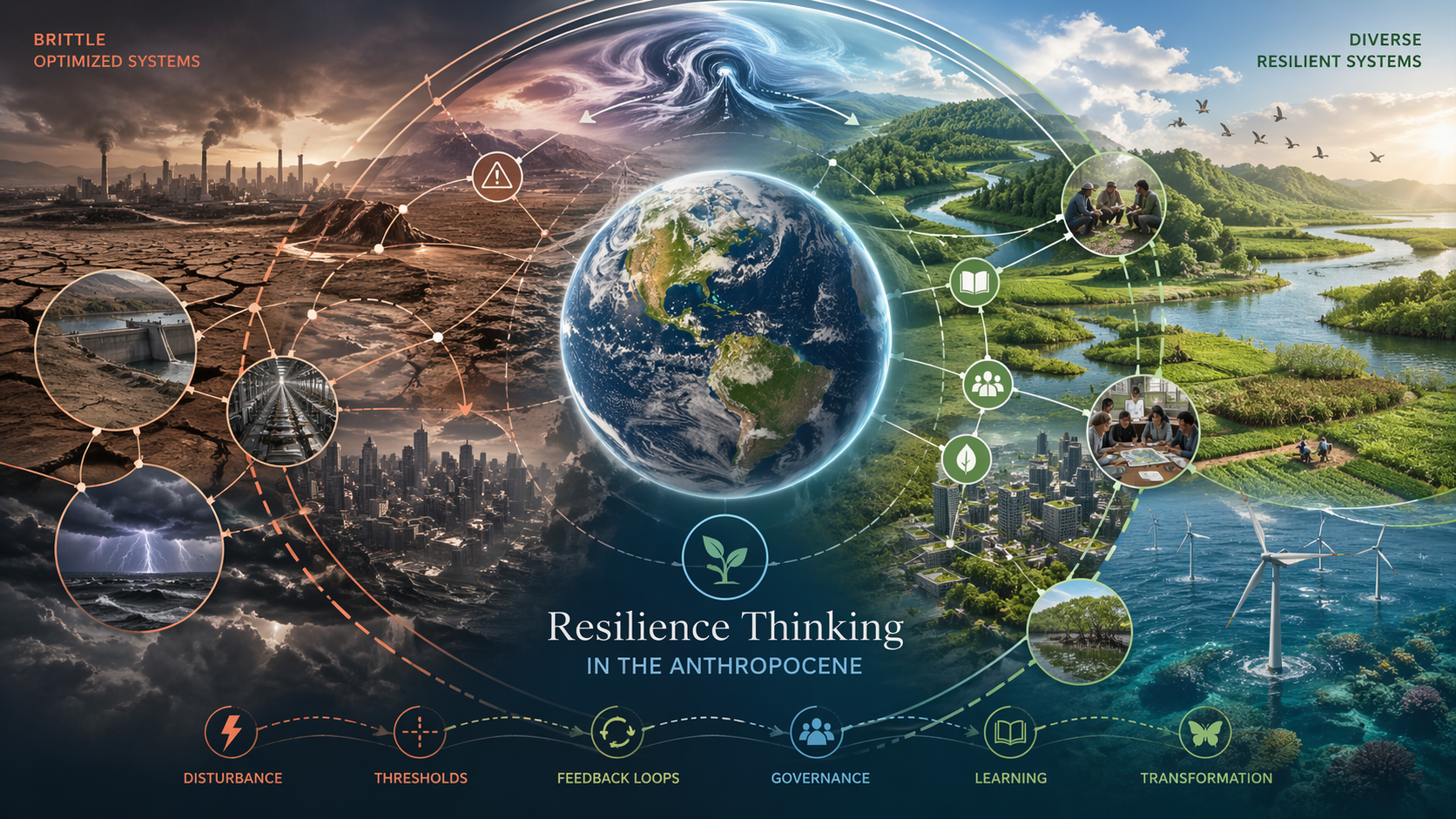
The planetary boundaries framework and resilience thinking belong together. Planetary boundaries identify the Earth-system processes whose destabilization can push humanity outside a safer operating space. Resilience thinking asks how systems respond as those pressures accumulate: whether they absorb disturbance, adapt, cross thresholds, collapse, or transform. Together, they provide a richer way to understand the Anthropocene: not merely as a period of environmental degradation, but as a period in which human societies must learn to govern feedbacks, thresholds, uncertainty, and transformation at planetary scale.
This article deepens the connection between resilience thinking and the planetary boundaries framework. It explains the intellectual roots of resilience, why optimization can create fragility, how nonlinear change and feedbacks matter in the Anthropocene, why adaptive management and social learning are essential, how resilience connects to justice and transformation, and how resilience diagnostics can be modeled using mathematical, Python, R, and Go workflows.
Resilience Thinking in the Anthropocene
Resilience thinking is an approach to environmental management and governance that emphasizes the capacity of systems to absorb disturbance, adapt to change, and reorganize without losing their essential functions. In contrast to management models built around prediction and control, resilience thinking begins from the recognition that many ecological and social systems are dynamic, uncertain, and shaped by interacting feedbacks across scales.
In the Anthropocene, resilience thinking has become especially important because human activity now influences the Earth system at planetary scale. Climate change, biodiversity loss, land-use change, nutrient disruption, freshwater stress, pollution, resource extraction, and synthetic chemical accumulation have created a world in which local and global dynamics are increasingly entangled. A drought is not only a weather event. It can interact with food prices, groundwater depletion, migration, public finance, political instability, ecological degradation, and global supply chains. A wildfire is not only a local disaster. It can reflect climate change, land management, housing patterns, insurance systems, air quality, forest ecology, and infrastructure exposure.
Under these conditions, resilience thinking provides a more realistic framework for sustainable development than purely linear or technocratic models of management. It does not assume that experts can fully predict and control complex systems from the outside. Instead, it asks how institutions, communities, ecosystems, and infrastructures can remain functional while learning from disturbance, preserving diversity, maintaining buffers, and adapting when conditions change.
Resilience thinking also changes the meaning of sustainability. Sustainability is not simply the effort to keep everything stable. Some systems must be preserved because they sustain life, dignity, and ecological function. Some systems must adapt because conditions are changing. Some systems must transform because their current structure is harmful, unjust, or incompatible with planetary limits. Resilience thinking therefore asks not only how systems persist, but whether their persistence is desirable.
This distinction is crucial in the Anthropocene. A fossil-fuel economy can be institutionally resilient. A destructive land-use regime can be economically resilient. A system of unequal climate exposure can be politically resilient. But the persistence of harmful systems is not the kind of resilience that sustainable development should protect. The central task is to strengthen the resilience of life-supporting systems while weakening the maladaptive resilience of systems that drive ecological destabilization and social injustice.
Why Resilience Thinking Matters
Resilience thinking matters because the Anthropocene is not a stable operating environment. Climate systems are changing. Ecosystems are being simplified. Freshwater systems are under stress. Food systems are exposed to heat, drought, flood, pests, market volatility, and geopolitical disruption. Cities face compounding risks from heat islands, aging infrastructure, stormwater overload, housing insecurity, insurance retreat, and unequal exposure. Public institutions face shocks that cross administrative boundaries and policy silos.
The older promise of optimization was that systems could be made efficient, predictable, and controllable. That promise is increasingly inadequate. Efficiency can reduce waste, but it can also remove buffers. Specialization can increase output, but it can also reduce diversity. Just-in-time logistics can lower costs, but it can also eliminate slack. Centralized control can coordinate action, but it can also fail when local knowledge, feedback, and experimentation are ignored. In complex systems, what looks efficient under normal conditions may become fragile under stress.
Resilience thinking therefore shifts attention toward capacities that are often undervalued: diversity, redundancy, modularity, feedback monitoring, ecological buffering, institutional flexibility, social trust, local knowledge, public legitimacy, and the ability to revise decisions when evidence changes. These capacities may appear inefficient in narrow accounting terms, but they are essential for survival and adaptation in turbulent conditions.
The framework also matters because it places learning at the center of governance. In a world shaped by thresholds, feedbacks, and cascading risks, no institution can know everything in advance. Governance must become more experimental, transparent, participatory, and adaptive. It must monitor outcomes, detect early warnings, listen to affected communities, revise assumptions, and act before irreversible damage becomes unavoidable.
Resilience thinking is therefore not a soft concept. It is a disciplined response to uncertainty. It asks how societies can avoid brittle dependence on systems that only function under ideal conditions. It asks how public institutions can prepare for surprise. It asks how communities can maintain dignity and function during disruption. It asks how ecological systems can retain the diversity and buffering capacity needed to sustain life.
From Stability to Resilience
Resilience thinking emerged partly from a distinction between stability and resilience. A stable system may return quickly to equilibrium after a small disturbance. A resilient system, however, may be able to absorb larger disturbances without losing its core identity, structure, or function. This distinction is important because a system can appear stable while becoming fragile. It may perform efficiently under normal conditions but fail under stress because it has lost diversity, redundancy, adaptive capacity, or ecological buffers.
C. S. Holling’s classic 1973 article on resilience and stability helped establish this distinction in ecology. Holling argued that ecological systems should not be understood only through equilibrium, constancy, or efficiency. They also need to be understood through persistence, variability, and the capacity to absorb disturbance. This was a major conceptual shift. It moved ecological thought away from the assumption that good management always means maintaining a fixed state and toward the recognition that living systems are dynamic, adaptive, and sometimes reorganizing.
That distinction becomes even more important in the Anthropocene. A climate system, forest, fishery, watershed, city, supply chain, or governance institution may look functional while underlying resilience is being depleted. Soil fertility can decline before crop failures become obvious. A forest can lose species diversity before wildfire risk accelerates. A river basin can be overallocated before drought exposes the vulnerability. A society can become economically efficient while losing the redundancy needed to endure shocks.
Resilience thinking therefore shifts the question from “How do we keep the system exactly the same?” to “What functions, relationships, and capacities must be preserved or transformed so that the system can remain viable under changing conditions?”
This does not mean stability is unimportant. Stability can matter for food security, public health, infrastructure, law, finance, and community life. The problem is not stability itself. The problem is mistaking short-term stability for long-term resilience. A system can be stable because pressure is hidden, costs are externalized, and risks have not yet surfaced. Resilience thinking asks whether the system can still function when the hidden pressures become visible.
That is why resilience is closely tied to diagnosis. It asks what capacities are being built, what buffers are being lost, what feedbacks are being ignored, what thresholds are approaching, what groups are being exposed, and what forms of persistence are becoming dangerous.
From Optimization to Adaptive Capacity
Many conventional approaches to environmental management are shaped by the logic of optimization and efficiency. A classic example is maximum sustained yield, the idea that a natural resource can be harvested at an optimal long-term rate without undermining future productivity. Such approaches can work well when systems are relatively stable, predictable, and controllable. But resilience thinking questions whether those conditions actually hold in many real-world settings.
Ecological and social systems often do not behave linearly. Disturbances do not always fade predictably over time. Instead, they may spread across scales, accumulate through feedback loops, or push systems toward thresholds beyond which change becomes abrupt and difficult to reverse. A management strategy optimized for average conditions may fail under extremes. A monoculture may be efficient in the short term but vulnerable to pests, drought, disease, or market disruption. A just-in-time supply chain may reduce costs but lose capacity to absorb shocks.
This is why resilience thinking shifts attention away from maximizing short-term efficiency and toward maintaining adaptive capacity. Adaptive capacity refers to the ability of a system to adjust, learn, reorganize, and respond to changing circumstances. It depends on information, diversity, redundancy, trust, institutional flexibility, local knowledge, feedback monitoring, and the ability to revise decisions when evidence changes.
In a planetary-boundary context, adaptive capacity matters because Earth-system pressures are not static. Climate change, biosphere degradation, freshwater stress, land conversion, and nutrient disruption interact in ways that create new combinations of risk. A system optimized for yesterday’s conditions may be poorly suited for tomorrow’s boundary pressures.
Adaptive capacity also matters because transformation is rarely smooth. Energy transitions, food-system reform, flood adaptation, land restoration, and biodiversity protection all involve uncertainty, conflict, and learning. A society that lacks adaptive capacity may either cling to failing systems too long or shift abruptly in ways that harm vulnerable communities. A society with stronger adaptive capacity can experiment, monitor, revise, compensate, and coordinate more effectively.
The point is not to reject efficiency altogether. Wasteful systems are also dangerous. The point is that efficiency must be balanced with resilience. A resilient system may keep spare capacity, maintain diversity, protect ecological buffers, invest in local knowledge, and preserve institutional flexibility even when those capacities do not maximize short-term returns. Under Anthropocene conditions, those forms of “slack” may be the difference between adaptation and collapse.
Nonlinear Change and Thresholds
A central insight of resilience thinking is that many environmental changes are nonlinear. In other words, the consequences of a disturbance may not be proportional to its initial cause. Small interventions can trigger large shifts, especially when systems are already under stress or near ecological thresholds. A lake may absorb nutrient pollution for years before shifting into a eutrophic state. A forest may tolerate drought until fire, pests, and heat interact. A coral reef may appear intact before repeated bleaching events push it into a different ecological regime.
The Anthropocene intensifies this problem by creating new planetary connections across time and space. Pollution emitted in one region may accumulate in another. Changes in atmospheric chemistry may alter rainfall, heat stress, food security, or disease risk far from their source. Local communities can therefore experience profound ecological consequences from processes over which they have little direct control.
One example discussed in resilience scholarship is the Arctic, where persistent pollutants originating in industrial regions can accumulate in Arctic food webs and in the bodies of people living in seemingly remote environments. This illustrates how Anthropocene change is often displaced across both geography and time, complicating simplistic ideas of local cause and local effect.
Nonlinear change connects resilience thinking directly to the planetary boundaries framework. Planetary boundaries are not designed merely to document degradation after it occurs. They are meant to identify zones of rising risk before thresholds, feedbacks, and cascading effects become harder to reverse. For companion analysis, see Safe Operating Space and the Logic of Thresholds and Tipping Points, Feedback Loops, and Cascading Ecological Change.
Thresholds matter because they challenge ordinary political time. Institutions often respond to visible damage rather than early warning. Markets often discount long-term risk. Infrastructure planning often assumes historical conditions. But many social-ecological thresholds become harder or impossible to reverse once crossed. A resilience framework therefore supports precaution not as fear, but as rational governance under uncertainty.
Threshold thinking also changes how evidence should be interpreted. Waiting for perfect certainty can become dangerous when delays increase the risk of irreversible change. A safer approach is to monitor signals, reduce pressure, preserve buffers, and maintain room for adjustment. In resilience terms, safe operating space is a form of institutional humility.
Planetary Boundaries and Resilience
The planetary boundaries framework and resilience thinking are mutually reinforcing. Planetary boundaries help identify the large-scale Earth-system processes that regulate planetary stability. Resilience thinking helps explain how those systems absorb pressure, lose buffering capacity, approach thresholds, and reorganize. Boundaries provide the risk architecture. Resilience explains the system behavior within and beyond that architecture.
This relationship is especially important because planetary boundaries are not independent switches. Climate change affects freshwater systems, land systems, the biosphere, ocean chemistry, and extreme events. Biosphere degradation weakens the living systems that support carbon storage, soil fertility, pollination, water regulation, and recovery after disturbance. Land-system change affects hydrology, carbon cycling, habitat connectivity, and regional climate. Biogeochemical flows destabilize freshwater and coastal systems. Novel entities can erode resilience in ways that remain poorly monitored.
Resilience thinking therefore helps avoid a static interpretation of planetary boundaries. A boundary is not merely a line on a diagram. It is a warning that resilience may be declining and that the system may be moving into a zone of increasing risk. This is why the concept of safe operating space is central. It is a buffer against the loss of resilience, not a guarantee of permanent safety.
The 2025 Planetary Health Check reports that seven of nine planetary boundaries are now breached, with ocean acidification newly crossing the boundary. That finding matters because multiple boundary transgressions can weaken Earth-system resilience through interaction effects. The more systems are stressed simultaneously, the less confidence societies should have that disturbances will remain local, manageable, or reversible.
Resilience also helps explain why planetary-boundary governance cannot focus only on global averages. Local and regional resilience matter. A global boundary may be expressed through local watersheds, forests, farms, cities, fisheries, coasts, and communities. A river basin can lose resilience before the global freshwater picture is fully understood. A coastal community can face severe risk before global averages communicate the lived danger. A planetary framework must therefore be interpreted through nested scales.
For this reason, resilience thinking helps translate planetary boundaries into practice. It asks where buffers are being lost, where thresholds may be approaching, where institutions lack adaptive capacity, where marginalized communities are most exposed, and where transformation is necessary to prevent harmful lock-in.
Adaptive Management and Learning
Because the world cannot always be predicted or controlled, resilience thinking treats management not as a final answer but as a learning process. This is one of its most important contributions to sustainability governance. Under adaptive management, policies and interventions are treated as experiments that generate feedback. Managers observe outcomes, compare them to expectations, and adjust strategies as conditions change or new knowledge emerges.
The goal is not to eliminate uncertainty. The goal is to build institutions capable of learning from it. That distinction matters. In a stable world, governance might appear to be mainly a matter of designing the correct policy and implementing it efficiently. In a changing Earth system, governance must also monitor feedbacks, revise assumptions, detect early-warning signals, and remain flexible when circumstances shift.
This perspective changes the meaning of competence in environmental governance. Competence is no longer defined solely by technical precision or predictive confidence. It also includes humility, monitoring, experimentation, institutional flexibility, and public accountability. In a rapidly changing world, the ability to revise a strategy may be more valuable than the illusion of having optimized the perfect one.
Adaptive management is especially important for boundary processes that are difficult to measure or govern globally, including biosphere integrity, freshwater change, atmospheric aerosol loading, and novel entities. These domains require iterative monitoring, local knowledge, regional interpretation, and precautionary response rather than simple global control alone.
Learning also requires institutions that can admit error. This is difficult because political systems often punish uncertainty, revision, and public acknowledgment of failure. Yet resilience depends on the ability to learn before failure becomes catastrophic. Monitoring without willingness to revise is not learning. Data without accountability is not adaptive governance. Participation without power is not social learning.
Effective adaptive management therefore requires more than technical tools. It requires trust, transparency, public explanation, independent science, community participation, and mechanisms for correcting course. In Anthropocene conditions, the ability to learn together becomes part of the infrastructure of resilience.
Governance, Social Learning, and Cooperation
Resilience thinking expands the meaning of governance. Many environmental problems in the Anthropocene cannot be solved by a single actor or authority. Rivers cross borders. Carbon dioxide mixes globally in the atmosphere. Marine ecosystems connect distant coasts and economies. Supply chains link consumption in one region to land conversion, water stress, or chemical exposure in another. These realities require forms of cooperation that go beyond command-and-control management.
As a result, resilience thinking places strong emphasis on social learning, trust, collective action, and institutional arrangements that enable people to work across scales and interests. Governance is not just a matter of balancing competing preferences. In some cases, ecological realities impose constraints that make certain compromises socially or biophysically untenable. Effective governance therefore depends not only on negotiation, but on shared understanding, mutual learning, and the capacity to act collectively under uncertainty.
Polycentric governance is especially relevant here. It refers to systems with multiple centers of decision-making that can coordinate, learn, and adapt across scales. In resilience terms, polycentric governance can support experimentation, local responsiveness, redundancy, and learning. But it can also create fragmentation if institutions are poorly connected or if powerful actors evade accountability. Resilience thinking therefore values governance diversity, but not governance chaos.
This is why resilience thinking belongs with Earth System Governance in an Age of Limits. Planetary risk cannot be governed through isolated agencies, short-term incentives, or purely national frameworks alone. It requires institutions capable of learning across scales while remaining accountable to affected communities.
Social learning also means taking seriously the knowledge of people closest to ecological change. Farmers, fishers, Indigenous communities, watershed stewards, public-health workers, emergency responders, infrastructure operators, and residents of exposed neighborhoods often see system stress before distant institutions do. A resilience framework that excludes these perspectives weakens its own diagnostic capacity.
Cooperation must therefore be both horizontal and vertical: across communities, agencies, sectors, jurisdictions, and levels of governance. The Anthropocene does not respect administrative boundaries. Resilience governance cannot remain trapped inside them.
Building Capacity for Surprise
Resilience thinking in the Anthropocene recognizes that surprise is not an exception to normal conditions. It is part of how complex systems behave. Environmental shocks, abrupt transitions, and unexpected feedbacks are not anomalies to be ignored; they are realities that institutions must be prepared to face.
This means societies need to build resilience not only to cope with negative shocks, but also to take advantage of positive surprises. Diversity, redundancy, modularity, learning capacity, local knowledge, trust, and institutional flexibility all help systems respond to the unexpected. A resilient food system, for example, is not simply efficient under ideal conditions. It is also capable of continuing to function when weather patterns shift, supply chains break down, pests spread, fuel prices spike, or new risks emerge.
In this sense, resilience is closely tied to preparedness. But it is a deeper concept than emergency response alone. It refers to the long-term capacity of systems and institutions to remain functional and adaptive in turbulent conditions. Preparedness is not only stockpiling supplies or writing emergency plans. It is maintaining the ecological, institutional, informational, and social capacities that make response possible.
Planetary-boundary analysis adds another layer. Surprise becomes more likely when multiple boundaries are stressed at once. Climate extremes, ecosystem degradation, water scarcity, chemical exposure, nutrient disruption, and infrastructure fragility can interact. Resilience thinking helps institutions prepare for these interactions instead of treating each risk as isolated.
Building capacity for surprise also means resisting overconfidence. Models, forecasts, and dashboards are useful, but they are not substitutes for humility. A society that believes it has fully quantified risk may ignore weak signals, local warnings, or low-probability high-impact events. Resilience thinking encourages a more careful posture: plan, monitor, learn, revise, preserve buffers, and avoid locking systems into pathways that cannot adjust.
Surprise is not always preventable. Fragility often is.
Navigating Transformation
Resilience thinking is not only about preserving what already exists. In some cases, the systems that currently dominate are themselves harmful, unjust, or unsustainable. Under those conditions, adaptation alone may not be sufficient. What is needed instead is transformation.
This point is especially important in the Anthropocene. Fossil fuel economies, extractive land-use systems, chemically intensive production systems, and inequitable institutions may all be highly resilient in the sense that they persist over time. But that persistence does not make them desirable. Resilience thinking in the Anthropocene therefore asks a harder question than simply how to maintain stability: what kind of resilience should be strengthened, and what kind should be weakened?
Transformation becomes necessary when preserving the status quo would lock societies into ecological decline or social injustice. The challenge then is not merely to resist change, but to navigate it in ways that are fair, legitimate, and oriented toward more sustainable futures. A coal-dependent energy system may be resilient institutionally and politically, but transformation may be necessary to protect climate stability. An industrial agricultural system may be resilient economically, but transformation may be necessary to protect soil, water, biodiversity, and rural livelihoods.
This is where resilience thinking intersects with just transition, Doughnut Economics, sustainable development, and planetary-boundary governance. The question is not only how systems survive disturbance. It is how societies decide which systems deserve to endure, which should adapt, and which should be transformed.
Transformation also requires care. Rapid transitions can reproduce injustice if they ignore workers, communities, land rights, cultural attachment, public finance, and unequal exposure. A just transition must provide pathways, not only prohibitions. It must invest in new livelihoods, public capacity, education, infrastructure, ecological restoration, and democratic legitimacy. Otherwise transformation may be resisted not because people reject sustainability, but because the burdens of change are distributed unfairly.
Resilience thinking therefore treats transformation as a governed process, not a slogan. It asks how societies can move away from harmful systems while protecting people, strengthening ecosystems, and building more legitimate institutions.
Trade-Offs in Resilience
Another important contribution of resilience thinking is its emphasis on trade-offs. Increasing the resilience of one system can reduce the resilience of another. A highly efficient agricultural system may improve short-term yields while undermining biodiversity or soil stability. Infrastructure that strengthens one form of resilience may create vulnerabilities elsewhere. A seawall may protect one coastline while shifting erosion or flood risk to another. A water-transfer project may support one city while weakening the resilience of a river basin.
Social systems can also distribute the burdens of adaptation unevenly, making some groups more exposed than others. A climate adaptation project that protects wealthy districts while displacing informal settlements may increase resilience for some while reducing it for others. A conservation policy that protects ecosystems while excluding Indigenous stewardship or local livelihoods may generate social injustice and long-term governance fragility.
For this reason, resilience should not be treated as a universal good to be maximized in the abstract. The key question is always resilience of what, for whom, and to what end? A rigorous resilience framework must include not only ecological analysis, but normative and political judgment. It must ask what futures are desirable, whose interests are protected, and how the costs of change are distributed across society.
This is why resilience thinking must be connected to Planetary Boundaries, Justice, and Global Inequality. A system can be resilient and unjust. It can persist by shifting burdens onto marginalized communities, future generations, ecosystems, or distant regions. Resilience without justice can become a defense of the status quo.
Trade-offs do not mean paralysis. They mean decisions must be made openly, with attention to evidence, affected communities, and long-term consequences. In resilience governance, trade-off analysis should identify who benefits, who bears risk, which ecological functions are strengthened or weakened, which futures become more likely, and which options remain open for future generations.
A resilience framework that ignores trade-offs becomes shallow. A resilience framework that names them clearly can become a tool for more honest governance.
Justice, Power, and Maladaptive Resilience
Resilience thinking becomes more powerful when it recognizes power. Some systems persist not because they are ecologically desirable or socially legitimate, but because institutions, capital, law, infrastructure, and ideology reinforce them. Fossil fuel dependence, destructive land use, overconsumption, pollution-intensive industry, and unequal exposure to risk can all exhibit forms of maladaptive resilience. They endure despite the harm they cause.
Maladaptive resilience is especially important in the Anthropocene because many boundary-transgressing systems are deeply embedded in economies, infrastructures, and political institutions. They are difficult to change not because alternatives are impossible, but because existing systems have sunk costs, incumbent power, regulatory support, cultural normalization, and financial interests that defend continuation.
This means resilience cannot be separated from transformation. Societies need resilience against shocks, but they also need the capacity to weaken harmful forms of persistence. A resilient fossil fuel regime is not a planetary success. A resilient system of unequal climate exposure is not justice. A resilient chemical production system that overwhelms monitoring capacity is not stewardship.
A justice-centered resilience framework therefore asks three questions at once. What should be protected? What should be adapted? What should be transformed? Those questions connect resilience thinking directly to planetary boundaries because the transgression of boundaries is not only a technical problem. It is also a problem of power, responsibility, and institutional design.
Justice also requires attention to whose resilience is being discussed. Communities facing climate hazards, pollution, water insecurity, food insecurity, displacement, or extractive development are often praised for being resilient while the systems that expose them to harm remain unchanged. That language can become morally dangerous. Resilience should not mean asking vulnerable people to endure preventable harm with dignity. It should mean changing the conditions that make endurance necessary.
In this sense, resilience thinking can either reinforce injustice or challenge it. It reinforces injustice when it normalizes survival under unequal exposure. It challenges injustice when it exposes harmful persistence, protects marginalized communities, supports transformation, and strengthens the life-supporting systems on which all communities depend.
Why This Matters for Planetary Boundaries
Resilience thinking matters for planetary boundaries because boundary transgression is not only a matter of crossing scientific thresholds. It is also a matter of losing buffering capacity, weakening feedback regulation, reducing ecological diversity, degrading institutional responsiveness, and narrowing the room available for adaptation. A boundary is not simply a line. It is a warning that the Earth system may be losing resilience.
It also matters because planetary boundaries are interacting domains rather than isolated categories. Climate change affects freshwater, biosphere integrity, land systems, ocean chemistry, and extremes. Biosphere degradation weakens carbon storage, water regulation, pollination, soil stability, and recovery after disturbance. Novel entities can undermine biological and human systems in ways that are difficult to monitor. Resilience thinking helps interpret these interactions as systemic risk.
The framework also clarifies why sustainable development cannot rely on brittle systems. Food, water, housing, energy, health, transport, finance, and governance systems must function under changing conditions. A society that depends on optimized but fragile systems may appear prosperous until stress reveals the hidden vulnerability. Resilience thinking asks whether development systems can absorb shocks, learn, adapt, and transform before crisis becomes collapse.
Most importantly, resilience thinking adds a justice lens to planetary-boundary governance. It asks resilience for whom, at whose cost, and toward what future. It recognizes that some systems should be strengthened, while others must be transformed because their persistence drives overshoot or injustice.
To understand resilience thinking in the Anthropocene is to understand that planetary stability depends not only on reducing pressure, but on restoring the capacities that allow social-ecological systems to absorb disturbance, learn from change, and remain compatible with life.
Mathematical Lens: Resilience, Threshold Distance, and Adaptive Capacity
Resilience can be represented mathematically as a relationship among disturbance, system function, threshold distance, recovery capacity, adaptive capacity, governance capacity, learning capacity, and transformation potential. These models are simplified. Their purpose is not to reduce resilience to a single universal number, but to make assumptions visible and support transparent comparison across social-ecological systems.
Let \(F_t\) represent the functional performance of a social-ecological system at time \(t\), and let \(D_t\) represent disturbance pressure. A simple resilience relationship can be written as:
R_t = \frac{F_t}{D_t + \epsilon}
\]
Interpretation: Resilience rises when a system maintains function under disturbance. The term \(\epsilon\) prevents division by zero.
This basic expression is incomplete, but it captures an intuitive idea: resilience depends on maintaining function under pressure. Planetary-boundary resilience also requires threshold distance. Let \(X_i(t)\) represent pressure on boundary process \(i\), and let \(B_i\) represent the boundary value. Boundary pressure can be expressed as:
P_i(t) = \frac{X_i(t)}{B_i}
\]
Interpretation: Boundary pressure compares an observed Earth-system pressure to a boundary reference value.
A threshold-distance margin can then be written as:
M_i(t) = 1 – P_i(t)
\]
Interpretation: If \(M_i(t)\) is positive, the system remains below the boundary reference. If it is negative, the boundary has been transgressed.
Resilience declines as threshold distance narrows, especially when adaptive capacity is weak. A governance-adjusted resilience score can be written as:
S_i(t) = \left(1 – T_i(t)\right)A_iG_iL_i
\]
Interpretation: Resilience is stronger when threshold risk is lower and adaptive, governance, and learning capacities are stronger.
Cross-boundary amplification can be represented as:
C_i(t) = \sum_{j \neq i} w_{ij}T_j(t)
\]
Interpretation: Cross-boundary amplification captures how risk in one boundary process can intensify risk in another.
A systemic resilience-risk score can then be written as:
Q_i(t) = T_i(t)(1 + C_i(t))(1 – A_iG_iL_i)
\]
Interpretation: Resilience risk rises when threshold risk increases, cross-boundary amplification grows, and adaptive, governance, and learning capacities are weak.
| Term | Meaning | Interpretive role |
|---|---|---|
| \(F_t\) | System function | Represents the ability of a social-ecological system to maintain essential performance. |
| \(D_t\) | Disturbance pressure | Represents shocks, stresses, exposure, volatility, or external pressure. |
| \(P_i(t)\) | Boundary pressure | Compares observed pressure on boundary process \(i\) to its boundary value. |
| \(M_i(t)\) | Threshold-distance margin | Shows how much room remains before a boundary reference is crossed. |
| \(T_i(t)\) | Threshold risk | Represents rising risk as boundary pressure approaches or exceeds safer operating ranges. |
| \(A_i\) | Adaptive capacity | Represents the ability to adjust, reorganize, and respond under changing conditions. |
| \(G_i\) | Governance capacity | Represents the institutional ability to coordinate, regulate, monitor, and act. |
| \(L_i\) | Learning capacity | Represents the ability to learn from feedback and revise assumptions. |
| \(C_i(t)\) | Cross-boundary amplification | Represents how stress in one boundary domain can intensify stress in another. |
| \(Q_i(t)\) | Systemic resilience risk | Represents total risk after threshold pressure, amplification, and weak capacity are considered. |
This formulation captures the central logic: resilience risk rises when boundary pressure increases, cross-boundary amplification grows, and adaptive, governance, and learning capacities are weak. It also shows why resilience thinking cannot be separated from planetary boundaries. The ability to absorb disturbance depends partly on how far a system has already been pushed toward or beyond critical Earth-system thresholds.
Advanced Python Workflow: Social-Ecological Resilience Diagnostics
The following Python workflow models resilience thinking as a social-ecological diagnostic system. It separates boundary pressure, disturbance exposure, functional integrity, diversity, redundancy, adaptive capacity, learning capacity, governance capacity, justice capacity, incumbent lock-in, and transformation feasibility. The values are illustrative, but the structure can be adapted for resilience dashboards, infrastructure planning, climate adaptation, watershed management, food-system analysis, supply-chain risk, and planetary-boundary monitoring.
"""
Social-ecological resilience diagnostics for the Anthropocene.

This workflow models resilience using:
- boundary pressure
- disturbance exposure
- functional integrity
- diversity
- redundancy
- adaptive capacity
- learning capacity
- governance capacity
- justice capacity
- incumbent lock-in
- transformation feasibility

The values are illustrative. Replace them with documented ecological indicators,
social vulnerability data, monitoring records, governance assessments, source
provenance, uncertainty ranges, and transparent assumptions before applied use.
"""

from __future__ import annotations

from dataclasses import dataclass
from pathlib import Path
from typing import Literal

import numpy as np
import pandas as pd


ResilienceClass = Literal[
    "adaptive_resilience",
    "fragile_resilience",
    "transformation_needed",
    "maladaptive_resilience",
]


@dataclass(frozen=True)
class ResilienceProfile:
    """Social-ecological resilience profile."""

    system: str
    boundary_pressure: float
    disturbance_exposure: float
    functional_integrity: float
    diversity: float
    redundancy: float
    adaptive_capacity: float
    learning_capacity: float
    governance_capacity: float
    justice_capacity: float
    incumbent_lock_in: float
    transformation_feasibility: float


def build_resilience_profiles() -> pd.DataFrame:
    """Create illustrative social-ecological system profiles."""
    profiles = [
        ResilienceProfile(
            system="climate_exposed_coastal_city",
            boundary_pressure=1.34,
            disturbance_exposure=0.86,
            functional_integrity=0.58,
            diversity=0.52,
            redundancy=0.46,
            adaptive_capacity=0.56,
            learning_capacity=0.62,
            governance_capacity=0.50,
            justice_capacity=0.38,
            incumbent_lock_in=0.62,
            transformation_feasibility=0.54,
        ),
        ResilienceProfile(
            system="industrial_monoculture_food_system",
            boundary_pressure=1.52,
            disturbance_exposure=0.72,
            functional_integrity=0.50,
            diversity=0.28,
            redundancy=0.34,
            adaptive_capacity=0.42,
            learning_capacity=0.46,
            governance_capacity=0.40,
            justice_capacity=0.36,
            incumbent_lock_in=0.82,
            transformation_feasibility=0.48,
        ),
        ResilienceProfile(
            system="restored_wetland_watershed",
            boundary_pressure=0.74,
            disturbance_exposure=0.54,
            functional_integrity=0.78,
            diversity=0.82,
            redundancy=0.76,
            adaptive_capacity=0.72,
            learning_capacity=0.78,
            governance_capacity=0.70,
            justice_capacity=0.66,
            incumbent_lock_in=0.24,
            transformation_feasibility=0.72,
        ),
        ResilienceProfile(
            system="fossil_fuel_dependent_region",
            boundary_pressure=1.68,
            disturbance_exposure=0.78,
            functional_integrity=0.62,
            diversity=0.36,
            redundancy=0.44,
            adaptive_capacity=0.38,
            learning_capacity=0.42,
            governance_capacity=0.36,
            justice_capacity=0.32,
            incumbent_lock_in=0.90,
            transformation_feasibility=0.42,
        ),
        ResilienceProfile(
            system="polycentric_river_basin_governance",
            boundary_pressure=0.92,
            disturbance_exposure=0.66,
            functional_integrity=0.70,
            diversity=0.74,
            redundancy=0.68,
            adaptive_capacity=0.76,
            learning_capacity=0.80,
            governance_capacity=0.78,
            justice_capacity=0.62,
            incumbent_lock_in=0.36,
            transformation_feasibility=0.70,
        ),
    ]

    return pd.DataFrame([profile.__dict__ for profile in profiles])


def logistic_risk(value: pd.Series, steepness: float = 8.0) -> pd.Series:
    """Convert boundary pressure into a smooth threshold-risk score."""
    return 1 / (1 + np.exp(-steepness * (value - 1)))


def classify_resilience(row: pd.Series) -> ResilienceClass:
    """Classify resilience condition."""
    if row["incumbent_lock_in"] >= 0.75 and row["boundary_pressure"] >= 1.0:
        return "maladaptive_resilience"

    if row["systemic_resilience_risk"] >= 1.40 and row["transformation_feasibility"] >= 0.45:
        return "transformation_needed"

    if row["resilience_capacity"] >= 0.65 and row["systemic_resilience_risk"] < 1.0:
        return "adaptive_resilience"

    return "fragile_resilience"


def score_resilience(data: pd.DataFrame) -> pd.DataFrame:
    """Calculate social-ecological resilience diagnostics."""
    scored = data.copy()

    scored["threshold_risk"] = logistic_risk(scored["boundary_pressure"])

    scored["ecological_buffering"] = (
        0.40 * scored["functional_integrity"]
        + 0.35 * scored["diversity"]
        + 0.25 * scored["redundancy"]
    )

    scored["institutional_capacity"] = (
        0.30 * scored["adaptive_capacity"]
        + 0.25 * scored["learning_capacity"]
        + 0.25 * scored["governance_capacity"]
        + 0.20 * scored["justice_capacity"]
    )

    scored["resilience_capacity"] = (
        0.52 * scored["ecological_buffering"]
        + 0.48 * scored["institutional_capacity"]
    )

    scored["lock_in_pressure"] = (
        scored["incumbent_lock_in"] * scored["boundary_pressure"]
    )

    scored["systemic_resilience_risk"] = (
        scored["threshold_risk"]
        * (1 + scored["disturbance_exposure"])
        * (1 + 0.50 * scored["lock_in_pressure"])
        * (1 - scored["resilience_capacity"])
    )

    scored["transformation_need"] = (
        scored["systemic_resilience_risk"]
        * scored["transformation_feasibility"]
        * (1 + scored["incumbent_lock_in"])
    )

    scored["resilience_class"] = scored.apply(classify_resilience, axis=1)

    scored["priority"] = np.select(
        [
            scored["resilience_class"] == "maladaptive_resilience",
            scored["transformation_need"] >= 0.75,
            scored["justice_capacity"] < 0.45,
            scored["learning_capacity"] < 0.50,
            scored["ecological_buffering"] < 0.50,
        ],
        [
            "weaken_harmful_lock_in",
            "managed_transformation",
            "justice_centered_adaptation",
            "learning_system_investment",
            "restore_ecological_buffers",
        ],
        default="maintain_adaptive_capacity",
    )

    return scored.sort_values(
        "systemic_resilience_risk",
        ascending=False,
    ).reset_index(drop=True)


def main() -> None:
    """Run resilience diagnostics."""
    output_dir = Path("articles/resilience-thinking-in-the-anthropocene/outputs")
    output_dir.mkdir(parents=True, exist_ok=True)

    data = build_resilience_profiles()
    scored = score_resilience(data)

    scored.to_csv(output_dir / "resilience_diagnostics.csv", index=False)

    display_columns = [
        "system",
        "threshold_risk",
        "ecological_buffering",
        "institutional_capacity",
        "resilience_capacity",
        "systemic_resilience_risk",
        "transformation_need",
        "resilience_class",
        "priority",
    ]

    print(scored[display_columns].round(3).to_string(index=False))
    print(f"\nSaved diagnostics to: {output_dir / 'resilience_diagnostics.csv'}")


if __name__ == "__main__":
    main()
This workflow is designed to make resilience assumptions visible. It does not claim that resilience can be reduced to one final number. Instead, it separates ecological buffering, institutional capacity, justice capacity, lock-in pressure, and transformation need so that analysts can see why a system is classified as adaptive, fragile, maladaptive, or in need of transformation.
A mature implementation should include source provenance, uncertainty ranges, regional context, threshold definitions, stakeholder review, and ethical interpretation. Resilience analytics should not become a technocratic substitute for democratic judgment. It should support more transparent decisions about risk, adaptation, justice, and transformation.
Advanced R Workflow: Resilience Dashboarding
The following R workflow prepares dashboard-ready outputs for resilience thinking in the Anthropocene. It is designed for sustainability analysts, environmental planners, climate adaptation teams, infrastructure analysts, food-system researchers, watershed managers, and governance practitioners who need to compare resilience capacity, threshold risk, ecological buffering, institutional capacity, justice capacity, lock-in pressure, and transformation need across systems.
# Social-ecological resilience dashboard
#
# This workflow scores resilience across:
# - boundary pressure
# - disturbance exposure
# - functional integrity
# - diversity
# - redundancy
# - adaptive capacity
# - learning capacity
# - governance capacity
# - justice capacity
# - incumbent lock-in
# - transformation feasibility
#
# Values are illustrative and should be replaced with documented ecological
# indicators, social vulnerability data, monitoring records, governance
# assessments, source provenance, uncertainty ranges, and transparent assumptions.

library(readr)
library(dplyr)
library(tidyr)

resilience_profiles <- tibble::tibble(
  system = c(
    "climate_exposed_coastal_city",
    "industrial_monoculture_food_system",
    "restored_wetland_watershed",
    "fossil_fuel_dependent_region",
    "polycentric_river_basin_governance"
  ),
  boundary_pressure = c(1.34, 1.52, 0.74, 1.68, 0.92),
  disturbance_exposure = c(0.86, 0.72, 0.54, 0.78, 0.66),
  functional_integrity = c(0.58, 0.50, 0.78, 0.62, 0.70),
  diversity = c(0.52, 0.28, 0.82, 0.36, 0.74),
  redundancy = c(0.46, 0.34, 0.76, 0.44, 0.68),
  adaptive_capacity = c(0.56, 0.42, 0.72, 0.38, 0.76),
  learning_capacity = c(0.62, 0.46, 0.78, 0.42, 0.80),
  governance_capacity = c(0.50, 0.40, 0.70, 0.36, 0.78),
  justice_capacity = c(0.38, 0.36, 0.66, 0.32, 0.62),
  incumbent_lock_in = c(0.62, 0.82, 0.24, 0.90, 0.36),
  transformation_feasibility = c(0.54, 0.48, 0.72, 0.42, 0.70)
)

logistic_risk <- function(value, steepness = 8) {
  1 / (1 + exp(-steepness * (value - 1)))
}

scored <- resilience_profiles %>%
  mutate(
    threshold_risk = logistic_risk(boundary_pressure),

    ecological_buffering =
      0.40 * functional_integrity +
      0.35 * diversity +
      0.25 * redundancy,

    institutional_capacity =
      0.30 * adaptive_capacity +
      0.25 * learning_capacity +
      0.25 * governance_capacity +
      0.20 * justice_capacity,

    resilience_capacity =
      0.52 * ecological_buffering +
      0.48 * institutional_capacity,

    lock_in_pressure =
      incumbent_lock_in * boundary_pressure,

    systemic_resilience_risk =
      threshold_risk *
      (1 + disturbance_exposure) *
      (1 + 0.50 * lock_in_pressure) *
      (1 - resilience_capacity),

    transformation_need =
      systemic_resilience_risk *
      transformation_feasibility *
      (1 + incumbent_lock_in),

    resilience_class = case_when(
      incumbent_lock_in >= 0.75 & boundary_pressure >= 1.0 ~ "maladaptive_resilience",
      systemic_resilience_risk >= 1.40 & transformation_feasibility >= 0.45 ~ "transformation_needed",
      resilience_capacity >= 0.65 & systemic_resilience_risk < 1.0 ~ "adaptive_resilience",
      TRUE ~ "fragile_resilience"
    ),

    priority = case_when(
      resilience_class == "maladaptive_resilience" ~ "weaken_harmful_lock_in",
      transformation_need >= 0.75 ~ "managed_transformation",
      justice_capacity < 0.45 ~ "justice_centered_adaptation",
      learning_capacity < 0.50 ~ "learning_system_investment",
      ecological_buffering < 0.50 ~ "restore_ecological_buffers",
      TRUE ~ "maintain_adaptive_capacity"
    )
  ) %>%
  arrange(desc(systemic_resilience_risk))

dashboard_long <- scored %>%
  select(
    system,
    threshold_risk,
    ecological_buffering,
    institutional_capacity,
    resilience_capacity,
    lock_in_pressure,
    systemic_resilience_risk,
    transformation_need
  ) %>%
  pivot_longer(
    cols = -system,
    names_to = "metric",
    values_to = "value"
  )

summary_by_class <- scored %>%
  group_by(resilience_class) %>%
  summarise(
    systems = n(),
    mean_boundary_pressure = mean(boundary_pressure),
    mean_resilience_capacity = mean(resilience_capacity),
    mean_systemic_resilience_risk = mean(systemic_resilience_risk),
    mean_transformation_need = mean(transformation_need),
    .groups = "drop"
  )

output_dir <- "articles/resilience-thinking-in-the-anthropocene/outputs"

dir.create(
  output_dir,
  recursive = TRUE,
  showWarnings = FALSE
)

write_csv(
  scored,
  file.path(output_dir, "r_resilience_diagnostics.csv")
)

write_csv(
  dashboard_long,
  file.path(output_dir, "r_resilience_dashboard_long.csv")
)

write_csv(
  summary_by_class,
  file.path(output_dir, "r_resilience_summary.csv")
)

print(scored)
print(summary_by_class)
The R workflow is useful for dashboard pipelines because it produces both wide and long formats. The wide output supports reporting tables. The long output supports charts, filters, and comparative visualizations. The class summary supports executive interpretation across groups of systems.
As with the Python workflow, the values are illustrative. A serious dashboard should document each indicator, define the normalization method, track uncertainty, identify data gaps, and include notes on social context. Resilience is not only a technical property. It is a social-ecological judgment about what functions matter, who is protected, which risks are tolerated, and what transformations are necessary.
Advanced Go Workflow: Lightweight Resilience Scoring Service
The following Go workflow translates the same resilience logic into a lightweight scoring service. Go is useful for command-line tools, APIs, reproducible scoring engines, and integration into monitoring systems. This example reads resilience profiles from a CSV file and reports threshold risk, ecological buffering, institutional capacity, resilience capacity, systemic resilience risk, transformation need, and classification.
package main

import (
	"encoding/csv"
	"errors"
	"fmt"
	"math"
	"os"
	"strconv"
)

type Profile struct {
	System                    string
	BoundaryPressure          float64
	DisturbanceExposure       float64
	FunctionalIntegrity       float64
	Diversity                 float64
	Redundancy                float64
	AdaptiveCapacity          float64
	LearningCapacity          float64
	GovernanceCapacity        float64
	JusticeCapacity           float64
	IncumbentLockIn           float64
	TransformationFeasibility float64
}

func parseFloat(value string) (float64, error) {
	parsed, err := strconv.ParseFloat(value, 64)
	if err != nil {
		return 0, fmt.Errorf("invalid numeric value %q: %w", value, err)
	}
	return parsed, nil
}

func parseProfile(row []string) (Profile, error) {
	if len(row) < 12 {
		return Profile{}, errors.New("expected 12 columns")
	}

	values := make([]float64, 11)
	for i := 1; i < 12; i++ {
		parsed, err := parseFloat(row[i])
		if err != nil {
			return Profile{}, err
		}
		values[i-1] = parsed
	}

	return Profile{
		System:                    row[0],
		BoundaryPressure:          values[0],
		DisturbanceExposure:       values[1],
		FunctionalIntegrity:       values[2],
		Diversity:                 values[3],
		Redundancy:                values[4],
		AdaptiveCapacity:          values[5],
		LearningCapacity:          values[6],
		GovernanceCapacity:        values[7],
		JusticeCapacity:           values[8],
		IncumbentLockIn:           values[9],
		TransformationFeasibility: values[10],
	}, nil
}

func thresholdRisk(boundaryPressure float64) float64 {
	steepness := 8.0
	return 1 / (1 + math.Exp(-steepness*(boundaryPressure-1)))
}

func ecologicalBuffering(p Profile) float64 {
	return 0.40*p.FunctionalIntegrity +
		0.35*p.Diversity +
		0.25*p.Redundancy
}

func institutionalCapacity(p Profile) float64 {
	return 0.30*p.AdaptiveCapacity +
		0.25*p.LearningCapacity +
		0.25*p.GovernanceCapacity +
		0.20*p.JusticeCapacity
}

func resilienceCapacity(p Profile) float64 {
	return 0.52*ecologicalBuffering(p) +
		0.48*institutionalCapacity(p)
}

func lockInPressure(p Profile) float64 {
	return p.IncumbentLockIn * p.BoundaryPressure
}

func systemicResilienceRisk(p Profile) float64 {
	return thresholdRisk(p.BoundaryPressure) *
		(1 + p.DisturbanceExposure) *
		(1 + 0.50*lockInPressure(p)) *
		(1 - resilienceCapacity(p))
}

func transformationNeed(p Profile) float64 {
	return systemicResilienceRisk(p) *
		p.TransformationFeasibility *
		(1 + p.IncumbentLockIn)
}

func classifyResilience(p Profile) string {
	if p.IncumbentLockIn >= 0.75 && p.BoundaryPressure >= 1.0 {
		return "maladaptive_resilience"
	}

	if systemicResilienceRisk(p) >= 1.40 && p.TransformationFeasibility >= 0.45 {
		return "transformation_needed"
	}

	if resilienceCapacity(p) >= 0.65 && systemicResilienceRisk(p) < 1.0 {
		return "adaptive_resilience"
	}

	return "fragile_resilience"
}

func main() {
	if len(os.Args) < 2 {
		fmt.Println("usage: resilience-score resilience_profiles.csv")
		os.Exit(1)
	}

	file, err := os.Open(os.Args[1])
	if err != nil {
		fmt.Println("error opening file:", err)
		os.Exit(1)
	}
	defer file.Close()

	reader := csv.NewReader(file)
	rows, err := reader.ReadAll()
	if err != nil {
		fmt.Println("error reading CSV:", err)
		os.Exit(1)
	}

	for i, row := range rows {
		if i == 0 {
			continue
		}

		profile, err := parseProfile(row)
		if err != nil {
			fmt.Println("parse error:", err)
			continue
		}

		fmt.Printf(
			"system=%s threshold=%.3f buffering=%.3f institutional=%.3f capacity=%.3f risk=%.3f transformation=%.3f class=%s\n",
			profile.System,
			thresholdRisk(profile.BoundaryPressure),
			ecologicalBuffering(profile),
			institutionalCapacity(profile),
			resilienceCapacity(profile),
			systemicResilienceRisk(profile),
			transformationNeed(profile),
			classifyResilience(profile),
		)
	}
}
The Go workflow shows how resilience diagnostics can move from article-level analysis into operational systems. A lightweight service could receive profile data from monitoring pipelines, score social-ecological resilience, flag maladaptive lock-in, and export results to dashboards or policy-support tools.
This kind of service layer should remain auditable. It should expose assumptions, weights, input definitions, data sources, and classification rules. Resilience scoring becomes most useful when it is not a black box, but a transparent decision-support tool that helps institutions see where buffers are weakening and where transformation is becoming urgent.
Engineering Extensions in the GitHub Repository
The accompanying GitHub repository extends the article workflow beyond Python, R, and Go into a broader engineering scaffold. The article body keeps Python and R visible because they are accessible tools for analytics, dashboard preparation, scenario testing, and reproducible reporting. Go provides a compact service layer. The repository, however, is structured for readers who want to translate resilience thinking into more technical systems: auditable databases, resilience scoring engines, APIs, embedded monitoring, scenario simulation, edge anomaly detection, and accelerator-aware environmental data workflows.
The SQL scaffold is intended for social-ecological systems, resilience indicators, disturbance events, adaptive capacity, learning capacity, governance capacity, justice capacity, boundary pressure, transformation need, scenario runs, source provenance, and audit trails. Rust can support reliable scoring engines where type safety and reproducibility matter. Go can support lightweight resilience diagnostic APIs. C and C++ can support embedded threshold alerts and high-performance scenario simulation. TinyML can support low-power anomaly detection at the edge, while PYNQ-oriented scaffolding can support accelerated preprocessing of environmental telemetry, sensor data, or monitoring streams.
This engineering layer matters because resilience is not only a concept. It is a monitoring, governance, and decision-support problem. A serious technical architecture should make resilience assumptions visible, uncertainty explicit, indicators auditable, and response logic reproducible.
A mature repository implementation should also include documentation for indicator choice, normalization methods, uncertainty handling, missing data, justice weighting, lock-in interpretation, scenario provenance, and review workflows. Without this layer, resilience analytics can become a misleading dashboard exercise. With it, the technical system becomes a form of accountable knowledge infrastructure.
GitHub Repository
Complete Code Repository
The full code distribution for this article, including social-ecological resilience diagnostics, adaptive-capacity modeling, threshold-risk scoring, transformation-need analysis, SQL materials, and optional edge-side tooling, is available on GitHub.
Common Misunderstandings
A common misunderstanding is that resilience means bouncing back to normal. In resilience thinking, returning to a previous state is only one possibility. Sometimes the previous state is no longer viable, or was harmful in the first place. Resilience can involve persistence, adaptation, or transformation.
Another misunderstanding is that resilience is always good. Some systems are resilient because they are protected by power, capital, infrastructure, and institutions, even when they produce ecological harm or social injustice. Fossil fuel dependence, destructive land systems, and unequal exposure can all display maladaptive resilience.
A third misunderstanding is that resilience thinking replaces sustainability. It does not. Resilience thinking strengthens sustainability by explaining how systems respond to disturbance, uncertainty, feedback, and thresholds. Sustainability asks what futures are viable and desirable. Resilience thinking asks how systems can maintain or transform the capacities needed to reach those futures.
A fourth misunderstanding is that resilience can be measured with one universal score. Resilience depends on context, scale, function, exposure, power, governance, and values. A single score can support interpretation, but it cannot replace judgment about resilience of what, for whom, and to what end.
A fifth misunderstanding is that resilience is mainly a local issue. Local resilience matters, but Anthropocene resilience is shaped by cross-scale interactions. A community may be affected by global emissions, distant supply chains, upstream water decisions, financial systems, trade rules, or chemical production elsewhere. Resilience must therefore be analyzed across nested scales.
A final misunderstanding is that resilience means accepting permanent crisis. It should not. Resilience should not be used to normalize avoidable suffering, austerity, or abandonment. A justice-centered resilience framework strengthens the capacities that sustain life while transforming the systems that create unnecessary harm.
Related Articles
- What Are Planetary Boundaries? Earth System Limits Explained
- The Origins of the Planetary Boundaries Framework
- Safe Operating Space and the Logic of Thresholds
- Planetary Boundaries and Earth System Resilience
- Tipping Points, Feedback Loops, and Cascading Ecological Change
- Climate Change as a Planetary Boundary
- Biosphere Integrity and the Stability of Life Systems
- Freshwater Change and Earth System Risk
- Land-System Change and Ecological Transformation
- Biogeochemical Flows: Nitrogen, Phosphorus, and Planetary Destabilization
- Novel Entities and the Problem of Synthetic Overload
- Planetary Boundaries, Justice, and Global Inequality
- Planetary Boundaries and Doughnut Economics
Further Reading
- Risk & Resilience
- Systems Thinking
- Sustainable Development
- Environmental Science
- Earth Science
- Stewardship & Ethics
References
- Biggs, R., Schlüter, M. and Schoon, M.L. (eds.) (2015) Principles for Building Resilience: Sustaining Ecosystem Services in Social-Ecological Systems. Cambridge: Cambridge University Press. Available at: https://www.cambridge.org/core/books/principles-for-building-resilience/5E0E1048F5E2C154F0967EA63F10AD95.
- Carpenter, S.R., Walker, B., Anderies, J.M. and Abel, N. (2001) ‘From metaphor to measurement: Resilience of what to what?’, Ecosystems, 4, pp. 765–781. Available at: https://doi.org/10.1007/s10021-001-0045-9.
- Folke, C. (2006) ‘Resilience: The emergence of a perspective for social–ecological systems analyses’, Global Environmental Change, 16(3), pp. 253–267. Available at: https://doi.org/10.1016/j.gloenvcha.2006.04.002.
- Folke, C., Carpenter, S.R., Walker, B., Scheffer, M., Chapin, T. and Rockström, J. (2010) ‘Resilience thinking: Integrating resilience, adaptability and transformability’, Ecology and Society, 15(4), 20. Available at: https://www.ecologyandsociety.org/vol15/iss4/art20/.
- Gunderson, L.H. and Holling, C.S. (eds.) (2002) Panarchy: Understanding Transformations in Human and Natural Systems. Washington, DC: Island Press. Available at: https://islandpress.org/books/panarchy.
- Holling, C.S. (1973) ‘Resilience and stability of ecological systems’, Annual Review of Ecology and Systematics, 4, pp. 1–23. Available at: https://doi.org/10.1146/annurev.es.04.110173.000245.
- Kitzmann, N. et al. (2025) Planetary Health Check 2025: A Scientific Assessment of the State of the Planet. Potsdam: Potsdam Institute for Climate Impact Research. Available at: https://www.planetaryhealthcheck.org/.
- Rockström, J., Steffen, W., Noone, K. et al. (2009) ‘A safe operating space for humanity’, Nature, 461, pp. 472–475. Available at: https://www.nature.com/articles/461472a.
- Steffen, W. et al. (2015) ‘Planetary boundaries: Guiding human development on a changing planet’, Science, 347(6223), 1259855. Available at: https://www.science.org/doi/10.1126/science.1259855.
- Stockholm Resilience Centre (2015) ‘What is resilience?’. Available at: https://www.stockholmresilience.org/research/research-news/2015-02-19-what-is-resilience.html.
- Stockholm Resilience Centre (2016) ‘Seven principles for building resilience’. Available at: https://www.stockholmresilience.org/research/research-news/2015-02-19-applying-resilience-thinking.html.
- Walker, B., Holling, C.S., Carpenter, S.R. and Kinzig, A. (2004) ‘Resilience, adaptability and transformability in social–ecological systems’, Ecology and Society, 9(2), 5. Available at: https://www.ecologyandsociety.org/vol9/iss2/art5/.
- Walker, B. and Salt, D. (2006) Resilience Thinking: Sustaining Ecosystems and People in a Changing World. Washington, DC: Island Press. Available at: https://islandpress.org/books/resilience-thinking.