
Last Updated May 7, 2026
Anthropocene planetary risk defines the challenge of sustaining human development on a planet increasingly shaped by human pressure. Earth system science shows that the Holocene provided the relatively stable environmental conditions that enabled agriculture, cities, infrastructure, trade, and modern civilization. Today, however, climate change, biosphere degradation, land-system transformation, freshwater disruption, nutrient overload, ocean acidification, synthetic chemical accumulation, and large-scale industrial metabolism are pushing the Earth system into a new and less predictable planetary condition.
The Anthropocene describes the growing recognition that human activity has become a dominant force of change in the Earth system. The term remains debated in formal stratigraphy, and the International Union of Geological Sciences and International Commission on Stratigraphy rejected the proposal to formalize the Anthropocene as an official geological epoch in 2024. Yet the concept remains analytically powerful in Earth system science, sustainability research, environmental history, political ecology, and planetary-boundary analysis. It names a real condition: human societies now alter planetary processes at a scale that can reshape the conditions of life.
Main Library
Publications
Article Map
Planetary Boundaries
Related Topic
Sustainable Development
Related Topic
Earth Science
Related Topic
Environmental Science
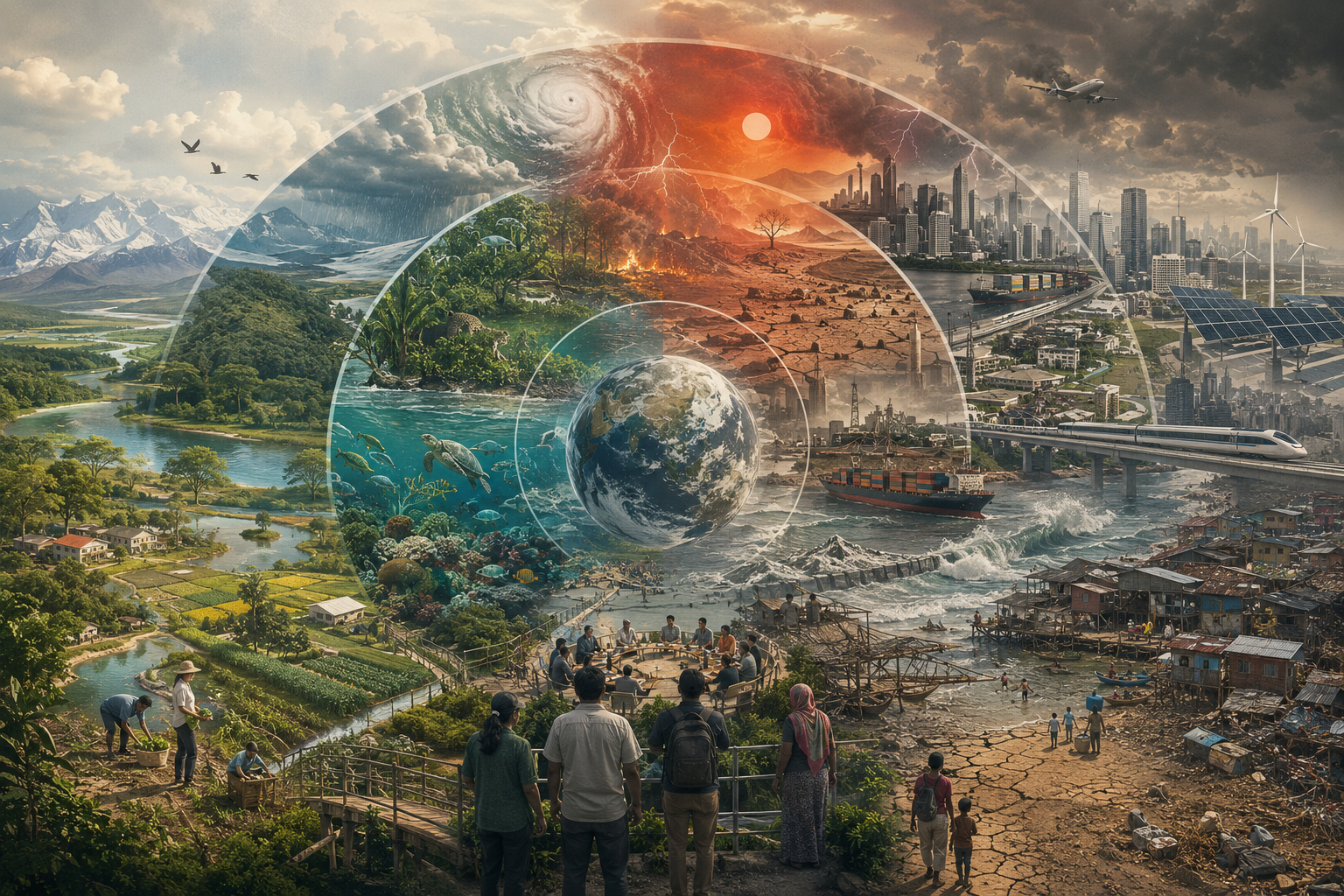
This shift changes how sustainable development must be understood. Development can no longer be treated as a local, national, economic, or sectoral question alone. It must be approached as a question of how societies operate within planetary limits while protecting the ecological stability on which prosperity depends. In the Anthropocene, development strategy must ask whether economic systems, infrastructure, food systems, energy systems, cities, trade networks, financial institutions, and governance arrangements strengthen Earth-system resilience or accelerate boundary transgression.
The “3–6–9 world” is a heuristic for this condition: the risk of roughly 3°C warming under insufficient mitigation, the sixth mass extinction or wider biodiversity crisis, and a human population moving through the scale of 9 billion people within a finite Earth system. The phrase should not be read as a precise forecast. It is a compact way of naming the converging pressures of climate destabilization, biosphere decline, and demographic-development demand.
What Is the Anthropocene?
The Anthropocene is the term widely used to describe a planetary condition in which human beings have become a dominant force shaping the Earth system. Population growth, industrial metabolism, fossil fuel combustion, land conversion, resource extraction, urban expansion, global trade, synthetic chemistry, and technological production now alter planetary processes at a scale once driven primarily by natural forces. In this sense, humanity has become a geological and Earth-system agent.
The concept matters because it reframes environmental change. Climate change, biodiversity loss, freshwater disruption, nutrient overload, ocean acidification, land transformation, and synthetic chemical pollution are not isolated issues. They are interconnected symptoms of a planetary system being pushed beyond the relatively stable conditions that characterized the Holocene. The Anthropocene therefore represents more than a new label. It is a shift in how science understands humanity’s relationship to the Earth system.
This is why Anthropocene planetary risk has become a central concern in Earth system science. It refers not only to environmental degradation, but to the growing possibility that human pressure may destabilize the biophysical conditions on which development depends. A society can adapt to many local disturbances. It becomes far more vulnerable when the large-scale systems that regulate climate, water, soils, ecosystems, oceans, and atmospheric chemistry become less stable at the same time.
The Anthropocene also changes the moral meaning of development. If humanity now shapes the Earth system, then development cannot be evaluated only by income, output, infrastructure, consumption, or technological capacity. It must also be judged by whether it preserves the planetary conditions that make durable human flourishing possible.
That is why the Anthropocene belongs near the foundations of planetary-boundary thinking. It names the historical moment when development, environment, infrastructure, technology, law, finance, agriculture, and public health all become Earth-system questions.
The Anthropocene as Formal Epoch and Analytic Concept
The Anthropocene is both a scientific concept and a contested geological proposal. In formal stratigraphy, geological time units require specific evidence, boundary markers, and institutional approval. In 2024, the IUGS and ICS approved the vote rejecting the proposal to define the Anthropocene as a formal unit of the Geological Time Scale. That decision means the Anthropocene is not currently an official geological epoch in the formal stratigraphic sense.
That formal decision does not make the concept irrelevant. It clarifies how the term should be used. For planetary-boundary analysis, the Anthropocene is most useful as an Earth-system, historical, and governance concept rather than as a settled stratigraphic label. It describes the scale and consequences of human transformation of the planet, whether or not the term becomes an official unit of geological time.
This distinction matters for intellectual credibility. A careful article should not claim that the Anthropocene is formally recognized as a geological epoch. It should instead say that the Anthropocene is a widely used concept for describing the planetary-scale influence of human activity on Earth-system processes. That framing is accurate, rigorous, and sufficient for sustainable development analysis.
The practical question remains unchanged: human activity is altering climate, biosphere integrity, land systems, freshwater, biogeochemical cycles, ocean chemistry, atmospheric processes, and novel entities at planetary scale. Whether the Anthropocene is formally codified as an epoch or not, the governance challenge it names remains real.
The distinction also protects the article from a false dilemma. The Anthropocene can be rejected as a formal geological unit and still remain indispensable as an analytical framework for understanding planetary risk, historical acceleration, and the responsibilities of human societies within a changing Earth system.
Anthropocene Planetary Risk and the Holocene
For roughly the past 11,700 years, the Earth has existed in the Holocene, an unusually stable climatic epoch that enabled agriculture, permanent settlement, and the rise of complex societies. Temperature variation remained within a relatively narrow range compared with earlier glacial and interglacial periods. This stability allowed ecosystems, growing seasons, coastlines, freshwater flows, and hydrological cycles to become predictable enough to support human development at scale.
Earth system science increasingly treats Holocene-like stability as the environmental foundation of civilization. That does not mean the Holocene was socially peaceful, politically just, or environmentally untouched. It means that the broad biophysical envelope was comparatively stable enough for societies to build agriculture, cities, states, markets, infrastructure, and long-distance exchange. If that stability weakens, the institutions and infrastructures built within it become more vulnerable.
In that sense, sustainable development is not simply about balancing economy, society, and environment in the abstract. It is about maintaining the Earth-system conditions that made human development possible in the first place. Food security, public health, water systems, insurance, finance, infrastructure, mobility, housing, and public institutions all assume a certain range of climatic and ecological regularity. When that regularity erodes, development becomes harder to sustain.
Anthropocene planetary risk is best understood against this Holocene baseline. The more human activity pushes the Earth system away from the conditions that supported civilization, the more development must confront systemic instability rather than isolated environmental problems. For further background, see Holocene Climate Stability.
The Holocene is therefore not a nostalgic ideal. It is a scientific reference point for understanding stability. The Anthropocene is the warning that the stability envelope within which modern civilization was built can no longer be assumed to hold automatically.
The 3–6–9 World
One useful way to interpret Anthropocene risk is through what might be called a 3–6–9 world:
- 3 degrees Celsius of warming as a risk scenario under inadequate climate mitigation,
- the sixth mass extinction as a shorthand for accelerating biodiversity loss and biosphere destabilization, and
- 9 billion people as a heuristic for demographic scale, development demand, and human need within a finite planetary system.
This framing captures the scale of the sustainability challenge. A world of substantial warming, accelerating biodiversity loss, and continued demand for food, water, energy, housing, materials, and infrastructure cannot be managed with narrow policy silos. It requires systems thinking, long-range planning, boundary-aware development, and governance models that recognize ecological thresholds.
The 3–6–9 framing should be used carefully. It is not a formal scientific model and should not replace more precise climate scenarios, biodiversity indicators, or population projections. Its value is interpretive. It compresses three major pressures into a memorable structure: climate risk, biosphere risk, and development demand. Each of these pressures is serious on its own. Together they define the strategic difficulty of sustainable development in the Anthropocene.
The core point is that Anthropocene planetary risk is not only about reducing emissions, protecting species, or managing population. It is about governing development within a world of interconnected pressures, where local prosperity increasingly depends on global Earth-system stability.
The “9” should also never be used to blame vulnerable populations for planetary crisis. Population scale matters, but the real drivers of boundary transgression include unequal consumption, fossil energy, industrial agriculture, high-throughput material systems, extractive trade, and institutional choices. The 3–6–9 framing is strongest when it connects demographic need to justice, not when it treats population as a scapegoat.
Three Degrees of Warming
The “3” in the 3–6–9 world refers to the risk of warming on the order of 3°C under insufficient mitigation. A 3°C world would not simply be a warmer version of the present. It would involve far greater risks of extreme heat, drought, flood, sea-level rise, food-system disruption, water stress, wildfire, ecosystem loss, migration pressure, infrastructure failure, public-health strain, and geopolitical instability.
Climate change is especially important because it is one of the two core planetary boundaries. It interacts with nearly every other boundary. Warming affects freshwater systems, biosphere integrity, land systems, ocean chemistry, cryosphere stability, disease ecology, agriculture, and extreme events. It is therefore not merely one environmental problem among others. It is a systemic stress amplifier.
A 3°C framing also helps clarify why climate adaptation alone is not enough. Societies must adapt to impacts already underway, but adaptation becomes increasingly difficult as warming intensifies. There are limits to how much heat people can endure, how much drought food systems can absorb, how much sea-level rise coastal systems can manage, and how much ecological disruption ecosystems can withstand.
This is why mitigation, adaptation, restoration, and resilience must be treated together. Climate strategy must reduce emissions while also strengthening systems that absorb shocks. For a dedicated planetary-boundary treatment, see Climate Change as a Planetary Boundary.
The “3” is therefore not only a temperature marker. It is a warning about the compounding social and institutional consequences of climate destabilization. At higher levels of warming, infrastructure, insurance, agriculture, urban planning, public health, migration governance, and disaster response all face stress beyond the assumptions under which many systems were built.
Sixth Mass Extinction and Biosphere Integrity
The “6” in the 3–6–9 world refers to the sixth mass extinction or, more broadly, the accelerating biodiversity crisis. The phrase is powerful because it communicates the scale of species loss, habitat destruction, ecological simplification, and biological disruption now associated with human activity. Yet in planetary-boundary terms, the issue is even broader than species extinction alone. It is the weakening of biosphere integrity.
Biosphere integrity matters because living systems help regulate the Earth system. Forests store carbon and recycle moisture. Wetlands filter water and buffer floods. Soils support food production and carbon cycling. Pollinators sustain crops and wild plants. Marine ecosystems support food webs, carbon pathways, and oxygen dynamics. Microbial systems regulate decomposition, nutrient cycling, and soil health. When biodiversity declines, the Earth system loses functional capacity.
This is why the planetary boundaries framework identifies biosphere integrity as one of the two core boundaries. Severe disruption to the biosphere can, by itself, weaken Earth-system stability. It also amplifies other risks. Deforestation affects climate and hydrology. Soil degradation affects food systems and carbon storage. Pollinator decline affects agriculture. Marine ecosystem disruption affects food security and ocean resilience.
The sixth-extinction framing therefore belongs inside a broader biosphere-integrity argument. The concern is not only the loss of individual species, although that loss is morally and ecologically serious. The deeper planetary concern is that the living fabric of Earth is being simplified, fragmented, and weakened in ways that reduce resilience. See Biosphere Integrity and the Stability of Life Systems.
The biosphere is not decorative scenery around human society. It is living infrastructure. It helps regulate water, climate, soil, food systems, disease dynamics, coastal protection, and recovery from disturbance. When that living infrastructure is weakened, development becomes more exposed to shocks.
Nine Billion People and Development Demand
The “9” in the 3–6–9 world refers to demographic scale and development demand. The United Nations projects that global population will continue growing for several decades, reaching roughly 10.3 billion in the mid-2080s before gradually declining. The 9-billion figure should therefore be understood as a heuristic threshold within a larger demographic transition, not as a fixed endpoint.
Population matters, but it must be interpreted carefully. Planetary pressure is not determined by population alone. It depends on consumption, inequality, technology, energy systems, food systems, land use, infrastructure, waste, governance, and power. A high-consuming minority can impose far greater planetary pressure than a much larger low-consuming population. Any responsible 3–6–9 analysis must therefore avoid simplistic population blame and focus instead on development models, resource use, inequality, and institutional design.
The development challenge remains real. Billions of people need food security, clean water, housing, sanitation, electricity, transportation, health care, education, and climate resilience. Many communities have contributed least to planetary destabilization while facing the greatest exposure to its consequences. Sustainable development in the Anthropocene therefore cannot mean freezing global inequality in place. It must mean meeting human needs while transforming the systems that drive boundary transgression.
This is where the 3–6–9 framing becomes ethically important. The goal is not fewer people with dignity denied. The goal is a development pathway that allows human flourishing without destroying the Earth-system foundations of that flourishing. For a direct bridge, see Sustainable Development Goals Within Planetary Boundaries.
The “9” is therefore a reminder of scale, not blame. It asks whether food, water, energy, housing, health, mobility, and infrastructure can be provided through systems that reduce ecological pressure rather than reproduce the high-consumption, fossil-intensive, extractive pathways that created the present crisis.
Planetary Boundaries and Earth System Limits
A central insight of Earth system science is that many planetary processes remain stable only within certain ranges. Atmospheric carbon dioxide concentrations, radiative forcing, freshwater flows, nutrient cycles, biosphere integrity, land systems, ocean carbonate chemistry, stratospheric ozone, atmospheric aerosols, and synthetic chemical burdens all shape Earth-system stability. Human activity is now pushing several of these processes beyond safer historical ranges.
This recognition helped give rise to the planetary boundaries framework, which identifies key Earth-system processes that should not be destabilized if humanity wishes to remain within a safe operating space. The framework does not claim that every threshold is perfectly fixed or simple. Rather, it provides a governance model for thinking about risk in a complex planetary system.
The current scientific context makes this framework increasingly urgent. The 2023 global assessment concluded that six of nine planetary boundaries had been transgressed. The 2025 Planetary Health Check reports that seven of nine are now breached, with ocean acidification newly crossing the boundary. This does not mean collapse is inevitable, but it does mean the world is moving deeper into a high-risk zone.
In practical terms, planetary boundaries shift sustainable development away from the assumption that environmental systems can absorb unlimited pressure. They suggest instead that economic and social systems must be designed to function within ecological constraints. That is the governance logic at the center of Anthropocene planetary risk.
The framework also clarifies why one-boundary thinking is inadequate. A climate-only strategy that worsens biodiversity loss, freshwater stress, land-system pressure, or material extraction is not fully boundary-aware. Anthropocene risk requires integrated governance across interacting Earth-system processes.
Tipping Points and Nonlinear Risk
One of the most serious implications of Anthropocene science is that Earth-system change may not proceed gradually. Some systems can cross tipping points, after which change becomes abrupt, nonlinear, and difficult or impossible to reverse on human timescales. Tipping elements commonly discussed in the scientific literature include major ice sheets, monsoon systems, rainforest resilience, permafrost, coral reefs, and large-scale ocean circulation.
These are not minor background shifts. They represent the possibility that human pressure could trigger systemic transitions that alter rainfall patterns, coastlines, food production, ecosystems, and habitability across large regions. A tipping point does not need to affect the entire planet instantly to be planetary in consequence. Regional tipping dynamics can propagate through food systems, trade, finance, migration, infrastructure, and geopolitics.
This is why Anthropocene planetary risk cannot be understood in linear terms alone. When nonlinear risks are present, precaution becomes more than a philosophical preference. It becomes a practical requirement of responsible development. Waiting for certainty may mean waiting until a system has already crossed a threshold.
Planetary boundaries and resilience thinking both help interpret this problem. Boundaries identify zones of rising risk. Resilience thinking explains how systems absorb disturbance, lose buffering capacity, and reorganize. Together, they show why development strategy must preserve buffers before thresholds are crossed. See Tipping Points, Feedback Loops, and Cascading Ecological Change.
The political difficulty is that nonlinear risk often becomes visible too late for easy intervention. Institutions built around short election cycles, quarterly returns, or annual budgets struggle to govern systems whose thresholds may be crossed slowly and then abruptly. Anthropocene governance must therefore become more anticipatory than reactive.
Why Anthropocene Risk Matters for Sustainable Development
The Anthropocene matters because it collapses the old distinction between environmental protection and economic development. A city cannot plan infrastructure without considering heat stress, water security, flood exposure, air quality, ecosystem services, and ecological resilience. Agriculture cannot be treated solely as a productivity problem if climate instability, pollinator loss, soil degradation, and hydrological change are undermining the conditions of production. Public health cannot be separated from climate-sensitive disease patterns, food insecurity, air pollution, chemical exposure, and extreme events.
In other words, sustainable development in the Anthropocene requires societies to operate with a deeper understanding of planetary interdependence. Development must be evaluated not only by output or growth, but by whether it preserves resilience, reduces systemic risk, and remains compatible with long-term Earth-system stability.
This changes the meaning of progress. Progress cannot be measured only by whether more goods and services are produced. It must also ask whether production systems undermine the ecological foundations that make future development possible. A development model that increases income while destabilizing climate, water, soils, ecosystems, and public health is not durable development. It is deferred risk.
This perspective aligns with broader work on The Great Acceleration, Resilience Thinking in the Anthropocene, and Earth System Governance in an Age of Limits.
The development task is therefore not simply to add an environmental chapter to conventional policy. It is to rethink development itself as a planetary condition: a way of organizing human flourishing within Earth-system limits while protecting the social foundations of dignity and justice.
Justice and Unequal Responsibility
Anthropocene planetary risk is not evenly produced, and it is not evenly experienced. High-consuming societies, fossil-fuel-intensive economies, industrial agriculture, extractive industries, and historically wealthy states have contributed disproportionately to many forms of planetary pressure. Meanwhile, low-income communities, Indigenous peoples, small island states, subsistence farmers, informal urban settlements, coastal populations, and future generations often face the highest exposure to climate, ecological, and economic disruption.
This means that Anthropocene sustainability cannot be only a technical exercise. It must also be a justice project. Climate mitigation, biodiversity protection, land-system restoration, freshwater governance, and chemical regulation all raise questions of responsibility, capability, rights, reparative finance, technological access, development space, and institutional legitimacy.
The 3–6–9 framing must therefore avoid treating humanity as a single undifferentiated force. “Humanity” has become a planetary force in aggregate, but not all humans have contributed equally to that force. Nor do all humans have equal power to change the systems that drive boundary transgression. A serious Anthropocene analysis must distinguish between survival needs and luxury consumption, between historical responsibility and present vulnerability, and between development justice and extractive growth.
This is where planetary-boundary analysis intersects with Planetary Boundaries, Justice, and Global Inequality and Planetary Boundaries and Doughnut Economics. The challenge is to remain within ecological ceilings while meeting social foundations.
Justice also changes the meaning of transformation. A transition that reduces planetary pressure while deepening poverty, displacement, debt, or exclusion is not a just transition. A development model that meets basic needs while reducing destructive excess is the more serious Anthropocene project.
Precaution and Governance in the Anthropocene
If the Holocene was the stable environmental backdrop of civilization, the Anthropocene is the era in which that backdrop can no longer be taken for granted. Humanity now occupies what might be called the planetary driver’s seat. That reality creates both responsibility and risk.
The most defensible response is not fatalism but precaution. When scientific evidence shows that human activity is destabilizing core Earth-system processes, and when some of those processes may involve irreversible tipping dynamics, development strategy must incorporate caution before damage becomes unmanageable. Precaution in this context means reducing known pressures, strengthening resilience, improving monitoring, protecting ecological buffers, and designing institutions capable of responding to uncertainty.
Governance in the Anthropocene must also become more integrated. Climate policy cannot be separated from land policy. Biodiversity cannot be separated from food systems. Water cannot be separated from energy, agriculture, forests, and urbanization. Finance cannot be separated from physical risk, transition risk, and ecological dependency. Planetary risk requires institutions capable of seeing interactions across sectors and scales.
Sustainable development in the Anthropocene is therefore not a matter of preserving nature as an external object. It is the project of maintaining a habitable, resilient, and just Earth system for human societies now and in the future.
The governance challenge is also institutional. Planetary risk cannot be governed by isolated agencies, fragmented indicators, short-term incentives, or delayed response systems. It requires public capacity, democratic legitimacy, scientific monitoring, adaptive planning, precautionary law, finance aligned with Earth-system risk, and participation from communities whose lives are directly shaped by ecological change.
Development Strategy in a 3–6–9 World
Development strategy in a 3–6–9 world must be both transformative and protective. It must transform the systems that drive boundary transgression while protecting people from the harms already produced by planetary instability. That means rapid decarbonization, biosphere repair, food-system redesign, freshwater resilience, safer chemical governance, circular material systems, and infrastructure planned for climate and ecological stress.
At the same time, it means expanding social foundations. Billions of people still need secure housing, public health, clean water, sanitation, electricity, education, transport, nutrition, and protection from shocks. The Anthropocene does not abolish development need. It intensifies the need for development pathways that meet human needs without deepening ecological destabilization.
This creates a difficult but unavoidable distinction. Some forms of activity must be reduced because they represent destructive excess: luxury emissions, wasteful material throughput, avoidable pollution, fossil lock-in, planned obsolescence, and extractive supply chains. Other forms of activity must expand because they represent unmet human need: climate-resilient housing, clean energy access, public health systems, ecosystem restoration, care infrastructure, food security, and adaptive public institutions.
The strategic task is not therefore “less” in every domain. It is redirection. Anthropocene development must reduce the pressures that push the Earth system toward instability while accelerating the capabilities that make dignified, resilient, low-pressure human flourishing possible.
That redirection requires more than individual behavior change. It requires public investment, industrial policy, legal reform, international cooperation, public finance, technology governance, democratic participation, and institutions capable of coordinating across time horizons and scales.
Common Misunderstandings
A common misunderstanding is that the Anthropocene must be formally accepted as a geological epoch before it can be useful. It does not. The term remains analytically useful as a description of planetary-scale human influence even though it is not currently an official stratigraphic unit.
Another misunderstanding is that the 3–6–9 framing is a precise forecast. It is not. It is a heuristic for thinking about the combined pressure of climate destabilization, biosphere degradation, and development demand. More precise analysis should always use climate scenarios, biodiversity metrics, population projections, material-flow data, and boundary indicators.
A third misunderstanding is that population alone explains planetary risk. Population matters, but consumption, inequality, technology, energy systems, food systems, land use, institutions, and historical responsibility matter enormously. A serious Anthropocene analysis must avoid blaming vulnerable populations for planetary pressures driven disproportionately by high-consumption systems.
A fourth misunderstanding is that planetary risk means inevitable collapse. Boundary transgression and Anthropocene risk indicate rising danger, not predetermined outcomes. The future still depends on mitigation, adaptation, restoration, governance, finance, technological choices, social movements, justice, and institutional learning.
A final misunderstanding is that sustainability in the Anthropocene means abandoning development. The opposite is true. It means defending the possibility of durable development by transforming the systems that currently undermine the planetary conditions on which development depends.
Why This Matters for Planetary Boundaries
Anthropocene planetary risk matters because it explains why planetary boundaries are not abstract environmental indicators. They are the biophysical limits within which development, infrastructure, health, food systems, finance, cities, and public institutions remain viable. The Anthropocene names the condition in which human activity has become powerful enough to destabilize those limits.
The 3–6–9 framing matters because it compresses the challenge into three interacting pressures: climate destabilization, biosphere decline, and development demand at human scale. These pressures do not operate separately. Warming affects ecosystems and food systems. Biodiversity loss affects resilience and health. Development demand affects energy, land, water, materials, and infrastructure. Weak governance amplifies all three.
The issue is also one of justice. Planetary risk has been produced unevenly and is experienced unevenly. The people and places most exposed to climate disruption, ecological loss, food insecurity, land degradation, and water stress are often those least responsible for high-throughput development. A serious planetary-boundary response must therefore combine ecological ceilings with social foundations.
To navigate the Anthropocene is not to give up on development. It is to redesign development so that human flourishing no longer depends on the destabilization of the Earth system. That requires precaution, resilience, restoration, rapid mitigation, safer material systems, public capacity, and democratic legitimacy.
Development becomes credible in the Anthropocene when it protects human dignity while preserving the climate, biosphere, freshwater, land, ocean, atmospheric, and chemical conditions that make dignity materially possible.
Mathematical Lens
The 3–6–9 world can be represented as a coupled risk system. Let \(C_t\) represent normalized climate pressure at time \(t\), \(B_t\) represent normalized biosphere pressure, and \(D_t\) represent normalized development demand. A simple Anthropocene pressure index can be written as:
A_t = \alpha C_t + \beta B_t + \gamma D_t
\]
Interpretation: Anthropocene pressure can be approximated as a weighted combination of climate pressure, biosphere pressure, and development demand.
This simple index is useful only as a starting point. Anthropocene risk is not merely additive. These pressures interact. Cross-pressure amplification can be represented as:
I_t = w_{CB}C_tB_t + w_{CD}C_tD_t + w_{BD}B_tD_t
\]
Interpretation: Interaction terms represent the way climate risk, biosphere decline, and development demand can amplify one another.
A coupled Anthropocene risk score can then be written as:
R_t = A_t(1 + I_t)(1 – G_t)
\]
Interpretation: Risk rises when core pressures are high, interaction effects are strong, and governance, adaptive, and learning capacity are weak.
Planetary-boundary distance can be added by comparing each control variable \(X_i(t)\) to its boundary value \(B_i\):
P_i(t) = \frac{X_i(t)}{B_i}
\]
Interpretation: A value greater than 1 indicates that the control variable exceeds its boundary value.
A risk-zone function can then be modeled as:
Z_i(t) = \frac{1}{1 + e^{-k(P_i(t) – 1)}}
\]
Interpretation: A logistic risk-zone function can represent rising concern as a system approaches or exceeds a boundary, without claiming that Earth-system behavior follows this exact curve.
| Term | Meaning | Interpretive role |
|---|---|---|
| \(C_t\) | Climate pressure | Represents warming, emissions, radiative forcing, or other climate-related pressure at time \(t\). |
| \(B_t\) | Biosphere pressure | Represents biodiversity loss, ecosystem degradation, functional integrity decline, or biosphere stress. |
| \(D_t\) | Development demand | Represents demand for food, water, energy, housing, infrastructure, health, mobility, and material systems. |
| \(A_t\) | Core Anthropocene pressure | Represents weighted pressure from climate, biosphere, and development conditions. |
| \(I_t\) | Cross-pressure amplification | Represents interactions among climate pressure, biosphere pressure, and development demand. |
| \(G_t\) | Governance capacity | Represents institutional ability to mitigate, adapt, restore, learn, and govern justly. |
| \(P_i(t)\) | Boundary pressure ratio | Represents the value of a planetary-boundary control variable relative to its boundary value. |
| \(Z_i(t)\) | Risk-zone function | Represents rising concern as a boundary is approached or transgressed. |
The broader lesson is that Anthropocene risk should be analyzed as a coupled system of climate pressure, biosphere decline, development demand, boundary transgression, cross-system interaction, and governance capacity. The equations are conceptual tools for making that structure visible, not substitutes for full Earth-system models or political judgment.
Advanced Python Workflow: 3–6–9 Anthropocene Risk Diagnostics
The following Python workflow models the 3–6–9 world as a coupled Anthropocene risk diagnostic. It separates climate pressure, biosphere pressure, development demand, boundary transgression, cross-pressure amplification, governance capacity, adaptive capacity, justice capacity, and transformation urgency. The values are illustrative, but the structure can be adapted for scenario analysis, sustainability dashboards, risk assessments, Earth-system governance tools, and planetary-boundary reporting.
"""
Anthropocene 3-6-9 risk diagnostics.

This workflow models a simplified 3-6-9 world:
- 3: climate pressure under inadequate mitigation
- 6: biosphere pressure associated with biodiversity loss
- 9: demographic-development demand in a finite Earth system

The workflow also includes:
- planetary-boundary transgression
- cross-pressure amplification
- governance capacity
- adaptive capacity
- justice capacity
- transformation urgency

The values are illustrative. Replace them with documented indicators,
scenario data, population projections, climate pathway data, biodiversity
metrics, governance assessments, and transparent assumptions before applied use.
"""

from __future__ import annotations

from dataclasses import dataclass
from pathlib import Path
from typing import Literal

import numpy as np
import pandas as pd


RiskClass = Literal[
    "managed_transition",
    "rising_systemic_risk",
    "high_anthropocene_risk",
    "transformation_urgent",
]


@dataclass(frozen=True)
class AnthropoceneScenario:
    """Scenario profile for Anthropocene 3-6-9 risk analysis."""

    scenario: str
    warming_pressure: float
    biosphere_pressure: float
    development_demand: float
    boundary_transgression_count: int
    governance_capacity: float
    adaptive_capacity: float
    justice_capacity: float
    mitigation_capacity: float
    restoration_capacity: float
    institutional_learning: float


def build_scenarios() -> pd.DataFrame:
    """Create illustrative Anthropocene scenario profiles."""
    scenarios = [
        AnthropoceneScenario(
            scenario="current_fragmented_response",
            warming_pressure=0.82,
            biosphere_pressure=0.88,
            development_demand=0.76,
            boundary_transgression_count=7,
            governance_capacity=0.42,
            adaptive_capacity=0.48,
            justice_capacity=0.34,
            mitigation_capacity=0.44,
            restoration_capacity=0.38,
            institutional_learning=0.46,
        ),
        AnthropoceneScenario(
            scenario="climate_policy_without_biosphere_repair",
            warming_pressure=0.62,
            biosphere_pressure=0.84,
            development_demand=0.74,
            boundary_transgression_count=6,
            governance_capacity=0.50,
            adaptive_capacity=0.54,
            justice_capacity=0.42,
            mitigation_capacity=0.62,
            restoration_capacity=0.40,
            institutional_learning=0.52,
        ),
        AnthropoceneScenario(
            scenario="green_growth_with_high_material_demand",
            warming_pressure=0.58,
            biosphere_pressure=0.72,
            development_demand=0.88,
            boundary_transgression_count=6,
            governance_capacity=0.56,
            adaptive_capacity=0.58,
            justice_capacity=0.44,
            mitigation_capacity=0.68,
            restoration_capacity=0.46,
            institutional_learning=0.56,
        ),
        AnthropoceneScenario(
            scenario="planetary_boundary_aligned_development",
            warming_pressure=0.42,
            biosphere_pressure=0.46,
            development_demand=0.62,
            boundary_transgression_count=4,
            governance_capacity=0.72,
            adaptive_capacity=0.70,
            justice_capacity=0.66,
            mitigation_capacity=0.76,
            restoration_capacity=0.72,
            institutional_learning=0.74,
        ),
        AnthropoceneScenario(
            scenario="just_transition_and_ecological_restoration",
            warming_pressure=0.36,
            biosphere_pressure=0.38,
            development_demand=0.58,
            boundary_transgression_count=3,
            governance_capacity=0.80,
            adaptive_capacity=0.76,
            justice_capacity=0.78,
            mitigation_capacity=0.82,
            restoration_capacity=0.80,
            institutional_learning=0.82,
        ),
    ]

    return pd.DataFrame([scenario.__dict__ for scenario in scenarios])


def classify_risk(score: float, transformation_urgency: float) -> RiskClass:
    """Classify Anthropocene risk condition."""
    if score >= 1.40 and transformation_urgency >= 0.75:
        return "transformation_urgent"
    if score >= 1.05:
        return "high_anthropocene_risk"
    if score >= 0.70:
        return "rising_systemic_risk"
    return "managed_transition"


def score_anthropocene_risk(data: pd.DataFrame) -> pd.DataFrame:
    """Calculate 3-6-9 Anthropocene risk diagnostics."""
    scored = data.copy()

    scored["boundary_transgression_pressure"] = (
        scored["boundary_transgression_count"] / 9.0
    )

    scored["core_369_pressure"] = (
        0.36 * scored["warming_pressure"]
        + 0.34 * scored["biosphere_pressure"]
        + 0.30 * scored["development_demand"]
    )

    scored["cross_pressure_amplification"] = (
        0.35 * scored["warming_pressure"] * scored["biosphere_pressure"]
        + 0.25 * scored["warming_pressure"] * scored["development_demand"]
        + 0.25 * scored["biosphere_pressure"] * scored["development_demand"]
        + 0.15 * scored["boundary_transgression_pressure"]
    )

    scored["governance_resilience_capacity"] = (
        0.20 * scored["governance_capacity"]
        + 0.18 * scored["adaptive_capacity"]
        + 0.18 * scored["justice_capacity"]
        + 0.16 * scored["mitigation_capacity"]
        + 0.16 * scored["restoration_capacity"]
        + 0.12 * scored["institutional_learning"]
    )

    scored["anthropocene_risk_score"] = (
        scored["core_369_pressure"]
        * (1 + scored["cross_pressure_amplification"])
        * (1 - 0.55 * scored["governance_resilience_capacity"])
        * (1 + 0.35 * scored["boundary_transgression_pressure"])
    )

    scored["transformation_urgency"] = (
        scored["anthropocene_risk_score"]
        * (1 - scored["governance_resilience_capacity"])
        * (1 + scored["boundary_transgression_pressure"])
    )

    scored["risk_class"] = [
        classify_risk(score, urgency)
        for score, urgency in zip(
            scored["anthropocene_risk_score"],
            scored["transformation_urgency"],
        )
    ]

    scored["priority"] = np.select(
        [
            scored["risk_class"] == "transformation_urgent",
            scored["biosphere_pressure"] >= 0.75,
            scored["warming_pressure"] >= 0.75,
            scored["justice_capacity"] < 0.45,
            scored["development_demand"] >= 0.80,
        ],
        [
            "system_transformation",
            "biosphere_integrity_repair",
            "accelerated_climate_mitigation",
            "justice_centered_development",
            "resource_demand_reduction",
        ],
        default="integrated_boundary_governance",
    )

    return scored.sort_values(
        "anthropocene_risk_score",
        ascending=False,
    ).reset_index(drop=True)


def main() -> None:
    """Run Anthropocene 3-6-9 risk diagnostics."""
    output_dir = Path(
        "articles/navigating-the-anthropocene-sustainable-development-3-6-9-world/outputs"
    )
    output_dir.mkdir(parents=True, exist_ok=True)

    scenarios = build_scenarios()
    scored = score_anthropocene_risk(scenarios)

    scored.to_csv(output_dir / "anthropocene_369_risk_scores.csv", index=False)

    print("\nAnthropocene 3-6-9 risk diagnostics:")
    print(scored.to_string(index=False))


if __name__ == "__main__":
    main()
This workflow is intentionally transparent. It does not claim to produce definitive Anthropocene risk scores. It provides a reproducible structure for connecting climate pressure, biosphere pressure, development demand, boundary transgression, governance capacity, justice capacity, and transformation urgency. In applied use, the illustrative values should be replaced with documented scenario data and explicit assumptions.
Advanced R Workflow: Anthropocene Risk Dashboarding
The following R workflow prepares dashboard-ready outputs for the 3–6–9 Anthropocene risk framework. It is designed for sustainability analysts, development planners, climate adaptation teams, resilience researchers, policy groups, and environmental governance practitioners who need to compare climate pressure, biosphere pressure, development demand, boundary transgression, justice capacity, governance resilience, and transformation urgency across scenarios.
# Anthropocene 3-6-9 risk dashboard
#
# This workflow scores scenario-level Anthropocene risk across:
# - warming pressure
# - biosphere pressure
# - development demand
# - planetary-boundary transgression count
# - governance capacity
# - adaptive capacity
# - justice capacity
# - mitigation capacity
# - restoration capacity
# - institutional learning
#
# Values are illustrative and should be replaced with documented scenario data,
# climate pathway data, biodiversity metrics, population projections, governance
# assessments, and transparent assumptions before applied use.

library(readr)
library(dplyr)
library(tidyr)

anthropocene_scenarios <- tibble::tibble(
  scenario = c(
    "current_fragmented_response",
    "climate_policy_without_biosphere_repair",
    "green_growth_with_high_material_demand",
    "planetary_boundary_aligned_development",
    "just_transition_and_ecological_restoration"
  ),
  warming_pressure = c(0.82, 0.62, 0.58, 0.42, 0.36),
  biosphere_pressure = c(0.88, 0.84, 0.72, 0.46, 0.38),
  development_demand = c(0.76, 0.74, 0.88, 0.62, 0.58),
  boundary_transgression_count = c(7, 6, 6, 4, 3),
  governance_capacity = c(0.42, 0.50, 0.56, 0.72, 0.80),
  adaptive_capacity = c(0.48, 0.54, 0.58, 0.70, 0.76),
  justice_capacity = c(0.34, 0.42, 0.44, 0.66, 0.78),
  mitigation_capacity = c(0.44, 0.62, 0.68, 0.76, 0.82),
  restoration_capacity = c(0.38, 0.40, 0.46, 0.72, 0.80),
  institutional_learning = c(0.46, 0.52, 0.56, 0.74, 0.82)
)

scored <- anthropocene_scenarios %>%
  mutate(
    boundary_transgression_pressure = boundary_transgression_count / 9,

    core_369_pressure =
      0.36 * warming_pressure +
      0.34 * biosphere_pressure +
      0.30 * development_demand,

    cross_pressure_amplification =
      0.35 * warming_pressure * biosphere_pressure +
      0.25 * warming_pressure * development_demand +
      0.25 * biosphere_pressure * development_demand +
      0.15 * boundary_transgression_pressure,

    governance_resilience_capacity =
      0.20 * governance_capacity +
      0.18 * adaptive_capacity +
      0.18 * justice_capacity +
      0.16 * mitigation_capacity +
      0.16 * restoration_capacity +
      0.12 * institutional_learning,

    anthropocene_risk_score =
      core_369_pressure *
      (1 + cross_pressure_amplification) *
      (1 - 0.55 * governance_resilience_capacity) *
      (1 + 0.35 * boundary_transgression_pressure),

    transformation_urgency =
      anthropocene_risk_score *
      (1 - governance_resilience_capacity) *
      (1 + boundary_transgression_pressure),

    risk_class = case_when(
      anthropocene_risk_score >= 1.40 & transformation_urgency >= 0.75 ~ "transformation_urgent",
      anthropocene_risk_score >= 1.05 ~ "high_anthropocene_risk",
      anthropocene_risk_score >= 0.70 ~ "rising_systemic_risk",
      TRUE ~ "managed_transition"
    ),

    priority = case_when(
      risk_class == "transformation_urgent" ~ "system_transformation",
      biosphere_pressure >= 0.75 ~ "biosphere_integrity_repair",
      warming_pressure >= 0.75 ~ "accelerated_climate_mitigation",
      justice_capacity < 0.45 ~ "justice_centered_development",
      development_demand >= 0.80 ~ "resource_demand_reduction",
      TRUE ~ "integrated_boundary_governance"
    )
  ) %>%
  arrange(desc(anthropocene_risk_score))

dashboard_long <- scored %>%
  select(
    scenario,
    warming_pressure,
    biosphere_pressure,
    development_demand,
    boundary_transgression_pressure,
    core_369_pressure,
    cross_pressure_amplification,
    governance_resilience_capacity,
    anthropocene_risk_score,
    transformation_urgency
  ) %>%
  pivot_longer(
    cols = -scenario,
    names_to = "metric",
    values_to = "value"
  )

summary_by_class <- scored %>%
  group_by(risk_class) %>%
  summarise(
    scenarios = n(),
    mean_core_369_pressure = mean(core_369_pressure),
    mean_governance_resilience_capacity = mean(governance_resilience_capacity),
    mean_anthropocene_risk_score = mean(anthropocene_risk_score),
    mean_transformation_urgency = mean(transformation_urgency),
    .groups = "drop"
  )

dir.create(
  "articles/navigating-the-anthropocene-sustainable-development-3-6-9-world/outputs",
  recursive = TRUE,
  showWarnings = FALSE
)

write_csv(
  scored,
  "articles/navigating-the-anthropocene-sustainable-development-3-6-9-world/outputs/r_anthropocene_369_scores.csv"
)

write_csv(
  dashboard_long,
  "articles/navigating-the-anthropocene-sustainable-development-3-6-9-world/outputs/r_anthropocene_369_dashboard_long.csv"
)

write_csv(
  summary_by_class,
  "articles/navigating-the-anthropocene-sustainable-development-3-6-9-world/outputs/r_anthropocene_369_summary.csv"
)

print(scored)
print(summary_by_class)
R is useful here because scenario-level Anthropocene risk analysis often needs to be translated into dashboard-ready tables, long-format visual datasets, and grouped summaries. This workflow keeps the framework reproducible while making it easier to compare scenarios across warming pressure, biosphere pressure, development demand, governance resilience, and transformation urgency.
Advanced Go Workflow: Lightweight Anthropocene Risk Scoring Service
This Go workflow translates the article’s 3–6–9 risk logic into a compact scoring service. Python and R are strong for analysis and reporting, but Go is useful when Anthropocene risk diagnostics need to run as a lightweight command-line tool or service behind a dashboard, API, or governance workflow. The service validates inputs, computes core pressure, cross-pressure amplification, governance resilience, risk score, transformation urgency, and a readable risk class.
package main

import (
	"encoding/csv"
	"fmt"
	"os"
	"strconv"
)

type AnthropoceneRecord struct {
	Scenario                    string
	WarmingPressure              float64
	BiospherePressure            float64
	DevelopmentDemand           float64
	BoundaryTransgressionCount   float64
	GovernanceCapacity           float64
	AdaptiveCapacity             float64
	JusticeCapacity              float64
	MitigationCapacity           float64
	RestorationCapacity          float64
	InstitutionalLearning        float64
}

func parseFloat(value string) (float64, error) {
	parsed, err := strconv.ParseFloat(value, 64)
	if err != nil {
		return 0, err
	}

	if parsed < 0 {
		return 0, fmt.Errorf("value cannot be negative: %f", parsed)
	}

	return parsed, nil
}

func parseRecord(row []string) (AnthropoceneRecord, error) {
	if len(row) != 11 {
		return AnthropoceneRecord{}, fmt.Errorf("invalid record length: expected 11 columns")
	}

	values := make([]float64, 10)

	for i, col := range row[1:] {
		value, err := parseFloat(col)
		if err != nil {
			return AnthropoceneRecord{}, err
		}

		values[i] = value
	}

	return AnthropoceneRecord{
		Scenario:                  row[0],
		WarmingPressure:           values[0],
		BiospherePressure:         values[1],
		DevelopmentDemand:         values[2],
		BoundaryTransgressionCount: values[3],
		GovernanceCapacity:        values[4],
		AdaptiveCapacity:          values[5],
		JusticeCapacity:           values[6],
		MitigationCapacity:        values[7],
		RestorationCapacity:       values[8],
		InstitutionalLearning:     values[9],
	}, nil
}

func boundaryTransgressionPressure(record AnthropoceneRecord) float64 {
	return record.BoundaryTransgressionCount / 9.0
}

func core369Pressure(record AnthropoceneRecord) float64 {
	return 0.36*record.WarmingPressure +
		0.34*record.BiospherePressure +
		0.30*record.DevelopmentDemand
}

func crossPressureAmplification(record AnthropoceneRecord) float64 {
	return 0.35*record.WarmingPressure*record.BiospherePressure +
		0.25*record.WarmingPressure*record.DevelopmentDemand +
		0.25*record.BiospherePressure*record.DevelopmentDemand +
		0.15*boundaryTransgressionPressure(record)
}

func governanceResilienceCapacity(record AnthropoceneRecord) float64 {
	return 0.20*record.GovernanceCapacity +
		0.18*record.AdaptiveCapacity +
		0.18*record.JusticeCapacity +
		0.16*record.MitigationCapacity +
		0.16*record.RestorationCapacity +
		0.12*record.InstitutionalLearning
}

func anthropoceneRiskScore(record AnthropoceneRecord) float64 {
	return core369Pressure(record) *
		(1 + crossPressureAmplification(record)) *
		(1 - 0.55*governanceResilienceCapacity(record)) *
		(1 + 0.35*boundaryTransgressionPressure(record))
}

func transformationUrgency(record AnthropoceneRecord) float64 {
	return anthropoceneRiskScore(record) *
		(1 - governanceResilienceCapacity(record)) *
		(1 + boundaryTransgressionPressure(record))
}

func riskClass(record AnthropoceneRecord) string {
	score := anthropoceneRiskScore(record)
	urgency := transformationUrgency(record)

	if score >= 1.40 && urgency >= 0.75 {
		return "transformation_urgent"
	}

	if score >= 1.05 {
		return "high_anthropocene_risk"
	}

	if score >= 0.70 {
		return "rising_systemic_risk"
	}

	return "managed_transition"
}

func main() {
	file, err := os.Open("anthropocene_369_scenarios_service.csv")
	if err != nil {
		fmt.Println("Error opening CSV:", err)
		return
	}
	defer file.Close()

	reader := csv.NewReader(file)

	rows, err := reader.ReadAll()
	if err != nil {
		fmt.Println("Error reading CSV:", err)
		return
	}

	for i, row := range rows {
		if i == 0 {
			continue
		}

		record, err := parseRecord(row)
		if err != nil {
			fmt.Println("Parse error:", err)
			continue
		}

		fmt.Printf(
			"scenario=%s core_pressure=%.3f amplification=%.3f governance_resilience=%.3f risk_score=%.3f transformation_urgency=%.3f risk_class=%s\n",
			record.Scenario,
			core369Pressure(record),
			crossPressureAmplification(record),
			governanceResilienceCapacity(record),
			anthropoceneRiskScore(record),
			transformationUrgency(record),
			riskClass(record),
		)
	}
}
The point is not to build a complete Earth-system governance platform inside the article. The point is to show how the logic of climate pressure, biosphere pressure, development demand, boundary transgression, governance resilience, and transformation urgency can be operationalized in a compact and auditable service layer. That makes the article’s conceptual framework easier to translate into dashboards, APIs, institutional risk registers, and reproducible governance tools.
Engineering Extensions in the GitHub Repository
The accompanying GitHub repository extends the article workflow beyond Python, R, and Go into a broader engineering scaffold. The article body keeps Python and R visible because they are the most accessible tools for analytics, dashboard preparation, scenario testing, and reproducible reporting. Go provides a compact service layer. The repository, however, can support readers who want to translate Anthropocene 3–6–9 risk logic into more technical systems: auditable databases, scenario-scoring engines, APIs, embedded monitoring, edge anomaly detection, and accelerator-aware environmental data workflows.
The SQL scaffold is intended for Anthropocene scenarios, climate pressure, biosphere pressure, development demand, boundary transgression counts, governance capacity, adaptive capacity, justice capacity, mitigation capacity, restoration capacity, institutional learning, scenario outputs, source provenance, and audit trails. Rust can support reliable scenario scoring where type safety and reproducibility matter. C and C++ can support embedded threshold alerts and high-performance scenario simulation. TinyML can support low-power anomaly detection at the edge, while PYNQ-oriented scaffolding can support accelerated preprocessing of environmental telemetry or dashboard inputs.
This engineering layer matters because Anthropocene risk is a systems-integration problem. A serious technical architecture should make scenario assumptions visible, uncertainty explicit, data provenance auditable, and response logic reproducible.
GitHub Repository
Complete Code Repository
The full code distribution for this article, including 3–6–9 Anthropocene risk diagnostics, planetary-boundary scenario scoring, governance-resilience analysis, SQL materials, optional service tooling, and edge-side engineering scaffolds, is available on GitHub.
Related Articles
- What Are Planetary Boundaries? Earth System Limits Explained
- The Origins of the Planetary Boundaries Framework
- Safe Operating Space and the Logic of Thresholds
- Resilience Thinking in the Anthropocene
- Planetary Boundaries and Earth System Resilience
- Tipping Points, Feedback Loops, and Cascading Ecological Change
- Climate Change as a Planetary Boundary
- Biosphere Integrity and the Stability of Life Systems
- Freshwater Change and Earth System Risk
- Land-System Change and Ecological Transformation
- Biogeochemical Flows: Nitrogen, Phosphorus, and Planetary Destabilization
- Novel Entities and the Problem of Synthetic Overload
- Sustainable Development Goals Within Planetary Boundaries
- Planetary Boundaries, Justice, and Global Inequality
- Planetary Boundaries and Doughnut Economics
- Holocene Climate Stability
- The Great Acceleration
Further Reading
- Crutzen, P.J. (2002) ‘Geology of mankind’, Nature, 415, p. 23. Available at: https://www.nature.com/articles/415023a
- Intergovernmental Panel on Climate Change (2023) Climate Change 2023: Synthesis Report. Geneva: IPCC. Available at: https://www.ipcc.ch/report/ar6/syr/
- Lenton, T.M. et al. (2008) ‘Tipping elements in the Earth’s climate system’, Proceedings of the National Academy of Sciences, 105(6), pp. 1786–1793. Available at: https://www.pnas.org/doi/10.1073/pnas.0705414105
- Planetary Health Check (2025) Planetary Health Check 2025. Potsdam: Potsdam Institute for Climate Impact Research. Available at: https://www.planetaryhealthcheck.org/
- Richardson, K. et al. (2023) ‘Earth beyond six of nine planetary boundaries’, Science Advances, 9(37), eadh2458. Available at: https://www.science.org/doi/10.1126/sciadv.adh2458
- Rockström, J. et al. (2009) ‘A safe operating space for humanity’, Nature, 461, pp. 472–475. Available at: https://www.nature.com/articles/461472a
- Steffen, W., Crutzen, P.J. and McNeill, J.R. (2007) ‘The Anthropocene: Are humans now overwhelming the great forces of nature?’, Ambio, 36(8), pp. 614–621. Available at: https://www.jstor.org/stable/25547826
- Steffen, W. et al. (2015) ‘The trajectory of the Anthropocene: The Great Acceleration’, The Anthropocene Review, 2(1), pp. 81–98. Available at: https://journals.sagepub.com/doi/10.1177/2053019614564785
- United Nations Department of Economic and Social Affairs, Population Division (2024) World Population Prospects 2024: Summary of Results. Available at: https://population.un.org/wpp/
References
- Crutzen, P.J. (2002) ‘Geology of mankind’, Nature, 415, p. 23. Available at: https://www.nature.com/articles/415023a
- Intergovernmental Panel on Climate Change (2023) Climate Change 2023: Synthesis Report. Geneva: IPCC. Available at: https://www.ipcc.ch/report/ar6/syr/
- International Commission on Stratigraphy (2024) ‘Joint statement by the IUGS and ICS on the vote by the ICS Subcommission on Quaternary Stratigraphy’. Available at: https://stratigraphy.org/news/152
- Lenton, T.M., Held, H., Kriegler, E., Hall, J.W., Lucht, W., Rahmstorf, S. and Schellnhuber, H.J. (2008) ‘Tipping elements in the Earth’s climate system’, Proceedings of the National Academy of Sciences, 105(6), pp. 1786–1793. Available at: https://www.pnas.org/doi/10.1073/pnas.0705414105
- Planetary Health Check (2025) Planetary Health Check 2025. Potsdam: Potsdam Institute for Climate Impact Research. Available at: https://www.planetaryhealthcheck.org/
- Richardson, K., Steffen, W., Lucht, W., Bendtsen, J., Cornell, S.E., Donges, J.F., Drüke, M., Fetzer, I., Bala, G., von Bloh, W., Feulner, G., Fiedler, S., Gerten, D., Gleeson, T., Hofmann, M., Huiskamp, W., Jakobsson, C., Jürgensen, J.H., Kummu, M., Mohan, C., Nogués-Bravo, D., Petri, S., Porkka, M., Rahmstorf, S., Schaphoff, S., Schulte-Uebbing, L., Staal, A., Sun, Z., Sakschewski, B. and Wang-Erlandsson, L. (2023) ‘Earth beyond six of nine planetary boundaries’, Science Advances, 9(37), eadh2458. Available at: https://www.science.org/doi/10.1126/sciadv.adh2458
- Rockström, J., Steffen, W., Noone, K., Persson, Å., Chapin, F.S. III, Lambin, E.F., Lenton, T.M., Scheffer, M., Folke, C., Schellnhuber, H.J., Nykvist, B., de Wit, C.A., Hughes, T., van der Leeuw, S., Rodhe, H., Sörlin, S., Snyder, P.K., Costanza, R., Svedin, U., Falkenmark, M., Karlberg, L., Corell, R.W., Fabry, V.J., Hansen, J., Walker, B., Liverman, D., Richardson, K., Crutzen, P. and Foley, J.A. (2009) ‘A safe operating space for humanity’, Nature, 461, pp. 472–475. Available at: https://www.nature.com/articles/461472a
- Steffen, W., Crutzen, P.J. and McNeill, J.R. (2007) ‘The Anthropocene: Are humans now overwhelming the great forces of nature?’, Ambio, 36(8), pp. 614–621. Available at: https://www.jstor.org/stable/25547826
- Steffen, W., Broadgate, W., Deutsch, L., Gaffney, O. and Ludwig, C. (2015) ‘The trajectory of the Anthropocene: The Great Acceleration’, The Anthropocene Review, 2(1), pp. 81–98. Available at: https://journals.sagepub.com/doi/10.1177/2053019614564785
- United Nations Department of Economic and Social Affairs, Population Division (2024) World Population Prospects 2024: Summary of Results. Available at: https://population.un.org/wpp/
- United Nations Environment Programme (2024) Emissions Gap Report 2024: No More Hot Air … Please! Nairobi: UNEP. Available at: https://www.unep.org/resources/emissions-gap-report-2024