
Last Updated May 28, 2026
Electrochemistry studies chemical systems in which electrons, ions, electrodes, electrolytes, interfaces, and redox reactions are linked. It explains how chemical energy becomes electrical energy, how electrical energy drives chemical change, and how materials store, release, transport, and dissipate charge. Batteries, supercapacitors, fuel cells, electrolyzers, corrosion systems, electrochemical sensors, electrodeposition processes, and electrochemical reactors all depend on the same central idea: charge transfer is chemical, interfacial, and measurable.
The central thesis of electrochemistry is that electrical performance is never only an electrical property. Voltage, current, capacity, impedance, efficiency, degradation, safety, and lifetime all emerge from chemical thermodynamics, charge-transfer kinetics, ion transport, electrode architecture, electrolyte composition, interfacial films, surface reactions, manufacturing quality, cycling history, and environmental conditions. An energy-storage device cannot be understood from active material identity alone. It must be understood as a coupled chemical system.
Electrochemistry is therefore a bridge between molecular chemistry and technological infrastructure. It connects oxidation-reduction reactions to batteries, electrode potentials to useful work, ion diffusion to rate limits, electrolyte design to safety, interfacial chemistry to cycle life, corrosion to infrastructure failure, electrolysis to hydrogen production, and recycling to responsible material recovery. To understand electrochemistry is to understand how charge becomes chemistry—and how chemistry becomes power, storage, measurement, and risk.
Main Library
Publications
Article Map
Chemistry
Related Topic
Physics
Related Topic
Environmental Science
Related Topic
Intelligent Infrastructure Systems
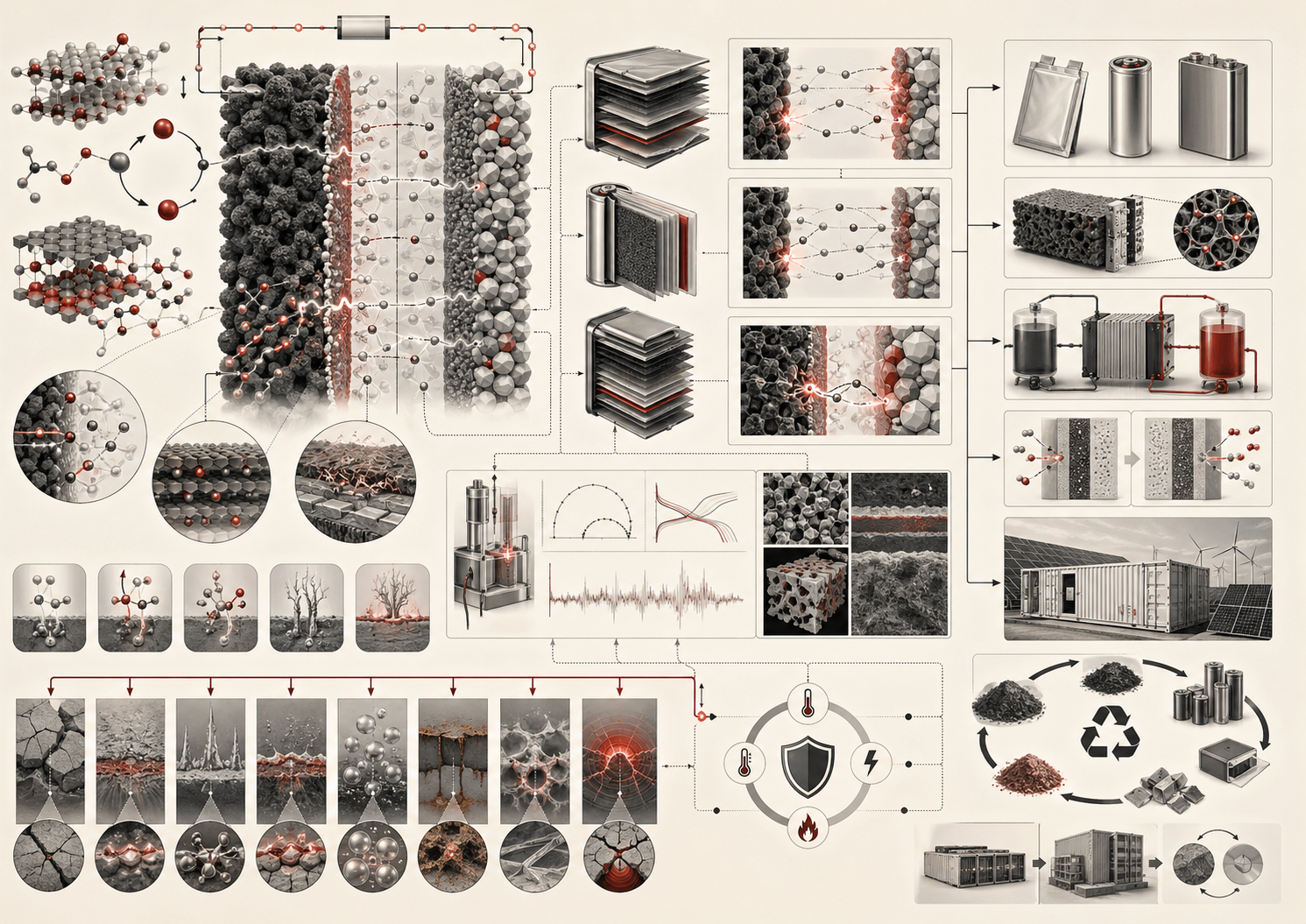
What Electrochemistry Studies
Electrochemistry studies the relationship between chemical change and electrical work. In an electrochemical system, electrons move through an external electronic pathway while ions move through an electrolyte, separator, membrane, pore network, or interfacial region. The reaction does not occur in one homogeneous space. It is divided across electrodes and linked by charge balance.
This division is what makes electrochemistry powerful. A redox reaction that might otherwise occur through direct chemical contact can be separated into two half-reactions. Electrons are then forced to travel through a circuit, where they can produce useful electrical work, provide a measurable signal, or drive a controlled device. Conversely, an external power source can push electrons in a chosen direction and drive chemical change that would not proceed spontaneously under the same conditions.
Electrochemistry is central to batteries, fuel cells, electrolysis, corrosion, electroplating, electrosynthesis, electrochemical sensors, water splitting, carbon dioxide reduction, metal refining, neural interfaces, electroanalytical chemistry, and energy-storage technologies. It also provides some of chemistry’s most important conceptual bridges: thermodynamics to voltage, kinetics to current, diffusion to rate limitation, materials chemistry to device performance, and degradation to lifecycle cost.
The field is especially important because it is both fundamental and infrastructural. A half-cell experiment can reveal reaction thermodynamics. A battery pack can determine electric-vehicle range, grid-storage reliability, fire risk, recycling value, and critical-material dependence. An electrochemical corrosion reaction can damage bridges, pipelines, water systems, ships, aircraft, and buildings. An electrochemical sensor can detect glucose, oxygen, pollutants, ions, or biomarkers. Electrochemistry is therefore a chemistry of interfaces that becomes a chemistry of systems.
For researchers and scientists, electrochemistry demands disciplined interpretation. A measured voltage may reflect thermodynamic driving force, concentration gradients, reference-electrode setup, interfacial films, ohmic losses, or kinetic polarization. A current response may reflect charge transfer, diffusion, adsorption, capacitive charging, side reactions, or electrode degradation. Electrochemical data are rich because they combine several processes at once; they are difficult for the same reason.
Electrochemical Cells, Electrodes, and Electrolytes
An electrochemical cell contains electrodes in contact with electrolytes. The electrodes conduct electrons. The electrolytes conduct ions. A separator or membrane may prevent direct electronic contact while allowing ionic transport. Current collectors, binders, additives, active materials, porous structures, seals, packaging, sensors, control systems, and thermal-management components may also be part of a practical device.
The main components include:
- Anode: the electrode where oxidation occurs during the electrochemical process being described.
- Cathode: the electrode where reduction occurs during the electrochemical process being described.
- Electrolyte: the ion-conducting medium connecting the electrode reactions.
- Separator or membrane: a structure that limits short circuit while allowing ionic transport.
- Current collectors: electronically conductive components that connect electrode materials to external circuits.
- Active material: the material that stores, releases, or transforms charge through redox, intercalation, plating, adsorption, conversion, alloying, or surface processes.
- Interphase: a chemically formed interfacial layer that can either protect the system or accelerate degradation.
In galvanic operation, a spontaneous chemical reaction produces electrical work. In electrolytic operation, electrical work drives chemical change. Batteries operate through repeated charge and discharge. Fuel cells convert externally supplied fuel and oxidant into electricity. Electrolyzers use electricity to produce chemical products such as hydrogen. Supercapacitors store charge through interfacial double layers or fast surface redox processes.
Cell design is never only a question of choosing two redox couples. It also requires compatible electrolytes, stable separators, mechanically durable electrodes, conductive pathways, controlled porosity, safe voltage windows, thermal stability, manufacturable coatings, quality control, and resistance to side reactions. A cell is a chemical architecture.
Electrochemical terminology also requires care. In a rechargeable battery, the electrode that acts as the cathode during discharge acts as the anode during charge if oxidation and reduction are defined strictly by process direction. In battery practice, however, electrodes are often named by their discharge role or by positive and negative electrode. Clear writing should specify whether “anode” and “cathode” refer to oxidation-reduction function or conventional battery naming.
Redox Reactions and Electrode Potential
Electrochemistry is built around oxidation and reduction. Oxidation is loss of electrons. Reduction is gain of electrons. In an electrochemical cell, oxidation and reduction are spatially separated but electrically linked. This separation allows chemical energy to be converted into measurable or useful electrical work.
Electrode potential expresses the tendency of an electrode system to accept or donate electrons relative to a reference. Standard electrode potentials are measured relative to defined reference conditions. In practical electrochemistry, potentials depend on concentration, activity, temperature, pH, electrolyte composition, electrode surface, reference electrode, and cell configuration.
Potential is thermodynamic, but current is kinetic. A reaction may be thermodynamically favorable and still slow because charge transfer, ion transport, nucleation, adsorption, desolvation, phase transformation, or diffusion limits the rate. Overpotential is the extra potential required to drive a reaction at a desired rate. In batteries, fuel cells, electrolyzers, electrochemical synthesis, and corrosion, overpotential becomes a major source of energy loss, heat generation, degradation, and inefficiency.
Electrode potential also depends on what is being compared. A half-cell potential is measured against a reference electrode. A full-cell voltage is the difference between two electrode potentials. An open-circuit voltage may approximate equilibrium under relaxed conditions, while operating voltage includes kinetic losses, concentration polarization, ohmic resistance, and thermal effects. In a battery, the voltage curve is therefore not only a simple chemical label. It is a record of state of charge, phase behavior, impedance, transport limitation, and aging.
Redox chemistry also explains why electrochemical systems can be both useful and dangerous. A high-voltage battery stores energy in chemically separated states. If those states are forced into uncontrolled contact through short circuit, mechanical damage, overheating, internal defect, or abuse, stored chemical energy can be released rapidly. Electrochemical design is therefore always also safety design.
Thermodynamics, Kinetics, and Ion Transport
Electrochemical performance depends on three major layers of behavior: thermodynamics, kinetics, and transport. Thermodynamics determines the maximum driving force. Kinetics determines how fast reactions occur at interfaces. Transport determines how quickly ions, reactants, products, and heat can move through electrolyte, porous electrodes, membranes, separators, and device geometry.
Thermodynamics gives electrochemistry its connection to voltage. The free-energy change of a redox reaction can be related to electrical work. This is why batteries can be compared by voltage, why fuel cells can convert chemical energy into electrical work, and why electrolyzers require applied voltage to drive nonspontaneous reactions.
Kinetics governs current. Charge transfer across an electrode-electrolyte interface requires electron movement, ion movement, solvation changes, surface adsorption, and sometimes structural rearrangement. If any step is slow, the system requires additional potential to achieve a given current. Catalysts reduce kinetic barriers by improving reaction pathways. In fuel cells and electrolyzers, electrocatalysis can determine efficiency, cost, and lifetime. In batteries, kinetics can determine fast-charge capability, low-temperature performance, and power output.
Transport governs rate limits. Ions must move through electrolyte and pores. Reactants must reach catalytic surfaces. Products must leave active sites. Lithium ions must diffuse through electrode particles. Protons, hydroxide ions, oxygen, hydrogen, carbon dioxide, metal ions, or redox-active species may need to cross membranes or porous structures. When transport cannot keep up with current, concentration gradients form, voltage losses increase, and side reactions may become more likely.
Thermodynamics, kinetics, and transport interact. A battery may have favorable voltage but poor rate capability because ion diffusion is slow. An electrolyzer may have strong catalyst activity but poor mass transfer because bubbles block active sites. A fuel cell may have good open-circuit voltage but low operating efficiency because oxygen reduction is sluggish. Electrochemistry is therefore not reducible to one “best” material property. It is a coupled system of driving force, reaction rate, transport, and architecture.
Interfaces, Double Layers, and Interphases
Electrochemistry happens at interfaces. The electrode-electrolyte boundary is where electronic charge meets ionic charge. This boundary contains electric fields, adsorbed species, solvated ions, oriented solvent molecules, interfacial films, surface defects, catalytic sites, and concentration gradients. Small changes at the interface can produce large changes in voltage, current, stability, selectivity, and lifetime.
The electrochemical double layer describes the separation of charge near an electrode surface. Electrons accumulate or deplete in the electrode, while ions and polar molecules reorganize in the electrolyte. This structure creates capacitance even when no faradaic redox reaction occurs. Supercapacitors exploit this interfacial charge storage. Electrochemical sensors and electrocatalytic reactions are also strongly shaped by the double layer.
In batteries, interphases can be decisive. The solid-electrolyte interphase on graphite-like anodes can protect the electrolyte from continuous reduction while allowing lithium-ion transport. Cathode-electrolyte interphases can influence high-voltage stability, transition-metal dissolution, oxygen release, gas formation, and impedance rise. In solid-state batteries, the interface between solid electrolyte and electrode can determine whether the cell works at all.
Interphases are chemically active. They may contain inorganic salts, organic fragments, polymeric species, metal fluorides, oxides, phosphates, carbonates, sulfides, decomposition products, trapped solvent, and electronically insulating but ionically conducting phases. A good interphase is selective: it blocks harmful reactions while allowing the desired ion to pass. A poor interphase grows continuously, consumes active lithium or electrolyte, increases resistance, generates gas, cracks, or exposes fresh surface to further reaction.
For researchers, interface control is one of the most important frontiers in electrochemistry. Bulk material identity matters, but interfacial chemistry often determines whether the material can be used safely, reversibly, and repeatedly in a real device.
Batteries as Chemical Energy-Storage Systems
A battery stores chemical energy and releases it as electrical energy. A rechargeable battery must do this reversibly enough to survive repeated cycles. This reversibility is never perfect. Each cycle can produce structural strain, interphase growth, electrolyte decomposition, particle cracking, gas generation, lithium plating, metal dissolution, contact loss, separator damage, impedance rise, or thermal stress.
Battery performance is usually discussed through linked metrics:
- Capacity: how much charge the cell can deliver.
- Energy: capacity multiplied by voltage over discharge.
- Power: how quickly energy can be delivered.
- Coulombic efficiency: charge delivered during discharge divided by charge supplied during charge.
- Energy efficiency: discharge energy divided by charge energy.
- Cycle life: number of cycles before capacity falls below a defined threshold.
- Rate capability: performance under fast charge or discharge.
- Calendar life: degradation during storage or standby.
- Safety: resistance to abuse, short circuit, thermal runaway, overcharge, puncture, crushing, manufacturing defects, and improper end-of-life handling.
Battery chemistry includes lead-acid, nickel-cadmium, nickel-metal hydride, lithium-ion, sodium-ion, lithium-metal, lithium-sulfur, flow batteries, zinc-based batteries, metal-air batteries, and emerging solid-state systems. Each chemistry has different strengths, risks, materials constraints, cost structures, energy density, power density, safety behavior, operating temperature range, and lifecycle pathways.
Batteries must also be matched to application. Portable electronics prioritize energy density and compactness. Electric vehicles require energy density, power, safety, fast charging, cold-weather performance, cost, durability, and pack management. Grid storage may prioritize cost, lifetime, safety, material availability, maintainability, and long-duration capability. Backup power may prioritize reliability and calendar life. No single battery chemistry is best for every use.
Battery systems are also more than cells. Modules, packs, enclosures, thermal systems, sensors, fuses, contactors, balancing circuits, battery management systems, fire-protection strategies, diagnostic software, and recycling logistics all influence performance and safety. Electrochemistry provides the cell-level foundation; engineering and governance determine how that chemistry behaves in the world.
Lithium-Ion Batteries and Intercalation Chemistry
Lithium-ion batteries are among the most important rechargeable battery technologies because lithium ions can move between host structures while electrons travel through an external circuit. During operation, lithium ions shuttle between electrodes through the electrolyte, while electrons move through the external load or charger. The electrode materials store lithium through intercalation, conversion, alloying, surface storage, or other mechanisms.
Common lithium-ion cell components include:
- graphite, silicon-containing, lithium titanate, or other negative-electrode materials;
- layered oxides, lithium iron phosphate, spinels, high-nickel oxides, or other positive-electrode materials;
- liquid, gel, polymer, ceramic, or solid electrolytes;
- polymeric separators;
- copper and aluminum current collectors;
- binders, conductive additives, coatings, and electrolyte additives.
Lithium-ion performance depends strongly on interfaces. The solid-electrolyte interphase on graphite-like anodes can protect the electrolyte from continuous reduction while allowing lithium-ion transport. Cathode-electrolyte interphases can affect high-voltage stability. Particle coatings can reduce side reactions. Electrolyte additives can improve interphase chemistry. Poor interface control can cause capacity fade, impedance growth, gas formation, thermal instability, or accelerated aging.
Lithium-ion batteries also show why battery names can be misleading. “Lithium-ion” is a family, not a single chemistry. A lithium iron phosphate cell, a lithium cobalt oxide cell, a nickel manganese cobalt cell, and a nickel cobalt aluminum cell differ in voltage, energy density, cost, safety, critical-material dependence, thermal behavior, cycle life, and recycling value.
Silicon-containing negative electrodes illustrate the promise and challenge of high-capacity materials. Silicon can store much more lithium per mass than graphite, but large volume changes during cycling can crack particles, disrupt interphases, isolate active material, and consume electrolyte. High-nickel positive electrodes can increase energy density but may raise concerns around thermal stability, interfacial degradation, metal dissolution, gas generation, and supply-chain dependence. Practical lithium-ion design is therefore a continuous negotiation among capacity, stability, cost, safety, manufacturability, and materials responsibility.
For researchers, lithium-ion chemistry is now a mature field and an active frontier at the same time. The basic architecture is widely deployed, but improvements in electrolyte design, interphase engineering, high-voltage stability, silicon utilization, sodium substitution, solid-state interfaces, recycling, and battery diagnostics remain scientifically and socially important.
Beyond Lithium-Ion: Sodium, Flow, Metal-Air, and Solid-State Systems
Lithium-ion batteries dominate many rechargeable applications, but they do not define the full future of electrochemical storage. Alternative systems are being studied and deployed because different applications require different combinations of cost, safety, duration, materials availability, cycle life, power, and energy density.
Sodium-ion batteries use sodium rather than lithium as the shuttle ion. Sodium is more abundant and may reduce dependence on some constrained supply chains, but sodium ions differ in size, mass, electrode compatibility, voltage, and energy density. Sodium-ion systems may be especially relevant where cost, safety, and material availability matter more than maximum energy density.
Flow batteries store energy in externally held electrolyte tanks. Power and energy can be partly decoupled because the reactor stack controls power while tank volume controls energy. This makes flow batteries attractive for some stationary storage applications. Their challenges include electrolyte cost, crossover, membrane durability, pumping losses, system complexity, and chemical stability.
Metal-air batteries use oxygen from air as one reactant. They can offer high theoretical energy density, but practical systems must manage air electrodes, catalysts, moisture, carbon dioxide sensitivity, dendrites, electrolyte management, rechargeability, and side reactions. The gap between theoretical and practical performance can be large.
Solid-state batteries replace flammable liquid electrolytes with solid ion conductors. They are often discussed as a route to improved safety and lithium-metal anodes, but they introduce difficult interfacial, mechanical, manufacturing, and contact challenges. A solid electrolyte with high ionic conductivity is not enough. It must form stable, low-resistance, mechanically durable interfaces with electrodes under cycling pressure, temperature changes, and volume changes.
Alternative chemistries should be evaluated by use case rather than hype. Grid storage, long-duration storage, mobility, aviation, marine systems, backup power, remote infrastructure, consumer electronics, and industrial applications have different constraints. Electrochemistry provides the comparison tools, but responsible deployment requires lifecycle, safety, cost, supply-chain, recycling, and infrastructure analysis.
Supercapacitors and Pseudocapacitive Storage
Supercapacitors store energy differently from conventional batteries. Electric double-layer capacitors store charge at electrode-electrolyte interfaces without the same kind of bulk redox transformation. Pseudocapacitive materials store charge through fast, reversible surface or near-surface redox processes. The distinction matters because double-layer capacitors often provide high power and long cycle life, while batteries generally provide higher energy density.
Supercapacitor materials include activated carbons, carbon nanotubes, graphene-like carbons, metal oxides, conducting polymers, and hybrid composites. Their performance depends on accessible surface area, pore size distribution, electrolyte ion size, conductivity, wettability, surface functionality, voltage window, and stability.
Pseudocapacitive behavior is especially important because it blurs the simple battery-versus-capacitor distinction. Some materials can store substantial charge at high rates when ion insertion or surface redox avoids slow phase transformations and long diffusion distances. This makes nanoscale structure, surface chemistry, and electrode architecture crucial for high-power energy storage.
Supercapacitors are valuable where fast charge-discharge, high power, pulse delivery, regenerative braking, backup support, or extreme cycle life are more important than maximum energy density. They may complement batteries rather than replace them. A hybrid system can use batteries for energy and supercapacitors for power smoothing, reducing stress on the battery and improving system-level performance.
For researchers, supercapacitors emphasize the importance of interfacial science. The same nominal material can behave differently depending on pore size, electrolyte, surface chemistry, binder, electrode density, ionic accessibility, and voltage window. Reported capacitance values require careful interpretation because they can depend strongly on test rate, mass loading, electrode geometry, and normalization basis.
Fuel Cells, Electrolyzers, and Reversible Electrochemical Systems
Fuel cells and electrolyzers show the two directions of electrochemical energy conversion. A fuel cell converts chemical energy from externally supplied reactants into electricity. An electrolyzer uses electricity to drive chemical production. Hydrogen fuel cells and water electrolyzers are closely connected: one consumes hydrogen and oxygen to produce electricity and water, while the other uses electricity to split water into hydrogen and oxygen.
These devices depend on electrocatalysts, membranes, gas diffusion layers, electrolytes, water management, heat management, and product transport. Overpotential, catalyst stability, membrane durability, gas crossover, impurity tolerance, and critical-material use are central design issues.
Hydrogen electrochemistry illustrates the importance of system boundaries. Hydrogen produced by water electrolysis can support low-carbon energy systems only when electricity supply, electrolyzer efficiency, water source, compression, storage, transport, leakage, end use, and infrastructure are considered together. A fuel cell may produce water at the point of use, but upstream hydrogen production can carry very different emissions profiles depending on feedstock and energy source.
Electrochemical energy systems also include redox flow batteries, carbon dioxide electrolyzers, metal-air batteries, and electrochemical ammonia or chemical-fuel concepts. In all of them, the same core problems recur: redox thermodynamics, interfacial kinetics, ion transport, mass transfer, material stability, safety, and system integration.
For researchers, fuel cells and electrolyzers make clear that electrochemistry is not just storage. It is chemical conversion through electrical control. This gives electrochemistry a central role in hydrogen, industrial decarbonization, carbon conversion, chemical manufacturing, grid balancing, and renewable-electricity integration—but only if efficiency, durability, materials, infrastructure, and lifecycle effects are treated seriously.
Corrosion, Electrodeposition, and Electrochemical Sensors
Electrochemistry also explains processes that are not usually described as energy storage. Corrosion is an electrochemical process in which materials degrade through coupled oxidation and reduction reactions. Metals can dissolve anodically while oxygen reduction, hydrogen evolution, or other cathodic reactions occur elsewhere on the surface. Electrolytes, salts, pH, oxygen gradients, coatings, microbes, stress, temperature, and material heterogeneity all influence corrosion behavior.
Corrosion matters because it connects electrochemistry to public infrastructure. Bridges, pipelines, ships, rebar in concrete, drinking-water systems, chemical plants, aircraft, vehicles, energy infrastructure, and electronics can fail through electrochemical degradation. Corrosion can cause economic loss, safety hazards, leaks, contamination, equipment failure, and service interruption. It is one of the most important examples of electrochemistry as risk science.
Electrodeposition uses electrical current to deposit metals or other materials onto surfaces. It is used in plating, metal refining, coatings, microfabrication, additive manufacturing, battery materials, and surface engineering. Deposition quality depends on current density, electrolyte composition, additives, mass transport, nucleation, surface preparation, temperature, agitation, and impurity control. Dendrite formation, roughness, hydrogen evolution, porosity, and poor adhesion can limit performance.
Electrochemical sensors use electrode responses to detect chemical species. They can measure glucose, oxygen, pH, ions, gases, pollutants, neurotransmitters, metals, and biological markers. Their performance depends on selectivity, sensitivity, calibration, fouling, drift, interference, electrode material, surface modification, mass transport, and sample matrix. A useful electrochemical sensor is not only a reactive electrode; it is a measurement system with uncertainty, calibration, and context.
These applications show the breadth of electrochemistry. The same principles that explain batteries also explain corrosion, plating, sensors, and electrosynthesis: potential, current, interfacial charge transfer, ion movement, surface chemistry, and material stability.
Degradation, Safety, and Failure Modes
Energy-storage devices fail chemically, mechanically, thermally, and electrically. Degradation can be slow and cumulative, or sudden and catastrophic. Battery aging may involve capacity loss, resistance rise, electrolyte decomposition, active material isolation, gas formation, lithium inventory loss, electrode cracking, separator shrinkage, metal dissolution, current-collector corrosion, or loss of electronic contact.
Important battery degradation and safety modes include:
- solid-electrolyte interphase growth;
- cathode-electrolyte interphase instability;
- lithium plating during fast charge or low-temperature charge;
- transition-metal dissolution and migration;
- gas generation and swelling;
- particle cracking and loss of active material;
- electrolyte oxidation or reduction;
- separator damage, shrinkage, or puncture;
- internal short circuits;
- thermal runaway under abuse or defect conditions.
Safety is not a single material property. It is a system property involving cell chemistry, separator design, electrolyte flammability, current interrupt devices, thermal management, pack architecture, battery management systems, manufacturing quality, aging state, charging protocol, storage conditions, transport practices, and end-of-life handling.
Thermal runaway is especially important because battery cells can contain oxidizing and reducing materials, flammable electrolyte, stored electrical energy, and heat-generating side reactions. Abuse conditions such as overcharge, external short circuit, internal short circuit, crushing, puncture, overheating, or manufacturing defects can initiate runaway pathways. Once heat generation exceeds heat removal, reactions can accelerate.
Battery safety therefore requires layered protection. Materials selection, electrolyte formulation, separator shutdown behavior, cell design, quality inspection, pack thermal management, state-of-charge control, current limits, voltage limits, fault detection, fire containment, transport rules, recycling protocols, and emergency response all matter. Electrochemistry explains the failure chemistry; responsible systems design reduces the chance and consequence of failure.
Electrochemical Characterization and Measurement
Electrochemical characterization links materials to device behavior. Common techniques include cyclic voltammetry, galvanostatic charge-discharge, chronoamperometry, chronopotentiometry, electrochemical impedance spectroscopy, rotating disk electrode methods, differential capacity analysis, rate testing, long-term cycling, potentiostatic holds, self-discharge testing, open-circuit voltage measurements, and post-mortem materials analysis.
Battery and energy-storage characterization also requires materials and structural methods: X-ray diffraction, electron microscopy, X-ray photoelectron spectroscopy, Raman spectroscopy, infrared spectroscopy, nuclear magnetic resonance, tomography, gas analysis, calorimetry, mass spectrometry, mechanical testing, and in situ or operando methods.
Measurement must match the claim. A coin-cell result does not automatically predict pouch-cell performance. A high capacity at low mass loading may not translate to practical electrodes. Fast-charge performance may be limited by lithium plating. A promising electrolyte may fail at high voltage or elevated temperature. A solid-state electrolyte may have high ionic conductivity but poor interface contact. A high initial coulombic efficiency may not guarantee long cycle life.
Electrochemical impedance spectroscopy illustrates the interpretive challenge. An impedance spectrum may contain information about ohmic resistance, charge-transfer resistance, double-layer capacitance, diffusion, porous electrode behavior, interphase growth, contact loss, and inductive artifacts. Equivalent circuit fitting can be useful, but circuits are not proof of mechanism unless supported by physical evidence, experimental design, and independent measurements.
For researchers, reporting conditions are essential. Current density, mass loading, electrode area, electrolyte amount, separator type, temperature, voltage window, formation protocol, rest time, pressure, cell format, reference-electrode setup, and normalization basis must be stated. Electrochemical data without test context can be impressive but irreproducible.
Manufacturing, Quality, and Cell-to-Pack Reliability
Electrochemical performance is shaped by manufacturing. Electrode slurry mixing, coating thickness, drying, calendering, porosity, binder distribution, particle dispersion, moisture control, electrolyte filling, wetting, formation cycling, gas removal, sealing, welding, stacking, winding, pouch formation, tab design, and contamination control can all affect performance and safety.
A battery material that performs well in a laboratory may fail in manufacturing if it cannot be processed into stable electrodes at practical loading, density, and thickness. High energy density often requires thick electrodes and high loading, but thick electrodes can create transport limitations, nonuniform utilization, cracking, drying stress, and poor electrolyte wetting. Processability is therefore part of electrochemical viability.
Quality control is essential because small defects can have large consequences. Metal particles, burrs, separator defects, coating voids, misalignment, moisture contamination, poor welds, electrolyte imbalance, or improper formation can lead to performance loss, internal shorts, gas generation, or safety incidents. Cell-to-cell variation becomes especially important in packs because weak cells can limit pack performance or create imbalance.
Battery management systems monitor voltage, temperature, current, state of charge, state of health, and fault conditions. But a battery management system cannot fully compensate for poor cell design, unstable chemistry, weak thermal management, or inadequate manufacturing quality. It is a control layer, not a substitute for safe electrochemistry.
For researchers, manufacturing translation is a critical step between promising material and useful system. Practical electrochemistry asks whether the material can be made, coated, dried, assembled, cycled, monitored, repaired, recycled, and operated safely at scale.
Sustainability, Critical Materials, and Circular Battery Design
Batteries and electrochemical energy systems are central to renewable electricity storage, electric mobility, portable electronics, grid resilience, and decarbonization. But energy storage is not automatically sustainable. It may depend on critical minerals, energy-intensive processing, hazardous electrolytes, difficult recycling, fire risk, water use, mining impacts, labor concerns, and end-of-life collection systems.
Responsible energy-storage design includes:
- reducing dependence on scarce, toxic, or geopolitically constrained materials where possible;
- designing electrodes, electrolytes, and cell formats for durability and repairability;
- improving safety through chemistry, separator design, thermal management, diagnostics, and battery management systems;
- building recycling pathways that recover lithium, nickel, cobalt, copper, aluminum, graphite, iron, manganese, phosphorus, electrolyte components, and other valuable materials;
- distinguishing second-life use, repair, remanufacturing, direct recycling, hydrometallurgical recycling, pyrometallurgical recycling, and material recovery;
- preventing unsafe disposal, fires, and worker exposure during collection, transport, storage, dismantling, and processing;
- reporting performance under realistic duty cycles, temperatures, charge rates, voltage windows, and aging conditions;
- aligning battery chemistry with application rather than maximizing one metric such as energy density alone.
Circular battery design must begin before disposal. It includes chemistry choice, pack design, labeling, diagnostics, disassembly, transport safety, material recovery, data transparency, and compatibility with recycling infrastructure. A battery that is difficult to disassemble, identify, safely discharge, transport, or process creates downstream burdens even if its in-use performance is strong.
Critical-material strategy should avoid simple substitution narratives. Reducing cobalt can lower one supply concern while increasing nickel dependence or changing safety behavior. Sodium-ion systems may reduce lithium dependence but may not fit every energy-density requirement. Solid-state systems may reduce flammable liquid electrolyte but introduce interface and manufacturing challenges. Responsible electrochemistry evaluates the full system: material source, performance, safety, durability, recyclability, exposure, and end-of-life.
The ethical strength of electrochemistry lies in making energy-storage systems not only more powerful, but more durable, safer, recoverable, and accountable. Energy storage can support decarbonization, but only if materials, manufacturing, operation, reuse, recycling, and disposal are designed with the same seriousness as energy density.
Mathematical Lens: Nernst Equation, Capacity, Energy, Power, and Efficiency
The Nernst equation relates electrode potential to reaction conditions:
E = E^\circ – \frac{RT}{nF}\ln Q
\]
Interpretation: \(E\) is electrode potential, \(E^\circ\) is standard electrode potential, \(R\) is the gas constant, \(T\) is temperature, \(n\) is the number of electrons transferred, \(F\) is Faraday’s constant, and \(Q\) is the reaction quotient. Concentration, activity, temperature, and reaction state affect voltage.
Electrical work and Gibbs free energy are linked by:
\Delta G = -nFE
\]
Interpretation: This relation connects chemical thermodynamics to cell voltage. A more positive cell voltage corresponds to a more favorable free-energy change for a galvanic process.
Charge capacity is related to current and time:
Q = \int I(t)\,dt
\]
Interpretation: \(Q\) is charge and \(I(t)\) is current as a function of time. This integral matters when current varies during charge or discharge.
For constant current, capacity simplifies to:
Q = It
\]
Interpretation: Constant-current cycling is common in battery testing. Charge delivered depends directly on current and time.
Energy delivered by a cell is:
E_{\mathrm{energy}} = \int V(t)I(t)\,dt
\]
Interpretation: Cell energy depends on the voltage profile and current over time, not merely nominal voltage.
For approximate constant voltage and current:
E_{\mathrm{energy}} \approx VIt
\]
Interpretation: This simplified expression is useful for rough estimates, but real batteries have changing voltage during discharge.
Specific capacity is commonly expressed as:
C_{\mathrm{specific}} = \frac{Q}{m}
\]
Interpretation: \(m\) is active-material mass. Specific capacity can be misleading if inactive materials, electrode loading, electrolyte amount, or full-cell balance are ignored.
Power is:
P = VI
\]
Interpretation: Power depends on voltage and current. High power requires low resistance, fast charge transfer, good transport, and thermal control.
Coulombic efficiency is:
\eta_Q = \frac{Q_{\mathrm{discharge}}}{Q_{\mathrm{charge}}}
\]
Interpretation: Coulombic efficiency indicates how much charge is recovered during discharge relative to charge supplied. Small inefficiencies can accumulate into large capacity loss over many cycles.
Energy efficiency is:
\eta_E = \frac{E_{\mathrm{discharge}}}{E_{\mathrm{charge}}}
\]
Interpretation: Energy efficiency includes voltage losses, overpotentials, ohmic resistance, and other irreversible processes.
For an ideal capacitor, stored energy is:
E = \frac{1}{2}CV^2
\]
Interpretation: \(C\) is capacitance and \(V\) is voltage. The squared voltage term explains why voltage window is so important for capacitive energy storage.
A simple ohmic loss relation is:
\Delta V_{\Omega} = IR
\]
Interpretation: \(R\) is resistance. Ohmic losses increase with current and appear as voltage loss and heat generation.
These equations are useful because they expose the logic of electrochemical performance. Voltage comes from thermodynamics, current from kinetics and transport, energy from voltage integrated over charge, power from current delivery, and lifetime from repeated deviations from perfect reversibility.
Computational Workflows for Electrochemistry
Computational electrochemistry can make energy-storage analysis more transparent. A workflow can track cell chemistry, electrode materials, electrolyte, cell format, voltage window, current rate, capacity, energy, power, cycle number, coulombic efficiency, energy efficiency, impedance, temperature, formation protocol, mass loading, capacity retention, degradation slope, safety flags, critical-material score, recycling pathway, and test metadata.
Useful workflows include battery-screening scorecards, cycling-data analysis, capacity-retention modeling, coulombic-efficiency tracking, energy and power estimation, rate-capability comparison, impedance-trend analysis, degradation-flag generation, safety-review metadata, critical-material screening, recycling-value estimation, and test-protocol auditing. More advanced workflows may integrate battery management system data, sensor telemetry, electrochemical impedance spectra, thermal models, manufacturing data, cell genealogy, pack-level diagnostics, and lifecycle assessment.
For researchers, computational workflows should preserve experimental conditions. A capacity value means little without current rate, voltage window, mass loading, electrode balancing, temperature, rest period, cycle number, and cell format. A degradation rate means little without formation protocol, aging temperature, state of charge, depth of discharge, and test duration. A model that ignores test conditions may produce clean graphs but weak science.
The examples below use synthetic data. They do not qualify a battery, certify safety, predict real lifetime, determine procurement, validate recycling, or replace professional electrochemical testing. They demonstrate how electrochemical reasoning can be structured, audited, and communicated responsibly.
Python Example: Battery Screening, Cycling, and Energy Metrics
The following Python example uses synthetic educational data to compare energy-storage candidates. It calculates derived battery metrics, flags degradation and responsible-design concerns, and ranks candidates against a simplified target profile. Real battery decisions require validated cell builds, safety testing, uncertainty analysis, aging studies, abuse testing, manufacturing review, and lifecycle assessment.
from pathlib import Path
from typing import Dict, List
import json

import pandas as pd


# Synthetic electrochemistry, battery, and energy-storage workflow.
# Educational example only; not for battery design, procurement, safety, or certification.


def calculate_screening_table(cells: pd.DataFrame) -> pd.DataFrame:
    """Calculate synthetic energy-storage screening metrics.

    The scoring model is illustrative. A real workflow would require
    validated test protocols, uncertainty intervals, safety review,
    thermal analysis, abuse testing, manufacturing data, and lifecycle review.
    """

    cells = cells.copy()

    cells["cell_capacity_mAh"] = (
        cells["specific_capacity_mAh_g"] * cells["active_material_mass_g"]
    )

    cells["cell_energy_Wh"] = (
        cells["cell_capacity_mAh"] * cells["nominal_voltage_V"] / 1000.0
    )

    cells["cycle_loss_percent_at_100"] = (
        100.0 * (1.0 - cells["cycle_100_capacity_retention"])
    )

    cells["estimated_average_capacity_fade_per_cycle_percent"] = (
        cells["cycle_loss_percent_at_100"] / 100.0
    )

    targets: Dict[str, float] = {
        "cell_energy_Wh": 6.0,
        "cycle_100_capacity_retention": 0.95,
        "coulombic_efficiency": 0.998,
        "rate_capability_score": 0.85,
        "critical_material_score": 0.20,
        "safety_review_score": 0.15,
    }

    weights: Dict[str, float] = {
        "cell_energy_Wh": 0.7,
        "cycle_100_capacity_retention": 1.2,
        "coulombic_efficiency": 1.4,
        "rate_capability_score": 0.9,
        "critical_material_score": 1.3,
        "safety_review_score": 1.1,
    }

    scales: Dict[str, float] = {
        "cell_energy_Wh": 3.0,
        "cycle_100_capacity_retention": 0.08,
        "coulombic_efficiency": 0.008,
        "rate_capability_score": 0.25,
        "critical_material_score": 0.50,
        "safety_review_score": 0.40,
    }

    score_terms: List[str] = []

    for property_name in targets:
        term_name = f"{property_name}_score_term"
        cells[term_name] = (
            weights[property_name]
            * ((cells[property_name] - targets[property_name]) / scales[property_name]) ** 2
        )
        score_terms.append(term_name)

    cells["screening_score"] = cells[score_terms].sum(axis=1)

    cells["degradation_review_required"] = (
        cells["cycle_100_capacity_retention"] < 0.90
    )

    cells["efficiency_review_required"] = (
        cells["coulombic_efficiency"] < 0.995
    )

    cells["critical_material_review_required"] = (
        cells["critical_material_score"] > 0.60
    )

    cells["safety_review_required"] = (
        cells["safety_review_score"] > 0.40
    )

    cells["responsible_design_review_required"] = (
        cells["degradation_review_required"]
        | cells["efficiency_review_required"]
        | cells["critical_material_review_required"]
        | cells["safety_review_required"]
    )

    ranked = cells.sort_values("screening_score").copy()
    ranked["rank"] = range(1, len(ranked) + 1)

    ranked.attrs["targets"] = targets
    ranked.attrs["weights"] = weights
    ranked.attrs["scales"] = scales

    return ranked


cells = pd.DataFrame({
    "cell_id": ["bat_A", "bat_B", "bat_C", "bat_D", "bat_E"],
    "chemistry": [
        "lithium_iron_phosphate",
        "nickel_manganese_cobalt",
        "sodium_ion",
        "solid_state_lithium",
        "supercapacitor",
    ],
    "nominal_voltage_V": [3.2, 3.7, 3.0, 3.8, 2.7],
    "specific_capacity_mAh_g": [160, 190, 125, 220, 40],
    "active_material_mass_g": [12.0, 10.5, 14.0, 9.0, 20.0],
    "cycle_100_capacity_retention": [0.96, 0.91, 0.94, 0.86, 0.99],
    "coulombic_efficiency": [0.998, 0.995, 0.997, 0.990, 0.999],
    "rate_capability_score": [0.78, 0.84, 0.70, 0.62, 0.96],
    "critical_material_score": [0.22, 0.78, 0.30, 0.65, 0.18],
    "safety_review_score": [0.20, 0.42, 0.25, 0.55, 0.12],
})

ranked = calculate_screening_table(cells)

output_dir = Path("outputs")
output_dir.mkdir(exist_ok=True)

ranked.to_csv(output_dir / "energy_storage_screening_ranked.csv", index=False)

manifest = {
    "workflow": "synthetic_electrochemistry_battery_energy_storage_screening",
    "target_profile": ranked.attrs["targets"],
    "weights": ranked.attrs["weights"],
    "scales": ranked.attrs["scales"],
    "best_candidate": ranked.iloc[0]["cell_id"],
    "responsible_use": [
        "Synthetic educational data only.",
        "Real battery decisions require validated testing, safety review, aging studies, abuse testing, manufacturing controls, and lifecycle assessment.",
    ],
}

with (output_dir / "electrochemistry_energy_storage_manifest.json").open(
    "w",
    encoding="utf-8"
) as file:
    json.dump(manifest, file, indent=2)

print(ranked[[
    "cell_id",
    "chemistry",
    "cell_energy_Wh",
    "cycle_100_capacity_retention",
    "coulombic_efficiency",
    "screening_score",
    "rank",
    "responsible_design_review_required",
]])
This workflow shows why energy-storage evaluation is a multi-objective problem. A cell with high energy may have higher critical-material dependence. A safer chemistry may have lower voltage or energy density. A supercapacitor may have excellent power and cycle life but lower energy. Battery design is therefore a structured tradeoff among chemistry, performance, safety, durability, cost, and lifecycle.
R Example: Replicate Cycling and Degradation Analysis
The following R example uses synthetic cycling data to estimate capacity retention, coulombic efficiency, and degradation slope. In real battery analysis, cycling results depend on cell format, temperature, pressure, electrolyte amount, electrode loading, rest time, formation protocol, current rate, voltage window, and manufacturing quality.
# Synthetic battery cycling workflow.
# Educational example only; not for battery qualification or safety claims.

cycling <- data.frame(
  cell_id = rep(c("bat_A", "bat_B", "bat_D"), each = 6),
  cycle_number = rep(c(1, 20, 40, 60, 80, 100), times = 3),
  discharge_capacity_mAh = c(
    1920, 1904, 1888, 1871, 1856, 1843,
    1995, 1958, 1915, 1880, 1842, 1815,
    1980, 1900, 1825, 1760, 1710, 1685
  ),
  charge_capacity_mAh = c(
    1926, 1908, 1892, 1875, 1859, 1847,
    2006, 1968, 1927, 1891, 1854, 1827,
    2000, 1920, 1845, 1783, 1732, 1708
  )
)

cycling$coulombic_efficiency <-
  cycling$discharge_capacity_mAh / cycling$charge_capacity_mAh

initial_capacity <- aggregate(
  discharge_capacity_mAh ~ cell_id,
  data = cycling[cycling$cycle_number == 1, ],
  FUN = mean
)

names(initial_capacity)[2] <- "initial_discharge_capacity_mAh"

cycling <- merge(cycling, initial_capacity, by = "cell_id")

cycling$capacity_retention <-
  cycling$discharge_capacity_mAh /
  cycling$initial_discharge_capacity_mAh

summary_table <- aggregate(
  cbind(capacity_retention, coulombic_efficiency) ~ cell_id,
  data = cycling,
  FUN = function(x) c(final = tail(x, 1), mean = mean(x))
)

summary_clean <- data.frame(
  cell_id = summary_table$cell_id,
  final_capacity_retention = summary_table$capacity_retention[, "final"],
  mean_capacity_retention = summary_table$capacity_retention[, "mean"],
  final_coulombic_efficiency = summary_table$coulombic_efficiency[, "final"],
  mean_coulombic_efficiency = summary_table$coulombic_efficiency[, "mean"]
)

degradation_slopes <- do.call(
  rbind,
  lapply(split(cycling, cycling$cell_id), function(df) {
    model <- lm(capacity_retention ~ cycle_number, data = df)
    data.frame(
      cell_id = df$cell_id[1],
      retention_slope_per_cycle = coef(model)[2],
      retention_loss_percent_at_100 =
        100 * (1 - df$capacity_retention[nrow(df)])
    )
  })
)

summary_clean <- merge(summary_clean, degradation_slopes, by = "cell_id")

summary_clean$degradation_review_required <- (
  summary_clean$final_capacity_retention < 0.90 |
    summary_clean$mean_coulombic_efficiency < 0.995
)

dir.create("outputs", showWarnings = FALSE)

write.csv(
  cycling,
  file = "outputs/battery_cycling_processed.csv",
  row.names = FALSE
)

write.csv(
  summary_clean,
  file = "outputs/battery_degradation_summary.csv",
  row.names = FALSE
)

sink("outputs/electrochemistry_energy_storage_report.txt")
cat("Synthetic Electrochemistry and Energy Storage Report\n")
cat("==================================================\n\n")
cat("Battery degradation summary:\n")
print(summary_clean)
cat("\nResponsible-use note:\n")
cat("Synthetic educational data only. Real battery claims require validated test protocols, safety testing, aging analysis, and lifecycle review.\n")
sink()

print(cycling)
print(summary_clean)
This workflow highlights a measurement principle: cycle life is not just a final number. The shape of capacity fade, coulombic efficiency, voltage hysteresis, impedance growth, and test conditions all matter. A cell that retains capacity for 100 cycles under mild conditions may fail under higher temperature, higher depth of discharge, faster charge, or practical electrode loading.
SQL Example: Electrochemistry Evidence Register
Electrochemical interpretation becomes more reliable when cell metadata, electrode composition, electrolyte conditions, cycling protocols, measurement methods, degradation flags, and safety-review context are traceable. A simple evidence register can preserve the structure needed to audit electrochemical claims.
CREATE TABLE electrochemical_cell (
    cell_id TEXT PRIMARY KEY,
    chemistry TEXT NOT NULL,
    cell_format TEXT,
    positive_electrode TEXT,
    negative_electrode TEXT,
    electrolyte TEXT,
    separator TEXT,
    nominal_voltage_v REAL CHECK (nominal_voltage_v >= 0),
    active_material_mass_g REAL CHECK (active_material_mass_g >= 0),
    responsible_use_notes TEXT
);

CREATE TABLE cycling_protocol (
    protocol_id TEXT PRIMARY KEY,
    protocol_name TEXT NOT NULL,
    temperature_c REAL,
    charge_rate_c REAL CHECK (charge_rate_c >= 0),
    discharge_rate_c REAL CHECK (discharge_rate_c >= 0),
    voltage_min_v REAL,
    voltage_max_v REAL,
    rest_time_min REAL CHECK (rest_time_min >= 0),
    formation_notes TEXT
);

CREATE TABLE cycling_result (
    result_id INTEGER PRIMARY KEY,
    cell_id TEXT NOT NULL,
    protocol_id TEXT NOT NULL,
    cycle_number INTEGER CHECK (cycle_number >= 0),
    charge_capacity_mah REAL CHECK (charge_capacity_mah >= 0),
    discharge_capacity_mah REAL CHECK (discharge_capacity_mah >= 0),
    charge_energy_wh REAL CHECK (charge_energy_wh >= 0),
    discharge_energy_wh REAL CHECK (discharge_energy_wh >= 0),
    internal_resistance_mohm REAL CHECK (internal_resistance_mohm >= 0),
    quality_flag TEXT,
    observation_notes TEXT,
    FOREIGN KEY (cell_id) REFERENCES electrochemical_cell(cell_id),
    FOREIGN KEY (protocol_id) REFERENCES cycling_protocol(protocol_id)
);

CREATE TABLE safety_and_lifecycle_review (
    review_id INTEGER PRIMARY KEY,
    cell_id TEXT NOT NULL,
    thermal_review_completed INTEGER CHECK (thermal_review_completed IN (0, 1)),
    abuse_test_review_completed INTEGER CHECK (abuse_test_review_completed IN (0, 1)),
    critical_material_score REAL CHECK (critical_material_score BETWEEN 0 AND 1),
    recycling_pathway TEXT,
    transport_or_storage_notes TEXT,
    review_status TEXT,
    FOREIGN KEY (cell_id) REFERENCES electrochemical_cell(cell_id)
);

CREATE TABLE electrochemical_interpretation (
    interpretation_id INTEGER PRIMARY KEY,
    result_id INTEGER NOT NULL,
    indicator_name TEXT NOT NULL,
    indicator_value REAL,
    unit TEXT,
    calculation_notes TEXT,
    confidence_score REAL CHECK (confidence_score BETWEEN 0 AND 1),
    review_status TEXT,
    FOREIGN KEY (result_id) REFERENCES cycling_result(result_id)
);

SELECT
    c.cell_id,
    c.chemistry,
    r.cycle_number,
    ROUND(r.discharge_capacity_mah / NULLIF(r.charge_capacity_mah, 0), 5)
        AS coulombic_efficiency,
    ROUND(r.discharge_energy_wh / NULLIF(r.charge_energy_wh, 0), 5)
        AS energy_efficiency,
    r.internal_resistance_mohm,
    r.quality_flag,
    s.critical_material_score,
    s.recycling_pathway,
    CASE
        WHEN r.discharge_capacity_mah / NULLIF(r.charge_capacity_mah, 0) < 0.995
            THEN 'efficiency review required'
        WHEN s.critical_material_score > 0.60
            THEN 'critical material review required'
        ELSE 'standard review'
    END AS screening_result
FROM cycling_result r
JOIN electrochemical_cell c
    ON r.cell_id = c.cell_id
LEFT JOIN safety_and_lifecycle_review s
    ON c.cell_id = s.cell_id
ORDER BY c.cell_id, r.cycle_number;
The purpose of this register is to keep electrochemical interpretation attached to evidence. A capacity value should preserve the protocol that produced it. A cycle-life claim should preserve temperature, voltage window, rate, and formation conditions. A safety statement should preserve review status. A recycling claim should preserve chemistry, format, and pathway. Electrochemical data become stronger when provenance is part of the record.
GitHub Repository
The companion repository for this article can support reproducible workflows for battery screening, capacity and energy calculations, cycling-data analysis, degradation summaries, coulombic-efficiency tracking, critical-material flags, SQL provenance, and responsible electrochemical interpretation.
Complete Code Repository
The full code distribution for this article, including selected electrochemistry examples, expanded computational workflows, reproducible data structures, provenance documentation, battery-screening metrics, cycling analysis, SQL evidence registers, and scientific-computing scaffolding, is available on GitHub.
Limits, Uncertainty, and Responsible Interpretation
Electrochemical claims are easy to overstate because performance depends strongly on test conditions. A battery material may show high capacity at low mass loading but perform poorly in practical electrodes. A cell may cycle well at room temperature but degrade quickly at high temperature or low temperature. A high coulombic efficiency over a short test may not guarantee long lifetime. A coin cell may not predict pouch-cell behavior. A laboratory electrolyte may not be manufacturable, safe, or recyclable.
Measurement uncertainty also matters. Electrode mass, active-material fraction, current calibration, voltage limits, temperature control, rest periods, reference-electrode placement, electrolyte amount, cell pressure, separator type, and formation protocol can all change results. Normalization choices can make performance appear stronger or weaker. Reporting capacity per active material, per electrode, per cell, per volume, or per pack produces different interpretations.
Safety interpretation requires special caution. Electrochemical performance data do not prove abuse tolerance. A chemistry with promising energy density may still require extensive safety testing, manufacturing control, thermal analysis, pack design, and end-of-life safeguards. A material that is stable in one test may react dangerously under overcharge, crush, puncture, contamination, fire exposure, or improper storage.
Sustainability claims also require system boundaries. A battery can support decarbonization while relying on mining, energy-intensive processing, constrained minerals, difficult recycling, or hazardous end-of-life pathways. A recycling claim should state what is recovered, at what yield, with what energy input, and whether recovered material displaces primary production. A critical-material claim should distinguish abundance, geographic concentration, labor conditions, processing capacity, and substitution feasibility.
The computational examples associated with this article are synthetic and educational. They do not qualify batteries, predict real cycle life, certify safety, evaluate procurement, determine regulatory compliance, validate recycling pathways, or replace professional electrochemical, safety, manufacturing, lifecycle, or engineering review. They are designed to show how electrochemical reasoning can be structured and audited.
Responsible electrochemistry should avoid both technological hype and technological dismissal. Energy-storage systems are essential to many decarbonization pathways, but their benefits depend on chemistry, safety, durability, manufacturing quality, mineral governance, reuse, recycling, and public accountability. The task is not simply to build more batteries. It is to build better electrochemical systems.
Conclusion
Electrochemistry explains how charge transfer becomes chemical work, electrical power, stored energy, sensing, corrosion, deposition, and material transformation. It is the chemistry of electrons and ions moving through separated pathways, meeting at interfaces, and producing measurable consequences. Batteries, fuel cells, electrolyzers, sensors, corrosion systems, and electrochemical reactors are all variations on this deeper theme.
The field’s importance lies in connection. Electrode potential connects thermodynamics to voltage. Current connects kinetics to reaction rate. Ion transport connects materials architecture to power. Interphases connect surface chemistry to lifetime. Degradation connects microscopic reactions to system failure. Recycling connects electrochemical design to material responsibility. Electrochemistry shows that modern energy systems are not only electrical or mechanical systems. They are chemical systems organized around charge.
For chemistry as a discipline, electrochemistry is one of the clearest examples of molecular science becoming infrastructure. It helps determine how societies store renewable electricity, electrify transportation, produce hydrogen, monitor chemical conditions, protect materials from corrosion, and recover critical materials. Its future value will depend not only on higher performance, but on safer, more durable, more recyclable, and more accountable electrochemical design.
Related articles
- What Is Chemistry?
- Oxidation, Reduction, and Electron Transfer
- Chemical Thermodynamics and Energetics
- Chemical Kinetics and Reaction Mechanisms
- Surface Chemistry, Interfaces, and Catalysis
- Materials Chemistry and the Design of Function
- Semiconductor, Electronic, and Photochemical Materials
- Analytical Chemistry and the Identification of Matter
- Electroanalytical Chemistry and Chemical Sensors
- Industrial Chemistry and Transformation at Scale
- Green Chemistry, Responsibility, and Sustainable Transformation
Further reading
- Bard, A.J. and Faulkner, L.R. (2001) Electrochemical Methods: Fundamentals and Applications. 2nd edn. New York: Wiley.
- Conway, B.E. (1999) Electrochemical Supercapacitors: Scientific Fundamentals and Technological Applications. New York: Springer.
- Dunn, B., Kamath, H. and Tarascon, J.-M. (2011) ‘Electrical energy storage for the grid: a battery of choices’, Science, 334(6058), pp. 928–935. Available at: https://doi.org/10.1126/science.1212741
- Goodenough, J.B. and Park, K.-S. (2013) ‘The Li-ion rechargeable battery: a perspective’, Journal of the American Chemical Society, 135(4), pp. 1167–1176. Available at: https://doi.org/10.1021/ja3091438
- Newman, J. and Thomas-Alyea, K.E. (2012) Electrochemical Systems. 3rd edn. Hoboken: Wiley.
- Tarascon, J.-M. and Armand, M. (2001) ‘Issues and challenges facing rechargeable lithium batteries’, Nature, 414, pp. 359–367. Available at: https://doi.org/10.1038/35104644
- Winter, M. and Brodd, R.J. (2004) ‘What are batteries, fuel cells, and supercapacitors?’, Chemical Reviews, 104(10), pp. 4245–4269. Available at: https://doi.org/10.1021/cr020730k
References
- Environmental Protection Agency (n.d.) Lithium-Ion Battery Recycling. Available at: https://www.epa.gov/hw/lithium-ion-battery-recycling
- International Union of Pure and Applied Chemistry (n.d.) Electrochemical Cell. Available at: https://goldbook.iupac.org/terms/view/09058
- International Union of Pure and Applied Chemistry (n.d.) Electrode Potential. Available at: https://goldbook.iupac.org/terms/view/E01956
- International Union of Pure and Applied Chemistry (n.d.) Three-Electrode Cell. Available at: https://goldbook.iupac.org/terms/view/09081
- National Institute of Standards and Technology (n.d.) NIST Chemistry WebBook. Available at: https://webbook.nist.gov/chemistry/
- National Institute of Standards and Technology (n.d.) Creating Pseudocapacitive Materials for High Rate Energy Storage. Available at: https://www.nist.gov/news-events/events/creating-pseudocapacitive-materials-high-rate-energy-storage-bruce-dunn
- National Institute of Standards and Technology (n.d.) Soft X-ray Characterization Technique for Li Batteries. Available at: https://tsapps.nist.gov/publication/get_pdf.cfm?pub_id=902383
- United States Department of Energy (n.d.) Battery Manufacturing and Recycling Grants. Available at: https://www.energy.gov/cmei/manufacturing/battery-manufacturing-and-recycling-grants
- United States Department of Energy (n.d.) Critical Minerals and Materials. Available at: https://www.energy.gov/cmei/ammto/critical-minerals-and-materials
- Zhang, S.S. (2006) ‘A review on electrolyte additives for lithium-ion batteries’, Journal of Power Sources, 162(2), pp. 1379–1394. Available at: https://doi.org/10.1016/j.jpowsour.2006.07.074